



Abstract
Several studies have summarized the biomedical publications in Arab countries. However, the quantity of health-related article publications from universities in recent years in Saudi Arabia is unknown. Therefore, this study aimed to perform a bibliometric analysis that showcases the quantitative health-related article publications output from universities in Saudi Arabia between 2008 and 2017. An extensive literature search was conducted using the PubMed database. The search was limited to original research articles, systematic reviews, and meta-analyses published in the English language reporting on humans from medicine and health sciences colleges by researchers affiliated with any university in Saudi Arabia between January 2008 and December 2017. A total of 3172 articles were found published between January 2008 and December 2017. The number of publication output increased significantly (p = 0.0027) from 73 (2.3%) in 2008 to 721 (22.7%) in 2017. The highest quantity of publications came from the Riyadh region (n = 2257), specifically King Saud University (n = 1538). Of specific journals, the BioMed Central journals published the most articles by Saudi Arabian researchers (n = 112). The total number of publications increased from 2% to 24.8% by region. However, approximately 80% of the papers were published in journals with an impact factor (IF) <3. Around 3.8% of the papers were published in journals that had an IF ≥6 and has increased significantly (p = 0.030) from 0% to 1.2% in the past decade. The journal with the highest IF that published a high quantity of articles was the American Journal of Human Genetics. This study has identified a continuous significant increase in the publication of health-related articles from universities in Saudi Arabia. This study extended our knowledge of the quantity of scientific productivity in the field of medicine and health sciences over a recent decade.
Introduction
There is considerable attention given to scrutinizing biomedical publications’ productivity worldwide.1,2 The evaluation of this scientific productivity is used to measure the University’s scientific activities, success, and contributions to the development of new knowledge globally.3,4 It is also used to measure a faculty’s research performance and their scientific publications, which is frequently regarded as an index of institutional prestige. 3 Moreover, it also mirrors the standard of medical education and practice in universities or institutions. 5
Accordingly, the Saudi government has established numerous research centers in various hospitals and universities with the intention of increasing the quantity and quality of biomedical publications in the country.6,7 Numerous studies have indicated previously that the majority of publications in high impact factor (IF) journals were from research centers or government hospitals, particularly King Faisal Specialist Hospital and Research Center and King Khalid University Hospital.6,8,9 Furthermore, a recent study has reported that Integrative and Complementary Medicine has published a high quantity of publications. 10
Biomedical publications in Arab countries, including Saudi Arabia, have been summarized by several previous studies.8,11,12 Moreover, previous studies have exhibited that the output of publications in Saudi Arabia was observed to increase steadily between 1987 and 1996, 13 and from governmental and academic hospitals, especially in Riyadh between 2006 and 2016. 6 However, the quantity of scientific productivity from universities over the past few years in Saudi Arabia in health-related fields has been limited. 6 Therefore, the goal of the present study was to perform a bibliometric analysis that showcases a quantitative evaluation of health-related publications by Saudi universities between 2008 and 2017.
Methods
The details of search criteria and keywords used in this study, including Medical Subject Heading (MeSH) terms used for the search, are shown in Table 1. The PubMed database was chosen for the following reasons: (1) Medline, which comprises a data store for medicine, nursing, dentistry, veterinary medicine, health care, and the preclinical sciences is sizable and available online; (2) specialization in biomedical literature; and (3) it is a free database that provides access to bibliographic data, primarily from Medline and pre-Medline, as well as publisher-supplied citations. 14 We also used Web of Science database citation reports to determine journals’ IF data.
Search details for the quantity of health-related article publications from universities over a recent decade in Saudi Arabia.

Original research articles, systematic reviews, and meta-analyses published in the English language and reporting on human species by researchers affiliated with the medicine and health sciences colleges of any Saudi University between 1 January 2008, and 31 December 2017, were included in this study. The original research and review articles were included because they are considered as primary literature, long, and reporting original research of possible implications. 15 Although review articles are secondary literature, they provide a critical and constructive analysis of the existing published literature in a field through summary, analysis, and comparison, often identifying specific gaps or problems and providing recommendations for future research. 15
Articles published in 2018 were not included to allow at least 1 year for citation. The following exclusion criteria applied: original articles published in fields other than medicine and health sciences, short and brief articles, case reports, editorials, and articles not affiliated with a Saudi university were excluded. Furthermore, short and brief articles, as well as case reports, affiliated with a Saudi university, were also excluded. Moreover, any articles published on animal species were also excluded. Ethical committee approval was not required for this study due to the lack of animal or human participants.
In the extraction phase, all original articles identified by PubMed search were exported through citation manager EndNote version X9.2 (Clarivate Analytics, Philadelphia, PA) for further analysis. The validity of the bibliometric analysis was established elsewhere. 16 As per the search criteria shown in Table 1, scientific productivity was determined by year and exported in the comma-separated value file. Furthermore, results by any specific university, and each geographical region are found in the search results items record.
According to the PubMed search, for journals with the highest number of health-related articles published in each journal over a recent decade, the IF was recorded as per search in Web of Science citation reports. Citation reports were also used to determine the contribution of scientific productivity in high IF journals for the year 2017. Items recorded in 2018 were excluded. Trends by IF at the time of submission or publication were not considered. Also, IF was not considered when a journal only has a Scimago journal rank (SRJ). Because of the SJR indicator provides an alternative to the IF. 17
Statistical analysis
The quantity of publications was calculated by stratifying the overall, year, university, or region. The percentages for each year (2008, 2009, 2010, 2011, 2012, 2013, 2014, 2015, 2016, and 2017) were calculated by overall, university, and region. Regions were also compared (Riyadh vs other areas). The formula used to calculate the percentages was: the number of publications in the year, divided by the total publication production between 2008 and 2017, multiplied by 100. All analyses were performed using the Microsoft Excel 97-2003 Worksheet (Microsoft, Redmond, WA). Two-tailed paired two-sample t-test was performed to see the degree/percentage of increase in the number of publications over the years, in journals with IFs more than 6, and its significances. A p-value ≤0.05 is defined as statistically significant.
Results
After exclusion of content published in 2018 and 2019 (n = 148), a total of 3172 articles were found published between January 2008 and December 2017 (Figure 1). The quantity of publications is illustrated in Figure 2. As shown in the figure, the amount of publication output increased significantly (p = 0.0027) from 73 (2.3%) in 2008 to 721 (22.7%) in 2017.

Flow chart showing the search details for the quantity of health-related article publications from universities over a recent decade in Saudi Arabia.

The quantity and percentage of health-related article publications over a recent decade by year.
A total of 2257 (71.2%) publications came from the Riyadh region (Table 2), particularly from King Saud University (KSU) (n = 1538), followed by King Khalid University (n = 326) and Alfaisal University (n = 316) (Figure 3). The highest quantity of publications was published in BioMed Central (BMC) journals (n = 112), followed by the Saudi Medical Journal (SMJ) (n = 109) and Annals of Saudi Medicine (ASM) (n = 83) (Figure 4). The overall quantity of publications increased from 2% to 24.8% between 2008 and 2017 and was higher in Riyadh (0.6%–8.9%) than other regions, including Jeddah, Dammam, Qassim, Abha, Taibah, Khobar, Madina, Dhahran, Makkah, Taif, Hail, Almajmaah, Jizan, Najran, Tabouk, Shaqra, Albaha, and Aljouf (Table 3). More than 80% of the contributions were in journals that have an IF between less than 1 and 3 (Figure 5).
Quantity and percentage of health-related article publications from Saudi universities over a recent decade by geographical region.

Almajmaah, Jizan, Najran, Tabouk, Shaqra, Albaha, and Aljouf.

The quantity of health-related article publications over a recent decade by university.

The quantity of health-related article publications over a recent decade by journal.
Percentage of health-related article publications from Saudi universities between 2008 and 2017.

Almajmaah, Jizan, Najran, Tabouk, Shaqra, Albaha, and Aljouf.
Jeddah, Dammam, Qassim, Abha, Taibah, Khobar, Madina, Dhahran, Makkah, Taif, Hail, Almajmaah, Jizan, Najran, Tabouk, Shaqra, Albaha, and Aljouf.

The quantity of health-related article publications over a recent decade by journal impact factor.
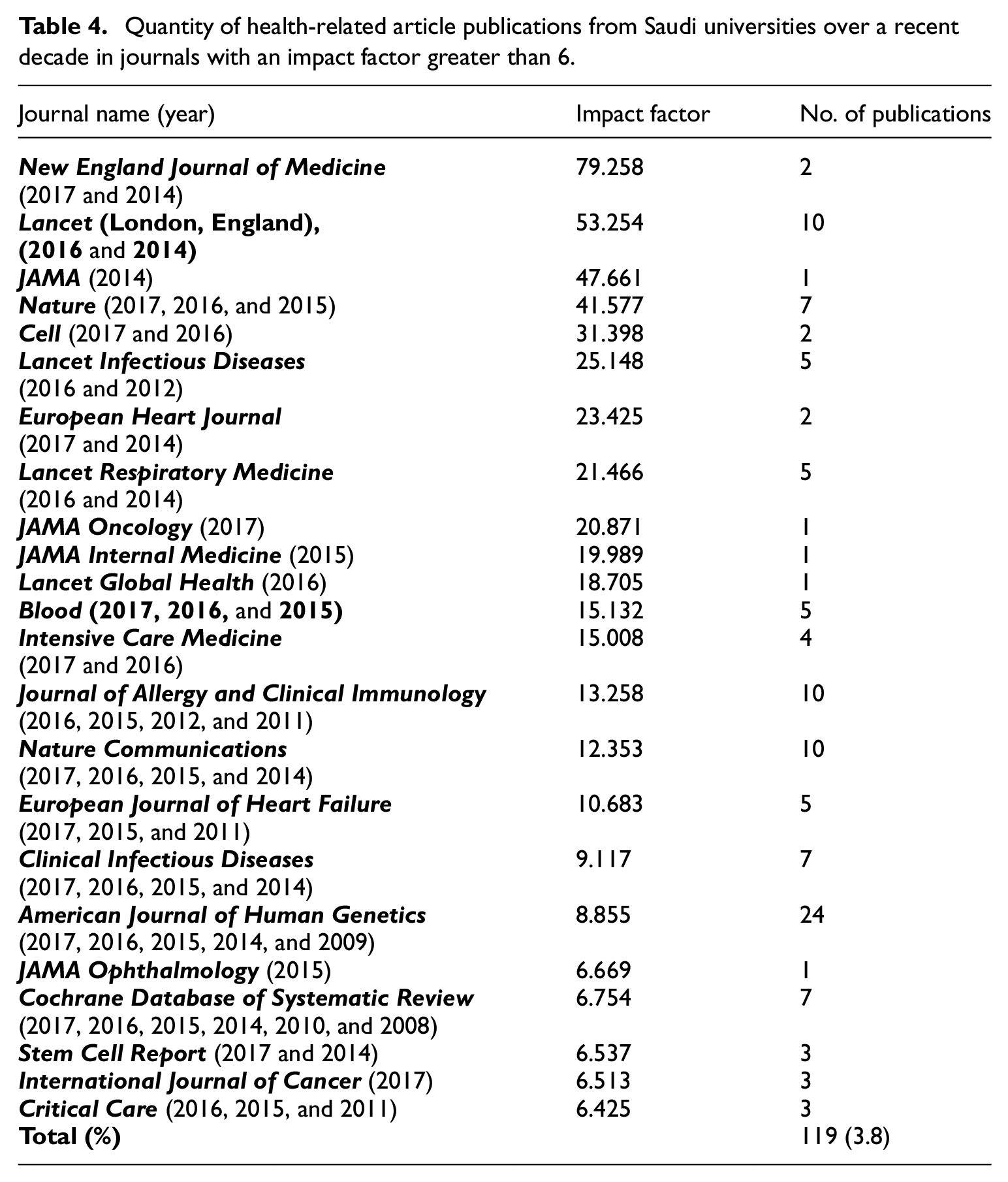
Between 2008 and 2017, a total of 119 (3.8%) articles were published in journals that had IFs ranging between 6 and 79. The journal with the highest IF was the New England Journal of Medicine, which published two articles. Other journals with high IFs were the Lancet (London, England), Nature Communications, and the American Journal of Human Genetics, which published a total of 10, 10, and 24 articles, respectively (Table 4). Overall, the publications output in both quantity and percentage increased from 1 (0%) to 39 (1.2%) in journals with IFs more than six was statistically significant (p = 0.030) (Figure 6).
Quantity of health-related article publications from Saudi universities over a recent decade in journals with an impact factor greater than 6.

The quantity and percentage of health-related article publications over the years by journal impact factor greater than 6.
Discussion
This study was performed a bibliometric analysis by year, region, university, journal, and journal IF between 2008 and 2017 to showcase the quantity of health-related articles published by universities in Saudi Arabia. The results of this study show that there was a substantial continuous significant increase in the number of scientific productivity over the 10 years between 2008 and 2017. This trend aligns with the Saudi vision 2030, which aims to promote research programs throughout Saudi Arabia. 18
It is interesting to note that most of the articles came from the Riyadh region, particularly KSU. Another notable finding was that the bulk of the publications in the field of medicine and health sciences were published in BMC, SMJ, and ASM. The current study also recognized that the contributions published were mostly in journals with an IF lower than 3. What is surprising is that some contributions were published in journals with an IF greater than six was slightly increases significantly from 2008 to 2016. This finding implies a well-developed approach for research and development for publication in a highly rated, reputable, peer-reviewed journal. A recent study sheds light on the role played by experience in crafting scientific work and publishing in specific prestigious scientific journals. 19 These phenomena differ depending on the journal, which has been reported in that study. In general, publishing in a prestigious scientific journal like Nature is more difficult without having published in Nature previously. 19 The results of that study also showed that it is challenging to publish in a journal without previous experience with that journal. In other words, multidisciplinary skillsets are required to publish in prestigious journals beyond field-specific expertise. Overall, that study provided a general structure on the knowledge needed to write for specific journals (which differ across science) with high-impact, interdisciplinary journals. However, that study did not pinpoint which facet of experience is most important to publish in health-related fields.
The results of the present study match those observed in previous studies,7–9 and extend the current knowledge of the quantity of scientific productivity in the field of medicine and health sciences. The results of those studies exhibited that research activity in Saudi Arabia is increasing. The recent data shows that the development of scientific journal articles was higher in Saudi Arabia than other regional countries, such as United Arab Emirates, Qatar, Kuwait, Oman, Bahrain, Jordan, Iraq, and Syria. 20 However, it not possible to compare the quantity of health-related article publications from these regions due to the unavailability of recent data.
There is a growing trend of publishing in regional journals with a low IF. Researchers of those studies advise that further effort and more substantial grants are lacking to promote medical research in Saudi Arabia. Other researchers in previous studies also provided recommendations that possible actions were required to fulfill the primary curriculum with or to invite medical intern students for practice in research, scientific writing, and publication. 21 These vital activities can play a central role in health research in any institution in Saudi Arabia, can enhance the number of publications, 22 and is a positive sign of the knowledge, skills, and attitudes of professionals toward scientific research. 23 Also, implementation of clear and productive policies will help to accomplish the Saudi vision 2030 goals by providing world-class educational opportunities, create knowledge-based research and development stockholders, and sustainably finance the required investment for these plans. 24 It has recently been shown that younger researchers tend to work on more innovative topics but need mentorship. 25
The findings in this investigation were imbalanced compared with those of other developed and developing countries in terms of biomedical research. 26 The reason for this is not apparent, 27 but realistic strategies should be adopted by the Ministry of Education (MoE) to boost the quantity of scientific productivity in Saudi Arabia. Accordantly, the MoE intended to begin a new research and development plan that is meant to strengthen the ecosystem and to encourage universities to accomplish their goals. 28 This research and development program, with many new entities from the government, established research centers in various universities, the private sector, and independent research and development centers across Saudi Arabia to assist in enhancing scientific research, cutting-edge technology, and innovation by working collaboratively with a broad mix of appropriate stakeholders. Furthermore, the MoE in Saudi Arabia should be categorized into two separate ministries by establishing the MoE and the Ministry of Higher Education and Research (MoHE&R). The MoHE&R should establish a new governmental agency focusing on health and medical research centers on a national level, with the collaboration of reputed institutions worldwide. This agency could help in monitoring the integrity of research in the country under the stewardship of MoHE&R by avoiding three cardinal signs of research misconduct: falsification, fabrication, and plagiarism. 29 Moreover, the agency would guide researchers on how to proceed in the course of conduct any manner of scientific research ethically in the country.
In recent years, the research and development division has made notable growth in Saudi Arabia. 28 Approximately 763 licenses were issued in 2015, and more than 47,000 citable publications were published between 2013 and 2015 under the stewardship of King Abdulaziz City for the Science and Technology National Science, Technology, and Innovation Plan. This National Science, Technology, and Innovation Plan financed more than 3.2 billion SAR over 1852 science and technology projects. A King Abdullah University of Science and Technology 20-billion-dollar grant supports attracting top expertise across Saudi Arabia for its 10 research centers. However, King Fahd University of Petroleum and Minerals published more than 530 publications with research and educational cooperation from the Massachusetts Institute of Technology between 2008 and 2016. In 2016, King Abdulaziz University published 157 articles in highly reputed journals. The research programs, such as the research chair program, Nobel Laureates program, and the Distinguished Scientific Fellowship Program, supported in 10 centers and four institutes of KSU to harvest scientific productivity through publication.
The evidence from this study must be interpreted with caution because it is limited to the quantity of scientific productivity in the field of medicine and health science across universities in Saudi Arabia. There was a disparity in determining scientific productivity, and the way data was secured may lead to conflicting results. For example, some authors described research productivity based on publication counts, 30 whereas others defined productivity by incorporating a journal’s IF, 31 research grants, 32 and citation counts. 33 Few researchers used the Science Citation Index-expanded, 34 websites, 13 and manual searches for data acquisition. 35 This study provides only a quantitative indicator of the number of publications, and it does not address those publications’ impact or quality. There may be a debate describing the quality of publication using journals IF.36,37 Our publication search was limited to journals indexed in PubMed. Therefore, there may be articles missed because they were published in different journals indexed in other databases.38,39 Also, these data must be interpreted with caution because the search was limited to human studies and electronically available full-text journal articles, systematic reviews, and meta-analysis published between 2008 and 2017. It is important to bear in mind that we have not included articles designed as case studies, short, or brief communications. The strength of this study is that it is the first study to extended knowledge of the quantity of scientific productivity in the field of medicine and health sciences during a recent decade in Saudi Arabia. The current study used solely the PubMed database, which is the most widely used database used by healthcare professionals and researchers.
Conclusions
The present study aimed to perform a bibliometric analysis that showcases the quantity of health-related article publications from universities in Saudi Arabia between 2008 and 2017. This study has identified a continuous significant increase in the number of publications during the period from 2008 to 2017. The leading region in terms of scientific productivity was the Riyadh region. The bulk of the contributed scientific productivity published in BMC, followed by SMJ and ASM. Most of the contributions published in journals with an IF less than 3, whereas a few published in high IF (≥6) journals, which was increases significantly from 2008 to 2016. In general, therefore, it seems that there is a need for innovative policies to increase the number of publications in journals with IFs higher than six to fulfill the goals of Saudi vision 2030. As such, we recommend that the MoE establish a new governmental agency for the implementation of planned research and development programs by focusing on health and medical research. This new agency could aid researchers in producing high-quality studies by collaboration with different centers across Saudi Arabia and internationally.
Footnotes
Declaration of conflicting interests
The author(s) declared no potential conflicts of interest with respect to the research, authorship, and/or publication of this article.
Funding
The author(s) disclosed receipt of the following financial support for the research, authorship, and/or publication of this article: This work was supported by the Deanship of Scientific Research at King Saud University through Research Group No. RG-1438-085.
