




Abstract
Microplastics have been considered a new type of pollutant in the marine environment and have attracted widespread attention worldwide in recent years. Plastic particles with particle size less than 5 mm are usually defined as microplastics. Because of their similar size to plankton, marine organisms easily ingest microplastics and can threaten higher organisms and even human health through the food chain. Most of the current studies have focused on the investigation of the abundance of microplastics in the environment. However, due to the limitations of analytical methods and instruments, the number of microplastics in the environment can easily lead to overestimation or underestimation. Microplastics in each environment have different detection techniques. To investigate the current status, hot spots, and research trends of microplastics detection techniques, this review analyzed the papers related to microplastics detection using bibliometric software CiteSpace and COOC. A total of 696 articles were analyzed, spanning 2012 to 2021. The contributions and cooperation of different countries and institutions in this field have been analyzed in detail. This topic has formed two main important networks of cooperation. International cooperation has been a common pattern in this topic. The various analytical methods of this topic were discussed through keyword and clustering analysis. Among them, fluorescent, FTIR and micro-Raman spectroscopy are commonly used optical techniques for the detection of microplastics. The identification of microplastics can also be achieved by the combination of other techniques such as mass spectrometry/thermal cracking gas chromatography. However, these techniques still have limitations and cannot be applied to all environmental samples. We provide a detailed analysis of the detection of microplastics in different environmental samples and list the challenges that need to be addressed in the future.
Introduction
Since the invention of plastic in the 1950s, plastic products have been widely used, and the environment is flooded with plastic waste.1,2 It is estimated that by 2060 there will be approximately 1.55–26.5 billion tons of plastic waste. 3 In 2004, the term “microplastics” was first introduced, referring to plastic particles smaller than 5 mm. 4 Compared to large plastics, tiny microplastics are widely distributed in the environment and are more easily ingested by organisms. Microplastics are prevalent in aquatic organisms such as fish and shellfish and are subject to food chain transport, 5 thus posing a potential threat to the health of organisms and ecosystems. Microplastics are broadly divided into two categories, primary microplastics, and secondary microplastics. The former refers to nanoplastics added to toiletries, biomedical products, waterproof coatings, and nanomedicines. 6 The latter refers to plastic particles formed from plastic waste under the external effects of light, mechanical action, chemical and biological degradation. 7 Table 1 shows the main categories of microplastics. Investigations have shown that micro/nanoplastics are widely present in water, sediment, soil, and atmosphere.8,9 In addition to areas of intense human activity, micro/nanoplastics have been found in uninhabited mountainous areas and even in surface water, sea ice, benthic organisms, and penguin gastrointestinal tracts in the North and South Poles. 10 The global plastic pollution situation is becoming increasingly critical, and it is estimated that microplastics in the subtropical convergence zone will increase by a factor of two or four by 2030 or 2060 compared to the present. 11
Source of microplastics.
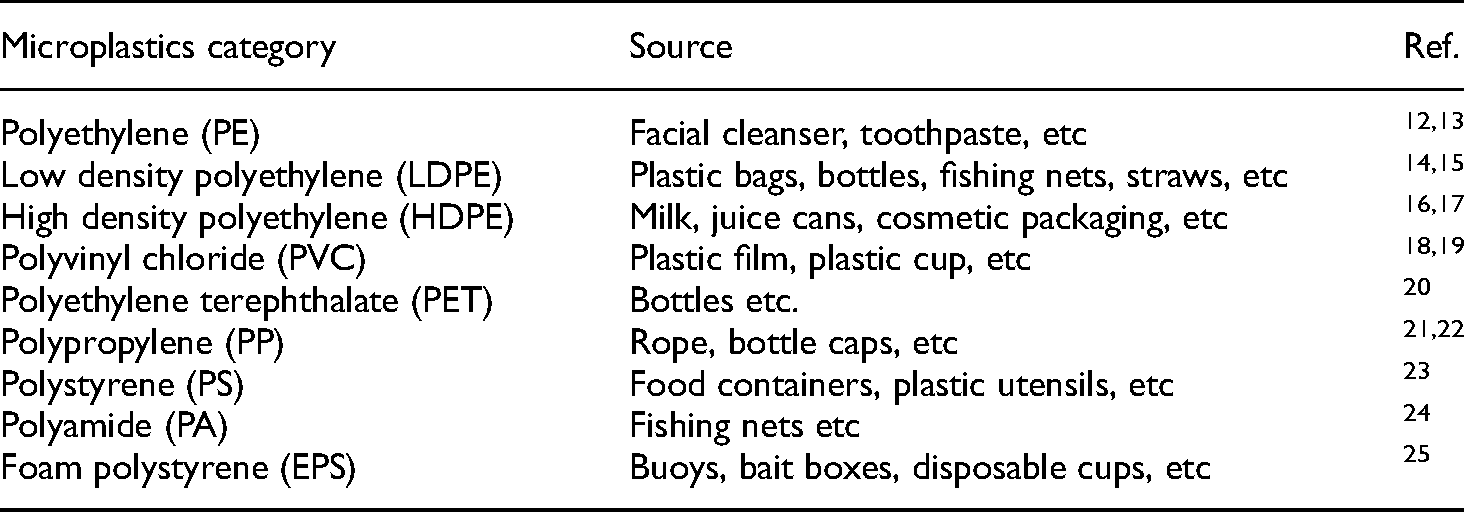
Studying the ecological and environmental health impacts of micro- and nano-sized plastics requires effective detection and monitoring methods. The extraction, separation, and determination of plastic particles of all sizes, especially nanoscale particles, from complex environmental and biological samples is a hot topic of current research. Although there are many techniques and methods, there is a lack of uniform standards for the extraction, qualitative and quantitative analysis of microplastics from different sample matrices. 26 Therefore, there is an urgent need to develop efficient and pervasive extraction, identification, and quantification methods to obtain comparable data. 27 Bibliometric analysis is a literature and information mining method based on mathematical statistics. It can reflect research trends and hotspots through clustering relationships of keywords in the literature and has become an important tool for global analysis in various scientific fields28–37. As an emerging environmental pollutant, microplastics are receiving increasing attention worldwide. Therefore, it is necessary to update the bibliometrics of this topic. To date, bibliometric analyses on microplastics have focused on the development of the entire field. We believe that how microplastics are detected is a very important part of its assessment. Only an accurate measurement of microplastics can give an indication of its impact on the environment. Therefore, we have paid special attention to the development of detection techniques in microplastics in this bibliometric work.
Materials and methods
Two bibliometrics software have been used in this systematic literature review. The first is CiteSpace, developed by Dr Chaomei Chen, a professor at the Drexel University School of Information Science and Technology38–41. CiteSpace 6.1R2 was used to calculate and analyze all documents. COOC is another emerging bibliometrics software. 42 COOC12.6 was used to analysis of annual publications and keywords co-occurrence. We used the core collection on Web of Science as a database to assure the integrity and academic quality of the studied material. “microplastics detection”, “microplastics sensor” and “microplastics quantification” have been used as a “Topic.” The retrieval period was indefinite, and the date of retrieval was December 30, 2021. 696 articles were retrieved, spanning the years 2012 to 2021.
Developments in the research field
Literature development trends
Figure 1 shows the annual and the cumulative number of publications on microplastic detection techniques between 2012 and 2021. As seen from the figure, the detection of microplastics did not become an immediate object of research with its conceptualization. Since the introduction of microplastics in 2004, no detection techniques for it were reported until 2012 (this does not mean that microplastics could not be detected in previous work). Harrison et al. 43 investigated the applicability of Fourier transform infrared spectroscopy in detecting microplastics. Fossi et al. 44 proposed phthalates as a tracer of microplastic ingestion when investigating whether baleen whales ingest microplastics during their filter-feeding activities. Imhof et al. 45 constructed a precipitate separator to improve the density separation method. This method allows the separation of different ecologically relevant size classes of plastic particles from sediment samples. At the same time, they identified and quantified microplastics using micro-Raman (μ-Raman) spectroscopy, verifying that the recovery rate of this separation technique is significantly higher than that of classical density separation devices and froth flotation commonly used in the industry.

Annual and accumulated publications from 2012 to 2021 searched in the web of science about microplastic detection techniques.
The topic of microplastic detection has gradually gained attention since 2015, and the number of annual publications has started to exceed 10. After that, the topic started to enter a very rapid development, with more than 100 annual publications in 2019. By 2021, the annual number of articles on this topic has reached 263. Although we did not include data on new publications in 2022 in this bibliometric survey, the trend of continued increasing publications has not been diminished based on the available data (as of June 2022). From a bibliometric analysis, this topic is entering a phase of rapid development, attracting many scholars. There is no doubt that a large amount of interest in microplastic detection technology is inseparable from the fact that microplastics are a hot topic in the environmental field today. The update of old detection techniques and the establishment of new methods are generally based on the widespread interest in the analyte.
Journals, cited journals and research subjects
Figure 2 shows the top 10 journals that published the most papers regarding microplastic detection techniques. It can be seen that Marine Pollution Bulletin published the most significant number of papers, accounting for 12.64% of all papers on this topic. In second place was Science of the Total Environment, with 77 papers accounting for 11.06% of the total. More than half of the journals in Figure 2 are affiliated with environmental science. In addition, Analytical and Bioanalytical Chemistry and Analytical Methods are journals related to analytical chemistry, and Analytical Methods in particular focuses on new analytical assay techniques. This demonstrates that the detection of microplastics has now attracted the attention of not only environmental scientists but has also involved analytical chemists. Figure 2 also includes the Journal of Hazardous Materials, which published 23 papers on this topic. This journal mainly publishes papers related to materials harmful to humans and the environment. Microplastics, a series of tiny forms of polymeric materials, have received so much attention in recent years precisely because of the pollution and toxicity they produce in the environment.

Top 10 journals that published articles on the microplastic detection techniques (the size of the box is proportional to the number of papers published in the journal).
In addition to the number of papers published by the journal on the topic, the frequency with which the journal is cited papers related to the theme is also an important indicator. Table 2 shows the top 15 cited journals on microplastic detection techniques. It can be seen that most of the journals in Figure 2 are also included in Table 2, except for the Journal of Hazardous Materials. The papers published in the Journal of Hazardous Material are most likely about the analysis of different environmental samples with different detection techniques. These works do not necessarily provide improvements and innovations in the methodology of detection. Therefore, they are not widely cited in papers on the topics we set. Journals in the analytical chemistry are further represented in Table 2 with the additional inclusion of TrAC Trends in Analytical Chemistry and Analytical Chemistry. On the other hand, comprehensive journals are also covered in Table 2, including Scientific Reports, Science, and PLOS ONE. These journals do not necessarily publish a large number of papers on the topic, but the articles that appear in them have an indirect impact on the topic. For example, the detection of other substances published in analytical chemistry-related journals indirectly inspired the detection of microplastics. The analysis results in Figure 2 and Table 2 show that microplastic detection techniques mainly attract scholars from two fields: environmental science and analytical chemistry. In addition to the journals related to these two fields, the coverage of this microplastic in comprehensive journals will significantly impact the investigation of this topic.
Top 15 cited journals on the microplastic detection techniques.

Although the most important journals on this topic and the fields to which they belong can be known from Figure 2 and Table 2, they do not present the most cutting-edge advances. Therefore, we analyzed journals that published this topic for the first time in 2020 and 2021 (Table 3). Environmental science and analytical chemistry-related journals remain the most dominant areas in the table. It is also worth noting that the new journals appearing in 2020 include a series of journals related to food science, including Food Bioscience, Food Chemistry, Food Control, and Food Packaging and Shelf Life. This reflects that detecting microplastics in food has become a more important direction of investigation in 2021. Gündoğdu et al. 46 investigated the presence of microplastics in mussels sold in five cities in Turkey. μ-Raman has been used for the quantitative detection of microplastics. Plastic-wrapped beverages may be a source of microplastics in the diet. Prata et al. 47 proposed an improved detection method for the detection of microplastics in white wines. μ-Raman has been used for the first time to identify microplastic particles in complex beverages. Huang et al. 48 examined the extent of PS and PVC contamination in chicken-based on attenuated total reflection mid-infrared spectroscopy (ATR-MIR) combined with chemometric techniques. Kedzierski et al. 49 investigated whether food trays made of extruded PS could generate microplastic contamination between the meat and the sealing film. Several microscopy and instrumentation-related journals appeared in 2021, including Micron, Microscopy Research and Technique, Microsystems & Nanoengineering. Schmidt et al. 50 proposed a detection method for nanoplastics smaller than 1 μm. Using a correlation between scanning electron microscopy (SEM) and μ-Raman, they identified nanoplastics in the 100 nm range in various environments. Qian et al. 51 tried to combine sparse particle localization and miniaturized mass sensing functions on a microelectromechanical system (MEMS) chip to realize the analysis of sparse particles. The use of 4-dimethylamino-4′-nitrostilbene (DANS) fluorescent dyes for detecting microplastics was proposed by Sancataldo et al. 52 DANS staining can provide access to different detection and analysis strategies based on fluorescence microscopy. Meanwhile, some pharmacology and toxicology journals also appeared in 2021, including Regulatory Toxicology and Pharmacology, Pharmaceutics.
List of journals published paper for the first time regards the microplastic detection techniques in the last two years.

The category of the published paper can reflect the evolution of the topic. Figure 3 shows the evolution of the category of the microplastics detection techniques over time. This topic originated from the two categories most related to microplastics (Environmental Science, Marine & Freshwater Biology). Two years later, the topic was further covered in Public, Environmental & Occupational Health. Starting in 2015, this topic was formally explored methodologically, so Chemistry, Analytical and Biochemical Research Methods were included. In 2017, some niche analytical methods were included in the category, including Spectroscopy and Electrochemistry (not shown in the figure because the count is too small). In 2018, this theme was further associated with several analytics categories, including Remote Sensing and Imaging Science & Photographic Technology. From 2018 onwards, this topic started covering a wide range of categories. In 2021, this topic covered a range of engineering fields, including Engineering (Geological, Marine, Mechanical, Ocean) for the first time. In addition, Agronomy, Anatomy & Morphology, Biochemistry & Molecular Biology, Biology, Education, Scientific Disciplines, Metallurgy & Metallurgical Engineering, Pharmacology & Pharmacy, Physics, Condensed Matter, and Soil Science were also published for the first time in 2021 on this topic. It is worth noting that the papers surveyed here are on microplastics detection techniques rather than microplastics. Papers related to microplastics should be published earlier in journals related to environmental science and geology.

Time-zone view of research categories for microplastic detection techniques (the year of the node in the graph is the time when a paper on this topic was first retrieved by a particular category in WOS. The size of a node is proportional to the number of connections between this paper and other nodes).
Geographic distribution
Figure 4 shows the top 16 countries with the most publications in microplastics detection techniques. Although Chinese scientists published the most articles, they only accounted for about 15% of all numbers. Both Germany and USA contributed more than 10% of the papers. This is due to the fact that this topic has attracted a great deal of academic attention and thus different countries have made considerable contributions to the topic. On the other hand, although a range of countries contributes to this topic, it is clear from the figure that Europe is the most actively involved region. This enthusiasm can also be observed in the time-zone view (Figure 5). The first countries to study this topic in 2012 were Italy and England. China and USA were added to the team in 2015. In Asia, Japan and South Korea are also interested in this topic. South Korea entered the survey on this topic in 2016, while Japan will not join in until 2018. Since the topic is still on the rise, many countries are getting involved every year. Singapore, Turkey, Iceland, U Arab Emirates, Ukraine, Romania, Peru, Croatia, Lithuania, and Cyprus published their first papers on this topic in 2021.
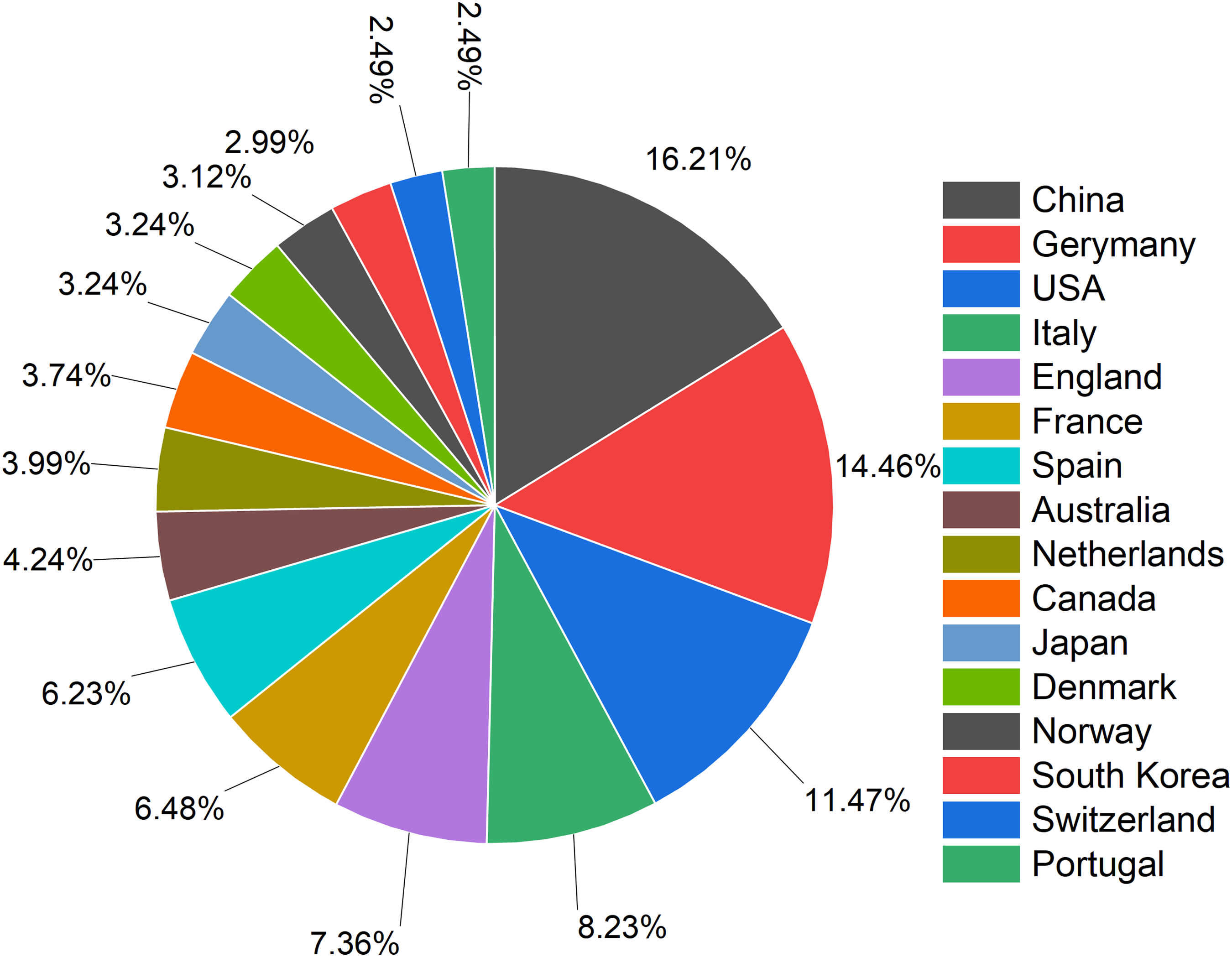
Pie chart of papers related to microplastic detection techniques contributed by different countries.
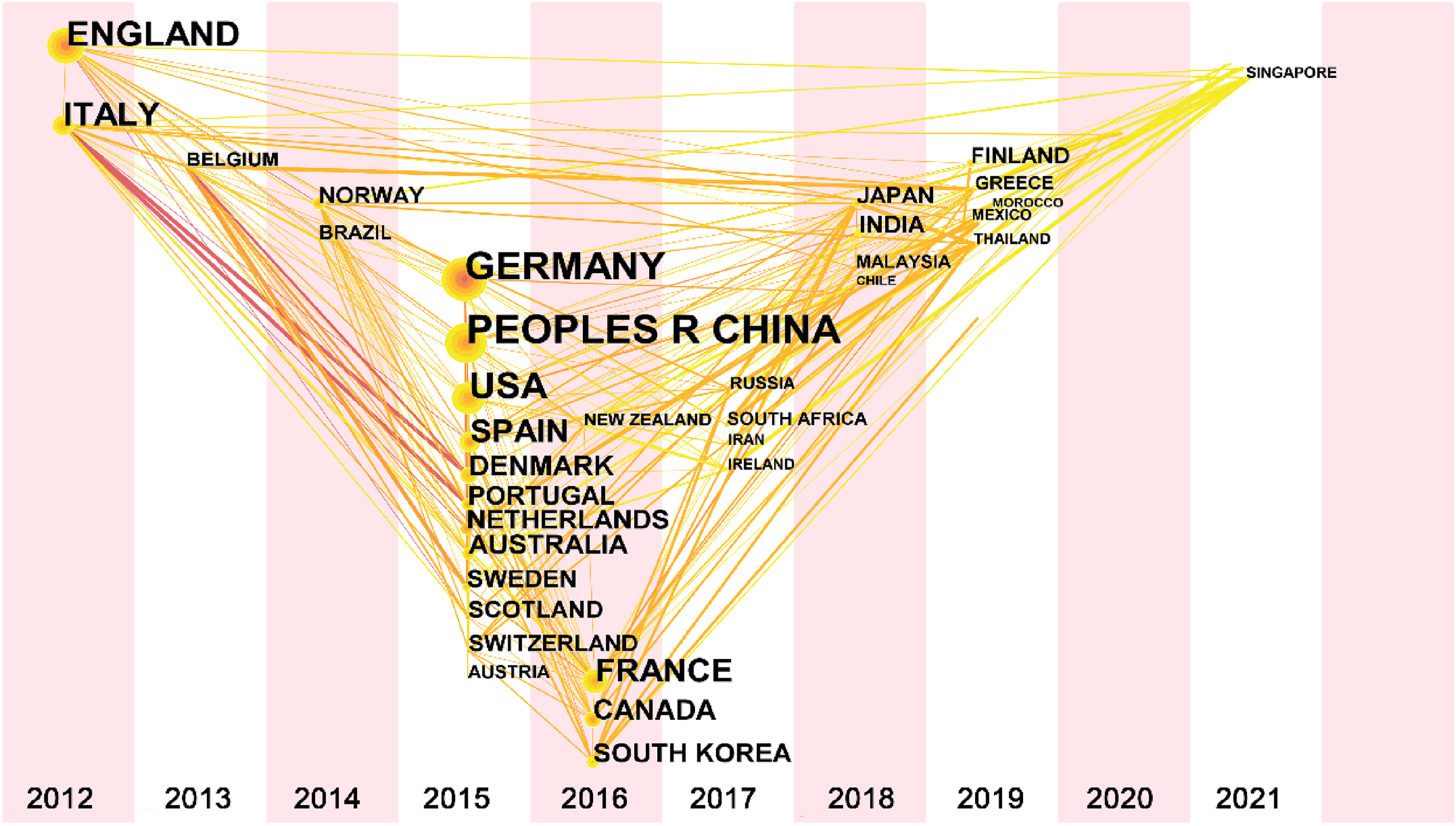
Time-zone view of geographic distribution for microplastic detection techniques.
Figure 6 illustrates the cooperation network between the different institutions on this topic. As can be seen, this topic has formed two main important networks of cooperation. The first cooperative network was mainly led by the Institut Francais de Recherche pour l’exploitation de la mer(IFREMER), Carl von Ossietzky Universitat Oldenburg, University of Toronto, Aalborg University and Technical University of Denmark. This collaborative network covers many research institutions and universities in European countries and North America. Another collaborative network is led by the Chinese Academy of Sciences, the University of the Chinese Academy of Sciences, and East China Normal University. This network includes a range of research institutes and universities in China, Netherlands, and England.

Institution cooperation network for microplastics detection techniques.
Keyword analysis and evolution of the field
A keyword analysis is often used in bibliometrics to understand the different directions under a topic. However, the fifteen most frequently occurring keywords in microplastic detection techniques do not include techniques and analytical methods. This is because a paper often contains five or more keywords. Microplastic detection techniques belong to one of the directions of microplastics, so this type of paper contains many keywords about environment and sample related. For this case, we purposely screened the keywords and listed only those related to detection technology (Table 4).
List of top eight keywords about the detection of microplastics.
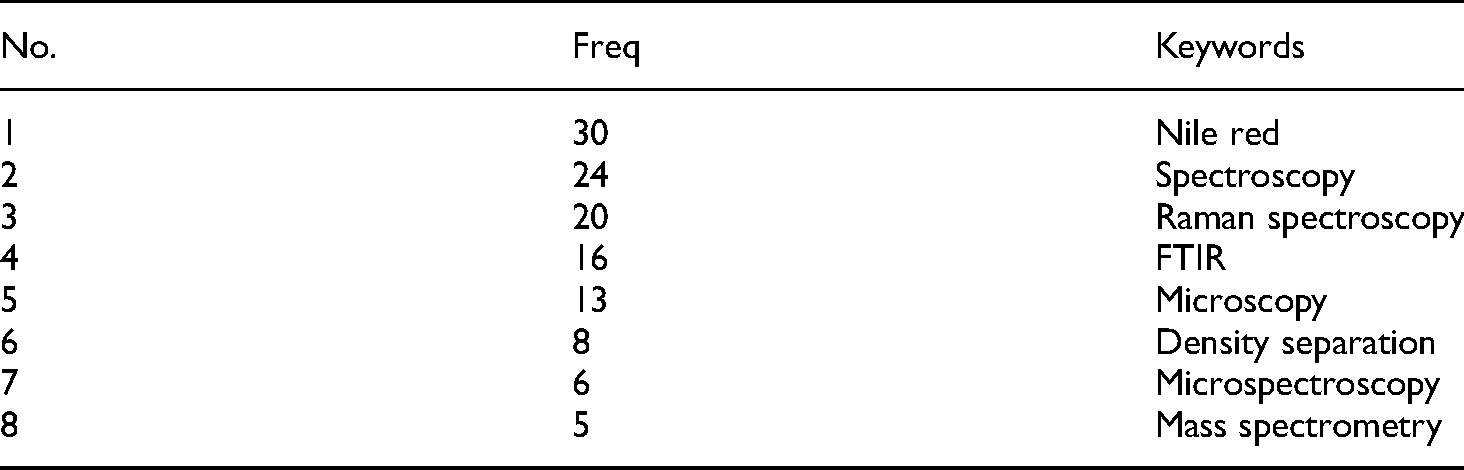
Visual classification is commonly used to identify microplastics in the environment, but the method has poor reliability and low accuracy. To obtain an accurate number of microplastics in the environment, fluorescent staining methods are used to aid in identifying microplastics. Usually, Nile red is used to fluorescently label microplastics. This method has the advantages of fast staining and a strong fluorescence signal. Therefore, it appears very frequently in the keywords in this topic. For example, Shim et al. 53 proposed a method for staining microplastics with Nile Red in 2016. They found that 5 mg/L of Nile Red in hexane can effectively stain plastics and identify them in green fluorescence. This technology can identify PE, PP, PS, polycarbonate, polyurethane (PU), and poly(ethylene-vinyl acetate). However, PVC, PA, and polyester cannot be identified. For a more efficient identification using fluorescent staining, the counting of microplastics in fluorescent images can be done by the corresponding developed software. 54 Other study has proposed staining microplastics with fluorescent dyes55–57. In these works, the Nile Red staining technique is often used as a control group to verify the feasibility and advancement of the new technique.
FTIR and μ-Raman are the two most commonly used spectroscopic techniques for microplastics. This technique has been widely used for the chemical identification of microplastics in water, sediment, and organism samples. In a study by Lusher et al., 58 FTIR spectroscopy was used to identify the presence of microplastics in fish successfully. The main components of these microplastics include PA, semi-synthetic cellulose materials, and rayon. However, this method is unable to identify irregular microplastics (reflectance FTIR measurements of irregularly shaped materials can have refractive errors 43 ). Attenuated total reflection (ATR)-FTIR can facilitate the identification of irregularly shaped microplastics but only applies to the analysis of plastic particles larger than 500 μm. 43 To address this problem, Löder et al. 59 applied focal plane array-based micro FT-IR imaging to identify microplastics in environmental samples to address this problem. This technique can detect plastic particles smaller than 20 μm and cover a larger filter surface area than conventional FTIR. However, analyzing the entire sample filter surface with high spatial resolution can be very time-consuming. Therefore, further optimization of FTIR spectroscopy is essential for detecting small particles of microplastics in complex environmental samples. Like FTIR spectroscopy, μ-Raman is a common technique for the analysis of microplastics. μ-Raman can detect plastic particles down to 1 µm and responds better to nonpolar plastic such as PP and PE. 60 The use of μ-Raman combined with microscopy allows the identification of microplastics of various sizes. 61 This technique does not destroy the sample while meeting the analytical needs of complex samples but cannot detect samples with fluorescence (e.g. residues from biological sample sources). In this case, purifying the sample before using μ-Raman measurements is recommended to prevent residuals in the fluorescent sample.
Mass spectrometry is often used with thermal cracking gas chromatography (Pyr-GC/MS). Pyr-GC/MS can identify the chemical composition of microplastics by analyzing their characteristic thermal degradation products. It accurately identifies the polymer type by comparing it to a pyrolysis reference map of a known pure polymer. 62 The advantage of this technique is that it does not require sample pretreatment and allows simultaneous determination of the type of plastic polymer and associated plastic additive. However, this technique only allows the analysis of one particle per cycle, which is not suitable for analyzing samples in complex environments. Mass spectrometry can also be used with thermogravimetric analysis and thermal desorption gas chromatography (TD-GC/MS). This technique is able to handle complex environmental samples. For example, Dümichen et al. 63 successfully identified PE microplastics from the soil, suspended solids, and mussels using TED-GC/MS.
Effectively separating microplastics from samples such as water, sediment, and organic matter is a crucial step for subsequent detection and analysis. Density separation is widely used to separate low-density plastic particles from dense sand, slurry, sediment, and other samples. Therefore, it becomes a high-frequency keyword in this topic. A variety of high-density solutions have been used to separate microplastics from environmental samples. The most commonly used solution is saturated NaCl. 64 It is inexpensive and non-toxic, but only for microplastics with densities below 1.20 g/cm3. However, some high-density microplastics, such as PVC and PET could not be completely separated. 65 To overcome this drawback, Nuelle et al. 66 developed a two-step method using air-induced NaCl solution overflow for pre-extraction followed by additional flotation using sodium iodide solution. The results showed that the recovery rates of all plastic pellets (PE, PP, PVC, PET, PS, PUR) ranged from 91% to 99%, except for the recovery rate of expanded PE, which was 68%. In addition, saturated sodium polytungstate solutions have been shown to isolate certain high-density microplastics. 67 Similar results can be achieved with other high-density solutions. For example, ZnCl2 solution has a density range of 1.50–1.70 g/cm3 and can extract almost all microplastic particles, but it is toxic and relatively expensive.45,68 NaI alone can also separate high-density microplastics, but it readily reacts with cellulose filter growth to darken them and thus affect visual recognition. 69
Cluster analysis of keywords can further understand the different directions of investigation in this topic. Figure 7 shows that 15 clusters were formed after clustering the keywords. Table 5 describes the clusters and their ID, size, silhouette, and respective keywords.
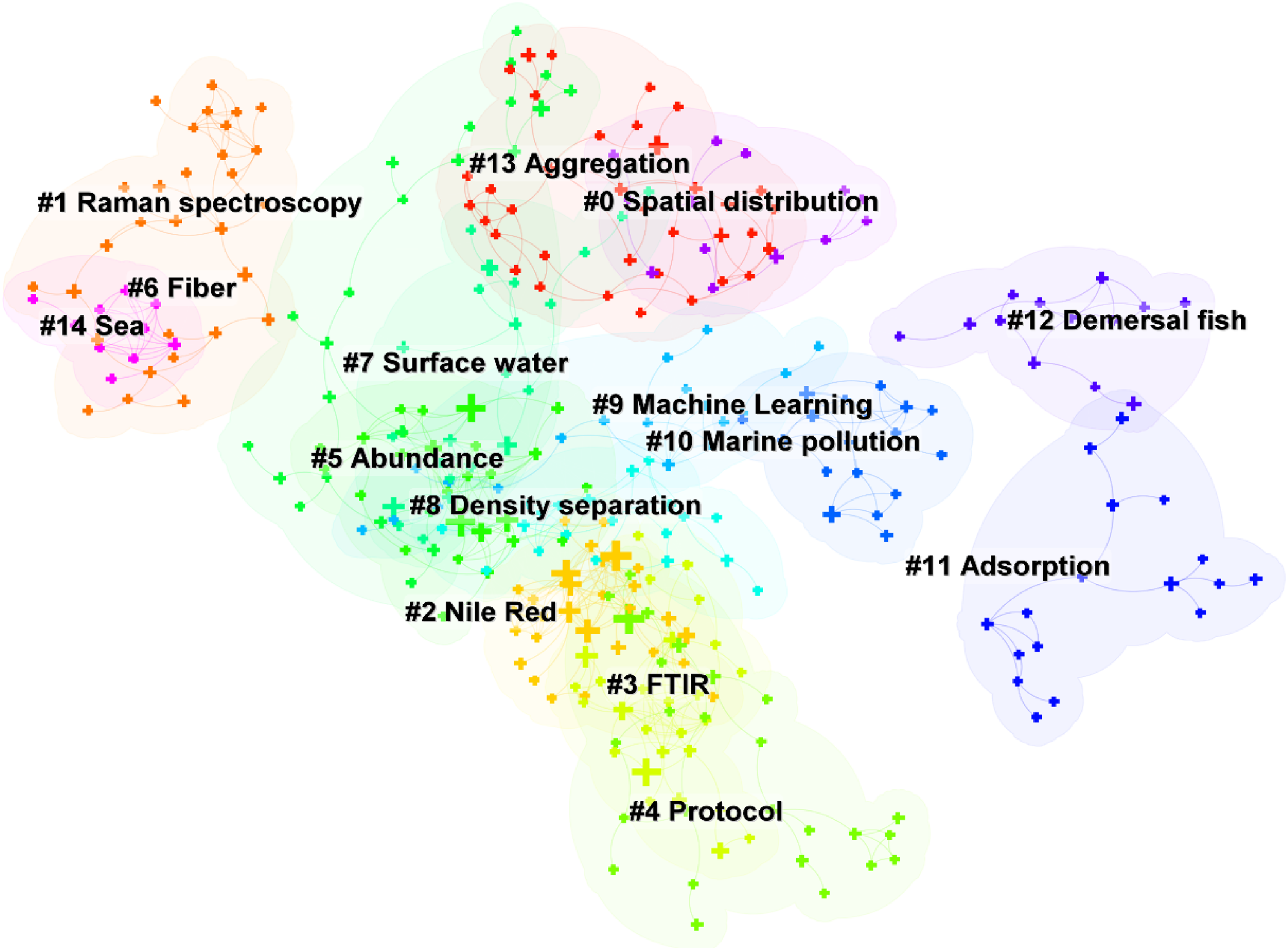
Grouping of keywords for microplastics detection techniques.
Cluster analysis of keywords in topic of detection of microplastics deduced from citeSpace (g-index: k = 20; pruning method: pathfinder + pruning sliced networks + pruning)he merged networks).

Based on the bibliometric analysis, the detection of microplastics currently encompasses the following techniques:
The most basic method used for microplastic identification is the visual inspection method. This method uses the human eye or microscope to observe the microplastics and count them according to their size and dimensions. Microplastics with particle diameters of 1 mm to 5 mm can be directly identified and analyzed using visual inspection. Due to the differences in color, structure, and other characteristics of the microplastics, there will be some influence on the identification results of the visual inspection method. If microplastic samples cannot be observed by visual inspection, they can be identified by microscopic techniques. Compared with a visual inspection, light microscopy is more convenient and efficient, but at the same time, the error is also more significant. Microplastics are analyzed and identified under ordinary light microscopy with an error rate of about 20%. In the case of colorless, transparent microplastics, the error rate would be over 70%. Scanning electron microscopy uses electron microscopy for analysis and identification, and the magnification of electron microscopy is greater than that of ordinary light microscopy. However, this method requires the sample to be solid, non-toxic, and non-radioactive. Also, this method has high requirements for the laboratory environment. Microplastics can be cleaved to produce unique pyrolysis profiles, so their chemical composition can be analyzed using Pyr-GC/MS. However, different polymers may also produce the same or similar pyrolysis products, which can overlap in the pyrolysis profile and produce errors in the final results. The best current method for determining microplastics is FTIR. It can obtain specific polymer information from the characteristic spectra of microplastics and can identify the type of microplastics in the environment. However, the sample must be dried when using this method to avoid interference from moisture and impurities in the sample. Due to the diversity of microplastic types, different microplastics have their own unique Raman spectral profiles. Compared with FTIR, μ-Raman has a broader range of applications and better sensing ability. However, μ-Raman is susceptible to the interference of fluorescent substances.
Conclusion and perspectives
The detection of microplastic detection has gradually gained attention since 2015. So far, this topic has shown a growing trend year by year. The detection of microplastics has now attracted the attention of not only environmental scientists but has also involved analytical chemists. Environmental science and analytical chemistry-related journals remain the most dominant areas in this topic. It is also worth noting that the new journals appearing in 2020 include a series of journals related to food science. The results of the geographical analysis point to European scholars being the most active in this topic. This topic has formed two main important networks of cooperation.
Reliable identification of microplastic particles in various environmental matrices is still limited. First, some microplastics are present in trace level in the environment, thus requiring high sensitivity for detection techniques. At the same time, these microplastics present a mixed state, containing different types, which are difficult to distinguish quickly by detection techniques. Separation and concentration become effective methods to solve the above two challenges, but there is no well-established protocol.
Based on the bibliometric analysis, we believe that the following directions are the priorities that need to be overcome for the future development of microplastic detection technology.
Challenges remain in the concentration and detection of microplastics in water and air samples. The development of detection techniques requires new strategies for the analysis of these two types of environmental samples. It is challenging to meet the requirements of sensitivity and resolution using a single analytical technology. Analytical techniques based on thermal cracking reactions coupled with GC-MS are most likely to be developed as a method that satisfies both detection sensitivity and specificity when supported by appropriate sample pre-treatment. It is important to establish a standard protocol for the detection of microplastics. Detection techniques at this stage do not even use uniform concentration units for microplastics. Therefore, the establishment of a uniform set of criteria would allow for comparability between the results of different studies.
Footnotes
Acknowledgements
This work was financially supported by Zhejiang Key Laboratory of Ecological and Environmental Monitoring, Forewarning and Quality Control (EEMFQ-2021-2), National Science Foundation of China (No. 42173073) and National Natural Science Foundation of China (No. 22108265).
Declaration of conflicting interests
The author(s) declared no potential conflicts of interest with respect to the research, authorship, and/or publication of this article.
Funding
The author(s) disclosed receipt of the following financial support for the research, authorship, and/or publication of this article: This work was supported by the Zhejiang Key Laboratory of Ecological and Environmental Monitoring, Forewarning and Quality Control, National Natural Science Foundation of China, (grant number EEMFQ-2021-2, 22108265, 42173073)
