



Abstract
Radiation heat and convection heat exist on stratified air conditioning zone building surfaces in large space, and they have significant impact on cooling load calculation and thermal comfort analysis. Actually, heat transfer in large space is usually under non-steady condition. Based on an actual large space, a 1:4 scale model experiment rig is built as research object, which has: typical sloping ceiling structure, columnar low supply air, middle return air, inner surfaces periodic heat flow simulation system, heat measurement, and control system. For stratified air conditioning zone building surfaces in large space, radiation heat transfer calculation model is presented based on Gebhart radiation model and radiation heat is calculated by matrix calculation. Convection heat transfer calculation formula is presented based on inner surfaces temperatures and indoor air temperatures. Taking two periodic heat flow experiment conditions, building surfaces temperatures and indoor air temperatures of stratified air conditioning zone in large space were collected, taking model calculation program to compute dynamic radiation heat and convection heat. The result indicated the dynamic characteristics of radiation heat and convection heat of stratified air conditioning zone building surfaces in large space. It provided some important information for dynamic heat transfer research in stratified air conditioning zone building surfaces in large space.
Keywords
Introduction
To save building energy consumption and improve indoor environment, stratified air conditioning, which has upper non-air conditioning zone and lower stratified air conditioning zone, is used widely in large space, such as gymnasium, movie theater, exhibition hall, airport terminal, and industrial workshop. Comparing with whole room air conditioning, which has air conditioning in whole room, stratified air conditioning can reduce building energy consumption about 30%.1,2 In 1960s, the stratified air conditioning was firstly used in a plasma laboratory in America. With the development of technology and research, stratified air conditioning has been used widely in Japan, Europe, and China.3–6 Low supply-middle return is the common stratified air conditioning form in large space and it can synchronously realize the building energy saving and indoor air quality improvement.7,8
Many scholars have studied the thermal environment, air distribution and stratified air conditioning load in large space. Gorton and Sassi9,10 fully studied stratified air conditioning load calculation and air distribution, and presented mathematical analytic formula. Nishioka 11 studied the indoor temperature distribution in large grand dome, and assessed the building energy consumption. Cheng 12 optimized the thermal comfort and maximized energy saving of a large lecture theater by numerical method. Kim 13 fully investigated the air distribution in a large space with a higher ceiling under various supply air velocities and diffusers locations at an identical supply air temperature. Liang 14 proposed a dry fan coil units as the terminal by cooling tower as the source of natural cooling water, and it could directly remove heat in the top zone of large space building to conserve energy.
The research on the dynamic heat transfer of building surfaces in large space is more realistic. Jin 15 analyzed the characteristics of tall atrium heat flow movement and thermal environment, and given dynamic simulation method by temperature benchmark zone model. Zhao 16 studied the indoor thermal environment between radiation air conditioning system and nozzle air distribution air conditioning system for a certain airport terminal, tested the dynamic temperature field measurement of radiation cooling floor, and calculated the amount of hourly cooling radiant panel by using the measurement data. Bouraoui 17 proposed thermal modeling of the olive mill wastewater drying process in a greenhouse solar dryer, and the results provided some information to evaluate the temperature, velocity, and vapor mass fraction distributions after hours of sunshine. Lv 18 analyzed the relationship between floor radiant cooling loads and floor radiant heat gains by hourly experimental data, and proposed a computed way of floor radiant cooling loads. Lin 19 investigated the potential of natural ventilation and cooling for large space with high ceilings, the research results were useful in design of openings and the air conditioning control strategies for large space.
In-site measurement has practical significance, but the outdoor environment is hard to control, and there is also a complex coupling relationship between various influencing factors, it makes it hard to operate a factor separation experiment.20,21 Abdelatief22,23 used artificial neural network modeling and 3D ANSYS numerical evaluations to study free convection thermal performance on the elliptical-tube outer surface, and investigated the free-convection heat transfer inside square tube with inner roughened surface at different uniform heat fluxes (q) and various inclination angles (θ). In scale model experiment, we can better control experiment object parameters and simulate external conditions or natural condition, such as simulate wall heat flow by pasting electro-thermal film heating system.
Scale model experiment methods include brine scale model experiment and air scale model experiment. Lin 24 used brine scale model to study the stratified air conditioning flow law of low supply air in large space, established the mathematical model of air flow movement and experiment verification. Gorton and Sassi9,10 proposed the vertical temperature distribution in the stratified air conditioning and air conditioning load calculation model by air scale model experiment, the model divided the indoor air into several layers in the vertical direction, and calculated air temperature of each layer. Li 25 utilized a 1:20 air scale model to study the distribution in two supply air modes in the generatrix floor underground hydropower station, and the research results provided useful references to optimize ventilation design in a large space with complex heat sources.
To sum up, the radiation heat and convection heat have significant impact on cooling load calculation and thermal comfort analysis of stratified air conditioning zone. The heat gains and cooling loads of lower air conditioning zone are affected by many external factors, such as outdoor temperature and humidity, solar radiation intensity, and outdoor wind speed. And the concerns of this study are:
The dynamic heat transfer of building inner surfaces in large space, which is caused by temperature differences of upper non-air conditioning zone and lower air conditioning zone, is studied and it has more realistic significance for thermal comfort analysis and energy saving operation.
In-site measurement has complicated control and high cost. The scale model experiment has advantageous by controlling experiment object parameters, and to study interested experiment parameter rule separately. The dynamic heat transfer of stratified air conditioning in large space is studied by scale model experiment.
In this study, the heat transfer calculation models about radiation heat and convection heat are given for stratified air conditioning zone in large space. Indoor air temperatures and inner surfaces temperatures are collected under dynamic conditions, the dynamic characteristics of temperature distribution, radiation heat, and convection heat of stratified air conditioning zone building surfaces are calculated and analyzed. The research results provide some important information for the dynamic heat transfer characteristics of stratified air conditioning zone in large space.
The heat transfer calculation model of stratified air conditioning zone
Derivation process of radiation heat calculation method
In large space building, the inner surfaces temperatures difference between air conditioning zone and non-air conditioning zone is up to 20°C, so different inner surfaces exists long wave radiation heat.26,27 For building surface radiation heat calculation, the effective radiation can be calculated by surface temperature, surface emissivity, and angle coefficient, and then the radiation heat can be obtained by effective radiation and angle coefficient. For unsteady conditions, the effective radiation should be recalculated each time, so it needs more computing capacity.28,29
Gebhart radiation model adopts Gij to represent the surface i radiation absorption proportion from surface j, it includes surface j directly absorbed radiation energy from surface i, and also includes directly absorbed radiation energy from other surfaces reflection.30,31 Gij coefficient is determined by angle coefficient, surface emissivity and it can be used to calculate surface dynamic heat transfer under unsteady operation condition. Gebhart radiation model owns equal computational precision with effective radiation model and it has less calculated quantities.30,32 The radiation heat Qij, which represent surface i from surface j, can be expressed as:

Where εi is inner surface emissivity; σ is Stefan-Boltzmann constant, 5.67 × 10⁻⁸ W·m−2K−4; Ti is inner surface temperature, K; Si is inner surface area, m2; Gij is Gebhart absorption coefficient from surface i to surface j; Xij is angle coefficient between surface i and surface j.
For surface i, equation (1) can be expressed as:

As shown in equation (2), Gebhart absorption coefficient is presented by angle coefficient and surface emissivity. For surface 1, 2, 3……, equation (2) can be shown as:
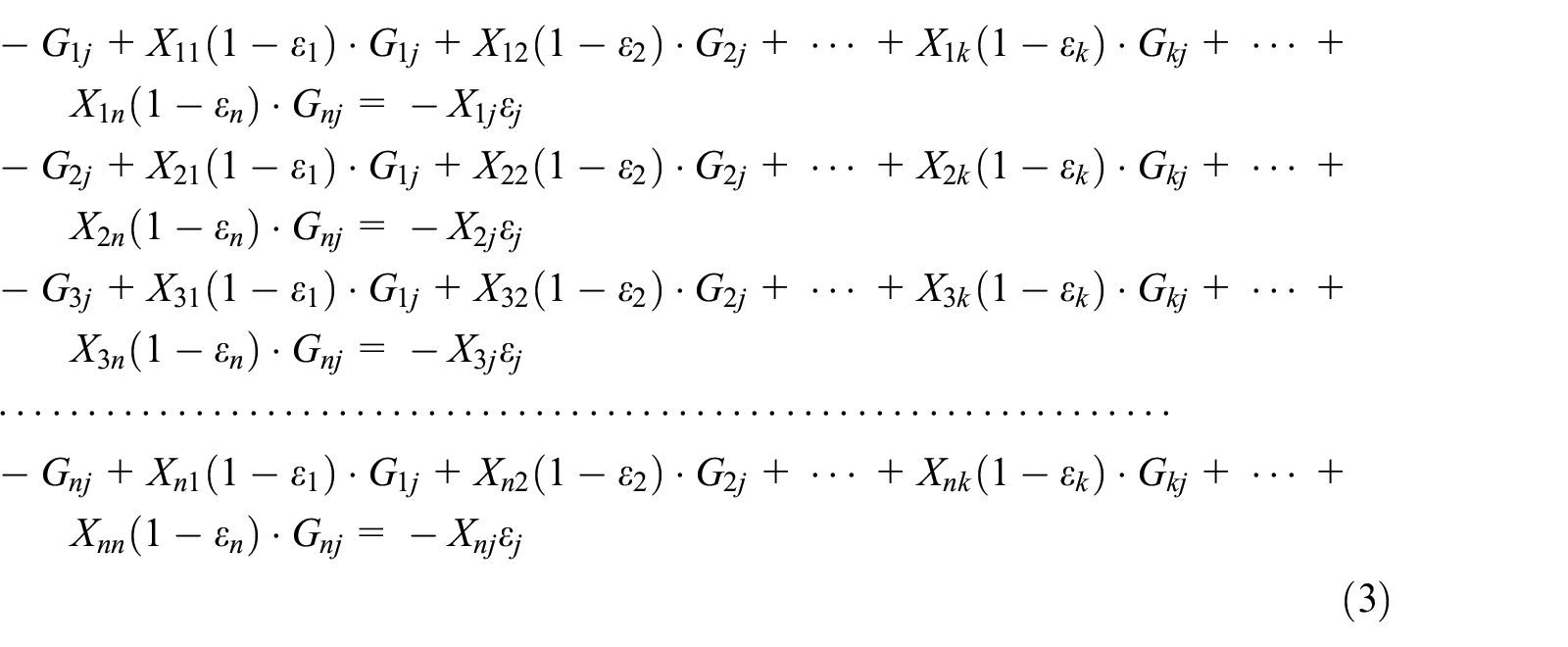
Since Gebhart coefficient matrix is gotten, Gebhart coefficient can be calculated by equation (3). If the surfaces temperatures are given, we can number these surfaces as 1,2,3……. Then the radiation heat transfer Qij is calculated by equation (1). So the surface i radiation heat is the sum of from surface i to surface n, and it can be calculated by equation (4).

Introduction process of convection heat calculation method
In stratified air conditioning, the convection heat is closely related to surfaces area, surfaces temperatures and indoor air temperatures.33,34 Usually, the convection heat flow can be written as:

Where Qd is convection heat, W; hc is convection heat coefficient, W·m−2K−1; Ti is inner surface temperature, K; Ta is indoor air temperature, K.
The convection heat coefficient is closely related to the difference between indoor air temperature and inner surface temperature.35,36
For the horizontal inner surface as floor:

For the vertical inner surface, the calculation formula can be expressed:

Calculation program
In stratified air conditioning, the building inner surfaces exist convection heat and radiation heat. According to the section 2.1 and 2.2, the radiation heat and convection heat can be calculated and the flow diagram of calculation program is shown as Figure 1. The key points of calculation program are as follows:
The air conditioning stratified height is important for calculating the radiation heat and convection heat, and it is mainly determined by the return air port height in low supply-middle return air conditioning.
Gebhart absorption coefficient is the key point of radiation heat calculation, and it indicates radiation absorption percentage of surface j that from surface i. The calculation method of Gebhart absorption coefficient is as shown in section 2.1.
Inner surface convection coefficient is the key point of convection heat calculation, and the calculation method of convection coefficient is as shown in section 2.2.

Flow diagram of calculation program.
Experiment description
Scale experiment rig
In this paper, the experiment research is conducted for heat transfer calculation model of stratified air conditioning zone. The large space lab is presented in Figure 2(a). The large space building is 20 m × 14.8 m. The column supply air is a semi-circular supply column with a height of 1.25 m, with a diameter of 600 mm, the supply air area is 2.36 m2 and the porosity is 73%. The return air is at 4.5 m high, and the return air port is 400 mm in diameter.

(a) Large space lab and (b) Scale experiment rig.
Based on the similarity theory, a scale experiment rig is constructed. As shown in Figure 2(b), it has a geometric ratio of 1:4 to the large space lab. The devices of supply air and return air are manufactured according to the proportion of 1:4. In the process of air flow is mainly affected by gravity and buoyancy, the fundamentals of similarity theory are Reynolds number Re and Archimedes number Ar. In the case of the design of the scale model, when the indoor air speed is higher than 0.0168 m·s−1, the indoor air Re has already reached the requirement of the similarity theory. The similar principle can be used to consider the equal number of Ar. The indoor air Ar is as follows20,25:

Where T0 is supply air temperature, K; h is supply air characteristic height, m; g is acceleration of gravity, m·s−2; uf is supply air speed, m·s−1.
According to the number of Ar similarity criteria, the other scale parameters are calculated by equations (9)–(11).
Geometric scale:

Temperature scale:

Supply air temperature difference scale:

Where l is physical dimension, m; ΔT is difference between supply air temperature and indoor air temperature, K; the following table m is the model parameter.
The geometric scale of the scale experiment rig is 1:4, the indoor air temperature scale is selected as 1:1, and the temperature difference scale is also selected as 1:1. According to the scale similarity, the corresponding length and width, the wind system parameters of the scale experiment rig can be calculated, which is shown in Table 1.
The dimension parameters of large space lab and scale experiment rig.

As shown in Figure 2(b), the scale experiment rig is a sloping ceiling structure with the length of 4.9 m and the width of 3.7 m. The locations of the return air outlets are at 1.1 m height and the percentage from the clear height (the ratio of stratified height) is 0.6. The scale experiment rig has six columnar low supply air outlets, and it has three supply air outlets attached on south wall and three supply air outlets attached on north wall respectively. The supply air pipelines, supply air outlets, and return air ports are near to the wall surfaces and they have been insulated. In order to simulate the heat conduction of the enclosure structure, the walls of the scale experiment rig have the carbon fiber electric-thermal films. The maximum heating power of the electric-thermal film is 230 W·m−2.
Measurement instruments and measurement plan
This study focuses on dynamic heat transfer of stratified air conditioning zone building surfaces in large space, which is caused by temperature differences of upper non-air conditioning zone and lower air conditioning zone. One significant advantage of scale model experiment is that, we can better control experiment object parameters, and to study interested experiment parameter rule separately. So, we try to avoid impact caused by building envelope heat, and we consider that the scale experiment rig is located in a room with almost stable temperature condition.
The scale experiment rig is a set system with a chamber room as the score, which is located in a suite room where the environment is almost stable, and is equipped with its own independent cold and heat source. System diagram of the scale experiment rig is shown as Figure 3. Cold and heat source contained piston type chiller and cooling tower, the cold water was produced by cold and heat source and it was transported to surface cooler. The air handling unit consisted of filter, surface cooler, electrical heater, nozzle, etc. The supply air was sent into the chamber room after being treated by the air handling unit. And the supply air was fed into the chamber room by six columnar low supply air outlets and it was discharged by the middle return air ports of the chamber room. The electric-thermal films installed on the ceiling can create temperature difference environment of upper non-air conditioning zone and lower air conditioning zone. The ceiling was pasted by electro-thermal film to simulate ceiling heat flow, and the electro-thermal film heat flow was set by sinusoidal form.
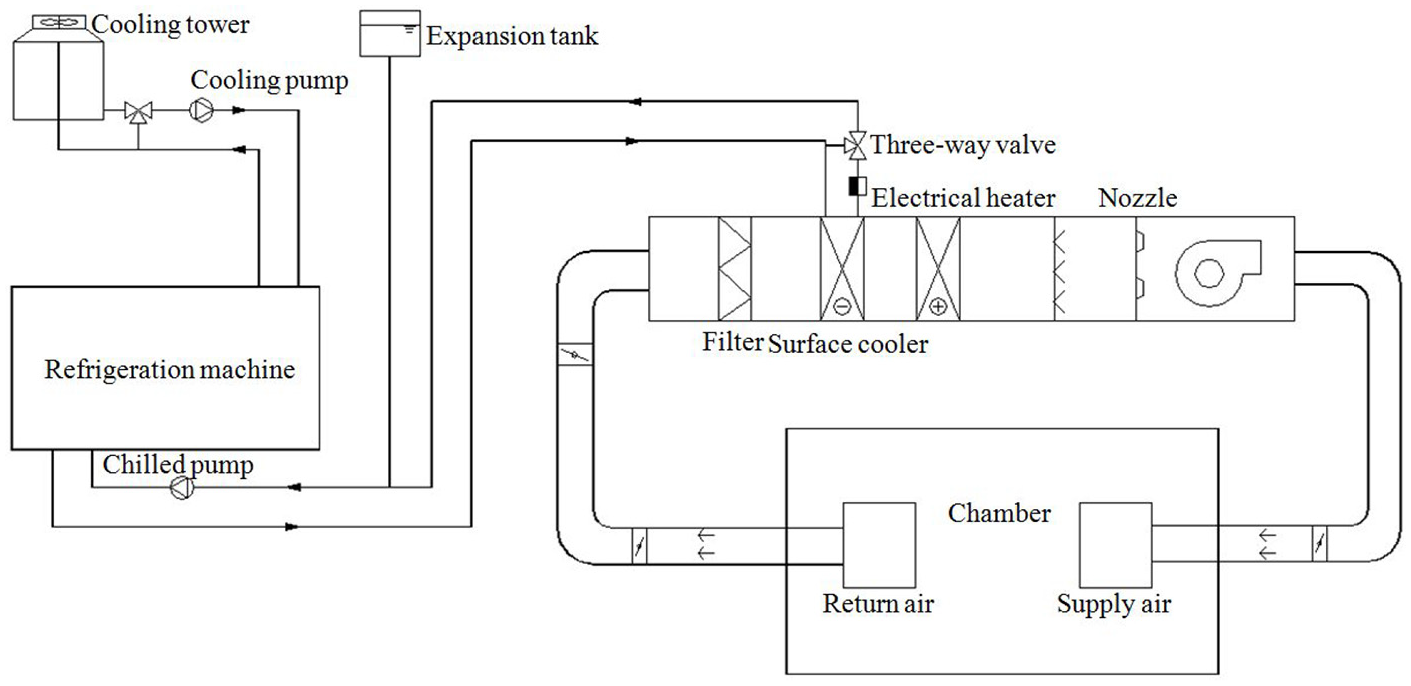
System diagram of scale experiment rig.
In experiment, the measurement data were temperature variation and heat flow variation of each inner surface in air conditioning zone and non-air condition zone. As shown in Figure 4, 20 temperature sensors were placed on inner surfaces to test temperature variation. 15 heat flow sensors were placed on inner surfaces to test heat flow variation. The temperature variation was measured by thermal resistance sensors and the heat flow variation was measured by heat flow density plates. The measurement data of temperature variation and heat flow variation were collected and processed centrally by TNT-C (temperature and heat flow meter). The indoor air temperature represented the air temperature of lower air conditioning zone. Its mean value was calculated by 10 testing values, which were shown in Figure 4. The chamber room surfaces were covered with electro-thermal films, and the locations of the temperature points and heat flow points were determined by preliminary experiments. The dashed red line in Figure 4 was the imaginary layered surface of stratified air conditioning. Its height was the height of the return air ports. Measurement instruments were provided in Table 2. All testing sensors have been calibrated in the laboratory.

(a) Temperature points and (b) Heat flow points.
The parameters of testing sensors.

Experiment conditions
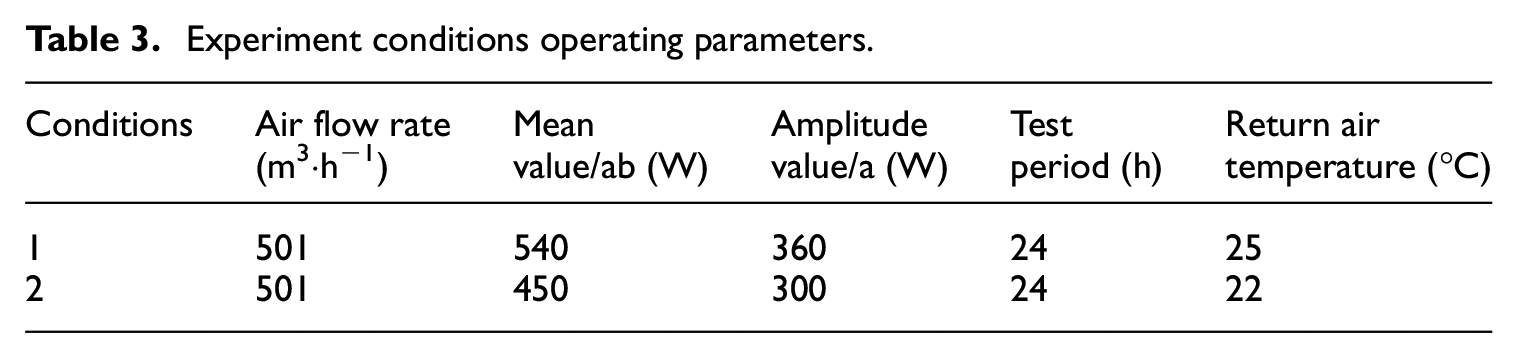
The dynamic heat transfer of stratified air conditioning zone building surfaces in large space is constituted by radiation heat and convection heat. The radiation heat is mainly caused by ceiling high temperature surfaces (created by the power of electric-thermal film) and lower air conditioning surfaces. The convection heat is mainly caused by indoor air temperature (contacted with return air temperature) and lower air conditioning surfaces. Considering the above content and characteristics of the scale experiment rig, conditions are chosen in Table 3. Under the action of ceiling heat disturbance, the return air temperatures and indoor air temperatures can be well stabilized after 3 h of power on. After 5 h of starting up, the thermal balance error rate of the scale experiment rig was less than 10% and it tended to be stable. The sinusoidal heat transfer perturbation of the cycle was set at 24 h. The building inner surfaces temperatures, indoor air temperatures, and inner surfaces heat flow were collected. In the experiment, the ceiling electro-thermal film was heated periodically, and the heating power was set as a periodic curve, as shown in equation (12).

Experiment conditions operating parameters.
Results and discussion
Temperature variation trend
In large space scale experiment, building inner surfaces temperatures and indoor air temperatures were measured and illustrated in Figure 5. Because of large amount of data which could not be listed completely here, hourly average temperatures of different surfaces were displayed.

Temperatures variation trend of stratified air conditioning zone: (a) Inner surfaces temperatures in case 1, (b) Indoor air temperatures in case 1, (c) Inner surfaces temperatures in case 2, and (d) Indoor air temperatures in case 2.
During the experiment, the ceiling electro-thermal film was heated to simulate periodic disturbance, and the stratified air conditioning zone was mainly affected by the upper non-air conditioning zone. As shown in Figure 5(a) and (c), inner surfaces temperatures of the stratified air conditioning zone increased firstly and then decreased. In case 1, the wall temperature range of stratified air conditioning zone was 25.8°C∼29.3°C. The temperature elevated values of the floor, east wall, south wall, west wall and north wall were 2.1°C∼2.9°C, and the temperature difference values of stratified air conditioning zone inner surfaces were 0.5°C∼1.5°C at a certain hour. In case 2, the wall temperature range of stratified air conditioning zone was 22.6°C∼25.1°C. The temperature elevated values of the floor, east wall, south wall, west wall and north wall were 1.4°C∼2.3°C, and the temperature difference values of air conditioning zone inner surfaces were 0.4°C∼1.1°C. It manifested that, under the effect of ceiling periodic heat flow, the temperature variation of air conditioning zone inner surfaces was consistent, and the temperature difference was not big.
Figure 5(b) and (d) indicated that indoor air temperatures variation. During the experiment, return air temperature was maintained constantly by operating supply air temperature. In case 1, the return air mean temperature was about 25.1°C and the deviation was within 0.5°C. In case 2, the return air mean temperature was about 22.1°C and the deviation was within 0.4°C. It was shown that the return air temperature control was effective. As shown in Figure 5(b) and (d), both supply air temperatures and indoor air temperatures decreased firstly and then increased. The reason was the periodic disturbances (the ceiling electro-thermal film periodic heat flow) increased firstly and then decreased. The heat gains of the stratified air conditioning zone from upper non-air conditioning zone increased firstly and then decreased. The supply air volume remained unchanged, so the supply air temperature decreased firstly and then increased. In case 1, the supply air temperature was from 16.5°C to 23.4°C, and the maximal decreased value of the supply air temperature was 6.9°C. The indoor air temperature was from 22.0°C to 24.4°C, and the maximal decreased value of the indoor air temperature was 2.4°C. In case 2, the supply air temperature was from 15.2°C to 20.3°C, and the indoor air temperature was from 18.9°C to 21.1°C. The maximal decreased value of the supply air temperature and the indoor air temperature were 5.1°C, 2.2°C respectively.
Heat transfer trend
According to heat transfer calculation model established in Section 2, the heat transfer of stratified air conditioning zone surfaces was calculated and the hourly average heat flow of different surfaces was illustrated in Figure 6.

Radiation heat and convection heat of stratified air conditioning zone: (a) Floor heat in case 1, (b) Floor heat in case 2, (c) West wall heat in case 1, (d) West wall heat in case 2, (e) South wall heat in case 1, (f) South wall heat in case 2.
In large space stratified air conditioning, the inner surfaces temperatures of the non-air conditioning zone were higher than the inner surfaces temperatures of air conditioning zone. The stratified air conditioning zone wall absorbed radiation heat, so the radiation heat transfer was negative value. Then the convection heat was gradually released into the stratified air conditioning zone air, so the convection heat transfer was positive value. As shown in Figure 6, the radiation heat transfer and convection heat transfer of east wall and south wall were smaller than that of floor. In case 1, the radiation heat minimal values of floor, east wall, and south wall were −507.1 W, −80.6 W, −128.0 W respectively, and the convection heat maximal values of floor, east wall, and south wall were 513.7 W, 79.4 W, 104.4 W respectively. Accordingly, in case 2, the radiation heat minimal values of floor, east wall, and south wall were −394.7 W, −61.1 W, −98.6 W respectively, and the convection heat maximal values of floor, east wall, and south wall were 426.0 W, 67.6 W, 88.4 W respectively. In large space stratified air conditioning, the ceiling temperature was big and the radiation angle coefficient that from ceiling to floor was significant, so radiation heat transfer and convection heat transfer of floor were more significant than other inner surfaces.
Meanwhile, as shown in Figure 6, the radiation heat transfer of floor, east wall, and south wall all decreased firstly and then increased. The convection heat transfer, which was released into stratified air conditioning zone air, increased firstly and then decreased. And the crest range of the convection heat transfer was corresponding to trough range of radiation heat transfer.
The thermal process analysis of stratified air conditioning zone
Based on above temperature variation trend and heat transfer trend, the thermal process analysis of stratified air conditioning zone is carried out. For common air conditioning room, indoor air temperature is uniformity, convection heat transfer is directly turning into air conditioning cooling load, and radiation heat is transformed into the air conditioning cooling load by a certain way. The large space stratified air conditioning is different to common air conditioning room, the indoor air temperature is different, and the non-air conditioning zone has significant influence on the air conditioning zone.
For the stratified air conditioning zone, the average values of 24 h dynamic temperature and heat transfer were acquired and illustrated in Figure 7. As shown in Figure 7(a), in case 1, average temperature value of the stratified air conditioning zone inner surfaces was 27.6°C, supply air temperature mean value was 19.8°C, return air temperature mean value was 25.1°C, and indoor air temperature mean value was 23.1°C. In case 2, average temperature values of the stratified air conditioning zone inner surfaces, supply air, return air, and indoor air were 23.5°C, 18.0°C, 22.1°C, and 20.1°C respectively. During the experiment, keep suite room similar temperature with the stratified air conditioning zone, so it was almost no heat transfer between suite room and stratified air conditioning zone. The stratified air conditioning zone walls absorbed radiation heat from non-air conditioning zone, and storage heat caused the wall temperature rising, which was higher than indoor air temperature of the stratified air conditioning zone and then released into indoor air by the form of convection heat.
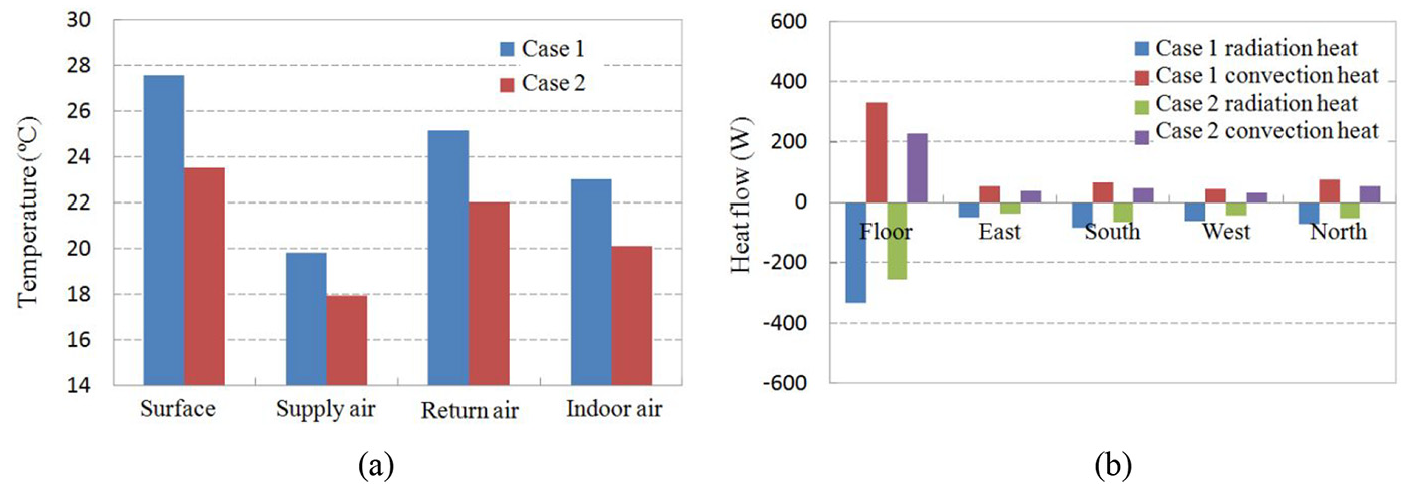
Thermal process analysis of stratified air conditioning zone.
The average value of 24 h dynamic radiation heat transfer and convection heat transfer were acquired and illustrated in Figure 7(b). In case 1, radiation heat transfer average value of floor was −331.8 W, convection heat transfer average value was 330.2 W. Comparing to stratified air conditioning zone radiation heat, the percentage of floor radiation heat was 55.5%. Comparing to stratified air conditioning zone convection heat, the percentage of floor convection heat was 57.6%. In case 2, the floor average values of radiation heat transfer and convection heat transfer were −254.1 W and 228.3 W respectively. Comparing to stratified air conditioning zone, the proportion of floor radiation heat was 56.7%, and the proportion of floor convection heat was 57.1%. The results further indicated that the stratified air conditioning zone wall absorbed radiation heat from non-air conditioning zone, and then released into the indoor air by the form of convection heat. Meanwhile, in the process of absorbing radiation heat and transforming into convection heat, the role of the floor was the most prominent. The experiment results of east wall, south wall, west wall, and north wall of case 1 and case 2 also illustrated this conclusion.
Conclusion
In this article, a 1:4 large space scale experiment rig is set up with typical sloping ceiling structure, columnar low supply air, middle return air, inner surface periodic heat flow simulation system, heat measurement, and control system. According to measured data, the dynamic temperature and heat transfer of stratified air conditioning zone are obtained by radiation heat transfer and convection heat transfer calculation model. The main conclusions are as below:
In large space building scale experiment, under the effect of ceiling periodic heat flow, inner surfaces temperatures of the stratified air conditioning zone increased firstly and then decreased. The inner surfaces temperatures were similar, and the temperature difference values were no more than 1.5°C. To keep the stratified air conditioning indoor air temperature constant, both supply air temperature and indoor air temperature all decreased firstly and then increased. The maximal decreased values of supply air temperature were significant. The temperature variation trend indicated that the ceiling heat flow disturbance was the vital factor to cause the supply air temperature dropped, the impact on the inner surfaces temperatures of the stratified air conditioning zone were consistent.
The dynamic radiation heat transfer existed between non-air conditioning zone inner surfaces and air conditioning zone inner surfaces. The convection heat transfer, which was released into stratified air conditioning zone, increased firstly and then decreased. The ceiling temperature was high and the radiation angle coefficient that from ceiling to floor was big, so radiation heat transfer and convection heat transfer of floor were more significant than other inner surfaces. And the crest range of the convection heat transfer was corresponding to trough range of radiation heat transfer.
The wholel room air conditioning has uniform indoor air temperature, and the radiation heat transfer and convection heat transfer directly affect the air conditioning zone. The large space stratified air conditioning is different, and non-air conditioning zone inner surfaces temperatures are significantly higher than that of air conditioning zone inner surfaces. The stratified air conditioning zone wall absorbed the radiation heat from non-air conditioning zone, and the storage heat caused the wall temperature rising, which was higher than indoor air temperatures of the stratified air conditioning zone, and then released into indoor air by the form of convection. In the process of absorbing radiation heat and transforming into convection heat, the role of the floor was the most prominent. Comparing to stratified air conditioning zone, the proportions of floor radiation heat and floor convection heat were above 55%.
Footnotes
Authors’ contributions
Liugen Lv, Yiying Luo, Yi Xiang, Chen Huang and Xiangjiang Zhou conceived and designed the research plan;
Liugen Lv, Yiying Luo, Yi Xiang, Xiangjiang Zhou and Chen Huang performed the implement of theory research;
Liugen Lv, Yiying Luo, Yi Xiang, Xiangjiang Zhou and Chen Huang analyzed the data, drafted and prepared the paper;
Liugen Lv, Yiying Luo, Yi Xiang and Xiangjiang Zhou contributed materials/analysis tools.
Declaration of conflicting interests
The author(s) declared no potential conflicts of interest with respect to the research, authorship, and/or publication of this article.
Funding
The author(s) disclosed receipt of the following financial support for the research, authorship, and/or publication of this article: This research was supported by Zhejiang Provincial Natural Science Foundation of China under Grant No.LY18E080022 and Jiaxing University Research Foundation under Grant No.70516003.
