




Abstract
Aiming at the problem that many algorithms could not effectively balance the global search ability and local search ability, a new optimization algorithm is proposed. Inspired by Finite Element Analysis (FEA) approach, a relationship of mapping between Finite Element Analysis approach and a population-based optimization algorithm is constructed through comparing the similarities and differences of FEA node and ideal particle. In algorithm framework, the stiffness coefficient corresponds to a user-defined function of the value of an objective function to be optimized, and the node forces among individuals are defined and an attraction-repulsion rule is established among them. The FEA approach that can simulate multi- states of matter is adopted to balance the global search ability and local search ability in the novel optimization algorithm. A theoretical analysis is made for algorithm parallelism. The conditions for convergence are deduced through analyzing the algorithm based on discrete-time linear system theory. In addition, the performance of the algorithm is compared with PSO for five states which include free state, diffusion state, solid state, entirely solid state, synthesis state. The simulation results of six benchmark functions show that the algorithm is effective. The algorithm supplies a new method to solve optimization problem.
Introduction
Inspired by the laws of nature and swarm intelligence in biology society, heuristic algorithm applies different strategies to search the solution space. Genetic algorithms mimic Darwinian natural selection, 1 where “fitness” selects individuals for inheritance, selection, crossover, and adaptive mutation. Particle Swarm Optimization (PSO) which is based on the swarming behavior of birds seeking food, 2 is the earliest example of a Swarm Intelligence algorithm. Particle Swarm Optimization (PSO) algorithm has existed premature convergence for multimodal search problems, and PSO has undergone numerous improvements.3–4 Some nature-inspired heuristics analogize the laws of physics, as do CFO, EM and APO. CFO searches for extrema by “flying” through the decision space a group of “probes” whose trajectories are deterministically governed by the gravitational analogy.5–7 EM is inspired Coulomb’s Force Law for electrostatic charges. 8 A framework of artificial physics optimization (APO) algorithm is constructed, in which a swarm of particles are treated as physical individuals seeking for a global optimum in the problem space driven by virtual force. 9
These heuristics have their applying ranges, advantages and disadvantages respectively. Some heuristics are easily trapped in the local optima of highly multimodal or “deceptive” functions. Therefore, a lot of problems about heuristic algorithm remain to study further. Finite Element Analysis 10 is one of the important foundational theories of digital technology. FEA has the features of simulating multi-states of mater, which has reference value for innovation of intelligence optimization algorithm. The primary principle of FEA is that a complex system can be divided into many comparative small and simple elements which facilitate understanding complex systems, so that a thoughtful understanding is obtained by combining the elements. 11 In many fields finite element method is used for simulating multi-states of matter,12–13 including solid mechanics, flow simulation, and gas flow field.
Aiming at the problem that many algorithms using a single motion rule could not effectively balance the global search ability and local search ability, a novel optimization algorithm based on Finite Element Analysis which is easy to simulate multi-states of matter and to implement parallel computing is proposed. Compared with the PSO and EM, the proposed algorithm is inspired by different laws of physics. The novel algorithm has advantages of effective motion which is affected by all the other particle, while PSO only flies to the historical best particle and the current best particle. The novel algorithm which has multi- states of matter is better at fine search than EM. Therefore, compared with the PSO and EM, the proposed algorithm has advantages of higher diversity and search efficiency. The paper constructs algorithm framework and verify the effectiveness of the algorithm through experiment. A theoretical analysis is made for algorithm parallelism at main steps, and the implementation of parallelism is a further study work.
The remainder of this paper is organized as follows: Section 2 introduces the FEA approach. Section 3 describes a relationship of mapping between FEA and a population-based optimization algorithm. Section 4 describes FEAO framework and analyzes theoretical parallelism of FEAO algorithm. Section 5 analyzes FEAO convergence. Section 6 compares the performance of FEAO five states and PSO against six recognized benchmark functions. Section 7 presents conclusions and suggestions for future work.
Finite element analysis
The typical finite element analysis goes through roughly four steps.
14
With one-dimension bar structure taken as an object for study, an example is given to intuitively illustrate the process of FEA in Figure 1. The structure consists of n bar components of different geometric sizes, and the junctions of the structure is under concentrated forces. The relevant parameters of material characteristics and structure size:
(1) Dividing elements and numbering node

Nodes and elements number of 1D bar structure.
At the junction of structure, n + 1 nodes and n elements are divided. The element and node numbers are illustrated in Figure 1. Each element is separated, and the displacement and external force of each node is indicated.
(2) Element stiffness equation
Stiffness equation (1) of element i (i = 1,2…n) is described as follows:

(3) Assembling the stiffness matrix and establishing global stiffness equation (2).

(4) Handling boundary conditions and solving global stiffness equation
With the boundary condition
A relationship of mapping between FEA and a population-based optimization algorithm
To address the optimization problem, the solutions sampled from the feasible region of the problem are treated as particle which have properties, such as fitness, velocity, position. With intelligent search strategy, the optimal solution is found by the way of successive iteration velocity and position. The nodes which forces are exerted on will deform appropriately depending on stiffness equations which consist of the forces and stiffness matrix. While nodes of FEA corresponds to particle of optimization algorithm, the paper constructs the relationship between node’s stiffness and the fitness of an objective function to be optimized. In addition, force rule of FEA corresponds to search strategy of optimization algorithm. As above, a relationship of mapping between Finite Element Analysis approach and a population-based optimization algorithm is constructed, as showed in Figure 2.

The mapping of FEA to optimization algorithm.
Matter can exist as a solid, liquid, or gas. Finite element method is used for simulating multi-states of matter. Adopting FEA simulation capacity, three node states which correspond to three different motion rules are designed for the novel algorithm. By setting the property of element stiffness matrix the nodes enter one of three states which include solid state, diffusion state, and free state. Three main states of FEAO algorithm draw analogies from three motion rules which effectively balance the global search ability and local search ability in optimization algorithm. (1) Solid state: solid state draws analogies from this method which can disperse the particles and improve the diversity of the population in order to avoid premature convergence. According to solid mechanics, atoms of solid states are not easily to move. Strategy of solid state turn the excessive-gathering particles among population into solid state which avoid excessive-gathering particles to get too close. The implement method of solid state is that particular negative values are assigned to off- diagonal elements of stiffness matrix. (2) Diffusion state: Diffusion state is the exact opposite of solid state. In diffusion state the node motion is motivated. The implement method of diffusion state is that particular positive values are assigned to off-diagonal elements of stiffness matrix. (3) Free state: the node motion is not related to each other. The implement method of free state is that zero values are assigned to off-diagonal elements of stiffness matrix. Three main states are implemented through off-diagonal elements of stiffness matrix as shown in Table 1.
Properties of three main states of FEAO algorithm.

Handling method of solving one-dimensional problem extends to multi-dimensional problem. By the principle of FEA element stiffness matrix, the diagonal element

An optimization based on FEA
The FEAO algorithm addresses the problem of locating the global minima of a (nonlinear) objective function f(x) defined on a bounded hyperspace; that is, determine:
FEAO framework
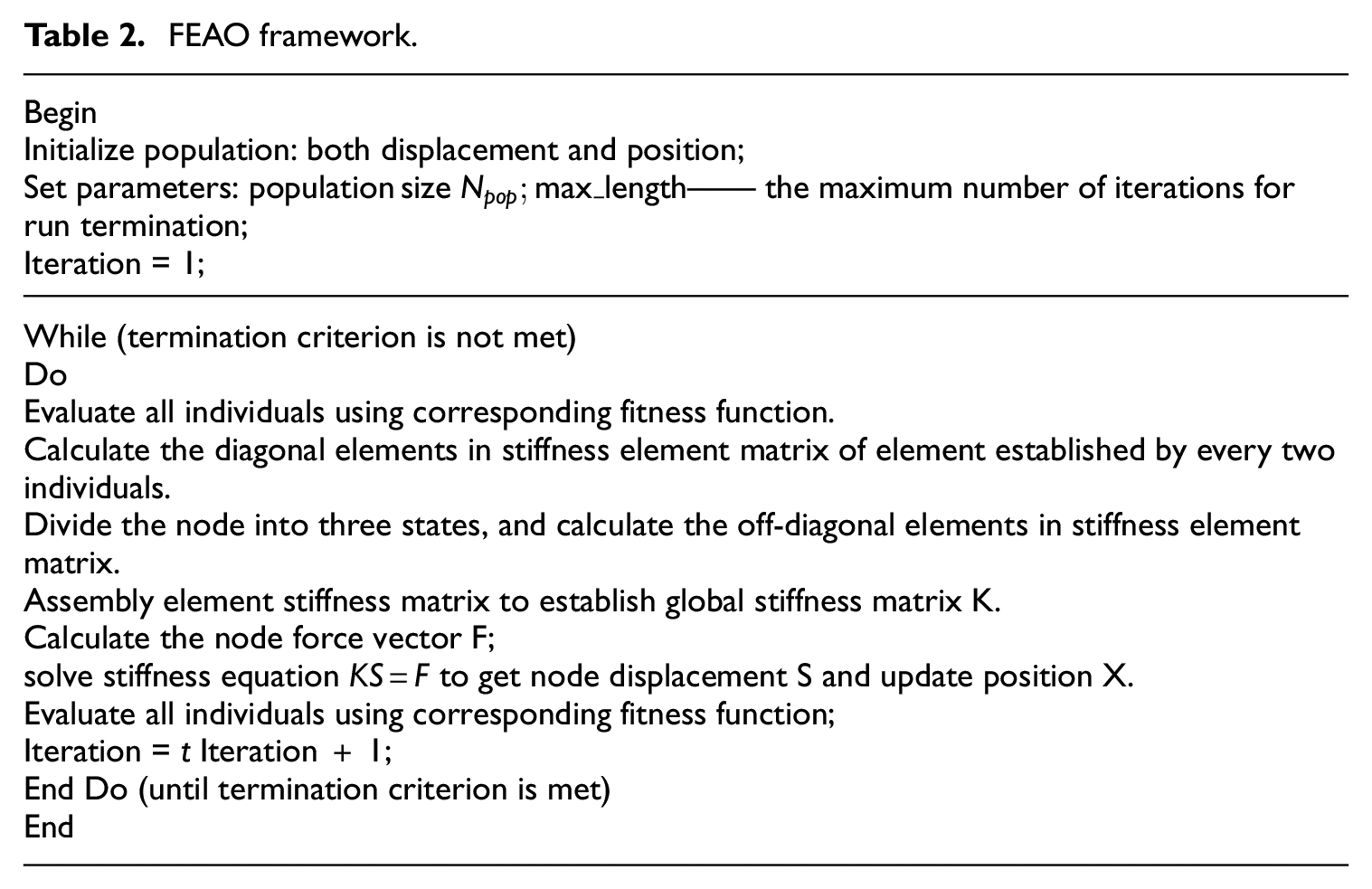
The FEAO algorithm comprises four main procedures: (a) Initialization;(b) Global stiffness matrix Calculation; (c) Nodes force calculation; (d) Displacement and position solution. FEAO’s algorithm framework (pseudocode) appears in Table 2.
FEAO framework.
Initializing population
In the Initialization step,
Calculating stiffness matrix
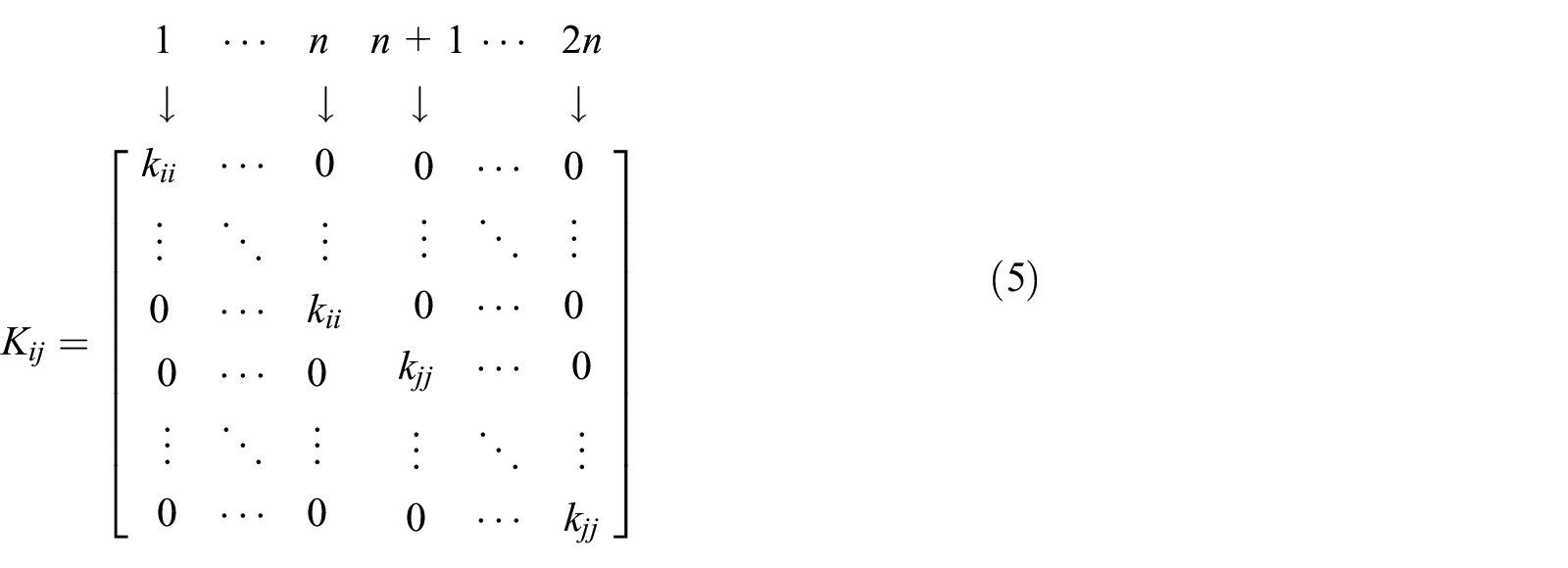
Calculating the diagonal elements in stiffness matrix
While any two node i and node j constitute a bar element, the stiffness coefficient

According to the equation
Calculating off-diagonal elements in stiffness matrix
According to the equation
A bar element which consist of node i and node j enters solid state when the conditions is simultaneously satisfied as follow: (1)


A bar element which consist of node i and node j enters diffusion state when the conditions is simultaneously satisfied as follow: (1)

Assembling element stiffness matrix to establish global stiffness matrix K

Where p—free state, q—solid or diffusion state.
Because in pth row only the diagonal element
Calculating the node force vector
Based on the results of the stiffness coefficient

The kth component of the total force

In this equation (11) of

According to theory of FEA, the node force vector is calculated as follow.

Solving node displacement
Only the diagonal element of nodes in free state is a non-zero value. Thus, displacement of the free nodes could be obtained by the direct calculation, while displacement in solid or diffusion state are calculated through solving global stiffness equation.
Global stiffness equation (13) is as follow:


The final FEAO step is to update position, which refers to the displacement of nodes through the decision space using the previously computed total force to calculate a “displacement,” which then is used to update the nodes’ position. The displacement and coordinates of node i at the next iteration, are updated using equations (14) and (15), respectively:


Parallel analysis
The FEAO algorithm adopts the parallel finite element method. Any element stiffness matrix is only dependent on themselves, and does not involve other element. All element stiffness matrix is simultaneously calculated, while the elements of matrix are implemented with parallelism. 17 The global stiffness matrix is assembled by the element stiffness matrix in accordance with the principle of “matching the number of nodes”. In the phase of assembling matrix, the processes in which all elements that have no common nodes with each other are superimposed are handled concurrently. The global stiffness equation is solved through both direct and iterative method. 18 There are mainly parallel direct methods: parallel Gauss-Jordan method, parallel Gauss method, parallel multifrontal method. Iterative method mainly refers to parallel preprocessing conjugate gradient method.19–20
Convergence analysis
The paper analyzes the convergence of FEAO algorithm theoretically, adopting the method by which Zeng Jianchao et al proved the algorithm convergence of PSO 21 and APO 22 based on discrete-time linear system theory. Nodes which are in solid state and diffusion state not always exist in iterative process, but there are always nodes in free state. Convergence of the algorithm is proved by convergence analysis of nodes in free state. Only the diagonal element of nodes in free state is a non-zero value. Therefore, the global stiffness equations are simplified to the root equations of a degree. The solutions of the stiffness equation (13) simplified are as follow.

When an individual i chosen arbitrarily can prove the convergence, the result could extent to all the others. Each dimension of equations (10)–(15) is irrelevant to the other dimension.


Define

With the following definitions:




Equation (19) becomes:

Substituting equation (24) into equation (18) yields the following 2nd order difference equation.

Through property analysis of equation (25), the convergence of the RV sequence {E

where


The characteristic equation of equation (25) is:

Theorem 1. If and only if 0 ≤
Proof. The condition of {

There are three cases that depend on the value of the discriminant
(1)
By summarizing three cases, the convergence condition for the sequence of random variables {E

When {E

Substituting equations (27) and (28) into equation (32) yields

which may be written
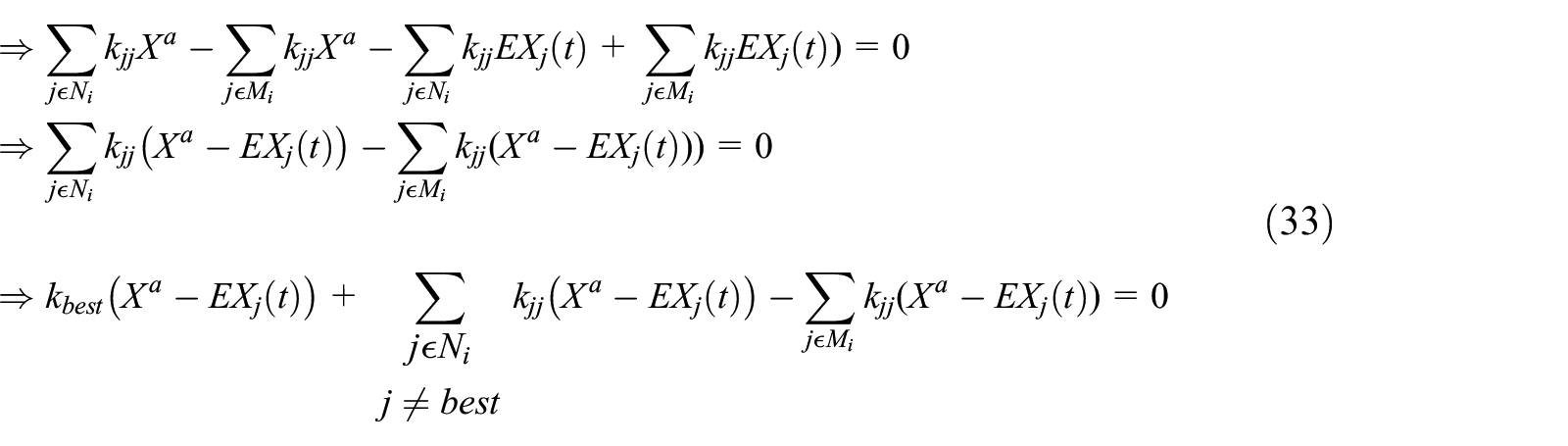
By inspection, equation (33) is satisfied if and only

According to equation (34), the algorithm converges by setting an appropriately small enough value for G.
Numerical experiments
In this section, FEAO’s performance is compared with PSO’s through the six recognized benchmark functions listed in Table 3. The Table 3 includes the search domain, the known minimum function value.
Parameters for Test Function.

FEAO algorithm runs were made with the following empirically determined parameters: inertia weight
Each numerical experiment was repeated 50 times. The recorded performance data were the best function value (BEST), the average best function value (Mean), the max function value (MAX), and its standard deviation (STD). The PSO test results were selected from the references.
23
The performance of FEAO algorithm is compared with PSO for five types which include free state, diffusion state, solid state, entirely solid state, synthesis state. Free state——in whole iterative process (t< MAXITER) all nodes are in free state; Diffusion state ——later in the iteration process (t>
Table 4 shows the comparative results. The results of testing Tablet function illustrate that except entirely solid state the other diffusion state, solid state and synthesis state of the FEAO has higher performance than the free state, and synthesis state obtains the best performance outperforming PSO. For Rosenbrock function, the numeral experiment indicates that the other four states have the advantage over free state, and synthesis state is the best exceeding PSO. For Quadric function, through simulations, compared with PSO and free state, the other four states enhance greatly the performance. For Griewank function, the performance of free state, diffusion state, entirely solid state, and synthesis state are similar to PSO, and solid state is the best exceeding the others. By the Rastrigin and Schaffer’s f7 test functions, the searching ability of the solid state and entirely solid state is more efficient, and the performance in all states to test Schaffer’s f7 are better than PSO.
Shows the comparative results.

The paper compared the dynamic performance of five states which are sampled at an interval of 20 iterations as shown in Figures 3–8. The results manifest that the diffusion state, solid state and synthesis state have advantages over free state. Because the force is proportional to the distance of nodes, at the end of the iteration the distance of two nodes is too close to generate large enough force for escaping from local minima. Therefore, the dynamic curve of the free state levels off as show. Each state has the capabilities and limitations. Solid state is well-suited for dealing with the Griewank, Rastrigin, Schaffer’s f7 functions, while synthesis and diffusion states are fitter for solving the problem of Tablet, Rosenbrock, Quadric. Solid state can improve the diversity of the population, and diffusion state enhances node force to improve search performance.

Dynamic performance for Tablet.

Dynamic performance for Rosenbrock.

Dynamic performance for Quadric.

Dynamic performance for Griewank.

Dynamic performance for Rastrigin.

Dynamic performance for Schaffer’s f7.
Conclusions and future work
Based on Finite Element Analysis, a novel optimization is proposed. The FEA approach that can simulate multi-states of matter is adopted to balance the global search ability and local search ability in the novel optimization algorithms. The condition for FEAO convergence is deduced through analyzing FEAO algorithm based on discrete-time linear system theory. The simulation results of six typical optimization test functions show that FEAO algorithm is effective. The paper analyzes parallelism at main steps by theoretical analysis. Thus, a further study of FEAO algorithm is needed to focus on realization of parallel/distributed computation.
Footnotes
Declaration of conflicting interests
The author(s) declared no potential conflicts of interest with respect to the research, authorship, and/or publication of this article.
Funding
The author(s) disclosed receipt of the following financial support for the research, authorship, and/or publication of this article: This project is supported by National Natural Science Foundation of China (Grant No. 51875381), National Natural Youth Science Foundation of China (Grant No. 51905369), and administration committee of Yangquan development zone (No.17-015).
