



Abstract
Based on Hertz contact theory, an elastic-plastic contact mechanics model of outer cylinder under different contact angles of axis is proposed. The relationship among contact angle, load and contact deformation, contact stiffness and contact area is established. The finite element method is used to simulate the elastic-plastic contact process of the cylinder. The influence of the load and radius of the cylinder model on the contact deformation and the contact stiffness is compared and analyzed under different contact angles. The error of the analysis results of the finite element and the mechanical model is within 9%. On this basis, the influence of contact deformation, contact area and contact angle on the contact stiffness of the outer cylinder in elastic and plastic stage is explored. The results show that in the stage of elastic and plastic deformation, the amount of contact deformation and contact area increase with the increase of load. The contact stiffness decreases with the increase of contact angle and increases with the increase of cylinder radius. The amount of contact deformation decreases with the increase of cylinder radius, and tends to constant gradually. In the elastic stage, the contact stiffness increases with the increase of load. The contact area decreases with the increase of contact angle and increases with the increase of cylinder radius. In the plastic stage, the contact stiffness is constant with the increase of load, and the contact area is independent of contact angle and cylinder radius.
Introduction
Hertz contact theory 1 and fractal theory are the main methods to analyze cylinder contact model. In recent years, several typical cylinder contact models have been proposed based on Hertz contact theory. 2 Johnson 3 proposed a model of long cylinder in non-conformal contact, which considered the internal and external contact between two cylinders. Radzimovsky 4 proposed an outer cylinder contact model, which was derived from the stress–strain formula. Goldsmith 5 also proposed an inner cylinder contact model based on Hertz theory, which gave the expression between the load and the contact deformation. However, the above studies are all elastic contact models, so it is impossible to analyze the mechanical properties of the model under the condition of plastic deformation under heavy load. Moreover, the above model formulas include logarithmic function; so when the load is applied to a certain value, the model will fail. 2 Through the research of rolling bearing, Lui and Shao6,7 put forward a cylinder contact model with lubricating oil film, which analyzed the influence of support stiffness on contact deformation. Sharma and Jackson 8 carried out the finite element analysis of the elastoplastic cylinder contact problem, and compared the finite element results under the elastic and full plastic conditions with the existing Hertz contact and spherical elastoplastic contact models. Vijaywargiya and Green 9 simulated two-dimensional sliding between two interacting elastoplastic cylinders by finite element analysis. Dumas and Baronet 10 used the finite element method to study the elastic–plastic indentation of an infinite rigid cylinder with its axis parallel to the surface of half-space in detail, and gave the calculation results of different strain hardening slopes. Jackson 11 presented a simple solution to a cylindrical rigid frictionless punch indenting a half-space considering only perfectly plastic deformation, which was verified by the finite element calculation. Based on the finite element method, Komvopoulos 12 solved the elastic contact problem of a layered semi-infinite solid with rigid surface compression. Cinar and Sinclair 13 studied the problem of infinite rigid cylinder under the condition of frictionless and complete adhesion release under incremental elastic–plastic condition. Bower and Johnson 14 evaluated the effect of strain hardening on the cumulative plastic deformation of cylinder under repeated rolling and sliding contact by using the non-linear kinematic hardening law. By comparing different contact models, Beheshti and Khonsari 15 found that the use of elastic–plastic micro-contact model can predict lower maximum normal pressure and larger contact width and actual contact area. Based on the fractal theory and Hertz contact theory, Huang et al. 16 established the contact model of two cylinders. Zhao et al. 17 established the fractal model of normal contact stiffness of the joint surface of two cylinders. Based on the theory of classification, Li et al. 18 established a fractal prediction model of the normal stiffness of the joint surface of two cylinders considering friction factors. Based on the Hertz contact theory and the fractal theory, the deformation properties of the model in elastic, elastic–plastic, and plastic stages are analyzed, but the deformation properties of the cylinder contact model in different contact angles are not considered.
Therefore, based on Hertz contact theory, this article proposes an elastic–plastic contact model of cylinder under different contact angles; establishes the relationship between load and contact deformation, contact stiffness, and contact area; and uses the finite element method to simulate the elastic–plastic contact process for comparison. The first section of the article establishes the contact mechanical model of the cylinder, which mainly derives the deformation formula of the cylinder model in the elastic and plastic phases. The second section conducts simulation analysis and comparison of the cylinder model, which mainly analyzes the effect of the load on the contact deformation and the effect of load on contact stiffness. In the third section, the contact mechanical characteristics of cylinder are studied, which mainly analyzes the effect of the load on the contact area and the influence of the cylinder radius on the model mechanical properties.
Cylinder contact mechanics model
The contact state of cylinder model can be divided into three stages: elastic stage, elastic–plastic stage, and plastic stage. In this model, the deformation formulas of cylinder in elastic and plastic stage are derived.
Full elastic contact
Let the radius of both cylinders be

From equation (1) and the displacement formula of the midpoint of the object under the distributed pressure on the semi-infinite boundary plane 19

where

Cylinder contact model: (a) before loading and (b) after loading.
From equation (2), the area of the contact ellipse and the relationship between the load and the deformation can be obtained as


where
Elastic–plastic contact
When the two cylinders in contact appear initial yield, the average contact pressure between the contact surfaces can be expressed as 20

where
Green 20 gave the calculation formula of constant C

where
From equation (4)

According to equations (5) and (7), the displacement distance of two cylinders at initial yield is

where
Plastic contact
When the material enters the complete plastic deformation stage, the average contact pressure is close to the yield strength 21

where
According to the theory of ABBOTT, E.J. 22 , the contact area can be expressed as

where
From equations (3) and (4)

According to equation (10), the contact area can be obtained as

Then the total load can be expressed as

where P is the total load.
Namely

According to equation (14), the contact stiffness is

where
Namely

Fiinite element method analysis and comparison
Modeling and analysis
In this article, the upper and lower cylinder models are made of carbon structural steel of the same material. The following material properties are selected: Young’s moduli
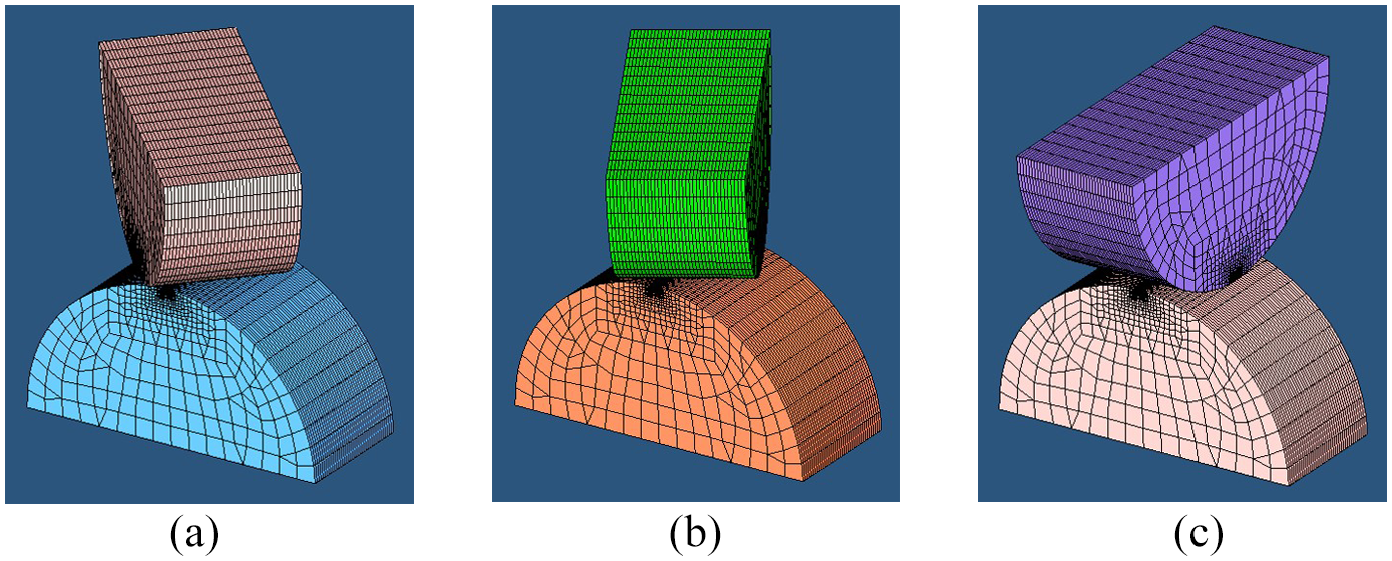
Cylinder mesh model: (a) 45°, (b) 60°, and (c) 90°.
The simulation results of strain pattern can be obtained after solution. Figure 3(a) is the integral deformation cloud of the cylinder model, the contact angle is 90°, and the load is

Cloud chart of cylinder contact deformation: (a) global deformation cloud and (b) cloud picture of local deformation of lower cylinder.
Contact deformation comparison
The amount of deformation obtained by the theoretical derivation formula of the elastic–plastic deformation of the cylinder model is compared with the result obtained by the finite element simulation, and the data are fitted by the image.
It can be seen from Figure 4 that there are some errors between the simulation value and the theoretical value of contact deformation, but the trend is consistent. When the load is about

Comparison between simulation value and theoretical value of contact deformation: (a) 45° contact, (b) 60° contact, and (c) 90° contact.
Comparison between simulation value and theoretical value of contact deformation.
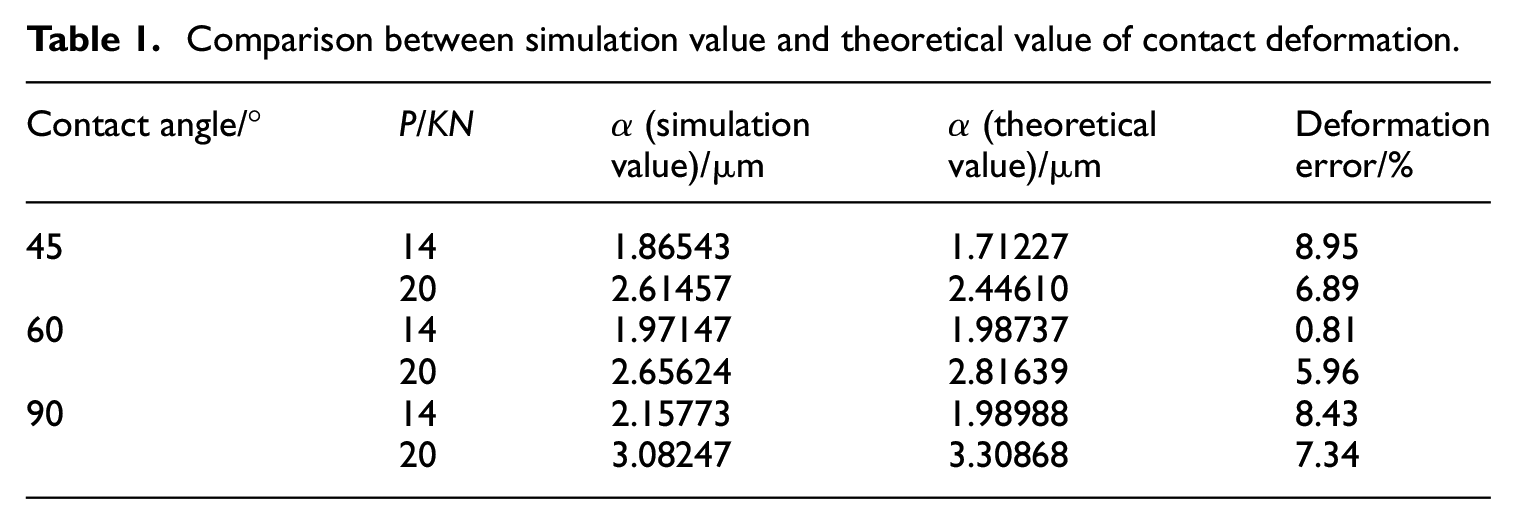
From the angle of error generation, it is mainly divided into two aspects. On one hand, it is analyzed from the material itself that the material has not reached the stage of complete plastic deformation during loading, and there is certain elastic deformation which results in deviation of the deformation quantity; on the other hand, it is analyzed from the model itself. The main sources of errors include partition density of grid unit, calculation method of model, setting of boundary conditions, and geometric dimensions. For the first error, the contact deformation can be removed from the elastic region by increasing the applied load; for the second error, it can be solved by further improving the accuracy of the grid element, selecting a more appropriate unit type and contact type, and a more accurate geometric model.
Contact stiffness comparison
It can be seen from the comparison of theoretical value and simulation value of contact stiffness of cylindrical model that the change trend of theoretical value and simulation value of the model is basically the same as that shown in Figure 5. In the elastic stage, the contact stiffness increases exponentially with increasing load, and in the plastic stage, the contact stiffness remains unchanged regardless of the load.

Comparison between simulation value and theoretical value of contact stiffness: (a) 45° contact, (b) 60° contact, and (c) 90° contact.
The simulation value and theoretical value rigidity of
Comparison between simulation value and theoretical value of contact stiffness.

Contact analysis
Load influence
Figure 6 shows the influence of load on the contact area. The following material properties were selected:

Influence of load on contact area.
Cylinder radius influence
Figures 7–9 show the influence of cylinder radius on contact deformation, contact stiffness, and contact area, respectively. The following material properties were selected:

Influence of radius on contact deformation.
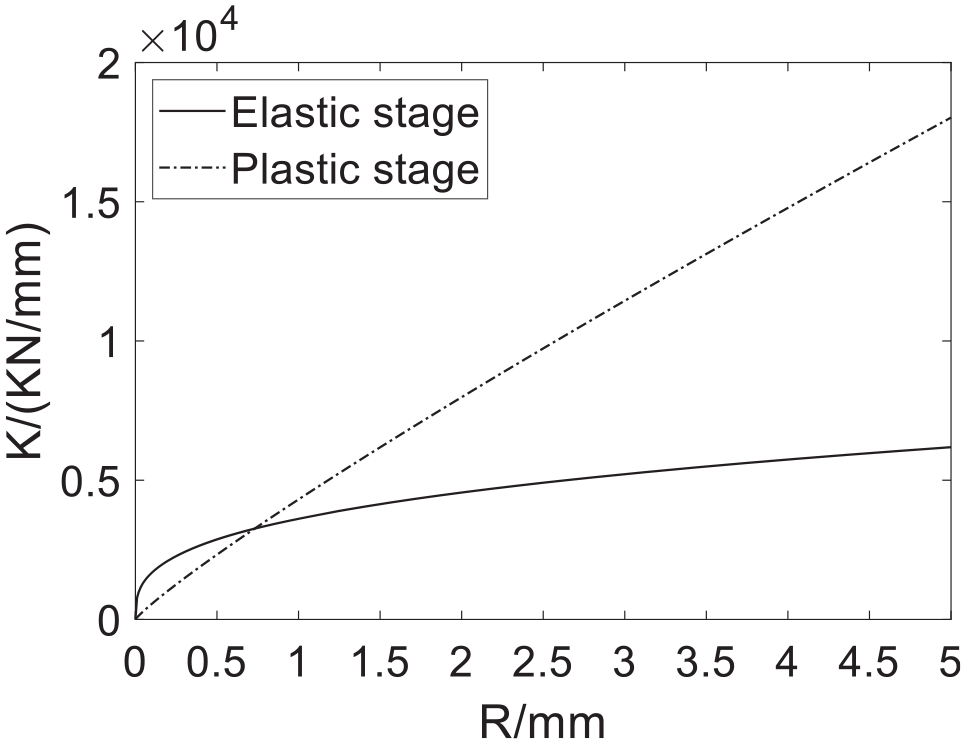
Influence of radius on contact stiffness.

Influence of radius on contact area.
Conclusion
Based on Hertz contact theory, this article presents an elastic–plastic contact mechanics model of cylinder under different contact angles of axis, including the relationship between contact angle, load and contact deformation, contact stiffness, and contact area, which is verified by finite element method. Based on this, the contact mechanical properties of cylinder are explored.
The contact deformation increases with the increase of load and contact angle.
In the elastic stage, the contact stiffness increases with the increase of load, and in the plastic stage, the contact stiffness does not change with the increase of load. The contact stiffness decreases with the increase of contact angle.
The contact area increases with the increase of load. In the elastic stage, the contact area decreases with the increase of contact angle, and in the plastic stage, the contact area is independent of contact angle.
In the elastic stage, the contact area increases with the increase of the cylinder radius, and in the plastic stage, the contact area is independent of the cylinder radius.
Footnotes
Declaration of conflicting interests
The author(s) declared no potential conflicts of interest with respect to the research, authorship, and/or publication of this article.
Funding
The author(s) disclosed receipt of the following financial support for the research, authorship, and/or publication of this article: This project is supported by National Natural Science Foundation of China (Grant No. 51875009).
