



Abstract
Traffic accidents have been closely concerned by the society, and the serious traffic accidents caused by vehicle and guardrail collisions are one of the main manifestations. However, the research in the field of vehicle and guardrail collisions is mainly limited to the waveform guardrail on the expressway, and there is little research on the urban road guardrail, especially in the secondary damage caused by guardrails field. Moreover, the collision between vehicle and the rectangular guardrail of city road is easy to form thin-walled long rod, and it penetrates the driver’s chest. To evaluate and analyze the injury results and mechanism of this phenomenon, a penetrating finite element model of chest bone characterized by Chinese human is established using the medical software (MIMICS) and engineering software (HYPERMESH). The model validation is mainly dependent on the corpse impact test. In addition, the software (LS-DYNA) is deployed to simulate the thin-walled long rod penetration. According to the analysis of the “PENETRATION,” it is found that the cavity effect produced by the thin-walled long rod through the chest, and the degree of chest damage is related to the speed, angle, weight, and stability of the thin-walled long rod. The difference between the peak value of collision corpse experiment and simulation peak value is less than 5%, which implies that the model is reasonable. Besides, the simulation results also confirm the accident and medical diagnosis cases. As a common form of secondary injury in traffic accidents and a typical case of medical penetrating injury, the thin-walled long rod penetrating injury has important reference value for studies in both directions.
Introduction
With the rapid development of economy, the urban motor vehicle population in the world is growing rapidly. The number of traffic accidents is also on the rise in China.1,2 According to the road traffic safety research institute of the ministry of public security, China’s urban road traffic accident accounts for 45.8% of the country’s road traffic accidents in 2018, and the number of casualties in urban road traffic accidents accounts for 38.8% of that. In order to separate vehicle, isolate pedestrian, and reduce the incidence of urban road accidents, the government has set up the isolation guardrails in the middle of the road and on both sides of the road, which is regarded as a powerful tool for harnessing traffic congestion. Although it diverts two-way lanes, motor lanes and non-motor lanes, the disadvantages of this practice are also increasingly prominent, leading to traffic accidents “secondary injury.” From 2005 to 2012, among the major road traffic accidents that killed more than 10 people at one time across the country, those involving road guardrails (mainly refer to rushing out/rushing through the side guardrails or central isolation guardrails) account for 20.8% of the total number of accidents. 3 The main reason is that the country makes relevant provisions only on the highway waveform guardrail, but there are no corresponding national standards for the isolation guardrail on the urban road. As a result, all kinds of guardrails in urban roads are different from each other and have great potential safety hazards, which cause unpredictable casualties and property losses. It can be seen that road traffic accidents have become a major threat to the China’s social public safety and health. Therefore, the research of automobile safety and human body injury protection has very important practical significance.4,5
At present, the research on vehicle and guardrail collision all around the world is mainly limited to the discussion of automobile and guardrail accidents on the highways, and the dynamic response and the safety performance evaluation of guardrail under a given impact load or impact of rigid body. There is less research on urban road guardrail, especially in the secondary injury of driver in car caused by the guardrail field. This article takes the rectangular guardrail as an example. The rectangular guardrail is made of several thin-walled long rod (TWLR) welded together. In traffic accidents of urban road guardrail, it is easy to form a TWLR, which penetrates through the chest of passengers, causing serious damage to passengers, as shown in Figure 1. In traffic accidents, the incidence of thoracic and abdominal injury is as high as 45%, second only to craniocerebral injury, which is one of the main causes of traffic accident death.6,7 Therefore, it can be seen that chest injury research is important. In recent years, researchers mainly use the volunteer experiment, corpse experiment PMHS (post mortem human subject), dummy experiment, tissue material experiment, and animal experiment to study the chest biomechanical response, the damage mechanism, and the tolerance limit of tissue in the process of car collision. However, there are difficulties in obtaining samples, poor repeatability and legal and ethical problems in tissue material and cadaver experiments, which are not being carried out much.8,9 However, the dummy chest collision experiment has the problems of the great destructiveness, high experimental cost, and poor bionic reliability, so it is difficult to simulate the fracture of the chest ribs in the process of guardrail collision. 10
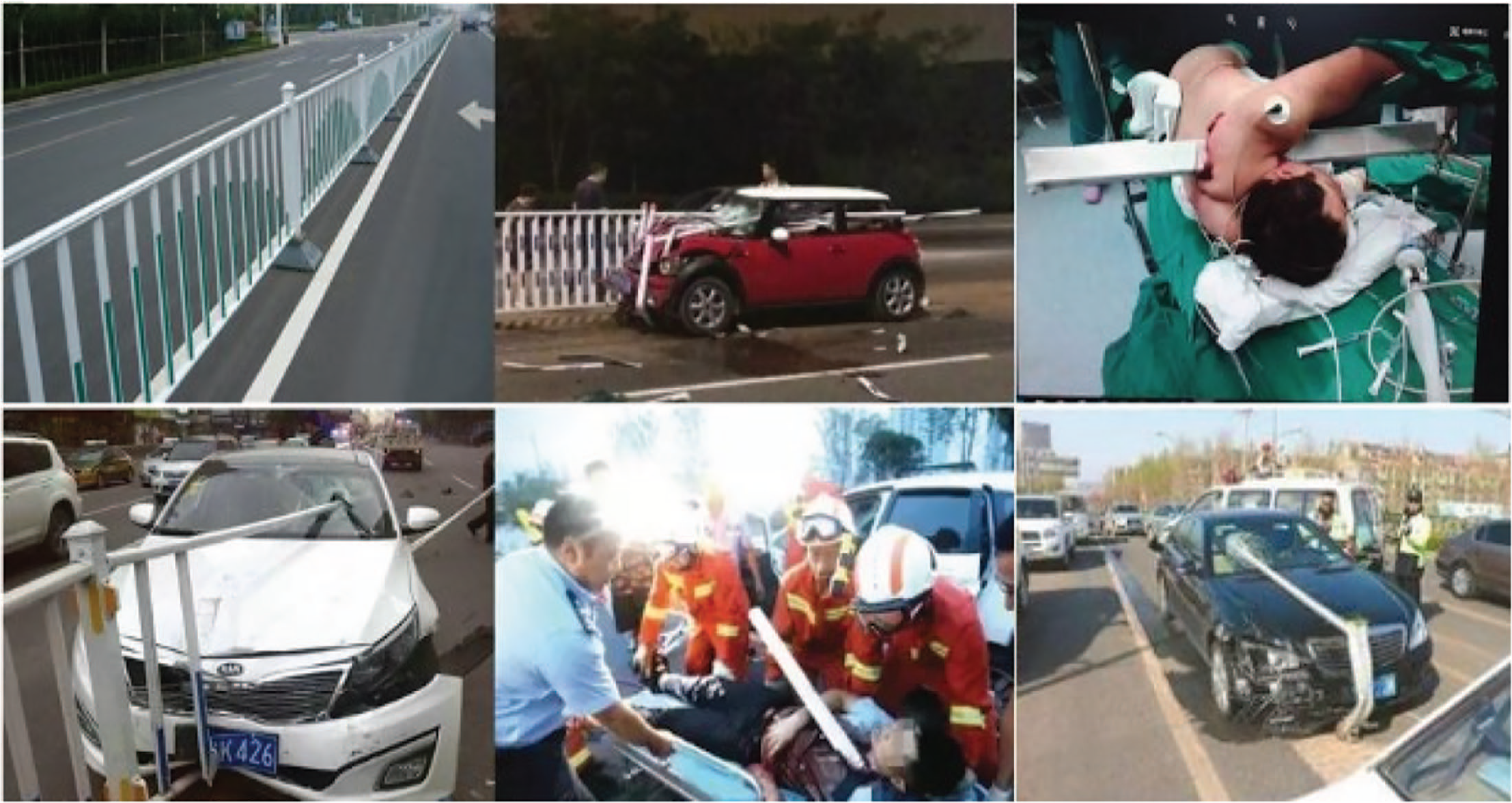
Collision accident of vehicle and city road guardrail.
To solve this problem, a biomechanical model of human chest is established in this article. It can not only simulate the fracture and injury of chest and ribs in the process of car crash guardrail, but also make up for the deficiency of the corpse experiment and dummy experiment. The advantage of the finite element method (FEM) combined with medical research is that it can simulate complex physical environment, so as to analyze the interaction between human bones and organs and the state of comprehensive movement. 11 The finite element model of chest is only used in the world to predict and evaluate the biomechanical response and damage mechanism of the chest under collision load. 12 The chest biomechanics of the finite element model is deployed to investigate the changes of impact loading in the chest bone, without considering the fracture of the sternum. This leads to sternal fracture. In terms of the FEM, the element failure is used, which is the key to solve the problem by employing the failure criteria. This article takes Chinese human body data as an example, where the medical computed tomography (CT) scan is used to obtain the main geometric parameters of the human chest, and the finite element model with TWLR penetrating the chest is established. The chest finite element model validation mainly refers to the corpse impact experiment. The simulation and calculation are carried out by LS-DYNA software, and the post-processing software (HYPERVIEW) is deployed to observe the penetrating process and the degree of injury of the driver’s chest. The damage mechanism of the TWLR through the chest is analyzed by “PENETRATION,” and simulation results are used to verify the domestic accident cases and medical diagnosis cases.
The remainder of this article is organized as follows. Section “Establishment of finite element model of TWLR through body chest” introduces the establishment of the finite element model of the biomechanical model. Section “Penetration model analysis and validation” analyzes the simulation results of the chest penetration model and verifies medical and accident cases. Section “Corpse verification” discusses damage mechanism of it. Section “Conclusion” draws the conclusions.
Establishment of finite element model of TWLR through body chest
There will be many problems in the establishment of the FEM, which will directly affect the effectiveness of the final model. 13 In order to ensure the effectiveness and accuracy of the penetrating model of the chest and TWLR, the thinking diagram shown in Figure 2 is adopted in this article. First, the healthy Chinese male is scanned by CT to obtain the Digital Imaging and Communications in Medicine (DICOM) data. Second, the chest model is established through the medical software. Third, the model is imported into the software for pre-processing. Then, the model is then imported into the software for calculation. If an error occurs during the calculation, the model is re-imported into the preprocessor for parameter setting. Instead, the simulation results are viewed and analyzed through post-processing. Finally, if the results are inconsistent with the accident and medical cases, the model parameters will be modified in the pretreatment and the calculation will be carried out. If the results are consistent, the simulation results will be analyzed.

Establishment and verification process of chest finite element model.
Establishment of geometric model of chest
The healthy Chinese male with a height of 173 cm and a weight of 67 kg is selected as the objects of CT scanning to obtain DICOM data of the biological model of human chest. The thickness of scanning layer is 0.6 mm, which can accurately capture the geometric information of the chest. Then the MIMICS (i.e. materialise’s interactive medical image control system) is used for modeling to generate the image of the thoracic skeleton. The chest consists of four parts: (1) sternum, (2) soft ribs, (3) frame, and (4) the spine. The chest CT scan image is shown in Figure 3. The software of GEOMAGIC will conduct denoising, filtering, data smoothing, and other processing on the CT point cloud image and fit the point cloud image between layers in the best surface way according to the selected precision to generate a geometric surface model with smooth surface. 14 The comparison of chest model before and after optimization is as follows in Figure 4. The established model is stored in Initial Graphics Exchange Specification (IGES) format to make preparation for the construction of finite element chest model.

Chest CT scan.

Optimization of thoracic model.
Finite element model establishment of chest and TWLR
The finite element pretreatment software (HYPERMESH) is used to conduct mesh division, material setting, attribute setting, and element failure setting for the geometric model of chest stored in the above IGES format. The finite element model is shown in Figure 5. The sternum, rib cartilage, ribs, and vertebra are simulated by tetrahedral unit. The long rod is simulated by the shell element with a thickness of 4 mm. The model of the TWLR penetrating chest includes 26,664 nodes, 512 shell elements, and 79,967 individual elements. The connection among the sternum, the rib cartilage, rib, and vertebra refers to the medical anatomy of the human body, and the joint point is used for simulation, while the rigid connection between the ribs and the vertebra is used for simulation. The x, y, and z degrees of freedom of movement and the rotation degrees of x and z axes of the joints connecting the back end of the ribs to the vertebra are constrained, and only the rotation degrees of freedom between the ribs and the vertebra of the y axis are retained. The contact between the TWLR and the chest is surface to surface, and the model of the chest is single to surface. The coefficient of static friction and the coefficient of dynamic friction are both set at 0.2.

Chest-thin-walled long rod collision through finite element model: (a) sternum, (b) rib cartilage, (c) rib, (d) vertebra, (e) penetrating chest model, (f) rib and vertebrae joints, (g) thin-walled long rod (TWLR), and (h) sternum and rob joints.
Material parameters of thoracic tissue
The biomaterial characteristics of the chest model are mainly defined by the existing constitutive model based on the material parameters obtained from the mechanical test of biomaterials. 15 As shown in Table 1, material parameters are obtained from relevant references. The sternum in the chest structure model is defined as a linear elastic material. 16 The rib is defined as a linear elastic material.18,19 The rib cartilage is defined as an elastic material.20,21 And the vertebra is defined as an elastic material. 20 The guardrail is defined as an elastoplastic material.
Material properties of FE model of human thoracic bone structure.

FE: finite element.
Control card
The TWLR through chest analysis control card includes solution and result output. KEYWORD, CONTROL_TERMINATION, and DATABASE_BINARY_D3PLOT are essential. Other control cards, such as CONTROL_CONTACT, HOURGLASS, and CONTROL_TIMESTEP control the process of calculation so as to terminate programs when those errors are found in the model. Save the model after setting the control card as a K file and import LS-DYNA for calculation and analysis.
Penetration model analysis and validation
Simulation results
In this experiment, the rectangular guardrail is simplified into a TWLR that crashes through the driver’s chest. The length of the long rod is 40 cm, and the port is 4 cm × 3 cm. The mass is 0.8 kg, and the speed is 45 km/h. The collision center is shown in Figure 5(f). The four representative moments are selected in the collision penetration process: (a) the initial moment, (b) the moment of contact with the anterior thoracic ribs, (c) the moment of contact with the posterior thoracic ribs, and (d) the moment of penetration throughout the chest, as shown in Figure 6. The simulation time is 40 ms. Figure 6 shows the stress diagram of the chest at the moment of the penetration process.
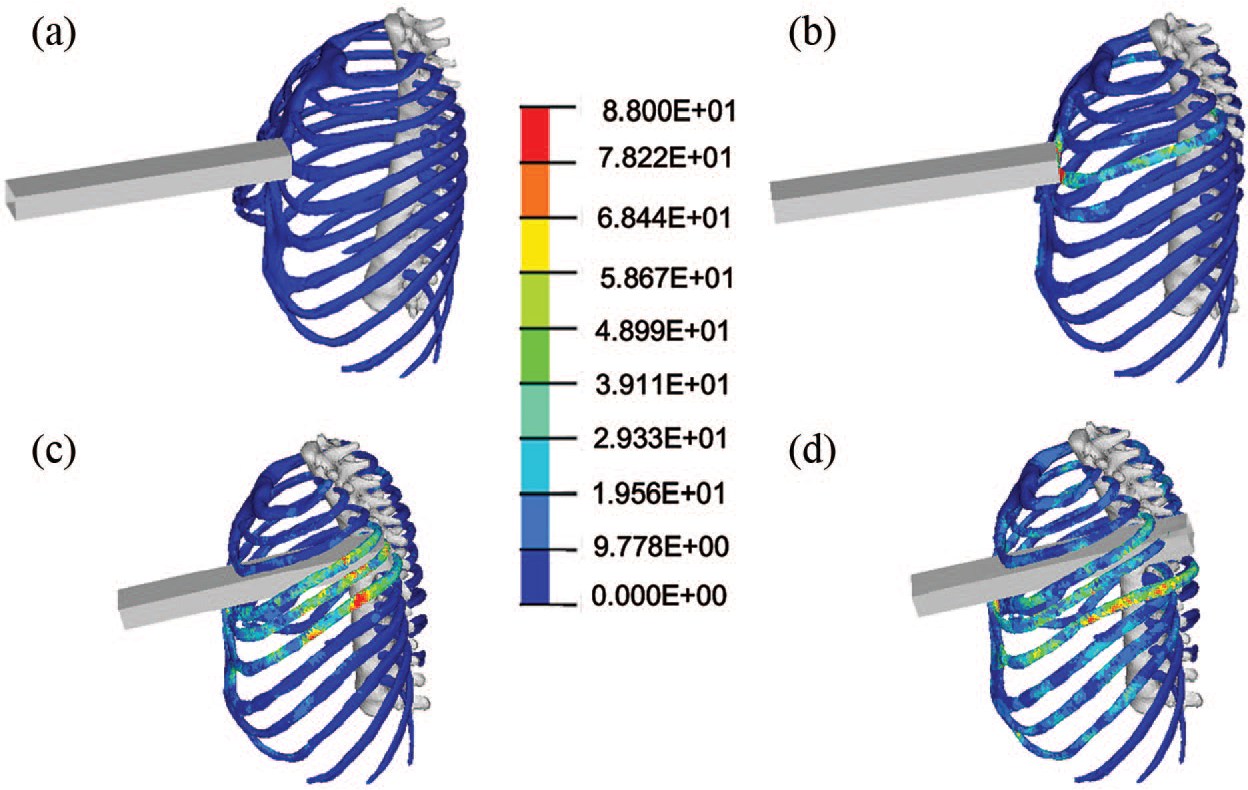
Guardrail long rod runs through chest simulation process: (a) 0 ms, (b) 0.5 ms, (c) 30 ms, and (d) 35 ms.
Figure 6 shows the simulation state of the collision of the TWLR on the chest at 0, 0.5, 30, and 35 ms. During 0–1 ms, the anterior ribs of the chest are penetrated and fractured, as shown in Figure 8(a). At 30 ms, the posterior ribs of the chest began to be impacted by the collision. During 30–35 ms, the posterior ribs of the chest were penetrated, as shown in Figure 8(b). At this time, the whole chest has been penetrated by the TWLR. When the ribs are penetrated and fractured, the ribs in other parts of the chest are fractured.
The simulation analysis
The penetrating thoracic injury is the most serious type of injury among surgery. As the main protective structure of the thoracic organ, the thoracic bone structure is often involved first in the chest injury.23,24 The TWLR through the chest involved in this article is a penetrating injury. The TWLR penetrates the human chest at a certain speed. The characteristics of the channel of the TWLR through the human organs are as follows.
The injury caused by the TWLR penetrating the chest is a penetrating wound. The Penetrating wound has entrances and exits. However, the size and shape of the wound caused by the projectile are different. There are three conditions for the entrance and exit of the penetrating wound caused by the projectile: (1) it is more common phenomenon that the exit is larger than the entrance. (2) The size of the entrance and exit is the same, because the TWLR is a rigid material. When it encounters the tissue resistance during the whole process, the end of the TWRL deforms a little, so the size of the entrance and exit is basically the same. (3) The inlet is larger than the outlet, and this is often the case with high-speed penetration at close range.
The TWLR through the chest tissue produces a thoracic channel. The size, shape, and trajectory of the channel depend on the properties of the TWLR and its breast bone and soft tissue. The penetrating wound may be straight or curved. The main reason for the tortuosity of the wound is that the TWLR encounters internal tissue resistance when penetrating the chest and changes its movement direction.
Case validation
The chest of the patient is penetrated from the chest to the back and left in the body by a piece of fir with a diameter of 4 cm. And the front and rear ribs are fractured, with multiple fractures in the chest. 25 It is consistent with the simulation process in Figure 8.
On 21 November 2017, a BMW crashed into the central isolation guardrail of the city road in Weifang, Shandong province. A TWLR formed in a collision is inserted through the windshield and penetrates the driver’s chest. Injury (driver) treatment is shown in Figure 7(a). The blood is flowing at the end of guardrail. And the length of TWLR is nearly 1m, which results in the inability to carry out CT examination. And it can not be rushed out. With the help of firefighters, the guardrail outside the injured body was cut off. The doctor then removed the remaining guardrails bit by bit from the chest, as shown in Figure 7(b). Doctors found the injured man’s ribs and collarbone in the upper left of the chest were crushed through, as shown in Figure 7, and the patient condition is consistent with the simulation. The subclavian vein is ruptured, the artery is torn, and multiple vessels and vessel walls are severely damaged. The tissue around the rod wall is polluted seriously. Fortunately, the barrier did not damage his heart. The operation took three days and four hours, and later, he was able to breathe on his own. However, due to the severe trauma, all the muscles in the chest suffered from ischemia and necrosis. After the several major surgeries and timely resection of all the necrotic muscle tissues, the fatal infection in the chest is stopped and a life is saved from death again.

Rescue site and long rod of thin wall. (a) Injured; (b) the thin-walled long rod.
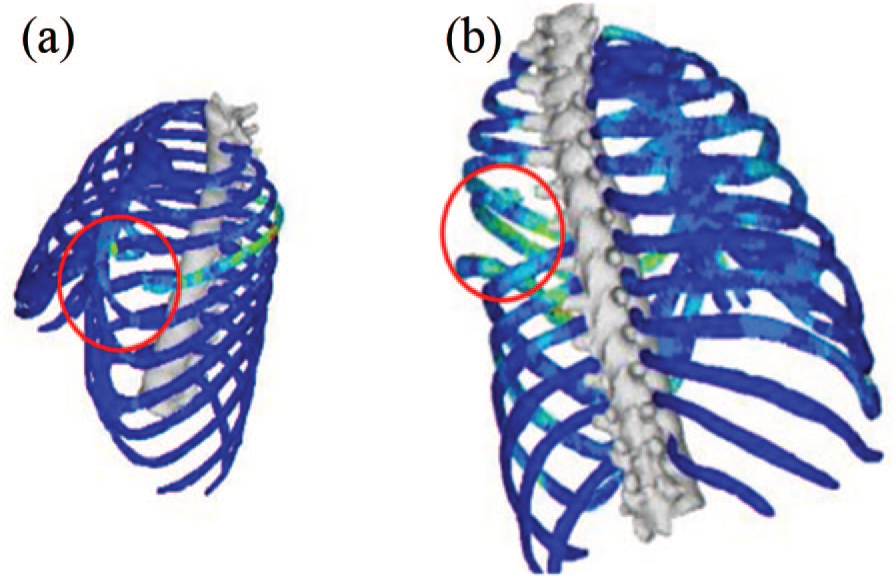
Thoracic rib penetration. (a) Entrance; (b) exit.
Corpse verification
The chest finite element model validation mainly refers to the corpse impact experiment, and the validity of the model is evaluated by comparing the chest deformation of experiment and simulation. Kroell et al.26,27 conducted low-speed impact experiments on corpses using cylindrical impellers with a mass of 23.59 kg and a diameter of 15.24 cm. The experiment hit the middle of the sternum of the corpse at an initial velocity of 6.7 m/s, and recorded the deformation of the chest with a high-speed camera. The frontal collision simulation is consistent with the boundary conditions of the experiment. The impacter is a rigid body, and the loading condition is to hit 1/4 of the sternum of the chest at an initial velocity of 6.7 m/s, as shown in Figure 9.

Chest collision validation model.
The results of comparison between simulation and experiment are shown in Figure 10. The simulated sternal displacements and time curves are consistent with the experimental trend. The peak displacements occur in 20–25 ms, with the experimental peak displacements of 82 mm, the simulated peak displacements of 79 mm, and the peak difference less than 5%, so the model has good validity.

Curve of displacement of chest and time.
Damage mechanism
The path through the chest
The penetrating process is followed by skin, subcutaneous tissue (muscle), bone, and visceral tissue (lung and heart, etc.), as shown in Figure 11, which is provided by Qingdao affiliated hospital.

Anatomy of human chest.
Indirect damage
The TWLR of the guardrail, which invades and runs through the driver’s chest at a certain speed, has a great energy in itself. The energy is transmitted to the surrounding tissues of the long rods, such as the chest bone, soft tissue, and internal organs. Subsequently, the surrounding tissues would move rapidly around, thus the gap between the chest tissue and the bar wall was formed (the gap is represented by the letter h), as shown in Figure 12. The whole process by which this gap forms and disappears is extremely short. The energy transfer causes the rapid changes in the intrathoracic pressure, leading to the tissue damage. The size of the clearance depends on the amount of kinetic energy transmitted into the tissue and the nature of the tissue itself. The greater the kinetic energy of the long rod, the larger the clearance will be. The more easily the muscle and liver can absorb and transmit kinetic energy, the larger the clearance will be. This situation is called cavity effect in the bullet penetration effect, and the theory of indirect damage needs to be further verified.

Simplified mechanism of chest injury.
Direct damage
In the process of TWLR penetrating the chest, it exerts forces (Ff, Fs) in two directions on the chest, as shown in Figure 12. One is the forward force (Ff), which moves along the direction of the TWLR, directly damaging the tissue and causing penetrating injury. The kinetic energy of the long rod is mainly expended on the direct damage to the chest. The other is lateral force (Fs), which acts on the tissues and viscera around the passage and causes damage to it.
Injury factors
The degree of damage caused by the collision of the TWLR, and the penetrating human chest is related to the kinetic energy, speed, weight, and movement stability of the TWLR. The most important damage factor is its penetration velocity.
Speed
The kinetic energy of the TWLR depends on the speed of the guardrail. The kinetic energy increases as drivers unconsciously step on the accelerator in a crash. The current general kinetic energy calculation formula is as follows

where m is the mass, V is the velocity, and Ek is kinetic energy.
Formula (1) indicates that kinetic energy is positively correlated with velocity squared. It must be pointed out that the greater the speed, the greater the kinetic energy, the impact on the chest tissue, the gap between the tissue around the long rod and the thin wall, and the greater the damage to the chest, even which causes permanent damage that cannot be recovered.
However, the lower the velocity is, the greater the sternum injury will be. As can be seen from Figure 13, the lower the velocity of the long bar through the chest, the greater the chest displacement will be. Figure 13 shows two crests and a trough. The first crest is caused by the long bar running through the front of the chest, and the second is caused by the long bar running through the back of the chest. Troughs are formed when the chest fails to recover from the first collision and is hit again by the second.

Relationship between velocity and chest displacement.
Stability
The TWLR rarely maintain stability in the chest cavity after penetrating the chest. This is because the bones, soft tissue, pleura, and lungs of the chest wall have different properties. TWLR is subjected to resistance in the movement of the chest, resulting in deflection, swing, and other phenomena, resulting in more serious damage to the chest tissue and organs.
Weight
The quality of the TWLR causes great damage to the driver’s chest. According to Formula (1), kinetic energy is positively correlated with weight. That is to say, the greater the weight of the TWLR, the greater the damage to the internal tissues and organs of the chest.
Conclusion
A finite element model of Chinese adult male chest with human anatomical structure is established. The human chest material model can accurately simulate the injury characteristics throughout the chest.
The model is verified by referring to medical penetrating injury cases and accident investigation cases. By analyzing the phenomena of rib fracture and fracture of chest before and after the collision, we find that the simulation results are in good agreement with the actual situation, and the model has certain validity.
By analogy to the bullet penetration effect, we find that the chest injury is directly related to the mass, velocity, and stability of the TWLR.
The analysis results of this article will provide important reference for the national government to formulate the laws and regulations of the city road barrier, and the medical treatment of penetrating chest injury and the injury of vehicle collision passengers.
There are some limitations in this study: (1) tetrahedral solid element is used to divide the biological model of chest (hexahedral solid element is more accurate in calculation). (2) The chest model do not distinguish cortical bone from cancellous bone. The cortical bone and cancellous bone are further refined according to the different gray values of the biological model, so as to improve the biological simulation. (3) In this model, the internal organs of the chest as well as skin and muscle tissues are not added. However, the skin and viscera will produce resistance to the penetration of the TWLR, which has certain influence on the velocity and trajectory of the movement in the chest.
In order to improve the accuracy of the model, it is necessary to carry out research in the later stage.
Footnotes
Acknowledgements
The authors would like to acknowledge the support of the Science and Technology Planning Project of Shandong University, China.
Declaration of conflicting interests
The author(s) declared no potential conflicts of interest with respect to the research, authorship, and/or publication of this article.
Funding
The author(s) disclosed receipt of the following financial support for the research, authorship, and/or publication of this article: This article was funded by the Science and Technology Planning Project of Shandong University, China (grant no. J16LB65).
