




Abstract
This paper presents a critical analysis of the multifaceted intermediary role played by ed-tech (educational technology) consulting providers in the realm of educational governance. The study draws on multidisciplinary research and uses illustrative examples from Germany to outline their impact on the integration of digital technologies in schools. By employing an analytical framework that encompasses three key perspectives—policy, pedagogy, and economics—the paper explores the complexities of consultancy between governance actors, sectors, and fields of knowledge. Considering these dimensions together, the study offers a comprehensive understanding of ed-tech consulting, shedding light on its influence on policy enactment, educational practices, and economic value chains. It underscores the challenges and tensions that consultants must navigate, while raising concerns about their potential to pre-empt pedagogical decisions and diffuse commercial interests into educational settings. As such, this paper aims to provide a conceptual foundation for investigating these ambiguities, with the goal of stimulating further research into the growing field of ed-tech consulting.
Introduction
The complexity of education governance has surged in recent years as a result of rapid advancements in educational technology (ed-tech), the emergence of dynamic policy networks, and the growing diversification of actors, from philanthropies and international organizations to ‘market-makers’ and investors (Castañeda and Williamson, 2021; Williamson and Hogan, 2020). Consequently, educational institutions face unprecedented challenges in navigating the dynamically changing webs of educational discourses and infrastructures, necessitating novel modes of communication and collaboration. As a result, new intermediaries have surfaced in the educational landscape. These actors bridge the gaps between sectors, reconcile the diverse interests of stakeholders across global-local or private-public domains and mediate in-between traditional institutional structures and societal spheres. They have been found to operate at the critical junctions of education governance, establishing cross-sector alliances, brokering ed-tech knowledge, funneling data flows, or linking digital educational infrastructures (Castañeda and Williamson, 2021; Hartong, 2016; Hartong and Förschler, 2020; Kerssens and Van Dijck, 2022; Williamson, 2016).
While the ‘in-betweenness’ defines the particular role of such intermediary actors in governance processes, it also complicates a comprehensive conceptual framing. Thus, researchers have coined various sub-types of intermediaries to grasp their heterogeneous characteristics, e.g. as “policy intermediaries” (Vandeyar, 2015), “evidence intermediaries” (Williamson and Hogan, 2020), “innovation intermediaries” (Howells, 2006), or “diffusion intermediaries” (Bergek, 2020). In the more specific context of educational governance and ed-tech research, such actors have been conceptualized as boundary brokers, hidden mediators, gatekeepers and intervenors, depending on the actors’ specific relation to governance, data, education, markets or knowledge (Decuypere et al., 2021; Hartong, 2016; Williamson, 2016).
Consulting, as a distinct type of intermediary work, hasn’t yet been comprehensively integrated in this set of research. Although consultancy in general has already been studied in various contexts, e.g. as guidance in school improvement projects (Goecke, 2018; Hazle Bussey et al., 2014), political and administrational consulting (Gunter, 2017; Gunter and Mills, 2017) or networking for educational reforms (Player-Koro and Beach, 2017), there is still very limited research on consultants as intermediaries in the implementation of digital technologies in schools (Cone et al., 2021; Förschler, 2021). The emerging and dynamic field of consulting in relation to ed-tech, however, offers ground to expand current research trajectories towards closer investigations of the ‘in-betweenness’ of consulting within education governance and digitalization.
This study utilizes the broad spectrum of existing research on intermediaries and consultancy to build a comprehensive understanding of the roles consulting providers play in the digital transformation of education. By using an integrated approach with three analytical dimensions—policy, pedagogy, and economics—the analysis systematically unpacks the complex nature of ed-tech consulting and its multifaceted intermediary functions. Each of these areas highlights different aspects of consulting, from influencing policy implementation, disseminating pedagogical and technological expertise to connecting the technology sector with educational institutions. The multi-faceted conceptualization is enriched with illustrative examples from Germany to provide insights into how ed-tech consulting providers, including private and public actors, work within and across these different operational dimensions. The analysis reveals that consultants’ work transcends a linear agenda, highlighting their unique position at the intersection of diverse interests and values and thereby challenging the conventional view of consultants as impartial facilitators or neutral mediators. Against this backdrop, the examples from Germany also serve to (re-)contextualize the general ambivalences and principles found in the broader literature on consultancy and intermediaries. In doing so, the paper aims to initiate a critical discussion on the challenges and opportunities associated with these emerging actors, hoping to establish pathways for future research across diverse socio-political landscapes.
Background: Ed-tech consulting in Germany
Since illustrative examples from Germany are employed throughout the analysis, it is crucial to briefly outline the contextual factors from which these insights are drawn. The German education system offers a mix of characteristics; some are distinctively local, whereas others resonate with broader global governance trends. Germany stands out for federal policy reforms, such as the ‘DigitalPakt’ 1 initiative and COVID-19 emergency policies, which have only recently elevated the role for ed-tech-related advisors in school-level change processes across the country. These policies increased the pressure on schools and municipalities to implement digital technologies and develop guidelines for their institutional transformation. Consequently, the federal states recognized that “qualified consulting and conceptual support” (KMK 2016, transl. L.J.) is crucial to guide schools through these transformative processes. Yet, the availability of public consultancy services remains inconsistent across different regions due to Germany’s decentralized education system. While there exists a degree of federal coherence, substantial differences persist among states and municipalities (Rohde and Wrase, 2022). Another circumstance influencing the adoption of ed-tech in Germany is its historical wariness toward corporate involvement in education. This cautious stance has led to a fragmented ed-tech market, limiting the access and influence of major tech corporations. Nevertheless, the landscape is evolving, particularly catalyzed by the COVID-19 crisis. Many ed-tech companies are now gaining traction within the German educational system, and consulting services have emerged as pivotal gateways for these businesses to enter the market (Cone et al., 2021).
At the same time, Germany is not exempt from the global trend towards a growing diversity of actors involved in education governance. This development is also reflected in the sphere of ed-tech consultancy itself. On the one hand, public entities have tried to reinforce their provision of ed-tech-related consulting services for schools. These providers include: • State-level institutions like the Institute for Quality Development in Schools of Schleswig-Holstein (IQSH) or the Lower Saxonian State Institute for School Quality Development (NLQ) • Municipal institutions known as Medienzentren (media centers), which operate for various municipalities such as Leipzig, Tübingen or Hochtaunuskreis
On the other hand, the provision of ed-tech consulting through private and non-profit actors has diversified and expanded considerably. In recent years, a growing number of actors with different backgrounds have entered the field of ed-tech consulting in Germany, further indicating a need for thorough investigation. In addition to the public institutions mentioned above and various freelancers, these new actors include: • Non-profit organizations, ranging from bigger organizations with close ties to the IT industry to smaller local organizations, such as the Pacemaker Initiative or the Zentrum für digitale Bildung und Schule (Center for Digital Education and Schooling) • Local consulting firms specialized on managing (digital) school transformation processes, e.g. GPI Consulting or HiSolutions • Private IT service providers that have expanded their portfolio and are now offering ed-tech consulting together with their conventional services, i.e. reselling, customization, installation, and maintenance of hard- and software, such as thinkRed, REDNET and the Gesellschaft für digitale Bildung (Association for Digital Education)
While these actors vary in size and focus, they all offer consulting services to support the integration of educational technologies into learning and teaching environments. They provide schools and school districts with interdisciplinary expertise to help them implement digital technologies in their organizations, assist them in finding appropriate technologies for their specific contexts, and provide guidance on organizational and pedagogical change processes. This involves a combination of pedagogical, technical, administrative, economic and legal expertise and can take a variety of forms, such as expert advice, mediation, training or coaching.
The following chapters analyze these activities, their implications, and the specific contexts in which they occur. The next chapter will first focus on how providers of ed-tech consulting operate in the realm of policy implementation. This will involve integrating research on intermediary actors in education policy with findings on consultancy while drawing on contextual examples from Germany.
Ed-tech consulting providers as policy intermediaries
From a policy-oriented perspective, actors in the field of ed-tech consulting can be seen as intermediary actors that engage in the implementation of policies into local school settings. This analytical dimension is linked to findings from education policy studies and governance research, which have already examined a variety of actors, such as nonprofit organizations and philanthropies (Reckhow and Snyder, 2014; Smylie and Corcoran, 2009), ed-tech policy networks (Hartong and Förschler, 2020), as well as school oversight committees and steering groups (Diedrich, 2020; Honig, 2004). In this context, ed-tech consulting providers, are examined in their role as intermediaries that “operate between policymakers and implementers” (Honig, 2004: 65) and facilitate the alignment of organizations with the governmental standards (Hazle Bussey et al., 2014). Thus, this perspective conceptualizes consultants not only as supporters of individual schools, but also as part of the educational governance system (Adenstedt, 2016), as they connect different levels of governance, translate and interpret policy discourses, and ultimately shape the implementation of policies.
Connecting policy levels
Research emphasizes the pivotal role of intermediary actors in policy implementation, facilitating coordination among diverse stakeholders and “connect[ing] otherwise unconnected actors” (Caves and Oswald-Egg, 2021: 6). This becomes crucial in increasingly complex education governance landscapes, characterized by a multitude of actors spanning public, private, global, and local spheres gradually becoming more “messy, patchy and diverse” (Ball, 2012: 100). To address these complexities, multilevel systems approaches have gained popularity among German education policy scholars (Altrichter, 2010; Maag Merki et al., 2014). Their decomposition of school systems into macro, meso, and micro levels recognizes the complexity inherent in decentralized education systems. More importantly, it aims to acknowledge the intricate interplay between federal, state, and municipal actors by emphasizing the need for “cross-border coordination” (Altrichter, 2010: 150). These coordinative acts are particularly relevant in the context of ed-tech policy implementation in Germany, where communication and cooperation challenges between different structural levels have been identified as significant constraints. This is partly due to Germany’s strict legal separation of pedagogical matters (responsibility of the schools and the federal state) and technological matters (responsibility of the municipality), which further complicates coordinated transformative initiatives (Krein, 2022; Petry et al., 2021; Rohde and Wrase, 2022).
In this context, policy research suggests that intermediary actors can mitigate such coordination barriers, as they operate in-between these ‘layers’ of governance and build bridges between the structural levels of policy implementation (Diedrich, 2020; Goecke, 2018; Hazle Bussey et al., 2014; Honig, 2004). For example, Frankfurt’s media center states on its website that it acts as a “mediator for digital education between municipal and state interests” by organizing or participating in network meetings, working groups, and advisory boards (Medienzentrum Frankfurt, 2024, transl. L.J.). Similarly, the NGO Zentrum für digitale Bildung und Schule organizes “round tables” with school principals, administrators, and public consultants to create “a common understanding of the [ed-tech implementation] processes” (ZdB, 2023, transl. L.J.). Consulting providers more closely tied to the IT industry also see economic actors as relevant actors in such networks. While the implications of these industry connections will be explored later, the various roles consultants play as policy “networkers” emphasize their ability to connect stakeholders but also highlight their potential to critically influence participation procedures, both by including and excluding actors.
Making sense of policies
Furthermore, in their interconnected position between different levels and actors of educational governance, ed-tech consultants can provide critical support to schools and districts in making sense of what one may call the ‘vagueness’ of policy. As Ball (1994: 19) puts it, “policies do not normally tell you what to do”, they rather create new circumstances for the spectrum of decision-making options and set certain goals. In many cases, schools are only implicitly informed by a policy but not precisely instructed on how to implement new demands effectively (Vandeyar, 2015). While different interpretations of the ‘policy intent’ are to a certain extent inevitable, successful implementation processes aim for some degree of “customized coherence” (Clune, 1993: 234) at the local level. Therefore, implementers are expected to ‘enact’ policies by interpreting and translating (universal) discourses into (specific) practices (Ball et al., 2012). However, in many cases, district administrators and school leaders have been found to lack the capacity to decontextualize policy intent into practice (Krein, 2022; Petry et al., 2021). In Germany, this has been particularly important as recent developments in educational governance have increased output-oriented control and school autonomy, thus placing greater demands on schools to develop individual approaches to change (Goecke, 2018).
As a result, schools and administrators have faced numerous challenges in the context of the aforementioned ‘DigitalPakt’ reform (Krein, 2022; Petry et al., 2021). Bureaucratic requirements, uncertainties about data protection, and varying infrastructural conditions have made it difficult to implement the policy effectively (ibid.). Moreover, a particular challenge lies in implementing the foundational principle of the policy, the ‘primacy of pedagogy’, which postulates that the digital transformation of the German education system should be guided by pedagogical considerations. In accordance with this central tenet, schools and administrations are required to develop ‘media concepts’ grounded in educational principles. However, many institutions lacked sufficient guidance on how to do so.
In this context, ed-tech consulting providers play a critical role as policy intermediaries. Their involvement entails providing essential services and resources to schools, assisting them in executing new requirements (Honig, 2006). Public ed-tech consultancies, such as Lower Saxony’s Medienberatung (media consultancy) and the municipal media centers, address policy-related challenges by providing services, such as identifying potential funding sources, presenting relevant regulations, or helping to develop ed-tech concepts for the ‘DigitalPakt’ initiative. They also assist schools and districts in complying with data privacy laws, which can vary from state to state in Germany. 2 Moreover, amidst these government-led initiatives, private sector providers actively promote their consulting services by emphasizing the complexities of the policy landscape, positioning their offerings as effective solutions. For example, the company thinkRed states on its website that “whether it’s the DigitalPakt or additional investment programs - thinkRED helps you navigate the ‘jungle of applications’” (thinkRED, 2024a, transl. L.J.).
Shaping policy implementation
The widespread expansion of services within this domain, provided by both public and private entities, underscores that there is indeed a keen interest from educational institutions for such forms of guidance. Nevertheless, as Ball and colleagues (2012) note, the interpretation and translation of policies are subject to iterative refractions that require critical reflection, as the interests, beliefs, values, views, and knowledge of actors ultimately shape the enactment of policies. Thus, acting as policy intermediaries, ed-tech consulting providers wield substantial influence, directly or indirectly impacting policy implementation. They can select and prioritize specific policy elements and tools, and consequently, affect implementation approaches. This process can lead to unintended consequences, as certain policies or strands within policies may be emphasized while others are neglected, potentially leading to widely differing interpretations of policy intent (ibid.).
Thus, it is essential to recognize that prioritizing policy compliance may not necessarily result in improvements within learning and teaching environments. Consulting services that primarily aim to meet specific policy criteria may place greater emphasis on fulfilling compliance obligations rather than considering pedagogical implications. For example, the company dchp Consulting promotes their services as an “implementation acceleration for the DigitalPakt” (dchp Consulting, 2020, transl. L.J.). While such offers respond to calls for a faster and more efficient digitization of schools in Germany, they also run the risk of narrowing the scope of the implementation process to the expenditure of (otherwise expiring) funds. A purely technocratic view on the issues of ed-tech implementation may not take sufficient account of the complex participation and negotiation processes which are necessary to ensure a pedagogically sound and sustainable integration of educational technology (Heldt et al., 2020). Consequently, an exclusive focus on policy compliance might overshadow the original objective of transforming teaching and learning.
Against this backdrop, it is important to consider the impact of consultancy on the implementation of ed-tech in the classroom and their role in shaping pedagogical practices. Ed-tech consultants can act as policy intermediaries, facilitating the implementation of educational policies, coordinating stakeholders, and assisting schools in complying with policies. However, their work also goes beyond the policy dimension and has significant pedagogical implications. It is therefore crucial to explore the context of their pedagogical intermediary work in order to understand the broader impact they have on transforming educational practices. The upcoming analytical dimension will further explore these multifaceted roles of ed-tech consulting by highlighting the implications of their work in transferring technological and pedagogical knowledge and shaping educators’ decision-making.
Ed-tech consulting providers as pedagogical intermediaries
The second perspective highlights the role of actors in the field of ed-tech consulting as intermediaries between the technical aspects of ed-tech and the pedagogical decisions required for its implementation. According to Gunter and Mills (2017: 51), consultants in education systems can be seen as working “(simultaneously) as ‘regulators’ and ‘diffusers’ of knowledge and as ‘shapers’ and ‘diffusers’ of teachers’ professional practice”. Ed-tech consultants, as experts in educational technology, can therefore be regarded as actors who bridge and transfer expertise from the fields of technical and pedagogical knowledge (Mishra and Koehler, 2006). Moreover, they evaluate and broker ‘what works’, similar to what Williamson and Hogan (2020) described as “evidence intermediaries”. This perspective allows us to examine the pedagogical tensions surrounding the integration of ed-tech tools, highlighting the critical role of ed-tech consultants in mediating pedagogical approaches, guiding schools to align their visions with technology, and processing expertise for educational practice.
Guiding schools through pedagogical discussions around ed-tech
Educational technologies often come with their own imperatives that enable or constrain certain content to be covered and the modes of presentation that are possible, thus, affecting or predetermining instructional moves and other pedagogical decisions (Koehler et al., 2013). Consequently, in order to make pedagogically informed decisions about what ed-tech to procure and how to appropriate it for a specific teaching and learning environment, it is necessary to reflect on one’s pedagogical goals and relate them to the technical abilities of ed-tech (Brandau and Alirezabeigi, 2022; Hashim, 2017). According to Koehler et al. (2013), these processes require “technological pedagogical knowledge”. However, many researchers have found significant “uncertainties about the compatibility of technology with the individual vision of teaching” (Petry et al., 2021: 8, transl. L.J.) among school staff. Given the usual lack of transparency, evidence, or prior experience with particular products, schools in Germany have explicitly emphasized the necessity for expertise to support the integration of ed-tech (Brandau and Alirezabeigi, 2022), mirroring similar needs in the UK (Hillman, 2022) and the US (Morrison et al., 2014).
In this context, educators often rely on third parties as “knowledge brokers” (Neal et al., 2022; Shewchuk and Farley-Ripple, 2022) or “evidence intermediaries” (Williamson, 2021; Williamson and Hogan, 2020), such as textbook publishers, teacher magazines, training providers, think tanks, and departments of education. Ed-tech consultants can also be considered to be part of this group, as they transfer ed-tech implementation know-how by working closely with practitioners and administrators through seminars, workshops, or consulting. This can include presentations of “best practices” for ed-tech infrastructure, as well as specific use cases for applications and digital tools (LMZ BW, 2024; REDNET, 2024). Moreover, consulting providers often advocate for and conduct “strategy and vision workshops.” These workshops address questions such as “What does the future of your school entail?” (HiSolutions AG, 2024, transl. L.J.) or even pledge to “redefine their vision of learning, teaching, and the educational environment” (GfdB, 2024, transl. L.J.), suggesting that consultants do not only bridge fields of expertise, but also provide their own input to stimulate change.
Such efforts should be critically examined, as aligning pedagogical goals with ed-tech in schools has proven to be a challenging task, with many tools showing limited transformative potential or even reinforcing existing teaching styles (Reich, 2020). Schools have grappled with various issues related to the use of ed-tech, such as the appropriate age for providing devices to students, determining when to use tablets versus laptops, and whether interactive displays are necessary in the classroom. In addition, recent trends such as datafication, platformization, and algorithmification have intensified debates about the appropriate implementation of ed-tech. While proponents believe data-driven approaches can improve learning outcomes (Clow, 2013), critics argue they oversimplify education and reinforce surveillance and behaviorist pedagogy (Knox et al., 2020; Manolev et al., 2019).
The varying narratives in ed-tech research resonate with the ambivalent opinions among educators. Studies showed that German teachers are concerned about decreased direct communication, weakened pedagogical connections, and potential distractions (Lorenz, 2018). At the same time, however, educators have shown positive attitudes toward ed-tech, recognizing its potential to promote student-centered approaches and positively influence learning processes (ibid.). Thus, ed-tech consultants face the challenge of mediating between these tensions when working with schools. However, despite their role as external experts, consultants should not be seen as inherently neutral pedagogical mediators; rather, given their political and economic dependencies outlined in this analysis, they are likely to be drawn into these discursive conflicts themselves and may be inclined towards particular narratives and approaches. Hence, the promise to guide schools in developing or even redefining their vision of learning and teaching requires a closer look at the sources of expertise and pedagogical values of consultants themselves.
Recontextualizing technological-pedagogical knowledge for schools
In this context, close attention needs to be paid to the pedagogical approaches that are transferred to schools through consultancy. As pedagogical intermediaries, consultants acquire “technological pedagogical knowledge” (Koehler et al., 2013; Mishra and Koehler, 2006) from a variety of sources and adapt it to practical contexts. In parallel with their engagement in policy implementation, ed-tech consultants act as intermediaries in the realm of pedagogy by transforming abstract objectives or narratives into concrete (“best”) practices. By disseminating such knowledge to schools, they engage in what Bernstein (2003) calls pedagogical “recontextualization” and thus prioritize certain domains within their ideological systems when constructing, appropriating, and transforming conceptions of pedagogical practice.
These pedagogical approaches can vary from one consulting provider to another. Public consultants typically operate within official guidelines, such as North Rhine-Westphalia’s Medienberatung, which explicitly adheres to guidelines set by the Conference of Ministers of Education and the state’s digital literacy framework (Medienberatung NRW, 2019). Private consultants, on the other hand, are less tied to these formal structures. For example, consulting offered on the platform Education Campus is linked to the Skills for Innovation program by chip manufacturer Intel, which deviates from the official state guidelines (Education Campus, 2024). 3 The adoption of these particular pedagogical frameworks is likely to shape the methodologies of consultants and subsequently influences the broader “pedagogical discourse” (Bernstein, 2003).
Furthermore, it is crucial to emphasize the significance of the role of consultants in restructuring knowledge into packaged ‘solutions’, as highlighted by Gunter (2017). In the context of ed-tech consulting, this entails converting pedagogical and technological knowledge into comprehensive offerings adapted to meet the specific needs of educational institutions. However, this approach presents a dilemma: while it strives to offer cohesive and targeted information, it also simplifies and streamlines complexities. Consequently, there’s a risk of preempting educators’ pedagogical decision-making, potentially obscuring educational implications and limiting teacher autonomy.
This dilemma manifests in the array of offerings from ed-tech consulting providers, such as curated hardware/software combinations and pre-designed ed-tech packages. For example, public media centers, such as the Landesmedienzentrum (state media center) of Baden-Württemberg, and IT service providers, such as the company REDNET, offer lists of software that they consider useful for schools (LMZ BW, 2024; REDNET, 2024). In addition, many IT service firms have offered to develop ed-tech infrastructure plans for schools and administrations in the context of the DigitalPakt reform mentioned above. In some cases, these particular service packages are highly standardized, with much input coming from the consultants themselves. For example, the provider REDNET promotes an “approximately 15-page concept” (2019, transl. L.J.) at a cost of €4,000.00 or more, which will be “developed and put on paper by REDNET’s ed-tech consultants in collaboration with a steering group,” including “a pedagogical vision, a media-pedagogical orientation of the infrastructure, a precise selection of the required hardware, and a justification for the selection” (ibid.).
The provision of such standardized ‘guidance’ is intended to attract schools and administrators with a lack of expertise, resources, or time constraints, as pre-designed templates promise efficient adoption of ‘what works’ and minimize disruption to daily school practice. However, relying extensively on these templates could inadvertently amplify the impact of external commercial actors, thereby imposing their specific educational visions on schools. Moreover, it might dissuade educators from engaging in collaborative experimentation and crafting personalized frameworks for integrating educational technology. Thus, the potential drawbacks of excessively depending on external expertise in digital transformation processes warrant careful consideration (Brandau and Alirezabeigi, 2022).
Lastly, considering that the endorsement or promotion of specific products and tools inherently serves the commercial interests of their respective vendors, whether such benefits are intended or not, raises questions about the economic implications of such offerings. The focus will therefore now shift to the third and final perspective, which complements the previous analytical considerations by examining the relationships between ed-tech consultancy and the ed-tech market. This dimension aims to shed light on aspects that have not yet been addressed, namely the importance of ed-tech production sites, their influence on consulting practices, and the role of consultancy for ed-tech producers. By examining consulting through this lens, we can gain a deeper understanding of how the tensions surrounding pedagogical knowledge and policy implementation are intricately intertwined with economic considerations.
Ed-tech consulting providers as economic intermediaries
From an economic perspective, actors in the field of ed-tech consulting can be seen as intermediaries bridging the gap between sellers and buyers or private and public sectors. In economic research, such intermediary entities are often described as “innovation intermediaries” (Howells, 2006). Williamson (2014) used this term in ed-tech governance research to refer to think tanks and nonprofit organizations that disseminate economic ideas to the public sector. Building on the same conceptual foundation but with particular emphasis on technology adoption, Bergek (2020) also proposed the term “diffusion intermediaries”. According to the researcher, these actors are “putting suppliers in contact with end users […] and [are] helping adopters to configure the technology to their particular needs” (Bergek, 2020: 380). Applied to the analysis of consulting providers, such a perspective helps to draw particular attention to their intermediary role as an integral part of the “global education industry” (Verger et al., 2016), their role in the “K-12 educational technology value chain” (Pierce and Cleary, 2016), and thus, their relationship to schools and ed-tech firms as users and suppliers.
Supporting users
Firstly, an analytical focus can be placed on the interdependencies of the ed-tech market and consulting providers, and their particular impact on educational institutions as adopters and users. Research on intermediaries in innovation processes shows that actors in-between technology transfer processes play a key role in scanning and gathering information about emerging technologies, market trends, and user needs (Howells, 2006). Dynamic, unregulated technology markets and the vast number of products available pose challenges for ed-tech procurement (Hillman, 2022; Morrison et al., 2014, 2015; Petry et al., 2021), making it difficult for schools and administrators to gain a “full view of who the good vendors and products are” (Hillman, 2022: 13).
Against this backdrop, ed-tech consulting providers as actors in technology diffusion, offer to help users to make informed decisions about whether or not to adopt a technology by evaluating and contextualizing technologies. For example, the Institute for Quality Development in Schools of Schleswig-Holstein (IQSH) offers a “guide for making the right decisions when selecting, procuring and setting up suitable IT infrastructures and required devices” (IQSH, 2020, transl. L.J.) which elaborates on recommended standards and technical requirements, e.g. for the interfaces of interactive displays or the computing power of laptops. According to Morrison and colleagues (2015), the demand for such services can be considered as a rational-choice strategy of ‘choosing not to choose’, as consumers aim to “restrict the costs of having to select between multiple options by restricting the choice set in advance” (p. 408). Consequently, ed-tech consulting should be considered a critical bottleneck in IT procurement. While acting as curators and gatekeepers, they engage in the normative process of reducing the complexity of the technology marketplace for schools.
Supporting suppliers
Depending on the criteria, logics, and biases that undermine these intermediary decision-making processes, consulting providers wield significant influence in shaping the landscape of the edtech market towards specific products and vendors (Williamson and Hogan, 2020). Sometimes, such biases are quite overt, as evident in a list of “10 reasons why every teacher should work with a Mac,” published by IT service firm ACS (2024, transl. L.J.). These marketing-style endorsements often result from collaborations between private companies, which offer ed-tech consulting, and technology vendors (Kerssens et al., 2023).
Economic research shows that intermediaries in technology diffusion act as “business incubators” (Dalziel and Margaret, 2010: 4), accelerating the growth of companies. Especially smaller ed-tech developers and start-ups often struggle to gain brand recognition, making it difficult for them to establish themselves in the education sector (Morrison et al., 2014). But with the engagement of ed-tech consultants in innovation diffusion processes, these smaller companies may gain a foothold in the market. Notably, IT service companies are increasingly recognizing their key role as intermediaries, as evidenced by initiatives such as co.Tec’s startup program, designed explicitly to connect entrepreneurs with the education system (Co.Tec, 2022). The consulting providers’ close connections to local schools and administrators and their knowledge about local structures can provide crucial access points to the vendors’ markets, especially in decentralized education systems, as it is the case in Germany (Cone et al., 2021).
Particularly those companies that offer both consulting and conventional IT services for schools are crucial door-openers for suppliers. These firms provide consulting along with customized IT products, sales, training, and maintenance for partnering ed-tech manufacturers – so-called “value-added services” (Youngdahl and Loomba, 2000) in industry terms. As “ambassador brokers” (Decuypere and Williamson, 2021) they support industry players, e.g. as Google for Education Premier Partners or Apple Authorised Education Specialists (Ideland, 2021; Lewis, 2022). Kerssens and colleagues (2022, 2023) argue that such partnerships have become a wide-spread business practice for the integration of educational platforms. The researchers conclude that “[l]ike car dealers who have committed to selling and servicing specific brands” (Kerssens and Van Dijck, 2022: 292), providers and schools are “increasingly integrated into the service line of [...] Big Tech companies” (ibid.), and further link the trend to the “Googlization” of education in the Netherlands, the US, and Australia (Kerssens et al., 2023). Similarly, in Germany, IT-service providers such as Bechtle or the ACS Group offer Apple-affiliated “Planning Essentials Workshops,” which are explicitly designed for school leadership teams to “develop a customized project plan for the successful implementation of Apple technology” (Bechtle AG, 2024, transl. L.J.), thus paving the way for Big Tech in the early stages of ed-tech implementation.
Funneling products into schools
In this context, the lines separating consulting and IT services, such as product sales, installation, and integration, are progressively blurring. Economic studies in Germany indicate that the rise of ‘full-service providers’ is part of a larger market trend (Lippold, 2018). This shift towards comprehensive service provision, providing ‘end-to-end’ support, has led many companies to evolve into what the market research firm Lünendonk (2022) terms as “business innovation/transformation partners” (BITPs). In light of this trend, some of the aforementioned companies are marketing their services as “360-degree” or “care-free” packages (thinkRED, 2024b, transl. L.J.). This expansion of services related to the digitization of schools is likely to play a key role in consolidating their importance in the German education landscape.
Furthermore, the increased interdependencies between consulting and ed-tech sales raise concerns about whether such private ed-tech ‘innovation/transformation partners’ might also reinforce “product-oriented discourses” (Witte, 2007) in ed-tech implementation. Focusing on the diffusion of IT innovations within the institutional transformation of schools pushes pedagogical (or political) considerations into the background of consultancy. It may reduce potential incompatibilities of ed-tech supply and users’ needs to ‘market inefficiencies.‘ Sturdy (2018) notes that such ‘match-making’ approaches can lead to the phenomenon of “solutions chasing problems” (ibid.: 11) where client problems are ‘translated’ to fit the solutions available to a particular consulting (or technology) provider. Hence, the author calls for a critical examination of how consultants co-produce both problems and solutions with clients and how they navigate between supply-push and demand-driven methodologies. Moreover, as the previous two analytical perspectives on ed-tech consulting have shown, a ‘mismatch’ between schools and particular ed-tech products should not be understood as a mere market irritation. Instead, such issues are always embedded in political struggles and pedagogical considerations, influenced by normative choices and discourses in the spheres of policy, pedagogy and economics.
Synthesis and outlook
The exploration into the diverse activities of ed-tech consulting providers has underscored their pivotal role in educational settings, influencing policy, pedagogy, and economics. This comprehensive analysis not only contributes to a refined understanding of ed-tech consulting, an area that remains underexplored, but also aims to raise awareness for the tensions and biases associated with the external expertise of consultants. By elucidating their intermediary roles from various angles, this analysis emphasizes the distinct tasks undertaken by the burgeoning consulting sector, illustrated by various insights into the German education landscape. From a policy standpoint, consulting providers serve as facilitators in education policy implementation, navigating intricate policy landscapes, bridging governance levels, and ensuring schools’ adherence to policy mandates. Looking through the pedagogical lens, consultants act as educational brokers, adapting and disseminating technological pedagogical knowledge. Simultaneously, from an economic perspective, they facilitate technology transfer processes, forging links between educational institutions and the IT market. Collectively, these perspectives underscore the critical role of ed-tech consultants as intermediaries that link policy, pedagogy, and technology within the educational realm (Figure 1). A multi-faceted conceptualization of ed-tech consulting.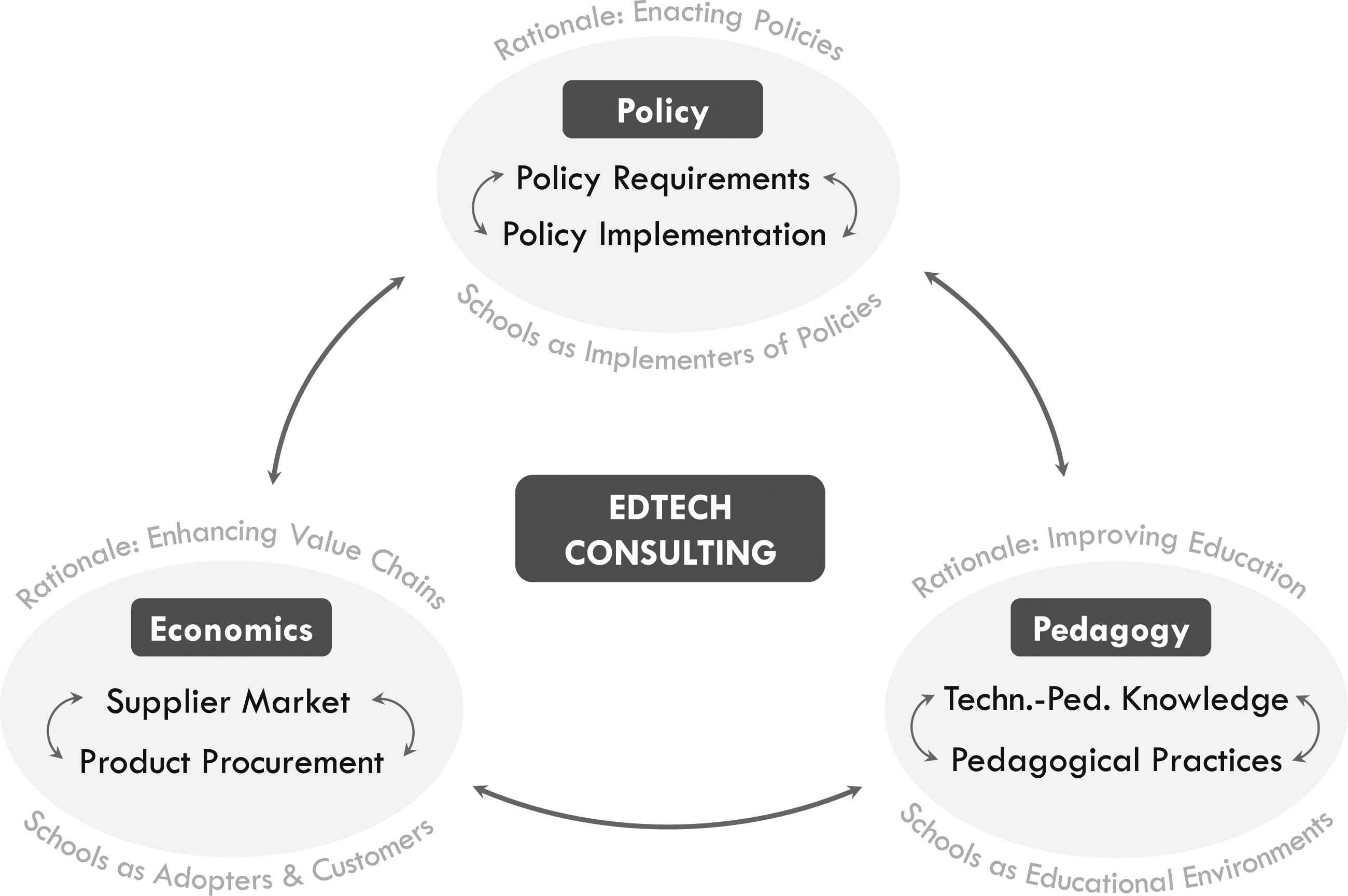
However, a critical evaluation of consultancy through these lenses also exposes several intricacies and potential pitfalls. Firstly, a close examination of consultants as policy intermediaries cautions against the risk of overly emphasizing political and/or administrative compliance, potentially overshadowing the crucial impacts on pedagogy. The role of consultants as networkers in this context also underscores the influence they have in shaping ed-tech governance, depending on which stakeholders they include in coordination and mediation processes. Secondly, the analysis sheds light on how consultants might prioritize specific pedagogical norms or frameworks, consequently shaping pedagogical discourse and practice. While aiming to streamline information and provide best-practice solutions to schools, there is a risk of inadvertently oversimplifying complexities, standardizing pedagogical decision-making, and consequently, constraining educators’ autonomy. Thirdly, the economic aspects of consulting services raise concerns about potential biases and commercial interests that could underlie their recommendations and partnerships. Instances such as overt endorsements of particular brands or products, along with blurred lines between consulting and selling, cast doubt on the integrity and impartiality of certain consulting services.
Considering that consultants operate within these tensions and ambivalences highlights their positioning within and between different spheres of actors, markets and logics. The management and balancing of political, pedagogical and economic logics through ed-tech consulting needs to be closely examined, taking into account that actions in one area and context-specific rationales may affect the pursuit of goals in other areas. Hence, consulting providers are unlikely to be found to simply adhere to a linear agenda. This understanding draws attention to the variance among ed-tech consultants, with some potentially leaning more toward one dimension than others. To address this complexity, this critical evaluation argues for increased scrutiny and highlights the need to be aware of potential biases, underlying commercial interests, and the impact on teacher autonomy within consultant-led technology adoption. Considering that the ‘improvement’ and ‘optimization’ of schools are often defined as the aim of external consultancy, critical research should prompt the crucial question: “Improvement for whom and at what cost?” (Mockler and Groundwater-Smith, 2018: 2).
Moreover, the insights gained from the examples of ed-tech consulting in Germany provide various impulses for a discourse on the role of similar actors internationally. While public consultancies seem to be less common in other countries, the presence of consultants affiliated with IT-service providers, consulting firms, or Big Tech companies marks a significant parallel. Emerging companies such as Knowing Technologies, Resultant, Educational Collaborators (USA), Softegg (UK), Speyk (Netherlands), and Signpost (Belgium) equally raise questions about their influence on policy implementation, the dissemination of pedagogical visions, and their roles as ‘ed-tech market makers’ through consulting and IT services. Furthermore, as demonstrated by the complexities highlighted in this analysis, the international emergence of these private sector actors warrants a critical examination of a potential larger trend of “outsourcing” (ed-tech) expertise. There is a need to further explore the phenomenon and critically evaluate to what extent private expertise is supplanting public sector knowledge, as critics warn that such developments may erode the independent capability of the state (Ylönen and Kuusela, 2019).
Hence, future studies could raise several relevant questions in this context: What contextual factors increase the relevance of (private/public sector) consultants? Is there a higher demand for consulting in decentralized countries like Germany, where municipalities and schools have to develop individual solutions and infrastructures, as opposed to centralized procurement and implementation? What kinds of patterns and structures perpetuate commercial biases in consulting? How can public consultancies strengthen the promotion of public values in ed-tech implementation? Ultimately, by presenting a multifaceted conceptualization of ed-tech consultancy, this paper seeks to inspire and guide further research inquiries into these matters. Exploring these questions could offer further perspectives on the dynamics of ed-tech consulting and its impact on education systems worldwide.
Footnotes
Declaration of conflicting interests
The author(s) declared no potential conflicts of interest with respect to the research, authorship, and/or publication of this article.
Funding
The author(s) received no financial support for the research, authorship, and/or publication of this article.
