




Abstract
In this editorial, we outline origins and evolutions of (studying) intermediaries in the field of education. While intermediaries have played a significant role since the establishment of mass education in the 19th century, it was not until the broader transformation from government to governance from the 1970s onwards that intermediaries became visible – and investigated – as a distinct field of powerful actors. The more recent digital transformation of education can, on the one hand, be situated within these broader evolutions. On the other hand, the rise of digital technologies, data infrastructures and platform has also significantly impacted, and further empowered, the field of intermediaries. With this Special Issue, which consists of five contributions, we aim at a closer disentanglement of these recent transformations. In this editorial, each contribution is briefly discussed individually, before outlining some overall findings of the issue.
Setting the scene: intermediaries as an expanding field in education scholarship
Over the past decades, education scholars’ interest in so-called ‘intermediary actors’ has expanded tremendously. This impression is numerically substantiated when counting the publications in Web of Science or Scopus that mention intermediaries in their title, abstract, or keywords. The trend is hereby reflected not only in absolute frequency, but also, even though to a lesser extent, in relation to all publications dealing with education (see Figure 1).
1
Number of articles mentioning (intermediar*) and (education*, school*, learn* or teach*) in title, keywords or abstract. Source: Scopus, Web of Science. Own calculations.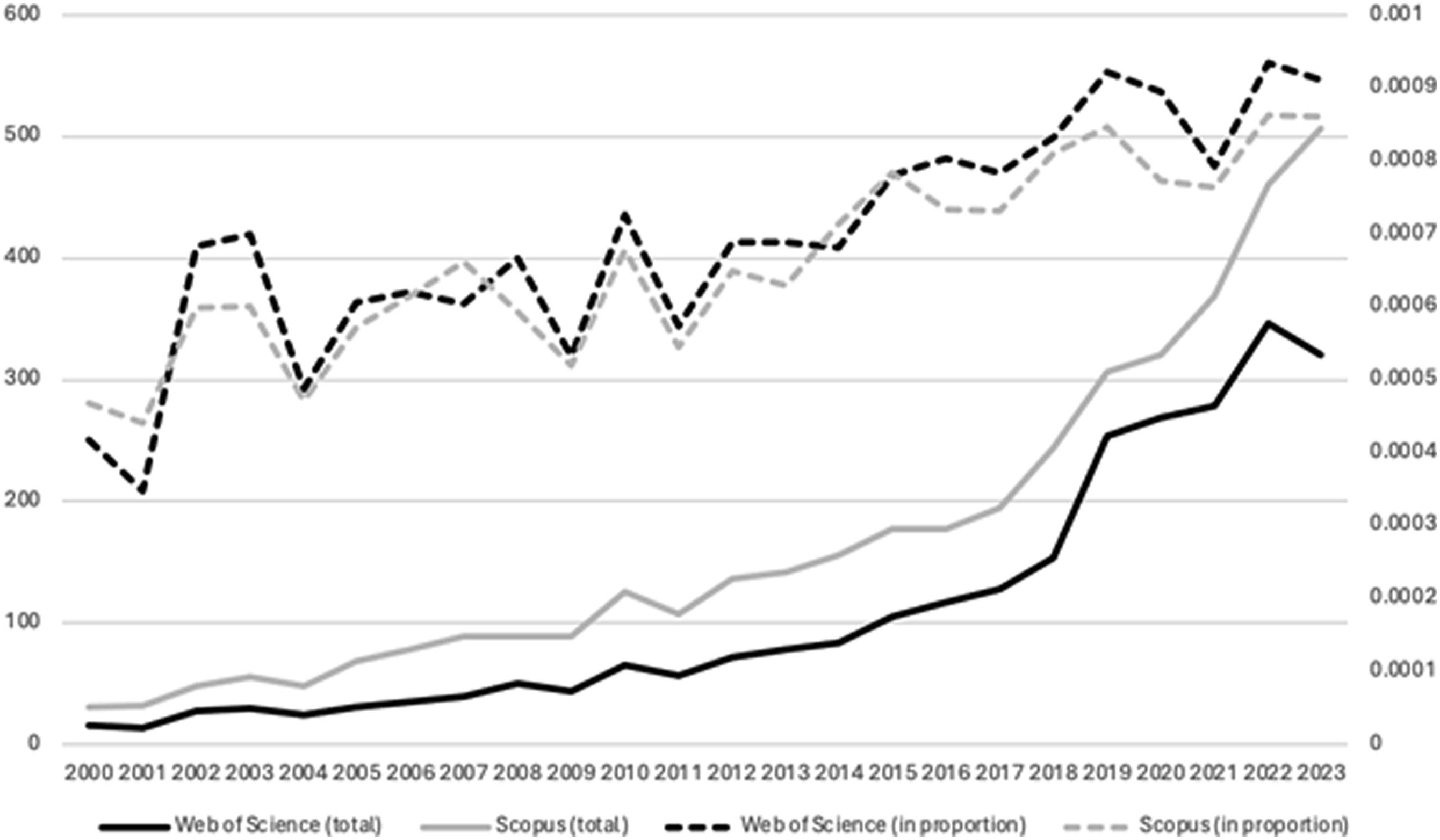
Within this body of research, intermediaries are identified in various shapes and at various locations, whether it is international organizations (Abbot et al., 2021), nongovernmental organizations (Parsons, 2018), professional learning communities (Parlar et al., 2019), external consultants (Hulme et al., 2020), teachers (Nielsen, 1982), or educational chatbots (Hobert and Berens 2023), just to name a few. 2 At the same time, as these examples show, it is not only new types of intermediary actors that are found to have ‘entered’ the field of education, but also traditional education actors seem to increasingly take on intermediary functions.
From a historical point of view, educational intermediaries have played a significant role since the establishment of mass education in the 19th century. Various associations, networks and interest groups emerged around that time (Fuchs, 2007a, 2007b) which ‘mediated’ particular knowledge into educational institutions and classrooms. Over the decades and centuries, this field further expanded, mirroring the rising complexity of education systems worldwide. Yet, it was not until the broader transformation from ‘government to governance…to meta-governance’ (Gjaltema et al., 2020) that intermediaries became visible – and investigated – as a distinct group of actors. Triggered by a wide-spread crisis of Keynesianism in the 1970s, governments around the world at that time turned away from modes of centralized policy planning, and instead towards market-based models, networked cooperation between state and non-state actors, as well as different forms of self-coordination (Stedman Jones, 2012). Over the past decades, this transformation, which also substantially affected the education sector, evolved further, leading to a growing complexity, dynamic, and layering of governance constellations including new forms of meta-governance (Gjaltema et al., 2020; Torfing and Triantafillou, 2011).
While many studies have been focusing on the potentials and benefits of involving more actors and different modes of coordination in education governance, other bodies of literature early on emphasized the many risks that lie within these evolving governance transformations. Heated debates have, for instance, emerged around public-private-partnerships (Robertson et al., 2012; see also Cone and Brøgger, 2020). On the one hand, such partnerships have been praised for improving cost efficiency or capacity for innovation, while at the same time being heavily criticized for introducing ‘private sector interests’ into schools, or for ‘hollowing out’ state responsibility for public education (see also Hogan and Thompson, 2020). Similar debates can be found with regards to the growing role of international (intermediary) organizations such as the OECD or UNESCO (Grek, 2010; Zapp, 2021) that, despite their lack of formal governmental authority, have been found to increasingly impact the education field. While these organizations themselves understand their role mainly as positive incubators of global exchange and education quality improvement, critiques have emphasized their ‘imprinting’ of particular (western, economic) ideas about education globally (Sellar and Lingard, 2017).
It is also through this growing body of literature that profound knowledge about the different mechanisms and strategies of governance could be gained which characterize many intermediaries today. These mechanisms and strategies are typically centered around the fabrication, mediation, and standardization of knowledge (see also Chang, 2020), including the promotion of particular understandings of, or frameworks for, education, the authorization of particular scientific methodologies to produce educational knowledge, or specific forms of evaluation of education systems (see also Cooper and Shewchuk, 2015; Ozga, 2008). Consequently, it is this strategic entanglement of research, politics and education which has commonly been addressed in studies on intermediaries (also) in the education field (see also Innes, 2023; Scott et al., 2017). In turn, and as mentioned in the beginning, that intermediaries seem to increasingly shape the education system does not mean that state actors or ‘classical’ education professions have disappeared. Instead, it is the manifold interaction of such actors with intermediaries – including their gradual transformation into intermediaries themselves – that are found to characterize the ongoing transformation (Hamann and Lane, 2004; Shiroma, 2014).
In sum, we see that ongoing governance transformations have, already since the 1970s, evoked a widespread emergence and empowerment of new types of intermediary actors, and, related to that, a substantially growing and heterogeneous field of ‘intermediary research’. It is, hence, this field in which the more recent global-digital transformation of education must be situated, which, at the same time, triggered an even further empowerment, expansion and reshaping of intermediaries.
The aim of this Special Issue: disentangling and relating intermediaries in the digital transformation of schooling
In many regards, the rise of digital technologies, (big) data and artificial intelligence in education (only) further enhanced already ongoing transformations in the field of intermediaries: For instance, intermediary actors have been found to trigger particular ideas of technology-enhanced education into policy and practice, many of them being situated in-between private (EdTech) sector products and public education (Cone et al., 2022; Kerssens et al., 2023; Komljenovic, 2021; Williamson, 2016), in-between policy and individual schools (Ramiel, 2019; Vandeyar, 2015), or in-between global and local contexts of governance (see, for instance, the many EdTech Alliances that have been emerging over the past years, see also Williamson 2021). 3
At the same time, the digital transformation has also significantly reshaped the field (further). For instance, equipping schools with devices and connecting schools to the Internet was a lever to open the door to public education for new types of private companies (Cain, 2021; Flury, 2023), just as the emergence of the field of ICT education (see also Geiss, 2023; Grütter, 2024; Selwyn, 2018). In addition, various old and new actors have become orchestrated around practices of data infrastructuring and platformization, such as data mediation, data management or platform design (Hartong, 2016; Lewis and Hartong, 2022; Perrotta et al., 2021; Williamson 2021), whilst platforms and data infrastructures themselves also operate as increasingly powerful intermediaries of digital governance (Decuypere et al., 2021; Förschler and Decuypere, 2024; Hartong and Decuypere, 2023; Pangrazio et al., 2022).
In 2022, we, the guest editors of this Special Issue, took this highly dynamic and constantly changing role of intermediaries in digital times as an opportunity to bring scholars from different backgrounds together in a workshop in order to better understand current evolvements of the field. Yet, the intention of the workshop was not only to learn about, and discuss, currently ongoing studies. Rather, we had the feeling that despite the massive attention for intermediaries in the digital transformation of schooling, intermediaries have, at least so far, been rarely investigated as a multiple, yet interrelated field. Put differently, whilst numerous case studies have been undertaken that drew our attention to different kinds of intermediary actors and their impact on governance, much less research, at least not in the context of digital education governance and practice, has so far addressed the more foundational conceptual question of what actually qualifies an actor as (digital education) intermediary, and how such intermediaries can be mapped, disentangled and analyzed (see also Quintero and Williamson, 2021). Investigating intermediaries, thus, also has important methodological consequences. To study things that are in-between and at the same time entangled means to rely on methods that are capable of grasping both relations as well as processes that are often ‘seen but unnoticed’ (Garfinkel, 1967: 37-38). Consequently, the notion of intermediary points not only to a specific phenomenon, but also to a perspective highlighting ambivalent processes of governance and mediation that are oftentimes overlooked. Particularly with the growing ‘blurriness’ between human and non-human intermediaries, as well as between public and private or global and local spheres, such questions seem extremely relevant, not only in the field of education.
During the workshop, we engaged in intensive and, in our view, highly fruitful discussions on what we see (differently) when bringing such foundational questions more to the forefront through a conversation of different types of ‘intermediary research'. We are, hence, delighted that with this Special Issue, we got the opportunity to make visible a collection of articles that evolved from these conversations.
Contributions to the Special Issue: a brief overview
The Special Issue brings together five articles, each of them focusing on different empirical contexts, and conceptual framings, around intermediaries in the digital transformation of schooling (Figure 2): Overview of the contributions.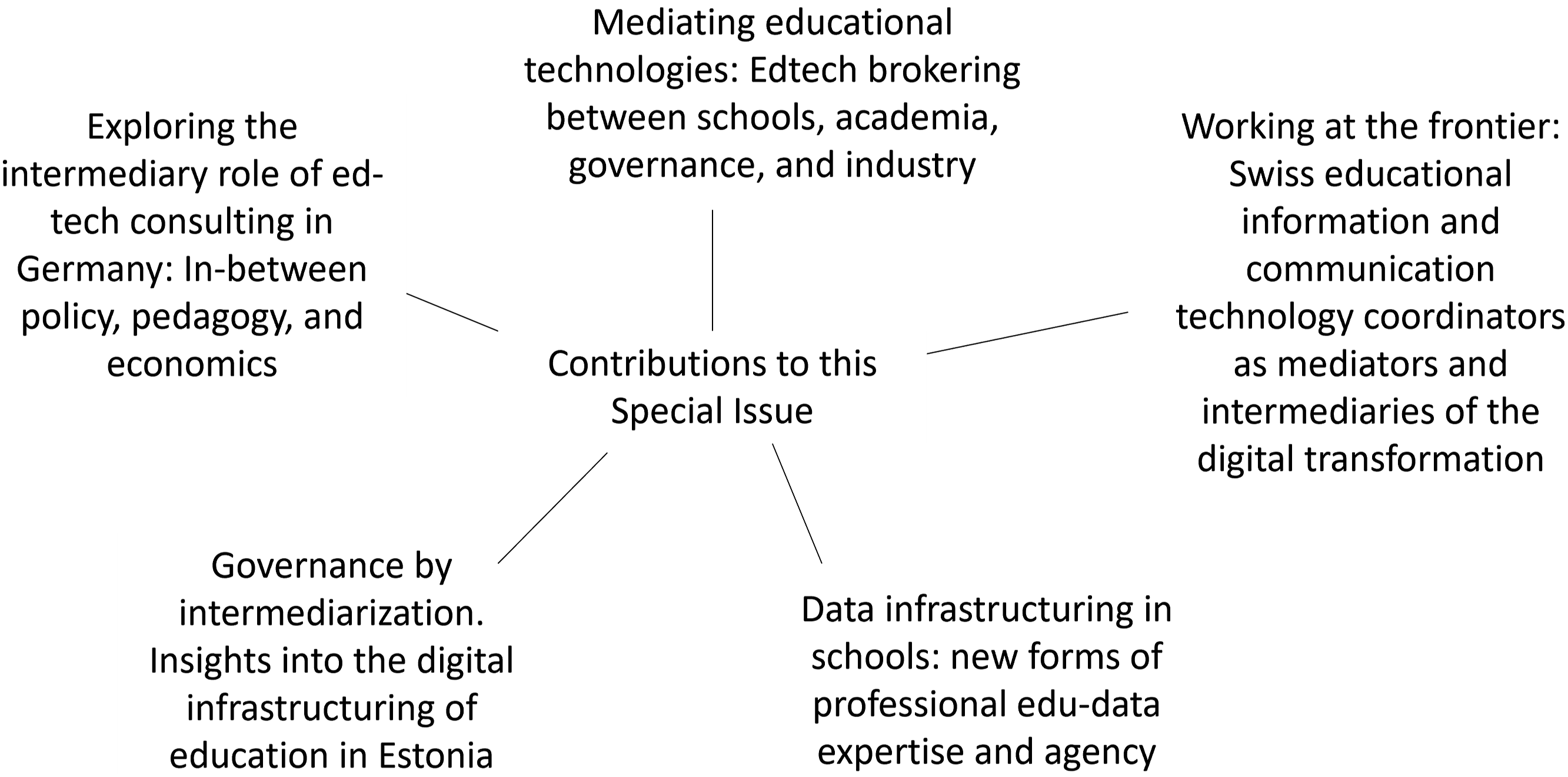
To begin with, in his article on EdTech consultancy in Germany, Lucas Joecks provides a critical analysis of EdTech consultancy providers in their ambiguous situatedness between policy, pedagogy and economics. Whilst EdTech consulting has gained growing relevance in the education field over the past decade (and particularly in course of the COVID-19 pandemic, see also Cone et al., 2022), few research has, at least so far, studied this type of intermediary actor in an in-depth manner. Yet, the article not only offers such a more in-depth investigation for the case of Germany. Also, it combines these empirical insights with broader developments in different (intermediary) research fields to employ a three-dimensional conceptual and analytical framework that facilitates capturing intermediary consultancy between different governance actors, sectors, and fields of knowledge production. Each dimension of the framework hereby ‘reveals different dimensions of consulting work: shaping policy implementation, disseminating pedagogical and technological expertise, and connecting the technology industry with educational institutions.’ In doing so, the framework brings attention to the fact that ed-tech consultants themselves actually face a multiplicity of mediation contexts, in which they need to navigate within and in-between, and which also expose them ‘to multiple interests and values’.
The contribution of Carlos Ortegón, Ben Williamson and Mathias Decuypere equally focuses on EdTech brokering (here) between schools, academia, governance, and industry, yet with a focus on Flanders and the UK context. Focusing on the interrelation between public education and the global EdTech market, the article investigates how EdTech brokers have embedded new types of professionalities into education, ‘taking an active role in co-creating and updating schools’ digital infrastructures, the evidence-making mechanisms around edtech, and the pedagogical practices around edtech.’ Drawing on an Latourian (1994, 2005) understanding of mediators, the article hereby develops a three-fold categorization of edtech brokers – ambassador, search engine, and data brokers – that facilitates capturing manifold brokers’ characteristics and practices of mediation. As the analytical findings of the study show, regarding all three categories, brokers appear as ‘organizations with their own specific sets of professional expertise and practices that cannot be reduced solely to the agendas of other established actors, such as policy organizations or edtech companies.’
The dimension of data brokering – or data mediation – also stands at the center of the article of Lyndsay Grant, in which she disentangles the growing role of data infrastructuring in schools, and the roles of data offices and teachers herein. In doing so, the article simultaneously moves the focus towards school-internal contexts, which in terms of data intermediary scholarship have barely been researched yet. More specifically, the article empirically investigates ‘processes of data infrastructuring in which people (mostly teachers), platforms, systems and tools come together to create, enable and maintain data flows’ within and around the data office in a secondary school in England. Also here, the study reveals the significant labor and (edu-data) expertise relevant for data mediation and infrastructuring. In addition, it discusses paradoxical effects of both de- and re-professionalization triggered by the changing role of teachers in their engagement with data infrastructures, including their own transformation into data mediators.
Michael Geiss and Tobias Röhl´s contribution resonates the focus on schools and the transforming (intermediary) role of teachers. Their study focuses on the Swiss context and the emerging group of so-called Swiss educational information and communication technology coordinators (PICTS). These coordinators, who mark a ‘new educational ICT profession as part of a national public-private partnership program to bring schools online’, are responsible to ensure the ‘meaningful and sustainable integration of digital technologies in the classroom’. Focusing on the context of Zurich, the article investigates the specific situatedness of PICTS both within the broader governmental structure, as well as within individual schools (e.g., how they are being perceived from colleagues). Conceptually, the study hereby distinguishes between ‘mediators’ and ‘intermediaries’ (Latour, 2005) in order to capture the ambiguous roles which PICTS need to constantly navigate, namely their simultaneous understanding as active change agents on the one hand, and as mere passive supporters for their peers on the other hand.
Lastly, the contribution of Sigrid Hartong once again brings attention to the specific interrelation between intermediaries and data infrastructuring, using the digital transformation of education in Estonia as a case study. The article suggests to conceptually capture intermediaries through a lens on ‘performative contexting’, that is, to shift the focus towards ‘how intermediary contexting is used, by whom and where exactly, rather than seeking to map intermediaries as an object from the outside.’ Adopting such a lens to the case study, the article disentangles different Estonian (state and non-state) actors as well as mechanisms of digital education governance in their ambiguous relation to data infrastructuring. As the findings show, more and more actors ‘are [currently being] shifted into the (self)contexting as infrastructural stewards’, which the article discusses as ‘governance by intermediarization’. It is particularly this concept of ‘governance by intermediarization’ which again offers a fruitful theoretical framing for capturing the reshaping of the interrelated field of intermediaries also more broadly.
As this brief overview shows, whilst the contributions to the Special Issue offer a range of insights into different empirical cases and analytical points of departure, they are simultaneously addressing very similar conceptual and methodological questions. Put differently, the collection not only provides readers with innovative frameworks and conceptual ideas regarding how to map, differentiate, and relate intermediaries in the digital transformation of schooling. Equally, it showcases and discusses a range of methodological approaches (document analysis, platform analysis, [hybrid network] ethnography, interviews, etc.) and shows how these approaches can guide intermediary analyses in increasingly digitized environments (see also Ball 2020; Schubert and Röhl, 2019). Lastly, the collection also clearly shows the many conflicts and contradictions surrounding the digital transformation, including the power(lessness) of intermediary actors at different levels, as well as the interconnectedness of various logics of interest. It is that awareness for multiplicity and ambiguity that we, consequently, regard as one of the central take-aways of the Special Issue: that digital technologies today are not only ‘brought into’ schools, but that they instead transform conjointly with schools as well as with the intermediaries themselves.
Footnotes
Declaration of conflicting interests
The author(s) declared no potential conflicts of interest with respect to the research, authorship, and/or publication of this article.
Funding
The author(s) disclosed receipt of the following financial support for the research, authorship, and/or publication of this article: This work was supported by the Deutsche Forschungsgemeinschaft 423781123.
