




Abstract
In recent years, literatures related to the use of technology for teaching and learning have proliferated, which can be divided into two groups: technology positivism and technology criticism. The technology positivism literatures posit that communities can be created in online platforms whereas the second group of literatures argue that learning technologies can detach learning from human societies. Despite criticisms, creating an online learning community has become the focus of technology positivism literatures whereas the notion of learning society that connected learning with society has disappeared. Drawing on key sociological theories of learning such as constructivism, social cognition, and communicative actions, this paper argues that the notion of learning society is a better alternative of online learning community. It proposes online learning society as an alternative model for online teaching and discusses its three key components: social construction of knowledge, situated cognition and social integration.
Introduction
The fourth industrial revolution, artificial intelligence (AI), and the COVID-19 pandemic have increased the use of technologies in the lives of individuals and their societies. Amidst all benefits that technologies have brought, a new concern for humanity has loomed large because the use of technology has intensified surveillance capitalism (Zuboff, 2019), replaced human agency in making decisions in vital sectors such as health and education (Crawford, 2021), and governed the subjectivities of educational stakeholders (Webb et al., 2020). Learning technologies are also used for tracking students physical and cognitive activities (Sellar and Gulson, 2021). This paper first critically examines the risks and benefits of learning technologies and then explores the idea of online learning society as an alternative model of online teaching for reconnecting learning with society.
With the widespread use of the internet, mainly interconnections leveraged by social media, new communities have emerged in online platforms; however, the very foundation of human society that helped individuals to construct knowledge, achieve social integration, and socialise new members has disappeared. Drawing on some notable educational sociologists (Dewey, 1913; Durkheim, 1984; Habermas, 1987; Husen, 1974; Tonnies, 1980), the paper argues that schools, postsecondary institutions and all informal learning venues such as museums, workplaces, and sociocultural centers are the part of larger human society. As Dewey (1913) theorised, a school is a society in miniature; therefore, the main argument of this paper is that online teaching should be geared towards revitalising the very foundations of human society mainly social construction of knowledge, situated learning and social integration. According to Dewey (1913: 44), … each one of our schools [is] an embryonic community life, active with types of occupations that reflect the life of the larger society, and throughout permeated with the spirit of art, history, and science. When the school introduces and trains each child of society into membership within such a little community, saturating him [sic] with the spirit of service, and providing him with the instruments of effective self-direction, we shall have the deepest and best guarantor of a larger society which is worthy, lovely, and harmonious.
While I have retained Dewey’s main thesis, I have replaced the term “school” with “learning” and “children” with “learners” (Dewey, 1913; Sellars and Imig, 2022) because, as noted above, in the larger framework of lifelong learning (Jarvis, 2008), schools are not the only venues for learning. My preference of the term “learning” over school is informed by what Biesta (2010) and others have critiqued as “learnification,” that is responsibilization of learners for acquiring only those forms of knowledge that can be measured through standardized testing systems. In this respect, I depart from the psychological foundation of learning because it assumes that knowledge produced by experts through experiments is ‘a storehouse of objective knowledge’ (Tomlinson, 1997: 367); rather, I embrace the sociological foundation of learning for its assumption that “culture” is the storehouse of knowledge that gets reproduced through the contribution of everyone who live in a given society (see Regmi, 2020).
In recent decades, scholarly literatures on the effectiveness of learning technologies have proliferated. They have taken basically two broad positions which I call technology positivism and technology criticism. Technology positivism literatures (Blayone et al., 2017; Bolliger et al., 2019; Borup et al., 2020; Bower et al., 2015; Garrison et al., 1999; Gökçearslan and Alper, 2015; Hsu et al., 2019; Khoo and Cowie, 2020; Kidd, 2010; Nistor et al., 2020; Ouyang and Scharber, 2017; Walsh and Pollard, 2020) tend to promote the idea that communities can be created in online platforms whereas technology criticism literatures (Bayne, 2015; Webb et al., 2020; Williamson, 2019; Kirkwood and Price, 2014; Perrotta et al., 2021) argue that learning should not rely on technologies as they have dehumanising effect on learners and their societies. However, research studies that investigate the connection between learning and society are very rare; therefore, this paper focuses on the following research questions: • How has technologies impacted the relationship between society and learning? • How can we re-establish the connection between society and learning in an online teaching environment?
The paper has four major sections including this Introduction section. By reviewing recent empirical research studies related to learning technology, the second section elaborates key arguments made by technology positivists and technology critics. By drawing on key sociologists (Dewey, 1913; Giddens, 1984; Habermas, 1987; Husen, 1974; Tonnies, 1980) and psychologists (Bandura, 2001; Piaget, 1953; Skinner, 1950; Vygotsky, 1978), the third section explores the interconnection between learning theories and the idea of learning society. Building on previous sections, the fourth section develops online learning society as a model for establishing connection between learning and society. Key features of online learning society model are presented under three subheadings: social construction of knowledge, situated cognition, and social integration.
Technology positivism and criticism
Garrison et al. (1999) developed a community of inquiry (COI) model and argued that the success of the creation of learning community in online teaching environment depends on cognitive presence, social presence, and teaching presence. The literatures that build on the COI model promote the idea that a community that comprises of teachers and learners could be built when they are pedagogically connected via learning technologies. For example, Blayone et al. (2017) argued that learning technologies such as MOOCs can contribute towards the creation of a ‘democratized learning communities that reduce transactional distance between learners and educators, incorporates authentic assessment, and encourages negotiated technology affordances and cognitive outcomes’ (p. 1).
Some scholars see a greater role of teachers whereas others emphasise the characteristics of students and instructional designs. For example, Ouyang and Scharber (2017) argue that students would be able to form an online learning community when instructors play the roles of facilitators, observers, and collaborators. Bolliger et al. (2019) report that teachers who use different strategies such as social media, synchronous communications, and cohort models could foster the sense of community. Unlike those who focus on teachers, Gökçearslan and Alper (2015) emphasise that the characteristics of individual students especially those geared towards academic success determine the nature of learning community. According to Khoo and Cowie (2020), ‘how learning communities are formed and evaluating their efficacy in supporting learning involves a complex set of issues that have a bearing on the design and facilitation’ (p. 47) of the online courses. Bower et al. (2015) emphasise the importance of ‘blended synchronous learning environments’ (p. 1) such as designs for active learning, appropriate use of technologies for engaged interaction, and a heightened cognitive load.
Using Vygotsky’s zone of proximal development framework, Borup et al. (2020) argue that while teachers and students form the core of learning community, they must be supported by university administration (e.g., student service centers, peer, and graduate advisors) and other stakeholders who are responsible for running an educational institution. They should also be supported by their own personal community such as friends, family members, and relatives. Walsh and Pollard (2020) ‘explored the learning experiences of a cohort of international students’ and reported that online learning helped students in ‘developing collaborative partnerships’ (p. 971) with the stakeholders concerned to the students.
Besides those who studied the role of technologies for the creation of online learning communities that I noted above, Nistor et al. (2020) explore social integration aspect of online learners who work in informal education environment. For them, creation of a learning community depends on the integration of new members into the network of learners that are already formed. Other studies that support the use of technology have emphasised that learning technologies increase learner engagement (Jung and Lee, 2018), provide learners with strategies for enhancing interactions (Vlachopoulos and Makri, 2019; Hsu et al., 2019), and leverage face-to-face teaching (McKenna et al., 2019).
Despite all the benefits of learning technologies noted by technology positivists, there is an emerging body of literature that critique the use of technology in teaching and learning. Their main concern is that technology positivists have ignored fundamental features of human society mainly social construction of knowledge, importance of social context for learning/cognition, and social integration. For example, nearly a decade ago, based on their review of contemporary literatures, Kirkwood and Price (2014) argued that a shared understanding about how technology really enhances students’ learning experiences had not been developed because the evidence provided by researchers in support of learning technologies is highly inconsistent.
In recent years, against the backdrop of an exponential investment made in AI by big corporations such as Google, Facebook, and Apple (Crawford, 2021; Zuboff, 2019), scholars have raised some serious issues against learning technologies. For example, Williamson (2019) analysed the use of learning technology from a sociological perspective, and argued that AI has promoted ‘precision education’ that uses advanced computational technologies to produce ‘intimate data’ about students’ bodies and their associations with learning (p. 1). These data have posed a new mode of governance therefore educational policymaking has been increasingly affected by AI. As Sellar and Gulson (2021) argue, new forms of automated thinking and new approaches to data analytics have promoted automated knowledge and posed new challenges in education policymaking and implementation.
A series of articles published in a special issue on AI in education (see Williamson and Eynon, 2020) critique the use of learning technologies from political economy, sociology, governance, and feminist perspectives. For example, Webb et al. (2020) use governance perspective and argue that technologies not only shape how students learn but what they might want to learn in the future. Since learning technologies use algorithms, AI, and tracking, knowledge, habits, and memories are predetermined. Perrotta et al. (2021) argue that learning technologies have created a new division of labour according to platform logics, and application programming interfaces, which have affected the job responsibilities of school administrators, teachers, students and guardians.
A key message of the review of technology positivism literatures is that individuals who are physically disconnected could create a community through the media of technologies. The learning positivism discourse also implies that having a community, or at least becoming a part of it, is a fundamental prerequisite for human learning. But unlike technology positivists, learning technology critics caution that the very community created through technology may not be a “community” in its original sense because the technological media may shape the scope and nature of the community itself. Their worry is not limited to whether students and teachers will lose their agency; rather, they worry that the agentic powers distributed among different individuals would be consolidated by big corporations and abused for domination, indoctrination, and subjugation (Zembylas, 2023). While these criticisms are valid, the desire expressed by learning technology positivists towards the creation of learning communities could not be dismissed because, in the context of globalisation and hyper-interconnectivity, communications mediated by technology is crucial for increasing participation in lifelong learning (Rubenson, 2019).
An important observation of the review of literature on learning theories and technology positivism literatures show that a shift from “learning society” (defined below) to the creation of “online learning community” has occurred, but the cause and nature of this shift is not explored. Scholars have used a range of theoretical lenses such as critical posthumanism (Bayne, 2015), social cognition (Eun, 2019), and automated thinking (Sellar and Gulson, 2021) but, except a few (e.g., Borup et al., 2020), the use of sociological theories (Dewey, 1913; Husen, 1974; Lave and Wenger, 1991; Piaget, 1953; Tonnies, 1980; Vygotsky, 1978; Durkheim, 1984; Habermas, 1987) that informed the discourse on learning society (Illeris, 2009; Jarvis, 2008; Schuller and Field, 1998; Husen, 1974; UNESCO, 1972) is lacking, which is the focus of the next section.
Learning theory and learning society
Learning theories
The learning strategies used in face-to-face of mode of teaching is rooted in some classical psychological theories of learning such as behaviourism (Skinner, 1950), cognitivism (Bandura, 2001; Piaget, 1953), and constructivism (Vygotsky, 1978). But there are no theories of that level of depth and complexity that could inform learning in an online environment. Often cited online instruction models such as COI (Garrison et al., 1999) and Academic Communities of Engagement (Borup et al., 2020) have drawn on those psychological theories of learning. But, as Potter and McDougall (2017) note, those theories ‘do not always intersect usefully’ (p. 2) with online pedagogical models. While the idea of teaching machines was conceived by early behavioural psychologists such as B. F. Skinner (see Watters, 2021), online learning leveraged by the Internet is a new phenomenon.
Neither the classical psychological theorists conceived technologies as important media for learning nor there was any need for creating online learning communities. However, it is critically important to note that AI engineers (LeCun et al., 2015; Zuboff, 2019; Crawford, 2021) have used those psychological theories of learning to train AI, something they call “deep learning” that has no resonance with how learning evolved through social interactions (Habermas, 1987; Regmi, 2020). In the past, the learning psychologists used data collected by observing the stimulus-response behavior to theorise human learning (Skinner, 1950; Piaget, 1953) whereas the AI engineers have used data that are being collected by observing the learning behaviours of humans to train machines assuming that they would develop intelligences more advanced than those possessed by humans.
If we look through the analytical theoretical lenses such as utilitarianism and instrumentalism (Dewey, 1913), we find that the use of technology has always been helpful for advancing human civilization to a new stage of learning, adopting with the new circumstances and harnessing natural resources for humans’ comfort and prosperity. In this respect, the use of technology in learning can never be neglected; however, since learning and the production of knowledge is based inherently on the lifeworld contexts (Habermas, 1987; Regmi, 2020), the use of technology has often been criticized for decontextualizing or re-contextualizing certain forms of knowledge (Lave and Wenger, 1991), instrumentalization of education (Sellar and Gulson, 2021), and valuing more dominant forms of knowledge over indigenous, occupational and traditional epistemologies (Bayne, 2015; Zembylas, 2023). In this respect, the desire for the creation of machines that are more intelligent than humans (Watters, 2021) cannot be justified from the perspective of sociological theories, which is rooted in the idea of learning society.
Learning society
The idea of learning society appeared in the academic literature during the 1970s (Faure et al., 1972; Husen, 1974). Since then the idea has spread across several disciplines such as political science and economics (Stiglitz and Greenwald, 2014), human resource development and workplace learning (Evans et al., 2004), and organisational studies (Laurillard, 1999). The concept of learning society has spread to many countries of the global South such as Viet Nam (Hossain, 2016), China (Wang et al., 2006), Thailand (Charungkaittikul and Henschke, 2014), Hong Kong (Young, 2008), and several African countries (Preece, 2006).
During the 1970s, scholars discussed about the importance of learning society because learning opportunities provided through formal school systems were not adequate for solving social problems (UNESCO, 1972; Husen, 1974). Inspired by Dewey’s famous dictum school as a miniature society (Dewey, 1913), scholars argued that a school should be considered as a part of a larger society (Sellars and Imig, 2022). The aim of schooling, which is mainly providing learning opportunities for students, cannot be fulfilled unless the whole society involves in learning. After the introduction of lifelong learning in the early 1970s (UNESCO, 1972) as a new approach to education, there has been an increasing emphasis on the use of non-formal and informal learning venues, which include family, communities, museums, temples, and workplaces (Greenhow and Lewin, 2016).
Because of the widespread use of internet, the depth, the breadth and the scope of learning have gone beyond the imagination of early scholars who conceived the idea of learning society (Dewey, 1913; Husen, 1974). But an interesting turn that has taken place along with this new development is the emergence of online learning community. It is interesting to note that advanced online platforms (Greenhow and Lewin, 2016; Perrotta et al., 2021) – also known as web 2.0 such as Facebook, Twitter, LinkedIn, YouTube, Instagram, and TikTok – have taken over the earlier notion of society (Tonnies, 1980; Giddens, 1984). A society can be defined in various ways but a common denominator is a collective of people with a certain degree of integration, a shared culture, and a common language for communication (Habermas, 1987). Since a collective of people in an online community does not necessarily have such attributes, the existing body of literature does not use ‘online learning society’; rather, in the present context ‘online community’ has been a cliché in scholarly literature and a hackneyed term in the field of teaching and learning (Hsu et al., 2019; Khoo and Cowie, 2020).
There is not much research studies for understanding the use of technology in learning from a sociological perspective hence the debate on community versus society (Tonnies, 1980) as well as the impact of technology on the knowledge production function of the lifeworld (Habermas, 1987) have not been explored. The idea of creating online learning community has gotten a lot of attention but with highly inconsistent interpretations (Kirkwood and Price, 2014). For example, Hsu et al. (2019) assume that online learning community is the totality of internet users who have common interest in a certain knowledge-intensive topic such as mental health. They define it as the spaces that users, either an organized group of people or random visitors, can access in order to ‘learn specific branches of knowledge, improve their competencies, and advance in their professions’ (p. 2).
The people involved in an online learning community may not be regarded as the members of a learning society because they lack cohesion and solidarity among group members as social and cultural theorists have conceptualized (Habermas, 1987; Tonnies, 1980; Potter and McDougall, 2017; Durkheim, 1984). This understanding, even if it has widened the periphery of an online community, ignores learning theories and sociological knowledge developed in the past as the intention is increasing the size of loosely connected people rather than a more permanent form of social solidarity required for knowledge construction, social integration and socialization (Regmi, 2020). Therefore, the rest of this review paper is devoted to the discussion of online learning society as a model for online teaching for reconnecting learning with society.
Online learning society: An alternative pedagogical model for online teaching
While the term “society” and “community” are used interchangeably, it is my intention here to make a distinction for revitalising the status of educational institutions (e.g., K-12 school systems, higher and adult education institutions, and workplaces) as a mirror of modern societies (Sellars and Imig, 2022; Dewey, 1913). I would argue that teaching and learning should not be controlled or governed by technologies; rather, learning technologies should be used in a more humanistic ways so that they can contribute towards the creation of a learning society, which has three key functions: social construction of knowledge, situated cognition/learning, and achieving a higher degree of social integration through collective learning (see Figure 1). Sociologists who theorised society not only distinguished it from the notion of community but also argued that these functions are key features of a society (Dewey, 1913; Durkheim, 1984; Habermas, 1987; Tonnies, 1980). Therefore, an underlying assumption that underpins this model of teaching is that the pedagogical approach taken by teachers and students in an online learning environment should be oriented towards revitalising those three functions of the society. Below, I elaborate these functions as three components of this model of online teaching. Online learning society model. Source: Author.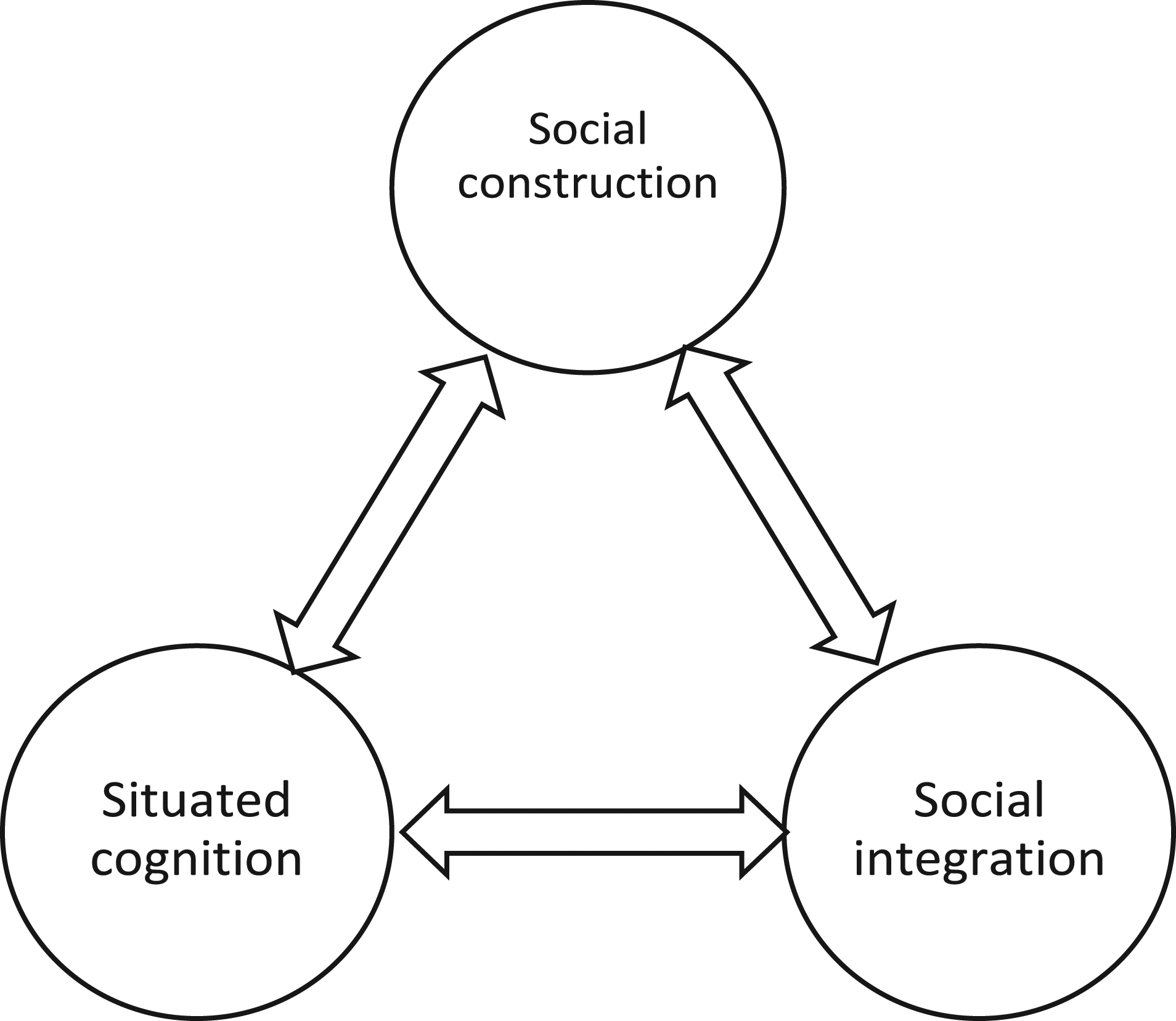
Social construction of knowledge
Key learning theories – such as the theory of communicative action (Habermas, 1987), the theory of constructivism (Piaget, 1953), social cognition theory (Bandura, 2001), and the Zone of Proximal Development (Vygotsky, 1978) – suggest that human knowledge has sociocultural roots for which every member of the society has their fair share of contribution (Eun, 2019; for details on this see Regmi, 2020). Therefore, online teaching and learning (e.g., discussions that happen in an asynchronous pedagogical mode) should be geared towards the co-construction of knowledge through interpersonal interactions where both instructors and students take roles as knowledge producers (Johnson and Aragon, 2003). When each student is motivated to use ‘their full personality into a mediated communication’ (Borup et al., 2020: 808) the knowledge they construct becomes social because it reflects their collective efforts.
If online teaching platforms need to be developed as venues for knowledge construction, then teachers should ensure that every student is involved in the teaching-learning process. Rather than taking a dominant role as knowledge transmitter, instructors should encourage all students to make knowledge-intensive contributions through online interactions. Instructors should not assume that all students are equally capable and motivated. This is also the problem in face-to-face classes, which remains so in online mode as well. However, especially in an asynchronous teaching (Bower et al., 2015; Hung and Chou, 2014), since so-called slow learners have time to think and reflect on the responses of quicker reactors – which provides scaffolding for learning – they can increase social presence (Garrison et al., 1999). As per Bandura’s social cognition theory (Bandura, 2001), early comments provide some kind of vicarious experiences for slow learners, which means that students ‘tend to perceive a higher probability of success when they see individuals similar to themselves succeeding in a particular task’ (Lin and Overbaugh, 2009: 1001).
Sociologists who theorised learning society argued that the knowledge construction process in a given society is not led by an individual; rather, it is a collective process in which everyone is involved both as a learner and as a teacher (Dewey, 1913; Habermas, 1987). In this respect, even if some self-regulated learners may not feel the necessity of peer support (Watters, 2021), majority of the students do much better while completing their learning tasks with a minimal support from peers and the instructor (Vygotsky, 1978). Hence, it is advisable that every instructor provides considerable amount of flexibility while leading online interactions ‘until students could shoulder these responsibilities on their own’ (Hung and Chou, 2014: 167). Even in larger online classes instructors should assume the roles of facilitators who ‘scaffold discussions while students should play a central role’ (ibid).
While synchronous interactions (Bower et al., 2015; Hung and Chou, 2014) are also important for constructing knowledge, students connected through asynchronous instructional tools are able to access online learning resources faster, create an emotional bond with peers and harness available educational support services, which can increase the sense of belongingness and motivation. By doing this, they can have control over the flow of information, a more ‘privileged access to varying points of view’ (Saqr et al., 2018: 3) and the capability and confidence to connect with the groups of collaborators to explore novel ideas by going beyond the purview of the learning contents offered through the course. In this respect, through online teaching, instructors can create an environment that encourages to be the members of a learning society that constructs knowledge, rather than limiting them to mere receivers of banal knowledge.
Situated cognition/learning
Situated cognition relates to the cognitive theory of learning; but unlike cognitivism, it does not assume that learning process takes place only in an individual’s mind (Bandura, 2001). Situated cognition implies that learning takes place in certain contexts hence without considering the context of learning, we will have an incomplete understanding of learning itself. If learning is a construction of knowledge then it always takes place in a certain context; without which knowledge has no meaning (Henning, 2004). All knowledge and learning are not only contextual but also social because the process of knowledge production is a societal endeavour. Situated cognition recognizes that the context in which individuals learn is the space for social interaction (Habermas, 1987); therefore, interaction becomes a key aspect of the learning process.
Lave and Wenger (1991) have extended the idea of situated cognition further by introducing the concept of the community of practice (COP) learning. In a COP, learners share a concern or a passion for something they do with a shared intention about how to achieve their common object in a better way through regular interaction. The members of COP share common purpose and try to make their identity by sharing what they have learnt to solve the problems that each member encounter in their daily lives. Learning is viewed, in this perspective, as the ongoing and evolving creation of identity and the production and reproduction of social practices both in school and out that permit social groups, and the individuals in these groups, to maintain communal relations that promote the life of the group (Henning, 2004; Lave and Wenger, 1991).
Three basic features of COP are mutual engagement, joint enterprise, and shared repertoire (Hansman, 2001; Lave and Wenger, 1991). These features suggest that online learning can be enhanced by focusing on engaged discussions. The knowledge constructed through mutual engagement and joint enterprise become holistic, contextual, and practical. Human learning is inherently social because ‘the nature of the interactions among learners, the tools they use within these interactions, the activity itself, and the social context in which the activity takes place shape learning’ (Hansman, 2001: 45). It is in practice that the construction of knowledge takes place; therefore, students should be provided with ample opportunities for practicing what they consider as contextually useful knowledge.
Context-based learning recognises both the social and psychological foundations of lifelong learning (Regmi, 2020). For creating online learning society, the behavioural and mental practices geared towards one’s learning must take place in a context. Schools and other formal education institutes can create simulated environment and make student understand what they intend to teach, but real learning does not occur until those simulated understandings are implemented to solve students’ real-world problems. Learning theories rooted in behaviorism (Skinner, 1950) confine learning to punish-and-reward systems but promote the ‘factory model’ or in Freirean sense the ‘banking model’ of learning (Freire, 1970). In contrast, in context based approach ‘learning is not something that happens, or is just inside the head, but instead is shaped by the context, culture, and tools in the learning situation (Hansman, 2001: 44). The context, culture, and tools are associated with both societal and practice aspects of learning. Hence, an online learning society needs to recognize the importance of context in learning.
Learning for social integration
One of the powerful and permanent forces that binds individuals together is a shared means of communication (Habermas, 1987). The day-to-day interactions among individuals not only gave birth to several languages in the past but also strengthened social solidarity (Tonnies, 1980). The relationship between interactivity and the sense of community has been empirically justified. For example, Bolliger et al. (2019) found that solidarity and integration among students increased when they had an engaged interactions on learning materials because they were able to reduce the ‘feelings of isolation and reduce attrition’ (p. 3284).
In an online teaching-learning environment, collaboration should be understood as a tripartite contract between the teacher, the students and the learning contents mediated by technologies. Solidarity can be strengthened through messaging, discussions, and collaborative learning. The kind of collaboration that are mostly useful for creating online learning society starts in the forums created for discussing the learning contents of the course, that is the extent to which students are engaged in the discussion done in knowledge-intensive interactions, also called academic engagement (Borup et al., 2020). Depending on the size of the class, collaboration can happen in small groups or in the whole class. The design, monitoring and the assessment of the discussion forums are also vital in this regard (Potter and McDougall, 2017).
In an asynchronous mode of online learning, discussion threads may include the purpose of the discussion, discussion questions (or talking points), instruction for making substantial discussion posts, and the grade value (or rubric) of each post. It is important to highlight that discussion posts made by each student are important for their peers to learn the course content. Similar to what Habermas (1987) calls as the mechanical solidarity forged among lifeworld members through day-to-day communications, in an ideal online forum, students should be encouraged to participate in discussion for helping each other. Participation in the discussion is a matter of belonging and a voluntary membership rather than just fulfilling assignment requirements.
Students should be regarded as the valued and respected member of the online class. By making good discussion posts students not only demonstrate what they have understood or reflect upon what knowledge they have gained but they can also teach their peers. By getting engaged in discussion they contribute to the learning society for the construction of intuitive knowledge. It is important to highlight that each discussion post includes at least one key idea from the reading or other learning contents offered through the course. This is particularly important because in any kind of interaction only those ideas are appreciated or retained by the members that are well-justified for their relevance and usefulness for the whole society, something that Habermas (1987) theorised as validity claims. While discussion threads such as coffee talk, which can be considered as the ‘third space’ (Potter and McDougall, 2017) may not necessarily include learning contents or stuffs for academic engagement, discussion forums created for instructional purpose should include at least one useful idea for understanding the learning contents of the lesson.
Some of the benefits of online collaborative learning include a higher level of ‘academic achievement, deeper levels of learning, retention of learned information for longer times, better problem solving, and higher-order critical thinking skills’ (Saqr et al., 2018: 2). However, having said that students have worked together in online discussions does not necessarily mean that an effective collaboration has taken place. Common barriers to effective collaboration include social loafing, dysfunctional group dynamics, lack of appreciation of values, absence of a stimulating task or script, lack of preparation, and lack of social skills. These barriers could be a hinderance for the creation of online learning society. Therefore, for successful online collaboration to take place, there should be active coordination of group dynamics, mutual engagement of the learners, discussion moderators, scaffolding by instructors (Vygotsky, 1978), and a stimulating environment that maximizes efficient interactions among participants.
Concluding remarks
Despite all the risks that technology capitalism has posed, technology positivists have promoted the idea of online learning community. In this respect, online learning community is something created on the platform managed by technical engineers and controlled by the richest corporations in the world. Scholars (Williamson, 2019; Webb et al., 2020) have warned that this technological governance of education may further erode the dwindling connection between the society and learning. By drawing ideas from sociological learning theories, this paper argued that the idea of online learning community is inadequate for informing teaching and learning because it does not reflect human society and its key features such as social construction of knowledge, situated cognition and social solidarity. The paper presented the idea of online learning society as an alternative pedagogical model for re-establishing the connection between society and learning.
As highlighted by the critics of learning technologies, the most sophisticated form of capitalist expansion has happened through the expansion of technologies (Hall and Soskice, 2001; Piketty, 2020). Some corporate giants such as Microsoft, Apple, Google, and Huawei – most of which are headquartered in the developed countries – provide platforms for massive spread of knowledge and information that circulate around the world without considering the context of origin and the context in which those knowledges make an impact (Appadurai, 1996). The videos, audios, images, and texts circulate far beyond the contexts of their production and in most cases do not include ‘cultural experiences’ (Potter and McDougall, 2017: 3) of individuals who are in the consumption side of knowledge. Controlled by algorithms and coding the knowledge and information diffused by videos, audios, images and texts are exposed to everyone irrespective of the potential harm they could make to general populace (Williamson, 2019).
Therefore, online course designers and instructors should be really careful while selecting learning contents for their students. In light of the pedagogical model presented above, I would argue that the three functions of society – social construction of knowledge, situated cognition and social integration – should guide their approach to teaching and learning. To conclude, despite the fact that learning technologies have increased people’s participation in lifelong learning, teachers should not assume that learning can exist without establishing a proper connection with society. Therefore, it is important to align online teaching with some fundamental features of society such as social construction of knowledge, the importance of context in the design and delivery of online courses, and forging solidarity among online learners.
Footnotes
Declaration of conflicting interests
The author(s) declared no potential conflicts of interest with respect to the research, authorship, and/or publication of this article.
Funding
The author(s) received no financial support for the research, authorship, and/or publication of this article.
