




Abstract
The human desire to join and participate in communities can be seen as an attempt to satisfy some of our universal human needs. The theory of communities of practice has been widely used to explain how and why humans participate in multiple communities, and a key requirement of a community of practice (CoP) is that members engage in ‘joint activities and discussions’. In the current age where social media tools have facilitated the exponential growth of online communities, the term CoP is often used to describe a group of people engaging in online discussion. In the context of online learning, the use of CoP theory can often lead to online discussion being interpreted as a joint activity. This paper argues that the concept of a joint activity as something other than online discussion has been neglected, and that while online discussion may account for the presence of an online community, evidence of joint activities beyond the simple discussion of ideas is required for the community to constitute a true CoP. Using activity theory, the authors investigated the factors motivating students on the Digital Design and Animation course at West Midlands University to participate in a non-formal learning activity involving the co-creation of a digital artefact. The authors believe that a greater understanding of the concept of joint activity, and of the link between co-creating an artefact and members’ shared emotional connection, has the potential to refocus our understanding and application of the theory of CoP in the networked era.
Keywords
Introduction
An important factor in creating a sense of belonging in a community is the use of technology to construct and contribute an artefact to represent membership. From the creation of Bronze Age stone circles (Burl, 2000) to Buddhist stupa (Byrne, 1995), there is a historical relationship between the co-construction of an artefact and perceived sense of community. ‘Sense of community’ theory originates in the discipline of community psychology, and was first proposed by Seymour B Sarason (1974) before being developed further by McMillan and Chavis (1986). In their sense of community theory, the development of a shared emotional connection between members is considered to be the ‘definitive element for true community’ (p.16). According to the theory, shared participation in activities is a key factor in the development of shared emotional connection, along with members being able to identify with the history of the community.
In the context of learning, both in higher education and in the workplace, sense of community theory is less prevalent than the theory of communities of practice (Lave and Wenger, 1991; Wenger, 1998). Although the theory of communities of practice (CoPs) evolved predominantly through the study of human interaction in the physical world, it has been widely used as a tool to analyse human behaviour in the many thousands of online or ‘virtual’ communities (Rheingold, 2000) that have emerged due to the discursive affordances of Web 2.0 technologies. The exponential growth in usage of social networking tools such as Facebook and Twitter has transformed online discussion from something undertaken primarily between computer enthusiasts to a phenomenon that has had a significant global impact on communication (Ahlqvist et al., 2010; Chen, 2013).
According to the theory of CoPs, both joint activities and discussions are central to the development of relationships between members of a CoP. However, research into the development of online CoPs tends to interpret discussion as a joint activity, and as a consequence the potential for activities involving the creation of digital artefacts to enhance members’ sense of community has been largely neglected. As the use of online and social technologies in higher education continues to grow, there is a corresponding need to understand the ways in which these technologies support and enhance interaction between members in learning communities (Lenning and Ebbers, 2014). Blended and distance learning communities play an increasing role in higher education courses, and a deeper understanding of the links between sense of community and learning, and of the role of joint activities in developing learning communities, has important implications for student engagement, curriculum design and delivery.
The Digital Design and Animation (DDA) course at West Midlands University (WMU) has successfully cultivated a blended CoP mediated by a network of blogs (Reeves and Gomm, 2012). Although students contribute regularly to both their personal blog and the course blog, they are driven primarily by the fact that blogging constitutes a significant part of the assessment requirement for the course. In the Autumn of 2012, the University received funding as part of the European Union funded A Common Territory (ACT) project, and the course leader was asked to work with his students to create a 16-minute digital animation to accompany a piece of music commissioned especially for the project. Although members of the course team were obliged to undertake the project, student participation was voluntary and the primary concern was whether students would engage with the activity, as it was not assessed. However, the project experienced a high level of student engagement and the animation that was created has subsequently been performed with an orchestra in the United Kingdom (UK) and France.
By investigating the factors motivating students to participate in the non-assessed activity, the authors hoped to understand more clearly the role of a joint activity in the formation of a blended CoP. The research will be of interest to tutors and curriculum designers who create and manage online learning communities and activities.
Literature review
Artefacts influence our sense of community profoundly. (Adams and Freeman, 2000: 163)
Since ancient times, artefacts have been used to represent our membership of communities in order to satisfy our need to feel a sense of belonging (Maslow, 1954). Examples of this include dispersed Bronze Age island communities in the north of Scotland creating stone circles in which each stone represented the membership of a particular group in the broader community (Burl, 2000). Although the last two centuries have seen traditional rural existence giving way to increased urbanisation, Hull et al. (1994) highlight that use of icons and symbols in urban planning is important in helping us learn about ourselves and about the owners of those symbols because ‘they contribute to place identity and ultimately to self identity, health, sense of community and sense of place’ (p.109).
The concept of a psychological sense of community was first introduced by Seymour B Sarason (1974) in an attempt to explain the community experience by focusing on the perceptions, feelings and attitudes of individual members of a physical community. Sarason’s work was later developed by McMillan and Chavis (1986), who proposed that an individual’s sense of community has four key elements: ‘membership’ and a sense of personal relatedness; ‘influence’ and a sense of making a difference; ‘reinforcement’ and fulfilment of needs; and ‘shared emotional connection’, including a sense of shared experiences and shared history. They define sense of community as: … a feeling that members have of belonging, a feeling that members matter to one another and to the group, and a shared faith that members' needs will be met through their commitment to be together. (McMillan and Chavis, 1986: 4)
As technology is increasingly used to mediate our interaction with the various communities to which we belong, it is interesting to reconsider the extent to which we are returning to an existence not dissimilar to that of the distributed communities of the Bronze Age. The similarity is the importance of our perceived sense of community and our desire to represent this through the co-creation of artefacts. Researchers have often used the historical practices of physical communities to describe activity in online environments. For example, Schwier and Daniel (2008) highlight the central role played by rituals in community development, and refer to Bryce-Davis’ (2001) identification of rules, roles, rounds, rituals and ringers as five key constructs for online communities, where ‘rituals can be thought of as the ceremony around the routines in learning communities’ (Schwier and Daniel, 2008: 355). Russo and Watkins (2005) note the value of community co-creation in providing individuals with agency, enabling them to enhance their social communication by bringing together memory, community, narrative and interaction. Collis (2008) has highlighted the value to learning of pedagogical approaches based on contribution, and the pedagogical value of co-creating artefacts has important implications for students on distance learning courses as a means to enhance their sense of community and, by proxy, their engagement. Schwier (2007) observes that the term ‘community’ itself has a strong resonance and, consequently, it is understandable why educators have sought to use it as a metaphor to explain how learning occurs. Building on Selznick's (1996) seven elements of communities (history, identity, mutuality, plurality, autonomy, participation and integration), Schwier and Daniel (2008) highlight the importance of contribution activities in developing community history, identity and mutuality. Such activities might include the co-creation of community logos, assignments and group exercises in which each member is required to contribute to the final product.
The study of online communities is a relatively new area of research, and interest in the field is growing as educators, marketers and managers seek to understand and predict member behaviour with greater accuracy (Koh et al., 2007). As online technologies are increasingly used to support teaching and curriculum delivery, a body of research has developed around the factors that influence student participation in online learning activities. These factors include, but are not limited to, social presence (Bangert, 2008; Butler et al., 2007; Garrison et al., 1999), teaching presence (Shea et al., 2006), feedback and prior experience with computer-mediated communication (Vrasidas and Stock McIsaac, 1999). Studies have also indicated the importance of designing meaningful online activities in order to enhance students’ interest and motivation (Pintrich and Schunk, 2002; Svinicki, 2004). Ma and Agarwal (2007) highlight some of the factors believed to be responsible for motivating members of an online community to participate in online discussion. Amongst these factors are members’ reputation, altruism, generalised reciprocity and level of interest in the community (Wasko and Faraj, 2005), social affiliation, professional self-expression and social capital (Peddibhotla and Subramani, 2007), and user experience, recognition from the site and individual attributes (Jeppesen and Frederiksen, 2006). Ma and Agarwal (2007) also observe that computer-mediated communication presents challenges with regard to social interaction due to the lack of visible social cues. As a consequence, they argue that the accurate communication and verification of identity is a key factor in determining a person’s level of knowledge contribution in an online community.
But while the literature highlights many factors affecting knowledge contribution, communication and sharing in online communities, the potential for the actual co-creation of an artefact to influence participation and sense of community has been less well documented. As the affordances of online collaborative technologies become increasingly sophisticated, the ability for members of online communities to truly engage in the joint activities identified by Wenger presents exciting opportunities for learning. If meaning in a CoP is created through dialogue between members (Ziegler et al., 2014), then the ability to co-create an artefact raises the possibility of further enhancing the meaning-making process. By investigating the factors motivating students to participate in the ACT project, the authors hoped to understand the effect of a successful joint activity on students’ sense of community and the subsequent implications for learning.
Research question:
What were the motivational drivers influencing student participation in a non-assessed, extra-curricular learning activity?
Theoretical framework
Activity systems analysis (Engeström, 1987) was chosen as the theoretical lens through which to analyse the data. Activity systems analysis has been used in educational technology contexts to examine the benefits and challenges of using technology to support learning (Barab et al., 2004; Blin, 2004; Brine and Franken, 2006) as it enables researchers to study collective meaning-making processes (Yamagata-Lynch and Smaldino, 2007). An aspect of these studies has been their focus on the conflicts that occur between elements of an activity system, such as the challenges regarding the use of tools when students ‘approach [a] new task with old habits’ (Blin, 2004: 167), and the ways in which new tools help or hinder group processes in online environments (Brine and Franken, 2006).
Central to these studies, and to Engeström’s model of activity theory, is the use of the principle of contradictions to identify ‘deviations in the observable flow of interaction’ (Engeström et al., 1991: 91). Contradictions have been defined as ‘disruptions’ (Berge and Fjuk, 2006), ‘problems, ruptures, breakdowns, clashes’ in activities (Kuutti, 1996) and also as ‘systemic tensions’ (Barab et al., 2002) between elements of an activity system that occur when an individual receives two conflicting or opposing messages (Engeström, 1987). However, contradictions can also be viewed as ‘the motive force of change and development’ (Engeström and Miettinen, 1999: 9) and as such are central to an understanding of how humans learn while participating in activities.
In the current study, activity systems analysis is used to examine the ACT project as it provides a way to understand the co-creation of the digital artefact from multiple perspectives. Obtaining these perspectives makes it possible to situate the joint activity within the wider context of the DDA community and evaluate the impact of the co-creation of an artefact on the key community constructs of sense of history, identity and mutuality (Selznick, 1996). The object-oriented nature of the activity system enables an investigation into how participation in the ACT project affected students’ existing activity, and the identification of any tensions arising between elements of the system.
Methodology
While the research aims to investigate a specific example of a joint activity at the university, the theme of this Special Issue provides an opportunity to situate the activity within a wider historical context of community development. A qualitative case study approach was chosen as it permitted an exploration of the complex and situated nature of the ACT project within the context of the DDA course (Cohen et al., 2007). Although the ability to generalise findings from a case study is limited, placing the study within the wider historical context of co-created artefacts and sense of community indicates that there is there is an important relationship between established notions of community formation and newer ideas of online collaboration. Activity theory provides a way of analysing the tensions between the various elements of the activity system in order to understand the factors influencing students’ participation. As activity theory enables an analysis of situated activity involving multiple participants, a case study constitutes a suitable methodology, as it supports an investigation into ‘a contemporary phenomenon within its real-life context’ (Yin, 2003). As the case study is situated within the wider historical context of community development, sense of community theory (McMillan and Chavis, 1986) is used to interpret the interview data as it provides a way of understanding the impact of the ACT project on students’ sense of community.
Sampling
Purposive sampling was used to identify members of the DDA community for interview. The criteria for selecting these ‘critical cases’ (Cohen et al., 2007: 115) were that the interviewees (a) had to have participated in the activity in some way, and (b) had to be available to be interviewed, as some students had graduated and left the University. The sample aimed to provide insight into the ACT project from four perspectives: those of the course leader, the students, a project manager and a technical tutor. The course leader identified five students whom he knew to have submitted paintings towards the final project. As an aim of the research was to identify tensions in the activity system, two of the students were selected due to the difficulties that they had reported in engaging with the ACT project. The course leader was included in the sample as he was able to provide an account of the project from inception to completion. One of the two project managers was interviewed in order to understand the challenges of managing the activity and delivering the project. Lastly, a technical tutor who supports students on the course and who had participated in the project was included in the sample to provide an additional perspective on students’ actions and motivations during the ACT project.
Data collection methods and tools
Semi-structured interviews were used to obtain data for the study. The interview questions were informed by Yamagata-Lynch (2010), who provides detailed examples of data collections methods used in studies employing activity systems analysis. Interview questions were also designed to investigate the influence that the introduction of a new activity had on a range of factors suggested by the literature, including visibility (Butler et al., 2007) identity communication and verification (Ma and Agarwal, 2007) and sense of community (McMillan and Chavis, 1986).
Interviews were conducted in person with participants where possible, and telephone interviews were used to speak to student participants in the ACT project who had graduated and left the University. Interviews were conducted using Skype and were recorded using a Zoom HD portable recorder to enable full transcription, coding and analysis.
Ethical considerations
Interviewees were made aware that participation in the research was voluntary. At the start of each interview the researcher explained the focus of the research in detail and that some of the questions would involve asking participants about their professional relationships with other members of the DDA community. The researcher took care to explain that if students felt uncomfortable answering any of the questions then they could choose not to do so, but this situation did not present itself during the research. Although participants were informed that their identities would not be revealed through the research, they were also advised that it was not possible to guarantee anonymity due to the specific nature of some of their roles (Cohen et al., 2007). In view of this, a pseudonym for the course and the University was therefore used to minimise the risk of identification.
Researcher bias and reliability
The qualitative nature of the study presented an inevitable risk that the researchers’ prior knowledge of the DDA community could bias the data collection and analysis (Cohen et al., 2007). It was important to acknowledge that the perception of the DDA community as friendly and supportive had arisen through conversations with the course leader and some students and did not necessarily represent the views of every student on the course. There was potential for this bias to influence the analysis of interviews in the current study, and so the researcher asked the course leader to identify students for the sample whom he knew had not had such a positive experience of the ACT project as other students. It was hoped that the views of these students would help the researcher remain conscious of possible tensions in the community and would reduce the potential for bias in the data analysis.
As activity theory was used to analyse the data, it is important to acknowledge that the research design was influenced by an assumption from a CHAT perspective similar to that identified by Yamagata-Lynch (2010). This assumption was that the ACT project represented the introduction of a new activity into an existing activity system (the DDA course), in which the ‘object’ was the ultimate attainment of a degree by students. Yamagata-Lynch (2010) also highlights the need to be mindful that the introduction of a new activity into an existing activity system does not always yield positive results, and so it was important not to assume that the impact of the ACT project was necessarily positive for all participants.
Data analysis and findings
Coding the data
Following an example of activity systems analysis by Yamagata-Lynch (2010), the constant comparative method, as used in a grounded theory approach (Strauss, 1987; Strauss and Corbin, 1998), was used to code and analyse the data. The analysis began with repeated readings of the interview transcripts to become familiar with the data and was followed by a process of open coding (see the Appendix for examples of codes). Each code represented the ‘minimal thematic unit’ (Yamagata-Lynch, 2010: 88) for a given section of text, and a list of codes and corresponding definitions was compiled. A process of axial coding was then used in which the researcher attempted to identify relationships between the codes and formulate groups of related codes. The codes and definitions were either modified or deleted until mutually exclusive categories of code groups were established. Figure 2 indicates a full list of the categories that emerged from the axial coding process.
Components of the activity system (adapted from Engeström, 1987). Full list of categories emerging from axial coding.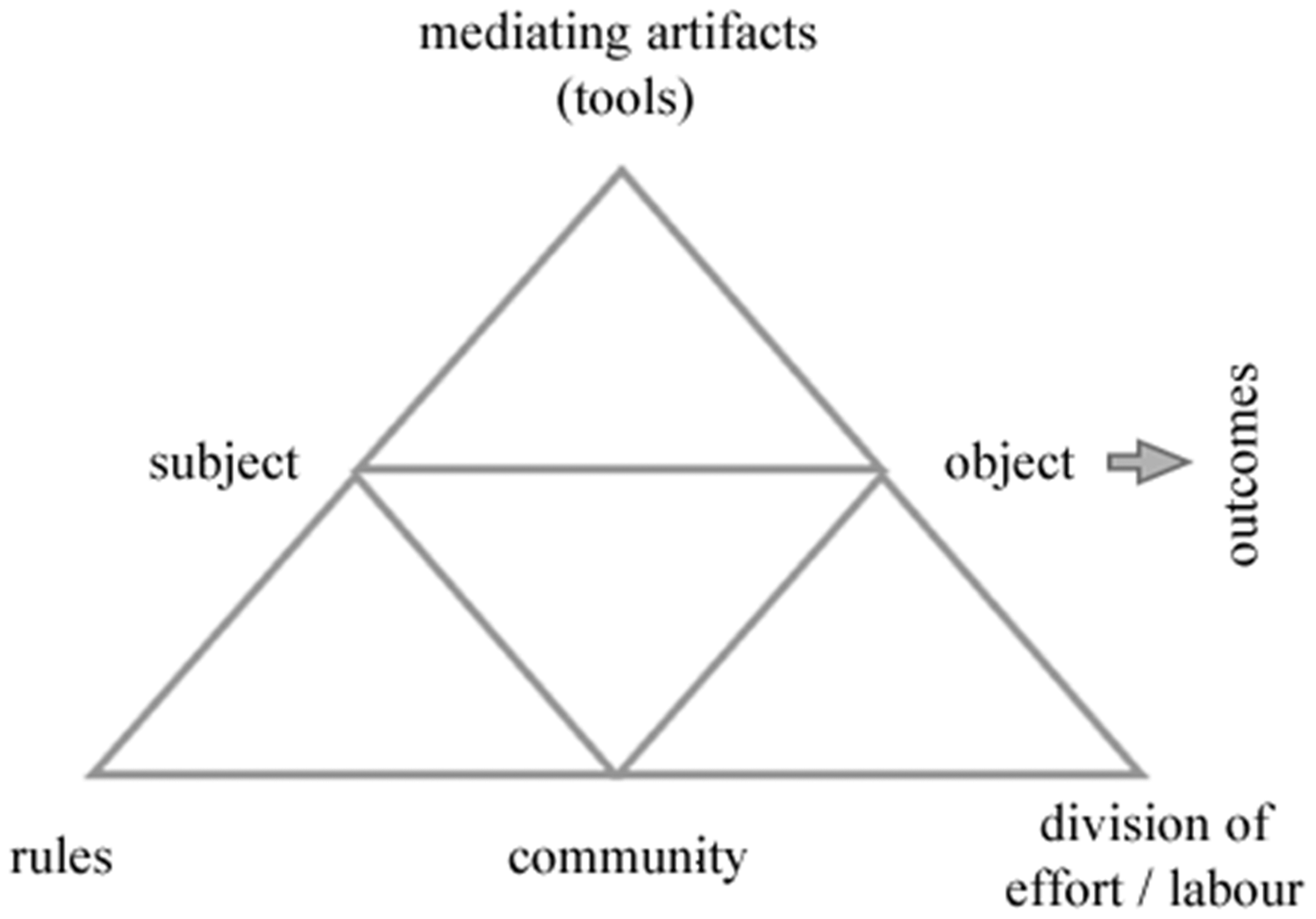
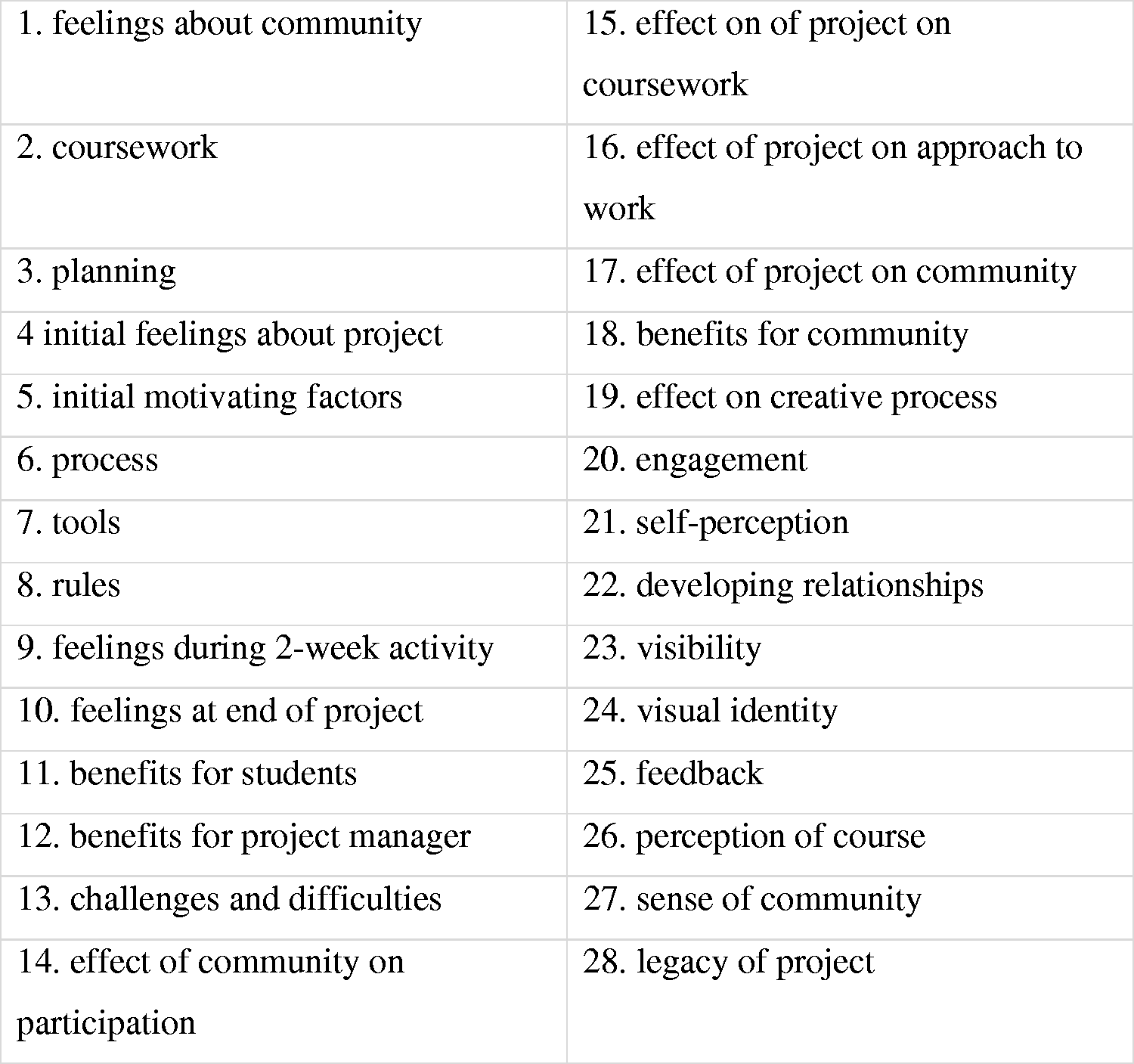
The authors then developed a narrative based on the code categories that aimed to describe the ‘lived-in experiences’ of participants (Yamagata-Lynch, 2010: 90). The narrative described the full range of participants’ experiences in relation to the joint activity and situated these experiences within the wider context of the DDA community. The narrative also identified any contradictions both within and between categories in order to reveal tensions in the activity system. The codes provided a structure for the narrative and enabled the researchers to relate the narrative to the research question.
Drafting the narrative
The following text is an extract of the narrative that was created which indicates how the codes were used to guide the analysis of the data. Feelings about community. Students and staff on the course experience a strong sense of community. Students value the inspiration and motivation they receive from regular exposure to each other’s work and benefit from a positive culture of constructive criticism. Staff value the shared histories and cultural references of the community, and the opportunity to view work through a younger person’s eyes is rejuvenating. The use of blogs encourages communication between cohorts and facilitates regular peer feedback on coursework. Assessed work is the principal object of students’ activity on the course. Initial feelings and planning. The initial feelings of the project team about the ACT project were mixed, as there was a fear of diluting students’ focus on their assessed coursework. The activity was designed to be as feasible as possible to minimise barriers to participation. The community had had previous and regular experience of ‘speed painting’, a non-assessed course activity in which the course leader asked students to respond quickly to a prompt by creating a digital painting in less than 20 minutes and then sharing it on their blog. Students’ familiarity with speed painting informed the activity design, as it would keep their time commitment to a minimum. The objective of the activity was for students to create a body of speed paintings inspired by the musical extracts in the form of layered Photoshop files. Participation in the activity was also optional. Students’ initial feelings about the ACT project were mixed. Some interviewees reported a level of excitement in the community at the fact that the whole course would be involved, and there was a sense of curiosity to see how the diverse range of styles would come together in a single piece of work. However, some interviewees expressed concern about the opportunity cost of taking time out from their coursework to participate in the project, and others were concerned about their ability to respond to music visually. Initial motivating factors. Students reported that they were motivated to participate in the activity by the fact that the speed paintings provided them with a welcome break from their coursework. Some viewed it as a chance to experiment and try different approaches, and as an opportunity to build their CV by participating in a professional project. Others identified the creative freedom and the desire to be a part of a whole-course project as motivating factors. Feelings during activity. During the two-week activity, some interviewees described that participating was fun, relaxing, reduced their stress levels and created a buzz in the community unlike anything they had experienced previously. However, others reported that the lack of rules regarding creative direction was frustrating and that having complete creative freedom was, in fact, paralysing.
Once the narrative had been created it was then possible to identify and construct activity systems based on the activities described in the narrative. In total, four distinct activity systems emerged from the narrative. The use of Engeström’s model of activity theory to analyse data often begins with a depiction of the activity system prior to the introduction of an innovation or change in order to provide context (Murphy and Rodriguez-Manzanares, 2008). Following the data analysis, Figure 3 illustrates the activity system prior to the introduction of the ACT project from the perspective of students on the course, taking the attainment of a degree to be the object of the system and the students as the subject. The dotted line (a) represents a tension between students’ coursework and the assessment criteria, student regulations and deadlines, which the interviews revealed as a cause of stress.
Activity system on the Digital Design and Animation (DDA) course prior to introduction of the A Common Territory (ACT) project.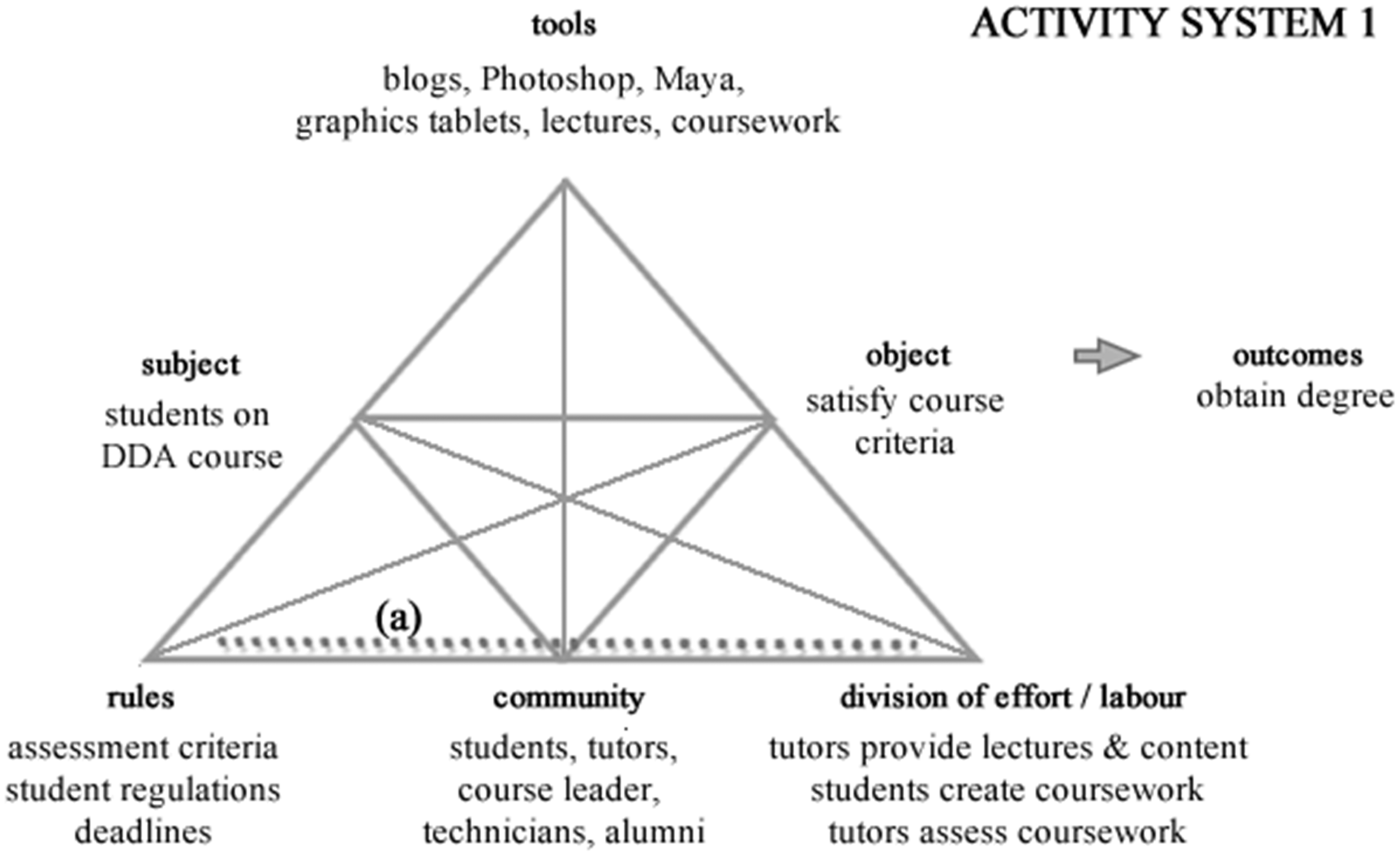
The introduction of the ACT project into the course culture created a new activity system, illustrated in Figure 4. In this second system the object of the activity was the creation of a large number of speed paintings by members of the DDA community, and the community can therefore be understood as the subject of the activity. Two tensions were evident from the interviews and subsequent narrative: line (a) represents the tension generated by the lack of creative rules, which prevented some students from believing that they could create appropriate paintings, while the circular line (b) indicates the tension in the division of labour caused by not all students participating in the activity. However, neither of these tensions was sufficiently strong to prevent the subject from attaining the intended object.
Activity system on the Digital Design and Animation (DDA) course after introduction of the A Common Territory (ACT) project.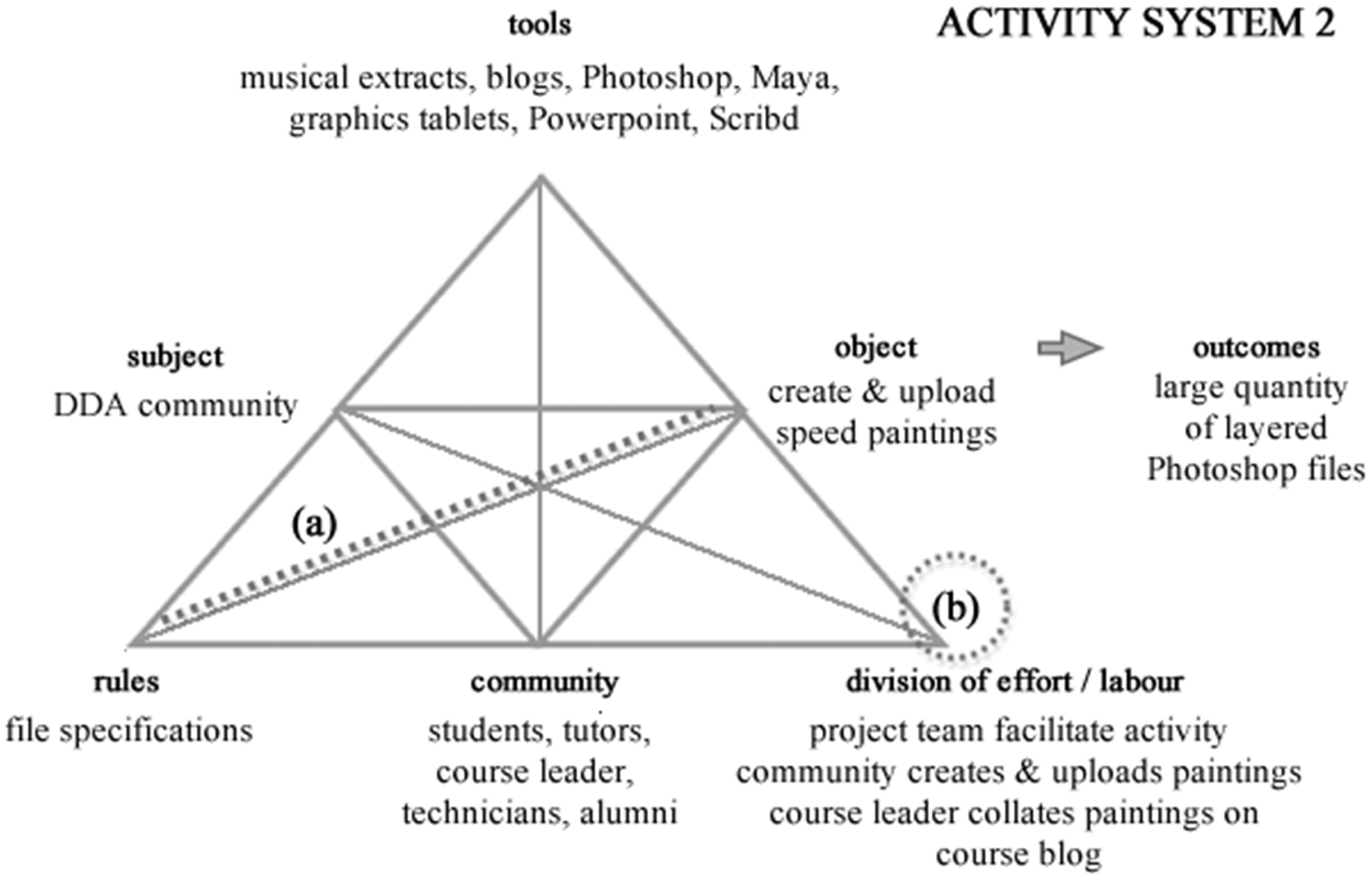
The completion of the second activity triggered the launch of a third activity system, illustrated in Figure 5. Having successfully obtained a large quantity of layered Photoshop files from the community, the two project managers began the task of selecting appropriate files and animating these to accompany the musical composition. The creation of the final animation can therefore be understood as the object of this third activity system. Three tensions were evident in this system: tension (a) represents the difficulty in selecting appropriate paintings to fit the animation, while (b) indicates the initial challenge of sharing control of project management between two project managers. Tension (c) represents the difficulty presented by the fact that not all participants had adhered to the requested file naming conventions, causing difficulty for the project managers in sorting through the submitted work.
Activity system triggered by the need to create animation out of speed paintings.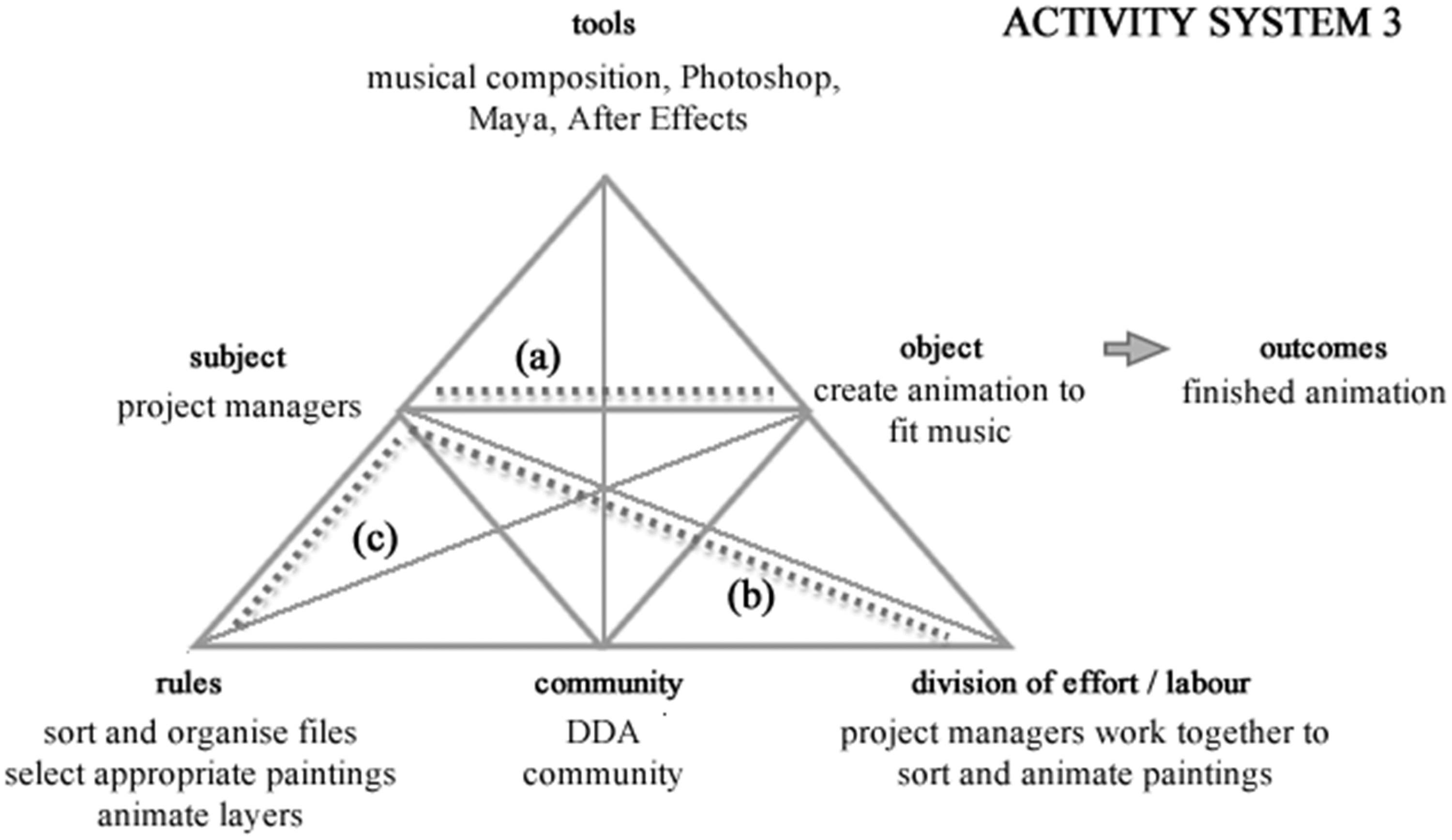
The fourth and final activity system, illustrated in Figure 6, describes the final stage of the ACT project, which consisted of a performance of the animation in front of an audience accompanied by an orchestra. The object of this activity was the successful real-time synchronisation of the animation with the music of the orchestra, and this system is presented from the perspective of the project managers and course leader. Two tensions were identified from the data analysis: tension (a) reflects the difficulty that the project team experienced in adhering to the rule of the activity, which was to keep the animation in time with the music. Tension (b) highlights the tension in the division of labour between the project team and the orchestra resulting from the need to synchronise the animation in real time.
Activity system representing the live performance of the A Common Territory (ACT) project.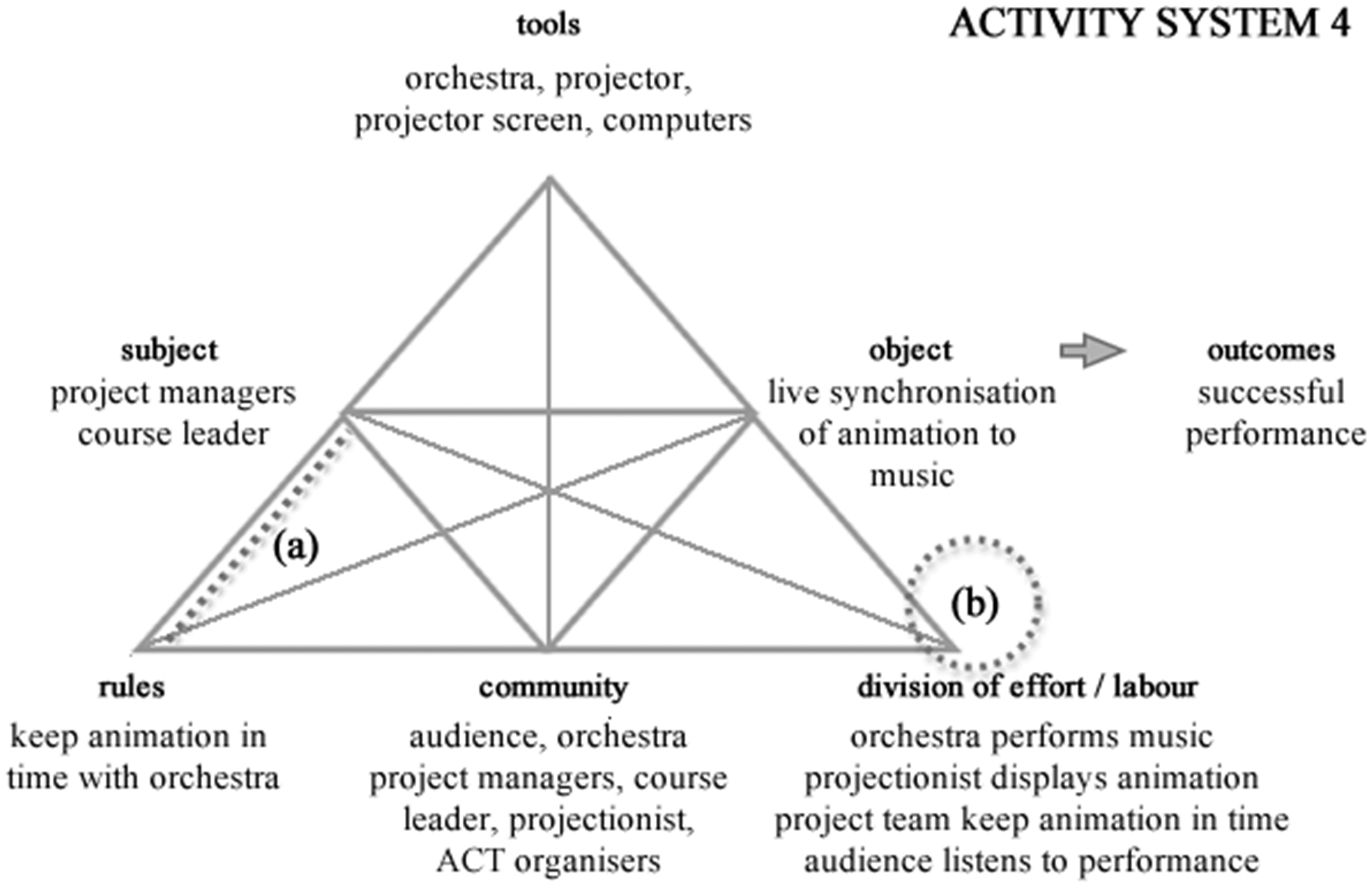
Discussion
The data revealed that the prior activity of speed painting had played a significant role in helping community members become accustomed to the practice of contributing artefacts. This practice can be interpreted as a community ritual, as described by Bryce-Davis (2001), and the ACT project successfully developed this ritual into a joint activity by enabling each speed painting to be a constituent part of the final animation. Referring to Selznik’s (1996) seven elements of communities, the short timeframe of the activity and the daily aggregation of speed paintings by the course leader on the group blog provided an intense point of focus for community members, and the intensity of this shared experience can be viewed as an important moment in the history of the community. Although the interviews were conducted almost a year after the two-week activity, the data revealed a significant sense of pride in the collective achievement of the DDA community, and the co-created artefact can be viewed as constituting an important part in the community identity. The course leader’s assertion that the finished animation belongs to the community rather than to any individual reflects the mutuality of the activity, where each member was invited to contribute towards the final product.
By interpreting the data using sense of community theory (McMillan and Chavis, 1986), it was also possible to understand the effect of the joint activity on the membership, influence, integration and fulfilment of needs, and shared emotional connection of community members.
Membership
Participation in the ACT project was open to any student, alumnus or member of staff associated with the DDA community, but not to anyone outside of the community. This established the clear boundaries necessary to provide the emotional safety in which participants could articulate their needs and feelings (Ehrlich and Graeven, 1971). Examples included students expressing both joy with other members at being able to find and develop their visual style and frustration at the creative paralysis induced by the lack of rules.
Influence
Participation in the ACT project provided a way for members of the DDA community to influence what the group did, and this is an important factor in attracting a member to a group (Peterson and Martens, 1972). The course leader reported that some of the students less able to grasp the concept of synaesthesia were influenced by the work of other students whose work was more abstract. Students also reported that the opportunity to have their speed paintings featured on the course blog was a motivating factor in participating, as it provided a way to increase their visibility in the community.
Integration and fulfilment of needs
Also interpreted as ‘reinforcement’, McMillan and Chavis (1986) indicate that belonging to a community or group must be rewarding for members. The authors also draw attention to studies indicating that the status brought by group membership is important in developing a sense of community (Berkowitz, 1956; Peterson and Martens, 1972), and that relationships between members grow stronger as the group becomes more successful. The critical acclaim and positive exposure that the ACT project afforded the course can be understood to have increased the status of being a member of the DDA community.
The authors also observe that ‘competence’ is another reinforcing factor for members of a community, and that ‘people are attracted to others whose skills or competence can benefit them in some way’ (McMillan and Chavis, 1986: 8). The course leader noted that the successful delivery of the ACT project has led to offers for similar projects in Europe and the United States of America. In this way, the ACT project demonstrated the shared competence of members of the DDA community.
The data strongly suggested that participation in the co-creation of the animation fulfilled the needs of community members. These needs ranged from the project’s ability to provide a relaxing break from coursework to enabling a student to discover a new way of approaching her final-year project.
Shared emotional connection
The ACT project encouraged regular contact between community members, as the project involved students submitting work on their blogs, thereby making it possible for others to see and comment on it. These comments sometimes led to students having a subsequent face-to-face conversation with someone who they might not otherwise have talked to, thus helping students develop their shared emotional connection with members of the community. The use of the group blog to showcase the work being created each day also provided a way to ensure regular contact between community members during the activity. Although the final-year interviewees stated that they were initially concerned about the opportunity cost of participating in ACT over their assessed work, the data still suggested that there was a sense of excitement to see what the community was capable of producing. Once the activity was underway, interviewees reported a ‘buzz’ throughout the community unlike any they had experienced previously, and that the community was ‘invigorated’ by the daily outpouring of creativity on the blogs. This suggests that the strong sense of community on the course was in partly responsible for motivating students to participate in the project. The comments by the course leader that the project is still being talked about over a year after its completion suggest that the project has left a powerful legacy regarding the collective achievement of the community.
The data analysis aligned with the view of Ma and Agarwal (2007) that accurate communication and verification of identity influences participation, and this was evidenced by the project providing students with an opportunity to develop their professional identity as a digital artist. This in turn brought extrinsic benefits, such as recognition from other members of the DDA community, and intrinsic benefits in the form of increased self-belief, confidence at finding their own professional style and methodology. Ma and Agarwal (2007) also suggested that individuals in an online community can experience psychological discomfort if their view of themselves differs from the views of others in the community. The data indicated that a student who had struggled to fit in creatively with the course culture during her first two years significantly developed her professional voice and style during the activity. This suggested that motivation in the ACT project was in part driven by the opportunity for students to experiment outside of the restrictions of coursework, and several of the interviewees confirmed that students took advantage of the opportunity to experiment and ‘try something new’.
Butler et al. (2007) also note that increased visibility in a community can bring professional advantages, such as the opportunity for a community member to reach a wider audience. The data confirmed that this was a motivating factor for students to participate in the ACT project, as the opportunity to have their work featured on the group blog provided exposure to both the wider community and also to employers and industry professionals who follow the blog. There was also a strong indication in the data that students were driven to participate in the project because they found it to be ‘relaxing’ and ‘a welcome break from coursework’. The evidence that students under significant pressure to meet coursework deadlines chose to participate in a non-assessed activity was an interesting finding.
Limitations of the study
Although eight interviews formed the basis of this study, time constraints prevented further interviews from being conducted. While the data analysis revealed some interesting correlations regarding students’ experience of the ACT project, the interviews only provide a limited insight into the factors motivating students to participate in the activity and cannot be considered as a fully representative sample. It would also have been interesting to study the interactions that took place on the network of blogs to obtain a deeper understanding of the supportive nature of the DDA community. Unfortunately, the problematic nature of obtaining ethical approval to study these online interactions prevented their inclusion in the research.
While the situated nature of the activity limits the generalisability of the findings, it is hoped that framing the study within the broader context of community formation will enhance its generalisability. The study has highlighted that further research into the links between joint activities and sense of community is needed in order to help educators develop successful blended and online communities of practice. In view of the need for universities to address issues of student satisfaction in response to higher fees, a better understanding of the links between joint activities, sense of community and student satisfaction, and of how to embed these activities in curriculum design, would also be valuable.
Conclusion and implications for practice
As traditional face-to-face teaching methods in higher education give way to increasingly blended and distance approaches, understanding the structural elements of online communities and their relationship with learning and engagement is becoming increasingly important. Although the term CoP has been liberally applied to many diverse forms of online activity, what has been lost is a clear differentiation between simple online discussion and joint activities, and of the importance of co-creating artefacts in developing a sense of community.
Communication between members is essential in order for communities to exist (Schwier and Daniel, 2008), and in the context of online communities communication is often sufficient for learning to occur. However, if an online community is to develop into a true CoP, joint activities are also an important mechanism in fostering the development of key community constructs, such as a sense of history, identity, mutuality and a shared emotional connection. Joint activities involving co-creation, such as that represented by the ACT project, are an important mechanism in enabling a community develop into a CoP, and should be viewed as separate from simple communication and online discussion. A key finding of this study was that the ‘ritualistic’ nature of regular speed painting was an important construct in supporting the success of the joint activity.
The data also revealed that the strong sense of community around the DDA course was a significant factor in motivating participation in the ACT project. The analysis indicated that communication and verification of identity, as suggested by Ma and Agarwal (2007), did influence participation, bringing both extrinsic benefits for students in terms of recognition from the community and intrinsic benefits, including increased self-belief and confidence in their artistic abilities. The chance for students to experiment and develop their professional practice and artistic style outside of assessed work was also an important motivating factor. The opportunity for students to increase their visibility in the community, while not necessarily a motivating factor at the start of the activity, did influence participation as the activity progressed, as students began to see the exposure that the speed paintings afforded on the group blog. An unexpected finding of the study was that the non-assessed, ‘fun’ nature of the activity was also a significant factor in motivating students to participate. This was evident in comments from all student interviewees that engaging in the joint activity provided an enjoyable break from their coursework.
The implications of this study are that joint activities need to be understood as separate from online discussion, as they are an essential component in the formation of CoPs with significant potential to enhance student engagement. A deeper understanding of the role of joint activities in enhancing a sense of community would enable tutors and curriculum designers to add value to student learning. Further research would aim to clarify the relationships between the co-creation of an artefact, sense of community, student engagement and motivation. In addition, while many online communities create digital artefacts in the form of text documents, less is known about the effect of co-creating a digital artwork on members’ sense of community. A subsequent study might also investigate students’ perceptions of ownership regarding a co-created digital artwork. In view of the growing use of social networking technologies in higher education, understanding the ways in which the co-creation of an artefact can enhance the sense of community could provide a way to deepen understanding of learning and engagement in both online and blended learning communities.
Footnotes
Funding
This research received no specific grant from any funding agency in the public, commercial or not-for-profit sectors.