




Abstract
Against an increasingly compartmentalized educational landscape, we have heard urgent calls for new modes of teaching and learning. In this light, educators from a variety of disciplinary backgrounds turned to transdisciplinarity and the arts for a possible response. The educational initiatives being developed and the related literature are situated across a wide range of themes, disciplines, and methodologies. The fragmented nature of the academic discussion inhibits our capacity to think through the implications of mobilizing the concept of transdisciplinarity within the arts and education. This study addresses the lack of an overview by conducting a systematic review of the literature characterized by a triangular interest in higher education, transdisciplinarity, and the arts. The documents under review amount to 458 unique scientific papers. In our results, we present a metaphorical scale – moving from buzzwords to a theoretically delineated usage – to make sense of the use and conceptualization of transdisciplinarity and we introduce three main ways how the arts are part of transdisciplinary educational compositions. In bringing together literature on education, the arts, and transdisciplinarity, we shed light on relevant similarities between thinking and doing that too often operates in isolation. As such, we aim to facilitate opportunities for mutual learning and present an improved vantage point from which to consider how decisions regarding particular conceptualizations and positionalities feed into our artistic and educational practices.
Transdisciplinarity (TD), in its various manifestations, has gained traction in higher education as a way of addressing complex societal problems by enabling productive border-crossing between different knowledge domains and communities of practice. These transdisciplinary efforts, attuned to co-creation, a richer conception of knowledge, and an awareness for ‘more-than-rational’ aspects (Galafassi et al., 2018), are increasingly put into connection with the arts and arts education. The primacy of TD in art education, and the urgency to learn more about it, was reflected in the theme of the ELIA Biennial 2020. ELIA is a globally connected knowledge platform with 260 members (all art schools) in 48 countries that aims to provide a place for discussions and development in higher arts education. With the motto “Expanding the arts”, the Biennial centered on the examination of “new crossovers and collaborations” (ELIA Theme, no date). On their website, they state that thinking and reflecting across disciplines has become a necessity. The proliferation of academic articles discussing TD involving the arts seems to affirm their statement. An overview of the literature is however lacking. The current fragmented nature of the academic discussion inhibits our capacity to think through the implications of mobilizing the concept of TD within the arts and education and it hampers opportunities for mutual learning. In this article, we seek to address the lack of an overview by bringing complementary, yet largely isolated articles in conversation by performing a systematic review of the literature concerned with higher education, the arts, and TD.
Nicolescu (2018), one of the key thinkers in the field of transdisciplinary theory, stresses the utmost necessity of “a new type of education which takes into account all the dimensions of the human being” in dealing with complex societal issues (p. 75). To enable this new type of education, Nicolescu (2018) asserts the importance of a reconciliation between the arts and sciences. He writes that “[e]verything must be done” to reunite the arts and sciences “so that they will move beyond to a new transdisciplinary culture, the preliminary condition for a transformation of mentalities” (Nicolescu, 2018: 78). These calls are amplified by authors such as Galafassi et al. (2018) who acknowledge that today’s complex challenges (e.g. climate-induced problems) cannot be faced by science alone, but demand an “open and engaging transdisciplinary processes with large and diverse populations aimed at sharing experiences, co-creating knowledge and reimagining public goals” (p. 73). As Mittelman (2018) reminds us, however, reformist rhetoric in itself is not enough. The rhetoric should always be accompanied by doing and by an enduring commitment to fostering cultures of creativity sustained by values of playfulness, adaptability, and innovation. These values must be “reflected in the creation of unorthodox curricular architecture dedicated to imaginative thinking, bold experimentation, and audacious visions” (Steger, 2019: 764). It is exactly those curricular activities that make up the bulk of our data set.
The fact that science alone cannot effectively respond to the “wicked problems” (Rittel and Webber, 1973) that plague our societies (e.g. social inequality, waste problem, pandemics) becomes increasingly apparent. Even within the academic arena, voices urge scientists to reflect upon how science might contribute to the production and maintenance of the problems we are facing. This realization and reflection offers much-needed opportunities to rethink how we shape our courses, curriculum, and educational landscape. Among educators, there is an increased attention for the potentiality of the arts to transform longstanding mentalities and ways of acting and learning of both students and staff. Examples of this trend can already be found in more established modalities such as Art Integration, Arts-Based Methods, and STEAM education (e.g. Chemi and Du, 2018; Ghanbari, 2015; Marshall, 2014). Simultaneously, connections are forged between these types of educational initiatives and transdisciplinary approaches, both in theory and practice.
Marshall (2014), for example, points to the similarities between the aims of TD and arts integration, by proposing art integration as a transdisciplinary practice, while Costantino (2017) refers to STEAM education as transdisciplinary practice. Several educational programs base their pedagogy on a transdisciplinary practice combined with the arts, such as the Transdisciplinary Studies program at Zurich University of the Arts, the Arts and Creative Practices initiative at Aalto University (Tavin et al., 2017), and the Transdisciplinary Design program at New School’s Parsons School of Design (Parsons Transdisciplinary Design (MFA), no date). In addition, many smaller initiatives, situated in the margins of the educational landscape, draw upon a transdisciplinary framework with the involvement of the arts to create new spaces for educational innovation.
In sum, both in theory and in practice, there is great interest – by educators, artists, and scholars alike – in connecting higher education, the arts, and TD. The particular ways in which TD is mobilized, however, and how the arts are part of transdisciplinary compositions remains unclear. It is important to examine these differences because concepts always do more than describing the social world. They influence how we make sense of our practices, surroundings, and ourselves. Concepts “enter constitutively”, as Giddens (1987: 20) put it, into the worlds in which they are mobilized. Similarly, how we take up space in a collaboration has consequences for the nature of that collaboration. Bearing that in mind, we set out to provide the conditions to think through the implications, for our educational and artistic practices, of certain usages of TD, and certain artistic positionalities, rather than others. We have formulated two research questions that direct our data collection and analysis towards that objective. How is transdisciplinarity used and conceptualized in articles concerning themselves with higher education, the arts, and transdisciplinarity? How are the arts positioned in transdisciplinary educational initiatives involving the arts?
Materials and methods
In this section of the paper, we expound upon the criteria for inclusion in our data set, present our corpus, and elaborate upon our analytical procedure.
Setting the scope
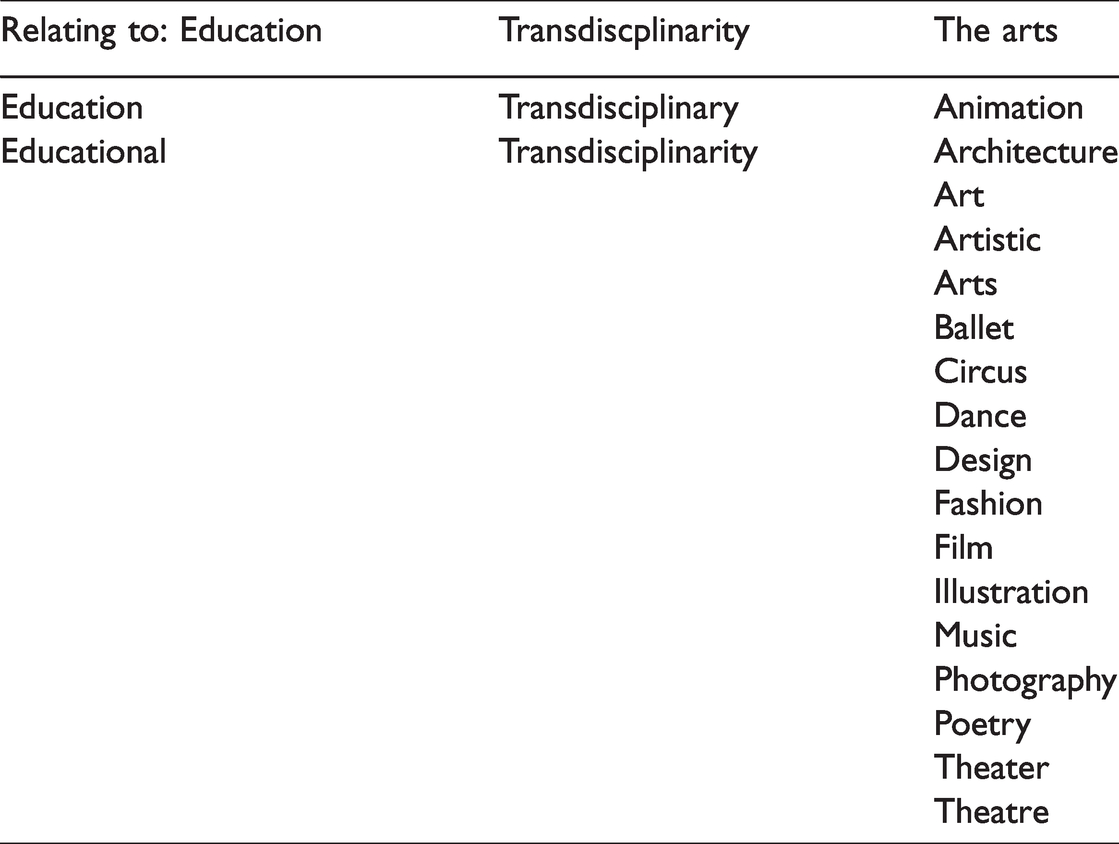
The documents under review amount to 458 unique scientific papers. The papers have been identified and selected through a structured literature survey of the ISI Web of Knowledge and Scopus databases (all years). We used key words to tailor our search towards issues related to higher education, TD, and the arts. The literature search was executed in November 2018. In an attempt to capture our triangular field of interest as comprehensive as possible we used different declensions of the same key word (see Table 1) and, following Johnston (2008), we “define the arts in a very generous way” (p. 224). In so doing, we avoid foreclosing potential avenues worth exploring before even conducting our qualitative analysis. All of the possible combinations of the search terms were entered in the title search. We did not restrict our search in terms of paper categories. The results of our search query were exported to a reference manager.
Overview of the key words used in our search query.
Materials used
The reference manager allowed us to organize the collected data. The first and second author removed duplicate entries and independently scanned the entire data set for material not related to the field of transdisciplinary, the arts, and higher education. We measured interrater reliability at the level of the decision to include articles to be reviewed. The percentage agreement amounted to 98%. During the process, we organized frequent meetings to discuss issues or concerns and collaboratively decide in cases of doubt.
In order to answer both research questions, it was necessary to construct two data sets (see PRISMA Flow Chart, Figure 1). Our second research question centers on the position of the arts in transdisciplinary, educational initiatives. We could only formulate an accurate answer to this question based on articles that actually concern themselves with educational initiatives. Therefore, only case studies were included. Our first research question did not require this categorical distinction.
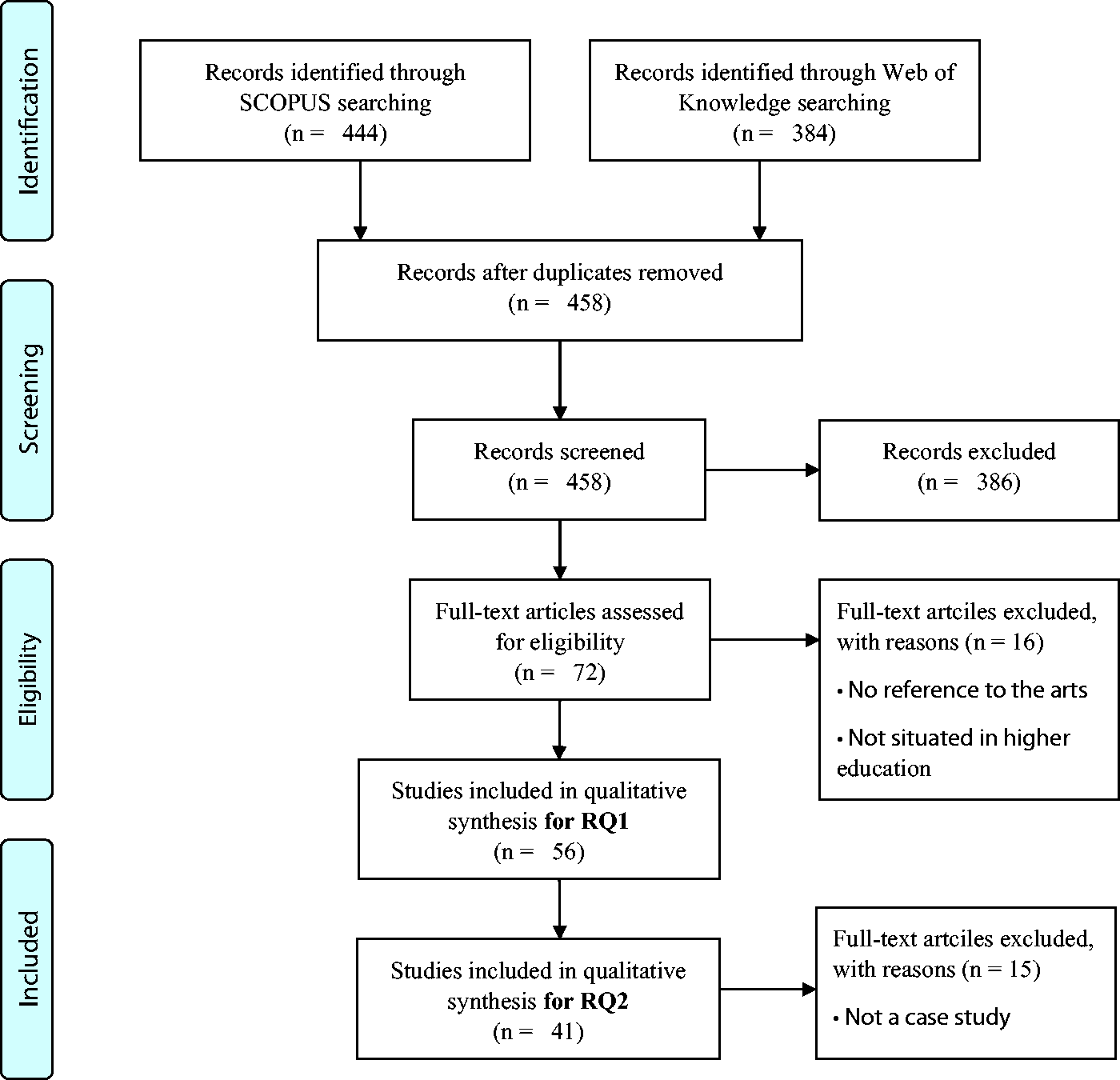
PRISMA flow chart.
Analytical procedure
In line with studies like Zscheischler and Rogga (2015) and Fritz and Binder (2018), our analysis is based on a qualitative in-depth examination of each publication and applies a synthetic approach for qualitative studies which builds upon the work of Noblit and Hare (1988). Our themes capture patterns of meaning, relating to our overall research questions, in our data sets. We use an inductive, data-driven approach to our corpus. Meaning that, in our analysis we coded the data without trying to fit it into a preexisting theoretical framework. Our analytical process progressed from description, where we primarily organize and summarize patterns in the manifest content, to interpretation, where we attempt to theorize the meaning of patterns often already in relation to existing literature, and finally we proceed to situating the broader implications of our results in a relevant body of literature. While constructing our themes, we aimed to acknowledge the complexities of our data set. Rather than smoothening out inconsistencies within our themes, we retained accounts that depart from the dominant narrative.
Results
This section presents the results of our qualitative review of the literature. Our analysis resulted in the construction of two themes. The first theme centers on the use and conceptualization of the notion of TD and consists of four subthemes. The second theme revolves around the position of the arts within transdisciplinary educational initiatives. The first theme relates to our first research question and the second theme concerns itself with the second research question.
Transdisciplinarity: Patterns of use and conceptualizations
In this section, we map the ways in which TD is used and conceptualized. Our subthemes are structured in line with our analytical procedure. We begin each subtheme with a descriptive account of the pattern of meaning concerned, then we present data extracts which vividly capture the essence of the theme, and we conclude with a more interpretive account of the data.
Mere mentions
If we were to approach the degree to which TD was conceptualized in our corpus as a scale, then we have to envision a scale that moves from mere mentions to lengthy, theory-heavy conceptualizations. Departing from the idea that the entirety of the scale is worth investigating, we start by exploring patterns that emerge from articles characterized by their frugal usage of TD.
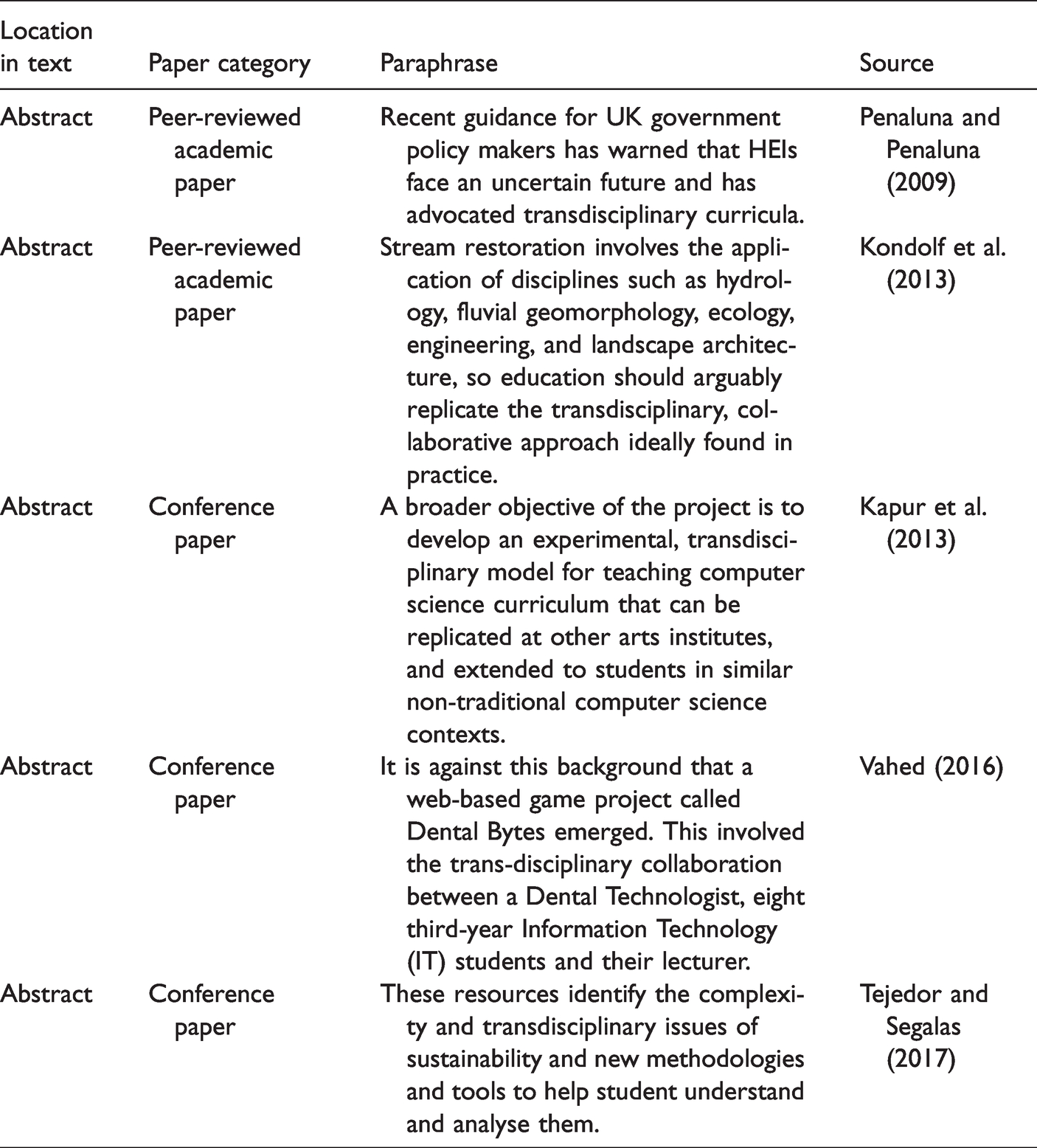
The articles (n = 9) supporting this subtheme did not go beyond mentioning the word transdisciplinary. All articles mentioned the word in the abstract. There were two minor deviations to this trend. Kondolf et al. (2013) mentioned transdisciplinary in the abstract as well as in their keywords. Penaluna and Penaluna (2009) mentioned transdisciplinary in their title, abstract, and keywords. But none of the articles mentioned the word in their actual text. Neither did one of the articles mention the declension transdisciplinarity. Table 2 provides an overview of several occurrences in the texts.
Examples of mere mention-usage.
The abstract is a prominent place in an academic text (let alone the title or keywords). Therefore, the silence after introducing the concept (i.e. TD) in the abstract was noteworthy. Perhaps the authors, during the writing process, imagine an audience familiar with the concept. But due to the lack of a universally accepted definition, methodology or theory of TD (Klein, 2013), this seems unlikely, or in any case ill-informed.
This mere mention-usage is better understood as authors attempting to ride the waves of the “current increased momentum for Transdisciplinarity” (Klein, 2013: 197). This also explains the use of the “word à la mode”, as Lawrence and Després(2004: para. 1) described TD, in the abstract. After all, the abstract may very well be the text enjoying the highest readership in an academic article.
TD as an adjective
In a significant amount of the articles (n = 33) TD was particularly used as an adjective. This means that the authors understood it as an attribute or quality of something else. The quantity as to which transdisciplinary is used, in the articles composing this subtheme, varies considerably. Hansen and Kofoed (2017), for example, mention the term 25 times (i.e. including 7 times in the title, abstract, and keywords). Esteve-Faubel et al. (2018), on the other hand, merely use the term once. In Table 3, we present in-text examples from four different articles.
Examples of sentences in which TD is used as an adjective.
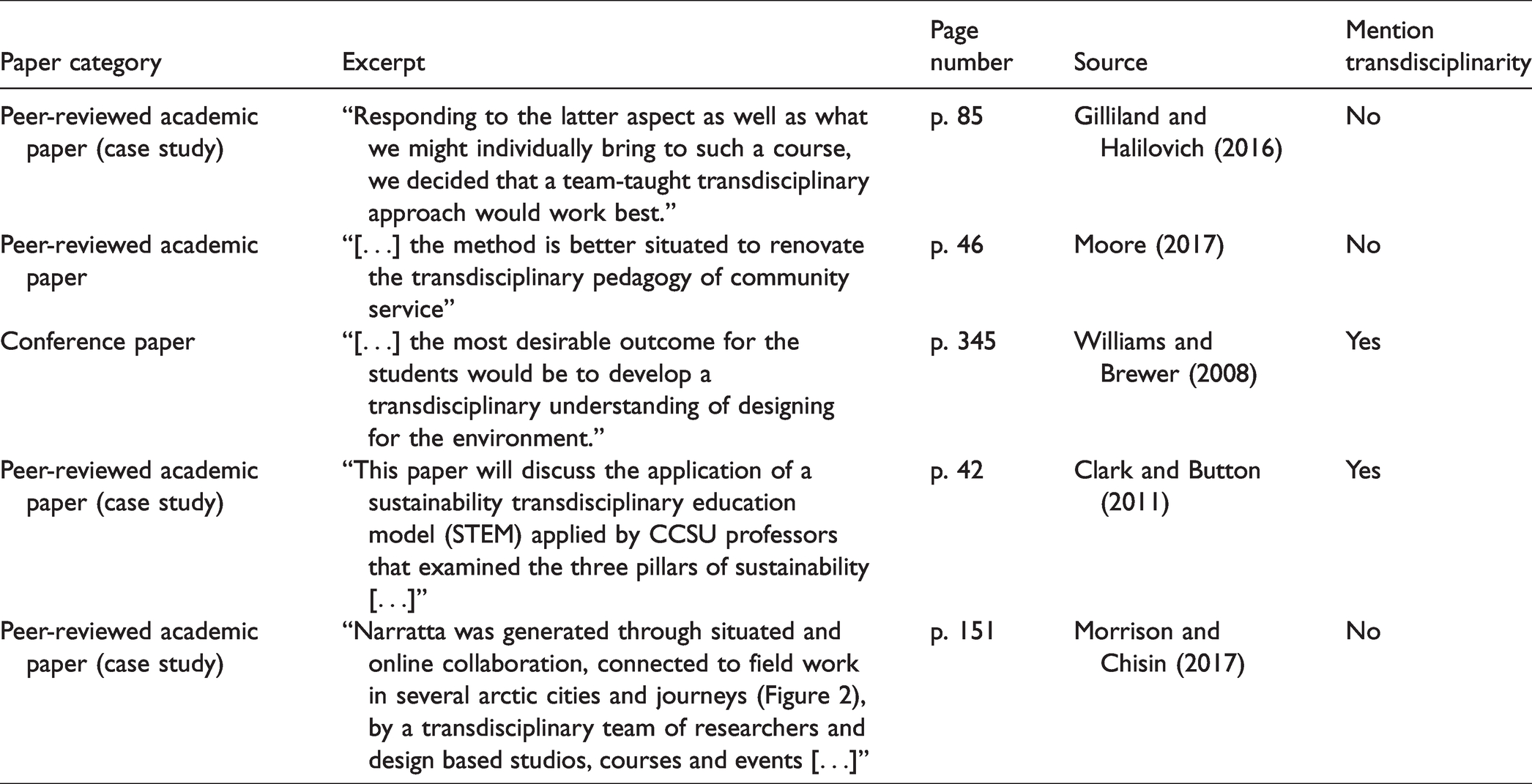
As Table 3 makes clear, TD functions as a characteristic of something else, may it be pedagogies or approaches. TD requires a noun to become meaningful and the noun becomes more meaningful by virtue of its relation to the adjective. The current subtheme highlights the importance of not only paying attention to the way TD is conceptualized, but also very much how it is used. It is telling that 26 (out of 33) articles do not use the declension transdisciplinarity, which suggests that it can be something in and of itself.
The pattern of usage that underlies this subtheme regards TD as a relational concept. TD therefore always needs to be contextualized, has to be put to use, has to exist in a symbiotic relationship with a noun (or nouns) of choice. This understanding of the term clarifies why we will not find lengthy elaborations on TD itself in these articles. Its meaning is always constructed in relation with and can only be understood as such. In this sense, the usage resembles the way in which Gibbons et al. (1994) discuss TD, as something that “consists in a continuous linking and relinking, in specific clusterings and configurations of knowledge which is brought together on a temporary basis in specific contexts of application” (p. 29).
A borderline case
Before introducing the next subtheme, we wish to present one data point which finds itself at the border between mere mentions and TD as an adjective. In Lin and Li’s (2017) research, notions of interdisciplinarity and TD are used throughout the text without a clear distinction. Their research question focuses on interdisciplinary learning experiences, but they describe their course (which serves as the context of their study) as being grounded in “a value-driven and locally relevant holistic approach to inter-/transdisciplinary learning” (Lin and Li, 2017: 560). In their text, TD is always used in relation to interdisciplinary and never in isolation. The contraction “inter-/transdisciplinary” appears four times in the entire text (i.e. including abstract, citations, and keywords), the word “interdisciplinary” appears nine times.
This article is a borderline case because it does use transdisciplinary as an adjective (and it does not use transdisciplinarity), but by not expanding upon their usage of TD and by only using it in contraction with interdisciplinarity, they really only mention TD. It is important to describe this tension in our data set, because it draws attention to the constructedness of our themes and accentuates the permeable boundaries of the themes. Borderline cases, like this one, demonstrate the continuity of our metaphorical scale and explicitly remind us not to think of the themes as categorically distinct territories.
Theoretically delineated usage
The texts (n = 13) supporting this subtheme operationalize the notion of TD. Seven articles explicitly define transdisciplinarity. The other articles are similar in the sense that they also clearly situate themselves in a theoretical tradition or body of literature. But rather than conceptualizing transdisciplinarity as such, they choose to elaborate on, for example, “transdisciplinary knowledge” (Al-Hagla, 2012: 23; Pour Rahimian et al., 2014: 3), a “transdisciplinary approach” (Exter et al., 2017: 5), “transdisciplinary” (Ertas et al., 2003: 289; Thomas, 2015: 474), or a “transdisciplinary tradition” (Stenberg and Fryk, 2012: 3285). In doing so, they all clarify what TD, or a similar-but-different concept, means to them and share, to different extents, what this implies for their research. The articles supporting the subtheme TD as an Adjective omit such clarifications. In Table 4, we present five brief excerpts from a variety of conceptualizations.
Five examples of how TD is conceptualized.
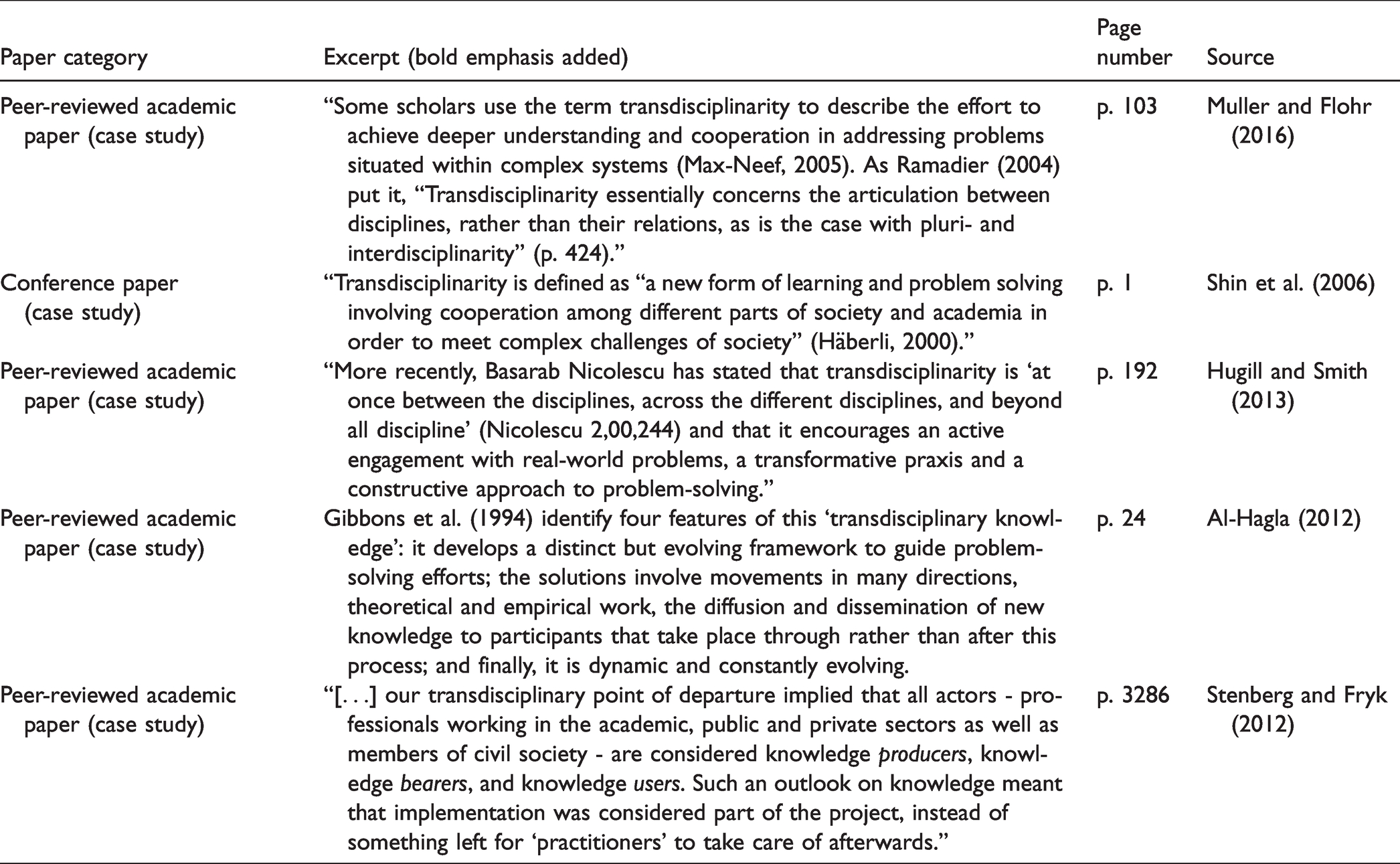
As the excerpts show, the authors often build upon the work of others. Nicolescu’s work is cited in five articles. But it falls outside the scope of our study to conduct an adequate Citation Network Analysis. What the current subtheme does show is that there is no consistent, unidimensional conceptualization of TD throughout the articles. More than once, the authors acknowledge the lack of conceptual clarity surrounding TD, but this does not inhibit them from using the concept. They still regard it valuable enough to give it a prominent place in their studies. Like Klein (2013), they do not aim to settle the debate and come to a universally accepted definition. They are interested in using the concept and for that reason they define TD in a way that works for them and their project, fully aware of potential conflicting conceptualizations. On a project-basis, they seem to come to consensus as to what TD entails. This helps the authors in directing their research and also evaluating the results. It, among other things, allows researchers to make statements like Exter et al. (2017), who concede that although they “aimed for true transdisciplinarity [emphasis added]”, they did not manage to fully realize that objective (p. 14).
The position of the arts
This section of the paper presents the results of our qualitative analysis of case study literature concerning themselves with higher education, the arts, and TD. The current theme presents the different ways of how the arts are positioned in transdisciplinary educational initiatives. The nine articles making up the subtheme mere mentions were excluded from our analysis for The Position of the Arts. We want to make claims pertaining to transdisciplinary educational initiatives. When no connection is made between the described educational practice and TD, as is the case in subtheme mere mentions, the case studies were excluded from our analysis. The articles under review therefore amount to 32, rather than 41 (see Figure 1).
An instrumentalized position
This theme captures those articles (n = 5) in which the position of the arts is instrumentalized. Meaning that, within the collaborations the arts are treated as a tool or guide to action, rather than an end in itself. The arts can still play an important role in these collaborations, but the degree to which they are allowed to give color to that role is greatly reduced. In other words, the arts, when discussing the articles in this theme, are not peripheral, but do enjoy a greatly reduced autonomy. More than once, the arts are invited, in different gradations, into a university setting. This is usually achieved through the application of arts/design methodologies in academia and/or by inviting staff/students from the arts into the academic setting.
A characteristic example of the story presented in this theme can be found in the case study by Shankar et al. (2017). They report on a course in which they bring together engineering, nursing, and arts students. The students are asked to develop an app in which patients can manage health-related activities. This should allow the patients to reduce the number of hospital visits/stays and avoid the stress that usually accompanies it. Let us consider the extracts presented in Table 5.
Sentences exemplifying the instrumentalized position of the arts.
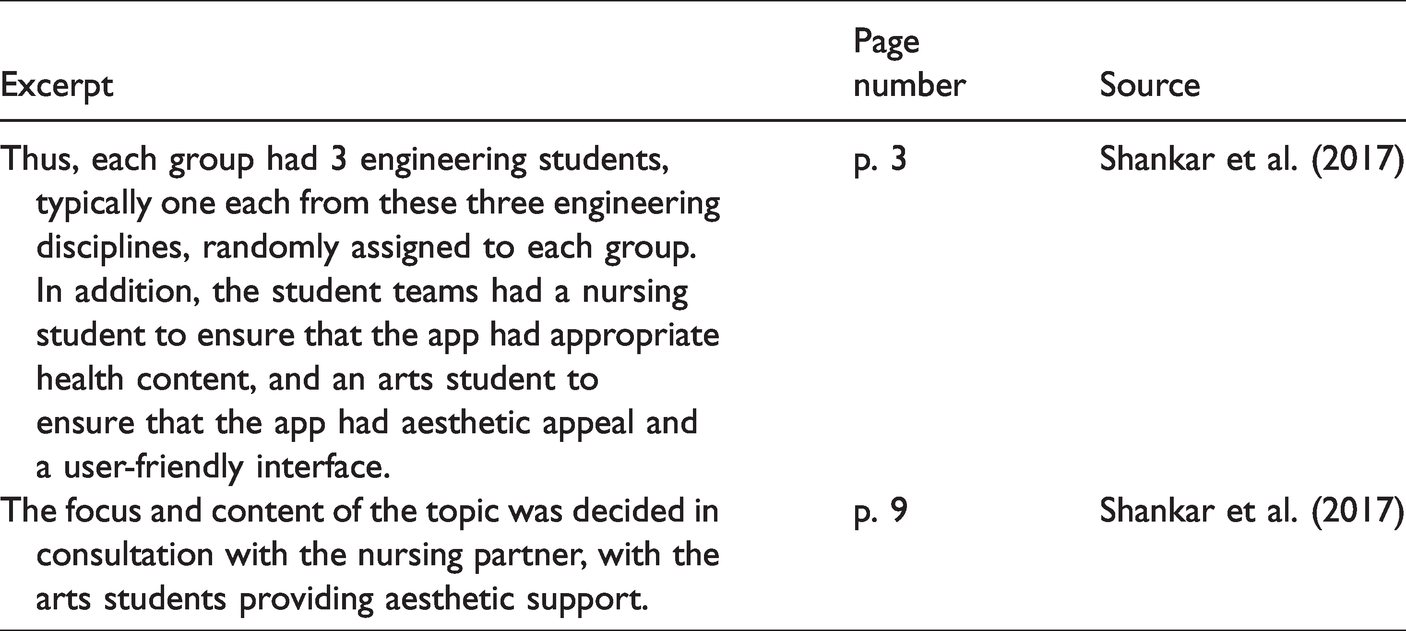
The first fragment shows that the arts students are asked to stay within their discipline and apply their skills on a very specific area within the larger collaboration. They have to concern themselves with the aesthetics, with the packaging, and not with the content. Within this theme, we observe a willingness to open-up a research process or educational context to a wider variety of actors, without the inclination to consider altering the infrastructure of the process or context itself. Other examples where the arts are mobilized in the interest of a pre-defined objective is (i) the article written by Bradley et al. (2017) where they describe a program in which “creative practice and arts-based methods [are used] to develop critical thinking and analytical skills across a range of core curriculum areas” (p. 55) and (ii) the research conducted by Lin and Li (2017) in which students “were asked to take photos focused on issues or personal interests representing the concept of “sustainable oceans” [parentheses in original]” (p. 560).
The current subtheme is supported by no more than five articles; the smallest number of articles still constituting a unique theme in our analysis. But although small in quantity, the articles do strongly and coherently add to the overall argument presented in this theme. The fact that we see this trend relatively little in our data set may come as no surprise to some. Instrumentalizing one discipline to the benefit of another may seem counterintuitive in transdisciplinary collaborations. After all, TD collaborations are more than once characterized by an adherence to equal footing and “truly lived co-leadership” (Binder et al., 2015).
The artistic vantage point
In thirteen articles the arts can be understood to be the primary perspective from which the article is written. Meaning that, in these articles the arts (in whatever manifestation) are not infused or integrated into an otherwise academically-oriented collaboration, but are the very canvas on which the collaboration is played out. Vogler and Eth (2000) and Rey and Lufkin (2016), for example, mobilize the notion of TD within the field of architecture, other scholars (e.g. Mulder, 2015; Muller and Flohr, 2016; e.g. Exter et al., 2017) depart from a design perspective.
It is common for studies to position themselves within a particular tradition, body of literature, or epistemological framework. This decision influences the ways in which a subject is approached, valued, and understood in relation to other processes or objects. We posit that the articles supporting this theme place themselves primarily within an artistic tradition. A compelling example of the story this theme is telling can be found in Al-Hagla’s (2012) case study. In his research, he investigates the role of the design studio in integrating sustainability thinking in architectural pedagogy. The design studio functions as the main vantage point, not only textually or theoretically, but also literally; it is the material space within which his case study is situated. This space is far from passive, but comes with its own traditions and norms, and as such gives shape to the educational activity within it.
The current theme (i.e. The Position of the Arts) centers on the position of the arts within transdisciplinary, educational initiatives involving the arts. It is important to emphasize that the articles within this theme are not being positioned by, for example, a higher-in-rank academic actor, but determine their own position within the collaboration (may it be implicitly). Subsequently, the articles making up the composition of this subtheme do not extensively justify, explain, or rationalize the presence of the arts in the educational setting. After all, the arts are the starting point. It is not only taken for granted that they deserve a seat at the table, but more so, they decide the type of table and are in charge of the attendance.
Transdisciplinary approach
The articles (n = 15) supporting this subtheme situate themselves in a space already beyond the disciplinary borders. Our analysis showed that in these studies, a wide variety of actors were included in heterogeneous collectives and the initiatives often took place in different contexts (regularly outside the traditional classroom). Clark and Button (2011), for example, describe an educational initiative where they “used a combination of visual art, music, video/film, theater, poetry, nature sounds, and sculpture to teach about the science of sustainability” (p. 48). Our review indicates that in studies like this it is not sensible to speak of a singular position of the arts. Their initiative (i.e. Clark and Button, 2011), like the other articles contributing to this theme, transgress disciplinary boundaries and demand to be understood from a transdisciplinary perspective.
Detand and Emmanouil's (2018) case study captures the essence of the current subtheme. They report on a project-based elective which centers on “co-creation”. All students, studying at the institution concerned, are eligible for the course. The lectures in the course (on a wide variety of topics such as: communication, design thinking, creativity and prototyping, entrepreneurship, and human aspects of co-creation) are given by a team of experts from four different faculties. The student teams consist of a total of five students, where at least three different disciplines are represented. The goals and aims of the project are defined by the teams in collaboration with external stakeholders. Throughout the entire process, the students receive guidance from a personal coach who participates actively in the meetings and pays attention to, among other things, the “development of common language” and “positive collaboration” (Detand and Emmanouil, 2018: 3). The teams, in collaboration with the stakeholders, concern themselves with addressing real-life experiences through an iterative process.
The, admittedly lengthy, enumeration in the previous paragraph clarifies that the actors in the case study “actively create a space for their interaction”, to speak with Fritz and Binder (2018: 6), in which disciplinary boundaries begin to blur. Rather than seeing that as an obstacle in the attempt to determine the position of the arts, we regard it as the main feature of this subtheme. If an educational initiative is positioned between (rather than beyond) disciplines (may it be scientific or arts disciplines), then one can usually determine between which disciplines it is positioned. It could for example be between sociology, architecture, and interaction design. The articles within this subtheme resist such categorizations and require to be addressed as a newly formed whole rather than an accumulation of components.
Discussion
In this section, we formulate an answer to our research questions, we discuss the meaning of our results in relation to existing literature and discuss our contributions.
Usage and conceptualization of transdisciplinarity
In our first subtheme (mere mentions), we approach the conceptualization of TD as a scale. We propose to imagine a scale that moves from mere mentions to lengthy, theory-heavy conceptualizations. At the beginning of the scale, we identify a pattern of usage characterized by an absence of any attempt to define or clarify TD. The articles contributing to this theme use TD as a buzzword. In these cases, the mobilization of TD is characterized by the “absence of real definition, and a strong belief in what the notion is supposed to bring about” (Rist, 2007: 486). Buzzwords, precisely, gain their “purchase and power through their vague and euphemistic qualities, their capacity to embrace a multitude of possible meanings, and their normative resonance” (Cornwall, 2007: 272). TD lends itself to being used as such, but we must realize that, within this particular theme, usage will last only as long as the trend upholds. Once out of vogue, a new word will be found as a substitute.
In the second subtheme (TD as an adjective), we still see a degree of ambiguity in the usage and conceptualization of TD. But in those instances, we should not understand it as a buzzword. The second subtheme presents the symbiotic nature of the times when TD is used as an adjective. It is the ambiguity that deserves closer attention now. In transdisciplinary collaborations, different actors, with different epistemologies, methodologies, and disciplinary backgrounds and from different institutional realities meet to work on projects of shared interest. In the articles contributing to the second subtheme, TD seems to function as a malleable concept facilitating collective action. Eisenberg (1984) was one of the first to stress the functionality of ambiguity in organizational communication. The conceptual fuzziness surrounding TD, generally shunned by academics, may serve a purpose and may even be worth protecting. There is an opportunity for “unified diversity” when multiple viewpoints can be read into the same concept (Giroux, 2006: 1229). In this sense, TD is the conceptual glue that brings together otherwise distinct territories. TD, as a boundary object, thus proves to be “both plastic enough to adapt to local needs and the constraints of the several parties employing them, yet robust enough to maintain a common identity across sites” (Star and Griesemer, 1989: 393). When venturing beyond the boundaries of institutions and disciplines, TD has the potential to temporarily serve as a collective anchor providing a sense of common ground for wandering nomads.
The scale of usage ends with a theoretically delineated usage of TD. In a way, this can be understood as realizing the same objective, as compared to the previous paragraph, by using different means. The strategic ambiguity discussed before is employed for its potential for collective action, for generating communion in the face of difference. The articles supporting the final subtheme (Theoretically delineated usage) face similar challenges (i.e. the coming together of different epistemologies and communities of knowing etc.), but cope with it not by employing the space generated by the malleability of TD, but rather by developing a meaningful consensus about precisely that what brings them together.
The proposed scale illustrates how the same concept is used and conceptualized in various ways. Different positions on the scale, subsequently, come with different consequences and implications, as already touched upon in the introduction of this article. Interestingly, by using TD as a buzzword however, one robs it of its constitutive force. There is a desire to benefit from the buzz without having to rethink or change common ways of doing things. If, to continue down the scale, TD is used as the common ground for a hybrid collaboration (TD as an adjective), then it can be necessary to negotiate how the ‘common ground’ relates to the ‘particular grounds’ of the participating parties. Approaching the other end of the scale, the implications for one’s educational or artistic modus operandi are expected to become more significant. Once a meaningful consensus has been reached as to what TD entails (Theoretically delineated usage) the attention can be directed to, for example, finding an appropriate educational space, the exploration of how different bodies of knowledge relate to each other, and how evaluation and assessment must be organized. Different ways of using TD, as a concept, leads us to encounter different questions and opportunities. The scale is helpful in considering, at an early stage, what types of encounters one hopes to facilitate by mobilizing TD.
The position of the arts within transdisciplinary educational initiatives
Our second research question centers on how the arts are positioned in transdisciplinary educational initiatives. In our results, we present three different positionalities. In the first subtheme (an instrumentalized position), the arts fulfill an instrumentalized role in the educational activities. Opposed to that, we illustrate, in the second subtheme (the artistic vantage point), how the arts can be the primary framework from which a case study operates. And finally, in the third subtheme (transdisciplinary approach), we describe several articles that situate themselves in an already in-between space.
The differences between these subthemes can be best understood as differing degrees of engagement in the transdisciplinary process. In order to make sense of our findings, it is helpful to build upon Mobjörk's (2010) work. She refined our common understanding of TD through identifying the different roles actors can play within transdisciplinary collaborations. Her work resulted in a distinction between consulting and participatory TD, which we will use to clarify the differences between our subthemes.
The first and second subtheme resemble a consultancy mode of TD, in which invited actors have “the role of responding and reacting to the research conducted” (Mobjörk, 2010: 870). An important note however is that the second subtheme moves in a counter-hegemonic direction. The arts are the primary perspective and do the positioning, rather than being invited in an academic context because they are thought to be of value to academically-inclined research interests.
The final subtheme, as opposed to the first two, leans more towards participatory TD, characterized by its open and equal nature, in which all actors are involved in choosing and developing research questions and methodologies. The interactional space in which the educational collaboration is situated is not given, but is co-constituted by the different actors involved. This integrative approach is in many ways a “much more delicate task than restricting the actors included and/or circumscribing their role in the research process” (Mobjörk, 2010: 871). Our corpus has showed that the degree of integration is often not only dependent on the intentions of the initiators, but also very much on limitations in practical matters such as time, funding, and spatial constraints.
The distinction between consulting versus participatory TD is helpful in clarifying the ways in which the arts are situated differently in transdisciplinary educational initiatives. We acknowledge that, depending on one’s conceptualization of TD, consulting TD will come across as a contradictio in terminis to some. But we deem it useful because it explicitly draws attention to the constitution of participation. It helps demonstrate that some actors are given, or take up, more discursive space in the case studies than others. This comes with critical implications for the nature of the educational initiative, because it translates into who is allowed to what degree to make decisions regarding, for example, assessment, course contents, and the bodies of knowledge that are presented. Although it falls largely outside the scope of our research, it is important to move the conversation to power in transdisciplinary collaborations. Neglecting or “negating power asymmetries between participants might weaken the transformative potential” of participatory research and education (Fritz and Binder, 2018: 19).
Our analysis presents three main ways how the arts are part of transdisciplinary educational compositions. These positionalities are not fixed. Contours of belonging can change throughout a project. Our findings are not meant to be read as a normative account of participation and engagement in transdisciplinary education, rather we encourage scholars, artists, and educators to use our results to start thinking about, and experimenting with, what positionalities, at what times, are appropriate for the collaborations they wish to enable.
Future research
Our study presents a systematic review of the academic literature concerning itself with higher education, the arts, and TD. There are two avenues of further research that we wish to suggest. Firstly, we have centered our study on the academic knowledge community. Future studies, working with similar methodologies, could open up their search query to include a wider variety of materials (e.g. books, videos, presentations) from databases representing a larger territory of our knowledge landscape. Secondly, it is important to engage critically with how (unbalanced) power relations feed into the nature, process, and evaluation of transdisciplinary educational efforts involving the arts. In so doing, we can both broaden and deepen our understanding of the practices and thinking situated at the intersection between higher education, the arts, and TD.
Conclusion
Despite the plurality of the articles in our data set and the particularities of each, mapping the ways scholars, artists, educators and a variety of other stakeholders bring together higher education, the arts, and TD holds great potential for collective learning and doing beyond the confines of traditional disciplinary boundaries. Our introduction of the scale as a sense-making metaphor upholds the possibility for concurrent difference when it comes to the usage and conceptualization of TD. Ambiguity and multiplicity are not complications in collaborative processes, but can be thought of as “qualities that signal marvellous potentials for an on-going, open-ended fabrication of the world” (Gough, 2006: 116). Our examination of the positionality of the arts within transdisciplinary educational initiatives can help educators with transdisciplinary ambitions to have enhanced conversations about participation, engagement, and inclusion. The need for further exploration notwithstanding, our findings present an improved vantage point from which we can consider how our usage and conceptualization of TD, and our artistic positioning, can facilitate the type of educational collaborations we envision, and how each choice comes with its own implications for our artistic and educational practice.
Footnotes
Declaration of conflicting interests
The author(s) declared no potential conflicts of interest with respect to the research, authorship, and/or publication of this article.
Funding
The author(s) disclosed receipt of the following financial support for the research, authorship, and/or publication of this article: This work was supported by the Dutch Research Council through the Comenius Leadership Fellowship [grant number 405.18865.732].
