




Abstract
This systematic review explores the benefits and difficulties of using technology for the learning of university students with disabilities in both face-to-face and distance learning. Three databases were searched: ERIC, Scopus and Web of Science. The review included 14 articles that met all the inclusion criteria. All the included articles were qualitative studies involving 240 students and 143 faculty members. The data were analyzed using an inductive system of categories and codes. The results are organized around five themes: characteristics of the studies, technological resources most commonly used in university teaching, benefits of technology for learning, difficulties in using technology, and valuation of virtual teaching environments. The discussion and conclusions highlight the positive aspects of technology in the learning of students with disabilities, and warn of the need to improve faculty training and inclusive policies to ensure an effective and accessible use of technology.
Introduction
The number of people from vulnerable groups accessing university, including individuals with disabilities, is increasing (Koutsouris et al., 2022). Accessing and completing a higher education degree has been found to be linked to improving the educational, social, employment and life opportunities of students with disabilities (Villouta & Villarreal, 2022). For example, data from the latest OECD Education at a Glance report (OECD, 2021) show that people who have a higher education degree can earn, on average, 38% more than their peers who have not studied at university.
Undoubtedly, higher education institutions' inclusion, equity and diversity policies play a key role in accessing and successfully completing university degrees (Koutsouris et al., 2022). However, studies conclude that barriers to inclusion are still present in universities around the world (Villouta & Villarreal, 2022).
Academic staff are a key element (González & Colmenero, 2021) and, as Barkas et al. (2020) recommend, in order to be truly inclusive, universities should consider how to combine teaching methods with technologies, with the aim of including all students. Moreover, in the study by Moriña and Orozco (2022), which describes the profile of an inclusive faculty member, it is concluded that these professionals not only dominate the content of a subject, but they also know how to teach and make use of different teaching resources, including technology.
Therefore, to promote inclusion, faculty members should use a variety of technologies, both conventional (e.g., virtual learning environments, email, social networking applications, smartphone apps and PDF readers) and assistive technology (e.g., screen reading software, speech recognition software, mind maps, Braille readers, scanners, voice recorders, and DAISY players). The use of these technological resources benefits all learners, not just those with disabilities (Clouder et al., 2019).
Although technologies have long been identified as necessary for the learning and inclusion of students with disabilities, with the training needs arising from the COVID-19 pandemic, they have been shown to be indispensable (Bon & Chen, 2021; Gin et al., 2021). Indeed, without these, it would not have been possible to continue the education of students at any stage of education anywhere in the world.
Technologies can be beneficial for learning, as today’s students need interactive teaching strategies that connect with their learning styles (Wynants & Jessica, 2018). For people with disabilities, this is a great opportunity, as they can overcome many of the barriers presented by traditional teaching systems. For instance, these are useful for supporting mentoring relationships, accessing information online and in accessible formats, or having class materials in advance (Chun & Williams, 2021).
In the specific case of assistive technology, it offers the opportunity for students with disabilities to become active learners and improve their learning outcomes. By including this type of technology (basic devices and assorted programs) students can participate on an equal footing with their peers (Chun & Williams, 2021). However, although technology can be beneficial, difficulties can also be identified (Bon & Chen, 2021; Seale et al., 2015; Williams et al., 2016). In some cases, faculty members and students are not trained in its use, and require preparation in digital skills (Fernández-Batanero et al., 2022; Pacheco et al., 2021). In other cases, there are difficulties in obtaining the necessary technologies or in having the time in advance to learn to use assistive technologies (Seale et al., 2021). The main reason why they can become a barrier in some cases is the fact that they are not accessible (Gin et al., 2021; Seale et al., 2021).
Therefore, universities need to act to ensure inclusion and accessibility to technology (Heron et al., 2022; Reyes et al., 2021). Products and environments should be designed to be used by all, without the need for adaptation or specific design (Preiser & Smith, 2011). Universal Design for Learning (UDL) can contribute to a more accessible learning environment by planning subjects for all learners, and considering multiple forms of expression, representation and engagement (Hills et al., 2022).
This accessibility must also be present in hybrid and virtual learning scenarios (Melián & Menes, 2022; Williams et al., 2016). Currently, many students with disabilities turn to distance learning for a variety of reasons, such as greater flexibility and the possibility of doing it from home. However, e-learning also creates barriers. In addition to those already mentioned, online learning, can cause stress and other mental health concerns for students with disabilities (Gin et al., 2021).
In closing, there is no doubt that technologies can facilitate the learning and participation of students with disabilities; however, the disregard for the principles of inclusive education and universal accessibility can generate new challenges that accentuate the difficulties they face during their studies at university. In this systematic review, we aim to explore the research conducted in the last 10 years on the benefits and difficulties of using technology for the learning of university students with disabilities. Unlike previous reviews on higher education that have focused exclusively on exploring works on increasing the faculty members' competence in providing accessible and inclusive digital learning materials and environments (Bong & Chen, 2021), assistive technology (McNicholl et al., 2021) or interventions aimed at promoting inclusion in online learning (Reyes et al., 2021), we analyzed blended-learning and online teaching modalities, as a function of the advantages and disadvantages of technologies, carrying out a specific analysis of their impact on the learning of students with disabilities.
Method
This systematic review followed five steps. First, the research questions were formulated. Second, the search strategy was defined (formulation of descriptors and selection of databases). Third, the inclusion and exclusion criteria were established. Fourth, studies directly related to the research questions were selected. Finally, the information was analyzed using an inductive system of categories and codes. In order to ensure the quality of the study, the standards of PRISMA 2020 (Preferred Reporting Items for Systematic reviews and Meta-Analyses) (Page et al., 2021) were followed. The flowchart is presented in Figure 1. Screening and selection process.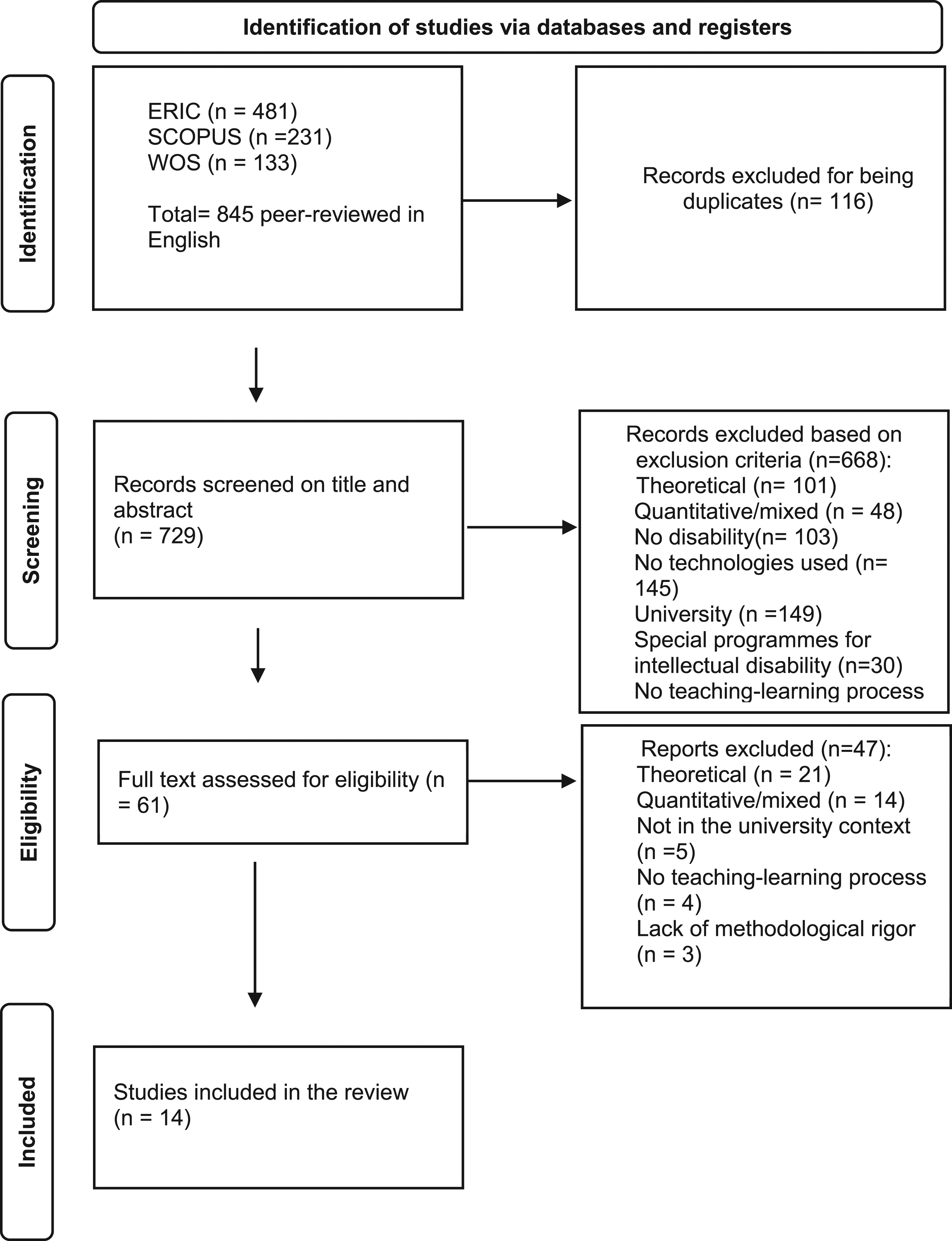
Research Questions
Four research questions were proposed: (1) Which technological resources are used in university education for students with disabilities? (2) What are the benefits of technology for the learning of students with disabilities? (3) What difficulties do students experience when using technology for learning? (4) How do students with disabilities rate participating in online learning environments?
Exploration and Database Search
Based on their reliability and international character, three databases were used for the systematic review: ERIC (Institute of Education Science), SCOPUS and Web of Science. The keywords used for the search were “disability” and “technology”, in combination with “university”, “higher education”, “college” or “postsecondary”.
Inclusion and Exclusion Criteria
The selection of studies was based on the following inclusion criteria: 1) peer-reviewed articles; 2) articles published in English; 3) articles published in the last 10 years (2022-2013); 4) studies focused on the teaching-learning process; 5) studies focused on the use of technology in higher education; 6) studies focused on students with disabilities; and 7) studies with qualitative methods. Only qualitative studies were selected, and neither quantitative nor mixed-methods studies, since the aim our study was to learn about the participants' experiences in the use of technology through their testimonies and narratives.
Studies were excluded based on the following exclusion criteria: 1) research with quantitative or mixed methodologies; 2) non-empirical studies (books, chapters, systematic reviews or conference contributions); 3) studies developed at educational stages different from higher education; 4) articles that did not focus on disability; 5) publications that did not consider the use of technology; 6) studies on training courses or programs (not university degrees) for students with intellectual disabilities; 7) papers that did not focus on the teaching-learning process; 8) publications prior to 2013; 9) studies that did not present adequate quality and methodological justification.
Screening and Selection
The selection process was designed in three stages and conducted by three researchers (figure 1). After defining the keywords, searches were conducted using the keyword combinations described above. In the first phase, a total of 845 publications were obtained in the three databases. In the second phase, the three authors reviewed the full text of each article (n = 61) to determine whether the publications met the inclusion criteria. Following this procedure, 21 papers were excluded. Likewise, in this second phase, a new exclusion criterion emerged, which referred to the quality of the qualitative methodology, excluding those studies that did not incorporate a methodological design, or whose information was minimal and did not address fundamental aspects such as recruitment, data collection process or data analysis. Three papers were excluded under this criterion. Thus, a total of 14 articles were included in this systematic review.
Validity
In order to ensure the validity of the study, the three authors independently reviewed and assessed the 14 articles to determine whether the papers met the inclusion criteria in the QSR. This decision was guided by 10 questions from the CASP qualitative checklist: Section A) Are the results of the study valid? (1. Was there a clear statement of the aims of the research?; 2. Is the qualitative methodology appropriate?; 3. Was the research design appropriate to address the aims of the research?; 4. Was the recruitment strategy appropriate to the aims of the research?; 5. Were the data collected in a way that they addressed the research issue?; 6. Has the relationship between the researcher and the participants been adequately considered?; Section B) What are the results? (7. Have ethical issues been taken into consideration?; 8. Was the data analysis sufficiently rigorous?; 9. Is there a clear statement of findings?); Section C) Will the results help locally? (10. How valuable is the research?). Finally, only articles that scored 100% agreement were included. Subsequently, a triangulation of the articles was carried out, resulting in an initial agreement of 92%. In the event of a discrepancy in the inclusion of an article, a debate was held, addressing the possible disagreements and finally taking into account the 14 papers included in the systematic review.
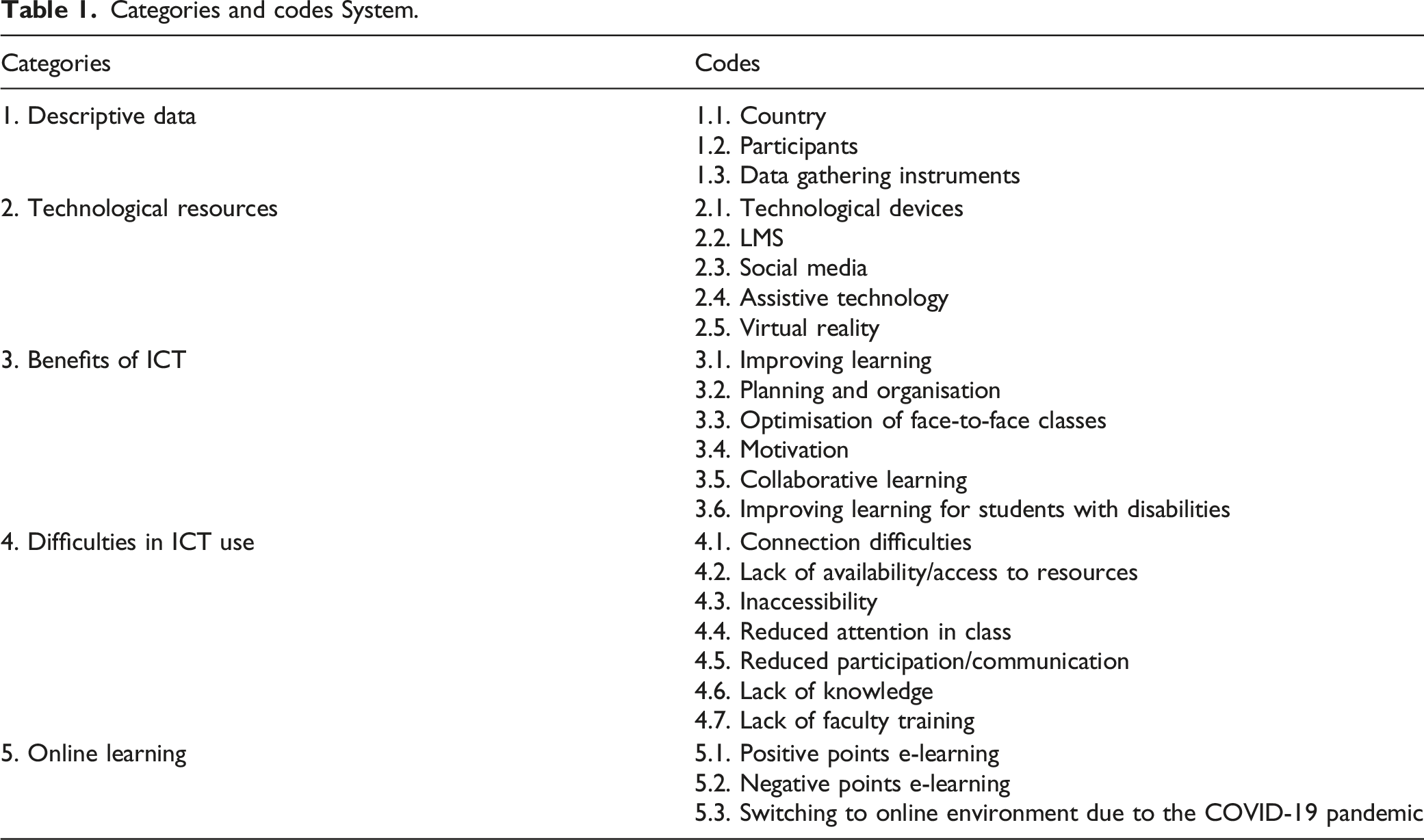
Data Analysis
Categories and codes System.
Findings
Descriptive data
The studies included in this systematic review were mainly conducted in the USA (n = 4), Spain (n = 3), New Zealand (n = 2), Australia (n = 1), Ghana (n = 1), Kazakhstan (n = 1) and UK (n = 1). One of the studies was conducted comparatively in five countries: Canada, Germany, Israel, UK, and USA (Seale et al., 2021). Of the 14 studies selected, 2 involved faculty members (n = 143) and the other 12 involved students with disabilities (n = 240). Among these students, the most common disability was sensory disability (n = 101), followed by physical disability (n = 27), mental/cognitive disability (n = 19), learning difficulties (n = 5) and chronic illness (n = 5). In one of the studies, the type of disability was not specified (n = 17) (Seale et al., 2021), while in another study some participants had more than one type of disability (n = 66), although the exact number of students in this situation was not specified (Gin et al., 2021). Regarding the data collection instruments used in the 14 qualitative studies, almost all of them used interviews (n = 13), being semi-structured in most cases. Observation (n = 6), focus group (n = 3), social media analysis (n = 2), researcher diary (n = 2), lifeline (n = 1), self-report (n = 1), document analysis (n = 1) and symposiums participation analysis (n = 1) were also used.
Which Technological Resources are Used in Higher Education?
The technological tools used for teaching and learning were varied: laptops, mobile phones, tablets, cameras, MP3 players and recorders, among others (Pacheco et al., 2019, 2021; Seale et al., 2021). In terms of digital resources, most studies highlighted e-learning platforms as the most used (Cotán et al., 2021; McDowell, 2015; Pacheco et al., 2021; Perera & Moriña, 2019; Perera et al., 2021). This resource appeared mainly in studies exploring the transition to online learning during the COVID-19 pandemic (Amponsah, 2021; Gin et al., 2021).
On the other hand, social networks were a resource identified in the publications by Amponsah (2021), Cotán et al. (2021), Pacheco et al. (2019) and Pacheco et al. (2021). Other resources were those related to assistive technology, such as voice recognition systems (Nelson & Reynolds, 2015) or accessible document reading and management software (Lannan, 2019; Pacheco et al., 2019; Perera & Moriña, 2019; Seale et al., 2021). Finally, Virtual Reality was identified in two of the investigations, being used as a visual interpreter (Lanan, 2019) or as a didactic strategy (Cotan et al., 2021).
What are the Benefits of Technology for the Learning of Students with Disabilities?
Both students and faculty members who participated in the different studies reported multiple benefits from the use of technological resources in university teaching. The studies agreed that technology improved learning for all students, not only for those with disabilities (Cotán et al., 2021; Pacheco et al., 2021). Perera et al. (2021) argued this by showing different educational uses of Information and Communication Technologies (ICT) that facilitated learning for all students. For example, they could offer a variety of formats in the materials, record classes on video, facilitate the delivery of work in digital format, share online resources, carry out online tutorials or facilitate communicative processes outside the classroom in a virtual environment.
Another benefit of using technology was related to planning and organizing learning. With the support of technological resources, faculty members could share the course calendar, include reminders and important dates, and provide content and materials in advance (Cotán et al., 2021). This was valued by students themselves, who used digital calendars and timetables to organize their academic life (Pacheco et al., 2021). Learning Management Systems (LMS) were also commonly used as a repository to share teaching projects and all course materials from the beginning (Cotán et al., 2021; Perera et al., 2021). On the other hand, these benefits did not only apply to course planning, as the study by Pacheco et al. (2019) showed that ICT had been a great help for students with disabilities in their transition to university life. Students used digital resources to search for information related to the functioning of the university, such as the admissions office, disability support services and even web maps of the centers. Students indicated that ICT was a stress reducer and helped them feel more confident (Pacheco et al., 2019; Perera & Moriña, 2019).
Optimizing time in face-to-face classes was another benefit of ICT. Cotán et al. (2021) pointed out that faculty members could use class time to work on the content in a more practical way, using online communication channels, virtual tutorials and sharing digital resources virtually (Perera & Moriña, 2019). Having the materials available beforehand meant that students focused their attention on the explanations, rather than on taking notes. In addition, faculty members were able to practice and apply more active methods.
On the other hand, the results of different studies pointed to an increase in learning motivation as a direct effect of the use of ICT. Students participating in the study of Perera and Moriña (2019) indicated that the use of technology in the classroom motivated them and made them pay more attention in their classes. For their part, faculty members considered that many of today’s students were digital natives, thus using technology brought them closer to the way they live, interact and learn. Moreover, with the use of ICT, they also worked on digital competence (Cotán et al., 2021; Perera et al., 2021).
The great potential of ICT to promote collaborative learning among students has also been highlighted. Faculty members often used virtual spaces such as blogs, forums or wikis to create group learning spaces to share and build knowledge collaboratively (Pacheco et al., 2021; Perera et al., 2021). In this sense, the results of McDowell (2015) showed an increase in the participation and social connections of a student with Asperger’s in virtual spaces, increasing his participation and communication with his peers.
Furthermore, ICT as a communicative resource went further, being an ally for the establishment of social relationships for students with disabilities. Thanks to social networks, such as Facebook or WhatsApp, students overcame the challenge of building a new social network at the university, helping to develop a sense of belonging (Pacheco et al., 2019; 2021).
Finally, in relation to the benefits of ICT for the learning of students with disabilities in particular, students felt that technology helped to overcome the academic and social challenges associated with disability. The use of voice recorders, electronic note-taking devices, magnification software, speech recognition software, screen readers, etc., enabled students to perform tasks and actions that would otherwise be much more complex or require assistance from others (Cotán et al., 2021; Nelson & Reynolds, 2015; Pacheco et al., 2019; 2021; Seale et al., 2021; Singleton & Neuber, 2020). Students reported that these resources improved study efficiency, saving time and allowing them to do tasks they found complex, such as replacing face-to-face participation with online group work, which is important for students with disabilities such as Asperger’s (McDowell, 2015).
In this line, Cotán et al. (2021) provided the faculty’s perspective. They commented that technologies helped to mitigate the impact of difficulties such as lack of attendance by providing digital material, recorded classes or virtual tutorials. It is interesting to note that these types of measures were considered for all causes of absence (medical problems, work, incompatibility of timetables, etc.). As for digital materials, faculty members reported that they made adaptations such as increasing the font size, modifying formats and colors, subtitling videos or administering alternative computer-based assessments. In short, as Seale et al. (2021) added, technology helped students with disabilities to complete their studies and achieve academic success.
What Difficulties do Students Encounter When Using Technologies for Learning?
Despite the benefits of ICT, some studies also identified obstacles that could arise with the use of the technology. First, problems with Internet connection could emerge when it was required for the use of some material; thus, for many tasks, it depended on the availability of this service (Cotán et al., 2021). Students also pointed out that certain technological devices were too expensive and, without financial support, they could not access them (e.g., software licenses) (Seale et al., 2021). Another barrier to access could arise from the lack of digitized material from the faculty members (Lannan, 2019).
However, having access to digital resources was not a guarantee of success, as these resources might not be accessible. Perera and Moriña (2019) reported that students with disabilities rated the e-learning platform as not very accessible. They also reported that faculty members confused “accessibility” with “availability”, as sharing material in digital format did not necessarily mean that it was accessible and usable. In response, students had to invest time and effort in editing these materials in order to be able to use them properly, either on their own or by seeking help from peers or services such as the library. Lack of accessibility was also a common challenge present in the findings of Perera et al. (2021), Seale et al., (2021) and Singleton and Neuber (2020). In fact, in Lannan’s (2019) study, lack of accessibility was identified as the main concern.
Another type of negative consequence of ICT occurred in face-to-face class sessions. Some faculty members indicated that, by having all the material virtually available from the beginning, the level of attention in class could decrease, and students could tend to take fewer notes of the contributions in class (Cotán et al., 2021). The same authors also pointed out that by using computers in the classroom, students neglected other actions such as listening and communication.
Finally, the different studies alluded to a lack of knowledge and training to make an effective use of ICT, both for students and faculty members. Many students found resources available, although they were unable to use them, due to a lack of knowledge. When they used them, they had to invest a lot of time and energy to learn (Singleton & Neuber, 2020).
In relation to the lack of faculty training, Perera and Moriña (2019) stated that most of the problems identified by students arose from this lack of knowledge. The study pointed out that faculty members made a merely technical and traditional use of technology, not a pedagogical one. Faculty members demanded more technopedagogical training in order to be able to meet the demands of students (Perera et al., 2021). Seale et al. (2021) added the faculty’s lack of willingness to offer the necessary support to students with disabilities.
How do students with disabilities rate studying in online learning environments?
Online learning can make it easier for older adults with disabilities to study at university by enabling them to combine their studies with employment and family commitments (McManus et al., 2017). However, the studies by McManus et al. (2017) and Stambekova et al. (2021) identified a number of barriers to studying in the online context. Thus, students with disabilities who participated in the study of McManus et al. (2017) did not find it easy to study while balancing their family obligations.
Although the disability office was seen as an essential support in the latter study, some participants reported difficulties in accessing course information and being clear about the assessment criteria when contacting faculty members who taught online subjects (McManus et al., 2017). Indeed, for these students, it was frustrating that information was inaccessible and that their grades were not commensurate with the effort and time invested in online learning.
Despite the advantages of online learning in terms of being able to study anywhere and with time flexibility, studies highlighted the absence of face-to-face interaction, both faculty-student and student-student, as a negative aspect (McManus et al., 2017; Stambekova et al., 2021). In the case of people with mental disabilities, this caused feelings of isolation and disconnection. In addition, students indicated that their participation in group discussions was low, since they felt intimidated by other students and were concerned about how they might be perceived by other students.
On the other hand, two of the reviewed studies focused on the effects of the transition from face-to-face to online learning during the COVID-19 pandemic (Amposah, 2021; Gin et al., 2021). As is well known, face-to-face university systems around the world had to suddenly transform to a virtual-based education system. This undoubtedly benefited students, allowing them to follow their classes from home, although it also brought great challenges for universities, including their staff and students.
Studies on the transition to online learning during the COVID-19 pandemic in relation to students with disabilities highlight how the rapid transition to online instruction influenced the learning of students (Amposah, 2021; Gin et al., 2021). While this type of instruction allowed for uninterrupted learning and did not increase social inequalities, in Amponsah’s (2021) study, students with disabilities acknowledged their lack of technological skills. They were not trained in the use of the university’s LMS and other learning tools. This did not facilitate virtual learning and hindered the transition from the traditional classroom to the online space.
The research by Gin et al. (2021) found that, after the transition to online learning, students with disabilities were unable to access the campus accommodations and resources they normally used for face-to-face courses. Participants also had problems with exam proctoring technology. Recording themselves taking an exam resulted in increased stress and exacerbated the symptoms of their disability while taking the exam. Another barrier they encountered was that, unlike face-to-face courses, where they could access information in multiple ways, in online teaching this was not the case, and the only route was synchronous teaching from the faculty. In addition, there was an excessive reliance on videos, which were often not accessible. A final negative aspect was the cost of using the technologies at home, requiring data for Internet access, which made the latter difficult for students with lower income (Amposah, 2021).
However, despite these difficulties, students were able to overcome the obstacles thanks to different personal coping strategies and support received by the university (Amposah, 2021; Gin et al., 2021). The main strategy used by students was self-advocacy, as this was especially important if they were to receive appropriate accommodations during this unique time. However, it should be noted that self-advocacy can be emotionally exhausting, especially at such a critical time during the pandemic.
Finally, in terms of the supports received by the university, one of these was the use of software as a useful strategy to cope with fully online learning. Another strategy that students considered key to their success in online learning was the additional time for assessments that the university granted them. In addition, the provision of social support and the creation of safe online learning spaces were indispensable for completing their studies. Another contribution to the academic success of the students was the fact that some faculty members did not only provide information, but they used WhatsApp and other social media tools to communicate, teach and assess students with disabilities. Family and friends also supported students in the new challenges related to online learning (Amposah, 2021).
Discussion
Research on university students with disabilities grants increasing relevance to the didactic use of ICT to facilitate educational inclusion (Barkas et al., 2020). In fact, technological competence is identified as a fundamental element in the profile of educators at all educational levels, including higher education (Moriña & Orozco, 2022). This systematic review presents the multiple benefits of ICT for the inclusion, not only educational but also social, of students with disabilities, and it also shows some challenges that still need to be addressed in order to improve technology-mediated learning. These results also show that good practice with technologies benefits all students, and not only those with disabilities (Wynants & Jessica, 2018).
This study collects the experiences of 240 students and 143 faculty members, who state that they make use of different technological resources. The use of devices such as computers and mobile phones for learning is already widespread in all universities, and not only by students with disabilities, as they have become essential resources for all students. This reality shows that ICT is not only an option to cover needs arising from disability, as it also has a great educational potential that must be harnessed in 21st-century education. A conclusion shared in many studies is that educational practices that are designed and implemented for students with disabilities have benefits for the rest of the students (Moriña & Orozco, 2022). Undoubtedly, the use of technological resources corroborates this statement, as all students benefit from ICT-mediated learning (Clouder et al., 2019; Wynants & Jessica, 2018). It can be observed that one of the potentials of ICT is their variety and versatility (including assistive technology for students with disabilities), offering multiple options that adapt to the characteristics and preferences of any person, thus fulfilling the principles of UDL (Williams et al., 2016). At the same time, ICT fosters an increase in students' motivation, adapting to their way of life as digital natives and favoring the acquisition of technological competence (Williams et al., 2016; Wynants & Jessica, 2018). These benefits, together with the facilitation of active and participatory methods inside and outside the classroom, are an added value for all students. Therefore, it would be advisable for universities to prioritize the use of these resources and to provide their centers with training programs for their teaching staff to learn not only the technical use of these resources, but also their pedagogical use. For example, faculty members should be trained in emerging educational technology, such as gamification applications, virtual and augmented reality, or educational chatbots.
Regarding the educational inclusion of students with disabilities, one of the needs that has been highlighted in multiple studies is related to planning the learning and having the materials in advance (Chun & Williams, 2021). In this sense, the use of tools such as LMSs greatly facilitates this aspect, as is shown in the studies by Cotán et al. (2021) and Pacheco et al. (2021). In addition, the use of assistive technology helps to overcome difficulties arising from disability. McNicholl et al. (2021) concluded that assistive technology can increase academic engagement and social participation. Therefore, faculty members should be aware of the importance of these technologies for students with disabilities and ensure the use of resources and materials that are accessible and compatible with assistive technology (e.g., screen readers or voice recognition systems).
This systematic review also identifies challenges in the use of these resources, in both face-to-face and online training. Access to technological resources and the Internet is not guaranteed in all contexts and for all people, thus economic barriers must be considered when developing ICT-mediated educational processes. At the technical level, the lack of accessibility of materials, applications and virtual environments remains a widespread difficulty (Gin et al., 2021; Seale et al., 2021). This barrier can translate into lower attendance and graduation rates for students with disabilities (Heron et al., 2022). The need for accessible resources and environments becomes even more relevant today, given that the situation generated by the COVID-19 pandemic has necessitated the use of e-learning environments. To ensure this, Bong and Chen (2021) conclude that it is essential to train faculty members on accessibility standards and guidelines, especially on web content accessibility guidelines (WCAG) and UDL principles. In this sense, the training policies of university systems should contemplate this and design and develop concrete actions to guarantee accessibility in all educational modalities.
On the other hand, it has become clear that, even with technology being available to students, the lack of training and knowledge to make an effective use of it remains the greatest difficulty, in both face-to-face and virtual environments. In relation to students with disabilities, McNicholl et al. (2021) note that disability support professionals must ensure that guidance is provided to meet the needs of these students in the use of assistive technology. This becomes critical in online learning, where accessibility and support are essential elements for the academic success of students with disabilities (Reyes et al., 2021).
In relation to faculty members, they are best placed to implement inclusive practices, although they require a thorough understanding of the barriers and opportunities present in the university (Hills et al., 2022). Studies such as González and Colmenero (2021) agree with the testimonies of faculty members in this systematic review, stating that they carry out inclusive educational processes. However, others such as Van Jaarsveldt and Ndeya-Ndereya (2015) point out that there are faculty members who do not take responsibility for providing support to students with disabilities, delegating these processes to university support services. Therefore, attention to students with disabilities continues to depend on the goodwill of each faculty member, even though there are educational policies that aim to guarantee the access and permanence for these students (Melián & Meneses, 2022). In addition to attitude, studies such as that of Fernández-Batanero et al. (2022) have shown that there is a low level of faculty competences in relation to the use of ICT in teaching students with disabilities, and that faculty training needs to be rethought in order to move toward educational inclusion (González & Colmenero, 2021). This shows that faculty members are a key element for inclusion, and that the teaching role should be better recognized in their professional development, as it has been excessively linked to research in recent years.
Although further work is still required to make an inclusive use of technology, it is important to recognize that university systems are moving toward hybrid learning spaces, in which technology plays a key role. As is shown in this systematic review, the benefits for the learning of students with disabilities and for other students outweigh the obstacles. Universities should therefore consider policies and actions to train staff and students in technology and inclusion, and invest resources to ensure the accessibility of higher education.
Limitations and Future Research
As a limitation of this study, we only included papers published in English. Other studies published in other languages may contain valuable information that we did not consider. Another limitation was the inclusion of only qualitative studies, since there may be quantitative or mixed studies that also provide relevant information that we did not analyze in this paper.
Despite these limitations, our review can pave the road for future research lines focused on the training of faculty members and students in the pedagogical use of ICT, the accessibility of ICT, and the creation and evaluation of policies to improve pedagogical practices with technologies.
Conclusions
Students with disabilities are now more represented in higher education, although they continue to face barriers to their retention and the completion of their studies, facing academic, psychological and social challenges. This systematic review shows evidence of the important role of ICT in the educational and social inclusion of university students with disabilities. The results leave no doubt about the benefits of technology in face-to-face, blended-learning and online teaching, not only for students with disabilities, but for all students. However, it is necessary to carry out inclusive practices and implement UDL in the university system, as well as to ensure that teaching, in all its forms, is fully inclusive and accessible. To achieve this, faculty training becomes crucial to ensure a good use of ICTs in teaching all students.
Footnotes
Declaration of Conflicting Interests
The author(s) declared no potential conflicts of interest with respect to the research, authorship, and/or publication of this article.
Funding
The author(s) disclosed receipt of the following financial support for the research, authorship, and/or publication of this article: This This work was supported by: Andalusian Regional Government and FEDER Funds (Regional Department of Economy, Knowledge, Business and University) [Grant number US-1381423]/ Ministry of Science and Innovation/State Research Agency/10.13039/501100011033 and European Union “NextGenerationEU/Recovery, Transformation and Re- silience Plan” [Grant number RYC2021-032768-I]; Ministry of Universities [Grant number FPU20/01991].
