




Abstract
This article takes as its point of departure the many converging crises of sustainability and the responsibility of higher education institutions and faculty members to participate in mitigating these crises to any extent possible. The author characterizes sustainability education as transdisciplinary praxis, explores the institutional and interpersonal barriers to transdisciplinary faculty collaboration, and suggests rationales and strategies for overcoming these barriers. In order to lay a foundation for discussing transdisciplinary collaborations, the author also explores the concepts of sustainability, transdisciplinarity, and praxis. She concludes that, because disciplinary and other traditional power structures within higher education tend to inhibit transdisciplinary collaboration and engagement in sustainability praxis, such work is most likely to be successful when it meets with visionary sustainability leadership practiced by upper administration.
Keywords
There is much at stake, and now is the time for academic leaders to commit their institutions to advancing what is nothing less than an evolutionary transformation in our collective consciousness. —Michael Crow (2007c: 60) Sustainability—this big, contested, cosmopolitan, and practical idea that must be worked out on the ground—connects our most pressing problems and engages our creative and moral imagination to ‘be more’ and help to build a world where everyone can do the same. —Tom Kelly (2009: 45). We need to maintain a transformatory vision so that change does not become stuck at the early levels of change, corresponding with weaker sustainability, but is able to work through to deeper levels…. Transformation depends on a vision informed by a clear philosophy. —Stephen Sterling (2001: 79). At a time when we should be tailoring our college curriculums to prepare graduates for dynamic action, our colleges and universities are bureaucratically moribund, self-interested, and inwardly focused. This combination, in the face of mutually reinforcing disruptive innovations and limitations, spells crisis. It is clear that the educational landscape is being transformed as never before in its history. Indeed, it is likely that as the marketplace shakes out, many institutions will close as a result of their unwillingness or inability to serve the world as it is, not as they wish it to be. —Stephen Mulkey (2012)
Introduction
I take as my point of departure for this article the immediacy of the sustainability crisis—a crisis that emerges from many converging socio-ecological problems ranging from local to global scales. Anyone who has been paying attention has heard the litany of truly tragic, in many respects overwhelming, and deeply interconnected challenges we face in our time. I will not revisit the list here, but I would like to emphasize that the sustainability crisis emerges directly from the interface of the social and the ecological. It is economic, environmental, emotional, and spiritual. It is cosmological, epistemological, and ontological in nature. It is a crisis of human meaning and place in the broader framework of the world. The sustainability crisis calls upon us to probe the deepest foundations of who we are and how we ought to relate to others and nature. It calls upon us to recognize what many traditional and indigenous cultures have recognized for millennia: that the social is embedded within the ecological and that we as individuals and communities are only parts of deeply interconnected wholes.
To begin to address the sustainability crisis, we as educators need to reflect upon and develop in new ways our personal and professional relationships and our educational praxis. In this article, I offer reflexive and theoretical explorations to this end. My central focus is on developing faculty collaboration and commitment necessary for faculty groups to succeed in developing transdisciplinary sustainability education praxis among themselves and with their students. A second purpose is to shed light on the institutional priorities, structures, and processes that can foster the work of these groups.
We urgently need education that confronts the challenges of our time. Many educators have effectively articulated the need for sustainability education, formulated key elements of its underlying philosophy, and suggested useful sustainability education content and processes (AASHE, 2010; Bacon et al., 2011; Cajete, 1994, 2001; Corcoran and Wals, 2004; Elder and Dyer, 2011; Evans, 2009, 2010a, 2012; Fassbinder et al., 2012; Gruenwald, 2003; Huckle, 2004; Kahn, 2010; Kelly, 2009; McLaren, 2007; Medrick, 2005; M'Gonigle and Starke, 2006; Orr, 2004; O'Sullivan, 2004; Pittman, 2004; Shiva, 2005; Sterling, 2001; UNESCO, 1997, 2002; Ward, 2006). Each of these authors has highlighted human/nature relationships in modern industrialized societies as defining contradictions of the sustainability crisis.
Much has also been written about transdisciplinarity and its application to education and social reform (Dōlling and Hark, 2000; Klein, 2001; Lenhard et al., 2006; Meyer, 2007; Nicolescu, 2002; Schroll and Stærdahl, 2001), and we witness today some examples of ambitious sustainability education projects (the Oberlin Project; the Center for Agroecology and Sustainable Food Systems at the University of California, Santa Cruz; Bard College's graduate programs in sustainability; Prescott College's PhD Program in Sustainability Education; Arizona State University's (ASU's) undergraduate and graduate programs in sustainability; Appalachian State University's undergraduate programs in sustainable development; the University of Vermont's sustainable learning community program; and Colorado Mountain College's Bachelor of Arts Program in Sustainability Education, to name a few), but little has been published that I am aware of on exactly how faculty can best collaborate in service to transdisciplinary sustainability education.
This article is about collectively creating a transdisciplinary praxis for sustainability education in colleges and universities. How might we move from perpetuating fragmented approaches to understanding complex socio-ecological problems and phenomena toward an integrated understanding and practice of sustainability in higher education? How can we foster transdisciplinary learning among faculty members engaged in this work? What are the challenges faculty members face in this process—institutionally as well as those that play out among transdisciplinary faculty collaborators? What might be some effective practices in which educators can collectively engage in advancing their understanding of sustainability and in developing sustainability education programs? These are the central questions for this article.
In my response, I draw from the theoretical and research literature of higher education internationally and from my experiences initiating and leading inter- and transdisciplinary education programs and projects. My experience in these efforts is limited to US institutions and particularly to small, public colleges, although I believe my reflections on my practice, especially coupled with the findings and experiences of others conveyed in the literature, may be useful to educators working in colleges and universities globally.
Before we explore the institutional and intra-group challenges and potentialities for fostering sustainability education in colleges and universities, we will briefly address sustainability and transdisciplinarity as concepts and practices. After laying this conceptual groundwork, I will elaborate on disciplinary and institutional factors that can hinder or contribute to generating effective faculty collaboration in service to sustainability education. That discussion will be followed by an exploration of philosophical approaches, attitudes, and processes among faculty participating in transdisciplinary collaborations that can either foster or hinder their work. In the final section of this article, I offer my conclusions on fostering effective faculty collaborations for sustainability education and on the relevance of this work to society and nature.
Conceptualizing sustainability
It is not my purpose here to define sustainability once and for all. By its very nature, sustainability is a contested concept (Kelly, 2009: 7–12; Zaman and Goschin, 2010: 8). It is also place-specific, meaning that what is sustainable in one place might not be so in another. Still, definitions of sustainability typically share certain attributes and emphases. They focus on intergenerational fairness extending over long time frames and on the health and integrity of human societies and the natural world (see, for example, Evans, 2012: 15–18; Pittman, 2004: 201; United Nations, World Commission on Environment and Development, 1987). It is also a dynamic praxis that must continually be evaluated and engaged (Evans, 2012; Pittman, 2004: 201). Sustainability advocates recognize that, since people are part of nature, we cannot thrive over the long haul at the expense of nature. Still, a great deal of flexibility exists in determining exactly what a healthy sustainable system would look like in any given place and time, and sustainability should rightly remain a contested concept/practice among faculty members engaged in sustainability education.
Sustainability as transdisciplinarity praxis
Sustainability is also a praxis. As I have argued elsewhere (Evans, 2012), praxis is a unity of theory, practice, and reflection. The relationship among the three aspects of praxis is nonhierarchical and nonlinear so that each can influence or serve as a generating point for activity in the other two realms of praxis (see Figure 1).
Praxis as a unity of theory, practice, and reflection.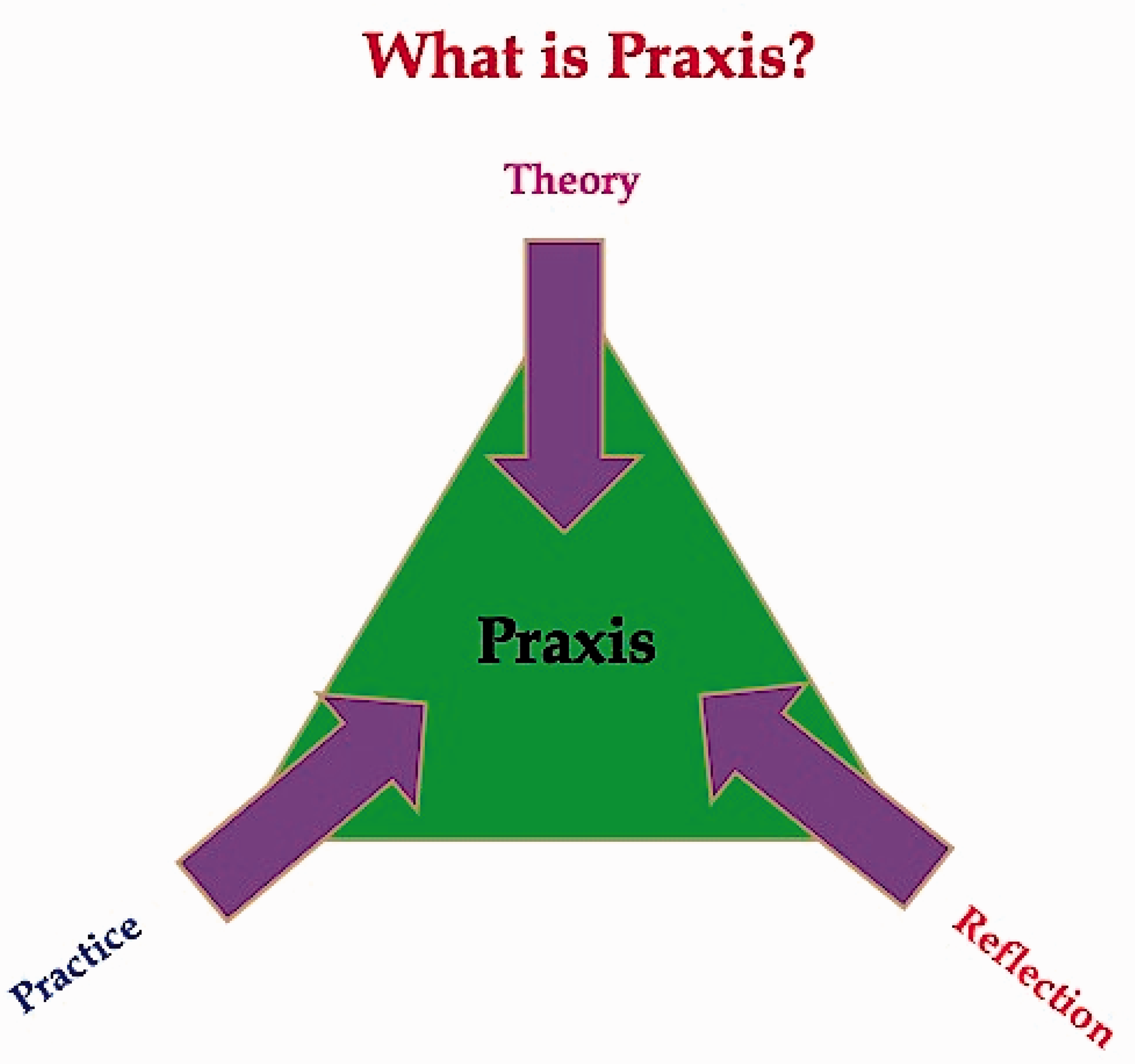
Because sustainability takes shape through praxis, any fully fledged program of sustainability education must be transdisciplinary. According to Eunsook Hyun (2011), The term transdisciplinarity was introduced by Jean Piaget (1970) in his awareness and acknowledgement of and thus attempts to understand the current world with an imperative overarching unity of knowledge. Transdisciplinarity is a principle for unity of knowledge beyond disciplines, and its approach implies full interaction between, among, and beyond disciplines from a real-life problem-based perspective. Transdisciplinary vision is also transcultural and transnational, encompassing ethics, spirituality, and creativity. (p.8) Transdisciplinary studies, research, and action focus attention on thematic threads that inform complex, real-world issues and challenges such as globalization, climate change, and sustainability. Transdisciplinary scholars and practitioners engage with these issues and challenges using integrative approaches to knowledge-making with the aim of transforming the subject(s) of study by informing purposeful human activity. Transdisciplinary research draws upon disciplinary methods of knowledge-making as means to generate and synthesize new knowledge, but transcends the disciplines in its drive to approximate the complex reality of its subjects of study. Transdisciplinary work is integrative, socially relevant, and oriented toward problem solving. Therefore, transdisciplinary work engages with human values in producing knowledge and identifying avenues for action. Thematic threads that draw the attention of transdisciplinary scholars and practitioners run across diverse sectors of society and differing loci of knowledge creation and use. Transdisciplinarians seek to identify, integrate, and act upon points of relationship among centers of knowledge-making as these relate to ideas and phenomena that manifest in complex ways across diverse sectors of society. Transdisciplinary work is relevant to and contextualized within the full complexity of the real world. This work entails an ontological perspective of the world as integrated, complex, and whole. Transdisciplinarians therefore seek to integrate perspectives and knowledge originating both inside and outside academe and to deal with epistemological questions of the validity of knowledge created in various contexts. Transdisciplinarity therefore implies a critique of the idea that valid knowledge is created solely within disciplinary boundaries and within academe. Since boundaries within knowledge making are both questioned and crossed by transdisciplinarians, transdisciplinary work also implies a critique of the ‘ivory tower’ conception of academic work as a ‘pure’ form of knowledge creation rightly detached from messy real world contexts. Transdisciplinary work, by contrast, seeks explicitly to engage with the real world and derives its character and relevance from this engagement. Transdisciplinary work is distinguished from interdisciplinary work by its engagement with human values within problem solving contexts. (Evans, 2012: 240–241; see also Hyun, 2011, for a similar discussion of the nature and purposes of transdisciplinarity)
Purposes of transdisciplinary programs
For faculty and students:
To ensure that students study concepts, issues, and problems from more than one disciplinary perspective. To ensure that students recognize that knowledge can be constructed using more than one epistemological framework, even when working with the same or similar ‘topics.’ To engage students in questioning the division of the knowledge world into discretely bounded disciplines. To engage students in probing the idea that knowledge derived from the academic disciplines alone may be incomplete as a basis for addressing complex social, ecological, technical, and other problems. To engage students in inquiry that makes use of knowledge generated both in- and outside the academy. To engage students in probing the validity of various constructions of knowledge in the context of comprehending complex phenomena and addressing complex problems. To engage students in academic work that both integrates and transcends disciplinary knowledge in an effort to both comprehend and directly address complex problems. To serve as a vehicle for students and faculty members to comprehend complex phenomena and problems and to engage in actions that address complex social, ecological, technical, and other problems. Thereby, to connect students, faculty members, the [transdisciplinary] program, and the College with the … mission of service to society. For Society: Similar to multidisciplinary and interdisciplinary programs, to increase the ability of members of society to engage in transformative capacities with complex issues in their work and their civic and social lives in an increasingly complex world. In comparison to graduates of multidisciplinary and interdisciplinary programs… graduates of transdisciplinary programs should generally be expected to demonstrate heightened abilities to engage with and evaluate knowledge drawn from multiple contexts both in- and outside the academy and to participate effectively in problem solving work. This difference should derive from the highly integrative and explicitly purposeful orientation of transdisciplinary curricula relative to multidisciplinary and interdisciplinary programs (Evans, 2010b; see also a similar framework articulated by Zaman and Goschin, 2010: 7). …entrenchment in disciplinary silos undermines the capacity of our institutions to address the grand challenges—one need only think of hunger and poverty, global climate change, the extinction of species, the exhaustion of natural resources, and the destruction of ecosystems. A response commensurate to these intractable problems requires that we advance research that can provide us with the means to balance wealth generation with continuously enhanced environmental quality and social well-being. (Crow, 2010b: p.488)
Institutional challenges and opportunities
Aspects of traditional higher education are becoming outmoded when compared to the world of challenges we face. According to Everett (2008), We provide narrow, disciplinary, highly specialized methodologies whereas the sustainability challenge faces us with multidimensional questions that are at once economic, scientific, social, political and ethical. (p.240)
Any exploration of fostering transdisciplinary faculty collaborations in service to sustainability education must recognize, as Hyun (2011) notes, that …higher education curriculum is a complicated cultural artifact that reflects emergent epistemologies, intents, interests, and values driven by history, geopolitical ideology, nationalism, globalization, transnationalism, and national social engineering. (p.12)
Institutional cultural and structural impediments to transdisciplinary education are many. The following list highlights key challenges that are likely familiar to readers experienced in inter- and transdisciplinary collaborations and teaching:
administrative and disciplinary silo structures that fracture knowledge along disciplinary lines; in particular, a sharp separation between sciences, engineering, and mathematics disciplines on the one hand and humanities and social sciences disciplines on the other; increasing specialization within the disciplines—what Nicolescu (2002) has termed ‘the disciplinary big bang;’ lack of formal recognition in the promotion and tenure process for faculty development of transdisciplinary service learning and project-based learning opportunities; a general lack of incentives for transdisciplinary work coupled with a faculty reward structure that adheres to disciplinary boundaries; and an ‘ivory tower’ intellectual tradition that externalizes the world (Bacon et al., 2011: 194).
As we shall see on closer inspection, these obstacles tend to be exacerbated by declining budgets (Bacon et al., 2011: 203). We will explore these barriers and potential avenues for overcoming them in more depth below, beginning with a close examination of rigid disciplinary silos.
Dominance of the disciplines
Although in recent years higher education has spawned significant growth in inter- and transdisciplinary programs (Cohen, 2012; Sterling, 2001: 71; UNESCO, 2002), many challenges remain to knowledge integration within the academy and to the application of knowledge in real world settings (Hegarty, 2008: 68; UNESCO, 2002). These challenges have developed historically within the cultural, political, and economic context of modern industrialism.
The research university in the USA assumed its current form by the late 19th century, complete with its discipline-based departmental organization (Crow, 2011: 52). Michael Crow (2011), President of ASU, elaborates on the rigidity of the current structure, its tendency to segregate rather than integrate disciplinary knowledge, its tendency toward hyper-specialization, and its focus on the generation of abstract rather than applied knowledge: Undergirding the strict disciplinary organization of knowledge is a social organization hidebound by behavioral norms of astonishing orthodoxy. Along with entrenchment in disciplinary silos has come a fixation on abstract knowledge for its own sake as well as the proliferation of increasingly specialized knowledge, which comes to produce diminishing returns on investment as its impact on the world is measured in smaller and smaller ratios. Rather than exploring new paradigms for inquiry, academic culture too often restricts its focus to existing models of academic organization. (p.52; see also Hyun, 2011: 7)
The discipline-based structure that developed in concert with the rise of the research university is also often mirrored within smaller, presumably teaching-focused institutions, where it has proven similarly difficult to dislodge. According to Crow, the attractiveness of this model has to do with a misplaced drive for prestige: Most colleges and universities define themselves in comparison to a set of institutions that comprise the ‘gold standard’ in American higher education: the Ivies, the great land-grant universities, and the elite institutions constructed on the foundation of private fortunes. Private institutions seek Harvardization and public institutions attempt to replicate the patterns established by Berkeley and Michigan; each would do better to seek its own unique identity and situate itself in a synergistic network of collaboration. (Crow, 2010a: 36)
In addition, knowledge is not the only aspect of higher education subject to this fragmented and competitive approach. Many institutions allocate resources, at least in part, on the basis of full-time-equivalent students (FTEs) enrolled in departmental programs, and departments may not receive funding for teaching their faculty members do for nondepartmental interdisciplinary programs. Therefore, according to Elizabeth Capaldi (2009), Executive Vice President and Provost for ASU, ‘faculty who teach outside the main lines of their own discipline are also frequently not valued by a home department that needs the disciplinary courses covered and the financial credit for its activities added to its budget.’
In its efforts to increase its relevance and reach as well as differentiate itself from other research universities, ASU has undergone a significant reorganization in recent years, creating many new programs and research centers organized around broad inter- and transdisciplinary themes, including the first-ever School of Sustainability (Crow, 2010a). Within this new structure, academic units receive funding for all courses taught by their faculty members, regardless of the course prefix or program with which the course is affiliated. Using this approach removes a financial disincentive to transdisciplinary teaching and allows units such as the School of Sustainability to staff its courses. This model also increases the flexibility of the institution to create and offer new programs of study staffed by currently employed faculty members (Capaldi, 2009).
The means of preparing educators also perpetuates the dominance and division of the disciplines. PhD training serves as the forging point for discipline-based identification and loyalty as well as the model for the enforcement of disciplinary norms. Faculty members identify with and become invested in perpetuating the system to which they have gained entry through painstaking work and through often strategic navigation past disciplinary gatekeepers (see Godemann, 2006: 54, on disciplinary enculturation). These professionals typically continue to advance their careers using the same strategies for success and recognition they learned to use as PhD students. Within an academic structure that has increasingly distanced itself from political entanglements, faculty success has increasingly taken the form of avowedly apolitical advancement of highly specialized and decontextualized knowledge. Faculty members who achieve recognition typically acquiesce, or at least do not threaten, powerful interests, thereby rendering themselves nonthreatening to entrenched economic and political interests. In broad terms, such is the nature of the collusion between highly specialized disciplines and the status quo.
According to Crow (2010b), traditional academic structures also promote individualized achievement over collaborative endeavors: While we valorize the discovery of the unknown by individual scientists, we attach less prestige to collaborative endeavors that target real-world problems, and to team participation in projects that accomplish assessment, assimilation, synthesis, implementation, and application. Scientific research conducted with application and social context in mind—outcome-driven science, or science with purpose—should be granted equal accord with fundamental research. (p.488)
Higher education in a vise
In the wake of the recent and continuing global economic crisis, colleges and universities find themselves facing budget cuts, in many cases extreme ones. In their hurried response, many institutions have focused on maintaining their traditional identity and purpose. This approach has often meant supporting outmoded curriculum and intransigent power structures highly resistant to transdisciplinary innovation and institutional differentiation.
At the same time, academic administrators working in less-well-funded public institutions are busy building their careers in an atmosphere of privation. Since there are few resources to support creative new endeavors, they often focus their attention on making the educational process efficient: ‘streamlining’ and/or standardizing academic programs and attempting to make faculty members ‘more accountable’ through intensifying program assessment efforts, raising requirements for promotion and tenure, and increasing faculty ‘productivity.’ These efforts offer administrators opportunities to demonstrate their leadership capabilities, although the reforms they lead may be misguided.
Efficiency is not the same as effectiveness, and institutions can easily become efficient at doing the wrong things. In the case of higher education, programs most vulnerable to being cut in the drive for efficiency may be those innovative and new areas of study perhaps most important to the well-being of both the institution and many of the people it serves. Richard Vengroff (2009), Dean of the College of the College of Humanities and Social Sciences at Kennesaw State University in Georgia, notes that interdisciplinary programs typically lack ‘centrality organizationally, to the academic mission of their respective colleges/universities’ and that ‘budget cuts are most likely to occur in [interdisciplinary program] areas, because they are often viewed as marginal and because position allocations favor traditional departments.’ Therefore, in a budget constrained atmosphere, retirements and resignations may have serious consequences for continuity in such programs (p.9; see also Orr, 2004: 103).
Large departments in established disciplines are less likely to be targeted. The sciences are likely to have a particularly strong edge in this regard because science is seen as the ultimate truth mode of our time and because scientific disciplines have garnered a large proportion of available research funding. In the process of making such cutbacks, academic leaders risk destroying crucial elements of institutional distinctiveness that could set their institutions apart, draw excellent and highly aware students, and pave the way for the institution to thrive and contribute productively to societies in need of deep change.
Crow (2007a) comments on ‘public universities and their self-imposed paralysis’ in the current atmosphere: I would argue that our institutions are under serious attack by what I have designated ‘the virus of the agency.’ Bureaucracies, or agencies, are admirable social constructs that accomplish much, delivering goods and services … but the principle mission of universities lies beyond the ‘service’ they deliver, that is, the basic task of educating undergraduates…. Universities have begun to act like service agencies, focused only on providing efficient educational service.… The primary symptom of the virus is a fixation with efficiency and ‘make-do logic’: ‘We have only so much to work with, so let us make do. Let us be sensible and not dare to dream of that which we could attain only with great struggle.’ Such make-do logic leads to a self-imposed lack of vision and initiative and encourages preoccupations with efficiency. Most of the processes and outcomes that define greatness in academic culture are by their very nature contrary to standardization and efficiency. Scholars and researchers cannot be efficient when following a path that has not already been marked. The hierarchical relationship that allows agencies like the local division of motor vehicles to perform repetitive tasks in a standardized and relatively efficient manner is ill-suited to the famously circuitous pursuit of discovery. I can say with absolute certainty that efficiency is not the means by which one determines the origin of the universe. (pp.26–27)
These motives for resistance to inter- and transdisciplinary faculty work, together with the competition for FTEs discussed above, typically go unspoken outside of departmental circles, but they nevertheless inform the actions of faculty in important ways. Intensified by budgetary austerity, the Balkanization of the disciplines is occurring in the same historical moment when the sustainability crisis calls for transdisciplinary integration of knowledge.
Threats to career
In an atmosphere characterized by declining budgets, increasing competition for scarce academic positions, and the entrenchment of the disciplines, individual faculty members may face genuine career risks when undertaking inter- and transdisciplinary work (Everett, 2008: 244; Hyun, 2011: 5). The structures of power and work in academia can create dilemmas for new faculty members who may be faced with a choice: whether to risk one's career by engaging in transdisciplinary teaching, research, and service, or pursue traditional discipline-based recognition and advancement. According to Everett (2008), Junior faculty are understandably committed to achieving tenure, and they can be at best uncertain whether these kinds of educational reform will be recognized by their tenured colleagues. More senior colleagues are often deeply invested in the traditions of the disciplines and find it even harder than their junior colleagues to imagine what a different form of education—one more appropriate to life in a climate-disrupted world—would look like and how they ought to evaluate those stumbling toward implementing such innovations. We lack a road map for navigating these changes, but the time when such changes were optional and might have been approached in a leisurely and studied manner is behind us by at least a decade. (p.246) The results of active involvement in interdisciplinary projects on the development of one's career are difficult to assess, but judging from the replies of the respondents the losses seem to outweigh the gains. On the one hand, the marginal status of many interdisciplinary activities is disadvantageous for a career. On the other hand, a specialist who devotes all his attention to one discipline is more likely to advance in that discipline than someone wishing to acquire competence in two areas. The involvement in interdisciplinary work may be advantageous for people whose careers are already well under way. And working in a quickly upcoming interdisciplinary area, such as ecology, may even lead to spectacular career advancement.
The hidden curriculum
All of the barriers to transdisciplinary work outlined above are constitutive to another powerful barrier to sustainability education, what Orr (2002) and Everett (2008: 240–241) call the ‘hidden curriculum.’ This curriculum consists of the messages students and others receive through their lived experience on campus, and much of it may be internalized uncritically. The hidden curriculum manifests in the extant priorities and practices of the institution. When the institution fails to measure up in its practices to its professed ideals, it teaches students that such disjunctures are typical of highly respected institutions and individuals. When the institution privileges highly specialized, abstract knowledge over integrated and applied knowledge, students often internalize these same values. When student success in courses depends not on critically examining complex socio-ecological problems and working toward mitigating their deleterious effects, but on passively receiving information and returning it virtually unchanged to the professor on tests, students may adhere to the cult of the expert and resign their own agency in a world that desperately needs their active and informed engagement. When service to the community is something relegated to volunteerism taking place during the ‘free time’ of students and faculty members, students may come to see community work as secondary to personal advancement and professional success. Sustainability, which can only thrive through integration and application of knowledge from diverse fields applied to problems in real world settings, faces significant and entrenched challenges in gaining ground in higher education settings where this hidden curriculum permeates the lived experience of students, faculty, and staff.
Leadership for transformation
Models of diffuse, shared leadership that promote a shared sense of commitment are preferable for long-term projects of cultural change (see Evans, 2011, for an in-depth discussion of sustainable leadership). On a similar note, Mudroch (1992) has observed that ‘strict hierarchies are unsuitable for interdisciplinary undertakings; a classless society is a more appropriate ideal.’ Through my experiences in founding a nonprofit as an undergraduate student in the 1980s and my long-term involvement in faculty governance work, including serving as Faculty Senate President at a past institution, I have observed that efficiency in accomplishing tasks is not the key to longevity of service work, neither is it the central factor in fostering cultural change. In service to fostering institutional development and change, people must be brought along and mentored as leaders, consciously and for some time, or path-breaking leaders will burnout, and initiatives will lose valuable momentum or even fizzle out altogether.
In addition to promoting the longevity of programs designed to address the challenges of our times, educators have a responsibility to look forward as we prepare current and future generations for productive and responsible social engagement. We have a responsibility to remain alert to current trends and promising ideas and initiatives so that we might offer educational experiences relevant to the pressing issues of our time. Robert K Greenleaf (1970/1991), who first developed the concept of servant leadership, says it thusly: The failure (or refusal) of a leader to foresee may be viewed as an ethical failure; because a serious ethical compromise today (when the usual judgment on ethical inadequacy is made) is sometimes the result of a failure to make the effort at an earlier date to foresee today's events and take the right actions when there was freedom for initiative to act.… By this standard a lot of guilty people are walking around with an air of innocence that they would not have if society were able always to pin the label ‘unethical’ on the failure to foresee and the consequent failure to act constructively when there was freedom to act. (p.18)
Conclusions on institutional factors relevant to fostering transdisciplinary sustainability education
Wals et al. (2004) note that there is no appropriate cookie cutter formula for institutions to develop and engage in sustainability education, but that effective communication and inclusiveness are important to the process: Meeting the challenge of sustainability in higher education is culturally embedded. At the same time, this challenge is closely tied to the academic history and curricular tradition of the institution concerned. Clearly, there is no panacea for the failure of the institutions to take on this challenge. Some institutions will choose to add on to existing programmes, others will opt for a more transformative approach. The decision about the most desirable reform approach is highly contextualized but appears to have more impact when resulting from an open and communicative process in which all stakeholders play their own, respected roles. (p.348)
For effective and timely action to take place, sustainability must become a core priority in institutional planning. In this regard, external commitments such as participation in the Sustainability Tracking, Assessment, and Ratings System (STARS) program of the Association for the Advancement of Sustainability in Higher Education (AASHE) and/or signing on to the American College and University Presidents' Climate Commitment (ACUPCC) can serve as an effective and multifaceted driver for sustainability initiatives in both campus operations and the curriculum.
Particularly important to promoting institutional effectiveness, responsiveness, and responsibility with regard to the sustainability crisis, is the re-examination and reform of important institutional structures. According to Hyun (2011), Academic affairs at higher education institutions must be reexamined with regard to the infrastructure supporting faculty hiring, tenure and promotion, various faculty reward systems, and overall academic culture to build or strengthen the transdisciplinary scholarship of discovery, curriculum transformation, teaching, application, implementation, and engagements as well as the culture of faculty socialization, starting at the departmental level. Institutions must have an inherent capacity for members to transgress disciplinary boundaries for continuous growth.… Personnel at the top administrative level in academic affairs must acknowledge, support, and create a ‘safe zone,’ where faculty members can engage in the transdisciplinary, borderless transformation of the curriculum. (pp.9, 12)
The widespread interest of students in sustainability studies and sustainable campus operations demonstrates that great opportunities exist for institutions seeking to differentiate themselves in their efforts to address the challenges of sustainability. Effecting sweeping changes to academic cultures, priorities, and structures remains difficult, however, in the absence of enlightened leadership—and perhaps even in its presence. Some special opportunities for differentiation along sustainability lines may exist for institutions that have built their reputations on teaching. Some of these institutions have been comparatively more willing to cross disciplinary boundaries and have recruited faculty members less committed to discipline-focused research. Higher than average teaching loads typical of some of these institutions, however, may inhibit their transformatory potential.
Intra-group factors promoting or hindering the success of transdisciplinary faculty collaborations
Myles Horton (1990) stated in his autobiography, ‘I don't think you help people by keeping them enslaved to something that is less than they are capable of doing and believing’ (p.184). Horton was remarking on the process of leading people into the uncomfortable, even dangerous, territory of social justice activism. In terms of both the internal and external challenges educators face when embarking on the path of sustainability education, certain parallels exist with other forms of activism. Sustainability praxis inherently challenges the status quo that has proven unquestionably destructive, but nevertheless evidences elaborate power structures and mechanisms of social control. In an atmosphere of intense competition for institutional resources and a societal atmosphere of ever-increasing entrenchment of powerful, unsustainable industries that provide research and other funding to colleges and universities, sustainability educators risk academic marginalization or even career assassination (Nocella et al., 2010).
Even within a relatively supportive institutional atmosphere, sustainability educators are likely to find that transdisciplinary teaching leads them into unfamiliar and perhaps uncomfortable terrain with regard to their relative authority among peers and in relation to their students. Sustainability-oriented transdisciplinary work tends to be challenging for faculty members because it goes against much of what they internalize from lived experience in the current academic and social paradigm. Sustainability-oriented teaching and learning, both in content and process, represents an evolving orientation to the world and to others—and this personal growth is not easy.
In becoming effective sustainability educators, we must develop wide-ranging content knowledge, authentic and empathic connections to diverse others and nature, inspiration, commitment, foresight, a critical self and social consciousness, and our capacity to engage in educational and community praxis. We are constructing more than new stocks of reified knowledge; we are building relationships, cosmology, epistemology, and ontology. In short, we are extending the framework of meaning within our lives and the educational process.
This is challenging work, although it is potentially deeply rewarding, and it must be undertaken voluntarily, or sufficient commitment to proceed is unlikely to materialize. According to Mudroch (1992), ‘People drawn into interdisciplinary cooperation more or less against their will often react with a lack of desire to learn anything outside their own discipline.’
In this section, we will explore personal and intra-group challenges to faculty engagement in sustainability education. We will also explore potential avenues for effectively meeting these challenges.
Explicitly situating sustainability education collaboration with regard to working across and beyond disciplines
Given that most faculty members have little background in the philosophy of education or educational theory, sustainability education projects may benefit from collaborators explicitly exploring the concepts of cross-disciplinarity, multi-disciplinarity, interdisciplinarity, and transdisciplinarity—their purposes, challenges, and potential—relative to the disciplines (see Evans, 2010b). Godemann (2008) notes that such a process can shape a group's shared expectations (p.632). Explicitly exploring the notions of agency and praxis could also prove helpful to developing a shared understanding of the group's goals (see Evans, 2012). Laying this conceptual groundwork may encourage the group to situate aspects of its work explicitly along a continuum of potential approaches to sustainability education (I argue above that sustainability education is inherently transdisciplinary, but that does not mean that every class or other educational experience that contributes to a transdisciplinary program of study must, in itself, be transdisciplinary). At least a brief amount of time invested in situating the group's work could help avoid significant misunderstandings later and also assist the group with developing its shared knowledge.
Developing a shared vision
Creating a shared vision is the defining activity for faculty members collaborating in programs of transdisciplinary sustainability education. According to Pittman (2004), ‘Organizational change practitioners highlight the power of shared vision, broad-based dialogue and collaborative learning’ (p.204). An authentically shared vision that can motivate faculty engagement with transdisciplinary projects must emerge through collaborative processes and must not be imposed by fiat.
Developing what Godemann (2006) calls ‘common ground’ is an indispensible foundation for creating a shared vision, and disciplinary hyper-specialization is among the chief inhibitors to this process.
The discipline-based competition for resources discussed above can produce tension and distrust among colleagues from different academic departments. Furthermore, specialized language and cognition structures virtually impenetrable to even educated laypeople combine with divergent epistemological frameworks to make the process of inter- and transdisciplinary communication very challenging. Godemann (2006) notes that use of specialized language by professionals is almost automatic and that specialists may believe that nonspecialists share more disciplinary domain knowledge than is in fact the case (p.54). According to Godemann (2006), ‘communication with people foreign to one's own discipline requires the anticipation of the “alien” perspective,’ and ‘the ability to adopt different perspectives forms the central cognitive category for interdisciplinary communication’ (p.54). According to Godemann (2008), effective inter- and transdisciplinary communication entails a conscious group process of constructing common ground: The success of any negotiation is dependent on how well informed the participants are about who has what knowledge. Following this logic, communication problems result from incorrect or mistaken assumptions about the knowledge of the interlocutor. The assumption of ‘common ground’ as shared knowledge, shared assumptions, attitudes and convictions is relevant to knowledge integration. Without a meta-knowledge of the ‘common ground’ (what knowledge etc. is shared), it is impossible to achieve consensus within the group. (p.632)
Godemann (2008) elaborates on effective inter- and transdisciplinary communication as a process of developing a shared reality, a culture that informs the group's identity and decision-making: Approaches from social psychology shed further light on the characteristics of shared knowledge and meta-knowledge. The ‘shared reality’ approach in particular provides interesting points of reference when applied to group phenomena. This approach deals with the role of shared knowledge in social interaction and describes shared reality as
Engaging with values
Because the ultimate purpose of sustainability education is social transformation (Evans, 2012), it is not, by its very nature, value-neutral (Evans, 2012; Hegarty, 2008: 686; Zaman and Goschin, 2010: 8). Any faculty collaboration for sustainability education must explicitly recognize this fact. Doing so can be especially challenging for faculty members who conceive of their work as the objective pursuit of value-neutral knowledge. The willingness to engage with human values in education is such an essential capacity for sustainability educators that those who are vehemently opposed to doing so are unlikely to be effective contributors to faculty groups advancing sustainability education.
O'Sullivan (2004) notes that, while values remain contested terrain, the work of faculty and students engaged in sustainability education can coalesce around widely agreed upon values while remaining open to diverse understandings and applications: Educational activities associated with ‘values’ remain a contested field because of concern about ‘which’ values and ‘whose’ values are being promoted. These concerns can be allayed so long as the values being examined represent core values that respect human dignity, are life affirming, and are consistent with those of major cultures around the world. However, at the same time, educators must be aware of the need to avoid proselytising, respect the right of individual learner to independently hold values, and understand that within the search for common ground there remain important values associated with cultural diversity. (p.171; for a similar argument regarding human rights as a basis for environmental activism, see Kerns, 2012)
Working with generative themes
Generative themes transect multiple realms of human existence and endeavor: economic, political, and cultural. Once engaged, they reveal many linkages among ideas and practices that converge in ideas and constructs highly important to learners in terms of potential praxis (see Freire, 1970/2000). Sustainability is perhaps the ultimate generative theme, the study of which reveals a complex of interrelated ideas and practices that manifest in the pressing social contradictions of our time.
Many entry points exist for exploring the generative themes of the sustainability crisis: the study of energy and water issues in society (and their close interrelationships), the study of food systems, exploration of the sources of social inequality and the concentration of wealth and power, the study of Western culture's attempts to dominate and control nature, and more. Faculty members collaborating for sustainability education could probe one or more of these themes through viewing and discussing documentaries, reading and discussing articles and books on these subjects, and/or having members share with the group their knowledge on one or more of these subjects. Faculty participants could then use the material they collectively explore in their own courses or invite their colleagues to guest lecture in their classes. My experience studying energy issues in society has revealed to me that, once one engages with a powerful generative theme of sustainability, the study of that theme ultimately can become a study of many diverse yet interconnected aspects of the sustainability crisis. This engagement can also reveal potential avenues for well-informed sustainability praxis (see Evans, 2012).
The process of collectively studying generative themes in a mutually supportive environment can be a highly effective approach to developing common ground and a shared reality. I have witnessed this occurring among students in my sustainability courses (Evans, 2012), among faculty members in a technology and society study group, and among faculty members collaborating in a freshman learning community thematically oriented toward sustainability. The importance of recognizing and engaging generative themes in sustainability-oriented faculty collaboration and teaching cannot be overstated.
Developing transdisciplinary identity and competence
Ongoing collective engagement by faculty members, affectively and intellectually, with generative sustainability themes is likely to alter the academic identities of those involved. In turn, as Hegarty (2008) notes, academic identities inform educational practice (p.683). Because sustainability must be considered a contested concept (Kelly, 2009; Pittman, 2004: 200–201), faculty members with rigid identities closely aligned with mastery of a body of knowledge will find it difficult to collaborate in sustainability education efforts. Prestige associated with specialized knowledge may intensify this rigidity. According to Hegarty (2008), ‘The identity formation of authorised knower, knower-with-status, is powerfully embedded in the ego-strength of the scholar’ (p.682).
Transdisciplinary faculty collaborators must be able to live and work in a space of ambiguity, recognizing that sustainability is a process, not an end (Evans, 2012: 15–18; Pittman, 2004: 200–201). Humility, a willingness to learn from others (including those outside of academe), and a personal identity that does not derive heavily from one's authority as an expert are typical characteristics and orientations of successful transdisciplinary educators. When engaging with sustainability praxis, we must be willing to admit that, while what we know is valuable, what we do not know is immense. We must recognize that all windows on knowledge and the world offer only partial views.
Team teaching, guest lecturing, and collective study/discussion among faculty collaborators can foster a culture of mutual acknowledgment, as can asking group members to comment on what other participants contribute to the development of a shared vision for sustainability education. Assumed competence among group members is also a prerequisite for creating a safe space for collective movement into transdisciplinary terrain.
Mudroch (1992) summarizes some important characteristics and orientations of educators engaged in successful interdisciplinary work; his findings derive from interviews with interdisciplinary practitioners from Swiss universities: Hand in hand with flexibility goes an open-mindedness toward oneself as well as toward others. One must be ready to admit one's own ignorance in new areas and to accept advice or even criticism from specialists representing those new areas. One must also be prepared to accept other people as equal partners and to respect their capabilities.… Characteristics often mentioned as essential for interdisciplinary work are humility and generosity; humility is thought to be important in order to prevent the research worker from overestimating the strengths of his or her field, while generosity will help in accepting the views of a foreign discipline. Creativity is often mentioned as a necessary personal trait, since interdisciplinarity often requires radically new approaches. Personal integrity was also mentioned in the interviews: given that in interdisciplinary fields clear standards of excellence often do not exist, one must be able to resist the temptation to present unfounded results. Personal initiative is very important as well, not only because of the novel character of the work, but also for overcoming institutional inertia and securing finances.… Patience and endurance were also frequently mentioned by the respondents. Resistance from neighbouring disciplines may be present throughout the duration of an interdisciplinary project and will have to be countered in one way or another.
One's identity and orientation toward diverse ways of knowing and diverse others clearly comprise important aspects of inter- and transdisciplinary competence. Hegarty's (2008) discussion of learning versus knowing highlights the importance of humility, willingness to be vulnerable, and an open orientation to a rapidly changing world for successful engagement in transdisciplinary sustainability education: Knowing and learning are diametrical positions; the latter an inherently vulnerable state, which is further and further extant from the ‘comfort zone’ of authoritative knower (Kofman and Senge 1993). In a world characterised by endless, rapid change, learning is as crucial a ‘catching’ position as any existing knowledge. Learning will enable us to respond, perhaps even proactively. Knowledge will be superseded almost instantly. This challenge for academics is an intense one in a knowledge economy, but the implications for EfS [education for sustainability] scholars are all the more immediate and intense. It is incumbent on us to inform and create the very response-able learning which our graduates will need if they are to envision and build sustainable futures. This project is at the heart of EfS research. (Hegarty, 2008: 682–683) From a psychological perspective, taking on someone else's perspective requires two mental processes: firstly, the concept of the other's perspective must exist, i.e. it must be recognised that another person has a different perspective on something. Secondly, a thought process must take place which virtually simulates and anticipates the perspective of the other. Only when both of these conditions are in place can we speak of taking on another's perspective (Flavell 1985).… The consequence for the knowledge integration process in the context of transdisciplinary cooperation is that the subjective nature of one's own disciplinary perspective is made explicit. This must be made part of the construction of common ground. (pp.633–634) Maintaining engagement in transdisciplinary research and curriculum practice … requires individuals' (at least a faculty-moderator's) ability to exercise multiple perspective taking coupled with moderation, mediation, association, and conveyance in order to promote constructive and sustainable dialogue. (pp.10–11) …to embed a commitment to sustainability, and to EfS in particular, in individual and collective academic identity. Sustainability, its values, goals and practices, must be understood, across scholarly endeavours, as inherent in who ‘we’ (academia) are. (p.687)
Creating a safe space for learning and creating
The group counterpart to individual humility and openness is safe space. If individual faculty members collaborating for sustainability education are to make themselves vulnerable by admitting what they do not know and by admitting that their perspectives are not singularly ‘correct,’ a safe space must exist for them to do so.
Creating such a space is challenging given the history of perceived inequities in disciplinary efficacy. According to Crow (2007b), Not only do we perpetuate traditional disciplines, we assign inordinate significance to distinctions in a strict hierarchy: Disciplines trump other disciplines based on their quantitative capacities. The academy remains unwilling to fully embrace the multiple ways of thinking, the different disciplinary cultures, orientations, and approaches to solving problems that have arisen through hundreds if not thousands of years of intellectual evolution. (p.3)
One approach to developing a shared understanding of inequities within the academy, an understanding necessary to demystifying these traditions and thereby divesting them of their social power, is collective exploration of social inequities and their sources. I have argued elsewhere that social justice is integral to sustainability and that studying generative themes of domination and oppression is, therefore, a key aspect of effective sustainability education (Evans, 2012). Exploration of inequity and oppression in broader society can provide a platform for exploring inequities within the social microcosm of the academy. Those who participate in exploring these issues must take care, however, to avoid superficial explanations for observed phenomena, explanations that focus attention on individual faults and, thereby, tend to blame the victims of systemic oppression. They must engage with the history of social power (colonization and empire) and explore the cultural hegemony that colonizes the minds and spirits of oppressed people worldwide (Gramsci, 1971/1999: 57–58; see also Evans, 2012: 41–45).
Because fear of being negatively received can inhibit collaboration (Godemann, 2008: 634), setting ground rules for group communication and participation can ease the sense of vulnerability faculty members may feel as they embark on a process of transdisciplinary collaboration. A particularly helpful rule in this regard is ‘discuss ideas, not the person.’ In other words, rather than attacking or praising an individual person for ideas offered to the group, one should focus on an evidence-based discussion of how the idea might contribute to advancing the group's understanding of issues discussed. Ground rules might also stress the importance of listening and of limiting the use of specialized jargon in group communications. The group might, through setting appropriate ground rules, also encourage depth of inquiry and discussion and discourage individuals from dominating the conversation. According to Hyun (2011), ‘A transdisciplinary orientation demands a politics of academic civility in the context of discourse among faculty from various disciplines’ (Hyun, 2011: 8), and formulating ground rules for group communication can address this need.
The prospect of feeling out of one's depth in the classroom (intellectually and/or emotionally) is another important source of insecurity among faculty members teaching transdisciplinary courses. Professors may find that their students ask questions that they cannot answer and/or experience strong emotional reactions to the material they are studying, sometimes including a sense of despair and disempowerment (Evans, 2012: ch. 9; Pittman, 2004: 207). These negative feelings may be quite appropriate to initial stages of recognizing the intractable and overwhelming nature of the sustainability crisis, and students can often come to a sense of clear-eyed hope when they are offered opportunities to engage in ‘collaborative work toward a shared vision of sustainability’ (Pittman, 2004: 207; see also Evans, 2012: ch. 9–10).
Explicit acknowledgment of these pedagogical challenges and open discussion of how to address them should figure as part of creating a safe collaborative space among sustainability educators. As noted above, an institution-wide orientation toward supporting inter- and transdisciplinary work can also play an important role in the creation of safe space with regard to faculty members' career concerns (Hyun, 2011: 8).
Highlighting the role of generalists
As noted above, the ability to take on others’ perspectives is important to communicating effectively in layperson's terms (Godemann, 2006: 55). This capacity is also characteristic of an effective generalist. Transdisciplinary faculty collaboratives may benefit from explicitly embracing and training generalists as participants and perhaps facilitators. In order to foster long-term collaborations, colleges and universities might consider hiring deep generalists as sustainability education program coordinators. Bacon et al. (2011: 204) and Ferrer-Balas et al. (2008) cite the importance of having ‘connectors’ (people who can make connections across departments, faculty, and the campus administration as well as with community organizations) to the success of sustainability education programs. Effective generalists recognize many connections among disciplines and can often envision subjects and projects ripe for collaborative development as well as potential pathways for doing so.
Sustainability as a praxis of place
By its very nature, transdisciplinary education needs a tangible context. I have argued elsewhere for the appropriateness of place as a container/context for sustainability education (Evans, 2012). Crow (2010a, 2011) also emphasizes the importance of ASU's immediate geographical and social context for shaping the programs of the university. Sustainability will mean different things in different places. It is a process of appropriately contextualizing our lives within the human and physical geography of the land, culture, and imagination. Academic leaders and faculty members must agree that an important focus for our institutions is fostering healthy long-term inhabitation. This focus should not be seen as an intellectual tyranny, but as the basic operating principle for all people if we want to survive and thrive. According to Crow (2011), If research universities are to create knowledge that responds to the grand challenges of our epoch—social justice, poverty alleviation, access to clean water, sustainable development—these institutions must integrate their quest to advance discovery, creativity, and innovation with an explicit mandate to assume responsibility for the societies they serve. (p.54)
Conclusions on transdisciplinary faculty collaboration for sustainability education
Intra-group challenges to transdisciplinary faculty collaboration are many, and effectively addressing these challenges requires continual, intense work that is both personally and professionally challenging. Hiring and training deep generalists to facilitate these processes can be an effective strategy in fostering transdisciplinary collaboration. Participating faculty members must devote considerable time and effort to the process, and they must be personally and professionally committed to doing so. They must also be open to negotiating unfamiliar intellectual terrain and be interested in constructing a mutually supportive environment for doing so. Institutions also must recognize the importance of sustainability education and the extensive demands its makes on the time and energy of faculty members. If this work is seen as an add-on to traditional faculty work, transdisciplinary collaborations for sustainability education are unlikely to thrive.
Conclusions
Many institutions have begun to address sustainability challenges through curricular and pedagogical innovation and through significant changes to facilities and operations. Yet, power structures and traditions that have characterized the ideal in higher education in the industrialized, globalized world die hard.
Perhaps the most important work of our time entails making the pursuit of personal fulfillment and institutional health congruent with fostering the long-term health and integrity of others and the natural world. This is the crux of the struggle for sustainability. At this point in time, it is difficult to imagine a full convergence, even though many recognize that the pursuit of individual and institutional success often comes at a high price paid by exploited people and nature, and even though we also recognize that an end must come to this exploitation, lest we succeed in making our societies and the world virtually uninhabitable.
What is an educator to do in the face of the sustainability crisis? One thing we clearly cannot do is throw up our hands. We have a responsibility to contribute to moving societies in more sustainable directions. Colleges and universities are formative institutions in the lives of students, and what students learn in- and outside of classrooms while engaged in their studies ripples outward to affect many people. When we as faculty members learn to collaborate effectively in order to foster meaningful and relevant sustainability education in our colleges and universities, we model change toward more sustainable living, and we also shift the content of the hidden curriculum toward sustainability.
Transdisciplinary teaching is an important factor in changing the destructive trajectory of the modern, globalized world. This article suggests various means for fostering collective learning and collaboration among faculty members with the ultimate purpose of fostering transdisciplinary sustainability education. Some of the strategies suggested here can be implemented directly by the faculty, but faculty members are much more likely to undertake these efforts within an atmosphere of administrative support and departmental/institutional recognition structures and processes that support such endeavors. Sustainability-oriented leadership in colleges and universities, if it is not initiated from the top, must at least meet with significant support from upper administration, or disciplinary fragmentation will rule the day, and the hidden curriculum that embodies defining social contradictions of our day will extend unaltered into a future of accelerating diminishment.
As Everett (2008) notes, changes in disciplinary foci and the cultures of the disciplines themselves, perhaps driven by groups such as the Disciplinary Associations Network for Sustainability, may help to reorient academic departments and institutions, but the environmental and social stresses we face are converging on a timeframe that outpaces the glacial pace of cultural change typical of academia. Still, a rapidly growing number of promising experiments and programs are active and emerging within many institutions. Visionary, well-informed leadership and the drive of students and faculty toward the praxis of sustainability will remain key factors in this change.
Footnotes
Funding
This research received no specific grant from any funding agency in the public, commercial, or not-for-profit sectors.