




Abstract
Objectives:
Public Health Reports (PHR), the official journal of the Office of the US Surgeon General and US Public Health Service, is the oldest public health journal in the United States. Considering its heritage through the eyes of its past editors in chief (EICs), many of whom have been influential public health figures, can provide a fresh point of view on US public health history, of which the journal has been an integral part. Here, we reconstruct the timeline of past PHR EICs and identify women among them.
Methods:
We reconstructed the PHR EIC timeline by reviewing the journal’s previous mastheads and its articles describing leadership transitions. For each EIC, we identified dates in office, concurrent job titles, key contributions, and other important developments.
Results:
PHR had 25 EIC transitions in 109 years of its history, during which a single individual in charge of the journal could be identified. Only 5 identifiable EICs were women, who served as EIC for approximately one-quarter of the journal’s traceable history (28 of 109 years). PHR’s longest-serving EIC was a woman named Marian P. Tebben (1974-1994).
Conclusions:
PHR history revealed frequent EIC transitions and a low representation of women among its EICs. Mapping the timeline of past EICs of a historic public health journal can yield valuable insights into the workings of US public health, especially in the area of building a research evidence base.
Keywords
Established in 1878, Public Health Reports (PHR) is the oldest continuously published journal of public health in the United States. Thus, its history is tied closely to the history of the nation’s public health system.1-3 Understanding the history of PHR can bring a unique perspective to the history of public health in the United States. 4 This knowledge can provide lessons to meet present and future challenges, 5 specifically in the area of building the public health evidence base (the ninth essential public health service),6,7 under which scholarly public health publishing falls. It can also offer a historic perspective on today’s public health challenges, such as improving equity and reducing health disparities.8-10
Tracing the history of PHR as a scholarly periodical can add to our understanding of the evolution of scientific publishing—both in general and specifically in the journal’s immediate subject area. Such insight can help identify innovative solutions to the scientific publishing industry’s long-standing and emerging challenges, such as the historical underrepresentation of women and racial and ethnic and other minority groups among editors in chief (EICs). 11 Addressing these issues is especially important in public health, a field that depends on a diverse pool of publications able to sustainably generate objective, high-quality, and timely content to inform practice. 12
One particularly informative lens on PHR’s history is through the eyes of its past EICs, many of whom were influential public health figures. For example, Frederic E. Shaw, MD, JD, was a former EIC of MMWR, and Hazel D. Dean, ScD, MPH, was the principal deputy director of a center at the Centers for Disease Control and Prevention. Moreover, a journal is a human and social enterprise, and its history is, to a large degree, a personal story driven by its EICs’ views, choices, scientific interests, and strategic priorities. These priorities reflect, are shaped by, and interact with the changing public health and publishing climate. For example, CAPT Laurence D. Reed, MS (Ret.), PHR’s acting EIC from 2008 to 2010, established a new journal department, Surgeon General’s Perspectives, which provides a venue for the US Surgeon General to communicate national public health issues and affirms PHR’s affiliation with the Office of the US Surgeon General. CAPT Reed (Ret.) also forged a new strategic partnership with the Association of Schools and Programs of Public Health (ASPPH), which is detailed later in this article. Similarly, in response to the field’s growing attention to diversity and equity in scientific publishing, 13 Dr. Dean, PHR’s current EIC, diversified its editorial committee, reviewer list, and content topics. Understanding other EICs’ influences and contributions can be similarly informative when tracking PHR’s evolution as part of US public health.
Reconstructing the genealogy of past PHR EICs, including their backgrounds and contributions in the context of emerging public health priorities, is an essential first step toward understanding the journal’s history as seen through its EICs’ eyes. While EIC genealogy has been established for at least 1 related journal, MMWR, 14 the history of PHR’s leadership has not been systematically documented. The objective of this article was to identify past PHR EICs and their contributions, practices, and impact on the journal.
Methods
We developed a timeline of past EICs, including their contributions to the journal and major organizational changes during their tenure. To create the timeline, we reviewed the journal’s past mastheads found in the PubMed archive of PHR, 15 the JSTOR PHR collection (1896-1970), 16 and articles archived privately by PHR’s cosponsor, ASPPH (Erin Williams, ASPPH director of membership, written communication, September 2021). We noted the first and the last time each editor was mentioned on the journal’s masthead and any concurrent appointments that person held while serving as EIC, which we defined as any non-PHR titles included next to the EIC’s name on the PHR masthead (eg, assistant surgeon general). In addition, we reviewed editorials and Message From the Editor and Surgeon General’s Perspective articles for any mentions of EIC transitions. One EIC, Marian P. Tebben, was involved with the journal for 37 years in various roles, such as assistant managing editor, managing editor, assistant executive editor, and editor. 17 We counted her EIC tenure starting when the “managing director” role disappeared from the masthead and she was listed first on the masthead as a sole “editor” (1974).
To understand past EICs’ contributions, we reviewed the journal’s published content and conducted qualitative semi-structured interviews with its most recent EICs and other key informants (6 EICs and 3 key informants, including a past PHR managing editor, an editorial committee member, and sponsor representative). We obtained additional information about past EICs and their contributions from the Message From the Editor column, published in each issue from the late 1990s until 2016. We also gathered biographical information about EICs through public domain internet searches. Because we searched only publicly available internet information, we did not pursue informed consent.
To locate images of past EICs, we searched the National Library of Medicine digital collection 18 and the NIH Record (a biweekly National Institutes of Health [NIH] newsletter with information on past EICs who were NIH employees). 19 We also searched the social security death index and Google for the editors’ names alone or in combination with additional search terms, such as “public health,” “public health reports,” and “assistant surgeon general.” If the image could not be confirmed from the initial search, we used additional information, gathered from the search results, to refine our search terms until we located a confirmable, usable photo. We also sought assistance from the NIH librarian. We assessed EICs’ sex using web searches and available images.
The Office of Human Research Protections at the US Department of Health and Human Services, Office of the Assistant Secretary for Health determined that this research did not constitute human participant research and waived formal ethical review.
Results
Timeline of Past PHR EICs
We developed a timeline of past EICs, acting editors, and individuals who edited the journal under such titles as managing director and assistant surgeon general and the chief of the Division of Sanitary Reports and Statistics (DSRS) at the US Public Health Service (USPHS) (Box; Figure 1). We found several gaps in PHR’s early years (June–September 1922 and February–December 1926), when digitally available journal issues did not include a masthead. We also found no mastheads online before January 1913. These issues and their mastheads may exist as physical copies, but we were unable to locate them.
Public Health Reports (PHR) editors in chief, their dates in office, concurrent appointments, contributions, and major journal events during their tenure, 1878-2022 a
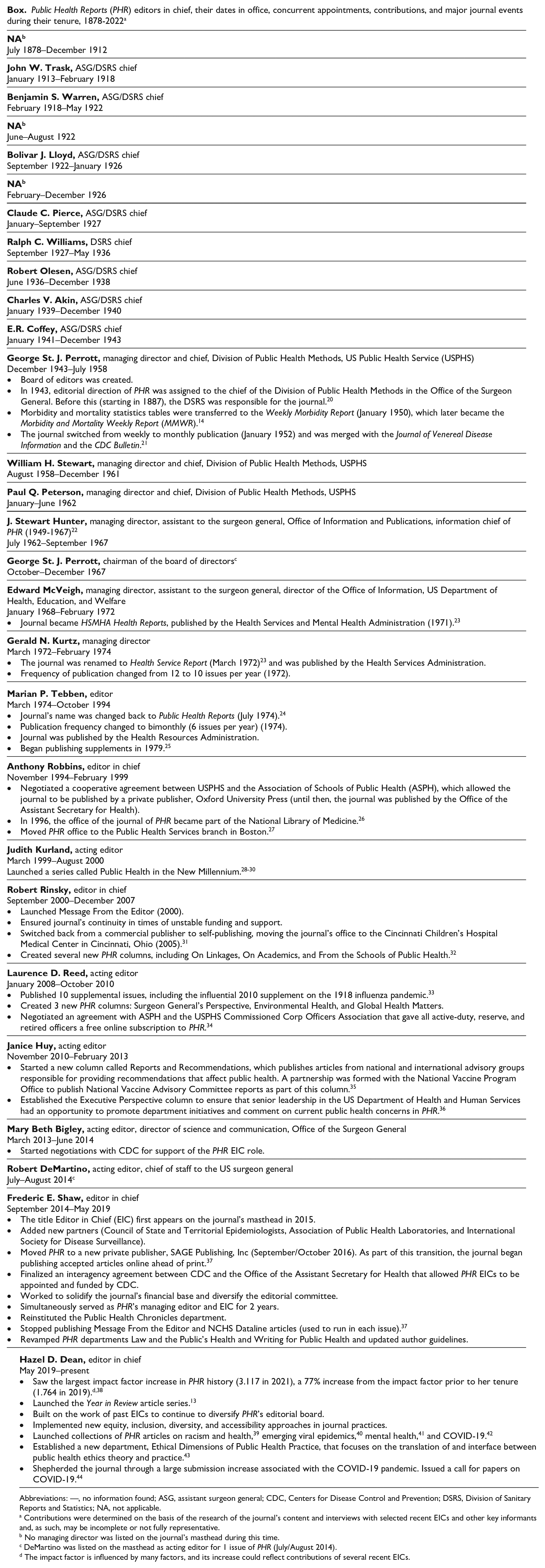
Abbreviations: —, no information found; ASG, assistant surgeon general; CDC, Centers for Disease Control and Prevention; DSRS, Division of Sanitary Reports and Statistics; NA, not applicable.
Contributions were determined on the basis of the research of the journal’s content and interviews with selected recent EICs and other key informants and, as such, may be incomplete or not fully representative.
No managing director was listed on the journal’s masthead during this time.
DeMartino was listed on the masthead as acting editor for 1 issue of PHR (July/August 2014).
The impact factor is influenced by many factors, and its increase could reflect contributions of several recent EICs.
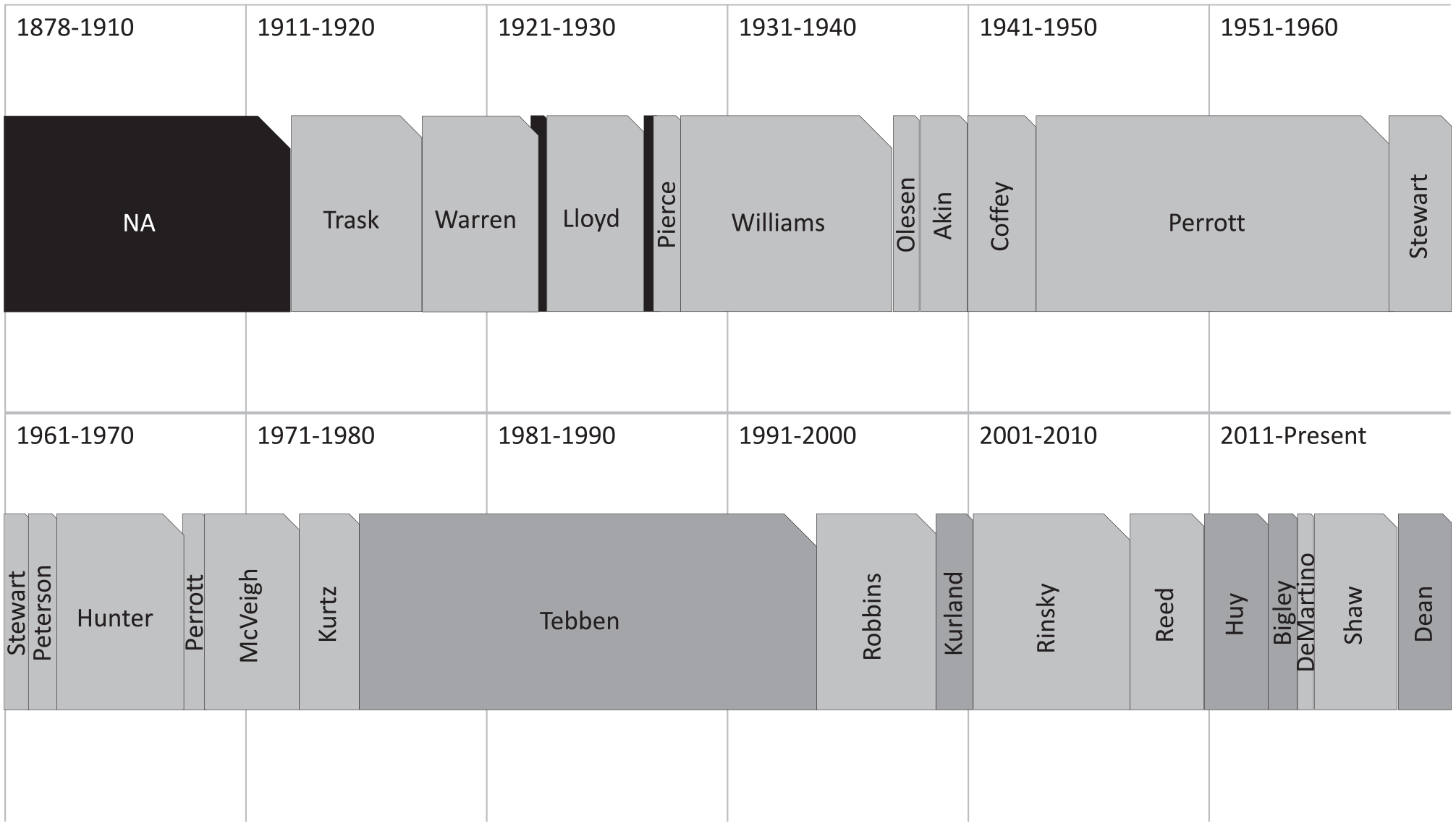
Timeline of past editors in chief (EICs) of Public Health Reports (PHR), 1878-2022. The black boxes and NA indicate that no information for the EIC was found on the masthead. The light gray boxes mean male EIC, and the darker gray boxes mean female EIC.
During 1913-1943, the editor of the journal held the title “assistant surgeon general and chief of the Division of Sanitary Reports and Statistics.” This title likely included the role of the PHR EIC. For example, Ralph C. Williams’ biography states that he served as the editor of PHR, while the PHR masthead (1927-1936) lists him as the assistant surgeon general and chief of the DSRS in USPHS. 45 This title disappeared from the masthead in 1943, after which PHR’s top person, George St. J. Perrott, was listed as chief of the Division of Public Health Methods at USPHS (1943-1951).
Before January 1952, the journal’s masthead listed only 2 primary officials associated with the journal: the surgeon general and the assistant surgeon general/DSRS chief (Figure 2). However, during 1952-1974, the masthead included additional staff members, such as the executive editor and the managing director, as well as the names of the editorial board members and the board chairman. The term “managing director” eventually disappeared from the masthead in 1974, and the terms “editor” and “acting editor” were used exclusively to describe PHR leadership from March 1974 to July 2014. The term used today, “editor in chief,” first appeared on the masthead in July 2015. 46 We were able to identify and confirm photographic images of 23 of 25 past PHR EICs (Figure 3). Images were missing for Edward McVeigh and Marian P. Tebben.
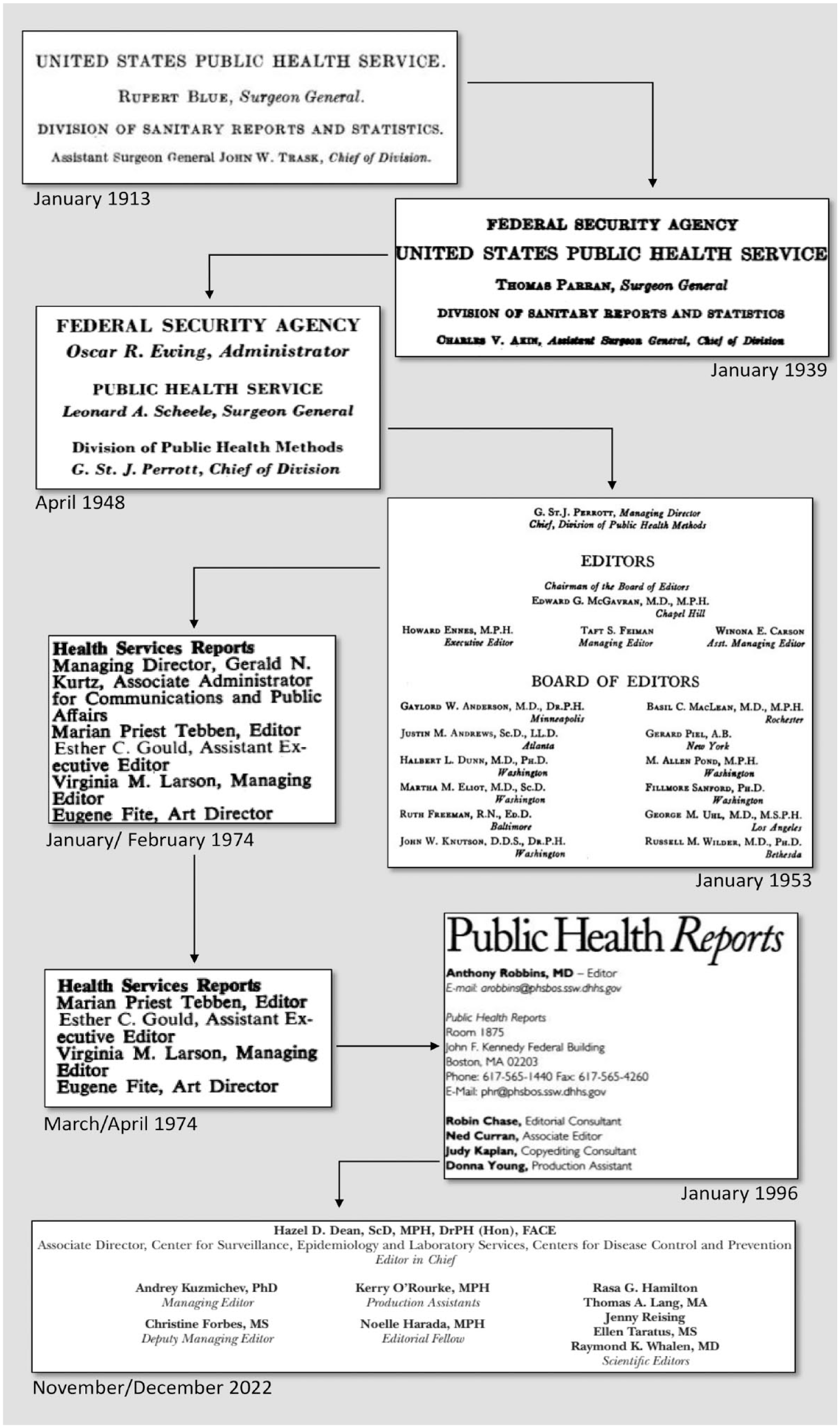
Examples of Public Health Reports mastheads showing different ways the editor in chief role was documented in the journal, selected years, 1913-2022.
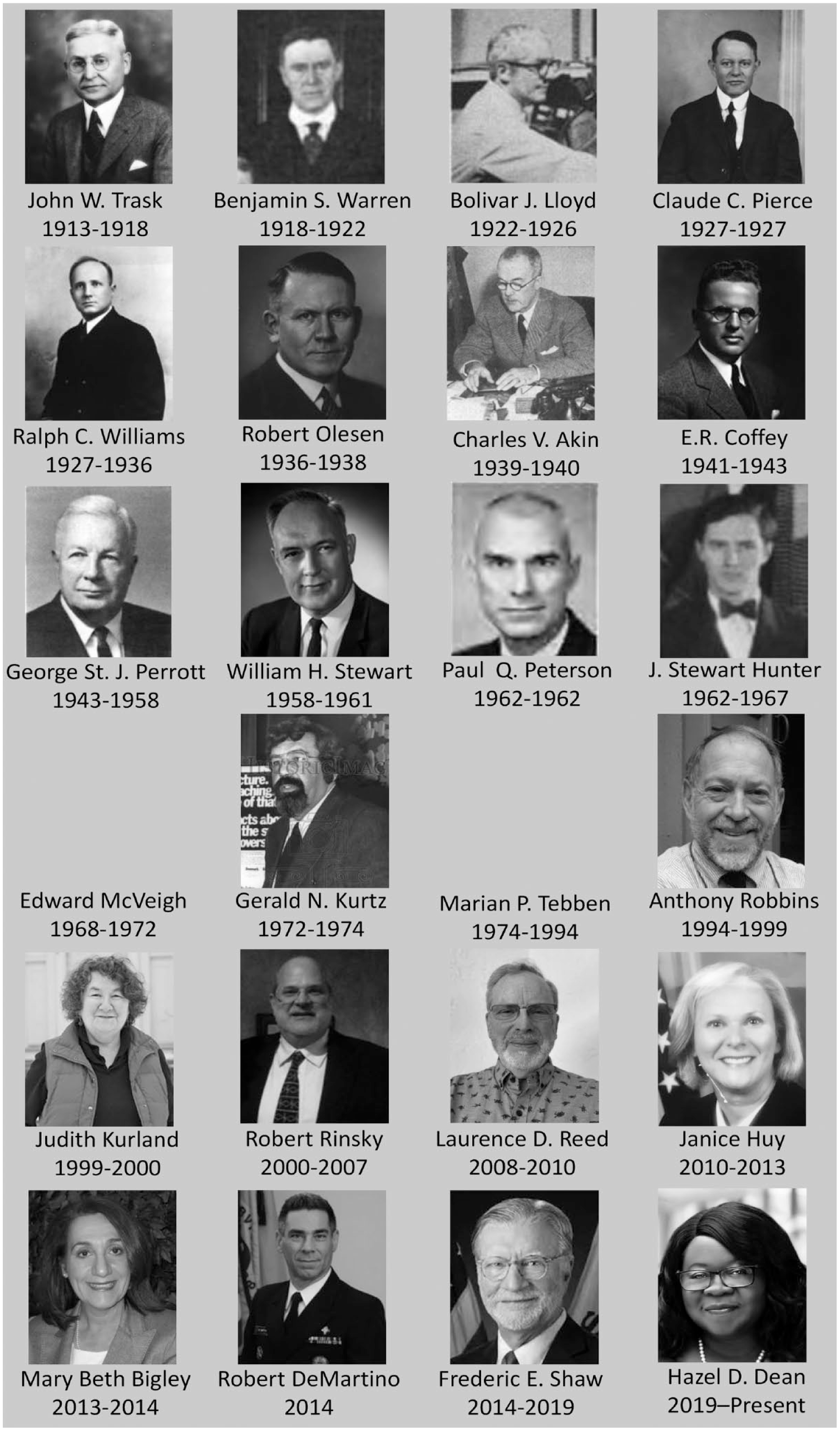
Photo collage of past Public Health Reports editors in chief, 1913-2022. Photos could not be located for Edward McVeigh and Marian P. Tebben.
The timeline shows 25 EIC transitions, representing 24 individuals (George Perrott acted as editor twice), during 109 years (counting from January 1913—the first year when a single individual in charge of the journal could be identified on the masthead—to the end of 2022). The 2010-2020 decade at PHR was the period with the most EIC transitions (6 transitions in 10 years). During this time, the journal had 4 acting EICs. The journal also had a high percentage of acting/temporary EICs as listed on the masthead (5 of 25 EICs), EICs serving for ≤1 year (4 of 25 EICs), and EICs holding concurrent appointments while working on the journal (15 of 25 EICs) (Box, Figure 1). The longest-serving EIC was Marian P. Tebben (1974-1994); the shortest-serving EIC was Robert DeMartino (listed as the editor for a single issue [July/August 2014]).
Representation of Women Among PHR EICs
Women accounted for 5 of 25 of its EICs. Overall, a woman was PHR’s EIC for approximately one-quarter of its history (28 of 109 years, counting only the time when a single individual responsible for the journal could be identified). Women also served as acting EICs more frequently than men (of 5 acting EICs, 3 were women). We observed recent improvement in this disparity. For example, before January 2000, only 1 of 16 PHR EICs was a woman, covering approximately one-quarter of the journal’s history (20.5 of 87 total years of identifiable EIC history), whereas from 2000 to 2022, 4 of 9 PHR EICs were women, serving almost 8.5 of 22 years.
Representation of Racial and Ethnic Minority Groups Among PHR EICs
Literature on the racial and ethnic diversity of EICs of medical and public health journals is limited and largely excludes the public health field. It points to a general underrepresentation of people from racial and ethnic minority groups in senior editorial roles.47-49 Consistent with these observations, we identified a single Black PHR EIC (Dr. Dean) among all prior, presumably White, EICs.
Discussion
We established a timeline of past PHR EICs, from 1913 through 2022, and observed high EIC turnover with 25 EIC transitions and underrepresentation of women. In comparison, MMWR had 12 EIC changes in 61 years (1961-2022), 6 of which occurred during the journal’s most recent 20 years. 14 Recent discussions in the scientific literature have highlighted and called for correcting the historical trend of the lack of gender and racial and ethnic diversity in the leadership of scholarly journals, as illustrated by the underrepresentation of women among EICs of top medical journals. 11 PHR’s EIC history seems to confirm this trend. Our observation of the scarcity of women serving as PHR EICs is broadly consistent with the findings from the 2019 cross-sectional study, which found that women account for about 21% of EICs of top medical journals. 11 In April 2022, JAMA appointed a new EIC, who was the first Black woman (and only the second woman) to assume the EIC role at JAMA.50-52 The 2021 analysis of the JAMA Network found that 38% of editors and editorial board members were women, including 4 EICs of JAMA Network journals. 27 The fact that we have generalized this trend among top medical journals to PHR, which is a mid-tier US public health journal (eg, in 2021, it was ranked 112 of 210 journals in the Public, Environmental & Occupational Health category 53 ), suggests that gender inequity among journal leadership is not limited to the “privileged gatekeepers” (ie, leading medical journals that are supposed to publish the best science) 8 but is prevalent across the field. Our longitudinal analysis offers a different perspective on the problem than the cross-sectional analysis by Pinho-Gomes et al. 11 It uncovers important temporal trends, highlights recent improvements, and distinguishes temporary and long-term EIC appointments.
The absence of female EICs in the early days of PHR could have been due to a general trend of women in the United States not working outside the home in the early 20th century. 54 The number of women in the workforce slowly rose after the end of World War II, 55 and during the 1970s, a cultural shift made it commonplace for women to be in the workplace. 54 This shift correlated with the appointment of the first woman to be PHR’s EIC, Marian P. Tebben, in 1974. In comparison, the American Journal of Public Health appointed the first female EIC in 1998, 56 the New England Journal of Medicine in 1999, 57 the Journal of the American Medical Association in 2000, 58 and MMWR in 2005. 14 The American Journal of Preventive Medicine has had no female EICs since its establishment in 1985. 59 While these numbers are too small to draw comparisons, in terms of years led by a female EIC during the early years of women’s workforce integration (ie, before the 1990s), PHR holds a demonstrable advantage over these publications—regardless of the circumstances around and motivations behind such appointments. Marian P. Tebben’s appointment as PHR’s first female EIC in the 1970s suggests that mid-tier journals such as PHR might have been more open to women serving in leadership roles than more prestigious “gatekeeper” publications 8 —a hypothesis that could be tested more systematically in the future.
Our observations are consistent with other reports on the sparsity of racial and ethnic diversity among EICs of medical and life sciences journals.47-49 The recent appointment of PHR’s first Black EIC and similar developments at other journals46,60 suggest that there might be a common appreciation of the need for improvement in this area. PHR is working with its publisher to identify ways to voluntarily capture data on demographic and other diversity characteristics of its editors, authors, and reviewers. It would be important to compare these data with those of other journals.
Limitations
Our approach had several limitations. First, we could not find evidence of who was acting as PHR’s EIC before 1913. We can speculate that the US Surgeon General oversaw the editing process at that time, but we could not confirm that he did. Along with the information gap during 1878-1913, we were unable to locate mastheads for June–September 1922 and February–December 1926. Although these gaps are small, we could have missed EIC transitions during these periods. Perhaps these gaps can be filled in the future if mastheads from these periods can be uncovered. Second, because the term “editor in chief” did not appear on PHR mastheads until 2015, it was sometimes difficult to understand who was acting as the primary editor of the journal. For example, the managing director, executive editor, and chairman of the editorial board may have had some overlap with EIC functions in their roles. Third, we were able to interview only the most recent EICs, so we could not determine the perceived top contributions for all past EICs. Some editors wrote about their top contributions in the Message From the Editor column. However, it was difficult to determine EICs’ contributions before this column was established. Another caveat, related to our inability to interview all past editors, is that we may have missed temporary or concurrent appointments not explicitly labeled as such on the journal’s masthead, especially during its earlier years. Fourth, we were unable to locate 2 images of past EICs (Edward McVeigh and Marian P. Tebben). Lastly, despite our extensive public and USPHS/National Library of Medicine resource searches, we were unable to establish any further details on the tenure of Marian P. Tebben, PHR’s longest-serving female EIC.
Future Directions
Moving forward, the present EIC timeline should be refined—with assistance from the National Library of Medicine and public health historians, including those from USPHS—and updated through future EIC transitions. Another future direction for this work may include assessing the potential impact of EIC diversity on the journal’s content: an EIC has influence on what the journal publishes (eg, through targeted submission recruitments or EIC’s initial manuscript review), and his or her diverse background (or lack thereof) may affect these choices. The caveat is that such influence is generally limited by the priority of external peer review and associate editor evaluations in editorial decision-making. Lastly, an area of future research may involve a brief biography of Marian P. Tebben’s tenure as EIC. Such detailed analysis could shed light on her experience as an EIC during an era when few scholarly journals had female editors.
Conclusions
We uncovered frequent EIC transitions and a low representation of women and racial and ethnic minority groups among EICs. Mapping the timeline of past EICs of a historic public health journal can yield valuable insights into the workings of US public health, especially in the area of building a research evidence base.
Footnotes
Acknowledgements
The authors thank David Rosner, PhD, MPH, for his insightful comments on the article. They are also grateful to Thurka Sangaramoorthy, PhD, MPH, and past EICs and PHR key informants (Mary Beth Bigley, DrPH, APRN; Janice Huy; Julie Keefe; Rick Kurz, PhD; Boris Lushniak, MD, MPH; CAPT Laurence D. Reed, MS; Anthony Robbins, MD, MPA; and Frederic E. Shaw, MD, JD) for their feedback and involvement in this project.
Declaration of Conflicting Interests
The authors declared no potential conflicts of interest with respect to the research, authorship, and/or publication of this article.
Funding
The authors received no financial support for the research, authorship, and/or publication of this article.
