




Abstract

On July 13, 2018, Public Health Reports marks its 140th year of publication. It began in 1878 as a small weekly government bulletin of disease reports and tables. During the past 140 years, this, the official journal of the surgeon general and the US Public Health Service (USPHS), has adapted continually to new public health challenges and innovations in medical communications (Box). From a simple bulletin publishing mostly reports from USPHS officers, through the decades the journal has evolved into a seasoned peer-reviewed journal publishing articles from all parts of the public health enterprise. In this editorial, we celebrate the journal’s anniversary and the contributions it has made to public health. We offer a short history of the journal; announce the reinstatement of Public Health Chronicles, a department in the journal dedicated to the history of public health; and reflect on the future of the journal.
Some key dates in the history of Public Health Reportsa
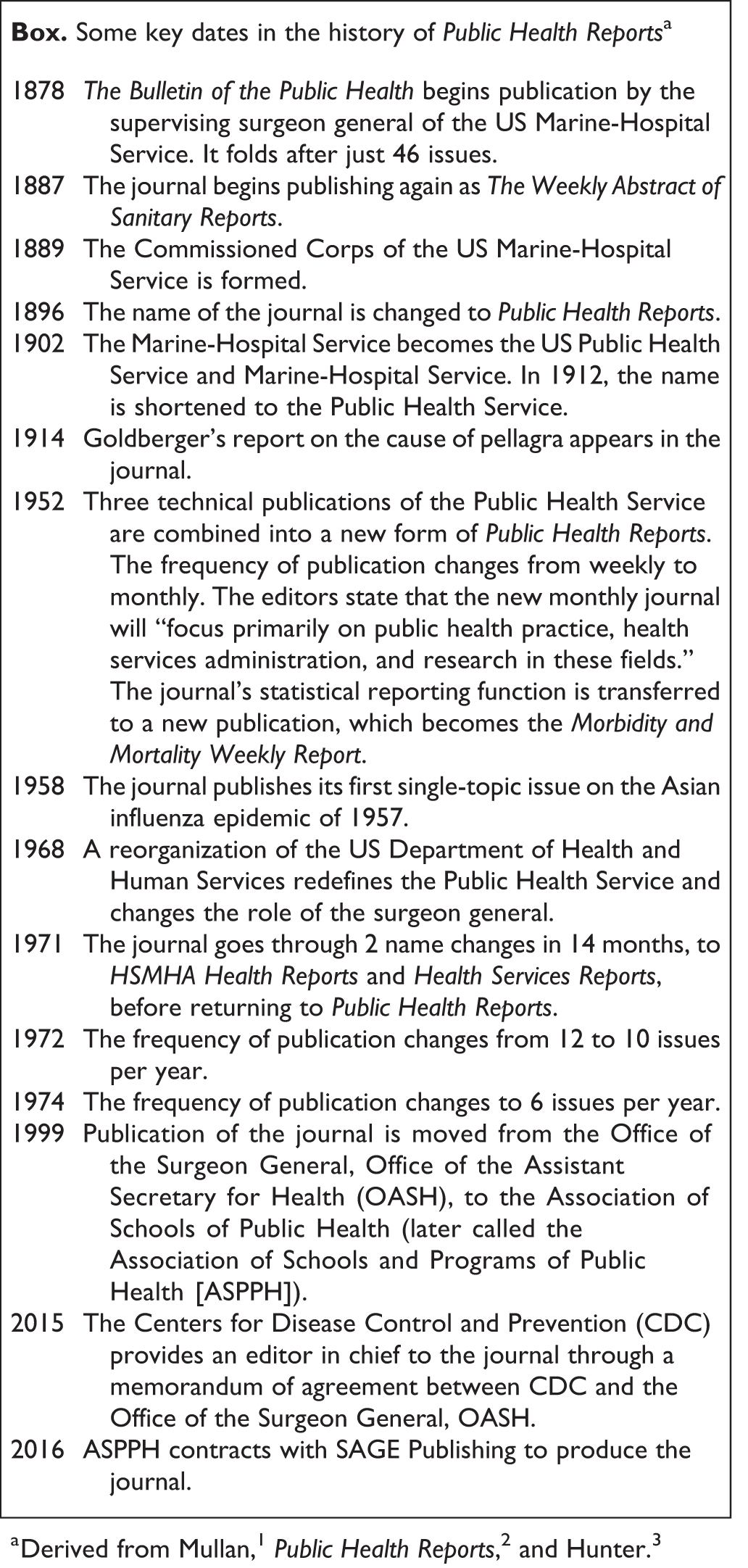
a Derived from Mullan,1 Public Health Reports,2 and Hunter.3
A Short History of Public Health Reports
Every issue of Public Health Reports, except those published in the most recent 12 months, is available online without charge as a PDF document on PubMed Central. 4 A reader can flip through 140 years of issues and take a fascinating tour of public health history in the United States since the end of Reconstruction. It is a story of the great killer diseases of the ages, of battles against them won and lost, and of the long history of the oldest uniformed service of the United States, the USPHS.
The journal was born in 1878 as The Bulletin of the Public Health, a weekly publication of the supervising surgeon general of the US Marine-Hospital Service, the precursor to the USPHS. 1 The Bulletin was inaugurated in accordance with an act of Congress in 1878 and was designed to notify Marine-Hospital Service officers, US customs officials, and state and local health authorities of sanitary conditions in the United States, foreign ports, and ships bound for the United States. 2,3,5 The Bulletin folded after just 46 weekly issues but reawakened in 1887 as The Weekly Abstract of Sanitary Reports. In 1896, the Weekly Abstract changed its name to the one that it has used almost continuously ever since, Public Health Reports.
The journal has reported on the greatest public health problems of the nation, sometimes in a very vivid way. In the year of the journal’s birth, one of the most deadly diseases of the time—yellow fever—was ravaging the lower Mississippi Valley, eventually resulting in as many as 20 000 deaths. 6 Reports of the spread of yellow fever filled the journal’s pages. In issue number 7 of the Bulletin, published August 24, 1878, Dr D. W. Booth, the Marine-Hospital Service officer at Vicksburg, Mississippi, reported, “At least 400 cases of yellow-fever from date of commencement, August 12, to yesterday evening, and 69 deaths; 20 deaths during last twenty-four hours.” Dr Booth telegraphed, “I am sick; impossible to procure accurate data.” 7 In the following week’s issue, the Bulletin reported, “Dr. Booth, in charge of the patients of the Marine-Hospital Service, died the 27th.” He was 37 years old. 8,9
The essence of the journal’s mission has always been to report the occurrence of cases of disease, epidemics, risk factors, and public health problems to allow health authorities to take action based on the best information. Over the decades, however, the journal’s methods have evolved to meet changing disease threats and communication channels. In the earliest years of the Bulletin and the Weekly Abstract, the journal transmitted telegraphic disease reports from foreign consuls and the far-flung officers of the Marine-Hospital Service. Soon, however, the journal was publishing long-form reports of disease investigations in the United States and foreign ports, along with weekly national mortality tables for communicable diseases, such as cholera, yellow fever, typhoid fever, smallpox, and whooping cough (Figure).
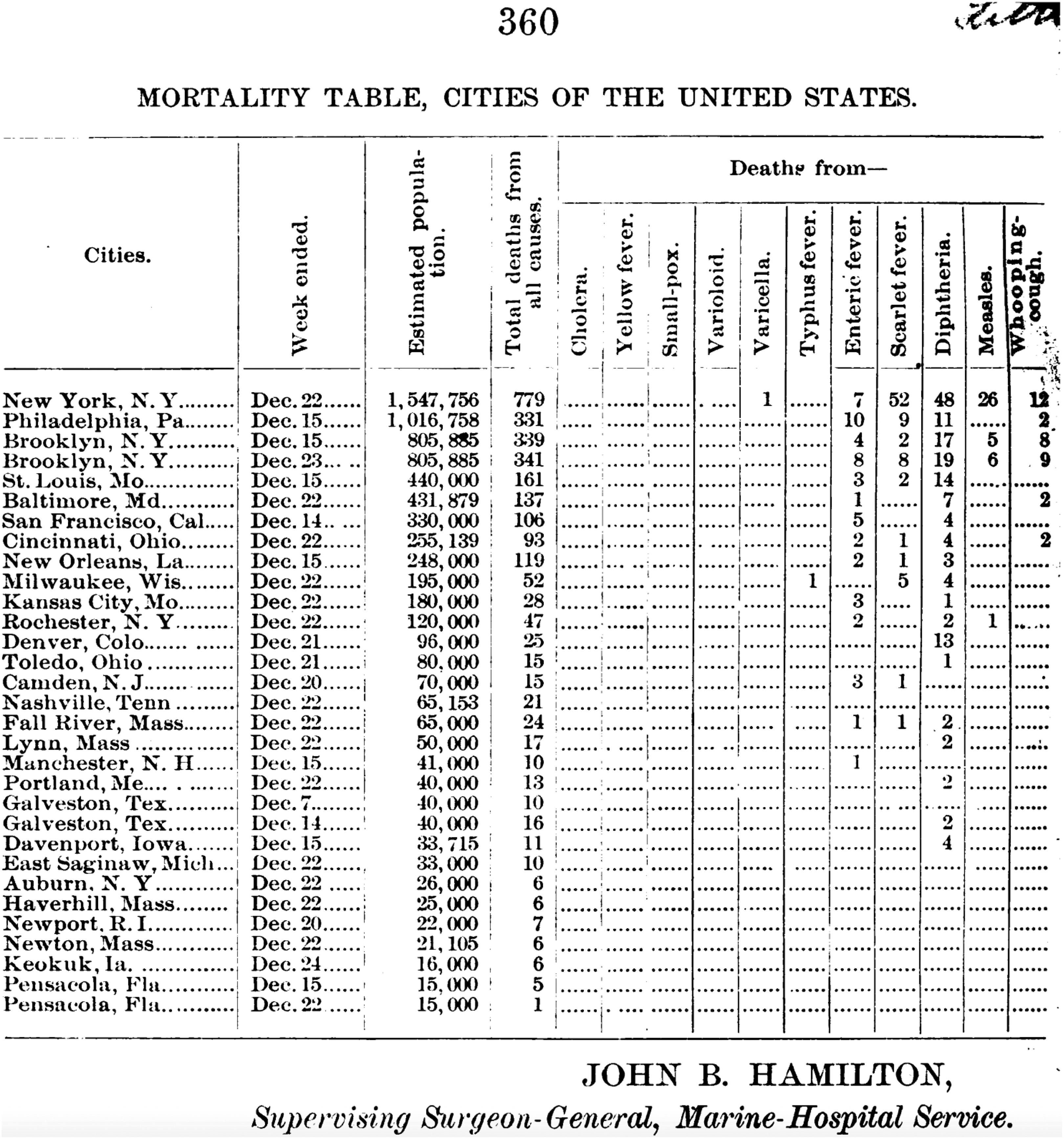
The mortality table for cities of the United States published in The Weekly Abstract of Sanitary Reports, December 28, 1888. 10
The June 29, 1888, issue of the Weekly Abstract, for example, contained reports of the causes of deaths in England and Wales, Ireland, Singapore, Montevideo, Santiago de Cuba, and Havana. A mortality table displayed the number of deaths from various causes in 14 foreign cities, from Glasgow to San Juan del Norte. Another table listed the number of deaths from 11 communicable diseases in 22 US cities. A 30-page article described a USPHS investigation of the “machinery and methods that are used by the [Louisiana] State board of health in the enforcement of the quarantine regulations of that State.” It was written by Joseph J. Kinyoun, a surgeon in the newly formed Commissioned Corps of the Marine-Hospital Service, who later founded the US Hygienic Laboratory, the predecessor of the National Institutes of Health. In the report, Kinyoun described in detail the state’s quarantine procedures for arriving ships, including exhaustive descriptions of ship fumigation methods and their microbiological effectiveness. 11
Public Health Reports has published on all the most vital public health topics of the day, from disease occurrence and risk factors to investigative methods and ethics, prevention, public health practice, regulation, and administration. Some of the most prominent articles are collected in a 2005 book, Public Health Reports: Historical Collection, 1878-2005. 12 Robert A. Rinsky, the editor of the book and editor in chief of the journal from 2000 to 2008, with help from others, including one of us (D.R.), reprinted 35 key articles from the journal with comments from experts and historians. The reports include such topics as the causes of high mortality in Puerto Rico (published in 1900); the mental examination of immigrants at Ellis Island (1917); “Untreated Syphilis in the Male Negro” (1954), a report on the infamous Tuskegee Study; and “The Surgeon General’s Report on Acquired Immune Deficiency Syndrome” (1987). Also included was arguably the most famous article ever published in the journal, a 4-page report on the cause of pellagra, reported on June 26, 1914, by Joseph Goldberger, a USPHS officer. 13 Through a series of astute observations, Goldberger overturned the long-held belief that pellagra was an infectious disease. He suggested that it was a disease of nutritional deficiency, and he advocated treating it with a diet rich in fresh meats, eggs, and milk. After Goldberger’s death, researchers determined that the cause of pellagra was, in fact, a deficiency of niacin. 14
For decades after its birth in 1878, the journal published national morbidity and mortality tables in each issue. In 1950 and 1951, a committee met to consider all the publications of the USPHS. As a result, the journal’s statistical reporting function was transferred to a new publication of the National Office of Vital Statistics (later to become the National Center for Health Statistics). In 1952, this publication became the Morbidity and Mortality Weekly Report, or MMWR. 15 Also in 1952, Public Health Reports became a more mainstream public health journal, with “focus primarily on public health practice, health service administration, and research.” 16 It continued as a peer-reviewed scholarly journal, minus the morbidity and mortality tables, but as a monthly instead of a weekly publication. In those years, too, the journal changed from an “insiders’” publication, with articles submitted almost entirely by USPHS officers, to a broader public health journal with authors from state and local health departments, academia, and foreign nations. In 1972, the journal changed to a 10 issues-per-year schedule, and then became a bimonthly in 1974. 3
The journal went through several changes in style and content in the 1970s and 1980s, but an especially important change occurred in 1999. Throughout its history, the journal had been edited and published by the Office of the Surgeon General (OSG). In 1999, the OSG and the Office of the Assistant Secretary for Health decided to outsource the publishing of the journal to the Association of Schools of Public Health, now the Association of Schools and Programs of Public Health (ASPPH). The purpose of the change was to “exploit the most efficient and effective aspects of commercial publishing,” something difficult to do from within the federal government, which could not collect subscription fees to offset journal expenses. 17 Although it did not allow readers free access to the journal’s content, the new arrangement with ASPPH provided a better publishing model. Another effect of this arrangement, which continues today, was to position Public Health Reports as the principal journal of American schools of public health and their pedagogy. In 2016, recognizing the increasing complexity of electronic publishing, ASPPH contracted with SAGE Publishing, a large scholarly publisher, to produce the journal online and in print using the latest publishing technologies.
Another key change took place in 2015, when the OSG agreed to have the Centers for Disease Control and Prevention (CDC) in Atlanta provide the editor in chief of the journal. The current editor in chief (F.S.) is the first CDC assignee to edit the journal under this agreement. He works in the same CDC center that houses MMWR.
Because of these arrangements, Public Health Reports operates quite differently from other federal health publications, such as Emerging Infectious Diseases, Preventing Chronic Disease, and MMWR at CDC, and Environmental Health Perspectives at the National Institutes of Health. The journal remains headquartered at the OSG but is published by ASPPH, produced for subscription by a private publishing house, and edited by CDC. Although a bit intricate, this arrangement offers the advantages of a public–private partnership. The journal has also been strengthened by new collaborations with the Council of State and Territorial Epidemiologists, the International Society for Disease Surveillance, and groups interested in legal epidemiology, with other collaborations to come.
Reinstating Public Health Chronicles
The archives of Public Health Reports have long served as a source of primary material for books and articles on public health history. These materials are indispensable for scholars who wish to understand the past, present, and future of public health. When Robert A. Rinsky became the journal’s editor in chief in 2000, he established Public Health Chronicles, a department of the journal dedicated to articles on public health history and edited by one of us (D.R.). Public Health Chronicles has lain dormant for a few years, but the 140th anniversary seems the right time to restart it, to build on the rich history of the journal. The reinstated department will publish a series of invited and submitted articles during the anniversary year and will continue as a regular part of the journal, covering public health problems old and new, through a historical perspective. Information on submitting an article to Public Health Chronicles is available online. 18
Reflecting on the Future of Public Health Reports
As the journal begins its next 140 years, we wonder what the editors of the 1878 Bulletin would think if they could see how their publication would look in 2018. The communications technology of today undoubtedly would seem like science fiction to them. But they would recognize the purpose of today’s Public Health Reports: to publish high-quality scientific information that helps preserve and advance the health and wellness of the American public. 18 As one looks through old issues of the journal, one is struck by the differences and similarities between the public health problems of decades past and those of today. The particularities of past problems certainly have changed, and many of the technologies used to solve them are radically different, but often the themes are the same.
A good example is opioid addiction. By the end of 2016, the current epidemic of opioid addiction and overdose in the United States had caused the deaths of more than 350 000 people.
19
The current epidemic has features not seen before (eg, the introduction of certain synthetic and semisynthetic opioids), but it is also an echo of the past.
20
Over the decades, Public Health Reports has published many articles on opioid addiction. One frequent contributor was Lawrence Kolb, a USPHS psychiatrist who spent years studying narcotic addiction and treatment and later became the director of the first USPHS Narcotic Hospital in Lexington, Kentucky.
21
Some of the issues described by him in a 1924 article have a ring of familiarity, such as the role of physician prescribing: The numerous reports and forms which physicians are required to make out in order to prescribe narcotics in any form tends to keep them alert to the dangers of these drugs, and mild forms of addiction now caused by a few weeks, or even months, of necessary prescribing quickly clear up after a few days of restlessness on the part of the patient and he is no wiser or worse off because of it. Formerly he could experiment further with his “doctor’s prescription” and become strongly addicted without realizing it until too late.
22
What will the next 140 years bring? Will Public Health Reports be publishing articles on the health problems of Mars dwellers? Will journals as we know them still exist? It is impossible to predict 10 years ahead, let alone 140. In public health, as in life, the only constant is change. Public health problems and responses will change, often in unexpected ways. Public health education, medical communications and publishing, and the way that authors and readers view content also will continue to change, often at a breakneck speed. Through it all, Public Health Reports intends to be there.
Footnotes
Declaration of Conflicting Interests
The authors declared no potential conflicts of interest with respect to the research, authorship, and/or publication of this article.
Funding
The authors received no financial support for the research, authorship, and/or publication of this article.