




Abstract

Keywords
The journal Public Health Reports (PHR) has been published since 1878. 1 PHR is the oldest scholarly public health journal in the United States, is one of the oldest such journals in the world, and is the official journal of the Office of the US Surgeon General and the US Public Health Service. 2 In 2021, PHR launched the Public Health Reports: Year in Review article series to inform its contributors and readers about its latest publication metrics, content, and planned improvements. 3 The series currently includes 3 reports—from 2020, 2021, and 2022.3 -5 To allow for historic volume-based comparison, analyses in these articles continue to be performed by volume, not article online publication date.
Journal’s 2023 Performance Metrics
In 2023, PHR received, for the third year in a row, its highest impact factor (3.3), a 6% increase from 2022 (3.117) and an 87% increase from 2019 (1.764). 6 The impact factor is based on the previous year’s citations of articles published within the 2 preceding years. 7 The rising trend in PHR’s impact factor could be due, in part, to implementing management processes focused on strategic science. These new processes work to inform public health policy and practice and to produce societal impact.
During 2023, PHR received 634 new submissions, including 614 for its regular bimonthly issues and 20 for the invited or sponsored supplemental issues. This number represents a 23.6% decrease in new submissions from 2022 (n = 830), including a 20.5% decrease in regular-issue submissions (n = 772) and a 41.2% decrease in supplement article submissions (n = 34). This drop was likely caused by a reduction in COVID-19 article submissions. The journal’s 2023 acceptance rate for bimonthly peer- or editor-reviewed content was 15.2%: 656 final decisions were made in 2023, including 100 acceptances and 556 rejections. These data exclude articles in supplements and articles that were not peer or editor reviewed, such as Surgeon General’s Perspective and Executive Perspective articles, which are commentaries by US Department of Health and Human Services officials. However, these data do include such content as letters to the editor and responses to letters and peer-reviewed Reports and Recommendations articles, as well as contributions to the departments of Law and the Public’s Health, From the Schools and Programs of Public Health, and Ethical Dimensions of Public Health, which are reviewed by the department’s associate editor and may undergo peer review. The acceptance rate for 2023 (15.2%) was close to that for 2022 (14.2%). 5
In 2023, PHR’s editor in chief (EIC) made 617 first decisions on bimonthly peer-reviewed content, as compared with 776 first decisions in 2022. 5 This number differs from the number of articles submitted in 2023 (n = 634) because decisions made in early 2023 may include late 2022 submissions and, conversely, articles submitted late in 2023 may receive their first decision in 2024; also, some bimonthly submissions were not peer reviewed (eg, Surgeon General’s Perspective and Executive Perspective articles). The time to first decision was a mean of 23 days (range, 0-261 d) and a median of 12 days (IQR, 7-25 d). These values represent a decrease in mean time to first decision (30 d) and a decrease in median time (20 d) as compared with 2022. Articles with a long time to first decision (ie, those in the top 25%) were delayed for the same reasons that they were delayed in 2022, including difficulties in finding reviewers and transitions in associate editor and peer review staff.
PHR published 126 articles in volume 138 (January–December 2023), including research articles (n = 67), commentaries (n = 11), case studies (n = 8), public health evaluation articles (n = 7), contributions to the From the Schools and Programs of Public Health department (n = 6), topical or systematic reviews (n = 6), brief reports (n = 4), Surgeon General’s Perspective articles (n = 3), letters to the editor (n = 3), public health methodology articles (n = 2), Ethical Dimensions of Public Health articles (n = 2), Executive Perspective articles (n = 1), and 6 other articles (eg, “Public Health Reports in 2022: Impact Factor Increase; COVID-19 Coverage; Authorship by State, Tribal, Local, and Territorial Agencies; and New Department on Public Health Ethics,” “Acknowledgment of Reviewers,” and “Corrigenda”) (Table 1). PHR published 18.2% fewer articles in volume 138 (2023, n = 126) than in volume 137 (2022, n = 154). The biggest change by department included a 330.8% increase in the number of public health evaluation articles. Two articles were published in PHR’s new Ethical Dimensions of Public Health department. The decrease in the number of articles published in volume 138 versus volume 137 reflects a reduction in the number of COVID-19 articles published. The increase in public health evaluation articles reflects the publication of several articles that evaluated programs related to the continuum of HIV care.8 -10
Content of volume 138 (January–December 2023) of the journal Public Health Reports versus volumes 135 (January–December 2020), 136 (January–December 2021), and 137 (January–December 2022), by department
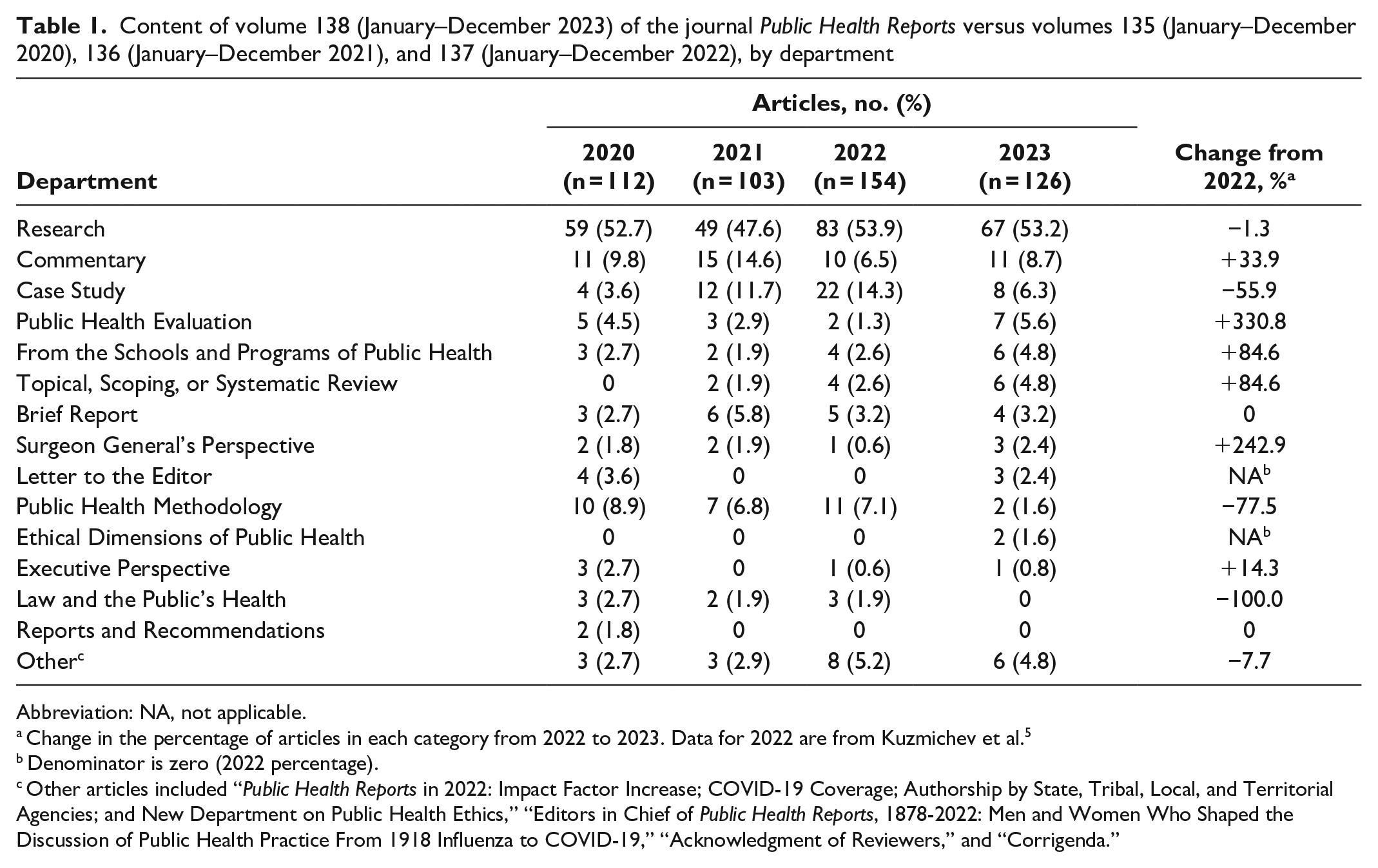
Abbreviation: NA, not applicable.
Change in the percentage of articles in each category from 2022 to 2023. Data for 2022 are from Kuzmichev et al. 5
Denominator is zero (2022 percentage).
Other articles included “Public Health Reports in 2022: Impact Factor Increase; COVID-19 Coverage; Authorship by State, Tribal, Local, and Territorial Agencies; and New Department on Public Health Ethics,” “Editors in Chief of Public Health Reports, 1878-2022: Men and Women Who Shaped the Discussion of Public Health Practice From 1918 Influenza to COVID-19,” “Acknowledgment of Reviewers,” and “Corrigenda.”
Among articles published in 2023 that were peer or editor reviewed (n = 116; excluding Surgeon General’s Perspective and Executive Perspective articles, “Acknowledgment of Reviewers,” “Corrigenda,” and special articles such as “Public Health Reports in 2022: Impact Factor Increase; COVID-19 Coverage; Authorship by State, Tribal, Local, and Territorial Agencies; and New Department on Public Health Ethics”), the time from original submission to final acceptance was a mean of 249 days (range, 44-623 d) and a median of 229 days (IQR, 193-289 d) (Table 2). This 2.7% decrease in mean time from 2022 (256 d) was likely due to changes in PHR’s production processes implemented in 2023.
Journal performance metrics for articles published in volume 138 (January–December 2023) of the journal Public Health Reports, by performance area
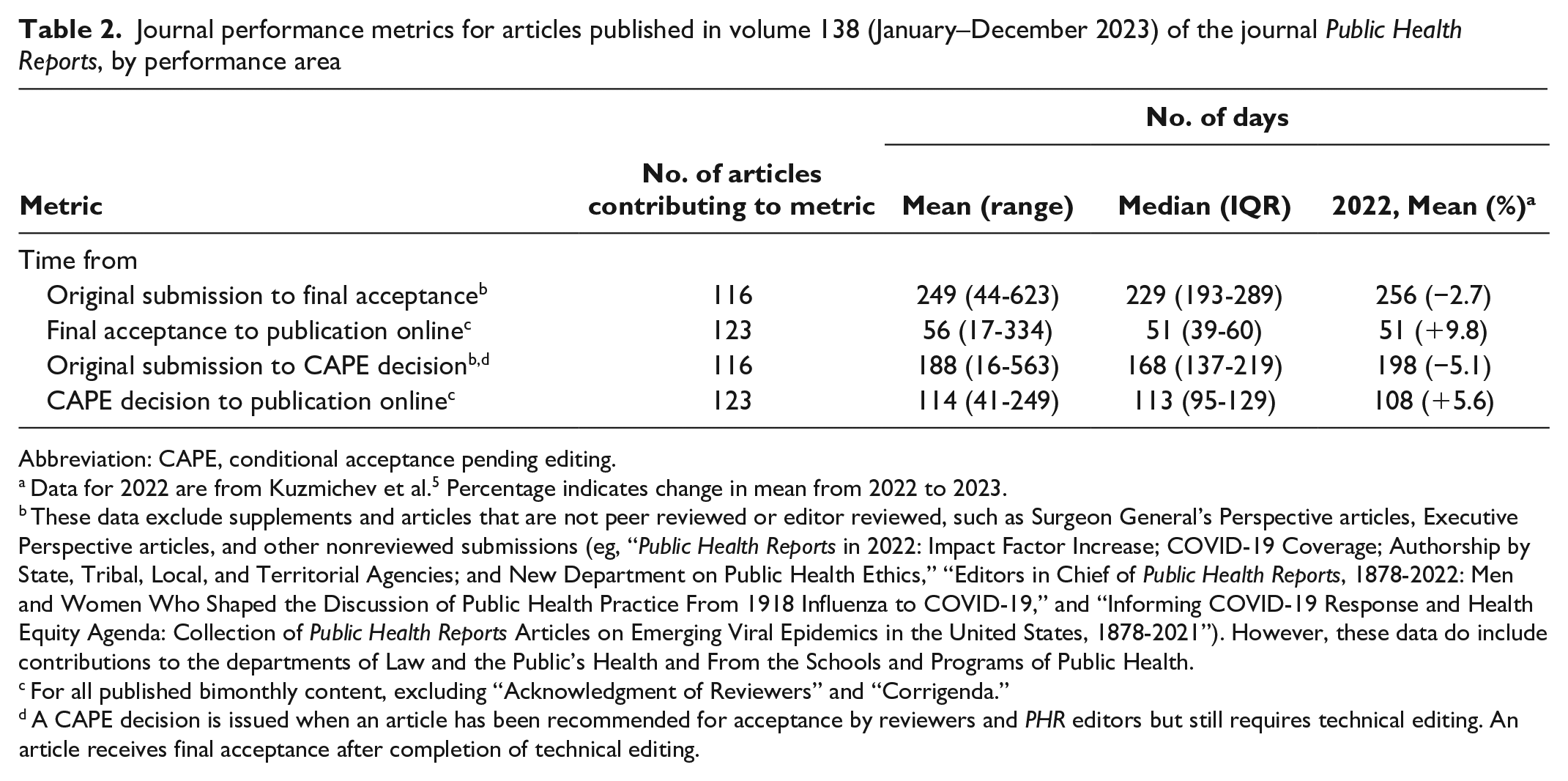
Abbreviation: CAPE, conditional acceptance pending editing.
Data for 2022 are from Kuzmichev et al. 5 Percentage indicates change in mean from 2022 to 2023.
These data exclude supplements and articles that are not peer reviewed or editor reviewed, such as Surgeon General’s Perspective articles, Executive Perspective articles, and other nonreviewed submissions (eg, “Public Health Reports in 2022: Impact Factor Increase; COVID-19 Coverage; Authorship by State, Tribal, Local, and Territorial Agencies; and New Department on Public Health Ethics,” “Editors in Chief of Public Health Reports, 1878-2022: Men and Women Who Shaped the Discussion of Public Health Practice From 1918 Influenza to COVID-19,” and “Informing COVID-19 Response and Health Equity Agenda: Collection of Public Health Reports Articles on Emerging Viral Epidemics in the United States, 1878-2021”). However, these data do include contributions to the departments of Law and the Public’s Health and From the Schools and Programs of Public Health.
For all published bimonthly content, excluding “Acknowledgment of Reviewers” and “Corrigenda.”
A CAPE decision is issued when an article has been recommended for acceptance by reviewers and PHR editors but still requires technical editing. An article receives final acceptance after completion of technical editing.
The time from final acceptance to online publication for the 123 full-content articles in volume 138 (excluding only “Acknowledgment of Reviewers” and “Corrigenda”) was a mean of 56 days (range, 17-334 d) and a median of 51 days (IQR, 39-60 d) (Table 2). This time was a 9.8% increase in mean time from 2022 (51 d), which could be attributed to changes in the publisher’s production processes.
In 2023, PHR continued to issue the “conditional acceptance pending editing” (CAPE) decision, which indicates that an article has cleared peer review and is ready for post–peer review editing. For peer-reviewed volume 138 (defined previously), the time from original submission to CAPE was a mean of 188 days (range, 16-563 d) and a median of 168 days (IQR, 137-219 d) (Table 2). This time was a 5.1% decrease from 2022 (mean, 198 d). Common barriers for articles in the top quartile for the time to CAPE continued to include associate editor reassignment and difficulty securing reviewers or reviews for original submissions. Shorter CAPE times in 2023 versus 2022 could be due to the implementation of procedures meant to limit severely overdue outliers that were submitted during the previous year.
The time from CAPE to online publication for articles in volume 138 (previously defined) was a mean of 114 days (range, 41-249 d) and a median of 113 days (IQR, 95-129 d) (Table 2). This time represents a 5.6% increase in mean time to online publication from 2022 (108 d). The increase in time from CAPE to online publication could be attributed to enhancements made by the publisher to improve the publication process.
Authorship of Journal’s 2023 Published Content
A total of 119 corresponding authors of regular, full-content articles in volume 138 (excluding supplement articles, “Acknowledgment of Reviewers,” and “Corrigenda”) were from US institutions, and 4 were from other countries (Canada, n = 2; Australia, n = 1; and the Netherlands, n = 1). The 119 US authors were affiliated with academia (n = 55, 46.2%); the federal government, such as the Centers for Disease Control and Prevention (CDC), National Institutes of Health, Office of the Assistant Secretary for Health, and Veterans Affairs (n = 45, 37.8%); state, tribal, local, and territorial (STLT) public health agencies (n = 8, 6.7%); nonprofit organizations (n = 6, 5.0%); the health care sector (n = 4, 3.4%); and private organizations (n = 1, 0.8%). As seen in 2022, most corresponding authors of PHR articles in 2023 were affiliated with academia, the federal government, and STLT organizations. However, the proportion of authors affiliated with STLT organizations decreased by nearly 49% from 2022 to 2023 (13.1% vs 6.7%). The decrease in the number of articles with STLT author affiliations was likely driven by a decrease in articles on COVID-19 and publication of a supplement focused on Tribal Epidemiology Centers (TECs).
Authorship by STLT Agencies
To further assess PHR’s STLT authorship in 2023, we extended our corresponding author analysis to determine how frequently representatives of STLT agencies served as coauthors on PHR publications. In 2023, PHR published 119 US-authored regular-issue, full-content articles, and 23 (19.3%) had an STLT author (corresponding author or coauthor). Of these, 15 (65.2%) had at least 1 coauthor from an STLT agency, and 8 (34.8%) had a corresponding author from an STLT agency. Fewer articles had an STLT author or coauthor in 2023 than in 2022 (43/145, 29.7%). Of the 15 articles with STLT coauthors, 8 had a corresponding author affiliated with the federal government, 6 had one affiliated with academia, and 1 had one affiliated with a nonprofit organization. Among federal agencies, CDC was STLTs’ sole lead collaborator (8 of 8 studies). Accordingly, of the 36 articles with a corresponding author from CDC, 8 (22.2%) had at least 1 coauthor from an STLT agency.
We also examined information on STLTs’ most frequent supporting collaborators. Of 8 studies with a corresponding author from an STLT agency, 3 had at least 1 coauthor from academia, and 2 had at least 1 coauthor from a federal office (both from CDC). These data suggest that STLT authorship was broader than what was observed in just the corresponding authorship analysis. STLT agencies’ frequent partnership with other types of organizations, especially CDC and academia, may reflect close partnerships in response to priority public health issues and practice- and science-based links to practical training for the next generation of public health workers.
Topics of PHR Articles Published in 2023
Thematically, content in volume 138 (123 full-content articles, excluding “Acknowledgment of Reviewers” and “Corrigenda”) could be grouped into 11 public health topics, not mutually exclusive (Table 3). The 3 most common topics in 2023 were infectious disease (77 articles), health disparities and the health of racial and ethnic minority and other socially or economically disadvantaged populations (57 articles), and public health practice (34 articles). Topics with >10 articles showing the biggest change from 2022 included public health workforce (+50.5%), chronic health conditions (+27.9%), and health disparities and the health of racial and ethnic minority and other socially or economically disadvantaged populations (+19.3%). These changes were likely due to PHR’s continued focus on the public health workforce, health disparities, and infectious and chronic diseases.
Content of volume 138 (January–December 2023) of the journal Public Health Reports, by topic a
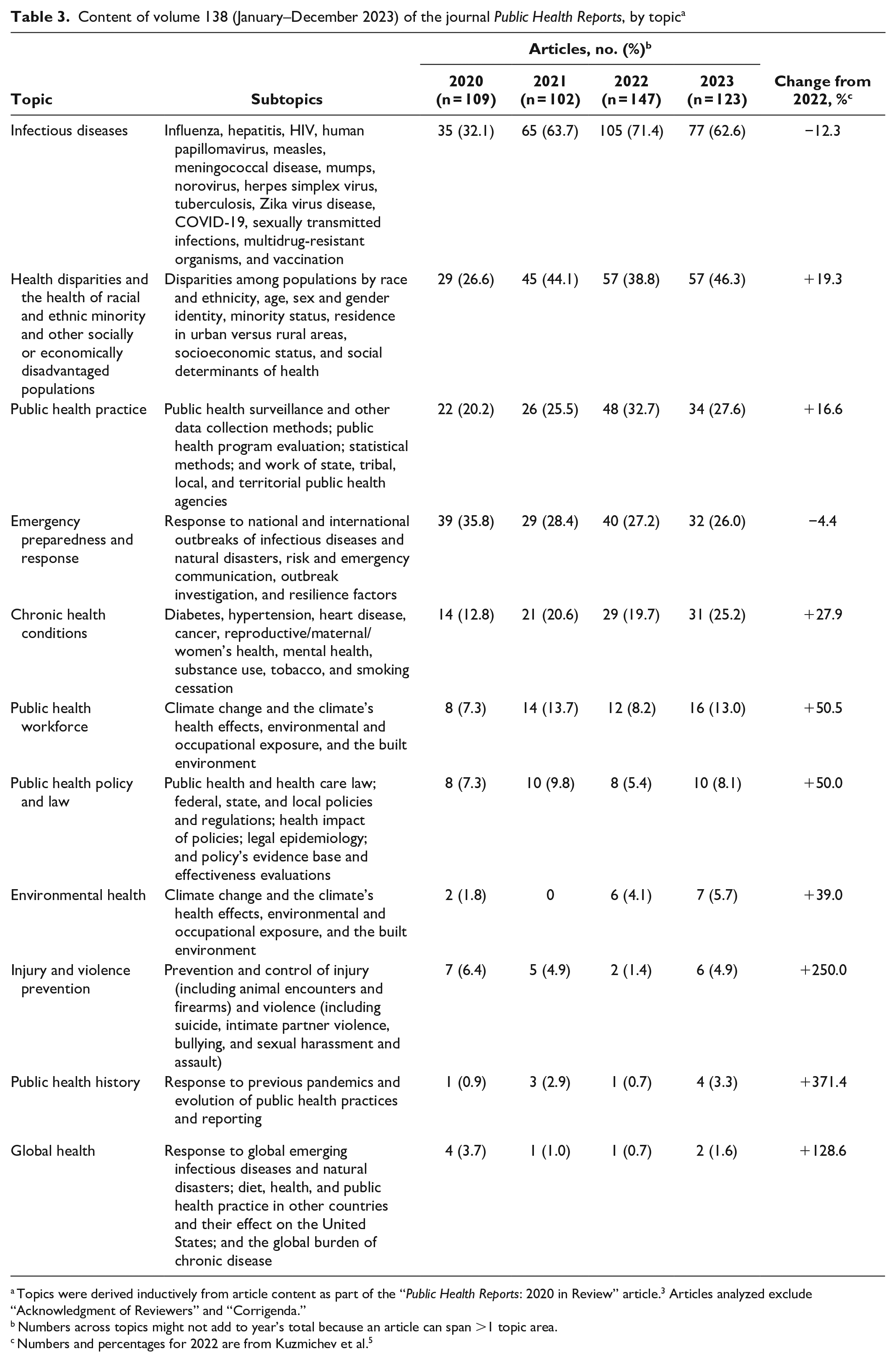
Topics were derived inductively from article content as part of the “Public Health Reports: 2020 in Review” article. 3 Articles analyzed exclude “Acknowledgment of Reviewers” and “Corrigenda.”
Numbers across topics might not add to year’s total because an article can span >1 topic area.
Numbers and percentages for 2022 are from Kuzmichev et al. 5
Impactful Content
In 2023, PHR articles were downloaded 570 041 times, which was a 1.5% increase from 2022 (561 571 times). The similar number of article downloads from 2022 and 2023 reflects continued interest and readership of PHR articles. The number of article downloads in 2023 was higher than the number of article downloads in the prepandemic year (418 593 downloads in 2020), suggesting an upward trend in the journal’s readership independent of the pandemic. The mean Altmetric score (which reflects the article’s news and social media attention) of all articles published in volume 138 (excluding corrigenda and Acknowledgment of Reviewers) was 25.7, as assessed on February 6, 2024. This score exceeded the mean Altmetric score for 2022 (16.3), likely due to publication of articles on contemporary public health topics, such as mental health among young people, climate change, and social and structural determinants of health.
The 3 most downloaded articles from 2023 were a commentary by the US Surgeon General on the importance of physical activity for the mental health of children and adolescents (4239 views/downloads; Altmetric score, 44), 11 a commentary by the US Surgeon General on whole-person health (1855 views/downloads; Altmetric score, 11), 12 and a research article about violent deaths among people experiencing homelessness in the United States (1710 views/downloads; Altmetric score, 1). 13
Several PHR articles published in 2023 generated substantial scholarly, public, and media attention, as measured by Altmetric scored. A research article that estimated the percentage of children with autism who have profound autism received the highest Altmetric score of any PHR article published in 2023: 1668 as of February 6, 2024 (representing the top 5% of all research outputs scored by Altmetric). 14 It was referenced by >200 news outlets in discussions about separating autism from profound autism, and it was shared by several large autism-related groups on X (formerly Twitter). 15 Another article, which examined how well cooling centers serve urban areas with high social vulnerability, 16 owes its relatively high Altmetric score (555, as assessed on February 6, 2024) to a heat wave in July 2023. During 2 days, the article was referenced by >60 news outlets in stories related to surviving excessive heat. 17 A third article, which examined the association between the incidence of COVID-19 across levels of social vulnerability and the duration of behavioral policy interventions, 18 received an Altmetric score of 202, largely because of a tweet by CDC’s Office of Health Equity that gained traction. 19
Supplements Published in 2023
In addition to 6 regular issues, PHR published 2 supplemental issues in 2023 (ie, sponsored peer-reviewed issues focusing on a particular public health topic or issue). One supplement—Expanding the Health Workforce Capacity and Responding to Public Health Emergencies, which was sponsored by the Health Resources and Services Administration, Division of Nursing and Public Health—aimed to describe novel strategies developed by grantees to respond to public health emergencies and address health equity, all during the COVID-19 pandemic. 20 The articles in this supplement focused on 3 areas: (1) assessing mental and behavioral health needs and integrating mental health care into primary care, (2) enhancing efforts to improve workforce flexibility, and (3) developing interprofessional/collaborative team-based care. 20 The second supplement published in 2023—Public Health Matters: Insights From Tribal Epidemiology Centers, which was sponsored by TECs 21 —provided firsthand examples of best practices and experiences that support culturally informed work in a tribal setting; described how data collection and analysis are community based and meaningful to the people served by TECs; and illustrated the value of the direct relationships TECs have with other tribes, tribal organizations, and urban Indian organization partners. 21 The supplement’s highlights included an article on facilitation of the urgent public health need to improve data sharing with TECs, 22 the care access and lived experience of American Indian/Alaska Native Two Spirit and LGBTQ+ participants in the Pride and Connectedness Survey, 23 and the association between resiliency factors and suicide indicators among American Indian/Alaska Native middle school students. 24
Department on Public Health Ethics
In 2023, PHR published 2 articles in the new Ethical Dimensions of Public Health department, which launched at the beginning of 2023. 25 This department’s goal is to fill the gap in publishing opportunities in the area of practical public health ethics. The articles published in 2023 focused on the ethics of expanding smoke-free housing policies in the United States and the ethics of personal behaviors for preventing infectious diseases in a post–COVID-19 pandemic world.26,27 Both articles focused on the translation of and interface between public health ethics theory and practice, and they provided practical examples of how to incorporate ethics into public health decision-making.
Historical Research on PHR Contents: New Collections and Article on EICs
PHR staff established 2 new collections of articles in 2023—Mental Health and About PHR. PHR staff performed a systematic review of PHR content from 1878 through 2022 to develop article collections relevant to mental health and the history of PHR. PHR staff were interested in creating a collection of articles on mental health because of the journal’s position in the Office of the US Surgeon General (ie, the office’s current priorities focus on topics related to mental health and well-being) 28 and its historical roots in the Health Services and Mental Health Administration (PHR was known as the HSMHA Health Report during 1971-1972). 29 The Mental Health collection includes links to articles, published from 1878 to present, that are relevant to the topic of mental health and well-being. 30 The About PHR collection contains links to articles that document the evolution and history of the nation’s oldest public health journal (1878 to present). 31 New articles are continuously vetted against inclusion criteria and added to these collections as they are published online.
PHR staff added to the scientific literature and authored a historical study on PHR’s EICs. 29 The study sought to document the contributions of each EIC and examine the representation of women and people from racial and ethnic minority groups among EICs. PHR has had 25 EIC transitions in its 109-year history, and 5 identifiable EICs were women, who served for 28 of the 109 years (25.7%). PHR’s longest-serving female EIC was a woman named Marian Priest Tebben (1974-1994), and a single Black PHR EIC (Hazel D. Dean) was identified among all prior, presumably White, EICs.
Publication Science and COVID-19
The area of publication science—the scholarly study of various aspects of the academic publishing process—is seldom studied by journals, and its applications to COVID-19 literature have been limited.32,33 On March 27, 2020, 16 days after the World Health Organization declared COVID-19 a pandemic, PHR announced an open call for submissions on the public health response to COVID-19, including challenges, lessons learned, and opportunities for public health practice. 34 After 1 year, the call for papers was updated to reflect changes in the pandemic and the public health response to it. Updates included 2 additional topic areas: vaccination and post–COVID-19 condition (also known as “long COVID”). 35
PHR staff summarized the journal’s COVID-19 publication efforts from March 27, 2020, through March 27, 2023, to help academic publishing better address the informational needs of public health responders and to inform public health practice and policy. 35 During this period, PHR received 1545 COVID-19 submissions and published 190 of those articles. By the categories listed in PHR’s call for COVID-19 papers, 51 articles (26.8%) addressed health disparities, 38 (20.0%) addressed public health surveillance, and 34 (17.9%) addressed COVID-19 vaccination. Of articles addressing CDC public health emergency preparedness and response capabilities, 87 (45.8%) addressed public health surveillance and epidemiologic investigation, 38 (20.0%) addressed community preparedness, and 32 (16.8%) addressed community recovery.
Staff Transition
In 2023, we said goodbye to PHR’s long-standing managing editor, Andrey Kuzmichev, PhD, as he moved on to another job. Kuzmichev was managing editor of PHR for 6.5 years under the leadership of the 24th EIC, Frederic Shaw, MD, JD, and 25th EIC, Hazel Dean, ScD, MPH. Under Kuzmichev’s steady leadership, PHR attracted and published impactful supplemental issues, launched the Year in Review article series, and improved administrative functions to help propel the journal forward to advance public health policy and practice. His dedication to scientific and management excellence is missed by the journal.
Conclusion
Moving forward, the journal plans to continue to instill equity in all its practices to improve the author and reader experience, increase the number of supplements published, improve its peer review and production metrics, and perform analyses of its historic content to inform current and future public health practice and policy.
Footnotes
Acknowledgements
The authors are grateful to Alyssa Venezia and Hailey Mullins of Sage Publishing, Inc, for their assistance with this article.
Declaration of Conflicting Interests
The authors declared no potential conflicts of interest with respect to the research, authorship, and/or publication of this article.
Funding
The authors received no financial support for the research, authorship, and/or publication of this article.
Disclaimer
The findings and conclusions in this article are those of the authors and do not necessarily represent the official position of the US Department of Health and Human Services or the US government.
