



Abstract
Trust is an integral team component for establishing communication between team members and ensuring higher task performance. Importantly, the literature has not suggested how higher trust and lower mistrust in teams are established within organizations. The investigation of mistrust, proposed as being distinct from trust, is lacking in the current literature. Hence, this study proposes that trust climate and leader–member exchange are positively correlated with trust (but negatively correlated with mistrust), communication and job performance; that trust and mistrust mediate the relationships of trust climate and leader–member exchange with communication; and that communication mediates the relationships of trust and mistrust with task performance. For this study, 343 full-time white-collar employees (males = 56.3%) were recruited from 76 teams across various organizations. The study’s findings supported all hypotheses, indicating the importance of the effects of both trust climate and leader–member exchange on team members in terms of trust, mistrust, communication and job performance. The findings also supported the view that trust and mistrust are integral team components between the leader and team members in achieving organizational objectives as a team.
Introduction
Task performance in the workplace is sometimes compromised not solely due to individual employee behavior, but rather due to the relational dynamics between the employee, their leader, and team members. Recognizing organizational trust as a foundational element of effective communication, which in turn drives task performance (Nguyen et al., 2022), is essential. Trust serves as a cohesive force that fosters a positive and productive work environment, enabling open communication and enhancing overall organizational effectiveness (Salamon & Robinson, 2008). However, existing literature often overlooks the nuanced relational aspects among employees, leaders, and teams, limiting a comprehensive understanding of how trust and mistrust manifest within organizational settings. Therefore, this study aims to address these gaps by expanding the current trust literature, with a particular emphasis on the role and implications of mistrust.
Trust is defined as “the willingness of a party to be vulnerable to the actions of another party based on the expectation that the other will perform a particular action important to the trustor, irrespective of the ability to monitor or control that other party” (Mayer et al., 1995, p. 712). Similarly, from an affective, behavioral, and cognitive perspective, trust is defined as “occurring under conditions of risk that require the trusting party to develop favourable expectations of the intentions and behavior of the other party, sufficient to prompt a willingness to become vulnerable to the trustee’s future conduct” (Saunders et al., 2014, p. 640).
In the past two decades, research on trust has been gaining recognition, with trust viewed as an important instrument in synergizing collaboration and partnership and producing outputs by team members (Postmes et al., 2001). This is becoming more important amid current globalization with the virtual workplace becoming more common (Sarker et al., 2011). The research findings showed that trust increases communication and cooperation between individuals (Jarvenpaa et al., 2004). With trust recognized as a form of social resource (Leana & Van Buren, 1999), trust also plays an important role in how leaders use it to improve their relationship with employees (Braun et al., 2013; Kelloway et al., 2012). With the increasing presence of teams within the workplace to complete projects that achieve organizational objectives, research on teams should not neglect the role of trust.
A few identified gaps still need investigation despite the many studies conducted on trust within the workplace. Firstly, mistrust seems to be absent in the literature on trust. The definition of the word ‘mistrust’ is “confident negative expectations regarding another’s conduct” (Lewicki et al., 1998, p. 439). The frequent investigations on trust often view trust as a similar notion to mistrust, with mistrust seen as the end of trust. However, Jennings et al. (2021) stated that trust and mistrust are two different concepts, with investigations of mistrust needing to view it as a separate entity. The current literature on mistrust, in relation to trust, remains unclear with little exploration (Bigley & Pearce, 1998). Hence, the whole aspect of the effects of mistrust on individuals remains a mystery. This raises questions about the function and objectives of mistrust and its associations with individuals’ processes, in this case, employees’ work processes. Investigating mistrust allows us to gain not only a better understanding of its relationship to trust, but also of how mistrust fits within the literature on trust.
Secondly, while the literature has shown the relationships between trust, communication and job performance (Mesmer-Magnus & DeChurch, 2009; Peterson & Behfar, 2003), it has yet to address the contexts which facilitate trust in the workplace. As organizational factors shape the dynamics of the work environment, how these factors relate to trust and mistrust and to other important aspects of work, such as communication and job performance, needs investigation. Of the various organizational factors, organizational climate is important as it transmits the expected attitudes, values and behaviors expected by employees in the workplace (Eberl et al., 2012). Trust climate, for example, is pertinent and relevant, allowing the investigation of how trust climate relates to trust between team members. In addition, the quality of the relationships between the leader and employees is important as leaders play an influential role in employees’ experiences and outcomes at work (Costa et al., 2018). Hence, both organizational climate and the leader play an impactful role in their contribution to organizational success (see Braun et al., 2013; Gao et al., 2011; Morrissette & Kisamore, 2020). Investigating both aspects allows this study to determine which aspect is more salient on trust and mistrust, so organizations can implement the necessary policies and training to improve the level of trust and reduce the level of mistrust in the workplace.
Although trust can be viewed from multiple levels within the organization (e.g., individual trust, team trust and organizational trust) (Fulmer & Gelfand, 2012), most studies have separately investigated either trust between team members or trust in the leader. Acknowledging the advantages of a multilayer phenomenon within a team, perspectives through the multilevel and individual-level lenses have not been integrated which would allow a more cohesive view of the facilitation of team trust. Furthermore, from a theoretical standpoint, as an upper-level variable (Pearce & Sims, 2000), organizational climate sets a collective message to which employees must adhere. Nevertheless, the experiences of individuals, such as in the leader–member exchange, are viewed on an individual level (Caldwell et al., 2010).
Considering the above points, with trust and mistrust viewed as two different constructs (Lewicki et al., 1998; McKnight & Chervany, 2001; Saunders & Thornhill, 2004) and spillover theory (Edwards & Rothbard, 2000) underpinning the current study, the aim is to investigate whether trust climate (team level) or leader–member exchange (individual level) is more effective in developing trust and mistrust between team members. In addition, the study investigates trust and mistrust as mediators in the relationships of leader–member exchange (for team and individual levels) and trust climate with communication. Similarly, the study explores communication as a mediator in the relationships of trust and mistrust with individual task performance. Moreover, this study is conducted in Malaysia, a country with a multicultural environment which emphasizes the high importance of human relationships; trust, therefore, plays a significant role in relationships (Huff & Kelley, 2003). This diversity in ethnicity creates a unique organizational context where cultural norms, such as indirect communication, respect for hierarchy, and the importance of maintaining harmony, play a significant role in shaping trust and team functioning (Abdullah et al., 2019; Klein et al., 2019). Trust as relationship is especially important in a country where employees do not solely regard their colleagues as mere workmates but, at times, also as friends, showing how personal relationships may also surface within a workplace (Pettinger, 2005). This translates to trust as an important element, warranting investigation within the work setting. Overall, the study presents a comprehensive view of ways in which trust can be established within a work context, in association with the leader’s role (cf. Braun et al., 2013).
While prior studies have examined trust, particularly in exploring constructs like leadership communication, communication climate, organizational identification, and employee advocacy (e.g., Hanke, 2021; Men et al., 2024; Yue et al., 2021), they mainly focus on a single-level individual perspective. The present study contributes to the literature on trust in several ways: multilevel framework and the distinction between trust and mistrust. From a meso-individual perspective, the study allows organizations to better understand what they can do to develop employees who are high in trust, low in mistrust, and high in communication and job performance, and the need to inculcate a high trust climate in teams and between team members. From an inter-individual perspective, this study raises leaders’ cognizance so they have greater awareness of their influence in fostering trust and reducing mistrust (Gao et al., 2011). Leaders, as the ‘go-to’ person for their team members, play a crucial role in promoting a trusting environment; hence, they can mold and alter the dynamics of their team (Dobbs & Do, 2019). A sense of belonging motivates and nurtures a good quality relationship between the leader and employees (DeConinck, 2011) which then engenders positive work outcomes. This dual focus allows us to offer a more comprehensive and context-sensitive analysis of workplace relationships.
Review of the Literature and Hypotheses Development
Traditionally, trust has been examined as an individual-level construct shaped by interpersonal relationships and leadership behaviors. However, drawing on the recent theoretical developments of communication-as-co-construction perspective (Cooren & Stücheli-Herlach, 2021; Fairhurst & Uhl-Bien, 2012), this study views trust, mistrust and communication not as static perceptions, but as emergent properties of ongoing communicative interactions and trust or mistrust building within teams and between leaders and members. From this perspective, organizational realities such as trust climates and leadership dynamics are constructed through discourse and relational exchanges. By using a multilevel quantitative approach and situating the study’s constructs within a communicative framework, we offer a more nuanced understanding of how trust and mistrust in teams are shaped and affect communication and performance in the workplace.
Communication within the Team and Task Performance
Communication is defined as “the communication transactions between individuals and/or groups at various levels and in different areas of specialization that are intended to design and redesign organizations, to implement designs and to coordinate day-to-day activities” (Frank & Brownell, 1989, pp. 5–6). It comprises three components: (a) inherently social communication behaviors; (b) relationship engagement with others; and (c) linkages of individual micro-actions to macro-communication patterns and the collective structure (Keyton et al., 2013).
Numerous activities today depend on work done within teams. Organizations often engage teams to achieve organizational goals, gathering team members to complete a task successfully. For work to progress smoothly, team members need to share information, transmitting it to each other (González-Romá & Hernández, 2014). Having a shared terminology plays a vital role in ensuring that information is accurately communicated (Brewer & Holmes, 2016). This allows the alignment of task progress and provides clarity on each member’s roles and responsibilities (Henderson et al., 2016).
Communication not only entails talking and speaking, but also involves listening, asking questions, giving suggestions, getting feedback and explaining details (Keyton et al., 2013; Lee et al., 2023). These are all important components for every individual employee to excel in his/her work. Furthermore, aside from conveying information, communication indicates the degree of team cohesion (DeOrtentiis et al., 2013) and team functionality and is a reflection of quality relationships (Lorinkova & Perry, 2017). Research has demonstrated that when a team has dysfunctional team attributes (G. Chen & Kanfer, 2006), this is often displayed via their communication (de Jong et al., 2014). Hence, a high level of communication among team members shows collaboration and cooperation, both of which are essential in ensuring high work performance (Ruck & Welch, 2012).
Previous studies have also found that communication denotes amiable social relationships and effective work relationships between team members, with these linked to higher task performance (Haroon & Akbar, 2016). Communication, from an organizational perspective, manifests in employees’ role performance, expressed physically, cognitively and emotionally, within the team and the organization (Welch, 2011). Mesmer-Magnus and DeChurch (2009), in their meta-analysis, found that information sharing via communication has a positive impact on task performance. Moreover, Lee and Ding (2023) and Marlow et al. (2018) found that the quality of communication also has a positive relationship with performance: in fact, it has a significantly stronger relationship than communication frequency. Conversely, when communication was lacking, this broke down working processes, hampering optimal work performance (Henderson et al., 2016).
Communication within the team has a significant relationship with individual task performance.
Trust, Mistrust and Communication within the Team
When high trust exists between individuals, the individual tends to have a higher tendency to expose themselves to risks. Within a team context, the employee is more likely to speak out, share information and have a higher level of communication with other team members. Given the notion that trust is a necessary element for communication, it was found that, even in virtual teams, those with a higher level of trust towards their fellow team members displayed a higher level of communication within the team (Jarvenpaa et al., 2004), thus increasing team cohesion and contributing to enhanced task performance (Brahm & Kunze, 2012).
This rings true with the plethora of research showcasing the positive link between trust and communication. When employees trust their fellow team members, they are more inclined to present ideas, share insights and offer suggestions, thus fuelling knowledge exchange between each other (He et al., 2009). Team communication is crucial as consistent communication is essential for information exchange and effective task completion (Erdem et al., 2003), resonating with the notion of trust being a vital social skill that has the power to influence team members and their ability to work efficiently (Lee et al., 2023; Martínez-Miranda & Pavón, 2012). In support of this, Costa et al. (2018) highlighted the significance of team trust in ensuring teamwork and organizational success, substantiated by more than four decades of research. From a team aspect, these researchers also demonstrated the association of increased team member trust with more knowledge exchange; greater cooperation and benevolence; better conflict resolution; and strengthened organizational citizenship behavior.
On the other hand, mistrust does not necessarily equate to a low level of trust. The definition of ‘mistrust’, commonly termed as ‘distrust’, is “a lack of confidence in the other, a concern that may act so as to harm one, that he does not care about one’s welfare or intends to act harmfully, or is hostile” (Grovier, 1994, p. 240). Hence, trust and mistrust are two distinct concepts (McKnight & Chervany, 2001), having different antecedents, roles and outcomes (Van De Walle & Six, 2014). More significantly, when investigating trust and mistrust, it is important that they are viewed within a context, this aspect is lacking in the previous literature.
While mistrust has been viewed as a concept that is “complex” and “elusive” (Zeffane & Connell, 2003), its outcomes are usually negative. Danna and Griffin (1999) supported this view, stating that mistrust between team members leads to higher job ambiguity, poor psychological well-being, low job satisfaction, poor innovation and poor communication. A high level of mistrust at work impedes the free flow of energy and motivation, leading to reduced work performance. The result is that employees are unable to fully maximise their potential and need to reduce their risk-taking level (e.g., to a lower level of organizational citizenship behavior) (Guinot et al., 2015).
Mistrust is also shown to negatively impact task performance. For example, when mistrust is present, this severely hampers knowledge exchange, resulting in inefficient and counterproductive work outcomes, such as reduced productivity and siloed subgroups (Buvik & Tvedt, 2017). The reason is that when mistrust is high, employees will refrain from expressing their ideas, fearing the exclusion of their informational knowledge or a team member using the information against them. Employees with a high level of mistrust fear the consequences of taking risks and, hence, opt to communicate less as a mechanism to shield their status within the team and the organization (Leung et al., 2013). When a communication breakdown occurs among the numerous people involved in the execution of tasks, this will affect task completion.
Trust towards team members has a positive relationship with communication within the team, while mistrust has a negative relationship with communication within the team.
Communication as a Mediator in the Relationships of Trust and Mistrust with Task Performance
Effective communication is a fundamental component of fostering trust, be it in teams or within the organization. Effective communication can engender greater dialogue exchanges (Postmes et al., 2001); heightened productivity (Mesmer-Magnus & DeChurch, 2009); and enhanced team cohesion (Peterson & Behfar, 2003), all of which contribute to optimized task performance. Frazier et al. (2017) demonstrated that intra-team trust boosted open and regular communication between teammates, refining the coordination and complex task performance that required interdependence. Conversely, when mistrust was present, this led to reserved and sporadic communication, thus impeding coordination. Team communication has been found to positively affect team trust and, in the same vein, team trust has a significant effect on team creativity, ultimately boosting task performance (Akhtar et al., 2019).
Furthermore, research has demonstrated that effective communication via initial trust in the early stages of team formation has a potential impact on task performance. To illustrate, Peterson and Behfar (2003) showed that initial trust in the early stages of team formation facilitated the exchange of input, viewpoints and feedback, enabling teams to reach ideal solutions quickly. However, when mistrust is present in the early stages of team formation, this restricts communication channels and creates barriers to optimal performance. Wildman et al. (2012) also found that team trust cultivated cooperative communication, knowledge exchange and support-seeking tendencies, reinforcing the aptitude for taking action and learning. However, mistrust led to excessively guarded and closed communication styles, ultimately restricting team productivity. In summary, the literature highlighted that communication is one of the fundamental mechanisms connecting team trust to performance:
Communication within the team mediates the separate relationships of trust and mistrust with individual task performance.
Trust Climate, Leader–Member Exchange, Trust and Mistrust
Spillover theory (Pierce et al., 2016) states that an individual’s experiences in one domain influence the experience of that individual in another domain. This spillover includes emotions and behaviors. The current study sought to understand how experiences or feelings in one aspect of work, such as trust climate and leader–member relationship satisfaction, could influence other aspects, such as trust evaluation in teams and team dynamics. For example, the positive trust climate could spill over to foster trust among team members and prevent mistrust in teams and, thus, spill over to communication behavior and performance.
Trust climate refers to “the impact of aggregate, collective beliefs within work units about managerial trustworthiness” (Jiang & Probst, 2015, p. 527). In other words, it is the overall feeling of team members’ trust in upper management and in other team members. Collective trust is imperative in creating an environment that allows individual trust processes and behavior. Organizational climate entails a collective perception of the environment that influences how employees should behave due to the agreed-upon attitude and beliefs (Eberl et al., 2012; Syed-Yahya et al., 2022). A high trust climate shows a high level of trust in management and in the people among whom the employees work with (Lee & Idris, 2017). As the environment displays high levels of trust, employees will also display high levels of trust and a lower level of mistrust towards their fellow team members.
Leader–member exchange refers to the quality of the relationship between the leader and the employee/team member. While the literature views leadership as a meso-level factor, leader–member exchange is personal, reflecting a personal quality relationship with the leader. Therefore, as perception of the leader is subjective and perceptual (Judge et al., 2006), we treated leader–member exchange as an individual-level factor (cf. Marstand et al., 2017).
Leadership plays an important role, as leaders convey the expected dynamics and behaviors to team members (Lee et al., 2019). An employee’s positive relationship with a leader will indirectly show that the leader would also have a positive relationship with other team members (Gundersen et al., 2012). This will lead team members to have a higher level of trust and a reduced level of mistrust in their fellow team members. Day-to-day interaction then reinforces these behaviors. Leaders play an influential role as the main liaison for their team members; hence, they have the influence to foster trust and positively impact employees’ work environment, thus enhancing task performance (see Costa et al., 2018; Siyal, 2023).
Previous studies have shown how different types of leadership styles influence trust propensity. Leaders with inclusive (Siyal, 2023), supportive (Holland et al., 2017), and transformational (Boies et al., 2015) leadership styles have demonstrated their role as catalysts in fostering a high trust climate between team members. A high trust climate then facilitates a sense of security and encourages employees’ investment in social connections with their teammates, thus boosting positive team performance and outcomes (Brahm & Kunze, 2012).
Conversely, when trust in leaders is lacking, employees are less likely to perceive leaders as reliable information sources (Nešić & Lalić, 2017), causing miscommunication and hampering task productivity. When leaders exhibit dysfunctional practices, this is likely to fuel team members’ negative beliefs and attitudes (Lee et al., 2024a). For instance, cadets in a military study who were experiencing toxic leadership were more inclined to have negative attitudes towards their organization (Dobbs & Do, 2019; Lee et al., 2024b; Sim et al., 2021). This led to increased mistrust and, thus, negatively impacted their task performance. Therefore, a positive leader–member exchange can be posited to play a crucial role in fostering trust between team members and within the organization.
When leader–member exchange is positive, this naturally translates into a better quality relationship between the leader and the employee (Gundersen et al., 2012). On a team level, trust climate positively relates to trust and negatively relates to mistrust in team members. Furthermore, on an individual level, leader–member exchange is positively associated with trust and negatively associated with mistrust in team members:
Trust climate at the team level positively relates to trust in team members and negatively relates to mistrust towards team members.
Leader–member exchange at the individual level positively relates to trust in team members and negatively relates to mistrust towards team members.
Trust and Mistrust as Mediators in the Relationships of Trust Climate and Leader–Member Exchange with Communication within the Team
As previously mentioned, the spillover theory can explain how experiences and emotions as a collective belief (i.e., trust climate in the upper-level domain) and the leader–member relationship domain can influence the domain of team dynamics. From a team perspective, a high trust climate allows employees to perceive the organization and top management as able to be trusted, in turn, trusting other team members (Jiang & Probst, 2015). Hence, when trust is present, communication levels within the team would also be higher. From a leader–member exchange relationship perspective, a high leader–member relationship would show higher trust, with communication between team members being at a higher level (Chen & Lin, 2018; Mikkelson et al., 2015).
Similarly, when high levels of trust climate and leader–member exchange are present, this helps to reduce mistrust, increasing the level of communication within the team. With communication occurring, visions and goals achieve a more construal fit between leaders and team members. A coherent and clear understanding of the vision and goals allows all team members to work to achieve organizational goals (Berson et al., 2015).
A psychological contract is defined as “an individual’s beliefs regarding the terms and the conditions of a reciprocal exchange agreement between that focal person and another party” (Rousseau, 1989, p. 124). In other words, it is an individual-level cognitive structure, reflecting how one individual thinks and behaves based on the promise made by another individual. Specifically, a psychological contract forms emotions and attitudes, influencing an individual’s behavior. In a similar context, when an individual employee has a good relationship with the leader and is within a high trust climate, that employee will display a higher level of trust in and a lower level of mistrust towards other team members. The higher level of trust will ultimately influence the employee’s behavior, demonstrating a higher level of communication within the team.
Trust in and mistrust towards team members separately mediate the relationships of trust climate at the team level and leader–member exchange at the individual level with communication within the team. Figure 1 illustrates the proposed research framework.
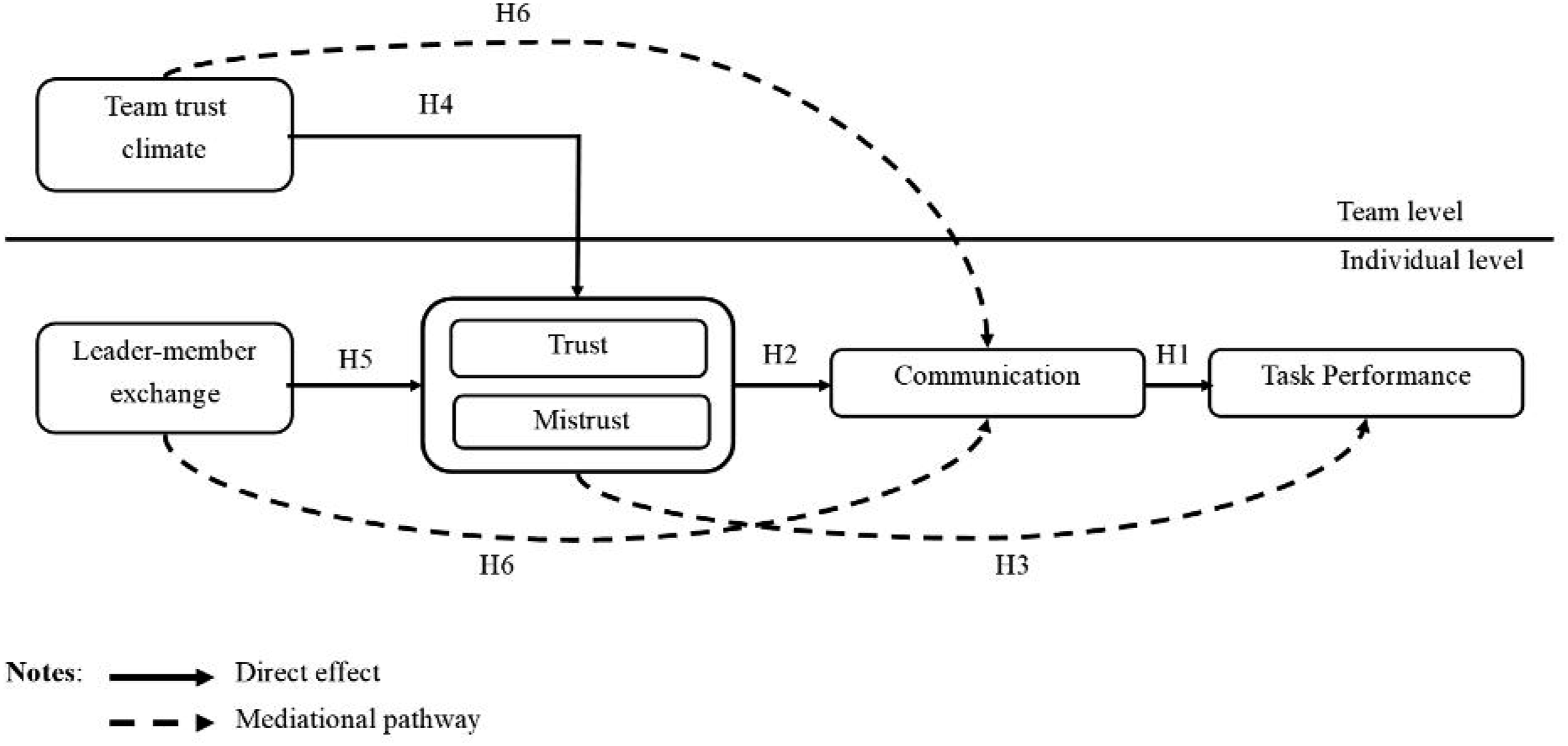
Hypotheses and Research Model
Method
Participants
This study adopted a cross-sectional multilevel design, with data collected from 343 employees comprising 76 teams from 22 small to medium-sized organizations across all industries in Malaysia. Just over half the participants were males (56.3%, n = 200). Data collection took place in different states of Malaysia from December 2017 to October 2019. Participants were representative of various ethnicities in Malaysia: 52.77% (n = 181) were Malays, followed by 23.91% (n = 82) Chinese, 5% (n = 17) Indian and 18.37% (n = 63) from other ethnicities. The average length of working experience was 8.88 years (standard deviation [SD] = 7.62 years) while the average work tenure in the current organization was 4.65 years (SD = 5.11 years). Working hours per week averaged 46.34 hours (SD = 21.37 hours). The size of teams ranged from 3 to 11 employees, with the average team size being 5.2 employees.
After the current study obtained ethics approval, a research assistant emailed companies operating within the Klang Valley region in Malaysia seeking their interest in participating in the study. The study then asked companies expressing interest in the study to disseminate the study information to their employees. The Human Development Department or Administrative Department in the respective companies approached all participants. Participants within designated teams and organizations received questionnaires inside envelopes. Participation was voluntary, with participants assured of the confidentiality of their responses. Those who were not interested returned the envelope with the unanswered questionnaire.
Instruments
All scales were translated from English to the Malay language using Brislin (1970)’s translation and back-translation method. The survey was presented in both English and Malay ensuring participants’ comprehension and minimizing response bias.
Trust climate was measured using items adapted from the Copenhagen Psychosocial Questionnaire II (COPSOQ-II). The COPSOQ is well validated (see Berthelsen et al., 2016, 2018) and is used to generally assess the psychosocial working environment across different job groups in the community. One example of the items was: “Do your team members in general trust one another?” The seven items were formulated as questions, with the 5-response option (0 = to a very small extent, 25 = to a small extent, 50 = somewhat, 75 = to a large extent, 100 = to a very large extent) based on frequency. For analytical purposes, all responses were scored as follows: 0–25–50–75–100. The value of the coefficient of internal consistency (Cronbach’s alpha [α]) for the overall scale was .77.
Leader–member exchange was measured using the Leadership Membership Exchange (LMX-7) scale, developed by Graen and Uhl-Bien (1995). The scale asked about the job-related help and support that team members received from their supervisors and/or team leaders. One example of the items was: “How would you characterise your working relationship with your team leader?” The scale used a 5-point frequency response format. This study used the mean of each item to compute the quality of the working relationship. For the LMX-7 scale, the Cronbach’s alpha (α) value was .89.
Trust in the team was measured using the trust instrument developed by Mayer and Gavin (2005). This instrument measured the amount of trust in the team from the perspectives of team members. Using statements, this measure was based on a 7-point Likert scale ranging from ‘1’ (strongly disagree) to ‘7’ (strongly agree). One example of the items was: “I would be comfortable giving my team a task or problem which was critical to me, even if I could not monitor its actions”. The overall 10-item scale demonstrated adequate internal reliability with the Cronbach’s alpha (α) value >.70.
Mistrust towards the team was measured using the Organizational Cynicism Scale (OCS) (Brandes et al., 1999). This 5-point Likert scale, ranging from ‘1’ (never) to ‘5’ (always), comprised 13 items under three dimensions: affect, cognition and behavior. Items included: “When I think about the team, I experience anxiety” (affect); “I see little similarity between what the team says it will do and what it actually does” (cognition); and “I talk to others about the way things are run in the team” (behavior). The Cronbach’s alpha (α) value for the overall scale was .90.
Communication within the team was measured using the communication section of the group processes instrument developed by Schulz et al. (2003). The communication section has seven items, ranging from questions like “How much do people in the team feel comfortable expressing their point of view? to “How much are you willing to listen to others’ points of view?” All the items were rated on a 5-point frequency Likert scale (1 = never, 2 = rarely, 3 = sometimes, 4 = often and 5 = always) and the score was summed. The Cronbach’s alpha (α) value was high (α = .87).
Task performance was measured using the scale developed by Hochwarter et al.’s (2006) study, in which questionnaires were based on an employer’s assessment of an employee’s job performance. In the current study, the questions were adapted to reflect the focus on an employee’s self-assessment of job performance. Items, written as statements, included, “I adapt readily to changing rules or requirements”; “I assume a sense of ownership in the quality of my personal performance”; and “I strive to meet deadlines”. All items were rated on a 5-point Likert scale (1 = weak, 2 = fair, 3 = good, 4 = very good, 5 = best). The Cronbach’s alpha value was .83.
Analysis Strategy
Three assumptions needed to be met to ascertain trust climate as an upper-level variable. Firstly, inter-rater agreement, rWG(J), was checked to determine whether trust climate was a climate agreed upon by team members (James et al., 1984). The rWG(J) value of .92 was acceptable (Mathieu et al., 2007), indicating that team members agreed on trust climate. Secondly, to ascertain that trust climate was an upper-level variable, the intraclass coefficient (ICC [1]) was used, showing that trust climate, with a value of .21, represented 21% of the variance for the construct due to the team factor. Thirdly, a one-way random-effect analysis of variance (ANOVA) was used to check trust climate to confirm the differences between teams for the current study. The value for F(III) = 2.264 (p < .001), indicating that it was justifiable to aggregate trust climate as an upper-level construct.
After these three assumptions were checked, the study’s hypotheses were tested by conducting the following three analyses: cross-level effects for Hypothesis 4; lower-level effects for Hypotheses 1, 2 and 5; and mediational effects for Hypotheses 3 and 6.
Results
Means, Standard Deviations, Reliability, and Pearson’s Bivariate Correlations
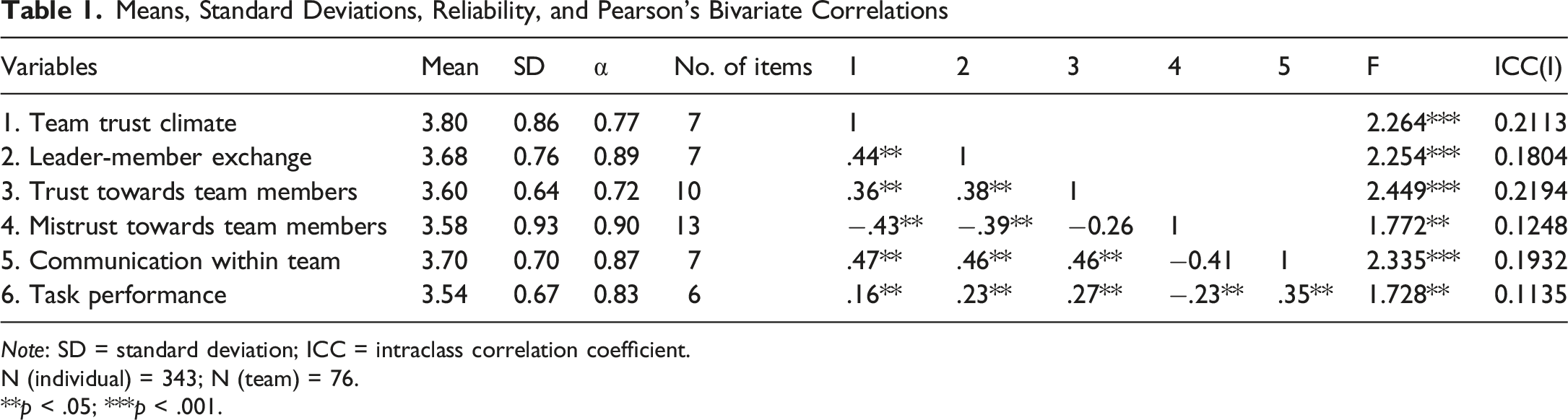
Note: SD = standard deviation; ICC = intraclass correlation coefficient.
N (individual) = 343; N (team) = 76.
**p < .05; ***p < .001.
Hierarchical Linear Modeling (HLM) Analyses of Lower-Level Outcomes and Cross-Level Effect of Transformational Leadership and Transactional Leadership on Lower-Level Outcomes
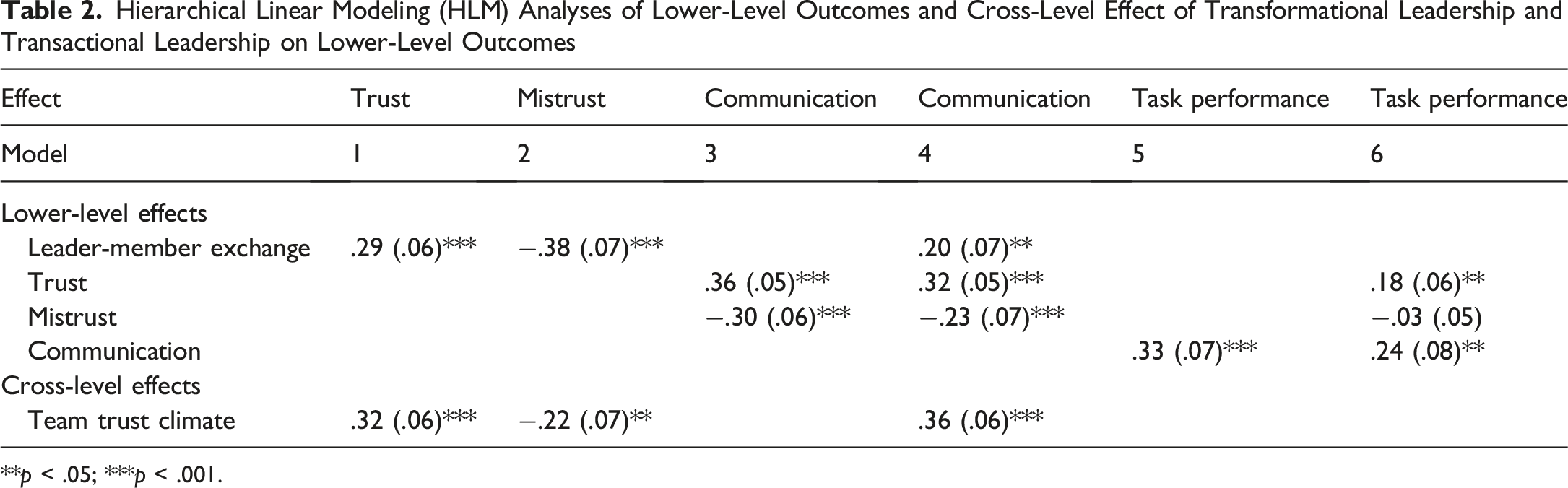
**p < .05; ***p < .001.
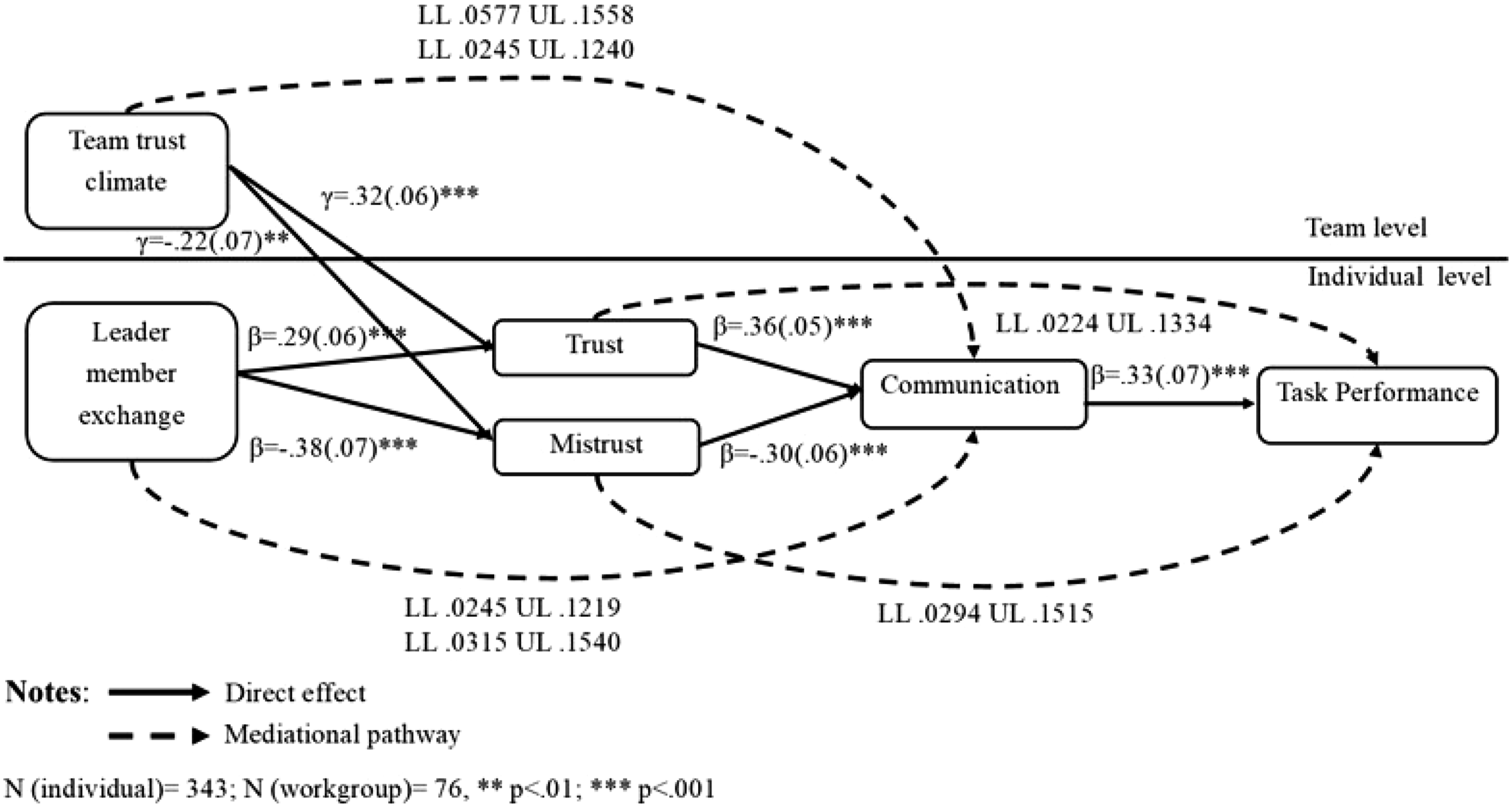
Final Model
The study supported Hypothesis 1 which stated that communication within the team has a significant relationship with individual task performance. Communication within the team had a positive significant relationship with individual task performance (β = .33, p < .05; Model 5).
Hypothesis 2 posited that trust in team members has a positive relationship with communication within the team, while mistrust towards team members has a negative relationship with communication within the team. Hypothesis 2 was supported as trust had a positive significant relationship with communication within the team (β = .36, p < .05; Model 3), while mistrust had a negative significant relationship with communication within the team (β = −.30, p < .05; Model 3).
Hypothesis 3 proposed that communication within a team mediates the separate relationships of trust and mistrust with individual task performance. The current study used the Monte Carlo method (MacKinnon et al., 2004) to conduct two mediation analyses (trust→communication within the team→individual task performance and mistrust→communication within the team→individual task performance). Model 3’s value was used as the value for the independent variables (i.e., trust and mistrust) to the mediator (i.e., communication within the team) (β = .36, standard error [SE] = .05, p < .05; β = −.30, SE = .06, p < .05, respectively), while Model 6’s value was used as the value for the mediator (i.e., communication within the team) to the dependent variable (i.e., individual task performance), with the inclusion of the independent variables (i.e., trust and mistrust) (β = .24, SE = .08, p < .05). The analysis confirmed the mediation effect from trust to individual task performance via communication within the team (95% confidence interval [CI], lower level [LL] = .0294, upper level [UL] = .1515). The mediation effect was also confirmed from mistrust to individual task performance via communication within the team (95% CI, LL = .0224, UL = .1334).
Hypothesis 4 posited that trust climate at the team level positively relates to trust in team members and negatively relates to mistrust towards team members. Hypothesis 4 was supported as trust climate had a positive significant relationship with trust in team members (γ = .32, p < .05; Model 1) and a negative significant relationship with mistrust towards team members (γ = −.22, p < .05; Model 2).
The study supported Hypothesis 5 which stated that leader–member exchange at the individual level positively relates to trust in team members and negatively relates to mistrust towards team members. Leader–member exchange had a positive significant relationship with trust in team members (β = .29, p < .05; Model 1) and a negative significant relationship with mistrust towards team members (β = −.38, p < .05; Model 2).
Hypothesis 6 posited that trust in and mistrust towards team members mediate the relationships of trust climate at the team level, and leader–member exchange at an individual level, with communication within the team. As with Hypothesis 3, four mediational analyses were conducted (i.e., trust climate→trust→communication within the team; trust climate→mistrust→communication within the team; leader–member exchange→trust→communication within the team; and leader–member exchange→mistrust→communication within the team). The study used values from Models 1 and 2 as the values for the independent variables (i.e., trust climate and leader–member exchange) to the mediators (i.e., trust and mistrust), as follows: trust climate to trust or mistrust: γ = .32, SE = .06, p < .05; γ = −.22, SE = .07, p < .05, respectively, and leader–member exchange to trust or mistrust: β = .29, SE = .06, p < .05; β = −.38, SE = .07, p < .05, respectively. Model 4’s value was used as the value for the mediators (i.e., trust and mistrust) to the dependent variable (i.e., communication within the team), with the inclusion of the independent variables (i.e., trust climate and leader–member exchange) (γ = .32, SE = .05, p < .05; β = −.23, SE = .07, p < .05, respectively). The analyses confirmed the mediation effects from trust climate to communication within the team via trust (95% CI, LL = .0577, UL = .1558); trust climate to communication within the team via mistrust (95% CI, LL = .0245, UL = .1240); leader–member exchange to communication within the team via trust (95% CI, LL = .0244, UL = .1219); and leader–member exchange to communication within the team via mistrust (95% CI, LL = .0315, UL = .1540). Therefore, Hypothesis 6 was supported.
Discussion
This study’s findings on trust, as in other studies, have shown its importance in facilitating communication behavior within a team. This is similar to studies by Frazier et al. (2017) and Akhtar et al. (2019) which highlighted that team members with higher trust in their fellow team members tended to communicate more within the team, improving the team’s task performance as a whole. The integrative review conducted by Costa et al. (2018) over 40 years also pointed out the significance of increased intra-team trust in elevating communication between team members, thus promoting organizational success.
Furthermore, communication plays an important role in disseminating information between all parties to ensure the appropriate completion of tasks. This has led to supportive findings that higher levels of communication lead to higher task performance (Erdem et al., 2003; Mesmer-Magnus & DeChurch, 2009; Ruck & Welch, 2012). Communication entails not only the performance of individuals but also of all other team members (Haroon & Akbar, 2016). It creates synergy in the cohesiveness of the team (Brahm & Kunze, 2012; DeOrtentiis et al., 2013; Peterson & Behfar, 2003). The current study’s findings on partial mediation between trust, communication and task performance also highlight the importance of trust in task performance.
Mistrust, on the other hand, showed a negative relationship with communication within the team. A lower level of communication often signifies a lack of proper teamwork, thus impeding the completion of tasks (see de Jong et al., 2014). This also translates into lower performance of individuals and other team members, as shown in findings from prior studies (Henderson et al., 2016). The current study’s significant mediational analysis between mistrust, communication and task performance also showed the importance of trust/mistrust as facilitators in higher/lower task performance, through higher/lower levels of communication within the team.
The study’s findings showed support for the importance of organizational context, such as trust climate and leadership in (1) facilitating trust and reducing mistrust, and (2) facilitating individual task performance. The findings also supported the use of spillover theory in the literature on trust, with trust climate and leader–member exchange found to have positive relationships with trust and mistrust. Specifically, the findings showed that trust climate had a slightly stronger positive relationship with trust, compared to leader–member exchange. However, leader–member exchange had a stronger negative relationship with mistrust, compared to trust climate. This suggests that a trusting climate within the team increases trust levels among team members. With leader–member exchange having a stronger negative relationship with mistrust, this suggests the important role of relationship quality, through one-to-one interaction with the leader, which can offset any prior doubts about the team or team members. Overall, the results suggest that higher levels of trust climate and LMX are associated with improved communication and performance. From a co-construction perspective, this implies that trust is not only a product of individual perceptions but is actively shaped through communicative exchanges that reinforce shared meaning and relational stability.
The study’s mediational analyses also supported the importance of organizational context in facilitating trust processes and reducing mistrust processes, in which a higher level of trust and a lower level of mistrust lead to a higher level of communication within the team. Combined with prior mediational findings, the current study showed the importance of organizational context from the team characteristic aspect (i.e., trust climate) and the leader aspect (i.e., leader–member exchange) in facilitating trust, communication and, finally, task performance for individuals within the team.
From a theoretical perspective, the study’s findings also showed that a specific climate could flow through to employees’ attitudinal processes (i.e., trust → trust climate → trust between team members). This is rare in the literature on trust, with trust frequently posited as being only at the individual level without consideration of a specific context (cf. Mayer et al., 1995). Our application of multilevel quantitative approach within a co-construction framework bridges the gap between structural models of trust and discursive perspectives on organizational life by demonstrating how trust climates and LMX manifest in communicative behaviors that co-create team realities.
Strengths, Limitations and Future Directions
This study is one of the first few studies to state the importance of organizational context in the literature on trust, with most studies investigating from an individual perspective. Often, the literature on trust has presented only the individual aspects of trust or aspects of trust between two individuals. Here, we firstly acknowledge the importance of investigating not only from the micro-level perspective, but also from the meso-level perspective (Braun et al., 2013). This integrates both levels to investigate the influence of trust climate (meso-level) and leader–member exchange (micro-level) on higher levels of trust in and lower levels of mistrust towards team members, indirectly leading to higher levels of communication and task performance.
Secondly, we viewed the importance of trust and mistrust differently with, at times, both occurring within the individual at the same time (Saunders et al., 2014). Therefore, we have expanded on the literature on trust to include the mistrust aspect. The study further adds to the literature on trust, capturing how trust and mistrust are related to the organizational aspects within a work context and, especially, within the Asian context. Specifically, the findings concluded that organizational factors have an indirect relationship with mistrust, with mistrust having a direct negative relationship with communication. In this study’s findings, both team and leadership factors play an important role in increasing trust and reducing mistrust (Gundersen et al., 2012; Jiang & Probst, 2015). This extends and supports the literature on trust, emphasising the social contexts in which trust and/or mistrust can be established.
Nonetheless, our study had several limitations. In assessing task performance, the study could have used more valid data in the form of objective data from companies’ Human Resource Departments or through their annual performance ratings. As task performance (or job performance) is viewed as one of the most important constructs of management and organizational studies (Richard et al., 2009), objective measures may serve as a more valid measurement of task performance. This may include using profitability, profit margins and shareholder returns.
Moreover, future studies may consider a more intricate design for research on the relationship between trust, mistrust and communication while incorporating constructs such as team member exchange (TMX; Banks et al., 2014), psychological safety (Edmondson & Bransby, 2023), and leader-team communication (Mayfield & Mayfield, 2021; Men et al., 2021; Weiss et al., 2018). Incorporating TMX will capture horizontal relationships among peers while LMX captures vertical relationships. Work by Edmondson & Bransby (2023) and Weiss et al. (2018) have linked psychological safety and leader communication to team trust and performance and open communication and learning in teams, showing that leaders who foster open dialogue and reduce fear of failure create environments where teams thrive. Overall, past studies have frequently found dynamic relationships in which trust leads to communication (Payne, 2014) and communication may also influence trust (Boies et al., 2015). By conducting a broader nomological net investigation, future studies can contribute their findings on whether trust or communication is the more important factor in affecting positive outcomes in the workplace (i.e. Hofhuis et al., 2016). In addition, more studies could explore the implications of other team characteristics in influencing trust processes and reducing mistrust processes within the team.
Additionally, team characteristics do not only encompass trust climate, explored in the current study from a meso-level perspective for the first time. We would also recommend investigating other factors, such as team resiliency (Meneghel et al., 2016), team trustworthiness (Cogliser et al., 2012) and team composition (Senior & Swailes, 2004). In reviewing the model of organizational trust (Mayer et al., 1995), future studies could also investigate the individuals’ dispositional factors, such as the trust propensity of the focal person (i.e., the employee) and the trustworthiness of the other party (i.e., the leader) as determinants of trust behavior between employees.
Finally, while this study adopts a communication-as-co-construction perspective to frame trust and communication as emergent relational processes, its quantitative cross-sectional design limits the ability to capture the dynamic and evolving nature of these interactions over time. Future research could build on these findings by employing longitudinal designs or mixed method approaches to explore how trust climates and LMX are continuously negotiated and reinforced through communication, offering deeper insight into the temporal and contextual dimensions of trust development.
Practical Implications
The Asian context heavily emphasises human relationship bonding, with it being common to see colleagues becoming good friends outside and after work. The societal emphasis on a close-knit relationship between families is then translated into relationships in the workplace (Lee & Ding, 2024). This suggests the importance of a good intra-team relationship which may facilitate every team member’s task performance (Singh & Srivastava, 2016). The findings further resonate with the importance of social context in the formation of trust in, and the reduction of mistrust towards, team members within organizations (Freeney & Fellenz, 2013).
From a meso-individual perspective, the role of organizational-level trust climate in increasing trust suggests the need for organizations to create teams that have a high level of trust climate among their team members. Leaders and/or human resources (HR) personnel can achieve this by developing more platforms for communication and interaction, enabling employees to perform well at work. From a formal aspect, job characteristics can be designed in such a way that strengths and skills can be synergized to create positive teamwork which will result in a positive working environment (Grant et al., 2010) with a higher level of trust and lower level of mistrust. From an informal aspect, platforms, such as meeting rooms or relaxation areas, will allow opportunities for team members to interact (Grant et al., 2010). As suggested in the literature, higher interaction usually results in higher levels of trust and can also reduce the level of mistrust (Mahajan et al., 2012).
From an inter-individual perspective, leaders must be aware of their role in increasing trust and reducing mistrust among team members (Gao et al., 2011). It is also important for a leader to create amicable relationships with his/her team members by providing them with more interaction, communication, encouragement and support (Lee et al., 2017; Yukl, 2012). Communication with leaders allows team members to gain a better perception of the information exchanged and to provide the correct information. Employees would also feel a sense of appreciation and that they are being heard when they communicate directly with their leader (Morrison, 2014). Aspects of communication including encouragement and support are also important for employees to feel motivated and that they belong (DeConinck, 2011). Positive exchange in these relationships then translates to positive work outcomes.
Conclusion
The current study investigated the effects of trust and mistrust and their processes on individual task performance from the aspects of trust climate and leader–member exchange. The findings showed that trust climate and leader–member exchange are important factors in increasing team members’ trust in their fellow team members. As for mistrust, leader–member exchange had a stronger negative relationship than trust climate with mistrust towards team members. Both trust and mistrust were found to mediate the relationships of trust climate and leader–member exchange with communication within the team. Communication was found to mediate the relationships of trust and mistrust with task performance. Future studies may look at the dyad relationship between the leader and employees and its influence on team processes, or the triangular relationship between the team, the leader and their influence on team members. Overall, the study indicates the importance of a good relationship with the supervisor/leader and having a high trust climate to facilitate team processes and individual task performance.
Footnotes

Ethical Consideration
The study has obtained ethics approval from the university ethics board (Approval number: SUREC2015/020).
Consent to Participate
All participants were given a participant information sheet and participated voluntarily in the study. Participants could also end their participation at any point in the study without any penalty.
Funding
The authors disclosed receipt of the following financial support for the research, authorship, and/or publication of this article: This study was funded by the Asian Office of Aerospace Research & Development (AOARD) (Grant number; FA 2386-15-1-4085).
Declaration of Conflicting Interests
The authors declared no potential conflicts of interest with respect to the research, authorship, and/or publication of this article.
Data Availability Statement
The datasets generated and/or analyzed during the current study are available from the corresponding author in response to a reasonable request.