




Abstract
This article explores how meat consumption in the Netherlands has become aligned with ideology. The study leverages survey data from 2008 to 2022 to analyse changes in the relationship between meat consumption and political beliefs. The findings reveal that meat consumption is increasingly associated with right-wing ideology, nativism and, in particular, climate-change scepticism. This comes at the relative expense of predictors such as animal welfare considerations. This shift reflects a broader cultural conflict, where dietary choices symbolize deeper ideological divides. The changing political alignment of meat has implications for the protein transition, suggesting that consumption patterns may become more entrenched, complicating efforts for policy interventions. The study highlights the Netherlands as a significant case due to its multiparty system and the political salience of livestock farming, potentially serving as a bellwether for broader European trends.
Introduction
In recent years, the environmental aspects of meat and dairy production and consumption are emerging as a new frontline of politicization of climate and environment. Given the enormous impact of agriculture, and livestock farming in particular, on the loss of biodiversity, deforestation and greenhouse gas emissions (Hedenus et al., 2014; Poore and Nemecek, 2018), governments across the globe are weighing their options for reducing the consumption of meat and dairy. This transition, referred to as the protein transition (Aiking and De Boer, 2020) requires transformative change in the entire food system. Such a radical change does not only uproot economic geographies of production, but also affects the everyday consumption practices and cultural traditions associated with meat and dairy. As such, the consumption of meat and dairy has become highly political. Politicians on the (far) right rally to the defence of the steak and meatball, while in some political discourse (mostly by its detractors) vegetarianism and veganism have become the symbolic hallmarks of a progressive urban elite (e.g. Lee, 2021; Michielsen and Van Der Horst, 2022). Our study aims to go beyond these stereotypes and establish to what extent meat-consumption choices have indeed become structurally aligned with citizens’ ideology. That is, has the growing contestation on the supply side been mirrored on the demand side by an increased concentration of meat consumption and avoidance at opposite sides of the political spectrum among citizens?
To be sure, the fact that meat production and consumption are highly salient topics among political parties and interest groups is evident enough. The recurring protests of farmers across Europe attest to the political sensitivity of sustainability transitions (Van Der Ploeg, 2020). The EU Green Deal involves a significant reform of the European agricultural sector. In addition, the discussion of meat is related to the sensitive notion of consumer sovereignty – the freedom to choose what to eat. Notwithstanding, some left-wing parties have proposed measures, such as a meat tax (Simmonds and Vallgårda, 2021), that would stimulate citizens to eat less meat (and sometimes dairy). It appears that those meat curtailment policies are increasingly targeted in political rhetoric, predominantly coming from the populist radical right (PRR) (Michielsen and Van Der Horst, 2022). For instance, the PRR party Alternative for Germany (AfD) has been strongly opposed to meat taxes (Fleischsteuer) (Küppers, 2024). Similarly, in Denmark the Danish People’s Party rejects taxing of meat products (Vihma et al., 2021). In the Netherlands, too, meat is becoming part of political debate in traditional and social media (Michielsen and Van Der Horst, 2022). Vegetarianism and veganism are now important components of stereotypes of progressives (Lee, 2021; Sanford and Lorimer, 2022).
In the present study, we ask how these developments have transformed the behaviour and worldview of citizens. We formulate three main expectations. First, that meat consumption and ideology have become more aligned. By that we mean that it has become increasingly associated with citizens’ belief systems (Converse, 1964). While the choice to eat meat (or not) has always had a political connotation (Twigg, 1983; Fiddes, 1991; Neo and Emel, 2017), it was nevertheless often shaped by motivations that were cross-cutting to the most salient political conflicts. For instance, vegetarianism rooted in animal welfare concerns has historically existed on both the political left and right (Schwörer and Fernández-García, 2023). As such, while meat was political, its alignment within the broader political space was arguably incomplete. This might be changing in light of increased elite contestation, which could be a reason for citizens to align their behaviours and attitudes. To this end, we leverage consecutive waves of survey data collected in the Netherlands between 2008 and 2022 to explore the changing correlation between political issue positions and meat-consumption choices (from dedicated vegetarianism to dedicated meat consumption and positions in between). Our goal is to observe the shifting relation between worldview and meat consumption.
Our second expectation is that this alignment has occurred mostly around the issues of climate and elite (dis)trust. The political space in Western Europe is multidimensional, characterized by at least two dimensions of conflict, an economic and cultural one. These two were in turn transformed under the pressures of accelerating globalization (Kriesi et al., 2008). Since the 1990s the cultural conflict around ‘old’ topics of tradition versus emancipation has been complemented by ‘new’ cultural conflicts between those embracing versus opposed to cultural openness, e.g. nativism versus cosmopolitanism (Hooghe and Marks, 2018). In the recent decade, to this configuration can be added the increasing prominent role of political distrust and the vilification of ‘immoral’ elites (Mudde, 2004) as well as the emerging topic of climate (Farstad, 2018; Kenny and Langsæther, 2023), both which are still finding their way in the dominant patterns of conflict. We argue that these developments pave the way for the political space to absorb the issue of meat effectively, through multiple points of affinity.
More specifically, it is plausible that, for many citizens, meat consumption will have an increasingly direct bearing on their views around climate change (Macdiarmid et al., 2016). Like other sustainability issues, the protein transition pits those who see a need to fundamentally change our relation with the environment to those who oppose these changes (Hess and Renner, 2019; Oleschuk et al., 2019; Otteni and Weisskircher, 2022). Among other behaviours, sustained meat consumption or (partial) avoidance might become a marker of either position. We hence expect climate attitudes to have become a main predictor of meat behaviour. Second, we expect meat reduction to have become increasingly aligned with trust in elites, notably those involved in science, media and politics. Meat consumption is drawn into the political polarization of climate change pivoting on the politics of climate science and the politics of costs and impacts of climate mitigation policies (Dunlap et al., 2016; McCright et al., 2016; Marquardt and Lederer, 2022) as well as populist arguments about homogeneous elites imposing their way of life on the ‘true’ People (Kulin et al., 2021). Hence, we expect that meat consumption or avoidance increasingly reflects the way citizens trust (or not) those elites that tell them to change their lifestyle
At the same time, the political meanings of meat are not exclusively about climate and elites. As a third and more speculative expectation, we expect meat consumption to be increasingly aligned with other cultural issues. This follows from our observation that the politics of meat has become closely linked to ‘cultural’ debates about landscape and nature conservation (for instance, the reintroduction of wolves), cultural tradition and identity, ‘non-native’ culinary traditions and a ‘masculine’ lifestyle in which eating meat is ‘manly’ (Adams, 1990; 2020; Lockwood, 2018; Oliver, 2021; Twigg, 1983, 2020; Rothgerber, 2013). It hence has affinity with both the ‘old’ and ‘new’ cultural conflict lines around tradition and emancipation as well as cultural openness versus communitarian views. If we were to find such alignment, this would be evidence of the potential of dominant conflict dimensions to absorb previously unrelated divisions in society (Lipset and Rokkan, 1967). It would signify that meat has become yet the latest bastion of a broader cultural conflict.
In short, this article aims to investigate to what extent and how meat is increasingly aligned with different ideological dimensions in Dutch politics since 2008, including possibly increased alignment with issues that are a priori less obviously related to meat consumption as such. By unravelling to what extent meat consumption is aligned with ideology this article aims to contribute to debates on the political ramifications of sustainability transitions more broadly. Because the speculations mentioned above are described as expected patterns that do not allow for rigorous testing, we formulate them as expectations, not hypotheses. Neither is our goal to disentangle the causal relation of meat consumption and ideology, which is a two-way process, as we discuss below. Rather, we provide biannual snapshots of the aggregate-level relation between meat consumption and ideology to explore its changing alignment.
The Netherlands presents a highly relevant case for two key reasons. First, the Netherlands is a highly fragmented multiparty system with extreme proportionality, low levels of partisanship and low barriers to entry. Given these features, Dutch politics tends to adapt early and swiftly to transformations that usually take longer to express themselves in more entrenched systems. Second, the Netherlands has a history of the political salience of livestock farming, which in recent decades has become more pronounced, most notably through the representation of both the Party for the Animals (PvdD) and the Famer-Citizen Movement (BBB) in parliament, but also more broadly the rise of (populist) parties on the right that are often supportive of agrarian interests. In other words, the Netherlands might be a ‘bellwether’ case when it comes to the political alignment of meat.
Theory: The Ideological Alignment of Meat Consumption
This study examines the ways in which meat-consumption behaviours have become aligned with citizens’ broader ideology. We understand ‘ideology’ as belief systems (Converse, 1964) and hence as patterns of related ideas and attitudes. While not all such beliefs are equally salient or activated in everyday decision-making, some may be (or become) relevant in light of meat consumption choices. The dimensionality of ideology, and the ways in which ideological beliefs constrain behaviour, varies significantly over time and across contexts and is subject to constant contestation.
We immediately acknowledge that elements of our ideology can inform our consumption choices as well as vice versa. Hence, our goal is not to make a causal argument either way. Rather, we expect the connection between ideas and behaviour to become more tight – i.e. for meat eating to become more closely aligned to ideology – as the political salience of protein consumption increases. Making consumption choices that can be framed as incompatible with ideological positions is certainly possible and widespread (e.g. people might not perceive a disconnect between their meat consumption and climate attitude). However, when issues become more central to the public discussion, an awareness emerges of what sort of behaviours are connected to one’s political stance, such inconsistencies between ideology and behaviour do result in cognitive dissonance (Festinger, 1957). This can be reduced by changing either one’s ideological positions or one’s behaviour. This is further enhanced through social processes that amplify social sorting (Flemmen et al., 2022; Mason and Wronski, 2018), or the overlap between political and non-political fault lines. Studies have shown that citizens overestimate the association between political positions and other attributes, including those pertaining to demography, ideas and lifestyle (Ahler and Sood, 2018). This becomes self-reinforcing as citizens self-select into the social environments that align with these expectations. Reversely, increased sorting amplifies the social pressure to adapt to the (perceived) expectations of the group in various ways, including in terms of cultural and consumption preferences.
The bottom line is that once citizens are aware of politicized connections between ideology and generally associated behaviours, they are more likely to also adapt the behaviour to their ideology or vice versa. This happens when meat is becoming central to the political agenda as it is in countries like the Netherlands. This
In addition, we expect that eating meat (or avoiding it) has become associated with some issues rather than others. Here, our starting point is not to identify the ‘real’ (or ‘scientific’) ideological implications of meat eating (say, whether meat eating is compatible with a pro-climate policy stance or a left-wing economic ideology). Rather, we are interested in the way in which meat consumption becomes, in practice, systematically associated with some combinations of political positions rather than others (Milfont et al., 2021; Nezlek and Forestell, 2019). Like any other emerging issue (e.g. Covid-19), its political alignment is not a priori a given: meat consumption can become politicized in different ways depending on the context. It can conceivably be interpreted politically as primarily an economic issue, or one of animal welfare, climate, tradition or any other number of angles. How meat is understood politically does matter fundamentally for how it plays out politically. If meat consumption is aligned exclusively with, say, a climate-sceptic ideology, that arguably reduces the scope for pro-meat action compared to a situation in which meat consumption is also associated with, say, traditional or nativism values, which might allow for larger coalitions.
Specifically, we expect that meat has increasingly become associated with the issues of climate and elite trust. This is our
Beyond these more obvious forms of alignment, we also formulate a
We also want to note that meat consumption will be plausibly connected to other positions. Most obviously, meat eating or avoidance will be connected to the more specific issue of animal welfare (Dhont and Hodson, 2014; Schwörer and Fernández-García, 2023). This is likely still relevant, but we argue it might decline in relative importance as citizens increasingly become vegetarians – or dedicated meat eaters – out of other ideological considerations. We also admit that meat eating can connect to economic ideology. We are a priori agnostic about the (changing) relation between meat consumption and economic left-wing ideas. While plausible arguments can be made in support of this relation, we do not have strong priors in this regard.
As a final note, we want to acknowledge that many of the political issues discussed above are themselves also (possibly increasingly) correlated. This is true for those issues that are associated with, for instance, the cultural ideological dimension, but also possibly across the categories we identify. Climate-change attitudes have affinities with the conflicts over tradition, but also with trust in elites and possibly economic ideology considerations. Hence, we will proceed to consider the relation between meat consumption and issue positions both individually and taken together. This will allow us to observe to what extent different issues are relevant for meat consumption through shared affinities.
Data & Methods
Data
This study relies on datasets collected as part of the Dutch Longitudinal Internet Studies for the Social sciences (LISS) panel. 1 The LISS panel is drawn from a true probability sample of households (see www.lissdata.nl). The LISS panel archives allow for the linking of responses across waves through an encrypted identifier of individuals in the panel. We leverage survey item responses regarding meat and ideology collected between 2008 and 2022. This allows us to track the changing ideological associations of meat consumption over a period which was at the start characterized by only niche attention to climate change and upheaval over the fallout of the post-2008 Great Recession, all the way to almost the present day, in which climate and meat are highly salient politically.
While we have access to panel data, we opted to not study change over time within individuals. The reason is that our aim is not to disentangle causal order (i.e. whether meat-consumption change follows or precedes attitudinal change). Such a venture would indeed benefit from leveraging the panel nature of the data, but also involve a significant reduction of the scope and composition of the available data due to panel attrition and restricted variance. Rather, our goal is to study the development of associations on the level of the political space as a whole. Hence, we take each panel as a snapshot of a moment in time. We do leverage the individual-level panel nature in cases where a lack of data availability requires us to rely on a previous wave for a particular indicator (see below).
Our core survey items were collected as part of multiple separate survey collection efforts within LISS that were not always collected synchronously, but which can be linked. The most important set of surveys are the first to the fourteenth wave of the Politics and Values module. In this survey respondents were asked about the party they voted for during the most recent parliamentary elections, as well as containing a large number of questions on a number of political issues, politicians and political parties as well questions on trust in political and social institutions.
Operationalization
Meat Consumption
The main dependent variable – meat consumption – is based on the self-reported average number of days per week people eat meat (never; less than once a week; once a week; 2–4 days; 5–6 days and daily). (For additional analysis the category ‘never’ was converted into a binary variable ‘vegetarian’; the category ‘daily’ was used to create the dummy ‘daily meat eater’.) This item was included as part of the regular LISS waves until 2018 only. For more recent observations, we rely on a separate and slightly different operationalizations that were included in two different ad hoc questionnaires (called Citizens in energy transition and Eating habits). 2 As a result, there exists a discontinuity in our trends: correlations until 2018 are based on a different (albeit plausibly very closely associated) variable than correlations for 2020 and 2022. Hence, we will refrain from interpreting any small changes between those two parts of the analysis, rather only focusing on broader trends in terms of the sign and size of the reported correlations before and during 2020 and 2022.
Party Support
While our main interest is in the associations of meat eating with political ideology, we start by depicting the political landscape through its association with party support. This is based on the question which party people voted for in the parliamentary elections of 2017. We selected the 10 parties with highest response in the sample in rank order of their environmental policy position according to the Chapel Hill Expert Survey (Jolly et al., 2022): Party for the Animals (PvdD), Green Left (GL), Socialist Party (SP), Labour Party (PvdA), Democrats ‘66 (D66), People’s Party for Freedom and Democracy (VVD), Christian Democratic Appeal (CDA); Cristian Union (CU); Reformed Protestant Party (SGP); Party for Freedom (PVV) and Forum for Democracy (FvD).
Political Issues
The main independent variables of this study are political issues and dimensions that we distilled and constructed from the survey data: climate; ‘animalism’ (i.e. concern for animal welfare); ethical conservativism and traditionalism in terms of gender ideas; trust in elites; nativism-cosmopolitanism; and economic left-wing ideology. In addition, we include left-right self-placement in some of our models. Appendix A provides exact wording for each item; here we note the main choices in this regard. To start, Left-right self-placement is measured on a scale from ‘left’ (0) to ‘right’ (10). Views on Climate change are measured through two very similar statements for 2008 and 2020 and, if missing, supplemented with the scores of three statements on the belief in anthropogenic climate change; degree of worry about climate change; and call for immediate action. Animal welfare concerns are based on the average scores on four items on animal welfare in 2018, used throughout all waves. Gender conservatism is based on the (full) agreement with statements related to division of unpaid work, child rearing and women in the workplace. Ethical conservatism is based on questions on abortion and euthanasia. Nativism-cosmopolitanism is construed using statements related integration and the position and rights of migrants. Trust in elites is constructed by combining trust in political parties, politicians, science and media. Left-wing economic ideology is based on statements regarding income inequalities and labour unions. All scales were tested for internal coherence (Cronbach’s alpha scores) and transformed to z-scores (mean = 0, SD = 1).
Control Variables
The models include control variables for age, level of educational attainment (up to lower vocational; vocational; and college/university degree); net household income (ordinal categories); migration background (dummy); gender and urbanity (density of addresses/km2). Because these might shape both attitudes and meat behaviour, we see them as potential confounders and hence include them as controls.
Empirical Strategy
We proceed in four steps. First, we assess the bivariate relation between meat consumption and both left-right self-identification and party support at an early and late point in the time span under study. While our primary interest is in ideological alignment, looking at the association of meat consumption with both self-identification as ‘left’ or ‘right’ and concrete political behaviour makes for an insightful starting point. It provides a snapshot of the concrete implications for political competition. After that, we delve into its ideological underpinnings. We do so in the second section by predicting meat consumption (as an ordinal variable) by each of the issue scales in turn (plus control variables). This allows to observe the development of the nominal association of (or, predictive power of) each issue when it comes to meat consumption. In the next step, we replicate this analysis as a logistic regression with either committed meat consumption or committed vegetarianism (versus all other options) as the dependent variable. In a fourth step, we present a similar regression model but this time including all issues simultaneously. This takes into account that issues are themselves correlated, and hence answers a slightly different question: given these associations, which issues have the strongest independent associations with meat consumption? We also report on robustness checks (including estimating meat consumption in a linear model).
Because in most models the main dependent variable (meat consumption) is ordinal, all regression models rely on ordinal logistic regression. This takes into account that the distance between the ‘steps’ on the ordinal ladder is not (always) equal. For instance, moving from total abstinence of meat to eating meat ‘less than once a week’ or vice versa might be more significant (as in, more indicative of a meaningful underlying change in disposition) than moving from the latter to eating meat ‘every week’. Ordinal logistic regression factors in the discrete differences between these ‘steps’ by assigning positions on a latent scale before estimating the effect of each of the independent variables. At the same time, as a downside, the coefficients of these models are less comparable across models with different specifications and samples. Given that we are interested in such a comparison, we replicated the main models using OLS (and report this in Appendix B). This provides virtually identical results. Hence, we only report the ordinal logistic regression coefficients in the main text below but are confident that our conclusions are not an artefact of either artificially ignoring the ordinal nature of our dependent variable or suffering from a lack of comparability of coefficients.
Analysis
The Relation Between Meat Eating and Party Support
We start by discussing the development of (avoidance of) meat consumption by those who locate themselves at different locations of the left-right scale, as visualized in Figure 1 (upper panels). This testifies that, as was to be expected, the more people identify as belonging to the right of the political spectrum, the more likely they are to be a daily meat eater. Correspondingly, people who are leaning to the left of the political spectrum are more likely to consume no meat at all. While the overall share of people that consume meat on a daily basis has dropped while vegetarians are more common, little has changed in terms of meat consumptions’ overall association with left-right positioning over the period 2008–2018.
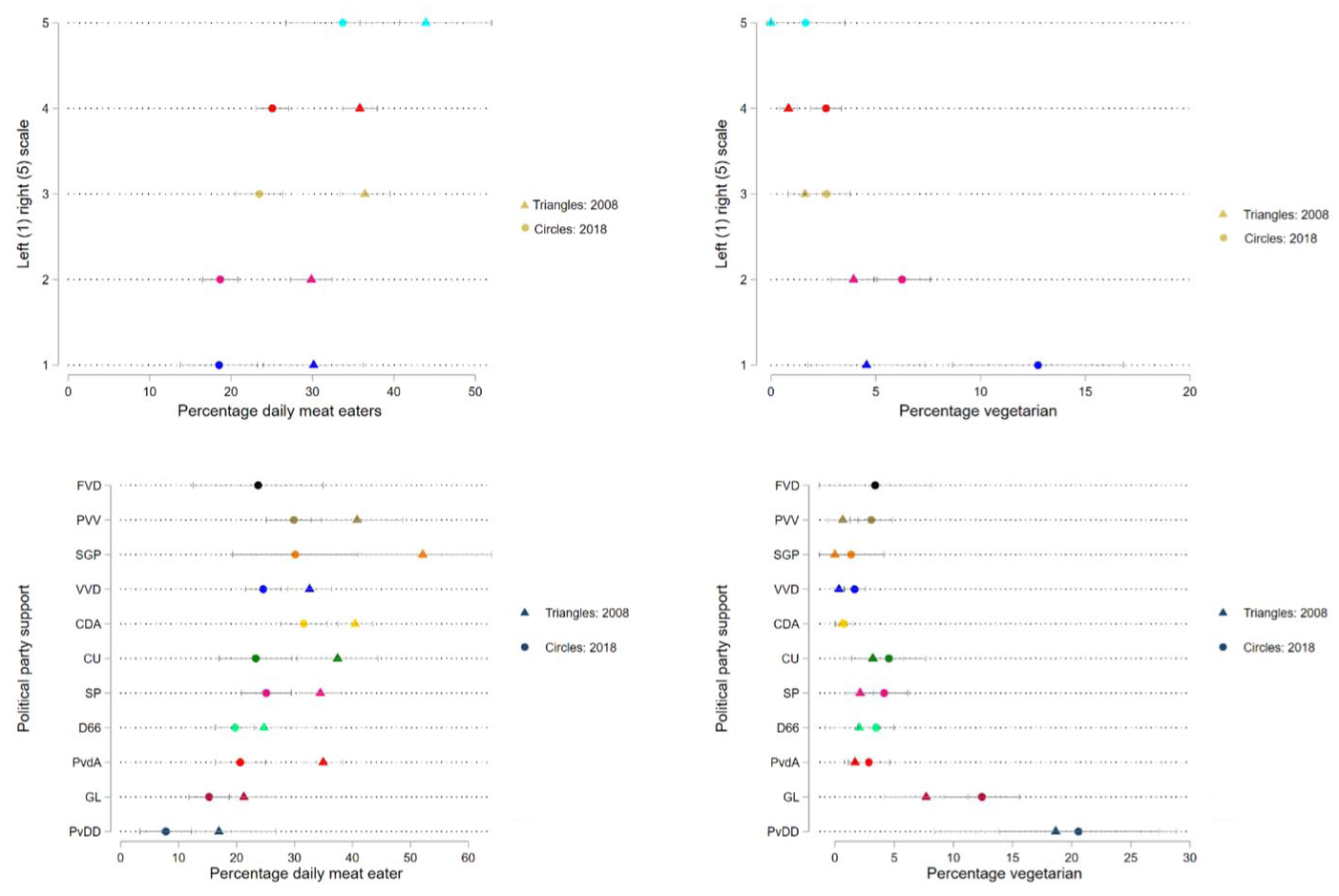
Daily Meat Eaters and Vegetarians by Left-Right Self Placement, and Per Political Party Vote 2008 and 2018, Ranked by Position on Environmental Policy.
This is also reflected in the association with political party support (Figure 1, lower panels). An analysis of the average share of daily meat eaters and vegetarians among the largest political parties by vote share of the Netherlands in 2008 and 2018 reveals that voting and meat consumption was, and remains, systematically related. In line with earlier research, right-wing party support positively associates with high meat consumption and low levels of vegetarianism. Vegetarians were heavily overrepresented among the Green and Animal parties in 2008. The share of people who do not eat meat at all was lower than 5% among voters of all other parties compared to about 7% among the Green party and 18% among Animal party supporters. By 2018, by contrast, vegetarian diets had become more common for supporters of all parties. Still, the gap between Green parties and the rest remains. The reverse pattern holds for people who ate meat every day. In 2008, these were principally found among supporters of right-wing parties: populist radical right parties but also among the conservative liberal and Christian parties. Labour party [PvdA] and Socialist party [SP] supporters also often ate meat 7 days a week. By 2018 the share of daily meat eaters has decreased across the board, while it remains highest among right-wing parties. Overall, the association between party preference and meat consumption has increased between 2008 and 2018: the correlation, expressed as a gamma coefficient, increased from 0.09 in 2008 to 0.16 in 2018.
These preliminary findings thus indicate that meat consumption has always been strongly related to both party preference and ideological self-positioning. We also found that this association has become somewhat stronger since 2008. It is likely that (non-)meat eating is part of an underlying ideological dimension that influences voting behaviour, but this association might have changed. This is impossible to judge from just the associations listed in Figure 1. We therefore now turn to an analysis of the association with more fine-grained issue positions.
The Relation Between Meat Eating and Ideological Positions
We start this section by exploring the development of the relation between meat consumption and each of the issue scales separately. To that end, Figure 2 reports the associations between each issue position and meat eating without controlling for the other issue positions, while including the other control variables. This allows us to assess these associations independently. As noted above, any comparison between the effects in 2022 with previous years requires special care as the former are arrived at through a slightly different operationalization.
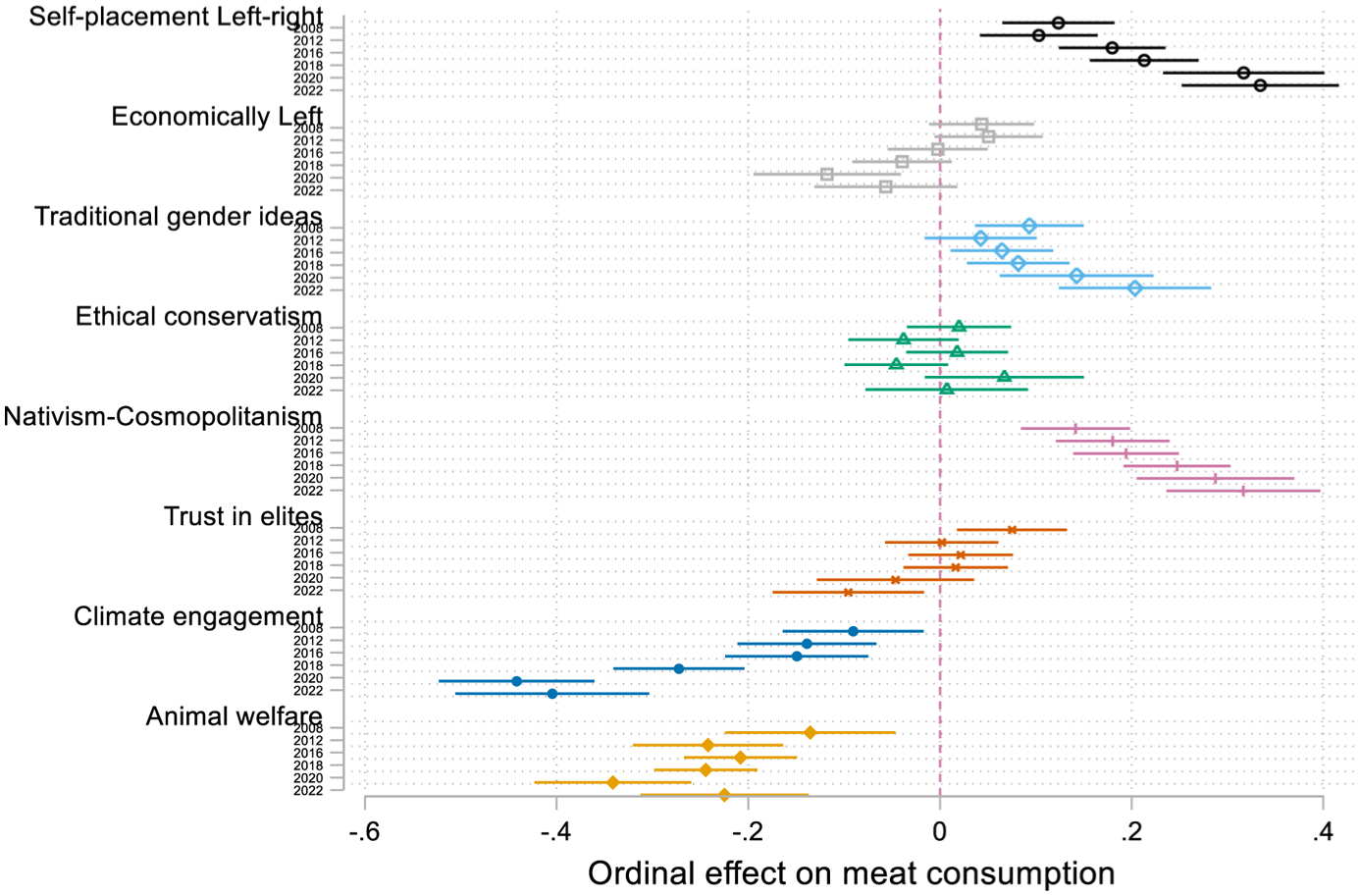
Predicting Meat Consumption (Ordinal Scale), One Issue Per Model, Including Control Variables.
Figure 2 shows, first of all, growing associations with several issue positions. Controlling for a wide range of other explanations, meat consumption is increasingly associated with right-wing self-placement, with traditional gender ideas, nativism and opposition to climate engagement. While the direction of these associations is hardly surprising, the fact that these associations are increasing to such a degree is quite remarkable. The association with right-wing self-placement more than tripled (from 0.1 to 0.3) in the period 2008–2022, and the same is true for the association with nativism. Most spectacularly, the effect of climate engagement on meat consumption grew fourfold, from 0.1 to 0.4. In other words, meat eating was hardly more common among people sceptical towards climate action and among nativists compared to their opposites in 2008, whereas they are now a relatively substantial predictor. In our reading, this testifies to a clear and broad politicization of meat consumption. Such consumption choices did not only become associated with climate views (which has become closely attached to it in public discourse over the period under study), but also with other political topics such as gender and nativism. The latter suggests that meat consumption became political as part of a broader ‘package’ of cultural associations, ideas and practices.
In addition, it is surprising that there is no correlation with trust in elites until the very last panel year. We had expected an increasing association, and this is what this last data point might reflect. In that year, for the first time meat consumption was stronger among those with lower elite trust. Still, it is too early to tell whether this correlation will grow, and the significant effect in the last year might be an artefact of changes in measurement. Still, given that this association appears to be slowly in the making in preceding years, and given that the association between climate views and elite trust is itself increasing (see Appendix D), it appears quite likely that this trend continues. Hence, we find some evidence that meat eating might become associated with anti-elite stances, but at the same time conclude that for much of the last decades, it was not.
Some other patterns are also telling. Some issue positions are not systematically or consistently associated with meat consumption. This is true for economic left-wing ideas, although some association seems to be emerging at the end of the period. Conservatism on ethical issues is not correlated at all. This might reflect the fact that this topic (including gender and LGTBI + equality) is not perfectly related to the nativism and climate part of the ‘cultural package’ discussed above (e.g. Spierings et al., 2019). Finally, the relation with animal welfare is quite stable. It is understandable that this remains an important predictor. However, while the correlation remains, it could be said that its respective role is diminishing, given that increasingly additional concerns of (we argue) a more explicitly political nature become associated with meat consumption.
The previous models have gauged the effects of issue positions on meat consumption as an ordinal variable. It could be assumed however that not eating meat at all represents not just the final step of an ordinal scale, but also a qualitatively different step. Similarly, eating meat every day in a changing consumption landscape with increasing focus on flexitarianism might also be a special category (Dagevos, 2021). We therefore also estimate the effect of the issue positions for the binary variables of ‘everyday meat consumption’ and ‘no meat consumption’ (Figures 3 and 4). However, it should be kept in mind that these models suffer from low variance in the dependent variables (particularly vegetarianism being relatively rare throughout the years).
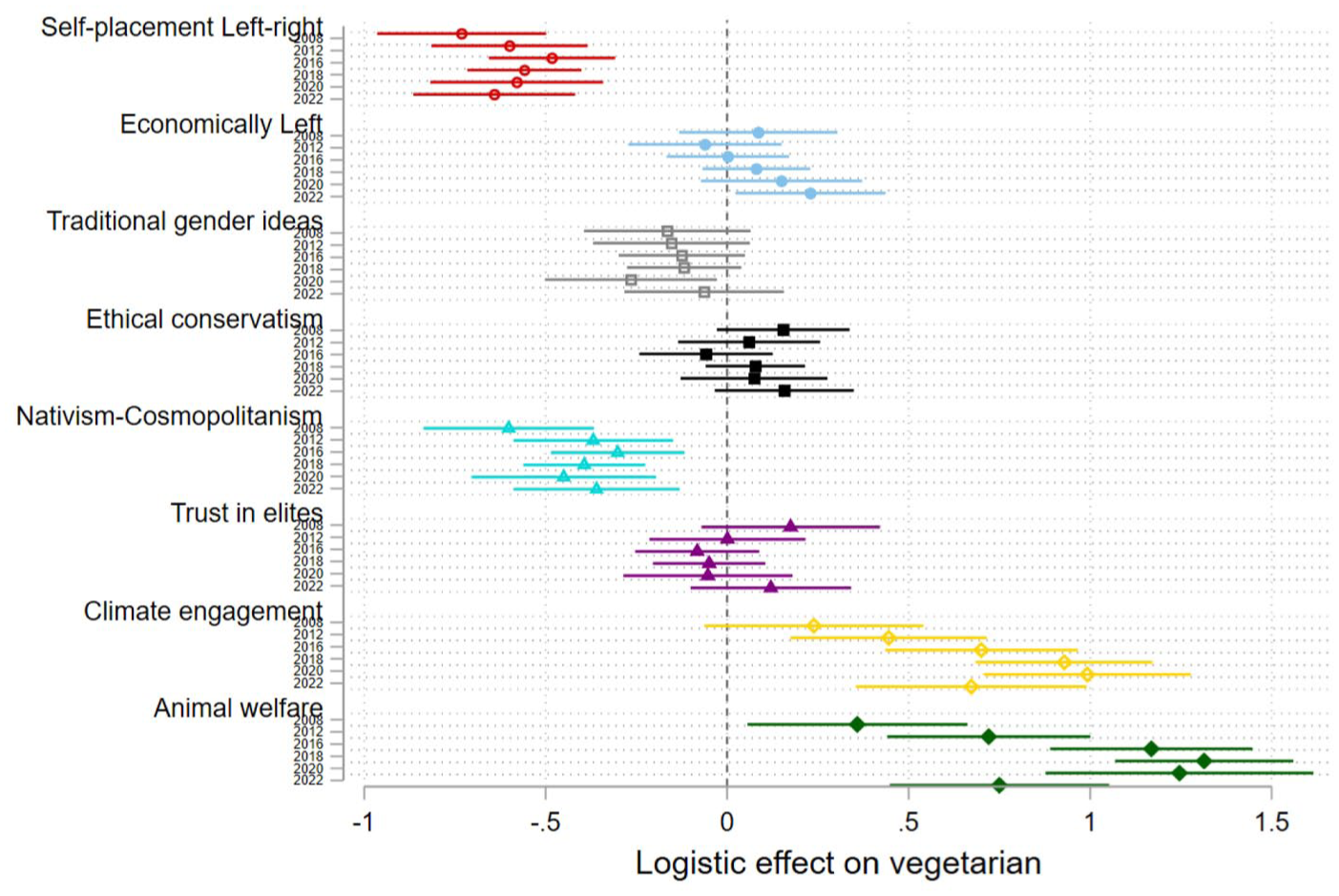
Predicting Vegetarianism (Dichotomy), One Issue Per Model, Including Control Variables.
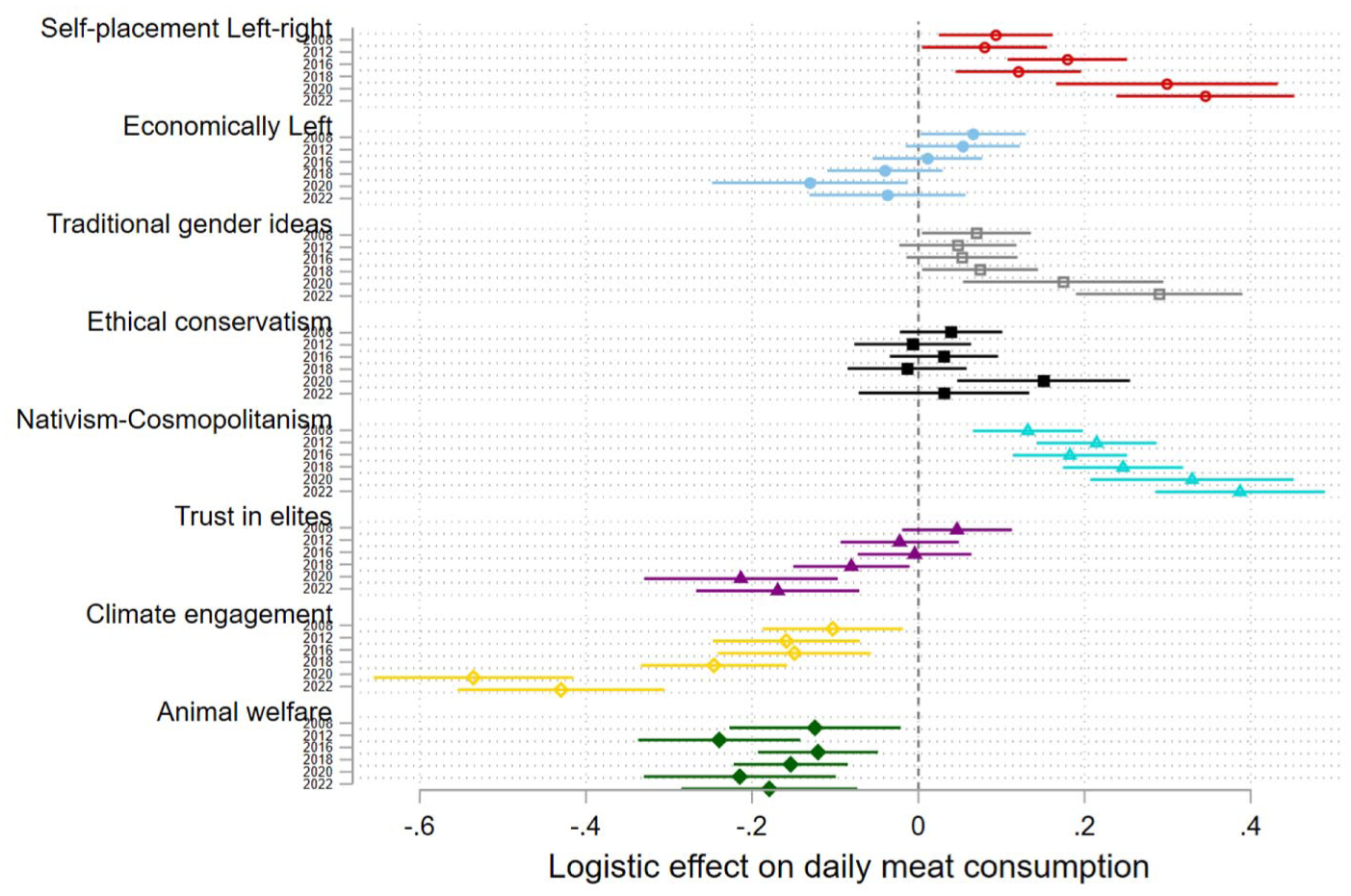
Predicting Daily Meat Consumption (Dichotomy), One Issue Per Model, Including Control Variables.
It becomes clear from Figure 3 that vegetarianism is consistently associated with left-wing self-placement as well as negatively associated with nativism. Furthermore, climate engagement and animal welfare are strongly positively correlated. Climate appears to become a stronger predictor over the years, albeit 2022 deviates from this trend (which might be a measurement artefact). Still, animal welfare remains uniquely important as a predictor for this particular consumption pattern. The other issues do not reveal significant patterns. Hence, while the degree of meat consumption more broadly has also become strongly aligned with most issues, vegetarianism as such is still particularly associated with climate and animal welfare.
In the model of the daily meat eaters the coefficients appear to become stronger of the years (Figure 4). Right-wing self-placement, nativism and traditional gender roles have more than doubled in strength. Climate and animal welfare are even stronger (negative) predictors, which seem also to get stronger in time. Interestingly lower trust in elites emerged as a significant predictor of daily meat consumption too. It thus confirms what we already identified for the ordinal models, but demonstrates it in an even clearer way.
Given the slow but gradual decline in frequency of meat consumption and the growing acceptance and practices of vegetarian and vegan consumption, the groups that ‘resist’ the trend are becoming a more specific section of the electorate. Our results indicate that these have more often conservative, right-wing and nativist ideological orientations.
Estimating the Relation with All Issues Simultaneously
As noted, each of the issue positions explored in Figures 2–4 are themselves associated with each other. As a result, we do not know if the growing association with, say, nativism might be an artefact of a growing association between such ideas and opposition to climate engagement. Figure 5 presents the associations of ideological positions controlling for the other dimensions (as well as the other usual controls). Comparing this figure to the preceding ones should give us an idea about the way meat consumption developed in relation to the broader dimensionality of the political space. We removed left-right self-placement as a predictor in this model, because this variable picks up on an unknown part of the variance in several of the other indicators (to different degrees for different variables for different respondents), whereas we are mostly interested in correlations with substantive ideological dimensions on their own. We do not present these models for the discrete outcomes of vegetarianism and meat eating in the main text, because (as noted before) these are already subject to low variance, which is amplified by estimating them by a host of issue dimensions that are themselves related. We do report these logistic regression models in Appendix E.
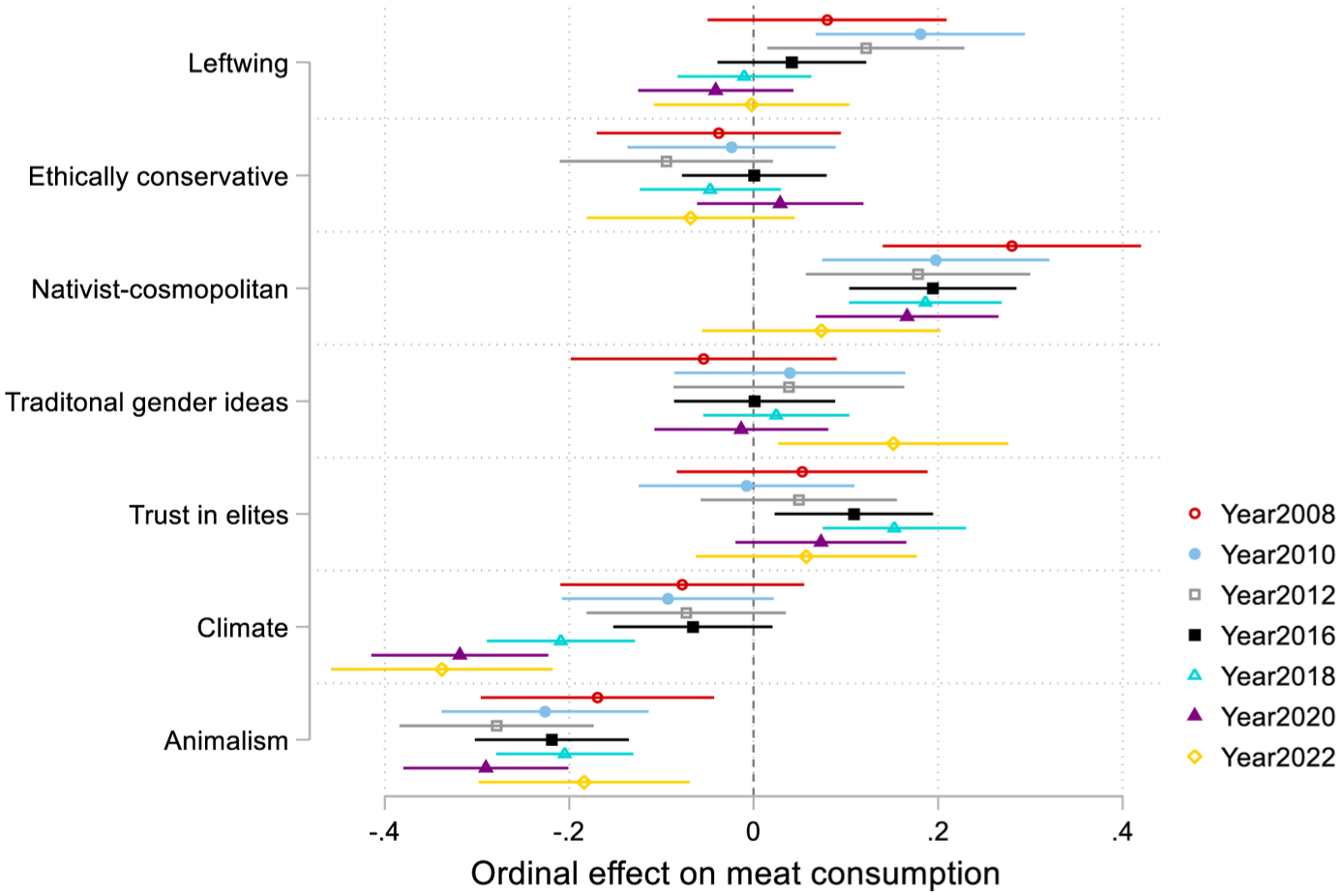
Predicting Meat Consumption (Ordinal Scale), Including All Issues at Once, Including Control Variables.
Figure 5, which shows the coefficients for models that include all ideological predictors at once, indeed presents a different picture than Figure 2. We see that fewer issues remain as significant independent predictors. Rather, climate engagement becomes the primary predictor of meat eating, next to (and possibly even eclipsing) animalism. Nativism played an evident role too throughout most of the period, although its effect disappeared in 2022, but the sudden nature of this shift suggests it might be due to the slightly different operationalization used in that particular year. Ethical conservatism is no longer a consistent predictor.
What does this comparison between Figures 2 and 5 tells us? Most importantly, that there are multiple developments going on at the same time. The association between meat consumption and climate views is clearly growing rapidly since around 2016. This shows up despite the associations with various other dimensions. This suggests that this is now the primary ideological connotation of meat eating, at the same level even as animal welfare concerns. In that sense, developments in framing of meat at the supply side (politicians, pressure groups, etc.) have rapidly found their way to the structure of public opinion. The ongoing association with nativism (if we see the 2022 effect as an artefact) suggests that this is still part of a broader package. In fact, Appendix D shows that the negative association between nativism and climate engagement grew clearly, from 0.25 to 0.4. Hence, while the associations with nativism remained the same, across the board this means that meat eating is increasingly concentrated among nativists. In short, meat is increasingly a matter of climate views; however, given the fact that opposition to climate engagement is itself increasingly associated with conservative positions more broadly, meat consumption is also now quite strong overlapping with nativism, as testified by Figure 2.
We report additional analyses in Appendix C and G. Here, we use stepwise inclusion of variables to gauge how much they independently contribute or rather share explained variance with other regressors. This confirms, most importantly, that nativism and climate share explained variance. That is, the effect of nativism is particularly reduced by including climate attitudes. For instance, the lack of a significant effect of nativism in the last survey year is only visible after including climate. This strengthens our conclusion that nativism and climate are increasingly capturing the same variance in respect to meat consumption. This can be linked, but not completely, to a broader sentiment towards elites: including climate attitudes reduces some of the (limited) effect of elite trust. In short, there are (to different degrees) independent roles played by nativism, climate change and trust in elites, but they also all capture a larger divide that is emerging as a main fault line in politics and that is associated with consumption choices.
Conclusions
In this study, we asked how the relation between meat consumption and ideology has developed in the last decade and a half. The starting point of this venture is the observation that meat consumption is increasingly contested at the ‘supply side’, as politicians (left and right) are increasingly including arguments pertaining to meat in their platforms and communication (Van Der Ploeg, 2020). Has this led to a growing alignment of meat consumption, in the sense that it has detached itself from ideological considerations directly pertinent to meat eating, and become more associated with the dominant axes of political competition?
By levering Dutch survey data, we provided an overview of longitudinal trends of the ideological correlates of meat consumption. This showed that meat consumption has become more strongly associated with multiple ideological dimensions. While meat consumption was always, and remains, related to concerns about animal welfare, it has over the past years also become increasingly associated with right-wing self-placement, opposition to climate policies, nativism and traditional gender ideas. As more and more people across society are reducing their meat intake (more commonly identifying as flexitarians; Dagevos, 2021), daily meat consumption is becoming a more particular and marginalized practice. Our analyses zooming into vegetarians and daily meat eaters suggest that indeed the ideological associations with daily meat eating are getting stronger. Vegetarianism to the contrary continues to be associated with left-wing politics, but this relationship is quite stable, although here, too, climate views are becoming a stronger predictor over time. The growing association with climate attitudes across the board is particularly striking in magnitude. In fact, this increasingly drowns out any other association, as some of our additional analyses have shown.
What does this imply? Going forward, we assess that meat eating might increasingly be associated with a broader package of culturally conservative positions (but not as clearly with economic views). This comes at the expense of the relative importance of even more ‘direct’ explanations such as demographic position or views regarding animal welfare; this embedding in the political conflict is mostly driven by the increasing association with climate ideology, which itself gets more firmly embedded with cultural conflict lines (Dunlap et al., 2016; McCright et al., 2016). All of this fits our understanding that meat has become more broadly political. Partly in line with our expectations, we find some evidence that meat eating is gradually becoming associated with a lack of trust in elites, albeit the overall relationship is (still) quite weak. This would indicate that these cultural issues of which climate is emerging as the most central also align with fault lines related to politics of knowledge in media and science and (lack of) representation. As such meat consumption and the debate around the protein transition more generally might become increasingly integrated in (right-wing) populist politics in which meat reduction and more sustainable agriculture are understood as an elite project pitched against the will of ‘the People’ (Michielsen and Van Der Horst, 2022).
Our study obviously also had limits. The measures we applied to study our core concepts are relatively simple, and moreover not always fully consistent over the entire period of study. Among these, we note that climate change attitudes are broad-ranging and likely multidimensional, and our operationalization only touched upon one aspect of it. A broader operationalization that also includes views about the implications for lifestyle and the landscape might arguably have produced even stronger associations, and one that is more distinct from nativism and elite distrust. In that regard our study is conservative about the role of climate change attitudes. Similarly, there might other elements of cultural conflict and of trust in epistemological authorities, that we did not capture in our study. Finetuning what elements of these various ideas and worldviews have the strongest affinities with meat consumption is a promising avenue for further research. Moreover, our design necessitates us to be agnostic about the causal direction between ideology and meat-consumption behaviour. While our goal was limited to documenting the changing ideological correlates, future studies are needed to unpack the mechanisms involved. This includes the role of adapting behaviour to ideology but also vice versa.
One final limit of our article is that we studied one particular context, while the political contestations of meat consumption is plausibly highly contingent of the electoral system and political landscape. Meat consumption in the Netherlands has become politically salient on the supply side, due to parties on either end of the spectrum (Party for the Animals and Farmer-Citizen Movement) that have an interest in making meat and intensive livestock farming at large into a political issue. In other similar electoral systems, such as Denmark, however, the protein transition seems to be supported by a broad consensus, as attested by the recent Green Tripartite Agreement on agricultural transition (Bäckstrand, 2025). It is unclear if multiparty systems are more ‘robust’ to withstand populism and polarization of sustainability transitions, or are more conducive to them compared to two-party systems. The evidence on polarization of sustainability and political systems seems to suggest that two-party systems might be more prone to polarization (Caldwell et al., 2025; Finnegan, 2022). However, issues such as meat consumption may be less likely to become salient in the absence of parties that are specifically organized around such issues, as our discussion of the Dutch case shows.
The insights of this article go beyond the main research questions we set out to answer. While it received little attention in our article, we also confirmed other research that showed that meat consumption is also associated with gender, educational attainment and levels of urbanity (Dagevos, 2021). Men are much more likely to consume meat, while people with a college degree and urbanites are much less likely to frequently eat meat. Indeed, ideology may crucially intersect with gender, class and urbanity. Future studies should investigate those intersections more thoroughly, especially the combination of gender, social conservatism and regional differences.
What does this mean for the future of the protein transition and its political fallout? The fact that meat consumption has increasingly broader ideological correlates means that new coalitions might emerge. We observe two implications in this regard. While vegetarianism and veganism might have always been more common in cosmopolitan and progressive circles (Dagevos, 2021; Twigg, 1983), it was until recently perhaps still of secondary importance. As meat reduction becomes more consistently overlapping with progressive views more generally, mechanisms of cognitive dissonance reduction and social pressure will likely create further pressures of alignment. This will also create new allies for meat reduction causes among broader progressive groups. On the other side of the spectrum, however, meat consumption might also become more central to conservative and nativist lifestyle. This is already visible anecdotally among some leaders in the far (and alt) right, who are increasingly eulogizing meat consumption as closely related to masculinity and a rejection of globalist and ‘elite’ values (Kulin et al., 2021; Marquardt and Lederer, 2022). If alignment continues along the lines identified above, this ‘package’ might become increasingly mainstream. If so, the politicization of meat, which is until now mostly driven by growing awareness among policy makers and the public to change consumption patterns, might become self-reinforcing. This might entrench consumption behaviours on both sides. Such a deepening fault line would create a political landscape in which politicians but also policy makers will find it more difficult to navigate this political terrain. The fear on intervening in consumer sovereignty by suggesting policy measures reducing the consumption of meat could present serious challenges for making further transitions. Understanding how meat becomes politicized can therefore critically contribute to the protein transition.
Supplemental Material
sj-docx-1-psx-10.1177_00323217251398339 – Supplemental material for (How) Is Meat Becoming Political? The Changing Ideological Correlates of Meat Consumption in The Netherlands
Supplemental material, sj-docx-1-psx-10.1177_00323217251398339 for (How) Is Meat Becoming Political? The Changing Ideological Correlates of Meat Consumption in The Netherlands by Willem Boterman and Eelco Harteveld in Political Studies
Footnotes
Data Availability Statement

Declaration of Conflicting Interests
The authors declared no potential conflicts of interest with respect to the research, authorship, and/or publication of this article.
Funding
The authors disclosed receipt of the following financial support for the research, authorship, and/or publication of this article: This research has been funded by the European Research Council, ERC-CoG-PROTEINSCAPES, 101125536.
Supplemental Material
Additional Supplementary Information may be found with the online version of this article.
Contents
Appendix A. Operationalization Table A1: Item wording Appendix B. Replication with linear regression Figure B1. Main model, one ideological dimension per model Figure B2. Main model, all ideological dimensions simultaneously Appendix C. Replication of model with all ideological dimensions excluding climate Figure C1. Main model, all ideological dimensions simultaneously, without climate Appendix D. Correlations between issue dimensions Table D1. Correlations between main ideological scales Appendix E. Discrete outcome models, all ideological predictors simultaneously Figure E1. Predicting vegetarianism (dichotomy), all ideological predictors included, including control variables Figure E2. Predicting daily meat consumption (dichotomy), all ideological predictors included, including control variables Appendix F. Alpha values issue dimensions
Notes
Author Biographies
References
Supplementary Material
Please find the following supplemental material available below.
For Open Access articles published under a Creative Commons License, all supplemental material carries the same license as the article it is associated with.
For non-Open Access articles published, all supplemental material carries a non-exclusive license, and permission requests for re-use of supplemental material or any part of supplemental material shall be sent directly to the copyright owner as specified in the copyright notice associated with the article.
