




Abstract
Peaceful transitions in power, after elections or referendums, depend upon the acceptance of the outcomes of the contests by those who have lost – a phenomenon known as ‘losers’ consent’. Achieving losers’ consent is arguably most acute in contested sovereignty referendums. A public opinion strategy is required by those who advocate changing the sovereign status of a territory and who are subject to three constraints: (i) their wish to maximise losers’ consent, (ii) their need to retain their support base, and (iii) their need to persuade undecided voters. The strategy involves generating, based on findings from specially designed studies of public opinion, an optimised version of the alternative to the status quo – and advocating that version before the referendum. The strategy in action is illustrated with potential referendums on Irish unification, a ‘typical’ case because it poses the core challenges – on timing, content and persuasion – addressed by our strategy.
In sovereignty referendums, voters may change the legal status of territories and peoples. Such referendums are quite frequent, though estimates of prevalence vary. According to Mendez and Germann (2016), over 600 have been held since 1776. Other analysts suggest half (Şen, 2015) or a quarter (Laponce, 2001) of that number. Different estimates arise from different coding decisions: whether to count both lawful and illegal referendums, whether to count upgrades in status from ‘a territory’ to ‘a state’ in a federation, and whether to count delegations of sovereign authority from a member-state to a confederation. Here, we focus on a specific subset of such sovereignty referendums, which we label ‘contested sovereignty referendums’. These are lawful but expected to be divisive. The paradigm case is where the proposed lawful referendum could change the sovereign status of a territory, but the expected result is likely to be very close and a pro-change result may be intensely opposed by a significant faction of lawful voters.
Our interest here is in the public opinion strategy of advocates of change who wish, or are strategically obliged, to maximise ‘loser’s consent’ (Nadeau and Blais, 1993). We suggest that a successful strategy requires clearly and convincingly elaborating, well before any referendum, a version of post-referendum change that will maximise their opponents’ confidence in the suggested change. But advocates of changing sovereignty face two risks in seeking to maximise loser’s consent. They may alienate their pro-change support base, by making too many concessions to the expected losers, or they may fail to persuade undecided voters who may be pivotal.
We illustrate our suggested strategy through the case of potential referendums on whether Northern Ireland should stay in the United Kingdom or exit the United Kingdom and re-unify with the rest of Ireland. We use the plural ‘referendums’ for two reasons. Under the provisions of the Belfast/Good Friday Agreement, a referendum in Northern Ireland on the subject of Irish unification may be held every 7 years, provided the required conditions are met. 1 Also, we believe that a referendum in Northern Ireland must be accompanied, though not necessarily simultaneously, by a matching referendum in the Republic of Ireland (Renwick et al., 2021). 2 To illustrate our argument we use data from specially designed surveys and focus groups in Northern Ireland (the North) and the Republic of Ireland (the South), and address how our findings may provide guidance on how to minimise post-referendum acrimony in the event of majority support for Irish unification in both jurisdictions. We reflect, more generally, on how our strategy may facilitate a peaceful transition after contested sovereignty referendums elsewhere.
A Public Opinion Strategy for Maximising Losers’ Consent
General Strategy
The consent of voters on the losing side after electoral contests is crucial because the healthy and stable functioning of democracy is based on voters accepting the legitimacy of the outcome (Anderson et al., 2005; Nadeau and Blais, 1993). ‘Sore’ rather than ‘gracious’ losers (Bowler, 2016; Nadeau et al., 2021) are likely to let their disappointment with the outcome prompt more general disappointment with democracy and thereby reduce trust in political institutions (Anderson and LoTempio, 2002; Anderson and Tverdova, 2001; Henderson, 2008; Listhaug et al., 2009). It is widely agreed that losers’ consent is more difficult to achieve in majoritarian and presidential systems than in proportional and parliamentary systems (Anderson and Guillory, 1997; Arceneaux and Truex, 2023; Moehler, 2009). The context of referendums – usually with a starkly binary choice and typically an irreversible outcome – is even more challenging (Hobolt, 2009; Hobolt et al., 2022). Unlike voters in elections, voters in referendums are not guaranteed the chance to revisit the decision they are about to take in a few years, one reason why referendums are often much more contentious than elections. Individual characteristics of voters, regarding ideology, identity and emotions are also important. People on the losing side with ideological views very distinct from the winners are more likely to be sore losers (Esaiasson, 2011; Ezrow and Xeezonakis, 2011), as are losers with strong political and partisan identities (Anderson et al., 2005; Anderson and LoTempio, 2002) or with negative emotional reactions (Singh et al., 2011).
Here, we focus on the unexplored question of how to prepare carefully to maximise losers’ consent in the especially challenging context of contested sovereignty referendums. In the presence of significant national, ethnic, religious or linguistic divisions such referendums are likely to be more salient, divisive, and enduringly consequential than other referendums and highly likely to prompt strongly ideological, partisan and emotional reactions by those on the losing side.
We outline a five-step public opinion strategy – see Box 1 – that we suggest may contribute to achieving as much losers’ consent as possible in contested sovereignty referendums. When planning for such referendums, there are likely to be a range of distinct possible and plausible versions of change (step 1). Before the referendum, advocates of change who wish to maximise losers’ consent should design and, on the basis of public opinion evidence and other forms of engagement with voters, calibrate a version of the change they want that minimises the discontent of strong opponents, while also ensuring that the pro-change side will actually win the referendum (by avoiding alienating its base, and persuading sufficient undecided voters) (steps 2–4). In a multi-party environment, advocates of change, informed by evidence on the socio-demographic and partisan profile of each target audience (supporters, opponents, and potentially pivotal undecided voters), should – insofar as it is possible in a saturated media environment – address each audience through the optimally chosen pro-change party (step 5). In essence, if a clearly articulated, and convincingly conveyed, version of change is not as substantively different from the status quo as opponents fear, then opponents’ confidence that change may not be disastrous can be maximised and, in consequence, losers’ consent can also be maximised.
Strategy for Accommodationist Advocates of Sovereignty Change.
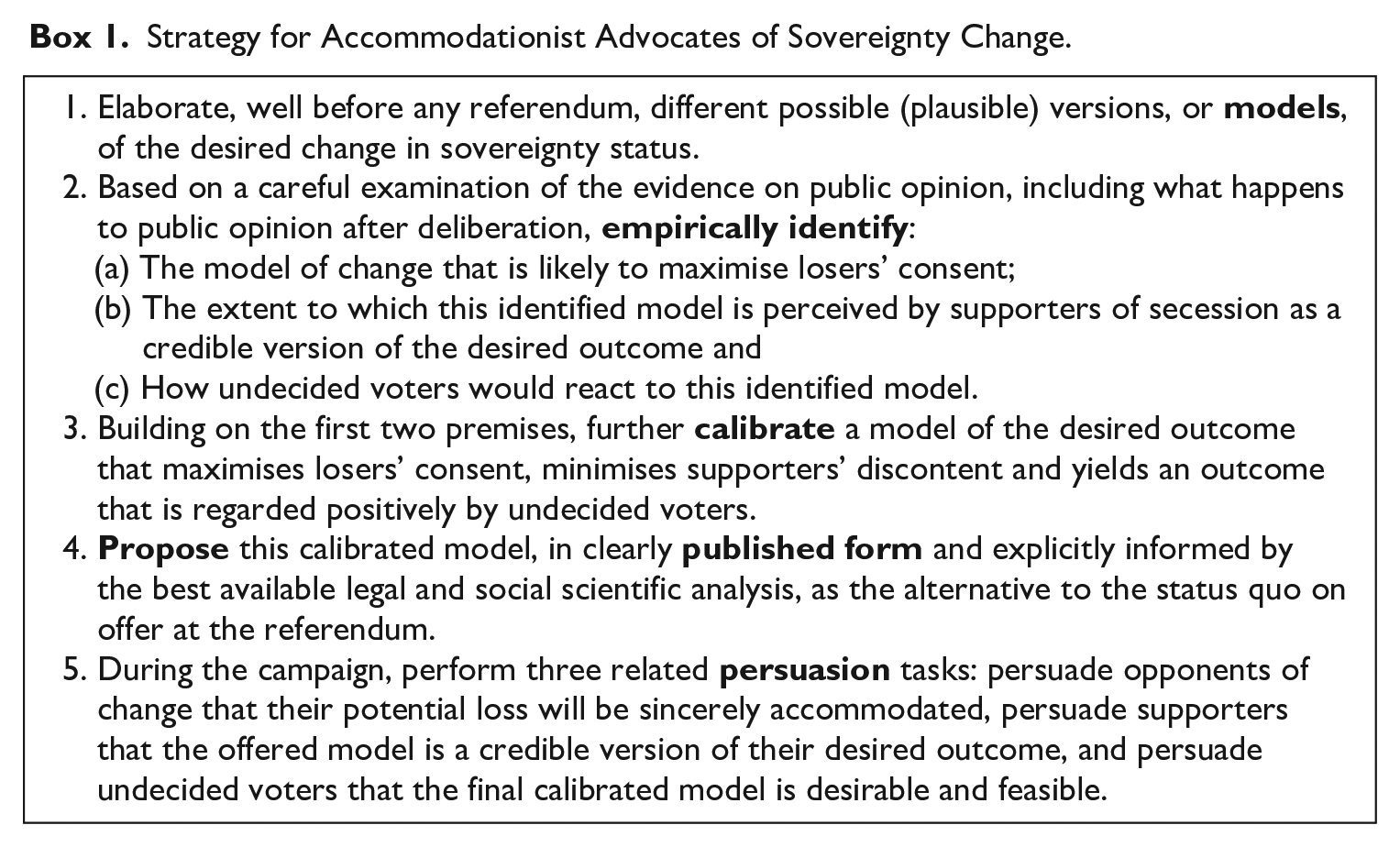
Our strategy cautions advocates of change against prioritising winning above all else, as such an approach could endanger the stability of any new sovereign order. Limited or minimal losers’ consent could lead to a fragile new regime without sufficient support to complete a smooth and peaceful transition.
Our suggested public opinion strategy is far from utopian. It will contribute to maximising loser’s consent, but it is not likely to achieve unanimity. Other factors, not considered in detail here, could positively influence opinion, such as advocates of change displaying empathy with, understanding of and respect for those opposed to change. Our strategy is likely to be difficult to implement. It requires that advocates of change be sufficiently motivated to accommodate potential losers and ensure a smooth and successful change in sovereignty. They need to be willing carmefully to elaborate versions of change and variants of accommodation (O’Leary and McGarry 2012) that some of their supporters may find surprising, even distressing. They must be open to engaging with objective social scientific data collection and analysis and committed to engaging persuasively not just with their own supporters but with their opponents and the undecided. And, of course, our strategy is insufficient. Careful preparation for sovereignty change would involve much more than a public opinion strategy; to avoid deleterious consequences, preparation would involve the careful assessment and integration of an array of economic, constitutional, institutional, policy, and symbolic analyses, preferably by a dedicated ministry.
Despite these important caveats, our suggested public opinion strategy is useful for advocates of change. The end-state is designed to be as palatable as possible to opponents of sovereignty change while retaining the support of proponents. The accurate presentation of the post-referendum outcome during the referendum campaign will reduce the ability of losers to say that what unfolds is radically different from what was promised. The fact that the outcome will be credibly known, and has catered for the losers, may reduce its offensiveness to them, and might reduce the intensity of the referendum campaign itself.
Illustrating the General Strategy: Potential Irish Unification Referendums
As with any individual case study, the Irish case is somewhat unusual and idiosyncratic. However, we argue that it is a good illustrative ‘typical’ or ‘representative’ case (Seawright and Gerring, 2008) because it poses the same core challenges faced by actors implementing our general strategy in any contested sovereignty referendum.
The Irish case is unusual because, as already observed, it would involve referendums in two polities (North and South) and because it would combine disintegrative and integrative sovereignty referendums (Mendez and Germann, 2016). A referendum in Northern Ireland would be disintegrative regarding possible secession from the United Kingdom (analogous to the Quebec referendums of 1980 and 1995, the Scottish independence referendum of 2014, and the ‘Brexit’ referendum which withdrew the United Kingdom from the EU in 2016). But it would also, along with a concurrent referendum in the Republic, be an integrative unification referendum (like EU accession referendums, the referendums on the free association of the Federated States of Micronesia with the United States in 1983, and the failed unification referendums on the Annan Plan in Cyprus in 2004).
Irish unification referendums are likely to risk substantial losers’ dissent among unionists and loyalists if Irish unification is endorsed. Losers’ consent is difficult to achieve when the result is close (Howell and Justwan, 2013) as Irish unity referendums would likely be – in the North, but not the South. Losers’ consent is also difficult to achieve when the electoral contest is conducted against a backdrop of democratic instability (Moehler, 2009; Rich, 2015), as Irish unity referendums may be. In February 2024, when power-sharing was re-established after a 2-year boycott by the Democratic Unionist Party (DUP), the Northern Ireland Executive had not functioned for over 40% of the available time since the institutions of the Good Friday Agreement were fully established. Crucially, referendums on Irish unity would be held in a historically deeply divided place with recent prolonged experience of violent ethnonational conflict (O’Leary, 2020a). The case is therefore particularly vulnerable to the general problem of sore losers’ refusing to consent to the outcome and resorting to violence (Piazza, 2022), before, during, and after referendums (O’Leary, 2022: 249–270; see also O’Malley, 2023). Political identity and ideological viewpoints are firmly held by many in Northern Ireland (Garry, 2016), and the potential for intense anger being the emotional unionist response to a pro-unity outcome is high, likely a more powerful version of the anger-driven lack of losers’ consent identified by Nadeau et al. (2021) and Tilley and Hobolt (2024) after the Brexit referendum. The case of potential Irish unification is highly salient because it is existential for British unionists who wish to preserve the United Kingdom of Great Britain and Northern Ireland; for them, it would mark the end of the existing UK state.
Notwithstanding the important specific context, and distinctive features, of the possible future case of Irish unification, we suggest that it is valuable to focus on a ‘typical’ case of a contested sovereignty referendum. It highlights the same general questions faced by advocates of sovereignty change when considering whether to implement a strategy like that sketched above, notably on questions relating to timing, content and persuasion.
The Timing of Model Specification
Should the version of sovereignty change be specified before or after the referendum? Our general strategy suggests that advocates of sovereignty change should explicitly elaborate on their desired version of change before any referendum is held. In the debate over Irish unification, the pre-referendum specification has been characterised as the ‘model’ approach, in contrast to the ‘process’ approach, in which the version of a united Ireland to be implemented would be decided after unification, likely through a constitutional convention consisting of elected representatives from across the island (O’Leary, 2022; see also Garry et al., 2022b, 2020).
Each approach likely has advantages and disadvantages for losers’ consent. Under the ‘model’ approach, the elected politicians on the losing side (unionist politicians) will most likely have had minimal input, if any, into the construction of the state in which they may find themselves; that is because they are highly unlikely to help design, before a referendum, a polity they do not want to join. Under the ‘process’ approach, by contrast, everyone ends up in a state the exact shape of which they could not accurately have anticipated when they voted.
There are several reasons for advocating the model rather than the process approach. Despite elite unionist non-involvement in designing the alternative to the status quo, the unionist public would have been influential, as our general strategy is based on calibrating a model based on public opinion and other evidence about their views, and this involvement would lend legitimacy to the model of change that would be implemented. In any case, under the process approach, it would be necessary to design a transitional model for a united Ireland that will apply before the process is completed – and to make clear the default, in the case of the process failing, for example, through a failed constitutional convention, or a public rejection of what the convention produces. The latter possibility is no idle speculation: twice within sixteen months, Chileans rejected a new constitution, one drafted first by the left and then another drafted by the right (Nicas, 2023). Furthermore, considered public opinion, at least as suggested by a deliberative forum, robustly favours a detailed description of the united Ireland on offer before any referendum, mainly to avoid the difficulties of the ‘Brexit’ experience in which post-referendum acrimony resulted from the lack of clarity around the meaning of ‘leave’ (Garry et al., 2022a).
Content
In any sovereignty referendum, if advocates of change are in favour of pre-referendum model specification, and wish to maximise ‘losers’ consent’, what exactly is the content of the model they should offer before the referendum? A description of the proposed expanded polity would have to be elaborated across multiple dimensions: possibly including constitutional design, public symbols, membership of international organisations, citizenship, education and health systems and the likely future trajectory of economic policy. On each of these dimensions, several plausible options are likely to exist. And they will vary in their attractiveness to supporters of change, opponents of change, and undecided voters. The challenge for advocates of change in a sovereignty referendum is to specify the particular composite model least likely to alienate opponents, while retaining their core supporters, and persuading undecided voters.
Regarding potential Irish unification, what combination of features of unification could meet these challenges? The first task is to lay out the possible models of Irish unification across a range of dimensions (summarised in Box 2). Regarding constitutional design, a conventional or traditional, conceptualisation of Irish unification would envisage a unitary state in which Northern Ireland would no longer exist as a political entity, and decision-making for the whole island would be made from a single all-island parliament and government: the ‘integrated model’ of unity. A ‘devolved model’ of unity, which seems likely to be more accommodating of opponents of unity, may also be possible. Here, Northern Ireland would persist but now as a devolved entity within a united Ireland, enjoying delegated authority from Dáil Éireann rather than Westminster. The Northern Ireland Assembly and its power-sharing executive would (assuming political engagement) function as currently legally permitted, 3 and Northern Ireland would continue to have devolved policy powers over health, education and policing. Currently these are the two most feasible territorial models of unification. 4
Different Possible Versions of Irish Unity.
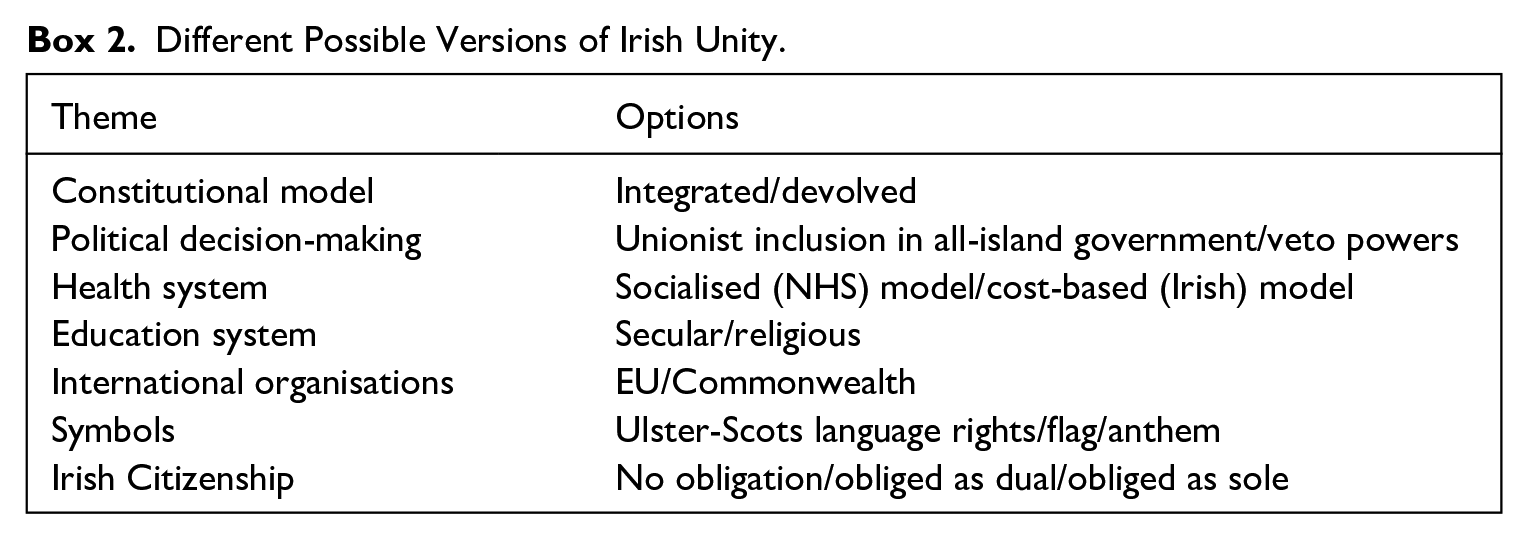
Under both the integrated and devolved models of Irish unity, a Dublin parliament and an all-island government would make decisions for the whole island, though in the devolved model, lawful decisions would be exercised by the assembly and executive in the North. Regarding the rules of parliamentary voting and government formation, there are (at least) two possible ways to proceed under Irish unification. The current system operating in the South could continue to operate: an all-island government (whether single or multi-party) would be formed from a majority of deputies after general elections, without rules specifying whether certain politicians or parties from specific places should be included in the government, and without rules about minority blocs of deputies having veto powers over legislation. In the alternative, to accommodate those opposed to unification, the all-island government in Dublin could, under unification, be changed to incorporate aspects of consociational arrangements that operate in Northern Ireland when the Good Friday Agreement functions (Evans and O’Leary, 2000; Garry, 2009; McGarry and O’Leary, 2006a, 2006a; O’Leary, 1999; O’Leary, 2020b; Taylor, 2009). Specifically, in the all-island Dublin parliament under unification, elected politicians of a British/unionist disposition could be guaranteed participation in government. Or, in parliamentary voting, elected politicians who identify as British/unionist could be afforded the right, as a bloc of parliamentarians, to veto legislation that they believed undermined their cultural or national identity.
On important public policies – such as health and education – advocates of Irish unification could spell out their broad favoured approach. Pro-unity agents could either advocate an NHS-style socialised health system free at the point of delivery, which might assuage the fears of unionists, or a modified version of Sláintecare, as developing in the South (Burke et al., 2018). 5 Losers’ consent could potentially be maximised by opting for an education system that either does, or does not, distinguish on the grounds of religious denominational ethos (Fontana, 2017, 2021; Smith, 2005).
Advocates of a united Ireland could argue that existing public symbols, broadly defined, that currently exist in the South would remain under unification. Or, to facilitate the accommodation of those opposed to Irish unity, they could suggest that under unification, there could or should be a new flag (Muldoon et al., 2020), a new national anthem, and language rights for ‘Ulster Scots’, or some permutation of these cultural ‘securities’.
If Northern Ireland left the United Kingdom and re-unified with the rest of Ireland, it would, by necessity and by previous agreement of the European Council, automatically rejoin the European Union (O’Leary, 2022: 28–29). A unified Irish state would succeed in meeting the obligations and rights of the current Irish state; it would not, for example, need to reapply for membership in the UN. Membership in other international organisations could be considered, however, especially those positively regarded by Northern unionists. Specifically, the Irish state can currently, if it wishes, apply to rejoin the Commonwealth (formerly the British Commonwealth), and a unified Irish state could choose to do so – a move that may appeal to some unionists and calm the fears of others.
Under Irish unification, there are two broad options regarding people on the island who currently identify as ‘British’. They could become Irish citizens, either in addition to continuing to be British citizens (‘dual citizens’), or, in a very hardline version of change, be obliged to become Irish citizens only – which would breach the Irish Government’s obligations under the Belfast/Good Friday Agreement. Alternatively, and more palatably for British identifiers, they could be afforded the right to remain as British citizens only, with no compulsion to take on (either jointly or solely) Irish citizenship. Under the current Irish constitution, however, such British-only citizens would not have the right to vote in either constitutional referendums or in presidential elections, and constitutional amendments, including a referendum, would be required to modify these provisions (Doyle et al., 2021).
Having clearly laid out such possible plausible options for a model of Irish unification across the range of relevant dimensions, the empirical task for advocates of sovereignty change who wish to maximise losers’ consent would be to identify an optimised composite model of change. The research question, which addresses steps 2–4 of our general strategy, would be: What version of Irish unification – across the domains of constitutional type, decision making, policy direction, public symbols, international organisations, and citizenship – maximises losers’ consent, minimises supporter dissatisfaction, and persuades undecided voters?
Who Persuades Whom?
In any sovereignty referendum advocates of change need to be persuasive in the campaign (step 5). They need to target their messaging to the relevant diverse audiences: supporters of change, opponents of change, and undecided voters. These three general opinion groups map onto three of the distinct audiences identified by Earl (2019), namely, current participants, potential recruits, and opponents. (On distinct audiences and political strategy, see Jasper (2004), Rohlinger (2014) and Stier et al (2018)).
Targeted messaging to these three diverse groups could be facilitated by identifying core socio-demographic characteristics of the members of each group, including age, gender, education, social class, and the extent to which voters’ lives are connected to the other jurisdiction, regarding friends, family, and visits (on inter-group contact see e.g., Paolini et al. (2021)).
Advocates of change could also benefit from considering which particular political parties could optimally deliver the targeted messaging to each distinct group, given that messages from trusted parties will likely be more persuasive (Dalton, 2020). Advocates also need to consider which parties should not deliver messages to particular groups because of the dissuasive impact of negative partisanship (Bankert, 2020).
Regarding Irish unification, the range of clearly pro-unity parties on the island who could potentially deliver messages include Sinn Féin (an all-island party), the main southern parties (Fianna Fáil, Fine Gael, the Social Democrats, and Labour), and the northern Social Democratic and Labour Party (SDLP). The main non-aligned or neutral party in the North is Alliance; the other is the Greens. The environmentalist Greens are an all-island alliance but not focused on Irish unity. The main unionist parties in the North opposed to Irish unity are the DUP, the Ulster Unionist Party (UUP) and Traditional Unionist Voice (TUV).
Based on this discussion, two empirical questions, which address the last step in the strategy, may be specified as follows:
What are the socio-demographic and partisan characteristics of those who must be persuaded – staunch opponents of Irish unity, northern and southern supporters of unity, and northern and southern undecided voters – about this (optimised) version of a united Ireland? And which political parties are best, and which are worst, placed to do the persuading?
Methods
Surveys
Quantitative survey data, in both the North and the South, were collected as part of the Analysing and Researching Ireland North and South (ARINS) project. ARINS is a joint initiative of the Royal Irish Academy and the University of Notre Dame (https://www.ria.ie/arins). Funding for the surveys was jointly provided by The Irish Times, Ireland’s newspaper of record, and the Keough-Naughten Institute for Irish Studies at the University of Notre Dame. The authors, in collaboration with other members of the ARINS public opinion committee, 6 and the political editor of The Irish Times, 7 designed the studies. The fieldwork was conducted in the South by IPSOS B&A and in the North by IPSOS Northern Ireland: 1009 respondents were interviewed in the North (between 17 August and 15 October 2022) and 1043 in the South (between 12 August and 24 October 2022), using in-home, face-to-face, computer-assisted interviews and a bespoke survey of 22 minutes in length. A two-stage sample selection process was used in both the North and the South: geographical sampling points were randomly selected, and demographic quotas were used to ensure the sample matched official population estimates (and given that the May 2022 Assembly election occurred almost directly before fieldwork, the Northern Ireland data were weighted to account for the slight deviations from official turnout and first preference vote choice results).
Measures
We began by identifying respondents in each of our five relevant opinion groups (Box 3). We identified respondents who indicated that if referendums were held and voters opted for Irish unity, they would find it very difficult to consent to the outcome. Specifically, respondents were asked whether they would be able to accept Irish unity if people, North and South, voted for it, using the following response options: ‘I would find it almost impossible to accept’, ‘I would not be happy but could live with it’ or ‘I would happily accept it’. 8 We focus on respondents from a Protestant background in the North who state that they would find a pro-unity result ‘almost impossible to accept’. In the Northern survey, one in three (32%) Protestants indicated this response. Exactly what ‘almost impossible to accept’ means is open to debate, but it likely represents a deep hostility to Irish unity associated with ambivalent reactions to possible political violence 9 and a tendency to self-define as ideologically hardline. 10
Five Opinion Groups.
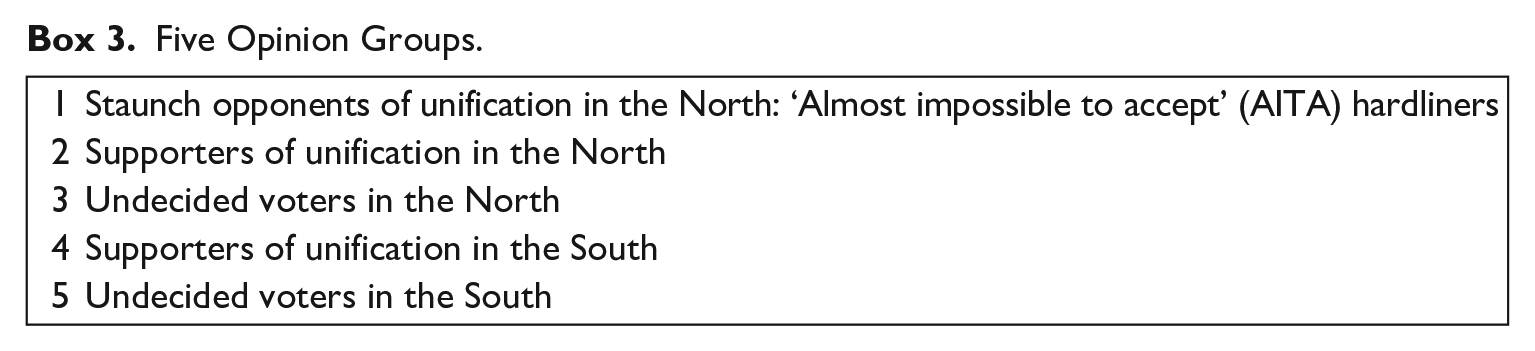
Next, we identified two categories of supporters of Irish unity: people from a Catholic background in Northern Ireland who would vote for Irish unity (55% of Catholics in the ARINS survey); and people in the Republic who would vote for unity (66%). We then identified two categories of ‘undecided’ voters, one in the North and one in the South. These were respondents who:
Indicated that they were likely to vote in a referendum (indicating 7 on a 1–7 scale running from 1 ‘definitely would not vote’ to 7 ‘definitely would vote’), and
Either (a) indicated ‘don’t know’ when asked to choose between Irish unity and staying in the United Kingdom, or (b) preferred one option over the other, but marginally so (i.e. on separate questions identifying, distinctly, how strongly they support each option on 1–7 scales, there was only a zero-, one- or two-unit difference).
Based on these criteria, 15% of respondents in the South and 14% of respondents in the North were identified as undecided voters.
On constitutional models, two questions were asked – one each on the acceptability of the devolved model and the integrated model of Irish unity. The three options for both questions were ‘AITA’, ‘would not be happy but would live with it’, and ‘would happily accept it’. In relation to the health system, education system, decision-making and international organisations, two distinct questions were asked on each theme: on a socialised model of health as operates in the North or an insurance- or payment-based model as in the South; on secular or religious education; on unionists being guaranteed a role in government or unionists having a veto on legislation; and on the Commonwealth and the EU. On public symbols, three distinct questions were asked about Ulster Scots language rights, a new flag and a new anthem. Respondents were asked on a Likert-type scale how each of these distinct conditions would affect their vote in a referendum on Irish unity: much more likely to favour unity, more likely, and it would make no difference, less likely or much less likely. (We also included, for benchmarking purposes, two economic conditions: a positive condition in which unity leads to being better off (by £3500 or €4000) and a negative condition in which unity leads to being worse off by the same amount.) Respondents were also asked whether Irish citizenship should be obligatory, either solely or in combination with British citizenship, or whether British identifiers could continue if they wished to be British citizens only. (Full question wordings are reported in Tables 1–4 in the ‘Results’ section.)
Acceptability of Different Constitutional Models of Irish Unity (%).
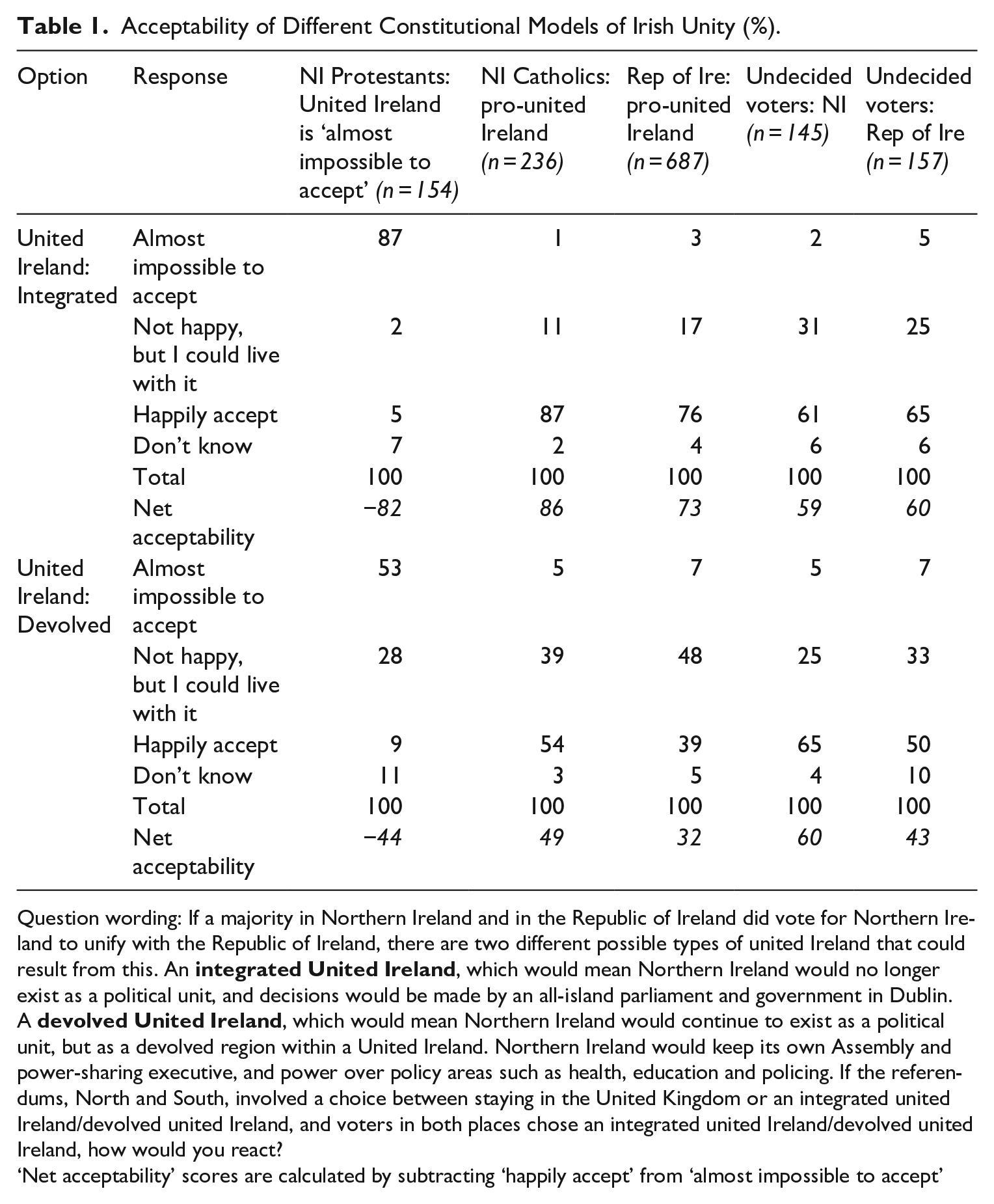
Question wording: If a majority in Northern Ireland and in the Republic of Ireland did vote for Northern Ireland to unify with the Republic of Ireland, there are two different possible types of united Ireland that could result from this. An
‘Net acceptability’ scores are calculated by subtracting ‘happily accept’ from ‘almost impossible to accept’
Impact of Different Factors on Support For Irish Unity (Net Scores %).
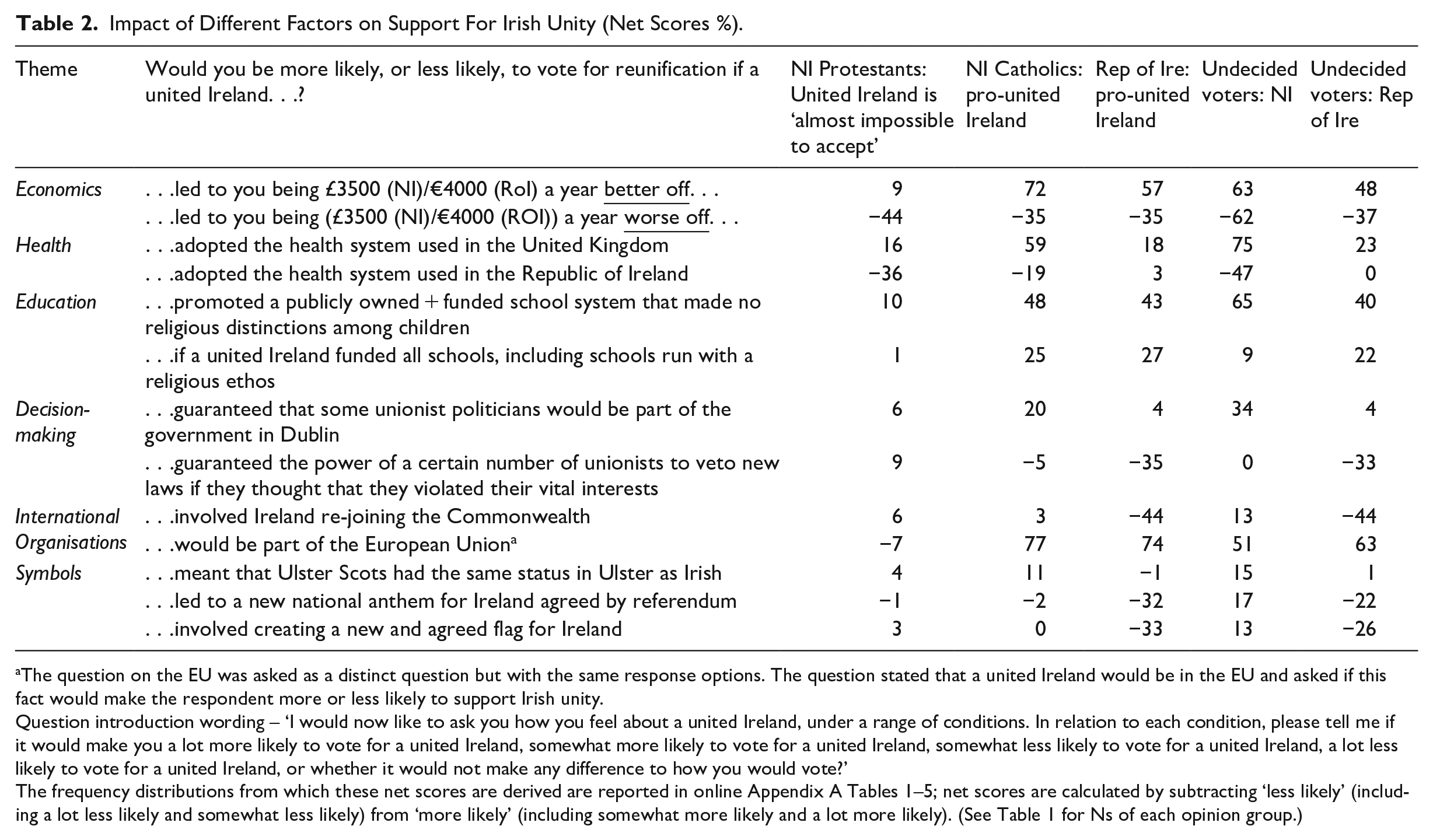
The question on the EU was asked as a distinct question but with the same response options. The question stated that a united Ireland would be in the EU and asked if this fact would make the respondent more or less likely to support Irish unity.
Question introduction wording – ‘I would now like to ask you how you feel about a united Ireland, under a range of conditions. In relation to each condition, please tell me if it would make you a lot more likely to vote for a united Ireland, somewhat more likely to vote for a united Ireland, somewhat less likely to vote for a united Ireland, a lot less likely to vote for a united Ireland, or whether it would not make any difference to how you would vote?’
The frequency distributions from which these net scores are derived are reported in online Appendix A Tables 1–5; net scores are calculated by subtracting ‘less likely’ (including a lot less likely and somewhat less likely) from ‘more likely’ (including somewhat more likely and a lot more likely). (See Table 1 for Ns of each opinion group.)
Comparing Unity Conditions for Each Opinion Group: Mean Differences.
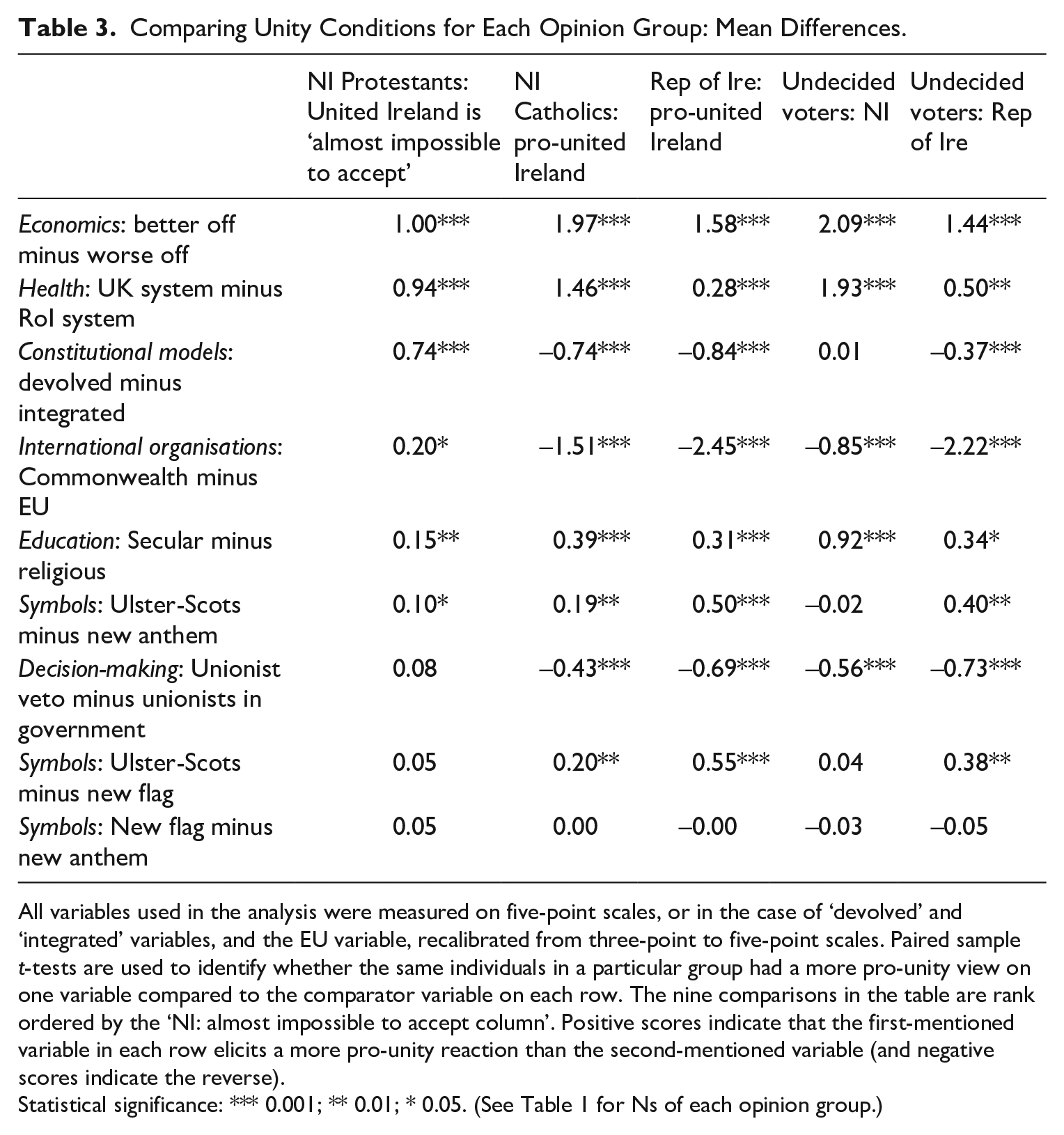
All variables used in the analysis were measured on five-point scales, or in the case of ‘devolved’ and ‘integrated’ variables, and the EU variable, recalibrated from three-point to five-point scales. Paired sample t-tests are used to identify whether the same individuals in a particular group had a more pro-unity view on one variable compared to the comparator variable on each row. The nine comparisons in the table are rank ordered by the ‘NI: almost impossible to accept column’. Positive scores indicate that the first-mentioned variable in each row elicits a more pro-unity reaction than the second-mentioned variable (and negative scores indicate the reverse).
Statistical significance: *** 0.001; ** 0.01; * 0.05. (See Table 1 for Ns of each opinion group.)
If, In Referendums North and South, a United Ireland is Agreed by Voters, Then People Born in Northern Ireland and Who Are Living in Ireland. . .? (%).
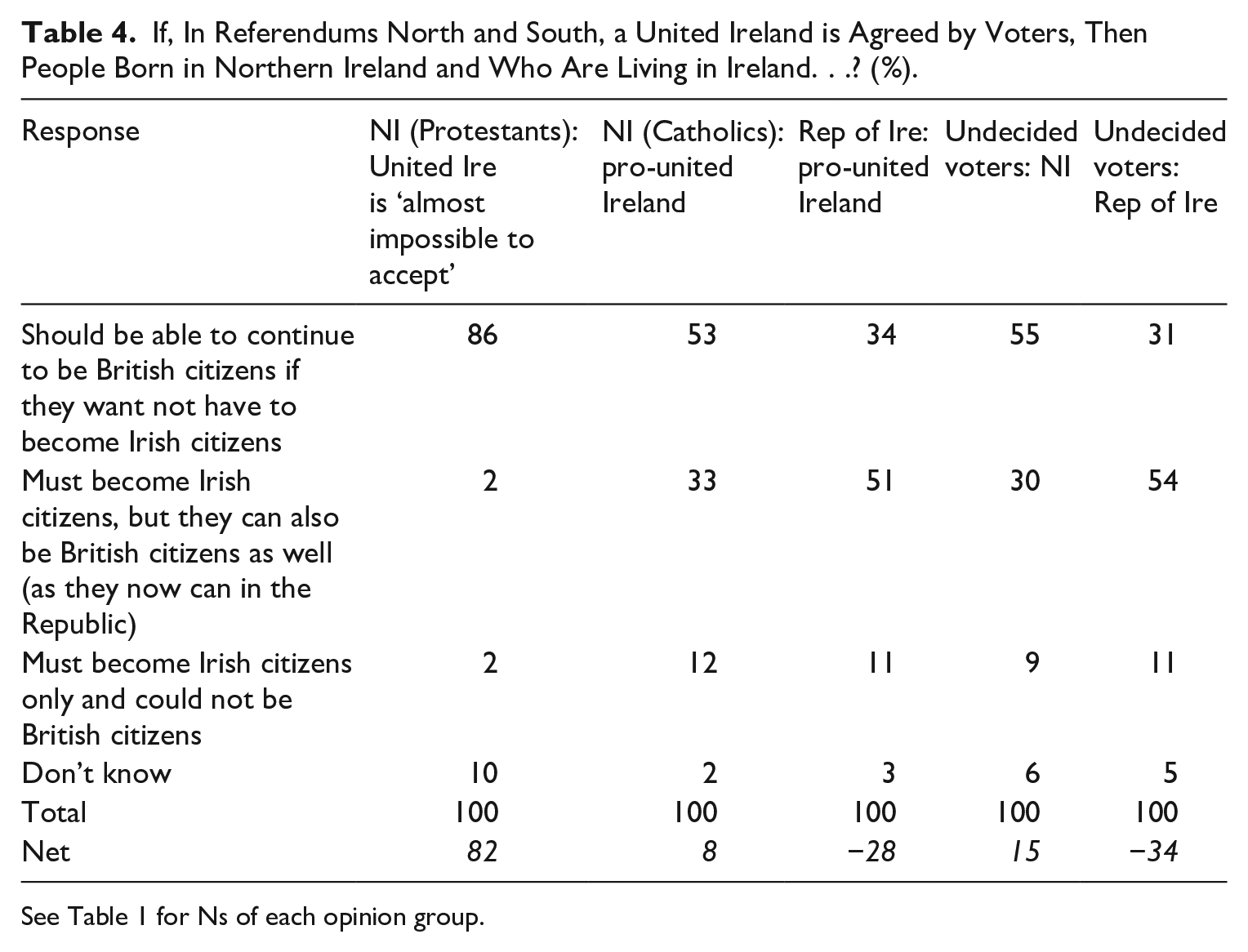
See Table 1 for Ns of each opinion group.
Age, gender, education and social class were measured. A multi-item scale was generated from four questions assessing the extent of cross-border connections, focusing on the frequency of overnight and daily visits in the last 5 years (no/yes, once/yes, several times/yes, lots of times) and the prevalence of cross-border friends and family (no/yes, one or two/yes, several/yes, lots). To measure both positive and negative partisanship, a battery of questions asked the extent to which the respondent feels, on a five-point qualitatively labelled scale, close to or distant from a range of parties in Northern Ireland and the Republic: very close to, close to, neither close to nor distant from, distant from or very distant from. 11
Focus Groups
In addition to surveys, the ARINS/Irish Times project organised two focus groups in the North and two in the South, in October 2022 (conducted by IPSOS Ireland and IPSOS Northern Ireland). In each group, participants varied by age, gender, place of residence (and by religious background in Northern Ireland). However, all participants were deliberately similar in that they were undecided voters. Focus group participants had indicated that they were likely to vote in a referendum but either did not have a view or were open to change after argument and discussion (see online Appendix C for details). All focus groups lasted approximately 2 hours and followed the same discussion guide run by a facilitator (with specified questions and prompts), which brought the participants through a discussion of their views on a possible referendum on Irish unity, on Irish unity versus staying in the United Kingdom, and on different types of Irish unity (see online Appendix D for the full questions, prompts and facilitator instructions). There were approximately eight participants in each focus group, and their discussions were transcribed in anonymised form. For each of the main questions covered we identified from the transcripts the main themes emerging and associated illustrative example quotes. The focus group data is obviously limited because it covers only two of our five opinion groups of interest (undecided voters, North and South). However, it enables us to tease out why these voters hold the views that they do and hence augments the survey data. 12
Results
Attitudes to Different Versions of Irish Unity
We begin by describing, in aggregate, for our five opinion groups, whether each distinct proposed version of a united Ireland on balance attracts respondents towards, or deters them from, Irish unity. We then rank-order each theme by the extent to which opinion group members are attracted in a pro-unity direction more by one condition then the other condition(s).
As reported in Table 1, staunch opponents of Irish unity reject unity less if it involves a devolved rather than integrated model. Almost all (87%) Protestants who find the general idea of Irish unity ‘AITA’ also find the integrated model ‘AITA’, but just 53% of them find the devolved model ‘AITA’, thereby approximately halving the number with the diehard response. The net acceptability score improves from a strongly negative −82 for the integrated model to −44 for the devolved model. Pro-unity supporters and undecided voters, North and South, have positive net acceptability scores for both constitutional models, but the pro-unity groups are much less enthusiastic about the devolved model than the integrated model: for pro-unity northern Catholics the net score reduces from 86 to 49 and for pro-unity southerners from 73 to 32. Undecided Southerners also prefer the integrated to the devolved model (net acceptability of 60 rather than 43), while undecided Northerners have the same (positive) acceptability rate for both constitutional models (59 and 60). 13
As reported in Table 2, respondents who find Irish unity ‘almost impossible to accept’ (hereafter ‘AITA hardliners’) are, on balance, less likely to support Irish unity under an Irish health system (net score of −36) but are more likely to support unity under an NHS-style model (net score of 16). The effects are larger for northern pro-unity Catholics (−19 and 59) and very large for undecided northerners (−47 and 75). 14 Southerners (both pro-unity and undecided) are neutral on the existing Irish health system and somewhat attracted by the socialised model).
It is useful to benchmark the size of these health effects against the size of the economic effects on dispositions to vote for unity. For AITA hardliners, the health system effect is very similar to the effect of the difference between the positive and negative economic conditions (9 and −44, respectively) of Irish unity. The health and economic effects are also similar for undecided northerners. But for pro-unity northern Catholics, the health effects are somewhat lower than the economic effects.
AITA hardliners are on balance more likely to support Irish unity under the condition of Commonwealth membership (net score of 6), and, on balance, less likely to support unity when reminded that a united Ireland would be in the EU (net score of −7). All four of the other opinion groups react very positively to a united Ireland being in the EU, with very high net scores of 77 and 74 for pro-unity southerners and northerners, respectively, and substantial net scores of 51 and 63 for undecided northerners and southerners, respectively. The prospect of Commonwealth membership, however, strongly deters southerners, both pro-unity and undecided, 15 from Irish unity. The net score for both is −44, the largest negative effect of all the conditions. AITA hardliners are more accepting of Irish unity under conditions of secular rather than religious education (net score of 10 rather than 1). A stronger effect in the same direction is observed for all the other four groups, especially for undecided northerners (net score of 65 rather than 9). The prospect of a unionist veto in the parliament of a united Ireland makes AITA hardliners somewhat more likely to support unity (net score of 9), as does – though to a lesser extent – the prospect of unionist involvement in an all-island government (net score of 6). Northern pro-unity Catholics and undecided voters are more attracted to unity under the condition of unionist involvement in government and are broadly neutral on unionist veto powers. In contrast, pro-unity and undecided southerners are strongly deterred by the prospect of unionist veto powers, with net scores of −35 and −33, respectively (and both groups are marginally positive about unionist involvement in government). For AITA hardliners, Ulster-Scots language rights and a new agreed flag make them marginally more likely to support a united Ireland (net scores of 4 and 3). The effect of anthem change is neutral (−1). Undecided and pro-unity southerners are neutral on Ulster-Scots but are strongly deterred from Irish unity by the prospect of changing the national flag (−26 and −33) or the anthem (−22 and −32). Pro-unity Catholic northerners are positively disposed to Ulster-Scots language rights (11) and neutral on flag and anthem change, and undecided northerners are positive about all three (net scores of 13 and 17).
In Table 3, we rank-order these themes by the extent to which the first-mentioned condition in each theme elicits a more pro-unity response among AITA hardliners than the second-mentioned condition. Preference for the devolved rather than integrated model, and preference for a socialised UK-style health service rather than the Irish model, are the two substantively large, and highly statistically significant, effects for AITA hardliners (and similar in scale to the size of the economic effect of being made better off rather than worse off by unity to the extent of £3500/€4000 annually). Consistent with our descriptive analysis, all four other opinion groups also prefer the United Kingdom to the Irish health system (and the effects are highly statistically significant), but on the constitutional model, pro-unity northerners and southerners prefer the integrated to the devolved model (to a highly statistically significant extent).
AITA hardliners are more attracted to Irish unity by the prospect of Commonwealth than EU membership and more by the prospect of secular than religious education. In both cases, the differences are statistically significant, but the effect sizes are smaller than in the case of constitutional models and health. Consistent with our descriptive analysis, the size of this Commonwealth/EU effect is dwarfed by the size of the effect in the opposite direction for all other opinion groups: the effect sizes for pro-unity and undecided southerners are large, and bigger than the effect sizes for economic differences. On education, all other opinion groups share AITA hardliners’ preference for secular over religious, and to a highly statistically significant and substantially larger degree.
For AITA hardliners, the higher score for unionist veto powers than that for unionist inclusion in government is not statistically significant, but for all four other groups, the preference for inclusion over veto rights is highly statistically significant. When the conditions for public symbols are compared to each other, Ulster Scots language rights have a statistically significantly greater pro-unity effect than a new anthem for AITA hardliners and for all other opinion groups (apart from undecided northerners).
A single bespoke question about citizenship obligations was also asked in our survey (see Table 4). Almost all (86%) of AITA hardliners support the right of people born in Northern Ireland to retain solely British citizenship in the event of a united Ireland, with only 4% supporting the proposal that everyone should have to become Irish citizens (either under dual or sole citizenship conditions). In sharp contrast, only one-third of pro-unity Southerners and one-third of undecided Southerners support ‘British only’ citizenship. Northern pro-unity Catholics and Northern undecided voters are more likely to support ‘British only’ citizenship than either dual or sole Irish citizenship (with positive net acceptability scores of 8 and 15, respectively). 16
Socio-demographic and Partisan Profiles
In a series of binary logistic regressions, we use socio-demographic and partisan factors to predict opinion group membership (Table 5). The analyses confirm that Northern Protestant AITA hardliners are different from other Protestants. They are more likely to be male, working-class and have low levels of contact with the South. They are also more likely to be supportive of the TUV and DUP, and negatively disposed to Sinn Féin; but they are not different from other Protestants in disposition towards Alliance and the SDLP. 17
Socio-Demographic and Partisan Characteristics of Opinion Group: Binary Logistic Regressions.
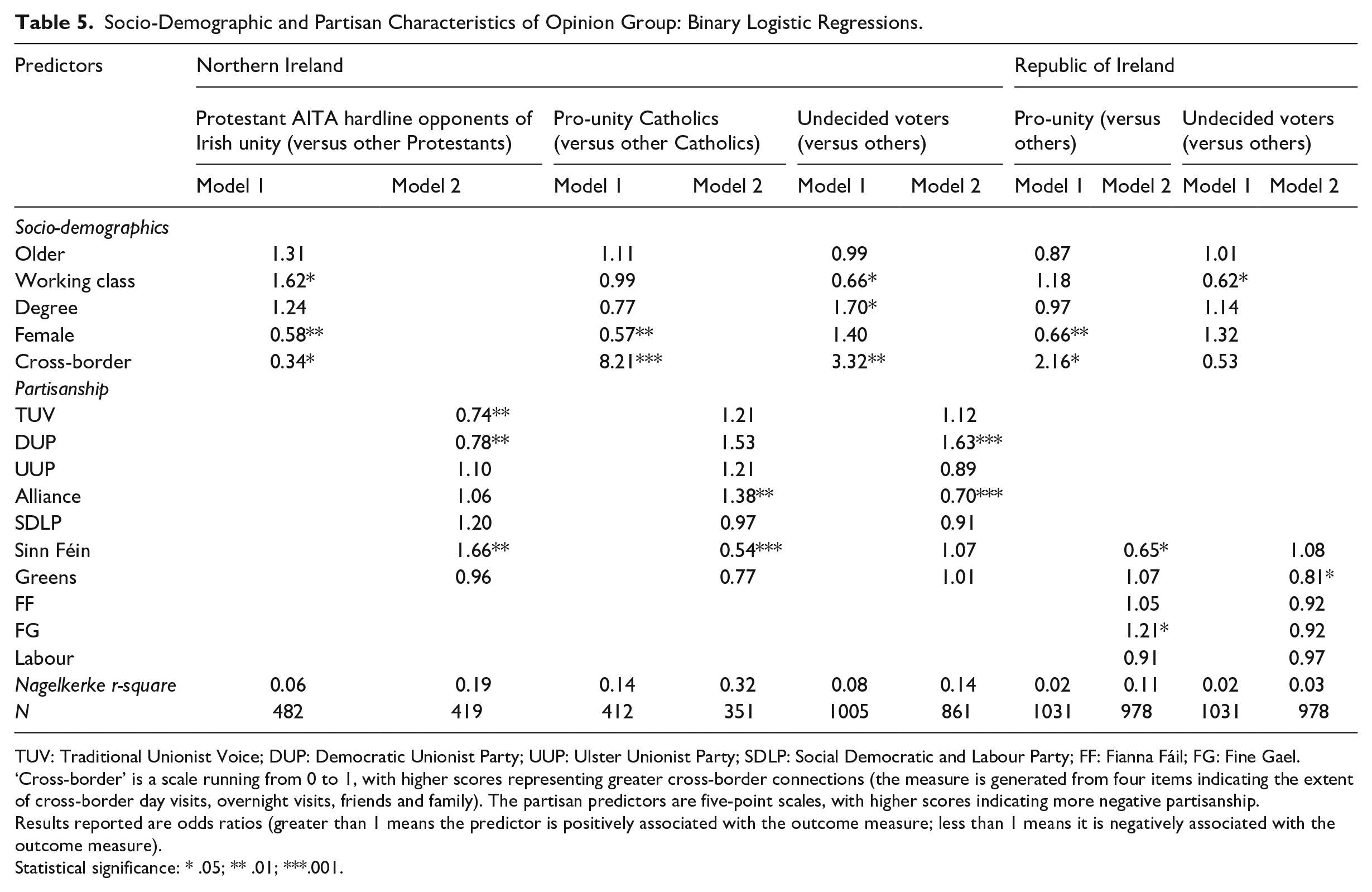
TUV: Traditional Unionist Voice; DUP: Democratic Unionist Party; UUP: Ulster Unionist Party; SDLP: Social Democratic and Labour Party; FF: Fianna Fáil; FG: Fine Gael.
‘Cross-border’ is a scale running from 0 to 1, with higher scores representing greater cross-border connections (the measure is generated from four items indicating the extent of cross-border day visits, overnight visits, friends and family). The partisan predictors are five-point scales, with higher scores indicating more negative partisanship.
Results reported are odds ratios (greater than 1 means the predictor is positively associated with the outcome measure; less than 1 means it is negatively associated with the outcome measure).
Statistical significance: * .05; ** .01; ***.001.
Pro-unity northern Catholics are much more likely than other northern Catholics to be male, have strong cross-border connections and to support Sinn Féin; but they are also less likely to have a positive view of Alliance. Undecided voters in Northern Ireland are more likely than decided voters to be middle class, degree educated and have strong links with the South. They are also more likely to be positively disposed to Alliance and negatively disposed to the DUP.
Southern supporters of unity are more likely than non-supporters of unity to be male and have strong northern connections. They are also more likely to oppose Fine Gael and support Sinn Féin. Undecided Southerners are more likely to be middle class than non-pivotal Southerners, and they are somewhat more positively disposed to the Greens.
Discussion
Implications for Potential Irish Unification Referendums
Accommodationist advocates of Irish unity, who follow our five-step public opinion strategy, would, based on our findings, provided they remain stable, propose a version of Irish unity that would:
Adopt the devolved constitutional model, not the integrated model;
Adopt a socialised NHS-style health system, not the Irish model;
Continue as an EU member, and not re-join the Commonwealth;
Adopt a secular education system, not a denominational one;
Ensure unionist inclusion in a Dublin government, but afford no parliamentary veto powers;
Ensure language rights for Ulster Scots, but keep the existing Irish flag and anthem; and
Enable British-only citizenship for northern British-identifiers, avoiding obligatory Irish citizenship.
This model of Irish unity, based on our survey evidence can, for some conditions, be easily defended: within a theme, the condition chosen is the one that elicits a pro-unity response not only from AITA hardliners but also from the other opinion groups. This evidence applies most especially to the health model 18 and the education and Ulster Scots proposals. For other themes, the condition that elicits a pro-unity response from AITA hardliners acts as a deterrent for the other opinion groups, but the condition preferred by AITA hardliners is the one proposed because the other groups still have an overall pro-unity reaction to that condition. Specifically, this reasoning applies to the proposal for the devolved rather than integrated constitutional model: undecided southerners and northerners prefer the integrated model, but their support for the devolved model is still high. And, conversely, for some proposals, the preference of AITA hardliners is not selected because of the highly negative reaction among other groups. Specifically, AITA hardliner’s attraction to unity under conditions of Commonwealth but not EU membership is more than offset by the massive negative reaction from pro-unity and undecided southerners. And on some proposals, where AITA hardliners are essentially indifferent between options, the condition that avoids a substantial negative reaction among other groups is chosen. Therefore, ‘unionists in government’ is preferred to ‘unionist vetoes’. 19 Finally, some proposals elicit a strongly pro-unity response from AITA hardliners and an anti-unity response from other groups. Specifically, British-only citizenship is proposed because the massive positive reaction from AITA hardliners more than offsets the moderate deterrent effect for pro-unity and undecided Southerners.
Overall, this summation attempts to construct a multi-faceted model of Irish unity that, on current preferences, represents the sweet spot between maximum attraction for AITA hardliners and minimum deterrence for pro-unity and undecided northerners and southerners.
However, some very important caveats apply. The proposals just outlined are based on current, survey-based, public opinion in 2022. Before any referendum, debate on all these subjects would likely intensify, and opinion would be likely to evolve upon consideration of these issues; that is why we added ‘. . .including what happens to public opinion after deliberation’ . . . into step two of our strategy elaborated earlier. Previous research has examined, both North and South, the effect of deliberation on attitudes to the constitutional models (Garry et al., 2020, 2022b). It found that once northern Protestants reflect on the debate between the integrated and devolved models, given objective information and the opportunity to discuss and clarify the issues, their support for the devolved option wanes somewhat. Participants’ reflections on the patchy record of devolved power-sharing prompted increased uncertainty about whether devolution would work better within a united Ireland – it functioned in the decade 2007–2017, but in preceding and subsequent years (1999–2007, 2017–2023) the Assembly and Executive were mostly not functioning, suspended or de facto suspended. In addition, contemplating the possibility that they would be a double minority under a devolved government and within a united Ireland as a whole may prompt some unionists to consider coalition possibilities with relatively conservative parties in the Republic’s parliament. Advocates of unity who support the devolved model might therefore have to seek to pre-empt any likely waning of support among Protestants that may occur upon further consideration. They might do so by making a convincing case that devolution would function more effectively within a united Ireland; allowing for review and evaluation; and would have to respond convincingly to the suggestion that integrated all-island economic, health and education policies might work better without a devolved Northern Ireland. 20 They could, however, argue for the devolved model as the least disruptive mode of transition to an integrated Ireland. 21 Obviously, the more frequently Northern Ireland’s current model of devolution dysfunctions within the United Kingdom, the less credible the transitional argument will become.
It will be vital to assess the mutability of public opinion, on all these subjects, especially where the public’s knowledge may currently be limited. The most extreme reaction in our study was the negativity of southerners to the idea of rejoining the Commonwealth. Traditional Irish hostility to the Commonwealth is easy to explain. In the Treaty of 1921, Lloyd George’s coalition government insisted that unioniusts be allowed to keep Ireland partitioned, and that the future Irish Free State had to be a member of the British Commonwealth of Nations, and recognise the British monarch. The Irish of the Republic therefore understandably associate their subsequent full sovereign independence and republican status with leaving the Commonwealth in 1948–1949. What may not be fully appreciated by current southerners is that it is no longer the British Commonwealth; it is overwhelmingly populated by republics; and there is no pledge in perpetuity that the head of the Commonwealth be the British monarch. The Commonwealth exercises no judicial, executive or legislative powers over its members – though some small Caribbean democracies still opt into the judicial services of the Privy Council. We therefore speculate that, compared to the strong attachment of southerners to their national flag and anthem, attitudes to the opaquer issue of the Commonwealth could soften upon further information and deliberative consideration. This case is also interesting as the Commonwealth produces positive pro-unity effects not just for AITA hardliners but also for northern Catholics and, more strongly, undecided northern voters (Table 2). Given that EU membership is not negotiable for the Republic, a possible historical compromise may be proposed: a united Ireland would return Northern Ireland to the European Union, and with partition reversed, Ireland could contemplate voluntary re-accession to the Commonwealth.
We emphasise that we do not regard our proposed public opinion strategy for winning the referendum(s) as definitive. Our survey-based proposals for a model of Irish unity that is more likely to lead to the referendums passing in favour of unification while catering to the concerns of hardline unionists, undecided voters and supporters of unification, do serve as a good starting point for further careful consideration and planning of deliberative (and experimental) studies to assess the flexibility of opinion.
Our findings suggest that once a revised and optimised model has been generated, messages to persuade AITA hardliners, who find Irish unity ‘almost impossible to accept’, should be especially directed to male, working class, Protestant supporters of the DUP and TUV who have very little connection to the South. Given the palpable hostility to Sinn Féin, evident in our survey data among AITA respondents, it may be reasonable to infer that more credible messengers to them could be leaders of the SDLP or Alliance. 22 Plausibly, Sinn Féin’s most constructive role would be to persuade its base that an accommodationist version of a united Ireland, involving compromises and concessions to assuage the concerns of British identifiers, remains a credible and authentic model of unification. Alliance, by contrast or willing Alliance actors, may be well placed to persuade middle-class and highly educated undecided voters in the North.
It is far harder to predict, in the event of referendums being initiated, which parties would be in government in the South with responsibility for advance clarification on the shape of Irish unity. Equally hard to predict is whether Alliance, or some of its leading figures, would be amenable to engaging in the campaign, and if so, in a way that would ameliorate the concerns of opponents of unification.
Wider Applications
We suggest that the general strategy illustrated in the Irish case could be helpful in other potential sovereignty referendums (on Scottish, or Welsh, independence, for example) and would have been valuable before some contested sovereignty referendums that have occurred (such as the 2016 ‘Brexit’ referendum).
If the advocates of holding a referendum on UK membership of the EU had followed our five-step strategy, then a constitutionally and politically plausible ‘compromise’ version of Leave would have been explicitly offered at the referendum, a version that was as attractive as possible to Remainers while still being regarded as a credible version of ‘Leave’ by supporters of exiting the EU, and potentially persuasive with undecided voters. What exactly this calibrated model would have looked like is now a counterfactual question, but the exercise would have been constrained to include options that were likely to be implementable, given the legally binding Belfast/Good Friday Agreement, and the rules of the European Union, with which the leading pro-Leave agents in government would have had to negotiate after winning the referendum. The process would have converted an ostensibly binary question (remain or leave) into a range of model specifications and more detailed consideration of these plausible alternatives to the status quo.
For example, we suggest that the impressive empirical (deliberative) study conducted by Renwick et al. (2018) – augmented by appropriate surveys, focus groups and experiments – could valuably have been conducted before the 2016 referendum rather than after it. Such work could have helped specify a plausible model of change that the UK government, which initiated the referendum, could have advanced before the referendum, the details of which could then have been negotiated with the EU afterwards in the event of a winning ‘Leave’ result. Whether this approach would have helped or hindered the Leave side in achieving a majority vote is another question, but it would likely have minimised post-referendum Remainer discontent with the legitimacy of the outcome (Hobolt et al., 2022; Tilley and Hobolt, 2024). The perceived strategy of Prime Minister Cameron was to keep Leave undefined in the hope that remain would seem the safer option, a strategy that dramatically failed to work. While anyone may reasonably quibble with the details of how exactly the ‘Brexit’ referendum could have been better managed, our general point remains. Careful preparation and calibration of the proposed alternative to the status quo in contested sovereignty referendums may help maximise loser’s consent and hence enable a less acrimonious implementation of the referendum result in the event of the pro-change side winning.
Our proposed strategy could valuably be applied to a potential further referendum on Scottish independence, and indeed to any divisive sovereignty referendum. A future Scottish referendum would be more complex than that in 2014, given the UK’s exit from the EU in January 2020. To elaborate a clear vision of what an independent Scotland would look like advocates of independence would, for example, have to clarify plans regarding EU membership, currency policy, and how to manage any resulting EU-rest of the UK border across Great Britain for goods and people (Hayward and McEwen, 2022; McEwen, 2022). Following our general strategy, advocates would elaborate the set of plausible options across the range of dimensions (economic, symbolic, citizenship, borders, currency), systematically measure public opinion on each dimension, and generate an optimised model of an independent Scotland that would minimise opponents’ hostility while maintaining the support base of Scottish nationalists and being attractive to the undecideds. Similar challenges would face advocates of Welsh independence.
Conclusion
Donald Trump’s refusal to accept that he had lost the 2020 Presidential election and the storming of the Capitol by a mob of Trump supporters (Arceneaux and Truex, 2023), dramatically highlighted the importance of ‘losers’ consent’ in the peaceful transition of executive power within a democracy. Here, we have focused on another democratic context in which losers’ consent is likely to be especially important: contested sovereignty referendums. We have offered and illustrated a general public opinion strategy to be used by advocates of sovereignty change designed to prepare carefully to maximise losers’ consent.
Supplemental Material
sj-docx-1-psx-10.1177_00323217241266045 – Supplemental material for Preparing to Maximise Losers’ Consent in Contested Sovereignty Referendums: The Potential Case of Referendums on Irish Unification
Supplemental material, sj-docx-1-psx-10.1177_00323217241266045 for Preparing to Maximise Losers’ Consent in Contested Sovereignty Referendums: The Potential Case of Referendums on Irish Unification by John Garry and Brendan O’Leary in Political Studies
Supplemental Material
sj-docx-2-psx-10.1177_00323217241266045 – Supplemental material for Preparing to Maximise Losers’ Consent in Contested Sovereignty Referendums: The Potential Case of Referendums on Irish Unification
Supplemental material, sj-docx-2-psx-10.1177_00323217241266045 for Preparing to Maximise Losers’ Consent in Contested Sovereignty Referendums: The Potential Case of Referendums on Irish Unification by John Garry and Brendan O’Leary in Political Studies
Supplemental Material
sj-docx-3-psx-10.1177_00323217241266045 – Supplemental material for Preparing to Maximise Losers’ Consent in Contested Sovereignty Referendums: The Potential Case of Referendums on Irish Unification
Supplemental material, sj-docx-3-psx-10.1177_00323217241266045 for Preparing to Maximise Losers’ Consent in Contested Sovereignty Referendums: The Potential Case of Referendums on Irish Unification by John Garry and Brendan O’Leary in Political Studies
Supplemental Material
sj-docx-4-psx-10.1177_00323217241266045 – Supplemental material for Preparing to Maximise Losers’ Consent in Contested Sovereignty Referendums: The Potential Case of Referendums on Irish Unification
Supplemental material, sj-docx-4-psx-10.1177_00323217241266045 for Preparing to Maximise Losers’ Consent in Contested Sovereignty Referendums: The Potential Case of Referendums on Irish Unification by John Garry and Brendan O’Leary in Political Studies
Footnotes
Acknowledgements
The authors acknowledge the help and advice of The Irish Times, especially the political editor Pat Leahy. They also acknowledge the contribution of members of the public opinion committee of ARINS: Professor John Doyle, Dr Joanne McEvoy, Professor Jennifer Todd, and Dr Dawn Walsh.
Declaration of Conflicting Interests
The authors declared no potential conflicts of interest with respect to the research, authorship and/or publication of this article.
Funding
The author(s) disclosed receipt of the following financial support for the research, authorship and/or publication of this article: The data collection was funded by The Irish Times and the University of Notre Dame, under the auspices of ARINS (Analysing and Researching Ireland North and South) which is a joint initiative of the Royal Irish Academy and the University of Notre Dame:  Also used is data from the ESRC-funded Northern Ireland Assembly Election Study 2022: ES/W010674/1
Supplemental Material
Additional Supplementary Information may be found with the online version of this article.
Appendix A.
Appendix B.
Appendix C.
22-058350 ARINS Irish Unification research.
Appendix D.
22-058350 ARINS Irish Unification study.
Notes
Author Biographies
References
Supplementary Material
Please find the following supplemental material available below.
For Open Access articles published under a Creative Commons License, all supplemental material carries the same license as the article it is associated with.
For non-Open Access articles published, all supplemental material carries a non-exclusive license, and permission requests for re-use of supplemental material or any part of supplemental material shall be sent directly to the copyright owner as specified in the copyright notice associated with the article.
