




Abstract
Accepting defeat in political decision-making is crucial for the health of democracies. At the same time, being a good loser is challenging. How can citizens be motivated to be gracious about various types of political loss? In this paper, we study whether political leaders can play an important role in boosting the perceived quality of decision-making processes among losers in policy conflicts. We propose and test the impact of a simple intervention post-decision: good loser messages delivered by co-partisan leaders that remind citizens about the rules of the game. Three survey experiments on probability samples of the Norwegian and Swedish population (total n = 4700) show that good loser messages can indeed boost the process evaluations of policy losers. These findings emphasize the potential of procedural messaging to build loser’s consent between elections.
“Democratic citizens must be good losers, willing to accept with good grace and no loss of commitment to the polity that the democratic game will not always go their way.” (Sabl, 2005, p. 216)
Democracy is challenging for losers in political conflicts. It is generally agreed that democratic polities will function better—be less conflictual—if the losing camp complies with the outcome and maintains trust in the decision-making authority (Levi, 1997; Sabl, 2005). Yet, it is difficult to be gracious about political loss. The losing camp will receive less utility from the system, will experience negative emotions such as anger and frustration, and will harbor feelings of dissonance toward a system that rejects their political views (Anderson et al., 2005; Pierce et al., 2016; Przeworski, 1991; Soroka, 2014). Rather than being good losers, it is psychologically easier to blame the other side for winning unfairly. Numerous empirical studies have documented a winner-loser gap in the context of elections; electoral losers typically consider the political system and the decision-making process as less legitimate than winners (e.g., Anderson et al., 2005; Daniller, 2016; Marien & Kern, 2018).
This is where responsible democratic leadership comes into play. Leaders are aware of their followers’ disposition to react poorly to loss at the ballot box (indeed, leaders are similarly disposed) (Sheffer et al., 2018). Nevertheless, at election night, responsible leaders manage to shake off the negatives associated with losing and take the stage to concede defeat and to ensure that they will be a loyal opposition until the next election (Corcoran, 1994; Mirer & Bode, 2015; Sabl, 2002; Weaver, 1982). Leaders’ concession speeches at election night signal to followers that they too are expected to react constructively to the unfavorable electoral outcome. It is telling that Przeworski (1991, p. 10) defines democracy as “the system in which parties lose elections.”
Responsible actions on election night help democracy fulfill its core function to solve social conflict peacefully, but it requires effort from those involved. It is generally acknowledged that citizens need to learn how to lose elections (Anderson & Mendes, 2006; Anderson et al., 2005), and that responsible leaders should assist in the process (Linz & Stepan, 1978). Over the years, arrangements have come to work well in established democracies, but events following the 2020 US presidential election are a reminder that the agreement between democratic winners and losers is not set in stone.
With recent events in mind, this paper directs attention to democracy’s capacity for conflict resolution (e.g., Levitsky & Ziblatt, 2018). While an emerging literature on the erosion of democratic norms focuses on the misbehavior of politicians and citizens’ (lack of) punishment thereof (e.g., Graham & Svolik, 2020; Lelkes & Westwood, 2019), we investigate a more mundane situation in contemporary democracies: policy conflicts. In doing so, we broaden the discussion on losers’ consent from elections to another type of social conflict with winners and losers. Just like in elections, large groups of citizens will end up on the losing side when controversial policy decisions are made. Still, there is no corresponding norm formation that helps policy losers react constructively to unwelcome outcomes. We argue that this is an oversight.
There are obvious differences between losing elections and losing policy conflicts. Contested elections may lead to conflicts over the control of state power (Huntington, 1991). Policy conflicts do not have such far-reaching consequences. The primary risk with policy controversies is instead low-intensity conflict where citizens' long-term loyalty to the system is undermined. This is no minor issue. If those who end up on the losing side in policy controversies routinely blame the other side for winning unfairly, governments capacity to effectively address societal challenges will be undermined (e.g., Smith, 2021; Mansbridge, 2019). 1 Keep in mind that many policy decisions impact directly on peoples’ lives. Consider, for example, national level decisions to raise gasoline tax and retirement age for government employees, and local level decisions to close schools and locate windmill parks in sensitive nature areas. The yellow vests protest in France illustrates the potential backlash when citizens do not accept policy decisions (in this case, for increases in gasoline prizes) and question the legitimacy of the decisions and the governing authorities (Driscoll, 2021).
A Playbook for Democratic Policy Conflicts
Our reasoning on democratic conflict-resolution revolves around the distinction between unwelcome policy decisions and violations of democratic principles when making them. As we develop below, good losers in democracy are expected to consent to policy decisions they dislike on substantial ground provided that the decision-making authority has followed standard procedures. We theorize that most citizens in established democracies agree about the principle, but that they, when facing policy loss, routinely seek for flaws in the decision-making process which allows them to regard the decision as democratically insufficient.
Building from this prediction, we identify an intervention that can motivate citizens to react as constructively to policy losses as they most often do to election losses. Specifically, we propose that leaders’ practice of sending good loser messages—to give concession speeches—can be transferred from the context of elections to the context of policy conflicts. We hypothesize that reminders about the rules of the game from a co-partisan leader post-decision will motivate policy losers to accurately assess the fairness of decision-making procedures. We acknowledge that such good loser messages occur rarely in policy controversies. If they do, it is often connected to local or regional policy decisions that are decided through means of referendums. A prominent example is the controversy around the train station construction project Stuttgart 21 in Southern Germany which was (mostly) resolved by a referendum and the following concession by leading public officials (Vatter & Heidelberger, 2013). We maintain that understanding the potential of good loser messages to pacify policy conflicts is relevant to understand the conditions for a well-functioning representative democracy as they signify the importance of constructive leadership. To account for the question of feasibility of such an intervention, we also test different sources of good loser messages, such as news media. We discuss implications in the concluding section.
While our study is the first to examine the effectiveness of good loser messages in the wake of policy conflicts, it relates to several lines of research. Studies similar to ours have explored how individual-elected representatives can motivate their constituents to retrospectively accept a controversial policy vote (Grose et al., 2015), and how leaders can reduce negative reactions that would occur due to policy based considerations by upholding procedural norms (Huddy & Yair, 2021). Other studies have assumed the opposite perspective and demonstrated that leaders who have lost at the ballot box can convince followers to believe that electoral arrangements were flawed (Vonnahme & Miller, 2013). Moreover, our study connects to research on peoples’ reliance on cues to make sense of political phenomena (Druckman & Lupia, 2000; Lenz, 2013; Zaller, 1992), and on how to de-bias peoples’ information processing (Nyhan & Reifler, 2015). Most generally, our research contributes to the literature on procedural fairness and psychological legitimacy (Tyler, 2006 reviews the literature).
In what follows, we will begin by discussing the challenges in obtaining loser’s consent in the event of adverse policy decisions. We will explain how an intervention in the form of “a good loser message from a co-partisan leader may motivate citizens to look beyond the painful defeat and be good policy losers.” Turning then to empirical matters, we will present the findings from three survey experiments with large probability samples of adult citizens designed (i) to demonstrate that “policy losers are disposed to find more flaws in decision-making arrangements than policy winners” and (ii) to test how effectively good loser messages counter that disposition. Our studies are set in two stable democracies, Norway and Sweden. Although the need for democracy-supporting measures should be low in these country settings, findings confirm that policy losers are biased against the decision-making process in the way our theory predicts. Moreover, we find that good loser messages can motivate policy losers to update procedural assessments in the expected direction.
How Policy Losers Ought to Behave
In our conceptualization, the notion of good policy losers requires two parts: winning politicians who make a binding policy decision and policy losers who disapprove of the substance of the decision. The first party in the process is the winning politicians who are obliged to follow decision-making arrangements that are up to standard. If they do, moral responsibility transfers to policy losers. Good policy losers are expected to acknowledge that the game has been played according to the rules and, therefore, to react constructively to the decision (Haugaard, 1997; Klosko, 2004; Sabl, 2005). Here, we focus primarily on policy losers’ evaluation of the arrangements that lead to the unfavorable outcome. Are they prepared to agree that the winning side have acted fairly?
We assume that most people in established democracies endorse the idea of good policy losers. To test this notion, we have asked a randomly selected sample of Norwegian adults how important it is “to accept decisions about social issues after they have been decided by politicians.” As expected, two out of three respondents (67%) answered “important” or “very important,” and only a small minority (5%) answered “slightly important” or “not important at all.” 2 Corroborating that this belief is widely shared, data from the European Social Survey shows that law abidance is a strongly supported norm for all countries in the sample (Ferrín & Kriesi, 2016). Similarly, the Citizenship, Involvement, and Democracy Survey demonstrates that large majorities from long-standing as well as recent European democracies believe that good citizens should “avoid violating official rules” (Denters et al., 2007).
Yet, while the idea of good policy losers is widely supported, it is difficult to apply in real-world politics. There is no absolute standard for political decision-making arrangements, and there is ambiguity in how arrangements should be implemented. In fact, there is always an opening for the losing camp to question the rules or their application (Mansbridge, 1997). The complexity of democratic politics makes the idea of good policy losers sensitive to perceptual biases.
How Policy Losers Typically Behave
Empirical studies have repeatedly shown that losing reduces satisfaction with the decision-making process and the authority that took the decision. For instance, observational research finds that citizens assess the fairness of election procedures differently depending on whether their preferred party is winning or losing (Anderson et al., 2005; Cantú & García-Ponce, 2015; Daniller, 2016). But also in the context of policy decisions, experimental evidence suggests that people’s procedure assessments are strongly colored by outcome favorability under conditions that are common for real world policymaking (Arnesen, 2017; Doherty & Wolak, 2012; Esaiasson et al., 2019). Since perceived fairness of decision-making procedures is closely related to reaction to the decision, the implication is that losers will be less willing to voluntarily accept the outcome.
While there are several explanations for this so-called winner-loser gap (Anderson et al., 2005), there is general agreement that cognitive dissonance plays an important role (e.g., Danniler & Mutz, 2019). Losing political conflicts causes a tension between the frustration about the substantive outcome and the desire to be a good democratic loser. Because dissonance is uncomfortable, losers in political conflicts will strive to regain internal consistency (Aronson, 1969; Cooper, 2007; Festinger, 1957).
One way for policy losers to reduce dissonance is to add new beliefs that allow them to blame negative reactions on the process that produced the unwelcome policy decision. This is effective, as the obligation to be gracious about loss only applies if winners have played by the rules. If they have not, if the decision-making arrangement has been biased in favor of the winning camp, then policy losers are free to act out their frustration without compromising their support of the good loser principle (Haugaard, 1997; Przeworski, 1991; Klosko, 2004). The psychological benefits that come from blaming the process provide losers with a motivation to search for evidence that decision-making arrangements were, in fact, unfair.
How a Good Loser Message Can Intervene
We theorize that people want to do the right thing—to be good policy losers—but that they succumb to the temptation to allow the unfavorable outcome to color fairness assessments of the process leading up to the decision. However, when people are reassured of the procedural quality by a cue from a credible source, they might reconsider their initial reaction. Such cues would then motivate citizens to adhere to the norm that they themselves hold, namely, being a good policy loser. Co-partisan leaders can be credible sources because politicians are important cue-givers to citizens (Bisgaard & Slothuus, 2018; Lavine et al., 2012; Lenz, 2013); because co-partisanship enhances collaboration in general (McConnell et al., 2018); and because politicians who speak against their own apparent interests are particularly convincing to ideologically-sympathetic groups (Berinsky, 2017). Hernández-Huerta and Cantú (2021) have shown how co-partisan leaders can widen the winner-loser gap by questioning the integrity of the electoral process. In essence, we study the positive version of this argument: the power of co-partisan messaging to ameliorate losers consent.
The idea to expose policy losers to “good loser messages” relates closely to the notion of hypocrisy induction as used in studies on racism or public health. Such an intervention exposes the discrepancy between pro-social attitudes (e.g., about racial equality) and behavior (e.g., racial discrimination) (Bruneau et al., 2020; Sénémeaud et al., 2013; Son Hing, Li & Zanna, 2002). Showing people that they do not “practice what they preach” (Aronson et al., 1991) is supposed to subsequently decrease hypocritical behavior. Empirical evidence suggests that these interventions can indeed be successful (Bruneau et al., 2020; Fried & Aronson, 1995).
For our purposes it is not central to identify precisely which individual level mechanisms produce the predicted outcome. However, one plausible mechanism derives from motivated reasoning theory. The bottom line is that most people want to be accurate observers of reality; when processing political information, people maintain “an illusion of objectivity” (Kunda, 1990, pp. 482-3). Given the principled preference that people have for accuracy, the objective for effective interventions is to activate accuracy goals at the expense of directional goals (Kunda, 1990; Taber & Lodge, 2006). It is plausible that a good loser message from a co-partisan leader will motivate policy losers to prioritize accuracy, for example, by decreasing the amount of ambiguity that exists around any political decision-making process and which tends to stimulate directional reasoning (Doherty & Wolak, 2012). Specifically, upon further reflection, policy losers will realize that the rules for representative decision-making have been applied in a reasonably fair way.
Good Loser Messages
As stated in the introduction, the idea to transfer good loser messages from the context of elections to the context of policy controversies is theoretically derived. Potentially, it is risky for leaders to tell disappointed followers that they lost fairly. We believe that to be realistic, good loser messages must confirm that the losing camp is right about the substantive matter before reminding about the rules of the game. That is, leaders will confirm that it is wrong to raise the retirement age for government employees, to close the local school (or which policy issue is currently relevant), and only then remind about the obligations that come with democracy as they do on election night.
We test two types of good loser messages that meet the criteria for realism in conjunction with a reassurance that policy losers are right in substantive terms. The first refers to a systemic property. Decision-making procedures are fair to the extent that all citizens have a reasonable chance of having at least some of their preferences fulfilled some of the time (Przeworski, 1991). More precisely, politicians can stimulate citizens to be good losers by reminding them that in a democracy “you win some and you lose some” (Shklar, 1988; p. 122; Sabl, 2005). Democracy, thus, is a game that is played repeatedly. We call this a generic good loser message.
The second type of good loser message refers to arrangements for specific decisions. Responsible politicians can activate accuracy goals by highlighting procedural qualities such as voice (“we had the opportunity to express our views”) (de Cremer & Tyler, 2007); consistency (“we should admit that the other side applied the rules systematically”) (Crosby & Franco, 2003); and dignity (“we credit the other side with showing respect for our position”) (Bies & Moag, 1986). That is, the message emphasizes that decision-making rules were applied fairly in the specific case. We call this a decision-specific good loser message.
Expectations
We have chosen to focus on policy decisions that are made by elected assemblies in accordance with established and agreed upon procedures. Hence, given that the standard practices of representative governments resemble democratic ideals (Dahl, 1971), we are holding the quality of decision-making arrangement constant at a reasonably high level (Mansbridge, 1997). For clarity, we have designed policy decisions with unambiguous winners and losers. That is, the losing camp cannot take comfort in the fact that the winning camp made policy concessions along the way. Moreover, the targeted decisions are politicized in the meaning that citizens are aware of the interests at stake.
In policy controversies like these, our baseline expectation is that policy losers will evaluate the fairness of decision-making arrangements more negatively than policy winners will (H1). Such an outcome favorability effect on procedural fairness assessments has been registered repeatedly in empirical research (Arnesen, 2017; Doherty & Wolak, 2012; Esaiasson et al., 2019).
Our key theoretical prediction is that we will observe a good loser message effect on the perceived fairness of decision-making arrangements: Policy losers that receive a good loser message will assess procedural fairness more positively than policy losers who do not (H2). We have no expectations about the relative effectiveness of the two types of good loser messages (generic and decision-specific). 3
National Settings
We test our argument in two countries: Sweden and Norway. Both countries represent multiparty democracies with generally high quality of governance (Teorell et al., 2021). As such, they present comparatively unlikely contexts to detect winner-loser gaps in the first place. Identifying gaps in these countries and using moderately controversial policy issues indicates the generalizability of the problem under study and emphasizes the demand for strategies to motivate citizens to be good losers. Furthermore, we study our relationships of interest for policy conflicts on the local level. We assume that local policy conflicts are more similar across political contexts than national ones which strengthens the generalizability of our findings to other Western European contexts. However, we reflect on the limitations of our case selection and the scope conditions of the results in the conclusion of this article.
Regarding message effectiveness, we have no a priori opinion on whether or how national setting matters. It seems likely that the threshold for signaling restraint is higher for political leaders in polarized contexts than in less conflictual contexts (Levitsky & Ziblatt, 2018). However, our key question concerns message efficiency once losing politicians have decided to act responsibly. In high trust countries like Norway and Sweden it might be relatively easy for politicians to activate accuracy goals among policy losers, but message efficiency might also be reduced by ceiling effects.
Experimental Setup
We used the same basic setup in all three survey experiments. Participants were asked to imagine that politicians in their municipality were debating an important policy proposal. Subjects were then asked whether they wanted the proposal to be accepted or rejected, and how important the policy issue was to them personally. Afterward, we described the decision-making process that eventually led to a majority decision on the policy proposal. Crucially, the description of the process gave no reason to believe that decision-making process was flawed.
The direction of the decision—whether the proposal was accepted or rejected by politicians—was randomly varied. Aligning the direction of the decision with subjects’ preferred outcome allowed us to generate a randomly distributed variable for outcome favorability.
Some subjects were randomly assigned to receive further information before responding to the outcome questions. In the lamenting politician condition, subjects learned that the leader of the largest opposition party had expressed disappointment with the decision. In the good loser message conditions, the same leader gave the same message but added a statement in support of the fairness of the decision-making arrangements. The lamenting leader condition was included to isolate the effect of the presence of a co-partisan leader commenting on the unwelcome outcome. This mimicked the typical situation in the aftermath of a controversial policy decision.
Our primary interest was to assess the perceived fairness of decision-making arrangements. We relied on the same single indicator in all three studies: “What do you think about the way the decision was made?” The answer scale ranged from “not fair at all” to “very fair.” 4 Subjects were also asked questions pertaining to voluntary acceptance of the and their trust in the politicians who made the decision. As explained below, we used these variables to test for robustness.
The policy decision in all three studies concerned a proposal to introduce a local ban on begging in public places. The free movement of individuals within the European Union has brought the problem of poverty to the fore in Scandinavian welfare states. In recent years, a considerable number of poor people primarily from Bulgaria and Romania have been begging outside supermarkets and other public places throughout Sweden and Norway. The phenomenon has led to a heated debate over whether begging should be banned (Barker, 2017).
In the third experiment, we also added another issue to expand the scope, namely, a road toll for diesel cars which was publicly discussed in Norway at the time of surveying. The debate over road tolls even resulted in the founding of new political parties running successful campaigns in the 2019 municipal elections, such as in the city of Bergen where the party People’s Action—No to More Road Tolls! went on to become the third largest party with support from one out of six voters (Christensen et al., 2021). Subjects were thus familiar with the policy issues prior to the study, which made it more difficult to detect effects (Druckman & Leeper, 2012).
Participants were presented with vignette scenarios for all three studies. Study 1 was embedded in a paper and pencil mail-back survey, administered as an add-on to the 2017 European Values Study in Sweden. Studies 2 and 3 were conducted online as part of the Norwegian Citizen Panel (Ivarsflaten, 2017) but were included in different waves. Study 2 was a video experiment embedded in the survey. Study 3 was a ratings-based conjoint, where contextual factors in the vignette text were randomly varied to measure the robustness of the good loser message. All three studies relied on probability samples (nE1 = 1019; nE2 = 955; and nE3 = 2819). For detailed study descriptions of samples, designs, results, and more, we refer to the Supplemental Appendix. 5
Policy Losers’ Disposition to Find Flaws
In order to establish that policy losers are disposed to find flaws in decision-making arrangements (H1), we randomly assigned subjects to receive either a favorable or an unfavorable outcome and asked them to rate the fairness of the process leading up to the policy decision. By policy loser we mean those who, pending their personal preference, learned that begging would, or would not, be banned in their municipality.
The description of the process could be concise, as in Study 1: “Following a public debate in the media on the pros and cons of a ban, politicians in the local council have decided that begging should be banned//should not be banned//in your municipality.” It could also be more elaborate, as in Study 2, which was presented by means of a one-minute animated film: “The decision will be made in the municipal council, and follows the normal decision-making procedure. The proposal is first debated in the council, where all members are welcome to express their position and their arguments. The debate is public, and journalists are present to reporton the debate. In the end, the politicians vote on the proposal.” The point is that subjects had no obvious reason to question that winning politicians had fulfilled their part of the good loser deal.
As shown in Figure 1, all three studies confirmed our baseline expectation: Policy losers evaluate decision-making processes that are up to standard as being less fair than policy winners do. The effects range as expected in these studies from moderate to small. The effect was substantially strongest in Study 1 which offered the least detailed description of the process, but was statistically significant in Study 2, as well, which gave subjects a minimum amount of room to detect bias in favor of the winning camp (t-value 2.15). The marginal outcome favorability effect on procedural fairness assessments in studies 1–3.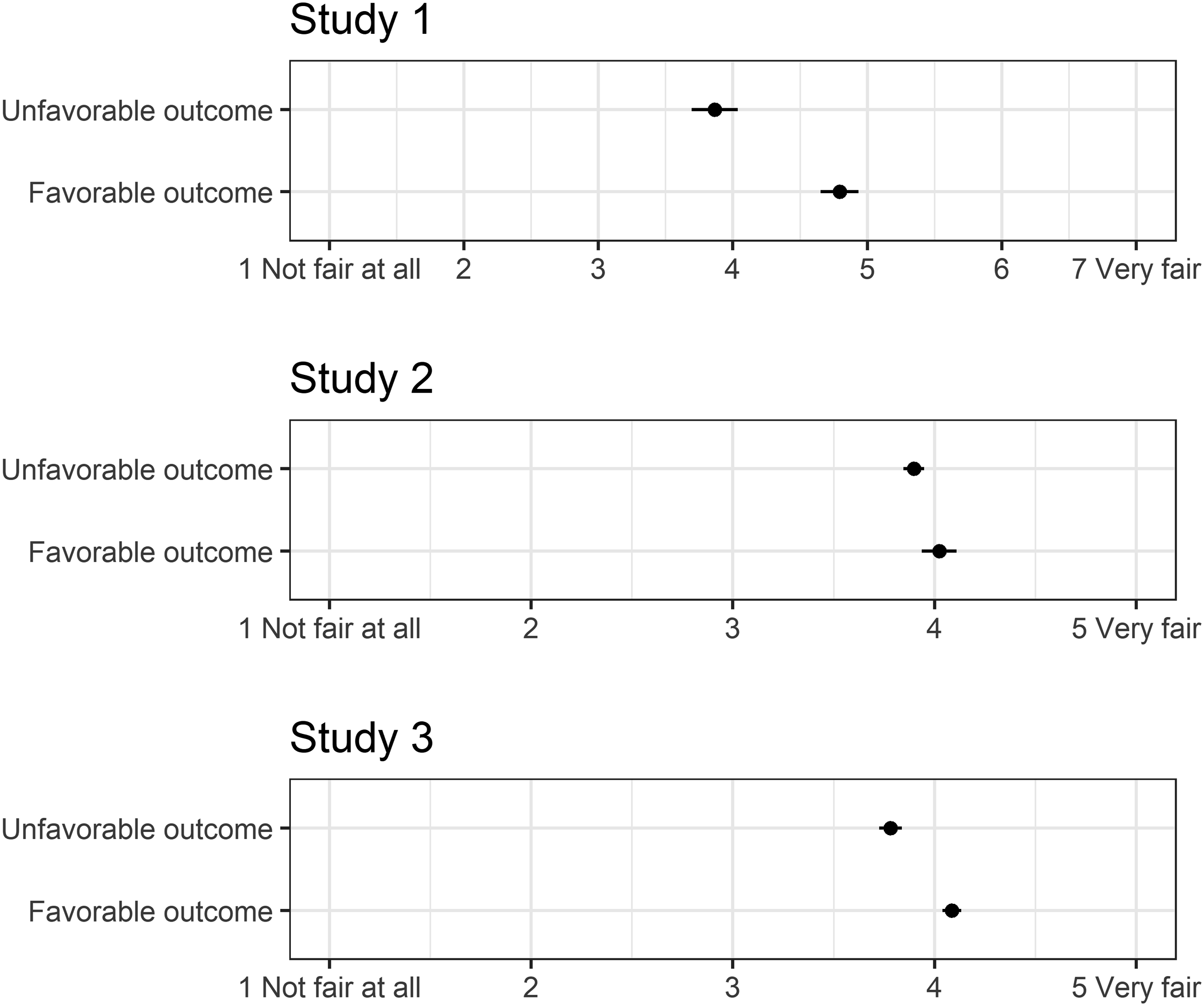
Having established that decision losers consider the process as more unfair than decision winners, we move to our core question: Can good loser messages from a co-partisan leader counteract this tendency and motivate citizens to evaluate the procedure more favorably? We approached this question somewhat differently in the respective study.
Good Loser Message Effects: Study 1
In the lamenting leader condition, subjects learned that the leader of the largest opposition party appeared after the decision to say that “we are disappointed and we believe that the decision//to ban//not to ban//begging in the municipality is wrong.” In the generic good loser message condition, the leader continued as follows: “…but we realize that one cannot always have it one’s way in a democracy.” Thus, the good loser message consists of a brief reminder about the terms of representative democracy. Realistically, this was a weak signal to followers. 6
As expected, the generic good loser message motivated policy losers to make less biased evaluations of decision-making arrangements. Figure 2 shows how fairness assessments in the treatment group, which heard from the co-partisan leader, differed from fairness assessments in the control group (ITT estimates). The difference is statistically significant (t-value 4.18). The treatment effect corresponds to almost one-half standard deviation of the dependent variable, which should be considered substantial since the signal was weak. The good loser message effect is also statistically significant when compared with the lamenting leader condition (t-value 2.87). How a generic good loser message affects the procedural fairness assessment of policy losers (Study 1).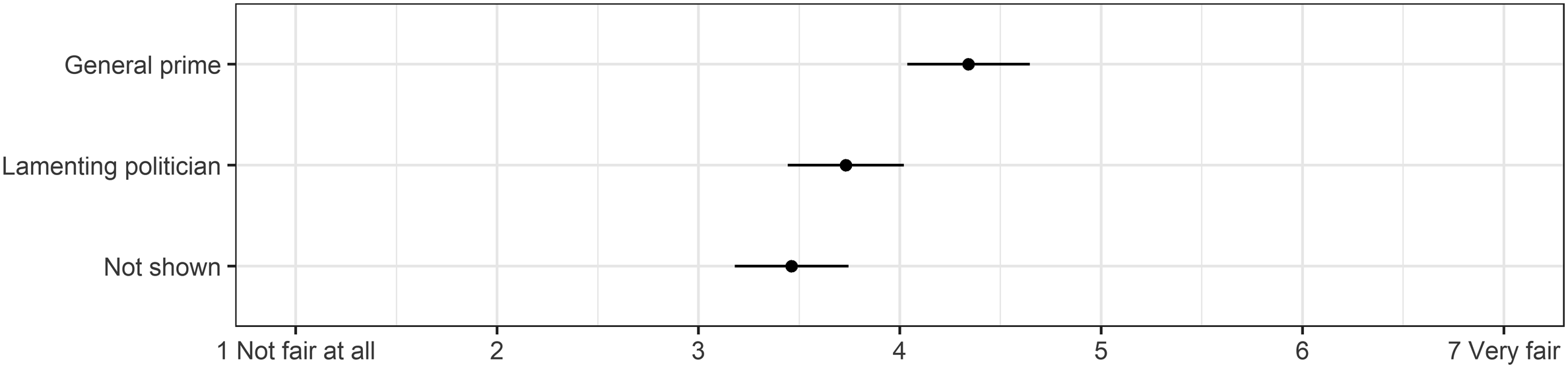
Good Loser Message Effects: Study 2
Besides the change in national setting from Sweden to Norway, the most important difference from Study 1 is that Study 2 included a decision-specific good loser message condition. Just as before, a leader from a party that voted for the losing proposal began by lamenting the decision and then presented the good loser message, echoing Study 1. The generic good loser message that followed was somewhat longer and more elaborate than in the previous study: “However, this is how it works in democracy. Sometimes you win, sometimes you lose. In the end, the majority won and we must accept the decision and move on.” Since the leader explicitly referred to the majority rule and stressed the importance of accepting and moving on, the signal to policy losers was stronger than in Study 1.
The decision-specific good loser message made the same final remark about majority rule and the need to move on, but with reference to two characteristics of the actual decision-making process: consistency in decision-making and the opportunity to voice concerns: “However, it was a fair fight where both sides had a chance to bring up their arguments. In the end, the majority won and we must accept the decision and move on.”
Once again, the data support that good loser messages motivate policy losers to make less biased fairness assessments. As shown in Figure 3, subjects who were exposed to any type of good loser message assessed decision-making arrangements more positively than subjects in the control group, who were not shown the message. The good loser message effect is also visible in comparison to the lamenting leader condition.
7
How generic and decision-specific good loser messages affect the procedural fairness assessment of policy losers (Study 2).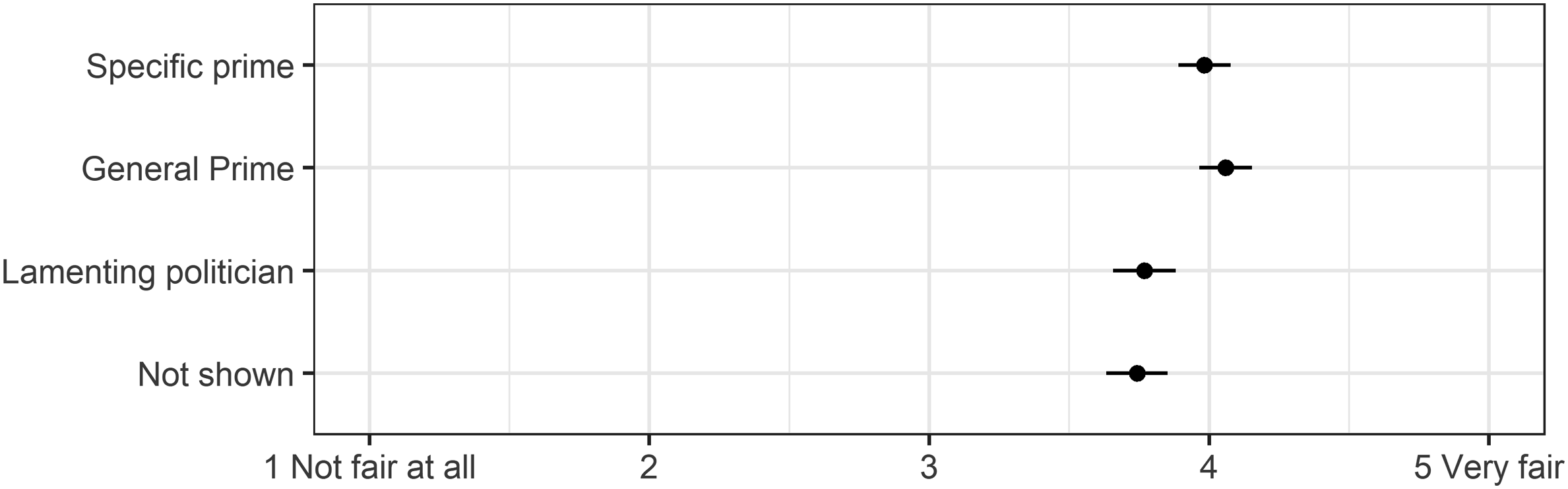
In substantial terms, the treatment effect for a respective good loser message corresponds to almost one-half (generic message) and one-third (decision-specific message) of a standard deviation of the dependent variable. The difference in effectiveness between the two types of good loser messages is small and not statistically significant. 8
Good Loser Message Effects: Study 3
For Study 3, we employed a conjoint design. The conjoint design allows us to explore the scope conditions of findings. The advantage of conjoint designs, a method increasingly used in experimental political science research (Leeper et al., 2020), is the possibility to include a large number of experimental treatments and estimate their effects simultaneously (Hainmueller et al., 2014). The stimulus material for each respondent consists of randomly combined attributes of the given treatment dimensions, resulting in sufficient observations for each treatment dimension while only a small share of the possible combinations is actually shown to participants. This enables us to include context variables in our design and to test our relationships of interest across a range of other factors that could potentially interfere with the treatment. As a result, we gain insights into generalizability and robustness of our findings. Our conjoint design is presented as a text vignette with rating outcome measures like in studies 1 and 2. For similar applications in conjoint designs, see for example Huff and Kertzer (2018).
We have considered three conditions that could potentially affect policy losers’ reactions to unwelcome decisions: the source of the good loser message; the size of the winning majority; and the presence of a gloating representative from the winning camp. Moreover, to further increase generalizability of findings, Study 3 involves another contentious policy issue in addition to the ban of begging: the introduction of a local road toll for diesel cars. 9
The source of the good loser message was either the leader of one of the parties that was against the decision or an editorial from the local newspaper which supported the losing proposition. This will tell us whether it is essential for policy losers that the message is delivered by a politician who was directly involved in the decision-making process or whether other elite sources are equally effective. The winning margin, when mentioned, was either large or slight. This will tell us whether policy losers condition their reaction upon the closeness of the race. In the gloating winner condition, a politician from the winning side stated that “it was a good decision and that common sense prevailed.” This will indicate whether policy losers are highly sensitive to the reactions of the winning camp.
Treatment Dimensions, Attributes, and Corresponding Vignette Text.
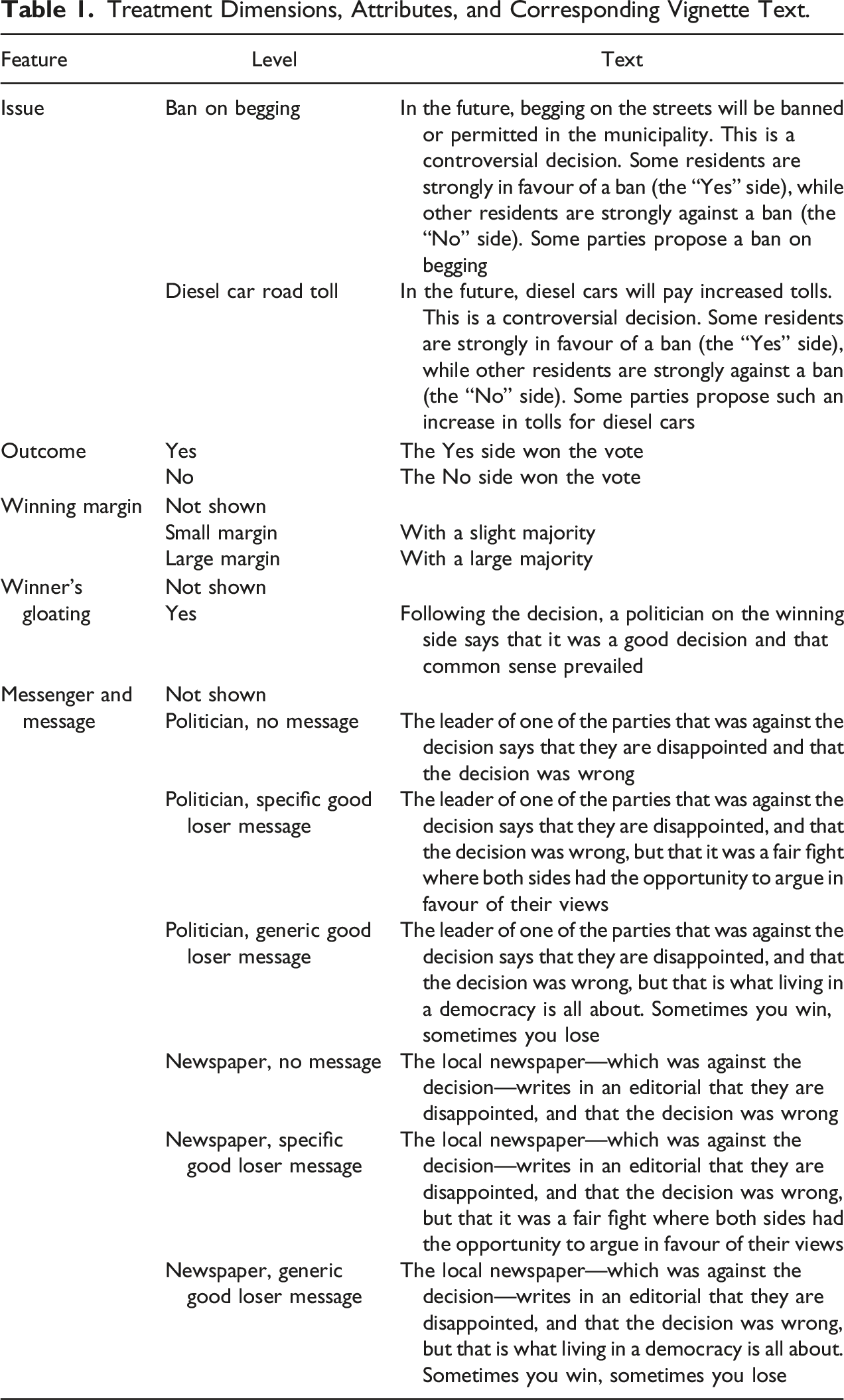
All attributes were uniformly distributed, with the exception that we excluded the combinations of a message without a messenger, as this combination would not be logically plausible. We chose to distribute the treatment levels uniformly across the vignette population since there is no measurable real-world target population and no theoretical reason to deviate from the de facto default uniform distribution (De la Cuesta et al., 2022).
Estimating the effects using the average marginal component effect (AMCE), we found that the fairness assessments of the policy losers were robust to these variations of the situational factors included in the experiment. That is to say that averaged over whether (i) the issue is road tolls or bans on begging, (ii) the messenger is a politician or a newspaper, and (iii) the winning margin of the vote was small or large, the good loser messages were effective. Important to our understanding of the scope conditions of the good loser message effect, all of this suggests that good loser messages may work in the context of a number of potentially influential situational factors. 10 This is especially informative regarding the source of the good loser message which we will discuss further in the conclusion section.
Turning to our key predictions, Figure 4 shows once more that good loser messages lead to significantly more positive—less biased—assessments of decision procedures relative to the baseline condition of no message. When compared to the control condition, effect sizes were similar to Study 2. The one deviation from the expected is that this time the lamenting leader condition differs significantly from the control condition. This is an unexpected finding for which we admittedly have no convincing explanation. Main effects from the democratic primes in study 3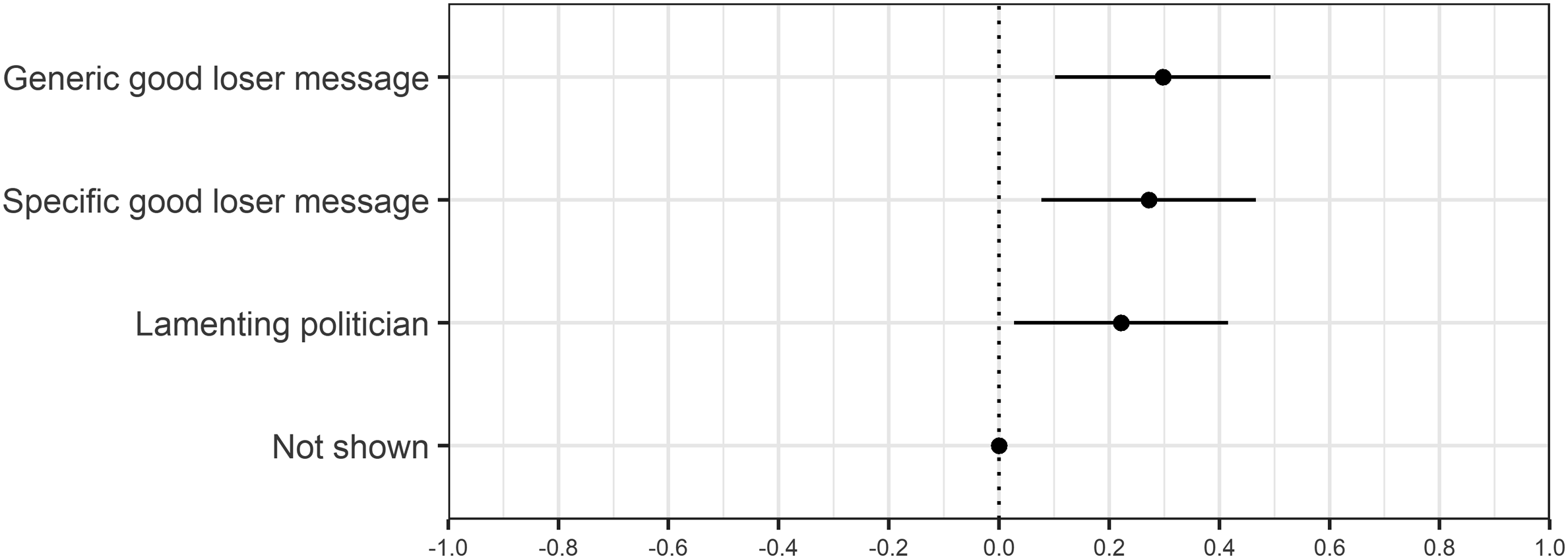
Additional Analysis
Are all policy losers equally receptive to good loser messages? Considering the propensity that people have to defend beliefs that are important to them (Howe & Krosnick, 2017), we might expect policy losers who care the most about the issue to be the least responsive to good loser messages. However, considering mixed findings in the literature regarding, for example, issue importance and vote choice (Mullinix, 2016), we are open to other findings.
For an empirical test of heterogeneous responsiveness among policy losers, we have estimated the marginal effect of the good loser message on procedural fairness assessments with 95% confidence intervals conditional upon personal importance of the issue as reported prior to treatment. We do not detect statistically significant interaction effects in our three studies. 11 Hence, we find little evidence of the moderating role of issue importance.
Robustness Check
For a robustness check, we looked at outcome measures that are more causally distant from good loser messages than fairness assessments of decision-making arrangements. According to the idea of good losers in democracy, policy losers’ recognition that winners have upheld their part of the deal should subsequently motivate a temporary acceptance of unwelcome decisions and maintained commitment to the decision-making authority (Sabl, 2005). Leveraging these “downstream consequences” of procedurally fair decision making, we predict that good loser messages will lead to higher levels of decision acceptance and trust in the politicians who made the decision.
Good Loser Messages and Indicators of Decision Acceptance among Policy Losers (OLS estimates Study 1 and Study 2, AMCEs Study 3).
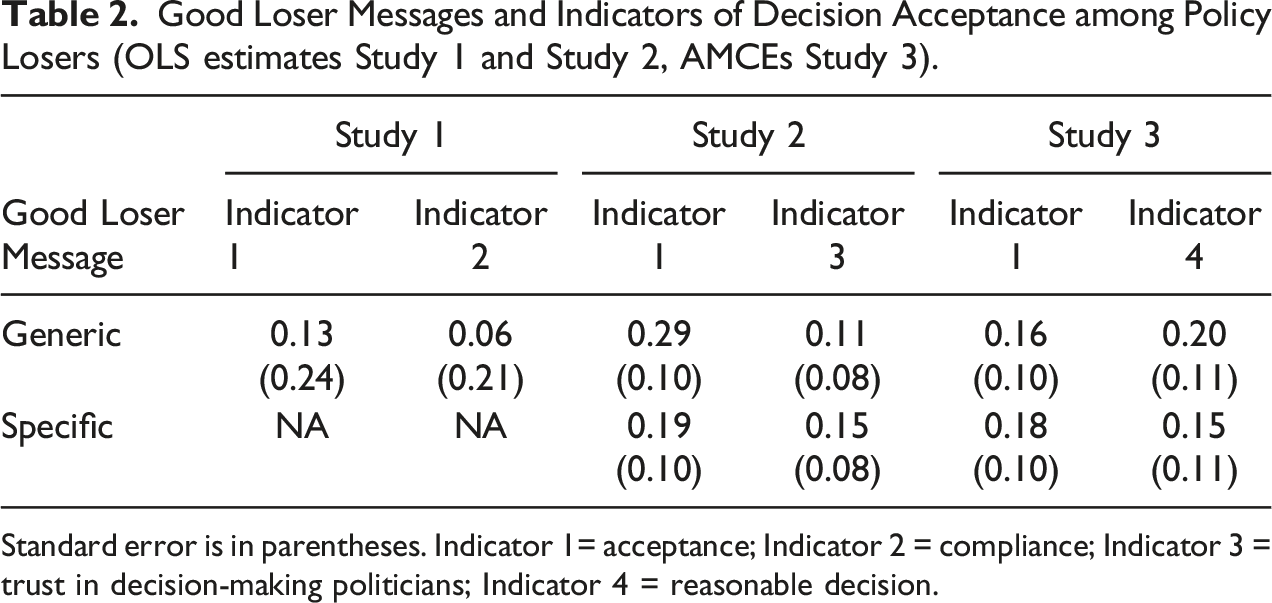
Standard error is in parentheses. Indicator 1= acceptance; Indicator 2 = compliance; Indicator 3 = trust in decision-making politicians; Indicator 4 = reasonable decision.
Conclusion and Implications
In this paper, we have focused on a seldom-observed fact in contemporary democracy: Most citizens recognize the importance of being constructive about political loss, but they struggle to act accordingly in policy controversies between elections. We proposed that good loser messages from a credible source such as a co-partisan leader can motivate policy losers to be their better democratic selves and strengthen the perceived fairness of the decision-making process. Evidence from three survey experiments from two different national settings supports this claim.
To provide context for our findings, it is important to consider how difficult it is for policy losers to acknowledge that decisions have been made fairly. Policy losers either must accept a higher level of dissonance or think more positively about the outcome, since it was made fairly. Tellingly, most interventions to de-bias the processing of political information are, at best, moderately successful (Bolsen et al., 2014; Christensen, 2017; Kahan, 2016; Nyhan & Reifler, 2015).
When viewed in this manner, our findings are encouraging for democratic stability. The effects are substantial enough to make a difference in citizens’ reactions during policy controversies. This is especially good news (if democratic stability is prized) as the good loser messages in the experiments were designed to be realistic, not to maximize impact in an artificial setting. Leaders of the losing camp simply remind followers about the realities of representative democracies (a generic good loser message), or that the procedure preceding the decision was fair (a decision-specific good loser message), much like responsible leaders do on election night.
Importantly, our conjoint study suggests that alternative sources of good loser messaging, such as news media outlets, might be equally effective as in-group politicians. This is important because it calms fears that leaders with an established relationship with their followers are needed for policy losers to deal with their frustration with the decision (Lenz, 2013). While it was out of the scope of the present study to explore this potential in depth, it opens a promising avenue for further research on the role that actors outside party politics can play in establishing consent—particularly when political elites do not rise to the occasion.
As with every study, ours have some constraints that necessitate further research. We do assume that the general mechanism holds across other European contexts, given that there is no reason to believe that citizens feel less strongly about local policy conflicts in Norway and Sweden than in, say, Germany or France. But it remains to be tested whether the effect can be generalized to more conflictual and less-trusting polities than Norway and Sweden as well as to other policy issues than the ones under study. Further, we decided to describe policy conflicts without specifying the party membership of the involved politicians. This was done to study the effect of good loser messages in isolation. However, it is an interesting question whether partisan attachments would depress or strengthen the effect of good loser messages which should be taken up in future research. Last, future research could provide more in-depth insights into the actual reasoning that citizens provide for their fairness perceptions.
Our study speaks to several branches of literature that pertain to democratic legitimacy. For instance, our findings add nuance to the claim in procedural fairness theory that people care about how decisions are made (e.g., MacCoun, 2005; Tyler, 2006). Our study also contributes to the ongoing search for ways to de-bias the way people process information (e.g., Nyhan & Reifler, 2015). Regarding the research on representative relationships, it provides further examples of successful top-down opinion formation (Grose et al., 2015). Moreover, our study can also be situated in the debate over deficits in perceived democratic legitimacy and the role played by political leaders in fostering this democratic resource (Neblo et al., 2018).
However, the most important implication concerns real-world politics and the need for new mechanisms to quell conflicts. Our study suggests that political leaders can help maintain respect between political camps in connection with policy controversies between elections. It is important to note that the proposed measure asks no more from leaders than that they act between elections as they typically do on election night by publicly recognizing standard democratic procedures. Our findings also suggest that good loser messages can be effectively signaled by informal leaders such as news media editorials and not only by elected politicians.
Will democratic leaders rise to the occasion? There is no constitutional requirement for leaders to be good losers, and the notion might even be at odds with strategic electoral goals. But, provided that leaders of the winning camp are fulfilling their part of the deal, this is a matter of acknowledging the long-term sustainability of democracy, what Levitsky and Ziblatt (2018) call “forbearance.” Discovering the conditions for which political leaders might be prepared to demonstrate such restraint is a topic for future research.
Supplemental Material
Supplemental Material - How to be Gracious about Political Loss—The Importance of Good Loser Messages in Policy Controversies
Supplemental Material for How to be Gracious about Political Loss—The Importance of Good Loser Messages in Policy Controversies by Peter Esaiasson, Sveinung Arnesen, and Hannah Werner in Comparative Political Studies
Footnotes
Acknowledgments
Previous versions of the paper were presented at the 2018 and 2019 Midwest meetings, at the 4th Barcelona-Gothenburg-Bergen Workshop on Experimental Political Science, and at Department of Political Science Research Seminar at University of Vienna. We thanks participants and in particular Elisabeth Ivarsflaten and Mike Tomz for constructive suggestions.
Declaration of Conflicting Interests
The authors declared no potential conflicts of interest with respect to the research, authorship, and/or publication of this article.
Funding
The authors disclosed receipt of the following financial support for the research, authorship, and/or publication of this article: This research was supported by the Research Council of Norway (Grants #262986 and #295892), the Swedish Research Council (Grant # 2017-01146), and the European Research Council under the European Union’s Horizon 2020 research and innovation programme (grant agreement No. 759736).

Notes
Author Biographies
References
Supplementary Material
Please find the following supplemental material available below.
For Open Access articles published under a Creative Commons License, all supplemental material carries the same license as the article it is associated with.
For non-Open Access articles published, all supplemental material carries a non-exclusive license, and permission requests for re-use of supplemental material or any part of supplemental material shall be sent directly to the copyright owner as specified in the copyright notice associated with the article.
