




Abstract
Competence shocks cut through partisan and other salient divides to impact party reputations and electoral choice. We examine whether the COVID-19 pandemic was a competence shock in Britain – a context where the issue of Brexit had otherwise dominated and reshaped electoral choice. Using British Election Study panel data between 2019 and 2022, we show that Brexit support had little effect on pandemic performance evaluations, that the pandemic served primarily as a competence shock and that the incumbent Conservative government lost popular support over its handling of the pandemic. The Conservatives were insulated from electoral losses by leader evaluations and by partisanship, but lost more of their newer voters from the 2019 general election. While the pandemic was exceptional, its effects have wider lessons for British politics in the post-Brexit era. The British case also provides insights into how competence shocks can cut through highly salient and otherwise dominant socio-cultural political divides.
The COVID-19 pandemic was an exceptional event. In Great Britain, the pandemic immediately followed a general election, in December 2019, fought in the highly salient and divisive political context of Britain’s exit from the European Union ((EU) ‘Brexit’). It was the first electoral test of the British government following the election and following Britain’s departure from the EU. From an analytic perspective, it provides the first test of whether the importance of ‘Brexit’ would mean that new events and policy shocks would be influenced by that Brexit ‘lens’. British voters had aligned behind the two largest parties (Labour and the Conservatives) in ways that closely matched their Brexit preferences, which, in turn, were strongly predicted by educational attainment and age (Cutts et al., 2020; Evans et al., 2023; Fieldhouse et al., 2020; Green, 2021; Prosser, 2021). The Brexit case also shares useful similarities with the rise in socio-cultural issues in other Western democracies and similarly realigning demographic divides (Ersson and Lane, 2003; Kitschelt, 1994; Kriesi, 2008; Norris and Inglehart, 2018; Stubager et al., 2021). The British case allows us to examine the electorate’s response to the pandemic in a context where the socio-cultural dimension had risen significantly in salience. It provides a test of the pandemic’s effect on political support; whether it was primarily a competence shock or ‘valence’ issue for voters, whether it was ideologically driven by differences in opinion over COVID lockdowns, and whether that changed as the pandemic unfolded. It also brings insights for understanding the British electorate specifically, in a period of volatility and political upheaval (Fieldhouse et al., 2020).
This article poses and responds to the following questions: Would the issue of Brexit in Great Britain insulate the government from perceived inadequacies in its performance on the pandemic, happening so soon after the 2019 election in which the Conservatives won a majority? To what extent did this first big test of the government confirm or cut across the ties that had been so recently in evidence around ‘Leave’ and ‘Remain’ in the EU referendum? Was the COVID-19 pandemic sufficient in this context to cost the incumbent government a substantial loss of support? To what degree was the pandemic a ‘competence shock’? A competence shock is an event that sends a strong signal to the electorate about the government’s competence in office, cutting through partisan alignments and other salient divides (Fieldhouse et al., 2020; Green and Jennings, 2017). How important were ideological differences over lockdowns and personal freedoms? And finally, how did the dynamics of the pandemic’s evolution over time affect these conclusions, as fatalities soared and lockdowns continued, and then as the COVID-19 vaccine was rolled out throughout the population? This article uses an extended panel study conducted throughout the pandemic (the British Election Study Internet panel; Fieldhouse et al., 2024) to bring new insights into these specific and more general questions.
Our analysis focuses first on the factors associated with government performance evaluations regarding the pandemic. We find strong leader and partisanship effects, minimal Brexit preference effects and we test a number of possible factors concerning the role of vaccine take-up, financial assistance like furlough and exposure to the pandemic. We illustrate how the COVID-19 pandemic served mainly as a competence shock that affected Brexit ‘Leave’ and ‘Remain’ voters in roughly equal measure, thereby shifting voters’ evaluations irrespective of their EU referendum preference. Furthermore, by analysing the relationship between COVID handling and more positional questions (whether respondents were in favour of prioritising the economy and personal freedom over reducing infections), we show that the pandemic was much more a valence issue (Stokes, 1963) than a positional one, and that this was true throughout the whole pandemic period.
Turning next to changes in vote intention, we find that perceived COVID-19 handling had a strong effect on loss of support for the Conservatives over this period, but there was minimal evidence that respondents’ Brexit preference served to insulate the Conservatives from these losses. There was a slightly greater defection rate among Leave voters for the Conservative party than among Remain voters, but these effects were relatively small in size. Partisanship, in contrast, continued to shape electoral behaviour in Britain in the face of the pandemic, as did ratings of the Prime Minister, Boris Johnson. Most simply, the greatest Conservative losses in this 3-year period, on the basis of the government’s handling of the COVID pandemic, happened among voters the Conservatives had recently acquired in the 2019 election and who subsequently became undecided. These less strongly aligned voters were the first to shift their support away from the Conservatives, as we might more generally expect in any electoral context.
Our findings have implications for how the British Conservatives would struggle to keep their ‘Leave coalition’ together. It might have been assumed, given the sheer dominance of Brexit on political debate and electoral behaviour, that the Conservatives could count on their Leave supporters, at least in the first years following the 2019 general election when they had just backed the Conservatives and Boris Johnson, and before ‘Bregret’ (waning support for Brexit) had taken effect. While support for Boris Johnson gave the Conservatives some insulation during the first two years of his premiership, his subsequent fall from grace (which happened when news emerged over parties and breaches of lockdown rules within government), and the lower support of subsequent Conservative leaders, would now be an electoral liability. In addition, a competence shock is most likely to lose the Conservatives support among their most recently acquired voters, for whom a pro-Brexit attitude provides little insulation against defection. This has significant implications for British politics, not least because the pandemic shock was followed by a series of scandals and a deep and prolonged economic shock. We consider the implications of this particular episode for Britain and for what it may teach us about political behaviour more generally in respect to accountability, and for the potential of new aligning issues to continue to shape electoral choice. In an era when there is economic turbulence facing political systems around the world, the electoral influence of governing competence to handle such crises may become substantially greater.
The COVID-19 Pandemic: How Did Voters Respond?
The COVID pandemic was unprecedented, and so its impacts on public opinion and electoral behaviour are not obvious. As a salient event, it could have shifted electoral outcomes substantially.
In terms of attribution and blame, the global experience of the pandemic may have contributed to the sense that negative outcomes were somewhat inevitable, the fault of others, not of a country’s government, and this would likely lessen the electoral penalty on governments dealing with the crisis. Voters distinguish between responsibilities and outcomes that are beyond the government’s control (Tilley et al., 2018) and attribute less blame to their own government when they see that things are worse elsewhere (Kayser and Peress, 2012). This pattern is consistent with some early experimental evidence in India on the pandemic, which showed limited attribution and handling evaluation updating for the pandemic at the beginning of the crisis (Acharya et al., 2020).
However, the sheer scale of the pandemic may have meant it had the potential to deliver a powerful and also a deeply personal signal for individual voters about the government’s performance. Salient electoral shocks have the power to transcend existing political predispositions (Fieldhouse et al., 2020). Among these, competence shocks are events (policy shocks or political events) that send a powerful competence signal to voters, high enough in salience to be noticeable, and significant enough to substantially shape public opinion about government competence, their handling of different issues (even of their traditional issue strengths, or their ‘owned issues’ (Petrocik, 1996) and to move generalised evaluations of a party’s or government’s competence (Fieldhouse et al., 2020; Green and Jennings, 2012). Competence shocks can cause updating of performance assessments that cut through other political divides and they can also update partisanship (Green and Jennings, 2012, 2017; Plescia and Kritzinger, 2016), particularly when information is high and disruptive (Chzhen et al., 2014), as it undoubtedly was during the pandemic. Competence shocks, by definition, relate to government performance, handling or ‘valence’ (Stokes, 1963), and as such, are not aligned with other ideological divides. We would therefore expect their effects to cross-cut other political divides and issues, shifting voters similarly, regardless of other ideological divides. Other examples of competence shocks include major economic failures or events; the Global Financial Crisis, and before it, in Britain, the Exchange Rate Mechanism crisis (when Britain was forced out of the European Exchange Rate Mechanism). Both shifted British voters’ views of government competence on the economy, both cut through partisan divides and both affected public opinion, given their electoral potency, for many years.
The COVID-19 pandemic provided very salient information to voters about government competence, preparedness and effectiveness in dealing with an unparalleled crisis. In the US, it was argued to be decisive for Donald Trump’s election loss in the 2020 US presidential election (Baccini et al., 2021; Neundorf and Pardos-Prado, 2022). That election was fought at the height of the pandemic, with political polarisation around actions to curb it (Allcott et al., 2020). Analysis showed that COVID cases cost President Trump up to 5 percentage points in vote share (Baccini et al., 2021), a finding supported by experimental analysis showing that voters, especially older voters, updated assessments of economic and health handling in response to COVID case numbers (Neundorf and Pardos-Prado, 2022). Further cross-national evidence for the pandemic’s effects found a relationship between higher COVID case numbers and lower government approval across 35 countries (Herrera et al., 2020), suggesting a consistent response to the pandemic in evaluations of government handling. Key events during the pandemic were associated with more negative or positive government handling evaluations in Britain (Vlandas and Klymak, 2021). This had the hallmarks of a competence shock; it was high salience, provided information to voters about government competence and was likely a shock that was largely orthogonal to other ideological issues.
The COVID pandemic was, of course, also personal. Just as personal COVID exposure to the virus decreased trust (Amat et al., 2020), we would also expect that COVID exposure impacted evaluations of government handling, through experiencing COVID, having a friend or family member who had caught the virus or living in an area where COVID infection rates were especially high. As vaccines became available, and as people benefitted from COVID-related financial assistance like furlough in the UK, 1 governments could have received an electoral reward from those individuals who had benefitted from these solutions. Conversely, vaccine take-up was also affected by partisanship in the US, though not in the UK where bipartisan support for COVID vaccine uptake was greater (Klymak and Vlandas, 2022).
Partisanship could, then, still remain an important influence upon performance ratings in general, particularly for those with stronger partisanship. There is considerable research showing the role of partisanship on performance ratings (see Bartels, 2002; Evans and Chzhen, 2016; Kuechler, 1991; Vliegenthart and Lefevere, 2018; Walgrave et al., 2015), and on attributions of responsibility (Bisgaard, 2015; Malhotra and Kuo, 2008; Marsh and Tilley, 2009; Tilley and Hobolt, 2011). In some cases, the crisis may have served to confirm existing political predispositions, as appeared to be the case, for example, in evidence in Costa Rica (Pignataro, 2021). This could be more likely if levels of partisanship were high and in periods when voters rallied behind incumbents, as they did especially towards the beginning of the crisis (Baekgaard et al., 2020; Kritzinger et al., 2021; Schraff, 2021), arising through fear as through trust (Seyd and Bu, 2022). There was evidence in Britain of latent trust in the government (Gaskell et al., 2020), indicative of voters having sympathy with the gravity of the challenge facing policymakers.
Finally, the COVID-19 crisis could, at least potentially, have been about the different means to deal with the pandemic; whether a country should be subjected to extensive restrictions and lockdowns or whether individual freedoms were more important (Mellon et al., 2021), with some supporting governments because of lockdowns (Bol et al., 2021), and evidence of support for COVID-19 measures being associated with polarised trust in different partisan in-group or out-group leaders (Cole et al., 2022). This may have been increasingly contentious, polarised and electorally relevant over time as resistance to lockdowns grew, suggesting that handling may have partly been a positional assessment, and that both ‘valence and position’ were relevant. An important question therefore is – to what degree did the pandemic represent a competence shock, and to what degree was it a question of ideological positioning with respect to personal freedom?
The British Case: COVID, Brexit, Boris Johnson
The 2019 British general election, and the 2017 election before it, realigned the electorate behind the Conservatives on the ‘Leave’ side of the Brexit debate, and behind the Labour party (as well as the Liberal Democrats, Greens and nationalist parties) on the ‘Remain side’ (Cutts et al., 2020; Evans et al., 2023; Fieldhouse et al., 2023; Green, 2021; Prosser, 2021). This electoral realignment sharpened longer-running transformations in the British electorate (Cutts et al., 2020; Sobolewska and Ford, 2020), representing a shift towards a strong age and education basis to electoral support for the two largest parties, and centre–periphery geographic divides (Fieldhouse et al., 2023). Brexit had come to dominate British politics, with Brexit polarisation and identities becoming strongly associated with other political attitudes and evaluations (Hobolt et al., 2021), and Brexit identities becoming more prominent than partisan identities (Evans and Schaffner, 2019; Hobolt et al., 2021). Many of the Conservatives’ newly recruited voters likely moved to the Conservatives in 2019 for the first time, since a swathe of their new supporters were ‘Labour leavers’ – those voters who had voted Leave but remained loyal to the Labour party through earlier elections and the 2017 general election (Green, 2021). The weaker loyalty to the Conservatives among these voters, and their likely weaker (or absent) Conservative partisanship may have made them a particularly volatile part of the incumbent vote base, and more sensitive, therefore, to the destabilising effects of ‘electoral shocks’ (Fieldhouse et al., 2020). Furthermore, there may have plausibly been some ideological overlap with respect to Brexit and support for different COVID measures, given Brexit was inherently about British freedoms.
Boris Johnson, the Conservative Prime Minister between 2019 and 2022, had greater popularity among Leave voters and the more Eurosceptic base of the Conservatives (Evans et al., 2023). Opinion polls showed an increase in Johnson’s popularity around the time he was in hospital with COVID (in April 2020), and he had more widely been credited with finally ‘delivering Brexit’. Boris Johnson would later suffer a dive in his popularity in 2022 when stories emerged of serial ‘lockdown parties’ in Downing Street, leading to his eventual resignation, but this happened after the first two years of his period as Prime Minister, which was otherwise dominated by Brexit and the pandemic.
The British government found itself unprepared for a pandemic. This was evident in the provision of protective health equipment, contact tracing, protection of vulnerable adults, and other public health measures. Britain was slow to follow World Health Organization advice on various mitigation steps. At one point, Britain had the highest COVID case and death rate of any country, peaking at over 1000 deaths a day on 8 April 2020. 2 It also began its first national lockdown at a late point in the curve of the first wave of the pandemic and subsequently imposed a longer lockdown than its European neighbours, beginning on 26 March 2020 and relaxing gradually from 10 May 2020. 3 English COVID measures were broadly in tandem in the nations of Great Britain, with some marginal differences in lockdown lengths and regulations in Scotland and Wales. The British government announced economic support packages in March 2020 (which began on 20 April 2020), and after an initial boost in its opinion poll ratings, the Conservatives saw their support decline. 4 There was little political opposition to the government’s legislative response in the first year of the pandemic, though competence and handling of the crisis was heavily criticised. Britain then had a relatively successful vaccine rollout programme, vaccinating its citizens before many countries within the EU.
These features of British politics might lead us to expect a number of informative features of the British electorate’s pandemic response. The first is that the Brexit divide might have insulated the Conservatives from some losses of support. Voters had just awarded the Conservatives their majority. A very large proportion of the Conservative vote was from among Leave voters. Boris Johnson had been elected in a victorious majority for his party, and the conditions on which Brexit could be judged a success or a failure were not yet in evidence in 2020 (Britain’s exit from EU was buffered from a transition arrangement through to the end of 2020). Indeed, the pandemic might have served to distract and confuse any forward-looking Brexit penalty or Brexit reward, now that the public’s attention had moved so rapidly to focusing on the pandemic. We might therefore expect some Brexit-based insulation from the government’s pandemic performance.
The pandemic in Britain had, aside from any Brexit effect, all the hallmarks of being a valence issue, though this may have altered over time, as objections to lockdowns became more forceful, as criticism of the government became louder or, conversely, as the successful vaccine rollout put focus on effective government handling in 2021 (for these reasons we remain agnostic about which should matter more in which time period). We would expect that COVID experience (exposure, vaccine uptake) would be associated with evaluations of government handling, with those exposed to the virus being more negative, and those vaccinated being more positive. Overall, we should expect the COVID pandemic to have acted as a competence shock, having a strong and significant effect on voting intention for the Conservatives, for the reasons given earlier. Partisanship, as well as support for the government’s leader, Boris Johnson, would be expected to insulate the Conservatives. Conversely, the newer voters and the weaker partisans for the Conservatives might have been the first voters to become ‘dislodged’ from their recent vote choice, and more likely to evaluate pandemic performance negatively. Accordingly, our focus on the British case leads us to the following hypotheses, which relate first to handling evaluations in respect to the pandemic, second to the role of pandemic handling on support (or losses of support) for the Conservatives and third to new voters and weaker partisanship.
Explaining Covid handling evaluations:
H1: Handling evaluations are associated with pre-pandemic partisanship, leader evaluations and Brexit vote choice.
H2: Handling evaluations are associated with personal exposure to the pandemic.
H3: Handling evaluations are associated with positional attitudes concerning the best response to the Coronavirus pandemic, varying in strength over time.
Explaining defection (a loss of support for the incumbent):
H4: Conservative voters who are more negative about the government’s handling of the pandemic are less likely to hold a Conservative voting intention in subsequent survey waves.
H5: Handling evaluations are more strongly associated with voting intention among 2019 Conservative voters than are their positional opinions about the response to the pandemic, varying in relative strength over time.
New voters, weak partisans:
H6: Conservative voters who did not vote for the party in 2017 are more likely to have changed their voting intention since 2019.
H7: Defection among new Conservative voters is greater for voters who reported weaker Conservative identities.
Data and Methods
To test these hypotheses, we use Waves 19–22 of the British Election Study Internet Panel (BESIP), a GB-wide survey administered by YouGov with a sample size of around 30,000 respondents per wave, and wave-on-wave retention of c.55%. Wave 19 was fielded between 13 and 23 December 2019, immediately after the 2019 UK general election but before the first confirmed Coronavirus death. Wave 20 was collected 6 months later, between 3 and 21 June 2020, towards the end of the UK’s first country-wide Coronavirus lockdown. Wave 21 followed 11 months later, fielded between 7 and 25 May 2021, at a time when the UK’s vaccination rate was one of the highest in the world. Wave 22 was collected between 26 November and 15 December 2021, which coincided with rising COVID cases but much lower fatality rates. Figure 1 depicts the timing of our data collection in relation to the UK’s experience of the pandemic.
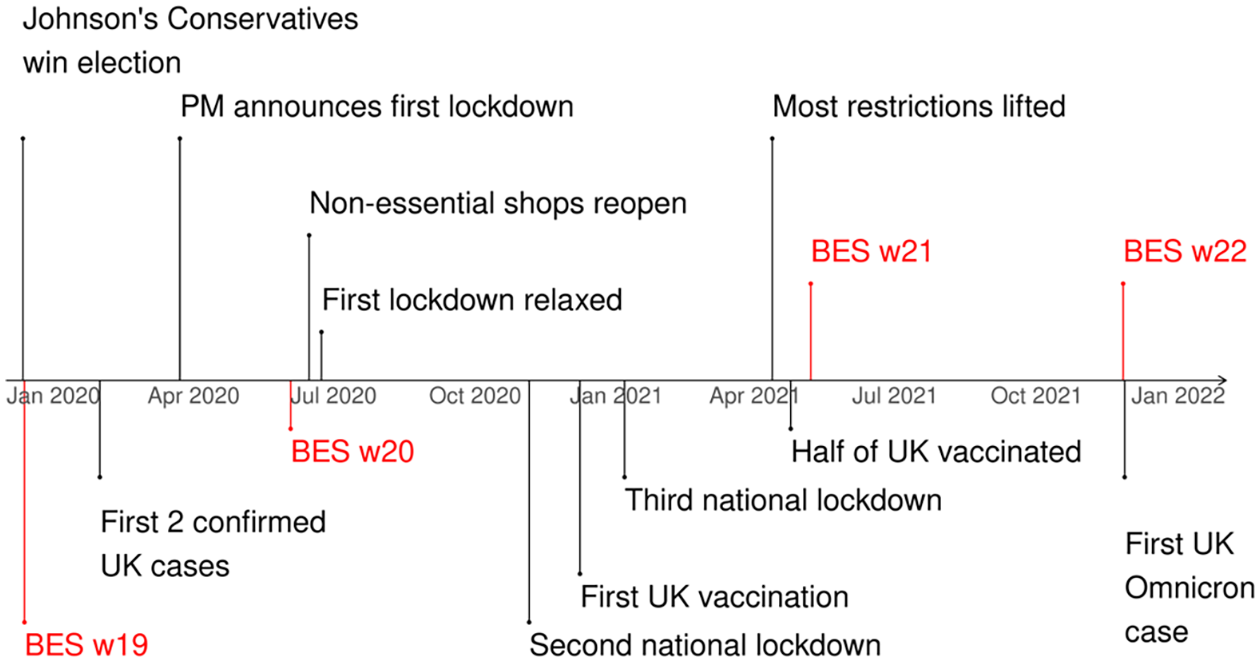
Timeline of Data Collection – Waves 19–22 of the British Election Study Internet Panel.
In Waves 20, 21 and 22 of the BES Internet panel, respondents were asked: ‘How well do you think the UK Government has handled the Coronavirus outbreak in Britain?’, with answers on a 5-point scale ranging from ‘very badly’ to ‘very well’, which we treat as a continuous variable. Respondents were also asked about their voting intention. To capture the extent to which handling evaluations reflect pre-pandemic political predispositions (partisanship, leadership ratings, EU referendum vote choice), we use a categorical variable in Wave 19 of partisan identity and strength, reflecting whether a respondent identified as a Conservative partisan, a partisan of another party or held no partisan identity, and whether partisan identity was very strong, fairly strong or not very strong. The reference category is ‘no partisan identity’. We also include a measure of support for Boris Johnson in the form of an 11-point thermometer rating of the Prime Minister. Objective measures of pre-existing political predispositions are provided by vote choices in the 2019 and 2017 general elections and the 2016 EU referendum.
We include two pandemic-related positional preferences that may influence an individual’s evaluation of the government’s performance (and vote choice): the degree to which it is preferable for the government to sacrifice citizens’ personal liberty, and the degree to which it is preferable to sacrifice the country’s economic prosperity in order to reduce infection rates. Responses to these ‘trade-off’ questions are given on an 11-point scale, where lower scores indicate less willingness to sacrifice liberty or the economy in order to reduce infections. The ‘freedom-trade-off’ question was only asked in Wave 20 and is therefore included as a time-invariant variable.
We include four variables measuring direct personal experiences of the pandemic. Exposure to the virus itself is measured by whether an individual believed that they had personally contracted the virus, or whether they knew friends or family whom they believe to have contracted the virus. Of the respondents present in all three pandemic waves, 27% reported personally having contracted the virus at some point, and 42% believed they knew someone who had contracted the virus. Vaccination, in contrast, can be considered an intervention that reduces exposure. We include a measure of whether an individual had already received at least one vaccine – 23% of our respondents had received at least one vaccination by May 2021, 93% by November 2021. To include a more objective measure of pandemic experience that does not rely on self-reporting, we control for the Coronavirus death rate in individuals’ local areas at the start of the pandemic, when respondents were most likely to be personally aware of local case rates. Local is defined as a respondent’s Middle-Layer Super Output area (MSOA), which are Census-defined areas that contain an average of 7000 individuals. The rate is included as the number of Coronavirus deaths as a proportion of total deaths, in the month of May 2020, in the middle of the first UK lockdown. The death rate data is provided by the Office for National Statistics (ONS).
To model exposure to the financial implications of the pandemic and the government’s response, we include a direct measure of whether a respondent received pandemic-related financial support from the government, via the job retention scheme or the self-employed income support scheme. This question was only asked in Wave 20 and is therefore included as another time-invariant variable. In all, 28% of our sample had directly benefitted from one of these forms of pandemic support, either personally or via their household. Full details of the variable coding are in Appendix 1 of the Supplementary Material.
To estimate the relationship of the above variables with handling evaluations, we employ pooled ordinary least squares (OLS) regression models, 5 with the Coronavirus handling measure as the dependent variable. The Wave 19 lagged variables are partisan identity, Boris Johnson’s thermometer ratings and demographic controls. 6 To examine whether the Conservative government’s handling of the pandemic resulted in electoral consequences, we use pooled logistic regressions to examine sources of lost support among the 2019 Conservative cohort. The dependent variable is a binary measure of Conservative voting intention with a value of 1 for those who continued to intend to vote Conservative, meaning that negative coefficients imply an increase in the chance of a respondent changing their voting intention away from the Conservative party.
Following Gelman (2008), we scale all continuous variables by subtracting the mean and dividing by two standard deviations, thereby facilitating meaningful comparison of coefficient size across continuous and dummy variables. All models include wave fixed effects, and standard errors are clustered at the level of individual respondents to avoid issues of serial correlation.
Results: Explaining Handling Evaluations
Figure 2 shows the results of a pooled OLS model with overall Coronavirus handling evaluations as the dependent variable. 7
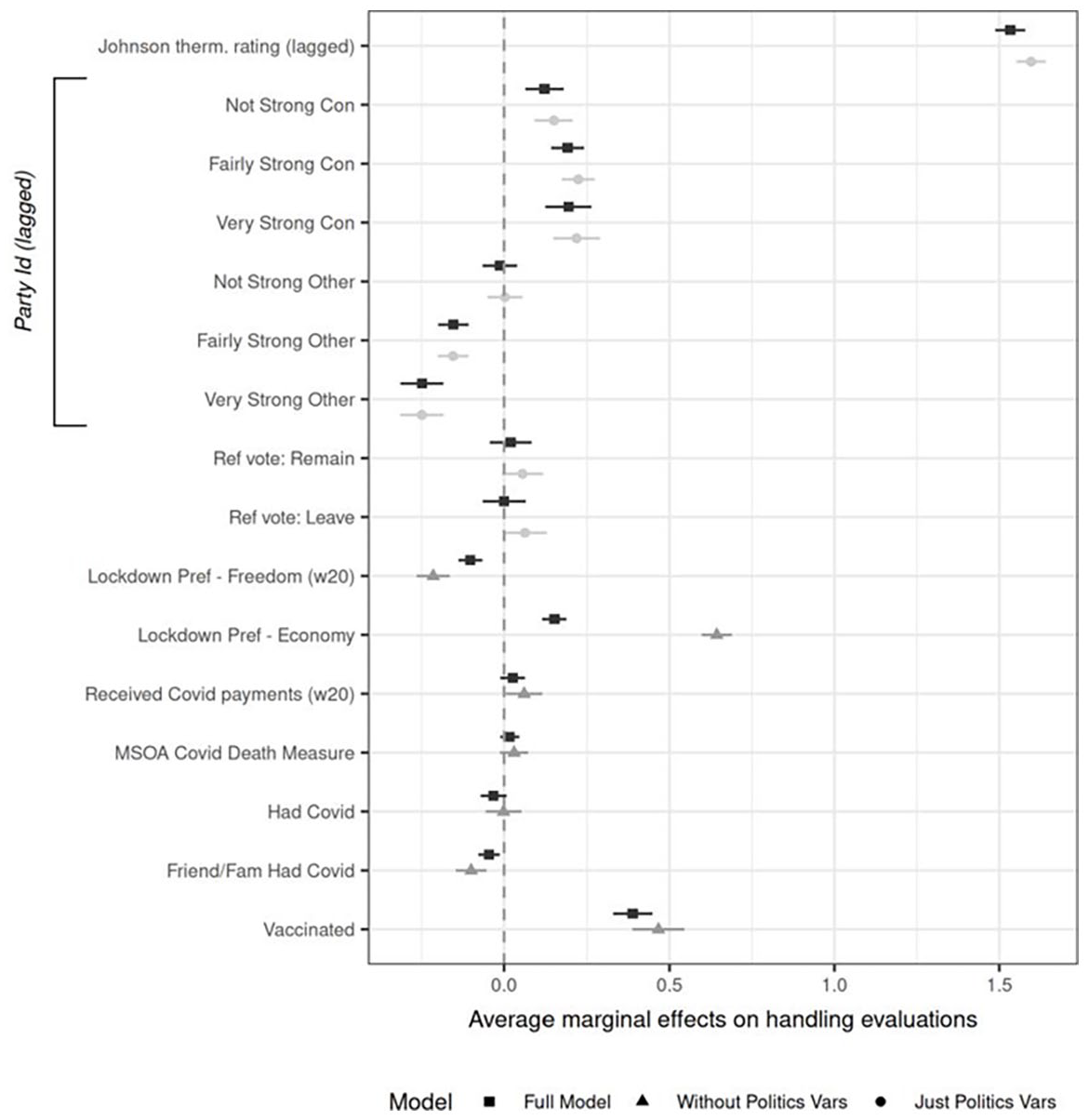
Pooled OLS Regressions Explaining Handling Evaluations (Whole Sample).
In line with Hypothesis 1, we find that Conservative partisans, particularly strong partisans, are more positive than non-partisans, while other partisans are less positive. Even more starkly, those individuals who felt more warmly about Boris Johnson in the wave prior to evaluating the government’s performance were much more positive; a two standard deviation in Johnson’s thermometer rating is associated with a 1.5 increase on the 5-point handling scale in the following wave, even after controlling for partisan identity, demographics and a range of variables capturing pandemic experience. Although not shown in Figure 2, the R2 for the models indicate that around half of the variation in handling evaluations can be explained purely by including lagged measures of Johnson thermometer ratings and partisan identity/strength, and the R2 is not increased by including the non-political controls. However, while the effects of partisanship and leadership evaluations are strong and significant, there is no additional effect of a respondent’s Leave or Remain vote choice in the 2016 EU referendum.
Personal experience of the pandemic, either financially or in terms of the virus itself, had very little effect on handling evaluations, contrary to the expectations laid out in Hypothesis 2. Suspecting that a friend or family member had contracted the virus is associated with slightly less positive evaluations of the government’s performance, but the magnitude is not big (less than a 10th of a point on the 5-point scale). Having received government payments due to COVID-related employment difficulties is also associated only marginally with viewing the government’s performance more positively, and this is not significant when controlling for political predispositions. Our measure of objective early-stage Coronavirus exposure, in the form of MSOA death rates, is not significantly associated with evaluations of the government’s handling of the pandemic. The one exception to this pattern in relation to exposure is vaccination status, which has a positive and sizable association with evaluations of the government’s handling of the pandemic. Respondents who reported having received at least one vaccination were half a point more positive on our handling scale than respondents who did not report receiving a vaccination, even when controlling for all other variables in our model. 8
Lockdown preferences explain some of the variation in handling evaluations, with slightly more positive evaluations coming from those who believe that the economy should not be sacrificed to curb infections, and from those who were more willing for personal freedom to be sacrificed to curb the virus (in Wave 20). There is some partial support for Hypothesis 3, although the coefficients are not large. These coefficients are somewhat larger in the model that does not include political preference variables, implying that they are also capturing, to some extent, prior feelings about the parties.
Overall, COVID handling evaluations were most strongly associated with feelings towards Boris Johnson, strength of partisanship, weakly associated with lockdown preferences and with COVID exposure, but not, additionally, with a respondent’s Brexit vote in the EU referendum, despite an expectation that Brexit could have played a large role in evaluations in the post-2019 period.
Results: Vote Intention
To examine the potential electoral consequences of the pandemic as a competence shock, we restrict our sample from this point to the subset who voted for the Conservatives in 2019. Our dependent variable is dichotomous, indicating whether in subsequent waves voters continued to hold a Conservative voting intention. A ‘defection’ is represented by 0 and continued support by 1.
Around 40% of our sample no longer held a Conservative voting intention by the end of 2022, despite voting Conservative in 2019, with most of these indicating that they were undecided. As Figure 3 shows, the Conservative party lost a number of supporters to ‘undecided’, as well as a portion to Reform UK (the successor party to the Brexit Party, and, before that, the UK Independence Party), and a smaller portion by November 2021 to the Labour Party.
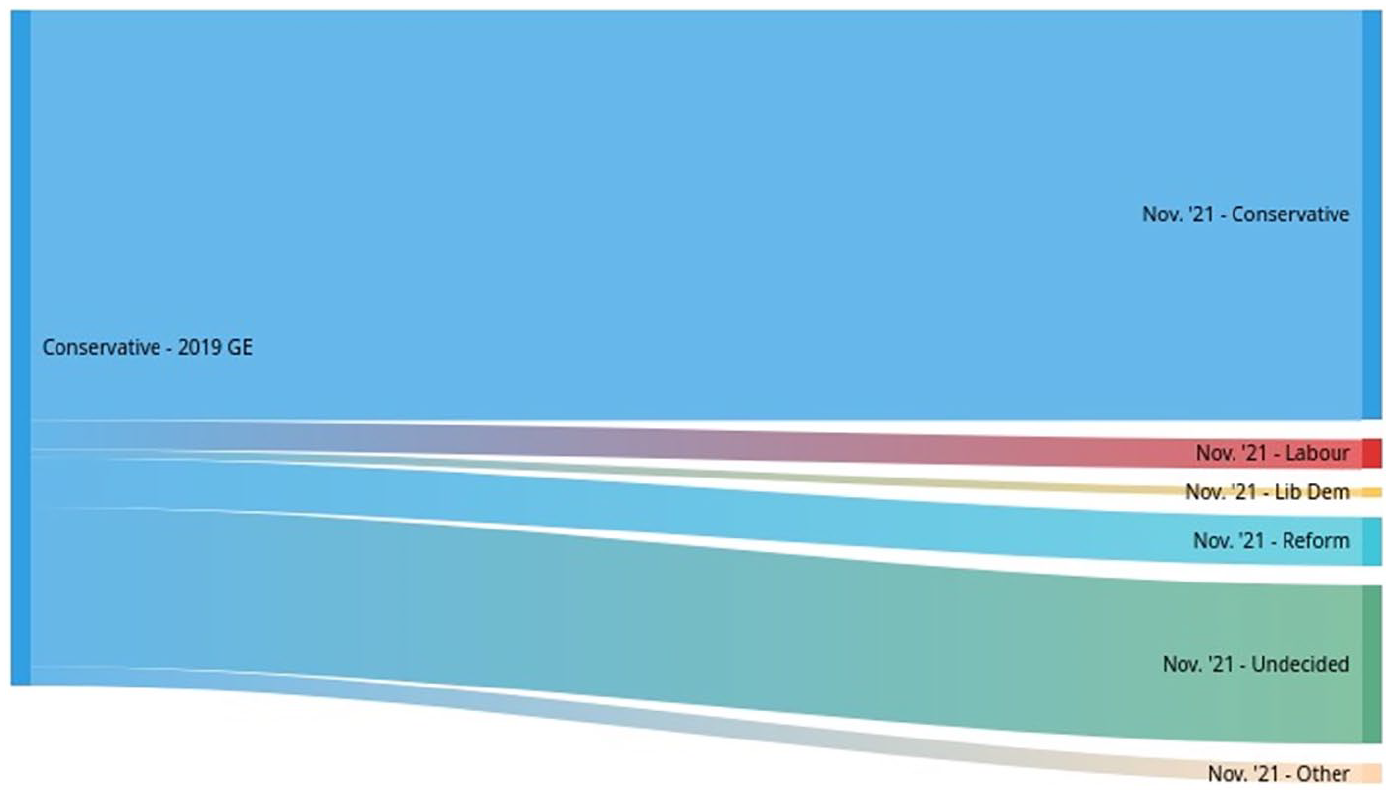
Vote Intention Flows From 2019 General Election to November 2021 (for Respondents Who Voted Conservative in 2019).
Figure 4 displays the results of a pooled logistic regression with Conservative voting intention (vs other) as the dependent variable.
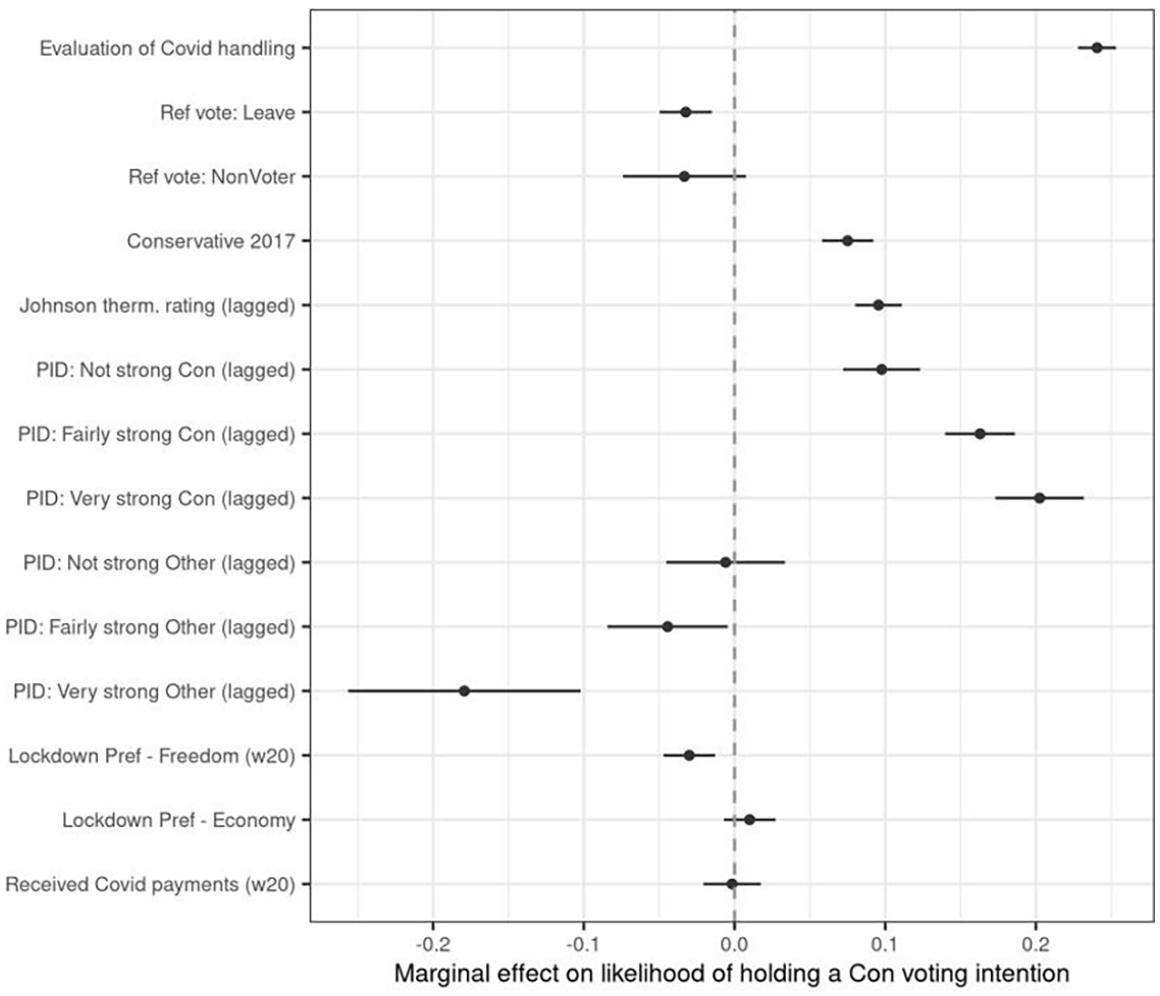
Conservative Voting Intention – Marginal Effects From a Pooled Logistic Regression of Respondents Who Voted Conservative in 2019.
The first important finding to note is that handling evaluations have a large and significant effect on the likelihood of holding a Conservative voting intention, even after controlling for the pre-pandemic political attitudes that partially determine these handling evaluations, providing strong support for Hypothesis 4. An increase in handling evaluations by two standard deviations, in a model that includes Johnson’s thermometer ratings and partisan identity and strength, is associated with an increased probability of a 2019 Conservative voter continuing to support the party of over 0.2 points.
Other political variables also affect the likelihood that a respondent remained loyal to the Conservatives in this period. Stronger Conservative partisans are, unsurprisingly, the most likely to have continued to hold a Conservative voting intention. Those who liked Johnson are also more likely to have retained their voting intention, though the effect of lagged thermometer ratings is decidedly lower in this model than was the case for handling evaluations. This is likely due, in part, to the fact that Johnson’s pre-pandemic popularity is less varied among 2019 Conservative voters than among the whole sample, with most Conservatives holding a positive view of the Prime Minister before the pandemic. Nonetheless, there is sufficient variation among the Conservative voters’ opinions of Johnson that a sizable effect of this variable was a possibility – ratings spanned the full 11-point scale in all four waves.
Further strengthening our argument that Coronavirus acted as a valence issue and competence shock, and in line with Hypothesis 5, preferences concerning a trade-off between the economy or freedom and reducing infections have little impact on defection: there is only a small negative effect of being pro-freedom. As additional evidence that voters were concerned about handling at the national level rather than their own personal gain from the government’s actions, we find that receiving Coronavirus-related financial help from the government also had no significant impact on continued support for the government.
Vote choice in 2017 continues to have a particularly large impact on Conservative support, in line with Hypothesis 6. Even after controlling for strength of partisan identity and thermometer ratings of Johnson, an individual who voted Conservative under Theresa May (the Conservative Prime Minister preceding Johnson) in the 2017 general election was nearly 0.1 points more likely to still hold a Conservative voting intention in June 2021 compared with an individual who did not.
Our model shows only a minimal additional effect of Brexit vote on Conservative defection, with Leave voters only slightly more likely to defect in this period. Brexit voters, who constitute 80% of Johnson’s supporters in our sample, were slightly less likely to hold a Conservative voting intention than those who voted for Remain in 2016. We find a similar negative association with Brexit attitudes when using a socio-psychological measure of Brexit identity or a measure of attitudes towards of EU integration, as can be seen in Appendix 5 of the Supplementary Material (Table A5.2). 9 It seems, then, that the Conservative government was already struggling to hold on to its newest cohort of voters soon after it gained their support, and was not insulated from criticism among Leave voters. It is worth noting that both of these variables had a fair degree of variation even among only 2019 Conservative voters – the Brexit identity scale has a standard deviation of 0.8 and the EU integration scale at 2.6.
Explaining Lost Support Among the New Conservative Cohort
As discussed above, the effect of the 2017 general election vote remains substantial even after controlling for a number of other political characteristics. 10 At a purely descriptive level, while a full 82% of those who voted Conservative in the last two elections would have done so again in June 2020, just 57% of the new cohort reported the same. 11 By November 2021, 67% of those who voted Conservative twice still intended to vote for the party again, but only 37% of the newer cohort did.
This difference in the level of continued Conservative support can be partly explained by the fact that the new cohort contains fewer Conservative partisans, and those who do hold a Conservative partisan identity tend to be weaker partisans than the 2017 cohort. We do not find evidence that the difference in voting intention between the two groups can be fully explained in terms of handling evaluations or thermometer ratings of Johnson, though as we showed in the previous section, handling evaluations in particular had a significant effect on voting intention in general.
As Figure 5 shows, the old and new cohorts of 2019 Conservative voters differ little in their evaluations of the government’s handling of the pandemic, though they are slightly more negative on average. They were also slightly more negative about Johnson personally even before the pandemic. 12 The most notable difference relates to partisan identity. Conservative voters who cast their ballot for the party in 2017 as well as 2019 are more likely to have held a Conservative partisan identity before the pandemic, and to have a stronger partisan identity. Nearly a third of the new cohort held no partisan identity, a proportion similar to that found among those who did not vote for the Conservatives in 2019, and nearly double the proportion found among those who voted for the party in both 2017 and 2019. Equally stark is the fact that over half of the consecutive 2017 and 2019 Conservative voters held a fairly strong or very strong Conservative identity, while only a quarter of the new cohort did. 13
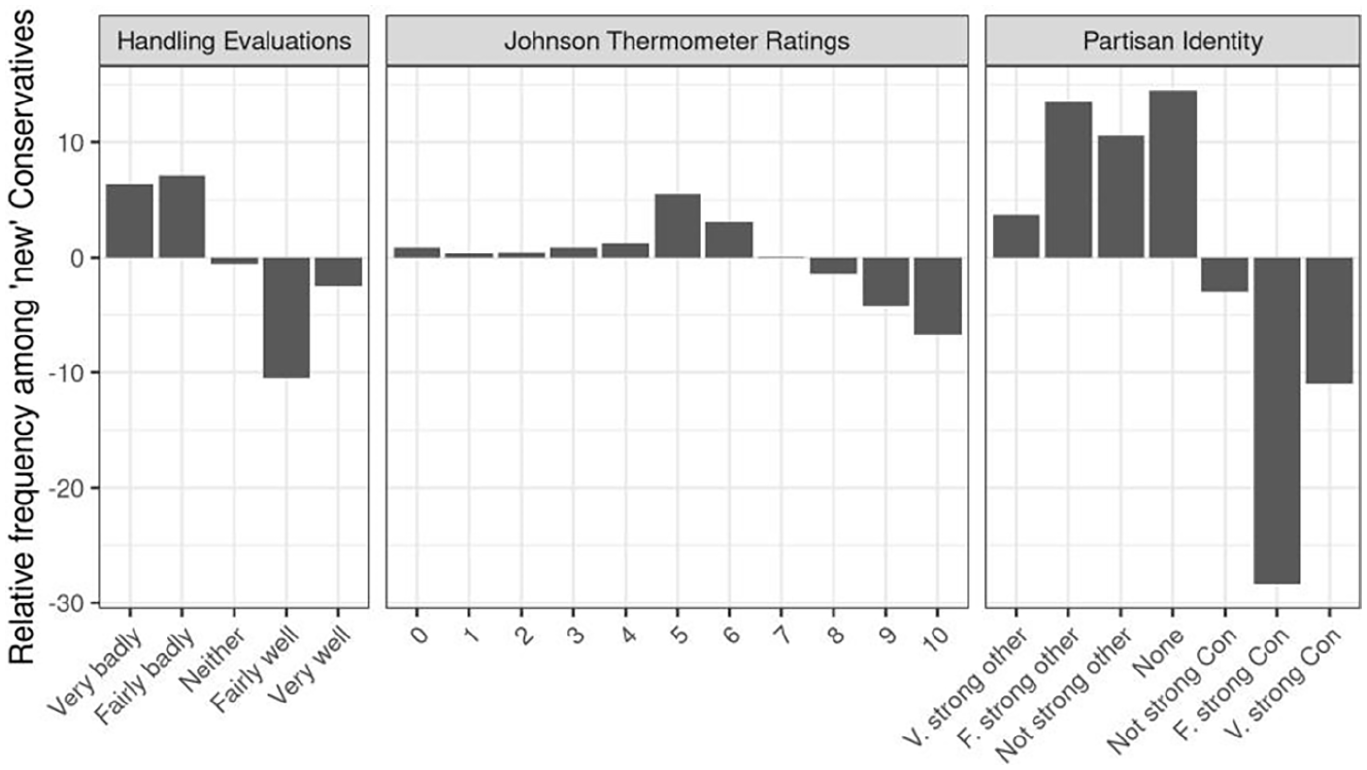
Distribution of Handling Evaluations (June 2020), and Johnson Thermometer Ratings and Partisan Identity (December 2019), Among ‘New’ Conservatives Compared With ‘Old’ Conservatives.
Table 1 shows the result of including these three potential mediators into a regression model with voting intention as the dependent variable. As a robustness check, we replicated the models using an independent variable that captures whether an individual voted for the Conservative party in both 2015 and 2017. The results, shown in Appendix 6 of the Supplementary Material (Table A6.3), are substantively almost identical.
Explaining Conservative Voting Intention Among 2019 Conservative Voters – Results From Pooled Logistic Regressions Across Waves 20, 21 and 22.
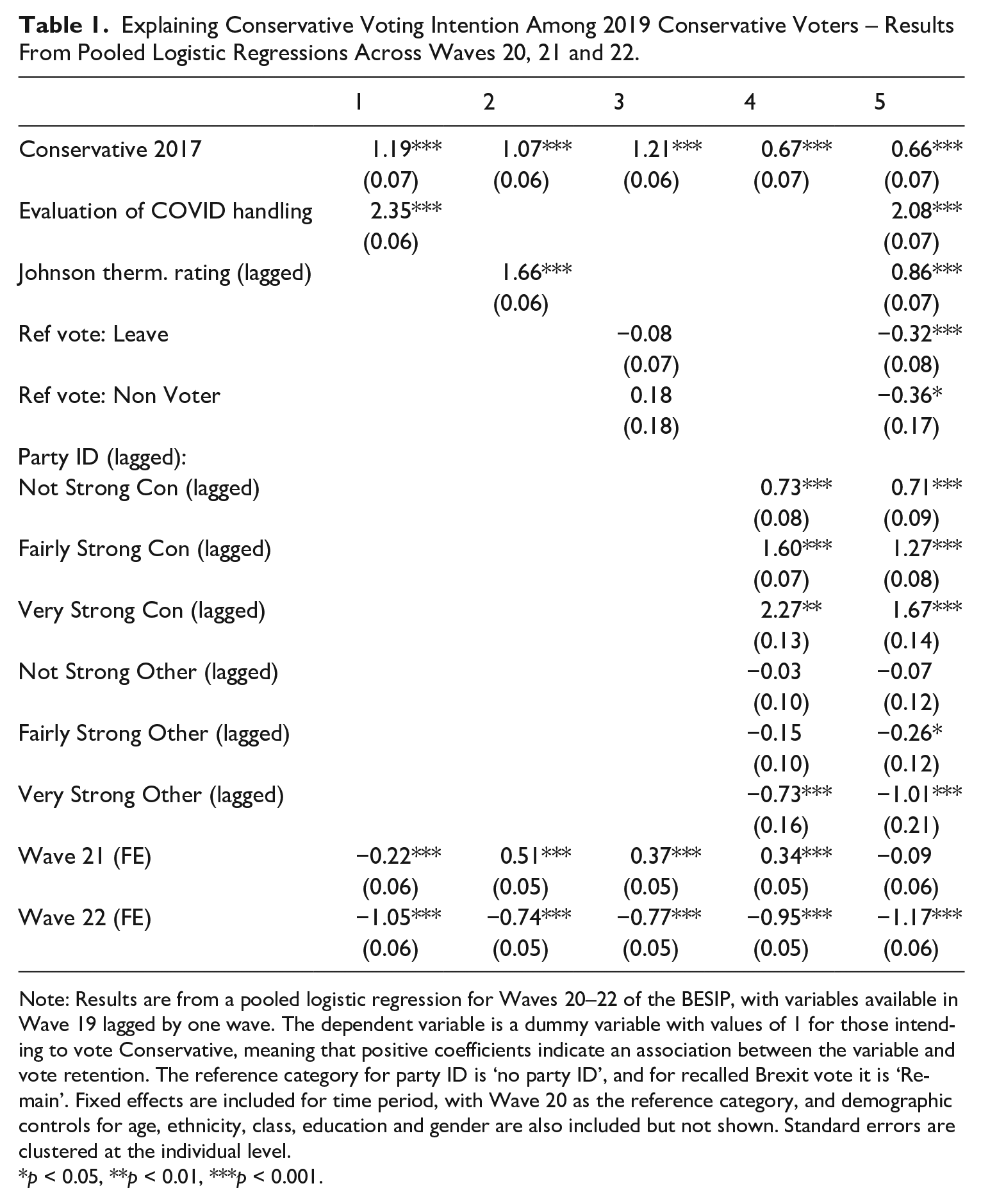
Note: Results are from a pooled logistic regression for Waves 20–22 of the BESIP, with variables available in Wave 19 lagged by one wave. The dependent variable is a dummy variable with values of 1 for those intending to vote Conservative, meaning that positive coefficients indicate an association between the variable and vote retention. The reference category for party ID is ‘no party ID’, and for recalled Brexit vote it is ‘Remain’. Fixed effects are included for time period, with Wave 20 as the reference category, and demographic controls for age, ethnicity, class, education and gender are also included but not shown. Standard errors are clustered at the individual level.
p < 0.05, **p < 0.01, ***p < 0.001.
As Models 2 and 3 show, including handling evaluations and Johnson’s thermometer rating does not significantly alter the coefficient of 2017 vote, indicating that the new cohort’s lower loyalty cannot be explained by their feelings about the Prime Minister or his government’s handling of the pandemic. As an additional test, we examined whether previous referendum vote might partially explain the size and significance of the 2017 vote coefficient – as Model 3 shows, it does not.
Including partisan identity reduces the coefficient on 2017 vote by around a third, indicating that a substantial part of the explanation for the new cohort’s altered voting intention is their lower levels of partisan identity. The model is therefore consistent with Hypothesis 7. The coefficient for 2017 vote remains significant even in the full model containing all political and demographic variables. This implies that there is a loyalty effect that goes beyond the question of partisan identity, and might be interpreted as habituation, whereby voting for the party in 2017 increased the loyalty of those voters to the party.
Dynamics During the Pandemic
As we showed in the analysis above, the COVID-19 pandemic was treated by voters as a competence, or valence issue (Stokes, 1963), but in Hypotheses 3 and 5 we considered that the degree to which this was true may have varied over the course of the pandemic. More and people became vaccinated against COVID-19, but more and more people were also exposed to COVID-19 over time. The period also saw rising case numbers, the vaccine rollout, persistent lockdowns and more criticism about the government’s handling of the pandemic; all of which may have led to some variation in the degree to which the pandemic was assessed as a valence or positional issue. In order to test whether the positional or valence nature of pandemic politics changed over time, we interacted our measures of lockdown preferences and, in the case of the voting model, the handling evaluations, with our wave fixed-effect variables. The results can be seen in Figure 6.
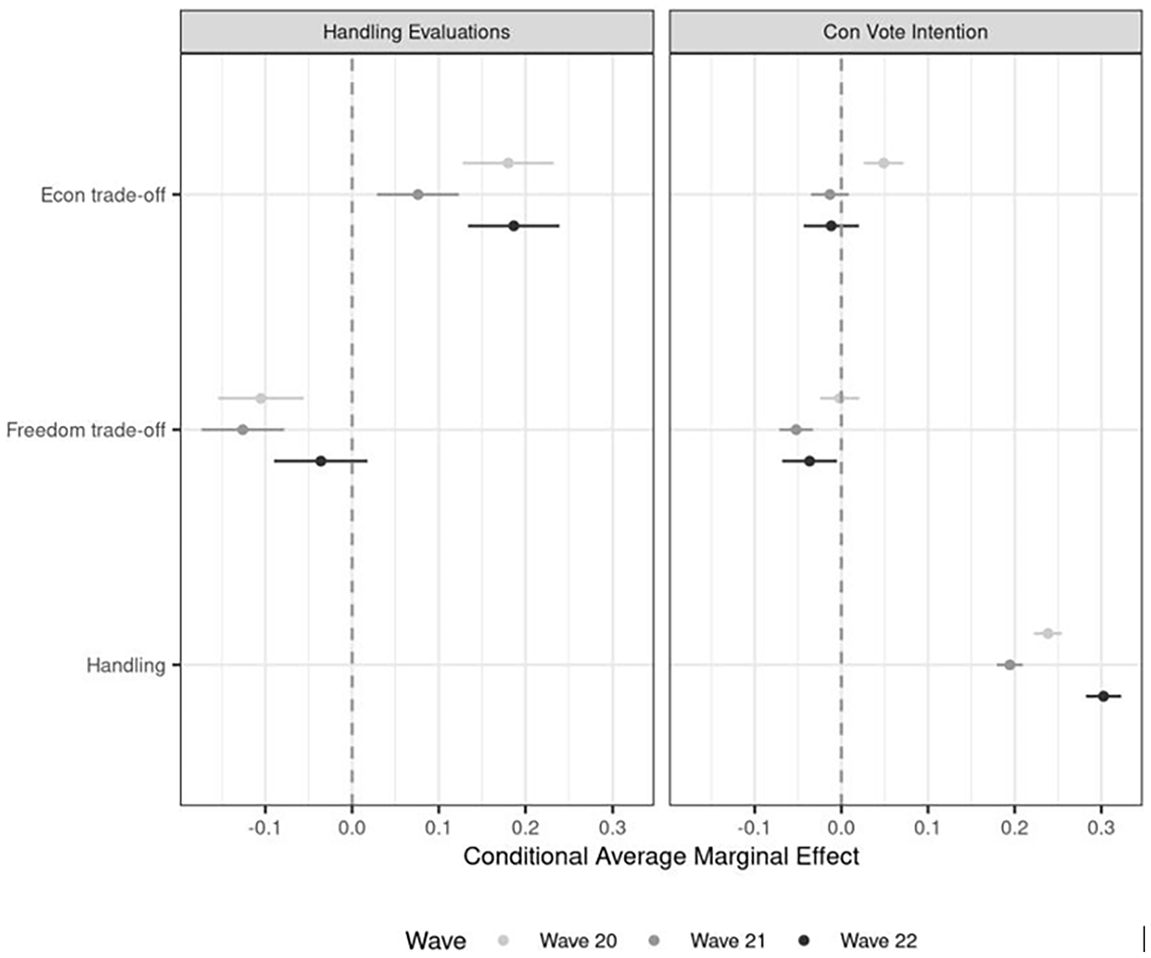
The Changing Role of Lockdown Preferences Over Time on Handling Evaluations and Vote Intention.
COVID-19 remained a valence issue from June 2019 through until at least November 2021. Lockdown preferences had a small marginal effect on handling evaluations for all three of our survey periods, and their association with Conservative defection remained consistently small, particularly in comparison to the role of handling evaluations which explained a sizable part of Conservative defection across the entire 2-year period.
Interestingly, it appears as though Wave 21 actually saw a slight decrease in the effect of economic trade-off preferences on handling evaluations. This was the height of the vaccine success; Britain was far ahead of most of the world and the press coverage was positive. Our findings suggest that this period of positive government performance may have partially united people with different positional preferences about COVID-19 in their evaluation of the government’s competence on the issue. We also find a decreased role of handling evaluations in explaining Conservative defections during this period in 2021, indicating that there were fewer COVID-related defections from the Conservative party when it was successfully delivering the vaccination programme.
Conclusion
The COVID-19 pandemic was the largest and most significant ‘event’ for global populations in most of our lifetimes. This article examined the two most significant years of the pandemic in Great Britain, finding considerable political insulation from vote loss for the government by way of prior partisanship and evaluations of the Prime Minister, Boris Johnson, but not for the previously defining issue of the prior general election: Brexit (Britain’s decision to exit the EU). Rather, the government’s handling of COVID-19 was a powerful competence signal that was not substantially associated with whether individuals backed ‘Leave’ or ‘Remain’ in the earlier EU referendum on Britain’s membership of the EU, but was strongly associated with partisanship and evaluations of the Conservative Prime Minister. Respondents were no more likely to think the government had handled the COVID-19 pandemic well if there were fewer local deaths, if they themselves had contracted the virus, or if they had been a recipient of financial support, and were only marginally less likely to approve of the government’s handling if a friend or family member had contracted the virus. The government action that seems to have been most strongly associated with government handling assessments was the vaccination rollout. Lockdown preferences for greater freedom or protecting the economy or the nation’s health were weakly though significantly associated with handling evaluations in all periods, but these were far outstripped by prior political evaluations. The government’s handling of the pandemic was – in addition to being a product of partisanship and leader support – far more obviously a valence issue than a positional one. The nature of the panel analysis in this article also showed that the valence or competence nature of the pandemic was consistent in its relationship to party support over time. That finding is notable given the variability in experience of the pandemic over the period: from rising case numbers to the vaccine rollout, increasing vaccine take-up and increasing COVID-19 exposure over time, and increasing political criticism of the government.
Our analysis found that the government was punished most significantly by the new cohort of 2019 Conservative voters. Insofar as the government experienced an electoral penalty for its handling of the pandemic, it was because of the lack of political loyalty expressed via partisanship among these newer voters. It makes sense that governments will be judged more harshly by individuals who have failed to form a positive attachment and loyalty to them over consecutive elections. This points to the potential of the pandemic (and other factors and subsequent economic shocks) to weaken government support among partisan-dealigned and volatile electorates, as exist now in many countries (Dalton et al., 2000; Dalton, 2012; Dassonneville, 2018; Fieldhouse et al., 2023).
The British case is instructive because of the highly divisive Brexit issue that had polarised the electorate and led to a strong sorting of the electorate along Leave and Remain lines (Fieldhouse et al., 2020; Green, 2021). Could this exceptionally salient issue determine voters’ responses to the pandemic, indicative of the persistence of this Brexit effect, or would the pandemic have the potential to force politics back onto domestic political issues? That question is important for the many national contexts in which cultural ‘second-dimension’ politics (sometimes summarised as ‘GAL-TAN’ issues) have also risen in prominence (Ersson and Lane, 2003; Kitschelt, 1994; Kriesi, 2008; Norris and Inglehart, 2018; Stubager et al., 2021). We focused on a specific subset of voters, those who had just voted for the Conservative Party in 2019. Among these individuals we found no strong evidence of any additional Brexit-insulating effect; insofar as there was a relationship between Brexit support and changes in Conservative vote intention, Leave voters were slightly more likely to defect from a Conservative vote intention than remain loyal to the party in this period. We conclude, then, that the pandemic (and likely other competence shocks that take place after it) has the potential to partly displace the electoral relevance of such second-dimension (or socio-cultural) issues, cutting across those otherwise salient political divides. Naturally, this British focus does not preclude different experiences of the pandemic in other countries. Nevertheless, the very high salience of the Brexit divide, and its recent importance in a preceding election to the pandemic, suggests that competence shocks have substantial potential in other countries to cross-cut other salient ‘second dimension’ ideological divides.
Our analysis has bearing on the specifics of British politics and for the potential endurance of the ‘Brexit realignment’. While it is clear that voters’ Brexit preferences did little to insure the Conservatives against lost support during the COVID-19 pandemic, this suggests that vote losses will cross-cut the Brexit division in British politics, so long as they are due to competence shocks, or valence issues. That may weaken the overall importance of Brexit, but it would do little to change the underlying relationship of Brexit to party choice; the Conservatives would still have more Leave voters and fewer Remain voters, but they would lose them in equal measure. This is particularly significant given that subsequent events in British politics have also been strongly trust, or ‘competency-based’ in nature: the ‘partygate’ scandals (wherein multiple parties and social distancing breaches were exposed in Downing Street), the financial market reaction to the ‘mini-budget’ put forward under the short-lived leadership of Liz Truss and the cost of living crisis which took place in Great Britain from 2022. Our evidence suggests that there is a potential for the new Conservative coalition (still consisting of a very large majority of Leave voters) to fragment in the face of new shocks, the potential for orthogonal valence issues to be highly important, and a tendency among less partisan voters of incumbent governments to update their support for a party on the basis of competence, particularly where they have weaker support for their political leaders beforehand.
This article has focused on a 2-year period in Great Britain; on a specific case and a specific and highly salient competence shock, the COVID-19 pandemic, and the conclusions and potential generalisability need to be caveated, as with all single-country analyses. However, our findings add to knowledge on the electoral importance of the pandemic in other countries (Baccini et al., 2021; Neundorf and Pardos-Prado, 2022), and on its relationship to public opinion and government performance (Herrera et al., 2020; Vlandas and Klymak, 2021). Our use of panel study data allows us to control for prior partisanship and evaluations of the British Prime Minister, but is limited by reliance on items that may, potentially, be confounded by unmeasured attitudes. We explored the electoral effects of the pandemic on defection away from a Conservative vote intention, but findings may be influenced by a wider choice set of political options, particularly if they were extended to a future general election vote choice.
We conclude that the COVID-19 pandemic is likely to have served as a highly electorally influential competence signal in many countries around the world. This will, of course, depend on its electoral contestation, and it is important to note the specifics of the pandemic. Perhaps, by its nature, its effects as a major competence shock are unique. Our analysis suggests that the role of positional opinions on the response to the pandemic remained low throughout the key pandemic years in Britain, but greater political contestation around lockdown and other economic protection measures could have more positional consequences in other contexts, as they likely did in the United States, where COVID measures were more strongly politicised along partisan lines. In Britain, the COVID-19 pandemic was a powerful competence shock. To the extent that this also applies in other contexts, our findings suggest that the first place researchers should look for its electoral consequences is to the voters who are more moveable and less loyal in the first place.
Supplemental Material
sj-docx-1-psx-10.1177_00323217241263404 – Supplemental material for The COVID-19 Pandemic in Britain: A Competence Shock and Its Electoral Consequences
Supplemental material, sj-docx-1-psx-10.1177_00323217241263404 for The COVID-19 Pandemic in Britain: A Competence Shock and Its Electoral Consequences by Jane Green, Geoffrey Evans and Dan Snow in Political Studies
Footnotes
Acknowledgements
The authors are grateful to the reviewers of Political Studies for useful suggestions and to colleagues at the Elections, Public Opinion and Parties Conference (2022) for comments on earlier versions.
Declaration of Conflicting Interests
No ethical concerns or conflicts of interest apply. The appendix to this paper is hosted by Political Studies online.
Funding
The author(s) disclosed receipt of the following financial support for the research, authorship and/or publication of this article: We are grateful to funding for the British Election Study via the Economic and Social Research Council Grant ES/S015671/1 for funding for data collection and to Nuffield College’s support for research assistance.

Supplemental Material
Additional Supplementary Information may be found with the online version of this article.
Table A1.1: Coding Strategy for Political Variables. Table A1.2: Coding Strategy for Pandemic Variables. Table A1.3: Coding Strategy for Demographic Variables Figure A2.1: Vote Intention Flows From 2019 UK General Election to November 2021 for Respondents Who Voted Conservative in 2019. Table A2.1: Breakdown of Voting Intention for All Who Voted Conservative in 2019, Shown With and Without Excluding Those Who Are Missing From Any of the Three Waves. Table A3.1: Explaining Handling Evaluations – Results From Pooled OLS Regression Across Waves 20, 21 and 22. Table A3.2: Explaining Conservative Voting Intention Among 2019 Conservative Voters – Results From Pooled Logistic Regression Across Waves 20, 21 and 22. Table A3.3: Explaining Conservative Voting Intention Among 2019 Conservative Voters – Results From Pooled Logistic Regression Across Waves 20, 21 and 22. Figure A4.1: Distribution of Handling Evaluations, Johnson Thermometer Ratings, and Partisan Identity, Among ‘New’ Conservatives Compared With ‘Old’ Conservatives Across All Four Waves. Table A5.1: Explaining Handling Evaluations With Controls for Brexit Position and Identity – Results From Pooled OLS Regression Across Waves 20, 21 and 22. Table A5.2: Explaining Conservative Voting Intention Among 2019 Conservative Voters, With Controls for Brexit Position and Identity – Results From Pooled Logistic Regression Across Waves 20, 21 and 22. Table A6.1: Explaining Handling Evaluations – Results From Pooled Ordered Probit Regression Across Waves 20, 21 and 22. Table A6.2: Comparison Between Explaining Conservative Handling, Labour Handling, and the Difference Between the Two – Results From Pooled OLS Regression Across Waves 20, 21 and 22. Table A6.3: Explaining Handling Evaluations Excluding Respondents in Scotland and Wales – Results From Pooled OLS Regression Across Waves 20, 21 and 22. Table A6.4: Explaining Conservative Voting Intention Among 2019 Conservative Voters With an Alternative Measure Of Loyalty – Results From Pooled Logistic Regression Across Waves 20, 21 and 22. Table A6.5: Explaining Handling Evaluations – Results From Separate Ols Models for Waves 20, 21 and 22. Table A6.6: Explaining Conservative Voting Intention Among 2019 Conservative Voters – Results From Separate Logistic Regression Models for Waves 20, 21 and 22. Table A6.7: Explaining Conservative Voting Intention Among 2019 Conservative Voters Excluding Respondents in Wales and Scotland – Results From Pooled Logistic Regression Across Waves 20, 21 and 22. Table A6.8: Explaining Conservative Voting Intention Among 2019 Conservative Voters With Variables From Handling Models – Results From Pooled Logistic Regression Across Waves 20, 21 and 22. Table A7.1: Explaining Handling Evaluations, Including Interactions Between Time Period and Lock–Down Preferences – Results From Pooled OLS Regression Across Waves 20, 21 and 22. Table A7.2: Explaining Conservative Voting Intention Among 2019 Conservative Voters, Including Interactions Between Time Period and Positional/Competence Evaluations – Results From Pooled Logistic Regression Across Waves 20, 21 and 22.
Notes
Author Biographies
References
Supplementary Material
Please find the following supplemental material available below.
For Open Access articles published under a Creative Commons License, all supplemental material carries the same license as the article it is associated with.
For non-Open Access articles published, all supplemental material carries a non-exclusive license, and permission requests for re-use of supplemental material or any part of supplemental material shall be sent directly to the copyright owner as specified in the copyright notice associated with the article.
