



Abstract
The UK’s in-out referendum on European Union membership is often attributed to an incompatibility inherent in the UK–EU relationship, or else a rising tide of Euroscepticism forcing a reckoning. We argue that the referendum should be understood as the culmination of parliamentary ‘referendum games’ in the preceding years, whereby backbenchers periodically applied pressure to office-seeking leaders who strategically defused this by promising public votes. These games were episodic and escalatory, coinciding with integrative European treaties which activated transient Eurosceptic backlashes. While referendum avoidance was personally rational, leaders’ repeated parlays created a standalone referendum politics, ratcheting up the intensity of backbench demands based on past promises and democratic renewal. After the Lisbon Treaty, a tipping point was reached, transforming calls for a ‘brake’ on integration to demand for binary ‘exit’ vote at the next treaty moment. This accompanied the Euro-area crisis in 2011, effectively ending David Cameron’s discretion to continue the game. To show this, we plot all mentions of EU-related referendums and adjacent terms in the House of Commons between 2000 and 2015. We descriptively identify five peak salience flares around EU treaty moments and then analyse 263 interventions by Members of Parliament to show how referendum pressure ratcheted up over time.
Introduction
After the 1975 ‘Yes’ vote had ushered in a period of relative calm, referendums re-emerged with the Maastricht Treaty to become a regular feature of the UK’s European debate. Compared with other member states, British political parties were singularly keen on promising discretionary plebiscites on European integration (Glencross 2014). Yet, absent a constitutional mechanism forcing a vote, for several decades, these appeals remained rhetorical. After Maastricht, debates within and between mainstream parties were largely confined to controversies surrounding specific treaties and a desire among most Eurosceptics to apply a ‘brake’ on further integration, rather than setting the UK on a course for exit from the European Union (EU). While the EU had negotiated its way past negative brake referendum results before, the UK’s comparatively rapid mainstreaming of exit terms took both polities into unprecedented territory, rendering real the prospect of a first member state departure. This article argues that this modal shift should be understood as the culmination of a single historical thread over the past several decades in British politics, ‘referendum games’ played out repeatedly in Parliament that escalated towards the highest stakes outcome.
While Cameron (2019) insists that his call was chiefly a principled response to Britain’s rising public Euroscepticism, scholars have offered more sceptical, strategic readings. Reviewing leading explanations, Bale (2022) suggests pressure from the parliamentary Conservative Party was far out of step with any mass public Euroscepticism, while Thompson (2017) points to the untenability of the UK’s continued membership in light of the Eurozone crisis. Both contributions contain essential truths about the key agents and events involved in the referendum call, however a full account must appreciate that referendum promises were not just an outcome of this process, but in fact integral to it. This article argues that referendum politics must be taken seriously in their own right, to be understood as a form of escalating parliamentary policy cycle that was a key determinant of Cameron’s January 2013 promise for an in–out vote. Periodic referendum calls around treaty moments played out as a repeated, escalating game whereby office-seeking leaders defused parliamentary pressure by making conditional promises designed to avoid calling a vote, risking their political careers. At any point, such short-term self-interest might have been a rational response for any given leader under pressure and seeking to avoid gambling their office, but it created a parlayed, ratchet effect at the next treaty moment, with Eurosceptic referendum calls increasing in both volume and intensity, with unfulfilled past promises and democratic legitimacy being cited as reason alone for a vote.
As such, the article concludes that the road to the referendum was episodic rather than linear, and Cameron’s gambit can be understood not as a short-term lurch but as the exhaustion of a longer term process of parlayed promises and myopic party competition and management attributable to distinctive features of British politics. To show how this process played out, the article presents data covering all House of Commons debates mentioning EU referendums and adjacent terms between January 2000 and May 2015, when an in–out vote was legislated. While it does not discount the influence of outside Eurosceptics – in particular, the United Kingdom Independence Party (UKIP) – on the referendum debate, following Bale (2022), it locates the loyalty and confidence of members of the parliament (MPs) as the most proximate and intense source of variable pressure on strategic Prime Ministers and party leaders. The article identifies aggregate trends in the salience of parliamentary referendum debates, identifying five peaks that cluster precisely around treaty moments, starting with Nice in July 2001 and peaking during the Euro-area crisis in October 2011. The article then analyses 263 coded statements from MPs during these debates, indicating qualitatively how referendum demands grew and intensified between episodes, and most particularly between the 2008 Lisbon and 2011 Euro treaty debates.
The article proceeds as follows. First, it situates the UK as a unique case within the wider EU of a polity offering discretionary referendums to alleviate domestic political pressure. We then outline our view of the historical backdrop to the UK vote, including how the EU’s response to the Euro crisis collided with the ratcheting up of domestic pressure created by the UK’s referendum game. The second half of the article turns to the empirical analysis and outlines our findings. Drawing on the EUParlspeech dataset (Hunter, 2021; Rauh and Schwalbach, 2020), it starts by charting aggregate descriptive statistics that show trends in mentions of EU referendums over time in Westminster. From this, five key salient episodes are subsequently taken forward as sets of hand-coded qualitative vignettes which describe the shift from a prevailing ‘brake’ to an ‘exit’ stance. We conclude that, more than British Euroscepticism per se, it was referendum pledges aligned to EU treaty moments that escalated, contributing significantly to the UK’s exit from the EU.
UK Referendum Politics in the European Context
In the post-war era, the EU has been a frequent subject of national referendums. In a minority of instances, such votes have been constitutionally mandated, but frequently, they are a discretionary device open to governments with a non-binding outcome (Hobolt, 2009; Mendez et al., 2014). Such referendum pledges might be driven in part by ideological preferences but can always be understood as strategic calculations on the part of office-holders operating on essential political logics (Closa, 2007; Oppermann, 2013; Cheneval and Ferrín, 2018). Oppermann (2013) describes two key dimensions along which all government discretionary promises can be located: domestic versus European-level effects, and defensive (loss-averse) versus offensive (gain-seeking) modes of engagement. His expert survey of all 28 discretionary referendum events across the EU (1972-2010) finds British governments to be consistently domestic-defensive – referendums were promised more than in any other member state and on each occasion experts ranked them as acutely concerned with preventing losses in domestic politics (Oppermann, 2013: 693).
While most EU-related referendums concern specific EU policies – even seismic ones such as Euro adoption – votes on ‘exit’ after accession are especially rare, Cameron’s promise qualitatively different to those of his predecessors after 1975. The EU’s crisis-ridden 2010s brought to the fore a cluster of ‘withdrawal referendums’, a subset of negative EU referendums, defined as votes to determine whether a member state should leave the EU or nullify a common EU policy (Schimmelfennig, 2019). These included the 2014 Swiss immigration initiative, the 2015 Greek referendum on bailout terms, and the 2016 Hungarian migrant quota referendum. Yet, while these referendums have sought to halt integration, only the UK government explicitly (if not legally) committed to withdrawal – with all associated shared risks and diplomatic upheaval – in the event of defeat.
In sum, then, the UK has not been the only EU member state to deal in the politics of discretionary referendums, but the frequency, assumed motives and eventual terms it followed through with mark it apart. Understanding the shift from a policy ‘brake’ stance to a membership ‘exit’ objective is surely significant, both for what it reveals about the pathologies of British democratic politics, but also for considering how generalisable if at all the UK’s experience might be. This article argues that doing so requires analysing the UK’s multiple referendum promises not as standalone conflicts but as a sequential, escalating historical process. This is a process in which referendum promises were themselves integral to the outcome, not epiphenomenal as much literature implicitly assumes.
Existing Accounts of the Referendum Call
Why, then, did Cameron pledge an in–out referendum in 2013? In the extant literature, his commitment is typically viewed as a response to two sets of factors: domestic Eurosceptic pressures, from within the Conservative Party as well as from a rising UKIP; and the EU’s development during the Euro crisis – more specifically, the UK’s drift within the architecture created by its own optouts. First, most studies on the Brexit referendum focus on domestic pressures, tracing Cameron’s pledge and its in–out formulation to rising Euroscepticism which he sought to placate. These pressures manifested, as mentioned, as an outside threat posed by UKIP (Bale, 2018; Tournier-Sol, 2015), an increasingly radicalised Conservative Party (Vasilopoulou and Keith, 2019: 488), and the natural interplay between both (Copsey and Haughton, 2014; Matthijs, 2013). UKIP’s major victories came only in second-order elections and the first-past-the-post electoral system constituted an important institutional barrier to its success, nonetheless, it is suggested that it has pushed Conservatives to harden on key issues such as welfare, immigration, and Europe. On the latter, ‘Cameron’s referendum pledge was clearly aimed at “shooting the UKIP fox” making it obsolete by depriving it of its very rationale’ (Tournier-Sol, 2015: 148). As for the Conservative parliamentary party, the influx of a new cohort of markedly Eurosceptic parliamentarians in 2010 is relevant here, though even then ‘hard Eurosceptics’ remained a minority, comprising only about a quarter of MPs (Heppel, 2013).
However, the argument that depicts the in–out pledge as a strategic Conservative response to their immediate radical right challenger fails to acknowledge the relative weakness of UKIP in the polls and the low salience of Europe as late as 2012 (Bale, 2022). As Bale (2022: 12) argues, ‘the pressure for a vote coming from the parliamentary Conservative Party . . . far outweighed any pressure coming from the public’, with backbenchers organising and agitating for a vote. This explanation also sits uneasily with the fact that all major parliamentary parties had been promising some form of plebiscite on Europe to voters since the better part of the 2000s. In essence, the Conservatives were continuing a long-standing practice in British politics of using referendums as a tool to cope with intra-party dissent and interparty competition from one electoral cycle to the next. As Copsey and Haughton (2014: 84) observe, ‘[C]alling a referendum for halfway through the next parliament has been a classic strategy of party management’ – from Wilson to Blair to Cameron. As referendum pledges became a permanent feature of British party politics, this also meant the opening of a competitive space over the design of the referendum (issue vs membership, conditionality, sequencing), while prior pledges and especially failures to hold referendums also became a relevant dimension of this competition.
Furthermore, examining the specific proposals of parties, we cannot assume that an in–out referendum must necessarily represent a Eurosceptic escalation, that is, a more radical option than a ‘mere’ policy referendum. As Smith documents, the Liberal Democrats had supported a referendum on Britain’s ongoing membership in the Union rather than the treaty because they: hoped that the ‘in or out’ question would elicit a positive answer in a way that a vote on a specific treaty reform would not, in part because referendums tend to be used as a way to kick the incumbent government rather than focusing on the merits of the issue at hand, and in part because referendums on treaty reform run into particular problems because they are so technical in nature. (Smith, 2012: 1288)
Even more revealingly, Lynch and Whitaker (2013), writing around the time Cameron made his in–out pledge, observed that committing to an in–out referendum would be a good move for Labour. In their analysis: [p]romising an ‘in-out’ referendum has attractions for Labour as it would further expose Conservative divisions, reinforce UKIP’s threat to the Conservatives and allow Labour to court public opinion while maintaining a more pro-European position than the Conservatives. The likelihood is that if one of the main parties pledges a referendum, others will follow suit although the nature of the vote on offer may differ (Lynch and Whitaker, 2013: 305–306).
This assessment is striking. Correct or not, it demonstrates that referendum pledges in British politics were as much about party-political strategy as offering principled responses to any mass public Euroscepticism.
A second set of explanations interpret Cameron’s decision to call an in–out referendum as a response to the evolution of the EU polity during the Euro crisis. Arguably, the management of the crisis made the terms of the UK’s membership appear increasingly untenable as a non-Euro-area member at a time of centralisation in the EU architecture of economic governance (Fabbrini, 2013). Ivan Rogers, former permanent representative of the UK to the EU, strongly emphasises this, claiming that the ‘Eurozone crisis very nearly ruptured the EU-UK relationship in 2011’ and that the decision to hold an in–out referendum stemmed from that crisis (Rogers, 2017). This account, which echoes Cameron’s (2019) own, appears plausible, but should be taken with caution. By locating Cameron’s decision to hold a membership referendum as early as in 2011, it seeks to fend off the criticism that he was opportunistically responding to domestic party-political developments, gambling the country’s future for career preservation, casting it instead as well-considered decision prompted by an ugly EU crisis. Within the academy, Thompson (2017: 446) articulates a similar view more convincingly, writing that ‘the 2008 financial crash and the Eurozone crisis put a time-bomb under the sustainability of Britain’s membership of the EU’. She directs attention to a plethora of structural conflicts and constraints (escalating differences between Euro-area countries and Britain, weakening the latter’s position in the single European market; and increased migration towards the UK) that, she claims, would have posed existential problems to any British government, let alone a Conservative-led one. However, while her piece is forensic on Euro-area tensions, it ignores the political–institutional run up to this flashpoint that left Cameron no room for manoeuvre.
Indeed, the longer trajectory of the EU polity since the 2000s is relevant to the story. While the 1990s and 2000s were by no means crisis-free decades for the EU, they were marked by a protracted, considered mode of integration embodied in treaties (Schengen, Maastricht, Amsterdam, Nice, Lisbon), which were products of strategic visions and multi-year debates among European elites about further integration, developed against a permissive geopolitical backdrop broadly characterised by US (neo-)liberal hegemony (Anderson, 2009). These treaties, especially the 2004 Constitutional Treaty, represented not only turning points in the development of the EU but also contributed to creating fault-lines in British politics over Europe (Smith, 2012: 1287). Conversely, both major shocks predating Brexit, the Euro and migration crises, prompted ad hoc reactive steps to address underlying issues, moving the EU unequivocally beyond ‘market integration’ and onto the turf of ‘core state powers’ (Genschel and Jachtenfuchs, 2018). These were essentially functional equivalents of treaty moments, but provided no formal channel of (re-)legitimisation of EU policy and polity.
Finally, it has been proposed that Cameron’s choice of an in–out referendum was a negotiation tactic he resorted to during his renegotiation campaign on the UK’s terms of membership that backfired. As Martill (2021) explains, [b]y externalising the decision, Cameron made the prospect of exit more credible than it would be otherwise, since opinion polls showed the United Kingdom would likely vote to leave without reform, but that there existed a majority to remain in a reformed EU.
Martill documents that, indeed, during his renegotiation campaign, Cameron cultivated a discourse according to which the UK was prepared to walk away if its terms were not met. However, the timeline of events suggests that this was more by accident than design. In a speech from 2009 Cameron had indicated that he ‘would not rule out a referendum on a wider package of guarantees’ should demands for repatriation of powers fail, but at that point, he opposed an in–out referendum, arguing that EU membership was in the national interest (Cameron, 2009, see also Lynch and Whitaker, 2013: 305). The mantra ‘reform, renegotiation, referendum’ put forth in his Bloomberg speech came only after the parliamentary party had pushed for an in–out referendum in the first place, as our analysis of parliamentary speeches will show.
A New Framework: The Referendum Game as a Standalone Policy Cycle
In summary, then, while existing explanations of the in–out referendum capture important elements about the drivers of Cameron’s pledge and (perhaps somewhat less so) how it escalated to its exit form, targeting the EU polity instead of a policy, each have some blind spots and inconsistencies. What they share is a neglect of how previous referendum promises themselves led to an escalation of policy tension, and narrowed the debate inside Parliament each time there was a ‘treaty moment’ salience flare. This created a kind of standalone policy cycle, involving an interplay between evolving EU membership and demands for democratic renewal in the form of a referendum.
By deflecting these salient moments to avoid a reckoning that would force them to stake their own political careers, successive leaders were contributing to its medium- to long-term exacerbation and exhaustion. We suggest that the Eurosceptic leap from ‘braking’ to ‘exiting’ was the result of domestic ratcheting colliding with the absence of treaty space for Cameron after Lisbon, leaving him in a space whereby not calling a referendum became, for the first time, a bigger political risk than calling one. With hindsight, it is possible to identify windows of opportunity during which British governments could have re-legitimised the EU project by responding to referendum calls earlier, before they had escalated. This might have involved an exit vote at a more favourable time prior to escalating Euroscepticism, per Liberal Democrat policy after 2008; or following through with an indicative brake referendum on an earlier treaty, again at some point in the previous decade. But by prioritising short-term careerist or party-political calculations, they only delayed building pressure. While governing motivations to hold discretionary referendums might apply across all member states, the British case appears to be the product of a long-running manifestation of Euroscepticism that became a qualitatively more meaningful vote than any previous ‘brake’ referendums on treaties or policies (Oliver, 2015).
The concept of a ‘referendum game’ illuminates the way in which an in–out vote gained traction in British politics, boxing Cameron into offering a binary choice on the UK’s future relationship with Europe. As the name implies, it is loosely inspired by game theory, and here the term refers to political leaders’ strategic and office-seeking management of pressure for votes on ‘braking’ treaty integration. Such pressures originate from the party’s own rank and file and as a result, while leaders must retain a general concern about public Euroscepticism, they must also manage intra-party relations and mitigate the risk of a leadership challenge or defections. Management takes place in an evolving programmatic space (in this particular case, on EU membership), which both shapes and is shaped by (previous) pledges to hold referenda by all parties. ‘Treaty moments’, in turn, act as exogenous shocks to this system, by punctuating the existing equilibrium, and typically leading to an escalating dynamic (schematically represented in Figure 1).
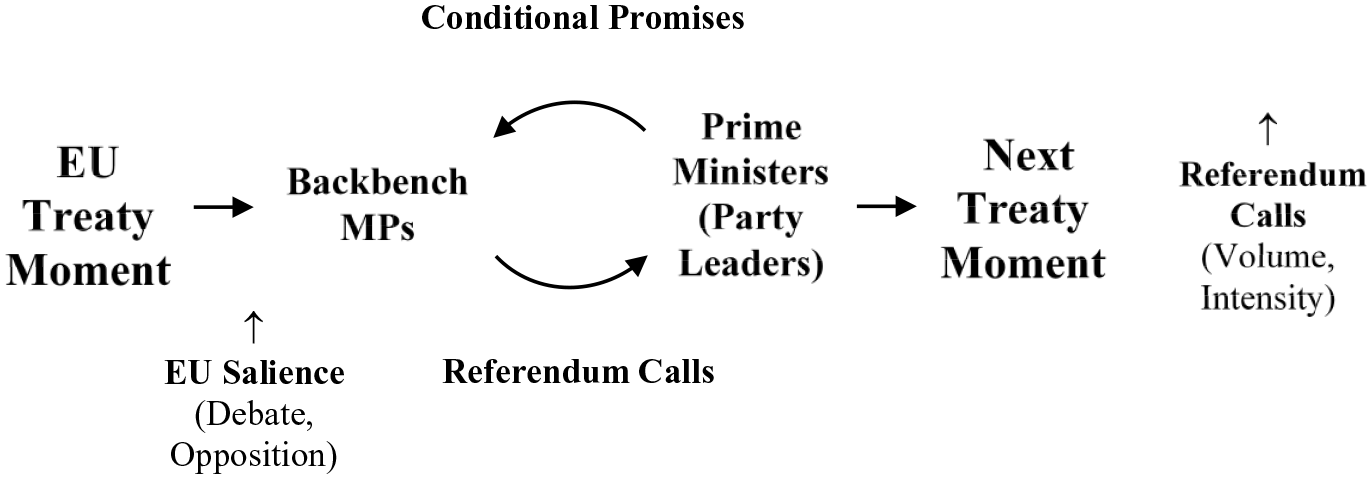
The Referendum Game Cycle.
MPs and party leaders, especially Prime Ministers, are guided by different priorities when campaigning at treaty moments. This can be understood by applying the rational choice language of ‘office- and policy-seeking parties’ to sub-party actors (Budge and Laver, 1986; Riker, 1962). While we cannot access actors’ true motivations, it is reasonable to assume that outright principled support or opposition to an EU referendum and careerist, office-holding goals are both at play. Treaty moments, in particular, bring European integration and sovereignty concerns into stark relief, when the salience of the debate over Europe spikes. At such points, it is therefore necessary for MPs – especially Conservatives – to be seen to take Eurosceptic concerns seriously for fear of alienating voters. However privately true, a desire to placate Eurosceptics by promising a referendum for electoral or careerist reasons does not equate to an honourable stance to present in public debate, and so public appeals (including parliamentary utterances) must be made on principle.
In sum, understanding and observing how and why this referendum pressure overran Cameron requires a longitudinal perspective dating back to his predecessors. To capture the referendum game process, we trace broad trends over time, complemented with a more fine-grained analysis of rhetorical action, defined as the ‘strategic, self-serving use of arguments’ (Schimmelfennig, 2021: 143). MPs are particularly instructive in this respect because they are more closely bound to the party leadership by parliamentary procedure and their own career aspirations than regular members or voters (Crowe, 1986; Kirkland and Slapin, 2018).
Data and Methodology
To identify the switch from braking to exiting and its drivers, we analyse speech acts in the House of Commons, seeking to understand the evolution of intra- and inter-party dynamics over time. As noted, we focus on parliamentarians because these represent the hardest test of instrumental game playing and party loyalty: they are less likely to defect in any number and more coerced to reinforce their leader’s agenda than ordinary members or voters. Tracking parliamentary referendum salience, dissent and positioning over time thus offers a clear insight into how Eurosceptic pressures were filtering through to party leaders.
Even though pressure for another EU referendum had started in earnest during the 1990s, key escalations took place in the period from 2000 to 2015, the years that bind our analysis. More specifically, this starts from a period of relative tranquility under New Labour after the acrimony of Maastricht had internally divided the Conservatives, and ahead of further treaty agreements (Nice and Lisbon) plus the EU’s eastern enlargement, of which Tony Blair was a passionate advocate (Fella, 2006). Analysis ends in May 2015 with David Cameron’s passing of membership referendum legislation following his victory in the general election weeks earlier.
We use the EUParlspeech dataset (Hunter, 2021; see also Rauh and Schwalbach, 2020), which scrapes Hansard and sorts all Commons speech acts by relevant variables including speaker’s party and issue agenda item, from November 1989 to December 2019. We narrow the scope substantially, using a dictionary that filters in only utterances concerning the European Union (or related terms such as ‘Europe’) and eliminating extremely short utterances (Hunter, 2021; Rauh, 2015). This yields 260,285 entries, but by filtering to entries between January 2000 and May 2015 inclusive, and by using a dictionary that further limits results to referendum-related terms, this is reduced significantly. 1 In a final pre-processing step, we limit inclusions so that only the first contribution of unique speakers containing our keywords during a given parliamentary agenda item are included. This reduces the total from 5025 to l717. There are downsides to this strict filtration, including losing potentially valuable exchanges, measures of tone or intensity based on the number of repeat interventions by individuals, or more explicit views expressed in follow-up comments from MPs. However, we argue that the potentially distorting effect of a small number of extremely vocal MPs, plus the vagaries of parliamentary orders of business, on measures of salience and tone justifies our ‘one contribution per MP per debate’ sampling strategy, which attempts to gain a more representative sense of the direction of parliamentary opinion. This also makes our subsequent qualitative hand coding of salient episodes more feasible. Figures 3A–5A in the Appendix 1 compare key trends in the data with varying levels of pre-filtering, and show that despite the reduction in the sample of speech acts, overall trends in the data in each key dimension remain strikingly similar. This suggests that pre-processing is not overly distortive of important trends in the aggregate data. From this dataset, we extract relevant descriptive statistics to identify pressure points and periods of special interest in the referendum game. Finally, there is a concern that this filtration process does not go far enough to exclude false positives, such as discussions of other referendums that only mention Europe accidentally or to make a comparison. In our hand-coded key months, we identify a false positive rate of 10.2% (27/263), which though not inconsequential, should again not be large enough to distort wider trends in the dataset.
The next phase of empirical analysis examines these salient episodes and offers a qualitative summary of shifts in debate over time, showing trends and key contributions during key months, or iterations of the referendum game. This is based on hand-coding of a subset of speech acts during the five most salient months out of the total 192 in the period of analysis: July 2001, June 2003, March 2008, October 2011, July 2013. Somewhat surprisingly, these peak months are not clustered and so allow further purchase on the changing nature of referendum debates over time. The goal is to better understand the tone and reasoning of these arguments, and to illustrate qualitative shifts over time with reference to influential individuals. This is because even if politicians are following a purely strategic, instrumental logic, they must justify their positions to constituents and the public, which are taken up and disseminated through the media (Slapin et al., 2018). In addition to relevant individual quotations, we focus on the following four coded dimensions: (1) referendum position, whether the MP indicates support or opposition to a referendum; (2) referendum type, what type of referendum those MPs supporting a vote are calling for (e.g. treaty brake or in–out exit); (3) EU position, whether the statement indicates a positive or negative stance towards the EU; (4) frame, the argument or rationale for the MP’s referendum stance, allowing us to gain insight into the qualitative shifts in the debate. The authors’ own coding was then reproduced by an independent research assistant, with generally moderate-to-good levels of congruence, although it should be noted at the outset that the ‘frames’ category scored lower because of its more interpretative nature. 2
Results
Aggregate Trends
A first general observation is that referendum mentions follow an uneven trend, albeit one that is mostly weighted to 2010 onwards. Figure 2 shows this trend in granular detail, aggregate mentions by month, and from it we can identify the five highest peaks as a proxy for salience: July 2001, June 2003, March 2008, October 2011, and July 2013. While it is not entirely surprising that treaty moments inspire debates over Europe and by extension referendums, the relative transience of these peaks is stark. For example, there are only eight mentions in September 2011, but this climbs to 69 in the highest peak month October, before falling back to only a further nine mentions in November. Much of this activity is accounted for by parliamentary motions and debates, in this instance, a motion for an in–out referendum in light of the unfolding Euro crisis (The Guardian, 2011). The prerogative for Cameron was to see off an unprecedented rebellion by assuaging his party with promises and commitments. This is discussed in greater depth in the next section. For now, however, Figure 2 reflects the short-term nature of Eurosceptic parliamentary salience flares rather than their slow-build, and the necessity for office-seeking leaders to negotiate these away.
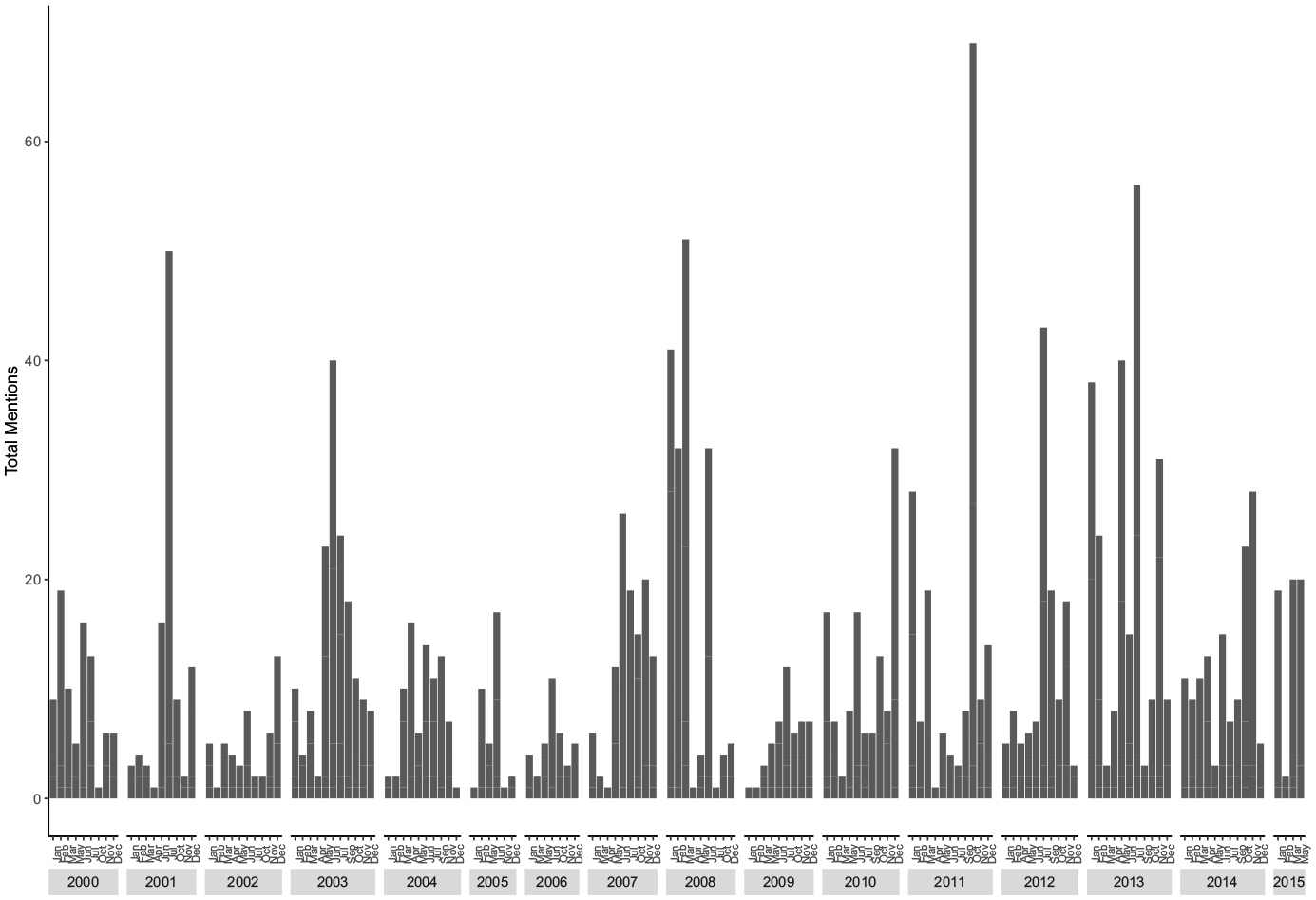
All Referendum Mentions, by Month.
Figures 3–5 then break these mentions data down by three further dimensions: by party; weighted-party, where MP totals account for the size of the parliamentary parties; and role, contrasting executive and backbench mentions. Figure 3(a) and (b) contrast slightly with Figure 2, showing more clearly that annualised totals did build over time, even though monthly totals were variable. This looks potentially driven by an ever-increasing number of Conservative MPs, and we see an increasing share of Tory contributions, particularly after 2010. When re-weighting the data to account for the number of Tory MPs and excluding exaggerated multipliers from smaller parties with a handful of vocal MPs, however, there is no marked change over time (Figure 4(b)). On a per MP basis, even in 2000, around 80% of mentions were from Conservatives. This suggests that an uptick in Conservative dominance in the conversation was driven by the sheer number of MPs, rather than especially Eurosceptic cohorts swelling the Tory ranks.
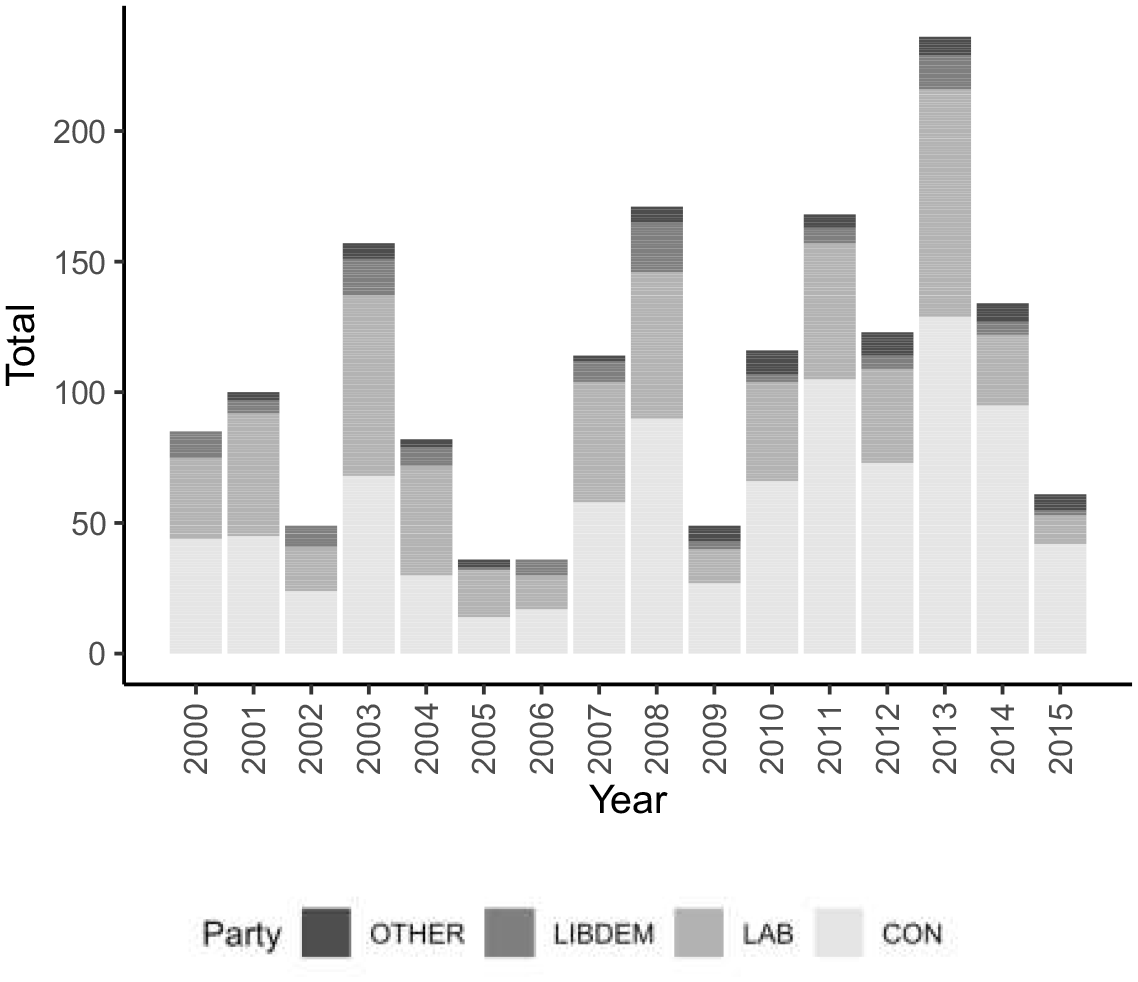
Total Referendum Mentions, by Party.
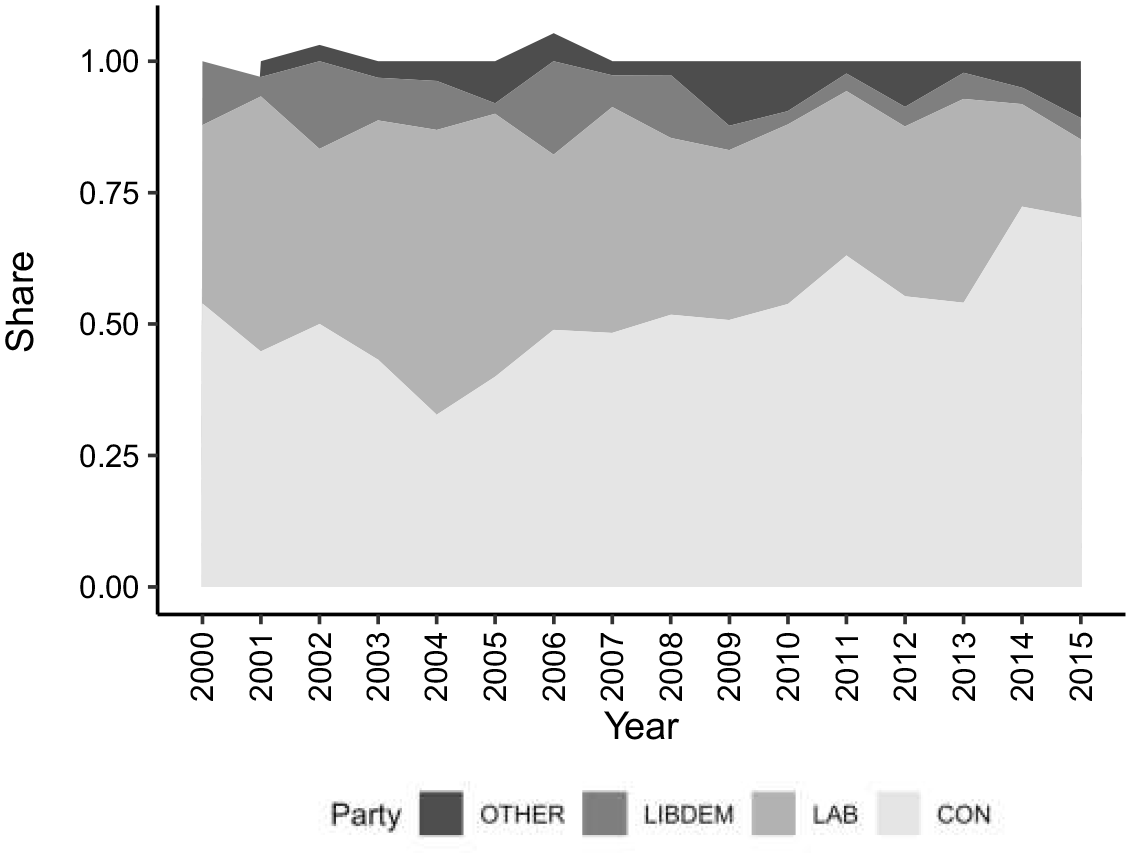
Share of Referendum Mentions, by Party.
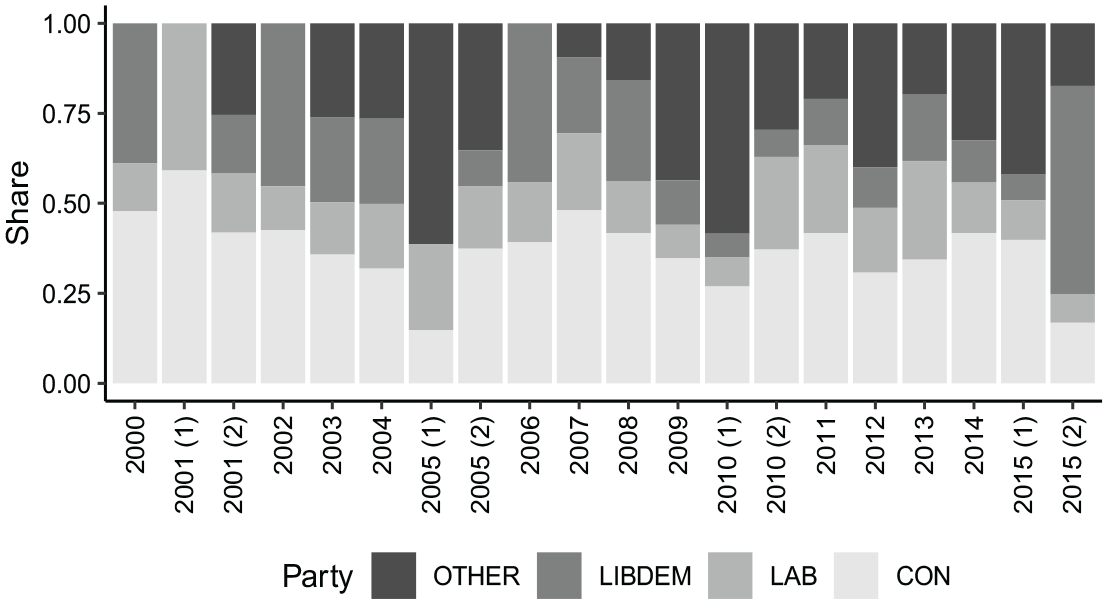
Weighted Share of Referendum Mentions, all Parties.
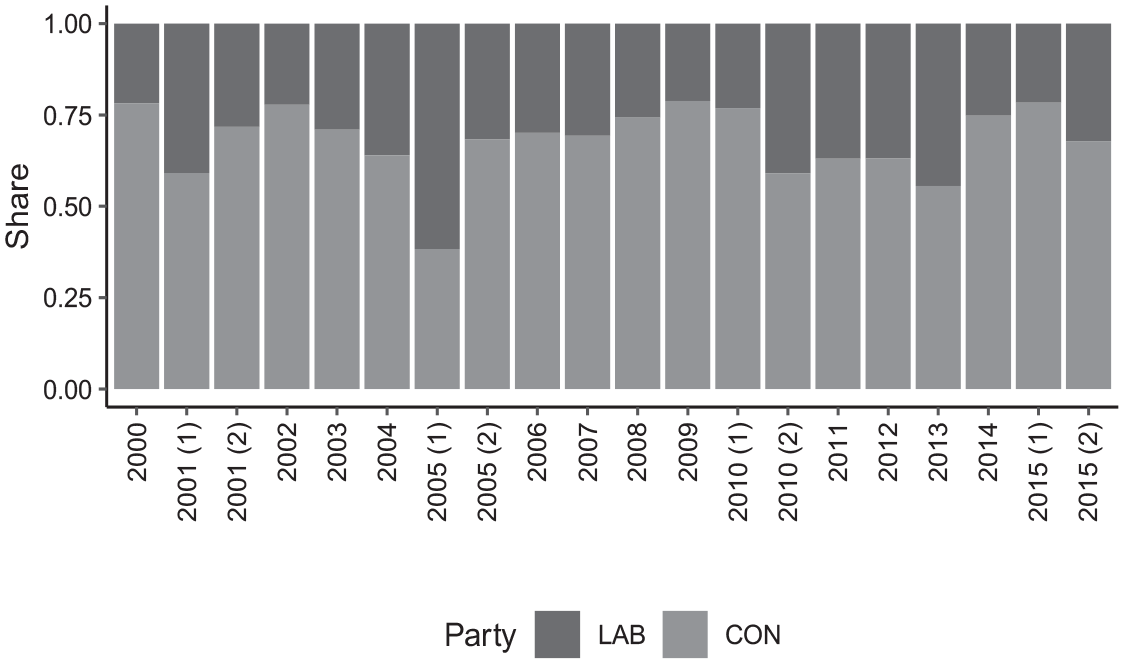
Weighted Share of Referendum Mentions, Labour-Conservative Only.
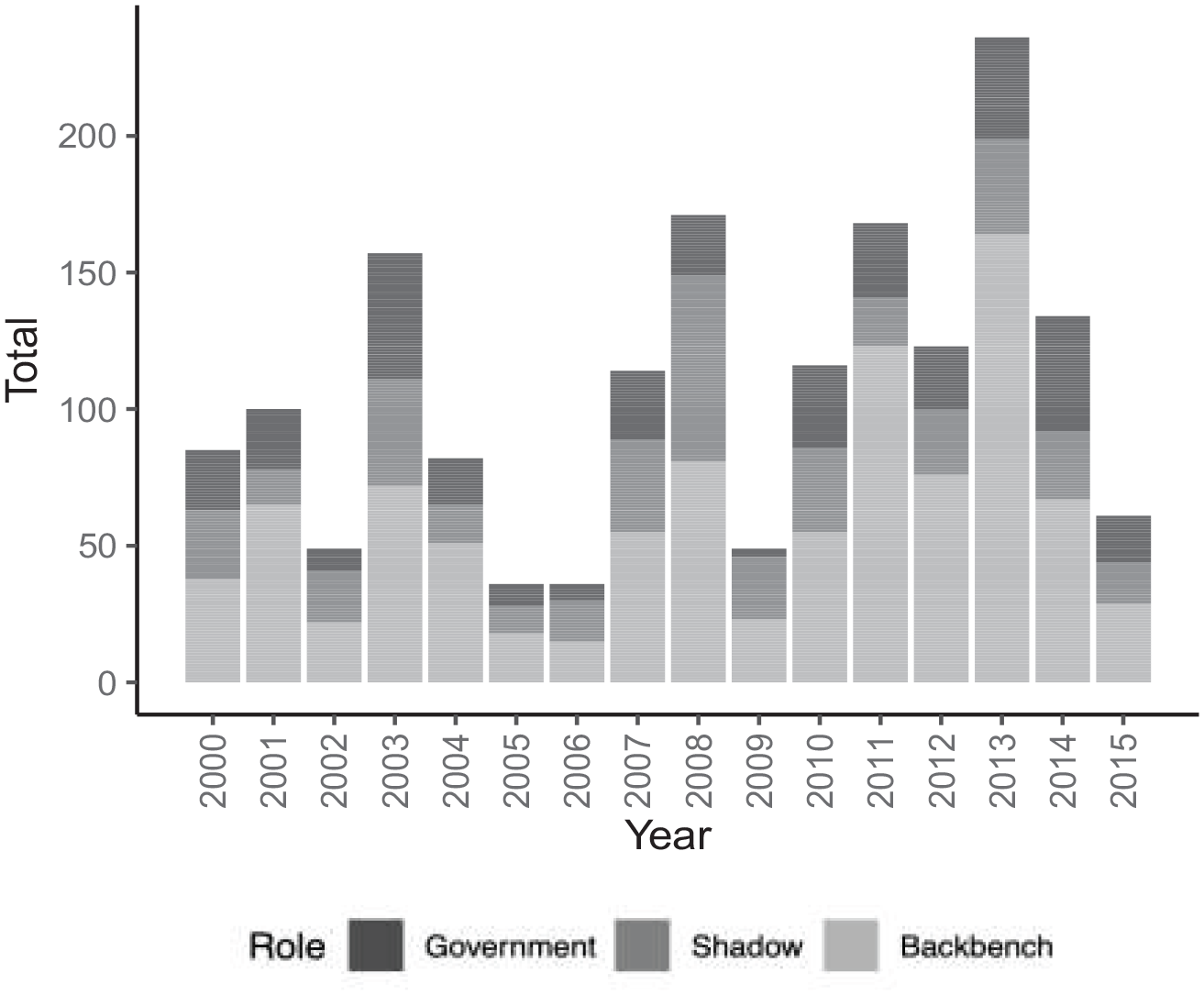
Total Referendum Mentions, by Role.
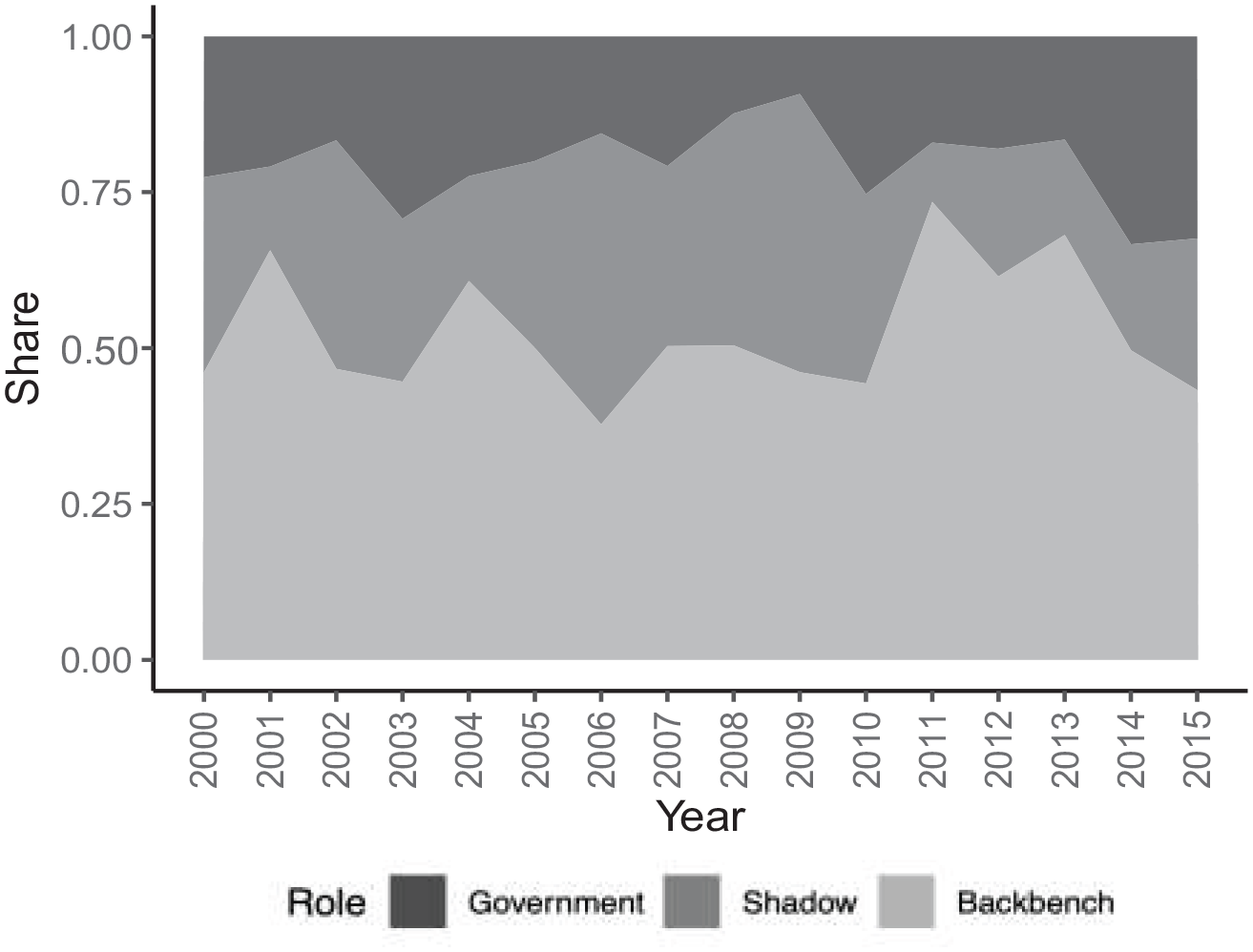
Share of Referendum Mentions, by Role.
Finally, Figure 5 lays out total and proportional contributions by role. There is no notable shifting trend over time, however, 3 of the 5 peak months are in years with spikes in the share of backbench contributions. This is most noticeable in 2011, again tentatively supporting our argument that this was a key juncture in terms of weight of pressure (although 2013 had a higher total overall). Also noticeable here is a recurrent partisan pattern: as shadow ministers account for a notably high-minority share of the overall referendum mentions up to 2010, where they shrink as the major parties switch positions. Overall, government ministers never account for more than around 20% of total mentions, and this is mostly in response to questions from backbenchers.
Collectively, the later years of heightened parliamentary salience of EU referendums, highlighted in Figures 3–5, match only roughly with our coarse cross-reference measure of salience in Eurosceptic newspapers (see Appendix 1). Aggregate mentions of referendum-related keywords in a cross-section of the Eurosceptic press spike in 2007 around the Lisbon controversy, relative to a stable decade throughout the 2000s. However, mentions grow in a much more consistent fashion, year-on-year in multiple newspapers, throughout the 2010s. This reflects a generally higher level of secular pressure building outside of Westminster being championed chiefly by UKIP and other prominent Eurosceptics outside the parliamentary Conservative Party, 3 contrasting with ‘solar flare’ patterns of parliamentary salience that tracked specific policy controversies.
Figures 3–5 offer tentative evidence that ‘outside Euroscepticism’ was gaining momentum but that this not necessarily closely linked to discursive pressure from within Parliament on Cameron. We posit that 2011 was critical because it united an increasing secular trend towards Euroscepticism with an acute parliamentary flare over crisis integration, creating consensus in both arenas that in-out was now realistically the only tenable vote. 4 We now turn to discussing the five key months in further detail.
Key Months: Salient Treaty Moments as Referendum Games
Quantitative measures show an unreliable pattern marked by flares rather than linear increases in salience over time, but they do little to elucidate the qualitative nature of the debate over EU referendums. Figure 2 reveals five key months that strongly influenced year high totals and can be examined more closely: July 2001, June 2003, March 2008, October 2011, and July 2013. In addition to being reasonably well spaced, these months are the five with the highest total mentions across all 192-month units in our period of analysis, with a combined 263 mentions between them. We treat the five episodes as salient vignettes within our broader UK case sample, to better understand how parliamentary debates over referendums were evolving over time, and where the critical leap from ‘brake’ to ‘exit’ became the default Eurosceptic stance, thus shrinking Cameron’s discretion to game.
The first coded speeches offer an indication of intra- and inter-party splits on the issue. Here, Conservative contributions to the debate are dominated by those calling for a vote, with only a little countervailing dissent surfacing in 2011 prior to Cameron’s referendum pledge. This does not indicate a total lack of Europhiles or referendum-sceptics on the Conservative benches so much as their propensity to avoid these debates entirely, with the likes of Kenneth Clarke typically opting not to dignify them. But it also hints at the seriousness of the situation by 2011, along with an inverse trend among Labour MPs outside of government, whereby opponents of referendums turn to silence and give way to neutrality, with Labour Eurosceptics such as Kate Hoey, Gisela Stuart and Ronnie Campbell gaining prominence by arguing against the party line for a vote. Finally, it is also notable that Figure 6 reflects how the Liberal Democrats adopted an idiosyncratic position of being pro-European but also broadly pro-referendum when intervening in these debates (pre- and post-2008), although the party’s small presence in parliament ensures that their total contributions are low.
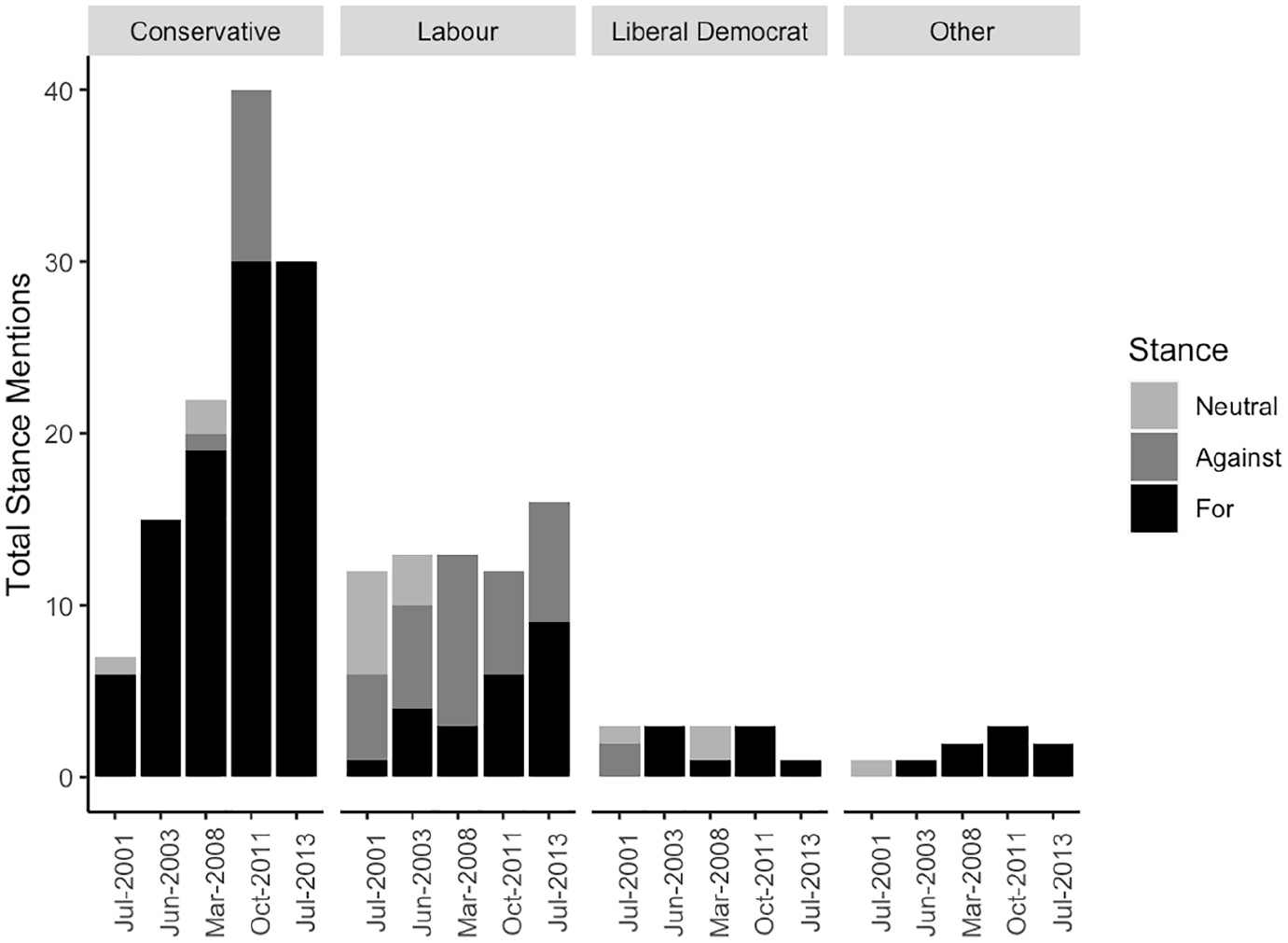
Key Episodes – Referendum Stance.
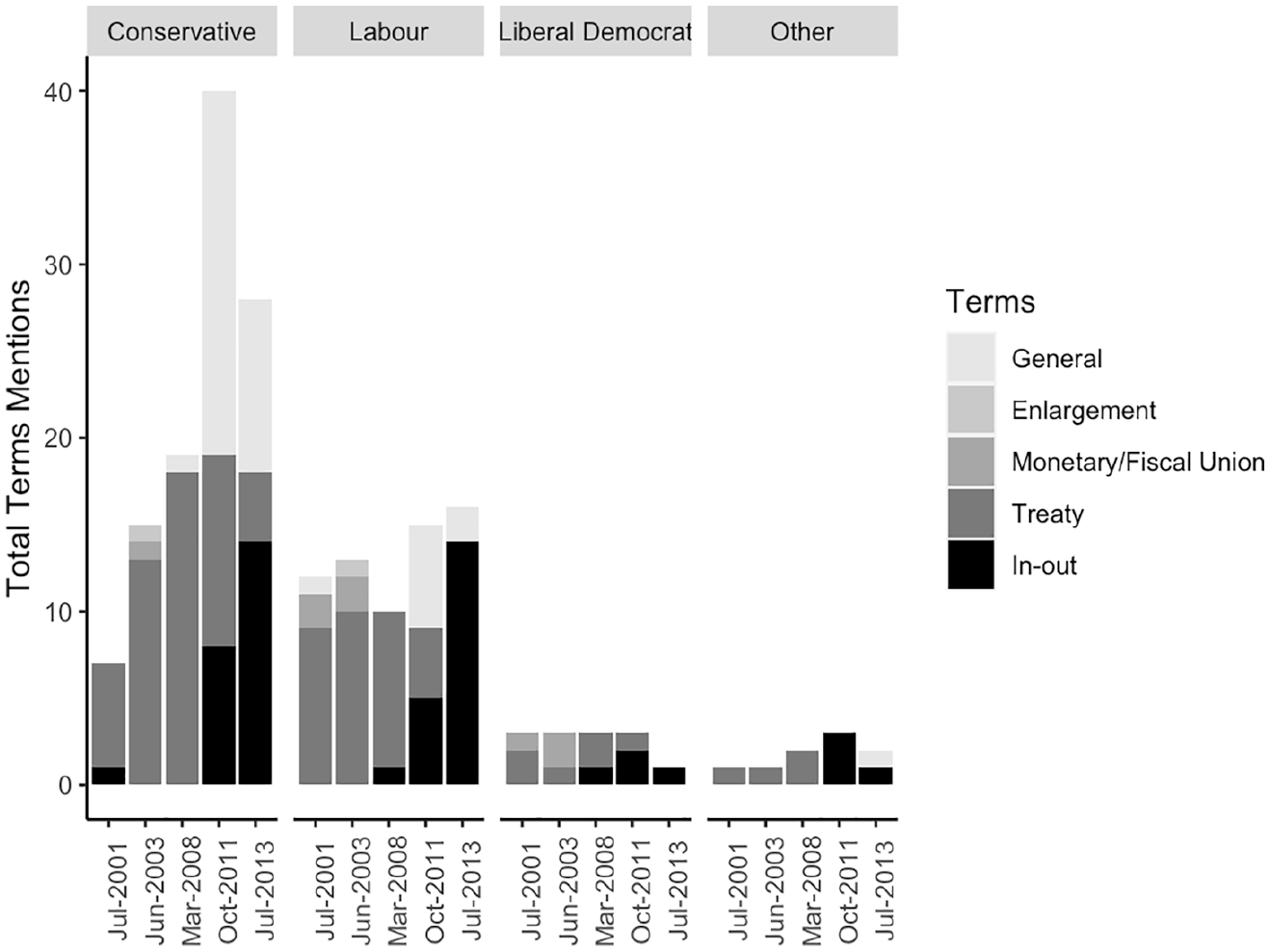
The second dimension is the type of referendum being argued for, an area predictably dominated by Conservative MPs. Yet, particularly striking in Figure 7 is the almost total lack of demand for an in–out referendum in the 2000s. As the high-profile Eurosceptic Bill Cash stated in 2003: ‘The motion is not about the merits or demerits of the EU, and neither is it about being in or out. It is not anti-European to be pro-democracy’. The implication at this point being that a referendum should not be seen as challenging Britain’s EU membership, but as a source of democratic legitimacy and popular consent.
Key Episodes – Referendum Terms.
Cash features in all key months except March 2008, and his personal attitudinal shift exemplifies the wider switch from braking to exiting (or a call for a general referendum, with no specified terms) among arch-Eurosceptics. Two Conservatives (Andrew MacKinlay, John Redwood) plus Chris Huhne for the Liberal Democrats pitched for an in–out vote in 2008, but the focus of these discussions was almost entirely on treaty matters and a plebiscite on an integration brake at Lisbon. The notion that the UK’s overall membership was at stake was actively dismissed by some campaigners. As Conservative Richard Shepherd states, [. . .] a vote on a treaty would not be about whether we were in or out. I remember the immediately previous leader of the Liberal Democrats standing in Westminster Hall saying that if Britain voted against the constitution in a referendum, it would mean that we had to leave the European Union. He was wrong on that, as France and the Netherlands demonstrated.
In short, Eurosceptic Conservative MPs were broadly not publicly advocating leaving the EU until the turn of the next decade, and the growth of demand for an in–out vote is notable. However, even in 2011, it is relatively evenly matched by MPs positioning themselves as behind a further ‘brake’ vote, and only in 2013 – after Cameron’s election pledge – is this largely consolidated. This suggests that, at least in parliamentary terms, the shift from brake to exit was relatively swift and episodic.
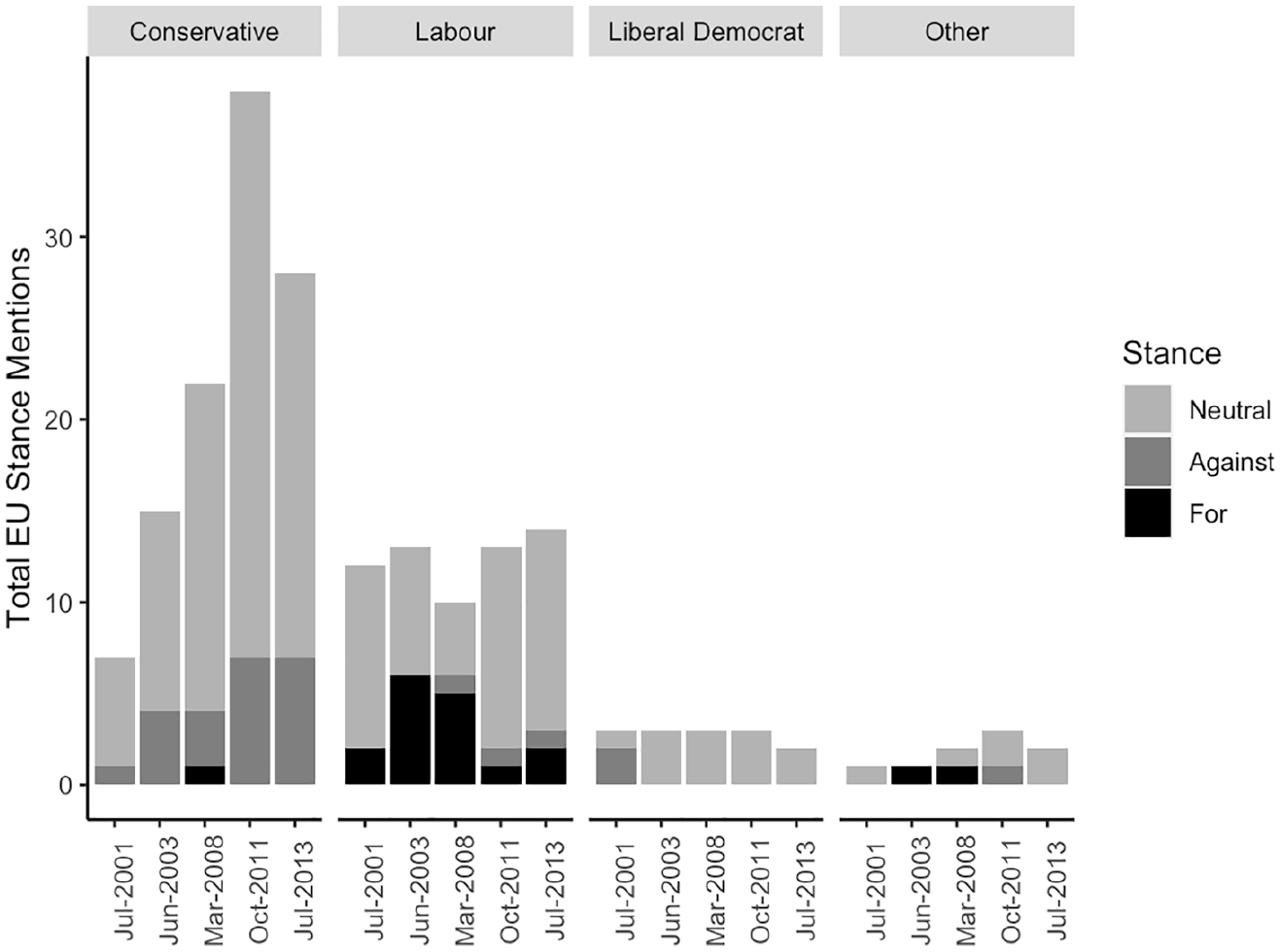
MPs’ orientations towards the EU itself and the way they frame their argument offer more indications as to why this 2008–2011 shift happened. Figure 8 shows neutrality to be the dominant stance. In other words, arguments about referendums were broadly taking place with appeals to principles, rather than with reference to the EU as a fundamentally good or bad, effective or ineffective entity. Bill Cash is one of a persistent minority of Conservative MPs across all years, however, that do explicitly refer to the EU in negative terms. Referring to the Euro crisis in 2011, Cash called the EU a ‘failing project’, and such sentiments clearly always outnumber pro-EU contributions within the Conservatives. But most Conservatives, even Eurosceptics, remained neutral on EU efficacy and preferred to couch their arguments in principled terms. Here, it is not that the EU is inherently good or bad, but democratic principles demand citizens have a say on it. As noted, Labour MPs’ proclivity to speak about the merits of the EU also appears to drop off once the party is out of government, and even this recently pro-European party gives way to neutrality. This hints that, broadly, the domestic–historical logic of referendum games as a strategic means to maintain office is at play. Once Labour had joined the opposition, their MPs had little interest in loyally defending the government position.
Key Episodes - EU Stance.
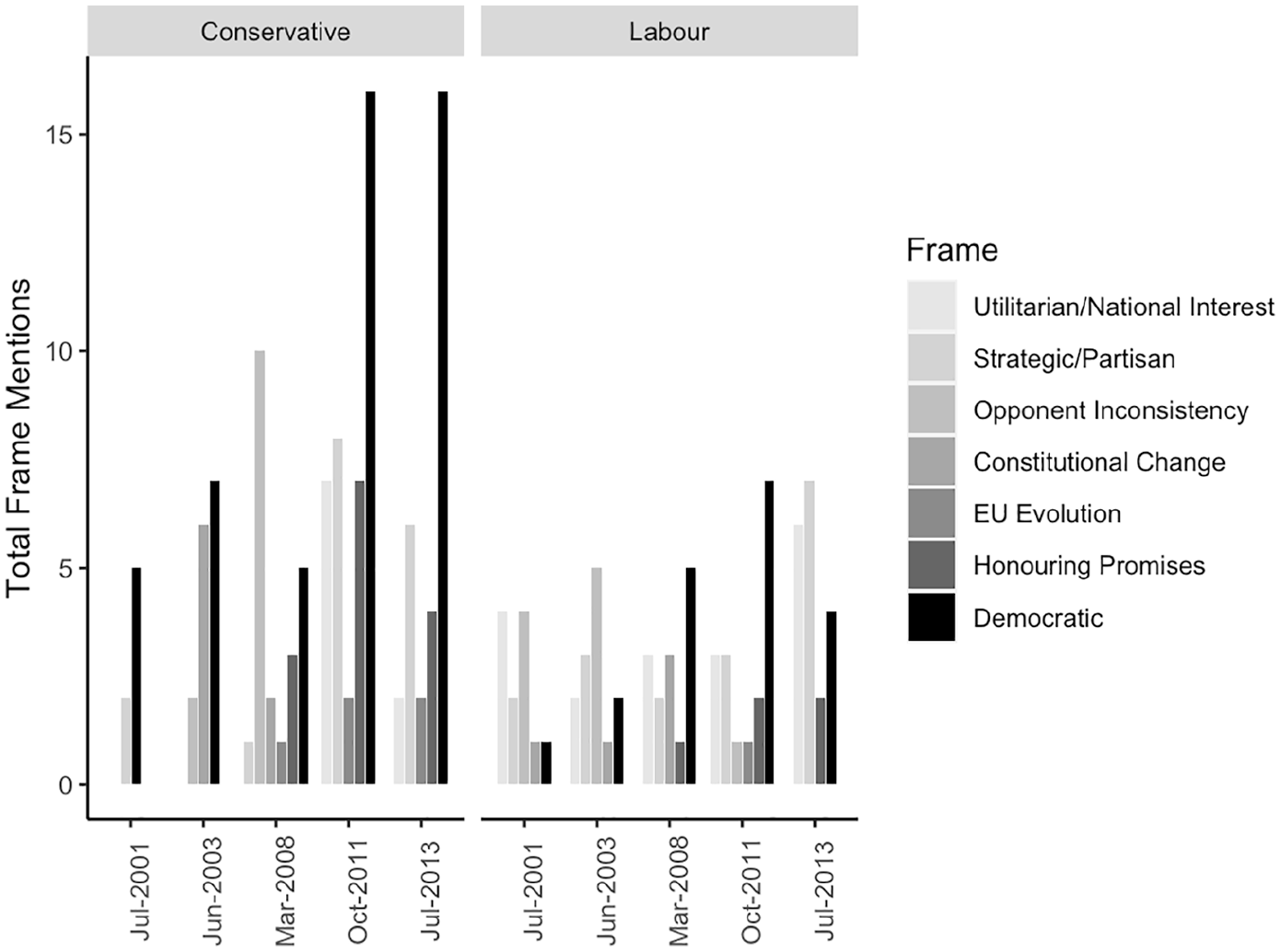
The referendum game playing out to its conclusion is further reinforced by the major parties’ respective framing of debates, shown in Figure 9. When in government (2001, 2003, 2008), there is a clear trend of Labour defending itself against Conservative referendum calls by pointing the latter’s broken pledges over Maastricht and the hypocrisy of their opponents’ position when in opposition (2003/2008). This broadly pervades until 2013, where the overriding frame of the argument switches to utilitarian: emphasising the economic benefits of membership and challenges in the feasibility of putting the entire UK–EU relationship to a binary question. This framing of EU membership would carry over to the referendum campaign as well. By contrast, Conservative arguments are dominated by democratic concerns – that a vote on the EU is overdue and/or democratically necessary. In 2008, this is second to Labour’s perceived broken pledge over Lisbon (‘Opponent Inconsistency’), while several members across years are concerned with the changing nature of the EU itself, and its integration through treaty and crisis (‘EU evolution’). This democratic emphasis and distaste for gaming of referendum pledges increases significantly between 2008 and 2011, and is summarised pithily in October 2011 by Conservative MP and veteran Eurosceptic Bernard Jenkin: ‘So many parties have again and again promised a referendum, and the British people clearly want a say over our future relationship with the European Union’.
Key Episodes - Referendum Frames.
This suggests that as his government was starting the 2010–2015 term, David Cameron’s capacity to continue the referendum game had been largely exhausted, but also that Eurosceptics’ calls had widene from relatively esoteric concerns about specific treaties, to the democratic legitimacy of the entire project. First, recall that in terms of domestic political developments, the threat of UKIP had become obvious. UKIP had come in second in the 2009 European Parliament Election, winning as many seats as Labour and more than the Liberal Democrats. In the 2010 general election, the Conservatives may have lost up to 20 seats to UKIP, UKIP’s popularity among their own constituents perhaps even costing them an outright majority in Westminster (Tournier-Sol, 2015: 147, see also: Lynch and Whitaker, 2013: 309). Second, this period coincided with an especially critical phase of EU politics in which member states were taking integrative steps to fend off the consequences of the euro crisis. Not only did Cameron become marginalised in the management of the crisis, famously blocking a proposed treaty only to be bypassed later on (Rogers, 2017), but also, our data of the 2011 parliamentary debate around a membership referendum show that British politics (captured by the ‘Democratic’ label) and EU politics (‘EU evolution’) were becoming irreconcilable for many Conservative backbenchers. In this context, the government’s attempt to address the EU membership issue by proposing the European Union Act 2011 (in November 2010), which required a referendum to be held on any further amendments to EU treaties, was deemed insufficient, since there was no opportunity to offer this sort of policy referendum at the time.
In 2011, then, British and EU politics collided in a context where prior pledges had diminished the available space for taking alternative positions to an in-out vote. This timing is corroborated by a participant account cited in Smith (2012: 1277), according to which by the summer of 2012 the dividing line in the Conservative Party had become ‘in-out’. It did not help the leadership that the Euro crisis continued unabated throughout this period. It seems that, having made his decision, David Cameron postponed his Bloomberg speech for months waiting for the appropriate moment to make his announcement (Copsey and Haughton, 2014: 74; see also Rogers, 2017). The next flare of intensive referendum motions and mentions in our data came after the 2013 January Bloomberg speech, and sought to bind him to his rhetorical commitment by introducing a schedule for a 2017 vote. These were initiated in July 2013 by James Wharton, and by this point, any internal Conservative opposition to a public vote had diminished. Even remain-inclined MPs, such as Theresa May, succinctly repeated the official rationale of the party’s position, which was broadly to emphasise the necessity of democratic renewal for the European project given the time and integrative evolution of the EU since 1975.
Conclusion
Since Euroscepticism has been understood essentially as form of polity contestation (De Wilde and Trenz, 2012), the British switch from braking to exiting could be taken as a response to the escalation of its own unique awkwardness towards the European project. However, as we have shown, this escalation was, in parliamentary terms, a ratchet – largely justified by the fact that more moderate referendum appeals had been eschewed. Our analysis indicates that the failure to secure a referendum on Lisbon appeared to take the game beyond ‘brake’ mode and towards outright ‘exit’. The call for ‘exit’ as opposed to a ‘brake’ on further integration became pre-eminent around the time of the Euro crisis in 2011. David Cameron’s unprecedented veto of a resolution treaty could not assuage Eurosceptic parliamentarians who saw the crisis measures as a sign of the irreconcilability of the UK and the EU going forward (Thompson, 2017). The exhaustion of parlayed promises by governing parties and a demand for wholesale democratic renewal was typically couched in principled terms, although verbal attacks on the EU itself also increased over time. At the same time, the absence of treaty referendums post-Lisbon, in a context whereby the UK had secured numerous optouts already, further limited the options for an issue-referendum rather than an in–out vote. In conclusion, then, while the spill-over from policy to polity politicisation to some extent was a response to an escalation of Euroscepticism outside of Parliament, ultimately, the in–out choice was also driven by the idiosyncratic logic of the referendum game: domestic short-sighted outbidding colliding with EU developments to diminish the available space for compromises that kick the issue down the road. In this respect, our article does not challenge conventional wisdom regarding British exceptionalism, but it does demonstrate its explanatory force and limits, by drawing attention to the missing link between domestic British parliamentary politics and an EU polity in crisis.
The same dynamics that produced the call for an in–out referendum also explain why the referendum result could not be reversed or ignored. EU referendum failure (a result that does not go the way those who have called for it intended) does not automatically determine the response. Instead, governments have devised all sorts of ways to get around and mitigate ‘no’ votes – by revising the terms of integration, diluting the result or finding substitutes (Schimmelfennig, 2019). This refers to the importance of sequencing in the process of democratic renewal over Europe. When Danish and Irish voters respectively rejected the Maastricht and EU constitutional treaties, this allowed national leaders to formally demonstrate that meaningful concessions were required to sate Eurosceptic public opinion at home and extract a package of bespoke concessions that could be presented as victories. Notably, David Cameron sequenced the Brexit referendum in reverse: first, he would extract concessions, then he would offer a comprehensive vote that was presented as binding, at least in the strongest political terms, if not legally. The point is that the political costs involved might render this a practically impossible or self-defeating process, he could triangulate or game no further.
Why is this relevant for the Brexit post-mortem? We argue that not only is it important to understand the road that led to the unique historical event of a member state exiting the EU, but also whether this could happen elsewhere. From hindsight, we now know that Brexit has not produced the domino effect that many expected in its immediate aftermath. But what our analysis demonstrates is that the domino hypothesis rested on shaky grounds to begin with: it assumed that calls for exit would represent genuine dissatisfaction with the EU, but the UK’s in–out referendum was more accidental than intentional – not only in its outcome but also in its origin. It was the result of a long-term build-up of an elite, idiosyncratic EU referendum game in a specific country and its collision with EU political developments at a very specific moment in time. While the EU can take some comfort in this, it is nonetheless important to understand why the European issue also creates space for opportunistic behaviour of political entrepreneurs with potentially deleterious consequences for the EU. Referendums are sometimes considered despotic and destructive democratic devices, but carefully deployed they surely need not be. In fact, they may lead to democratic renewal. In any event, the pressure to deliver them may become overriding, so pro-European leaders might use them wisely when weighing their domestic political incentives and long-term legacies. Smedley (2019), for example, has speculated about a quite different counterfactual history whereby Labour put the Euro to the public, per its 1997 manifesto. More generally, we hope to highlight that timing and sequencing matters and that the EU and pro-European leaders in member states might be guilty of myopia when avoiding the awkward question of democratic consent for further integration.
Supplemental Material
sj-docx-1-psw-10.1177_14789299241239002 – Supplemental material for Braking and Exiting: Referendum Games, European Integration and the Road to the UK’s Brexit Vote
Supplemental material, sj-docx-1-psw-10.1177_14789299241239002 for Braking and Exiting: Referendum Games, European Integration and the Road to the UK’s Brexit Vote by Joseph Ganderson and Anna Kyriazi in Political Studies Review
Supplemental Material
sj-xlsx-2-psw-10.1177_14789299241239002 – Supplemental material for Braking and Exiting: Referendum Games, European Integration and the Road to the UK’s Brexit Vote
Supplemental material, sj-xlsx-2-psw-10.1177_14789299241239002 for Braking and Exiting: Referendum Games, European Integration and the Road to the UK’s Brexit Vote by Joseph Ganderson and Anna Kyriazi in Political Studies Review
Footnotes
Acknowledgements
The authors would like to thank Tom McCrae Hunter for generously sharing his dataset, Joris Frese for excellent research assistance, and two anonymous reviewers for their very helpful comments
Declaration of conflicting interests
The author(s) declared no potential conflicts of interest with respect to the research, authorship, and/or publication of this article.
Funding
The authors disclosed receipt of the following financial support for the research, authorship, and/or publication of this article: The authors were supported by ERC Synergy Grant, number 810356, for the project Policy Crisis and Crisis Politics. Sovereignty, Solidarity and Identity in the EU post 2008 – SOLID.

Supplemental material
Additional supplementary information may be found with the online version of this article.
Notes
Author Biographies
References
Supplementary Material
Please find the following supplemental material available below.
For Open Access articles published under a Creative Commons License, all supplemental material carries the same license as the article it is associated with.
For non-Open Access articles published, all supplemental material carries a non-exclusive license, and permission requests for re-use of supplemental material or any part of supplemental material shall be sent directly to the copyright owner as specified in the copyright notice associated with the article.
