




Abstract
Scientists gained relevance and visibility during the COVID-19 pandemic, but how trust in scientists affected compliance with COVID-19 policy measures is understudied. This article asks to what extent trust in scientists influences (intended) compliance with COVID-19 vaccination policy and whether and how it acts as a mediator of the effects of cultural worldviews, partisanship, and ideology. Using data from the latest round of the European Social Survey, it applies multigroup path analysis to outline the mediating influence of trust in scientists in two countries differently affected by the COVID-19 pandemic: Italy and Switzerland. The results indicate that trust in scientists is related to (intended) compliance, but that there are cross-country differences in the explanatory models: While ideological and party-related influences on COVID-19 vaccine uptake become visible in Switzerland, cultural worldviews better explain the intention to get a COVID-19 vaccine in Italy.
Introduction
Research shows that trust is essential to enhance support for and compliance with policy measures, which are key to effective pandemic management (Han et al., 2023; Vu, 2021). Political trust in government and administration facilitates state regulation in general (Trein and Varone, 2024) and the adoption of policy responses to the pandemic in particular (Zahariadis et al., 2021). Existing studies found that lower levels of trust make necessary stricter policy measures because voluntary compliance with government recommendations is expected to be lower (Toshkov et al., 2022). In turn, stricter policy measures toward groups that do not comply with recommendations can have a negative effect on trust (Jørgensen et al., 2024). So far, however, research has investigated the link between policy compliance and trust in government, social trust, or political actors, and not so much with trust in scientists. Given the increasing visibility and relevance of scientific policy advisors in pandemic crisis management during COVID-19 (Boussaguet et al., 2023), two questions around the trust variable arise: What are the direct effects of trust in scientists on intended policy compliance? Which other factors affect compliance independently or through trust in scientists?
These questions are of importance for several reasons. First, understanding whether there are direct effects of trust in scientists on intended policy compliance holds implications for the relevance of the public perception of scientists. If attitudes toward scientists only mediate effects of ideology on intended compliance, as some studies suggest (Hanimann, 2023), the reputation and trust-upholding features of scientific presentation might lose importance in pandemic management compared to strategies that address ideological or cultural polarization. Second, gaining a deeper understanding of policy compliance against the backdrop of cognitive factors, such as social identities (Hornung et al., 2018; Zeng, 2021), ideology (Diehl et al., 2021; McCright et al., 2013), and cultural biases (Cordella et al., 2023; Yuan and Swedlow, 2024) sheds light on the mediating role of trust in scientists that has multiple dimensions. Investigating how these effects differ across national contexts contributes to more effective pandemic management in the future, as obstacles to compliance with pandemic measures can be reduced.
Filling this gap, this article contributes to the growing literature on trust in scientists and policy compliance during COVID-19 (Wang et al., 2023) by expanding knowledge on what drives policy compliance in times of a pandemic, and which role trust in scientists plays directly or as a mediator in such times. What is more, how these effects differ across countries helps outlining the relevance of contextual factors of pandemic affectedness and policy responses on micro-level dynamics. By analyzing the latest round of the European Social Survey (ESS), this article tests the effects that cultural worldviews, identities, and ideologies have on general levels of trusts in scientists and hypothesizes trust in scientists to be a mediator in this relationship. A multigroup path analysis allows for estimating the direct effect that these factors had on compliance and whether trust in scientists can be considered a mediator of these relations, depending on the national context. The results provide implications for future pandemics.
The remainder of the article is structured as follows: Section “Roots and Consequences of Trust in Scientists During COVID-19” reviews the state of the art on research on trust, both regarding its predictors and effects on acceptance and compliance, and on the moderating role of national contexts. Thereby, it derives hypotheses for later testing. Section “Methods” presents the research design and section “Results” the results of the empirical analyses. I conclude with a discussion of the practical implications of the results for future pandemics and a research agenda.
Roots and Consequences of Trust in Scientists During COVID-19
Since the pandemic, several studies have dealt with the issue of trust and how it relates to pandemic crisis management in terms of compliance (Devine et al., 2021; Yuan et al., 2022). In this context, research on the roots and consequences of trust and its policy-related implications has strongly focused on either systems of governance (such as the European Union or the health care system; Busemeyer, 2022), trust within institutions (Squevin et al., 2024) or “political trust” in government, the executive, or state institutions (Belchior and Teixeira, 2021; Devine et al., 2021; Fiedler et al., 2024; Jennings et al., 2021; Lynggaard et al., 2023; Vasilopoulos et al., 2023; Weinberg, 2023). For example, Hrbková and Kudrnáč (2024) draw on original survey data during the first and second wave of COVID-19 in the Czech Republic to show that institutional trust was positively related to compliance, which they—among other things—theoretically trace back to the rally-round-the-flag effect that during crises, citizens tend to collectively support the governmental institutions because of the uncertainty and risk associated with crisis (Erhardt et al., 2021; Kritzinger et al., 2021; van der Meer et al., 2023).
Although trust in scientists and experts is considered equally relevant in public policy reactions to crises (Cairney and Wellstead, 2021) and partly more important to policy compliance than trust in government (Bicchieri et al., 2021), it has received less attention in the literature. Trust in scientists differs conceptually and empirically from trust in political institutions, such as parliaments or the legal system, for several reasons: First, because of the presumed independence of political dynamics and conflict, questions after trust in scientists trigger less ideological and bureaucracy-related attitudes that could potentially bias the relationship between trust and compliance, because individuals with a certain political opinion might be more or less inclined to trust government institutions and comply. For example, Kerr et al. (2021) show that liberals in the United States were more likely to not trust politicians but to trust medical experts, which points toward a certain disentanglement between trust in political institutions and trust in scientists. However, the interdependence between trust in scientists and trust in (political) institutions is found to be complex (Pechar et al., 2018). Bertsou and Pastorella (2017) outline that trust in political institutions can also have positive effects on technocratic attitudes. Second, independent of political institutions, the causes of trust in scientists could lie less in political opinion but in individual predispositions such as education or technocratic attitudes (Angelucci and Vittori, 2025; Bertsou and Caramani, 2022).
What Effect Does Trust Have on Compliance?
During the COVID-19 pandemic, governments adopted policy measures mainly with the aim of preventing infections to spread and persevering public health. However, the effectiveness of policy measures essentially depends on the public’s compliance with the regulations, which is related to their acceptance (Dohle et al., 2020). The role of trust in this relationship is contested. While some scholars find that during the COVID-19 pandemic, a low level of trust in science was associated with low support for policy measures and compliance (Algan et al., 2021; Cabrera-Álvarez et al., 2022; Campbell, 2023; Muğaloğlu et al., 2022), others show that only support but not compliance was related to trust during the COVID-19 pandemic (Newton, 2020), and that trust was a mediator between political ideology and support (Sulik et al., 2021). In general, the role of scientists was very visible during the COVID-19 pandemic, most importantly because countries explicitly consulted scientists when formulating recommendations, often under the paradigm of “following the science” (Kurzer and Ornston, 2023). Hence, trust in scientists should generally increase the willingness to follow the recommendations, which is a claim also supported by research on the specific topic of vaccination (Kossowska et al., 2021).
Besides the direct effect of trust in scientists on policy compliance, Plohl and Musil (2021) find trust in scientists to be a mediator of political convictions, religion, conspiracy beliefs, and intellectual curiosity. This is because, depending on political ideology, people might be more or less likely to trust scientists and—as a result—comply with policy measures based on scientific evidence. Beliefs about scientists’ objectivity and conspiracies are also found to be directly related to individual behavior (Hamilton et al., 2021; Johnson, 2023; Lindholt et al., 2021). Therefore, trust in scientists is hypothesized to have a direct effect on COVID-19 vaccination policy but also to mediate the effects of the other variables.
H1: Higher levels of trust in scientists are associated with higher intentions to comply with policy measures.
What Influences Trust in Scientists and Policy Compliance?
Trust has been widely found to not only have direct effects on compliance but also to be a mediator between individual-level factors and compliance (Schmeisser et al., 2021). Interestingly, trust in scientists as a mediating factor between cultural biases, ideology, and partisan identities has not been studied in the context of the COVID-19 pandemic. This is striking given the fact that cultural worldviews and ideological beliefs as well as social identities are prominent predictors of trust and perceptions of experts (Lachapelle and Montpetit Gauvin, 2014; Kahan et al., 2011) and policy compliance (Vignoles et al., 2021).
The cultural theory of risk (Douglas and Wildavsky, 1982; Kahan, 2012; Wildavsky and Dake, 1990) distinguishes between cultural worldviews on a two-dimensional pattern of grid and group (Grid-Group Cultural Theory, GGCT). Depending on whether there are weak or strong restrictions on the individual (grid) or embedment in groups (group), individuals possess certain cultural orientations or biases (Grendstad, 2003; Hoppe, 2007) that can affect individual attitudes and policy preferences (Hornung and Bandelow, 2021; Jones, 2011; Swedlow, 2011). Three cultural worldviews are most commonly applied in political research: egalitarianism—the view that people should be treated equal and fair and that the community is more important than the individual, the individualistic worldview from which individuals rank higher than the community and people are responsible for themselves, and the hierarchical worldview, which signifies that rules are handed down in clear-cut hierarchies and should be followed (Lachapelle et al., 2018). Cultural theories have been widely proven relevant in research on trust and support (Kumove, 2024; Nowlin, 2022). For instance, Conner et al. (2016) have used worldviews as conceptualization of managerial values and found that people who score higher on the hierarchical and egalitarian index exhibit larger motivations for fostering trust.
In relation to COVID-19, Dimitrijevska-Markoski and Nukpezah (2023) show that even after controlling for partisan and religious affiliations, cultural biases explained support for COVID-19 mitigation measures. Both indirect effects through trust (Yuan, 2022) and risk perception (Savadori and Lauriola, 2021, 2022) as well as direct effects on compliance have been found (Siegrist and Bearth, 2021; Yuan and Swedlow, 2024). However, existing research presents mixed findings as to whether hierarchical and individualistic worldviews make people trust more or less in scientists and follow policies in the COVID-19 pandemic. Wang et al. (2023) argue that hierarchists uphold traditional structures and find them to be more skeptical regarding COVID-19 vaccination. Therefore, people with hierarchical worldviews are expected to be less trusting of scientists and less compliant with COVID-19 policy. Yet, hierarchists also value regulatory policy instruments—or policy instruments at all—above no policy instruments (Diriye et al., 2022). As COVID-19 vaccination policy was accompanied by several policy instruments in governing the pandemic, hierarchists might be more willing to comply with them. Since hierarchists tend to weigh risks generally lower because they follow established leadership (Cheng et al., 2023), I expect their trust in scientists to be lower and their willingness to comply with vaccination policy higher.
The same is expected for people who hold individualistic worldviews, who have been found to perceive less risks connected to COVID-19 and consequently also showed less compliance with measures (Siegrist and Bearth, 2021) as well as fewer support (Liu and Yang, 2023). Because there is complementary evidence that higher individual risk perceptions are positively associated with greater trust in science (Dryhurst et al., 2020), individualistic worldviews should be negatively related to trust in scientists.
Different expectations emerge for egalitarian worldviews, on which the literature presents relatively unanimous findings: Since COVID-19 and compliance with policy responses has often been framed as an issue of solidarity to reduce infections among vulnerable groups of the population, people who hold an egalitarian worldview should be more prone to comply with COVID-19 vaccination policy. As Song et al. (2014) state for the issue of childhood vaccination policy, egalitarianists seek to secure public health for the benefit of society and value this more than a potentially imposed vaccination.
People with hierarchical worldviews have lower levels of trust in scientists (H2a), but a higher willingness to comply with COVID-19 vaccination policy (H3a).
People with individualistic worldviews have lower levels of trust in scientists (H2b) and a lower willingness to comply with COVID-19 vaccination policy (H3b).
People with egalitarian worldviews have higher levels of trust in scientists (H2c) and a higher willingness to comply with COVID-19 policies (H3c).
Furthermore, ideology has emerged as a driving factor of trust in scientists (Kossowska et al., 2021). In general, people that are placed at the conservative or rather right-wing spectrum are more likely to show lower levels of trust (Evans and Hargittai, 2020). Ideology is found to have both a direct effect on behavioral intentions in the COVID-19 pandemic (Debus and Tosun, 2021) and an indirect effect that runs through trust (Baumgaertner et al., 2018). While ideology is often placed at the individual level by measuring the self-identification on a left-right scale (Juen et al., 2023), this operationalization impairs comparability across regions (Bauer et al., 2017). Ideological orientation can also be assessed in social terms via the subjective identification with a political party. The social identity model of risk formalizes this focus on social groups as influential on trust (Cruwys et al., 2021) and has been applied already in the context of COVID-19 (Power et al., 2023). The difference is that in case of the latter understanding, the influence on trust and support runs through a social identification rather than an ideological precondition (Abramowitz and Saunders, 2006; Huddy and Bankert, 2017). Such social influence on trust through right-wing political parties, has been corroborated with empirical evidence in the literature (Agley, 2020; Bromme et al., 2022; Elgar et al., 2020). Since conservative right-wing individuals perceive a lesser risk connected to COVID-19 (Ruisch et al., 2021), people who self-identify as right-wing should be more prone to also distrust scientists and not follow COVID-19 vaccination policy. A different mechanism is hypothesized to run through partisanship: since especially right-wing parties often exhibit a strong group identity, and those groups tend to engage in critical discourses of how the political elite steers the pandemic (Farias and Pilati, 2022), these should also be less trusting and less complying, but because of group influence and not because of individual ideological beliefs.
People who self-identify as right-wing are less trusting of scientists (H4) and on average have a lower willingness to comply with COVID-19 policies (H5).
People who self-identify as members of right-wing political parties are less trusting of scientists (H6) and on average have a lower willingness to comply with COVID-19 policies (H7).
Which Moderating Role for the National Context?
What this contribution particularly adds to the extensive literature on trust and compliance in the COVID-19 pandemic is the moderating role of the national context. Only few studies have explicitly estimated the effect of macro-level variables on trust and compliance (Lavallee et al., 2021). Pagliaro et al. (2021) have found no effect of the nationally varying infection rates on individual intention to comply with COVID-19 measures, but state that this intention was entirely traced back to trust. Similarly, there is evidence that infection rates impacted political trust over time (Schraff, 2021). Six et al. (2023) compare temporal contexts in Belgium and find that trust in government declined over time but that there is no positive effect on compliance. An important comparative study on the United States and China found trust in government to be a mediator in China, but not in the United States, and highlighted the GGCT as contributing both a direct and indirect predictor for compliance (Johnson et al., 2024). As regards country comparisons, a greater stringency of measures positively interacts with high levels of trust in government (Stanica et al., 2022), thereby also explaining compliance (Bargain and Aminjonov, 2020). I therefore hypothesize that the effect of trust on compliance varies depending on whether a country was severely affected by the pandemic or adopted strict policy measures.
National differences that potentially moderate the proposed relationship are not limited to affectedness or strictness of policy measures. Given that the mechanism between trust and compliance bases on the trust in scientists, the way in which scientists were involved in decision-making and should also be relevant in this regard, as scientific advice was highly polarized in some countries. The involvement of scientists in public policymaking is often analyzed through the lens of policy advisory systems, which during COVID-19 varied across countries (Bouchat et al., 2024). In some countries, such as France, scientific advice was highly centralized in line with the pre-existing institutional structure of the political system, while in other countries, such as in Germany, the rather fragmented and uncoordinated policy advisory structure potentially increased politicization (Bandelow et al., 2021; Kuhlmann et al., 2021). If the institutional structure of scientific policy advice is centralized, scientific recommendations are communicated more unanimously, which—as a result—theoretically is expected to strengthen trust and resulting compliance, because scientific communication influences trust and compliance (Zarzeczna et al., 2024).
H8: The relationship between trust and compliance should be stronger in countries with stricter policy measures and in countries with more centralized structures of scientific policy advice.
The final theoretical model is depicted in Figure 1.
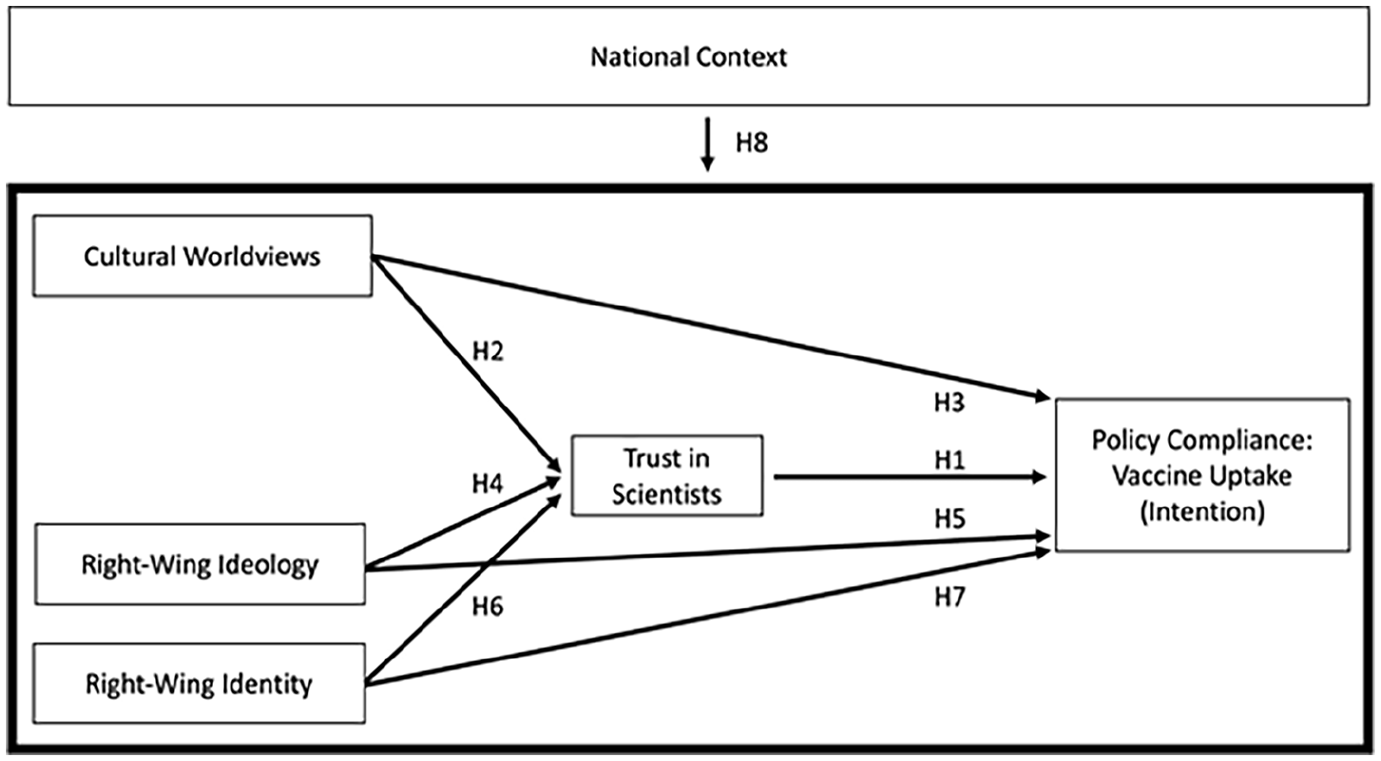
Theoretical Model of Roots and Consequences of Trust in Scientists.
Methods
The theoretical model comprises both a mediator variable (trust) and the assumption that the relation between the independent variables, the mediator, and the dependent variable of intended compliance with COVID-19 vaccination policy differ across countries. Therefore, I rely on a multigroup path analysis as a methodological procedure in which the two groups to compare are different nationalities. Path analyses are a frequently applied method for singling out the effect of trust, also as a mediating variable in theoretical models on crisis management (Awwad et al., 2023). The hypothesis on the national context postulates that it is the different affectedness and reactions of countries that moderates the relationship. Therefore, Italy and Switzerland present the countries of comparison, because they are similar regarding culture and geographical location within Europe, but differed in the severity of pandemic management as well as preparedness and responses (Capano, 2020; Hadorn et al., 2022).
The European Social Survey (ESS) serves as database. The ESS provides an encompassing representative dataset to study social scientific research questions. It is carried out very two years with the participation of a fixed team of social scientists who distribute the same set of survey questions in the respective national languages to a representative sample of the national population. Because of the identical questions it is possible to conduct comparative analyses of respondents in different national contexts. The latest round 10 of the ESS encompasses data from 31 countries, although only for a few of them, complete datasets are available. Two of these few are Italy and Switzerland, for which complete data is available for the year 2020 (ESS, 2020). The two countries also have relatively high response rates, with 49.5 (Switzerland) and 49.8 (Italy) respectively; only Bulgaria, North Macedonia, Slovenia, Czechia, and Montenegro have higher response rates between 54.7 and 72.8. Using this round of data appears appropriate because it captures a moment in the pandemic where it was potentially least politicized, as politicization presumably increased over the months and years (Relihan et al., 2023; Schmidt, 2023). The questions of this round also have the advantage that they included items that relate to the COVID-19 pandemic.
To date, there are already few publications that have used the ESS data to answer research questions that address COVID-19 crisis management. Oksanen et al. (2020) explain mortality rates, taking—among other variables—trust in institutions and strictness of regulations into account. Other studies seek to shed light on vaccine hesitancy: Lamot et al. (2022) use latent profile analysis to grasp characteristics of people rejecting vaccination in Slovenia. Cadeddu et al. (2021) use ESS data from 2017 and 2019 to explain vaccination hesitancy in Italy. Because trust in physicians has been shown to enhance vaccine uptakes (Viskupič et al., 2022), the issue is suitable to test further associations with trust as a mediator and the effects on compliance in different national contexts. In general, vaccinations are perceived as a necessary step toward reducing negative impacts of the COVID-19 pandemic (Coccia, 2023), but it is also a polarizing issue (Avdagic and Sedelmeier, 2024). As a result, this study operationalizes compliance with COVID-19 policy as the behavioral intention to get vaccinated. It examines how cultural worldviews, social groups, as well as ideology, are predictors of such compliance and which direct and mediating effect trust in scientists has.
Dependent Variables
Therefore, there are generally two dependent variables. The first is the dependent variable of compliance, or rather intended compliance, because the ESS does not provide data on whether respondents actually followed certain policy measures. This intended compliance is operationalized by taking the ESS variable formulated as “Whether respondent will get vaccinated against COVID-19 with vaccine approved by the national regulatory authority in country,” whereby “Yes, I will,” “Yes, I already have,” or “No” are the response options. It is true that the part of the question that points toward the approval by the national regulatory authority might trigger different trust associations than just that toward scientists. Although there exist other trust variables in the ESS (such as trust in parliament or trust in the legal system), the second dependent and at the same time independent, because conceptualized as mediating, variable is trust in scientists. This is operationalized in the ESS as the extent to which an individual personally trusts scientist, to be indicated on an 11-scale item.
Independent Variables
The independent variables are mainly individual-level variables and membership in social groups, as well as the national context. Ideology is measured on the well-acknowledged left-right scale, and political partisanship is measured in terms of the closeness that respondents feel toward a political party as opposed to others. As the hypotheses specifically presume right-wing partisanship to have an effect, an additional dummy variable categorizes respondents into those feeling close to right-wing parties (in Switzerland: SVP; in Italy: Lega Nord and Fratelli d’Italia). Both variables are manifest variables that were directly asked in the questionnaire.
Cultural worldviews are usually measured via three items in political research (Ripberger et al., 2014), but recent research points toward the necessity to improve face and content validity (Swedlow et al., 2020). The ESS provides several items that are at first sight appropriate to measure cultural worldviews. However, the Cronbach’s alpha values are not high enough to warrant the construction of a scale of these items. Therefore, single items are used in line with existing research 1 (Hornung and Bandelow, 2021). This includes the following items:
Individualism: It is important to him or her to make his or her own decisions about what he or she does. He or she likes to be free and not depend on others.
Hierarchy: He or she believes that people should do what they’re told. He or she thinks people should follow rules at all times, even when no-one is watching.
Egalitarianism: He or she thinks it is important that every person in the world should be treated equally. He or she believes everyone should have equal opportunities in life.
Finally, there are some control variables that are included in the model because of their relevance in previous studies. These include age and gender (Bromme et al., 2022; Goldfinch et al., 2021; Pförtner and Hower, 2022) as well as personal affectedness with COVID-19 (Zhang et al., 2020). Since trust and compliance might also essentially depend on the personal experience one has had with COVID-19 (Zhang et al., 2020), this is considered as additional control variable. Here, several critical events are imaginable that might have an influence on trust in scientists and compliance with COVID-19 measures. This concerns the personal affectedness by the virus itself (infected with COVID-19 or living with someone who was infected with COVID-19), or consequences of the policies (loss of job, workplace change, reduction of income or working hours, being furloughed or forced to take unpaid leave).
Results
Version 4.2.2 of R (R Core Team, 2022) underlies the entire analysis. Selecting only those observations in Italy and Switzerland that have indicated complete information on the items of interest results in a total number of observations of 3011.
Descriptive Analysis
Table 1 lists the descriptive values of the variables of interest in the model. Sixty-nine respondents in Italy and 219 respondents in Switzerland indicated that they do not intend to get vaccinated, which accounts for 4.02% and 16.92% of observations, respectively. Around 10% of respondents feel close to a far right-wing party. The mean value of trust in scientist is rather high and with 7.24 slightly higher in Italy compared to Switzerland (7.18) with a standard deviation of 1.99 and 1.84. On the left-right scale, the mean value is almost exactly in the middle (5.13 and 5.05), but with a relatively high standard deviation of more than 2. Respondents are slightly more right-wing in Italy compared to those in Switzerland. Cultural worldviews of hierarchy, egalitarianism, and individualism, vary most by country: Respondents in Switzerland are on average more individualistic and egalitarian at the same time, with mean values over 5, but less hierarchical (mean value of 3.53), which could be associated with the federalist and decentralized political system. In Italy, respondents are less egalitarian and individualistic, but more hierarchist compared to Switzerland.
Descriptive Values for Variables of Interest.
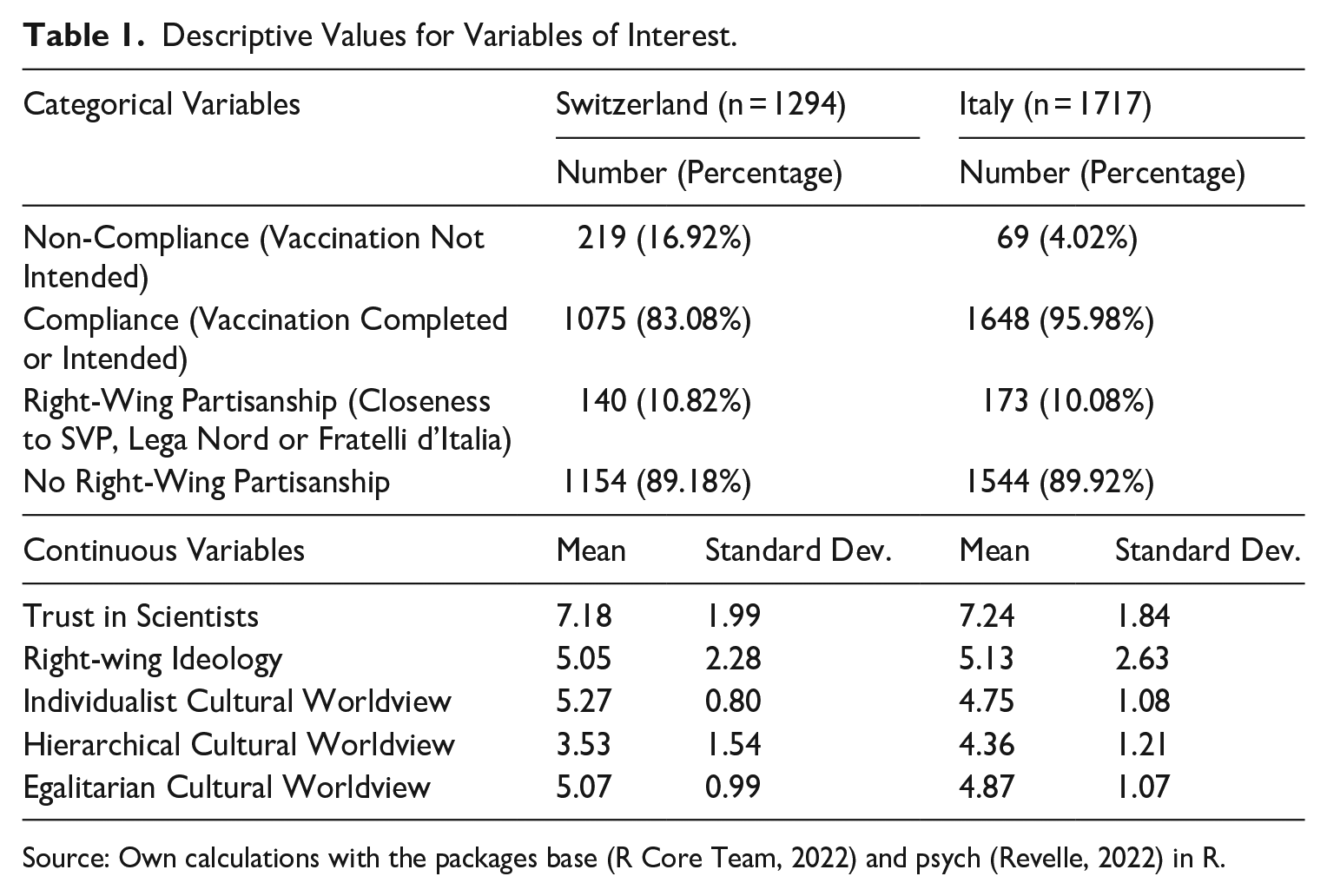
Source: Own calculations with the packages base (R Core Team, 2022) and psych (Revelle, 2022) in R.
Bivariate Analysis
Proceeding with the bivariate analysis, what is of particular interest is the relation between the independent variables, the mediator of trust in scientists, and policy compliance. Figure 2 presents a boxplot of the median and quartiles of trust values in scientists by the outcome variable (compliance), grouped by the national context and by right-wing partisanship, respectively. In general, the mean values of trust in scientists are higher among people that intend to get vaccinated or have already completed vaccination against COVID-19 compared to those that do not intend to get vaccinated. Beginning with the comparison by country, it becomes visible that people in Switzerland have only slightly higher level of trust in scientists. Nevertheless, the few observations of non-complying respondents and the fact that even those who do not intend to get vaccinated partly show high levels of trust in scientists suggest that the reasons for non-compliance can be found at least not only in trust. Even considering the low number of observations that indicate non-compliance with the vaccination recommendation, though, the results indicate a potential correlation between trust in scientists and compliance.
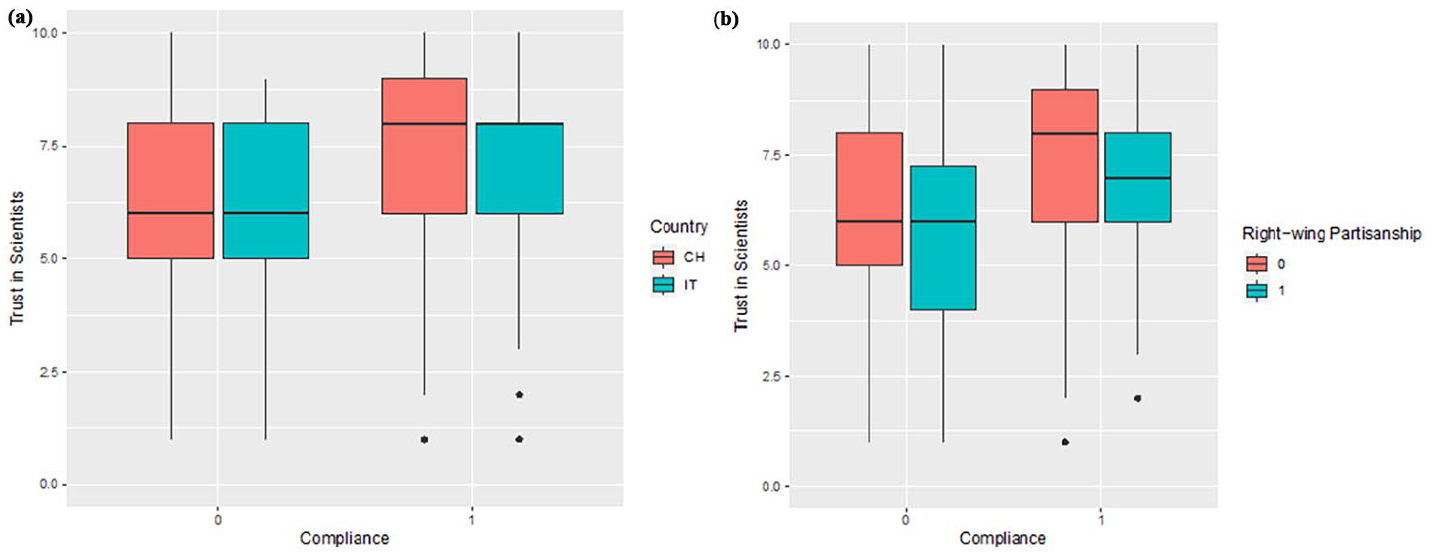
Boxplot of Trust in Scientists and Compliance, by (a) Country and (b) Partisanship.
Furthermore, the findings also suggest an association between right-wing partisanship and compliance. Trust values are on average lower among people that feel close to the right-wing parties and therefore exhibit right-wing partisanship. Interestingly, it seems that even among right-wing partisans, there are partly very high levels of trust in scientists, but this is apparently not related to a higher compliance. Instead, right-wing partisanship seems to be the driving force here. The later mediation analysis will shed further light on this relationship.
Table 2 presents the correlation matrix between all continuous or at least ordinary variables that go into the analysis. Policy compliance, right-wing partisanship, and the control variable sex are excluded because of their binary measurement as per the dataset. Overall, the correlation shows relatively weak, but partly very significant correlations among all variables. Policy compliance is significantly related to trust in scientists, which the hypotheses would also expect, as well as with partisanship, right-wing ideology, and the individualistic and hierarchist worldview. Trust—the hypothesized mediator—is significantly correlated with right-wing partisanship and ideology and the individualistic as well as egalitarian worldview. Overall, the matrix does not show any multicollinearities that would pose a challenge to the analysis.
Correlation Matrix.
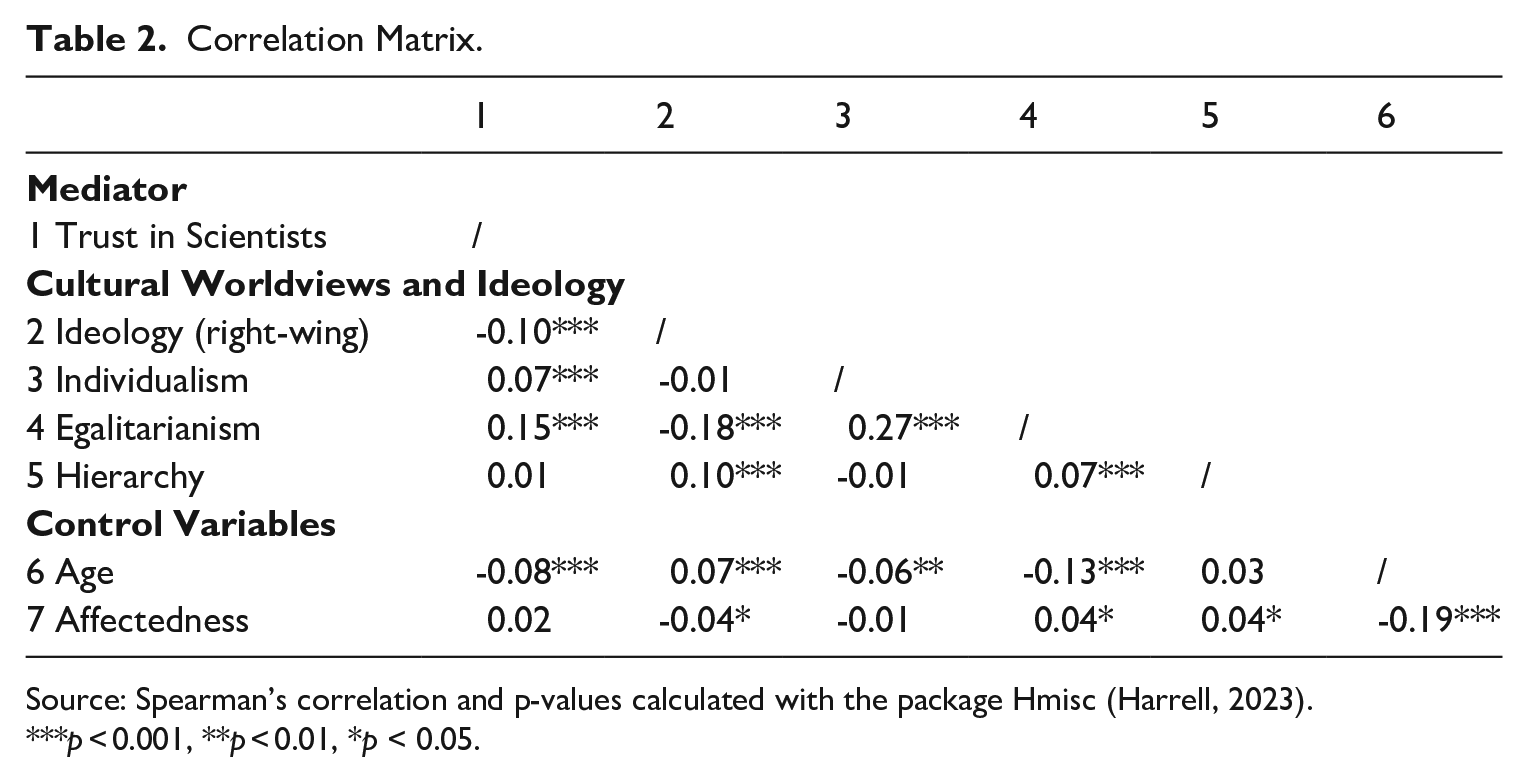
Source: Spearman’s correlation and p-values calculated with the package Hmisc (Harrell, 2023).
***p < 0.001, **p < 0.01, *p < 0.05.
Multigroup Path Analysis
There are a number of best practice examples of how to conduct a multigroup path analysis (e.g. Duckitt and Sibley, 2016). I follow these and begin by estimating a full model by each group (hence two separate models for the sample in Italy and in Switzerland) including policy compliance as dependent variable, trust in scientists as mediating variable, and partisanship, political ideology, and three cultural worldviews as predictor variables. Age, affectedness, and sex are included as controls. These models result in very different fits. Hu and Bentler (1999) recommend 0.95 as a cutoff criterion for the Comparative Fit Index (CFI) and the Tucker Lewis Index (TLI) as well as an RMSEA of >0.06 and an SRMR of >0.08. The model for Switzerland fulfills these cutoff values perfectly (CFI = 0.999; TLI = 1.000; RMSEA = 0.004; SRMR = 0.001). However, the model for Italy has weak fit indices (CFI = 0.549; TLI = 0.850; RMSEA = 0.046; SRMR = 0.000) with χ2 (1) = 25.104. This indicates that the estimated model performs less well in depicting the variable relations in Italy compared to Switzerland. Furthermore, the two models suggest that the control variables sex and affectedness should be excluded from an overall model, since they are not significant in either and deleting them would improve the model fit (see Figures A1 and A2 in Appendix 1; visualization with lavaanPlot (Lishinski, 2022). Doing so and estimating such a model for both groups results in a comparatively better fit (χ2 = 125.514, df = 1, RMSEA = 0.056 (0.029–0.089), SRMR = 0.000, CFI = 0.925, TLI = 0.925) (see also Figure 5). However, especially CFI and TLI are still below the threshold of 0.95, but acceptable according to Bentler (1990).
Afterwards, I proceed with the assessment of whether this unconstrained model, where all paths, covariances, and error variances are allowed to vary, is actually best in capturing the relationships between variables, or whether paths need to vary by group to provide a better fit to the data structure. To this end, several models are run with interaction effects between the grouping variable (in this case: country) and the independent variables. If these effects are significant, paths should vary and not be constrained to be equal across groups. Hence, I stepwise check which effects of predictor variables can be constrained to be equal per country group, because their interaction between macro and microlevel is not significant and thereby does not improve the model fit indices. Checking this results in the finding that the effects of egalitarianism and right-wing ideology on compliance are best captured when equal in Italy and Switzerland, which means that these factors about equally explain the variance in the dependent variable of compliance. The cultural worldview of individualism can be constrained for both compliance and trust in scientists. For trust in scientists, the cultural worldview of hierarchy can be constrained. This suggests that egalitarianism and right-wing ideology have nationally dependent effects on trust in scientists, and the hierarchical worldview has nationally dependent effects on intended compliance with COVID-19 vaccination policy.
After having constrained these effects, the model renders the effect of individualism on both compliance and trust in scientists as well as across groups insignificant. Therefore, this variable is also excluded from the model following the theoretical consideration that egalitarianism and hierarchy are two ends of the same dimension (grid) and therefore are conceptually not correlated, as opposed to individualism and hierarchy (Rippl, 2002). As a result, the following model can be considered the final multigroup path analysis model (see Table 3). It shows a good fit with χ2 = 129.999, df = 2, RMSEA = 0.041 (0.021–0.062), SRMR = 0.002, and TLI = 0.961. Only the CFI with 0.902 does not meet the cutoff criterion, but is still acceptable according to Bentler (1990). From the initial analyses, one can assume that this is probably due to the subgroup of Italy, which already had very weak model fit indices in the separate models. Acknowledging this, the analysis proceeds with the interpretation of the model and disentangling the variable relations within and across groups.
Multigroup Path Model.
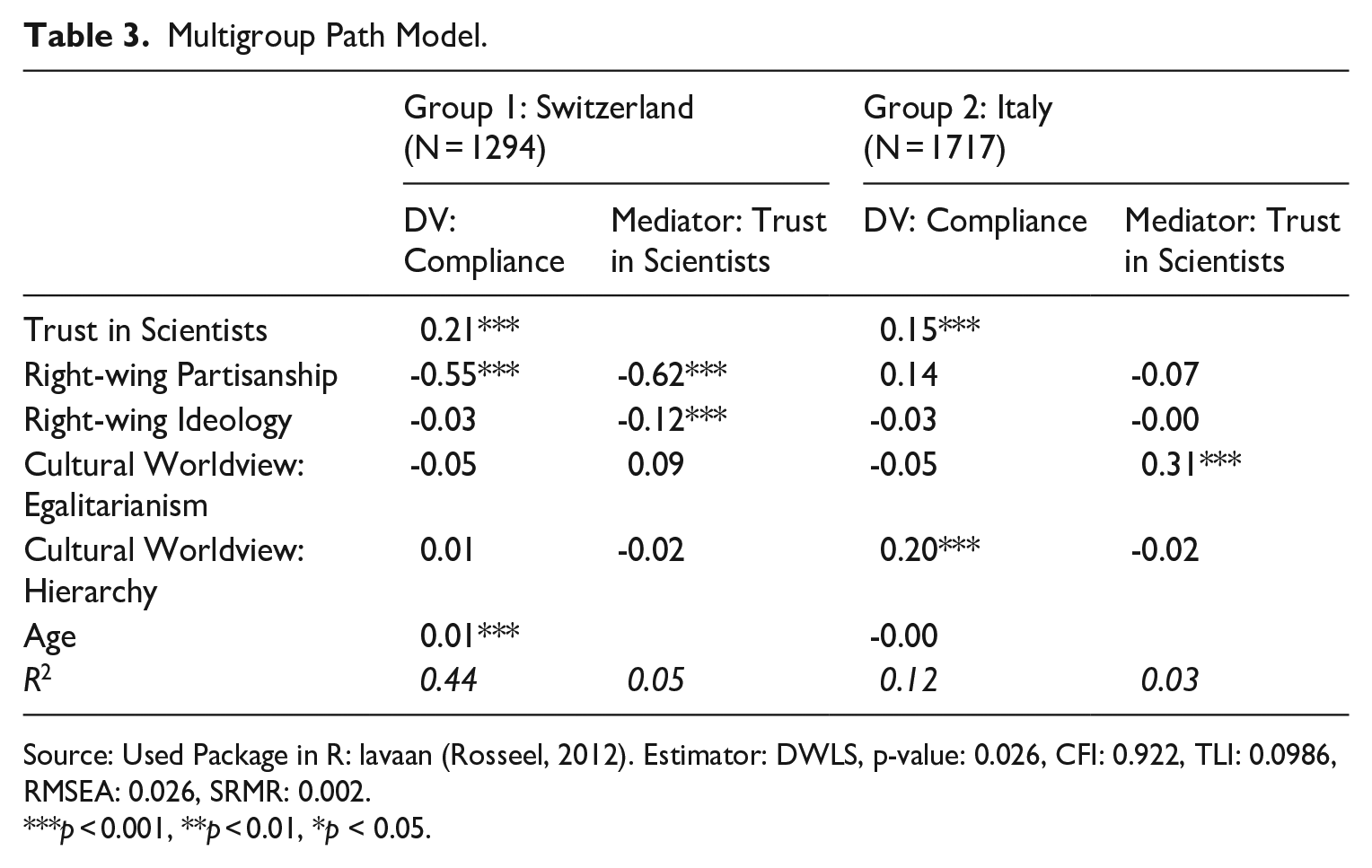
Source: Used Package in R: lavaan (Rosseel, 2012). Estimator: DWLS, p-value: 0.026, CFI: 0.922, TLI: 0.0986, RMSEA: 0.026, SRMR: 0.002.
***p < 0.001, **p < 0.01, *p < 0.05.
The final model first shows that greater levels of trust in scientists significantly influence the intention to get vaccinated against COVID-19. This is independent of the national context, although the effect size is slightly smaller in Italy compared to Switzerland. As regards partisanship, it can be stated that a right-wing partisan identity significantly decreases the chance for the intention to get vaccinated and trust in scientists in Switzerland, but not in Italy. Right-wing ideology also only is a significant predictor in Switzerland, and only for trust in scientists. The more right-wing people self-identify, the lower the trust in scientists. As already presumed because of the piecewise procedure of testing interaction effects, only the cultural worldviews of egalitarianism and hierarchy have a significant effect, and this varies depending on the national context. While cultural worldviews do not show any significant influence in Switzerland, a hierarchical worldview significantly increases the chance for policy compliance in Italy, and an egalitarian worldview significantly increases trust in scientists. Among the control variables, one can postulate that a higher age increases the chance for policy compliance in Switzerland.
Discussion
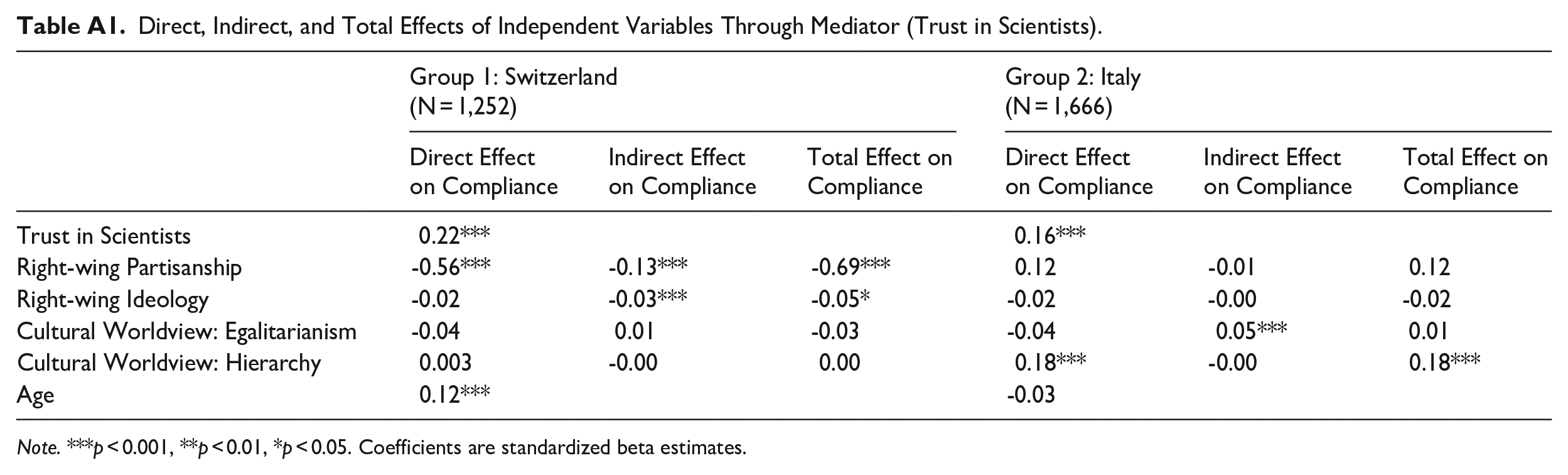
Does trust in scientists influence compliance with COVID-19 policy and is it a mediator of the effects of identity, ideology, and cultural worldviews? The answer is: Yes. From the path analysis can be derived the direct and indirect—via trust in scientists—influence of partisan identity, ideology, and cultural worldviews on the intention to get vaccinated against COVID-19. To begin with, the analysis has revealed a positive effect of trust in scientists on compliance across the institutional contexts of Italy and Switzerland, thereby confirming H7. Furthermore, there are different effects of ideology and partisanship as well as of cultural worldviews—both direct and through trust—on compliance. For Switzerland, right-wing partisanship is significantly and negatively associated with compliance and trust in scientists, which confirms H6 and H7 for Switzerland. Right-wing ideology is not significantly influencing compliance but trust in scientists, which then acts as a mediator of right-wing ideology (see Table A1 in Appendix 1 for details on the direct, indirect, and total effects), which confirms H4, but rejects H5 for Switzerland.
This suggests, first, that right-wing ideology and right-wing partisanship are theoretically distinct from each other, and that compliance is often more a matter of identity than of beliefs. Second, by contrast, trust in scientists is a mediator for both factors, which provides evidence for the claim that people have varying levels of trust in scientists depending on their ideological beliefs and depending on their identities. Following up on this finding, it can be expected that even if people do not trust scientists, they can well comply with policies if their social identities lead them in this behavior.
For Italy, H4–H7 must be rejected altogether. Admittedly, the situation in Italy during COVID-19 can be described as politically unstable, with a reformation of government that brought together parties from different ends of the left-right spectrum and earlier “enemies” (Vicentini and Galanti, 2021). It is therefore not necessarily surprising that the ideological and partisan identity variables had a lesser influence on COVID-19 vaccination compliance, because these were shaken up in that very situation and there was also substantial change within the right-wing political parties’ spectrum (Albertazzi et al., 2021). Instead, cultural worldviews played a greater role in Italy. As opposed to Switzerland, where hypotheses 1 and 2 must be rejected, they can at least partly be confirmed in Italy. Here, a hierarchical worldview significantly positively impacts the (intended) compliance with vaccination policy and an egalitarian worldview does so indirectly through trust in scientists.
Finally, the analysis confirms H8 in that there are nationally different relationships between partisan identities, political ideology, cultural worldviews on the one hand and policy compliance on the other hand, as well as how trust in scientists acts as a mediator in this relationship. Scientific policy advice in Italy lacked coordination and influence during the pandemic (Casula et al., 2023; Galanti and Saracino, 2021) while scientific policy advice in Switzerland was organized via a centralized task force that was both visible, publicly well supported, and influential (Eichenberger et al., 2023). This could have strengthened the relation between trust and compliance. Thereby, the analysis contributes to insightful studies that have so far tackled the role of trust in the COVID-19 pandemic in a single country (Lalot et al., 2023).
Limitations
When interpreting the results and before drawing a conclusion, several limitations must be reflected. First, the operationalization of variables draws from an established dataset, which has the advantage of a large sample size and enabling comparisons across countries, but which also comes with the disadvantage of pre-formulated items that cannot be perfectly adjusted for the research design. This primarily refers to the operationalization of cultural worldviews, whose measures have made use of proxies. While the benefits in this case probably outweigh the downsides, future studies are encouraged to use original measurement scales and evaluate the findings presented here.
In a similar vein, a second methodological limitation is that trust in scientists is not equal to trust in recommendations made by scientists (Bennett, 2020) and intention to comply is not the same as compliance. Again, this is due to the pre-existing dataset, whose data quality and sample can be argued to outweigh this weakness.
Third, the research literature points toward a non-negligible relevance of risk perception in the theorized relationship. The ESS, unfortunately, also does not provide a measure for risk perception. The only one that captures a concept that comes closest is the extent to which respondents are worried about climate change. But given that this does not relate to the pandemic and is very specific, the analysis did not include this variable due to the potential of invalid results. However, one could argue that the degree of affectedness in Italy, especially with the severe situation at the beginning of the pandemic that led to substantial challenges in the health care system, might have increased risk perception among the population, which in turn could have increased the willingness to vaccinate independent of political ideology or affiliation.
Fourth, due to the use of the ESS as dataset, the analysis provides but a cross-sectional study of the hypothesized relationships. However, pandemics are dynamic phenomena and both trust and intended compliance can easily and quickly change over time in response to new information or developments (Seyd and Bu, 2022; Wright and Fancourt, 2021), and particularly also the crisis communication that is in place (Johansson et al., 2023). Therefore, a longitudinal study would be required to corroborate the findings, which—however—already point toward interesting correlations between trust and compliance in different contexts and depending on different cultural worldviews, which are presumably less easy to change. As a result, the outlined relation between cultural worldviews and trust in scientists might be relatively stable.
Conclusion
During the COVID-19 pandemic, policy compliance was vital for effective pandemic management. Given that the role of scientists was omnipresent, a central question is whether trust in scientists has influenced policy compliance, and which other factors had an impact on trust and (directly or indirectly) on compliance. This study has conducted a multigroup path analysis to not only shed light on this complex relationship but to assess how it differs across national contexts. This is particularly relevant as COVID-19 affected countries differently.
The findings have revealed important theoretical, methodological, and practical contributions to the literature. First, there is empirical evidence for a conceptual distinction between political ideology and partisanship, at least in Switzerland. While the former only influences trust in scientists, the latter influences policy compliance both directly and indirectly through trust in scientists. Practically, this implies that compliance might be fostered by addressing group identities rather than beliefs of individuals. Second, the fact that political ideology and partisanship are only significant predictors in Switzerland while cultural worldviews are only significant predictors in Italy suggests that there is indeed a dependency on national context. In a politically stable environment such as Switzerland, partisan bonds and ideological orientations seem to have a greater relevance to trust and compliance than in the politically fragmented context of Italy, in which cultural factors—specifically the worldviews of hierarchy and egalitarianism—play a greater role. Scientists were also given different roles in these different contexts (Johansson et al., 2023): The structure of scientific advice during COVID-19 was rather regional and fragmented in Italy while begin rather centralized in Switzerland (Armingeon and Sager, 2022; Cairney and Toth, 2023; Capano et al., 2024; Hadorn et al., 2022). This might explain why the effect of trust on compliance is stronger in Switzerland compared to Italy, because scientific recommendations were more centralized and hierarchical. Methodologically, this outlines the need to conduct comparative analyses of factors influencing trust and compliance during COVID-19 to gain a holistic picture of the driving forces.
Hence, the results call for further research. First, there is a need for further cross-country studies with original data on different countries beyond the two that were analyzed here. This will help reveal further multilevel dynamics on how national contexts influence how citizens trust scientists and comply with COVID-19 policy. Second, this should be combined with research on the communication strategies of governments, which might have an influence on how trust in scientists develops during a pandemic and how different communication strategies can foster compliance. Third, contributing to the substantial amount of work on the interrelation between cultural worldviews, political orientations, and partisanship, further analyses can focus on other than this study’s dependent variable of interest. For instance, they will allow to investigate the effects that these have not only on intended compliance with COVID-19 vaccination but also on other COVID-19 policies and in comparison with policies that are not related to a pandemic, to build knowledge on whether these differ within and between crisis and non-crisis times.
Footnotes
Appendix 1
Direct, Indirect, and Total Effects of Independent Variables Through Mediator (Trust in Scientists).
| Group 1: Switzerland |
Group 2: Italy |
|||||
|---|---|---|---|---|---|---|
| Direct Effect on Compliance | Indirect Effect on Compliance | Total Effect on Compliance | Direct Effect on Compliance | Indirect Effect on Compliance | Total Effect on Compliance | |
| Trust in Scientists | 0.22*** | 0.16*** | ||||
| Right-wing Partisanship | -0.56*** | -0.13*** | -0.69*** | 0.12 | -0.01 | 0.12 |
| Right-wing Ideology | -0.02 | -0.03*** | -0.05* | -0.02 | -0.00 | -0.02 |
| Cultural Worldview: Egalitarianism | -0.04 | 0.01 | -0.03 | -0.04 | 0.05*** | 0.01 |
| Cultural Worldview: Hierarchy | 0.003 | -0.00 | 0.00 | 0.18*** | -0.00 | 0.18*** |
| Age | 0.12*** | -0.03 | ||||
Note. ***p < 0.001, **p < 0.01, *p < 0.05. Coefficients are standardized beta estimates.
Acknowledgements
I thank Madita Olvermann for methodological advice and the participants in the panel on policy advisory systems at the International Conference on Public Policy (ICPP) in Toronto 2023 for comments on an earlier version of this manuscript.
Declaration of conflicting interests
The author(s) declared no potential conflicts of interest with respect to the research, authorship, and/or publication of this article.
Funding
The author(s) disclosed receipt of the following financial support for the research, authorship, and/or publication of this article: This study was funded by the Multidisciplinary Centre for Infectious Diseases, University of Bern, Bern, Switzerland.
