



Abstract
The result of the Brexit referendum and its effect on subsequent UK elections have attracted a large amount of media and scholarly interest, but there has been minimal research into gender and voting behaviour at the referendum. Similarly, gendered differences in Euroscepticism have had little attention. This article seeks to understand how attitudes towards the European Union vary by age and gender and whether such gender-age gaps are associated with gender differences in attributes known to predict European Union attitudes and support for Leave/Remain. The article finds a gender gap in Euroscepticism in under-45s and in Brexit vote choice in under-25s. It demonstrates that socioeconomic and value differences by gender are associated with the gender gap in younger age groups, but not older. As such differences seem likely to persist, this article suggests that gender divides will continue to have electoral and democratic consequences in the United Kingdom and across Europe.
Introduction
Political scientists have long been interested in determining which factors influence attitudes towards the European Union (EU) among its citizens, particularly since (usually right-wing) Eurosceptic parties have become more successful and, in perhaps the ultimate demonstration of negative EU attitudes, the United Kingdom voted Leave in 2016. The differing importance of various economic and social factors, as well as the relative impact of immigration and wider social change in determining attitudes towards the EU, has been widely discussed. One factor has been largely missing in this discussion – gender. This article fills this gap by providing an updated study of how gender affected attitudes towards the EU and vote choice at the referendum. It provides a crucial study of how gender and age can shape attitudes to the EU, how the ‘Brexit cleavage’ is gendered, and why a gender gap occurred in the youngest age group at the 2019 General Election.
Previous studies of Euroscepticism have generally not focused on gender differences, with the exception of Nelsen and Guth (2000), whose work focused on why women overall might be more Eurosceptic. It is likely that gender has not been widely studied as there was no aggregate-level gender gap in vote choice (Shorrocks and Fowler, 2019). However, the lack of a difference in the level of support for Leave between men and women is puzzling. The majority of explanations for the motivations of Leave voters draw on the literature on the populist radical right, particularly UK Independence Party (UKIP). But women show lower levels of support for the radical right in general (Immerzeel et al., 2015) and for UKIP in particular in the United Kingdom (De Geus and Ralph-Morrow, 2021; Ford and Goodwin, 2014). Due to this, current explanations of Brexit may have inadvertently been produced, which describe a certain type of older working-class men’s voting behaviour well, but which fail to account for women’s behaviour.
Furthermore, research into gender and voting behaviour demonstrates that focusing on aggregate-level gender gaps and/or seeking to find a uniform effect of gender across social groups can obscure the true extent of political differences between men and women (see Campbell, 2006; Shorrocks, 2016, for UK analysis). This includes the 2019 General Election, where Campbell and Shorrocks (2021) demonstrate that there was a gender gap between younger men and women and that this was associated with prior referendum vote choice. The same is true of the literature on the EU referendum. Even where gender is focused upon, the relationship between age and gender is not considered (Guerrina et al., 2018; Hozić and True, 2017). This potentially obscures the true extent of gender differences and how the important relationship between age and Euroscepticism (Down and Wilson, 2013; Fox and Pearce, 2018) may be gendered.
If, as this article shows, gender gaps exist by age, we risk misrepresenting the views of women (and men) who are particularly in favour of or opposed to the EU, as their attitudes and the expression of these attitudes through their vote choices get lost in the aggregate. Consistently passing over considering gender in research into Euroscepticism and voting behaviour in favour of focusing on other demographics such as age or socioeconomic divides such as class, education, and income leaves women’s voices unheard and fails to acknowledge that gender, in tandem with age, often forms a major determinant in a person’s socioeconomic characteristics such as their education level. Furthermore, such gender gaps, even if small, are likely to have electoral consequences in the United Kingdom (as already shown).
This article seeks to rectify this by considering three research questions: (1) Were there gender gaps in age groups in Euroscepticism in the United Kingdom prior to the 2016 referendum; relatedly, (2) were there gender gaps between age groups in vote choice at the 2016 referendum; and finally, if the answer to one or both of the first two questions is yes, (3) what explains these gaps? I answer these questions using the British Election Study Internet Panel (BESIP) and find that there were gender gaps by age in attitudes towards the EU. Specifically, younger women were less Eurosceptic and more likely to vote Remain than men of the same age, but there were no gender differences for older age groups. I show that gender differences in younger age groups are affected by differences in established predictors of Euroscepticism between men and women, particularly education level and related value differences.
I make three key contributions. First, this article contributes to the literature on Euroscepticism by adding a gendered perspective and is the first to consider how and why gender differences vary by age. Although it examines a single case (the United Kingdom), the arguments as to why such gender gaps exist (e.g. due to educational differences) are relevant more broadly across Europe. Second, this article offers one of the few analyses of the 2016 referendum which explicitly focuses on gender, and the first which analyses gender and age together. It therefore challenges the dominant narrative of the older, White, working-class man as the stereotypical Brexit voter and shows that the age gradient so often discussed in relation to the referendum result is gendered. This analysis therefore also helps us to understand the emergent gender gap in British Politics. Finally, I provide further evidence that researchers should be aware that the lack of an aggregate-level gender gap can obscure gender gaps by age and demonstrate which differences influence these gaps with regard to the EU.
Gender, Euroscepticism, and the 2016 referendum
Nelsen and Guth (2000) conducted the most recent cross-national investigation as to whether men and women differed in their attitudes towards European integration. They theorised that women should be more hostile towards the EU, as women exhibited lower interest in foreign policy, more traditional values, and followed left-wing parties who were then less in favour of the EU. Their article does then find both that women were more Eurosceptic than men, including in the United Kingdom. Beyond this, there is a scarcity of understanding of women’s attitudes towards the EU, with no further analysis which addresses if and why there may be a gender gap, although Campbell (2006) does find that women placed a lower priority on EU issues.
While Nelsen and Guth’s (2000) findings were consistent with previous research, particularly Laatikainen (1996), newer research does not find a consistent gender gap. More recent studies control for gender without exploring (in theory or through analysis) why men and women might show different levels of Euroscepticism, but do generally include gender as a control variable in quantitative models. Some studies do still find that women are significantly more Eurosceptic (Kuhn et al., 2016; Lubbers and Scheepers, 2007; Stockemer et al., 2020), although such differences tend to be small and inconsistent between models. Furthermore, some studies do not find an effect of gender on Euroscepticism at all (Mau, 2005; Nielsen, 2016). In the UK context, Clements (2009) found that women held slightly less favourable opinions towards the EU.
Studies of voting behaviour at the 2016 referendum have also paid little attention to gender, with a handful of exceptions. Guerrina et al. (2018) focus on gender differences in engagement with the EU referendum campaign, finding that women were less engaged, possibly due to a lack of focus on issues pertinent to them. Gender is also the focus of Green and Shorrocks (2021), who demonstrate that men who harbour gender-based resentments were more likely to vote Leave at the referendum. Broader analysis of the referendum vote generally did not find a gender gap at the aggregate level (Ashcroft, 2016; Curtice, 2017), and gender is only inconsistently significant in individual-level models of voting behaviour at the referendum. Many authors find no significant effect of gender (Clarke et al., 2017; Goodwin and Milazzo, 2017), although Hobolt (2016) does find a small effect (women are less likely to have voted Leave), once other factors are accounted for, in some models of vote choice, as do Colantone and Stanig (2018) and Alabrese et al. (2019).
There is therefore a substantial gap in our understanding of how gender affects Euroscepticism and Brexit. As previous research demonstrates that analysing gender without considering how it interacts with other characteristics – particularly age/cohort – underestimates gender differences, I now consider this. I show that theories of Euroscepticism, when analysed through a gender lens, suggest that gender gaps in Euroscepticism and support for Brexit should differ by age, and demonstrate that their logical conclusion is that older women should be more Eurosceptic than men on average, and younger women less.
Gender, age, and EU attitudes
Previous studies of Euroscepticism tend to advance at least one of three categories of argument. Individuals may like or dislike the EU for material, value-based, and/or partisan reasons. This article will now demonstrate that there is good reason for all three of these arguments to cause gender gaps among men and women by age. These arguments have been summarised in different ways – notably as ‘Calculation, Community and Cues’ by Hooghe and Marks (2005) – but broadly each conceptualisation captures why individuals with different socioeconomic profiles, particularly variation in education and occupational/social class, are likely to hold different attitudes towards the EU. These themes have also provided a base for analysing the United Kingdom’s vote to leave the EU, with the most direct example being Clarke et al. (2017) who use the ‘Calculation, Community and Cues’ framework for their analysis of Brexit.
First, there is the material or ‘calculations’ perspective. The idea that EU membership may produce advantages and disadvantages to different groups is long-standing (e.g. Andersen and Reichert, 1995; Eichenberg and Dalton, 1993; Rohrschneider, 2002). Education in particular is now highlighted as important to the formation of EU attitudes (Hakhverdian et al., 2013) and vote choice at the 2016 referendum (Fieldhouse et al., 2021; Hobolt, 2016; Sobolewska and Ford, 2020). More educated individuals from higher occupational classes are theorised to perceive the EU as of benefit to themselves as they have the right skillset (Gabel and Palmer, 1995; Koehn and Rosenau, 2002). These individuals who can take advantage of the opportunities created by open markets – the so-called ‘winners of globalisation’ (Kriesi et al., 2008) – are expected to be more positively disposed towards the EU. Contrastingly, there are those individuals who are expected to lose out in a globalised world. The so-called ‘left behind’ (Ford and Goodwin, 2014), or ‘losers of globalisation’ (Hobolt, 2016), instead feel threatened by the United Kingdom’s membership of the EU, particularly due to the increase in low-skilled immigration (Ford and Goodwin, 2017). Overall, individuals ‘calculate’ (Hooghe and Marks, 2005) whether continued EU membership is in their interest, and this calculation is highly influenced by their education and occupational class.
To explain the historical greater Euroscepticism of women, it has been emphasised that women were, similarly to the ‘left behind’, less able to adapt to economic change, as they were less likely to have a high level of education or be in a higher occupational class, and were more likely to have care responsibilities (Nelsen and Guth, 2000), rendering them less mobile in the economy. At the aggregate level, these were reasonable assumptions when Nelsen and Guth were writing in 2000, but no longer. Women, particularly young women, have made significant progress in education and the workplace, to the extent where they now hold socioeconomic characteristics, which make them more likely to favour EU membership than their male peers.
More young women than men (c.10% by 2016) now go onto higher education in the United Kingdom (Department for Education, 2019). Although the gender pay gap in the United Kingdom persists, and men are still more likely than women to be in full-time employment, differences in the workplace between men and women are much smaller in younger age groups (Office for National Statistics (ONS), 2016), and young women have likely benefitted to a greater extent than young men from the United Kingdom’s economy shift towards service over manufacturing (Nixon, 2009). As a result of these educational and economic changes, young men are now more likely to be unemployed than young women (ONS, 2017). Furthermore, younger women are well represented in comparison with their male peers in all but the very highest occupational class (ONS, 2016), and in the United Kingdom the gender pay gap is also now close to zero among those under 40, whereas for those over 50 the pay gap is more than 15%. Older women are more likely to work in lower paid occupations than younger women and are less likely to be managers, directors, or senior officials (ONS, 2016). Thus, younger women now have the attributes, through their education and position in the labour market, to be able to take full advantage of EU membership. In contrast, older women who experienced poorer access to education and who are least likely to be in higher occupational classes, theoretically lose out from EU membership the most.
These economic and social changes to women’s lives have also been shown by scholars of gender and comparative politics to have transformed women’s values, attitudes, and voting behaviour and produced gender differences by age (e.g. Abendschön and Steinmetz, 2014; Dassonneville, 2021; Inglehart and Norris, 2003), but a similar age by gender analysis has not been conducted on attitudes towards the EU or voting behaviour at the referendum. However, existing explanations of the vote to leave the EU do emphasise how Brexit was an expression of developing cultural divisions in society (Sobolewska and Ford, 2020) which have been produced as some groups lost economic, political, and social status over time and others gained (Gest et al., 2018). We can expect younger women to be more likely than younger men to fall on the ‘Remain’ side of this cultural division, and older women to be less likely than older men, for a number of reasons.
First, higher education levels or being from a higher occupational class are associated with holding social values and attitudes, which make an individual less likely to be Eurosceptic and less likely to have voted Leave, in addition to their high level of education increasing their likelihood of favouring EU membership for their own possible personal gain. Research demonstrates that an individual’s attitudes towards the EU are affected by values, particularly what Hooghe and Marks (2005) label ‘community’ and what Hakhverdian et al. (2013) call ‘questions of collective identity’. Consistently linked to Euroscepticism are traditionalism (Lubbers and Scheepers, 2007), nationalism (Hakhverdian et al., 2013; McLaren, 2002), attitudes to immigration or ethnocentrism (Lubbers and Scheepers, 2007; Stockemer et al., 2020), and populist/anti-government sentiment. Populism and Euroscepticism can be seen as two elements of anti-elite sentiment overall (Harmsen, 2010), particularly in combination with nationalist and ethnocentric values on both the radical right and left of politics (Halikiopoulou et al., 2012).
For Brexit, this populist element has been emphasised as a reaction to embracing of socially liberal/progressive values by political elites (Evans and Menon, 2017). In particular, nationalism (Henderson et al., 2016) and immigration attitudes (Goodwin and Milazzo, 2017) have been highlighted by political scientists, as well as a broader link between traditionalism and/or socially conservative values and voting Leave (Clarke et al., 2017; Evans and Menon, 2017; Hobolt, 2016; Sobolewska and Ford, 2020). Crucially, this group of values and attitudes which influence attitudes towards the EU are consistently linked to education level (Hakhverdian et al., 2013; Surridge, 2016) and, to a lesser extent, occupational class in the United Kingdom (Clements, 2009). Given the educational differences between men and women by age, we can expect their values to differ too. Gidron and Hall (2017) already explicitly link this values divide to gender and suggest that men’s support for populist outcomes such as Brexit is linked to their (perceived) loss of economic and social status relative to women. Similarly, Green and Shorrocks (2021) find that men who perceive themselves as discriminated against because of their gender are more likely to have voted Leave. However, while this explains the voting behaviour and values of men in response to economic and social changes, it does not consider the more positive story of economic, social, and political change for women, particularly younger women, over the same period as this article has done.
Furthermore, in addition to such educational and occupational differences, broader societal change including declining levels of traditional marriage and changes to family structures have been conceptualised to affect gender gaps in values which translate to gender gaps in values and political behaviour by age/cohort. Inglehart and Norris (2000, 2003) argue that younger women will be particularly liberal compared with older women, although whether this is due to societal modernisation as they claim has limited evidence (Giger, 2009) and differences in, for example, religion have been argued to be more important (Shorrocks, 2018). Overall, regardless as to why, it is agreed that older women can be expected to be least socially liberal and most traditional compared with younger women. This should place younger women strongly on the Remain side of the cultural or Brexit cleavage now seen in British politics (Fieldhouse et al., 2021; Sobolewska and Ford, 2020), and older women on the Leave side.
Finally, political cues, particularly partisanship, have been demonstrated to influence both attitudes towards the EU and vote choice at the referendum in 2016. Voters take their cue on whether to support the EU or not from the political party they support and other political media they consume (Hooghe and Marks, 2005). In the UK context, the Liberal Democrats are overwhelmingly in favour of EU membership (Clements, 2009) as well as supporters of the Scottish National Party (SNP) and Plaid Cymru, all of which backed Remain strongly in the referendum, and supporters of UKIP are unsurprisingly overwhelmingly against EU membership (Ford and Goodwin, 2014). The two main UK parties both contain factions in favour of and against EU membership and their position has changed over time, although a far larger proportion of Labour MPs backed Remain in 2016 than Conservative MPs (Mason et al., 2016). Thus, while there was a lack of a completely clear ‘cue’ from political elites for supporters of the major parties, potentially reducing the effect of partisanship (Vasilopoulou, 2016), some partisanship effects are still likely. Supporters of the Liberal Democrats and nationalists would be expected to be most likely to support Remain, followed by Labour, then Conservatives, with UKIP supporters by far the least likely.
Once again turning to the gender literature, it can be seen that partisanship could reinforce the gender and age divisions discussed. The modern gender gap is now found in most countries across Europe (Abendschön and Steinmetz, 2014), including in the United Kingdom (Campbell and Shorrocks, 2021; Sanders and Shorrocks, 2019), with younger women showing greater support for left-leaning parties such as Labour which generally supported EU membership compared with younger men. Thus, partisanship should also be associated with younger women being less Eurosceptic than men and older women more, although what drives this partisanship remains an open question.
Being from a higher occupational class or having a higher level of formal education is therefore connected to EU attitudes in three ways. Voters with these attributes can take advantage of EU membership for themselves, hold values which are associated with positivity about the EU, and such voters increasingly support (in the United Kingdom) left-wing parties, which are in favour of EU membership. Applying a gender lens, younger women should therefore perceive the EU as particularly positive and beneficial to them compared with both younger men and older individuals, as they are more likely to be in possession of the resources to take advantage of its benefits due to their comparatively high level of formal education from both their male peers and older women, and better position in the labour market compared with older women. Thus it is clear that younger women should see the EU as of material benefit to themselves in comparison to older women and their male peers, with the trend reversing by age, and that values and partisanship are likely to produce similar effects.
Hypotheses
To understand the relationship between age, gender, Euroscepticism, and vote choice in 2016, I test six hypotheses.
H1. In younger age groups, women will be less Eurosceptic than men of the same age; in older age groups, this trend will reverse and women will be more Eurosceptic than men of the same age.
H2. In younger age groups, women will be less likely to have voted Leave than men of the same age; in older age groups, this trend will reverse and women will be more likely to have voted Leave than men of the same age.
H3. Gender gaps between men and women of the same age will be associated with differences in the level of formal education they possess.
H4. Gender gaps between men and women of the same age will be associated with differences in their occupational class.
H5. Gender gaps between men and women of the same age will be associated with differences in the values and attitudes that they possess.
H6. Gender gaps between men and women of the same age will be associated with differences in partisanship between cohorts of men and women.
Data and methods
This article uses data from the BESIP 2014–2023 Waves 7 and 9 (Fieldhouse et al., 2020). Waves 7 and 9 of the study were conducted from 14 April 2016 to 4 May 2016 and from 24 June 2016 to 4 July 2016, respectively, and fall directly before and after the referendum. Wave 7 is used to examine individual predictors of Euroscepticism and test the hypotheses developed in the previous section. As it is plausible that the referendum campaign itself and its aftermath may have affected attitudes towards the EU, this is the wave best able to capture attitudes to the EU. Wave 9 is used to measure vote choice. This enables the use of reported vote choice immediately following the referendum as opposed to vote intention.
Approach
Two sets of models were conducted to understand the relationship between gender, age, and (1) Euroscepticism or (2) EU referendum vote choice. The variables are introduced to the models in steps to understand whether there are gender gaps by age group in Euroscepticism and EU referendum vote choice, and then to determine whether these gaps can be explained by differences in socioeconomic position, values and attitudes, or partisanship. This approach allows us to understand what any ‘raw’ gender gaps might be and then which factors are associated with enlarging or reducing the gender gap.
I first test for an overall gender gap by running the model with gender as the only independent variable. The second model tests the effect of gender and age group (as an interaction) on Euroscepticism, testing H1. Next, education (testing H3), occupational class (testing H4), working status (which includes current student status and thus also helps test H3), and religion (as it is known to influence gender gaps by age in values, as per Shorrocks (2018)) are added to separate models to understand whether their inclusion affects gender gaps within age groups. All factors are then added to the model together with the addition of further controls. Model 8 adds values and attitudes to test H5. Finally, partisanship is added in model 9 to test H6.
For the EU referendum vote choice models, this is simplified as it is assumed that the socio-demographics, values and attitudes and, to an extent, partisanship will be prior to Euroscepticism in the classic ‘funnel of causality’. There are just four models of EU referendum vote choice: gender only (model 10); age and gender with no controls (model 11), testing H2; with socio-demographics, values and attitudes, and partisanship added (model 12); and finally with Euroscepticism added to the model (model 13).
The full tables for each of these models are shown in Supplemental Appendix 2. The main body of the results focusses on plotting the gender gap by age for each scenario, 1 to show how the addition of different controls affects any gender gaps. In addition, I show the effect of education after the addition of values, attitudes, and partisanship to the model, to understand the extent to which there is a direct effect of education on vote choice, and the extent to which it is filtered through values and partisanship. The sample is held constant across all models by running each model only on respondents who are included in the final model with all variables added, to accurately judge how the gender gap changes.
Dependent variables
To measure the main dependent variable, level of Euroscepticism, answers to the following are used: Some people feel that Britain should do all it can to unite fully with the European Union. Other people feel that Britain should do all it can to protect its independence from the European Union. Where would you place yourself and the political parties on this scale?
Don’t know/non-responses are removed. The scale runs from ‘0 – Unite fully with the European Union’ to ‘10 – Protect our independence’. Analysis of Euroscepticism is conducted using ordinary least squares (OLS) regression models.
Vote choice at the 2016 EU referendum is also used as a dependent variable, using the BESIP ‘profile’ variable that measured vote choice in wave 9. For this, only the Remain and Leave responses (coded 0 and 1 respectively) are used; don’t know and non-voters are removed. This creates a binary variable and logistic regression models are used to calculate the probability of voting Leave.
Independent variables
Gender is binary (men/women) in the data. As these are cross-sectional data, age is in practical terms indistinguishable from cohort and thus when age is discussed age and cohort effects are not separated. Age group is used rather than age as a continuous variable to allow for the possibility that the effects of different factors will vary for different groups in the OLS analysis. The age groups used are standard 10-year intervals with the exception of the youngest age group (which begins at 18, the voting age) and the oldest, which groups all individuals aged over 75 years together. Although all respondents over 65 years are often instead grouped together, this approach has been taken for two reasons. The first is that the sample of over 65s would otherwise be larger than other age groups; second capturing the oldest age group may be crucial given that previous research into the gender gap finds the traditional gender gap in the United Kingdom in those born prior to the Second World War (Norris, 1999). By the time of the referendum in 2016, these individuals would be at least 77 years old.
Education is measured using the highest qualification achieved (no qualifications, below GCSE, GCSE, A-level, Undergraduate, Postgraduate, other/not known; categories include equivalent qualifications). Occupational class is measured using the simplified National Statistics Socio-Economic Classification (NS-SEC). These two characteristics are included to directly test Hypotheses 3 and 4. Although not part of the hypotheses, I also include religion, ethnicity, and working status as further controls. Religion is included as it has been found to predict support voting behaviour at the referendum and attitudes towards the EU (Kolpinskaya and Fox, 2019; McAndrew, 2020) as well as its role in affecting the voting behaviour of older women (Shorrocks, 2018). It is simplified into three categories: No religion/not given (don’t know), Christian, or other religion. As there are insufficient sample sizes to analyse all ethnic groups separately, ethnicity is simplified into ‘White British’, ‘White other’ and ‘any other ethnic group/not given (don’t know)’. Working status is included without alteration except to group ‘other’ and ‘don’t know’ together, with the other categories being working full-time, part-time, student, retired, unemployed, not working for any other reason, or other.
Authoritarianism/libertarianism and left/right are measured using the standard five-item scales, shown in Supplemental Appendix 1, developed by Evans et al. (1996). Nationalism is measured using the simple scale of Britishness included in the BESIP where respondents are asked to place themselves on a scale between 0 and 7, where 7 is strongly British. Although sub-state national identity in the United Kingdom does complicate how an individual’s national identity is constructed and affects their attitudes to the EU (Henderson et al., 2020), overall Britishness has been found to predict hostility to the EU across the three nations included in the BESIP. I use responses to the question as to whether the United Kingdom should allow more or fewer immigrants to measure immigration attitudes, with respondents being asked to answer where they would place themselves on a 11-point scale where 0 is many fewer and 10 is many more. As controls, I include measures of dissatisfaction with politics and nostalgia for the past where categorical responses are used, recoded to four categories from the original six: agree/neither agree nor disagree/disagree/don’t know, to the statements ‘politicians don’t care about people like me’ and ‘things were better in the past’. As one potential concern when analysing gender and voting behaviour is women’s well-documented greater likelihood of stating they ‘don’t know’ in response to these kinds of questions (Dolan, 2011), the analysis for both of the full models is replicated in Supplemental Appendix 4, where ‘don’t know’ responses to the attitudinal questions included here are coded as the midpoint value and included rather than excluded. These models show extremely similar results.
Finally, to measure partisanship, I include in the model a simplified version of party identification, where respondents are asked whether they consider themselves to be Conservative, Labour, Liberal Democrat or other (a list of smaller parties and a write in option is given, including the SNP in Scotland and Plaid Cymru in Wales as well as UKIP). Partisans of the SNP and Plaid Cymru were grouped together as nationalist; smaller parties beyond the nationalists and Conservative, Labour, Liberal Democrat, and UKIP were grouped together as ‘other’.
Results: Descriptives
Before moving onto the multivariate analysis, I first show gender-age differences in the key attitudinal variables of interest in Table 1, given that there is a scarcity of recent research on gender, age, and these different values and attitudes. There is little difference by either age or gender in economic left/right values, although older women aged between 45 and 74 years are significantly more right-wing than men from the same age group. Both immigration opinions and feelings of nationalism show the expected trend, with older individuals feeling on average more strongly British and wanting fewer immigrants. There is no obvious gender difference in immigration opinion; women do however express slightly higher feelings of Britishness, particularly with age. The surprise is gender differences in mean position on the libertarian-authoritarian scale. Women under 65 are consistently more authoritarian than men. To understand this result, the five scale items were separated (see Supplemental Appendix 1). Doing so reveals that women are only more in favour of censorship than men; for all other scale items, they are either equally as authoritarian as men or significantly less so in the case of the death penalty.
Mean position on value scales of men and women across age groups.
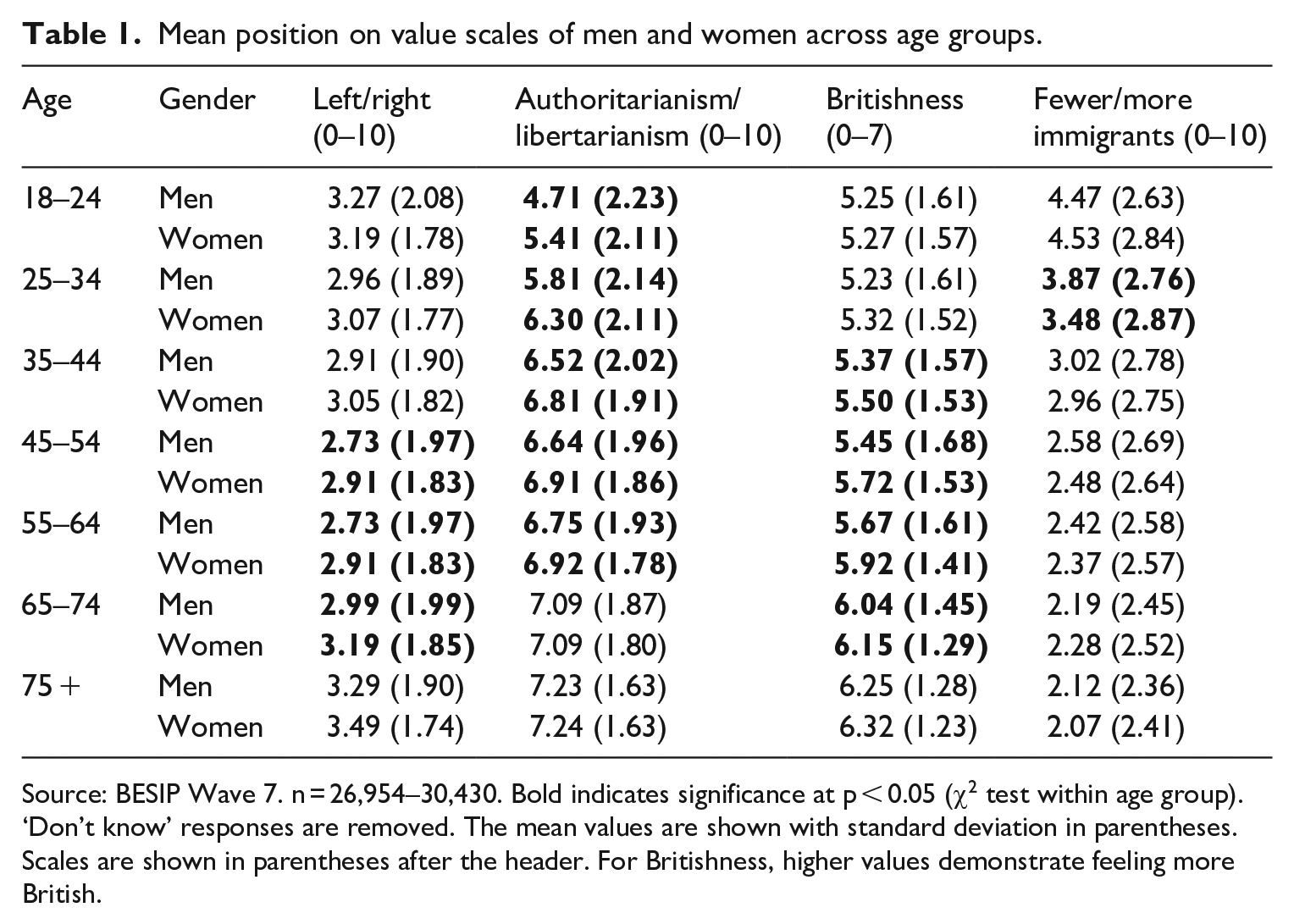
Source: BESIP Wave 7. n = 26,954–30,430. Bold indicates significance at p < 0.05 (χ2 test within age group). ‘Don’t know’ responses are removed. The mean values are shown with standard deviation in parentheses. Scales are shown in parentheses after the header. For Britishness, higher values demonstrate feeling more British.
Overall, there are not substantial age and gender differences in values. In fact, the lack of a substantial difference on these issues between men and women of the same age group despite the socioeconomic differences between them offers a promising area for further research to understand why substantial differences are not observed and to examine the extent to which this is sensitive to the particular items and scales used.
Results: Euroscepticism
I now model Euroscepticism and then referendum vote choice. For each, I start with a model that only includes gender, and then the effect of the interaction of gender and age group on the dependent variable to demonstrate where gender gaps exist, overall or by age. If introducing a variable reduces the gender gap in an age group, this indicates that the gender gap for that age group is associated with that variable, for example, if introducing education to the model reduces the gender gap in 30- to 45-year-olds, this suggests that gender differences in education level among this age group are associated with the gender gap in this age group. Variables are added step by step as we understand them to be related to each other as in the ‘funnel of causality’: for example, education is theoretically expected to be prior to value differences, which are prior to Euroscepticism. Adding them in stages means that this can be understood; for example, if adding values to the model reduces the effect of education, then some of the effect of education works ‘through’ education-based value differences.
Starting with the basic model, Figure 1 demonstrates that there is a very small overall gender gap in attitudes towards the EU, with women being slightly less Eurosceptic than men, in contrast to previous research which found women in the United Kingdom were slightly more Eurosceptic (Clements, 2009). It also shows that when this gender gap is broken down into age groups it only appears in those younger than 45. 2 There is a gender-generation gap in Euroscepticism and partial evidence to support H1 as the expected pattern appears among younger age groups, but not older. Consequently, as younger women are the least Eurosceptic group of all, young women are more different from older women in their attitudes towards the EU than younger men from older men.
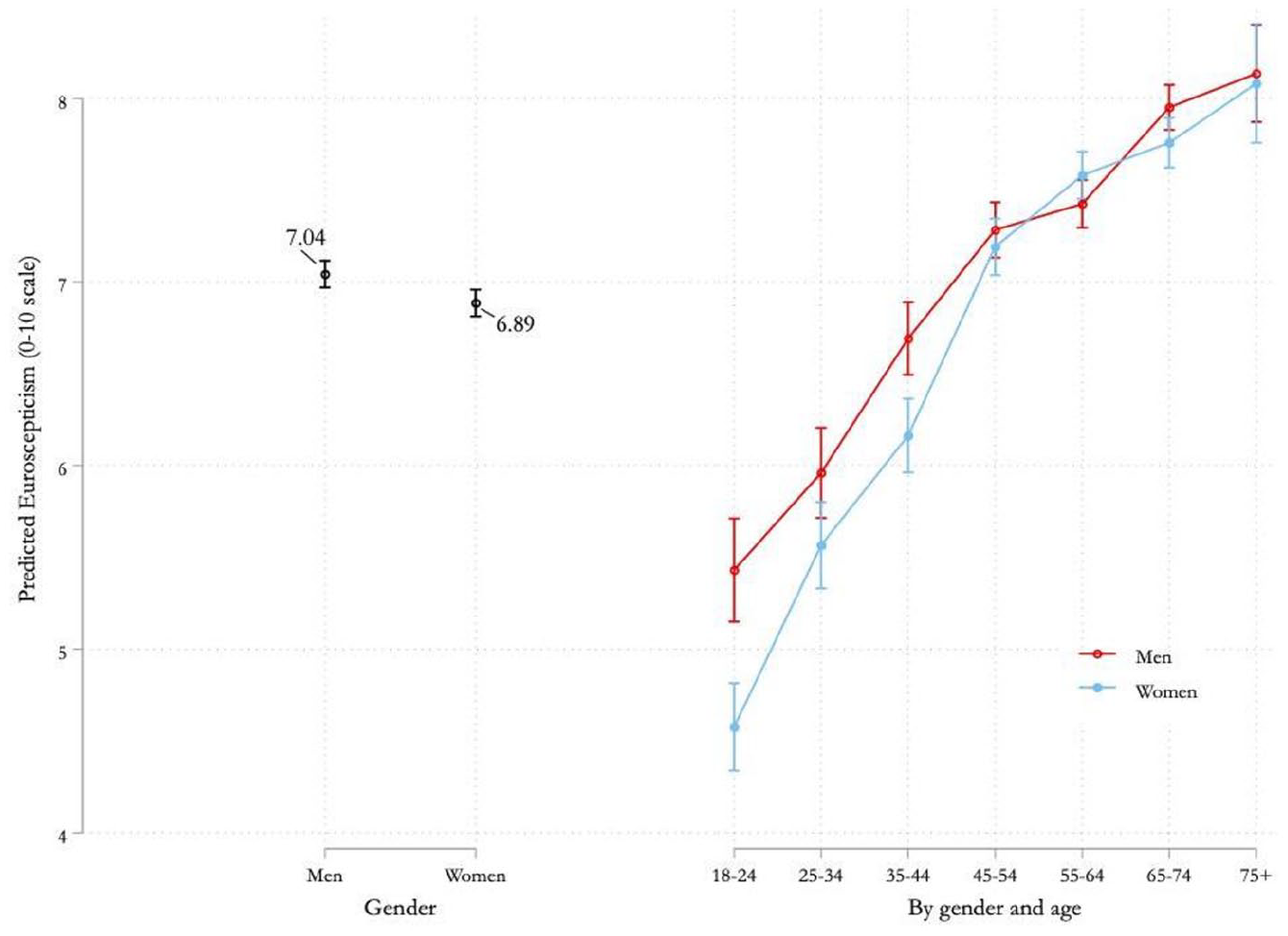
Euroscepticism by gender and age group.
Given that a gender gap is only present in younger age groups, I present the results for these groups only. Figure 2 shows the predicted Euroscepticism for men and women aged 18–44 years across models 1–9. For 18- to 24-year-olds, introducing controls has little effect on the gender gap, although it is slightly reduced by accounting for education in the form of introducing education level and working status (which accounts for whether they are a current student). This effect may be dampened as many individuals in this age group have not completed their education. The gender gap in this age group is persistent across all models and does not appear to be associated with differences in the working life of men and women of this age, or by differences in values or partisanship, contradicting H2–H4 and suggesting that gender differences in this age group in their attitude towards the EU are not associated with differences in material, value-based or partisan motivations as commonly argued to determine attitudes towards the EU.
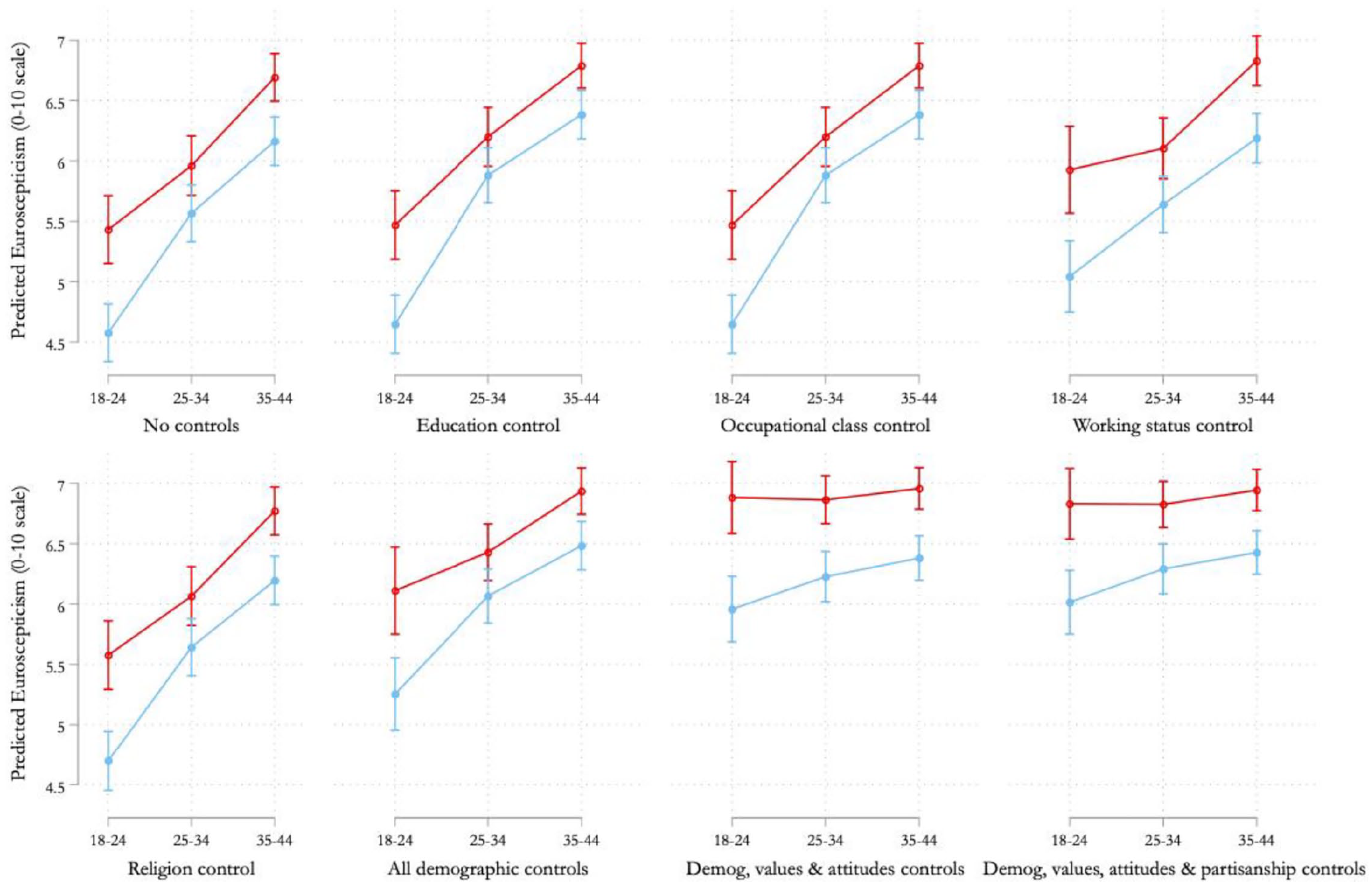
Euroscepticism in 18- to 44-year-olds after controlling for different factors.
In Figure 2, there is a slightly larger effect of introducing the education control among 25- to 34-year-olds and 35- to 44-year-olds, suggesting that these differences between men and women are partly due to education, supporting H2. However, occupational class, working status, and religion have little effect. Regarding class, as discussed in the theory section, women in younger cohorts are more similar to men in their role in the workplace than older women, but they are still slightly less likely to occupy the highest occupational classes. This is unlike education, where younger women are more likely to have attended higher education than men, and thus it is understandable that education affects the gender gap in younger cohorts, but not occupational class.
After introducing all the socio-demographic controls, the gender gap is insignificant in all but the youngest age groups, but controlling for values and attitudes widens the gender gap again, in contradiction of the expectations behind H3. This may be due to younger women’s greater authoritarianism, driven by their attitudes towards censorship, as found in the descriptive results; for the same position on the authoritarian-libertarian scale used here, younger women are less Eurosceptic. In older age groups (shown in Figure 3), there is no gender gap, just as there is no gender gap in their level of authoritarianism shown in Table 1 of the descriptive results.
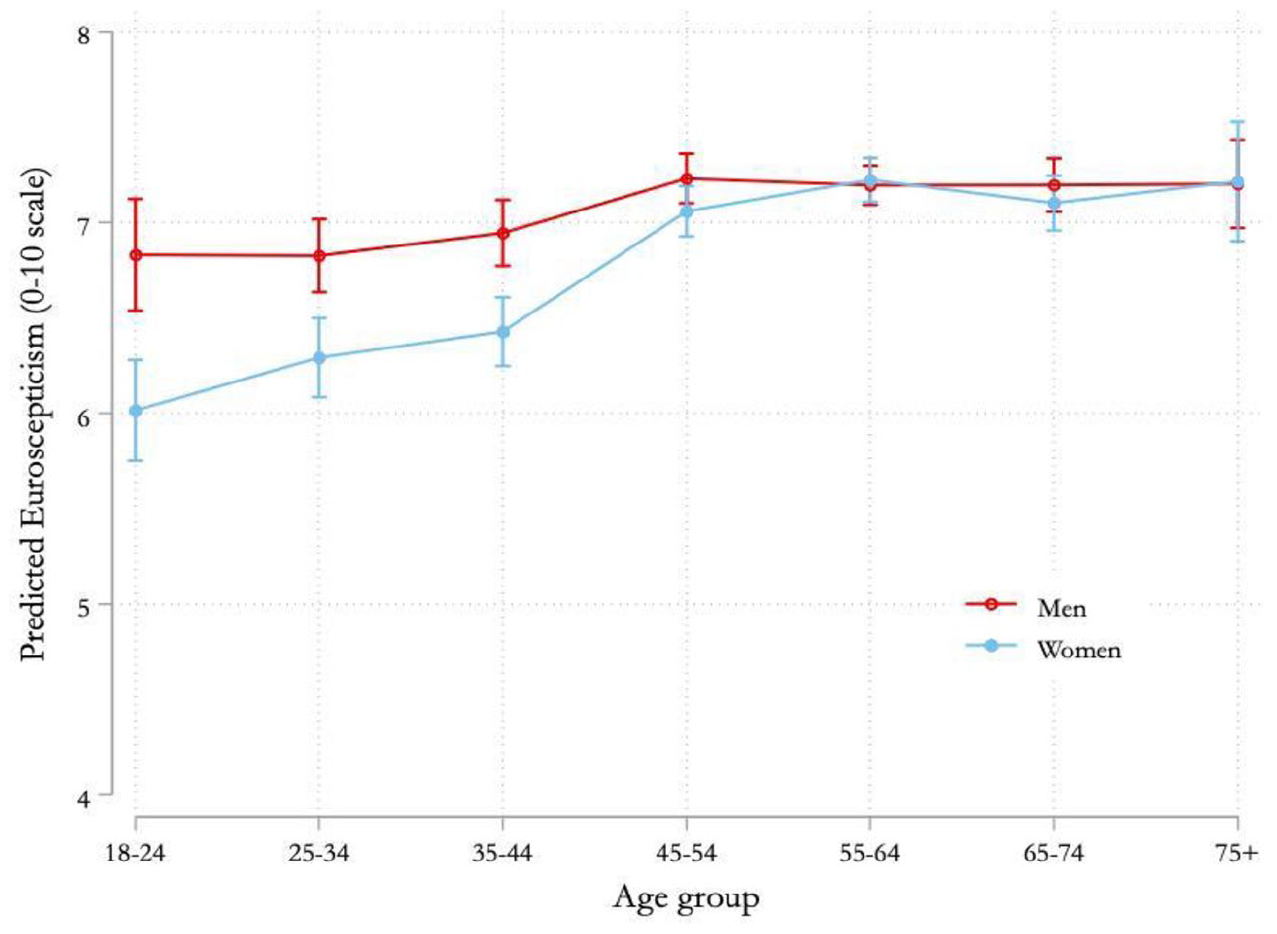
Euroscepticism across all age groups, full model.
The gender gap in Euroscepticism is thus related to both socioeconomics and values, but not necessarily as expected. As the gender gap narrows very slightly for both age groups when partisanship is introduced in the bottom right panel of Figure 2, there is some evidence that it is having an effect, supporting H4, but it is small. Once all factors are controlled for, the size of the gender gap in 25- to 34-year-olds or 35- to 44-year-olds is very similar to that between 18- and 24-year-olds, shown in Figure 3.
We can unpack the nature of the relationship between education, values, and Euroscepticism further by considering how the relationship between education and Euroscepticism changes when values (and partisanship) are added to the model. To understand the extent to which having a greater level of education produces more positive opinions on the EU due to direct effects (such as being more able to take advantage of the benefits of EU membership) and indirectly through values, I plot in Figure 4 the effect of education from model 3, model 8 (including values), and model 9 (including partisanship).
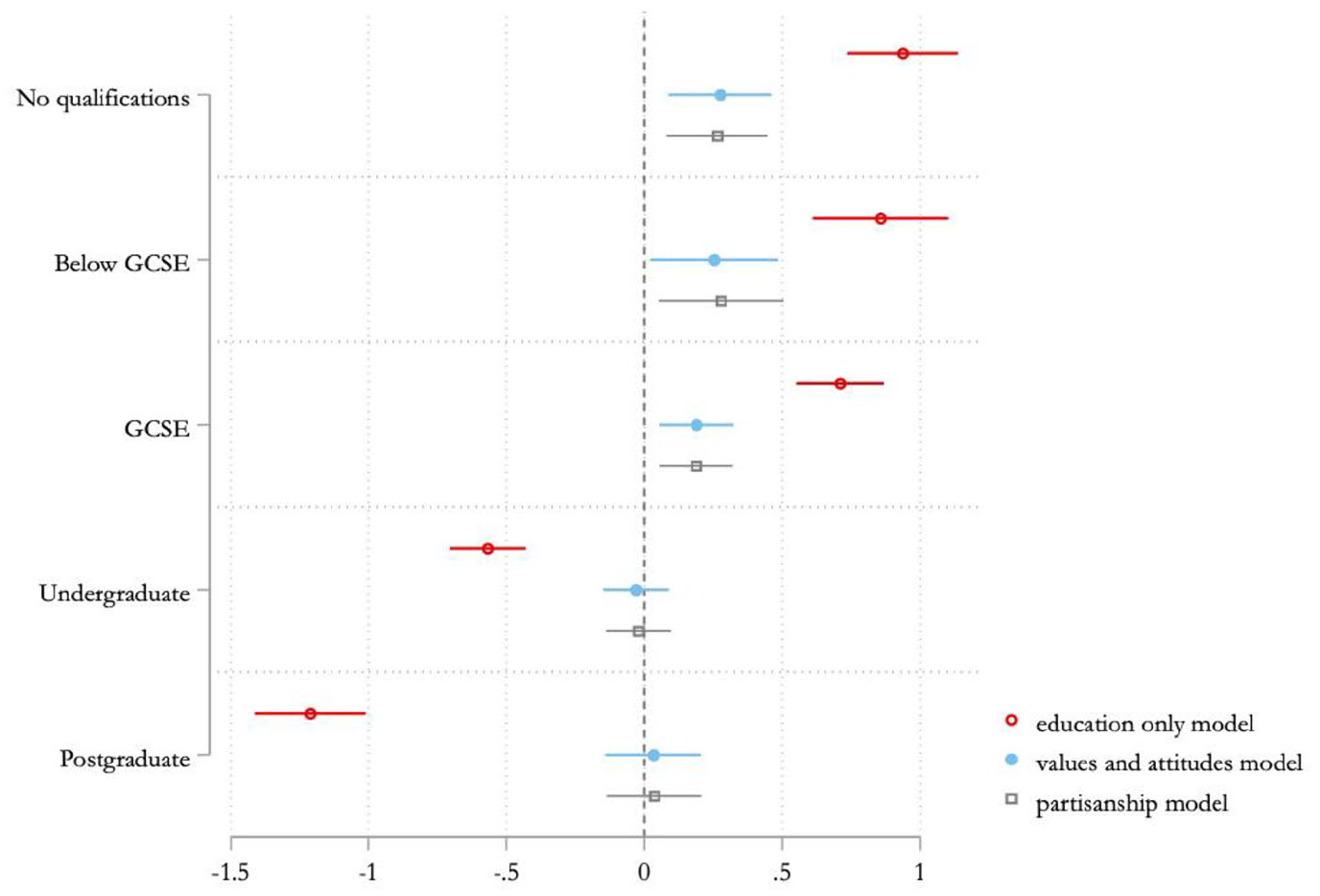
Effect of education on Euroscepticism after incorporating values, attitudes, and partisanship.
Figure 4 shows that the effects of education are reduced but are not insignificant when incorporating values and attitudes into the model for those who only have GCSE/equivalent or below compared with the reference category of A-level, but that the difference between those with A-levels and those with a higher education qualification becomes insignificant once values are accounted for. This suggests that there is a direct effect of education on attitudes to the EU, and thus that those with less than A-level qualifications may be more Eurosceptic as they do not perceive EU integration as benefitting them. However, the effect of education for those with higher level qualifications seems to primarily be rooted in values rather than material benefits. Young, degree-educated, women thus can be characterised as particularly less likely to be Eurosceptic due to their high levels of education influencing their values.
Results: EU referendum vote choice
EU referendum vote choice will now be examined. Figure 5 shows the probability of voting Leave by gender and age group. There was no overall gender gap in vote choice at the referendum, despite the slight gender gap in attitudes towards the EU just prior to the referendum shown in Figure 1. Also in contrast to Euroscepticism, there is a gender gap only in the very youngest age group of 18- to 24-year-olds where women were significantly less likely to vote Leave, and not among 25- to 44-year-olds. H2 is largely not supported, as there is a gender gap only in the youngest age group.
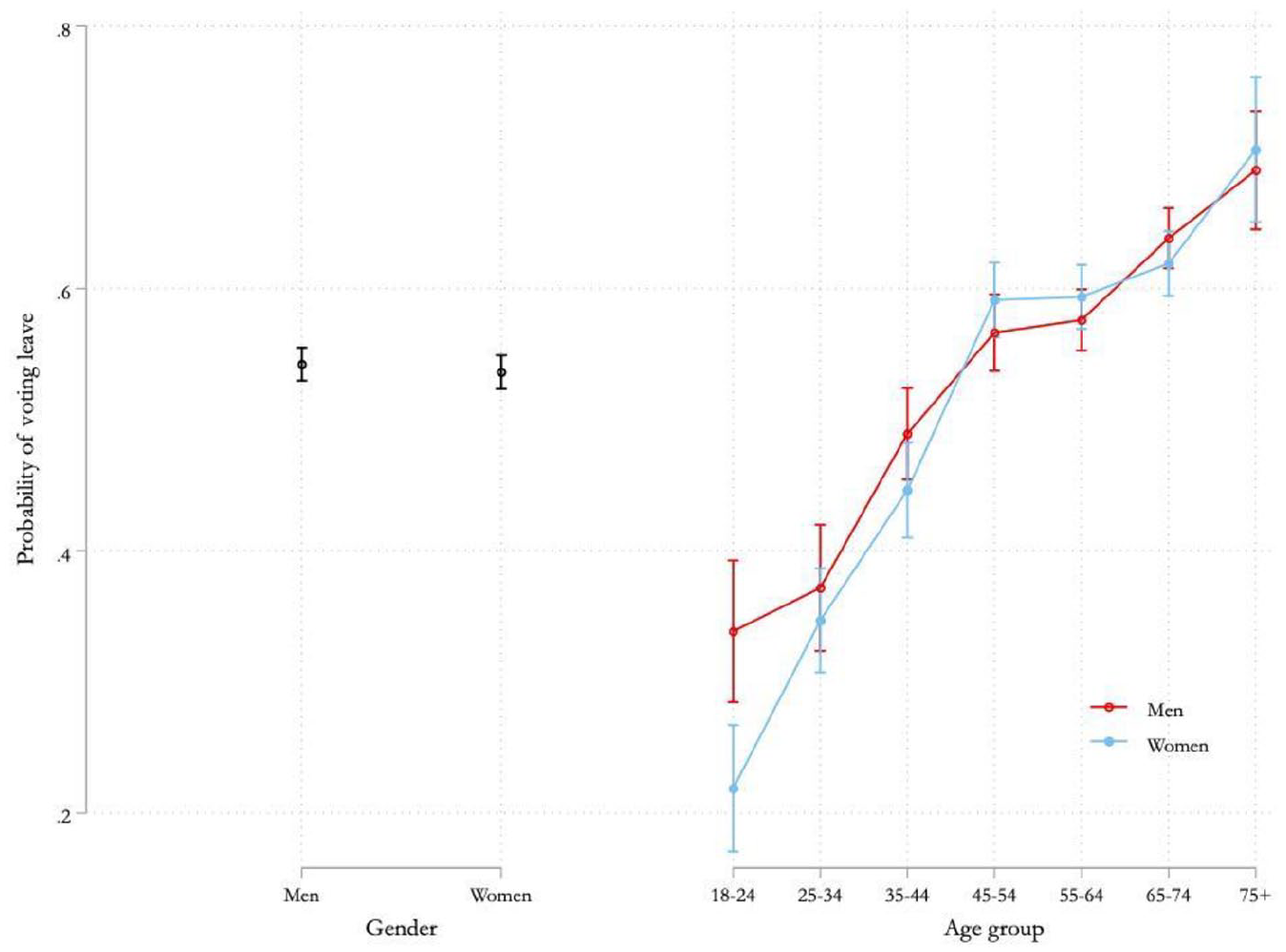
EU referendum vote by gender and age.
To investigate the gender gap present in the youngest age group, the result of adding the various controls to the model is shown in Figure 6. It can be clearly seen that the gender gap in voting behaviour between young men and women at the referendum can be explained largely by differences in their values and attitudes. The gap narrows very slightly once demographic differences are accounted for by adding them as controls to the model, is reduced as to be non-significant by accounting for values and attitudes, and is completely closed by adding prior attitudes to the EU. This suggests that younger women’s lower likelihood of voting Leave at the referendum was rooted in these differences and that their more positive attitudes to the EU were the main difference which drove their vote choice. As accounting for socio-demographic and value differences closes the gender gap in this age group (although it equalises even further once Euroscepticism is accounted for), differences in these attributes do appear to be consequential, although some of younger women’s greater positivity towards the EU remains unexplained.
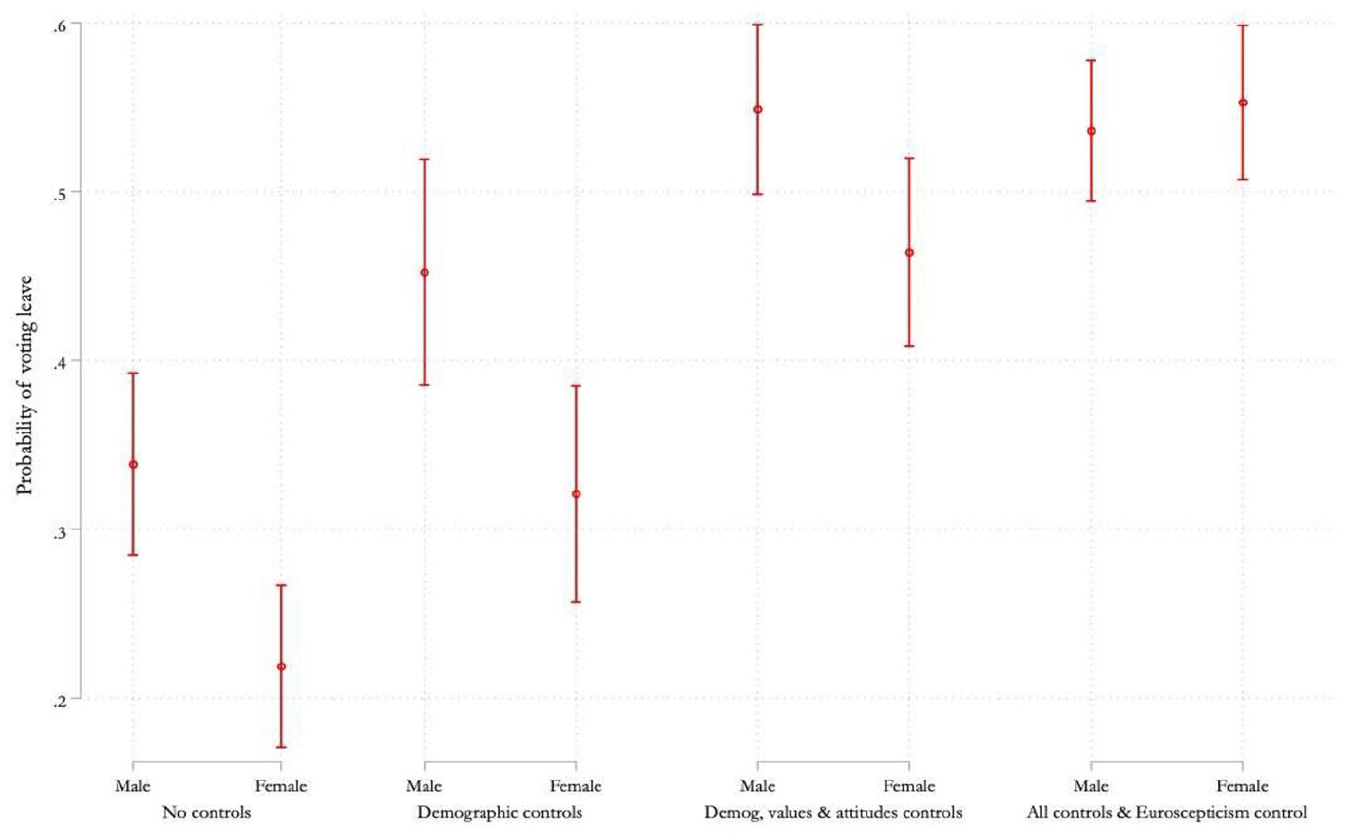
Probability of voting Leave by gender for 18- to 24-year-olds after controlling for different factors.
After adding all controls to the model, shown in Figure 7, the probability of voting Leave across different age groups for both men and women is highly similar. Even the youngest age group show similar probabilities of voting Leave. Age and gender differences at the referendum are thus largely associated with prior attitudes towards the EU and the material, value-based, or partisan reasons individuals may have for their support of or opposition to EU immigration. In addition, in this full model, with the differences in Euroscepticism between men and women accounted for, a slight gender gap appears at the aggregate level (shown in Figure 8, and see Supplemental Appendix 2, Table A3). For the same reported attitudes towards the EU, women were more likely to vote Leave – thus women who voted Leave were less Eurosceptic than men.
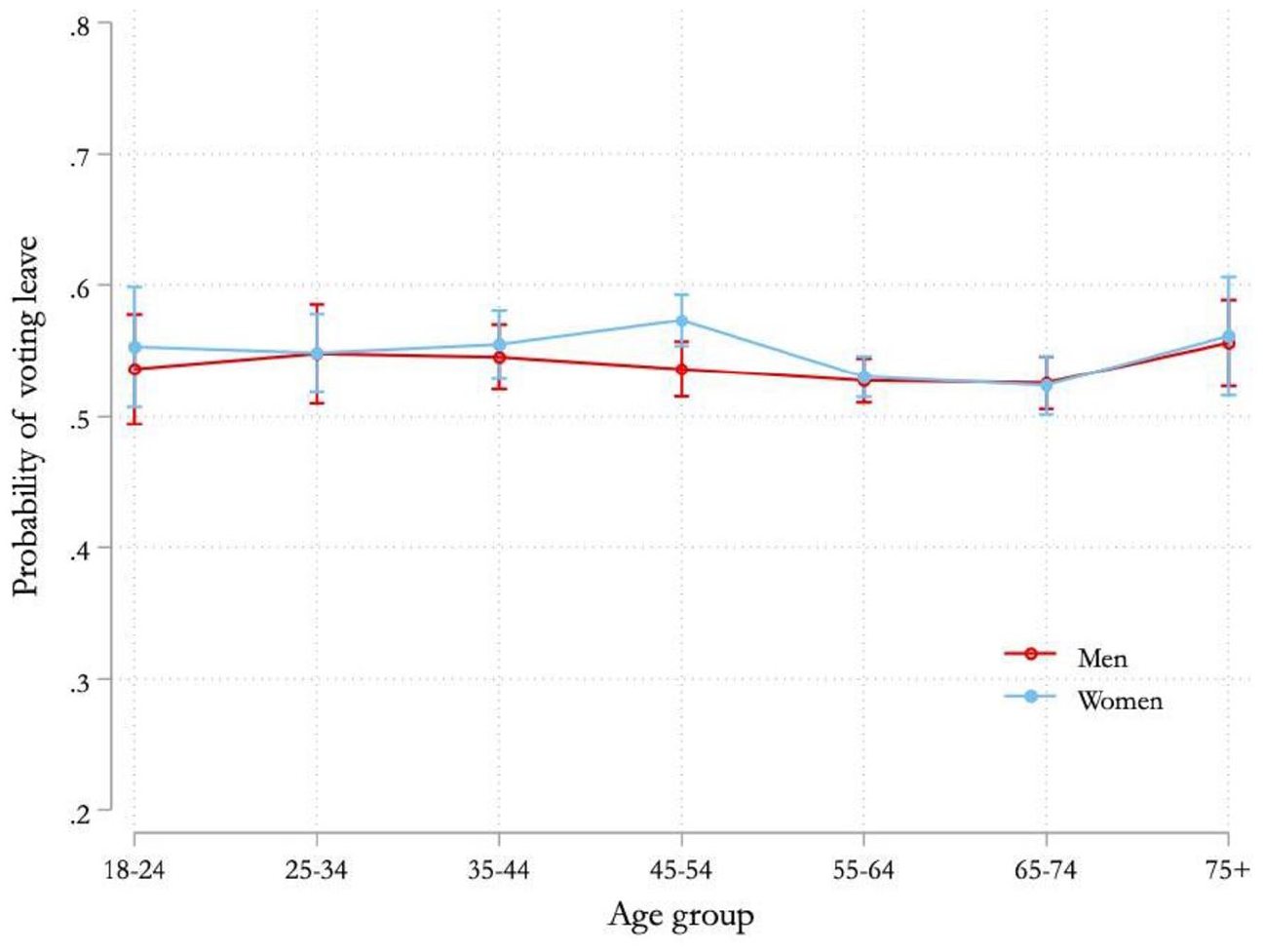
EU referendum vote choice by gender and age group, full model.
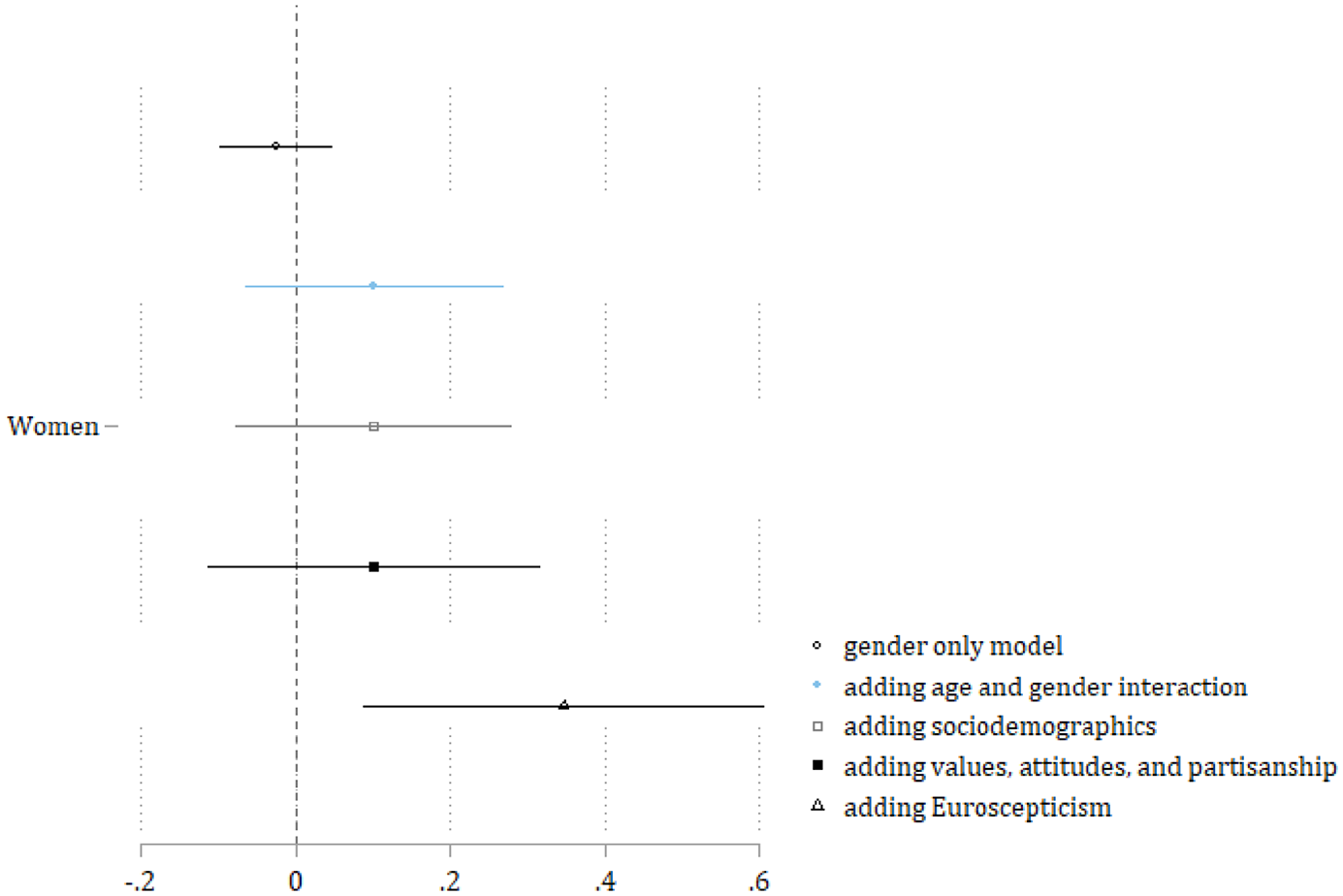
Effect of gender on EU referendum vote choice after incorporating values, attitudes, and partisanship.
Overall, there is evidence for a gender gap in the youngest age group in both Euroscepticism and in vote choice at the 2016 referendum in the United Kingdom. There are also gender gaps in the 26–45s in Euroscepticism, although not as large. There is no evidence, contrary to expectations, of a gender gap in either Euroscepticism or referendum vote for older age groups, despite older women’s greater Britishness and lower education levels relative to men of the same age. Any gender gaps disappear (with the exception of the age gap in the very youngest age group for Euroscepticism) once education and occupational classes are included in the model; including values and partisanship in the model reduces but does not diminish the effect of education and occupational class entirely. Thus, there is some evidence in support of all hypotheses, but there are also some surprising findings and complexities. Women are less Eurosceptic than similar men in younger age groups. Furthermore, rather than narrowing the gender gaps by age, introducing values into the model resulted in a larger gender gap in Euroscepticism, likely due to women’s greater authoritarianism in these age groups. There is also an effect of gender on EU referendum vote choice once an individual’s Euroscepticism is controlled for: women were less likely to vote Leave than men in the full model of vote choice, suggesting that some of the motivations of women who voted Leave was not due to their attitudes towards Europe.
Discussion and conclusion
This article makes a number of contributions. It has discussed three important research questions: (1) Were there gender gaps between cohorts in Euroscepticism in the United Kingdom prior to the 2016 referendum; relatedly, (2) were there gender gaps between cohorts in vote choice at the 2016 referendum; and finally, if the answer to one or both of the first two questions is yes (3) what explains these gaps? I find that there are significant gender gaps between women and men aged below 45 years in Euroscepticism and a significant gender gap among 18- to 24-year-olds in vote choice at the referendum. These gaps can be partially explained by differences in education and to a lesser extent occupational class or working status, although just accounting for having a greater level of formal education does not explain the gender gaps in younger cohorts entirely, or why younger women and older differ in their attitudes towards the EU. However, it is notable that the age gaps in Euroscepticism appear in cohorts born after 1971 as this almost perfectly aligns with the cohorts which have a higher proportion of women who are educated to degree level.
This finding that gender gaps only appear in younger cohorts for Euroscepticism in the United Kingdom and that women are less Eurosceptic than men in the United Kingdom also suggests that the Euroscepticism literature needs to re-evaluate its approach towards gender. An update is due which looks at how gender interacts with age, especially given that the last major cross-national study of gender did not do so and was conducted almost two decades ago (Nelsen and Guth, 2000). This represents a possibly fruitful area for further study of gender, Euroscepticism and/or values in the United Kingdom and across Europe, where similar patterns in women’s increased access to education can be observed.
Alternatively, there may be further reasons why younger, more educated, women perceive the EU to be beneficial to them compared with men which are not tested here, such as protection of maternity rights (Guerrina and Masselot, 2018), although whether women were aware of such benefits at the time of the referendum is questionable. On the flipside, the political motivations of young men would also merit being considered in future research; as Carver (2006) remarks, men have socially constructed gender roles as much as women, and thus young men falling behind young women in the labour market may affect their own sense of self-worth as ‘breadwinners’ as well as their wallets. How this translates into their political behaviour merits further exploration. Will the gender gap in the youngest age group found here remain consequential as the men in these cohorts ‘catch up’ to women in the workplace, or will the differences in their formative experiences of education and work continue to influence their behaviour?
It is also intriguing that gender gaps are present to a greater extent (in under 45s) in Euroscepticism than in vote choice at the referendum, and that (relatedly) women overall were more likely to vote Leave once Euroscepticism was controlled for. Or, to phrase it differently, Leave-voting women appear to have been less Eurosceptic than men. It may be that women felt less strongly about the issue of Europe (Campbell, 2006), but when faced with a binary choice were sceptical enough to choose to Leave even if their sentiments were not as strong as men’s. On the lack of a gender gap in older age groups, one possible solution would be to examine how women and men vote beyond individual factors by examining social and geographic contextual effects. Social factors have been shown to affect gendered differences in political behaviour with regard to far-right politics (Harteveld and Ivarsflaten, 2018), and that partners and households effect one another’s voting behaviour is well established (e.g. Huckfeldt and Sprague, 1995; Zuckerman et al., 2005). Fowler (2021) suggests that as men and women live in the same communities and form partnerships and households with one another, the economic and social differences between them are balanced as they share resources and influence one another’s political behaviour through discussion, reducing the gender gap.
There are a number of further implications for the study of Brexit and politics in the United Kingdom. First, although not a major focus of the article, I show that while women across almost all age groups in the United Kingdom are ‘more authoritarian’, this appears to be primarily driven by their attitudes towards censorship. In addition, older men are no more likely to have voted Leave than older women. The stereotype of the older male voter does not appear to be rooted in fact, as women of a similar age are both equally Eurosceptic and equally likely to vote Leave. I also find a ‘modern’ gender gap in that younger age groups are less Eurosceptic and less likely (among 18–24s) to have voted Leave. The Brexit cleavage is gendered and this gender gap has already been shown to be consequential for elections in the United Kingdom as Campbell and Shorrocks (2021) find that the gender gap in the same age group was highly associated with their lower probability of support for the United Kingdom’s exit from the EU. This article shows that this gender gap is partially due to factors which are likely to persist and expand even if Brexit fades in political importance and thus it is likely to be on continuing electoral importance. Younger women’s greater education is a significant predictor of their lesser Euroscepticism, and the education gap between men and women can be linked to a much broader set of values than just attitudes towards the EU. The gender-education gap in the United Kingdom, and beyond, has the potential to cause value and attitude differences with political consequences that are here to stay.
Supplemental Material
sj-docx-1-bpi-10.1177_13691481221110764 – Supplemental material for Gender-age gaps in Euroscepticism and vote choice at the United Kingdom’s 2016 referendum on EU membership
Supplemental material, sj-docx-1-bpi-10.1177_13691481221110764 for Gender-age gaps in Euroscepticism and vote choice at the United Kingdom’s 2016 referendum on EU membership by Ceri Fowler in The British Journal of Politics and International Relations
Footnotes
Acknowledgements
The author would like to thank Ed Fieldhouse, Rosalind Shorrocks, Chris Butler, and the members of the Democracy and Elections Research Group at the University of Manchester for their helpful comments on earlier drafts, and the ESRC for funding the PhD from which this work was drawn.
Data availability statement
The data used in this paper are from the British Election Study Internet Panel, which are freely available here: https://www.britishelectionstudy.com/data-objects/panel-study-data/. This paper primarily uses data from wave 7: DOI: 10.15127/1.293723 which is freely available here: 
Funding
The author(s) disclosed receipt of the following financial support for the research, authorship, and/or publication of this article: The research for this article was originally undertaken with support from Economic and Social Sciences Research Council [grant number: 1920506]
Supplementary Information
Additional supplementary information may be found with the online version of this article. A1. Mean Position on Liberal-Authoritarian Scale Items by Gender. A2. Tables Table A1. Results of OLS Model of Euroscepticism (0-10 Scale, where 10 = Protect our Independence). Table A2. Further Results of OLS Model of Euroscepticism (0-10 Scale, where 10 = Protect our Independence). Table A3. Results of Logistic Regression Model of Vote Choice (0 = Remain 1 = Leave). A3. Gender, Age and Euroscepticism, Unrestricted Sample. A4. Alternative Analysis with ‘Don’t Know’ Responses at Midpoints for Values and Attitudes.
Notes
References
Supplementary Material
Please find the following supplemental material available below.
For Open Access articles published under a Creative Commons License, all supplemental material carries the same license as the article it is associated with.
For non-Open Access articles published, all supplemental material carries a non-exclusive license, and permission requests for re-use of supplemental material or any part of supplemental material shall be sent directly to the copyright owner as specified in the copyright notice associated with the article.
