




Abstract
At a time when party politics is becoming increasingly personalised, conventional wisdom argues that the party leaders’ power in organisations is on the rise. However, scholarship has not yet provided a thorough and systematic analysis of the role of party leaders that offers theoretical and empirical specification. The aim of this article is to provide an analytical framework for the study of party leadership by examining the concept of leadership autonomy and its components. This new conceptualisation is then applied to a number of different parties across Western Europe, showing how leadership autonomy varies across countries and different party organisations. The conclusion sets out the implications for party change and highlights the importance of placing the leaders’ role at the centre of the empirical analysis of political parties.
Keywords
Introduction
The vital role played by party leaders is a recurring theme in the expanding literature on comparative party organisations (e.g. Katz and Mair, 2018; Rahat and Kenig, 2018). 1 This scholarship has tended to emphasise the increasing powers of party leaders and their growing importance in the institutional and electoral arenas. According to several authors, the autonomy of leaders is fundamental to boosting electoral performance, by enhancing their flexibility and ability to adapt to the external environment (e.g. Beyme, 1996; Enyedi, 2014; Kitschelt, 1994). Drawing on a comparative analysis, Webb et al. (2012: 89) make the rather sweeping claim that ‘the direction of travel in favour of (even) greater leadership autonomy has been broadly similar in many major parties within all types of institutional regime’.
However, scholarship has failed to provide a systematic account of the relationship between leaders and party organisations. 2 Although the literature on party models assumes the structurally enhanced autonomy of party leaders from party bodies and activists (see next section), studies seldom offer a clear conceptualisation of party leadership autonomy and they lack a systematic measurement that allows for empirical comparisons. A review of recent works illustrates that researchers regularly qualify the role of leaders by referring to a range of terms including ‘centralisation’, ‘strength’, ‘presidentialisation’, ‘personalisation’ or ‘accountability’. Some empirical studies focus explicitly on the concept of leadership autonomy, but they fail to define either the term or its operationalisation (e.g. Loxbo, 2013; Raunio, 2002). It is clear that different criteria are used to examine party leadership and there has been little attempt to make them more consistent and compatible with each other. Such shortcomings make it difficult to evaluate the validity of theoretical arguments and test empirical propositions. It is both interesting and important to fill this gap as many authors hypothesise a link between the strengthening of party leadership and the changing role of political parties in contemporary democracies (Enyedi, 2014; Ignazi, 2014; Katz and Mair, 1995; Krouwel, 2012). Lobo (2014) notes that the segmented and incipient nature of studies on party leadership makes this a promising topic of research.
We contribute to this general endeavour by developing a conceptual framework to examine party leadership autonomy. More specifically, this study contributes to a more nuanced and fine-grained understanding of the role of party leaders in contemporary parties by developing a conceptual framework that specifies the multi-dimensionality of leadership autonomy. After clearly defining this concept, we connect to available measures and explore the distinct mechanisms behind it. Rather than anticipating new sources of data, our approach highlights how existing data conventions support the continued study of these concepts. In so doing, we disentangle the concept of leadership autonomy and parse out the key conceptual distinctions between the concept’s underlying dimensions. This will not only allow us to highlight the fundamentally distinct nature of leadership autonomy – hence drawing attention to differences in ‘kind’ – but also to provide empirical tools to measure differences in the ‘degree’ of party leadership autonomy across distinct party types and contexts. Thus, we provide an analytical framework useful for elaborating new typologies and empirically distinguishing the role of party leaders across distinct party organisations.
This article proceeds as follows. The next section discusses the concept of leadership autonomy in light of the literature on party models and elaborates an analytical framework for empirical analysis. The third section provides information regarding the operationalisation of variables and the data. We then present the empirical analysis and discuss the results, examining how leadership autonomy varies across different countries and party types. The conclusions summarise the findings and consider the fruitfulness of the analytical framework for the study of contemporary party leadership.
The Concept of Party Leadership Autonomy
Contemporary appraisals of the party change literature have highlighted the need to focus on the role of party leaders. However, the proliferation of party models and empirical data has yielded neither comparative and cumulative knowledge on the leaders’ place within party organisations, nor a clear qualification of the concept of leadership autonomy. This section briefly reviews how party models have framed the role of party leaders, emphasising the relevance of adopting a multi-dimensional approach to elaborate a consistent conceptualisation of leadership autonomy.
The focus on party leadership has assumed greater relevance since Kirchheimer’s (1966) seminal contribution. Following the debate on the electoralist and the cartel party (Katz and Mair, 1995, 2009), a number of contributions have attempted to specify the relationship between party leaders and party models. According to Hopkin and Paolucci’s (1999), the ‘business firm’ party is characterised by an all-powerful leadership and lightweight organisation, without any significant constraints on defining the political message or selecting professional marketing experts. This means that leaders enjoy a high level of autonomy, and they use party organisation to promote themselves (see Krouwel, 2006: 263). Overall, ‘the high levels of centralisation of control over resources (. . .) place particular responsibility for the party’s survival on the shoulders of its leader’ (Hopkin and Paolucci, 1999: 323). A radical version of the business-firm model is the so-called memberless party, in which ‘power is concentrated in the hands of the party leader himself’ and his or her position is even stronger than in the former party model (Mazzoleni and Voerman, 2016).
More recently, the literature on entrepreneurial parties has emphasised the importance of party leaders as these parties are formed by individuals mostly as a vehicle for political careers. Arter defines an entrepreneurial party: as being formed by one person, who does not hold a position in government. It must have external origins, represent the work of a single entrepreneur and will be closely associated with an issue prioritised by the founder of the ‘party enterprise’ (Arter, 2016: 17).
In the same vein, Calise (2010) argues that a new party type, ‘the personal party’, has emerged from the ashes of traditional mass parties that characterised the Italian ‘First Republic’. This new party model is based on a combination of charismatic and patrimonial resources, which replace the collective and legal-rational criteria that had shaped intra-party functioning in previous party models.
As this brief literature review shows, previous works have used various frameworks and party models to understand party change and the shift towards party leaders’ increasing powers. However, a number of issues remain unresolved. First, most party types elaborated since the demise of the mass party tend to rely on a principal–agent framework, based mainly on the leader–follower relationship in which the two parts are set against each other in a zero-sum game. Leaders are only regulated or constrained by followers. Second, most works are more concerned with legitimacy and the external dimension of leadership action than with intra-party mechanisms. Finally, the empirical analysis is largely impressionistic and the comparison of differences across parties and over time proves difficult. It is undoubtedly necessary to clarify the terms and concepts already in use, so that their distinctive nature and measurement are well defined to facilitate a comparative empirical analysis of leadership autonomy.
The concept of autonomy has been traditionally associated with either the party as a whole, for example, in the literature on party institutionalisation (e.g. Mainwaring and Torcal, 2006; Panebianco, 1988), or in structural terms, that is, the relative autonomy of local/regional subunits vis-à-vis national structures (e.g. Bolleyer, 2012). In the literature on party models, the concept of leadership autonomy is used to examine the intersection between organisational changes and the internal distribution of power, for example, through the analysis of intra-party democracy (e.g. Cross and Katz, 2013). Some scholars consider the autonomy of party leadership to be equivalent to the concept of centralisation, namely, ‘the place and the distribution of the effective authority of decision within parties’ (Janda, 1980: 108). In this sense, leaders’ autonomy is related to the concentration of powers in their hands, that is, the degree of control they maintain with regard to both essential resources and ‘zones of uncertainty’ (Panebianco, 1988).
Leadership autonomy is a key concept recently used in the Political Party Data Base (PPDB) led by Poguntke et al. (2016). It is one of the organisational dimensions covered by the project that is used to build the index of leadership power. It is linked with the decision-making processes, and takes rules for leadership selection and re-selection into account, as well as rules for policy-making. Although the authors consider leadership autonomy to be synonymous with power concentration, they also refer to it as ‘leadership strength’. As with the literature on party models, there is not only a lack of clarity and specification of this concept, but also inconsistencies in its measurement.
Taking the cue from Janda (1980) and Scarrow et al. (2017), we define leadership autonomy as a leader’s structural independence from the party organisation and its control over organisational resources and decision-making processes. This implies considering the actions undertaken by leaders in a specific organisational context. In some cases, party leaders are agents of the organisations they represent, and their main goal is to aggregate the preference of intra-party actors (members, activists and party elites). But in cases characterised by personalised party leadership, the principal–agent relation may be exactly the opposite. This means that party organisation becomes a resource and a strategic tool in leader’s hands, using the party as a vehicle to acquire or increase political power. This (hypothetical) scenario corresponds to the highest level of leadership autonomy. Although many leaders may attempt to reduce or minimise constraints or periodic accountability, they are rarely able to completely eliminate intra-party mechanisms of checks and balances.
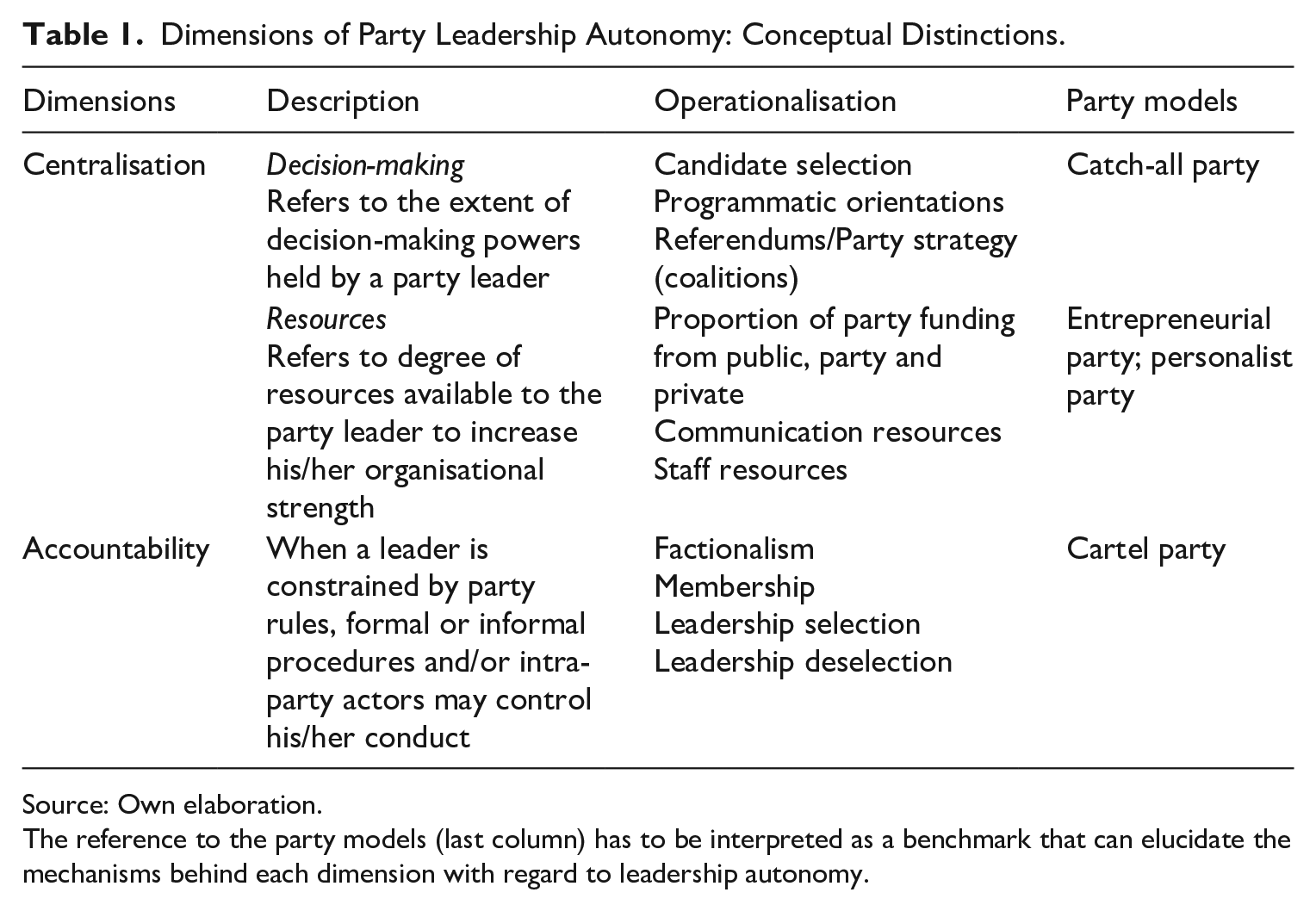
We contend that there are two key dimensions that can accurately capture the concept of leadership autonomy, namely, centralisation and accountability. Table 1 presents these notions, their respective operationalisation and their relation to the main party models. Centralisation implies the concentration of power in leaders’ hands. As in other organisations, power is a relational property, which means that there is only one power centre (the leader) in centralised party leadership, whereas in more decentralised party leadership we can find several (or even many) power centres (within or outside the party elite). By contrast, accountability has more to do with the idea of authority, that is, to what extent party leadership may be restrained by other party actors (e.g. party executive board, party bureaucracy or party membership). 3 As vom dem Berge and Poguntke (2017: 140) emphasise, accountability implies that party actors can exert a degree of control over the leader. There can be parties that grant leaders a great amount of internal power but also have several sources of authority. But the opposite may also occur, with leaders who act on behalf of the party but where intra-party power is dispersed, such as in stratarchical parties. To examine how leadership autonomy varies, we need to consider how these two dimensions are combined.
Dimensions of Party Leadership Autonomy: Conceptual Distinctions.
Source: Own elaboration.
The reference to the party models (last column) has to be interpreted as a benchmark that can elucidate the mechanisms behind each dimension with regard to leadership autonomy.
First, two key aspects are involved when talking about centralisation: decision-making powers and resources. While this distinction seems implicit in Krouwel’s (2006: 262–264) analysis when he differentiates between concentration of powers and resources, it is not sufficiently clear elsewhere. A leader obviously lacks autonomy if intra-party actors or structures can control (or manipulate) internal decision-making. Although most research finds leaders’ powers are growing more than that of other layers of the party, their action remains embedded in party organisations. In other words, party leadership is autonomous when it removes other important intra-party actors from the decision-making processes. From this viewpoint, the distinction between leadership autonomy and decision-making (de)centralisation as two separate dimensions put forth by Poguntke et al. (2016) is somewhat misleading.
Following the conventional approach to the study of centralisation (e.g. Cross and Katz 2013; Krouwel, 2006), this component can be assessed using four distinct indicators: candidate selection, control of programmatic decisions, the distribution of financial resources and communication strategy. 4 The analysis for all these dimensions focusses on the national level because it is assumed that intra-party positions nationally are more important to the party and thus more indicative of the overall level of leadership autonomy. 5
The procedures for personnel selection are at the heart of intra-party democracy and one of the core functions of political parties. There is little doubt that candidate selection is one of the key aspects of intra-party politics. When centralised mechanisms are in place, the party leader is able to select candidates and use disciplinary tools to punish rebel MPs, thus controlling party behaviour (e.g. Hazan and Rahat, 2010; Katz, 2001). In other words, candidate selection mechanisms, as established by party statutes and informal rules, are powerful whipping resources that may neutralise negative effects of internal conflicts or intra-party divergences.
The second aspect of centralisation is the concentration of powers regarding programmatic decisions in the leader’s hands. According to conventional wisdom, this is a key dimension of intra-party power because party elites strive to enhance and preserve their autonomy to be able to adapt to changing electoral markets and party competition (Panebianco, 1988; vom dem Berge and Poguntke, 2017). The more inclusive the decision-making process in a political party, the less autonomous the leader is (see Kitschelt, 1994; Loxbo, 2013). Indeed, empirical evidence shows that parties characterised by more democratic procedures for the drafting of programmes are also less likely to adapt to changing electoral environments (Hennl and Franzmann, 2017).
The concentration of resources is the third important aspect of centralisation. Party leaders need to mobilise key resources to implement their strategies and achieve their goals. Although symbolic resources may also be important especially in terms of the party leaders’ role in the electoral and institutional environment, we focus on human and financial resources since our study is concerned with organisational autonomy. Like other organisations, political parties tend to develop a bureaucratic process based on specific administrative or managerial roles that cannot be performed by activists (Webb and Kolodny, 2006). It is generally agreed that staff resources are an important instrument leaders can use to increase their leeway, and systematic data can be easily found to compare distinct parties through the PPDB project. As for financial resources, the most important distinction is between internal versus external funding. Whereas intra-party resources are associated with a less autonomous party leadership, criteria for the use of external resources may be more discretional and organisational constraints tend to be less relevant. External funding includes public subsidies and private donations. As empirical research has shown (Biezen and Kopecky, 2017), there is a common pattern in Western democracies towards the overwhelming predominance of public funding. This seems to benefit party leaders given that party elites can easily control the distribution of state subsidies. However, private donations are prohibited or amount to a very small proportion of party income, with the exception of the United Kingdom and Denmark.
The final relevant aspect of centralisation is the capacity of party leadership to exert control over communication strategy. Indeed, national leaders fulfil the symbolic function of personifying the party and are the main linkage between party organisations and the electorate at large. As Janda (1980: 109) noted, the idea that the leader is the primary spokesman of the party in the country’s communication media is intrinsically associated with the notion of party leadership. The degree of centralisation of communication channels is a key resource to exert power within party organisations, increasing leaders’ coordination capacity and their influence on the definition of the party message in public opinion.
However, while the concept of autonomy takes the lack of sanctioning mechanisms ex ante or ex post into account, the centralisation concept does not. If there are well-defined procedures and rules within party structures, leaders’ actions are constrained by internal party life. In addition, these mechanisms are effective when intra-party actors can control and sanction the action of leaders. Thus, the key aspect that defines the concept of autonomy is based on accountability mechanisms (see also Scarrow and Webb, 2017: 7). The latter strive to examine how party organisations systematically control leaders by providing mechanisms to check their action. The greater the party leader’s accountability to internal party actors, the less his or her autonomy. In fact, Kitschelt’s (2000: 223–225) comparative analysis of social democratic parties considers leadership autonomy and accountability to be synonymous, using four indicators to measure the concept (candidate recruitment, control of conference schedules, domination of the legislative leadership over the party executive and the party’s distance from labour unions).
When considering the concept of autonomy in terms of the internal distribution of power, it is important to remember that party organisations have different layers and work in several (functionally distinct) arenas. From this standpoint, the accountability process of party leadership is essentially defined by two sub-dimensions. The first focusses on the horizontal relationship among top party politicians; more specifically, the links between leaders and party elites – the dominant coalition to use Panebianco’s (1988) terminology – especially within the main party bodies. The second sub-dimension is based on vertical relationships, that is, the control that party members or structures can exert over party leaders.
The first sub-dimension involves the party leaders’ ability to control internal divisions within party elites. An important argument set forth in Sartori’ seminal contribution is that party factions may play an important role in activating leadership accountability (Sartori, 1976). According to Maor (1997: 149), factionalism can be defined as ‘a form of conflict organisation which reflects the tendency of intra-party actors to act collectively to reach common goals’. There are two mechanisms underlying factions’ constraints on leaders’ autonomy. First, parties with higher levels of internal fragmentation display higher transaction costs to take decisions and to reach equilibrium between different subgroups (Carty, 2004; Ceron, 2016). In this case, party leaders are managers of internal conflicts more than rulers, thus mediating between subgroups’ heterogeneous preferences. Second, as noted in various studies on government coalition (Laver, 1999; StrØm, 2000), factionalism is likely to constrain leaders when taking key party decisions, such as inter-party negotiations or strategic choices. Overall, factionalism increases the number of veto players and tends to make outcomes more unstable. In parties characterised by high levels of factional politics, leaders always have to ensure that factions will comply with their decisions. It is our contention that factionalism may assess informal mechanisms of leadership constraints, thus complementing the analysis of formal rules as proposed by the PPDB project. Although qualitative analysis can be used to assess the kind of factions within a party, the degree of factionalism can also be easily measured using, for instance, the effective number of factions developed by Boucek (2012).
The second sub-dimension of accountability is related to vertical links between leaders and members. A party with an inclusive party membership is more likely to display a greater involvement of rank-and-file in making decisions, thus exerting some degree of control over the leader. According to the cartel party model, the leader’s leeway is constrained significantly by members, who limit leaders’ strategic flexibility and their capacity to expand parties’ electoral support. Kitschelt (2000) has also argued that party leaders have to face increasing internal constraints in contemporary politics, but that declining class loyalty and party identification force elites to be more, not less, sensitive to increasingly unruly members. However, the opposite may also be true, as parties with larger membership size are more likely to display oligarchical tendencies (see Michels, 1962). This rationale seems to be confirmed empirically as the analysis based on the PPDB found that parties with relatively strong leaders tend to be associated with larger memberships (Bolin et al., 2017). Despite this, our assumption is that higher levels of party membership are more likely to constrain the action of part leadership, as shown by populist or ‘memberless’ parties. 6
Besides informal mechanisms of accountability, party organisations may also establish formal rules to control party leaders. Leadership selection and deselection are two sides of the same coin and represent a key element of party constraints. As some scholars have noted (e.g. Kenig, 2009; Pilet and Cross, 2014), the selection of party leaders is increasingly plebiscitary, especially when parties adopt one-member-one-vote (OMOV) procedures. This means that leaders are not bound by factional dynamics and are more likely to control key party decisions, such as the formulation of party platforms or party strategy, leading to ‘Bonapartist’ leaders. Rules that allow leaders’ (mis)conduct to be checked periodically are the most important tool for holding party leaders accountable. A number of studies (e.g. Pilet and Cross, 2014; Chiru et al., 2016) demonstrate that most parties’ statutes fail to include rules on how to deselect a leader. Those that do usually attribute this power to party delegates at the end of the leader’s mandate; this typically corresponds to a 4- or 5-year electoral cycle. However, in Germany, for example, the federal party Law obliges parties to run leadership contests every 2 years, thus providing stable and formal norms for making party leaders accountable.
Overall, these indicators are also important because they can reveal the degree of organisational decentralisation, that is, the vertical integration of parties, measured as the degree of sub-national party autonomy. The empirical analysis of this dimension focusses on the allocation of competences and resources, thus distinguishing between hierarchical, federal and stratarchical configurations (Bolleyer, 2012). When a high concentration of resources is added to already high levels of decision-making centralisation and low accountability, the political party is close to the entrepreneurial or personalist parties. As mentioned above, these party models take the ‘big men’ approach to party leaders, that is, leaders are the party, and the principal–agent relationship is often inverted as party organisations are tools in the leaders’ hands.
Measurement and Data
We begin by identifying who the party leaders are. A party's ‘national leader’ is the person who acts as the primary spokesman of the party according to the rules established by party statutes. This implies adopting a formal approach, that is, to focus on ‘organisational leaders’, thus excluding what we might call the frontmen (party officials more known to the public who are not formal leaders despite their standing) from the definition. Usually, the party leader is the party chair or secretary. 7 There are parties, normally belonging to the left-libertarian family, that adopt the principle of shared leadership, based on a dual leadership or a larger party body. In these cases, parties have a recognisable leadership and have been included here. However, interim party leaders (selected for a short term and often not through the ‘normal’ procedures) have been disregarded, as have leaders of electoral coalitions, that is, electoral leaders that lack a supporting party.
As explained above, we assess party leadership autonomy within party organisations by focussing on two dimensions: the degree of centralisation (i.e. the concentration of power in the leaders’ hand), and (internal) accountability, that is, to what extent leaders are constrained by internal rules and dynamics.
Given the multi-dimensionality of centralisation, we rely on multiple indicators. 8 The first focusses on the method of candidate selection. In this case we take the cue from Hazan and Rahat’s work (2010), which provides a useful framework for examining the variety of internal mechanisms. The main criterion for classifying methods of candidate selection is based on the level of inclusiveness, which oscillates along a continuum from more inclusive to more exclusive processes. On one hand, candidates may be selected by the electorate at large, such as in the American ‘blanket primary’. On the other, the most exclusive selectorate is based on restricted non-selected party agencies or even the single leader, who may control the overall process of candidate selection. Relying on the debate about democratisation reforms (Katz, 2001), we posit that there are two strategies for allowing the leader to control the process of candidate selection. The first is formal centralisation around the party leader, while the second consists of empowering the ordinary party members. The classification ranges from 0 (party congress) to 1 (single leader). A note of caution related to mixed procedures of candidate selection rules is in order. In these (few) cases, we proceed with a qualitative analysis to identify the key locus of candidate selection, that is, the most important layers or intra-party actors that play a decisive role in this process.
A second item of the leadership centralisation index is how the party manifesto for national elections is elaborated. As the PPDB presents missing data for most parties (see variable C101MAN2), we combine it with the COSPAL (Comparative Study of Party Leaders) dataset by using the following coding: the value 1 is attributed to parties that grant the party leader (and/or a drafting committee directly appointed by him or her) both an informal input and a vote in formulating the party election manifesto; 0.5 when the role of the party leader is based on either an informal input or a vote; 0 when neither of the two situations applies. When party statutes do not provide any specifications, we perform a qualitative analysis with the help of the coding scheme elaborated by vom dem Berge et al. (2013).
Regarding the degree of resource centralisation, the operationalisation is quite straightforward. The main indicator is related to party funding and measures the proportion of public sources used to finance party organisations. Data for all parties are again available through the PPDB (CR29_1REVSUBTOT), thus this variable ranges from 0 to 1. As mentioned above, it would make sense to consider full paid employees in the national party headquarters, but this variable presents two main problems. First, there is a huge variation in the number of full paid employees depending not only on party size, but also on national legal frameworks. Second, most parties do not provide this information, thus comparable data are unavailable.
Finally, the fourth indicator of centralisation is based on communication resources according to party statutes. As emphasised in the previous section, it is very difficult to measure leadership qualities (e.g. communication skills) and psychological resources in a comparative and systematic way. Moreover, we are concerned with communication resources from an organisational point of view. Consequently, we rely on the variable C17LDRROLE1 of the PPDB, which measures the extent to which the leader represents the party externally (1: the leader represents the party externally; 0: no role for the party leader).
Moving to accountability, the first indicator is based on the degree of factionalism. There are several proposals to measure the degree of party internal fragmentation. Ceron (2016) examined the heterogeneity of policy orientations, thus considering congress motions as an indicator of internal divisions, classifying how distinct factions position themselves on the traditional left–right scale. Here we are more interested in quantifying the number of factions, as we postulate that more factionalised parties also provide more constraints on the party leadership. From this viewpoint, a better indicator of factionalism is based on the degree of competitiveness for party leadership. As our goal is the analysis of leadership accountability, the number of challengers may be considered as a good proxy of (horizontal) accountability, namely, the power of party elites to control the party leader. We therefore adopt the operationalisation formulated by Kenig (2009) with regard to the distribution of votes for leadership contests. Following Kenig’s approach, our index is based on a 0–1 scale to reflect the distribution of votes and the number of candidates. We recode this index such that a maximum value of (1) is associated with the lowest degree of competitiveness (higher leader’s autonomy). By contrast, a value close to (0) means that the contest is highly competitive, therefore party leaders enjoy a lower degree of autonomy. It is worth remembering that we assume a negative relationship between fragmentation and autonomy, that is, higher levels of fragmentation are associated with a lower degree of leadership leeway (leadership is less autonomous).
The second indicator of accountability is the relative number of party members (M/V). We use party voters as the denominator (rather than the electorate) to roughly control for the relative political appeal of the various political parties. The M/V ratio ranges from 0.03% (in the case of Forza Italia, FI) to 34.7% for ÖVP (Austrian People’s Party). On average, the parties included in our sample display an M/V ratio of 6.3%, meaning that about 6 out of 100 of their voters are members of the party. As higher M/V ratios are associated with higher levels of accountability, the final variable is recoded into a continuous variable that ranges between 0 and 1, where the latter identifies cases of the highest levels of leadership autonomy and 0 otherwise.
Two other items included in the accountability index consider the provision of leadership selection and deselection rules in party statutes. As mentioned above, the single most important feature to distinguish between selection methods is based on the degree of inclusiveness of the selectorate (Kenig, 2009; Pilet and Cross, 2014). As noted by Pilet and Cross (2014: 226), the variety of leadership selection modes ranges from the Italian PD (Democratic Party), which adopts open primaries to select its leaders, to the Israeli Shas in which the (spiritual) leader seems to be selected by God. Yet the ‘democratisation paradox’ argues that greater inclusiveness through primaries or postal ballots atomises membership participation, because the integrated elite faces a disorganised mass of members (Katz and Mair, 1995). According to the cartel thesis, the introduction of membership ballots ‘enhanced leadership autonomy’ because such plebiscites can easily ‘be manipulated by oligarchic elites’. Therefore, this situation is considered to grant leaders a high level of autonomy, just below the ‘self-appointed’ leader. The final operationalisation uses a 6-point scale that ranges from 1 (self-nominated leader, corresponding to low accountability, highest autonomy) to 0 (leader selected by party council or restricted party body, which corresponds to a situation of higher levels of accountability). The problem here is how to measure leadership selection in those parties that adopt mixed modes of selection. However, this situation is very rare in European political parties (Pilet and Cross, 2014), and it does not invalidate the comparative analysis.
As for leadership deselection, we created a new variable (‘deselection’) based on two variables included in the COSPAL project. The first refers to ‘leadership removal’, that is, who is entitled to remove the leader. The second is based on ‘term length’, namely, whether the statutes establish some limits in terms of leadership tenure. Some party constitutions may include deselection procedures but no term limits, or vice versa. As discussed above, most parties do not constrain leadership tenure through statutory norms, thus increasing leaders’ autonomy. By contrast, when there is a specific term length or procedures to deselect leaders, party organisation may play a greater role in making party leadership accountable. The final score ranges from 0 (party statutes include rules for organising the end of leaders’ tenure and also establish term limits) to 1 (no rules for leadership selection and no term limits). 9
Finally, we employ each of these sub-dimensions of leadership autonomy to construct a composite index. All four components of centralisation have been standardised and added to build the final index that measures the overall degree of centralisation, ranging from 0 (low centralisation) to 1 (maximum level of centralisation). We build a similar additive index for accountability, based on the arithmetic mean of all variables, ranging from 0 (high accountability) to 1 (low accountability). 10 In this case all variables have been recoded so that higher values are associated with lower levels of leadership accountability (higher leadership autonomy). This means, for example, that a party with an accountability score of 0.7 features a party leader with less constraints than a party with a score of 0.2. To better illustrate how this index works, we can image an extreme case of ‘unaccountable’ party leadership, that is, presenting the maximum score (1) and a situation characterised by no factions, no members, a self-appointed leader and with no deselection rules.
It is worth noting that both indices are based on theoretical justifications, that is, they are formative indices rather than reflective indices (constructed by factor analyses). From this viewpoint, the quality of a formative index is mainly defined by the quality of the theoretical concept on which the index is based (see Coltman et al., 2008).
As for the data, our empirical analysis relies mainly on two types of sources. The first is an original data set elaborated by Cross and Pilet (2016), which includes a number of dimensions related to party leaders. In particular, it contains information on leadership selection methods, degree of competitiveness in leadership race, party ideology and party size. The second type of source relies on rules and regulations of party constitutions. Party statutes are ‘hard data’ (Bille, 1997), which allow us to better compare different cases based on uniform data and sources. Therefore, we rely on the PPDB to retrieve data on party organisations (Poguntke et al., 2020). The period ranges from 2000 to 2015, depending on the unit of observation. 11 Obviously, one may argue that formal power relations do not perfectly mirror real power relations. To minimise these problems, we also rely on secondary sources and bibliography, which provide valuable insights and a more fine-grained analysis on internal party dynamics and internal power distribution. In this study, we focus on mature democracies, thus excluding less institutionalised parties of Eastern Europe where informal dynamics play a crucial role and the degree of correspondence between party statutes and its actual power structure is low. In addition, it was not possible to collect data for all indicators for Eastern Europe and some Western countries, especially with regard to factionalism and the internal distribution of power. Thus, the empirical analysis comprises a set of 56 parties from nine Western European countries. 12
How Does Leadership Autonomy Vary? Empirical Findings
We begin by describing the extent of variation in the two main components of leadership autonomy, namely, centralisation and accountability (Table 2). It is interesting to note that the degree of centralisation with regard to the elaboration of the election manifesto is substantially higher than for candidate (or leadership) selection. This is related to the competitive pressures originated from the electoral arena and the need for leaderships to stay in tune with the changing concerns of public opinion. As empirical research has shown (Dolezal et al., 2012; Hertner, 2015), top leaders usually play a central role in the manifesto writing process, which often includes the party in central and public office. This is especially true for issues related to European matters, for which party elites receive only modest levels of instructions from their own party (e.g. Raunio, 2002).
Description of Variables.
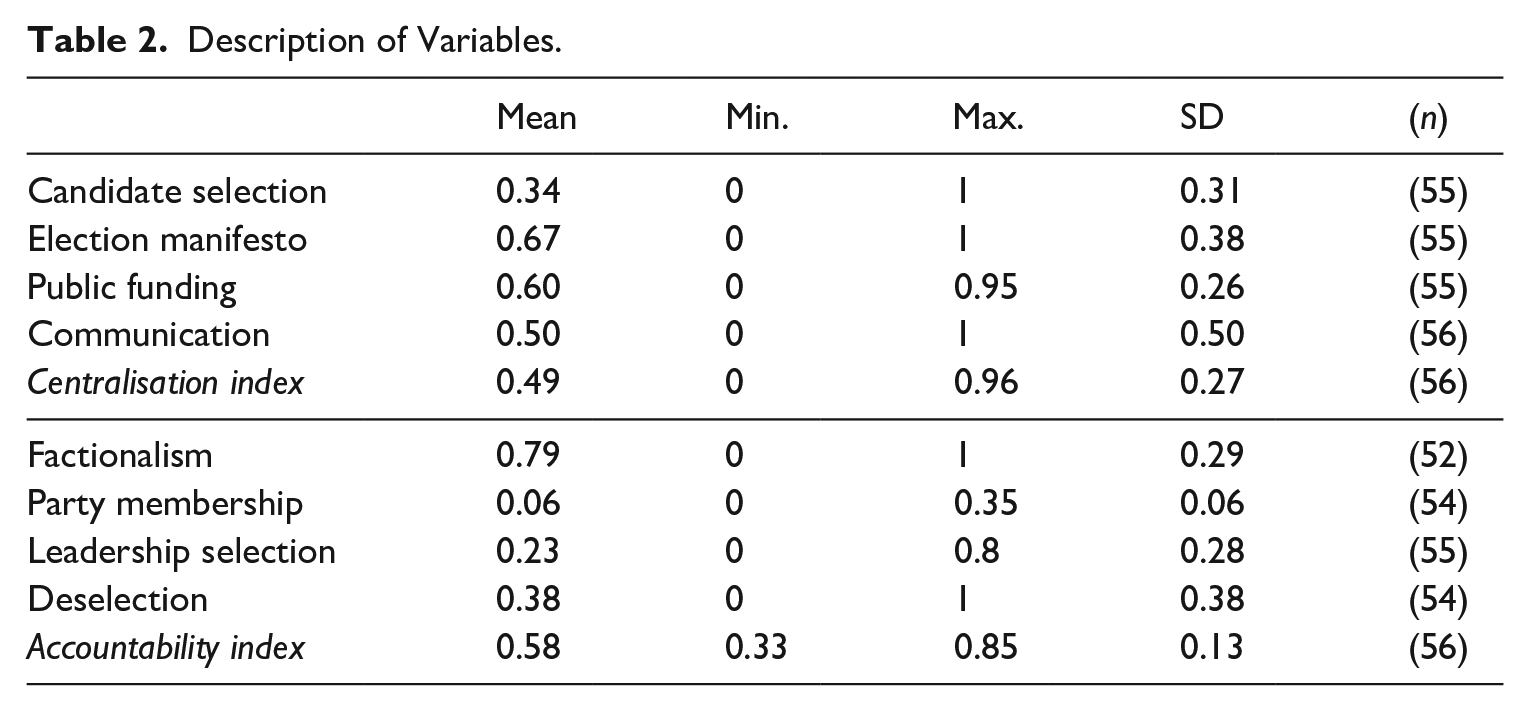
Turning to accountability, it is also clear that the four items perform in a different way and display a high variation. Low levels of accountability are related to a situation characterised by weak factionalism, which presents the highest mean. This suggests that horizontal accountability is quite weak, thus enhancing leadership autonomy. The parties surveyed in this study show that Conservatives and Labour in the United Kingdom display the highest levels of factionalism (when in opposition), followed by two left-libertarian parties (the Spanish United Left [IU] and Ecolo). A substantial number of parties (14) in our dataset register no challengers in leadership contests over the last decade. 13 We can find very distinct parties in this category – from the liberal parties in Norway and Denmark to the Portuguese Communist Party (PCP) – but more often than not this is a feature of centre-right mainstream parties. As for leadership selection, most parties still adopt exclusive procedures, which are associated with a higher level of accountability. While a significant number of parties (N = 16) allow party members to select the party leader, only two parties display the lowest level of accountability (self-appointed leader or open ballot). Finally, it is worth noting that deselection of party leadership shows the greatest variation (highest standard deviation) and that most parties in our sample (approximately 40%) only include term limits for party leadership, while 25% of the parties present no rules.
Figure 1 illustrates the relationship between the two dimensions of leadership autonomy. By combining the two indices of centralisation and accountability we gain a clearer picture on how leadership autonomy can vary across distinct parties. Overall, the results point towards a very limited association between the two components (r = 0.10). We can clearly distinguish four main groups of parties. The first group displays a high degree of centralisation and low levels of accountability, whereas the second combines a low degree of centralisation with high accountability. Finally, the third and fourth sets of parties encompass parties with a moderate leadership autonomy, but with a distinct combination between centralisation and accountability. The main lesson to be drawn from this picture is that the claim regarding a general trend towards increasing leadership autonomy is far too simplistic, and a deeper look into intra-party dynamics is needed.
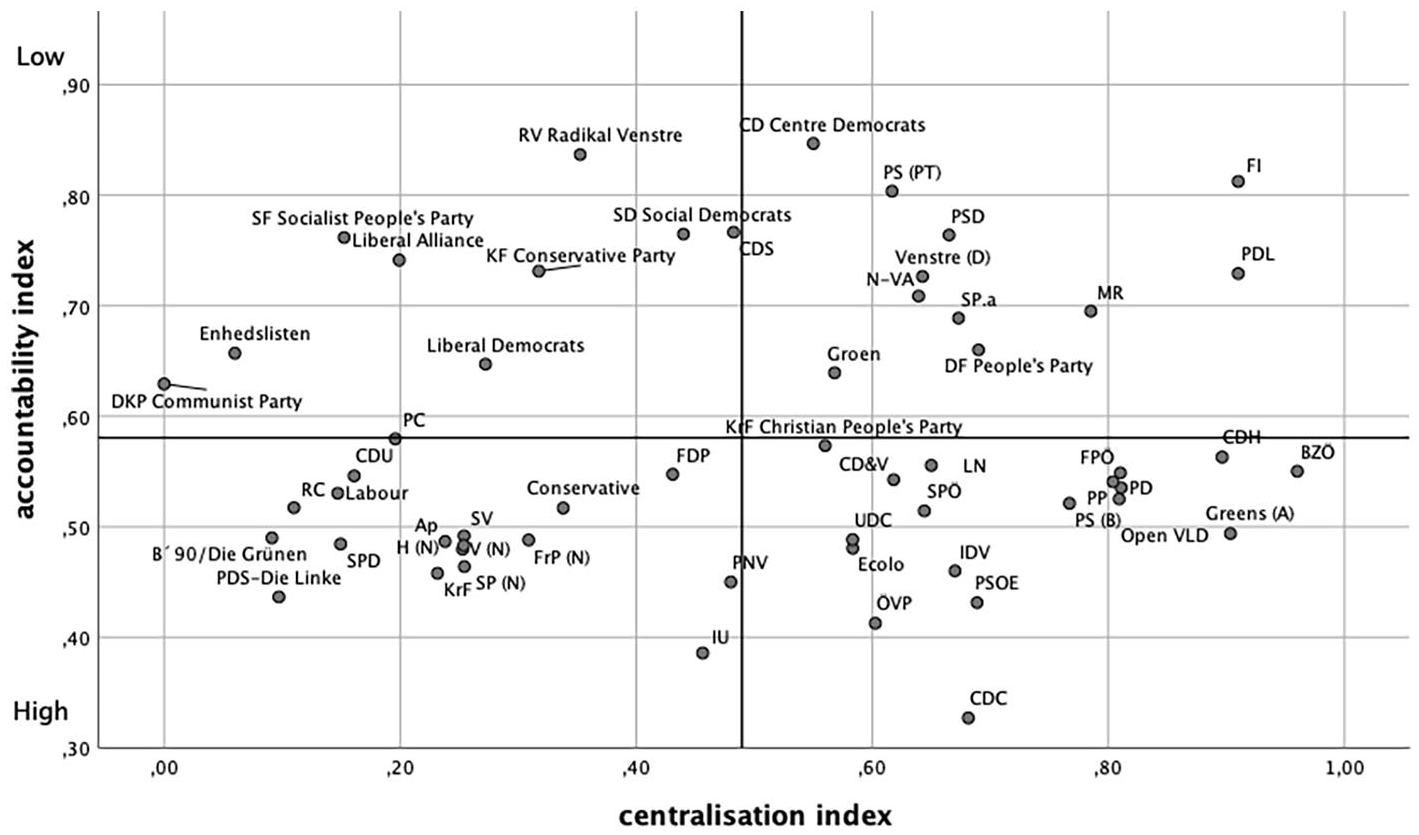
Party Leadership Autonomy in Western European Countries.
The two most populated categories are parties with a low degree of centralisation combined with high levels of accountability (in lower left area), and those with a high degree of centralisation and, at the same time, high levels of accountability (18 cases, 32% of the sample, for each category). The first quadrant mostly includes radical left or social-democratic parties, although with some exceptions. In the lower right area we can find a very heterogeneous group of parties, although with the predominance of moderate centre-right or centre-left parties. Although these cases present high levels of accountability, leaders may enjoy more leeway with a good electoral performance or when the party achieves institutional positions. The upper right area includes mainly right-wing parties, whose leaders rely on relatively strong powers and do not face serious internal constraints in terms of accountability. It is also worth considering that the threshold in terms of accountability is not very clear. Indeed, a number of parties are borderline, displaying average scores of the accountability index, which can be subject to important variations due to fluctuations in the degree of factionalism and membership rates.
To provide a more interesting interpretation of the findings, we look at several potential factors that may account for variation in leadership autonomy. In particular, we consider here differences in terms of country, ideology, party family and size. 14 As shown in Table 3, a country effect emerges on both (dependent) variables, confirming one of Krouwel’s (2012: 264) main findings. Overall, Austrian and Belgian parties display higher levels of (decision-making or resource) centralisation, while Germany presents the lowest score. This case can be considered an outlier to a great extent due to the Party Law, which requires that candidate selection must be done through party conferences. Parties in Norway also score relatively low in the overall level of centralisation. As several authors have noted, Norwegian parties have gradually converged towards Labour’s mass party model, thus limiting the role of party leadership (Allern and Karlsen, 2014; Svasand, 1994). Overall, these findings suggest a strong within-country contagion effect of leaders’ powers, which may be due to the competitive pressure of the electoral arena. This means that parties compete in a closed national market, which gives them strong incentives to align in terms of leadership role and behaviour. The exception to this trend is Italy, which shows the highest level of within-country variation. This may be due to the importance of the extra-parliamentary party and the divergences of party models, given the emergence of new parties and the presence of both personalised parties and organisations close to the mass party model.
Party Leadership Autonomy across Countries and Distinct Types of Parties.
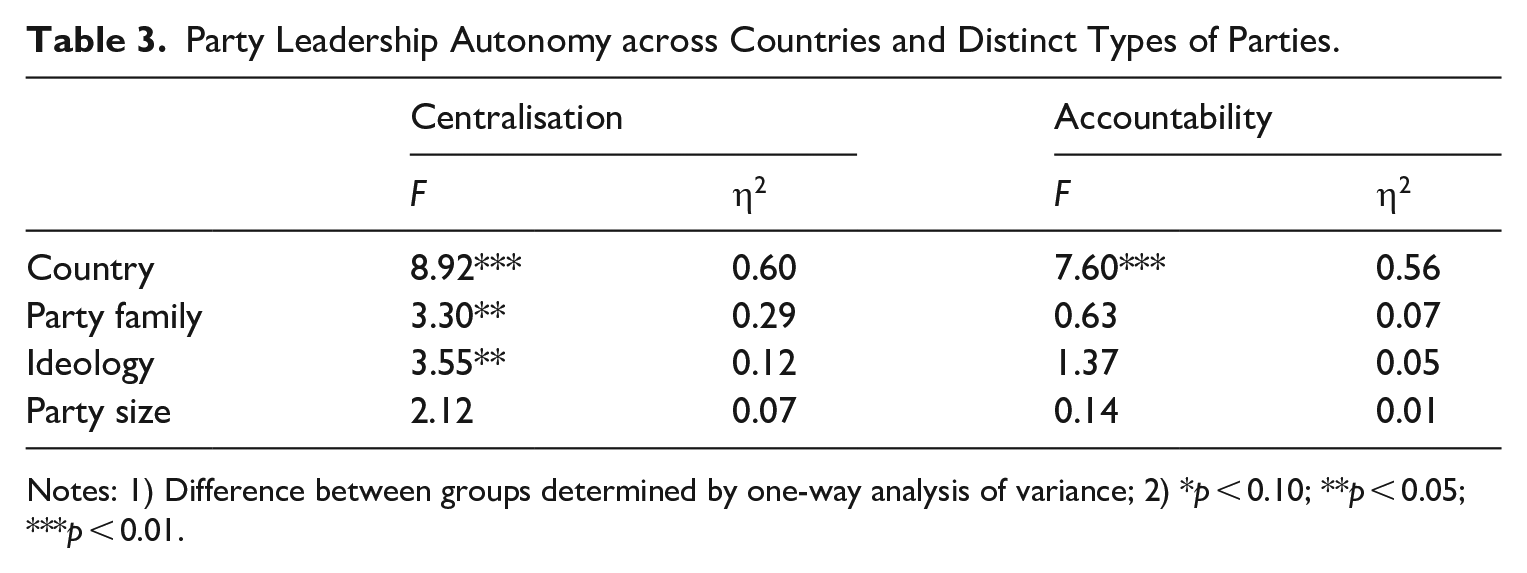
Notes: 1) Difference between groups determined by one-way analysis of variance; 2) *p < 0.10; **p < 0.05; ***p < 0.01.
A second factor that seems to be associated with differences in terms of centralisation is party family. From this viewpoint, we consider seven categories, namely, radical left parties, communist parties, social democratic parties, liberal parties, religious or Conservative parties, radical right and, finally, regionalist parties. 15 The variance explained for the centralisation index is lower than for country differences (η2 = 0.60 and 0.29, respectively) and achieves statistical significance. The radical left party family shows the lowest score, while radical right parties are the most centralised (0.17 and 0.69, respectively). It is also worth noting that moderate parties (Conservative, Liberals and Social Democrats) display roughly the same degree of centralisation (close to the mean). There is also variation in terms of accountability, ranging from the high levels of accountability registered by regionalist/ethnic parties (0.51) and the Greens (0.53) to the lowest score displayed by the liberal party family (0.63). However, these differences do not meet standards records of statistical significance.
The third factor that might explain the variation of party leadership autonomy is ideology. We correlate each dimension of leadership autonomy with the position of the surveyed parties according to their left–right orientation. 16 The results show that right-wing parties display higher levels of centralisation and a lower degree of accountability. With respect to centralisation, left-wing parties are less centralised, whereas centre parties are an intermediate case. As for accountability, the main difference is between centre and right parties, on one hand, and left-wing parties, on the other. Different operationalisations seem to confirm these findings, even though the association is weaker than for country or party family. 17 Finally, party size seems to be irrelevant in terms of leadership autonomy. 18 This means that mainstream catch-all parties do not significantly differ from smaller parties either in terms of centralisation or in regard to accountability.
One problem that needs to be addressed is the factors that determine party leadership autonomy. Although this is not one of the main objectives of the article, this is a topic of great potential for future research. One important source of party autonomy is the legacy of the original model, that is, the way the party was created. When there is a founder-leader, it is more likely that the party organisation will be more personalised, leading to personalised parties or personal rule (Bolleyer and Bytzek, 2016). By contrast, parties that emerge through a more conflictual or ‘consociational’ process are more prone to give rise to leaders with a more ‘administrative’ profile, whose major role is to mediate among distinct dominant factions and to manage party resources efficiently to achieve the main goals. Regardless of the genetic model, path-dependence restrains leader’s leeway, as shown by the Conservative Party in the United Kingdom, for which the elaboration of the election manifesto has displayed a substantial amount of inertia (Bale, 2010). From this viewpoint, external shocks – such as international events or scandals – are often the main mechanism leading to a shift in the relationship between leader and party organisations, thus decreasing or increasing leadership autonomy.
Conclusion
The notion of leadership ‘centredness’ in party organisation is well established in the literature. Yet extant research has failed to clarify both the concept of leadership autonomy and its measurement, especially in the framework of party (organisational) change. We believe the conceptualisation offered here provides a more systematic, and at the same time parsimonious, approach towards assessing leadership autonomy as it underlines fundamental differences in kind and degree concerning party leadership autonomy. Thus far, theories and approaches in this sub-field have tended to focus on centralisation (often as a proxy for autonomy); however, we believe accountability is equally important to understanding the role of leaders in contemporary political parties. In addition, it is useful to distinguish between the concentration of (decision-making) power and resources. Therefore, this framework enhances conceptual clarity and facilitates comparative (empirical) work and the further accumulation of knowledge on these fundamental concepts. We have also shown that this conceptualisation can be easily operationalised and applied to the world of contemporary party organisations using available data. The set of real-life cases can yield interesting typologies that allow us to better distinguish how leadership autonomy varies in distinct contexts (and over time), as well as a possible adaptation of the indicators to be used to assess this concept given the growing process of hybridisation that political parties are experiencing and the increasing heterogeneity of party models (see Chadwick, 2007; Krouwel, 2006).
In this article, we test this new conceptualisation on a wide variation of parties from nine Western democracies. One of the central findings is that the autonomy of party leaders varies, even in increasingly leadership-dominated parties and in a context of growing presidentialisation of politics. Therefore, leadership autonomy is not just a matter of ‘degree’ or (more or less) ‘strength’, but it implies important ‘qualitative’ differences. Moreover, leaders interact with party organisations and face important veto powers and potential constraints. Empirical evidence also shows that leaders enjoy great powers in the elaboration of the election manifesto, while they display more limited authority in terms of candidate and leadership selection. Even more importantly, most parties present very low levels of accountability, thus increasing leadership’s leeway and its capacity to control intra-party functioning. By distinguishing between two key dimensions of leadership autonomy – centralisation and accountability – we have been able to shed more light on distinct types of ‘personalised’ leadership and the internal dynamics of party organisations.
Leadership autonomy is a malleable concept that interacts with party organisational legacies, leaders’ qualities and institutional and social contexts. Rather than taking the ‘presidentialisation’ thesis for granted, the two-dimensional analytical framework developed in this article reveals that party leaders construct their particular role according to organisational constraints and incentives, to respond to intra-party dynamics and to comply with the institutional and political setting. We believe that a better understanding of the concept of leadership autonomy helps explain important features of intra-party politics – such as party cohesion, competitiveness or patterns of participation – as well as the relevance of leaders for public opinion and voting choice. The analytical framework and measurement proposed in the present study can be fruitfully applied to test one of the key arguments put forth by the cartel party thesis, namely, the fact that leadership autonomy has increased in recent decades. Indeed, in-depth case studies have found that leaders have not gained more power vis-à-vis party organisations, as far as key issues are concerned (e.g. Lisi, 2015; Loxbo, 2013).
The framework suggested in this article and the measurement of leadership autonomy may also be used to examine important topics beyond party organisations. It helps scholar to examine the impact of leadership power on institutional dynamics, for example, government-opposition relations or parliamentary activities. Furthermore, this contribution can also link party politics to public policy, examining the role leadership plays in decision-making processes and policy change.
Two final aspects need to be considered. First, to explain the variation of party leadership autonomy, it is also important to examine the external environment, in particular the institutional and electoral arenas. For example, a weak personal leadership can be durable and survive through electoral success and the occupation of public office (see Gauja, 2013). Indeed, empirical research shows that party leaders are more likely to be removed when they lose elections or office (Ennser-Jedenastik and Schumacher, 2016). Another important external dimension involves leadership control in selecting ministers when parties acquire governmental status. Of course, not all parties are office-seeking and therefore this aspect is not a key dimension for assessing the internal distribution of power from a comparative perspective. Yet leaders’ capacity to control the selection of government offices might be a relevant component of their power vis-à-vis the party organisation. Too many variables may intervene when explaining party leadership autonomy and this should be explored more systematically in future studies. These issues call for in-depth (qualitative) analyses of specific case studies, which may elucidate differences ‘in kind’ between distinct parties.
Second, personal qualities may play an important role when assessing party leadership autonomy (Blondel and Thiébault, 2010); this can be illustrated by an example drawn from populist parties. According to McDonnell (2016), this party family presents distinct types of ‘charismatic’ leadership. Bossi, the founder-leader of the Northern League (LN), fulfilled the characteristics of ‘coterie charisma’, but Berlusconi’s leadership lacked his emotional and irrational appeal. Although most populist parties are characterised by weak (or non-existent) accountability and leaders are largely unconstrained, the personal rule that characterised Forza Italia prevented leadership turnover, contrary to what happened in the LN. In this case, communicative skills, ideology and charisma may strengthen the leader’s position, even when party leadership does not entirely control key resources for the functioning of party organisation and leaders do not ‘own’ the party. From this point of view, the use of mass communication channels and a populist appeal may also increase the leaders’ chances of controlling party organisations, regardless of their internal power. It is also worth noting that the spread of digital media affects the way leaders mobilise key resources, and this is expected to lead to the increasing concentration of power in party leaders (e.g. Gerbaudo, 2018).
This paper has clearly shown that there is still a lot to be done as far as the study of party leadership is concerned, at both the theoretical and empirical levels. While the empirical section mostly aimed to illustrate the validity of the main argument, this study points to the need to undertake a broader comparative analysis by collecting more data and including as many parties and countries as possible, at least with regard to the European context. This will be the first – and necessary – step for developing an inferential approach on the causes and consequences of party leadership autonomy.
Supplemental Material
sj-docx-1-psx-10.1177_00323217221117381 – Supplemental material for Conceptualising and Measuring Leadership Autonomy in Contemporary Party Organisations
Supplemental material, sj-docx-1-psx-10.1177_00323217221117381 for Conceptualising and Measuring Leadership Autonomy in Contemporary Party Organisations by Marco Lisi in Political Studies
Footnotes
Acknowledgements
The author would like to thank the reviewers for their time and extremely helpful comments in improving this article. Previous drafts were presented at several conferences and workshops. For their helpful comments, the author would like to thank participants and discussants. All remaining errors are his own.
Declaration of Conflicting Interests
The author(s) declared no potential conflicts of interest with respect to the research, authorship and/or publication of this article.
Funding
The author(s) disclosed receipt of the following financial support for the research, authorship and/or publication of this article: This study was supported by the Fundação para a Ciência e Tecnologia (FCT), grant numbers PTDC/IVC-CPO/1864/2014 and PTDC/CPO-CPO/30296/2017.

Supplemental Material
Additional Supplementary Information may be found with the online version of this article.
Content Table A1: Coding of variables for party leadership centralisation. Table A2: Coding of variables for party leadership accountability and sources. Table A3: Party leadership autonomy by country. Table A4: Party leadership autonomy by party family. Table A5: Party leadership autonomy by ideology (dummy variable). Table A6: Party leadership autonomy by ideology (3 categories). Table A7: Party leadership autonomy by ideology (3 categories). Table A8: Party leadership autonomy by party size. Table A9: Descriptive statistics for external funding. Table A10: New results for centralisation (based also on private donations).
Notes
Author Biography
References
Supplementary Material
Please find the following supplemental material available below.
For Open Access articles published under a Creative Commons License, all supplemental material carries the same license as the article it is associated with.
For non-Open Access articles published, all supplemental material carries a non-exclusive license, and permission requests for re-use of supplemental material or any part of supplemental material shall be sent directly to the copyright owner as specified in the copyright notice associated with the article.
