



Abstract
What differentiates personal safety habits of police officers who live with family and officers who live alone? The current explorative, qualitative study explores the personal safety habits and security measures of police officers in relation to their household composition. 30 police officers answered an online study and described their personal safety habits and security measures, which are then analyzed using reflexive thematic analysis. Five personal safety habits and two security measures are identified that aim to improve officer and household safety, and the failure to differentiate the personal safety habits and security measures between the officer groups are analyzed.
Introduction
Police officers face a significant amount of stress and strain in their daily lives [(Aaron, 2000; Ellis, 2017; Griffin and Sun, 2018; Queirós et al., 2020)]. Perception of stress can be different for everyone; however, some common physical, psychological, and behavioral strain in officers can result from excessive workload, work-family conflict, lack of scheduling control, lack of departmental/organizational support, and hazardous working conditions [(Adams and Buck, 2010; Brandl and Stroshine, 2012)]. Previous studies in the field of occupational stress have found that officers use deconstructive and short-term coping skills, including drugs and alcohol, social isolation, dissociation and avoidant coping styles, lashing out to family members, and always being suspicious or hypervigilant—all of which can have negative consequences to their physical and mental health as well as their social and familial relationships [(Adams and Buck, 2010; Alexander and Walker, 1996; Ballenger et al., 2011; Ellis, 2017; Henry, 1995; Miller, 2007; Sadulski, 2017)]. However, research also has found that social support—particularly family support such as talking, emotional expression, identifying strengths within the family, collaborative problem solving, effective communication, and even family-friendly programs offered by police departments—can alleviate the chronic stress of policing and even act as a buffer or a protective factor for future stress [(Granholm Valmari et al., 2022; Lieberman, 2007; Memarian et al., 2017; Miller, 2007; Sadulski, 2017; Tuttle et al., 2019; Youngcourt and Huffman, 2005)]. Given that police officers frequently engage in deconstructive coping mechanisms but evidence in research suggests that social support can reduce some of the daily stress faced by police officers, why do police officers not utilize positive coping mechanisms derived from their social support system?
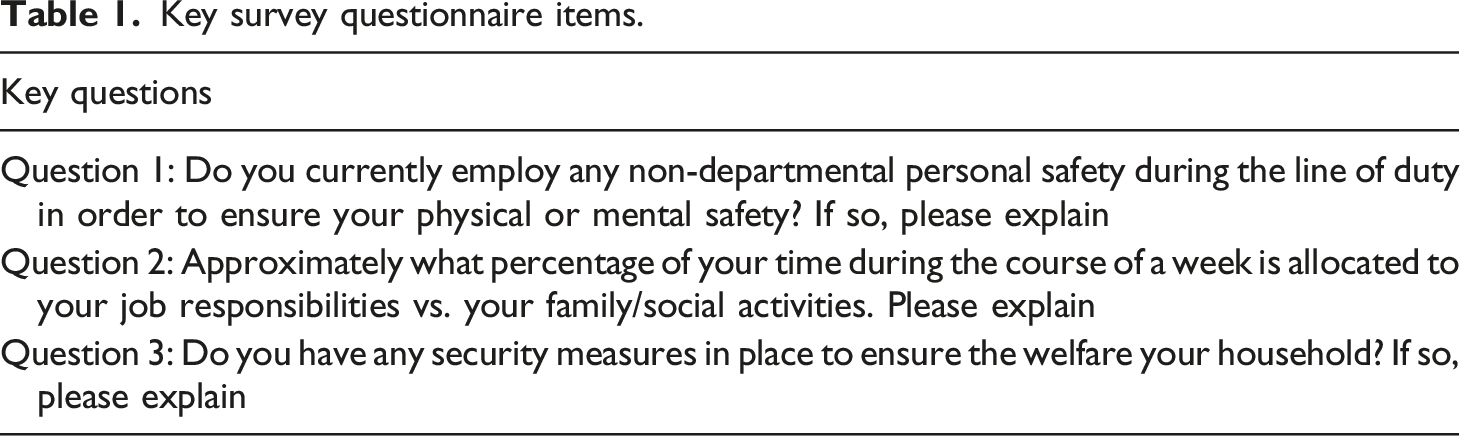
The present exploratory research survey study will attempt to answer this question by looking at officers’ household composition, operationalized through individuals (roommates, children, spouses, etc.,) that are currently living with the officer in the same household, and their potential influence on the officers’ personal safety habits, operationalized through subjective behaviors that aim to improve officer safety while in the line of duty, and security measures, operationalized through subjective behaviors that aim to improve household welfare. This paper will continue with a theoretical justification to conduct the study, summary of relevant literature on officer coping mechanisms, followed by a detailed description of methods and data collection, specific analytic plan to investigate the responses, results, discussion, and finally, concluding with limitations of the study and future directions.
Theoretical framework
The relationship between household composition of police officers and their use of personal safety habits and security measures is best examined through the lens of strain theory of sociology, which proposes that the presence of negative stimuli, such as chronic stress, varying work shifts, and threat of danger can lead to negative coping strategies, such as drugs and alcohol, social isolation, and hypervigilance [(Agnew and Brezina, 2018; Ellis, 2017; Henry, 1995; Miller 2007; Sadulski, 2017)]. Unsurprisingly, negative coping strategies lead to negative health outcomes; therefore, the theoretical justification of the current study is to explore positive coping mechanisms, operationalized through the presence of household members (e.g., parents, spouses, and children) and their potential influence on positive health outcomes, operationalized through subjective descriptions of personal safety habits and security measures. Research suggests that the presence of spouses or children can have a positive correlation on officer survival rate [(Gibbs et al., 2014; Kachurik et al., 2013)]. Therefore, the purpose of the current study is to explore the potential influence of household members on the officers’ personal safety habits and security measures. Furthermore, exploring the intricate details of how household members affect police officers and policing itself as a profession can give great insight to the officers’ thinking process and can have broad implications to officer safety procedures. As far as the researchers of the current study are aware, this is the first explorative analysis to examine police personal safety procedures in terms of household composition.
Literature review
Previous research indicates police subculture introduces deconstructive coping mechanisms very early in a young officer’s career [(Henry, 1995)]. Dissociation—the mind splitting off itself from thoughts, feelings, or memories of a painful or distressing event—is often used as a coping mechanism in response to chronic stress (i.e., dealing with a dead body) and is related to denial and isolation [(Aaron, 2000; Henry, 1995)]. No matter how effective dissociation might be in the short-term to relieve the shock of the painful event, it is associated with poorer psychological adjustment and cannot completely succeed in neutralizing the internal or external source of stress [(Aaron, 2000; Henry, 1995)]. Similar to dissociation, another deconstructive coping mechanism widely used by police officers to dampen emotions or to reduce stress is substance use, such as drugs and alcohol [(Alexander and Walker, 1996; Ballenger et al., 2011; Burke, 1993; Clifton et al., 2018)]. Alcohol is a popular “stress-reducer” among both men and women police officers, and officers who report greater alcohol use also tend to report psychosomatic symptoms [(Alexander and Walker, 1996; Ballenger et al., 2011; Burke, 1993)]. Furthermore, continuous alcohol use can lead to alcohol dependence, which will surely affect the officer’s job, family, and health [(Clifton et al., 2018)]. Another form of deconstructive coping mechanism, isolation and keeping emotions to oneself, also can have broad and negative associations across the officer’s biopsychosocial life [(Alexander and Walker, 1996; Burke, 1993; Miller, 2007; Tuttle et al., 2019)]. Some officers might choose not to share the aspects of their job with their family and spouse in order to protect them and make the home a safe haven from the pressures of their job [(Miller, 2007)]. However, to the officer’s family, this decision might be perceived as the officer closing themselves off due to their inability to separate the work life from the home life, which can cause strain within the family [(Miller, 2007; Tuttle et al., 2019)]. Moreover, officers who reported greater self-isolation also reported psychosomatic symptoms and negative feeling states [(Burke, 1993)]. To summarize, due to the chronic stress and pressure from their occupation, the average police officer’s first line of defense is to use short-term and deconstructive coping mechanisms which can lead to long-term physical, mental, or social consequences and create more problems for the officer in the future.
Given the vast array of deconstructive coping mechanisms that police officers employ, it is no surprise that some recent studies chose to focus on constructive coping mechanisms, particularly family and social support that police officers can utilize in order to reduce or protect themselves from the chronic stress of their job. For example, it is crucial for police officers to maintain a balance through clearly defining their job responsibilities and home life, and not let one aspect of their life sip into the other [(Tuttle et al., 2019)]. This can be accomplished through participating in relaxing and non-work-related recreational activities with friends and family outside of the police department [(Sadulski, 2017; Tuttle et al., 2019)]. Furthermore, in order to combat the feelings of shame and guilt, officers must learn to clearly communicate their emotions to others, which has been demonstrated through scientific studies and officer self-reports to reduce fear and anxiety [(Burke, 1993; Lieberman, 2007; Memarian et al., 2017; Tuttle et al., 2019)]. Communicating emotions to family members, especially, can benefit officers. Indeed, there is a strong argument for spousal support be a very strong source of strength to the police officer to combat the stresses of the job, and scheduling time outside of work to talk to one another, spend quality time together through “caring days,” identifying the strengths within the family such as movie nights, weekly barbecues or monthly trips to the grocery store can all work to buffer the officer from occupational stress, and reduce self-isolation associated with negative health outcomes [(Granholm Valmari et al., 2022; Janik and Kravitz, 1994; Miller, 2007; Sadulski, 2017; Youngcourt and Huffman, 2005)]. Miller (2007) argues the social network between the family and the officer can be helpful even when the officer is away from family at work [(Miller, 2007)]. Leaving notes on the refrigerator, sending “I miss you” texts, and surprising each other when the officer comes home with little gifts can all be beneficial to strengthen the bond between the officer and the family [(Miller, 2007)]. Indeed, ample evidence supports strengthening the social networks of police officers and their families outside of work in order to reduce their occupational stress or even protect against it. A gap remains in the application of this research.
One might speculate that due to the societal emphasis on police infidelity and brotherhood of officers behind the blue wall of silence, officers do not act to strengthen their bond to their family because they do not significantly care about their family outside of work. However, there is some research to suggest the opposite [(Black, 2004; Gibbs et al., 2014; Helfers et al., 2021; Kachurik et al., 2013)]. Semi-structured interviews of children of police officers have found that police officer parents are not encouraging of their children to go into law enforcement, which the authors infer based on available data is because of the chronic stress of the occupation and because of its negative connotation in the community [(Helfers et al., 2021)]. Furthermore, two studies using logistic regression looked at officer deaths in the line of duty and the social investment of the officer, such as having a spouse and children [(Gibbs et al., 2014; Kachurik et al., 2013)]. The first study found that officers with children are less likely to be killed compared to single officers [(Kachurik et al., 2013)]. The second study found that spouses and not children to be a significantly associated with officer survival [(Gibbs et al., 2014)].
Since the research in the literature primarily focuses on the study of negative coping mechanisms in officers’ health while not providing the same type of attention to positive coping mechanisms, the current study exclusively focuses on positive coping mechanisms that are operationalized through family/household constructed personal safety habits and security measures. Family was selected as a source which positive coping mechanisms such as personal safety habits and security measures emerge from because previous research highlighted that officers with spouses or children are less likely to die in the line of duty compared to officers who do not have spouses or children [(Gibbs et al., 2014; Kachurik et al., 2013)]. Furthermore, numerous other studies have portrayed the importance of family as an island of strength to combat the negative effects of job stress [(Granholm Valmari et al., 2022; Janik and Kravitz, 1994; Miller, 2007; Sadulski, 2017; Youngcourt and Huffman, 2005)]. The concepts of personal safety habits and security measures were created in order to highlight the difference between officers with and without a family because if the assumption that departmentally mandated security guidelines are followed by every single officer independent of their families is true, then an alternative explanation for the variance in officer death rate is personal safety habits, or behaviors that officers perform on their own without departmental guidelines to ensure their security because of their family/household members.
Research question
The primary question of this research study asks, what role does the household composition of the police officer play in their use of positive coping mechanisms operationalized through personal safety habits and security measures of the officer?
Data collection
Key survey questionnaire items.
Characteristics of respondents (N = 30).
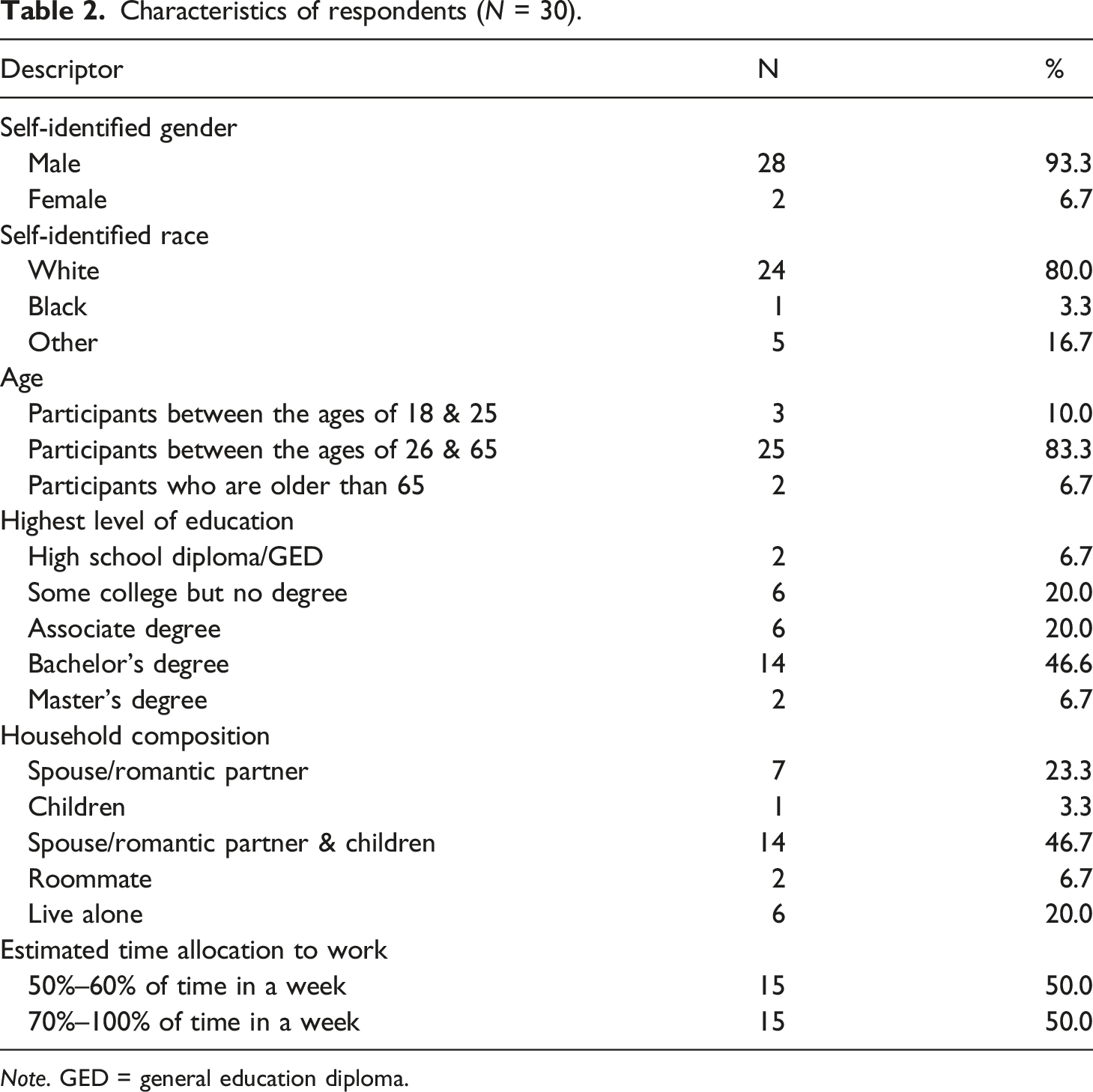
Note. GED = general education diploma.
Multiple benefits exist in collecting qualitative data through an online survey method [(Braun et al., 2020)]. Online qualitative surveys can capture a diverse perspectives, experiences, and sense making in a short period of time and with a larger audience when compared to time-intensive interviewing [(Braun et al., 2020)]. Furthermore, since the participants are alone when completing the online survey, they are more encouraged to disclose personal aspects of their life [(Braun et al., 2020)].
Although semi-structured interviews were not performed due to the exploratory nature of this study, they can be a great source of narrative data which can produce in-depth knowledge about the subject of interest [(Adeoye-Olatunde and Olenik, 2021)]. Unlike the online survey method, the researcher is able to ask follow-up questions to the participants’ answers, which can be useful to enrich the obtained data. However, interview results can diminish from participant bias, decreased number of participants due to time restraints, and decreased disclosure due to the loss of anonymity.
Participants
30 police department heads, police union officers, and university police officers of a northeastern state in the United States were contacted via email and asked to complete and distribute the survey study among their officers. Unfortunately, since the number of active police officers that received the survey from the contacted department heads is unknown, true response rate of the survey cannot be determined. The 30 department heads, who served as initial contacts, were asked to complete the study, and also distribute it among their active police force. The department heads were randomly selected from the list of law enforcement agencies in the selected state of the United States, which employs about 1000 agencies with about 15,000 sworn and active law enforcement officers in total [(BJS, 2022)]. Given that an average law enforcement agency employs about 15 officers in this particular northeastern U.S. state, the potential number of officers that the survey could have reached equal about 450 officers. It is important to note that these numbers are purely estimates, and large discrepancies exist between hiring practices of officers between agencies. Potential barriers to support these discrepancies include funding sources, local politics, crime, and population density. Since the initial contact of 30 department heads were selected at random to reduce researcher bias, the exact number of officers at each contacted agency cannot be disclosed. Ultimately, 25 police respondents finished the majority of the survey to be eligible for inductive coding analysis. Two follow-up emails were sent to the selected department heads over the course of 2 months to increase the response rate of the survey, which again encouraged them to complete the survey and to distribute it among their active police force. Unfortunately, these follow-up emails did not prompt an increase in participation. In order to increase sample size, the survey was also posted on a prominent data gathering platform used by registered participants in the United States, Prolific. co, and the researcher of the study offered US$5 for each officer who had an account on Prolific. co to complete the survey study. In order to reach the targeted audience, the researchers’ utilized the pre-screening filters that are available on the platform, and 5 police officers completed the survey through this platform. Prolific. co also includes a secure and anonymous transaction system that does not reveal any personal or payment information to the researchers; the researchers only submit specified amount of money to the research account which then becomes available to the respondents after the completion of the study. Unfortunately, due to the anonymity of the respondents, the original sample of 25 officers could not be contacted and compensated for the completion of the study. The sample contained 28 officers who identify as male, 24 officers who identify as white, 25 officers between the ages of 26 and 65, 14 officers with bachelor’s degree, 6 officers with some college but no degree and 6 officers with an associate degree. 14 officers also reported living with a spouse/romantic partner and children, 7 reported living with a spouse/romantic partner, and 6 reported living alone. Finally, 15 officers reported that they commit 50%–60% of their time in a given week to their career, while the other 15 officers reported committing between 70%–100% of their time to their careers. Although parents and siblings were considered in the survey as potential individuals who reside with the officer, they were omitted from analyses because no officer reported living with these individuals in the same household. The full characteristics of respondents can be seen in Table 2.
Analysis
The fundamental reason to utilize inductive reflexive thematic analysis, assisted by the guidelines of Braun and Clarke (2022), is to recognize emerging patterns and themes of personal safety habits and security measures that are distinctive between police officers with a household composition versus police officers who do not have a household composition. Inductive analysis was a fundamental lens to examine the results of the survey since this is one of the first studies to look at officer personal safety habits and security measures in terms of household composition; therefore, as far as the researchers are aware, there is no established theories or models of research in the literature that can guide the analytic process.
The primary investigator of the study followed a familiarization-grouping-analyzing process while coding the data of the survey. Familiarization with the data included reading and understanding the officer responses as they relate back to the research questions. Complementary sentences and ideas were grouped together and reorganized to better fit with the initial emerging codes of the data. Once groups of data started to synthesize into meaning, the first code was generated. The same process was repeated continuously until 6 distinctive codes emerged to best represent the data of the sample. The same analytical process model was also repeated to the second part of the analysis, where the now established codes were grouped and reorganized to generate themes. Each candidate theme was reflected back to the codes as check-ins to make sure balanced representation. Initially, it seemed like each code was distinctive enough to become its own theme; however, continuous groupings of similar candidate themes allowed for more comprehensive review of the data.
Results
Two independent themes emerged after completing reflexive thematic analysis for the entire sample on officer personal safety habits while on duty.
Theme One: Situation-based personal safety habits which include codes for Always be ready, Situational awareness, and High vigilance. The central idea of this theme revolves around personal safety habits that are based on the environment of the officer. For example, the descriptive code Always be ready considers using another police officer as a backup when responding to calls: “Always make sure I have backup with me going to every call or wait for backup” (Respondent 5). This response clearly highlight’s the officer’s concern for their safety and the necessary value of another officer responding to the same call. Furthermore, the descriptive code Situational awareness advocates for officer preparation through examination of one’s environment: “Always know my surroundings and keep my back to the wall when in unknown places” (Respondent 16). The importance of situational awareness can be independent of the presence of a threatening situation: “Plan out areas of cover prior to any threat presenting itself, even if it doesn’t” (Respondent 21). An inference can be made from this response that Situational awareness is built into the policing profession; therefore, officers expect threat at every situation. Lastly, the descriptive code High vigilance supports the notion of always being ready for unexpected threats, or even anticipating future threats at every turn: “different routes to and from frequent locations, locate secondary entry points/exits upon entering buildings, radio and phone with me, and watch hands of suspects while speaking” (Respondent 18).
Theme Two: Individual-based personal safety habits include the codes for Maintain physical fitness, and Protective gear. Unlike the codes related to Theme One: Situation-based personal safety habits, the central idea of this theme revolves around personal safety habits that are not based on the environment but are based on the officer’s body. For example, the descriptive code Maintaining physical fitness by training in martial arts or working out at the gym is another common personal safety habit of police officers that is directly related to their physical body. Lastly, the descriptive code Protective gear highlights bulletproof vests and other protective armor, such as trauma plates, that increase the safety of the officer’s body in the field.
Furthermore, one additional theme emerged after completing reflexive thematic analysis for the entire sample on security measures that aim to improve household welfare.
Theme One: Threat-based security measures to ensure the welfare of the household include the descriptive codes for House protection and Firearms. The descriptive code Household protection includes cameras, house security systems, and educating family members on personal safety in case of an occurrence of a threat. One officer’s response perfectly sums up this descriptive code: I have surveillance cameras at home and have instructed my wife to walk away from me if I encounter someone off duty that have the potential to harm me or my family (Respondent 13).
Leading on, the descriptive code Firearms highlights carrying a gun while the officer is off duty or keeping weapons around the house for protection. Since both descriptive codes Household protection and Firearms revolve around the idea of potential threat occurring to the officer’s household or deterring potential threat from occurring, as in the case of cameras and house security systems, both codes are placed under the central theme of threat-based security measures to ensure the welfare of the household.
Discussion
Reviewing and comparing the responses of officers with varying household compositions failed to detect any significant influence of household composition on personal safety habits of police officers while in the line of duty or security measures in order to ensure the welfare of the household. Although the officers of this study did not discuss any personal safety habits or security measures that are unknown in the current policing literature, the significance of their results lie with the lack of connection between household members and the use of personal safety habits. In this study, the participants were prompted to think and discuss the role of their household composition, which is considered to be a source of strength, on their physical and mental safety [(Granholm Valmari et al., 2022; Janik and Kravitz, 1994; Miller, 2007; Sadulski, 2017; Youngcourt and Huffman, 2005)]. Officers who live alone and officers who live with multiple other people reported very similar personal safety habits and security measures. For example, an officer with no household composition described their personal safety habit as: “Try to drive if I ride with a partner to ensure on my end, I know what I’m driving into and good car positioning” (Respondent 11). At the same time, an officer who resides with their spouse/romantic partner and children described their personal safety habit as: “Always wear my ballistic vest, practice good contact cover when approaching calls” (Respondent 2). Both of these responses highlight the importance of Situational awareness when approaching calls. Moreover, an officer with no household composition described their personal safety habit as: “Protective vests. Extra equipment such as a knife and other firearms. Practicing different tactics for different scenarios” (Respondent 10). Additionally, an officer who lives with a spouse/romantic partner and children under the age of eighteen described their personal safety habit as: Vest worn or with me, different routes to and from frequent locations, situational awareness, locate secondary entry points/exits upon entering buildings, back to wall while speaking w/people, if possible, stop in traffic w/ a means to move to another lane, road, etc., radio or phone w/me, watch hands of suspects while speaking. (Respondent 18).
Both of these responses highlight the importance of High vigilance and Protective gear in the profession of the police officer. Similarities between officers with varying household composition is not only apparent in the field of personal safety habits. An officer with no household composition described their security measures to ensure the welfare of their household as: “Cameras” (Respondent 10). Correspondingly, an officer who lives with a spouse/romantic partner and children described their security measures as: “Yes, alarm system, cameras” (Respondent 3). Both officers highlight Household protection as their security measures in order ensure the welfare of their household.
Previous studies in the policing literature significantly correlated police families with decreased chance of officer death in the line of duty. Specifically, Kachurik et al., (2013) highlighted the significant correlation of children to officer survival rate, while Gibbs et al., (2014) pointed out the significant correlation of spouses, but not children [(Gibbs et al., 2014; Kachurik et al., 2013)]. Given that unknown factors might be influencing the significant correlation between officer safety and families, the current study attempted to identify one of these unknown factors as personal, non-departmental safety habits that are specifically derived from the presence of family members, operationalized as household composition for the purposes of this study.
Several inferences can be made to explain the failure to detect the influence of household composition on officer personal safety habits and security measures, which the author of this study encourage future researchers to empirically test and analyze. First, given the presence of strong brotherhood-bonds within the police force, personal safety habits can be shared between officers with household composition and officers with no household composition, which make the presence of household members irrelevant to the creation or use of certain personal safety habits or security measures [(Jones et al., 2021)]. Police officers report that wearing the uniform can create an instinct feeling of protection within the police force as well as strong desires to protect each other from harm and looking out for each other [(Jacques, 2022)]. This intradepartmental culture of protecting each other and feeling protected would certainly apply when it comes to sharing non-departmental mandated safety habits between officers, no matter the existence of a household composition. Second, although personal safety habits are not departmental training mandates, the existence of high occupational stress may contribute to their creation, especially the ones associated with descriptive codes Situational awareness and High vigilance independent of household composition [(Aaron, 2000; Ellis, 2017; Griffin and Sun, 2018; Queirós et al., 2020)]. Especially when looking through the lens of strain theory, which proposes that high occupational stress ever so present in the daily life of a police officer can lead to negative coping skills, the wave of stress and frustration might degrade or mitigate the effects of families as a source of positive coping skills [(Bishopp et al., 2018; Moon and Jonson, 2012)]. In fact, when occupational stress is reduced, officer commitment to their department increase, and future studies in the field are encouraged to focus on the effects of reduced stress on commitment and bonding with family members, and the potential effects that increased bonding with family members can result in police officers [(Moon and Jonson, 2012)].
An important contribution of this study to the current literature is household composition does not have a strong influence on officer personal safety habits or security measures, which leads to an interesting question: If all police officers independent of household composition use similar personal safety habits, security measures, and departmental mandates, then what explains the variance in officer death rate portrayed in Gibbs et al., (2014), which highlighted a significant correlation between spouses and officer survival rate in the line of duty, and Kachurik et al., (2013), which highlighted a significant correlation between children and officer survival rate? Future research studies should include different operationalizations of officer positive coping mechanisms to answer this question.
Although comparison between officers with varying household compositions failed to identify differences in the use of personal safety habits or security measures, half of the sample (n = 15) reported that they spent on average 50%–60% of their weekly time on their profession, and the rest is dedicated to their family. One officer’s response clearly exemplifies this finding: “40–55 h per week to work. Rest to family.” (Respondent 24). This finding is important to consider because research suggests that officers who make concentrated effort to spend time with their families and social circles can reduce the occupational stress of the officer along with feelings of self-isolation [(Granholm Valmari et al., 2022; Janik and Kravitz, 1994; Miller, 2007; Sadulski, 2017; Youngcourt and Huffman, 2005)]. It is unfortunate that only half of the sample makes this concentrated effort towards their families and social circles, and future studies should examine pathways that can lead to an increase in officers’ involvement in their social activities.
Limitations and future directions
As an exploratory study to investigate the concepts of personal safety habits in the line of duty and security measures to ensure the welfare of the household, this study is subject to several limitations. First, the sample used for data collection was small. Despite the numerous efforts to contact potential departments in the United States and the extensive duration of the survey on the Prolific. co platform, twelve weeks, the number of participants did not increase. In fact, the number of police officers who get involved in scientific research with interviews or surveys have been low, between 15 and 25 participants in each study, no matter the diversity of questions or the topics of study [(Helfers and Nhan, 2021; Kleygrewe et al., 2022; Oxholm and Glaser, 2023; Saxton et al., 2022)]. Although both surveys and interviews have similar number of participants, future studies examining the importance of household composition on officer safety are encouraged to use interviews in order to obtain more in-depth knowledge about the topic. Second, although collection of data through an online survey method allowed for a greater number of participants in a short period of time, the author was not able to contact the participants for a follow-up on their responses. Lastly, because the groups of officers with varying household compositions are unbalanced when compared to each other, the author encourages future studies to obtain a large sample suitable enough for quantitative analyses and statistical hypothesis testing.
Despite the presence of numerous limitations within the study, the results of this paper opened up numerous avenues for future research in policing, family networks, and coping mechanisms of police officers to deal with occupational stress. Investigating the introduced concepts of personal safety habits and security measures in the future with in-depth interviews and quantitative analyses can provide greater insight to the profession of policing and enrich the current pool of knowledge in the literature.
Footnotes
Acknowledgments
Special thanks to Dr Katherine Mclean for her guidance and assistance in completing this study.
Declaration of conflicting interests
The author(s) declared no potential conflicts of interest with respect to the research, authorship, and/or publication of this article.
Funding
The author(s) disclosed receipt of the following financial support for the research, authorship, and/or publication of this article: This work was supported by the John W White Graduate Fellowship awarded by the Penn State Committee on Student Life funded this study.
Ethical approval
All procedures performed in studies involving human participants were in accordance with the ethical standards of the institutional and/or national research committee and with the 1964 Helsinki declaration and its later amendments or comparable ethical standards.
Informed consent
Voluntary implied consent was obtained from each participant before they started to answer the survey questions.
