



Abstract
Volunteers have always played a prominent role in policing. Although known by many names worldwide, auxiliary police in Canada are one particular group of formalized volunteers that have received little research attention. Therefore, through an exploratory survey utilizing both closed and open-ended questions, this article adds to the literature on volunteer police by focusing on how auxiliary members perceived their safety at a police service located in Canada. The findings show how auxiliary members' perceptions of safety were intricately connected to their uniforms, received trainings and associated accoutrements. More specifically, we find that these key elements act as symbols connecting auxiliary members to the extended police family and when they are absent members can feel distanced. Further, safety concerns were expressed as a result of such distancing. The implications of these findings are discussed.
Introduction
In recent decades, the increasing amount of civilianization and pluralization of police duties has increased opportunities for members of the public to volunteer for their local police service (Johnston, 2007; Kiedrowski et al., 2019). Police volunteers are generally welcomed and valued within policing, particularly as part of agencies' community policing philosophies (Phillips, 2013; Phillips and Terrell-Orr, 2013; Ren et al., 2006). To date, police volunteers have been deployed in many countries around the world, such as Australia (Cherney and Chui, 2010), Malaysia (Cheah et al., 2018), the Netherlands (van Steden and Mehlbaum, 2019), South Africa (Hirtenfelder, 2016), Sweden (Uhnoo and Löfstrand, 2018), Hungary (Kardos and Szoke, 2016), the United Kingdom (Britton et al., 2018; Bullock and Leeney, 2016; Chandan and Meakin, 2016; Cooke, 2005; Gravelle and Rogers, 2010; Pepper and Wolf, 2015; Rowland and Coupe, 2014; Wolf et al., 2017) and the United States (Britton et al., 2018; Dobrin, 2017; Pepper and Wolf, 2015; Wolf et al., 2017). Police volunteers are also prominent in Canadian policing, but little is known about their experiences.
In Canada, police volunteers tend to be referred to as auxiliary members/police. However, there are a plethora of names worldwide that have been used to describe citizen volunteers in policing, including police support volunteer (PSV) (Bullock, 2017; Callender et al., 2019; Millie, 2018), special constable (SC) (Bullock and Leeney, 2016; Chandan and Meakin, 2016; Pepper and Wolf, 2015; Wolf et al., 2017), police community support officer (PCSO) (Cooke, 2005; Johnston, 2007; Whittle, 2014), auxiliary (Dobrin, 2017; Wolf and Borland Jones, 2018; Wolf et al., 2015), special deputy (Wolf et al., 2015), reserve/reservist (Hirtenfelder, 2016; Wolf et al., 2015), volunteer of the police (Uhnoo and Löfstrand, 2018), Civil Guard (Moskovich, 2013; Wolf and Borland Jones, 2018) and police liaison officer (PLO) (Cherney and Chui, 2010), among others. Despite the variety of names and volunteers being labelled as part of the ‘extended police family’ (Bullock, 2017; Cherney and Chui, 2010; Cooke, 2005; Johnston, 2007), their roles and in particular, their uniforms often differentiate them from regular police officers.
In the context of the unique position of auxiliary members and the shortage of research on the Canadian experience, this article adds to the literature in two important ways. First, we add a Canadian perspective to the broader volunteer police literature. Second, we contribute to the sparse literature on police volunteer safety and how this is intricately linked to uniforms, trainings and associated accoutrements. More specifically, the focus of this article is on how police volunteers at a large Canadian police service perceive their safety as it relates to their uniforms as well as the adequacy of received trainings and associated accoutrements. We find that the uniforms, trainings and associated accoutrements act as symbols connecting auxiliary members to the larger police family. The more these symbols differed from those of regular members, the more likely it was that these differentiations were perceived by auxiliary members as creating safety issues, and as an attempt by the police service to distance volunteers from being part of the extended police family.
Literature review
Brief overview of police volunteers
Generally, police volunteers engage in a wide range of roles and tasks, although these largely differ by jurisdiction (Wolf et al., 2015). Some volunteers are brought into the police family to solely assist with administrative tasks, such is the case with PSVs in the United Kingdom (Bullock, 2017; Callender et al., 2019; Millie, 2018), whereas others occupy a predominately outward-facing role, but can still be utilized for administrative tasks if needed (Cherney and Chui, 2010). These roles can include conducting patrol (Bullock and Leeney, 2016; Cherney and Chui, 2010; Cooke, 2005; Dobrin, 2017; Rowland and Coupe, 2014; Wolf et al., 2015), taking part in community engagement initiatives (Bullock and Leeney, 2016; Cherney and Chui, 2010; Dobrin, 2017; Wolf et al., 2015) and even assisting in counterterrorism efforts (Greenberg, 2003). In the United Kingdom, for example, SCs and PCSOs are largely utilized for high-visibility patrols to help increase citizen perceptions of safety and deter crime and antisocial behaviour (Bullock and Leeney, 2016; Cooke, 2005; Johnston, 2007; Rowland and Coupe, 2014). By contrast, PLOs in Australia are deployed to primarily engage and maintain rapport with minority populations (Cherney and Chui, 2010).
In addition to enhanced community representation, as well as increased community cohesion, public confidence and transparency (Gravelle and Rogers, 2010), there are numerous additional benefits that police agencies may reap should they take on volunteers (Wolf and Bryer, 2020). For instance, although there may be costs associated with recruiting and training volunteers (Siegel and Sundeen, 1986), many are ultimately not paid for their time, thus resulting in a financial benefit for the agency (Dobrin, 2017; Gravelle and Rogers, 2010; Whittle, 2014; Wolf and Borland Jones, 2018). Volunteers consequently provide the agency with greater flexibility by means of free labour and increased personnel that can be used to conduct a variety of non-core police duties, allowing for a larger number of sworn officers to be made available for core duties (Dobrin, 2017; Gravelle and Rogers, 2010; Siegel and Sundeen, 1986; Wright, 1998). Additionally, police volunteers may further contribute to the police agency through special skills and abilities that sworn officers may not possess, as well as formulate a potential recruitment pool from which the agency may hire sworn officers in the future (Dobrin, 2017).
In contrast to their full-time, sworn counterparts, police volunteers may possess characteristics that are identical, similar or different from sworn officers at their respective agencies. One such characteristic is the police powers that are provided to these volunteers to utilize throughout their duties. For example, SCs in the United Kingdom (Britton et al., 2018; Bullock and Leeney, 2016; Callender et al., 2019; Wolf et al., 2017), auxiliaries/reservists in select jurisdictions in the United States (Dobrin, 2017; Wolf et al., 2015, 2017), as well as volunteers in the Netherlands (van Steden and Mehlbaum, 2019) possess identical powers to their full-time counterparts. By contrast, some may possess limited powers, such as PCSOs in the United Kingdom (Cooke, 2005; Millie, 2018; Rowland and Coupe, 2014), whereas others may have no powers at all (Callender et al., 2019; Cherney and Chui, 2010; Gravelle and Rogers, 2010; Millie, 2018). Canada's auxiliary members, for the most part, have limited powers with the exception of potentially intervening in emergency situations. In addition to differing police powers, as we discuss more extensively in the next section, uniforms are also one particular way that police services, in Canada and elsewhere, can mark police volunteers as different from, or similar to, regular members. Gaining a better understanding of how auxiliary members perceive their uniforms as differentiating them from regular members is a key topic that we explore in this article.
Police volunteer uniforms
The traditional blue police uniform materialized in tandem with the Metropolitan Police in 1828 and was designed to differentiate local patrol officers from military troops (Emsley, 2008). These uniforms sought to quell civilian concerns about the policing profession functioning as a ‘system of espionage’, by making police officers visible within their respective communities (Emsley, 2008: 74). Since its creation, the police uniform has evolved over time as well as across geographical locations and cultures (Johnson, 2005; Johnson et al., 2015). The uniforms worn by police volunteers are often different from those of their full-time colleagues but vary in their degree of pronounced difference between and within countries. For example, PCSOs in the United Kingdom wear uniforms that are similar to sworn officers and SCs, but are clearly identified as a PCSO on their external garments (Cooke, 2005; Rowland and Coupe, 2014). Whereas, PLOs in Australia have uniforms comprised of yellow epaulettes and a yellow chequered hat to distinguish them from full-time officers (Cherney and Chui, 2010). Volunteers in other jurisdictions, such as Sweden, do not have a uniform, but rather are issued a vest that clearly identifies them as ‘volunteers of the police’ (Uhnoo and Löfstrand, 2018). However, related to their near equivalent powers to regular members as discussed above, SCs in the United Kingdom (Britton et al., 2018; Bullock and Leeney, 2016; Callender et al., 2019; Pepper and Wolf, 2015; Wolf et al., 2017), auxiliaries/reservists in select jurisdictions in the United States (Britton et al., 2018; Dobrin, 2017; Pepper and Wolf, 2015; Wolf et al., 2015, 2017), as well as volunteers in the Netherlands (van Steden and Mehlbaum, 2019), have uniforms that are either identical or extremely similar in nature to those worn by full-time officers.
Various scholars have argued that uniforms possess a wide range of impacts upon those who wear them, as well as those who come into contact with those wearing uniforms. Uniforms play a crucial role in perceptual interpretations through their ability to serve as a ‘mental shortcut’ that conveys select information about the individuals who wear them (Johnson, 2013). For instance, Joseph and Alex (1972) argue that uniforms signify membership to a particular group, distinguish those within the group from the general population, act as a certificate of legitimacy, generate cues related to occupation, status and authority, set expectations during social interactions and supress individual social identities in favour of the group identity (e.g., police identity) (see also Bell, 1982; Bickman, 1974). Research has also found that uniforms have the ability to attain increased levels of compliance, even if the uniformed individual issuing the order does not have the authority to do so. Bickman (1974), for example, conducted a study in which three individuals – dressed as a civilian, milkman or guard – ordered random strangers to either: (1) pick up a bag; (2) put a dime in a parking meter; or (3) not stand at a bus stop. The results revealed that even though these orders were outside the scope of authority for all three individuals, the individual dressed as a guard received the greatest amount of compliance due to the perceived authority that was associated with the guard uniform. This result held true in a second part of the study in which the person giving the order turned the corner so they could not see whether the individual complied.
Other research on uniforms, specifically police uniforms, shows that officers in uniform are viewed more favourably than the same officer in civilian clothing (Simpson, 2017), and that officers in uniform are perceived as being more helpful, competent, reliable and intelligent than officers in civilian clothing (Singer and Singer, 1985). In addition, seemingly minor adjustments to an officer's uniform, such as accoutrements (e.g., gloves, glasses, baseball caps, batons) (Johnson et al., 2015; O’Neill et al., 2018; Paul and Birzer, 2004; Simpson, 2020) or uniform colour (Johnson, 2005, 2013; Nickels, 2008) can also have a significant impact on how the public perceives an officer.
Given the power that uniforms hold, differences and similarities between police volunteer uniforms and those of full-time, sworn officers may have significant implications on both the ability of the volunteer to successfully carry out their duties, as well as preserve the safety of the public. With respect to differences, Joseph and Alex (1972) argue that in order for a uniform to function as a certificate of legitimacy, and thus authority, the public must recognize the uniform's special status. As agents of the state who are tasked with enforcing the law (Emsley, 2008), the police uniform non-verbally communicates an officer's function and authority (Bell, 1982); however, the volunteer uniform may not have the same effect. That is, should volunteer uniforms possess deviations in symbols (e.g., volunteer badge as opposed to police badge) or other uniform standards (e.g., being labelled ‘auxiliary’ as opposed to ‘police’) that are commonly recognized on police uniforms by the public, there may be ambiguity with respect to the volunteer's status, legitimacy, perceptions and expectations (Joseph and Alex, 1972; Simpson, 2017).
Scholars suggest that uniforms are closely connected to both the perceived and actual safety of police officers and civilians (Johnson, 2013; Johnson et al., 2015; Rowland and Coupe, 2014). Research examining the personal safety of police officers demonstrates that cosmetic changes to uniforms can impact interactions with civilians, particularly in relation to acts of civilian-on-officer aggression (Johnson, 2013). For instance, in the late 1960s, the Menlo Park Police Department in California replaced their traditional police uniform with ‘softer’ clothing (e.g., sport coats, white shirts, slacks and ties) in an effort to make officers appear more approachable to the public (Schrader, 2020). Although this change was initially well received by the public, police officers were subject to higher rates of physical assault while wearing the alternative uniforms; it was not until the former uniforms were reinstated that these incidents returned to their average quota (Johnson, 2013; Johnson et al., 2015). Correspondingly, when exploring public perceptions of uniforms worn by police officers and police volunteers, research shows that not only do more members of the public successfully identify a police officer in contrast to a police volunteer (Rowland and Coupe, 2014), but also that members of the public feel safer in the presence of police officers than police volunteers (Balkin and Houlden, 1983; Doyle et al., 2016; Rowland and Coupe, 2014).
Uniforms may play a part in how volunteer police are perceived. Cooke (2005) argues that a volunteer uniform that more closely resembles a police uniform may attain more authority. However, the closer in similarity that a volunteer uniform is to that of a police officer, the more likely it is that members of the public may not be able to distinguish one from the other (Cherney and Chui, 2010; Cooke, 2005). Further, Cooke (2005) argues that indistinguishable uniforms can lead to dangerous circumstances in which members of the public may call upon a volunteer to assist in a situation for which the volunteer may not be trained. Such a situation may be even further exacerbated given that some police volunteers believe they lack the confidence and training to adequately fulfil their duties for the police agency (Bullock and Leeney, 2016; Chandan and Meakin, 2016; Whittle, 2014; Wolf et al., 2017).
Given the dearth of research on police volunteer uniforms, this study contributes to the literature on this topic by exploring how auxiliary members in one Canadian police service perceived their assigned uniforms, as well as how their uniforms impacted their perceptions of safety. Prior to the survey, the assigned uniforms had been recently redesigned to make them more distinct from regular officers (e.g., different colours and emblems) to mark volunteers as auxiliary members more clearly. These uniform alterations provided a unique opportunity to explore the impact of these changes on auxiliary members' perspectives. Thus, our study was guided by the following research questions: (1) How did auxiliary members perceive their uniforms impacting their safety?; and (2) More generally, what other concerns did auxiliary members have regarding safety and the training they received for volunteering? In the next section, we discuss the survey methods used to collect data to answer these research questions before subsequently examining our exploratory findings. Then, in the discussion, we utilize our findings to support our argument that uniforms, trainings and associated accoutrements act as symbols that connect auxiliary members to the extended police family and impact perceptions of safety.
Method
The data for this article were collected between September and December 2017 through an online survey distributed to auxiliary police volunteers at a police service in Canada. The police service helped to recruit participants by forwarding our request for participants, which contained the anonymous survey link, to all of the auxiliary police volunteers that were listed in their system (approximately n = 820). A follow-up email was sent in early November 2017 to remind potential participants to complete the survey. The survey was completed, at least partially, by 230 participants for a completion rate of approximately 28%. Some participants preferred not to answer or left certain questions blank which we coded as missing data. Although this response rate appears low, there is little consensus in the literature as to what would constitute an appropriate response rate in policing research because there are substantial variations in response rates from study-to-study. There is also little evidence that low survey response rates substantially bias the results (Nix et al., 2019). Moreover, little was known about the overall demographic make-up of those who volunteered for this particular police service, how actively they participated in volunteering, or whether they received or viewed the request to participate in this research project. Although these shortcomings make it difficult to determine how representative the sample is in comparison with the larger group of auxiliary members at this police service, obtaining representativeness was not the goal of this survey. Instead, given the lack of research on auxiliary police in Canada, our goal was to begin to explore how auxiliary members experience being members of the auxiliary. Therefore, the findings presented in this article should be considered exploratory in the sense that this article only begins to develop an understanding of police volunteers within the Canadian context.
The final sample of participants was approximately 22% (n = 40) female and 78% (n = 144) male. Participant ages ranged from 20 to 74 years with the mean age of the sample being approximately 38 years. A median age of 35 years suggests the sample skews slightly younger. Participants were asked to identify if they belonged to one or more, from a list of several options, racial or cultural groups. The vast majority of participants identified as white (93%, n = 171). Most participants' highest level of education completed was some form of post-secondary including either a college diploma (44%, n = 86), bachelor's degree (26%, n = 50) or graduate degree (5%, n = 9). Income levels varied across the sample with the majority of participants reporting a household income of $100,000 or more a year (44%, n = 76), with the remaining reporting between $60,000 and $99,999 (28%, n = 48) and less than $60,000 (29%, n = 50) a year.
In terms of their auxiliary work, participants volunteered an average (mean) of 26 hours a month (with a low of 5 hours and a high of 100 hours). Most participants stated that their auxiliary volunteer work occurred in rural areas (57%, n = 111) with the remaining stating their work occurred in either urban areas (25%, n = 48) or suburban areas (19%, n = 37). Approximately half of the sample (48%, n = 93) had been auxiliary members for 1–5 years with 12% (n = 24) serving less than a year, 14% (n = 28) serving between 6 and 10 years, 12% (n = 24) serving 11–15 years, and the remaining serving 16 or more years (13%, n = 25). In terms of rank, the majority of participants were auxiliary constables (76%, n = 136) with the remaining sample being made up of auxiliary sergeants (16%, n = 28) and auxiliary staff sergeants (9%, n = 16). Auxiliary members participated in a variety of activities as part of their volunteering, including: assisting with community events (n = 220), conducting patrol (n = 217), administering safety displays (n = 116), participating in initiatives to reduce impaired driving (n = 144), doing presentations (n = 97), participating in ceremonial duties (n = 96), administering seatbelt clinics (n = 41) and assisting victims (n = 32).
The survey asked participants closed and open-ended questions about their training experiences and perceptions of their uniforms and safety. The questions were developed from the sparse existing literature in this area and were meant to be exploratory. The survey data were collected using the computer software program Qualtrics and analysed with the assistance of SPSS (for the quantitative data) and NVivo (for the qualitative data). The quantitative data discussed in the next section provide a synopsis of auxiliary members' perceptions, whereas the qualitative findings are used to provide context. We were particularly interested in how participants responded to two open-ended questions regarding their uniforms (i.e., Overall, please provide any additional thoughts about the auxiliary uniform that you would like to share?) and safety more generally (i.e., Overall, please provide suggestions on how to improve auxiliary member safety?). The qualitative results were analysed from the ground up and themes were developed as they emerged from the data (Charmaz, 2005). In total, the data were read/reread and coded/recoded three times. The first reading of the qualitative data assigned broad codes to the participants' responses. The second reading of the qualitative responses refined and recoded the data to ensure accuracy. Finally, the third reading of the data involved further refinement and recoding of the data, summarizing the key findings and providing illustrative quotes. Overall, given the exploratory nature of our study, our goal is to illustrate how auxiliary members think about and understand their uniforms and safety rather than to generalize and test hypotheses.
Findings
In what follows, we present the findings from both the closed and open-ended survey questions in two sections. First, we discuss participants' perceptions of their uniforms and safety. Second, we examine participants’ feelings of safety more generally by discussing their perceptions of the adequacy of the trainings and accoutrements they were provided.
Perceptions of uniforms and safety
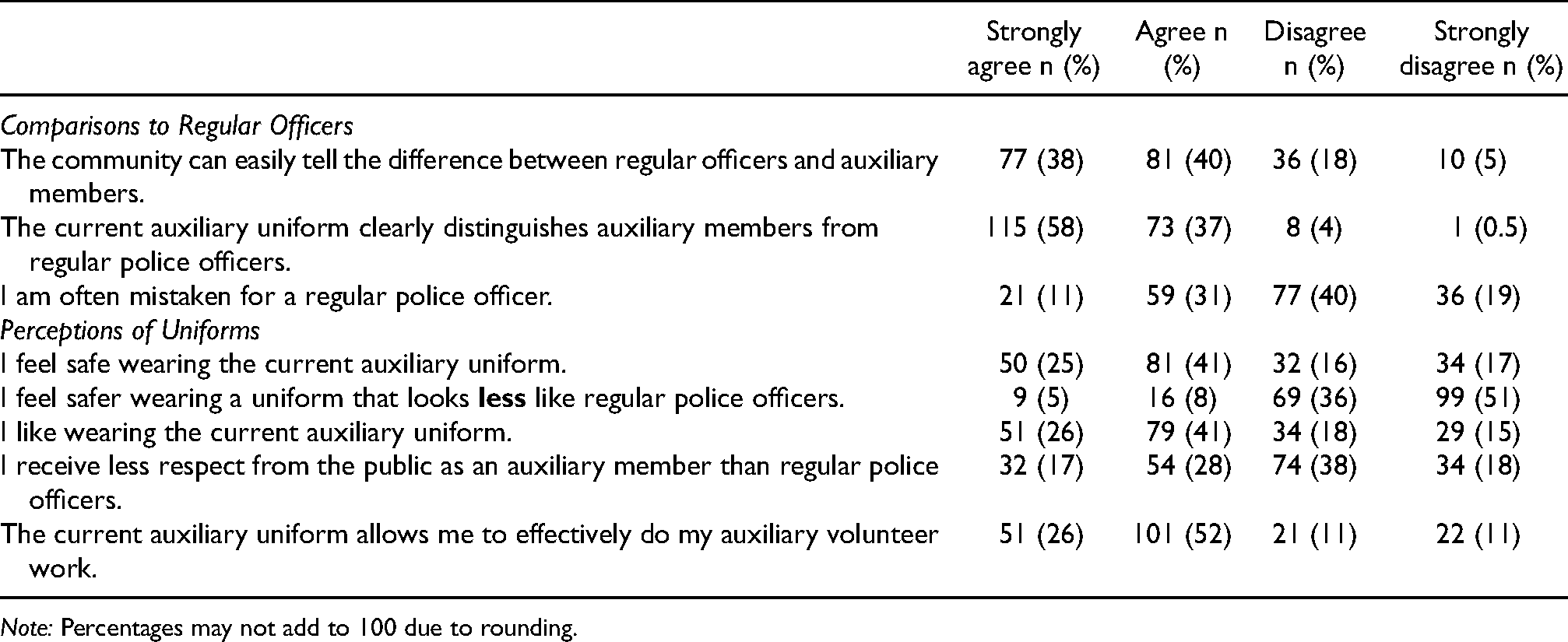
Participants were asked to rate their level of agreement with a series of statements about their uniforms and safety (Table 1). When examining how participants compared themselves with regular police officers, a clear majority agreed or strongly agreed that the community can easily tell auxiliary members apart from regular officers (78%) and that the auxiliary uniform clearly distinguishes them from regular officers (95%). Similarly, albeit to a lesser extent, the majority of participants disagreed or strongly disagreed that they are often mistaken for regular officers (59%). For the most part, this suggests that participants agreed that the uniform changes were successful in clearly distinguishing auxiliary members from regular police officers.
Perceptions of uniforms and safety.
Note: Percentages may not add to 100 due to rounding.
Despite this, auxiliary members had several concerns about what this differentiation meant for their safety. Although the majority agreed or strongly agreed that they felt safe wearing their current auxiliary uniform (66%), this still leaves a substantial number of volunteers with safety concerns. Further, only 13% agreed or strongly agreed that they felt safer wearing a uniform that looked less like those worn by regular officers. The open-ended responses from auxiliary members revealed several specific concerns regarding their uniforms and safety.
First, some auxiliary members expressed concerns that uniform changes compromised their safety because they looked too different from regular members. In particular, in the redesign of the uniforms, the word ‘police’ was removed so that the auxiliary members' uniforms simply read ‘auxiliary’. Participants stated that the lack of a ‘police’ label on their uniforms made them feel less safe. For example: I feel my safety is more at risk now with the current auxiliary uniform. Having ‘auxiliary’ in big bold lettering on our vests and jackets makes us stand out. I don't feel as safe at community events when a regular officer is not present…. I feel it is much safer to go back to the old auxiliary uniforms [looking more like regular officers].
Though the auxiliary billboards make sense from a liability perspective, I am concerned that they pose a serious safety concern in a high-risk situation.
It completely identifies you as an unarmed police member, and could potentially make you a target in certain situations.
Other respondents made note of the introduction of a light blue shirt for auxiliary members: I believe that our uniform shirts should be dark like the regular officers' shirts as they show up too easily in the dark. For safety reasons we should be wearing black shirts. This was the reason regular members switched. Many times I've had to put on a jacket in the middle of the summer to cover the light blue shirts.
Although these uniform changes appear to have been successful in clearly distinguishing auxiliary members from regular members, many participants perceived these changes to put them at greater risk of harm.
Relatedly, approximately half (45%) of participants agreed or strongly agreed that they received less respect from the public as an auxiliary member compared with regular officers because of the uniform changes. Participants considered this lack of respect from the public to also be a safety issue. For example: The current large ‘auxiliary’ band on the vest and coat have contributed to more negative attention at public functions compared to my attendance at the same events prior to wearing the current banners. The current uniform seems to be overloaded with auxiliary insignia to try and distance ourselves from looking like a regular member. This can lead to issues involving respect at certain events that involve crowd control and unruly people. I feel less respected since the ‘auxiliary’ flash has been added to our vests. The community now will say ‘you are just an auxiliary and I do not have to listen to you’, making our job more difficult.
Overall, respect and authority were thought to come at least in part from wearing uniforms that looked very similar to regular members' uniforms. As one participant stated: ‘[w]e get compliance because of our uniform and this [uniform] change has eroded that level of compliance and … become a danger’.
A further consequence expressed by participants of the uniform changes was public confusion. For some, public confusion over uniforms was related to the role of auxiliary members. For example: With the light blue shirt and the fact that quite a number of auxiliary members are older, most people think that auxiliaries are senior members. They seem to direct more questions to the auxiliaries than the regular members. You constantly have to tell civilians that they will have to ask the investigating officer and direct them to the regular member.
For other participants, the confusion stemmed from the public not knowing what auxiliary meant absent of the word ‘police’: The auxiliary billboard in my personal experience only serves to confuse members of the public who are unclear of its meaning. The simple inclusion of the word ‘police’ under ‘auxiliary’ would have alleviated that problem. ‘Auxiliary’ alone is grammatically incorrect. Auxiliary is an adjective used to describe a noun. The noun is missing … Furthermore, ‘auxiliary’ is not a common word. Most people who speak English as a first language do not know what it means. People who don't speak English well, definitely do not. However, ‘police’, is very similar in several different languages so it is more recognizable. The placards should say ‘Auxiliary Police’.
For participants, without a clearly identifiable connection to the police on their uniforms, public confusion made their auxiliary roles more difficult. Despite this confusion, the majority of participants also agreed or strongly agreed (78%) that their current uniform allowed them to effectively do their volunteer work.
While auxiliary members perceived the public as expressing a general confusion about their uniforms, they made a clear distinction between the general public and people seeking to do them harm. It was perceived that people wanting to cause harm saw auxiliary members as easier targets than regular members because of the uniform changes. For example: The uniforms of auxiliaries are distinct not to the public but to the subjects we have problems with. It is terrifying to know that the people we arrest are the ones that know we don't have a gun and this leads them to think they can fight with us auxiliaries and makes them much more willing to. The public see the [police]. The criminals see an easy target. Making us look like volunteers makes us a soft target, known to be unarmed, for that I don't appreciate the current uniform.
Therefore, auxiliary members perceived their uniforms as marking them as an easy (unarmed) target to potentially problematic individuals (e.g., ‘criminals’).
In addition to the above-discussed removal of the word ‘police’ from auxiliary uniforms and the change in shirt colour, other subtle uniform changes were introduced to mark auxiliary members as different from regular members. Some of these changes were also considered to mark auxiliary members as targets. For example: [T]he … checker head bands … this is a red bullseye because [the] community knows we do not carry firearms.
Despite these concerns, overall participants agreed or strongly agreed (67%) that they liked wearing their current auxiliary uniforms. In the next section, we continue to examine participants' perceptions of safety more broadly by examining their perceptions of the trainings they received as well as the accoutrements provided to auxiliary members.
Perceptions of training, accoutrements and safety
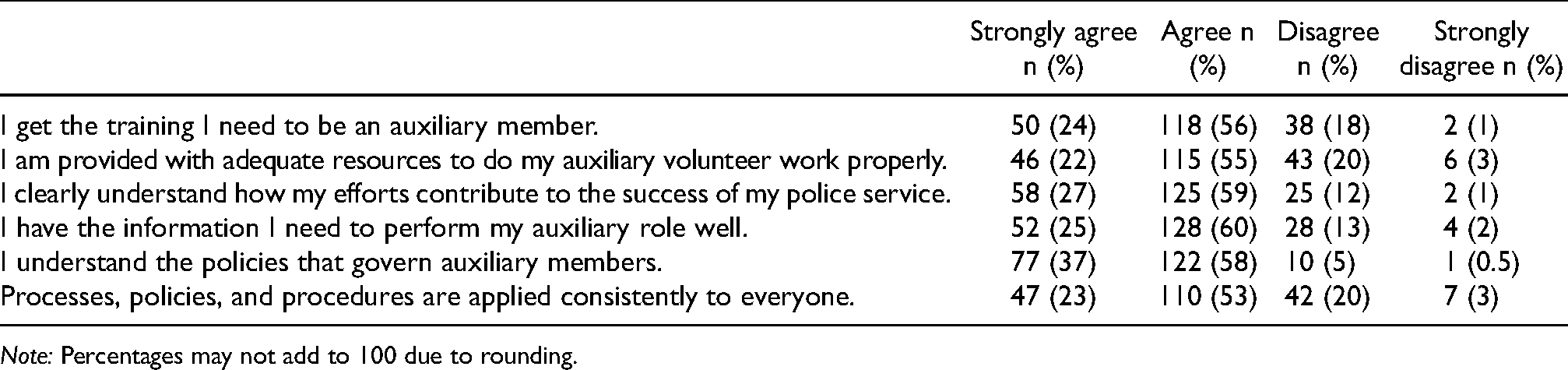
Auxiliary members were asked to rate their level of agreement with a series of statements about their training experiences (Table 2). The majority of participants agreed or strongly agreed that they received adequate training (80%) and resources (77%) to do their volunteer work, understood how their efforts contributed to the success of their police service (86%) and the policies governing them (95%), had the required information to perform their auxiliary role well (85%), and perceived processes, policies and procedures being applied consistently to everyone (76%). Therefore, despite concerns discussed in the previous section about auxiliary members' safety, the majority of participants felt adequately trained and resourced. However, analysis of the open-ended responses revealed two areas, from auxiliary members' perspectives, in need of improvement: (1) use of force options; and (2) accoutrements. In what follows, we discuss how these issues are linked to auxiliary members' perceptions of safety.
Training experiences.
Note: Percentages may not add to 100 due to rounding.
Although auxiliary members generally agreed that they were provided adequate resources and training, they did note that additional use of force options would further improve their safety.
We should be issued OC [pepper] spray as a use of force option for sure … Having another use of force option would make a lot of auxiliary members feel safer I think.
I believe it would be ideal for us auxiliary members to receive pepper spray. From a distance we do not have any advantage at defending ourselves. We do not have a Taser or gun that can shoot or be used for distance. Our baton is only effective close range. Pepper spray would allow us to maintain a safe distance between us and a suspect in case we needed to use it.
I would feel much safer taking out a C8 [rifle] on patrol [in case of emergencies] rather than a shotgun.
In part, these additional use of force options were interconnected with how participants perceived their auxiliary uniforms as marking them as different and vulnerable targets in comparison with regular officers. For example: Community members realize that auxiliaries do not have the same use of force options as a regular member and therefore the new uniform makes us a target.
Providing auxiliary members with additional use of force options could potentially alleviate some of the safety concerns expressed by participants.
Similarly, participants noted that improvements to accoutrements provided to auxiliary members could potentially enhance their safety: Additional radios … we do not have enough radios for our unit so we have to share while doing events – very dangerous if you get separated.
For others, additional accoutrements were perceived as a way to align auxiliary members more closely with the larger police family: I feel very proud of being an auxiliary member and most services issue badges to their members making them feel more part of the organization, I would like to see [them] follow suit with that one day.
Moreover, auxiliary members noted that they generally wanted more ‘training’ in all aspects of police work in order to bring their skillsets closer in line to those of regular officers. In the next section, we discuss the implications of these perspectives in more depth.
Discussion
Our study provided a unique opportunity to examine how changes made to uniforms impacted auxiliary members' perceptions of their safety. The findings suggest that these changes led to auxiliary members having increased concerns for their safety and perceiving that they were being distanced from their extended police family. As we argue in this section, auxiliary members' uniforms, as well as provided trainings and accoutrements, act as symbols connecting volunteers to the ‘extended police family’ (Bullock, 2017; Cherney and Chui, 2010; Cooke, 2005; Johnston, 2007). As symbolic connections increasingly marked auxiliary members as different from regular officers, concerns emerged regarding their personal safety.
Auxiliary members identified several uniform changes that marked them as vulnerable targets to bad actors intending them harm. These changes included the removal of the word ‘police’ from their uniforms, blue shirts instead of black, and chequered headwear. More specifically, for some auxiliary members, these uniform changes were thought to visually identify them as easy targets, putting their personal safety at risk. Bad actors who sought to do auxiliary members harm were portrayed by participants as calculating rational actors with the ability to easily identify auxiliary as vulnerable targets. However, it is important to note that these were participants' perceptions of potential harm rather than actual incidents and no concrete examples were ever provided of them being targeted. In comparison, the perception that the general public was confused and unsure about the role of auxiliary members was supported with specific examples. These concerns raise questions about how uniforms should be designed to balance perceptions of potential harm and actual (likely) risk. The literature thus far on this topic is far from definitive. If uniform differences are too pronounced in comparison with regular police officers and the public can easily tell auxiliary members are not regular officers, some have found that this could cause issues in gaining compliance and place volunteers at greater risk (Rowland and Coupe, 2014). Alternatively, others have found that if volunteer uniforms too closely resemble those of regular officers, auxiliary members can be placed in risky situations and thus greater risk of harm (Cherney and Chui, 2010; Cooke, 2005). Unfortunately, there is no clear evidence in the literature of what would be optimum uniform design. There is also little research being conducted with the public on their perceptions of auxiliary uniforms, which likely varies by locale and cultural context.
Relatedly, some auxiliary members perceived the uniform changes as decreasing their legitimacy (Joseph and Alex, 1972). It was thought that without wearing uniforms that closely resembled those of regular members, gaining compliance and respect from the public was difficult. Although somewhat dated, there is some evidence in the literature to support this perspective. It has been found that uniforms more generally can act as symbols of authority and legitimacy to the public, which can aid in gaining public compliance and respect (Bickman, 1974; Joseph and Alex, 1972). Having said this, much has changed in policing in the several decades since this research was published. With little recent research on this topic – mostly limited to how variations in the uniforms of sworn police officers affect public perceptions (Simpson, 2017, 2020) – it is unclear whether uniforms still project to the public symbols of authority and legitimacy as they once might have done.
What is clear is that auxiliary members' presentation of their (uniformed) selves (Goffman, 1959) was closely tied to the appearances of regular officers (i.e., they desired similar uniforms, accoutrements and trainings). Interestingly, obtaining authority and respect, and thus legitimacy, from the public was viewed as emerging from playing the role or appearance of a police officer rather than from substantive skills (e.g., communication). For example, in regard to safety, procedural justice training was not something specifically asked for by auxiliary members but more use of force options were requested (e.g., pepper spray, better weapons). Thus, safety and respect were viewed by auxiliary members as something that could be obtained by target-hardening themselves rather than from obtaining more procedural justice type trainings that emphasized treating people with dignity and respect (Sunshine and Tyler, 2003; Tyler et al., 2014; Wells, 2007) or improved communication skills (Shon et al., 2020).
Overall, auxiliary members' perceptions of their safety were intricately tied to their feeling a part of the ‘extended police family’ (Bullock, 2017; Cherney and Chui, 2010; Cooke, 2005; Johnston, 2007). The uniform changes led to a distancing from this family that was felt by, and had real consequences for, auxiliary members. Calls for the word ‘police’ to be added back onto their uniforms, uniforms generally to look more like regular officers, and accoutrements (e.g., badges) and trainings (e.g., use of force) that approximated those that regular members received can all be viewed as attempts by auxiliary members to become closer members of the police family – and to access the authority and legitimacy that membership in that family is perceived as holding. For auxiliary members, these key elements were held as symbols of their membership in policing (Hirtenfelder, 2016; Joseph and Alex, 1972). Distancing these volunteers from the policing family created perceived and/or actual safety issues. Essentially, auxiliary members felt safer the closer they were to the appearance and skills of regular police officers. This also raises the question of whether auxiliary members would be less likely to ask for additional use of force options if their uniforms were changed to resemble more closely those of regular officers. Future research should continue to examine this.
Determining a uniform design that optimized both auxiliary and regular member safety was beyond the scope of this article but would be valuable future research to pursue. Presumably, the intent of introducing changes to auxiliary uniforms was to increase the safety of auxiliary members. However, these changes do not appear to be something that was discussed with auxiliary members before changes were implemented. Doing so might have alleviated some of the concerns identified by members in our study. Unfortunately, given that we only spoke to auxiliary members regarding their perceptions, we do not know the thought processes behind the police services' uniform changes. Understanding optimum uniform design would require discussions with police leadership, regular members, auxiliary members and members of the public. This would also likely require experiments be run to test different uniform styles and how the public perceives uniforms. As mentioned earlier, Simpson’s (2017, 2020) work in this area has already revealed how slight uniform changes can significantly impact public perceptions. To our knowledge, research of this type was not completed by the police service in our study before the uniform changes were implemented.
Conclusion
Despite the above findings, our approach did have limitations that are important to note. Although our research was exploratory and provided insights into how auxiliary members perceived their safety, it did not examine whether perceived safety translates into actual safety. We also only examined one auxiliary police service in one country and did not have a representative sample of participants from which to draw our conclusions. Thus, it is unclear how applicable our findings are to other contexts.
Notwithstanding these limitations, our article added a much needed Canadian perspective to the literature on police volunteering. In particular, we provided evidence of how auxiliary members' uniforms, training, and associated accoutrements are symbolically interconnected with safety and being part of the extended police family. The implications of these findings are that police volunteers might require more consultation from police management on decisions that affect them before changes are implemented. Even something as seemingly innocuous as a slight uniform change could have significant repercussions (e.g., reduced connection to the police service, volunteers feeling less safe) and signal to auxiliary members that they are not symbolically connected to the extended police family.
Our findings also point to some potentially valuable research directions to explore. Future research should explore how uniforms are perceived and impact safety across various countries, types of auxiliary police (i.e., those with varying police powers and uniforms), and police services. Additionally, it would be interesting to examine how the proliferation of private police/security in recent decades, with their variety of different uniform styles, as well as recent calls to defund the police have impacted how the public perceive the police uniform. Finally, it would also be interesting to explore how liability concerns impacted the uniform changes at this police service and others. It is possible that the uniform changes were more motivated by liability concerns, as some participants noted, than they were actual auxiliary member safety. Thus, much more research is needed in order to fully understand the intricate connections between uniforms and safety in policing.
Footnotes
Declaration of conflicting interests
The author(s) declared no potential conflicts of interest with respect to the research, authorship, and/or publication of this article.
Funding
The author(s) received no financial support for the research, authorship and/or publication of this article.
