



Abstract
As part of the present research, we employed a field study paradigm to test the effects of an unoccupied police vehicle on speed(ing) along a voluminous highway offramp in Western Canada. During the intervention period, a randomly assigned, marked police vehicle was parked nightly at the target location while radar-recording devices captured the speed of passing vehicles. Our analyses of speed data collected before, during, and after the intervention period, both before and at the target location, indicated that the average speed of vehicles and the proportion of speeding vehicles were significantly lower in the presence of the unoccupied police vehicle. We discuss the results of our police-directed field study with respect to theory, research, and practice.
Introduction
Policing roadways constitutes a significant proportion of modern police work. Public concern about motorist behavior, and hence the policing of such behavior, is well-justified. Traffic collisions are a leading cause of death and injuries worldwide (World Health Organization, 2015) and incur tremendous financial costs annually (Blincoe et al., 2015). Aggressive driving, even when it does not result in traffic collisions, can also generate safety concerns and motorist contention (Bogdan et al., 2016). Policing roadways, however, requires significant resources. There are more roadways to be policed than police officers available to police them. There are also far more motorists using these roadways than police officers available to interact with them. This imbalance can create logistical challenges for police. For example, active enforcement—particularly saturation enforcement (Simpson et al., 2023)—is not always possible, especially in light of the staffing shortages currently facing police (Adams et al., 2023). Instead, police agencies must often be creative in their approach to policing roadways. Attempts to maximize police presence while minimizing personnel demands have included the use of inanimate police cut-outs (Simpson et al., 2020) and stationary police vehicles (Armour, 1986; Kaplan et al., 2000; Ravani & Wang, 2018), among other passive techniques.
Many police-led, road safety interventions have focused specifically on speed. The rationale for speed enforcement by police may be threefold. First, speeding is a well-documented contributor to traffic collisions (Aarts & van Schagen, 2006; Blincoe et al., 2015; Richter et al., 2006). Speed correlates with both the prevalence and severity of traffic collisions. Second, speed is amenable to the enforcement actions of police (Armour, 1986; Kaplan et al., 2000; Ravani & Wang, 2018; Shinar & Stiebel, 1986; Simpson et al., 2020, 2023). Previous research has consistently found that police actions can reduce speed(ing). Third, and finally, police are able to detect speeding with relative ease. Unlike other kinds of enforcement, including for impaired driving, police are able to effectively detect speeding from a distance, by for example using handheld and/or vehicle-mounted radar devices. Although police are not the only means to reduce speeding, or perhaps not even the most effective and/or efficient means to reduce speeding, speed enforcement has become a cornerstone of modern police work worldwide.
As part of the present research, we employed a field study paradigm to assess if a marked and unoccupied police vehicle could reduce speed(ing) along a voluminous highway offramp in Metro Vancouver, British Columbia, Canada. During a seven-day period, a marked police vehicle—the specific model of which was randomly assigned by date—was parked nightly alongside the offramp from 8:00 pm to 6:00 am. Prior to, during, and following the deployment of the unoccupied police vehicle, radar-recording devices passively captured the speed of passing vehicles before and at the location of the police vehicle. Our results reveal that the unoccupied police vehicle reduced both speed and the proportion of speeding vehicles along the offramp. Moreover, and consistent with related research, our results suggest that such effect was temporally bound to the period of the study when the police vehicle was present. We discuss our findings from this police-directed field study with respect to theory, research, and practice: suggesting that the police vehicle—as an “icon in policing [and] symbol of deterrence” (Simpson, 2019, p. 88)—exhibits important implications for motorist behavior.
Literature Review
Speed has consistently been identified as a contributor to traffic collisions. Past research has found that increases in speed limits correlate with increases in traffic collisions (Farmer, 2017; Farmer et al., 1999; Friedman et al., 2009; Patterson et al., 2002). Past research has also observed that increases in vehicle speed correlate with a greater risk of a traffic collision and more serious injuries if a collision occurs (Joksch, 1993). Given this information, the focus on reducing speed is well-justified. Even though the police may conduct the most “public” or “obvious” work in the area of speed reduction, it is important to acknowledge that speeding interventions can be conducted by an array of different groups (including other government and non-government entities) and via means other than enforcement or education (as typically done by the police).
Speeding Interventions
Speeding has been the focus of numerous police and non-police-led interventions. From a non-policing perspective, governments have manipulated various road characteristics to reduce speed. For example, governments have installed speed humps (Rothman et al., 2015), setup speed reading and warning signs (Flynn et al., 2020), and implemented camera-related enforcement programs (Hoye, 2014), all with at least some success. Although the latter interventions are arguably enforcement-related, they are often implemented and managed without the direct participation of police.
From a policing perspective, much attention toward speed has come in the form of enforcement. These interventions, as well as the camera-related enforcement programs mentioned above, generally center around the principle of deterrence. Deterrence theory argues that people are rational actors who seek to maximize benefits and minimize costs (Nagin & Pogarsky, 2003; Paternoster, 2010). The theory suggests that people—in this case motorists—refrain from committing crime—in this case speeding—because they perceive the costs (e.g., receiving a violation ticket) to outweigh the benefits (e.g., arriving earlier at the destination). One’s cost-benefit calculation can be impacted by three factors: certainty (i.e., the likelihood of being caught), severity (i.e., the magnitude of the punishment), and swiftness (i.e., the immediacy of the punishment). In most jurisdictions, police have little to no control over the severity or swiftness of the punishment, with the exception of their discretion to administer fewer or greater, or more serious, traffic violations in the context of severity. The police can, however, impact certainty—namely through their enforcement efforts.
Police enforcement can manifest in many different forms, including spontaneous traffic stops and planned initiatives. Spontaneous traffic stops are often the result of police patrols where traffic violators are directly observed by police officers (Lum et al., 2020). As part of planned initiatives, police proactively seek out problematic motorist behavior. This latter kind of enforcement is deliberate: often conducted along roadways determined to be at high risk for traffic collisions and/or where problematic motorist behavior, like speeding, has been documented as a significant issue. These sorts of initiatives—such as saturation enforcement (Simpson et al., 2023)—are resource-intensive. In order to stop offending motorists, there must be officers available and present to conduct the stops for a committed period of time. In light of increasing personnel shortages among police (Adams et al., 2023) and competing demands upon police (Thacher, 2022), such enforcement is often infrequent. Moreover, when it is conducted, it is generally done by dedicated traffic units within municipal police agencies or police agencies with specific traffic mandates (e.g., highway patrol agencies; for more discussion about police enforcement of speeding, see Simpson et al., 2023).
In light of these resource challenges, other police-led interventions have sought to capitalize on the perception of enforcement without the need for actual officers to conduct enforcement. Interventions of this nature have included the use of police cut-outs. For example, Simpson et al. (2020) observed that the use of life-size, inanimate police cut-outs reduced speeding along arterial routes in two cities in Metro Vancouver, British Columbia, Canada. Interventions of this nature have also strategically manipulated police vehicle presence. Previous research has found that stationary police vehicles can reduce speeding—at least in the short-term—when occupied as well as unoccupied. For example, Armour (1986) found that an occupied police vehicle reduced speeding along an urban roadway in New South Wales, Australia and Ravani and Wang (2018) found that an occupied police vehicle reduced vehicle speeds in rural highway work zones in California, USA. In another American context, Kaplan et al. (2000) observed reduction effects for an unoccupied police vehicle parked alongside a winding roadway near an airport. Finally, previous research has observed that—in addition to altering motorist behavior—marked police vehicles can reduce more traditional forms of crime and disorder (Ratcliffe et al., 2021), even when parked and unoccupied (Worrall et al., 2022).
Police Vehicle Presence
This discussion of police vehicle presence leads to a further caveat. Police vehicles are not all homogenous. There are nuances in police vehicle aesthetics and such aesthetics may implicate in the effects of police vehicles on road safety. As Simpson (2019) described, police vehicles can be marked (i.e., visibly identifiable as police vehicles) or non-marked (i.e., not visibly identifiable as police vehicles). His research suggests that marked police vehicles—which are more readily identifiable as belonging to the police—are perceived more favorably by the public than non-marked police vehicles (Simpson, 2019). Related research by Thomas and Williams (2012) echoes the importance of police vehicle aesthetics for motorist detection and recognition.
Given that the police vehicle is the key manipulation in many interventions that invoke and/or amplify police presence, it is important to be mindful of the effects of police vehicle aesthetics. In order for deterrence to manifest, motorists must be able to visually detect the vehicle and identify it as a police vehicle—a process which is achieved via the markings on the vehicle. The latter process is particularly important for inducing perceptions of certainty or—in more practical terms—the likelihood of receiving punishment from the police. If motorists do not associate the police vehicle with the police, then one would not expect it to elicit deterrence. Second, although deterrence of a problematic behavior, like speeding, may be the primary aim of these interventions, it is possible that the means by which the behavior is deterred by police could alter the effect and/or induce negative consequences. If the public do not perceive the process by which the roadway is policed fairly—for example, if they feel tricked as a result of the police’s use of a non-marked police vehicle—any behavioral effect achieved by the presence of the vehicle could be offset by the negative perception of the policing process (for a discussion of procedural justice, see Mazerolle et al., 2013). The effects of an intervention centered around police vehicle presence may therefore vary depending upon the characteristics of the police vehicle used in the intervention.
The present research draws upon this collective body of research to empirically test the deterrent effects of police vehicle presence—as operationalized by a parked, unoccupied, and marked police vehicle—on speed(ing) along a voluminous highway offramp. At an abstract level, our work seeks to validate the findings of existing research that has studied the effects of police vehicle presence either historically or in different settings and/or contexts. At a more nuanced level, our work adds to existing research by testing the effects of police vehicle presence on speed(ing) along a highway offramp in a Canadian context—both of which have yet to receive empirical attention.
Data and Methods
Setting
The present research evaluates the effects of an unoccupied police vehicle on speed(ing) along a highway offramp in Metro Vancouver, British Columbia, Canada. The offramp under study (hereinafter referred to as the “intervention site”) connects the Trans Canada Highway (the major thoroughfare for the metropolitan region of Vancouver) with numerous arterial routes that flow into/out of the large cities of Vancouver and Burnaby. Given the size of these cities, and the volume of traffic that they attract, the intervention site experiences high volumes of traffic. It also experiences much traffic congestion during the daytime hours.
The intervention site is comprised of three lanes of traffic, all of which flow in the westbound direction. It commences via the furthest right line of the highway and terminates approximately 0.6 km later at a four-way, signal-controlled intersection. The speed limit along the intervention site is 50 km/hour.
The intervention site was selected for the present research for three reasons. First, per the British Columbia Ministry of Transportation and Infrastructure, it has been a problem site for traffic collisions, and hence has been the focus of much government concern and attention. Second, it offered a safe and unobtrusive space to park the unoccupied police vehicle, which has been required for the intervention. Third, it provided a segment of isolated roadway that allowed for the careful measurement of vehicle speeds at two different locations.
The British Columbia Highway Patrol (BCHP) proactively polices the intervention site for all traffic-related issues during their operating hours. In light of the length of highway and the number of highway onramps and offramps that the BCHP are responsible for policing, the intervention site would generally receive only limited, intermittent enforcement under typical conditions. Outside of the BCHP’s operating hours, the intervention site is policed by the municipal police of jurisdiction, including for traffic-related purposes. 1 The municipal police of jurisdiction are also responsible for attending all criminal-related events that occur along the intervention site, regardless of time.
Similar to previous research in this area (Simpson et al., 2020, 2023), this project was police-directed: the authoring police officers designed and implemented the field study paradigm as well as collected the data necessary to analyze its effects.
Procedure
Prior to the commencement of the study, radar-recording devices (hereinafter referred to as “the devices”) were installed at two different locations along the intervention site to passively record each passing vehicle’s speed in kilometers. Whereas the first device (Point A) was located approximately 0.2 km before the unoccupied police vehicle (i.e., in the absence of police presence), the second device (Point B) was located at the location of the unoccupied police vehicle (i.e., target location). Both devices were bolted to highway infrastructure at each of the respective locations and were battery-operated. BCHP staff routinely recharged the batteries of the devices to ensure continuous data collection.
Following the installation of both devices along the intervention site, data were then collected for 1 week in the absence of the unoccupied police vehicle (i.e., pre-test period). At the commencement of the second week, the BCHP began to deploy the unoccupied police vehicle nightly for a period of 1 week (i.e., intervention period). Each night, the BCHP parked the unoccupied police vehicle at the target location from 8:00 pm to 6:00 am. This time range was selected for deployment given that there was little risk of traffic congestion. Consistent with this argument, the results from an ancillary test suggested that more vehicles sped during the nighttime hours than the daytime hours. In order to enhance the realism of the intervention, the specific police vehicle parked at the target location randomly varied by date. Although all of the police vehicles deployed during the intervention period were fully marked, their model varied from a Ford Explorer to a Ford Taurus to a Ford Crown Victoria. While parked at the target location, the police vehicle was unoccupied and considered “non-operational” (e.g., no emergency lights activated). Following the intervention period, no more police vehicles were deployed to the target location, however data continued to be collected for one additional week (i.e., post-test period).
During the entire study period, the BCHP did not proactively patrol the intervention site. They only entered such site when responding to calls for service, maintaining the devices, and/or parking/removing the police vehicle. This was intended to help minimize any measurement error that the presence of police could otherwise have introduced at the intervention site.
Analytic Strategy
We drew upon various analytic techniques to assess the effects of the unoccupied police vehicle on speed(ing). Whereas we employed independent samples t-tests to compare speed data before and at the target location, we employed one-way ANOVA tests (Bonferroni correction applied for pairwise comparisons) to compare speed data during the different periods of the study. We assessed all tests against the p < .05 standard. We also contextualize the practical implications of our findings, noting that the large sample size may have contributed to the presence of statistical significance.
In terms of outcomes, we conducted our analyses using speed 2 and the proportion of speeding vehicles (as defined via multiple thresholds) as our dependent variable. We also tracked the weather during our study period. With the exception of the first date of the study period, 3 which exhibited high winds and heavy rainfall, we observed few fluctuations in conditions. For this reason, we excluded data from the first date of the study period (which shortened our pre-test period to 6 days instead of 7 days), but did not otherwise include weather in our analyses.
Results
The unoccupied police vehicle was parked at the target location nightly from 8:00 pm to 6:00 am during the intervention period. For the purposes of our analyses, we thus analyze data collected from vehicles that passed along the intervention site during these hours. For logistical reasons, we only recorded data for vehicles that were driving at least 23 km/hour. Although this criterion could affect the mean values reported below, we acknowledge that few motorists likely drove slower than this speed given the time period that we selected for the intervention (which was unlikely to exhibit traffic congestion). Motorists driving slower than this speed also were not speeding by law and would be least likely to be affected by the intervention. In total, our dataset includes data for approximately 41,000 vehicles during the pre-test period, 52,000 vehicles during the intervention period, and 53,000 vehicles during the post-test period.
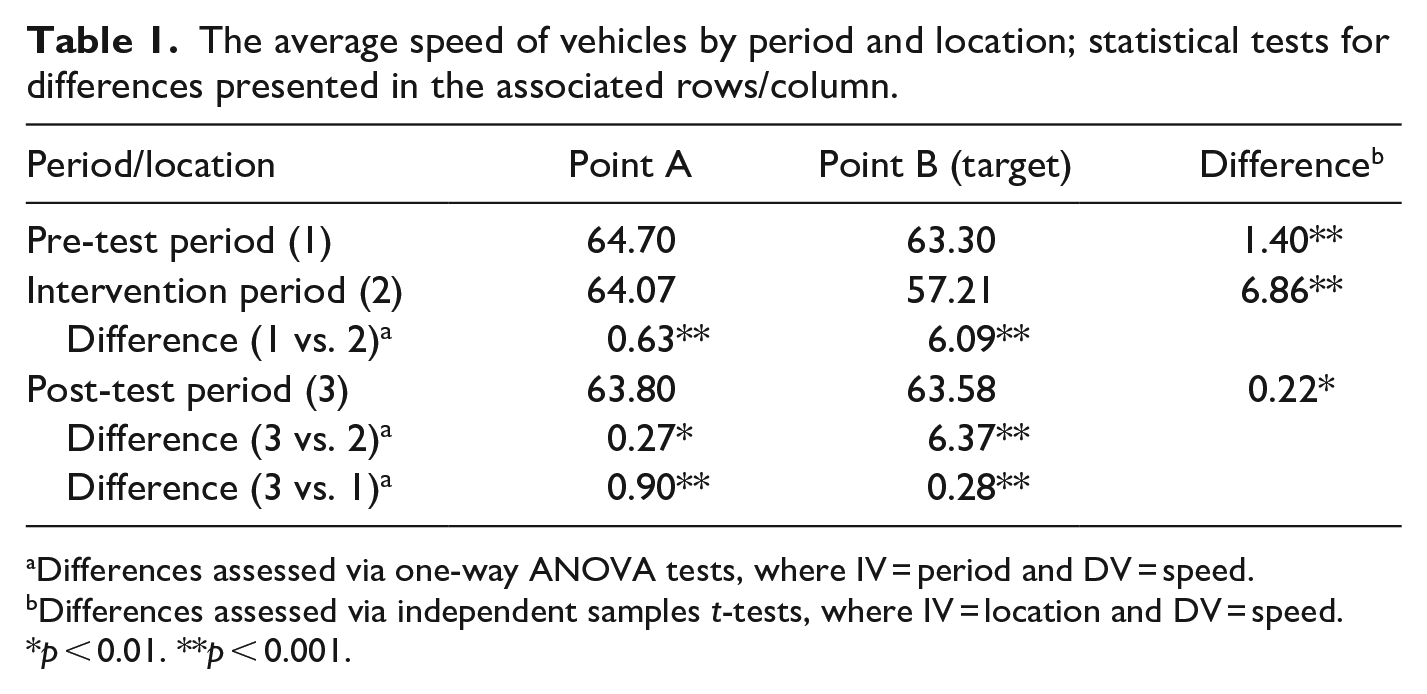
As shown in Table 1, the average speed of vehicles varied by location, with lower speeds at Point B—where the unoccupied police vehicle was parked—than Point A. The average speed of vehicles also varied by period, with lower average speeds during the intervention period.
The average speed of vehicles by period and location; statistical tests for differences presented in the associated rows/column.
Differences assessed via one-way ANOVA tests, where IV = period and DV = speed.
Differences assessed via independent samples t-tests, where IV = location and DV = speed.
p < 0.01. **p < 0.001.
As presented in the associated column, the results of our independent samples t-test suggest that the difference in average speeds between Point A and Point B was statistically and practically significant during the intervention period (t(47,771) = 86.82, p < .001): the average speed of vehicles was nearly 7 km/hour less at the target location (but still above the speed limit). In contrast, the differences in average speeds between Point A and Point B were statistically significant but not practically significant during the pre-test period (t(34,625) = 15.84, p < .001) and post-test period (t(48,514) = 2.85, p < .01). These results suggest that motorists generally drove the same speed between points in the absence of the unoccupied police vehicle, which was only parked at the target location during the intervention period.
As presented in the associated rows, the results of our one-way ANOVA tests suggest that the differences in average speeds across period by location were statistically significant at both Point A (F(2, 69,263) = 45.05, p < .001) and Point B (F(2, 76,468) = 5,564.77, p < .001). However, these differences were only practically significant at Point B: the average speed of vehicles was approximately 6 km/hour less during the intervention period than either the pre-test or post-test periods at this location (with no practical difference between the pre-test and post-test periods). These results provide further evidence to suggest that motorist behavior was amenable to the presence of the unoccupied police vehicle, which was parked at the target location during the intervention period. The average speed of vehicles at the target location are presented in Figure 1.
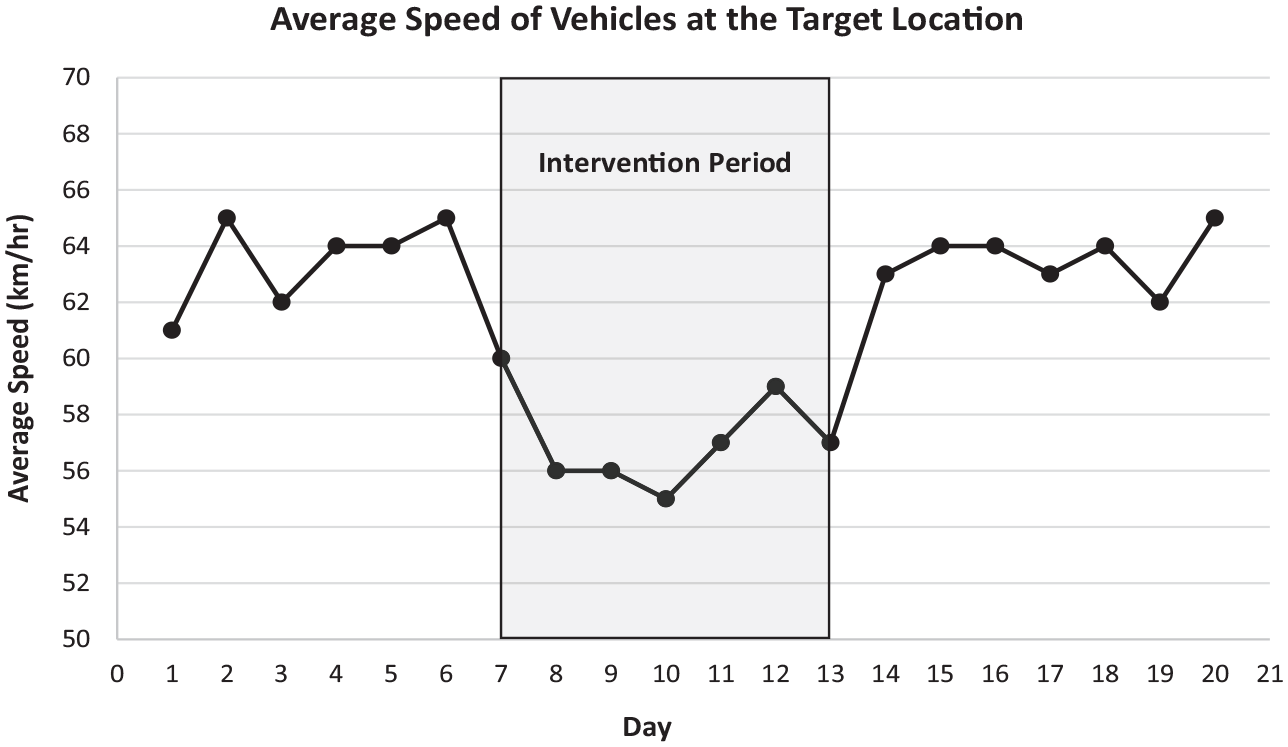
The average speed of vehicles at the target location.
As noted earlier, we were also interested in the effects of the unoccupied police vehicle on the proportion of speeding vehicles at various thresholds. We thus conducted similar analyses using such proportions as our dependent variable. Our first speeding variable employed a threshold of >3 km/hour. This threshold identified all vehicles that legally exceeded the speed limit, with a small buffer (3 km/hour) to account for any error in speed readings. Of vehicles that passed during the study hours, approximately 85% met this threshold. Our second speeding variable employed a higher threshold of >10 km/hour. This threshold identified speeding vehicles that were travelling in noticeable excess of the speed limit. Of vehicles that passed during the study hours, approximately 58% met this threshold. Finally, our third speeding variable employed an even higher threshold of >20 km/hour. This threshold identified speeding vehicles that were travelling substantially faster than the speed limit. Of vehicles that passed during the study hours, approximately 18% met this threshold. All speeding variables were treated as dichotomous (i.e., 0 = did not meet the speeding threshold; 1 = met the speeding threshold).
The analyses by speeding threshold all showed similar patterns in results. Regardless of threshold, and similar to the results when raw speed was used as the dependent variable, fewer vehicles sped at the target location during the intervention period. With that being said, there are a few caveats. First, and as expected, the proportion of speeding vehicles declined as the threshold for speeding increased. Second, we suspect that some of the effect observed when using the most conservative threshold of speeding may have been driven by the faster moving vehicles. For example, the difference in the proportion of speeding vehicles between points was particularly large at the 10 km/hour threshold: whereas 63% of vehicles met this threshold during the intervention period at Point A, only 32% did at Point B. Third, many vehicles still sped at the target location during the intervention period, even when using the higher thresholds. Nonetheless, ancillary analyses indicate that the sheer amount by which vehicles sped may have been lower in the presence of the unoccupied police vehicle. For example, there was a large decline in the total number of vehicles driving >70 km/hour from Point A to Point B during the intervention period, even though many still sped by >3 km/hour. The proportion of speeding vehicles at the target location are presented in Figure 2.
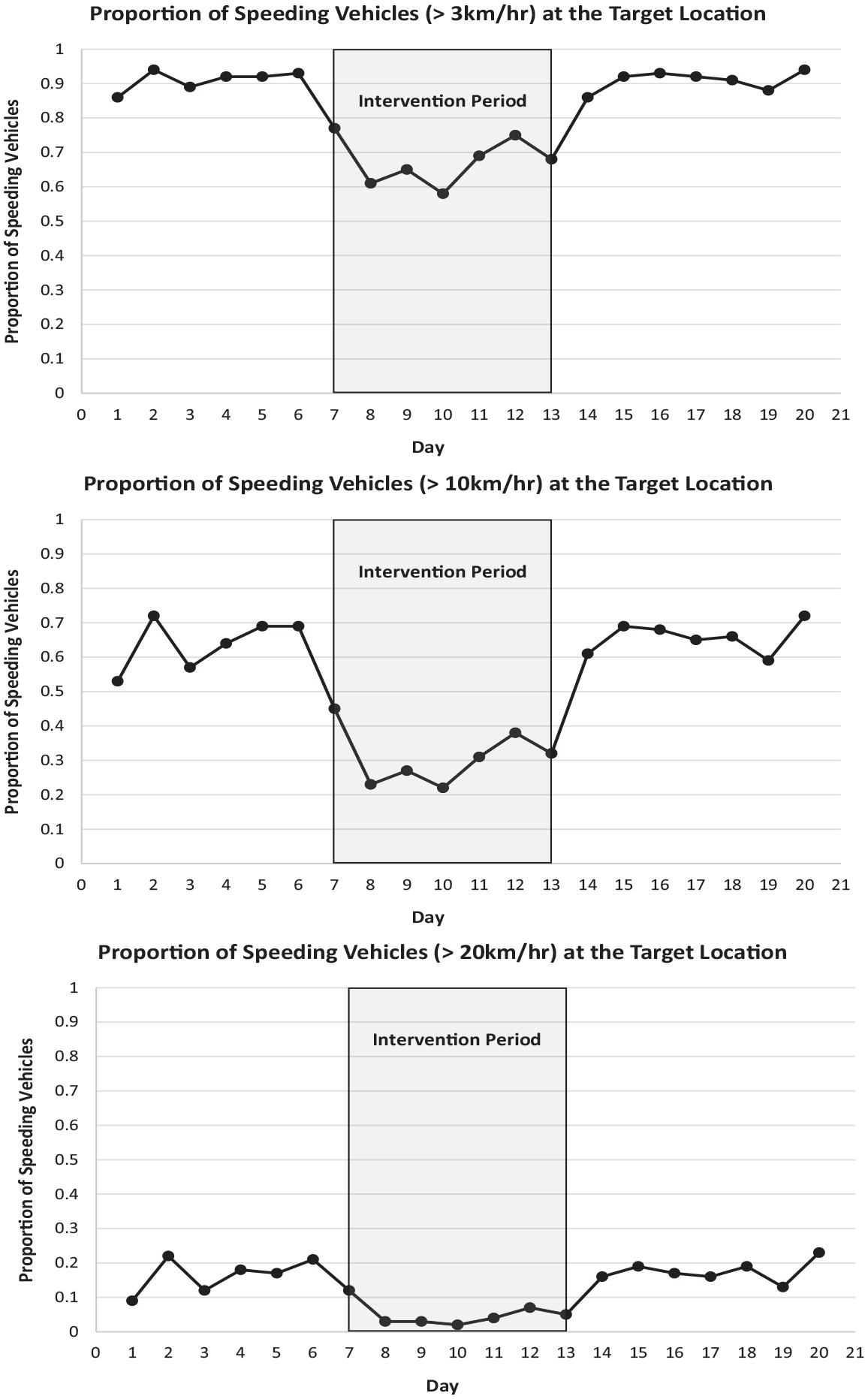
The proportion of speeding vehicles at the target location, by speeding threshold.
Outside of the required maintenance of the devices—which occurred during the daytime hours and hence did not affect our data—there was no documented police proactivity along the intervention site during the study period. There were, however, at least two traffic collisions 4 that occurred along the intervention site during the study hours in the pre-test period (excluding the third collision which occurred on the first date of the pre-test period, which we excluded data from as outlined above). Given that these traffic collisions invoked police attendance and may have caused traffic disruptions, we conducted ancillary analyses that excluded data for vehicles that passed during the affected times on the affected dates. We observed no substantive changes in the results and so we do not report them here. There were no traffic collisions reported during the study hours in either the intervention or post-test periods.
Discussion
Highways exhibit high volumes of traffic and high rates of speed. They are the site of many traffic collisions and the source of many costs, including personal and financial. Policing highways and their associated infrastructure, including onramps and offramps, remains the focus of governments worldwide. Much of the policing of highways comes in the form of police enforcement. However, similar to other types of roadways, there is much more highway to be policed than officers available to police it. Even in any stretch of the highway, or on any single on/offramp, there are also far more motorists using the roadway than officers available to interact with them. Police in many places have thus had to become innovative in their approach to policing roadways, in large part because traditional, active enforcement is resource-intensive and not always feasible.
One offence of much police attention is speeding. Speed has been documented as a contributor to traffic collisions (Aarts & van Schagen, 2006; Richter et al., 2006). Past research has also observed that police can reduce speed(ing) via their enforcement efforts (Armour, 1986; Kaplan et al., 2000; Ravani & Wang, 2018; Shinar & Stiebel, 1986; Simpson et al., 2020, 2023). As part of the present research, we empirically evaluated the effects of a marked and unoccupied police vehicle on speed(ing) along a voluminous highway offramp in Western Canada: asking if its presence could reduce the speed of vehicles and/or the proportion of speeding vehicles. In addition to recording vehicle speeds during the intervention period, when a randomly assigned, marked police vehicle was parked nightly alongside the offramp, we recorded vehicle speeds before and after deployment. We then compared both the speed of vehicles and the proportion of speeding vehicles across periods before and at exposure to the unoccupied police vehicle. Our results revealed that vehicles drove slowest during the intervention period at the target location, where the unoccupied police vehicle was parked. Our results also revealed that fewer vehicles sped—as defined by exceeding the speed limit by >3, >10, and >20 km/hour—during the intervention period at the target location.
These results provide additional evidence to suggest that the police can reduce speed(ing), including via passive techniques. Although many vehicles still sped at the target location, even in the presence of the unoccupied police vehicle, the average speed at such location when the police vehicle was present was approximately 7 km/hour less during the intervention period. Similar to the Constable Scarecrow initiative (Simpson et al., 2020), which deployed life-size, inanimate cut-outs of police officers along city streets, there was no actual enforcement conducted as part of this intervention. Indeed, there was not even formal contact between the public and the police. Instead, motorists simply passed the unoccupied police vehicle as they travelled along the offramp. It would appear that a marked police vehicle alone is salient enough to elicit deterrence, at least in the short-term, even when an officer is not present. This finding is important as—like with the findings of the Constable Scarecrow initiative (Simpson et al., 2020) as well as related police vehicle studies (Kaplan et al., 2000)—it questions the bounds of deterrence: it may not be necessary to have a physical officer present and conducting enforcement (e.g., stopping motorists and issuing consequences) to achieve a behavioral effect.
With that being said, we recognize that this reduction effect may be temporally limited, which is consistent with the findings of past research. For example, the speed of vehicles and the proportion of speeding vehicles both increased from the intervention period to the post-test period, when the unoccupied police vehicle was no longer present. Because of differences in traffic patterns during the day versus night, we were unable to assess within each date how long the reduction effect existed following the removal of the police vehicle. Even when deployed, it is also possible that motorists may have increased their speed immediately after passing the police vehicle, especially if they observed that the vehicle was unoccupied and hence there was no risk of being stopped. We were unable to assess this possibility, though, due to structural limitations. Finally, it is possible that motorists may habituate to the presence of the police vehicle if frequently observed unoccupied. A rotating intervention (e.g., see Sherman, 1990), which would reposition the unoccupied police vehicle on a frequent basis, may help to extend its deterrent effect. Depending upon the extent, scaling up this intervention (e.g., see Sampson et al., 2013) could also reduce the overall salience of the intervention as well as require more resources, both of which could complicate its success.
We note that this intervention—as implemented—was generally inexpensive and required few resources. The police vehicles deployed as part of the intervention were already owned by the police agency. Transporting the police vehicle to the intervention site required little time. Once deployed, no officers were required to remain with the police vehicle. From this perspective, deploying an unoccupied police vehicle allows police to increase their presence at a location without inducing a significant burden on officers. However, calculating exactly how efficient this intervention would be would depend upon what these police vehicles and officers would be doing if not involved in the intervention: a question that we could not explore under our current framework. If practically feasible, police agencies may wish to consider incorporating the use of their vehicles into their crime prevention through environmental design efforts (for more discussion, see Jeffery, 1971).
It is also possible that the presence of the unoccupied police vehicle deterred more problematic behaviors than just speeding, which was the focus of the present research. For example, the police vehicle’s presence may have helped to stimulate seatbelt use and reduce distracted driving. It could also have helped to decrease aggressive driving. These behaviors are correlates of traffic collisions (Blincoe et al., 2015) and therefore reducing them would further enhance road safety. Given that we had no measures of such behaviors, we could not test these effects as part of our research.
Limitations
We note some limitations of the present research. First, we only tested the effects of the unoccupied police vehicle along a single highway offramp. Moreover, we recognize that such offramp was selected in part because of its high number of traffic collisions. Our results, therefore, may not generalize to other offramps or other contexts (however they are consistent with the findings of related research in this domain). Relatedly, we only tested the effects of the unoccupied police vehicle during the nighttime hours. We acknowledge that time of day correlates with visibility, and hence testing this intervention under similar traffic conditions during the daylight hours could potentially produce different findings. Third, and similar to related research in this domain, we were unable to link specific vehicle information across locations/periods (i.e., there was no recording of license plate or other vehicle-identifiable information). For this reason, we were only able to compare aggregate information across points rather than changes in the speed of individual vehicles. Fourth, and also similar to related research, our study period was relatively short, and thus we were unable to assess any potential long-term effects of our intervention.
Conclusion
Police vehicles exhibit multiple important functions, including transportation and storage. Police vehicles can also elicit perceptual effects (Simpson, 2019), and as we—and others—have demonstrated, deterrent effects too. Using a field study paradigm, we observed that simply parking a marked police vehicle alongside a voluminous highway offramp was sufficient to reduce motorist speed as well as speeding, both of which are correlates of traffic collisions. The findings of our research—when evaluated alongside related research that has explored other passive policing interventions like police cut-outs and stationary police vehicles—suggest that formal police contact and/or consequences may not always be required to achieve behavioral change, at least as it relates to motorist behavior. In terms of implications, the use of an unoccupied police vehicle is generally inexpensive and resource-friendly. Many police agencies own many police vehicles, including retired police vehicles, that could be used as part of this kind of intervention. With consideration of evidence-based policing principles, including research regarding the perceptual effects of police vehicles, police agencies may be able to increase their presence and enhance road safety by using this kind of intervention. Future research should continue to explore the effects of police vehicle presence on other types of behaviors, including more traditional forms of crime.
Footnotes
Declaration of Conflicting Interests
The author(s) declared the following potential conflicts of interest with respect to the research, authorship, and/or publication of this article: The second and third authors are intimately connected with the police agency and data analyzed as part of this research. With that being said, none of the authors have any financial interest in this research.
Funding
The author(s) received no financial support for the research, authorship, and/or publication of this article.
