




Abstract
In the name of food security, governments and NGOs purchase large volumes of maize seed in non-relief situations to provide at reduced or no cost to producers. At the same time, efforts to build formal maize seed systems have been frustrated by slow turnover rates – the dominance of older seed products in the market over newer, higher performing ones. Under certain conditions, governments and NGO seed aid purchases can support formal seed systems development in three ways: i) support increased producer awareness of new products, ii) support local private seed industry development, and iii) advance equity goals by targeting aid to the most vulnerable of producers who lack the capacity to purchase seeds. This study explores the objectives and activities of seed aid programmes in Uganda and their interactions with the maize seed sector. We draw insights from interviews with representatives of seed companies, NGOs and government agencies, as well as focus group discussions with producers. The findings indicated that seed aid programme objectives are largely disconnected from broader seed systems development goals. There is little evidence of public-private collaboration in design of these programmes. Better designed programs have the potential to align with varietal turnover objectives, commercial sector development and targeting of underserved markets could promote equity and ‘crowd in’ demand.
Introduction
In many parts of the global South, faster progress towards poverty alleviation and food security goals, will depend, in part, on farmers having access to improved varieties that meet their requirements as both farmers and consumers. Governments and donors have responded to this challenge through their long-term support for crop breeding by CGIAR and National Agricultural Research Institutes (NARES). In the case of cereals, crop breeding for many parts of the global South has aimed to support farmers’ resilience to changing agro-climatic conditions (Atlin et al., 2017). Investments in breeding have been complemented by investments in seed systems development aimed at improving farmer access to improved seed through formal and informal channels. The issues surrounding seed systems development are complex, with strong, and sometimes opposing, views on the appropriate roles of farmers, governments and the private sector (Mulvany, 2005; Thompson, 2012).
In East and Southern Africa, crop breeding and seed systems development has a focused on rainfed hybrid maize – a crop that is critical for food security in the region and which is facing considerable challenges due to increasing variation in rainfall and temperature (Cairns et al., 2013). Over recent decades, these investments have delivered results: CGIAR and NARES breeding programmes release dozens of new seed products 1 a year that vary in maturity levels and pest and disease resistance, among other attributes. Farmers have reliable access to a wide selection of maize seed products via thousands of retail shops spread across the region. The maize seed sector consists of dozens of locally and internationally owned seed companies, some with decades of experience in production and marketing. Government and donor investments in maize breeding and seed systems development across East and Southern Africa have been an important factor in explaining overall increasing levels of maize productivity since the 1970s (Smale and Jayne, 2009).
Looking ahead, future progress in maize seed systems development will require solutions to slow varietal turnover – that is, the persistence of previous-generation maize seed products in farmer's fields, despite the availability of new-generation products that offer higher yields and are drought and disease tolerant. Research has pointed to farmers’ overall lack of information on new seed products, and their lack of engagement with seed retailers on seed-product attributes (Rutsaert & Donovan, 2020). Farmers may perceive new products, in particular new hybrids, to cost more (Nakanwagi, 2021), and may have concerns over seed quality (Barriga & Fiala 2020; Gharib et al., 2021). In many countries in sub-Saharan Africa, open-pollinated varieties (OPVs) continue to represent a major segment of the maize seed market (Abate et al., 2017). Discussions on maize seed systems development have offered few insights on potential solutions to the varietal turnover problem. Efforts to develop formal seed systems for non-hybrid crops, such as sorghum, millet and groundnut, have proven to be even more challenging, given the lack of incentives for private sector investment in seed multiplication and distribution (Bagamba et al., 2022).
In this article, we explore the idea that maize seed systems development can be accelerated when its goals and actions are coordinated with seed aid programming. For decades, governments and donors have sought to increase farmers’ access to improved seed through seed aid – that is, the direct distribution of seed products to farmers by government agencies and NGOs. Seed aid has generally been discussed in terms of emergency and relief conditions that follow droughts, floods and civil wars (e.g., McGuire & Sperling, 2013; Sperling et al., 2008; Sperling & McGuire, 2010). However, government and donors have invested in seed aid during non-relief conditions as part of their strategies aimed at boosting agricultural production and productivity (e.g., Bramel and Remington, 2004; Spielman et al., 2012). NGOs and government programmes purchase seed directly from individual seed producers or seed companies and distribute it, either free or subsidized, to farmers (Sperling et al., 2008). Governments and NGOs may also provide vouchers to farmers to purchase seed products and other inputs at reduced costs from agrodealers (Aloyce et al., 2014). For the private seed industry, seed aid sales can represent a critical source of revenue – for example, recent data showed that NGO and select government programmes in Uganda comprised 63% of seed companies’ maize seed sales, 67% of bean seed sales and 77% of sorghum seed sales (Mabaya et al., 2021).
We know little about how NGOs and government agencies engage with maize seed companies and farmers for the implementation of seed aid in non-relief situations. Government and NGO seed purchases must involve decisions on the benefits and costs of responding to what farmers know and trust (e.g., high-selling products based on decades-old genetic technologies) versus sourcing newer, but perhaps lesser-known, products that are designed and tested to deliver higher performance under current growing conditions. How these trade-offs are negotiated have important implications for seed systems development and crop breeding but is not well understood.
In general, a substantial body of literature has found that input subsidy programmes’ beneficiary targeting is often inadequate or inappropriate. This occurs when subsidies are applied too widely (i.e., reaching farmers who would otherwise have access to quality seed without the aid), or when farmers are excluded from received aid based on eligibility criteria or other factors but still receive seed aid (e.g., through loopholes, fraud or corruption). In the case of fertilizer subsidies, poor targeting is thought to contribute to ‘crowding out’ (i.e., displacing) commercial sales (Jayne et al., 2013; Mather and Jayne, 2018; Ricker-Gilbert et al., 2013; Takeshima and Nkonya, 2014; Xu et al., 2009). While few studies have examined seed aid and seed subsidies’ role in crowding in or crowding out commercial seed purchases (Mason and Ricker-Gilbert, 2013; World Bank, 2014), the concerns raised by fertilizer subsidies programmes are likely relevant.
We argue that a targeted and coordinated seed aid programming agenda can advance maize seed systems development in multiple ways: i) greater gender equity and social inclusion in seed distribution, ii) distribution at scale of new products tailored to specific farmer requirements, and iii) local seed business development. Through a case study in Uganda, we looked to understand the implications of how seed aid was implemented in relation to formal maize seed systems development. To what extent did these programmes support varietal turnover, increased social inclusion and the development of local seed businesses? Our insights are based on interviews with representatives from seed companies, NGOs and government agencies. The following section explores the challenges facing seed systems development with a focus on maize. ‘Materials and methods’ section describes how we designed the study, while ‘Results’ section presents the results. We conclude with recommendations for how seed aid programmes might better support wider seed system goals.
Seed sector development
Gender equity and social inclusion in seed distribution
Researchers have raised concerns that new maize hybrids fail to equally reach women and the poorest farmers (e.g., Fisher et al., 2019; Fisher and Carr, 2015; Fisher & Kandiwa, 2014; Gebre et al., 2019; Kassa, 2013; Smale and Olwande, 2014). Researchers also have pointed to disparities in information and training access (Katungi et al., 2008; Mudege et al., 2018; Ragasa, 2014), women's limited access to required cash (Bourdillon et al., 2007; Mudege et al., 2015; Quisumbing and Pandolfelli, 2010), social constraints on mobility and agency (Galiè et al., 2017; Puskur et al., 2021), women's limited access to complementary resources such as land (Doss and Morris, 2001; Mudege et al., 2018) and gender-based differences in product preferences or perceptions about seed sources (Bourdillon et al., 2007; Kilwinger et al., 2020). In addition, maize seed companies and seed retailers lack incentives to target distribution and marketing efforts to groups that face price and material constraints (e.g., transport) for purchase. These discussions raise questions about the capacity of formal sector seed distribution pathways to support equitable uptake of new seed products and have generated increased attention to seed system accessibility.
Varietal turnover
Development-oriented, government- and donor-funded maize breeding programmes in East and Southern Africa have, for decades, produced new, high yielding, stress-resistant maize seed products (Cobb et al., 2019; Evenson and Gollin, 2003; Walker and Alwang, 2015). Despite evidence of these products’ promising performance from on-station and on-farm trials (Worku et al., 2020), their sales continue to lag behind the sales of older, well-known maize seed products (Rutsaert and Donovan, 2020; Spielman and Smale, 2017). ‘Varietal turnover’ refers to farmers’ replacement of an older seed product with a more recently developed improved one, a process that entails a genetic change (Spielman and Smale, 2017). In the case of hybrid maize, seed companies are expected play a critical role in this process by phasing out their stock of older products, thus enabling their replacement with newer products which have been designed and tested for higher performance. However, smaller-sized seed companies with limited marketing budgets may resist calls to limit their production and distribution of older seed products that generate important revenue streams. Recent evidence from Kenya showed that few farmers sought to purchase the latest, highest performing products (Rutsaert and Donovan, 2020), perhaps because varietal replacement generates relatively incremental yield gains but requires farmers to bear risk (Spielman and Smale, 2017). Achieving faster rates of varietal turnover is a priority for government- and donor-funded maize breeding programmes and, generally speaking, is considered important for farmers to achieve sustained yield gains in the face of increased variability in growing conditions (Atlin et al., 2017).
Through careful selection of maize seed products, seed aid programmes have the potential to deliver large volumes of new products to farmers. Seed companies stand to benefit from wider distribution and increased awareness of their seed, brand recognition and promotion of new varieties, which could aid in varietal turnover in the medium to long term. Achieving these objectives relies, again, on NGO and government programme's careful targeting of underserved markets and quality assurance efforts to ensure minimal disruption of commercial sales or improved farmer trust of seed in the long term. It also necessitates effective labelling of distributed seed to increase brand awareness, cooperation and collaboration with seed companies in product selection to ensure that priority varieties are distributed, and deliberate facilitation of varietal turnover through prioritization of new, high-performing products.
Local seed business development
Direct seed aid and input subsidy programmes have been criticized for disrupting commercial seed sector operations with free and below-cost distributions (Mutonodzo-Davies and Magunda, 2011; Sperling and Remington, 2006; Sperling et al., 2008; Sperling and McGuire, 2010) and distribution of low quality seed that ultimately weakens product demand (Tripp and Rohrbach, 2001). However, seed aid programmes can also support formal seed systems development. For example, seed vouchers (Croft et al., 2021) can increase sales by agrodealers and help to expand their consumer base. Subsidy and direct seed aid programmes can generate bulk sales opportunities for the locally owned seed companies which may lack the financial and human resources required for business growth and development. During the initial stages of small-scale seed business development, bulk sales can provide much needed resources for product development, retail network establishment and expansion and direct-to-farmer marketing.
Seed companies’ dependence on sales to these programmes can be risky, however, as delayed payments can throw company accounts, especially in small businesses without significant alternative revenue streams, dangerously out of balance. Late or unplanned bulk orders can also disturb supply to build up retail networks. For NGO and government programmes to be effective partners in seed business development, transparent and predictable procurement processes must be in place to enable seed companies to plan.
Materials and methods
Study context
We conducted this study in Uganda, a country with an emerging maize seed industry and with high levels of government and NGO involvement in agricultural development. By recent estimates, Uganda's seed sector includes 23 seed companies, 19 of which produce and process their own seed (Mabaya et al., 2021). Relatively limited regulation of seed quality (Langyintuo et al., 2010), low levels of competition between agrodealers (Barriga and Fiala, 2020) and agrodealers’ repackaging of inputs into smaller units have raised concerns about low input quality and seed counterfeiting (Bold et al., 2017). However, despite numerous seed adulteration scandals, maize seed purity and quality was assessed as fairly good, despite challenges with product mishandling and poor storage (Barriga and Fiala, 2020).
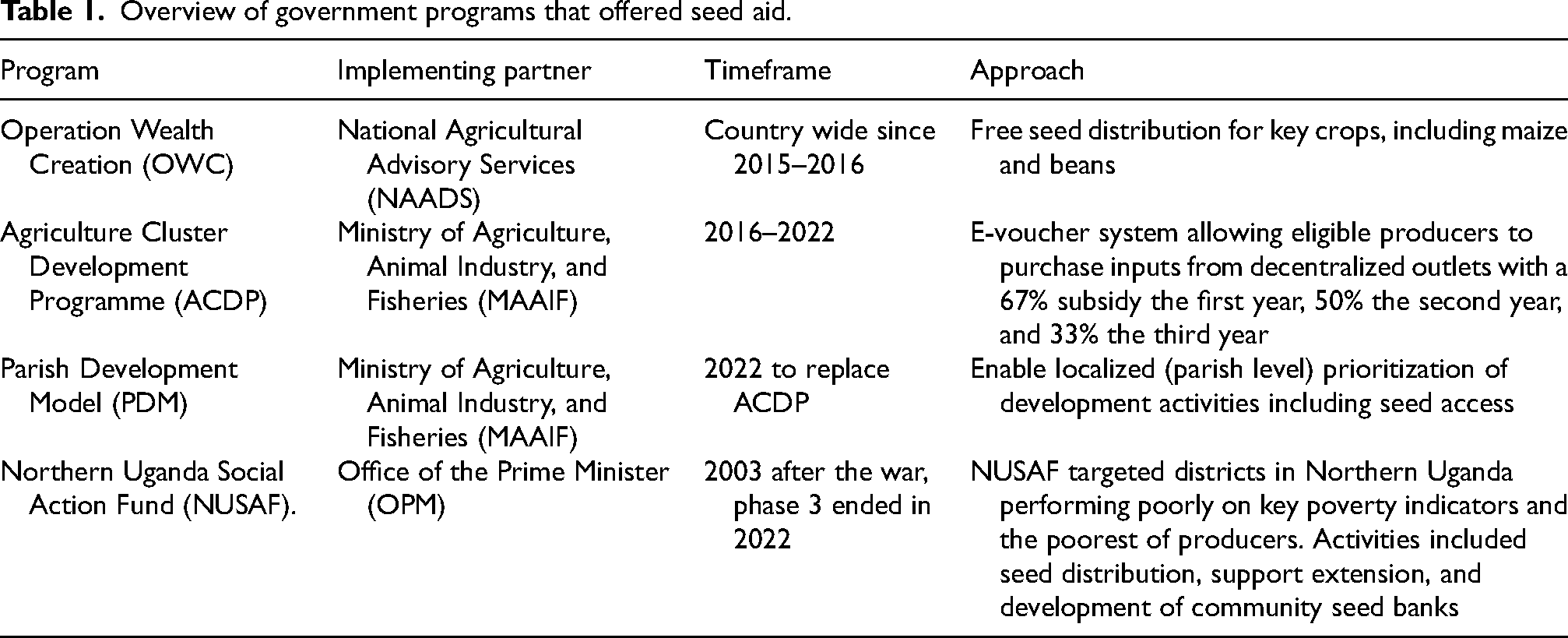
Uganda has an active civil sector including NGOs engaged in humanitarian assistance and rural livelihoods development. The country is also a major seed provider for Sudanese refugees and their host communities. In 2019, 32% of total maize seed produced went to the national subsidy programme called Operation Wealth Creation (OWC), 31% to NGOs, 25% to agrodealers and 8% directly to farmers (Mabaya et al., 2021). Uganda's formal maize seed system thus depends, in significant part, on subsidy programmes and NGO and government seed purchases. Table 1 provides an overview of four government programmes in Uganda that engaged in seed aid around the time this study was implemented.
Overview of government programs that offered seed aid.
Methodology
Between April and May of 2022, we conducted stacked, semi-structured key informant interviews with representatives of seed businesses, NGOs and government agencies participating in seed aid programmes. We selected seed companies that represented diversity in terms of market share, production volume and past participation in government and NGO seed distribution programmes: three market leaders, two medium-scale and two small-scale companies were selected, each pair showing varied past engagement in government and NGO seed aid programmes. Interviews targeted either owners or senior staff responsible for marketing, distribution and/or contract decisions related to participation in seed aid programmes. These discussions sought to clarify the process through which seed companies engaged with the programmes, including selection of varieties to distribute, the importance of these distribution channels to their business model and marketing objectives, their motives in participating and their perceptions of costs and benefits. A representative from the Uganda Seed Trade Association was also interviewed on these topics. Interviews were conducted in English or in local languages (Luganda or Swahili) and took 60–80 min.
Snowball sampling led to the identification of five NGOs and three government programmes to which companies supplied seed. Interviews were organized with staff at these organizations who were knowledgeable about seed procurement, programme objectives and implementation. In most cases, more than one person was interviewed at each NGO or programme office, as programming decisions and seed procurement were typically handled separately. Interviews covered programme objectives and operations, impact metrics, beneficiary targeting, details on procurement processes and perceptions of the programme's role in the wider seed system. Two local agricultural officers were also interviewed as their role in the product selection process became clear. Interviews took 30–60 min and were conducted in English or local languages. Where possible, interviews were backed by secondary data available in project reports, particularly for government programmes.
Twelve focus group discussions with maize farmers (six with men and six with women) were organized in areas targeted by NGO and government seed programmes to gather farmer perspectives on programme targeting and reach. Communities were chosen based on partner contacts in the area, and six to ten farmers were invited to participate in each, aiming for diversity of landholding size and production orientation. In these groups, farmers were prompted to share experiences with NGO and government programmes distributing seed and their perceptions of these programmes and the seeds themselves. Focus groups were conducted in local languages and took 30–60 min.
Key informant interviews were recorded and transcribed, while focus groups were recorded and detailed notes and representative quotes extracted. We applied deductive, iterative coding with the software Dedoose, and used top-down and bottom-up analysis of patterns and themes to analyse interview and focus group data. Ethics approval was obtained from CIMMYT (IREC.2022.034) and Makerere University (MAKSSREC 04.2022.544). Written consent was obtained from participants, using a witness in the case of illiteracy. Interviewees were not compensated but focus groups participants were offered refreshments and modest compensation for their time and transportation costs to ensure equal ability to participate.
Results
Experiences of maize farmers
NGO and government programmes were the most reported seed sources for farmers. Focus group participants reported several problems with these programmes. A common theme was late delivery. One farmer reported that seed deliveries from OWC came ‘when they think about us’ rather than on a predictable schedule. Poor quality seed from these programmes also emerged from almost every discussion, although the perceived reasons for this were unclear. Most focus groups reported that farmers did not engage on the selection of products to be supplied to them through NGO and government programmes, in part due to their limited knowledge of product availability.
Farmers in focus groups expressed appreciation for the ACDP voucher system, which reportedly provided farmers with higher quality seed and a full input package. ‘They used to give better seeds compared to the ones from NAADS’, said one farmer. ‘In addition, what was good was how they gave us seeds. They gave us everything, a complete package of seeds, fertilizers, pesticides, and tarpaulins’. Concerns about quality in ACDP were less common, suggesting the voucher-based distribution channel had been more effective at connecting famers with quality seed, although input delivery timelines again emerged as a concern. Farmers offered a few areas that could be improved in ACDP, including faster delivery, cheaper goods, improved market access and expanded eligibility for farmers without their own land (renters).
While seed aid has its challenges, farmers’ assessments of seed retail channels were also poor. Price was the most frequently cited challenge associated with commercial seed – unsurprising in a context where seed had been distributed for free for so long. A second set of challenges associated with commercial seed related to seed quality, including sale of expired seed or seed that failed to germinate, and availability of preferred varieties in agrodealer shops, pointing to problems with the reliability of commercial seed supply chains. Quality concerns, availability constraints and limited farmer knowledge appeared to have eroded farmer trust in commercial seed.
Focus groups underscored that farmer knowledge of seed companies and new products in Uganda was limited; when asked which seed companies sold high quality seed, one group pointed the researchers to shopkeepers as those who could best answer the questions. One women's group pointed the researchers to men, who typically acquired seed and reportedly had better knowledge – and indeed, men's focus groups were generally better able to identify seed companies operating in their area and seed products available to them.
Targeting by governments and NGOs
Many NGOs and NUSAF reported that they deliberately targeted the ‘most vulnerable’ districts, parishes and communities according to poverty indicators (also contributing to their focus on OPVs over hybrids). Focus groups corroborated this. Although no government programmes reported intentional targeting at the household or sub-household level, one NGO representative stressed their participatory efforts to identify vulnerable households, and one focus group indeed alluded to NGO's prioritization of farmers who were considered to be most vulnerable. None of the seed aid programmes reported a deliberate focus on gender in their seed distributions.
Several study participants felt non-commercial distribution channels inherently brought some social inclusion benefits. One mid-sized seed company cited last-mile delivery as a benefit of partnering with NGO programmes: ‘Some of those NGOs reach even where we don’t have an agrodealer – they are close to the ground and able to take products even to the lowest farmer who wouldn’t access town’. However, wider access to quality seed in underserved areas appeared to be an incidental benefit. No seed companies reported that reaching underserved communities was a deliberate motivation behind their decisions to engage with these programmes.
Government programmes, in contrast, reported a scattershot approach to targeting, making programmes widely accessible to commercialize agriculture while generating goodwill and political support among rural communities. Political considerations entered government seed distribution decisions at the sub-county scale, where a small proportion of seed was often set aside for members of parliament to allocate as they chose. This reportedly led to some duplication and poor targeting in distributions. Wide seed distribution had also become a challenge in recent years due to budget reductions and limited seed supplies; NAADS relied on extension officers to engage in beneficiary targeting at the district level, although the outcomes of this were unclear. In one focus group discussion, farmers reported that OWC seed distributions had become first-come, first-served.
ACDP's targeting was more deliberate, as the programme put in place a cap on land ownership to help direct subsidies to potentially needy households. However, this requirement was not practically enforceable, a programme representative admitted. ACDP did mandate farmer co-funding – in advance – to receive subsidized inputs, which focus groups reported led to the exclusion of farmers with very limited financial resources. ACDP's use of an e-voucher system also had potential implications for women and the poorest farmers’ ability to access and use the services. Seed companies, district government officers and an ACDP programme representative all relayed concerns about farmers’ limited digital literacy, which led middlemen (often input vendors) to facilitate input ordering and thereby influence farmer choices and/or deliberately cheat them of their entitlements. Although ACDP reported that 42% of input buyers were women, concerns about fair and equitable engagement persisted.
Seed product selection
Most procurement programmes published lists of desired products in their tenders. The generation of product lists for most NGO and government programmes aimed to be grassroots-driven, with farmers theoretically requesting products they wanted. Extension agents and their contacts from the National Agricultural Research Organization of Uganda (NARO) played a key role in this process, especially for OWC. It was reported that extension agents were guided by farmers on choice of good seed, but only one focus group discussion reported community involvement in choosing seeds (and that only recently, through the PDM). One district-level procurement officer said that their decision to prioritize a specific product (i.e., Longe 10H) each year was based on knowledge of its performance and affordability, rather than assessment of farmer demand.
NGO and government programmes offered seed companies the chance to propose alternative products. Some companies shared that they had proposed alternatives, but rarely with the intention to get newly launched products purchased by seed aid programming. Neither seed companies, government programmes, nor NGOs reported incentives to make available newly released seed products. Relationships between seed aid programmes and seed companies were perceived by both sides as transactional, with no evidence of collaboration on questions around turnover. A large-scale seed company representative explained the challenge in introducing new products through these programmes: They are all buying what they know; they are not going to buy what they don’t know. A new product will raise a lot of questions. Even if you convince them, even if it has the lowest price but it is new to them, there is no incentive for them to take it. Especially with the government, they try as much as possible to collect data from the district and what is required, and people [farmers] will talk about what they know.
Several NGOs and one government programme (NUSAF 3) sought primarily or exclusively OPVs – a decision reported to be linked to their focus on community resilience, humanitarian relief and efforts to serve the most vulnerable, as well as constraints on their ability to deliver seeds to communities indefinitely. One NGO programme representative involved in product choice reported deep scepticism about the benefits of hybrid maize for smallholders: Scientists keep changing seed, time after time keep changing seed, so it brings discontentment into the minds of farmers… we encourage our farmers to produce for food security, we also encourage them to produce for income, and also keep some to be planted in the next season. You find that with most [hybrid] seed… the farmer is not enabled to create an environment where he can stand and sustain himself… So the farmer is forced to look back to us or to look back to the market to the seed producer…. [A hybrid] promotes the seed industry but not the farmer.
Contributions to local seed business development
Discussions with seed companies focused largely on the implications of NGO and government seed programmes for their business growth and development. Reported impacts were largely positive, with important caveats. All seed companies reported that their bulk sales to these programmes were a boon, as a small number of centralized sales were logistically simpler and more profitable than sales through agrodealer networks. These bulk sales helped companies settle accounts, particularly where outgrowers were involved in seed production. ‘When you get an order from an NGO or government, you are sure, though there also some delays in payment, that when they put that transaction on your account at once, it helps you to clear off most of your [payments to outgrowers] and settle for the next season’, said a small-scale seed company.
Despite the benefits of direct sales to NGO and government programmes, seed companies reported variability in demand as a persistent challenge. Typically, NGO and government programmes released invitations for tenders and seed companies submitted bids to supply seed. Companies found procurement timelines and levels difficult to predict, however. ‘[Allocations to] government varies; some seasons they don’t take, some seasons they take… if government offered you a contract, in that season, they will take the largest, almost all volume’, a mid-sized seed company reported. Seed aid programme representatives attributed this variability to annual budgeting processes and demand assessments by local extension agents. In 2022, after NAADS's budget for seed procurement was slashed, purchase orders for seed companies were drastically reduced.
Because tendering processes occurred when government and NGO programmes were ready to buy seed rather than when seed companies were planning production, companies’ ability to tailor production to actual demand was limited. A representative of a mid-sized company said that bid winners were sometimes unable to meet their sales commitments, leading to inter-company seed sales that undermined quality control. Furthermore, intra-governmental coordination was lacking. ‘Our biggest challenge as the private sector, for all of us, is that there is no systematic planning from the government. The [end of the] financial year is coming in July, and we know OPM will require 1000 tons of seeds… then NAADS will come and say, “For us we need this”, and then ACDP… If we would have that planning information given to us as a seed sector, it could be easy to manage’.
Furthermore, the tendering process meant seed companies had no guarantees to win a purchase order. Several government and NGO programmes had adopted pre-qualification processes and multi-year framework contracts with seed companies, which added some certainty. However, these tools primarily benefitted NGO and government actors by increasing confidence in seed companies’ quality control and production capacity, rather than added certainty for seed companies concerning demand. Government programme representatives said that framework contracts, despite specifying quantities to be purchased over multiple years, were not always adhered to due to funding variability. Purchase orders could ultimately fall up to 25% above or below the level specified in a framework contract. Seed companies incurred losses if they resorted to selling carry-over seed as grain when purchase orders did not come through as expected. ‘Sometimes we are not able to determine whether the orders will actually come through or not. Sometimes you submit [a bid] and tell [the NGO or government programme], “I can produce fifty metric tons of hybrid”, and boom! They give you twenty. Maybe you can sell twenty, so the other balance, now, that is where we … probably look out for other means on how to sell the balance’. (marketing manager, large scale company).
A further element of uncertainty in seed aid procurement related to limited transparency in purchasing processes. Seed companies rarely understood how final procurement decisions were made. For most NGOs and government programmes, standards were in place (and typically pre-qualification processes) to ensure that prospective seed suppliers were reputable enterprises with adequate production capacity and quality control systems. Beyond that, the primary criterion for evaluation of seed company bids was typically price. This was particularly true for smaller procurements and NGOs with strict budget constraints, which incentivized cheap seed production rather than rigorous quality control. One market-leading seed company reported that the focus on price has been a big issue in some programmes: ‘For the NGOs, they count the numbers. They may take the cheapest supplier but then they have the issue with quality, purity’. Only for ACDP did seed companies report freely setting their desired prices.
For larger procurements (notably government programmes), price was the primary consideration following verification of supplier capacity. Ultimately, however, large government programmes’ purchase orders were often split among qualifying companies to improve the likelihood of timely delivery. This meant that the final purchase orders issued to seed suppliers were dependent on the size and nature of other purchase orders issued. While one market-leading company praised the splitting up of purchase orders as a way to avoid any one company ‘monopolizing the business’, a smaller seed company with little share in these programmes said that with government programmes, ‘It's luck, very big luck’. A mid-sized company representative emphasized that they have no idea how tonnage is allocated among companies for programmes like OWC.
Because NGO and government programmes published lists of desired seed products in invitations for tenders, entry into seed aid markets could be challenging for new or smaller-scale seed companies or companies promoting new products. Long-operating NGOs and government programmes already had a clear idea of which companies they want to source from, alleged a small seed company representative with limited engagement in these programmes: ‘If they say they want Longe 5, in their mind, they know which company. They always have an idea’. Government programme representatives reported prioritizing medium- and large-scale seed suppliers due to trust in their production capacity, quality and reliability. This added opaqueness to the procurement process for small or new seed companies.
According to seed companies, there was little evidence of ‘crowding out’ of commercial demand due to free or subsidized distributions. One large-scale company that had focused heavily on development of retail channels did criticize seed aid programmes’ impacts: We have seen that these specific interventions have disrupted both the distribution chain as well as farmer decisions on how to buy seeds. Farmers were sitting back and waiting for the government to come in to get free seeds, so the retail sector went to square one. Many shops lost hope and they had to close, they had to divert the business into something else, and this was really a big problem. Currently we are seeing a new revival of agrodealer networks which is quite good and necessary for farmers, giving them a choice of buying seeds and inputs.
NGO and government programme representatives appeared to have limited awareness of the seed retail sector in areas where seed aid systems operated, but reported that the commercial sector did not adequately serve seed aid programmes’ target beneficiaries. For instance, one NGO representative said they were generally aware of commercial operations in their target regions but did not feel they infringe upon these: ‘[Agrodealer outlets] are only established in those big towns, and… our farmers are deep in the villages, to the extent that accessing towns is quite hard. That's why at least we tend to give them the seed or they go to the local markets’. Many NGO and government programme representatives pointed out that their seed distributions are particularly important for vulnerable community members like those in female-headed households with limited mobility.
Rather than feeling ‘crowded out’ by seed aid, most companies were pleased with the brand awareness generated through their engagement with NGO and government programmes. Seed aid packages in Uganda were legally required to include company branding and product information. Several companies offered examples of cases where new products were rapidly picked up or where the company entered a new market through seed aid programmes. ‘I know we had incidences of supplies going to NAADS and the farmers were so happy because germination was high and products performed well, so the [subsidised] packs sparked some sales within the regions’, reflected a market-leading company representative. A medium-sized seed company listed numerous districts that they had been able to reach thanks to collaboration with NAADS, beyond their retail operations: ‘You find they cover beyond where we could not have reached. So you find that if government has given you an order, and even they pay you to transport your product all the away to Ishaka, where you probably wouldn’t have reached by your own financial capacity’.
A more worrying impact on the commercial sector related to the effect seed aid programmes have had on seed companies’ distribution strategies – notably their prioritization of sales to NGO and government programmes despite aid programmes’ unpredictable budgets and shifting approaches. Several companies interviewed made it clear that NGO and government programmes’ bulk purchases came first, and remaining stock was distributed through retail channels. The draw of NGO and government procurement options was irresistible, even for more established companies. ‘We are entirely focusing on the little markets. Having said that, yes, you may focus on the little markets, but if there is an opportunity to make a sale to an NGO, government entity or other well-wisher, it becomes sensible for us to do it. If we don’t do it, our competition will do it, then we are out of business’. ‘It's just the packaging [that changes] – when we produce seed, we don’t care that it went to government or what… we can pack almost 90% of [what's produced] in small packs if the demand is there. We can also pack in big packs if the demand is there’.
A large-scale company representative said that NGO and government sales were enabling them to invest more in retail channels: The seed business, especially for you to perfect your distribution network, it calls for a lot of investment. So our whole main idea is to build and grow with the primary off-takers [seed aid programmes] that we look forward to; we take advantage of what is available to give us revenue. So it may look as though we much interested in dealing with NGOs and government, but that is only to leverage to help us build this other [retail] side.
Seed demand from NGO and government programmes had long been variable, but in 2022, Ugandan seed aid programmes were at a turning point. The NUSAF 3 project ended, direct procurement by NAADS scaled back as MAAIF shifted focus to voucher systems and decentralized procurement via the PDM programme, and many relief and development NGOs appeared to be shifting away from direct procurement – often towards seed demonstrations, local seed enterprise development and Quality Declared Seed. Seed companies’ dependence on bulk purchasing thus appeared increasingly risky. In response to these changes, most seed companies were increasing their focus on retail. However, seed company comments and farmer complaints about variable seed availability at agrodealers indicated that development of a healthy commercial seed sector may have been hampered by long-term prioritization of seed aid programmes.
Discussion
The findings presented here provide insights into the potential for seed aid programmes to support Uganda's maize seed system development, including growth of the commercial seed sector, varietal turnover and equitable seed access. We now reflect on how seed aid programmes operated in relation to these seed system development objectives.
Beneficiary targeting
Supporting commercial seed operations and improving the equity of seed access in Uganda both depend on effective beneficiary targeting, which should ensure that seed aid and subsidy programmes reach under-served populations with minimal disruption to retail operations. While several NGO programmes and one government agency reported intentional targeting of vulnerable regions and communities, there was minimal evidence of targeting vulnerable individuals within those communities – i.e., women and the poorest farmers. In the few cases of deliberate household targeting, this process was delegated to local government, NGO actors or participatory wealth ranking approaches, all of which allow for flexibility as well as possible co-optation. Only ACDP appeared to have clear eligibility criteria in place for subsidy recipients, although a programme representative stated that those screening criteria were largely unenforceable.
None of the NGO and government programmes showed much understanding of commercial seed operations in their target areas, especially not an understanding grounded in any deliberate assessment of retail sector capacity. Seed companies also did not see NGO and government programmes as an explicit means to reach regions and communities under-served by retail channels. Still, reaching under-reached populations appeared to be an incidental benefit for seed companies, as NGOs in particular provided last-mile delivery to remote locations. Many seed companies were able to point to explicit instances of demand creation (‘crowding in’) through participation in NGO and government programmes. Few complained about ‘crowding out’ of demand, in contrast to much prior research on input subsidy programmes (Jayne et al., 2013; Mather and Jayne, 2018; Ricker-Gilbert et al., 2013; Takeshima and Nkonya, 2014; Xu et al., 2009). It is unclear to what extent this was simply because strong retail channels that might be disrupted by seed aid were not present in Uganda in the first place.
Most worrying were the targeting practices for large-scale government seed distributions through NAADS, which appeared to be motivated primarily by the objective of reaching as many farmers as possible. Instead, in the clearest sign that these distributions are politicized, a portion of OWC seed was openly diverted to local members of parliament for distribution. In none of the NGO and government programmes were deliberate targeting practices implemented to ensure that seed aid and subsidy programmes complemented rather than undermined the seed retail sector and expanded equitable access to improved seed. Thus, the possibility of inadequately targeted seed aid ‘crowding out’ emerging commercial operations persists.
Product selection
Ensuring that NGO and government seed aid programmes support varietal turnover goals requires some degree of cooperation and collaboration between these actors and seed companies, as well as product selection processes deliberately oriented towards turnover. Neither of those conditions appeared present in Ugandan seed aid programmes. Seed procurement processes were highly transactional, with neither seed suppliers nor NGO or government buyers invested in the product selection process. In most cases, although NGO and government programmes published product lists for procurement, seed suppliers could propose substitutes. However, seed companies rarely opted to push new products.
While most seed aid programmes implemented a demand-driven seed procurement process, there is a clear trade-off between this approach and varietal turnover goals. Very likely, product selection procedures and policies need to be revisited to assess if and how varietal turnover goals might be balanced with existing demand-driven approaches, ensuring farmers’ needs and priorities are met while allowing promising new varieties to enter the market. ‘Demand-driven’ varietal selection in the programmes examined here evidently involved more discussions between local agricultural officers and NARO staff than direct engagement with farmers – however, farmers’ limited knowledge of varieties means their engagement would not be likely to contribute to varietal turnover, either. If NARO and local agricultural officers are the ultimate decision-makers, there is need to ensure that these individuals are attuned to challenges of varietal turnover and clear about new varieties’ potential benefits. The latter would require varietal performance data to be more readily and publicly available than it typically is.
Enabling conditions for seed industry growth
The results also suggested that procurement processes, despite recent improvements, still present obstacles to seed companies. The late release of tender invitations does not typically allow seed companies to plan production in advance, and issuance of purchase orders remains somewhat unpredictable. Both factors leave seed suppliers at heightened risk of carry-overs. However, as both government and NGO players appear to be moving away from direct procurement and distribution models, greater focus should be on public-private collaboration in the development of new models, including voucher programmes and the PDM approach, to support seed business development.
Experiences with ACDP's e-voucher programme provide important lessons. Seed companies appreciated that the e-voucher approach allowed them to set their own prices and left seed choices in the hands of farmers, although digital literacy constraints meant that farmers’ choices were not always honoured. Decentralized distributions for the e-voucher programme proved a burden for many seed suppliers, especially smaller companies. Identifying ways to facilitate the involvement of smaller enterprises in voucher programmes is of critical interest but requires acknowledgement by NGO and government programmes that seed business development matters.
Public-private collaboration
All the above concerns – the need for complementary beneficiary targeting, more intentional product selection, and the improved functioning of procurement and distribution processes to support seed companies’ growth – can and should be addressed through increased collaboration between seed companies and NGO and government seed aid programmes, CGIAR and NARES breeding programs, as well as government agricultural extension programs. The interviews conducted for this study indicate that this cooperation has been lacking.
The seed aid programmes were principally motivated by objectives unrelated to seed systems development, so were typically designed without input from the wider seed sector and implemented without attention to seed systems development goals. The Uganda Seed Trade Association learned about the PDM programme through a press release, their representative shared. They and their members were left scrambling to understand how seed suppliers fit into the new approach. One government programme representative admitted, ‘Every year we review what happened in each season, and we also support those [seed suppliers] who had challenges in receiving money so we follow up, and then we plan for the next season about what should we do better. But I think it's the first time as a project we were really engaging with private sector’.
This lack of historic coordination has meant that seed companies have had to repeatedly adapt to work within programme structures that are designed without their own needs and constraints in mind; there have been few opportunities for seed companies to engage directly with these programmes to discuss challenges, complementarities and shared objectives. Greater collaboration will be critical to improved linkages between these programmes and seed system development objectives.
Conclusions
In this study, we explored the design and implementation of maize seed aid programmes in non-relief situations and the implications of these programmes for development of formal maize seed systems. The results showed that seed aid programmes had no deliberate focus on varietal turnover and minimal attention to social inclusion – two factors required for future maize seed systems development. Limited coordination between public, private and civil sector actors instead appeared to constrain the potential ‘social goods’ generated through these efforts.
Improved coordination in aid recipient targeting, product selection and seed business engagement will be essential to improve the outcomes of interventions in both seed aid and seed systems development in Uganda. Farmers and extension agents will require more information on the seed products available and their performance across different agroclimatic zones. Innovation in the targeting of seed aid will be critical for seed aid to deliver on the larger development goals upon which seed aid is justified, as well as for crop breeding and seed systems development to support increased social inclusion. The use of digital communication systems has the potential to improve targeting, as well as coordination among the key players (e.g., seed companies, agrodealers and government agencies). Careful monitoring of the effects of seed aid on the performance of seed businesses should be considered. Seed aid can contribute positively to local seed business development when the seed aid purchases are time bound and designed to support brand recognition for newly launched products, when purchases are planned with sufficient lead time to allow companies flexibility to meet the demands of seed aid programmes and commercial clients, and when seed aid is complemented with other types of support designed to build capacities for seed production and marketing.
Footnotes
Acknowledgements
The authors extend their gratitude to the research participants who offered time and insights, and to Godfrey Asea (Director NaCRRI), Daniel Kwemoi Bomet, Wilber Wambi, Joab Murungi and Abraham Kibirige for their contributions to the study design and execution. They are also grateful to the funders who supported this work, including the Bill & Melinda Gates Foundation, UK Foreign, Commonwealth & Development Office, United States Agency for International Development (USAID), Foundation for Food and Agricultural Research (FFAR), and CGIAR Initiative Seed Equal. For a full list of CGIAR Fund Donors please see:  . The perspectives shared in this paper are those of the authors and do not necessarily reflect the views of their institutions or funders.
Declaration of conflicting interests
The author(s) declared no potential conflicts of interest with respect to the research, authorship, and/or publication of this article.
Funding
The author(s) disclosed receipt of the following financial support for the research, authorship, and/or publication of this article: This work was carried out in the framework of the Accelerating Genetic Gains project, which is supported by Bill & Melinda Gates Foundation (grant number INV-003439, INV-018951), UK Foreign, Commonwealth & Development Office, United States Agency for International Development (USAID), Foundation for Food and Agricultural Research (FFAR), and CGIAR Initiative Seed Equal. For a full list of CGIAR Fund Donors please see: . The perspectives shared in this paper are those of the authors and do not necessarily reflect the views of their institutions or funders. CGIAR Initiative Seed Equal, BMGF.
Data availability
Original qualitative data for this study can be supplied upon request, but have not been made publicly available in the interest of protecting research participants’ identities.