



Abstract
In Morocco, the adoption of recent improved wheat varieties is low, casting doubt on whether investments in wheat research are paying off. This paper generates estimates of the returns to the national and international investment in wheat research for Morocco. The benefits are estimated by applying the endogenous switching regression model to data from a nationally representative sample survey of 2,296 wheat fields, whereas costs were estimated using data on public and CGIAR (INRA-CG) investments on wheat research in Morocco. Considering all the benefits and costs of wheat research investment in Morocco, we estimated a conservative benefit-cost ratio (BCR) of 19.64 with 623 thousand tons (14.8%) of additional wheat supply from domestic production and net economic benefit of US$355 million. We also estimated that institutional problems in the seed system identified by past research are causing the country to lose at least 746.6 thousand tons (17.7%) wheat production and net economic benefit of US$75.2 million. These results show that despite the institutional challenges, wheat research in Morocco is still paying off and the country has sufficient incentives to address the problems in the seed sector that prevent the development and uptake of recent varieties.
Introduction
Over the last two decades, the Moroccan National Agricultural Research Centre—Institut National de la Recherche Agronomique (INRA) has benefitted from increased government spending on institutional capacity building. This heightened R&D investment has led to quantitative and qualitative increases in personnel, equipment, and operational budget for research. Particularly, during the last 10 years, the investment in the wheat breeding program of INRA has seen sizeable growth to reach an average annual budget of about US$ 0.25 million (INRA, 2013). Despite the commendable growth, the annual investment by the Moroccan government in wheat research remains low, given the country’s large and growing expenditure on wheat imports.
In 1977, INRA and the CGIAR represented by the International Center for Agricultural Research in the Dry Areas (ICARDA) and the International Maize and Wheat Improvement Center (CIMMYT) established a joint wheat breeding program (hereafter referred to as INRA-CG). Since then, the Moroccan wheat sector has also benefited from the expansion of international agricultural research, the investment on which has reached an estimated US$400 thousand per year. Yigezu et al. (2019) reported that as of 2013, INRA-CG varieties covered 79% of total wheat area—showing the importance of the breeding program in the country. However, the same report showed that area share of all nine varieties released by INRA-CG between 1993 and 1997 is only 20% while that of all 10 varieties released after 1997 was zero. This situation is casting doubt that investment made on INRA-CG in the last 15 years is paying off and whether the program is worth the continued investment.
A recent study by Yigezu et al. (forthcoming) concluded that both macro-level policy and institutional factors and micro-level farm and farmer characteristics are important in explaining the low diffusion of improved wheat varieties in Morocco. The study identified institutional factors such as overly stringent variety testing procedures, imbalance of power among actors in the seed sector and ill-conceived variety licensing contracts are limiting the ability of INRA-CG to release new improved varieties and in getting their seeds widely disseminated. Farm and farmer characteristics, liquidity constraints, and imperfect access to new seeds, sometimes associated with the institutional factors, are also found important in explaining farmers’ adoption decision for varieties the seeds of which are already in the market. The question that requires an answer is therefore, in the face of all these challenges INRA-CG is facing, are the investments on wheat research in Morocco worthwhile?
In this paper, we try to provide an answer for the above question by generating empirical evidence on returns to investment on wheat research. We used historical data on wheat research expenditure in Morocco for the cost side and data from a nationally representative survey to generate estimates of the benefits. One of the major strengths of our paper is that it overcame a common limitation of past studies on returns to investment on crop improvement research which used secondary data for estimating productivity gains which often include gains from improvement in agronomic practices. Our estimates of benefits came from the application of the endogenous switching regression model to data from a nationally representative sample of 1,230 households and all 2,296 wheat fields they cultivate. In our analysis, we control for most of the important agronomic practices that affect yield and cost of production. By so doing, we estimated yield gains and cost savings that better approximate that which come purely from varietal change.
The rest of the paper is organized as follows. The next section presents the picture of wheat research and varietal adoption. The third section describes the data generation process, and the fourth section outlines the methods, including the specification and estimation of the econometric model used in the study. The fifth section presents and discusses the model results. The sixth section provides concluding remarks and recommendations.
Wheat research investment, output, and varietal adoption in Morocco
The INRA-CG and various local and international private companies have provided Morocco access to a wide range of germplasm. As a result, 183 wheat varieties (58 from INRA-CG and 125 from other sources including the private sector) were registered in Morocco’s national catalog in 2015. Most varieties released by the parastatal seed company called Société Nationale de Commercialisation des Semences (SONACOS) which controls 81% of the certified wheat seed market and small private seed companies which control the remaining 19% of the wheat seed market are “obsolete” foreign (mainly European) wheat varieties whose plant variety protection (PVP) has expired (Bishaw et al., 2019; Lyamani et al., 2011).
While only 7 varieties were released between 1949 and 1981 (an average of 0.22 per year), since INRA-CG started releasing varieties in 1982, an average of 5.5 varieties per year were being released. Based on a nationally representative sample survey conducted in 2013, Yigezu et al. (2019) reported that 40 wheat varieties were under cultivation in Morocco. 18 were of INRA-CG origin 9 of which were more than 20 years old covering 59% of total national wheat area while the remaining 9 were between 15 and 20 years old covering 20.4%. None of the INRA-CG varieties under cultivation are under 15 years old.
In Morocco, wheat yield increased from a 20-year average of 0.92 ton/ha between 1961 and 1980 to about 1.18 ton/ha between 1981 and 2000, about a 28% increase. The improved wheat varieties developed and released by INRA-CG are believed to have played an important role in this achievement. Yields in the later period are still far below the world average of over 3 ton/ha and the African average of 2.3 ton/ha, reflecting the relatively harsh conditions for growing wheat and hence the challenge for research to push the yield frontier (FAOSTAT, 2019).
Low productivity, along with increased demand for wheat, has made Morocco heavily dependent on imports, which reached about 5 million tons in 2016 (FAOSTAT, 2019) and cost the country over US$1.75 billion. Despite the high dependency on imports, wheat remains one of the most important food staples in the Moroccan diet, consumed as bread and couscous (CIHEAM, 2006). Therefore, increasing productivity remains an important pursuit for the Moroccan government.
In 2012 (the year for which household survey data for use in this study was available), Morocco had about 7.69 million ha of land that was cultivated with 88 different annual and perennial crops (FAOSTAT, 2019). In that year, Morocco spent $147.3 million (only 0.49% of its agricultural GDP) on agricultural research which is equivalent to an average of only U$19.16 per ha of crop area (ASTI, 2019). The investment on agricultural research by Morocco is less than the West Asia and North African (WANA) regional average of US$29.85 per ha of crop area and the US$21.26 research investment per ha in neighboring Algeria. It is however higher than that of Tunisia, another North African country which invested on agricultural research only US$16.25 per ha (Table 1).
Agricultural research investment by countries in the West Asia and North Africa (WANA) region.
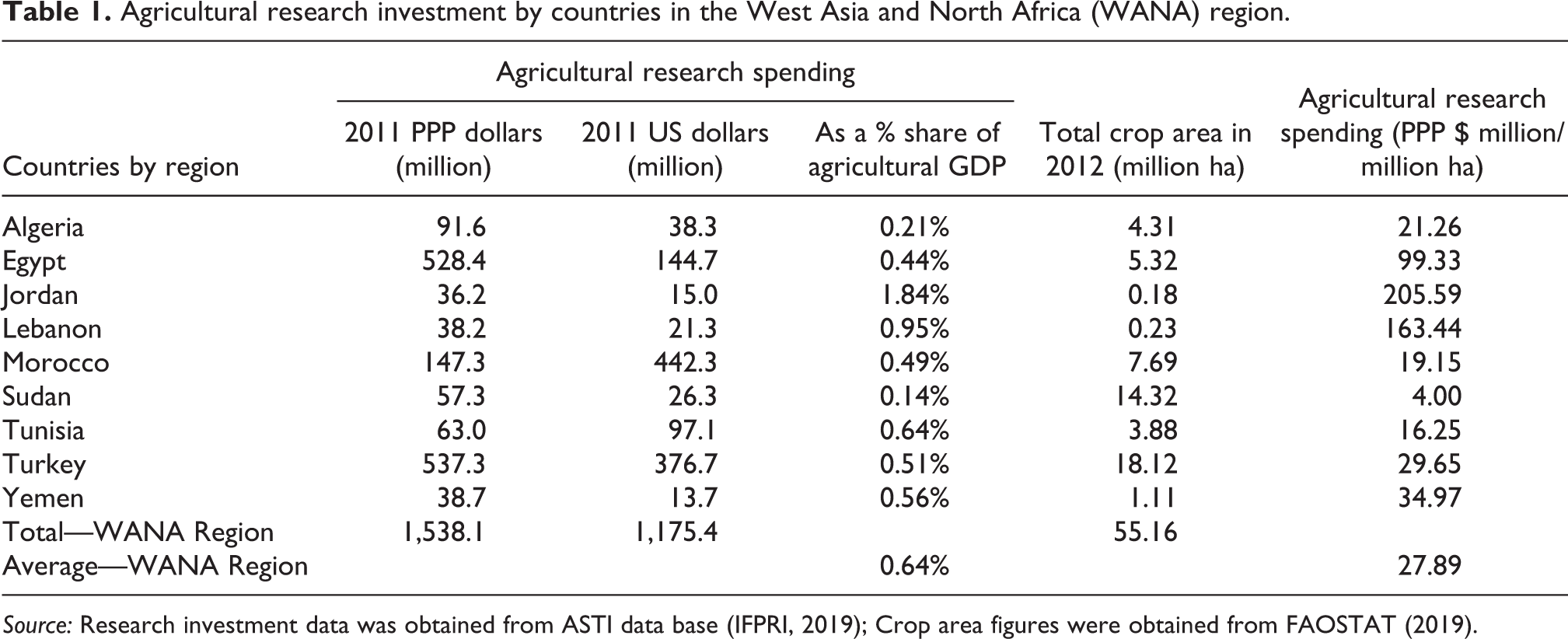
Source: Research investment data was obtained from ASTI data base (IFPRI, 2019); Crop area figures were obtained from FAOSTAT (2019).
Despite the relatively low research investment in Morocco, Bishaw et al. (2019) documented that 30 varieties were submitted by INRA-CG for release between 1998 and 2012. However, only 10 had been released none of which were cultivated by farmers as of 2012. Yigezu et al. (forthcoming) and Lantican et al. (2016) concluded that while many new varieties are being developed by INRA-CG, the stringent multi-location testing for release regardless of the agroecology for which the variety was bred has been preventing the release of most. This is because, to exploit the potential of some specific traits which manifest in specific agro-ecologies, INRA-CG has since the early 1990s started breeding for specific mega-environments (rainfed and irrigated). Some of these varieties may not compete with the best local checks in the mega-environments for which they were not bred—putting them at a disadvantage in the face of wide adaptation testing.
For the few varieties that passed the testing and were released, Yigezu et al. (forthcoming) identified an ill-conceived variety licensing contract used by INRA which does not compel the company to produce a certain minimum amount of seed and uneven playing field for seed companies (only one of them controlling 81% of the certified seed market) as the culprits preventing newly released INRA-CG varieties from reaching farmers. The studies concluded that macro-level policy and institutional problems provide the explanation for the dominance of old wheat varieties in Morocco. Lack of adequate information, farm, and farmer characteristics provide the micro-level demand side explanations (Yigezu et al., 2019). Alary et al. (2020) also argue that there is some divergence between breeding objectives and farmers’ trait preferences. However, while it provides useful insights, it does not rule out the importance of the new INRA-CG varieties because: 1) the study compares past (not the new) breeding objectives with varieties already under cultivation. It does not also capture the regional and agroecological differences that shape farmer preferences; 2) the new INRA-CG varieties build on the important traits of the old INRA-CG varieties which still dominate the Moroccan landscape (good and stable yield potential, high grain and consumption quality, high market demand, and resistance to diseases and pests). INRA-CG breeders and some seed company personnel agree that the new INRA-CG varieties have superior traits including up to 25% yield gains, resistance to new variants of rust, drought and heat tolerance, and resistance to hessian fly, which has become a major problem for wheat production in Morocco. To keep company secrets, the public institution responsible for variety testing did not provide any records about the traits of the varieties newly released by the other sources making direct comparison difficult. However, based on their experience, local breeders agree that the wide adaptation testing in Morocco favors the broadly adapted old European varieties being released by the other sources a comparative advantage. While all the above studies provided explanations for the low adoption of recent INRA-CG varieties, the question that remains to be answered is whether the investment on INRA-CG has been paying off and is worth the continuation.
Methods
The estimation of the returns to research investment on a given crop is often challenging. It becomes even more difficult when estimation is done for specific technologies such as varieties. The challenge arises from at least three main reasons: 1) Agricultural research builds on progress made in the past (locally and internationally); 2) There is considerable time lag between the introduction and diffusion of the technology (Pardey et al., 2016); 3) It is difficult to separate the productivity gains coming from crop improvement and improvements in agronomic practices and changes in socio-economic, agroecological and natural resources conditions.
Several studies provide reviews and meta-analyses of the literature on the internal rates of return (IRR) and benefit-cost ratios (BCR) for investment on agricultural research in different parts of the world (Hurley et al., 2014, 2016; Pardey et al., 2016). Norton and Davis (1981) classify such studies into two, namely ex-post and ex-ante. In their meta-analysis, Alston et al. (2000) make a distinction between ex-post benefits that were derived from econometric models (especially in which the lag structure is modeled econometrically) and those derived from explicit (or implicit) economic surplus models. They argue that the two are not mutually exclusive, as some studies use both methods. In this study, we use the combination of the two. Despite the increase in productivity gains in Morocco, fast growth in population and per-capita consumption have increased the demand for wheat, causing production to fall short of demand. As a result, the country is becoming increasingly dependent on wheat imports (Yigezu et al., 2019). Given the importance of imports in the market, in this study, we assume an open-economy model where consumer prices are not expected to reduce due to increases in domestic production of wheat. We measure benefits in terms of gross margins (the value of increased production, holding all other inputs and costs constant), which are explicitly assumed to be received by producers. In this sense, as argued by Alston et al. (1996), our approach for valuing additional output still relies upon an implicit economic surplus analysis with zero technology-induced price effects.
This paper attempts to generate a conservative estimate of the benefit-cost ratio (BCR) of investment on wheat improvement research in Morocco. To this effect, first, we use the household-level adoption estimates by Yigezu et al. (2019). The study used the same farm household survey data used in this analysis and included all improved wheat varieties originating from both the INRA-CG and other sources. Then, secondary data on the wheat area at the village, district, and provincial levels during the survey year were used as weights for upward aggregation of the adoption estimates to the national level. To estimate the average treatment effects (ATE) of the adoption of improved INRA-CG varieties on yield and net returns per ha of land, we followed El-Shater et al. (2016) and applied the endogenous switching regression (ESR) model (in the interest of space, detailed description of the ESR model is provided as Supplemental Material). The benefits of ESR are twofold: 1) the model is potent in correcting for selection bias from both observed and unobserved factors; 2) Most past research does not make distinction between productivity gains from crop genetic improvement and other sources of productivity gains including agronomic practices and socio-economic and agroecological differences. By using ESR, we were able to filter the benefits that are exclusively generated because of crop genetic improvements. Finally, the total national benefits from the introduction of the improved varieties coming from the INRA-CG wheat breeding program (TNBIVCG) was estimated as the product of the national adoption level in percentage (NAL), the total national wheat area in hectares (TNWA) and the estimate of the ATE on gross margins per hectare of wheat production (ATEWR).
The annual average total investment on wheat research (TIWR) was computed as the mean of the 2002–2014 (12-years) national and international investments on wheat research in Morocco. As research investments are made in advance and benefits accrue over many years, to make all values comparable by capturing differences in both prices and utility, we have converted all annual investments and estimated benefits per unit area (i.e., the ATE) into their 2010 US$ equivalents using annual discount factors that are published by the National Bank of Morocco. Then, the benefit-cost ratio is generated as the ratio of TNBIVCG and TIWR.
We estimate a variant of the Cobb-Douglas production function which necessitated logarithmic transformation on all continuous variables (income, consumption, farmer age, years of education, distance to the nearest seed market, farm size, wheat area, and all quantities of inputs, etc.) that are included either as dependent or explanatory variables in the ESR model. Table 2 provides the full list of variables included in the model as well as their summary statistics.
Summary statistics for selected variables.
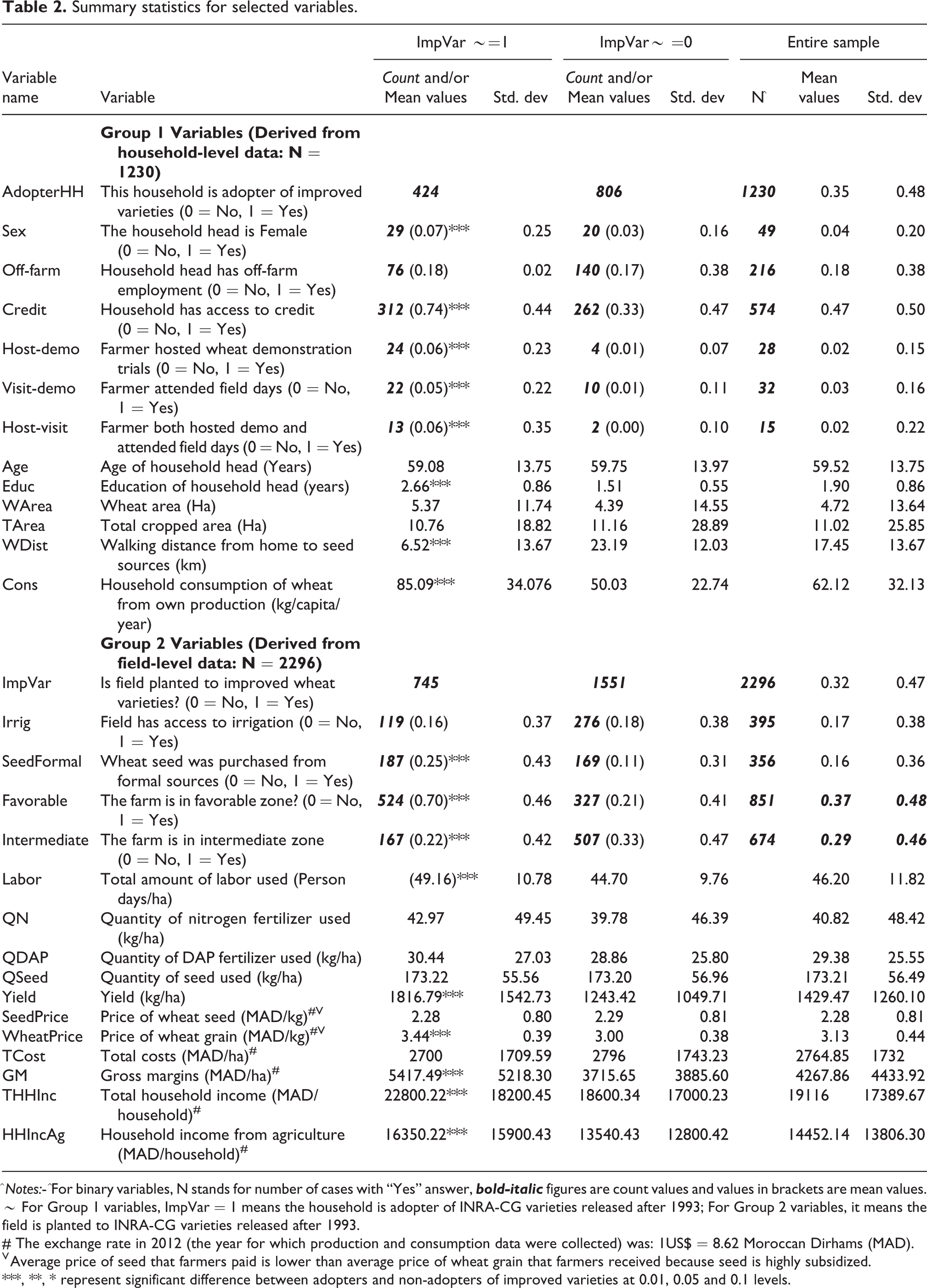
^ Notes:- ^ For binary variables, N stands for number of cases with “Yes” answer,
∼ For Group 1 variables, ImpVar = 1 means the household is adopter of INRA-CG varieties released after 1993; For Group 2 variables, it means the field is planted to INRA-CG varieties released after 1993.
# The exchange rate in 2012 (the year for which production and consumption data were collected) was: 1US$ = 8.62 Moroccan Dirhams (MAD).
V Average price of seed that farmers paid is lower than average price of wheat grain that farmers received because seed is highly subsidized.
***, **, * represent significant difference between adopters and non-adopters of improved varieties at 0.01, 0.05 and 0.1 levels.
Data
Data for the analysis of adoption and impacts of improved wheat varieties came from a large survey carried in 2013 covering 1,230 farm households in 21 major wheat-producing provinces which account for about 81% of the national wheat area. The sample households were drawn using a stratified sampling approach where provinces, districts, and villages were used as strata. The sample was distributed proportionally to farmer population across 292 villages and 56 districts. Structured survey questionnaires were used to collect demographic, economic, social and consumption data from each sample household. Detailed production-related data including field size, name of variety used, quantities of each input used, and agronomic practices used were also collected for each of the 2,296 wheat fields cultivated by all the sampled households. All data collected during the survey referred to the 2012 production season.
Costs and benefits since INRA-CG was established in 1997 are needed for this analysis. However, data on wheat research investment was obtained only for 13 years (2002–2014) from two sources: 1) For national investment on wheat research, we used the actual annual expenditures obtained from the accounting books of INRA (INRA, 2013). The total investment was estimated as the sum of expenditures on personnel, equipment and operations related to breeding, agronomy, entomology and mycology research on wheat and costs of release, demonstration and popularization of new varieties; and 2) For international investment, as discussed in detail in Section 5.4, we used the CGIAR’s global investment on wheat research and total number of improved wheat varieties released reported by Lantican et al. (2016) to generate Morocco’s share. Using the 12-years research investment data, from the two sources we estimated total annual average annual investment cost of wheat research in Morocco and applied it to all years since 1997 with the necessary discounting. We have also used data from the literature to fill data gaps.
Results and discussion
Varietal release
Lantican et al. (2016) reported that globally, the total number of wheat varieties released between 1994 and 2014 was 4,604, equivalent to an average of 0.69 varieties per million ha of wheat area per year. The corresponding figure for the West Asia and North Africa region (WANA) is 1.34 varieties per million ha of wheat area per year. Despite the challenges associated with stringent varietal release system (Yigezu et al., forthcoming), the national varietal release database shows that Morocco has released 113 wheat varieties (from all sources) during the same period which is equivalent to 1.21 varieties per million ha of wheat area per year, close to the regional average.
Table 3 shows the contribution of the INRA-CG to the total number and acreage of improved varieties released in the country. Immediately after INRA-CG started releasing varieties in 1982, the wheat varietal release rate jumped from 0.22 per year pre-1982 to a 5-year average of 2.8 per year between 1982 and 1986. The release rate continued to increase and reached a maximum of 13.25 during 1993–1997. The rate decreased substantially in the following 5-year period (1998–2002) to 2.25 and started to increase afterward but has not reached the levels achieved in 1993–1997 (Table 3). The 5-year period between 1993 and 1997 was especially remarkable because 30% of total and 24% of all INRA 1 releases occurred during this period. Of 14 varieties released during 1993–1997 and grown by farmers in 2012, 9 were from INRA-CG which covered 20.7% of total national wheat area.
Trends in the contribution of INRA-CG in varietal release and in covering the Moroccan wheat area by improved varieties.
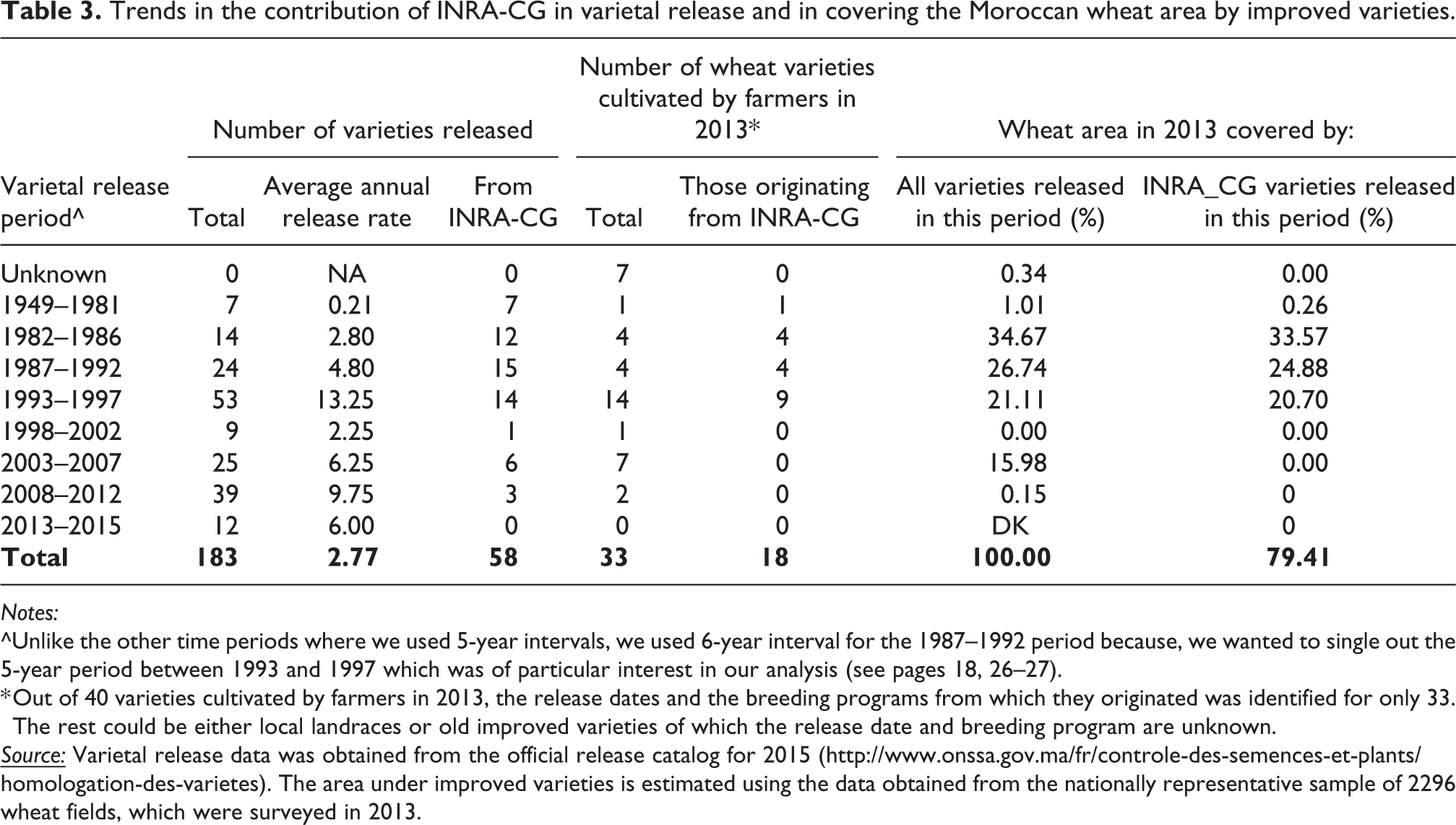
Notes:
^Unlike the other time periods where we used 5-year intervals, we used 6-year interval for the 1987–1992 period because, we wanted to single out the 5-year period between 1993 and 1997 which was of particular interest in our analysis (see pages 18, 26–27).
* Out of 40 varieties cultivated by farmers in 2013, the release dates and the breeding programs from which they originated was identified for only 33. The rest could be either local landraces or old improved varieties of which the release date and breeding program are unknown.
The above table also shows that in 2012, 82.5% of total national wheat area was cultivated with varieties released during 1982–1997. Of this, 96% (79.2% of national area) was planted with 17 INRA-CG varieties—showing that the partnership between INRA and the CGIAR centers produced varieties with durable presence in Morocco. Since 1998 however, the partnership has been far less effective where despite a good number (30) of submissions, only 10 were released none of which were planted by farmers until 2012. During the same period, a staggering 75 varieties were released by the other sources but only 10 (13%) were under cultivation—showing that the challenges in the release-dissemination continuum, though at a lesser scale, also affect the other sources.
Adoption of improved varieties
Survey results showed that 40 wheat varieties were cultivated by farmers in 2012. Out of 27 varieties whose breeding programs were identified, 17 originated from INRA-CG. With an area-weighted national average varietal replacement rate of once in 22 years, very old varieties still predominate in Morocco where more than 58% of the growers are still cultivating varieties which were released before 20 years. The top 10 varieties covered 92% of total wheat area while the top 2 varieties, namely Karim and Achtar (both released before 28 years from INRA-CG) were cultivated by 38.1% of Moroccan farmers.
To serve the purpose of this study, we narrow down the definition of adoption to the use of any INRA and CGIAR-related wheat variety (i.e., those which either have genetic material that originated from INRA, ICARDA and CIMMYT or have INRA and CGIAR inputs in their selection or any part of their breeding) which were released in the last 20 years. Only 9 out of the 17 INRA-CG varieties under cultivation were released in the last 20 years. Analysis of the adoption data shows that most of the farmers have started using the improved varieties since the year 2000 (Figure 1).
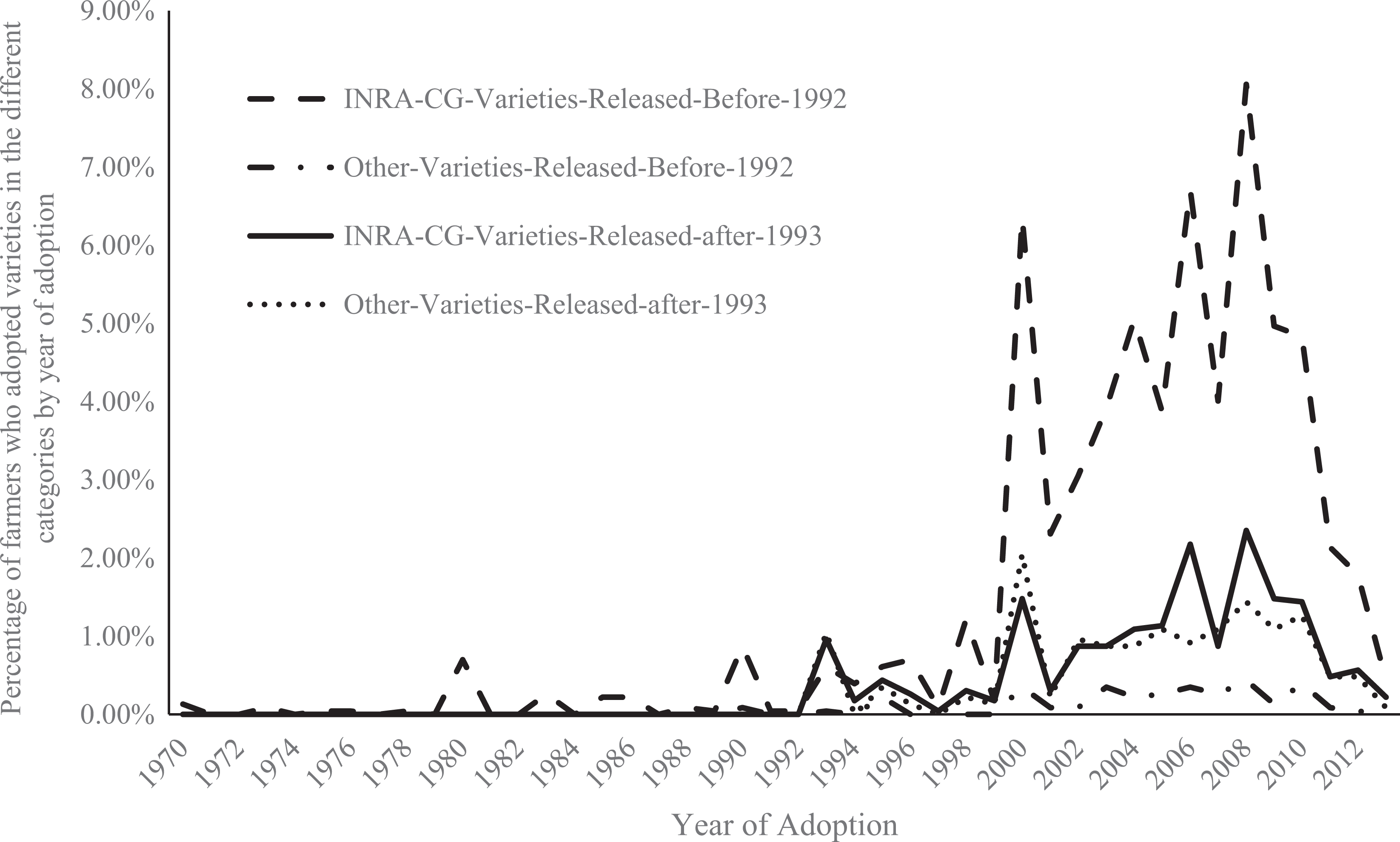
Percentage of farmers who adopted different categories of varieties by year of adoption.
A closer look at Figure 1 reveals that even new adopters are using the older varieties. Yigezu et al. (forthcoming) identify at least three macro-level supply-side policy and institutional reasons and several micro-level demand-side factors for the low adoption levels of more recent improved varieties. Alary et al. (2020) also found some mismatch between breeding objectives of wheat breeding programs and farmers’ trait preferences providing another factor to explain low adoption of recent varieties.
Impact measurement
In impact analysis, one should generally suspect that there could be variables omitted from the model that may have influence both on the treatment (in this case the adoption decision) and on the outcome variables (in our case yield and hence on gross margins). As a result, it is important to test if the treatment variable is endogenous. Given that we have at least two exogenous variables in the selection equation that are excluded from the outcome equation for identification, we carried the Durbin-Wu–Hausman test which showed that the treatment indeed is endogenous—justifying our use of the endogenous switching regression model. We also followed Di Falco et al. (2011) and carried falsification test for the two identifier variables (hosting demonstration trials and visiting field days). The results showed that individually, hosting demonstration has significant (P < 0.01) effect on the adoption decision but not on yield while field day significantly affects neither the adoption decision nor yields. Jointly however, we found that they significantly (P < 0.01) affect the adoption decision but not yield—providing justification for the appropriateness of the identifiers. This result is consistent with the practice because, in Morocco demonstration trials and field days are used mainly to create the exposure among farmers rather than training them.
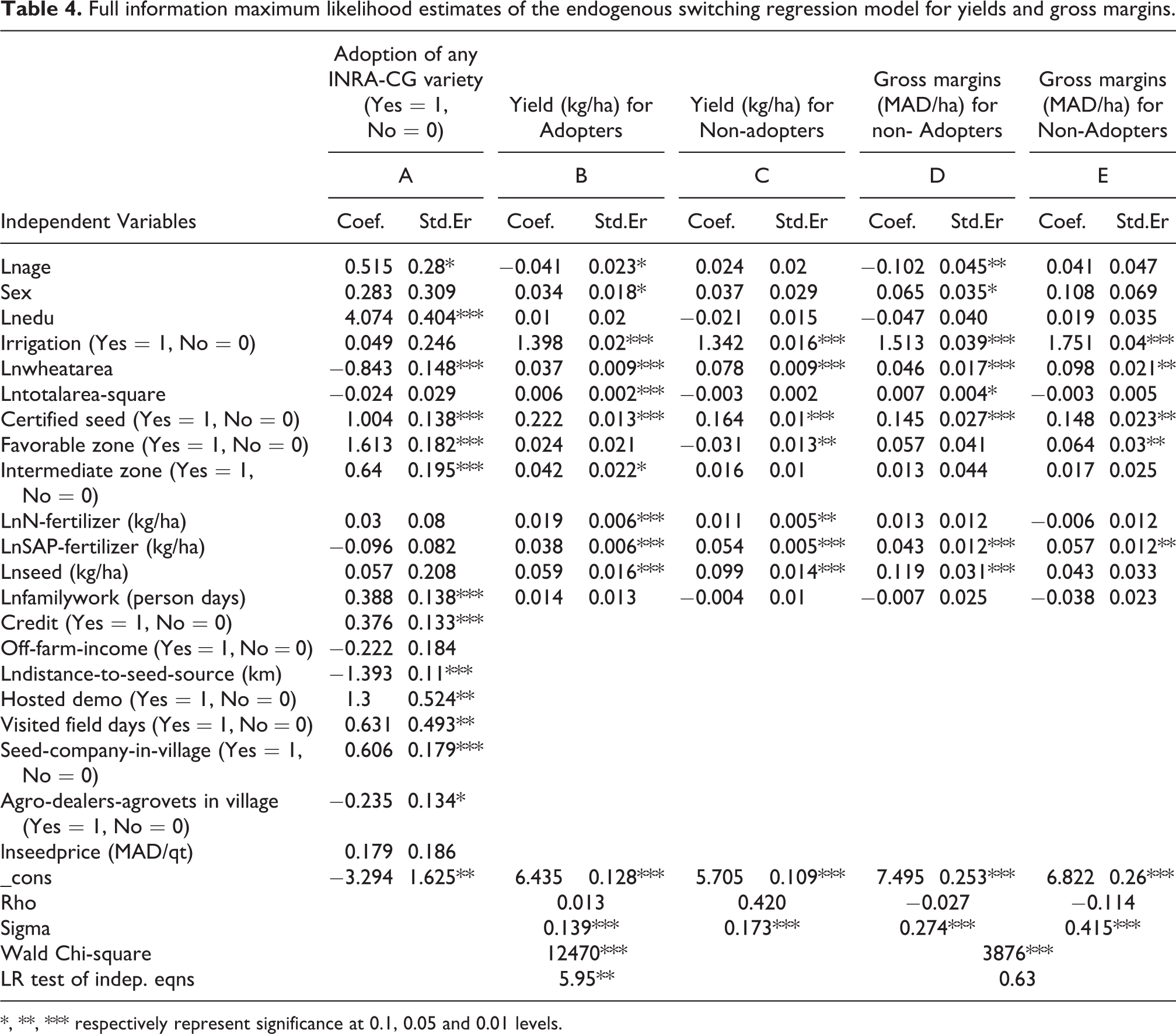
Results of the full information maximum likelihood estimation of the ESR model for yield and gross margin are presented in Table 4. As the main purpose of this section is to measure the impacts of adoption of the INRA-CG varieties, in the interest of space, we omitted the discussion of the factors affecting adoption of the varieties.
Full information maximum likelihood estimates of the endogenous switching regression model for yields and gross margins.
*, **, *** respectively represent significance at 0.1, 0.05 and 0.01 levels.
Model results show that quantities of all inputs and field size have positive and significant effects on yield for both adopter and non-adopters of improved INRA-CG varieties (columns B and C in Table 4). With the exception of sex of the household head, which is not significant and being in the intermediate agroecology which has negative impact, all other covariates have similar impacts on wheat yield obtained by farmers who have not adopted the improved INRA-CG varieties as those who adopted.
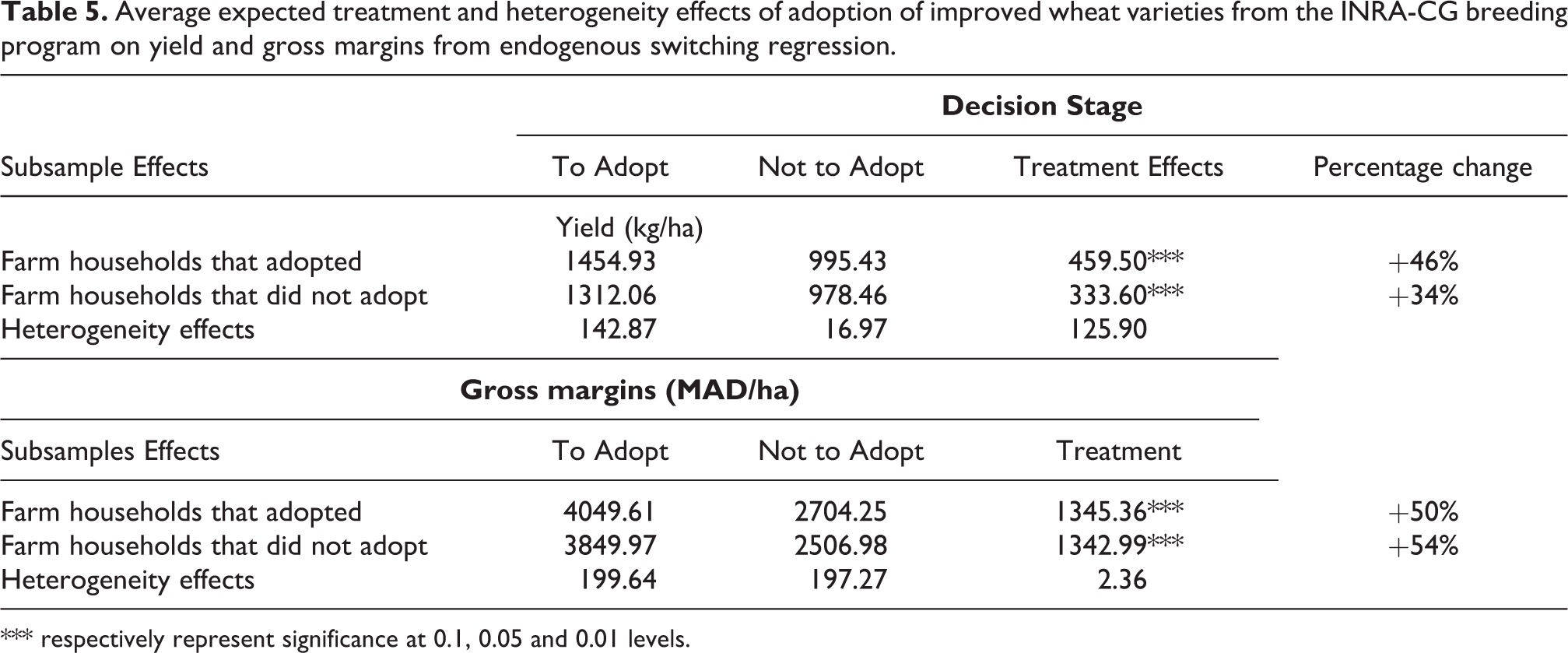
The ATE results presented in Table 5 show that adopters of the INRA-CG varieties were obtaining 460 kg/ha (46%) higher yield and MAD 1345 (US$156) per ha (50%) higher gross margins relative to what they would had they not adopted them. Had non-adopters used the INRA-CG varieties, they would have obtained comparable benefits as those who already adopted.
Average expected treatment and heterogeneity effects of adoption of improved wheat varieties from the INRA-CG breeding program on yield and gross margins from endogenous switching regression.
*** respectively represent significance at 0.1, 0.05 and 0.01 levels.
Estimation of benefit-cost ratio (BCR)
Considering different cost items for inclusion as research investment, Lantican et al. (2016) provide two different estimates of total annual global expenditure on CGIAR wheat research: US$19 million (in 2010 US$ equivalents) and US$22.9 million (in 2010 US$ equivalents). In view of our desire to generate a conservative BCR, in this paper, we use the higher of the two thereby inflating the cost.
To estimate the share of Morocco in total global CGIAR investment on wheat research, we consider two approaches. First following Evenson and Gollin (2003), we use the ratio of the number of CGIAR-related varieties released in Morocco since 1993 (which is 17) and the total number of CG-related varieties released globally since 1993 (i.e., 4,604) 2 as a proxy for the proportion of CGIAR wheat research investment in Morocco out of total CGIAR wheat research investment. The value of this proportion considering only the varieties released since 1993 was 0.37%.
We also followed Lantican et al. (2016) to use the ratio of the total wheat area under CGIAR-related improved wheat varieties released in Morocco and total global wheat area covered by CG-related varieties as another proxy for the proportion of CGIAR wheat research investment in Morocco out of total CGIAR wheat research investment. The share of Morocco in total global wheat area is 1.33% while the share of Morocco in total wheat area under improved wheat varieties is 1.70%.
Taking the higher proportion (1.70%) of the global annual average investment on wheat research, the total annual CGIAR investments on wheat research in Morocco for 36 years (1977–2012) was estimated at US$389,471. The estimate of total national and international investment on wheat research in Morocco was therefore US$517,519.
Based on data from the accounting books of INRA, the total numbers of full time equivalent (FTE) researchers (including technicians) and support staff in a typical year during the 2002–2014 period were only 6.83 and 3.22 respectively. Including expenditures on personnel, equipment and operations, the 12-years average annual national investment on wheat research by the government of Morocco was estimated at about US$128,000 (in 2010 US$).
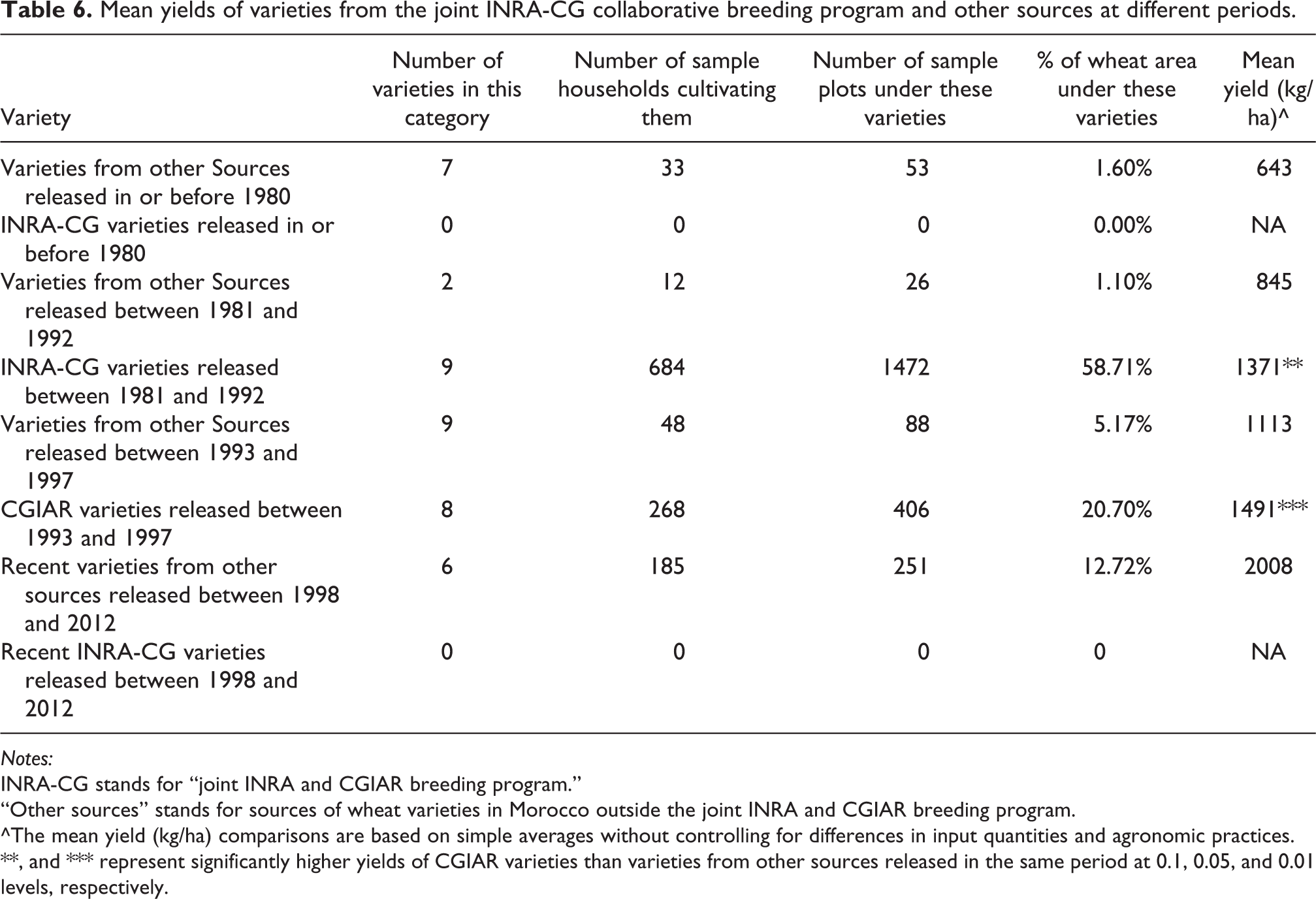
Simple mean comparisons of average yields of varieties from the INRA-CG and other sources show that until 1997, the INRA-CG varieties released at different blocs of time periods had consistently higher yields than those from other sources released in the same time blocs (Table 6). Thereafter however, while newer even higher yielding varieties from the other sources were being released and cultivated by farmers, only few such varieties from INRA-CG were released but none were cultivated mainly due to institutional problems (Yigezu, forthcoming). This phenomenon is casing doubt and raising questions among donors and policy makers if the continuation of national and international investment on wheat research in Morocco can be justified.
Mean yields of varieties from the joint INRA-CG collaborative breeding program and other sources at different periods.
Notes:
INRA-CG stands for “joint INRA and CGIAR breeding program.”
“Other sources” stands for sources of wheat varieties in Morocco outside the joint INRA and CGIAR breeding program.
^The mean yield (kg/ha) comparisons are based on simple averages without controlling for differences in input quantities and agronomic practices.
**, and *** represent significantly higher yields of CGIAR varieties than varieties from other sources released in the same period at 0.1, 0.05, and 0.01 levels, respectively.
Answering the above question in the absence of more recent varieties from INRA-CG under cultivation requires conducting simulations by creating different possible scenarios about: 1) the likely outcomes in terms of wheat variety adoption in the country; and 2) wheat yield gains had more of the recent INRA-CG varieties been released and their seeds made available to farmers.
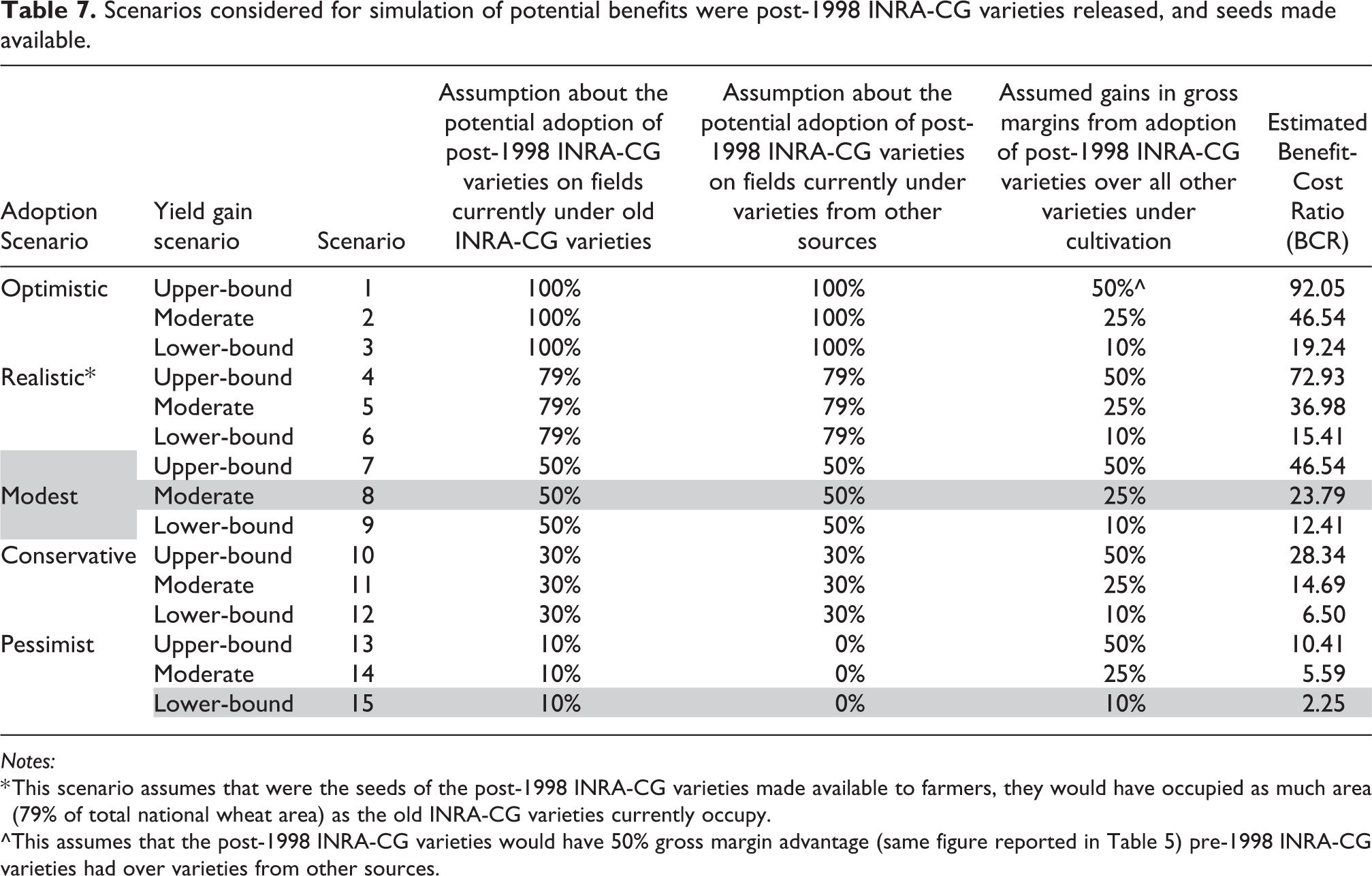
The premises for the scenario analyses that we carried are: 1) the most recent INRA-CG varieties build on the good traits of the old INRA-CG varieties which are dominating the Moroccan landscape. Therefore, had the seeds of those already released (and at least some of the rejected ones) been made available, they would be desirable by farmers; and 2) the release of 10 INRA-CG varieties after 1998 shows that these new varieties have higher yields than the old INRA-CG varieties that dominate the Moroccan landscape and possibly all the old and some of the new varieties from the other sources which currently occupy 12.72% of total wheat area in the country. While we have considered 15 different scenarios and carried the analysis (Table 7), in the interest of space, we discuss below only Scenario 8 which we consider is a modest scenario for the purpose of this paper.
Scenarios considered for simulation of potential benefits were post-1998 INRA-CG varieties released, and seeds made available.
Notes:
* This scenario assumes that were the seeds of the post-1998 INRA-CG varieties made available to farmers, they would have occupied as much area (79% of total national wheat area) as the old INRA-CG varieties currently occupy.
^This assumes that the post-1998 INRA-CG varieties would have 50% gross margin advantage (same figure reported in Table 5) pre-1998 INRA-CG varieties had over varieties from other sources.
In scenario 8 (modest scenario), we assumed that: i) Were the seeds of most recent INRA-CG varieties multiplied and made available to farmers, they would replace part (say a modest 50%) out of the area under the varieties released by the other sources and part (a modest 50%) out of the total area occupied by the older INRA-CG varieties—thereby achieving a total adoption level of 50%; and ii) the most recent INRA-CG varieties would have a moderate advantage in gross margins of only half as much as that INRA-CG varieties had during the 1993–1997 period over varieties from other sources reported in Table 2.
Yield gains over the years did not come only from the use of improved wheat varieties as weather conditions can lead to different outcomes. As 2012 was an average year in terms of rainfall and temperature, the yield and gross margin benefits estimated using our survey data can be considered as representative of all years. But, we argue that the BCR estimated here will be conservative because: 1) As we don’t have adoption estimates for the pre-1993 period, we included in our estimation only the benefits of INRA-CG varieties released after 1993; 2) The counterfactual group includes farmers who in 2012 cultivated high yielding varieties from other sources which were released after 1998—thereby undermining the yield gains, especially from early releases from INRA-CG; 3) Even though public and CGIAR investment on wheat research in Morocco has generally shown an increasing trend over the 36 years, out of lack of data for the period 1977–2001, we applied the average annual investment for the period 2002–2012 as the average for the entire 36 years (1977–2012) and calculated the total investment since the establishment of INRA-CG; and 4) There is generally between 10 and 15 years’ time lag between variety development and adoption. Therefore, the benefits of the investments made in the last 10–15 years are yet to accrue. However, to avoid the creation of complex scenarios for estimation of these benefits and to make our estimates conservative, we ignore future benefits from research investment in the last decade.
The ATE of adoption of INRA-CG varieties released after 1993 (INRA-CG93) on gross margins was US$156 (in 2012 US$) which is equivalent to US$72.03 per ha in 2010 dollars. The adoption degree of INRA-CG93 was 0.96% in 1993 which gradually increased to reach 20.44% in 2012. Therefore, the total benefits obtained in the last 36 years by all Moroccan farmers who adopted INRA-CG93 was estimated at US$355.83 million in 2010 US$. On the cost side, using the annual average investment by the government of Morocco and the CGIAR for 12 years (2002–2012) and multiplying by 36 years, we estimated the total investment at US$18.11 million (in 2010 US$). These benefits and costs led to a BCR of 19.64. The total wheat area in the country (average for 2002–2012) was 2.91 million hectares. Therefore, at the adoption level of 20.44%, the varieties released between 1993 and 1998 alone have led to 623 million tons (14.8%) additional wheat supply in the country.
Yigezu et al. (2019) documented that none of the post-1998 INRA-CG varieties are being cultivated by farmers. However, were the seeds of these recent varieties made available to farmers, we assume that they would have achieved an adoption level of at least 50% of total wheat area in the country (less than the 79% INRA-CG varieties currently occupy) and only half of the yield and hence gross margin advantages. This means, the benefits from INRA-CG93 until 1998 will be the same as what we used in the above calculation, but adoption would increase at a faster rate after 1989 to reach 50% in 2012 while the gain in gross margins would be only 25% (half of what is reported in Table 5). With these conservative assumptions, for the same cost incurred in the last 36 years, the total benefits from INRA-CG varieties would have been US$431.02 million in 2010 US$ (US$75 million higher than what is currently realized) leading to a potential BCR of at least 23.79. This would also have led to 1.37 million tons (32.5%) additional wheat production (i.e., 17.7% higher than the additional wheat supply already achieved).
Discussion
Given the modest assumptions we made, the BCR of 19.64 that we estimated for INRA-CG is less than the Sub-Saharan African (SSA) average of 30.1 (Pardey et al., 2016). However, under all the scenarios we considered, the BCR is always greater than 1—showing no loss on the investment. For example, in the extremely pessimist scenario (Scenario 15) we considered in this study, were more INRA-CG varieties to be released and their seeds made available, we assumed that they would have achieved only 10% adoption level replacing some of the old INRA-CG varieties and none of the varieties from other sources and would have a yield advantage of only 10%. Under this scenario, we estimated a BCR of 1.92. We argue that even under this extremely pessimistic scenario under which costs are overestimated and benefits underestimated, the return on investment on wheat research in Morocco is high enough for a public good which also has several other benefits not included in the calculation. Even though their profits are included as farmer costs in the calculation of gross margins, the investment cost of seed companies as well as that of the national extension service delivery system are assumed as given.
For INRA-CG, the primary objective is to develop improved wheat varieties that can replace older varieties and enhance food and nutrition security and higher income for poor farmers. In this regard, older INRA-CG varieties are still contributing substantially but the recent varieties are not. Even though most of the recent varieties are not being released and the seeds of those released are not being produced and disseminated, INRA-CG is on track in terms of having varieties that can be readily used when needed. If and when the policy and institutional problems are solved, Morocco will not need to spend 10–15 years to develop new varieties but can bring itself up-to-speed by using or building on the recent varieties which are kept on the shelf.
Breeding helps to develop varieties and make germplasm with desirable qualities readily available to help countries respond to emerging biotic and abiotic stresses quickly, especially in emergency conditions. As we don’t have a good example to cite from Morocco, referring to an Ethiopian experience might help in making our point here. Despite the availability of more recent improved wheat varieties, most Ethiopian farmers were using old improved varieties until about 2010 (Shiferaw et al., 2014). After the rust epidemic which hit the country very hard in 2010, the presence of readily available rust-resistant varieties from CIMMTY and ICARDA enabled the country to continue wheat production through a fast-track variety testing and release (FTVR) system. In this effort, 40 sets of 6523 wheat entries from ICARDA and CIMMYT international nurseries and 41 sets of 3504 wheat entries/lines from NARS were evaluated, and five rust-resistant wheat promising lines identified for verification and release in 2014 (Bishaw et al., 2016). This approach also gave priority for adaption of resistant varieties from abroad for quick release and multiplication of seeds of candidate varieties. As a result, a total of 10 stem rust and/or yellow rust-resistant varieties were released through accelerated and/or regular approaches between 2010 and 2014. Dis-adoption of the susceptible varieties and replacement with new, rust-resistant varieties has subsequently been reported (Jaleta et al., 2019). In this regard, low or no adoption of most recent improved varieties from the INRA-CG does not mean that the germplasm that is being developed has no value.
If, and when Morocco or other countries need varieties with the traits contained in the new INRA-CG varieties, they will be available for immediate use. Moreover, the breeding program is also expanding the genetic resource base, thereby preventing the ever-increasing erosion of genetic resources. Therefore, despite the institutional problems that are limiting the ability of public and CGIAR centers to achieve higher impacts, the INRA-CG breeding program is still making significant contribution to the overall national and international food and nutrition security and poverty alleviation, disaster prevention, and agrobiodiversity enhancement efforts.
Conclusions
A nationally representative sample of 1,230 farm households showed that despite the availability of more recent improved wheat varieties, 59% of the total wheat area in Morocco is covered by varieties that are more than 20 years old. However, despite their old age, INRA-CG varieties cover over 79% of total wheat area in the country. Past research has attributed the slow varietal replacement in the country to three main macro-level supply-side policy and institutional factors and several micro-level demand-side factors, including farm and farmer characteristics. In the period 1998–2012, these constraints prevented the release of 20 (out of 30) varieties submitted from the joint national public and CGIAR wheat research program (INRA-CG). Because of the same problems, none of the 10 varieties released were cultivated by farmers until 2012 casting doubt if national and international investment on wheat research in Morocco is paying off. This paper tried to provide evidence that will help clear the doubt.
Results of an endogenous switching regression model showed that adoption of more recent (<20 years old) INRA-CG varieties led to clear economic and food security advantages. Even with overestimated costs of US$18.11 million and underestimated benefits of US$355.82 million (both in 2010 US$), we estimated that INRA-CG varieties which were released before 1993 generated a benefit-cost ratio (BCR) of 19.64. Considering the extremely conservative assumptions made, other benefits from the breeding program not included in the calculation such as biodiversity conservation and preparedness for climate change, and institutional problems preventing the release of newer INRA-CG varieties and the dissemination of their seeds, such level of a BCR can be considered high. The varieties also generated an additional wheat supply of 623 thousand tons (14.8% increment). With yet more conservative estimates and pessimistic future outlook for the adoption and yield advantages from post-1998 INRA-CG varieties, we estimated a potential increase of the BCR to 23.79 and an additional wheat supply (on top of what is being realized now) of 17.7%—making the investment on wheat research in Morocco even more worthy.
Despite their old age, improved wheat varieties from public and CGIAR centers (INRA-CG) that are widely cultivated are generating sizeable benefits in Morocco. Moreover, even though policy and institutional constraints are limiting the ability of INRA-CG to release newer varieties and to make seeds of already released recent varieties available to farmers, given the potential benefits that Morocco can tap from these varieties now and in the future in terms of food security, agrobiodiversity, and in its readiness for potential shocks related to climate change, we conclude that it is financially, economically and strategically rationale for the Moroccan government and the international community to continue and even increase the investment in wheat research in the country. Our results might also be equally applicable to other countries with similar policy institutional challenges in their variety development, release, and licensing and seed systems.
Supplemental material
Supplemental Material, sj-pdf-1-oag-10.1177_00307270211023058 - Are continued public sector and CGIAR investments on wheat crop improvement research justifiable? A Moroccan case
Supplemental Material, sj-pdf-1-oag-10.1177_00307270211023058 for Are continued public sector and CGIAR investments on wheat crop improvement research justifiable? A Moroccan case by Yigezu A Yigezu, Tamer El-Shater, Zewdie Bishaw, Abdoul Aziz Niane, Mohamed Boughlala, Michael Baum and Ahmed Amri in Outlook on Agriculture
Footnotes
Declaration of conflicting interests
The author(s) declared no potential conflicts of interest with respect to the research, authorship, and/or publication of this article.
Funding
The author(s) disclosed receipt of the following financial support for the research, authorship, and/or publication of this article: Funding for this research was obtained from the CGIAR Research Program on Wheat—CRP-WHEAT (Agreement No. 200077).

Supplemental material
Supplemental material for this article is available online.
Notes
References
Supplementary Material
Please find the following supplemental material available below.
For Open Access articles published under a Creative Commons License, all supplemental material carries the same license as the article it is associated with.
For non-Open Access articles published, all supplemental material carries a non-exclusive license, and permission requests for re-use of supplemental material or any part of supplemental material shall be sent directly to the copyright owner as specified in the copyright notice associated with the article.
