



Abstract
While the field of sociophonetics generally views social meanings of linguistic features as indexical and socially constructed, prosodic features have long been argued to have supposedly natural, iconic, universal associations, according to “biological codes,” for example, the frequency code that links high versus low pitch with small versus large body size, female versus male gender (via sexual dimorphism), and hence, affective meanings like uncertainty versus confidence. This study looks at affective meanings of two features of New Zealand English associated with opposing pitch extremes: Uptalk with high pitch and creaky voice with low. In a matched-guise experiment, listeners of different ages were asked to rate short speech samples from young women containing uptalk and creaky voice on a series of affective meaning scales. Results showed that while uptalk was rated more negatively overall, ratings largely aligned with predicted iconic associations of pitch for each scale. However, there were differences by listener age, especially for creak. We argue these results show that the availability of iconic associations of pitch depends on social factors such as the listeners’ beliefs and experience, such as group differences related to age, which affect the seeming naturalness of a given iconic link.
1 Introduction
Within the field of sociophonetics, social meanings indexed to linguistic features are generally considered to be socially constructed (e.g., Eckert, 2008). In other words, sociolinguistic variants are not considered to have inherent pre-linguistic meanings. Prosodic features, however, have long been tied to universal associations according to biological codes (Gussenhoven, 2004; Ohala, 1983, 1994). The most well-known of these is the frequency code, which links voice pitch to physical size: beings who are or appear to be smaller tend to produce higher pitch, and larger beings produce lower pitch. According to the theory, this leads to (seemingly) natural associations between high versus low pitch, female versus male gender (via sexual dimorphism), and affective meanings like submissiveness versus dominance and uncertainty versus confidence. While there is considerable evidence for such associations across languages (see Section 1.1), social factors that could contribute to the establishment of such meanings are usually not taken into consideration, for example, listeners who ideologically identify uncertainty with femininity are far more likely to perceive a female high-pitched speaker as conveying uncertainty (D’Onofrio & Eckert, 2021; Holliday et al., 2023; Winter et al., 2021). Given the renewed interest in non-arbitrary, or iconic, sources of linguistic meaning currently (e.g., Ackermann & Zimmer, 2021; Dingemanse et al., 2015; Winter & Perlman, 2021a), the time is ripe for critical reappraisal of the role of biological codes in the meaning of pitch features, taking into account the role of social factors.
We present the results of a matched-guise rating experiment looking at the affective associations of uptalk and creak by New Zealand English (NZE)-speaking listeners of different ages. Uptalk and creak are typified by opposite pitch values: while uptalk involves a high-rising pitch contour, creaky voice is generally produced with low pitch (Davidson, 2019a; Warren, 2016). Our aim is to look first at the extent to which affective associations of these features match those predicted for high versus low pitch according to the biological codes. Second, we look at whether and how these associations vary according to the social characteristics of the listeners, particularly their age and gender, that is, whether and how indexicality interacts with iconicity in pitch associations. We propose that the availability of iconic associations of pitch depends on social factors such as the listeners’ cultural and linguistic norms and their beliefs and experience, that is, the extent to which the indexical link would seem natural or iconic to them (D’Onofrio & Eckert, 2021; Holliday et al., 2023; Winter et al., 2021; Calhoun et al., 2024). Both uptalk and creak occur in many English varieties including NZE and are currently stereotypically associated with young women’s speech (Dallaston & Docherty, 2020; Warren, 2016). However, creak has previously been associated with masculinity (e.g., see the study by Henton & Bladon, 1988). Therefore, different-aged listener groups may vary in their gendered associations with creak. Furthermore, gender ideology shifts in Western cultures, including New Zealand (NZ), have potentially altered the supposedly natural iconic associations of pitch, affecting indexical associations of uptalk and creak for different-aged listener groups. There is very limited research looking at how iconicity in sociolinguistic variables influences perception (D’Onofrio & Eckert, 2021), and even less perceptual research on pitch iconicity; making this study novel in multiple respects.
In the following sections, we further introduce biological codes and discuss how this supposedly universal theory of “how pitch meanings arise” could be integrated with sociolinguistic understandings of how linguistic features index social meanings. We then define uptalk and creak in relation to iconicity and discuss their gendered used in NZE and how this has changed over time. We then review affective associations of uptalk and creak found in the literature. We show that both features have been linked to a range of affective meanings, many of which are consistent with predictions of the biological codes, but speaker and listener characteristics and context are also important. We then present the results of the rating experiment.
1.1 Biological codes and iconic meanings of pitch
Biological codes have been proposed to “explain what is universal about the interpretation of pitch variation” (Gussenhoven, 2004, p. 74). They link physiological properties associated with the production of different pitches with informational and affective interpretations of pitch features in language. The frequency code links associations of high and low F0 with individual size, based on animal behavior (Morton, 1977; Ohala, 1983, 1994). Larger animals have larger vocal apparatus, therefore producing vocalizations with low F0, with the opposite being true for smaller animals. Morton (1977) observed mammals and birds tended to use lower F0 when acting aggressively and higher F0 when acting submissively, regardless of the animal’s actual size, that is, F0 conveyed apparent size. Following this, Ohala (1994) proposes that affective meanings such as “deference, politeness, submission, lack of confidence are signaled by high and/or rising F0, whereas assertiveness, authority, aggression, confidence, threat are conveyed by low or falling F0” (p. 327). Ohala (1983) extended this to human sex differences because of sexual dimorphism: he argued that as males tend to be larger than females, the relationship between low F0 and dominance is particularly associated with males, and high F0 and submissiveness with females. Ohala did not discuss the distinction between sex and gender: the former being related to biological and physiological characteristics, and the latter to socially constructed characteristics, such as norms, roles, and relationships (Munson & Babel, 2019; Tripp & Munson, 2022). When discussing perceptions of human speech, we must discuss these in relation to gender, as it is the gender people present with and are perceived to have that we usually have access to (Tripp & Munson, 2022). Until recently gender has been widely conceived in Western culture as being binary, resting on a socially constructed (if rightly disputed) assumption of an equivalence between binary sex and binary gender, and this conception is still highly salient (Munson & Babel, 2019; Tripp & Munson, 2022). Therefore, in this study, we look at associations in relation to binary gender, while recognizing that in future work, it would be interesting and important to look at associations in relation to a wider range of gender identities.
Importantly, while studies have found that F0 may not be a reliable cue to human body size (e.g., Rendall et al., 2005; van Dommelen & Moxness, 1995), listeners strongly associate low pitch with larger body size (Rendall et al., 2007). Furthermore, listeners are very sensitive to vocal cues to male versus female gender in speech, including F0, from a very young age (e.g., Most et al., 2007; Nagels et al., 2020).
There is considerable support from perception studies for the frequency code, which have found high pitch being associated with uncertainty, weakness, dependency, and submissiveness across listeners of different genders, cultures, and language backgrounds (e.g., Borkowska & Pawlowski, 2011; Chen, 2005; Gu et al., 2015; Gussenhoven & Chen, 2000; Tang & Gu, 2015; van Bezooijen, 1995). In particular, the link between low F0 and vocal dominance is widely accepted in the social psychology literature (e.g., Armstrong et al., 2019; Hodges-Simeon et al., 2010; Pisanski & Bryant, 2019; Tsantani et al., 2016). The frequency code is paralleled at the segmental level in an association between small size and high front vowels and large size at back and/or low vowels, which has been shown to be widespread across languages (Blasi et al., 2016; Johansson et al., 2020; Winter & Perlman, 2021b).
Another proposed universal idea is the effort code, linking wide F0 excursions such as uptalk rises, which take more energy to produce, to increased cooperativeness, enthusiasm, and significance, and narrow F0 excursions to disinterest but also calmness (Chen, 2005; Gussenhoven, 2004, 2016; Voigt et al., 2014).
As has been pointed out in a number of recent works, however, despite commonalities in these seemingly natural pitch associations, they are also culturally and linguistically-specific, affected by different groups’ beliefs and experiences (D’Onofrio & Eckert, 2021; Eckert, 2019; Holliday et al., 2023; Winter et al., 2021; Calhoun et al., 2024). For example, Winter et al. (2021) looked at the link between politeness and pitch in Korean, Japanese, Chinese, Catalan, Austrian German, and German using a common production task. They found that pitch was either lowered or did not differ between the polite and non-polite conditions for these languages, contrary to many earlier studies and Ohala’s (1983) predictions (see also the study by Holliday et al., 2023). As Winter et al. (2021) point out, the link between high F0 and politeness depends on the link between high F0 and submissiveness, that is, the speaker signals politeness by appearing non-threatening to their interlocutor (what Brown & Levinson, 1987 call “negative politeness”). However, as decades of politeness research has shown, this is only one of multiple ways of signaling politeness, depending on the speaker’s cultural and linguistic norms and the context (e.g., Culpeper et al., 2017). Winter et al. (2021) suggest that low pitch may be linked to polite speech through “prosodic mitigation,” that is, more formal, damped down, and composed speech (arguably consistent with the effort code). Similarly, Holliday et al. (2023) show Korean listeners have similar pitch associations for submissiveness to English listeners, but not politeness, showing politeness and submissiveness are not linked in Korean. Winter et al. (2021) argue that iconic pitch associations show “pluripotentiality,” that is, different physical associations of pitch (including those consistent with the frequency and effort codes) can lead to multiple different meanings.
Currently, there is considerable evidence that pitch features can and do reflect iconic associations consistent with the frequency and effort codes. However, most of this research does not take into account the role of cultural and linguistic norms and ideologies, speakers’ and listeners’ beliefs and experiences, and the situational and discourse context, in making such associations available. In this research, we are particularly interested in the effect of differences between listener groups, as exemplified by their macrosocial categories. In understanding how such differences might affect listener interpretation, the notion of indexicality is important (e.g., Eckert, 2008; Jaffe, 2016; Ochs, 1992). Indexical associations can arise from a linguistic feature’s, or sign’s, distributional use or from salient uses by certain social groups (Kiesling, 2009; Ochs, 1992). One feature may point to multiple social meanings, or an indexical field, according to their situated use (Eckert, 2008; Kiesling, 2009).
Critically, speakers and listeners with different beliefs and lived experiences may perceive a particular linguistic variant as indexing different social meaning (Bucholtz & Hall, 2005), for example, depending on their regional background (e.g., Campbell-Kibler, 2009), gender and ethnicity (Walker et al., 2014), and age (Schleef & Flynn, 2015). For example, Campbell-Kibler (2009) looked at perceptions of alveolar [ɪn] and velar [ɪŋ] (ING) variants in American English, finding that if a speaker was perceived to be Southern, neither the variant used nor the perceived class had an effect on intelligence/education ratings, with speakers being rated low regardless. However, if the speakers were thought to be from “anywhere else in the US,” only those perceived as working-class and who used [ɪn] were rated less intelligent/educated. This can be explained by indexical fields: hearing [ɪn] from someone perceived as working-class could index “inarticulate,” but when from someone perceived to be not working class, it could index “unpretentious” (see also the study by Eckert, 2008). If we think of the variants [ɪn] and [ɪŋ] on a scale, then what the evaluative end points are, and indeed whether the scale is evoked at all, depends on listeners’ experiences and beliefs.
The social meanings that a linguistic feature indexes can be arbitrary, that is, established solely by social convention. However, recent sociolinguistic work has discussed how iconicity interacts with indexicality (D’Onofrio & Eckert, 2021; Eckert 2019; Gal, 2013; Pratt, 2018). Eckert (2019) discusses how while iconized connections between physical features and linguistic meanings can appear natural, they are also “the products of cultural constructions of resemblance to things in the natural world” (p. 754). In other words, of the multiple different potential resemblances pitch (or any other linguistic feature) could have, those that align with existing world view of the listener, and the affordances of the context, are most likely to become established social meanings. Gal (2013) terms this rhematization, proposing indexical links may be seeded or strengthened where they align with iconic associations, but only insofar as those associations are supported by speakers’ and listeners’ underlying beliefs and experience.
Prosodic features have been considered less frequently than segmental features in perceptual indexicality literature; however, studies that do exist in this area show similar results to those of the segmental studies regarding the indexicality of social meaning (e.g., Levon & Ye, 2020; Wollum, 2019). Wollum (2019) looked at how uptalk affected perceptions of competency in the speech of young NZE-speaking women in different professional contexts. She found that for listeners in the 18–30 years age group, the presence of uptalk did not affect ratings of competency, and listeners in the 60–72 years age group rated uptalk users as significantly less competent. Uncertainty is frequently associated with uptalk use (Warren, 2016). This association is consistent with the frequency code and is reinforced by beliefs around women in Western society as less competent than their male counterparts (e.g., Regine, 2011). Wollum’s (2019) results reflect that these beliefs are more pervasive among older listeners leading them to hear a young woman using uptalk as indexing an uncertain stance, reinforced by the iconic link. If younger listeners have different, more positive beliefs around young women in professional contexts, they should be less likely to rate women using uptalk as incompetent, and less likely to orient to the iconic link.
1.2 Uptalk, creak, and iconicity
In this paper, we compare uptalk and creak as they involve opposite pitch values, high versus low, which should therefore draw on opposite potential iconic associations stemming from the frequency or effort codes. It should be noted, though, that these are not the only potential iconic associations of high and low pitch, or of uptalk and creak (e.g., see the study by Winter et al., 2021). In NZE, as in many other varieties of English, uptalk and creak are stereotypically associated with similar social groups, especially young women (for further discussion, see the next section).
Uptalk is rising intonation at the end of declarative statements (Warren, 2016; see Figure 1 in Section 2.4). The frequency code is claimed to apply to both high and rising F0 (see the aforementioned Ohala quote), and indeed uptalk has been found to have many iconic associations predicted by the frequency code, including deference and uncertainty (see Section 1.5). Uptalk rises are also similar in form to question rises. Questions are argued to have a quasi-universal association of rising intonation (Bolinger, 1978; Ohala, 1994), via the frequency code association between high F0 and vulnerability and submissiveness. Gussenhoven and Chen (2000) showed listeners with different language backgrounds (each expressing interrogativity differently) all rated utterances with final rising intonation in an unknown language as likely to be questions, consistent with the frequency code.
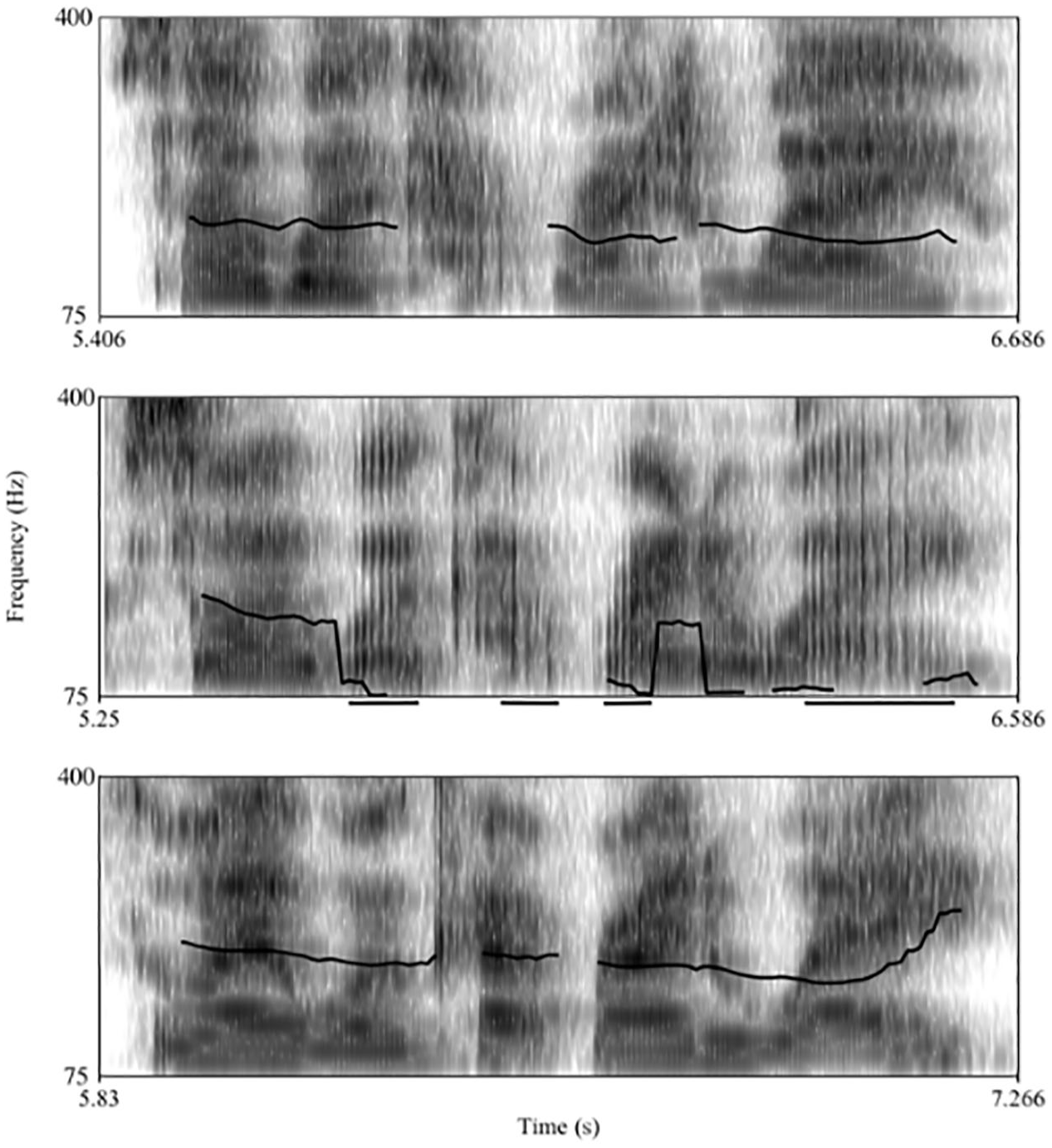
Spectrogram and pitch track of IP “so I woke up right away” in each condition. Neutral condition is shown in the top panel, creak (marked with thick lines) in the middle, and uptalk in the bottom panel.
Creaky voice, or creak, is characterized by “high glottal tension” and very low airflow compared with modal voice (see Figure 1 in Section 3.4 for an example; Davidson, 2019b; Yuasa, 2010, p. 315). While there are different acoustic realizations of creak, low F0 is a consistent and important perceptual cue to creak (Davidson, 2019a, 2019b; Huang, 2020; White et al., 2024). As listeners are so sensitive to its low pitch (Davidson, 2019a), it is likely this contributes to its social meanings through iconicity. Yuasa (2010) claims creak indexes authority, consistent with the frequency code claim that low F0 is iconic of dominance (Ohala, 1983). However, iconic meanings of creak may also stem from its other acoustic properties, like turbulence and roughness (Mendoza-Denton, 2011; Pratt, 2018).
1.3 Uptalk and creak: gendered use in NZE and change over time
Uptalk has been found consistently more in women’s speech across the English-speaking world, including Canada (Shokeir, 2008), Britain (Bradford, 1997), America (Linneman, 2013), and NZ (Warren, 2016). While, in reality, uptalk is used by speakers of all genders, and fairly recent studies of Australian English have found no differences across genders in production (e.g., McGregor & Palethorpe, 2008); it is still stereotypically associated with women’s speech (e.g., Kyrie, 2013; Tyler, 2015).
One study found that within Pākehā speakers (European New Zealanders), women used uptalk three times more than men (Britain, 1992). Even in 4-year-old children, girls were found to use uptalk more than boys (Ainsworth, 1994). While boys are socialized “to be competitive and outdo each other verbally,” girls are taught to be more cooperative in their relationships and their speech (Ainsworth, 1994, p. 16), a stance that uptalk is commonly used to index (consistent with the effort code, see Section 1.4).
Furthermore, uptalk is predominantly assumed to be a feature of young women’s speech. Britain’s (1992) study is the most recent available corpus study of uptalk use in NZE. He found that uptalk rises were used most by 20- to 29-year-old speakers; their use decreasing with increasing speaker age. More recent perception studies indicate that uptalk is still a feature associated with younger speakers today (Warren, 2017). This is supported by recent public media discourse (Warren, 2016).
Turning to creak, an early study using American English speakers referred to creak as an “uncommon and somewhat bizarre” feature of which “small amounts [. . .] may occur at the ends of utterances produced by males” (Monsen & Engebretson, 1977, p. 987). Another early study of British English found that creak was significantly more prevalent among men than among women, where it was suggested to be indexing hyper-masculinity (Henton & Bladon, 1988). Other quantitative studies of Scottish English show similar results (Mackenzie Beck, 1988; Stuart-Smith, 1999). More recently, Gittelson et al. (2021), in a study using crowd-sourced data from over 2,500 speakers in the UK, found creak was more prevalent in male and older speakers. Most US studies report creak is now consistently more common in women’s speech than men’s (e.g., Podesva, 2013; Yuasa, 2010); however, Dallaston and Docherty’s (2020) review of quantitative research on creak shows studies have disproportionately focused on the speech of young American women. In Australian English, studies suggest creak is more prevalent in female than male speakers, or there is no difference, in younger, urban communities (Leung et al., 2022; White et al., 2023), while it is more prevalent in male than in female speakers in rural communities (Loakes & Gregory, 2022); suggestive of a change over time. There are few studies on creak in NZE. Szakay (2012) reports that within older Māori and all Pākehā speakers, creak is used more by women than men, and that all groups, apart from Māori men, became significantly more creaky as age increased (there were only five older Pākehā speakers, so it is difficult to draw conclusions about the interaction of age and gender in these data). Another recent study, looking at creaky voice in NZ women alone, supports that creak is more common in younger speakers (Hornibrook et al., 2018).
Whether or not they are actually used more by young women, both uptalk and creak are stereotyped as features characteristic of young women’s speech in NZ; however, it is probable that creak carried a masculine association one generation ago. Therefore, listeners from different age groups likely have different beliefs and experiences surrounding the gendered associations of uptalk and creak, both in terms of gender in general, and for creak, which gender creak is associated with. Iconic connections reinforce indexical links, so we predict shifts in the perceived associations of each across listeners of different ages.
1.4 Affective associations of uptalk and creak
Affect refers to the attitude or emotion that a speaker brings, or is perceived to bring, to an utterance. Affective stances and personal qualities have been argued to be particularly tied to “expressions of one’s ‘inner self’” and therefore embedded in the idea of “naturalness” (Eckert, 2019, p. 757). Therefore, affect is related to and more likely to be sourced from sound symbolic associations, including of pitch. Studies have found multiple affective meanings for uptalk and creak, many of which we show can be argued to be iconic. The present study focuses on eight affective meaning scales commonly reported in the literature on both uptalk/high pitch and creak/low pitch, which we consider representative of the range found in the literature. Although some of these scales may not technically be affective, we deem them sufficiently similar to be considered together. In the following discussion and our analysis, the scales are grouped into three sets, based on relationships we hypothesize to the biological codes. The first set, physical strength, dependency, and authoritativeness, can be linked to body size and gender, while the second set, certainty, education, and pleasantness/attractiveness, are more related to gender alone. The final set, level of interest and inclusivity, are hypothesized to relate to the effort code, which has less explicit links to gender. We discuss how each affective meaning could stem from the iconic associations related to the frequency or effort codes, and also how they relate to the social background of the speakers and listeners. We include some studies on high and low overall pitch, as well as uptalk/creak. While these are not completely equivalent, as uptalk and creak are now semi-conventionalised features of English, we think they are relevant given that the iconic associations of uptalk and creak should be sourced from their physical properties.
1.4.1 Physical strength, dependency, and authoritativeness
As discussed earlier, the frequency code derives from observations of mammals and birds using lower pitch when acting aggressively and threateningly, and higher pitch when displaying submissive or frightened behavior (Morton, 1977; Ohala, 1983). Ohala (1983) extends these associations to masculinity and femininity, respectively. In addition, high pitch is reminiscent of sounds produced by baby animals. Speakers or listeners may associate high- and low-pitch features with these meanings if they fit in with their experiences and beliefs (Podesva, 2013). For example, listeners who believe women are generally smaller and weaker than men may be more likely to interpret a woman’s uptalk use as indexing a weak stance.
High pitch has been linked to physical weakness and dependency in women’s speech (van Bezooijen, 1995). An early study by Guy and Vonwiller (1984) found Australian women using uptalk were rated as more deferent, claiming “a person who believes that women are passive and compliant could easily come to interpret some characteristic of women’s speech as being itself a marker of passivity or deference” (p. 16). On the other hand, McLemore (1991) found senior sorority members reinforced their authoritative position using uptalk, through associations with high involvement (consistent with the effort code). Uninitiated sorority members used uptalk too, but this was interpreted as insecurity. This highlights the importance of social context: speaker status affected the availability of different potential iconic associations of uptalk.
Borkowska and Pawlowski (2011) found that women’s voices were rated as more dominant when they had lower pitch. Similarly, Yuasa (2010) suggests that using creak could be a way for American women to convey authority through associations with masculinity, although she finds that creak also indexes non-aggression, suggesting it can be used to assert dominance while maintaining a feminine image.
Female speakers with lower pitch are rated as physically strong and independent (van Bezooijen, 1995). Mendoza-Denton (2011) points to the use of creak to portray a tough hardcore persona by Babygirl, a Chicana girl involved in gangs, a persona she claims is not tied to masculinity, although there do seem to be associations with large body size and physical strength. Creak also allows Babygirl to manage her emotions while maintaining her hardcore persona. Pratt (2018) suggests that creak is iconically associated with pain and vulnerability through its perceived roughness, as well as, like for Mendoza-Denton (2011), distancing from the vulnerable act of sharing this pain, associated with independence (see also the study by Levon, 2015).
1.4.2 Certainty, education, and pleasantness/attractiveness
Expressing levels of certainty is another common social meaning of uptalk and creak. Studies suggest these associations are highly gendered. The connection to body size is less straightforward, although uncertainty/lack of confidence could be linked to submissiveness or a lack of threat. Both studies and social commentary have suggested uptalk is indexical of uncertainty/a lack of confidence (Australian English: Guy & Vonwiller, 1984; Tobin & Benders, 2018; American English: McLemore, 1991; Rhodan, 2014; Weber, 2017). Tyler (2015) found such associations were stronger in women’s “stereotypical” utterances with uptalk (about shopping). However, Tobin and Benders (2018) found uptalk was rated as sounding less confident regardless of whether the speaker was perceived to be a stereotypical uptalk user. This points to subtle differences in context and perceived user affecting judgments.
Creak has been found to be indexical of confidence (Irish English: Gobl & Ní Chasaide, 2003; American English: Lake, 2016). Lake (2016) suggests this relates to creak’s use as a means of negotiating emotion. However, in Yuasa’s (2010) study, creak was perceived as marginally hesitant. Yuasa (2010) suggests listeners make an iconic connection between hesitancy and non-continuous airflow of creak production.
Yuasa (2010) also found that creak users were perceived as highly educated, suggesting that a “creaky voice may be . . . being reinterpreted as a new type of [professional] American women’s voice quality” (p. 330). She argues women use creak to “tak[e] advantage of the positive attributes associated with low-pitch male voices” including educatedness (Yuasa, 2010, p. 331). However, Anderson et al. (2014, p. 5) found young American women using creak were considered “less competent, less educated, less trustworthy, less attractive, and less hireable” (relative to modal voice), regardless of age group (although the effect was slightly stronger for older listeners). This is reflected in media commentary where both uptalk and creak, stereotypically from young women, are frequently described as “vile,” “annoying,” and “less educated” sounding (e.g., NZ: Ralston, 2012; America: Wolf, 2015). This may show that the positive supposedly masculine iconic associations of creak, including certainty, educatedness, and attractiveness, are not available to listeners whose worldview makes attributing such qualities to young women unlikely. Relatedly, early studies on attitudes to NZE found female speakers were systematically rated lower than male speakers on educatedness, showing an association between educatedness and masculinity for older NZE speakers (Bayard, 2000). For uptalk, Wollum (2019) found no significant effect of uptalk on perceived education, but some listeners commented speakers using uptalk might have jobs requiring less education.
Speaker attractiveness is often related to pitch. In the study by Borkowska and Pawlowski (2011), high pitch in women’s speech was rated by Polish listeners as more attractive than low pitch until about 280 Hz, at which point it elicited negative responses. Borkowska and Pawlowski (2011, p. 58) suggest very high pitch sounds “babyish,” and therefore unattractive. In British English, Liu and Xu (2011, p. 1274) found that “the most attractive [woman’s] voice is the one that projects a small body size,” that is, the one with the highest pitch; creak was always rated as least attractive (see also the study by Anderson et al., 2014). Conversely, women have rated men with low-pitch voices as more attractive than those with high-pitch voices (e.g., Xu et al., 2013). However, creak is also associated with desirable women in popular media, for example, Scarlett Johansson (Shaw & Crocker, 2015). This suggests again that available iconic associations of pitch depend on listeners’ experiences.
1.4.3 Levels of interest and inclusivity
Uptalk has been found to index enthusiasm and excitement (e.g., Tyler, 2015). The wide pitch excursion of uptalk iconically reflects emphasis, consistent with the effort code; as one of Tyler’s (2015) participants describes it: “The rise was used like an exclamation point” (p. 293). On the other hand, creak has been found to express boredom (e.g., Gobl & Ní Chasaide, 2003). This accords with Lake’s (2016) interpretation of creak as iconically passive (see also the study by Podesva, 2018). Creak is a low-energy feature, which listeners may link to dismissiveness and low levels of interest as per the effort code (Gussenhoven, 2004).
A well-established meaning of uptalk is that of inclusiveness (Britain, 1992; Warren, 2016). It has been shown to have an “other-oriented nature,” checking comprehension and establishing common ground (NZE: Britain, 1992, p. 79; Australian English: McGregor & Palethorpe, 2008), which can be linked to the effort code, that is, increased effort is associated with cooperativeness.
Along with boredom, creak has been associated with friendliness, intimacy, and genuineness (Esposito, 2015; Gobl & Ní Chasaide, 2003; Yuasa, 2010, p. 32), which suggests creak’s restricted amplitude and frequency range “relays a quality of rawness and bareness,” conveying emotional intimacy. As mentioned, however, creak can also index toughness and emotional distance (Lake, 2016; Mendoza-Denton, 2011). These various interpretations are likely the result of context, for example, the conversation topic (Esposito, 2015; Lake, 2016; Mendoza-Denton, 2011) and the listener’s experiences (Gobl & Ní Chasaide, 2003). Listeners may link creak to toughness through size regarding the frequency code; however, if they do not ideologically associate the speaker with toughness, they will be less likely to accept toughness as a stance indexed by them.
2 The present study
In this research, we were interested in, first, whether listeners perceive affective meanings of uptalk and creak in ways that were consistent with hypothesized iconic associations of the frequency or effort codes; and second, whether there were differences in perceived meanings between listener groups, particularly by age. As the studies surveyed earlier show, many affective meanings found for uptalk and creak align with the predictions of the frequency or effort codes, for example, uptalk with dependence and creak with independence. However, they may also differ by context, for example, uptalk can signal authority for high-status speakers. This is consistent with the availability of iconic associations, which may seed indexical associations differing between speaker and listener groups.
We used a matched-guise design to compare ratings of short recorded passages by young female NZ English speakers featuring uptalk, creak, or neither feature by older and younger NZ listeners. We intended the neutral guise to be a baseline to compare the uptalk and creak ratings with. There was a large age difference between the older and younger groups (18–30 vs. 50–75 years), to maximize the likelihood of tapping into generational differences in relevant experiences and beliefs. Participants rated the passages on a series of affective scales (described earlier).
As reviewed earlier, the affective meanings of uptalk and creak can be affected by a wide range of factors related to speaker and listener characteristics and the context. As one of the few perception studies in this area, we decided to focus on group-level differences, particularly age and gender, as a starting point. For creak, age was likely to be relevant given the probable shift in underlying gender associations of creak over the last decades from indexing masculinity to femininity (see Section 1.3). If older listeners still associate creak with masculinity, its use by young women may disrupt and weaken iconic connections (see Wollum, 2019, Section 1.1). This is plausibly related to shifting ideological gender associations. While older listeners were exposed to second-wave feminism in their youth, research has shown that people who grew up in the 1950–70s are likely to have traditional gender roles more deeply ingrained, while younger listeners are likely to have grown up with less strictly defined gender roles and attitudes (Brooks & Bolzendahl, 2004; Scarborough et al., 2021). Finally, there has always been a tendency for older generations to be critical of younger generations (e.g., Feifer, 2019), and when it comes to speech, young women are a particular target (e.g., Ralston, 2012; Wolf, 2015). Older listeners might therefore be more resistant to positive associations of either creak or uptalk (i.e., the positively valenced end of each of the attribute scales) given the speakers were young women, particularly those associated with masculinity. We also looked at the effect of listener gender, as both uptalk and creak are stereotypically associated with female speakers, listeners of different genders might plausibly react differently. However, as we show in the following sections, this did not significantly affect ratings (similar to that observed in the study by Wollum, 2019).
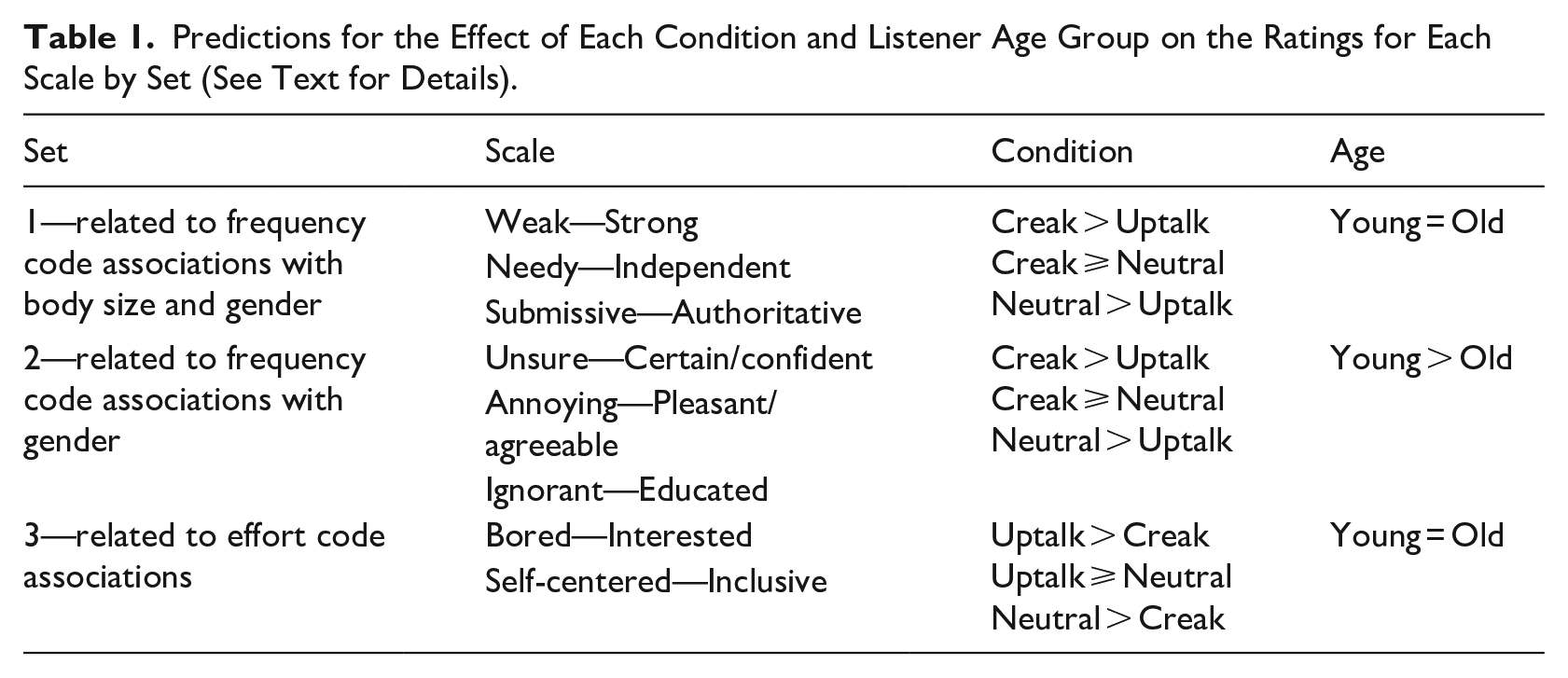
Affective scales were grouped into sets according to the relationship we hypothesize they have to the frequency and effort codes, based on the review in Section 1.4. We predicted ratings for each set of scales to be similar, in terms of the relative ratings of creak and uptalk by listeners in each age group (Table 1). However, as these set groupings were part of our predictions, the scales are separate in the statistical modeling, so that we could see if these sets emerge as predicted in the ratings. We hypothesize the first set is related to iconic connections between body size and gender. Therefore, we predicted creak would be more likely rated as physically strong, independent, and authoritative, while uptalk would be more likely rated as physically weak, dependent, and submissive. While differences in ratings between listener age groups were possible, we predicted they would be relatively small, as associations with body size should hold for both groups. For the second set, iconic pitch associations with gender would predict creak to be rated as more certain, educated, and pleasant/attractive than uptalk. However, we predicted the older group could be less likely to perceive the positive affective associations of creak in young female speakers, as these are associated with masculinity; and indeed it is possible creak may be associated with being less pleasant/attractive in a female speaker (see Section 1.4.2). For the third set, we predicted creak would be rated as more bored and self-centered sounding, and uptalk more interested and inclusive, consistent with the effort code’s predictions. We predicted no differences between age groups as the effort code is not strongly linked to gender. In each case, we predicted the neutral voice condition would be either in between the other two or equal to the more positively associated voice condition (creak or uptalk).
Predictions for the Effect of Each Condition and Listener Age Group on the Ratings for Each Scale by Set (See Text for Details).
3 Methodology
3.1 Speakers
Four speakers were recorded: Three voices for the main experiment and one for the practice block. The voices belonged to native NZE-speaking women aged between 18 and 25 years. These speakers were chosen to be likely stereotypical users of uptalk and creak based on the literature discussed earlier (e.g., Szakay, 2012; Warren, 2017). Selecting this group allowed us to focus our attention on the meanings listeners associate with uptalk and creak used by NZE-speaking young women. Given the complexity of the design, including multiple pitch features, affective scales, and listener groups, it would not have been feasible to also include multiple speaker groups.
The collection of stimuli and survey data was approved by the Human Ethics Committee at Victoria University of Wellington (reference no. 27051). All participants gave informed consent.
3.2 Listeners
Seventy-one listeners’ responses were collected in this study. Two listeners were excluded as they grew up outside NZ, one who reported that English was not their first language, four who reported a history of hearing impairments, and two who recognized one of the speakers. One listener who identified as gender diverse was excluded: unfortunately, as gender was one of the predictors, we could only include people who identified as men or women to get statistically meaningful results. One further participant was excluded for having very low variability in their ratings (the mean standard deviation of their ratings was more than two standard deviations below the mean standard deviation of ratings over all participants), suggesting a lack of engagement with the task. This left a total of 60 listeners’ responses in the analysis. These listeners were native speakers of NZE from two age groups: 18–30 or 50–75 years old, henceforth referred to as younger and older listeners. Fifteen younger men and 15 younger women, 10 older men, and 20 older women were recruited. The initial aim was to recruit 15 men and women in each age group; however, it became apparent that recruitment of older men was more challenging than women in the same age group. Wollum’s (2019) recent uptalk perception study did not find an effect of gender on ratings, so the decision was made to forego the gender balance in the older age group.
Listeners were given the option to go in the draw for a 50-dollar supermarket voucher for their participation in the experiment.
3.3 Stimuli
Five sets of stimuli were created based on stories from the UC QuakeBox corpus, a verbal collection of experiences of the 2010 and 2011 Canterbury earthquakes, providing consistency in topic (Walsh et al., 2013). Real narratives told by young NZE-speaking women were selected and modified to have certain phonological characteristics (explained below). Uptalk is most common in narratives compared to other text types such as explanations or opinions; therefore, adding to the naturalness of the stimuli (e.g., Britain, 1992). The chosen passages did not contain graphic descriptions or overly emotive language and were determined to be fairly neutral overall.
The stimuli were passages consisting of four intonational phrases (IPs) following those in the study by Wollum (2019), allowing for multiple instances of uptalk to occur (Warren, 2016), as in the following example. The full list of stimuli sentences is provided in Supplementary File 1. Stimuli.
1. I remember the September one being in the early hours of the
In the uptalk condition, speakers were instructed to produce uptalk on the bolded words. These words were chosen to be made up mainly of sonorant sounds. This allowed for the best chance of listener perception of uptalk as the F0 contour can be interrupted by voiceless sounds and obstruents (Ladd, 2008, Online Appendix). The first and third bolded words and the final word in the last sentence were chosen to be of two syllables. This was because uptalk rises are characteristically earlier than question rises in NZE (Warren, 2016), and this meant the words were long enough to allow listeners to perceive the earlier rises.
3.4 Recordings
The four stimuli speakers were recorded in a sound-proof room, directly to a MacBook Pro laptop connected to an USBPre2 interface and a Beyerdynamic microphone into Praat (Boersma & Weenink, 2018). Each speaker produced all stimuli (five passages) in all three conditions (uptalk, creak, and neutral; Supplementary File 2: Audio). Speakers were given examples of how each stimulus should sound and coached through the production of creak and uptalk. During the recording sessions, they were able to record the stimuli multiple times, to get the most natural-sounding speech possible while still producing the desired features. Producing natural uptalk rises was easier for some speakers than others; however, during a piloting phase, listeners did not report differences between speakers. The inclusion of speaker as a random effect in the model accounts for between-speaker differences.
Figure 1 shows examples of the stimuli from the utterance “so I woke up right away.” Auditory and acoustic analyses found that within each set of stimuli, the three conditions were noticeably different from each other. There were some audible traces of creak in some of the neutral and uptalk conditions, but these were found near the ends of utterances, a location where creak is significantly less likely to be identified (Davidson, 2019b).
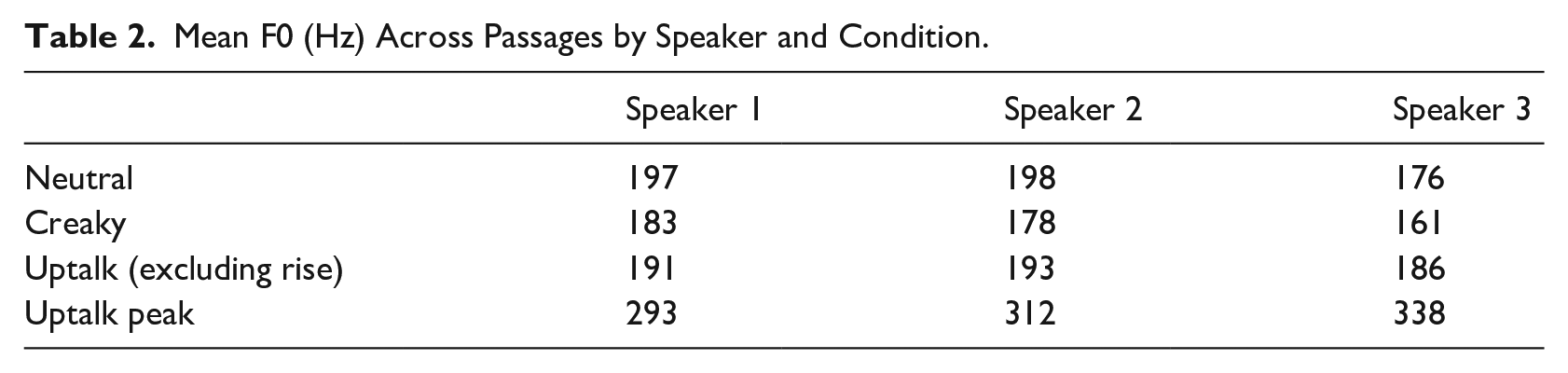
In the uptalk condition, the first three IPs were uptalk, while the last had falling intonation to indicate finality. The mean F0 across passages for each speaker in each condition can be seen in Table 2. F0 measures of uptalk stimuli were taken excluding each final rise. The mean F0 of uptalk peaks for each speaker can also be seen in the table, which shows the peak as considerably higher than the speaker’s F0 in other conditions.
Mean F0 (Hz) Across Passages by Speaker and Condition.
In the creak condition, all four IPs contained creaky voice. The pitch-tracker REAPER was used to identify creak in all passages (Talkin, 2015). As is described in the study by Szakay and Torgersen (2019), REAPER enables the calculation of the percentage of glottal closures spent in creak in an utterance. Results showed that, while all conditions contained creak, on average, passages in the creak condition contained 19% creak, and those in the other conditions contained only 5.5% creak. In the creaky condition, creak was produced throughout each IP. In the neutral and uptalk conditions, creak was generally very brief, or phrase-final where it is significantly less noticeable (Davidson, 2019b).
All recordings were filtered using Audacity to remove any background noise using the noise-reduction effect (Audacity Team, 2019) and scaled to 70 dB so they would be of a consistent loudness.
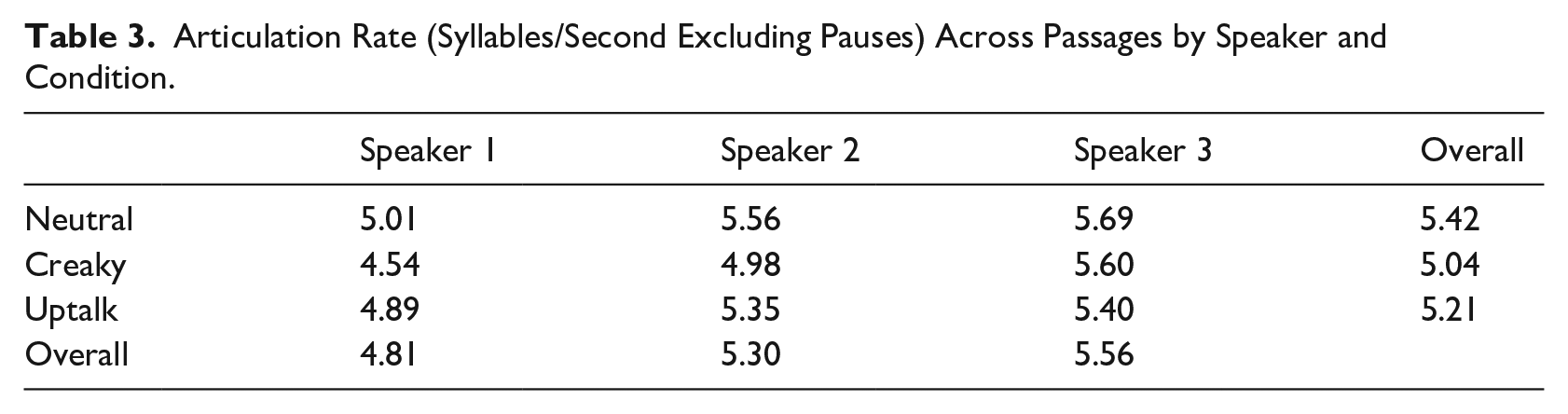
The length of each passage was measured with the average length across speakers and passages being 10.2 seconds in the creaky condition, 9.7 seconds in the neutral condition, and 9.9 seconds in the uptalk condition. Table 3 shows the articulation rate for each speaker in each condition. As can be seen, for most speakers, the neutral condition had the fastest articulation rate, creak the slowest, and uptalk in between; although Speaker 3 showed a different pattern for creak. Articulation rate was not normalized, as we did not want this to interfere with the naturalness of the recordings. It cannot, therefore, be ruled out that listener judgments may have been affected by articulation rate as well as the condition.
Articulation Rate (Syllables/Second Excluding Pauses) Across Passages by Speaker and Condition.
3.5 Attributes
As mentioned in Section 1.5, eight pairs of attributes were chosen for this study: physically strong—physically weak, independent—needy, authoritative—submissive, certain/confident—unsure, educated—ignorant, pleasant/agreeable—annoying, interested—bored, and inclusive—self-centered. They were selected based on the surveyed literature presented in Section 1.4. It was decided to include the pleasant/agreeable—annoying scale rather than any attractiveness scale because both uptalk and creak are often referred to as annoying (Ralston, 2012; Wolf, 2015), and we decided that a wider range of listeners would feel more comfortable rating young women speakers for pleasantness as opposed to attractiveness.
3.6 Design and procedure
Listeners were randomly but evenly assigned to one of three groups. Each of the three main experiment voices was associated with a different condition in each group.
During the experiment, listeners heard the five stimulus passages in each condition (a total of 15 stimuli), which they rated on the eight attribute scales. Stimulus presentation was pseudo-randomized for each listener so that no condition or passage was played twice in a row. Attribute scales appeared in the same order across stimuli for each listener but were randomized across listeners to control for list effects.
The experiment was run online in Qualtrics software from the participants’ homes (Qualtrics, 2019). Participants were asked to use headphones to reduce the risk of distraction and were specifically instructed to base their ratings on their overall impressions of the speaker, rather than the content of the stimuli.
First, listeners heard the two practice passages in the neutral condition in the voice of the fourth speaker. Listeners could listen to these as many times as they wanted, to familiarize themselves with the task and adjust volume. In the main experiment, stimuli played only once to help ensure listeners were basing responses on their initial intuitions. Listeners rated each of the stimuli for each attribute pair on sliding scales. Each scale was marked from zero to 100 in increments of 10. When first presented to the participants, the marker was at the zero point. As the participants slid the marker up and down the scale, they could see exactly which number they were placing it at (shown in Figure 2). They could not move onto the next stimulus until they had moved the marker on all eight scales.
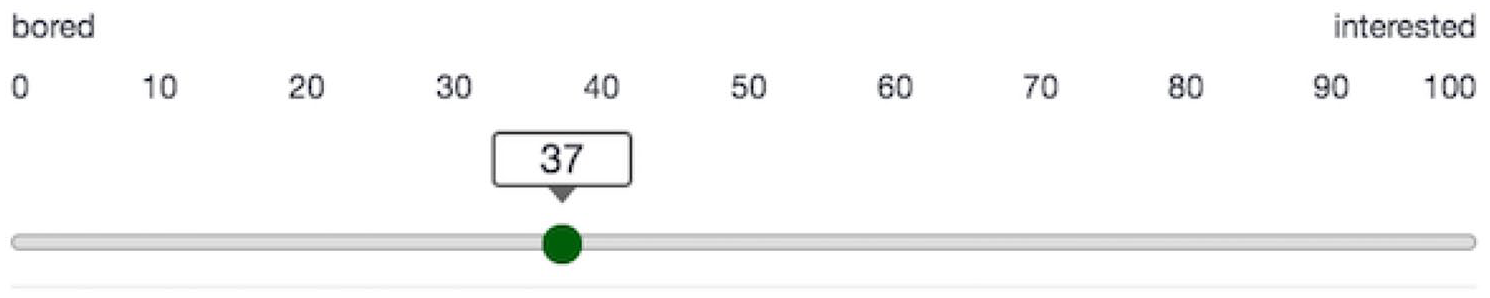
Example scale showing number as the marker is slid across.
After listening to and rating all the stimuli, listeners indicated whether they recognized any of the speakers. They were also asked if there were any features that stood out to them in the speech, and if so, what they were, and whether they used those features themselves. They also filled out a questionnaire about their demographic background.
4 Results
One hundred twenty ratings were analyzed from each of the 60 participants (for a total of 7,200). The mean rating across scales for the neutral condition was 54.9, 51.8 for creak, and 40.8 for uptalk (for all scales, the range was 0–100, with zero the most negative). When broken down by age group, older listeners’ mean ratings of neutral and creak were lower than younger listeners’ (respectively, 53.7 vs. 56.1 for neutral and 50.2 vs. 53.5 for creak), and older listener’s mean rating of uptalk were higher than younger listeners’ (43.6 vs. 38, respectively). While responses to Speakers 2 and 3 patterned similarly, responses to Speaker 1 were different, with generally lower ratings, particularly in the neutral condition. Speaker 1 had a slower articulation rate than the other speakers, although similar mean F0 (Tables 2 and 3). This, or other idiosyncratic properties of her voice beyond the experimental manipulation, may account for this difference. In the model below, speaker is included as a random effect to account for this variation. We also conducted a subsidiary analysis with speaker as a fixed effect, which showed a similar pattern of results for the effect of scale, condition, and participant age as reported in the following section, as well as lower ratings for Speaker 1 across most condition combinations (for details, see Supplementary File 3: Analysis with speaker as fixed effect).
Linear mixed effects regression (LMER) modeling was used to analyze whether the presence of uptalk or creak significantly affected participants’ ratings on each of the eight attribute scales. LMER models were built using the lme4 and lmerTest packages in R (Bates et al., 2015; Kuznetsova et al., 2017; R Core Team, 2019). A full model was created with rating as the dependent variable. The model included as fixed effects a four-way interaction between the attribute scale, stimuli condition (creaky, neutral, or uptalk), participant age and participant gender, and all possible lower-level interactions and simple effects involving these four fixed effects. Condition, order of stimulus presentation, and attribute scale were included as random slopes by participant, and condition, attribute scale, participant age, and participant gender as random slopes by speaker. Including all the scales in one model, instead of having different models per scale, accounted for the similarity in ratings of the different voice conditions across scales, as well as the variation between them. Participants were a fairly homogeneous socio-economic group working in professional fields based on responses to the questionnaire, so socio-economic status was not included in the model.
The step function in the lmerTest package was used to perform automatic backward model selection of the fixed and random effects. The final model is given in (2), and the analysis of variance (ANOVA) of this model in Table 4. The gender of the listener had no effect on ratings, consistent with other recent research in this area (Anderson et al., 2014; Wollum, 2019).
2. Rating ~ age × scale × condition + (1 + stimuli order − participant) + (1 + participant gender − speaker)
ANOVA of Final Model.
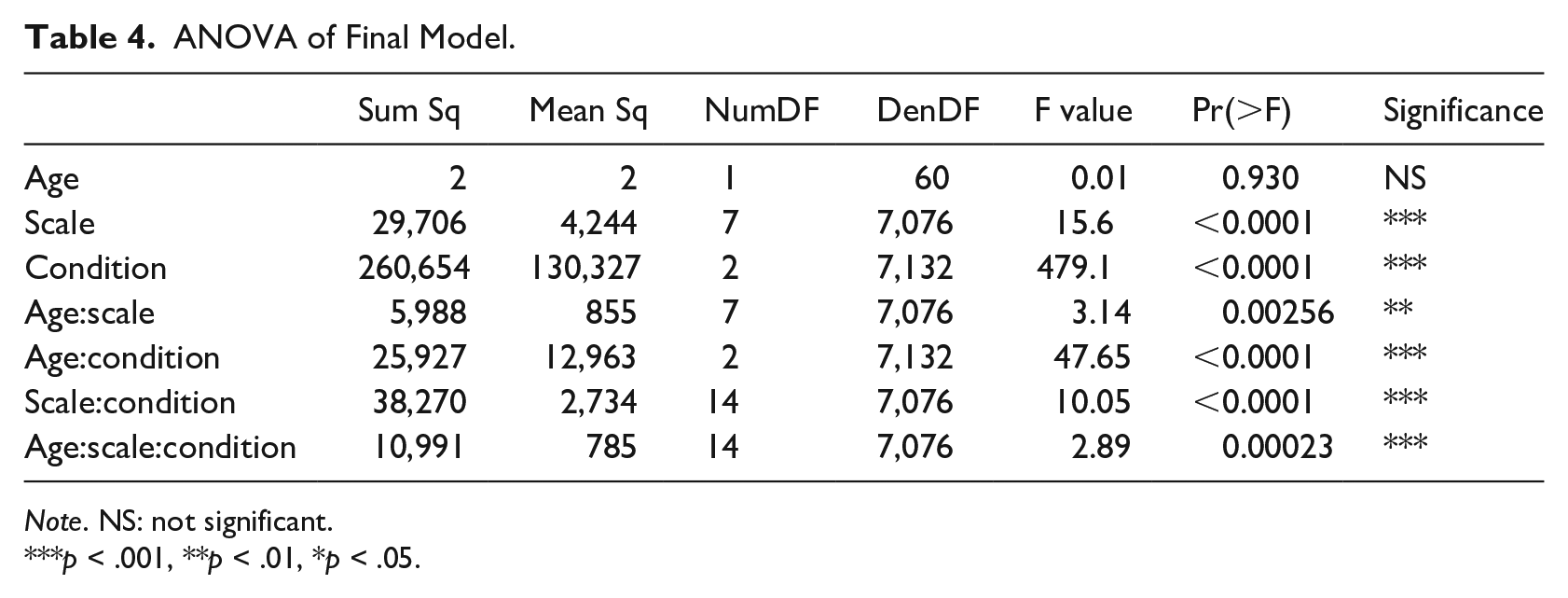
Note. NS: not significant.
p < .001, **p < .01, *p < .05.
Using this model, post hoc pairwise comparisons for the condition and age interaction were conducted over scale with the emmeans package (Lenth, 2018), using the default Tukey adjustment for multiple comparisons. This enabled us to see more clearly the nature of the three-way interaction. The following results are presented in sets of attribute scales, which were predicted to pattern together (see Section 2 and Table 1). However, note these sets were not part of the statistical model. Figures 3–5 were created using ggplot2 and show model predictions (Wickham, 2016).
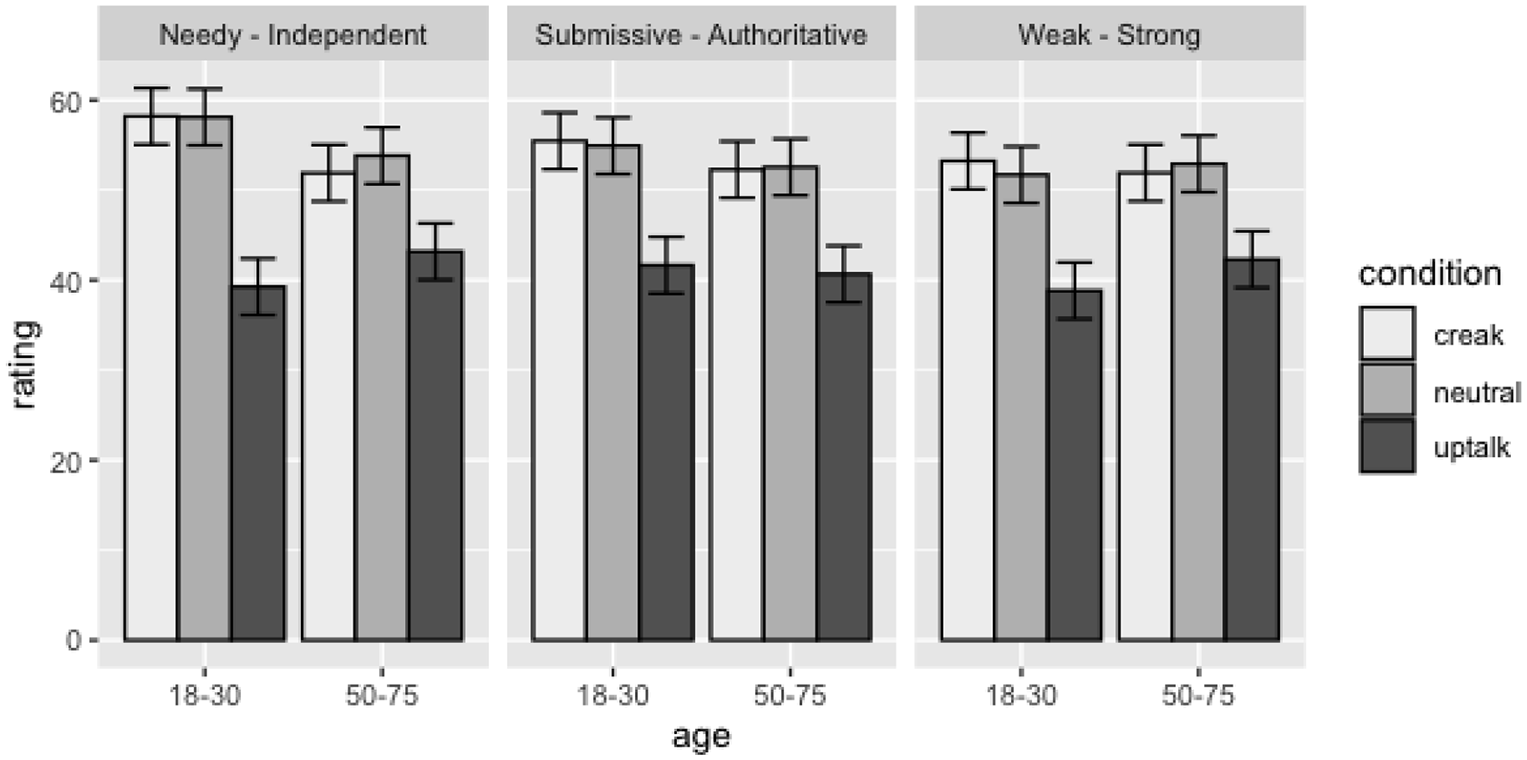
Effect of participant age and stimuli condition on ratings for needy—independent, submissive—authoritative, and physically weak—physically strong. Higher ratings indicate independent, authoritative, and physically strong.
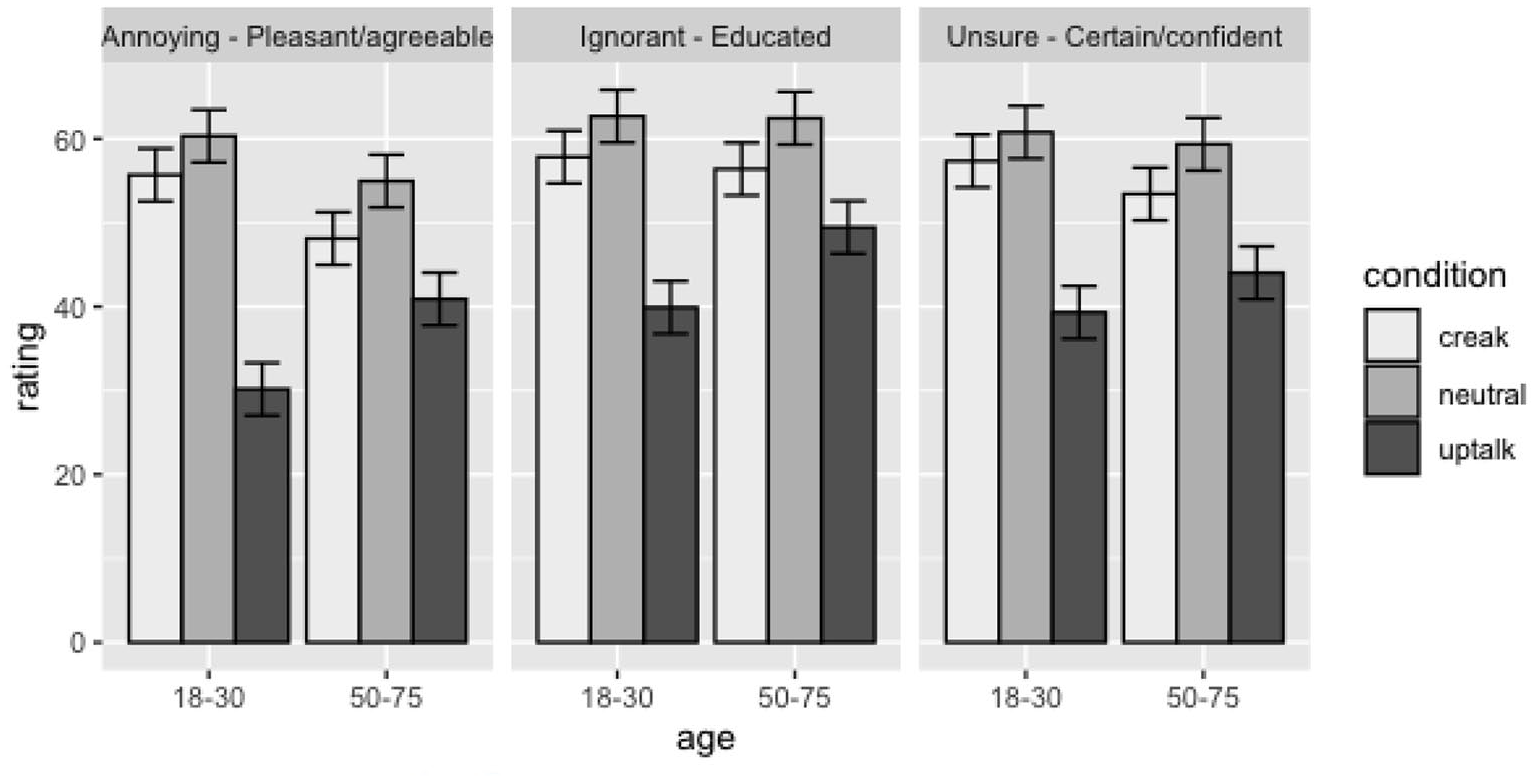
Effect of participant age and stimuli condition for annoying—pleasant/agreeable, ignorant—educated, and unsure—certain/confident. Higher ratings indicate pleasant/agreeable, educated, and certain/confident.
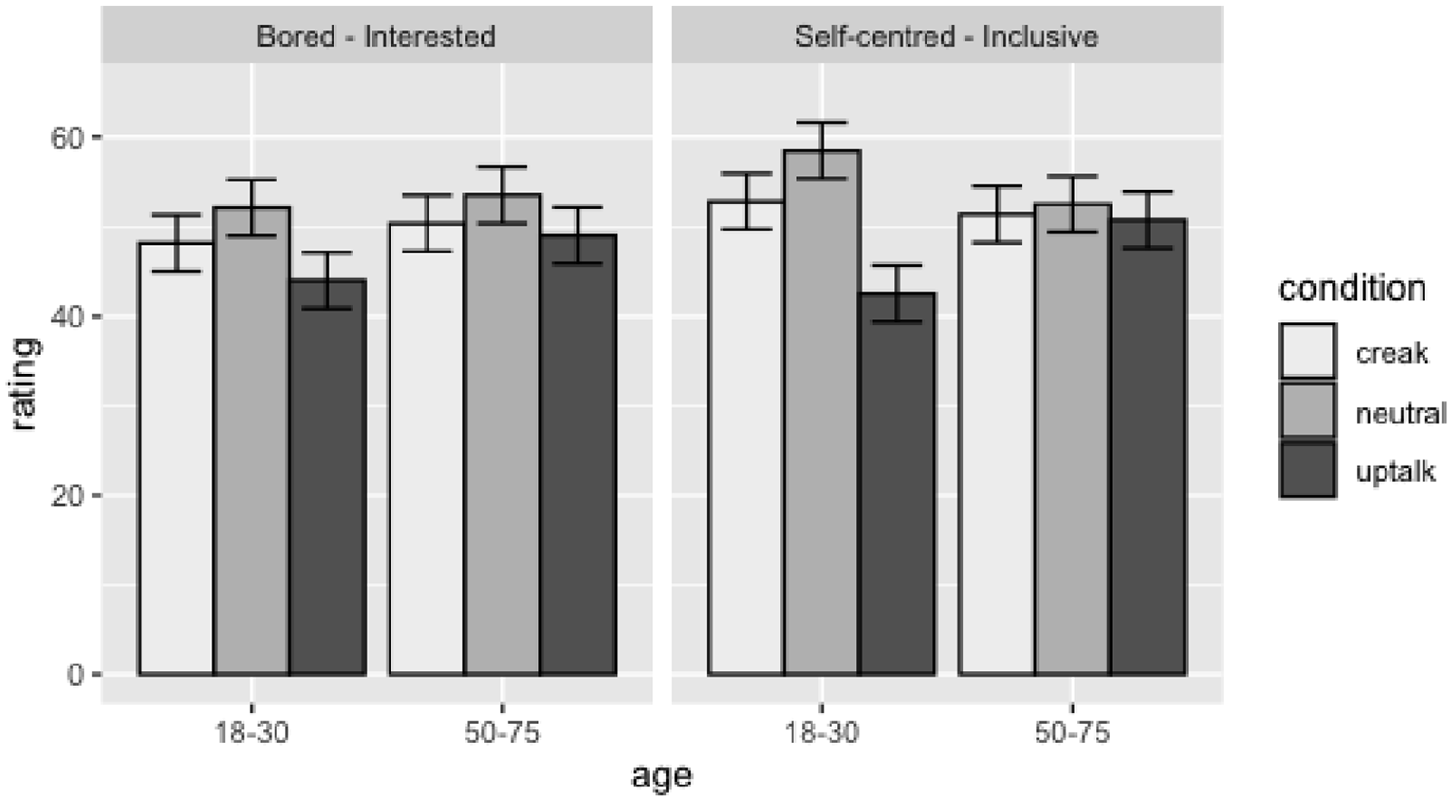
Effect of participant age and stimuli condition for bored—interested and self-centered—inclusive. Higher ratings indicate interested and inclusive.
Figure 3 presents the interaction between age and condition for the needy—independent, submissive—authoritative, and physically weak—physically strong scales. It shows the creaky and neutral stimuli were all rated comparatively more independent, authoritative, and physically strong sounding, and uptalk stimuli were perceived as needier, more submissive, and weaker for both age groups. Post hoc pairwise comparisons confirm this. Within each age group, the neutral and creaky stimuli were rated significantly more positively on the scales than the uptalk stimuli (p < .0001). No significant differences were found between creaky and neutral conditions for either age group.
On the annoying—pleasant/agreeable, ignorant—educated, and unsure—certain/confident scales, the age groups’ ratings patterned differently from each other (Figure 4). For all three scales and for both age groups, neutral stimuli were perceived as significantly more pleasant/agreeable, educated, and certain/confident than uptalk stimuli (p < .0001). In addition, ratings of creak were significantly higher on the scales than uptalk ratings on all three scales for younger (p < .0001) and older participants (p = .0022 for annoying—pleasant/agreeable; p = .0037 for ignorant—educated; p < .0001 for unsure—certain/confident). While there was no significant difference between the neutral and creaky conditions on any of these scales for the younger group, the older group perceived creak to be significantly more annoying, ignorant, and unsure sounding than the neutral stimuli (p = .0045 for annoying—pleasant/agreeable; p = .0189 for ignorant—educated; p = .0228 for unsure—certain/confident).
Figure 5 suggests there was little variation between conditions in the older group on the bored—interested and self-centered—inclusive scales. This was confirmed by post hoc pairwise comparisons, finding no significant differences between conditions for this group. By contrast, the younger group appears to vary more between conditions and scales. On the bored—interested scale, they perceived the neutral stimuli as significantly more interested than the uptalk stimuli (p = .0003), which was opposite to predictions; however, there were no significant differences between their ratings of the neutral and creaky or the creaky and uptalk stimuli. On the self-centered—inclusive scale, the young group rated uptalk as significantly more self-centered than the neutral (p < .0001) and creaky stimuli (p < .0001), again opposite to predictions, and ratings of creak were also found to be significantly more self-centered than the neutral stimuli (p = .0349).
Across all scales, there were no significant differences between the different age groups’ ratings of the neutral and creaky stimuli; however, the younger group perceived uptalk as significantly more annoying (p = .0027), ignorant (p = .0121), and self-centered (p = .0503) than the older group did. Table 5 presents a summary of comparisons between conditions by scale and age group, and Table 6 presents a summary of comparisons between age groups by scale and condition.
Summary of Comparisons Between Conditions by Scale and Listener Age Group.
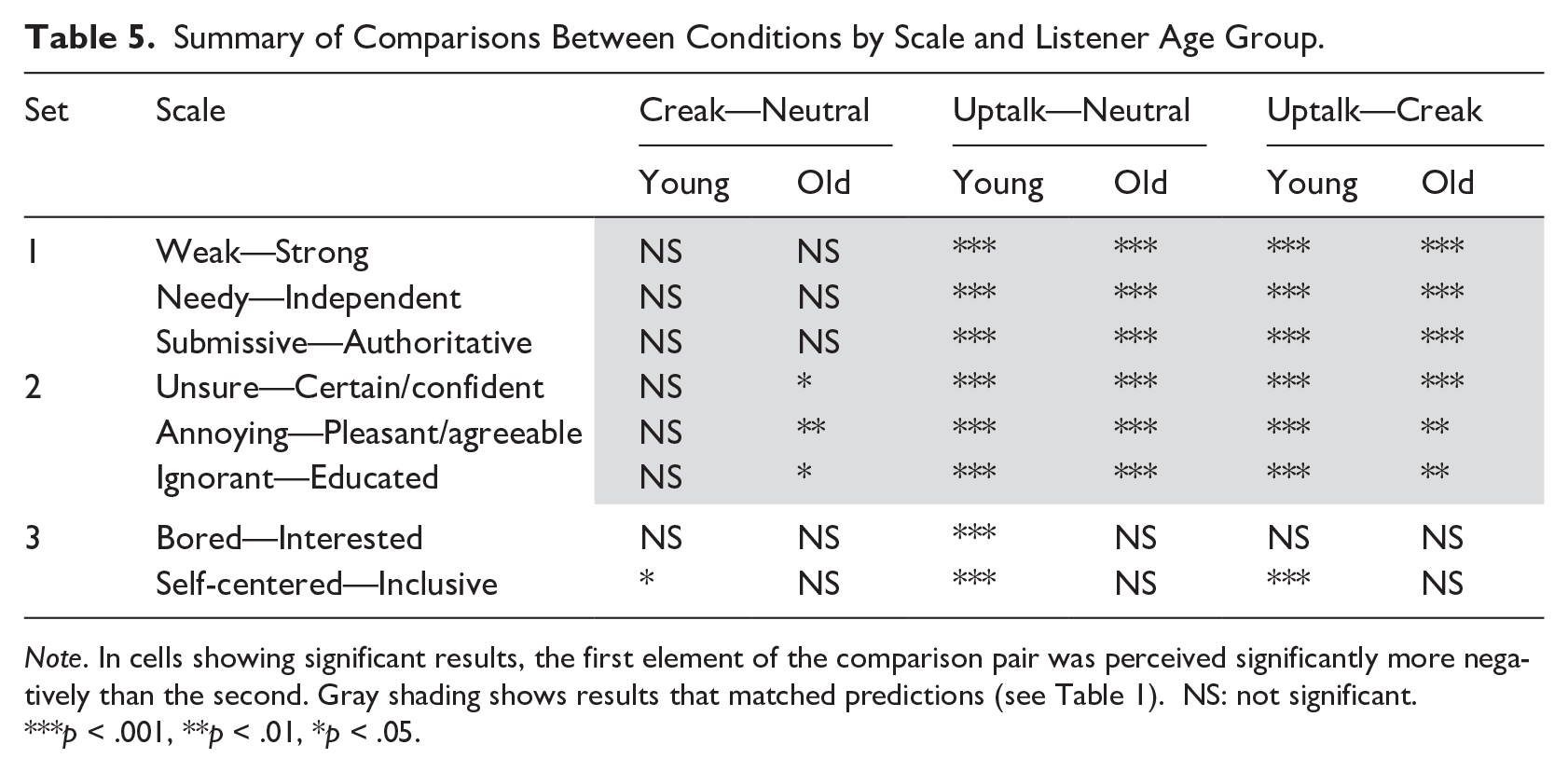
Note. In cells showing significant results, the first element of the comparison pair was perceived significantly more negatively than the second. Gray shading shows results that matched predictions (see Table 1). NS: not significant.
p < .001, **p < .01, *p < .05.
Summary of Comparisons Between Age Groups by Scale and Condition.
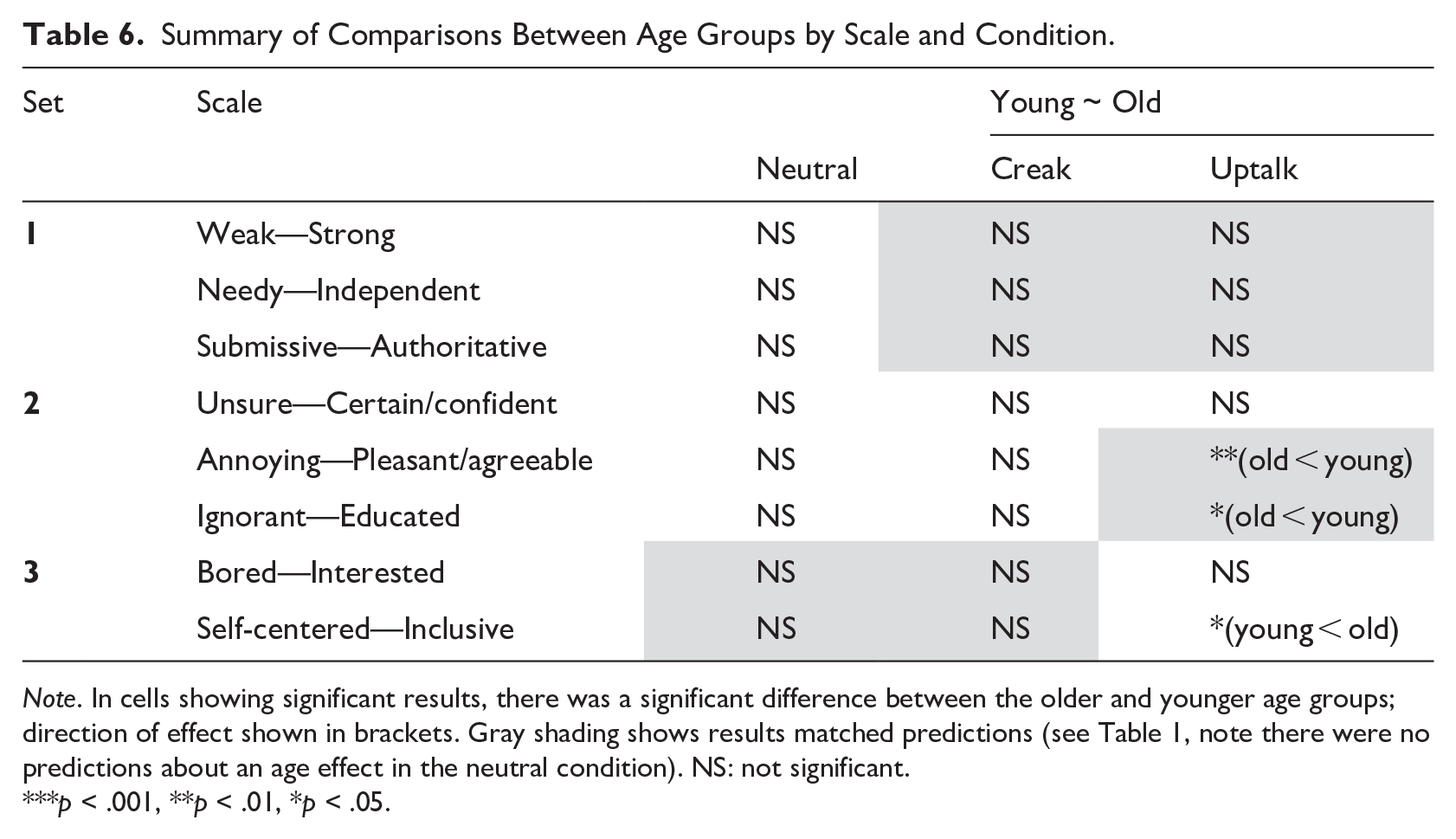
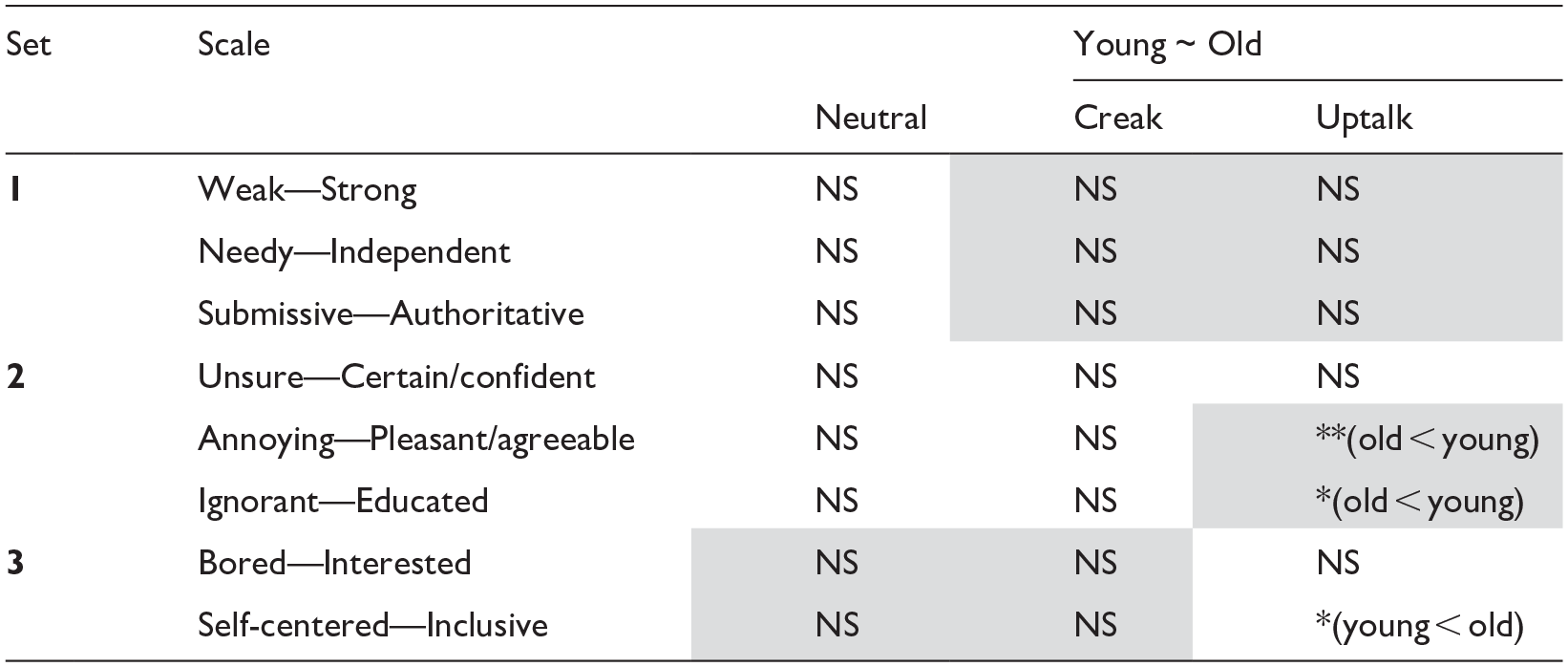
Note. In cells showing significant results, there was a significant difference between the older and younger age groups; direction of effect shown in brackets. Gray shading shows results matched predictions (see Table 1, note there were no predictions about an age effect in the neutral condition). NS: not significant.
p < .001, **p < .01, *p < .05.
5 Discussion
Our aim was to investigate first whether the perceived affective associations of uptalk and creak match the iconic associations predicted by the frequency and effort codes, and second, whether and how these associations differed between listeners’ macrosocial groups, particularly by age. The results of the matched-guise experiment showed that, for the most part, ratings matched predictions of the biological codes; however, there were important differences by age group, consistent with the availability of iconic associations being affected by listener experiences and beliefs related to age.
For the first set of scales, as predicted, a speaker using creak was perceived as more physically strong, independent, and authoritative than a speaker using uptalk (with no difference between creak and neutral) (see Set 1 in Table 5), similar to most previous studies involving creak/uptalk and low/high pitch (see Section 1.4.1). These associations did not differ by age group (see Set 1 in Table 6). These findings suggest the iconic relationship between body size and gender predicted by the frequency code aligns with indexical associations of uptalk and creak for these scales based on beliefs and experiences shared by both age groups.
On the second set of scales, younger listeners perceived creak equally pleasant/agreeable, educated, and confident as the neutral condition, while older listeners perceived creak as significantly more annoying, ignorant, and unsure than neutral, as predicted (see Set 2 in Tables 5 and 6). This is consistent with the changing gendered association of creak disrupting iconic links for the older listeners. That is, for older listeners, who potentially still link creak with masculinity, hearing creak in a young woman’s voice may weaken iconic associations and lead to more negative ratings. For the younger listeners, likely always having associated creak with women’s speech and being in a similar social demographic, positive iconic associations of creak in a woman’s voice are more available. This is similar to the findings of Yuasa (2010) for similar affective meanings, also involving younger listeners.
Why, then, are older listeners still willing to accept creak as physically strong, independent, and authoritative in a young woman’s voice? We suggest the first set of scales link more directly to size than gender. In contrast, the second set of scales likely originate in gender associations, and only indirectly in size. Different-aged listeners are more likely to differ in beliefs and experiences around gender than size, resulting in the different ratings.
All listeners rated uptalk as significantly more uncertain, annoying, and ignorant sounding than creak or neutral, aligning with frequency code predictions. Younger listeners, however, rated uptalk lower on the annoying and ignorant scales than the older listeners. We did not predict this age difference but think it can be explained through gender experiences related to these scales. The many articles and blogs linking young women’s uptalk and creak to annoyingness, ignorance, and uncertainty suggest these are highly salient in public discourse (e.g., Ralston, 2012; Wolf, 2015). We asked participants to provide comments about features they recognized in the speech. Although there is no scope for a full analysis, some quotes provide insight into this discourse:
3. [Uptalk] tended to increase my “annoying” score. Classic female habit and I’m male so I don’t do it.
4. One girl lifted her voice at the end of every statement as if it was a question which made her seem very unsure and even less intelligent.
Younger listeners rating uptalk more negatively, despite being stereotypical users, suggests linguistic insecurity, that is, hypersensitivity to uptalk’s stigmatized nature (Labov, 1972). This self-imposed tone-policing is illustrated in these comments from young women:
5. I try not to do this because I don’t like how it sounds but I think as Kiwis we all do it to a certain extent.
6. I try not to but am aware I do mildly.
These findings were different to Wollum’s (2019) perception study, involving professionals giving advice to the listener. This relatively high status likely meant younger NZ listeners oriented toward uptalk’s positive functions (such as those stemming from the effort code). Here, speakers were not given any authoritative position, making associations with uptalk’s negative iconic associations more available (cf. Levon & Ye, 2020).
Results on the third set of scales are less pronounced than the others. For the older listeners, there were no significant differences on either scale (see Set 3 in Table 5). This was unexpected considering the previous consistently strong effects for this group.
Comments from older listeners during piloting suggested “inclusive” and “self-centered” may have been difficult terms for them. This scale has not been used in other uptalk or creak perception studies. Inclusivity is a salient concept in current political conversations, particularly on social media. Consequently, while these terms may be common for younger listeners, they may be less accessible for the older group, and hence, iconic associations related to them are unavailable.
Against our predictions, younger listeners perceived uptalk as more self-centered and bored sounding than creak or neutral speech (see Set 3 in Table 5). This is not only contrary to findings in production (e.g., Britain, 1992; Tyler, 2015; Warren, 2016) but also the expected iconic association regarding the effort code. It is, however, consistent with young listeners’ uptalk ratings on all other scales, and the difference with creaky/neutral was smaller than that for those scales. This may again relate to the perceived status of the speakers making positive iconic associations with uptalk unavailable for these listeners.
Only on the inclusive—self-centered scale did younger listeners rate creak more negatively than neutral. This potentially points to the iconic connection between low pitch and less effort indexing less cooperation, but only in that younger listeners perceive creak as more self-centered relative to neutral. Possibly younger listeners were orienting to the proposed iconic “emotional distancing” meaning of creak (e.g., Mendoza-Denton, 2011), which could be linked to self-centeredness.
It is not clear why there was no effect on the interested—bored scale for the older group. This scale has been used successfully in older studies (e.g., Gobl & Ní Chasaide, 2003). It is possible judgments on this scale were based more on content than on voice despite instructions.
We acknowledge some limitations to the design of the study, which may have affected the results. In particular, as the stimuli were naturally produced, articulation rate was not controlled and varied by condition and speaker (see Table 3). Articulation rate is known to contribute to affective judgments about speakers (e.g., Torre et al., 2023). This may have contributed to the lower ratings overall for Speaker 1, who had a slower articulation rate than the other speakers, and potentially to the ratings of the conditions. Furthermore, while uptalk and creak are associated with high versus low pitch, respectively, they are not true opposites and have other potential iconic associations, as reviewed earlier. It would be worthwhile to look at other voice features to consolidate these findings in the future.
6 Conclusion
This study looked at the role of pitch iconicity in explaining perceived affective meanings of uptalk and creak, in relation to social factors, primarily listener age. Listener ratings of speech samples containing uptalk and creak broadly matched those predicted by the frequency or effort codes for eight affective scales. However, there were important differences between younger and older speakers, consistent with the view that the availability of iconic links to pitch is affected by listener experiences and beliefs, such as those related to age. In this study, we have shown such differences at the group level, between age groups; to our knowledge, this is the first study to show such effects. In future research, it would be valuable to extend this to differences at the individual level, using a design that would enable us to directly measure listener beliefs, for example, related to gender.
Negative uptalk perceptions regardless of age point to congruency between iconic meanings regarding the frequency code and widespread gender ideologies in Western culture. Although uptalk is not always perceived negatively, these results suggest its positive affects, largely stemming from the effort code, may be more contextually bound. For creak, listener age influenced perception, with older listeners rating creak more negatively than younger listeners on scales arguably most closely related to gendered associations. We suggest this is due to a change in underlying gender associations for the older listeners. For younger listeners, creak indexes an emerging young woman’s identity type as described by Yuasa (2010), which is reinforced by pitch iconicity. However, older listeners are more resistant to the positive iconic associations of creak in a young woman’s voice, as the affective meanings no longer align with iconic associations with masculinity.
We suggest pitch iconicity provides a shared, “extra-linguistic” basis for affective meaning, mediated by cultural and linguistic norms and speaker and listener experiences and beliefs. This cultural and contextual specificity is an important consideration for prosodic research involving biological codes. Future research with a wider range of speakers and listeners, and other potential iconic features, would be valuable to further explore the role of iconicity in affective meaning.
Supplemental Material
sj-docx-1-las-10.1177_00238309251314863 – Supplemental material for What Makes Iconic Pitch Associations “Natural”: The Effect of Age on Affective Meanings of Uptalk and Creak
Supplemental material, sj-docx-1-las-10.1177_00238309251314863 for What Makes Iconic Pitch Associations “Natural”: The Effect of Age on Affective Meanings of Uptalk and Creak by Sasha Calhoun and Hannah White in Language and Speech
Supplemental Material
sj-docx-2-las-10.1177_00238309251314863 – Supplemental material for What Makes Iconic Pitch Associations “Natural”: The Effect of Age on Affective Meanings of Uptalk and Creak
Supplemental material, sj-docx-2-las-10.1177_00238309251314863 for What Makes Iconic Pitch Associations “Natural”: The Effect of Age on Affective Meanings of Uptalk and Creak by Sasha Calhoun and Hannah White in Language and Speech
Supplemental Material
sj-wav-3-las-10.1177_00238309251314863 – Supplemental material for What Makes Iconic Pitch Associations “Natural”: The Effect of Age on Affective Meanings of Uptalk and Creak
Supplemental material, sj-wav-3-las-10.1177_00238309251314863 for What Makes Iconic Pitch Associations “Natural”: The Effect of Age on Affective Meanings of Uptalk and Creak by Sasha Calhoun and Hannah White in Language and Speech
Supplemental Material
sj-wav-4-las-10.1177_00238309251314863 – Supplemental material for What Makes Iconic Pitch Associations “Natural”: The Effect of Age on Affective Meanings of Uptalk and Creak
Supplemental material, sj-wav-4-las-10.1177_00238309251314863 for What Makes Iconic Pitch Associations “Natural”: The Effect of Age on Affective Meanings of Uptalk and Creak by Sasha Calhoun and Hannah White in Language and Speech
Supplemental Material
sj-wav-5-las-10.1177_00238309251314863 – Supplemental material for What Makes Iconic Pitch Associations “Natural”: The Effect of Age on Affective Meanings of Uptalk and Creak
Supplemental material, sj-wav-5-las-10.1177_00238309251314863 for What Makes Iconic Pitch Associations “Natural”: The Effect of Age on Affective Meanings of Uptalk and Creak by Sasha Calhoun and Hannah White in Language and Speech
Footnotes
Data accessibility statement
The data associated with this paper are available from the authors on reasonable request. Under the terms of our ethics approval, which the participants agreed to in giving informed consent, the data cannot be stored in an open repository; however, it can be shared with approved researchers in the field on the proviso they store it privately and securely.
Funding
The author(s) disclosed receipt of the following financial support for the research, authorship, and/or publication of this article:The second author was supported by a Graeme Kennedy Master’s Scholarship while carrying out the project reported in this paper.

Supplemental material
Supplemental material for this article is available online.
References
Supplementary Material
Please find the following supplemental material available below.
For Open Access articles published under a Creative Commons License, all supplemental material carries the same license as the article it is associated with.
For non-Open Access articles published, all supplemental material carries a non-exclusive license, and permission requests for re-use of supplemental material or any part of supplemental material shall be sent directly to the copyright owner as specified in the copyright notice associated with the article.
