




Abstract
The 3Rs strongly shape the practice of laboratory animal use, as well as related policies worldwide. This success should not obscure the fact that implementing the 3Rs comes with challenges. A major problem is that it is fundamentally unclear under which conditions the 3Rs may be considered fulfilled in specific contexts. We argue that this lack of clarity is largely a result of the fact that the normative nature of the 3Rs has so far been disregarded. Hence, this paper seeks to answer the following research question: how is the normative nature of the 3Rs to be understood, and how can this understanding transparently guide their implementation? Based on a distinction between different types of norms, we show that the 3Rs, which have been called ‘principles’ since their origin, are indeed to be understood as principles in a substantive (norm-theoretical) sense. That is, they are norms that command the highest possible realization of their content. This understanding of the normative nature of the 3Rs has a significant effect on their implementation in practical contexts. As we will argue, it turns the orthodox idea of implementation strategies upside down. Building on this theoretical claim, we propose an ethics tool designed to help applicants, review committee members and authorities to apply the 3Rs transparently and, above all, in accordance with a reflected understanding of the relevant EU Directive’s intention (Directive 2010/63/EU) and of the work of Russell and Burch, the pioneers of this milestone in the promotion of animal welfare in research.
Background and introduction
More than 60 years after their introduction by Russell and Burch in The Principles of Humane Experimental Technique, 1 the 3Rs (replace, reduce and refine) have become established as a normative prerequisite for the responsible and humane use of animals for scientific purposes.2–7 The individual Rs require those using animals in research to replace them with alternative models – such as in vitro or in silico – to reduce their number and to refine projects to minimize harm done to animals whenever possible. In the European Union (EU), the 3Rs are incorporated in Directive 2010/63/EU (henceforth referred to as ‘the Directive’) 8 as well as in corresponding member states’ legislative acts. The use of animals for scientific purposes is lawful in EU member states only if the 3Rs are followed as formulated, for example, in article 4 of the Directive. The Directive also contains more overarching goals, such as respecting the intrinsic value of animals and promoting public awareness of our ethical responsibilities to them (recital 12, Directive), and speaks of the need to work toward full replacement of live animals in experiments (recital 10, Directive). The 3Rs, however, are key as they place specific requirements on researchers that must be followed for projects to be approved (article 38(2)b, Directive).
While the 3Rs are an established normative core for the use of animals for scientific purposes, the question of their proper implementation remains subject to vigorous debate. To address this issue, a number of inter and multi-disciplinary studies have been carried out in recent years.5–7,9–21 Such inquiries are becoming increasingly relevant, as public perceptions seem to become more and more critical of animal use in research. In fact, phasing out animal use for scientific purposes has become an explicit target (e.g. European Parliament; 22 recital 10, Directive; for an overview, see Müller (2024) 18 ). Another reason for this kind of research, integrating the sciences and humanities, is that abstract concepts such as norms (e.g. to avoid harm, ensure welfare) and values (e.g. intrinsic value) are in need of interpretation to be adequately implemented in practice. This is also true for the 3Rs. Although much has been said about their content and their different interpretations (e.g. Balls et al. 2 and Tannenbaum and Bennett 21 ), their normative nature remains under-investigated. However, norms differ not only in terms of their content but also, for example, with regard to how their conflict with other norms should be dealt with. As long as the normative nature of a norm is unclear, it is not possible to say under what conditions the norm is fulfilled at all or what must be done to fulfill it.
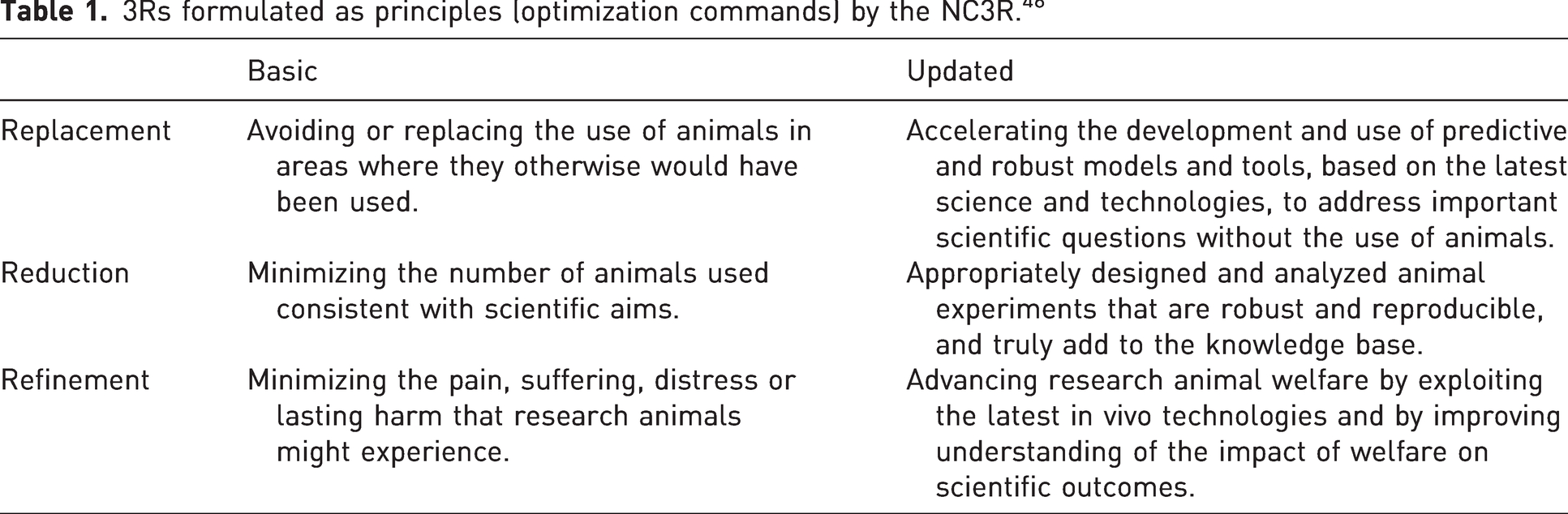
Consider the situation in the EU. Everyone using animals for scientific purposes has to follow the 3Rs – but what exactly does ‘follow the 3Rs’ mean? Although definitions of the 3Rs’ contents are provided (Table 1), there is no explanation in the Directive or elsewhere of how far one must go in their realization. For instance, is it sufficient for an applicant or researcher to ‘consider’ the 3Rs in the sense of ‘taking note of them’, and replace, reduce and refine if it is easy to do so? What if a researcher knows about a promising 3R method, but does not have the financial resources to implement it in her laboratory? Is this an indication that she has not met the 3Rs’ normative requirement? Where is the threshold that allows claiming that the 3Rs are fulfilled? And are the 3Rs goals or rather means to another end? As Michael Balls claimed in a recent lecture, we might wonder whether the point that Russell and Burch made in 1959 has been entirely missed during the past 60 years: ‘The Three Rs were the path to achieving that goal [i.e. humane research; H.G./M.D.], not the goal itself […]’. 2
3Rs formulated as principles (optimization commands) by the NC3R. 46
The success of the 3Rs belies the fact that the situation just outlined is problematic. While clarity and comprehensiveness are key criteria for the quality of legal texts and requirements,23,24 it is unclear how the 3Rs’ normative nature is to be understood precisely, meaning that applicants who submit project proposals to the competent authorities – as well as the authorities themselves – might struggle to see whether the 3Rs are fulfilled. The lack of a clear understanding of the 3Rs – as a core element of the Directive – is bound to create the risk of deficient and incoherent strategies in practice. We argue that with a thorough understanding of the normative nature of the 3Rs, these problems can be better addressed and potentially solved for applicants, review bodies and authorities. Hence, this paper asks: ‘how is the normative nature of the 3Rs to be understood, and how can this understanding transparently guide their implementation, in accordance with Directive 2010/63/EU?’
We investigate the normative nature of the 3Rs by drawing on Robert Alexy’s theory of norms (The normative nature of the 3Rs). We show that the 3Rs must be understood as principles (i.e. as optimization commands). Taking the 3Rs’ normative nature seriously addresses the present practical understanding of the 3Rs as a way to improve the situation of animals in research contexts. We argue that this improvement paradigm stands in contrast to the original understanding of the 3Rs and their legal understanding in the Directive. Therefore, it must be replaced by a different paradigm that apprehends the 3Rs as tools whose goal is full replacement, or in the words of Russell and Burch, to remove inhumanity. In Implementing the 3Rs: (re)turning to practice, we present an ethics tool for 3R implementation that translates their actual normative nature into practical guidance. This prototype of an ethics tool is intended to orient the systematic reflection of applicants and authorities when developing or assessing 3R strategies in project applications. The concluding remarks summarize the main findings and connect them to the societal developments sketched in the introduction and in particular to the idea of phasing out animal research (Conclusion and outlook).
The normative nature of the 3Rs
To understand how the 3Rs should be understood in a normative sense, it is useful to distinguish different kinds of norms. A particularly prominent and helpful distinction in this context is that between rules and principles. This distinction was introduced by Esser as early as 1956, but gained attention internationally only after Dworkin’s essay ‘The Model of Rules.’ 25 It is of immense practical importance in the theory of fundamental rights 26 but it has also found its way into research fields outside law and moral philosophy, such as sustainability assessments 27 (p.12). We take Alexy’s understanding as the basis for our discussion (for criticism of Alexy’s approach, see, for example, Jansen 28 ).
Theoretical background: Alexy on principles and rules
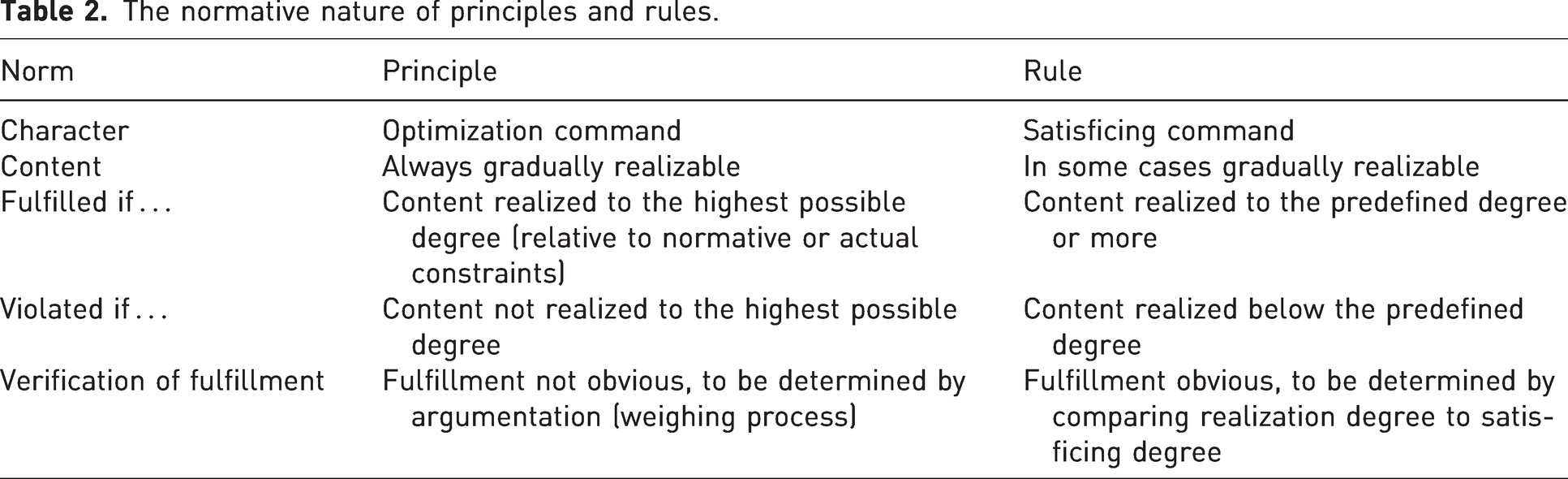
Following Alexy, 26 two types of norms can be distinguished: principles and rules. Principles can be defined as optimization commands: they command that something is realized to the highest possible degree relative to normative and actual possibilities. If you understood the norm ‘replace animal models with new approach models’ as a principle, you should use new approach models (NAMs) instead of animals whenever possible. The range of normative possibilities can be limited by other, opposing, norms, such as opposing principles, but also by factual constraints, such as lack of resources.
Alexy characterizes principles as gradually fulfillable norms. But what precisely does ‘gradual fulfilability’ mean? Many norms feature a content that can be realized gradually (although this is not true of all norms, such as the obligation to overtake on the left in some countries’ road traffic systems). This applies not least to the 3Rs: the quantitative replacement and reduction of laboratory animals, as well as refinement, can be realized to a greater or lesser extent (i.e. gradually). The gradual realizability of the norm’s content is not to be confused with the gradual fulfilability of the norm itself. (One reason for this far-reaching confusion is the fact that the German language uses the ambiguous term ‘Erfüllung’ to refer to both the realization of the content of the norm and the fulfilment of the norm itself 29 (p. 158ff). ‘Fulfilment of a norm’ is the opposite of ‘violation of a norm’. A norm is violated if its requirements have not been met. In the case of principles, the requirement is to realize their content to the highest possible degree. Against this background, Alexy’s characterization of principles can be put more precisely: principles are norms that can be considered fulfilled for different degrees of content realization. 29 Impairments of content realization may be justified by normative or actual restrictions and the principle still be fulfilled. Whether such a justification exists must be clarified in the course of a weighing procedure. Principles can thus also be characterized as norms that can be weighed.
In contrast, rules are norms that, according to Alexy, cannot be fulfilled gradually. To say that a rule is more or less fulfilled makes no sense, because a rule commands ‘that one does exactly what it demands, nothing more and nothing less’ 30 (p. 295). Alexy thus characterizes rules as definitive commands. This characterization of rules can also be made more precise by applying the distinction, outlined above, between the realization of a norm’s content and the fulfilment of a norm. From this perspective, rules are norms that require their content to be realized to a specific and predefined degree. If this degree of content realization is reached or exceeded, the rule is fulfilled. Otherwise, it is violated. It makes no difference to the fulfilment of the rule whether its content is realized to the required degree or more: either way, it is simply fulfilled. Thus, rules can be characterized as satisficing commands.29,31 Consequently, they cannot be weighed; impairments of content realization cannot be justified but rather signify the violation of the rule.
The difference between principles and rules becomes particularly apparent when one considers collisions of principles on the one hand and conflicts of rules on the other. In both cases, two or more norms, taken individually, lead to incompatible results on the practical level, namely contradictory normative requirements (i.e. actions that cannot be carried out simultaneously). However, they differ fundamentally in their resolution. 26 When rules are in conflict, either an exception clause is introduced into one of the rules, or one of the rules is declared invalid (as in the field of law by means of conflict-of-law rules, such as ‘lex posterior derogat legi priori’). If, on the other hand, principles collide, the two options found in the case of conflicts of rules do not provide a solution. Instead, it must be determined which of the principles should take priority in the specific case. If a principle A takes priority over an opposing principle B, this does not imply that B is invalid or violated. It merely means that in the case in question, A takes priority over B for reasons that have to be provided. In another situation, the question of priority may turn out in favour of B. This is where the metaphor of the ‘weight’ of principles applies: the principle to which greater weight is assigned in a concrete case is the one whose normative consequence applies.
The 3Rs as principles
We argue that the 3Rs are principles in the sense outlined above. One straightforward indication of this is that Russell and Burch 32 speak of The Principles of Humane Experimental Technique in the title of their book. To this day, the 3R concept is typically referred to as the ‘3R principle’. Most importantly in this context, the Directive also speaks of implementing the principles of replacement, reduction and refinement in projects: ‘Comprehensive project evaluation, taking into account ethical considerations in the use of animals, forms the core of project authorisation and should ensure the implementation of the principles of replacement, reduction and refinement in those projects’ (recital 38, Directive; our emphasis).
But it is not only the actual designation of the 3Rs as principles that indicates that they are indeed principles in a substantial sense. In addition, there is no mention in the Directive of satisficing criteria (i.e. predefined degrees of demanded content realization). This is important because such criteria would indicate rules, by providing a clear-cut condition as to whether the rules are fulfilled or not. If the directive required a replacement of 20% of animals used in each project with NAMs, then replacement would have to be considered a rule. If reduction to a certain maximum number – for example, 800 mice per project in basic research – were required, then, again, replacement would be a rule. If cup handling33,34 or other refinement methods were explicitly listed, we could speak of a ‘refinement rule’. But none of this is the case. Examples of rules derived from the 3R principle can be found, for example in annex IV (Directive), where legitimate killing methods are listed. If methods that are not listed were used, the norm would be violated (as it has the character of a rule). No such clear guidance is given with regard to the 3Rs themselves.
A third argument can be found in relation to implementation practice: if the 3Rs were rules, competent authorities would have to check only whether the required satisficing criteria are met and addressed in project applications. This is not the case, but quite the opposite: authorities check how far the 3Rs are implemented, which is not a check list exercise.
Fourth, typical formulations of the 3Rs in the literature suggest that they are understood as norms that command that their content be realized to the highest possible level (for example, Balls et al., 32 Grimm et al., 5 Tannenbaum and Bennett 21 ). This is illustrated by an example from the NC3R center (UK), where a basic and updated understanding of the 3Rs is put forward (Table 1).
Taking the 3Rs’ normative nature seriously
Based on these arguments, it becomes clear that the 3Rs are to be understood as principles in Alexy’s sense. Although unfortunate, it is understandable that this interpretation is disregarded in the relevant literature. Looking at the origin of the 3Rs, clear guidance regarding their normative nature could not have been expected from Russell and Burch, whose training in the natural sciences was not accompanied by a background in the humanities, let alone the theory of norms. Lacking a detailed explanation in the original book, the 3Rs are often taken directly as formulated there: ‘Replacement means the substitution for conscious living higher animals of insentient material. Reduction means reduction in the numbers of animals used to obtain information of a given amount and precision. Refinement means any decrease in the incidence or severity of inhumane procedures applied to those animals which still have to be used.’
32
(p.64) (in a similar vein and more recently).6,21
In line with this truncated definition, most of the relevant literature today sees 3R implementation itself as the goal and as a mere question of whether and how plans have been put in place to improve the situation of animals. As Hubrecht and Carter 6 rightly state, the 3Rs have become ‘synonymous with the measures to improve the welfare of animals used in research and are now used as an ethical framework for improving laboratory animal welfare throughout the world’. 6 In the rare cases in which the question of the fulfilment conditions of the 3Rs is mentioned (e.g. ARRIVE guidelines (for example, Percie du Sert et al. 35 ) and PREPARE guidelines (for example, Smith et al. 36 ), this is done without clarifying the underlying normative understanding of the 3R concept. Only recently have Balls et al. 2 explicitly addressed whether the 3Rs are actually to be seen as means to other ends or as goals themselves.
The references above describe the currently dominant understanding of the 3Rs: something is to be done to improve the situation for animals in laboratories. On this interpretation, the 3Rs command improvements without specifying a measure or benchmark, and seem to imply that there is no fundamental problem with animal use for scientific purposes as long as the 3Rs are implemented (for example, MPG 37 p. 50). They are thus understood neither as rules (i.e. satisficing commands) nor as principles (i.e. optimization commands), but in a way that leaves the question of correct implementation entirely open. We refer to this prevailing understanding of the 3Rs as the improvement paradigm, on which the 3Rs’ implementation to improve the situation of animals in research is seen as a goal.
Returning to Russell and Burch’s 3Rs: demanding more than improvement?
A closer reading of Russell and Burch’s book reveals that the improvement paradigm does not at all live up to their claims. At their time of writing, the main goal was formulated as to diminish and remove inhumanity 32 (p. 54, pp. 64–66). As soon as animals’ pain and distress can be detected, Russell and Burch claim: ‘We turn now to consideration of the ways in which inhumanity can be and is being diminished or removed. These ways can be discussed under the three broad headings of Replacement, Reduction and Refinement […]’ 32 (p. 64). Put differently, applying the 3Rs is not the goal, but the means to the goal of full replacement 32 (p. 64).
According to Russell and Burch, the 3Rs are intended ultimately to achieve the goal of the full replacement of animals in laboratories. This is a statement regarding the normative nature of the 3Rs: a norm that requires the fullest possible realization of its content (here: full replacement) is a principle (cf. Table 2). The understanding of the 3Rs as means to the end of full replacement is also formulated in the Directive. In recital 10, it clearly states full replacement as its goal: ‘However, this Directive represents an important step toward achieving the final goal of full replacement of procedures on live animals for scientific and educational purposes as soon as it is scientifically possible to do so’ (recital 10, Directive). But how is it to be determined if the 3Rs have been fulfilled, that is, if their content has been realized to the highest possible degree, given normative and actual constraints? Existing inquiries into this issue are rare and mostly descriptive.38–41 Only recently have the barriers and facilitators of 3R implementation been addressed as an explicit object of inquiry. 16 Here, we systematically provide guidance on how applicants can substantiate the claim that the 3Rs’ content is actually realized to the highest possible degree.
The normative nature of principles and rules.
Turning the rationale of the 3Rs’ implementation upside down
To answer the question as to whether the 3Rs’ content is realized to the highest possible degree, two directions of reasoning are conceivable. First, the starting point for reflection might be seen in the factual situation (an initial experimental design) and its potential for improvement. This approach resembles the improvement paradigm, with the essential difference that it is not about any improvement, but about the greatest possible improvement of the situation. Applied consistently, it can at least theoretically meet the requirements of a system of principles. However, there are reasons to find this approach inadequate from a theoretical and a practical point of view.
First, this approach is theoretically deficient because it retains the idea that the use of animals in laboratories is unproblematic, as long as the 3Rs are applied to improve the situation. However, this contradicts the intention of full replacement, formulated as the goal of Russell and Burch’s 3Rs and the Directive. Second, with a view to practice, taking the status quo (of animal use) as a starting point risks reducing ambition to go further. This is a psychological argument, as in purely factual terms, the highest possible realization of the 3Rs is the same in both cases. However, because we are dealing with a highly valuable asset, it seems to us to be a relevant and strong argument.
An alternative starting point is the level of complete content realization of the 3Rs, namely full replacement. For each of the 3Rs, a criterion of complete realization can be clearly defined:
Complete realization of the replacement principle’s content: the principle of replacement’s content is completely realized if no animals are used to achieve a scientific benefit/outcome. Complete realization of the reduction principle’s content: the principle of reduction’s content is completely realized if no animals are used to achieve a scientific benefit/outcome. Complete realization of the refinement principle’s content: the principle of refinement’s content is completely realized if no harm is done to animals to achieve a scientific benefit/outcome.
Following this approach, any deviation from complete realization of the 3Rs’ content remains problematic. The ethical problem of inhumane animal use vanishes only in cases of complete realization of one or more of the 3Rs.
Pursuing this idea leads to an interesting conclusion: if one or more of the 3Rs were completely realized in the above sense, we would not speak of a ‘procedure’ in the terminology of the Directive anymore. The reason for this lies in the legal definition of a ‘procedure’ that comprises three conditions: (a) the animal use criterion: a minimum of one live animal has to be used (on what falls into this category, see article 1 (3), Directive); (b) the needle criterion: the use has to cause harm experienced by the animal (on what is considered harm, see article 1 (4) f, Directive); the scientific purpose criterion: the use of animals has to aim at a scientific purpose (on what falls under this category, see article 5, Directive). If one or more of these points are not given, the Directive does not apply, no justification is needed from the directive’s point of view, and we can speak of full replacement according to recital 10 (Directive). Thus, the aim of the Directive is ultimately to make itself obsolete.
Accordingly, a need for justification remains as long as full replacement is not achieved. This changes the direction of normative deliberation significantly, as deviation from the ideal is the problem to be dealt with. Hence, the challenge is not to improve the situation but to justify deviations from the level of complete realization. We refer to this understanding of the 3Rs as the deviation paradigm. The deviation paradigm conveys the theoretical position that the use of animals in laboratories remains problematic until full replacement has been reached, just as argued by Russell and Burch and as stated in the Directive. In practice, this paradigm might increase the motivation to go to the greatest possible efforts to do justice to the 3Rs (i.e. to realize their content to the highest possible degree), because the greater the deviation from the level of complete realization, the more serious the remaining problem. This understanding of the 3Rs has far-reaching practical implications.
To summarize: although the improvement paradigm seems plausible at first glance, it is not in line with the understanding of the 3Rs found in Russell and Burch’s 1959 work and in the Directive. It follows from the nature of the 3Rs as principles that the goal is not (laudable) efforts to improve the situation of laboratory animals; on the contrary, the goal is the 3Rs’ complete content realization, and deviations need to be justified. Regarding the implementation of the 3Rs, the argument emphasizes moving beyond viewing the improvement of animal treatment in research as the ultimate goal. Instead, it advocates adopting the deviation paradigm, which aligns with the Directive’s intent and the original meaning of the three Rs as outlined by Russell and Burch. Moving beyond the improvement paradigm and adopting the deviation paradigm turns the entire logic of implementing the 3Rs upside down (Figure 1).
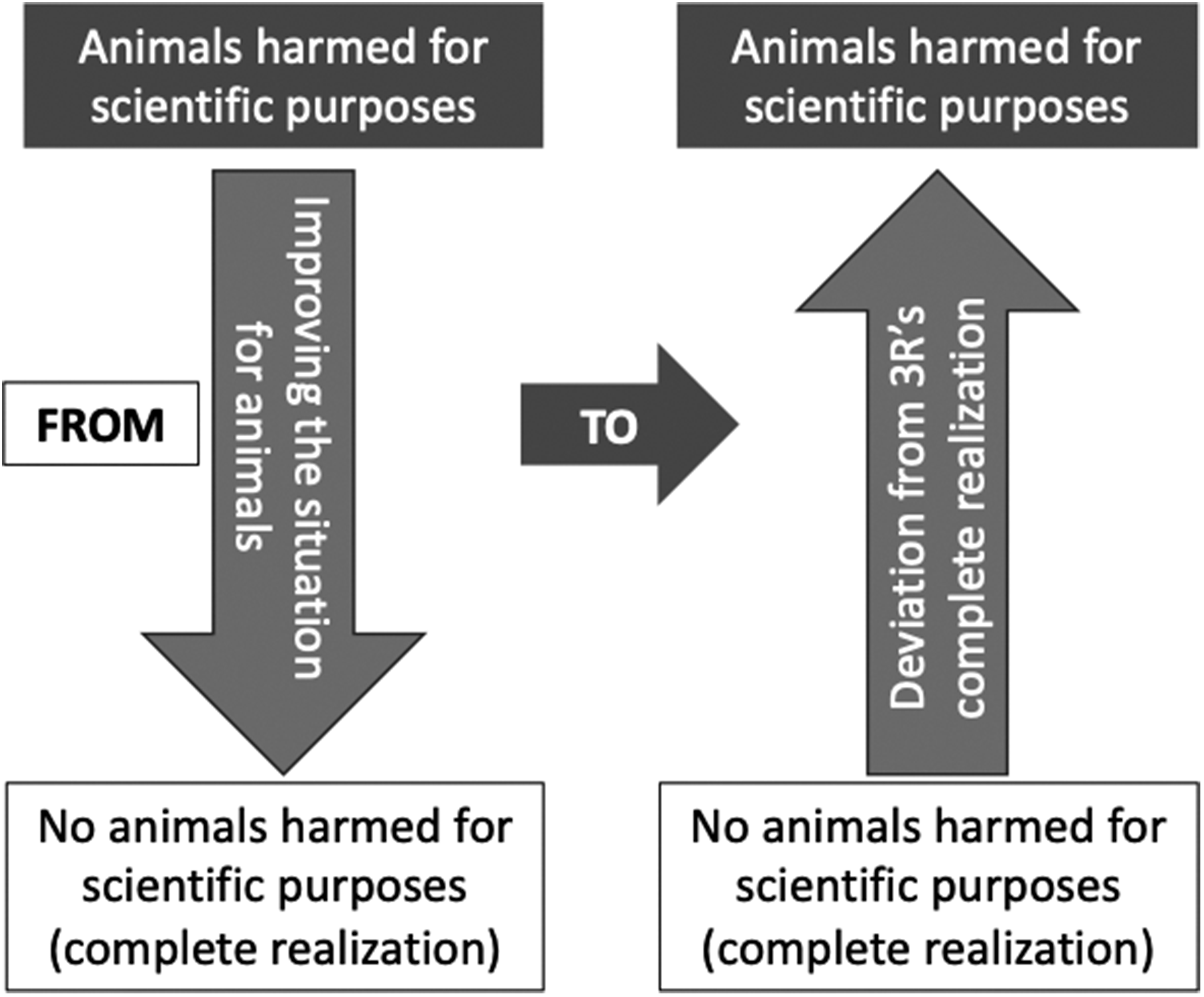
Turning 3R implementation upside down: from the improvement paradigm to the deviation paradigm.
Implementing the 3Rs: (re)turning to practice
In light of the above, the practice of implementing the 3Rs also needs to be turned upside down. When asked to implement the 3Rs in a project application (article 4, Directive; article 38, Directive), an applicant has to state why full replacement cannot be achieved and why the deviation from full replacement cannot be reduced. It follows that three levels of content realization are important when implementing this rationale (Figure 2): (1) complete realization of the principles’ content (level 0: full replacement); (2) scientifically unavoidable deviation from complete realization (level 1); and (3) practically unavoidable deviation from complete realization (level 2).
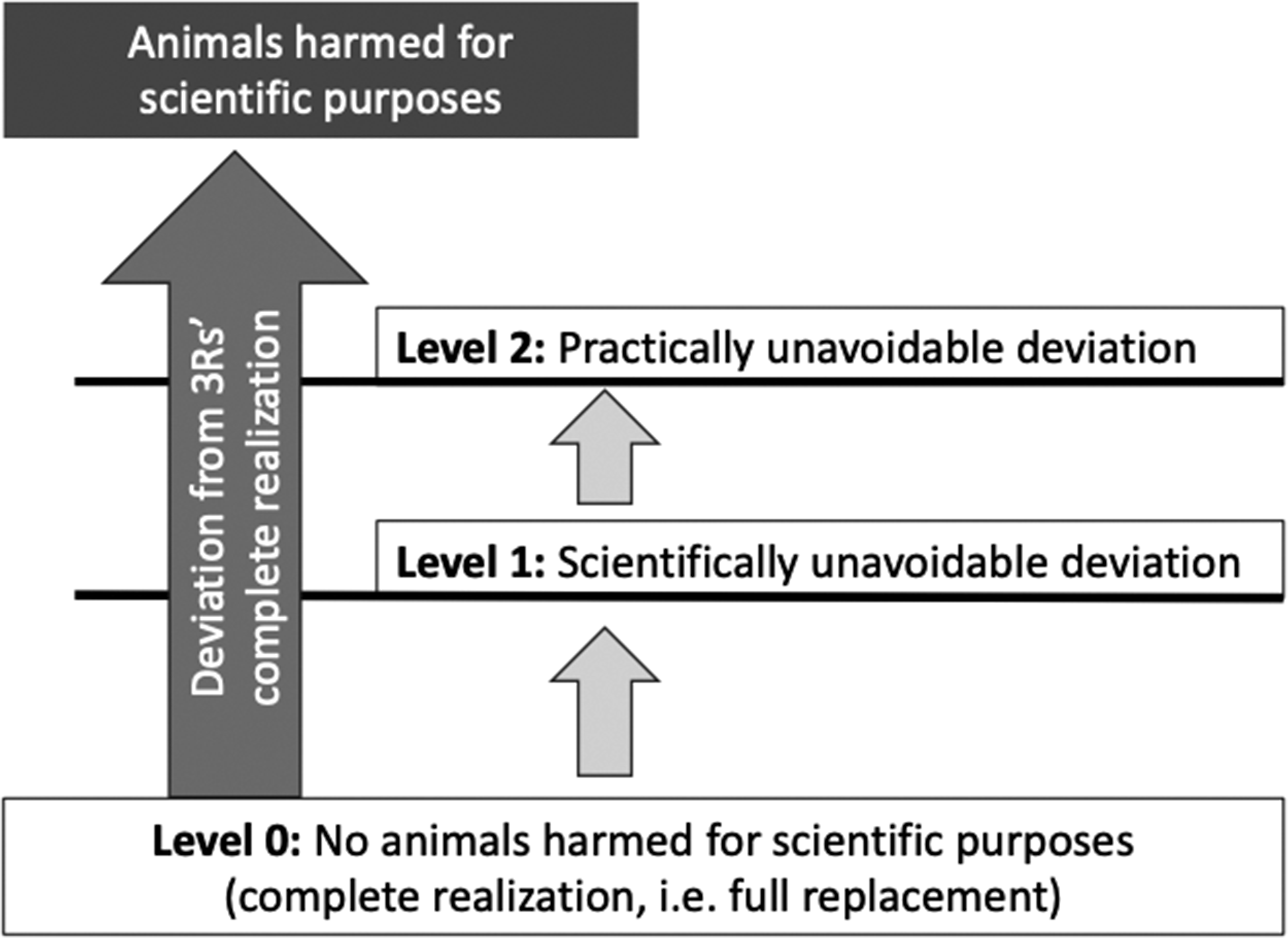
Levels of deviation from 3Rs’ contents’ complete realization.
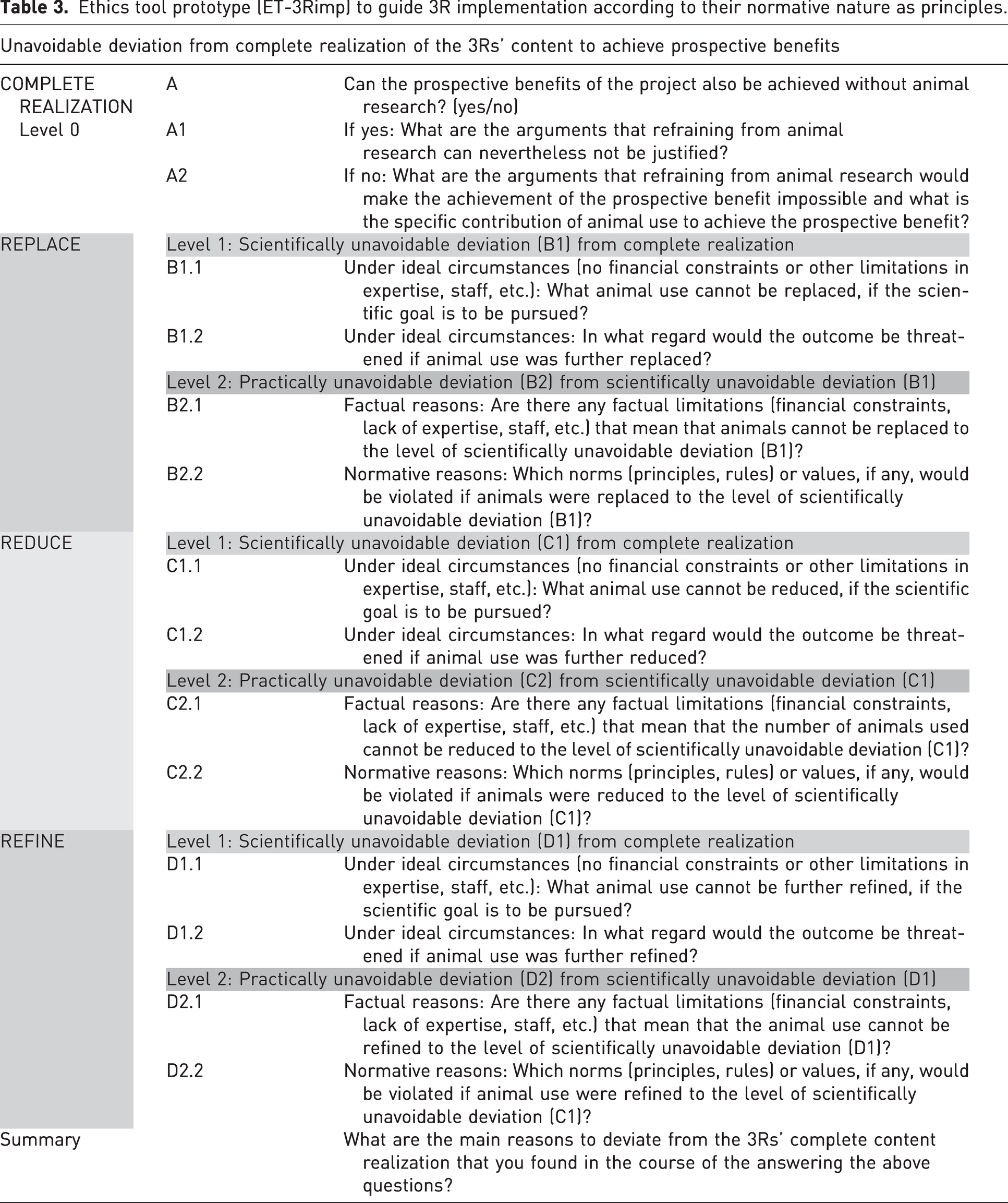
Developing the idea of implementing the minimal scientifically and practically possible deviation from level 0, we offer an ethics tool to guide 3R implementation. First, the logic of the different levels as the basis for the tool will be described (4.1–4.3). Second, the ethics tool will be sketched, offering guiding questions for systematic planning of 3R implementation (4.4). The draft in Table 3 presents the prototype of this ethics tool (ET-3Rimp), which aims to bring the complexities into a coherent structure.
Ethics tool prototype (ET-3Rimp) to guide 3R implementation according to their normative nature as principles.
Level 0: avoiding leaving the level of complete realization
If deviations from the complete realization of the principles’ contents (level 0) are the fundamental problem, the obvious first question to be addressed is: why deviate at all? To operationalize this point, one has to differentiate between a scientific ‘outcome’ and a ‘benefit for humans animals and the environment’ (cf. the formulation of the harm–benefit analysis in article 38 (2) d, Directive). Whereas the outcome is the direct result of scientific endeavours, the practical benefit is not. In fact, although a scientific outcome in terms of knowledge might often be a necessary condition for achieving practical benefits, it is not sufficient for benefits such as medical patients being healed or health improvements in a population. 42 With this in mind, the initial question asks whether prospective practical benefits can be achieved without animal research (see question A in the ET-3Rimp). If the answer is affirmative, it might still be justifiable to use animal research as a means (e.g. if achieving the envisioned benefit is very unlikely without animal research, or if alternative options cause major problems). However, alternative ways of achieving the envisioned benefit must be made transparent, and reasons must be provided to explain why animal use is the preferable strategy and to justify deviating from level 0. Starting from complete realization of the principles’ content, this translates into the question of why refraining from animal research cannot be justified (ET-3Rimp question A1).
When the benefits at stake cannot be achieved without the use of animals, it is again important to differentiate ‘benefit’ and ‘outcome’ and note that most of the time the result of animal research is knowledge and not benefit. 42 Hence, it is important to clarify the reasons for thinking that refraining from animal research would make the achievement of the prospective benefit impossible, and to clarify the specific contributions of animal use to achieving the prospective benefit (ET-3Rimp question A2). Only if complete realization (ET-3Rimp section A) is not justifiable, and deviation unavoidable, does this second step comes into the picture.
Level 1: scientifically unavoidable deviation from complete realization
If the 3Rs’ content cannot be realized completely (deviation from level 0), and if it can be justified that the animals’ use significantly contributes to achieving the potential benefits, the degree to which the project deviates from the complete realization level becomes relevant. In general, the smaller the degree of deviation, the better, as long as the scientific purpose can be achieved. This shifts the debate from complete realization to the highest scientifically possible degree (level 1) of realizing the 3Rs’ content. Formally, and under ideal circumstances, the line has to be drawn at which further realization of the 3Rs’ content makes the achievement of the scientific purpose impossible (ET-3Rimp questions B1.1; C1.1; D1.1). In other words, under ideal circumstances (with all necessary resources available), the scientifically unavoidable deviation lies at the point where further measures of reducing the deviation from complete realization would make it impossible to achieve the scientific purpose. If the scientific purpose were not achieved owing to 3R implementation, the use of animals could not qualify as procedure anymore and the scientific purpose could not be reached (questions B.1.2; C.1.2; D.1.2). Hence, the scope of the directive would remain. Consequently, the scientific purpose criterion can be used to identify the scientifically unavoidable deviation from complete realization of the 3Rs’ content:
Minimal scientifically possible deviation from the complete realization of the replacement principle’s content: realizing the principle of replacement’s content is impaired to the lowest scientifically possible degree if further realization of its content makes it impossible to achieve the scientific purpose.
Minimal scientifically possible deviation from the complete realization of the reduction principle’s content: realizing the principle of reduction’s content is impaired to the lowest scientifically possible degree if further realization of its content makes it impossible to achieve the scientific purpose.
Minimal scientifically possible deviation from the complete realization of the refinement principle’s content: realizing the principle of refinement’s content is impaired to the lowest scientifically possible degree if further realization of its content makes it impossible to achieve the scientific purpose.
In an ideal world, all resources to remain at level 1 would be available and nothing other than scientific constraints would limit the level of realizing the 3Rs. However, in real-world settings this is generally not the case, which brings us to the next deviation level.
Level 2: practically unavoidable deviation: factual and/or normative constraints
Under non-ideal conditions, the scientific purpose might be achieved only if the 3Rs’ content is impaired to a greater extent than is scientifically necessary. But what degree of impairment can be justified against the background that it is prima facie wrong to cause suffering to animals?
Here, the norm of ultra posse nemo obligatur comes into play: only those actions can be demanded from an actor that are within their power. If a laboratory cannot implement a 3R measure that is available in principle (level 1), but which is inaccessible to them because of financial or other limitations, then they could argue that the corresponding deviation from the 3Rs’ content realization is practically unavoidable and that the 3Rs are thus fulfilled (i.e. realized to the highest possible degree). However, what can be considered possible or impossible, and what an actor can and cannot achieve in a given context is anything but self-evident. Hence, the only way to make sense of this is to let applicants explain, argue and substantiate at what point they cannot go further and why they have to deviate from level 1 (ET-3Rimp questions B.2.1; C.2.1; D.2.1).
Besides such actual restrictions, normative constraints might also be relevant. If, for example, increasing the degree of a principle’s content realization can be achieved only at the expense of another principle that is equally important, the question is whether the increase and corresponding decrease is proportionate or disproportionate. This might even apply to the 3Rs themselves, if one principle (e.g. refinement) can only be realized to a higher degree at the cost of a lower degree of realizing another principle (e.g. reduction) – for example, cases in which there is better welfare for all animals but more animals have to be used. If the violation of one principle has a disproportionate effect on one or more other principles, the content’s realization should not be further increased. 43 But, again, the practical weighing is something that cannot be carried out theoretically and detached from the actual context. Hence, applicants are also required to explain why they set the level 2 deviation where they do (ET-3Rimp questions B.2.2; C.2.2; D.2.2).
An Ethics Tool Prototype (ET-3Rimp) for reflective 3R implementation
The discussion in this section is here summarized in an ethics tool prototype that replaces the improvement paradigm with the deviation paradigm in 3R implementation (Table 3):
This tool is designed for planning 3R implementation in line with the requirements of the Directive. It is based on the view that there is no hierarchy of the 3R principles, but that they are equally important. Nevertheless, the principles are to be applied sequentially for pragmatic reasons. In the course of the application process, applicants should work through the questions and arrive at a transparent argument regarding the fulfilment of the 3Rs. Open questions are deliberately used so that applicants have the opportunity (and are guided) to present the reasons that are relevant for the individual case. We hope that this tool will support the work of applicants, as well as of evaluators and authorities, in a transparent manner, without giving the false impression that a one-size-fits-all strategy is appropriate.
Conclusion and outlook
The thorough and correct understanding of the 3Rs’ normative nature as principles has a substantial impact on the rationale for their implementation. In line with the Directive’s intention, as well as Russell and Burch’s original 1959 formulation, the improvement paradigm for implementing the 3Rs was put into question and replaced with the deviation paradigm. This latter paradigm presents the 3Rs as instruments to achieve full replacement. Accordingly, we have argued that deviations from the complete realization of the 3R principles’ content need justification. Full replacement was therefore identified as the adequate starting point for planning to implement the 3Rs. On this basis, an ET-3Rimp was presented that guides systematic 3R implementation according to the deviation paradigm – a paradigm that takes the normative nature of the 3Rs as principles seriously.
An ethics tool has been developed to such a point that it should be directly applicable in practice in its current form. Nevertheless, its actual application must show whether and where there is a need for further refinement to achieve the best possible practicability. In addition, whether the theoretical promise of greater 3R effectiveness holds true in real-life situations also has to be judged empirically, which was not within the scope of this study. Such inquiries into the deviation paradigm’s impact on 3R strategies are more than welcome. Empirical findings might also help to develop the prototype further – to meet the expectations and needs of applicants as well as of reviewers, committee members and authorities in complex real life contexts. For instance, 3R methods are not equally available for all relevant areas of research. In the case of regulatory testing, where OECD guidelines and validated non-animal models might exist, it is clear what the applicant has to do and how the authorities have to evaluate applications. In contrast, basic research and hypothesis-driven research might lack such established and validated NAM implementation strategies. 5 With regard to the 3R implementation tool, this means that in the first case it is clear what the applicant must refer to in his argumentation, whereas in the second case he has a greater degree of freedom. However, this implies that the applicant is responsible for explaining and arguing more thoroughly, so that the authorities can comprehend and transparently evaluate whether the 3Rs are fulfilled. A further reason to modify the tool might be to integrate it into existing guidelines and methodologies such as the ARRIVE or PREPARE guidelines.
Moreover, the role of the 3Rs in relation to other parts of project evaluation might also change owing to the paradigm shift. For instance, the new understanding of the 3Rs already integrates the project’s benefit dimension, which is traditionally addressed in the harm–benefit analysis as a second main requirement within project evaluation (article 38 (2) d, Directive).12,44,45 This means that while the 3Rs are usually used under the rubric of mere means to improve the situation of laboratory animals, this tool integrates the goal dimension into the 3Rs’ implementation and reflection.
The presented strategy also addresses a key criticism of the 3Rs: as Müller 17 claims, the 3Rs do not enable a path to achieve full replacement. This is true for the improvement paradigm. In contrast, the deviation paradigm focuses on the ideal of full replacement as a normative guide and problematizes animal use for scientific purposes, even if a justification is in place and deviations from full replacement are unavoidable in a concrete situation. In this way, the deviation paradigm brings full replacement into the center of the 3Rs. Hence, if understood correctly, the 3Rs are powerful instruments on the way to phasing out the use of animals in research.
Footnotes
Acknowledgements
The authors would like to thank Graham Tebb for critical comments and valuable inputs to the manuscript.
Authors information
HG and MD conceptualized the manuscript. HG prepared the first draft. HG and MD developed, revised and edited the manuscript. All authors read and approved the final manuscript.
Declaration of competing interests
The authors, HG and MD, declare no competing interests.
Funding
The authors received no third-party funding for the research, authorship, and/or publication of this article.
