



Abstract
The implementation of the 3R principles (Replace, Reduce, Refine) requires a comprehensive understanding of the various levels at which they operate, as well as the factors that may hinder or support their advancement. Central to this process is incorporating the perspectives of stakeholders in biomedical research to develop practical and relevant strategies for action. In a qualitative study, we conducted 35 semi-structured interviews with Swiss researchers working on the 3Rs or animal experimentation. Interviews were analysed following a reflexive thematic analysis, and we identified two categories of facilitation: originative facilitation, which concerns epistemic aspects of the 3Rs, and executive facilitation, which concerns interventionist aspects of the 3Rs. In this article, we report on the former dimension, which can be further divided into the conceptualisation of the 3Rs on the one hand, and the education of researchers on the other hand. Although grounded in the Swiss context, these findings reveal key insights for researchers, policymakers, and institutional stakeholders internationally. As efforts to align animal research practices with ethical standards continue to grow globally, understanding how the 3Rs are conceptualised and taught is essential for creating coherent, cross-border strategies that foster responsible scientific practice. Clarifying definitions and reinforcing researcher education are critical steps in ensuring the consistent and meaningful implementation of the 3Rs across national boundaries.
Introduction
The 3Rs of animal experimentation (Replace, Reduce, Refine) were first defined in 1959 by Russell and Burch. A couple of decades passed before the scientific community started to seriously pick up these principles, and since then, the 3Rs have served as a cornerstone in institutional policies, as well as national and international regulations on animal experimentation.1,2 Since their introduction, various interpretations of the 3Rs have emerged, and deviations from the original definitions of Russell and Burch have been noted.3,4 Although a definitive consensus on the precise interpretation of the 3Rs has yet to be achieved, a panel of 3R experts has proposed the following definitions, 5 complemented by additional conceptual clarifications offered by the authors of the present article 6 :
- Replacement: The complete avoidance of animal use in scientific research, regulatory testing, and education by employing alternative methods.
- Reduction: The use of strategies that minimise the number of animals required to obtain scientifically valid, reliable, and meaningful results in research, regulatory testing, and education.
- Refinement: The implementation of measures that improve animal welfare and minimise pain, suffering, distress, or lasting harm in animals used for scientific research, regulatory testing, and education.
In the European Union (EU), article 1 of Directive 2010/63 lays out the 3R principles as having the ultimate goal of the ‘full replacement of procedures on live animals for scientific and educational purposes as soon as it is scientifically possible to do so’. 7 At present, the EU is developing a roadmap to phase out animal use in chemical safety testing. 8 In Switzerland, the 2022 public vote on animal experimentation gave rise to an increased commitment to the 3R principles and to the funding of the Swiss National Research Programme 79 ‘Advancing 3R’. 9
When tackling the advancements of the 3R principles, many reports focus either on specific technologies and individual efforts from researchers,10,11 or on a broader political level.9,12 However, in recent years, both more fine-grained and holistic frameworks have been described to better grasp the implementation of the 3Rs. An example of such frameworks is the multilevel perspective, developed to better describe sociotechnical transitions13,14 and applied to the context of regulatory acceptance of the 3Rs. 15 The multilevel perspective defines three broad levels to describe the dynamics in sociotechnical transitions 16 : (1) the niche level, where new technologies are developed, (2) sociotechnical regimes, where established practices and rules stabilise the existing system, and (3) the sociotechnical landscape, which conceptualises slow-changing values and ideologies. Such a framework helps to better understand that 3R implementation is not limited to a specific level, but is rather the expression of a complex, non-linear interplay between the different levels in a broader sociotechnical system.
As a result, investigating the implementation of the 3Rs at a national or international level requires an extensive mapping of these different structures and how they interact in practice. The case of Switzerland is especially relevant as it is a federal country composed of 26 cantons. Each canton organises the conduct of animal experimentation locally and has its own committee on animal experimentation and administrative office. Each structure reviews and validates projects involving animals protected under federal law, in particular the Animal Welfare Act (AniWA), the Animal Protection Ordinance (AniPO), and the Animal Experimentation Ordinance (AEO). The results from the Swiss National Research Programme 79 ‘Advancing 3R’ could thus enlighten the case of 3R implementation in other countries with a similar system.
As part of this research programme and a broader research project, we carried out an explorative qualitative study on the perceptions of researchers regarding the implementation of the 3Rs in Switzerland. The objective was to elucidate potential barriers and facilitators to this implementation from the perspective of researchers. The sociotechnical regimes level from the multilevel perspective framework, defined as a ‘semi-coherent set of rules that orient and coordinate the activities of the social groups that reproduce the various elements of socio-technical systems’ 16 is particularly fitting for the context of this study, as we were interested in how the 3Rs are applied by the research community and related institutions. These regimes can further be understood as a form of duality between shared beliefs and concrete actions by stakeholders. 17 It provides a useful lens for understanding current challenges in implementing the 3Rs and for developing targeted strategies to address them. To capture this distinction, we introduce two concepts: originative facilitation, which refers to the influence of sociotechnical regimes on the discursive framing and the collective meanings attributed to the 3Rs; and executive facilitation, which denotes the influence of these regimes on the practical implementation of the principles. Given the breadth of this study report, the findings have been divided into two complementary publications following this duality: Part 1, focusing on originative facilitation, and Part 2 on executive facilitation. In this first article (Part 1), we focus on the experiences shared by participants concerning the collective meaning-making of the 3Rs and ways to improve it.
Methods
This article follows the standards for reporting qualitative research (SRQR). 18 Supplementary information 1 provides all 21 items of the SRQR and their corresponding sections in this manuscript.
Qualitative approach and research paradigm
We approached this qualitative study with a research paradigm of interpretivism and constructivism. As one of the main objectives for this study was to be explorative, that is, acquire new insights through the perspective of involved stakeholders, we analysed the different interviews inductively and through hypothesis generation. 19 We employed reflexive thematic analysis 20 to capture the richness and complexity of participants’ views and experiences on the implementation of the 3Rs in Switzerland. Throughout the process, we remained attentive to our own positionality and the influence of our interdisciplinary research backgrounds on data interpretation.
Researcher characteristics and reflexivity
The research team was composed of one PhD candidate in biomedical ethics (ELM), one postdoctoral researcher (LDG), the principal investigator (BSE), and research collaborators (CB and LH). ELM first received extensive training in qualitative research with the different interview skills and then solely conducted the semi-structured interviews with the participants involved in this study. ELM had no prior relationships with the interviewees before the start of the study. He has a background in veterinary medicine (doctorate) and applied ethics (BA, MA). He approached this research project from his knowledge of animal studies 21 and a ‘new welfarist’ perspective, with a focus on improving animal welfare and questioning existing systems of animal use. 22 LDG is a postdoctoral researcher with a background in medicine and global health. He holds a PhD in biomedical ethics and has over 6 years of experience conducting qualitative research. LH is a PhD researcher specialising in sociotechnical transitions of New Approach Methodologies, who provided some theoretical suggestions for the study. CB is a professor of administrative and environmental law with expertise in animal law, particularly in the regulation of animal research. As a member of the Swiss Ethics Committee for Animal Experimentation (ECAE), she also brings a legal and interdisciplinary perspective to the analysis of the 3Rs and the challenges of their implementation. She contributed to this paper in her academic capacity, not as an official representative of the ECAE. BSE is a medical doctor and professor of bioethics with extensive experience in empirical bioethics in the field of clinical and research ethics.
Sampling strategy
We recruited by email 35 participants through purposive and snowballing sampling. We sent a single reminder about 2 weeks after the initial invitation in case of non-response. In total, we approached 103 Swiss researchers between February and December 2024. Of these, 18 explicitly declined to participate, 50 did not answer the invitation, and 35 accepted the invitation. The overall response rate was thus 34% (35/103). No participants dropped out of the study after their interview.
Interview context
The majority of the semi-structured interviews (28/35) were conducted face-to-face with the participants. The remaining interviews were conducted during online meetings using the Zoom conference software with its end-to-end encryption functionality. All interviews were conducted in English, except for one that was conducted in French (at the request of the participant).
Ethical issues pertaining to human subjects
The present study was approved by the Ethics Commission of the University of Basel (reference number UEK_137). The participants were informed by email at the time of invitation as well as orally immediately before starting the interview about the confidential and anonymous nature of their participation, including the management of their interview data. The participants had to sign an informed consent form in order to be included in the study.
Data collection methods
Data collection was carried out from February to December 2024. Participants were only interviewed once. The mean duration of the interviews was 68 min (range: 39–96 min). ELM conducted interviews until the dataset was rich, complex, and varied enough to make meaningful interpretations. Importantly, we did not evaluate the saturation of our dataset, as this study is embedded in a non-positivist paradigm. 23
Data collection instruments and technologies
ELM, LDG, and BSE developed the interview guide (Supplementary information 2). The interview guide was pilot tested in January 2024 with three researchers that met the inclusion criteria for this study. This first step helped refine the interview guide before the start of data collection. The interviews were audio recorded using an offline portable audio recorder when face-to-face or with the recording functionality of the Zoom software when online.
Units of study
In order to capture various perspectives on the implementation of the 3Rs in Switzerland, two populations of researchers were included during the recruitment process: researchers developing replacement, reduction, or refinement strategies as part of their current research (labelled ‘3R’, 19/35), and researchers undertaking in vivo research without any specific 3R emphasis (labelled ‘AX’, 16/35). All participants were recruited from public research institutions. Concerning academic position, the majority of participants (27/35) were in senior positions (from senior researcher to emeritus professor) and a few (8/35) were in junior positions (PhD candidates and postdoctoral researchers). Forty per cent of the sample (14/35) were female researchers. Switzerland is divided into three language regions, and participants were recruited from German-speaking cantons (20/35, 6 of which were from the canton of Basel-Stadt, 7 from the canton of Bern, and 7 from the canton of Zürich) and French-speaking cantons (15/35, 5 of which were from the canton of Fribourg, 5 from the canton of Geneva, and 5 from the canton of Vaud), but none from the Italian-speaking cantons. Figure 1 describes the scientific fields to which participants identified their work.
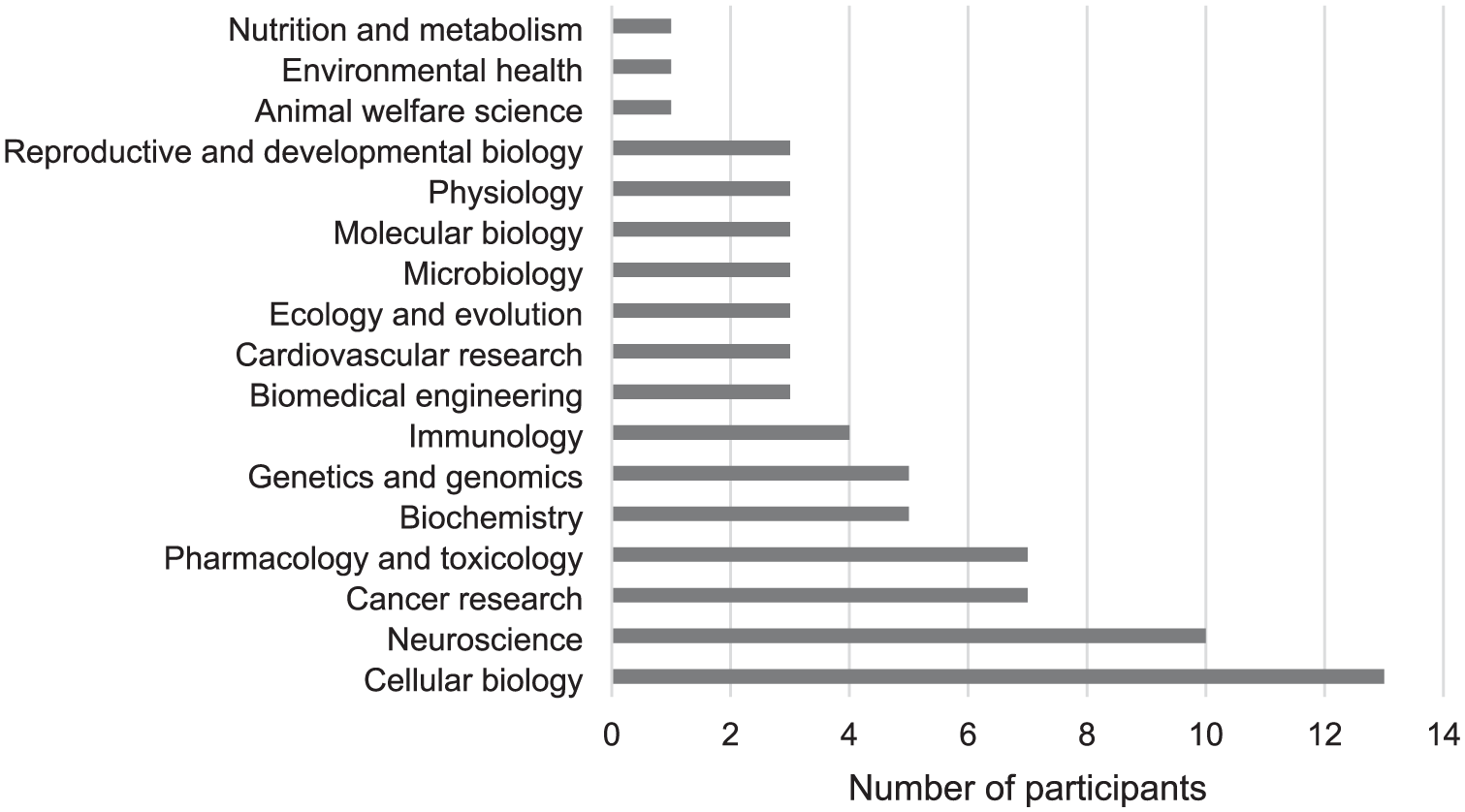
Scientific fields of interview participants.†
Data processing
Audio files were transcribed verbatim by a single author (ELM) while omitting any identifying information. Upon request, participants could review their transcripts and add comments before analysis. All files were uploaded on a secured folder on the servers of the University of Basel, and only authorised personnel from the research team could access this folder.
Data analysis and techniques to enhance trustworthiness
Data analysis was performed using the qualitative data analysis software MAXQDA (version 24.1.0) and following the six non-linear steps of reflexive thematic analysis. 20 The first step consisted in a familiarisation with the interview data by reading and rereading the transcripts closely. Then, a single coder (ELM) coded the entirety of the dataset by identifying meaningful features relevant to the research question, with guidance from more experienced qualitative researchers (BSE and LDG). Overarching themes were then constructed by grouping related codes into broader patterns of interpretation. In the fourth and fifth steps, the themes were named and reviewed to ensure they fitted both the coded extracts and the whole dataset. Finally, the themes were reported in a narrative fashion, using quotes to illustrate the analysis. Regular checks were performed by the overseeing team (BSE and LDG) in order to evaluate the quality of the interviews, integrity and precision of the transcripts, as well as the coding and interpretation process. The results were then discussed collegially with all the co-authors of this article.
Results
General presentation
Participants expressed various ways to facilitate the implementation of the 3Rs in Switzerland, building on different institutions and practices (so-called sociotechnical regimes). Specifically, six themes were formed from the interview data: (1) the conceptualisation of the 3Rs; (2) political leadership; (3) the research institution; (4) the cantonal commission for animal experimentation; (5) the Swiss 3R Competence Centre; and (6) the education of researchers. Figure 2 illustrates these six themes and the relationships between them. In particular, a ‘duality of structure’ 17 was noticeable in participants’ perspectives of the 3Rs. Different elements were indeed related to the understanding and discursive framing of the 3Rs (originative facilitation), while others were more clearly related to the actions of specific institutions (executive facilitation). These two aspects work together and influence each other: stakeholders draw upon their understanding of the 3Rs to apply them, and the practical application of the 3Rs by stakeholders also shapes how they are understood. In this article, we focus on the originative categories of facilitation, that is, categories that refer to a common meaning-making of the 3Rs. Two themes are included: revising the conceptualisation of the 3Rs and developing 3R-focussed education for researchers.
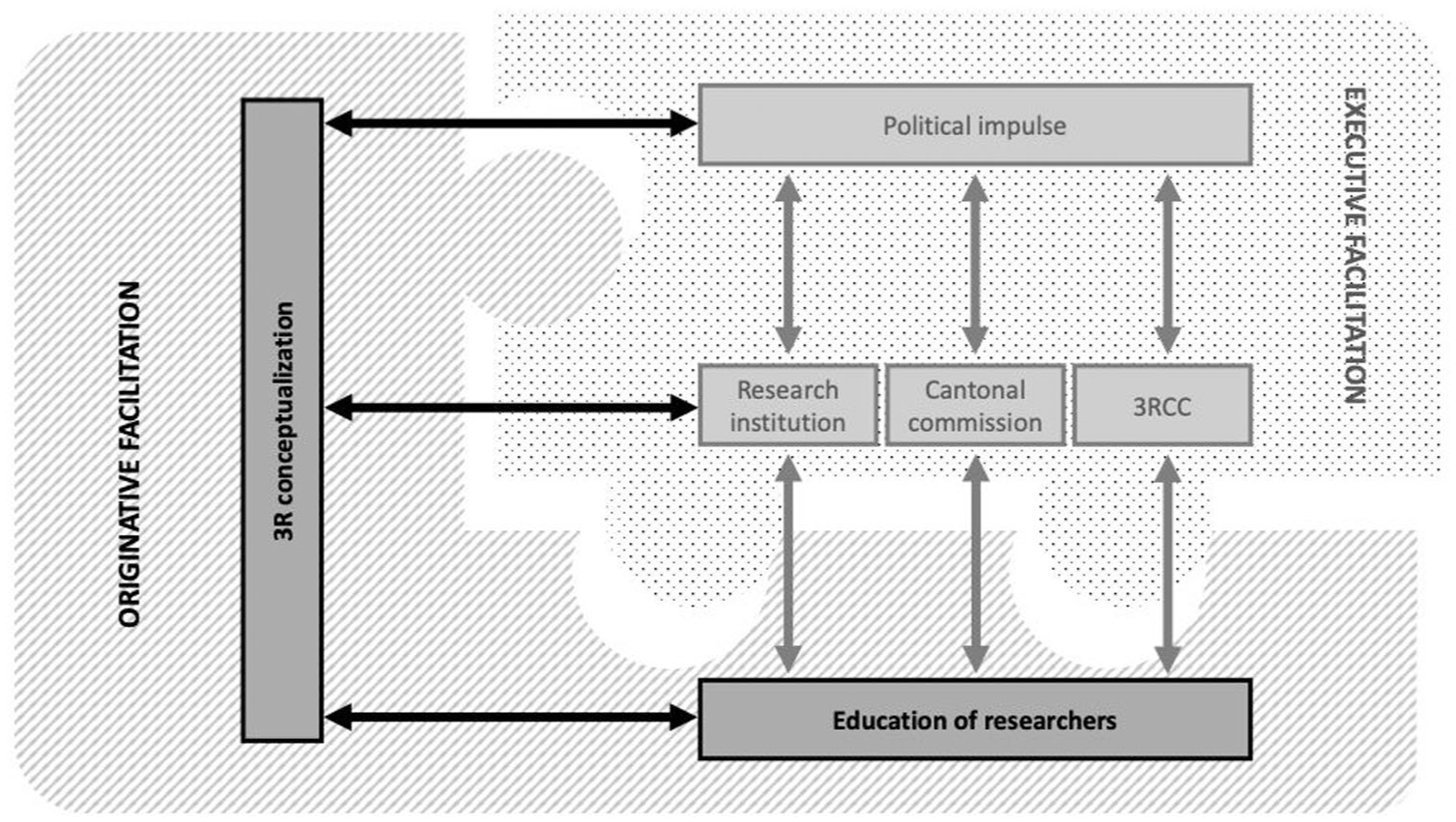
Thematic map of the different levels of facilitation identified. This article focusses on the darker shades, while lighter shades are reviewed in Part 2.
Revising the conceptualisation of the 3Rs
One key finding from the interviews was that the general understanding of the 3Rs is heterogenous among participants, which may reflect both varied levels of familiarity with the concept and divergent interpretations of their practical implications in their everyday work. While some participants articulated certain nuances in their definition of the principles and their role in animal experimentation, others had mix-ups in the principles or conflated them with general welfare guidelines, not recognising the regulatory status of the 3Rs. This revealed an inconsistent understanding of the 3Rs, which not only impacts their implementation at the individual level but also creates a gap between the higher-level structures on the one side and the field perception of researchers on the other side. Hence, the conceptualisation of the 3Rs represents a discursive framing that influences all other structures involved in their implementation. The participants shared various critical perspectives on the adequacy of the 3Rs for their actual research contexts. More specifically, these discussions can be divided into three aspects: separating replacement from reduction and refinement; expanding the scope of 3R concern; and including good scientific practices in the 3Rs.
Replacement as a special unit of the 3Rs
A recurrent observation among participants – whether explicitly stated as such or implied – was that replacement is perceived differently as reduction and refinement. While the latter two principles are often seen as improvements within existing animal-based research paradigms, replacement implies a more fundamental shift: the move toward methods that do not involve animals at all. However, this conceptual distinction can lead to a cognitive tension, where replacement is viewed as being in conflict with, rather than complementary to, reduction and refinement.
Within the 3Rs, there are two things. There are the first two Rs, reduce and refine, which is just about doing your animal experimentation correctly. [. . .] Then, there is the replace part. It is not the same people who do the replace and the reduce, refine. [. . .] And as a rule, the scientific community, this is my impression, does not like to talk about replace because if you admit that replace is good, you are saying that animal experimentation is not good. (Participant 3R-17 – Full professor)
Expanding the scope of concern of the 3Rs
A first kind of expansion is related to the ‘hidden’ use of animals for experimental purposes, for example, in the production of reagents or additives (foetal bovine serum or antibodies for instance), or in sub-threshold procedures (severity degree 0 in Swiss legislation, see art. 24-25 AEO), which are not reviewed by commissions for animal experimentation.
People often don't think about antibodies or their culture medium as animal use, of course . . . But it is a really good way and an effective way to reduce the number of animals used in research. And it has huge scientific aspects, beneficial aspects, in both cases. (Participant 3R-11 – Postdoctoral researcher) At level 0, nothing is required. From the moment you have a degree 0 and you have the training to use animals, you do not have to justify the number you are going to use. I do not think that is right. (Participant AX-06 – Senior researcher)
A second kind of expansion of the scope of the 3Rs is related to what can be referred to as a ‘minimalist–maximalist’ use of animals: generating as few laboratory animals as possible and using each one of them as much as possible to not waste individual lives. This concern is particularly true in the case of surplus animals, that is, animals that are bred in experimental facilities but not used in any procedures. The current legal paradigm on animal experimentation only mandates the application of the 3Rs on those animals that are actually used in experiments (AniWA, art. 17), which is sometimes frustrating for researchers. As a result, some participants proposed new systems to share animals at their institution.
Like in [name of research institution abroad], if someone was going to sacrifice mice to get embryos, we had a mailing list where relevant parties were being informed that this laboratory will euthanise mice. And if you wanted to use the remaining body parts, like liver, lung, brain, et cetera, you could just contact them. And people were actually contacting each other and they were getting and making most out of that animal at that time point. Unfortunately, the similar system is not functioning in my institution for example. (Participant AX-07 – Senior researcher)
The final kind of expansion concerns the species included in experimental procedures. The majority of existing guidelines concern ‘standard’ animal models (e.g. rodents, rabbits, zebrafish), which makes the implementation of the 3Rs challenging when it comes to unusual species such as wild animals. Animal welfare officers and cantonal commissions for animal experimentation are often not prepared to provide relevant guidance for researchers in this context. This situation similarly applies to invertebrate species. With the exception of cephalopods, their use as experimental models in Switzerland is not specifically regulated, leaving limited to no guidance on how the 3Rs should be implemented in this domain.
So unfortunately for invertebrate models, there is no ethical laws so far . . . Yes, so for our research, we do not need any ethical approval . . . But still, even if there is none, it does not mean that we can do whatever we want. Of course . . ., [pause] we try to apply also the 3Rs for our insects, even if there are no regulations. [. . .] I mean, because so far the studies about the nervous system and the cognitive abilities of the invertebrates are not well studied, there are no regulations and ethical laws about it. But yes, I think with time, further investigations maybe can arrive to the 3Rs about insects. Why not? (Participant 3R-14 – PhD student)
Including good scientific practice within the 3Rs
Two specific examples of good scientific practice were mentioned for their 3R potential: pilot experiments and data sharing. Indeed, pilot experiments can, on the one hand, help evaluate the effect size and calculate a precise sample size for actual experiments, which contribute to reduction, and on the other hand, provide some room to improve the experimental procedures, which contributes to refinement. As for data sharing, having access to transparent and well-curated experimental data can provide an opportunity for hypothesis generation and reduce the need for duplicate experiments.
I think there should always be a part of the money allocated for a pilot experiment to refine the method before going in the big one. It is what we did for this project, for example. First, we began with three rats and we wanted to know how it works. [. . .] And it was one animal that died for that, not twelve, because if we had begun with twelve animals, they would all be dead. I think pilot experiments should be done every time. (Participant AX-02 – Postdoctoral researcher) Instead of doing these types of experiments again and again in our laboratories, we try to actually use publicly available data, which obviously benefits the 3Rs if the data quality is good. It is also practical and financially convenient, you do not wait, you just get the data. (Participant AX-07 – Senior researcher)
Developing 3R-focussed education for researchers
Participants indicated that structured education alongside informal knowledge exchange (e.g. during conferences or local exchange groups) were instrumental in improving individual awareness of the 3Rs. This concerns both the initial education for early-career researchers and the continuous education of senior researchers. Interestingly, mentorship from seasoned laboratory workers was mentioned as lacking for early-career researchers, in particular in relation to the implementation of refinement methods. Nevertheless, education alone was also perceived as slow-moving in the process of change. Thus, while education seems to be a necessary condition for promoting 3R adherence, it is not sufficient in isolation, which suggests that without parallel changes at other structural levels, the transformative potential of individual educational initiatives may remain limited.
A 3R-centred initial education
From the perspective of the participants, the initial education of young scientists, in particular through the Labortierkunde course (LTK, see Supplementary information 3 for details about the training system in Switzerland) but also at prior stages during bachelor’s and master’s studies, is a key facilitator for 3R implementation and should be further developed in biomedical curricula. This initial education helps to build awareness on current experimental opportunities and good practices for animal use, thus planting the seed of looking for alternative methods to an animal experiment. However, many participants also warn against having a 3R education that is too general and not tailored enough for the future needs of students. Therefore, 3R education should be progressively structured, with recurring reminders throughout the initial education and in-depth training based on the specific areas of students’ interest and research.
You know, when we have started this 3R seminar in the doctoral school, I don't remember who mentioned that to me in the first place . . ., but this was a missing piece. This was missing, and I suspect that it is missing in many institutions. But yet, we are training people to go to postdoctoral fellowships everywhere and they will be confronted to animal experiment. So I think the 3Rs need to start at the bottom, in a bottom-up fashion. Possibly much more than what it is today, because I see a gap. (Participant 3R-18 – Full professor) There are a lot of interesting things but most of the people do not know. And I have actually colleagues and we had a lecture and the professor was talking about organoids and I knew some things because of other situations and my colleagues were like ‘How do you know that’, so they even did not know. So there is I think a lack of knowledge about techniques that maybe if the people would know about it, they would reconsider how to do their experiment. (Participant AX-13 – PhD student) I think it is a mistake to have one . . ., [pause] very generic, teaching program or teaching course that everybody should take . . . [. . .] It is a shame that I have been taught about and trained with mice my whole life and that I have never actually worked with mice. We had to sacrifice mice for my training without the need of it. (Participant 3R-11 – Postdoctoral researcher)
Mentorship for young animal experimentalists
A comment especially shared by early-career researchers during interviews is how mentorship can shape the relationship young researchers have to animals and the implementation of refinement in particular. Indeed, even though these participants learned the theoretical foundations of the 3Rs, they often had to learn on their own how to apply the principles in their work, how to manipulate animals, how to limit distress and anxiety, or how to assess for pain. As acknowledged by the following participant, informal knowledge transmission contributes to filling in gaps in the practical implementation of the 3Rs. However, it may also perpetuate conceptual misunderstandings, thereby functioning as a double-edged sword. Although having the necessary education to handle animals is already required in Swiss law (art. 134 and art. 197 AniPO), more in-depth structured mentorship of young researchers by dedicated trained personnel (e.g. animal technicians or postdoctoral researchers) could further smooth the transition from theoretical knowledge to practical work.
And at the same time, I know that people in laboratories are not actually taught how to work with the animals by the courses, but by their colleagues. And that can be a good thing, but what you are going to be taught is not necessarily in a total agreement with the 3R principles and what you should be doing legally, even at a legal standpoint. (Participant 3R-11 – Postdoctoral researcher)
Interdisciplinary continuing education for senior researchers
In Switzerland, in addition to the initial education provided by the LTK course, all individuals performing or supervising animal experiments (including animal caretakers and animal welfare officers) have to complete a minimum of 4 days of training every 4 years (art. 190 AniPO, see Supplementary information 3). This mandatory continuing education, overseen by the Federal Food Safety and Veterinary Office, was usually positively seen by participants. In particular, its ability to put together researchers from different backgrounds while providing opportunities to collaborate using different kinds of methodologies. But this ability can only be fully realised if the continuing education is extended not only to animal researchers but also to other kinds of researchers working in a given biomedical field, for example engineers, cellular biologists, or computational biologists.
That is an interesting question, because during my doing of [animal] experiments or having my license, it was always required to do two days per year of education. And now, since I am not doing it anymore, I do not have that education anymore. [. . .] Yeah, it is interesting. Once you are not doing animal experiments anymore, you are sort of out of that circle of continuous education. (Participant 3R-10 – Full professor)
Discussion
This first part of our qualitative study on the originative aspects of 3R implementation provides new empirical insights on barriers and facilitators from the perspective of Swiss researchers. In particular, 3R implementation can be understood not only as a function of institutional or political processes, but also as a product of cultural, epistemological, and educational stands. Unlike executive facilitation, which is addressed in Part 2, originative facilitation emphasises the formation of shared meanings about the 3Rs. This engagement in a collective sense-making echoes findings on symbolic interactionism, where the very conceptualisation of a concept (the 3Rs in this case) creates a symbolic world and a process of interaction with others that shapes action.24,25 Such findings are relevant to all stakeholders of animal experimentation (researchers, laboratory workers, policymakers, institutions, etc.) as they form a heterogeneous community with shared concepts such as the 3Rs. And because these concepts are shared, interactions between stakeholders are based on the premise of a common interpretation.
However, while previous literature has highlighted the institutional and regulatory importance in implementing the 3Rs,9,26,27 our findings point to a more fundamental ambiguity: the lack of a coherent interpretation of what the 3Rs mean in practice, and the resulting variety of approaches to implementing and observing them. This issue has been raised numerous times in theoretical papers.3,28,29 Our study not only brings qualitative evidence to the scarce existing empirical literature on this hypothesis,30,31 but it also helps shed light on undesirable approaches to avoid and others to observe as best practices in implementation. While the question of how best to interpret the 3Rs may seem trivial, it bears very practical implications regarding how policymakers, researchers, and other stakeholders approach the principles and their implementation. Further, inconsistent interpretations of the 3Rs may reinforce epistemic divides between research paradigms depending on whether or not they are based on animal models, and may create a false impression of ‘irreconcilable worlds’, by insinuating ‘non-animal methods as second best to animal models’ in biomedical research.32,33
Our findings reaffirm the importance of education from the perspective of researchers as a necessary, although not sufficient, condition for successful 3R implementation. This is consistent with several other studies on the topic34–37 and the results from our systematic review of European empirical literature. 38 While structured training, for instance during the LTK course, was seen as a valuable foundation, participants emphasised the need for more contextual learning to bridge the gap between theoretical instruction and applied knowledge. Importantly, our findings show the role of informal knowledge transmission and peer mentorship as a critical, yet under-recognised, form of 3R education.39,40 One possible strategy to integrate this peer mentorship may consist of further practical training of early-career researchers in the design and conduct of experiments in biomedical research by seasoned personnel, or increased supervision by the 3R office for these researchers, which in turn demands more resources in research institutions.
Originative aspects of the 3Rs play an important role in implementation, as the interpretation of the principles and the education received on these principles influence the worlds of practical possibilities that researchers have access to and may look out for. Taking the case of replacement as a practical example, some researchers may want to reflect on how best to apply this principle in their research design. Originative facilitation would thus require them to have access to a clear definition of what ‘replacement’ actually entails, but also to be knowledgeable (and therefore be trained or be able to connect with educated peers) of replacement methods relevant to their research questions. These elements therefore help better understand the cultural dimensions of animal research and 3R implementation, inviting further research on how epistemic communities in science shape and share normative constructs. More specifically, there is a need to investigate whether the discursive framing of the 3Rs varies between different institutions (e.g. policymaking, general public, administration, 3R competence centre) and, if so, how these variations relate with each other and affect the implementation of the principles. Although this study was limited to the Swiss context of animal experimentation, the findings suggest that aiming for an international consensus in the definition of the 3Rs as well as a cross-border, standardised education of scientists on their practical application, two important aspects of the originative facilitation of 3R implementation, would be relevant for other national contexts.
This qualitative study is not without limitations. The sample, while diverse, does not capture the full range of disciplinary variability present in Swiss animal research and only includes researchers from public institutions. Cultural factors and social desirability may have played a role in the information we received. Future research should therefore explore how these originative and executive forms of facilitation interact in other national contexts. Longitudinal or ethnographic approaches would also help elucidate how changes in conceptual understanding and educational interventions translate into practical advancements.
Supplemental Material
sj-docx-2-lan-10.1177_00236772261436225 – Supplemental material for Advancing the 3Rs? Researchers’ perspectives on institutional facilitation in Switzerland – Part 1: originative facilitation
Supplemental material, sj-docx-2-lan-10.1177_00236772261436225 for Advancing the 3Rs? Researchers’ perspectives on institutional facilitation in Switzerland – Part 1: originative facilitation by Edwin Louis-Maerten, Lester D. Geneviève, Love Hansell, Charlotte E. Blattner and Bernice S. Elger in Laboratory Animals
Supplemental Material
sj-pdf-1-lan-10.1177_00236772261436225 – Supplemental material for Advancing the 3Rs? Researchers’ perspectives on institutional facilitation in Switzerland – Part 1: originative facilitation
Supplemental material, sj-pdf-1-lan-10.1177_00236772261436225 for Advancing the 3Rs? Researchers’ perspectives on institutional facilitation in Switzerland – Part 1: originative facilitation by Edwin Louis-Maerten, Lester D. Geneviève, Love Hansell, Charlotte E. Blattner and Bernice S. Elger in Laboratory Animals
Supplemental Material
sj-pdf-3-lan-10.1177_00236772261436225 – Supplemental material for Advancing the 3Rs? Researchers’ perspectives on institutional facilitation in Switzerland – Part 1: originative facilitation
Supplemental material, sj-pdf-3-lan-10.1177_00236772261436225 for Advancing the 3Rs? Researchers’ perspectives on institutional facilitation in Switzerland – Part 1: originative facilitation by Edwin Louis-Maerten, Lester D. Geneviève, Love Hansell, Charlotte E. Blattner and Bernice S. Elger in Laboratory Animals
Footnotes
Declaration of conflicting interests
The authors declared no potential conflicts of interest with respect to the research, authorship, and/or publication of this article.
Funding
The authors disclosed receipt of the following financial support for the research and publication of this article: This work was supported by the Swiss National Science Foundation, as part of the National Research Programme 79 ‘Advancing 3R’ (grant number: 407940_206432). The funder played no role in data collection and interpretation nor in the study design and reporting.

Data availability statement
Supplemental material
Supplemental material for this article is available online.
References
Supplementary Material
Please find the following supplemental material available below.
For Open Access articles published under a Creative Commons License, all supplemental material carries the same license as the article it is associated with.
For non-Open Access articles published, all supplemental material carries a non-exclusive license, and permission requests for re-use of supplemental material or any part of supplemental material shall be sent directly to the copyright owner as specified in the copyright notice associated with the article.
