




Abstract
This document provides assessment criteria for evaluation of each of the Learning Outcomes of the Modules specified (in addition to the Core Modules) for those designing procedures and projects in the Education and Training Framework guidance document by the European Commission and endorsed by the Member States Competent Authorities. This Working Group was tasked to produce these criteria by the Education & Training Platform for Laboratory Animal Science, which was funded by the European Commission to this aim. The assessment criteria address knowledge and skills (including critical thinking) expected to be acquired during education and training of persons preparing to design research procedures and projects using animals under the scope of Directive 2010/63/EU. Recognizing the diversity of expertise and experiences of those being educated and trained, we provide two levels of attainment, an ideal response and one that would be acceptable for each Learning Outcome. The balance between ideal and acceptable could be decided by the particular course providers and/or assessors, according to their local requirements. We envisage that the use of these assessment criteria by training providers and accrediting or approving bodies will help harmonize the education and training for those who will design procedures and projects using animals for scientific purposes. In Europe, this may also contribute to mutual recognition of training, and facilitate free movement of scientists.
Introduction
The purpose of the present document is to provide accessible guidance on the assessment criteria for the Learning Outcomes specified in the European Commission Education & Training (E&T) Framework guidance document 1 for the training of personnel designing procedures and projects (Function B staff) a
The authors have provided assessment criteria for the Function B specific Modules 7, 9, 10 and 11 in this current document. Function B staff are required to also complete the Core Modules 1, 2, 3.1, 4, 5 and 6.1.
The Education & Training Platform for Laboratory Animal Science (ETPLAS) 3 was tasked by the European Commission funded Preparatory Action ‘Promoting alternatives to animal testing through accessible and harmonized education and training’ (grant agreement no. 09.200200.A092004/2021/864077/SUB/ENV.B.2) to provide assessment criteria for the Learning Outcomes stated in the E&T Framework guidance document. 1 The authors of this assessment criteria document constituted the Working Group. The intention was to develop assessment criteria for the Learning Outcomes in accordance with good educational practice and to agreed quality standards. Assessment criteria are statements which specify (and itemize) the standards that must be met and what evidence will be taken to show achievement of the respective Learning Outcomes. 4
The assessment criteria developed seek to evaluate knowledge and intellectual skills acquired, and critical thinking. They follow a knowledge, skills, and attitudes (or behaviours) framework widely used (instead of Bloom’s taxonomy 5 ) in professional assessments,4,6 –9 and are forward-thinking in outlook. The aim was that they should be available, accessible, and understandable to educators and learners, and transferrable across the European Union. For those participating in these educational activities, which may include individuals undertaking professional life-long learning, we consider them as ‘learners’ rather than as ‘trainees’. Recognizing the diversity of expertise and experiences of the learner community, we provide two levels of attainment: an ‘ideal’ (I) response and one that would be ‘acceptable’ (A) as a pass level for a Learning Outcome (see Discussion). Course providers and/or assessors may decide that ideal is more suitable for assessment of some or all of the Learning Outcomes in their particular situations.
To allow for the flexibility appropriate for the document to be useful in different establishments and systems, these assessment criteria do not indicate the way in which assessment should be carried out, but instead have been written so that all would be amenable to different formats of written assessment. The wording provides for different types of content. Thus for ‘listed’ a simple listing would be sufficient but ‘related’ is looking for some extra text for each item on a list; ‘illustrated’ requires that there is an example for each of the elements of a topic, while for ‘illustrative’ one general example of the topic would be sufficient. ‘Provided’ or ‘given’ allow for a variety of appropriate content, with the judgement on whether the response meets the criterion made by the assessor. Course assessors may decide on whether the variety and quantity of the responses provided are sufficient for an ‘ideal’ or ‘acceptable’ response, which is indicated in the wording of the assessment criteria such as variety, several, few, or one.
In the following Tables of the Modules for persons who will design procedures and projects, namely Modules 7, 9, 10 and 11 according to the E&T Framework guidance document, 1 the assessment criteria are placed to the right of the Learning Outcomes (LOs) column. Underneath the assessment criteria for each Module, for some LOs, additional details or links to other material have been provided, to allow all those with an interest in the educational process to see a range of content which may be included.
All tables are preceded by the original text from the E&T Framework guidance document. 1
Module 7: Minimally invasive procedures without anaesthesia – species specific (theory)
[Function Specific for Functions A and B]
This module provides an introduction to the theory relating to minor procedures. It provides information about appropriate methods of handling and restraint and describes appropriate techniques for injection, dosing and sampling relevant to the species. It should provide information sufficient for individuals to understand what will be required of them before they go on to be b
Addition to the original E&T Framework guidance document.
Change of sequence to the original E&T Framework guidance document, as principles have to be understood before being applied in practice.
[Abbreviations: I = Ideal, A = Acceptable]

Module 9: Ethics, animal
Typo corrected.
welfare and the Three Rs (level 2)
Typo corrected.
[Function Specific for Function B]
Deleted here from the original E&T Framework document as biological consequences of experimental procedures were covered previously.
The purpose of this module is to address the fact that those designing procedures should command a deeper and broader understanding of the general issues. Thus, the main difference between level 1 and level 2 Modules on ‘Ethics, animal welfare that
f
The word ‘that’ in the original E&T Framework guidance document has been replaced by ‘and’.

Note:
Assessment criteria pertaining to LO 9.6. A format for an NTS has been provided by the European Commission implementing decision 2020/569/EU. This can be retrieved at https://eur-lex.europa.eu/legal-content/EN/TXT/?toc=OJ%3AL%3A2020%3A129%3ATOC&uri=uriserv%3AOJ.L_.2020.129.01.0016.01.ENG.
The EU public database of NTSs on project licences issued since 2021 may be consulted at https://environment.ec.europa.eu/topics/chemicals/animals-science/statistics-and-non-technical-project-summaries_en#project-summaries-database or at
European Commission, Directorate-General for Environment, Non-technical project summaries under Directive 2010/63/EU on the protection of animals used for scientific purposes, Publications Office of the European Union, 2022, https://data.europa.eu/doi/10.2779/778680.
Module 10: Design of procedures and projects (level 1)
[Function Specific for Function B and Additional for Function A (as required)] [Function Specific for Functions A and B]
This module is a pre-requisite for people who will be designing projects (Function B) but it is also be
g
The word ‘be’ has been deleted from the original E&T Framework guidance document.
[Abbreviations: I = Ideal, A = Acceptable]

Module 11: Design of procedures and projects (level 2)
[Function Specific for Function B]
This module provides a relevant level of understanding of the national and international legal and regulatory framework within which projects are constructed and managed, and of their legal responsibilities.
The trainee must be able to identify, understand and respond appropriately to the ethical and welfare issues raised by the use of animals in scientific procedures generally, and specifically within their own programme of work. These have been addressed in Module 2.
The trainee should be able to develop, direct and control a programme of work in order to achieve its stated objectives, while ensuring compliance with the terms and conditions of any regulation governing the project. This includes implementation of the Three Rs throughout the programme of work. Learning outcomes relating to Reduction are addressed in Module 2.
[Abbreviations: I = Ideal, A = Acceptable]
(i) Legal issues
Notes:
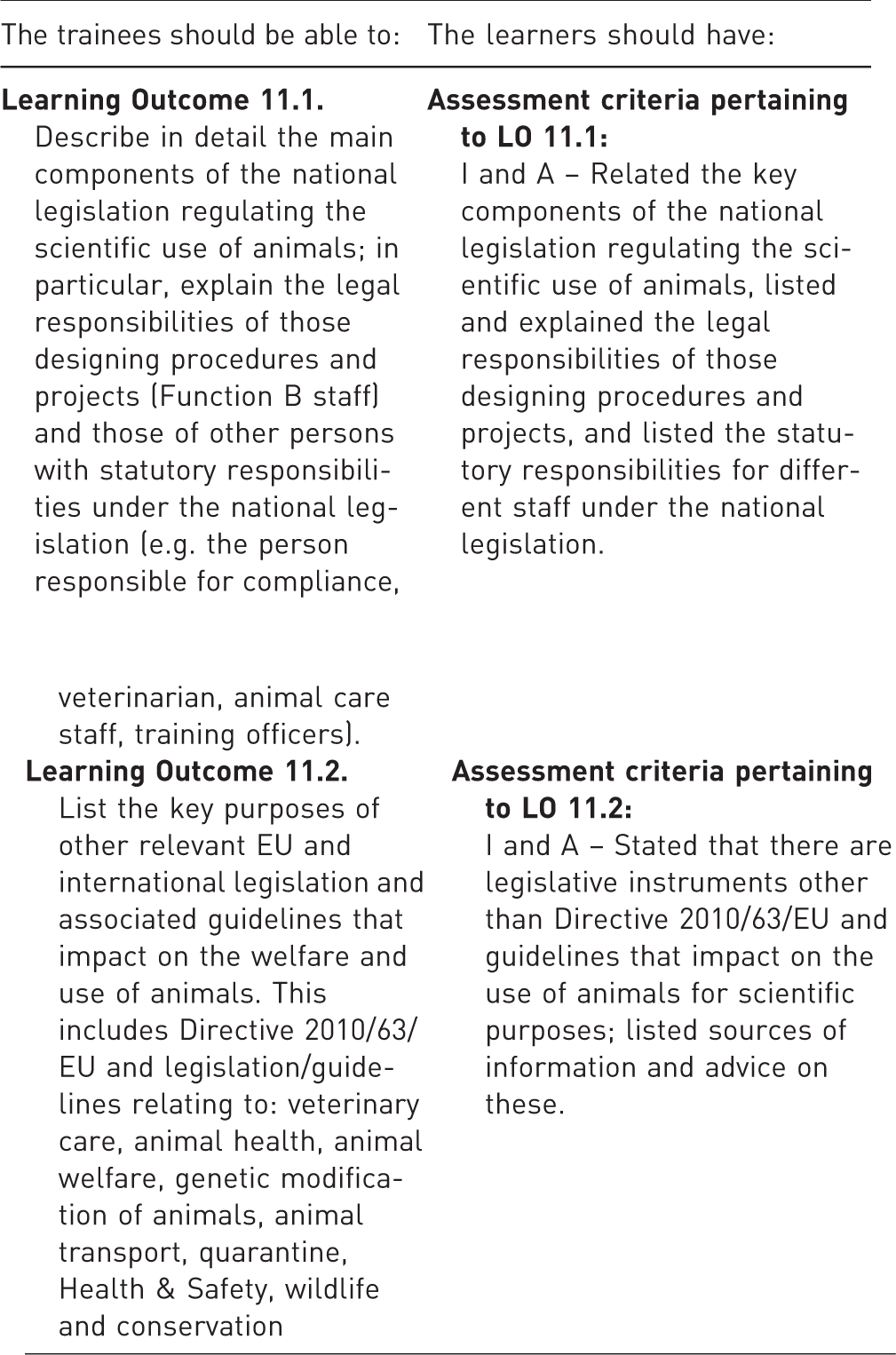
Assessment criteria pertaining to LO 11.1. Member states are required to implement in their national legislation the legal responsibilities of those designing procedures and projects and those of other persons with statutory responsibilities stated in the Articles 20, 23, 24 and 25. It is not expected that the learners should be required to reproduce the whole of the national legislation.
Assessment criteria pertaining to LO 11.2. Although those designing procedures and projects may not need to specify what other legislation and guidelines could apply to their animal use, they should be aware that there are many regulations other than the Directive 2010/63/EU which apply to their work and that they need to consult on these.
(ii) Good scientific practice

Notes:
Assessment criteria pertaining to LO 11.3. This LO refers to a ‘good scientific strategy’ and ‘robust results’. A good scientific approach that would yield robust results requires a clear objective (why the experiment is being performed) for each study and, where appropriate, the testable hypothesis that comes from it. It includes obtaining valid, unbiased results by the proper conduct of an experiment and consideration, with evident understanding, of the use of different experimental designs, in particular fully randomized, randomized block, factorial and cross-over arrangements, and how each of these designs could be statistically analysed.
Assessment criteria pertaining to LO 11.4. It is expected that the experts to be consulted will be those knowledgeable in the design, conduct and analysis of animal experiments. The causes of biological variability to be considered could include inter-individual differences, age, sex, genetic status, environment and handling.
Assessment criteria pertaining to LO 11.5. Harm–benefit analysis is discussed with examples in the FELASA Working Group reports (https://felasa.eu/Portals/1/Reports/Bronstad_2016_FELASA_AALAS_HBA_P1.pdf?ver=eos0kLpCTV1BrUN8N0T5Rg%3d%3d, and https://felasa.eu/Portals/1/WorkingGroupsPublic/Laber_2016_FELASA_AALAS_HBA_P2%20(1).pdf?ver=MsIzEOgiUkc4NhHJaOV4eg%3d%3d).
Assessment criteria pertaining to LO 11.6. The NC3Rs link on pilot studies (https://nc3rs.org.uk/3rs-resources/conducting-pilot-study) explains what they are and when they are valuable.
Assessment criteria pertaining to LO 11.8. Good Laboratory Practice (https://one.oecd.org/document/env/mc/chem(98)17/en/pdf) governs the documentation of how the experiment was planned, conducted and analysed.
Assessment criteria pertaining to LO 11.9. The Animal Research Reporting In Vivo Experiments (ARRIVE) guidelines vs. 2.0 are available at https://journals.plos.org/plosbiology/article?id=10.1371/journal.pbio.3000410.
(iii) Implementing the Three Rs

Notes:
Assessment criteria pertaining to LO 11.13. The assessment criteria do not cover the elements in parentheses (e.g. EURL ECVAM Search Guide, Go3Rs) in the E&T Framework document LO 11.13 as these examples are not search tools but repositories and databases. It also does not cover Systematic Reviews and Meta-Analyses as they are primarily methods of analysis, not methods of search.
Assessment criteria pertaining to LO 11.14. The assessment criteria changed the sequence regarding alternative methods and research strategies in the LO 11.14 since ‘replace, avoid or complement’ are related to alternative methods more than to research strategies.
(iv) Responsibilities
Discussion
This document is aimed at all stakeholders (learners, educators and accrediting bodies) involved in the education of learners who will go on to design procedures and projects, written so all know what is expected to be examined and the assessment approach. Given the roles of those being educated and the knowledge they have gained from this education, we have moved beyond just testing knowledge recall to a broader assessment that includes intellectual skills acquired and critical thinking, and appropriate attitudes and behaviours,4,6 –9 embedding these in the wording of the assessment criteria. So, for instance, an ‘illustrated example’ requires both explanation and application, not just stating the example.
The objective is that the overall assessment of the learning activity is to move from an end-of-course assessment that can be a pass or fail, to a stage in the learner’s life-long learning journey. Educators may set the balance of acceptable (A) versus ideal (I) depending on the cohort mix, experience and needs of their learner community. As they progress through their careers, learners should transition from the acceptable (A) to the higher level ideal (I), based on their individual needs, roles in the workplace and life-long learning requirements.
Educators who are delivering content that will be assessed using these criteria are recommended to adopt a student centred, active learning educational approach in their delivery,10,11 as student active learning should develop the appropriate skills and attitudes/behaviours.12,13
Module 7 assessment criteria have been written for those designing procedures and projects, giving ideal and acceptable levels. A previous publication 14 has provided assessable learning outcomes with a level of detail appropriate for teachers and assessors dealing with those performing procedures. Assessment of those designing procedures and projects requires assessment criteria appropriate to the extent of reflection and critical thinking expected from them, and the text here is broadly written to both encompass and go beyond the assessment elements given previously. Ideally, reassessment of Module 7 should be considered for personnel moving from performing procedures to designing procedures and projects.
Question setters may find the notes related to the assessment criteria of the modules helpful in preparing questions. Particularly for Module 11, there is considerable guidance on content in the notes provided.
We anticipate that different types of questions will be needed to fully assess the particular Learning Outcomes according to these criteria. For example, a simple multiple choice question format may be appropriate where ‘listed’ has been specified, whereas where the assessment criterion has specified ‘related’, a more complex question format could well be needed.
We hope, in accordance with ETPLAS’ wider aspirations, 15 this will provide a common framework to assist the harmonization of the assessment after training of individuals designing procedures and projects. We also hope that our identifying some points that could be modified in subsequent versions of the E&T Framework guidance document will be helpful.
Footnotes
Acknowledgements
The authors are grateful to Prof. Jan-Bas Prins and Dr. Anne-Dominique Degryse for gaining the funding for this work and reviewing the manuscript. The authors also thank Mrs Penelope Alborough for administrative support.
Data availability statement
No clinical or research data was used in this paper. The paper reflects the opinion of the authors and is supported by relevant references.
Declaration of conflicting interests
Ismene A Dontas is currently a Member of the ETPLAS Executive Committee and David I Lewis is currently a Member of the ETPLAS Stakeholder Board.
Ethics statement
Our study did not require an ethical board approval because it did not contain human or animal trials. The ARRIVE guidelines author checklist has not been attached because this manuscript does not describe animal research. It has developed criteria for the assessment of those designing procedures and projects according to the Learning Outcomes described in the European Commission’s Education and Training Framework document.
Funding
The authors disclosed receipt of the following financial support for the research, authorship, and/or publication of this article: This work was supported by the Education and Training Platform for Laboratory Animal Science (ETPLAS) Preparatory Action ‘Promoting alternatives to animal testing through accessible and harmonized education and training’ (European Commission grant agreement No. 09.200200.A092004/2021/864077/SUB/ENV.B.2). The Gold Open Access publication of this work was funded by Laboratory Animals Limited (Ref: BA531 2024).
