




Abstract
Article 23(2) of the European Union Directive 2010/63/EU, which regulates welfare provisions for animals used for scientific purposes, requires that staff involved in the care and use of animals for scientific purposes be adequately educated and trained before they undertake any such work. However, the nature and extent of such training is not stipulated in the Directive. To facilitate Member States in fulfilling their education and training obligations, the European Commission developed a common Education and Training Framework, which was endorsed by the Member States Competent Authorities. An Education & Training Platform for Laboratory Animal Science (ETPLAS) Working Group was recently established to develop further guidance to the Learning Outcomes in the Framework, with the objective to clarify the levels of knowledge and understanding required by trainees, and to provide the criteria by which these Learning Outcomes should be assessed. Using the Framework document as a starting point, assessment criteria for the Learning Outcomes of the modules required for Function A persons (carrying out procedures on animals) for rats, mice and zebrafish were created with sufficient detail to enable trainees, providers and assessors to appreciate the level of knowledge, understanding and skills required to pass each module. Adoption and utilization of this document by training providers and accrediting or approving bodies will harmonize introductory education and training for those involved in the care and use of animals for scientific purposes within the European Union, promote mutual recognition of training within and between Member States and therefore free movement of personnel.
Introduction
The European Union (EU) Directive 2010/63/EU 1 provides legislative framework for the protection and welfare of animals used for scientific purposes. It has three principal objectives: (a) to enhance the efficient functioning of the EU internal market and the competitiveness of research and industry in the EU; (b) to ensure high standards of research animal welfare; (c) to improve transparency to the general public on the use of animals for scientific purposes.
Critical to the realization of these objectives is to ensure that all personnel involved in the care and use of research animals are appropriately educated, trained and competent to fulfil their respective functions. Article 23(2) of the Directive 1 requires that ‘staff shall be adequately educated and trained before they perform any of the following functions’. Whilst the Directive does not stipulate how Member States ensure appropriate provision of education and training, the European Commission (EC) developed a common Education and Training Framework, 2 which was endorsed by the Member States Competent Authorities, to facilitate them in fulfilling their obligations.
The developed Framework describes the education, training, supervision, competence and continuing professional development of the four Functions set out in the Directive, based on a modular training structure. It includes compulsory (‘Core’) and Function specific modules, each module comprising a set of Learning Outcomes. Core modules are compulsory to all four functions whereas Function specific modules are compulsory for a specific Function. 2 The Learning Outcomes define the minimum knowledge and skills trainees should possess on completion of the required modules for their respective Function. Adoption and use of this Framework by education and training providers across the EU promotes the harmonization of training provision to a common standard or level of knowledge and understanding. This in turn facilitates mutual recognition of provision within and between Member States, and therefore promotes the free movement of personnel.
To promote the Framework to prospective, new or existing providers, the Education & Training Platform for Laboratory Animal Science 3 (ETPLAS) was established. ETPLAS functions as an information sharing and communication portal to facilitate the sharing of information and good practice in education and training in research animal sciences between Member States, accrediting or approval bodies, education and training providers and employers. 4 It seeks to encourage consistency of content, assessment and outcomes across modules, and between education and training providers, critical for mutual recognition and acceptance of provision.
The Framework provides an outline of the required introductory education, training and assessment provision. However, the underlying Learning Outcomes were not written using assessable verbs (verbs that enable the Learning Outcomes to be assessed objectively and by electronic means), and thereby posing difficulties for their assessment in their current format. These difficulties include an incomplete set of assessment criteria; the suggested assessment tools cannot be justified pedagogically, and only few exemplars of good assessments are provided. To address these issues, ETPLAS was awarded an EU Parliament Pilot grant to undertake the following: (1) development of guidance for producing assessment criteria for the Learning Outcomes; (2) development of a database of assessment criteria for core and Function A specific modules; (3) establishment of a questions database; (4) establishment of a database of assessments of common practical tasks; (5) establishment of a suitable IT platform. In 2019, Working Groups were established to fulfil objectives 1-5.
Development of assessable Learning Outcomes and guidance on assessment tools for theory modules
The ETPLAS Working Group tasked with the development of guidance, assessable Learning Outcomes and assessment criteria comprised the authors of this paper. Learning Outcomes have been expanded by creating assessment criteria with sufficient detail to enable trainees, providers and assessors to appreciate the level of knowledge, understanding and skills required to pass each module. Assessment criteria for core modules 2, 3.1, 4, 5 and 6.1, as well as Function A (persons carrying out procedures on animals) 2 specific and species specific modules 3.2, 7 and 8 for rats and mice have been developed. Zebrafish specific assessment criteria are provided as Supplementary Material online (Appendix A). Criteria for module 1 (National Legislation) have not been included, as legislative requirements may differ between and within Member States. Minor amendments (indicated in footnotes in the tables) have been made to some Learning Outcomes in the original Framework document, as the Working Group considered these as needing additional clarification or being beyond the scope required for introductory courses.
In the tables below of the Learning Outcomes for each of the aforementioned modules, each assessment criterion assesses an individual element of a composite Learning Outcome, includes assessable verbs in accordance with Bloom’s taxonomy of educational objectives, 5 and is capable of being marked objectively using electronic or digital tools. Objective marking is where the answer can only be either right or wrong, it does not require interpretation by the assessor (subjective marking), thereby providing a robust means of assessing the level of knowledge and understanding of the trainee, free of bias introduced by the assessor. Guidance on appropriate assessment tools and exemplars of different formats of questions are provided as Supplementary Material (Appendix B). These include, but are not limited to: multiple choice questions (with single or multiple correct answers), extended matching questions, missing words, drag and drop, and ‘label a diagram’.6–8 Open comment question formats, requiring written text answers, have been specifically excluded, as they cannot be marked electronically and have been shown to discriminate against those being examined in their non-native language or students with learning challenges.
Modules, Learning Outcomes and assessment criteria – Core modules
Module 2: Ethics, animal welfare and the Three Rs (level 1) (Core)
This module provides guidance and information to enable individuals working with animals to identify, understand and respond appropriately to the ethical and welfare issues raised by the use of animals in scientific procedures generally and, where appropriate, within their own programme of work. It provides information to enable individuals to understand and to apply the basic principles of the Three Rs.
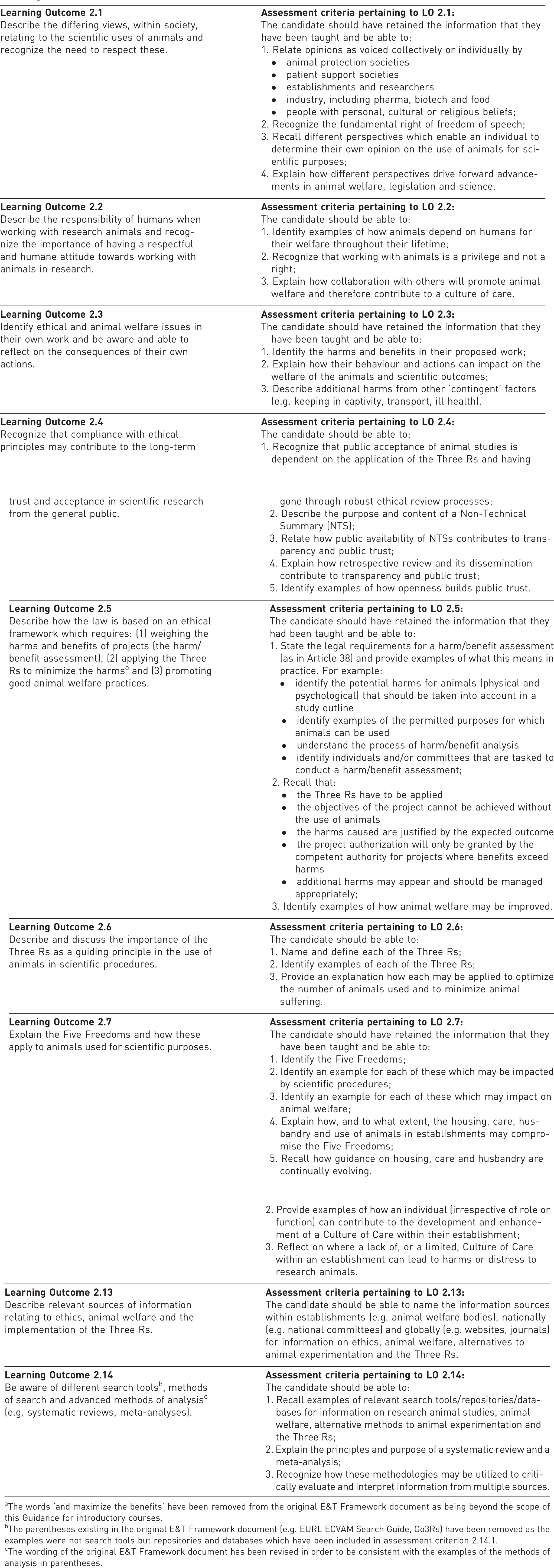
aThe words ‘and maximize the benefits’ have been removed from the original E&T Framework document as being beyond the scope of this Guidance for introductory courses.
bThe parentheses existing in the original E&T Framework document (e.g. EURL ECVAM Search Guide, Go3Rs) have been removed as the examples were not search tools but repositories and databases which have been included in assessment criterion 2.14.1.
cThe wording of the original E&T Framework document has been revised in order to be consistent with the examples of the methods of analysis in parentheses.
Module 3.1: Basic and appropriate biology – species specific (theory) (Core)
This module provides an introduction to the basic principles of animal behaviour, care, biology and husbandry. It incorporates information in relation to anatomy and physiological features, including reproduction, behaviour and routine animal husbandry and enrichment practices. It is not intended to provide more than the minimum background information which is needed for someone to be able to begin work under supervision.
Following this module practical training, under supervision, should provide each individual with the expertise and skills needed for them to carry out their particular function. Practical training requirements will, inevitably, differ according to function.
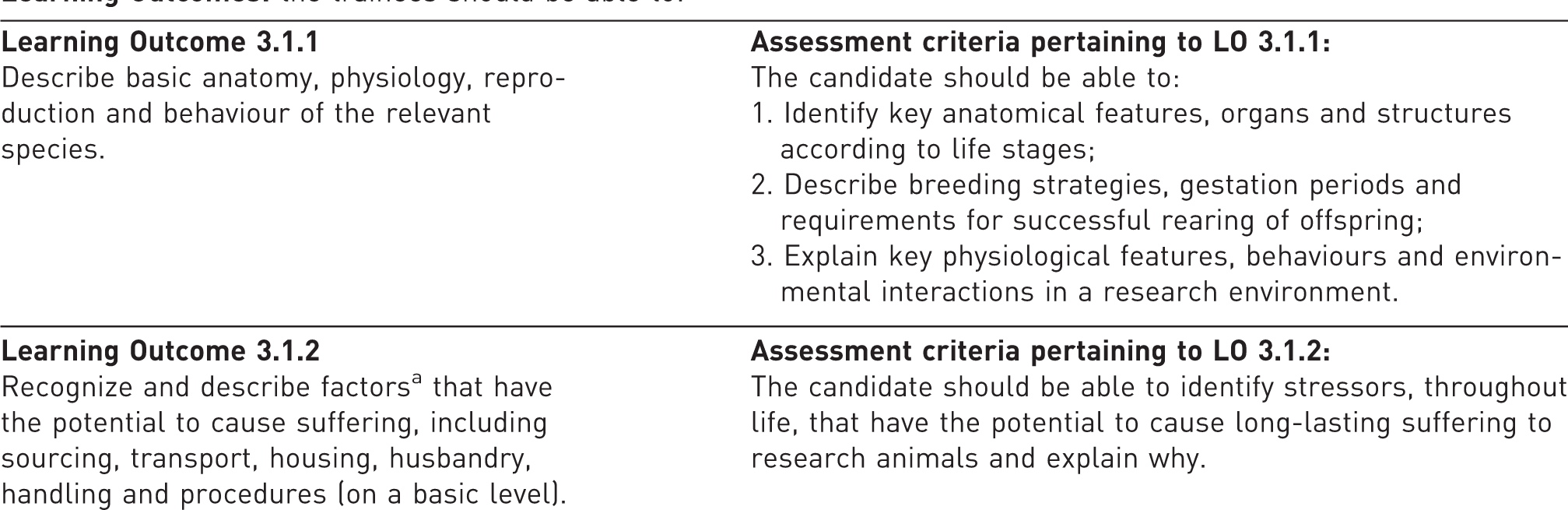
aThe words ‘life events’ in the original E&T Framework document have been replaced by ‘factors’, as ‘life events’ depict long-lasting impacts and as an expression, lack clarity.
bThe examples provided in the original E&T Framework document have been consistently removed throughout this Guidance.
c‘Dietary’ has been replaced by ‘nutritional’ as the former does not encompass the animals’ full needs.
Module 4: Animal care, health and management – species specific (theory) (Core)
This module provides information on various aspects of animal health, care and management including environmental controls, husbandry practices, diet, health status and disease. It also includes relevant basic Learning Outcomes relating to personal health and zoonosis.
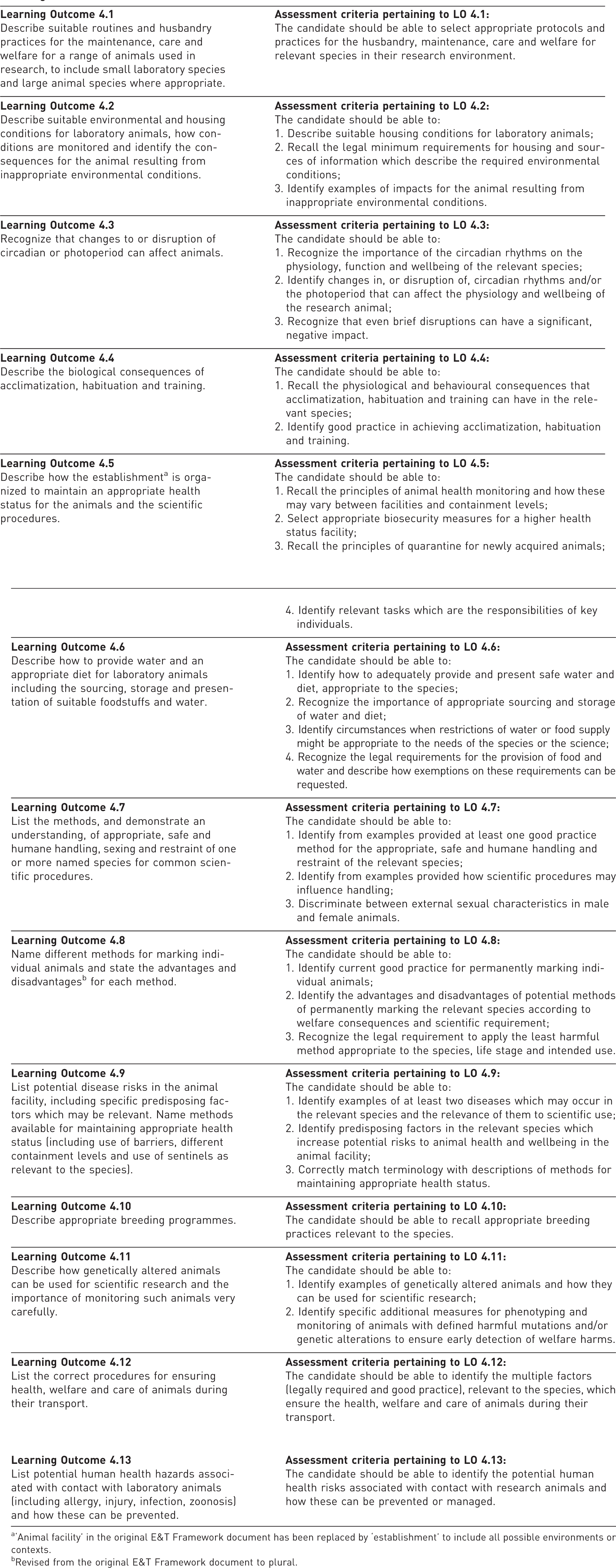
a‘Animal facility’ in the original E&T Framework document has been replaced by ‘establishment’ to include all possible environments or contexts.
bRevised from the original E&T Framework document to plural.
Module 5: Recognition of pain, suffering and distress – species specific (Core)
This module prepares individuals to be able to identify normal condition and behaviour of experimental animals and enable them to differentiate between a normal animal and one which is showing signs of pain, suffering or distress which could be a result of factors including environment, husbandry or the effect of experimental protocols. It will also provide information regarding severity classifications, cumulative severity and the use of humane endpoints.
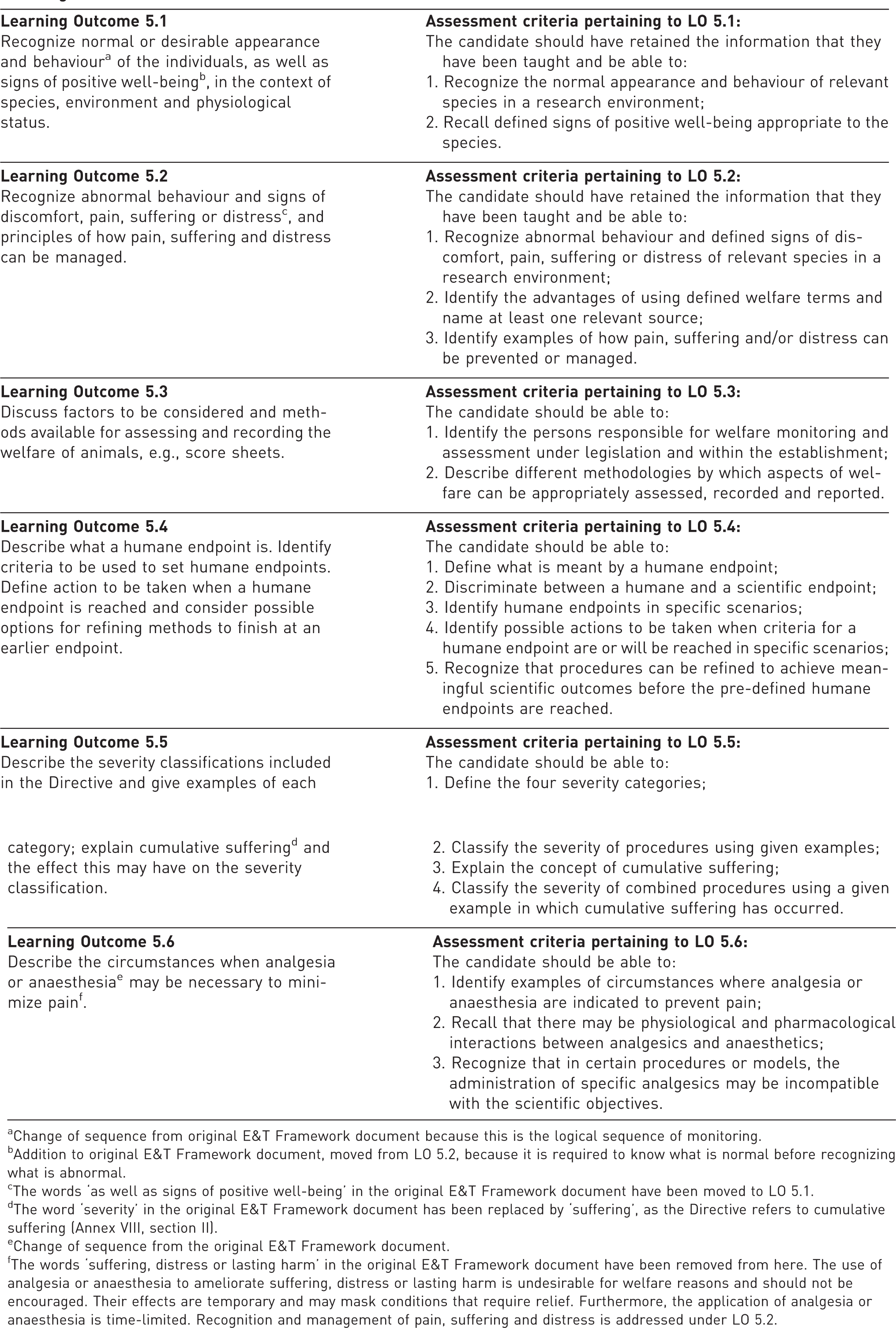
aChange of sequence from original E&T Framework document because this is the logical sequence of monitoring.
bAddition to original E&T Framework document, moved from LO 5.2, because it is required to know what is normal before recognizing what is abnormal.
cThe words ‘as well as signs of positive well-being’ in the original E&T Framework document have been moved to LO 5.1.
dThe word ‘severity’ in the original E&T Framework document has been replaced by ‘suffering’, as the Directive refers to cumulative suffering (Annex VIII, section II).
eChange of sequence from the original E&T Framework document.
fThe words ‘suffering, distress or lasting harm’ in the original E&T Framework document have been removed from here. The use of analgesia or anaesthesia to ameliorate suffering, distress or lasting harm is undesirable for welfare reasons and should not be encouraged. Their effects are temporary and may mask conditions that require relief. Furthermore, the application of analgesia or anaesthesia is time-limited. Recognition and management of pain, suffering and distress is addressed under LO 5.2.
Module 6.1: Humane methods of killing (theory) (Core)
This module provides information on the principles of humane killing and the need to have someone available, at all times, who is able to kill an animal quickly and humanely if required. The module will include information and descriptions of the different methods available, details of the species for which these methods are suitable and information to help trainees compare the methods permitted and determine how to select the most appropriate method.
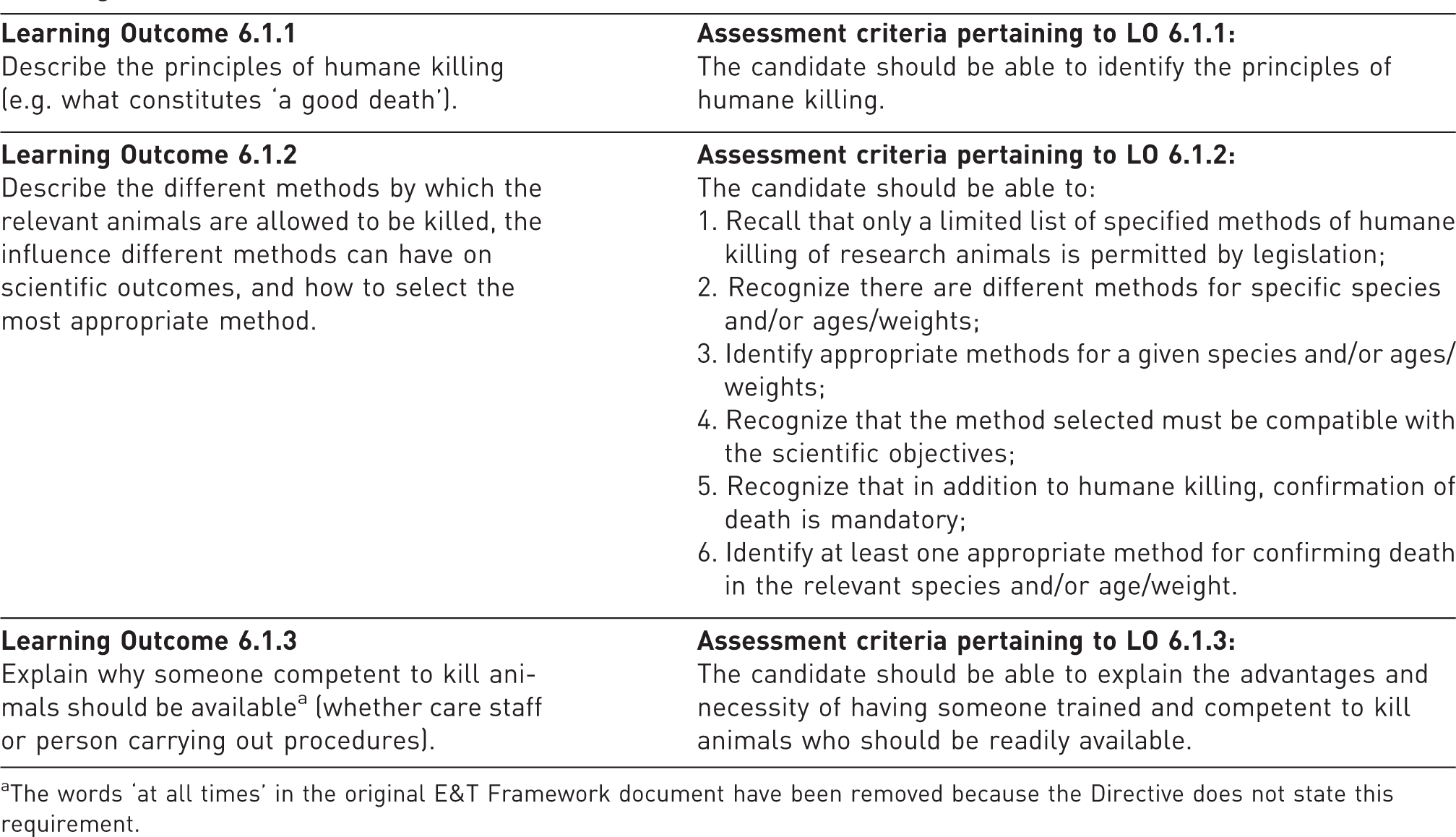
aThe words ‘at all times’ in the original E&T Framework document have been removed because the Directive does not state this requirement.
Modules, Learning Outcomes and assessment criteria – Function A specific Modules
In addition to the Core Modules, to meet the minimum training needs for a specific function, 2 Function specific Modules are required. For Function A persons (carrying out procedures on animals), the following Function A specific Modules need to be delivered and assessed.
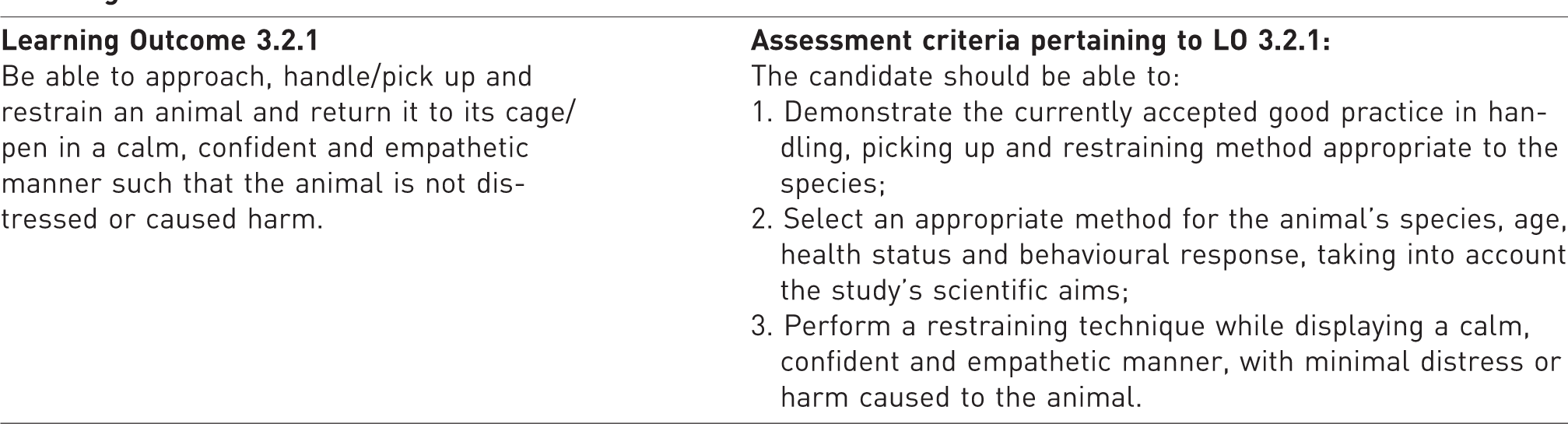
Module 3.2: Basic and appropriate biology – species specific (practical) (function specific for Functions A, C and D)
Module 7: Minimally invasive procedures without anaesthesia – species specific (theory) (function specific for Functions A and B)
This module provides an introduction to the theory relating to minor procedures. It provides information about appropriate methods of handling and restraint and describes appropriate techniques for injection, dosing and sampling relevant to the species. It should provide information sufficient for individuals to understand what will be required of them before they go on to be* trained in the practical aspects of these skills whilst under supervision.
*Addition to original E&T Framework document.
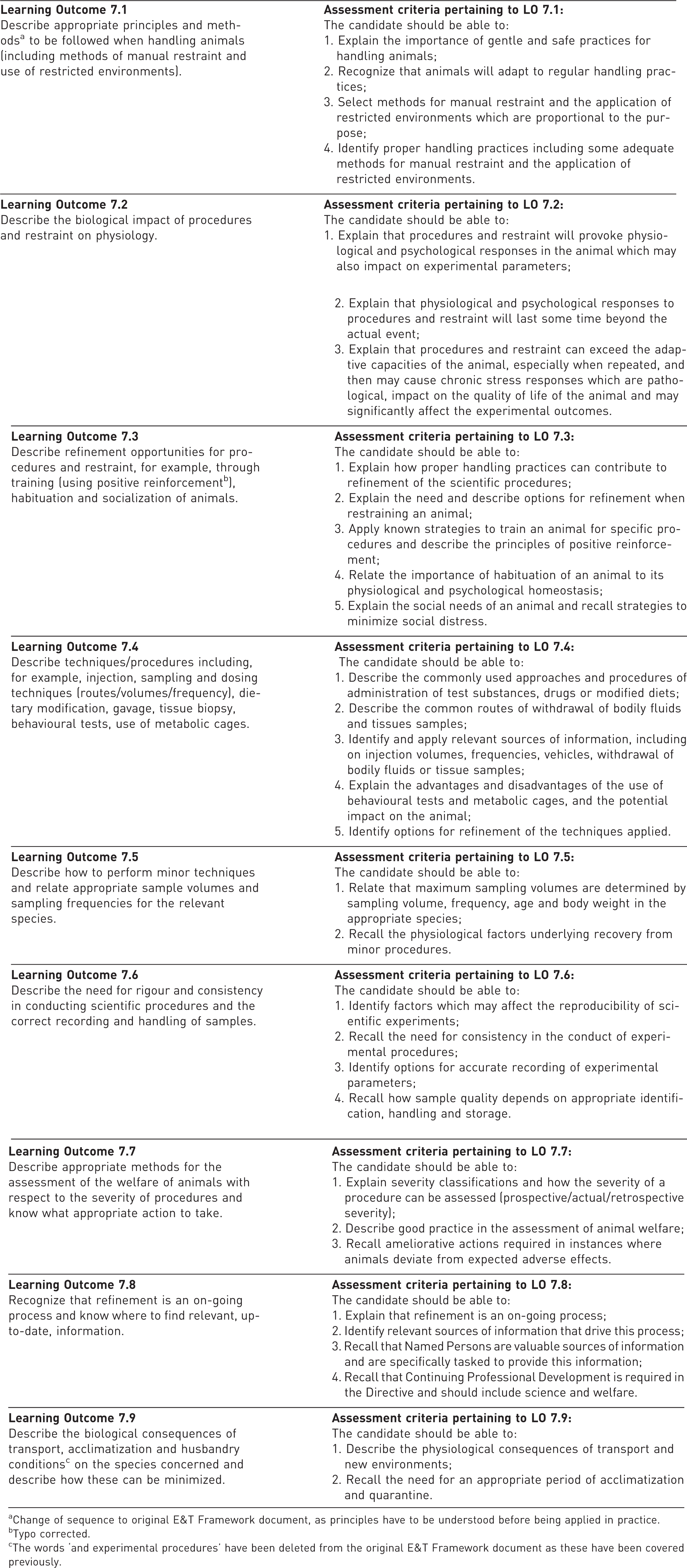
aChange of sequence to original E&T Framework document, as principles have to be understood before being applied in practice.
bTypo corrected.
cThe words ‘and experimental procedures’ have been deleted from the original E&T Framework document as these have been covered previously.
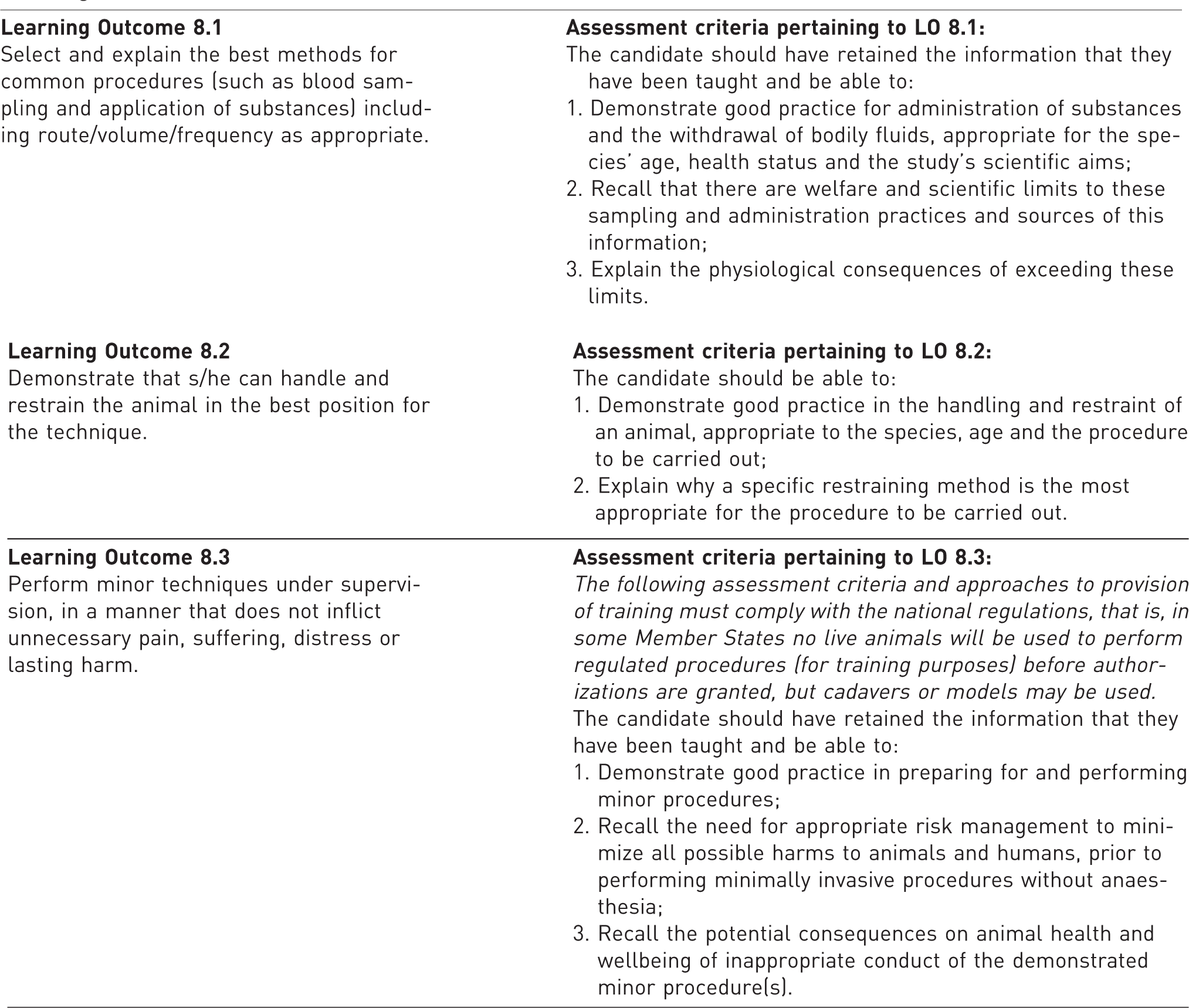
Module 8: Minimally invasive procedures without anaesthesia – species specific (skills) (function specific for Function A)
This module delivers practical elements of training relevant to Module 7. Practical training for minor procedures can be taught through a number of methods using different tools which are available and designed for the purpose (this is likely to include surrogate materials,** synthetic animal models and the use of cadavers). The module should be designed in such a way that it will enable the trainee to attain a level of proficiency such that, when commencing work under supervision, s/he should cause no pain, suffering, distress or lasting harm to the animal.
**Addition to original E&T Framework document to encompass alternative skills training materials
Implementation and next steps
This document builds on the EC Education and Training Framework, 2 providing guidance on the level of knowledge and understanding required to achieve the Framework Learning Outcomes. Some of the original Learning Outcomes have been revised in order to better portray the desired educational objectives; the rationale of these revisions is explained in the tables’ footnotes. We have produced assessment criteria for all the Learning Outcomes of the modules required for Function A persons, with wording that permits the evaluation of the knowledge acquired by objectively assessable examination methods. The user community could choose to add to this suggested provision, determine themselves where to give greater focus, and choose the most appropriate educational method, means of delivery and method of assessment.
The course should cover all Learning Outcomes of the required modules, ensuring that trainees have been provided with all the required knowledge. However, the assessment at the end of the course will, by necessity, access only a restricted number of these. The Learning Outcomes which are assessed should be chosen at random, varying between each time the assessment test is presented, and should collectively cover all modules being examined. A successful independent assessment should give reassurance that the trainee is ready to begin using animals for scientific purposes under supervision.
In developing assessments for these Learning Outcomes, providers and accrediting or approving bodies should consider the following: whether or not to hold examinations as open (can bring resources/information with them) or closed book (no resources/information permitted); standardized formats of questions; a balanced sample of assessed Learning Outcomes; provide extra time for non-native speakers to complete the assessment; supervised or unsupervised examinations, all of which have been shown to influence the marks awarded to those taking the assessment.6-8 In addition, consideration should be given to the pass mark for the assessment based on its complexity rather than selection of an arbitrary pass mark, and re-assessment options (including feedback, support and timelines) in the case of failure.
It should be noted that the assessment criteria for each respective Learning Outcome have been developed so as to be capable of assessing individual elements of a composite Learning Outcome, and that their marking can be conducted electronically, provided questions are designed appropriately. Electronic marking is objective, that is, not open to interpretation by the assessor, and therefore is more robust than subjective marking. 8 Exemplars of objective question formats that test both knowledge and understanding are provided as Supplementary information in Appendix B. The ETPLAS Working Group recommend the use of these formats as they are inclusive, they do not discriminate against those being examined in their non-native language or students with learning challenges.
Harmonization of all of the features discussed in this paper by training providers and recognition of their value and importance to promote equivalent standards between courses by accrediting or approving bodies will provide a tool for mutual recognition of training within and between Member States and more widely to other nations, and therefore promote free movement of personnel.
This document provides guidance to implement the Learning Outcomes from the Framework document 2 for introductory Function A courses and describes assessment criteria that can be used for their examination. On successful completion of these courses, trainees will have the minimum level of knowledge and understanding required, under the Directive, to carry out procedures on research animals under supervision. This should be followed by further education and training for those who continue to be involved with the care and use of animals for scientific purposes. As an individual’s career progresses, opportunities should be sought for additional education and training (continuous professional development) to deepen knowledge and understanding, as well as broadening the scope of what is learnt to accommodate developments in science and/or welfare, or enhanced leadership responsibilities or a new role within the establishment.
This programme of work is being further developed by two additional ETPLAS working groups: WG3, who are developing a database of assessment tools, and WG4, who are developing a database of assessments of common practical tasks. All of the above will be available via the ETPLAS website. 3
Supplemental Material
sj-pdf-1-lan-10.1177_0023677220968589 - Supplemental material for Assessable learning outcomes for the EU Education and Training Framework core and Function A specific modules: Report of an ETPLAS WORKING Group
Supplemental material, sj-pdf-1-lan-10.1177_0023677220968589 for Assessable learning outcomes for the EU Education and Training Framework core and Function A specific modules: Report of an ETPLAS WORKING Group by Ismene A Dontas, Kenneth Applebee, Martje Fentener van Vlissingen, Viola Galligioni, Katerina Marinou, Kathy Ryder, Johannes Schenkel, Jan-Bas Prins, Anne-Dominique Degryse and David I Lewis: the Hand-Wrist Study Group in Laboratory Animals
Supplemental Material
sj-pdf-2-lan-10.1177_0023677220968589 - Supplemental material for Assessable learning outcomes for the EU Education and Training Framework core and Function A specific modules: Report of an ETPLAS WORKING Group
Supplemental material, sj-pdf-2-lan-10.1177_0023677220968589 for Assessable learning outcomes for the EU Education and Training Framework core and Function A specific modules: Report of an ETPLAS WORKING Group by Ismene A Dontas, Kenneth Applebee, Martje Fentener van Vlissingen, Viola Galligioni, Katerina Marinou, Kathy Ryder, Johannes Schenkel, Jan-Bas Prins, Anne-Dominique Degryse and David I Lewis: the Hand-Wrist Study Group in Laboratory Animals
Footnotes
Acknowledgements
The authors are grateful to the ETPLAS Board and LASA for their constructive feedback, and to Mrs Penelope Alborough for administrative support.
Declaration of Conflicting Interests
The author(s) received no financial support for the research, authorship, and/or publication of this article
Funding
The authors disclosed receipt of the following financial support for the research, authorship, and/or publication of this article: This work was supported by the Education and Training Platform for Laboratory Animal Science (European Commission grant number 07.027741/2018/794340/SUB/ENV.B2).

References
Supplementary Material
Please find the following supplemental material available below.
For Open Access articles published under a Creative Commons License, all supplemental material carries the same license as the article it is associated with.
For non-Open Access articles published, all supplemental material carries a non-exclusive license, and permission requests for re-use of supplemental material or any part of supplemental material shall be sent directly to the copyright owner as specified in the copyright notice associated with the article.
