




Abstract
Since the embedding of the principles of the 3Rs (Replacement, Reduction and Refinement) in national and international regulations on the use of animals, scientists have been challenged to find ways to reduce the number of animals in their research. Here, we present a digital platform, called ‘3R Backboard’, linked to a laboratory animal management system, which facilitates sharing of surplus biological materials from animals (e.g. tissues, organs and cells) to other research teams. Based on information provided, such as genotype, age and sex, other animal workers were able to indicate their interest in collecting specific tissues and to communicate with the person providing the animals. A short pilot study of this approach conducted in a limited academic environment presented strong evidence of its effectiveness and resulted in a notable reduction of the number of mice used. In addition, the use of 3R Blackboard led to resource saving, knowledge exchange and even establishment of new collaboration.
Biomedical research relies on animal experimentation usually conducted in central animal facilities that handle thousands of animals. The European Parliament and the Council of the European Union prescribed the EU Directive 2010/63 as a framework for conducting scientific experiments with animals 1 making strict compliance with the 3Rs principle (Replacement, Reduction and Refinement) mandatory. 2 In addition, the regulation in place requires thorough tracking of individual animals, data capture and scientific data management. Recently, diverse freely available non-commercial programs and commercially distributed management systems were developed3,4 to allow accurate data integration and management in accord with specific requirements of the institution. Most of these systems are designed to increase workflow efficiency, data security and animal welfare, 5 but do not allow efficient sharing of information to promote a reduction in animal numbers. Here we demonstrate the value of ‘animal sharing’ and report the implementation of a new feature in the tick@lab animal management software that allows reduction of the number of laboratory animals by sharing surplus animals, organs and tissues.
A recent report revealed that about 10 million animals were used per year for experimental and other scientific purposes in the 28 EU Member States during 2015–2017. 6 Mice are the most common species used in regulated procedures (61%) and are mainly sacrificed for organ harvesting only.
In accord with the ‘reduction’ principle of the 3Rs, 2 the total number of animals used in experimental settings can be minimized by performing more than one procedure on an animal. This strategy is permitted only under specific conditions related to the actual severity level of the previous procedure. Consequently, animal reuse contributed to only a 2% decrease of the total number of animals used for scientific or translational purposes in 2017. 6 Reduction can also be achieved by improved information collection and experimental techniques, as well as appropriate statistical analysis.
Alternatively, sharing data and resources, such as surplus animals and tissues, can contribute to reduction. In particular, surplus animals are commonly generated in laboratories where single sex or a specific age of animals is preferentially used for experimentation. Similarly, the generation and maintenance of new genetically modified strains creates an excess of animals with undesired genetic background. Based on volunteered data from three UK Home Office licensed projects in Cardiff University, School of Medicine, we calculated that approximately 80% of mice fall into this category. Unfortunately, generation of these animals (Surplus 1) cannot be prevented. Another limited use of the animals (Surplus 2) consists of those destined for tissue collection without procedure, or culled for harvest of a single organ at the end of an experiment, while the rest of the sacrificed animal is disposed of. When shared, these sacrificed animals can offer a rich source of biological materials (e.g. organs, tissues, cells) for other researchers. Therefore, meaningful use of Surplus 1 and further exploitation of Surplus 2 can significantly contribute to the reduction of the absolute number of animals used for scientific purposes.
The RWTH University Aachen (Germany) and Cardiff University (UK) use tick@lab (a-tune software AG, Darmstadt, Germany) to ensure protocol compliance and proper reporting of all animal experimentation. In the basic version of the program, the menu already offers the transfer of animals that are not required (Surplus 1) from the experimental stock between different licensed projects if the legal requirements (e.g. signed transfer agreement, animal application for specific strains) are met.
We have now extended this function by adding a platform termed ‘3R Blackboard’, in which research teams can announce the availability of excess biological materials (tissues, organs, cells). In this application, the provider lists important details about the animal (e.g. strain, sex, age, treatment) and their contact information (Figure 1(a)). Animal workers from other groups can then specify their interest in collecting tissues and communicate with the person providing the animals.
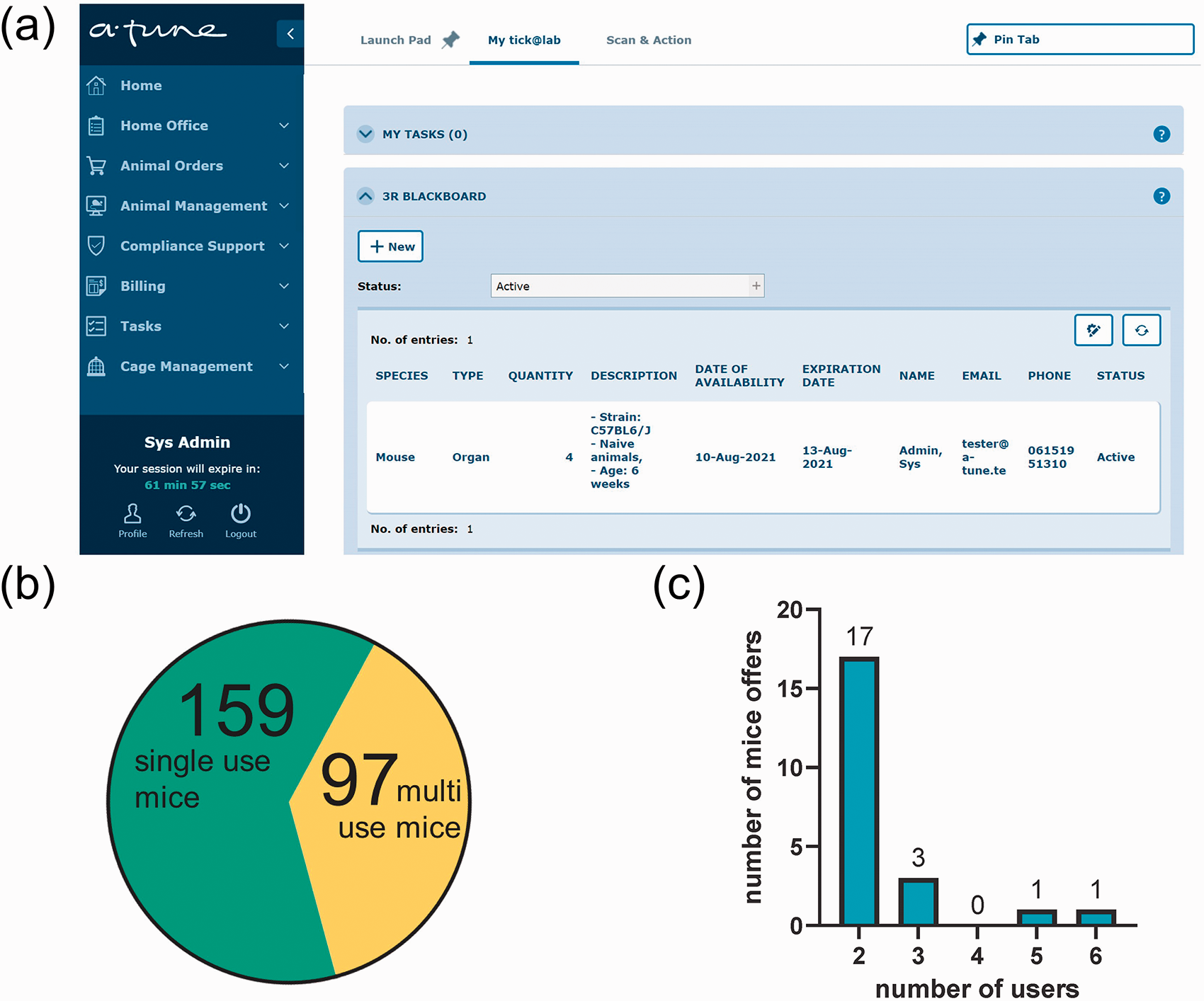
The principle and effectiveness of the 3R Blackboard. (a) Tick@lab 3R Blackboard platform; (b) total number of untreated Surplus 2 mice offered and used by multiple licensees over duration of the pilot study; (c) number of times licensees made any number of mice available (number of mice offers) versus the total number of licensees collecting tissue from at least one mouse on that occasion.
Development of this function follows a successful pilot study involving 10 participants with active UK licences from two research groups based at Cardiff University. Licensees were requested to offer mice from Surplus 2 that had not undergone any prior treatment according with guidelines explained above. Over a period of 19 months, we recorded 46 entries with an average of 5.57 mice per entry and a total of 256 mice. Nearly half of the mice that were made available (47.8%) were then shared by two to six licensees including the individual providing the animals. The majority of tissue collections (total of 17) were performed by two licensees (Figure 1(b) and (c)). In total, 97 mice out of 256 offered (37.9%) were shared for extraction of tissues, including bone marrow, peritoneal lavage, brain and others (e.g. blood, kidney, peritoneal membrane, skin, spleen, thymus). Bone marrow was the predominantly collected tissue, reflecting the research need of laboratories involved in this study. Most importantly, utilization of this sharing approach saved 140 mice (97 multi-used mice × 1.45 average number of extra users per mouse) and reduced animal costs. According with local animal facility charges, 140 mice bred to age of eight weeks have a full economic costing approaching £4000, depending on husbandry and environmental controls, but in simplified terms this represents a cost saving of approximately 35% that matches the reduction in animal use. We anticipate that these and other benefits will be greatly amplified after implementation of the offer platform on the institute scale and inclusion of remaining animals from Surplus 2.
Notably, working with materials of these sacrificed animals is generally not subject to additional special regulations and does not require supplementary approval by an institutional animal care and use committee. However, it should be noted that in some cases when sacrificed animals are subject to legally binding Material Transfer Agreements that involve intellectual property, the dissemination of materials is potentially limited or even prohibited. The researchers should report the health and genetic status of the animals used and follow all standard institutional procedures to prevent cross-contamination of facilities, where appropriate.
We provide strong evidence that exchange of surplus biological materials in combination with improved workflow (Figure 2) fulfils the legal compliance to reduce the number of animals used in research. Moreover, such strategies offer the opportunity to scientists to generate additional data, harmonize their protocols and to establish and manage joint collaborative projects and publications. The 3R Blackboard approach can be easily implemented at other locations as a simple software update.
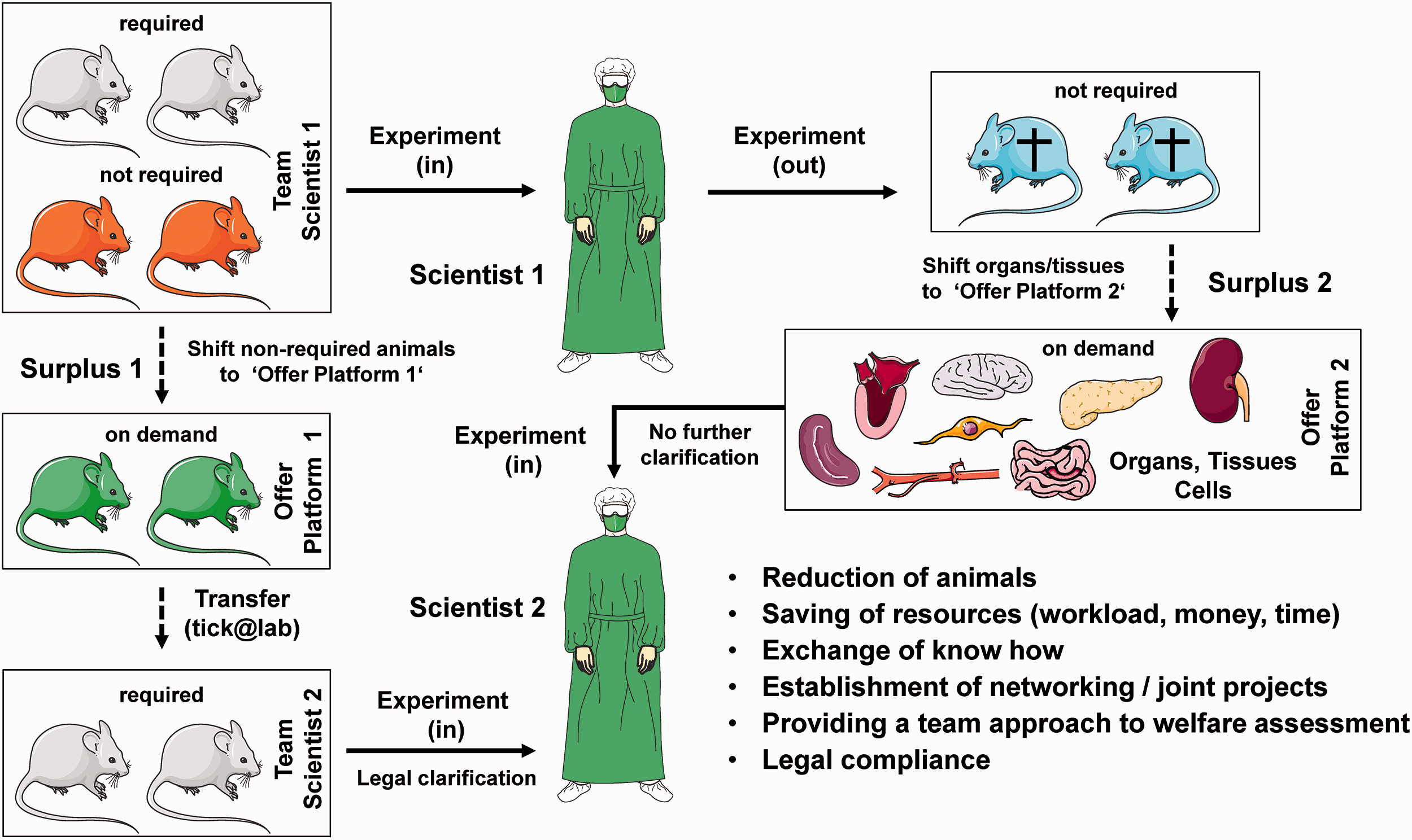
Overview of animal surplus handling in tick@lab. Animal surplus (Surplus 1) from excess stock is offered to other research teams. Similarly, surplus organs, tissues and cells (Surplus 2) from sacrificed animals are shifted to an offer platform (e.g. 3R Blackboard) and shared with other animal workers. Generated with Smart Servier Medical Art (https://smart.servier.com/).
The application of the 3Rs principle is a central component in animal experimentation that has already improved animal welfare and benefited science in many aspects. However, the best way to improve general animal welfare is to reduce their usage. We show that implementation of an ‘offer platform’, such as 3R Blackboard, in laboratory animal management systems offers an effective approach to meet this objective.
Footnotes
Data availability statement
All data is included in this paper.
Declaration of conflicting interests
AS is CEO and EE is working as a veterinarian at the a-tune software AG company. All other authors declare no conflict of interest.
Funding
The authors disclosed receipt of the following financial support for the research, authorship, and/or publication of this article: This work was supported by the German Research Foundation (WE2554/13-1, WE2554/15-1, and WE2554/17-1), Biotechnology and Biological Sciences Research Council Discovery Fellowship (BB/T009543/1), the German Research Foundation for the project ‘Severity assessment in animal-based research’ (TO 542/5-1), a Wellcome Trust Investigator Award (107964/Z/15/Z), and the UK Dementia Research Institute.
