




Abstract
The objective was to determine the rate at which Chinese journals include Animal Research: Reporting of In Vivo Experiments (ARRIVE) Guidelines/Gold Standard Publication Checklist (GSPC) in their instructions for authors, and the awareness and recognition of editors. The survey was performed on Chinese journals. The most recent versions each journal's instructions for authors were downloaded, and the information related to the ARRIVE/GSPC was collected. A self-developed questionnaire was used to conduct the survey among the editors. Questionnaires were sent to 238 qualified journals and 198 of them returned them, achieving an 83.2% response rate. The results showed that none of the journals included the ARRIVE/GSPC in their instructions for authors, and the awareness rate was only 13.1% (26/198). The participants who were unaware of the ARRIVE/GSPC were less likely than those who were aware of them to believe it was necessary to include the ARRIVE/GSPC in the instructions for authors (23.3% vs. 61.5%), and less likely to request authors in their manuscript preparation (28.5% vs. 88.5%), editors in the editing and processing (28.5% vs. 84.6%) and reviewers in peer review stage (28.5% vs. 92.3%) to follow the ARRIVE/GSPC. Currently no Chinese journals include the ARRIVE/GSPC in their instructions for authors. The recognition rate of the ARRIVE/GSPC was low among the editors. So, we suggest that Chinese journals should promote inclusion of the ARRIVE/GSPC in journals' instructions for authors. It is also important to educate researchers and editors alike to increase their understanding of the ARRIVE/GSPC, so that the quality of reporting of animal study can be improved.
Introduction
Animal studies are an important means bridging the basic research and clinical trials, and the results of animal studies have a profound impact on research quality and recognition of study outcomes in a variety of fields of research.1,2 However, increasing amounts of evidence indicate that even the animal studies published in top-tier journals are not of satisfactory quality.3–6
In a retrospective analysis conducted by the National Centre for the Replacement, Refinement, and Reduction of Animals in Research (NC3Rs), the largest institute in sponsoring animal studies in UK, the authors showed that many of the animal studies sponsored by NC3Rs failed to report important information such as experimental design, conduction and analysis; 41% of the publications failed to provide the hypotheses and objectives, number of animals used or the characteristics of the animals. 7 In addition, 87% of the studies did not use randomization and 86% did not use blinding. Even worse, among the studies that used randomization, only 9% (3/33) stated the specific methods used for randomization. These flaws result in a low efficacy in utilizing animal study results and translating them to the clinical applications, leading to a poor return of the investment in research. Inadequate and incomplete reporting of outcomes in animal studies has significantly hindered development of experimental animal studies and utilization of their results. 8 In 1993, the investigators in biomedical research have started to notice the lack of standardization and adequacy in reporting clinical experiments, after which several institutes have developed and issued standardized reporting methods for different types of clinical studies to improve the quality of reporting clinical study results, including Preferred Reporting Items for Systematic Reviews and Meta-analyses (PRISMA), 9 Meta-analysis of Observational Studies in Epidemiology, 10 Consolidation Standards of Reporting Trials (CONSORT) 11 and the Standards for Reporting Diagnostic Accuracy (STARD). 12 Studies have indicated that the quality of reporting clinical studies can be greatly improved when the standardized report methods are introduced into the journals’ ‘Instructions for authors’.13–15
In basic research, especially pre-clinical animal study areas, there were no standardized reporting guidelines until 2010, when the Animal Research: Reporting of In Vivo Experiments (ARRIVE) Guideline, 16 Gold Standard Publication Checklist (GSPC) 17 and other guidelines were published. The ARRIVE Guidelines and GSPC not only provide guidelines and checklists for writing and publishing the results of animal studies but also help assure that the information generated from animal studies can be fully evaluated and utilized, thus promoting integrity and transparency in the process of reviewing pre-clinical animal studies. ARRIVE Guidelines have thus far been introduced into the instructions for authors of 317 international journals, 18 and they are also endorsed and recommended by the editorial committees of biomedical journals and EQUATE working group. 19 However, a study by Baker et al. showed that the quality of the reporting of pre-clinical animal study results published in the journals endorsing ARRIVE Guidelines was not improved by the addition of the ARRIVE Guidelines. 20 It has been five years since the ARRIVE Guidelines were translated into Chinese and introduced in China by Chinese scholars. 21 There are to date no studies investigating the present-day effects of introducing the ARRIVE Guidelines/GSPC into the instructions for authors of Chinese journals. Nor is the information available for the recognition or application of the ARRIVE Guidelines/GSPC by Chinese journals.
The current study was to investigate the effects of introducing the ARRIVE Guidelines/GSPC to Chinese journals using specific forms of analysis. Furthermore, questionnaires were used to determine how the editors of selected journals recognized the ARRIVE Guidelines/GSPC and put them into practice in editing and peer review processes.
Materials and methods
Ethical review
This study was reviewed and approved by the ethical committee of the School of Basic Medical Sciences of Lanzhou University. The content involved in the current study was deemed of no harm to the participants, so consent was obtained from the participants through telephone interview.
Inclusion and exclusion criteria
Chinese journals covered in the databases Science Citation Index (SCI), PubMed, Chinese Science Citation Database (CSCD) and Chinese Science and Technology Papers and Citation Database (CSTPCD) were included. Chinese journals that had never published animal studies and journals based in Hong Kong, Macau, and Taiwan were excluded.
Collection of the instructions for authors
The most recent versions of the instructions for authors, up to May of 2015, were obtained from the official websites of the journals investigated in this study. Two investigators, TZ and XB, separately read every version of the instructions for authors and extracted the information related to the ARRIVE Guidelines/GSPC, and then verified each other's results. When they disagreed, they discussed their findings to resolve the discrepancy, or a decision was made based on the judgment of a third investigator, BM.
Survey of the journal editors
Email addresses and telephone numbers of editors-in-chief and editors were obtained from the official websites of the journals investigated. Two investigators, TZ and JJY, first sent electronic copies of the questionnaires via email. If replies were not received after 20 days, the investigators made telephone interviews to collect answers to the survey questionnaires. The survey was conducted between June 2016 and December 2016.
The questionnaire was designed based on the review of relevant publications combined with the specific objectives of the current study. The types of questions included both single- and multiple-choice questions and open questions. The main questions were as follows: 1) basic information regarding the participants, including sex, age, specialty, education and position; 2) editors' awareness of the ARRIVE Guidelines; 3) editors' awareness about the GSPC; 4) application status of the ARRIVE Guidelines and GSPC during the processes of manuscript submission by authors, review by editors and peer review by reviewers; 5) practical obstacles currently present blocking introduction of the ARRIVE Guidelines/GSPC into the routine process of journals and the determining factors for Chinese journals to adopt the ARRIVE Guidelines/GSPC.
Statistical analysis
Statistical analysis was conducted using Excel software (Microsoft Excel 2010; http://office.microsoft.com/zh-cn/) and results were presented as number of sample (n) and percentage (%).
Results
A total of 238 journals were investigated, including 20 in SCI, 56 in MEDLINE, 145 in CSCD and 17 in CSTPCD (Supplementary Material online).
Addition of the ARRIVE Guidelines/GSPC to the instructions for authors
None of the 238 journals investigated referred to the ARRIVE Guidelines/GSPC.
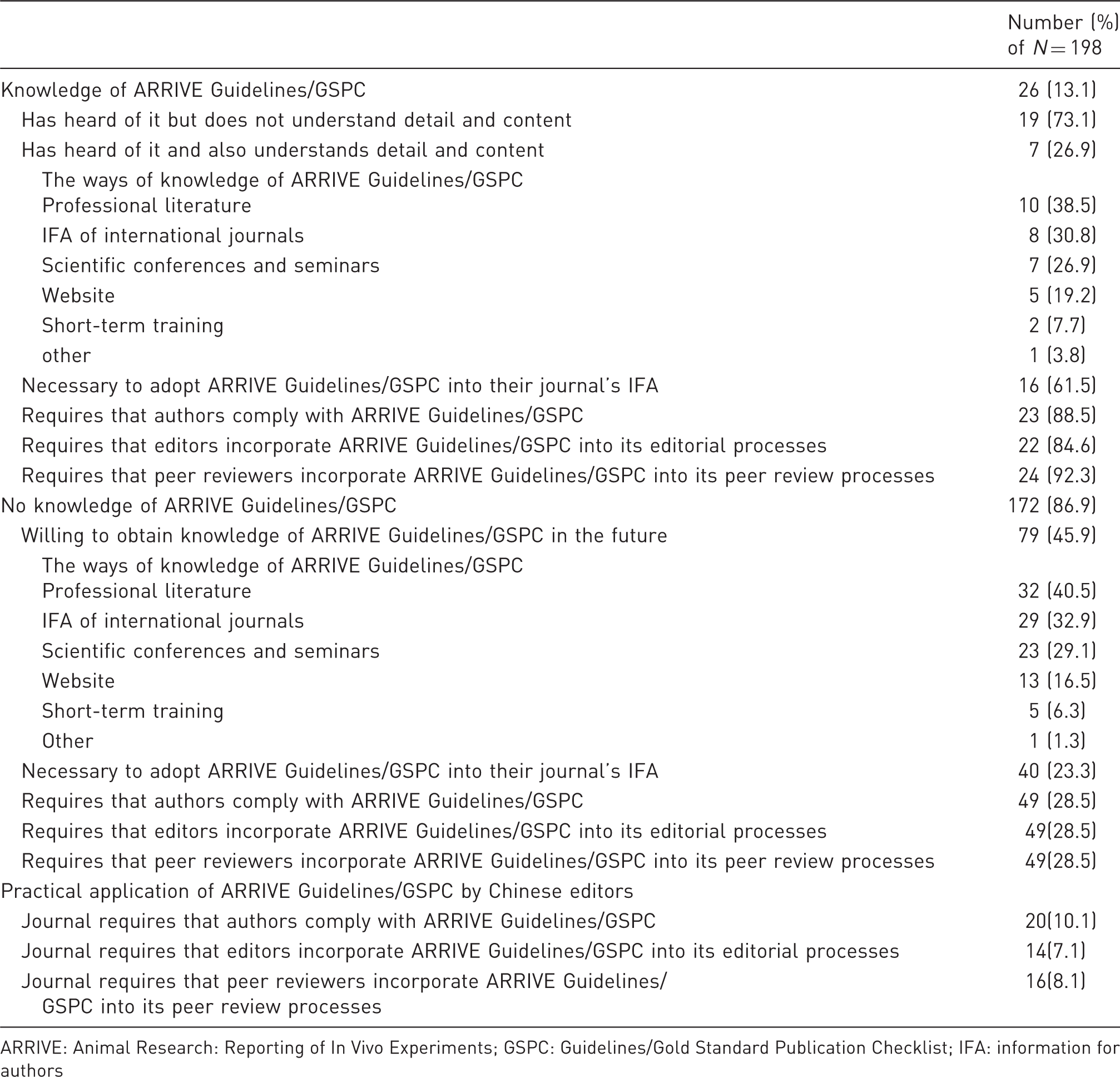
Editors' awareness of the ARRIVE Guidelines/GSPC (Table 1)
Survey of journals editors' endorsement of ARRIVE Guidelines/GSPC.
ARRIVE: Animal Research: Reporting of In Vivo Experiments; GSPC: Guidelines/Gold Standard Publication Checklist; IFA: information for authors
Of 198 participants who completed the survey, only 26 (13.1%, 26/196) were aware of the ARRIVE Guidelines/GSPC, among whom the majority (73.1%, 19/26) had only heard of them and had no specific knowledge of them, and fewer than one-third (26.9%, 7/26) had specific knowledge about them. The top three sources by which the 26 participants learned about the ARRIVE Guidelines/GSPC were reading professional literature (38.5%, 10/26), submission to international journals (30.8%, 8/26) and scientific conferences and seminars (26.9%, 7/26). More than half of these 26 participants believed it necessary to add the ARRIVE Guidelines/GSPC to the instructions for authors of their journals (61.5%, 16/26). The majority of them believed it necessary to ask that authors follow the ARRIVE Guidelines/GSPC in manuscript preparation and submission (88.5%, 23/26), others asked editors to use them in the editing and processing of submissions (84.6%, 22/26) and others asked reviewers to use them in peer review (92.3%, 24/26).
Of 198 participants, 172 (86.9%, 172/198) were not aware of the ARRIVE Guidelines/GSPC, among whom fewer than one-third (23.3%, 40/172) believed that they should be added to the instructions for authors. Fewer than one-third (28.5%, 49/172) thought it necessary to ask that authors follow the ARRIVE Guidelines/GSPC in manuscript preparation and submission, to ask that editors use them in the editing and processing of submissions and to ask that reviewers use them in peer review. Fewer than half of the 172 participants who were not aware of the ARRIVE Guidelines/GSPC (45.9%, 79/172) were willing to learn the ARRIVE Guidelines/GSPC in the future. Among them, the top three sources by which respondents said they had learned were reading professional literature (40.5%), attending scientific conferences and seminars (32.9%) and the Internet (29.1%).
Among the 198 participants who completed the survey, only a small proportion had already requested that authors follow the ARRIVE Guidelines/GSPC in manuscript preparation and submission (10.1%, 20/198), or that editors follow them in the editing and processing of submissions (7.1%, 14/198), or that reviewers use them in peer review (8.1%, 16/198).
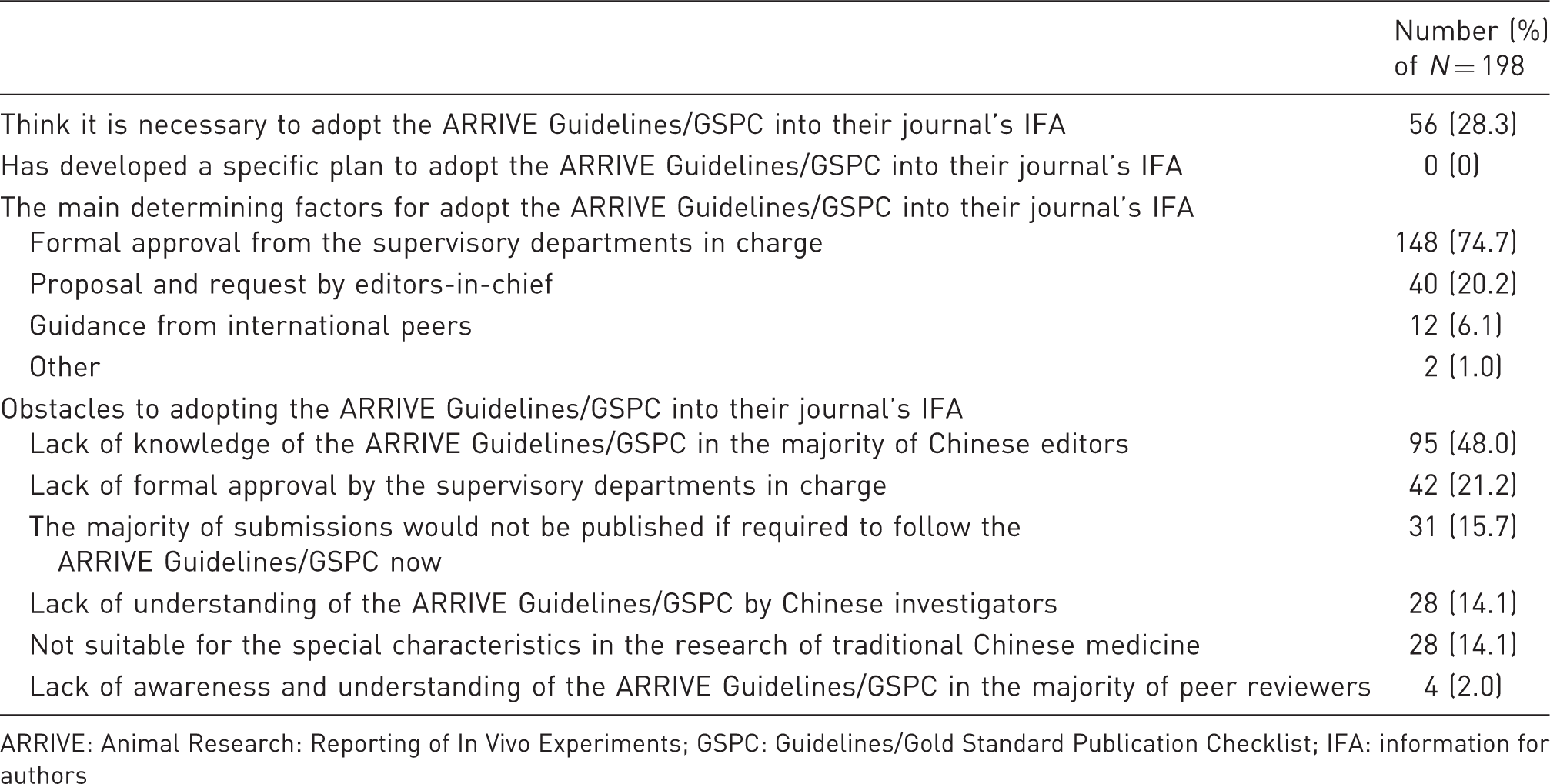
Reasons for not adding the ARRIVE Guidelines/GSPC to the instructions for authors (Table 2)
Reasons for not adding the ARRIVE Guidelines/GSPC to the instructions for authors.
ARRIVE: Animal Research: Reporting of In Vivo Experiments; GSPC: Guidelines/Gold Standard Publication Checklist; IFA: information for authors
Participants named several obstacles to adding the ARRIVE Guidelines/GSPC to the instructions for authors: 1) lack of awareness of the ARRIVE Guidelines/GSPC (48%, 95/198), 2) lack of formal approval by the supervisory departments in charge (21.2%, 42/198), 3) concerns that the majority of submissions would not be published if required to follow the ARRIVE Guidelines/GSPC (15.7%, 31/198), 4) lack of understanding of the ARRIVE Guidelines/GSPC by Chinese investigators (14.1%, 28/198), 5) not suitable for the special characteristics in the research of Traditional Chinese Medicine (14.1%, 28/198), and 6) the lack of awareness and understanding of the ARRIVE Guidelines/GSPC in the majority of peer reviewers (2.0%, 4/198).
Discussion
This is the first study to investigate the current status of adding the ARRIVE Guidelines/GSPC to the instructions for authors in Chinese journals and the awareness and recognition by editors. The ARRIVE Guidelines and GSPC were published in 2010 and they have been introduced into the instructions for authors in 317 international journals.16–18 They are also endorsed and recommended by the editorial committees of biomedical journals and EQUATOR network. 19 However, current survey results for their status in Chinese journals were disappointing. Although as many as 238 Chinese journals have published the studies involving use of experimental animals, none of them referred the ARRIVE Guidelines/GSPC in their instructions for authors, which is in sharp contrast to the rate for required use of standard reporting methods in biomedical studies, such as CONSORT/CONSORT extension and PRISMA.15,22–25
The ARRIVE Guidelines/GSPC provide important guidance for writing the reports on animal studies because they help readers clearly understand what authors are trying to present and facilitate assimilation of the information necessary for repeating the reported animal experiments, 16 so that the information generated from the animal studies can be fully evaluated and utilized, which promotes the integrity and transparency in the basic research review process and avoids waste of resources for biomedical research. 26 Even though the ARRIVE Guidelines/GSPC were introduced into China in 2011, the current survey demonstrated that the majority (86.9%, 172/198) of Chinese journal editors who participated in this study were not aware of them. 21 This may be due to the lag in editing knowledge and lack of adequate attention to progress in relevant areas. 27 It may also be related to the failure of the publishers to add these guidelines to their continuing education and training programs. However, given the situation, there is reason to be optimistic that the lack of awareness and understanding of the ARRIVE Guidelines/GSPC does not necessarily mean that Chinese journals do not emphasize the high quality of papers describing animal studies that they choose to publish. Rather, many different journals have their own standards for evaluating the submissions.
There is also reason to believe that a more important reason why the ARRIVE Guidelines/GSPC have not been added to the instructions for authors is the lack of related policies in China. Results showed that 75.8% (150/198) of surveyed editors named formal approval from the supervisory departments as a determining factor for introducing the ARRIVE Guidelines/GSPC into the instructions for authors. Given this, it is important for national societies to develop appropriate policies for journal publications, starting by encouraging and making suggestions regarding the ARRIVE Guidelines/GSPC to authors during manuscript preparation and submission, to editors in editing and processing and to reviewers in peer review, and allow a gradual transition to mandatory adherence.
It is also important to note that the participants who were not aware of the ARRIVE Guidelines/GSPC were much less likely than those who were aware of them to believe it necessary to introduce the ARRIVE Guidelines/GSPC to the instructions for authors (23.3% vs. 61.5%), and also less likely to request that authors follow the ARRIVE Guidelines/GSPC in manuscript preparation and submission (28.5% vs. 88.5%), that editors follow them in the editing and processing of submissions (28.5% vs. 84.6%) and that reviewers follow them in peer review (28.5% vs. 92.3%). One key means of improving the quality of reports describing animal studies is to increase public awareness and understanding of the ARRIVE Guidelines/GSPC through effective training programs. For example, it may be appropriate to add the ARRIVE Guidelines/GSPC to continuing education and training programs for Chinese journal publication professionals and as part of medical education in the school system.
The limitations of the current study include that the information in instructions for authors was obtained from the websites at the time, and it is possible that some of this information may have been changed after the data collection. However, no journals were found to have updated their instructions for authors by the time the survey was completed.
Conclusion
In summary, currently no Chinese journals have introduced the ARRIVE Guidelines/GSPC to their instructions for authors, and awareness of the ARRIVE Guidelines/GSPC was low among the editors. The editors of most of journals have not begun to ask that authors follow the ARRIVE Guidelines/GSPC in manuscript preparation and submission, or that editors use it in the editing and processing of submissions, or that reviewers use them in peer review. Given this, it is strongly suggested that we should develop appropriate policies through the national societies for journal publications to promote inclusion of the ARRIVE Guidelines/GSPC to the ‘Instructions for authors’. In addition, effective measures should be taken to educate the researchers and journal editors to increase their awareness and understanding of these guidelines, so the reporting quality can be improved, which will ultimately increase the utilization and translation of achievements in the animal studies.
Supplemental Material
LAN879181 Supplemental Material - Supplemental material for Endorsement of Animal Research: Incorporation of In Vivo Experiments (ARRIVE) Guidelines/Gold Standard Publication Checklist (GSPC) by Chinese journals: A survey of journals' instructions for authors and editors
Supplemental material, LAN879181 Supplemental Material for Endorsement of Animal Research: Incorporation of In Vivo Experiments (ARRIVE) Guidelines/Gold Standard Publication Checklist (GSPC) by Chinese journals: A survey of journals' instructions for authors and editors by Ting Zhang, Jingjing Yang, Xi Bai, Hongyan Liu, Fang Cheng, Zhanjun Ma and Bin Ma in Laboratory Animals
Footnotes
Acknowledgements
We thank the National Natural Science Foundation of China and the Fundamental Research Funds for the Central Universities. Author contribution: conceived and designed the experiments: BM. Performed the experiments: TZ, JJY, XB, YL, FC, ZM. Analyzed the data: TZ, JJY, XB. Contributed reagents/materials/analysis tools: BM, TZ, JY, XB, YL, FC, ZM. Wrote the manuscript: BM, TZ, JY, XB, YL, FC, ZM.
Declaration of Conflicting Interests
The author(s) declared no potential conflicts of interest with respect to the research, authorship, and/or publication of this article.
Funding
The author(s) disclosed receipt of the following financial support for the research, authorship and/or publication of this article: This work was supported by National Natural Science Foundation of China (grant no. 81873184) and the Fundamental Research Funds for the Central Universities (number: lzujbky-2018-98).
References
Supplementary Material
Please find the following supplemental material available below.
For Open Access articles published under a Creative Commons License, all supplemental material carries the same license as the article it is associated with.
For non-Open Access articles published, all supplemental material carries a non-exclusive license, and permission requests for re-use of supplemental material or any part of supplemental material shall be sent directly to the copyright owner as specified in the copyright notice associated with the article.
