




Abstract
Severity assessment in biomedical research is required by the European authorities. Therefore, a variety of score sheets are available. The first score sheets were designed and introduced by Morton and Griffith (M&G) in 1985, to assess pain and distress in animals. Score sheets are an important part of the 3R principles to evaluate the degree of severity in different studies. Here, we used a modified score sheet from M&G for severity assessment of 12 Aachen minipigs after partial liver resection for safety testing of a novel synthetic sealant (VIVO-107). The control group was treated with the clinical standard fibrin. Estimation of recovery status of both groups was performed from the day of surgery to postoperative day 7 using a score sheet. Included parameters were blood loss during the surgical procedure, general state, spontaneous behaviour and clinical results. Values from 0 to 20 were graded for each category and resulted in the degree of strain (DS) from DS0 to DS4. An increasing DS indicated higher severity. Suitability of the implemented score sheet was evaluated. Higher score points were documented almost exclusively as an outcome of the clinical results, influenced mainly by increased temperature in the fibrin treated control group, whereas, spontaneous behaviour had only slight influence and general state had no influence. The average score seven days after surgery was <2. The laparotomy, where the partial liver resection is a part, is rated as moderate severity in the EU Directive 2010/63, while the assessment done in the present study hints to a mild severity of the model in our hands.
For partial liver resection as well as for other hepatological surgical procedures, the pig is the most appropriate and commonly used large animal model. 1 Partial liver resections are further facilitated in pigs by the easy lobular mobility and due to the anatomical and physiological similarity to humans.1,2 On basis of the fact that surgical procedures in laboratory animals become more and more crucial the implementation of the 3R (Replacement, Reduction and Refinement) principle by Russell and Burch in 1959 is both important and required by the EU Directive 2010/63.3,4 A major point in the EU Directive 2010/63 is the severity assessment as a determination by the degree of pain, suffering, distress or lasting harm expected under different procedures. Procedures on animals as a result of which the animals are likely to experience short-term moderate pain, suffering or distress, or long-lasting mild pain, suffering or distress as well as procedures that are likely to cause moderate impairment of the well-being or general condition of the animals shall be classified as ‘moderate’ (EU Directive 2010/63 annex VIII). Therefore, a well-designed scoring system is essential. In 1985, Morton and Griffiths postulated a scoring system for severity assessment and laid the foundation for score sheet design. 5 Score sheets should be adjusted to the procedure conditions and should include the animal species, strain, sex, procedures or interventions, application routes, volumes and frequencies. 6
A method for pain assessment is the use of grimace scales most common for rodents.7–10 In the last years, the development of grimace scales was extended further to large animals. Nevertheless, in the best of our knowledge, the grimace scales are only applicable for rabbits, horses and lamb.11–13 The grimace scale pain assessment method could be part of severity assessment.
For severity assessment after liver surgery, especially for partial liver resection in rats and rabbits, Kanzler et al. and Drude et al. established a score sheet, which provides recommendations for design and analysis.14,15 Therefore, one aim of the study was to adopt a score sheet based on the score sheets of the previous studies in rats and rabbits but adjusted to the species-specific differences for pigs. The main differences to the scoring system of Kanzler et al. and Drude et al. were the classification of the degree of strain (DS) and the inclusion of a score for the surgical procedure. While in Kanzler et al. and Drude et al. the DS was only divided in three grades, we modified the classification of strain into four grades and adapted the point system.
After score sheet modification, the scoring system was applied for severity assessment of minipigs after partial liver resection. According to the 3R principle, we combined the primary objective to test safety and effectiveness of a novel synthetic sealant (VIVO-107) in a chronic, 6-months evaluation, in comparison to the clinical gold standard fibrin glue (Tisseel), with the secondary objective to evaluate the score sheet adopted for pigs.
Animals and statistical analysis
The animal experiments were performed in accordance with the German Animal Welfare Law and the EU Directive 2010/63. The experimental protocol was approved by the governmental animal care and use committee (Landesamt für Natur, Umwelt und Verbraucherschutz (LANUV) Nordrhein-Westfalen, Recklinghausen, Germany) the corresponding approval number being AZ 84-02.04.2015.A256. A total number of 12 female Aachen minipigs (Gerd Heinrichs, Heinsberg, Germany), six animals per group with a body weight between 27.6 and 36.4 kg and an age of 8–10 months, were analysed in this study. The experimental (VIVO-107) as well as the control group (fibrin) consisted of six animals. The minipigs were acclimatized for at least two weeks after delivery. They were housed in species-appropriate boxes with a 12 h light and dark cycle at 22 ± 2 ℃ and relative humidity of 30–70%. Water was offered ad libitum and a standardized porcine diet (Minipig, Complete feed for minipig, sniff Spezialdiäten GmbH, Soest, Germany) was fed twice per day. The pigs were housed in groups of six animals.
For severity assessment after partial liver resection in pigs, semiquantitative scores for surgical procedure, general state, spontaneous behaviour and clinical results were determined (Figure 1). The daily body weight control was exchanged with the control of daily feed intake for the first postoperative days (PODs). Weight determination was done on POD 7, 14, 30, 60, 90, 120, 150 and 180. Also, a score for the surgical procedure, in this case measurement of blood loss, was included.
Time-line of the peri-operative severity assessment. Adaptation phase, severity assessment by score sheets and all postoperative interventions are shown. Severity assessment during the first 7 postoperative days (PODs), body weight control, blood collection and CT scans on POD 7, 14, 30, 60, 90, 120, 150 and 180.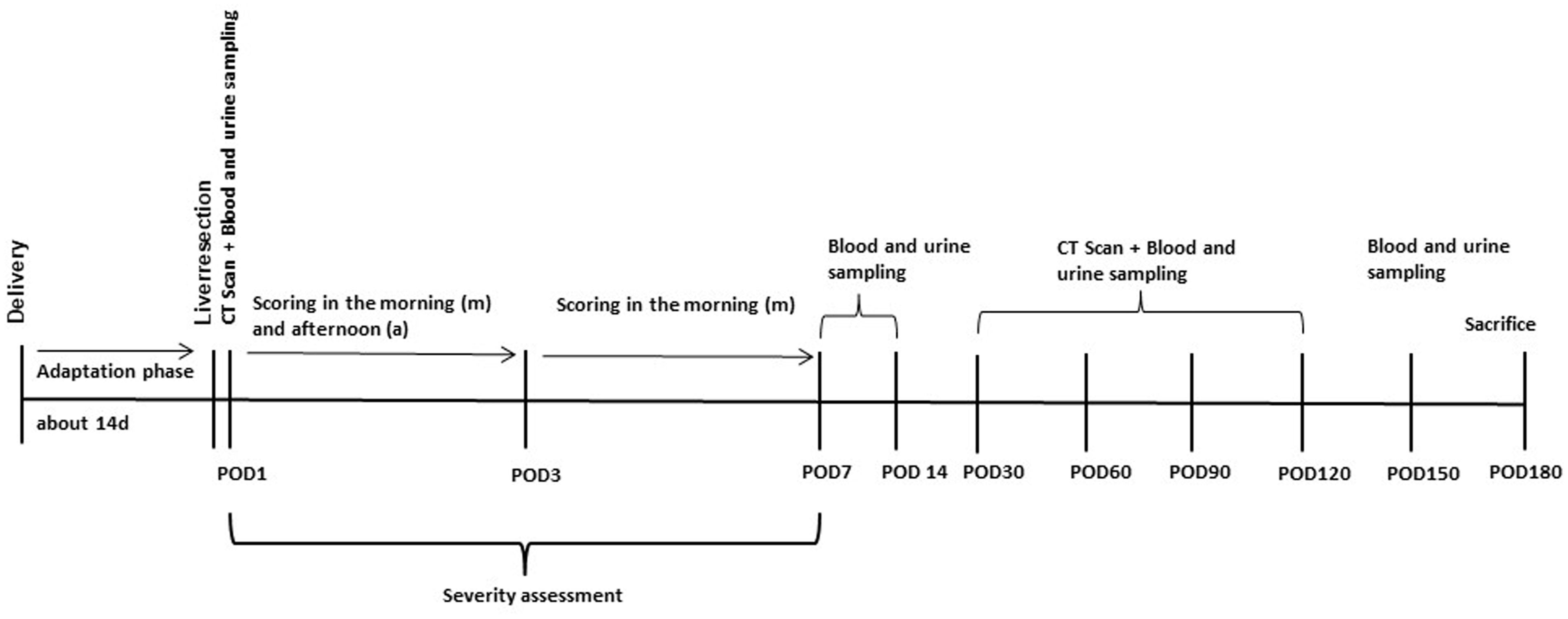
The number of animals per group was calculated via a power calculation using G*Power, version 3.1.9.2 (Freeware, Kiel University, Kiel, Germany). Results are expressed as mean ± standard deviation (SD). Statistical analyses were performed using GraphPad Prism version 7.02 (GraphPad Software, San Diego, CA, USA). Statistical post-test was performed using Two-way ANOVA; p-values of <0.05 were considered significant.
Experimental procedure
Liver resection
The pigs were used in a chronic, 6-months evaluation of safety and effectiveness of a novel synthetic medical sealant, VIVO-107, in comparison to the fibrin glue (Tisseel) with several CT scan and blood sample controls (Figure 2).
Procedure of partial liver resection in pigs. (a) Median laparotomy. (b) Superficial pre-coagulation on the transection line. (c) Partial liver resection. (d, e) Application of tissue sealant VIVO-107 or Tisseel. (f) Repositioning of the liver.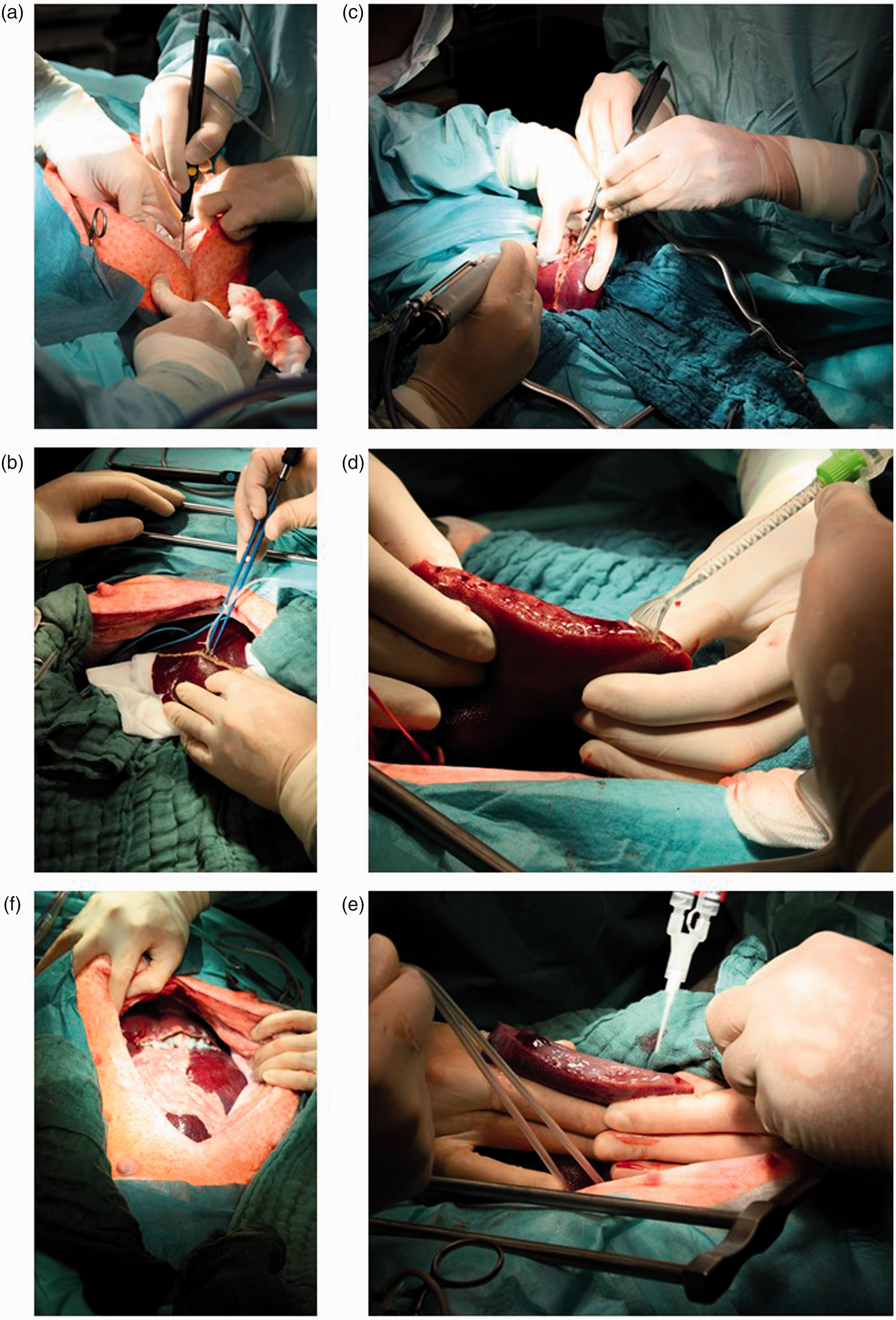
Pigs were randomized to receive either VIVO-107 (Adhesys Medical GmbH, Aachen, Germany) or Tisseel® (Baxter, Baxter Vertriebs GmbH, Wien, Austria). The non-anatomic partial resection of the left lateral lobe was performed according to the method described by Erdogan et al. 16 Animals were fasted for 12 h prior to surgery with free access to water.
Atropin 1% 1 ml (Dr Franz Köhler Chemie GmbH,64625 Bernsheim, Germany) and 5 mg/kg Azaperone (Stresnil® Lilly Deutschland GmbH, Elanco Animal health, 61352 Bad Homburg, Germany) was administered intramuscular (IM) as premedication. For induction of anaesthesia and to withdraw blood samples, a cannula (Vasofix 18 G, B. Braun Melsungen AG, 34212 Melsungen, Germany) was placed into an ear vein. Propofol (Propofol Claris 2%, PHARMORE GmbH, 49479 Ibbenbüren, Germany) 1 mg/kg was given as an intravenous bolus followed by intratracheal intubation. Anaesthesia was induced by a mixture of Dorbene 0.1 mg/kg (Zoetis GmbH, Germany) and Ketamine 10% 0.2 mg/kg (MEDISTAR GmbH Arzneimittelvertrieb, Germany) and maintained by ventilation with Isoflurane 1.5 vol% and oxygen delivered by endotracheal intubation (Mallinchrodt Hi-Contour oral/nasal tracheal tube cuffed). Analgesia was maintained by fentanyl (Rotexmedica GmbH Arzneimittelwerk, 22946 Trittau, Germany) (35 µg/kg/h) infusion. General fluid resuscitation was secured by fluid infusion of Ringer lactate (Baxter, Utrecht, Netherlands) and glucose 5% (Baxter) (5–10 ml/kg/h). A urinary catheter (Teleflex Medical, Rüsch Austria, A-1090 Wien) was used to drain the urine from the bladder during surgery.
ECG, heart-rate, arterial, central venous pressure, oxygen via pulse oximetry (AS/3; Datex Ohmeda, Helsinki, Finland) were monitored throughout the experiment.
All preparations were conducted under aseptic conditions. Animals were placed in a supine position and the surgical field was disinfected with alcohol and tincture-iodine. Thereafter, a median laparotomy was performed (Figure 2(a)) and the bleeding was controlled by electro cautery.
The liver was exposed, and the left medial lobe was retracted upwards. A superficial pre-coagulation on the transection line was performed using bipolar diathermy (VIO 300D, Erbe Elektromedizin, Tübingen, Germany) (Figure 2(b)). Thereafter, the liver was dissected with the help of an ultrasonic dissector (Sonoca 300, Söring GmbH, Quickborn, Germany) (Figure 2(c)). The device dissected the liver parenchyma (mainly the hepatocytes) via ultrasound and the cells were absorbed from the operation field using a vacuum. Bleeding from small blood vessels was coagulated with bipolar forceps. To avoid forceps adhesion, the bipolar forceps were continuously cooled using 0.9% NaCl, supplied through a small infusion line connected to the forceps. Larger blood vessels (diameter >3 mm) were sutured with Ethicon Vicryl 4-0. Visual bile ducts were coagulated using bipolar diathermy.
VIVO-107 or Tisseel was immediately applied after the surgical resection of the liver lobe was completed (Figure 2(d) and (e)). Thereafter, the resection area was observed for an additional 3 min to assure successful sealing.
The liver was then repositioned (Figure 2(f)) and the abdominal wall was closed using continuous suture followed by a running subcutaneous suture. The skin was closed using a surgical stapler. The animals recovered in a small separate box with a warming lamp until full consciousness was achieved.
In accordance with the German Society of Laboratory Animal Science (GV–SOLAS) recommendation, ‘Pain management for laboratory animals 2015’, 17 all pigs were treated with 0.05–0.1 mg/kg of buprenorphine subcutaneously as preoperative analgesia as well as postoperatively every 12 h for three days. Animals received perioperative cefuroxime 35 mg/kg IM every 24 h and 17.5 mg/kg IM every 12 h on the following three days as antibiotic prophylaxis as well as buprenorphine 0.05–0.1 mg/kg every 12 h as an analgesic.
Score sheet
Score sheet used for severity assessment after partial liver resection in pigs.
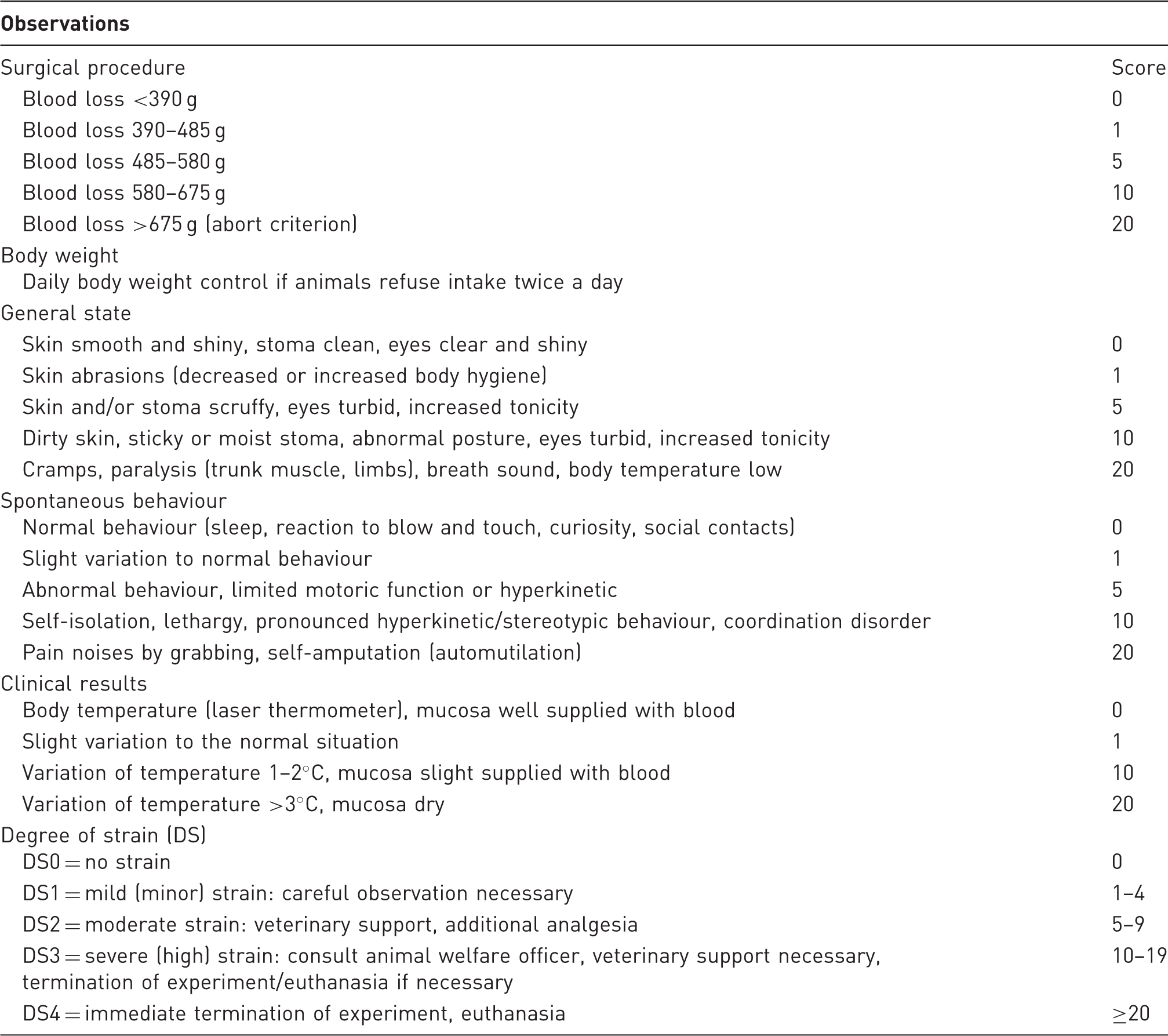
An adapted scoring system for severity assessment of Morton and Griffith was modified by Kanzler et al. and Drude et al. for rats and rabbits, and in this study was used as a base for establishment of a semi-quantitative score for severity assessment of pigs after partial liver resection. Among others, the classification of the DS was modified, that is DS = 0 (no strain), DS = 1 (mild), DS = 2 (moderate), DS = 3 (severe) and DS = 4 (termination) (Table 1). The modified classifications from four to five DS is a form of refinement according to the 3 R Principles 4 and implements the veterinary support at a total score of 5–9, whereas, the scoring system from Kanzler et al. and Drude et al. recommended the veterinary support at a total score of 10–20. Furthermore, the modified classifications recommended a consultation of an animal welfare officer at DS3 with a total score of 10–19, so that the animal welfare is closely monitored.
Further modifications of the score sheet design are the deletion of body weight control during the first six PODs and hence, the implementation of the scoring during the surgical procedure for blood loss. The body weight was controlled within the first six PODs only, if the animals did not eat the diet twice in a row. However, body weight control was done during the anaesthesia for blood collection and CT scans on POD 7, 14, 30, 60, 90, 120, 150 and 180 (Figure 1) but not included in the daily severity assessment at the first PODs. For partial liver resection the blood loss during the procedure was measured and evaluated (Table 1).
In Kanzler et al. and Drude et al. the recovery status of the animal was assessed at POD 3–4.14,15 In the following pig partial liver resection study, the assessment of general state, spontaneous behaviour and clinical result, to evaluate the recovery status of the animals, was extended to seven PODs in which the assessment on POD 1–3 was done twice a day and on POD 4–7 once a day (Figure 3(a)–(d)).
Scoring of pigs who underwent a partial liver resection for seven postoperative days. The parameters (b, d) spontaneous behaviour and (c) the clinical results were part of the overall calculation of (a) the degree of strain (DS). The DS is divided into DS0 (no strain), DS1 (mild strain), DS2 (moderate strain) and DS3 (severe strain). More than 20 score points (DS4), associated with immediate termination, were not reached. Values are depicted as mean ± SD.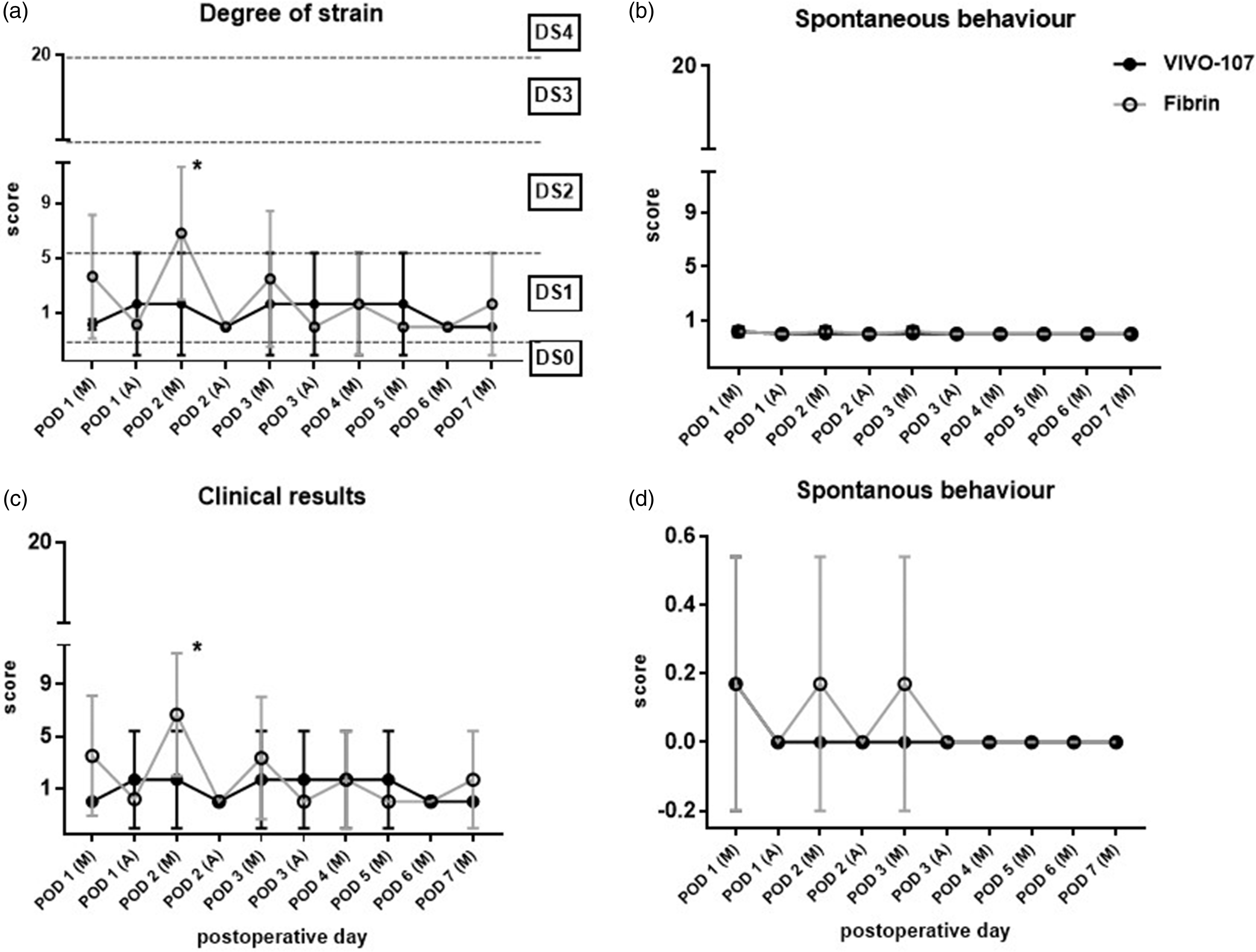
Results
For the surgical procedure all animals were rated with a score of 0 since there was only minimal blood loss observed.
The body weight gain was comparable in the groups (VIVO-107 and fibrin) and showed no significant differences from the day of operation up to 180 days (Figure 4).
Body weight gain of pigs underwent a partial liver resection. The parameter body weight was not part of the daily severity assessment by score sheet during the first seven postoperative days. Body weight was measured pre-operative and on postoperative day 7, 14, 30, 60, 90, 120, 150 and 180 as an additional indicator for the animal health status during the whole postoperative observation phase of 180 days. Values are depicted as mean ± SD.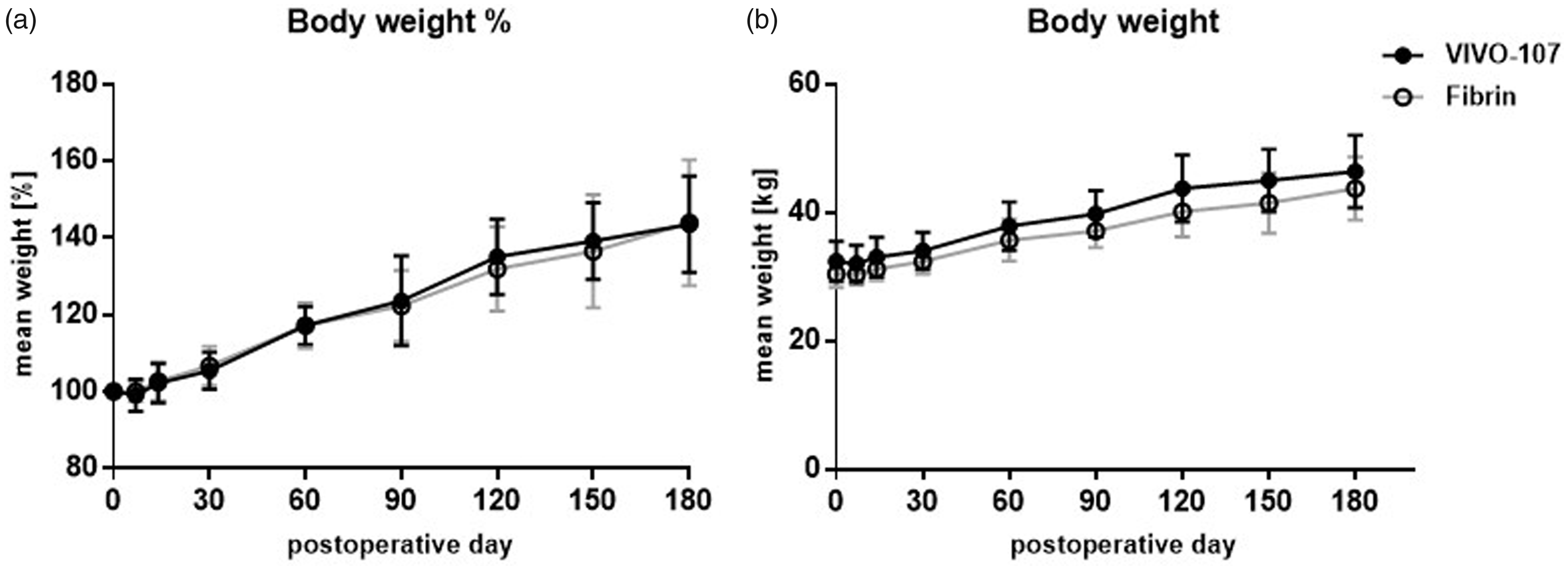
In Figure 3, the overall score for degree of strain, spontaneous behaviour and clinical results are shown. No significant differences occurred in spontaneous behaviour between the animals treated with VIVO-107 and fibrin (Figure 3(b)), since only minor deviation from the normal behaviour could be observed. These minor deviations are reflected by increased nervousness and restlessness during the scoring, as well as feed refusal of one animal at one day in the morning. The maximal exceeded total score for spontaneous behaviour was below 1 (Figure 3(d)). For clinical results, a significant difference was observed on POD 2 (M) between the both treatment groups. The reason for the increase was a short-term deviation from the physiological body temperature (1–2 ℃) in certain animals each time on POD 1 (A), POD 2 (M), POD 3 and POD 5 of the VIVO-107 group and in two animals on POD 1 (M), four animals POD 2 (M), two animals POD 3 (M), one animal on POD 4 and one animal on POD 7 of the fibrin group. For all other assessment times, there were no significant differences. The total score for clinical results did not exceed 7 (Figure 3(c)).
Also, the score for degree of strain differed significantly between the two groups on POD 2 in the morning assessment (Figure 3(a)) but at no other assessment point. A total score of 7 was not exceeded on any postoperative day.
Overall, the scores assessed ranged between 5–9, which correlated to DS2 with a definition of moderate strain (Table 1).
Discussion
The aim of the study was to test a modified score sheet design for evaluation of the severity of an established partial liver resection model in pigs.
It is totally meaningful to assess available score sheets prior implementation in a pilot study to not miss procedure specific symptoms (e.g. application routes, volumes, frequencies) or species-specific symptoms. 6
Therefore, the 2016 established score sheets for severity assessment after liver surgery in rats and rabbits served as a basis for the score sheet design for severity assessment after partial liver resection in a chronic pig model.14,15
Overall, the classification of the degree of strain was modified for a more precise adjustment and an earlier engagement of veterinary support (Table 1). The partial liver resection was performed according to clinical standard procedures and, as per EU Directive 2010/63, classified as moderate. 3 Therefore, from the animal welfare perspective a stricter assessment method was appropriate. Further, the partial liver resection was a chronic evaluation on safety and effectiveness of two tissue sealants with a survival period of the animals of 180 days. It is essential to implement stricter assessment criteria due to the chronic approach of the study because it could potentially harm the animals for the whole survival period.
Most score sheets or recommendations are given for the post intervention period and clinical symptoms in the recovery period.19–21 However, the degree of strain during an experiment or a surgical procedure can cause harm and can influence the recovery period of the animals. A stricter and more procedure-specific score sheet design means the implementation of the surgical procedure evaluation, more precisely the evaluation of blood loss during the surgical procedure (Table 1). The recovery phase of the animals is also dependent on the amount of blood loss during surgery. For instance, the German Society for Laboratory Animals Science (GV-SOLAS) recommends the volumes for blood sampling against the background of recovery periods and animal welfare. 22 Since the score sheet was planned prior the surgical procedure due to expected symptoms, a constant re-evaluation of the parameters during and after the procedures is an important part of score sheet design 6 and for continuous improvement. The re-evaluation during the partial liver resection revealed the scoring parameter for the surgical intervention to be inaccurate: the partial liver resection was performed according to the clinical standard method and so, therefore, hardly any measurable blood loss occurred thus giving no indication of the degree of strain during the procedure.
A further modification on the score sheets for severity assessment in pigs was the removal of daily body weight control as a refinement due to stress induction. The Aachen minipig is a calm pig race, 18 which is also mirrored in their normal, friendly behaviour. Nevertheless, daily body weight control can induce stress. Fentener van Vlissingen et al. described daily handling as an additional stress inducer and suggested an observing assessment. Only animals which need closer observations should be handled daily. 21
Figure 4 shows the weight gain of the animals during the whole observation period of 180 days and the results confirmed the strain classification of moderate for this study according the EU Directive 2010/63. The physiological body weight development of healthy non-operated Aachen minipigs 10–16 months of age is approximately 35 to 42 kg. This is in line with the body weight development of the operated animals.
The clinical results part of the score sheet was adjusted to the species-specific physiological parameters, especially the body temperature, and showed a significantly higher score for the fibrin treated group on POD 2. This result might be a reaction to the fibrin-based sealant (Figure 3(c)). The results for spontaneous behaviour also showed a slight trend for the fibrin treated group in the first postoperative days (Figure 3(d)). The observation of spontaneous behaviour is a widely used parameter for severity assessment.23,24 But it is important to ensure that the observation of the spontaneous behaviour is done by well-trained personnel who are familiar with the species, 21 otherwise it will lead to high observer variability.
Overall, the degree of strain was mostly affected by the clinical results, in detail a slight body temperature increase (Figure 3(a) and (c), POD 2 (M)).
It is important to note that the animals in this study were subjected to moderate level of stress. Therefore, the study is limited by the fact that this scoring system was not tested in case of severe stress. Further research is required to assess the suitability of this score sheet in procedures involving severe stress.
For further optimization of the assessment on clinical results digital implantable transponders for exact determination of physiological parameters should be implemented, especially in chronic studies. Another possibility could be the use of a ‘Fitness tracker’ for humans adapted for animals.
Supplemental Material
Supplemental material for Severity assessment in pigs after partial liver resection: evaluation of a score sheet
Supplemental Material for Severity assessment in pigs after partial liver resection: evaluation of a score sheet by Kerstin Hagemeister, Lisa Ernst, Pramod Kadaba Srinivasan, Hirokazu Tanaka, Kenji Fukushima and René Tolba in Laboratory Animals
Footnotes
Acknowledgements
The authors would like to thank Thaddäus Stopinski for his excellent technical assistance and Karl-Heinz Riemek for his support on daily observation of the animals.
Declaration of Conflicting Interests
The author(s) declared no potential conflicts of interest with respect to the research, authorship, and/or publication of this article.
Funding
The author(s) disclosed receipt of the following financial support for the research, authorship, and/or publication of this article: R. Tolba was supported in part by Deutsche Forschungsgemeinschaft, TO 542/5-1.
References
Supplementary Material
Please find the following supplemental material available below.
For Open Access articles published under a Creative Commons License, all supplemental material carries the same license as the article it is associated with.
For non-Open Access articles published, all supplemental material carries a non-exclusive license, and permission requests for re-use of supplemental material or any part of supplemental material shall be sent directly to the copyright owner as specified in the copyright notice associated with the article.
