




Abstract
In recent years, tremendous advances have been made in our ability to characterize complex microbial communities such as the gut microbiota, and numerous surveys of the human gut microbiota have identified countless associations between different compositional attributes of the gut microbiota and adverse health conditions. However, most of these findings in humans are purely correlative and animal models are required for prospective evaluation of such changes as causative factors in disease initiation or progression. As in most fields of biomedical research, microbiota-focused studies are predominantly performed in mouse or rat models. Depending on the field of research and experimental question or objective, non-rodent models may be preferable due to better translatability or an inability to use rodents for various reasons. The following review describes the utility and limitations of several non-rodent model species for research on the microbiota and its influence on host physiology and disease. In an effort to balance the breadth of potential model species with the amount of detail provided, four model species are discussed: zebrafish, dogs, pigs, and rabbits.
Introduction
The development and increasing availability of methods to characterize complex microbial communities has led to a staggering number of associations between characteristics of the human gut microbiota (GM) and health or disease. However, the bulk of those associations are purely correlative and causative relationships in humans are difficult to identify due the ethical implications of prospective experiments in human subjects. Moreover, the genetic and environmental heterogeneity of human populations makes it incredibly difficult to conclusively associate characteristics of the GM and disease phenotypes. Animal models can often be used to circumvent those limitations and allow for prospective experimentation in controlled conditions. Additionally, the disease or condition replicated by many animal models often occurs in a compressed timespan relative to the human condition being modeled. As in most fields of biomedical research, investigations related to the GM and host interactions are dominated by rodent models due to their high fecundity, convenience, availability, tractable genetics, and other reasons. That said, there are limitations to rodent models and certain procedures simply preclude their use. The current review will focus on GM-centric research performed in certain non-rodent model species, and specific benefits or attributes of each meriting consideration in experimental design. Specifically, we address invertebrate and zebrafish models as cost-effective precursors, alternatives, or adjuncts to rodent models, which should be considered in the context of the three Rs (reduction, refinement, and replacement of animal models). The discussion then switches its focus to three higher vertebrate models (rabbits, dogs, and pigs), which may be more appropriate model species for certain lines of investigation and, in the case of dogs and pigs, may serve as more relevant models for humans due to their shared environmental exposure. With that in mind, readers are also directed to more focused reviews on the aforementioned model species1–4 as well as other species not discussed here, such as non-human primates5,6 and other non-murine rodent species. 7
Invertebrates
Invertebrate hosts such as worms and insects represent multicellular in vivo systems with variably compartmentalized digestive tracts and homologs of many of the differentiated cell types found in vertebrate hosts. There are several invertebrate model species that are frequently used to study certain interactions between the host and its microbiota. Frequently, invertebrate species are used in studies focused on symbioses between the host and microbiota and the mechanisms by which those interdependent relationships are established and maintained. Two characteristics of invertebrates making them particularly amenable to such research are their reliance on the innate immune system 8 and a highly restricted (i.e., low α-diversity) gut microbiota. 9 Much work has been done in this regard using entomopathogenic nematode hosts such as Heterorhabditis bacteriophora and Steinernema carpocapsae and their respective symbionts. Photorhabdus luminescens and Xenorhabdus nematophila,10–13 as well as marine organisms such as the freshwater leech (Hirudo verbana)14,15 and bobtail squid (Euprymna scolopes) and their respective symbionts Aeromonas veronii and Vibrio fischeri.16,17
Summary of the advantages, common uses, and limitations of various non-rodent species for research investigating host-associated microbiota.
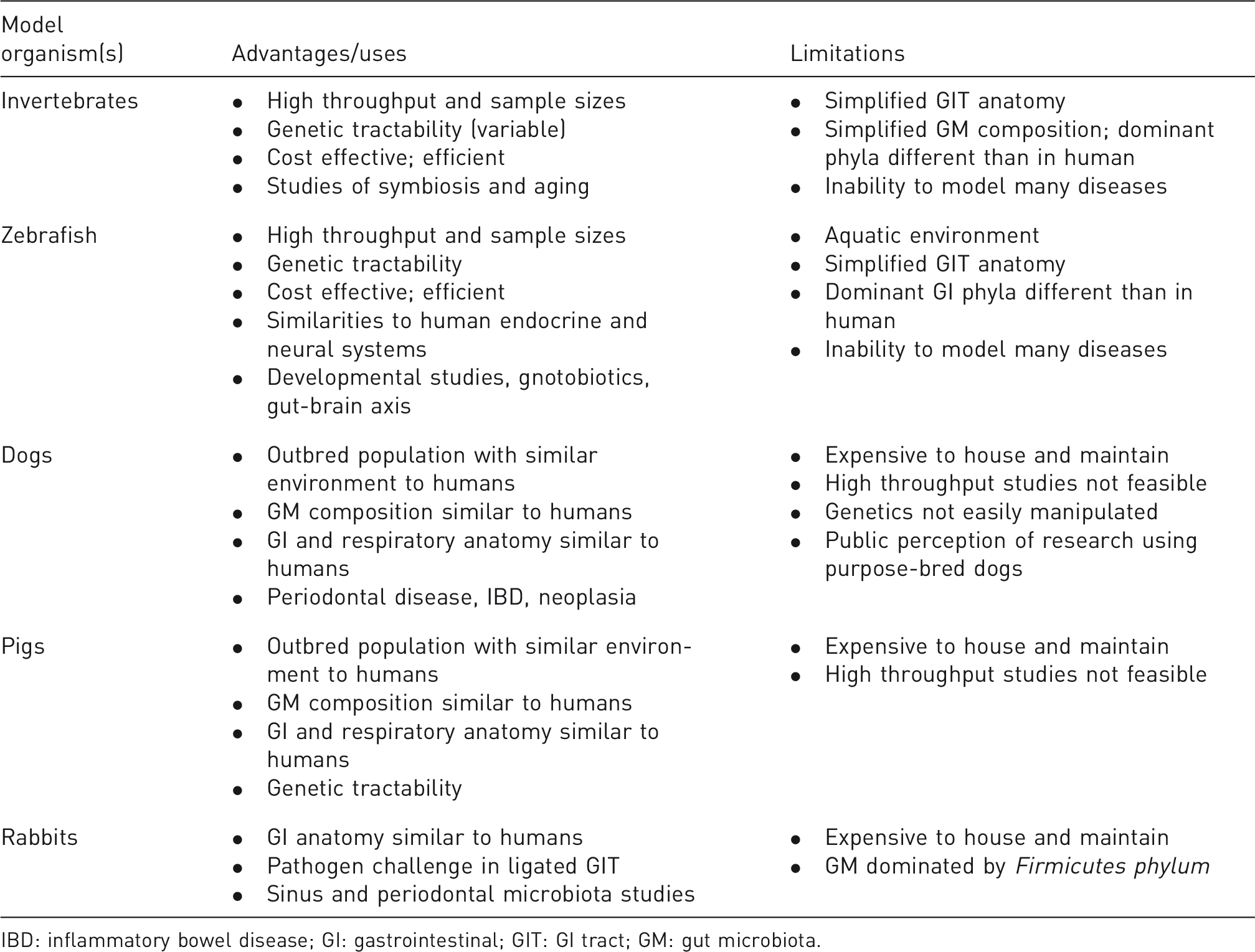
IBD: inflammatory bowel disease; GI: gastrointestinal; GIT: GI tract; GM: gut microbiota.
Zebrafish (Danio rerio)
The use of zebrafish in biomedical research in general has been increasing steadily over the last couple of decades. As in mice, the limited requirements related to housing space and cost and high fecundity allow studies with larger sample sizes. Physiologically, zebrafish also possess several basic similarities to mammalian hosts including a well-differentiated adaptive immune system, 31 a stress response axis typified by the same neuronal transmitters, 32 corticosteroid mediators, 33 and responses to pharmaceutical interventions in accordance with the responses observed in humans. 34
Zebrafish first gained popularity in the field of developmental biology and teratology due to their transparent body wall during embryonic and larval stages, allowing direct visualization of events during organogenesis. That same trait, along with their ex utero development, can be exploited to directly study early events during colonization by the gastrointestinal tract (GIT). Specifically, surface sterilization of embryos with various antibiotic cocktails results in GF zebrafish larvae,35,36 and whole mount larvae can be labeled with in situ hybridization or other assays to localize gene expression or specific cell types in GF and colonized fish. 37 Alternatively, fluorescently labeled bacteria can be visualized directly through the transparent body wall.38,39
Zebrafish are also increasingly being used to determine the role of the microbiota in disease models, 40 including chemically induced models of inflammatory bowel disease (IBD).41,42 In these and other studies, their aquatic environment allows test compounds and antibiotics to be delivered directly into the tank water.43,44 Notably, zebrafish have gained considerable attention over the last decade for their utility in determining the influence of probiotic bacteria, such as Lactobacillus spp., on stress- and anxiety-related behaviour, 45 appetite and feeding behaviour, 46 metabolism, reproduction,47,48 immunity and pathogen resistance,49,50 and candidate microbial taxa with possible effects on these parameters can also be delivered via the tank water.36,45,51 Allowing for investigations of the effect of host gene expression on the GM, genetic manipulation can be accomplished in zebrafish using any of the recently developed platforms employed in rodents.52–54
Limitations of the zebrafish model in microbiota-related research include differences in environmental conditions and exposures when compared to humans and other model organisms. Perhaps not surprisingly, the intestinal microbiota of zebrafish is thus quite different from that of mammalian hosts and, unlike most other host species, differs dramatically between institutions (and depending on diet) at the phylum level.36,55–58 Although the fecal microbiota of humans and rodents may vary significantly at the genus level depending on host genetics, geography, age, and environmental factors, it is consistently dominated by the phyla Firmicutes and Bacteroidetes. Depending on the source, the GM of zebrafish is dominated by Proteobacteria and Fusobacteria, with variable presence of Firmicutes, Cyanobacteria, Actinobacteria, and other phyla;55,57 Bacteroidetes are usually, but not always,36,58 negligible. Although they are beyond the scope of the current review, there are also considerable differences between zebrafish and mammalian hosts in gut anatomy that may be of relevance to particular studies such as a lack of Paneth cells and organized lymphoid structures. 59 Specifically, the intestinal microbiota stimulates Myd88-mediated signaling in Paneth cells to induce the production of antimicrobial peptides (e.g. defensins), 60 which, in turn, modulate microbial ecology within the gut.61,62 Additionally, the GIT of zebrafish lacks the clearly differentiated segments (e.g. stomach, small and large intestines) found in higher vertebrates. In higher vertebrates, there is a distinct division between the small and large intestines with regard to bacterial composition63,64 and the lack of a clear anatomic division between these regions in zebrafish should be considered a limitation with regard to translational research.
Dogs (Canis familiaris)
Companion animals such as dogs possess attributes that make them an appropriate model species for certain microbiota-focused studies. First, the canine GIT is more similar in size and structure to that of humans than the rodent (or zebrafish) GIT. Specifically, although mice and rats have large ceca that serve as sites of hindgut fermentation, dogs are functionally monogastric, like humans. Dogs do possess a well-developed cecal structure when compared to the human cecum (or appendix), although it is relatively small compared to rodent ceca and the bacterial populations present in this region are of unknown relevance to host health. Of importance for translational research, privately owned dogs are often exposed to the same environmental influences as humans and, in some cases, may share compositional similarities to humans in the same household,65,66 begging the question of whether there is direct exchange between humans and their pets or that both host species are exposed to the same factors. Considering the functional capacity of the canine microbiota, metagenomic analyses based on the collective genomic content of the microbiota (rather than marker genes such as 16S rRNA) suggest that diet-induced differences in the composition of the microbiota do not necessitate changes in function, and that canine, human, and mouse fecal microbiota demonstrate a high degree of metabolic and phylogenetic similarity. 67 The functional or metabolic capacity of microbial communities can be interrogated using whole metagenome sequencing or metatranscriptomic approaches to reveal microbial genetic content and expression respectively, 68 and metabolomic 69 or metaproteomic 70 approaches to quantify specific classes of molecules in the gut. It is important to remember that these and other functional outputs are essential adjuncts to composition-based studies.
For these and other reasons, microbiota-related research using dogs as the model species is growing and some of the most salient research focuses on gingival and periodontal disease, dental implants, and inflammatory bowel disease. Links between the oral/gingival microbiota and periodontal/gingival disease are intuitive and dogs have proven to be apt model species for decades.71–73 Like humans (and unlike rodents), dogs are subject to diet-induced periodontal disease74,75 and host genetics also influence susceptibility. Although the cultivable oral microbiota of dogs differs depending on whether saliva, gingival sulci, or plaque proper is analysed,76–78 dominant genera include Streptococcus, Staphylococcus, Pseudomonas, Actinomyces, Pasteurella, Neisseria, and Porphyromonas, genera repeatedly identified in the human oral microbiota.79,80 A recent culture-independent analysis of composite oral samples (combined gingival, dental, buccal, and lingual samples) collected from six privately owned dogs revealed Porphyromonas spp. as the dominant colonizer of the canine oral cavity, along with high relative abundance of Fusobacterium and Capnocytophaga spp., among others. 81 The apparent discrepancies between these two studies could be explained by differences in sampling techniques, and the presence or absence of microbiological culture prior to sequencing. Of particular interest are the changes associated with canine periodontal disease as similar changes may occur in humans.82–85 For example, despite differences in the composition of the oral microbiota between healthy dogs and humans at the species level, the shift from predominantly Gram-positive aerobic and facultative anaerobic membership to greater numbers of Gram-negative anaerobic species during the development of periodontal disease in both host species suggests common ecological progression and mechanisms. 83
Dogs (and cats) also develop chronic inflammatory conditions very similar to human inflammatory bowel disease. Considering the common environmental exposures with humans, there is interest in whether common mechanisms are involved. 86 Fusobacteria, Firmicutes, Bacteroidetes, and Proteobacteria constitute the dominant phyla in the healthy canine fecal microbiota87,88 and associations between certain compositional changes and incidence of idiopathic canine IBD have been identified in multiple studies.89,90 Notably, these studies support the notion that chronic inflammatory conditions may be the result of dysbiosis in genetically susceptible individuals, resulting from myriad pressures, and a decrease in the beneficial functions of the GM such as production of short-chain fatty acids.90,91 As in the aforementioned studies on oral microbiota, the fact that the relevant bacterial communities differ at a finer taxonomic resolution between dogs and humans may be irrelevant if common pathways are involved in disease susceptibility. Thus, efforts to enhance the beneficial functions of the GM and prevent or ameliorate inflammation via oral probiotics using canine models is also a growing area of research.
Lastly, dogs may also represent an ideal model species for investigations of the microbiota present in other internal organ systems such as the respiratory tract. Although the lungs and lower airways were historically regarded as sterile environments based on negative culture results, molecular approaches have revealed rich, low-biomass bacterial communities in the healthy lungs of humans, 92 cats, 93 dogs, 94 sheep, 95 and mice.96,97 This newly appreciated factor potentially affecting human development, physiology, and disease susceptibility might be most appropriately studied in a canine model based on the comparable size and environmental exposures relative to humans. Moreover, the four dominant genera found in the lungs of healthy humans (i.e. Pseudomonas, Streptococcus, Prevotella, and Fusobacterium) 98 were all detected at appreciable relative abundance in canine lung samples, 94 suggesting specific attributes of those taxa render them capable of colonization in the lower airways of both species.
There are several limitations to the use of dogs as research models. Clearly, dogs are quite expensive to purchase and house relative to rodents, and studies using purpose-bred research dogs often suffer from poor statistical power owing to this burden. Additionally, there is increased scrutiny of research performed in companion animals from an animal welfare standpoint, and less acceptance by the general public. Lastly, although the use of defined dog breeds can provide some degree of genetic homogeneity, they are nonetheless outbred, and genetic manipulation of dogs is not a readily available practice.
Pigs (Sus scrofa domesticus)
Domestic and miniature pigs have become standard model species in several areas of translational research including xenotransplantation, 99 cardiovascular physiology,100,101 and more recently, gastrointestinal physiology 102 and immuno-ontogeny. 103 The appeal of pigs as research models stems from their comparable size, physiology, and developmental trajectories relative to humans, as well as the ability to manipulate their genome.104,105 As omnivores with a similar GIT structure to humans, the well-characterized fecal microbiota of juvenile and adult domestic pigs 106 and other select strains used in research107–109 also possesses compositional similarities to that of humans. Notably, many of these strains are used to study diet-induced obesity in genetically susceptible individuals and the same differences (i.e. an increase in the ratio of Firmicutes to Bacteroidetes) observed between lean and obese humans 110 are mirrored in these pig models during the development of obesity. 111 Moreover, when comparing the gut microbiota of humans and a wide range of farm animals including horse, cow, goat, sheep, rabbit, and pig via real-time polymerase chain reaction (PCR), probes targeting the prominent butyrate-producing C. leptum (i.e. Clostridial cluster IV or family Ruminococcaceae) and C. coccoides (i.e. Clostridial cluster XIVa or family Lachnospiraceae) groups, as well as the Bacteroides/Prevotella group, were able to discriminate between humans and all farm animals except for pigs and rabbits. 112 Thus, with regard to several metabolically active and physiologically relevant clades of gut bacteria, pigs appear to harbor the most compositionally similar fecal microbiota relative to humans.
Aside from rodents, pigs appear to be the only other host species that has been stably colonized with human GM, 113 and, unlike so-called “humanized” mice, 114 cesarean-delivered pigs (i.e. not colonized with bacteria at parturition) colonized with human GM at birth develop relatively normal gastrointestinal morphology with no overt deficiencies in immune system development. 115 In fact, pigs colonized with human GM at birth develop the same or greater numbers of IgA- and IgG-producing cells, CD4+ T helper cells, and MHC class II antigen-presenting cells in the small and large intestines, when compared to control pigs colonized experimentally with porcine GM in a similar fashion. 116 Based on these findings, other groups have now begun using human GM-colonized pigs to evaluate the influence of prebiotics and probiotics on community structure and pathogen resistance.117–119 A more comprehensive review of the use of pigs colonized with human GM is provided by Wang and Donovan. 113 Similarly, piglets delivered via cesarean section can be monocolonized120,121 or colonized with a highly restricted defined microbiota similar to Altered Schaedler Flora used in mice122,123 to tightly control GM composition.
Given the financial implications of pigs as livestock, the vast majority of GM-focused research in pigs has been done from a production perspective, rather than as biomedical or microbial ecology research. Numerous studies have reported the effects of resistant starch, 124 high- and low-fat diets, 125 antibiotics126,127 prebiotics, 128 probiotics,129,130 and myriad other compounds 131 on the GM of pigs. That said, many of these studies may have translational merit owing to the similar functions of the GM, regardless of the host (e.g. butyrate production, stimulation of the immune system, and colonization resistance). A thorough review of pigs as research models of dietary interventions in humans provides a more exhaustive discussion of their beneficial attributes and limitations. 132
The major limitations associated with pigs in studies of the microbiota are related to their size and expense to house and feed. These factors, in turn, make large sample sizes difficult to achieve due to the necessary physical space and budget. Moreover, although pigs can be genetically manipulated, it is much more difficult to generate knockout and transgenic pigs than rodents.
Rabbits (Oryctolagus cuniculus)
In general, rabbits are used sparingly and for select purposes as animal models, and the same is true of research targeting the GM. As herbivorous hindgut fermenters, rabbits possess a large and metabolically active cecum, the contents of which have been characterized using culture-independent methods at different stages of life.133–135 Within days of birth, rabbit kits actively ingest fecal material from the doe and thus inoculate their own GIT. Failure to do so results in increased post-weaning mortality and a decreased rate of GM maturation. 136 Interestingly, GF rabbits fail to practice coprophagy. 137
Beginning in the mid-1960s, there was considerable interest in GF rabbits as axenic models complementary to their rodent predecessors, particularly in the areas of nutrition and digestion.137–139 However, the same factors that drive the use of mice and rats as experimental models in general (i.e. low costs and high fecundity) likely explain the relative dearth of research being performed with GF rabbits; it is simply more cost effective to work with GF mice or rats than it is to work with GF rabbits. That said, there are still investigators taking advantage of the precocious nature of rabbits and hand-rearing cesarean-born rabbits as GF models.140,141
Prior to the development of GF rabbits (or mice), 142 rabbits had gained favor as model organisms in investigations of cultivable infectious agents. Specifically, in 1953 De and Chatterje pioneered an acute rabbit model to study GI pathogens wherein a portion of the small intestine was ligated intra-operatively, injected with a pure culture of the candidate bacteria, and placed back in the abdomen with the ligations intact. 143 At 24 hours post-surgery, rabbits were euthanized and the ligated section was removed and evaluated to assess in vivo effects of the bacteria in question. Since that initial study on the effects of Vibrio cholerae, numerous pathogenic agents have been studied using similar techniques.144–148 As this approach completely stops intestinal transit of ingesta and the associated microbiota, rabbits must be sacrificed shortly after the procedure. Recently, however, a related approach has been developed that allows for longer studies and can be used to investigate complex microbial communities. Specifically, within 24 hours of birth, the appendix is flushed with a broad-spectrum antibiotic cocktail and ligated at the cecal-appendix junction to prevent influx and colonization of commensal bacteria. At 4 weeks post-ligation, the sterile lumen of the appendix can then be inoculated with cecal contents or pure isolates to assess influence on the immune system and inflammatory responses.140,149–151 Although undeniably artificial, this model is somewhat unique in that it renders only a portion of the gut a sterile environment and allows otherwise normal gut development and physiology.
There are, of course, limitations of rabbits as model species in microbiota-focused research including their cost relative to rodents. As with dogs and pigs, this often precludes large sample sizes. Also, as in swine, although the technology to create knockout and transgenic rabbits does exist, these are not commonly performed procedures and existing mutant rabbit models are few.
Conclusion
In translational medicine, model species are selected based on some similarity to humans with regard to anatomy, molecular basis, pathogenesis, or response to treatment. In studies of host-associated microbiota and interactions between host and microbes, the investigator must now consider other factors. For example, traditional rodent models may be less preferable than dogs when studying the effects of environmental factors on the GM of an outbred population. Similarly, larger omnivorous animals such as pigs may be preferable to rodents for nutrition research or certain procedures. The question of which host species harbors a GM most similar to humans may be, to some degree, irrelevant. Although it is difficult to argue against the possible merits of working with host species in which the GM resembles humans, it is also well established that each host has co-evolved with its cognate GM and xenotransplantation of the GM usually fails to recapitulate the same effects as the “correct” GM on development of the immune system and other physiological parameters. 114 Moreover, the concept of a “core microbiota” of any host species, humans included, has largely been supplanted by the concept of a core microbiome. In other words, although the GM composition may vary widely between and within a host species, the functions provided by those microbes are highly conserved. As such, readers are encouraged to fully consider the experimental question being asked during study design and consider whether alternative model species might better serve their goals.
Footnotes
Declaration of Conflicting Interests
The author(s) declared no potential conflicts of interest with respect to the research, authorship, and/or publication of this article.
Funding
The author(s) received no financial support for the research, authorship, and/or publication of this article.