




Abstract
Record keeping within research animal care facilities is a key part of the guidelines set forth by national regulatory bodies and mandated by federal laws. Research facilities must maintain records of animal health issues, procedures and usage. Facilities are also required to maintain records regarding regular husbandry such as general animal checks, feeding and watering. The level of record keeping has the potential to generate excessive amounts of paper which must be retained in a fashion as to be accessible. In addition it is preferable not to retain within administrative areas any paper records which may have been in contact with animal rooms. Here, we present a flexible, simple and inexpensive process for the generation and storage of electronic animal husbandry records using smartphone technology over a WiFi or cellular network.
In many countries, national legislation recognizes animal use regulatory bodies that set and implement guidelines and standards for animal ethics and care in science research facilities. These guidelines set out minimum standards for physical infrastructure of facilities as well as regular husbandry schedules. Documentation is required for animal experiments involving food and water restriction, surgery and procedures requiring anesthetic, unexpected experimental outcomes, sterilization of food, animal breeding, ongoing animal and colony health, and for many other activities and events. These guidelines are set forth in documents such as the Guide for the care and use of laboratory animals (8th ed), 1 and similar documents from other jurisdictions. Documentation must be maintained and be accessible for a number of years. The increasing requirements for documentation and reporting over the last 25 years has certainly improved transparency of animal care and ultimately quality of animal care. 2 However the effort involved in achieving improved care has become extremely costly and time-consuming for facilities of all sizes. Documentation is one area which has become increasingly resource-consuming, but provides less tangible benefit in the care provided.2,3 Maintaining records of completed checklists for basic husbandry, for example, has the potential to generate large amounts of paper. Paper checklists should not be stored in general administrative areas if they have been kept inside animal rooms, and so electronic records may be preferable.
In an effort to reduce some of the effort and paper associated with documentation of daily husbandry checklists for rodents and aquatic animals held in our animal care facility, we have developed a simple, flexible and inexpensive platform for generating and storing electronic versions of daily animal husbandry records using smartphone/smart device technology over a WiFi network.
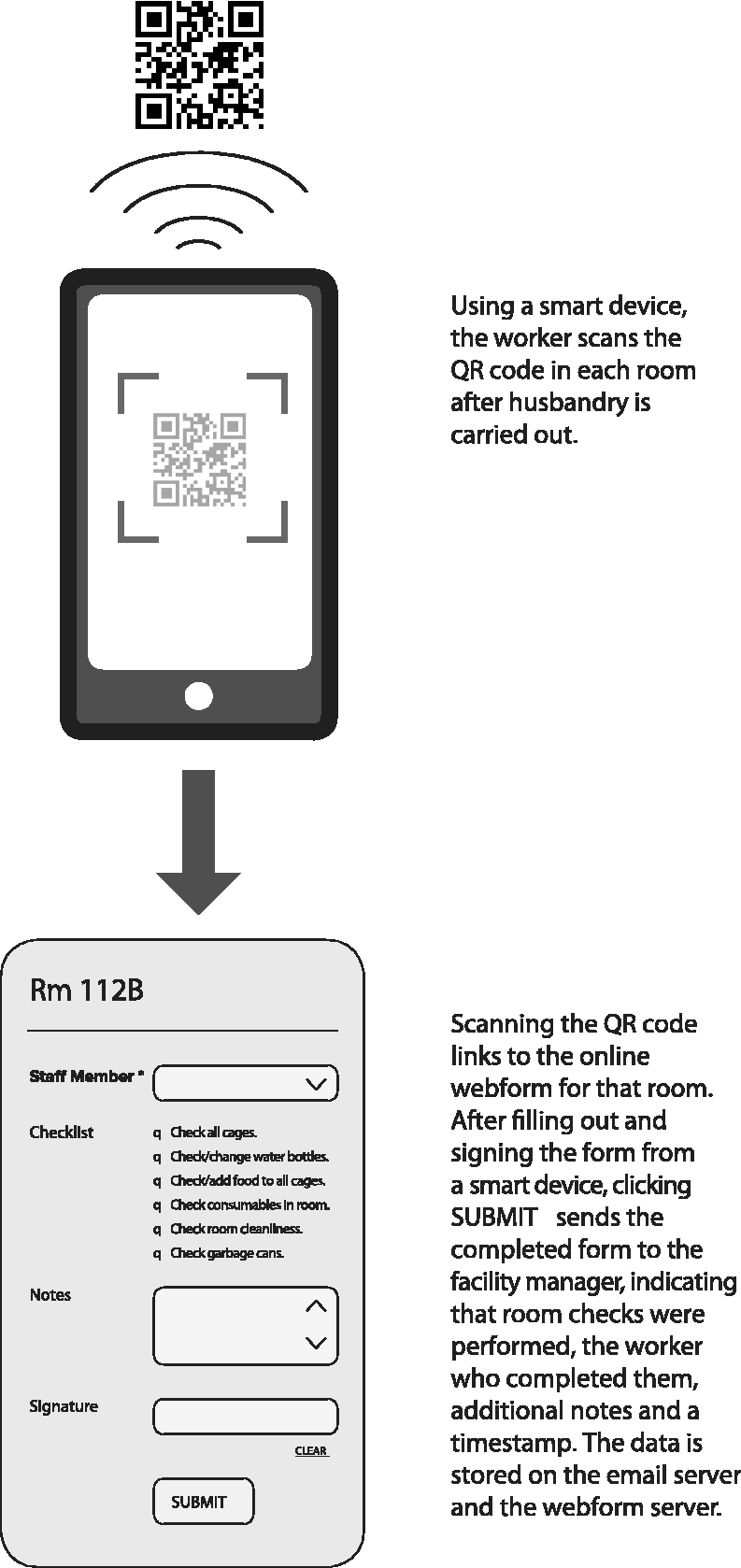
The platform we report here is based on a suite of software developed for Security Services at the University of Manitoba to track movement of security personnel on patrol routes. Briefly, unique QR codes (quick response codes, Denso Wave) were constructed on a free website (www.QRstuff.com) to link unique URLs generated by a secure webform builder website (www.jotform.com). The QR codes were then printed, laminated and placed in each animal holding room. When the chores detailed in daily husbandry checklists were completed by an animal care worker, the worker scanned the QR code with a WiFi/cellular enabled smart device (iPod Touch, Apple) using a free app (QR Code Reader; Scan Inc, Provo, UT, USA). Scanning the QR code opened the webform builder website with the checklist for that room. The animal care worker identified themselves, made notes, and submitted the form to the animal facility director via an embedded email link. The system is independent of the smart device platform (Apple, Android).
The platform we developed is demonstrated as outlined graphically in Figures 1 and 2. The system was piloted at the Biological Sciences Animal Holding Facility (BSAHF) at the University of Manitoba in the fall of 2016, under the supervision of the facility director (TS) and Head of Veterinary Services (RH). The BSAHF is 14,500 square feet, containing five rooms for the housing of aquatic species, six rodent rooms equipped with biobubbles or ventilated caging for rodents, and one terrestrial reptile room. The facility is inspected annually by the University Animal Care Committee, and approximately every three years by the Canadian Council on Animal Care (CCAC, the national regulatory body). The facility was inspected by representatives from the CCAC near the end of the pilot period.
Flow chart indicating steps taken for development of a QR code scanning system. Flow chart indicating process of QR code scanning and sample of abbreviated webform activated via the QR code.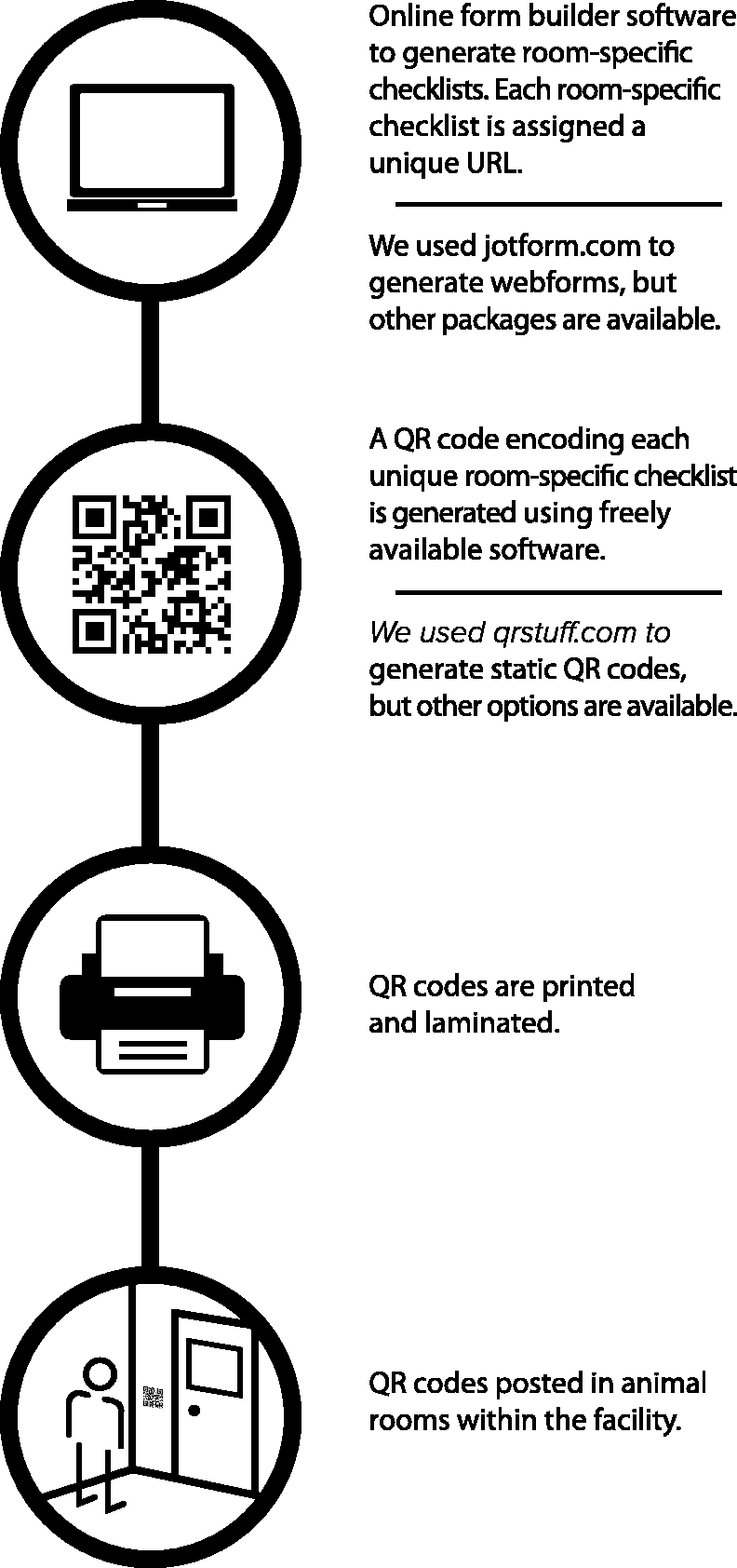
We have presented here a description of an inexpensive and simple platform we have deployed in order to facilitate documentation of simple husbandry procedures in our facility. It is our hope that this work may be utilized and built upon by other facilities as part of the effort to increase quality of animal care while aiming to control regulatory burden and cost.
Setup of this platform at our facility took approximately 4 h for 12 rooms, including the time to print and laminate the QR codes. Advanced computer skills were not required for any aspect of this task.
Several commercial packages which can track workers and activity (in the context of animal care or security) are available, however the cost of these can run to thousands of dollars. The key requirement of the system we intended to develop for the electronic management of daily husbandry checklists was cost minimization. The platform we present has a cost of USD$19 per month for the online webform builder package (www.jotform.com). There is no cost associated with the use of QR code scanning technology. The only additional cost for us was a one-time purchase of the WiFi enabled smart devices (iPod Touch, Apple) for the animal technicians at the facility. This latter cost may or may not be applicable to a facility intending to implement a QR code system in that animal facility workers may be mandated by health and safety regulations to have smart devices for communication at all times. In some cases these devices will be owned or subsidized by the facility.
The compliance by staff at our facility was 100% (five workers plus a facility director). Initially, some reluctance to engage was noted for a single technician, however most technicians engaged quickly, having significant previous experience using QR code technology with their personal smartphones. Once they were familiar with the process, scanning QR codes to submit documentation of work completed was faster and simpler than marking physical paper checklists in each room, and later scanning and filing the paperwork. While we did not perform a controlled experiment, the facility director reported that the QR scanning saved about an hour per week, based on the elimination of gathering and scanning daily paperwork. This time saved could be put into issues directly related to actual animal care, as opposed to simply fulfilling regulatory requirements. Importantly, the technicians reported that QR scanning eliminated the tedium of completing a daily paper checklist and scanning it at the end of the week. Moreover, QR code scanning provides real-time confirmation of when husbandry is performed, which is preferred by the CCAC.
This platform can be used to generate accessible and analyzable documentation of other aspects of the management of animal care. For example, at our facility, several snakes are used for outreach to local schools, teaching handling procedures to veterinary technician students, and teaching undergraduate biology. Our facility is required to document for each animal the number of hours per month for each of these activities, the number of students involved in the activity, etc. A dedicated QR code has been set up to document use of animals in this regard, making the details of these visits easily quantifiable for annual reporting. Specifically, each specimen has a QR code linked to a webform containing the reportable data. Each time an animal is used, the QR code is scanned. The data are emailed to the facility director for each instance and cumulative data are stored on the webform platform to be exported on demand as a Microsoft (MS) excel file for analysis. Analysis of environmental data is also possible with the QR platform. For example, we are implementing QR codes for marine tanks in order to track parameters including water temperature, salinity, pH and dissolved nitrogen (measured weekly). While these data can certainly be written in a notebook and transcribed for later analysis, the QR code eliminates the need to carry a physical notebook and reduces the possibility of transcription error.
QR scanning has recently been used as a platform to allow communication between pet owners and veterinarians, 4 and for a web-based monitoring system that mimics human patient digital charts, as has recently been described. 5 These platforms were programmed with standard MySQL, PHP, and nginx environments. However the system developed by Freznel et al. 5 took a skilled individual one year to develop and deploy. The system described in our study can be deployed in a few hours by an individual with no programming skills.
The platform clearly requires robust WiFi/cellular network connection in the animal facility. This is not expected to be an issue or an added cost in most facilities, as wireless connectivity is found in all areas of university campuses, in part due to demand and health and safety concerns of university workers.
Another potential issue is the possible folding of webform providers. While it is certainly true that any webform provider may unexpectedly fold, there are numerous companies providing this type of service. Construction of individual QR codes is accomplished on free websites and QR scanning technology is so widespread it is not likely to become obsolete in the near future.
Footnotes
Declaration of Conflicting Interests
The author(s) declared no potential conflicts of interest with respect to the research, authorship, and/or publication of this article.
Funding
The author(s) disclosed receipt of the following financial support for the research, authorship, and/or publication of this article: WMF is supported by a Discovery Grant from the Natural Sciences and Engineering Council of Canada.