




Abstract
There are different husbandry situations that lead to social isolation of male mice. Besides legal considerations, single housing has a negative impact on behavioural and molecular studies. We have implemented two strategies, the ‘companion mouse’ and just-weaned male grouping, to reduce the number of male mice housed singly in our facility. We have achieved a progressive reduction (42% in three years) without an increase in aggression.
Introduction
Directive 2010/63/EU recommends the group housing of social animals, such as mice, to maximize their well-being. However, there is an open debate about group housing male laboratory mice. 1 On one hand, it is recommended to individually house highly aggressive strains of male mice to avoid fighting. 2 On the other hand, it has been shown that single housing is not an optimal solution for overcoming aggression, and improving housing conditions could be a better option. 3 Behavioural studies show that individually-housed mice display increased locomotor activity, worse habituation response and impaired memory. 4 Moreover, social isolation leads to a wide range of global epigenetic changes in the brain. 5
We have been improving strategies to manage individually-housed mice following different recommendations.3,6 The aim of this short report is to describe the positive outcome of the protocol that we have implemented.
Animals, material and methods
Mice born in our specific pathogen-free (SPF) breeding zone are socially housed, up to four male and five female mice, in 1145T (Tecniplast) cages in individually ventilated cages. We use black poplar/aspen shavings as litter, and irradiated tissues as nesting material. Mating pairs and individually-housed mice are enriched with autoclaved cardboard cylinders and cotton for nesting. 7 Once a week socially housed mice, together with their nesting material, are transferred to clean cages.8,9 This same procedure is done with individually housed mice every other week. Mice have ad libitum access to water and diet (irradiated Special Diet Services RM1 up to nine weeks of age, and RM3 for breeding pairs and young mice until nine weeks old). Rooms are maintained under standard environmental conditions (humidity: 40–70%; temperature: 20–24℃) and a 12 h light/dark cycle (lights on at 08:00 h). Animals are monitored every day. Animal care and use programme is approved by PRBB-Ethics Committee and accredited by AAALAC International, following European (2010/63/UE) and Spanish (RD 53/2013) regulations.
Females are grouped with same strain mates, but adult males never are, due to aggression. Thus, when there is only one male with the genotype of interest in a litter, it would be housed singly. To reduce the number of singly housed male mice we followed two strategies. In 2016, we started implementing the ‘companion mouse’ strategy for genetically modified mice, keeping alive a ‘companion’ littermate to avoid social isolation of the single male with the genotype of interest. 10 In 2018, we implemented a post-weaning grouping strategy that consists of incorporating the single male to a litter to a cage of males with less than a week age difference.9,11 If neither of the aforementioned strategies is feasible, those mice are registered in our computer software with a welfare problem and the investigator is required to provide justification to keep them alive. Our Ethics Committee considers injuries due to fights between males, health concerns and active breeders or vasectomized males as suitable justification for individual housing.
In this study, we have considered only males that were born and housed in the breeding zone to ensure that we did not include any cases of individualization due to procedural protocols. To determine statistical differences among strains we performed two-way analysis of variance followed by Bonferroni's multiple comparisons test with Prism 6.01 (GraphPad Software). The results are described in accordance with the ARRIVE guidelines. 12
Results and discussion
The average number of male mice born in the breeding area of the SPF zone in the last three years was 22,299.3 ± 938.1, corresponding to the vast majority of different lines of genetically modified mice (80.6% ± 2.1), followed by C57BL/6 (7.7% ± 0.6), NOD.Cg-Prkdcscid Il2rgtm1Wjl/SzJ (4.2% ± 0.3), SCID/Beige (3.9% ± 0.5) and CD1 (3.6% ± 0.8).
In 2016, we registered 2245 singly housed male mice, which represented 54.4% of total welfare problems (4128). The following year, they were 1911, 49.6% of the total welfare issues (3853), and in 2018, 1309 males, which accounted for 40.2% of the total welfare problems (3255) (Figure 1(a)). The records of singly housed male mice three years ago were more than a half of the total welfare problems, maybe due to the large number of in-house bred genetically altered mice. The implementation of the strategies led to a progressive reduction in singly housed male mice, resulting in 42% less individually housed male mice in 2018 compared with 2016.
(a) Singly housed mice (continuous line) and wounds from fights (dashed line), total number by year. In-house born (b) singly housed mice and (c) wounds from fights percentage by strain. Graphs show the two periods 2016–2017, ‘companion’ strategy, and 2018, both strategies being used. **p < 0.01 indicates differences between the periods.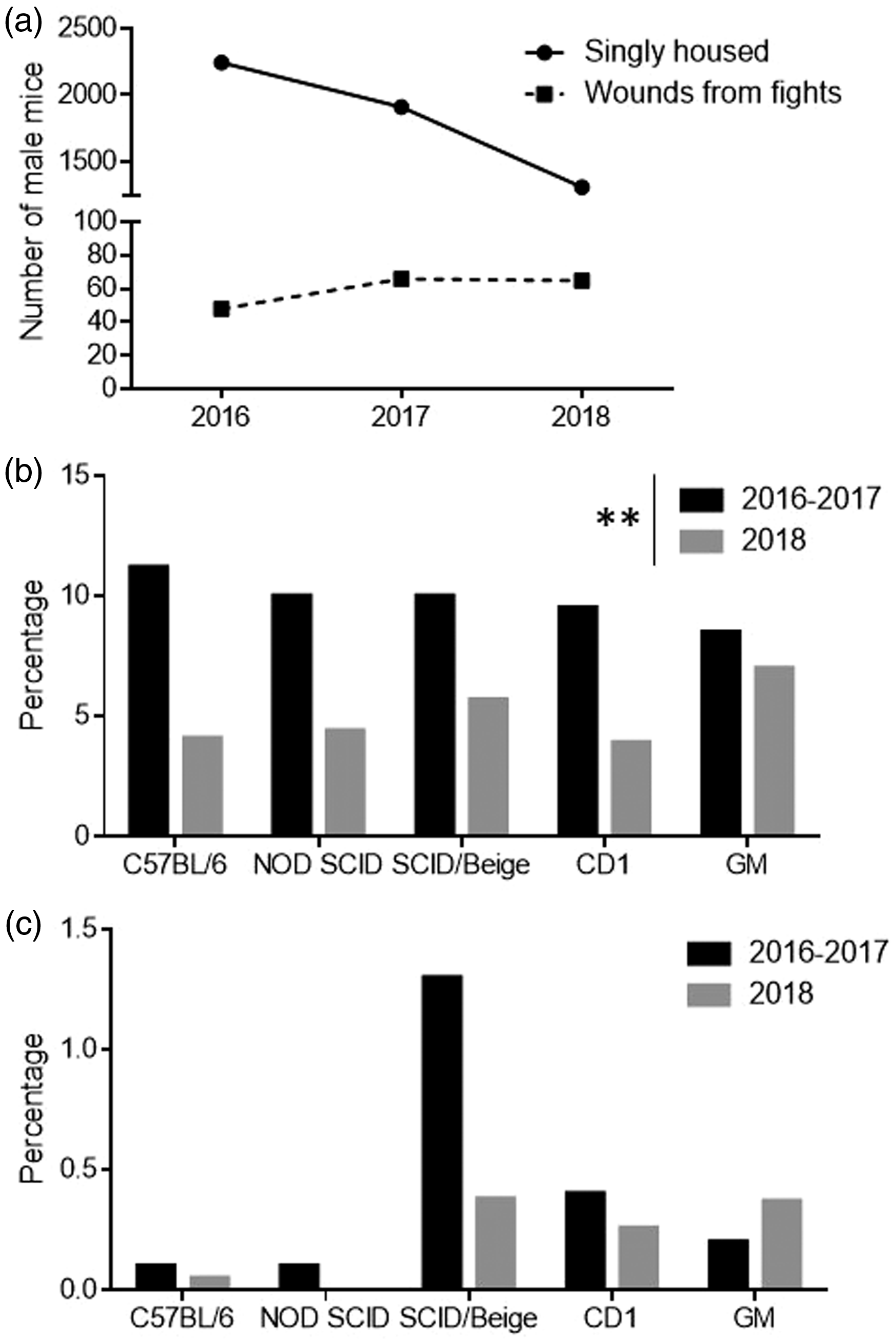
During this period, results showed no significant differences between the percentages of singly housed animals by strain. It is interesting to note that the implementation of the post-weaning grouping strategy in 2018 managed to reduce the percentage to below 10% for all strains, and in some instances to below 5% (Figure 1(b)) and that this reduction is statistically significant (F(1, 4) = 26.24; p < 0.01).
Finally, to determine whether these measures had an impact on aggression, we registered the number of wounds due to fights. The records indicated that the total number of episodes was 48, 66 and 65, corresponding to 1.2%, 1.7% and 1.9% of the total welfare problems in 2016, 2017 and 2018, respectively (Figure 1(a)). There were no significant differences among strains (Figure 1(c)). Overall, the percentage of fights related to the number of in-house born animals represented less than 2% and in some strains close to zero, most likely because we followed previous management recommendations.8,9
Conclusion
In our experience ‘companion mouse’ and just-weaned male grouping strategies are suitable husbandry practices to reduce the number of singly housed males. In the future, it would be interesting to increase the age difference to two weeks to see whether it is still possible to generate a stable social group without injurious aggression or stress to the animals, as has been shown for CD19 and C57BL/611 mice, and further reduce singly housed mice.
Footnotes
Acknowledgments
The authors would like to thank Tomás Garcia and Noray Bioinformatics, S.L.U. for welfare issues, software design and development, and Charles Rivers staff for their assistance with collecting the data.
Declaration of Conflicting Interests
The author(s) declared no potential conflicts of interest with respect to the research, authorship, and/or publication of this article.
Funding
The author(s) received no financial support for the research, authorship, and/or publication of this article.