






Abstract
In the animal facility, a range of different sounds are present. On the one hand, rats and humans will regard sound and noise differently even within the audible range, but on the other hand mice and rats being very adaptable to the environment may adapt to living in a noisy facility with e.g. a radio playing. It was the aim of the present study to investigate whether two different strains of rats had different preferences for different kinds of sound patterns, including radio, and to get an indication of whether they are able to distinguish between different sound patterns. The present preference study revealed that rats were able to distinguish between different sound patterns. They showed a clear preference for silence to anything else, which may be taken as an indication that they feel disturbed by the sound from the speaker.
Sound is everywhere; some being low, some being loud. Sound can be present in the audible range of humans (from 20 Hz to 20 kHz), but also in the lower range as infrasound or in the higher range as ultrasound. Rodents primarily register the audible range and the ultrasound range. The ultrasound level is very important to the animals, but it is difficult to register and quantify. The majority of rodent communication is performed at the ultrasound range, and therefore essential levels of environmental ultrasound may disturb the rodents significantly. It is well known that exposing animals to ultrasound stresses them. 1,2 Most equipment used in the animal facility should be checked and found free of ultrasound generation. 3
Generally, responses to sound such as increased levels of stress hormones, i.e. corticosterone, adrenaline and noradrenalin, are comparable to physiological responses after exposure to any other stressor. 4–6 These reactions are observed for both short-term and long-term sound exposure. In studies using rats, some sounds have been shown to induce an increase in blood pressure. After a long-term sound exposure, hypertension persists weeks after the exposure has been terminated, in the same way as it is observed in rats exposed to grid floor housing 7 or other stressors. 8,9 Sound exposure to the mother within a narrow time-window during pregnancy may result in offspring being malformed at birth. 10 In other cases, sound exposure of the pregnant female may have physiological or behavioural consequences for the offspring later in life. For example, when a rat mother has been exposed to white noise at 90–95 dB during pregnancy, the offspring showed reduced exploration in the open field test later in life 11 and offspring from sound-exposed mothers had higher corticosterone and catecholamine release when subjected to foot shock as adults. 12 Generally, behaviour is easily affected by noise. If given the opportunity mice avoid sound with 7–14 kHz at 70–104 dB by staying in the most quiet part of the cage. 13 It could also be hypothesized that rats exposed to rock music at 60–80 dB for 24 h, which made them show an acute increase in activity, and then normalized after a few hours, were trying to escape the sound. 14 Interestingly, another study showed that rats exposed to sounds at 68 dB with frequencies between 70 and 3000 Hz had increased spatial learning, and made fewer errors when tested in a maze. 15
In the animal facility a range of different sounds are present. Rats and humans do not have the same sound perception (humans: 20–20,000 Hz; rats 250–76,000 Hz), and therefore they will regard sound and noise differently even within the audible range. The animals themselves generate different sounds, e.g. during vocalization or from movements. 16 Different equipment and procedures in the facility are also generating sounds, e.g. ventilation, cleaning, movement of cages, washing machines, etc. 17 Another source of sound is the facility staff, who communicates, uses telephones and computers. Furthermore, a radio is constantly playing in many facilities, and depending on its volume, and probably also its programme, whether it is music programmes, talk-shows or classical music, it could be hypothesized that a playing radio may affect animals. On the other hand, it is probably uncommon to play the radio louder than 60 dB. As mice and rats are very adaptable to the environment, 18 they may adapt to living in a noisy facility, but in most studies it has been shown, that the noises need to be uniform and predictable for the animals to adapt, 4,19 whereas other studies cannot show any habituation. 15,20 A radio playing very differing programmes with a wide selection of different music cannot be regarded as a uniform sound source, and such a non-uniform stressor may disable the adaptation of the animals.
It is possible to reduce or eliminate some of these noises or sounds generated by humans. The telephone could be placed in another room together with the computer, and the radio could easily be turned off or be replaced by an ear-plug-based MP3 player. However, the question is whether these sounds actually affect the animals, at all.
It was the aim of the present study to investigate whether two different stocks of rats showed different preferences for different kinds of sound patterns, including radio, and to get an indication whether they were able to distinguish between different sound patterns.
Methods and materials
Ten male rats (HsdOla:LH), initial weight 300 g, and 10 male rats (NTac:SD), initial weight 250 g, were used. The rats were pair-housed in type U1500 Makrolon cages (Tecniplast, Buguggiate, Italy) with aspen bedding (Tapvei, Kortteinen, Finland), a shelter (Des.Res.TM, Lillico, Surrey, UK), nesting material (Enviro-Dri®, Lillico, Surrey, UK), a paper tube (GLP Fun Tunnels, Maxi, Lillico Biotechnology, Surrey, UK) and a biting stick (aspen brick, size M, Tapvei). All cages were changed weekly, and the rats were offered diet (Altromin 1324, Brogaarden, Gentofte, Denmark) and tap water
A preference set-up was designed (Figure 1), in which the cages were placed on digital weights connected to a computer automatically logging the weight of each cage as an indicator of the presence of the rat in the cage. 21 In each end of the connection tube, two IR sensors were placed. These sensors were connected to a graphic logic controller (GLC) controlling the sound from two CD players (CMT-EH10, Sony), both connected to the same loudspeaker. When the rat entered the left cage, the speaker played one type of noise, music or speak, while when entering the right cage another kind of sound was played. The rat was able to move freely between the two cages and sound patterns. The rat could not be present in the set-up without being exposed to sound from the loudspeaker, unless some of the cages were set to silence.
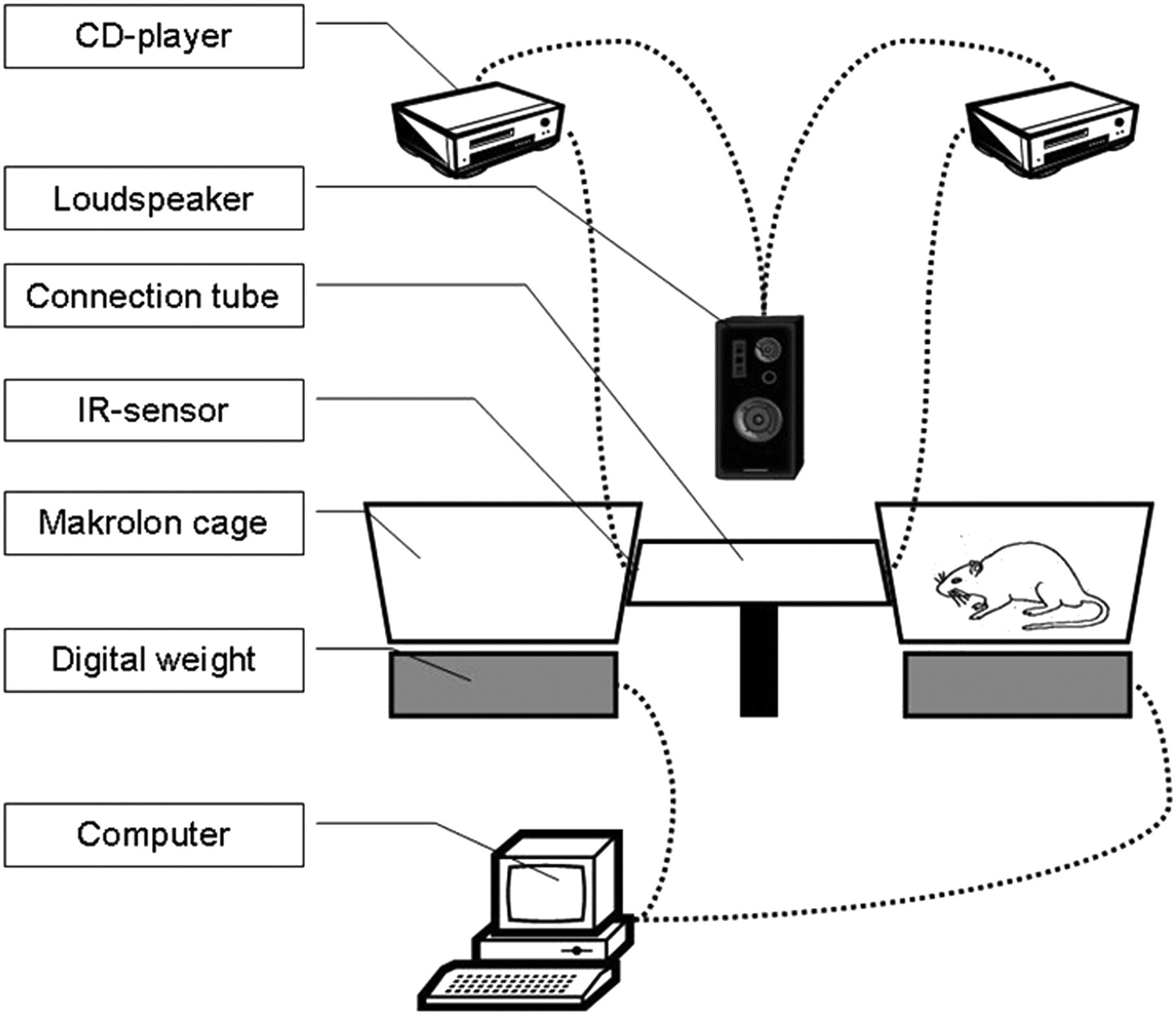
Sound preference set-up. The two cages are interconnected with a tube and placed on two separate digital weights, which is logging the weight of the cages on a computer. Two IR sensors at each end of the connection tube is registering in which cage the rat is present and wire the sound from either one of the two CD players to the loudspeaker
The different sound set-ups used in the study are shown in Table 1.
Different sound set-ups used and played in the study at 60 dB
Two set-ups were placed simultaneously in two ventilated cabinets (ScantainerTM3, Scanbur A/S, Karslunde, Denmark) in a separate room with no other animals present, and with automatic day/light shift (06:00–18:00 h), room temperature at 23 ± 1°C and relative humidity at 55 ± 5%. The room and the cabinet were ventilated 10–15 times per hour and 70 times per hour, respectively. Two night time (18:00–06:00 h) and two day time (06:00–18:00 h) periods were analysed for each rat in each study. To avoid bias on the preferences, the set-up was validated before testing (control period) by placing the rats one by one in the set-up, noting that they chose equally between the two identical cages with no sounds. Between each test in the preference set-up, the rats were housed with the companion for at least two weeks.
The different sound set-ups were analysed using a sound detector (Model 824, Larson Davis, Depew, NY, USA) which showed the sound spectra for each set-up. All experiments on the animals were conducted according to the Danish legislation directed by the EU Directive EU 86/609 and the study was approved by the National Animal Experimentation Committee.
Statistic analysis
All data were tested for normal distribution using the Anderson–Darling normality test. The results were statistically analysed using a
Results
The sound spectra for the sounds given above at 60 dB(A) are shown in Figure 2. As a reference the audiogram for a LH rat is added to the figure (modified after 22 ).
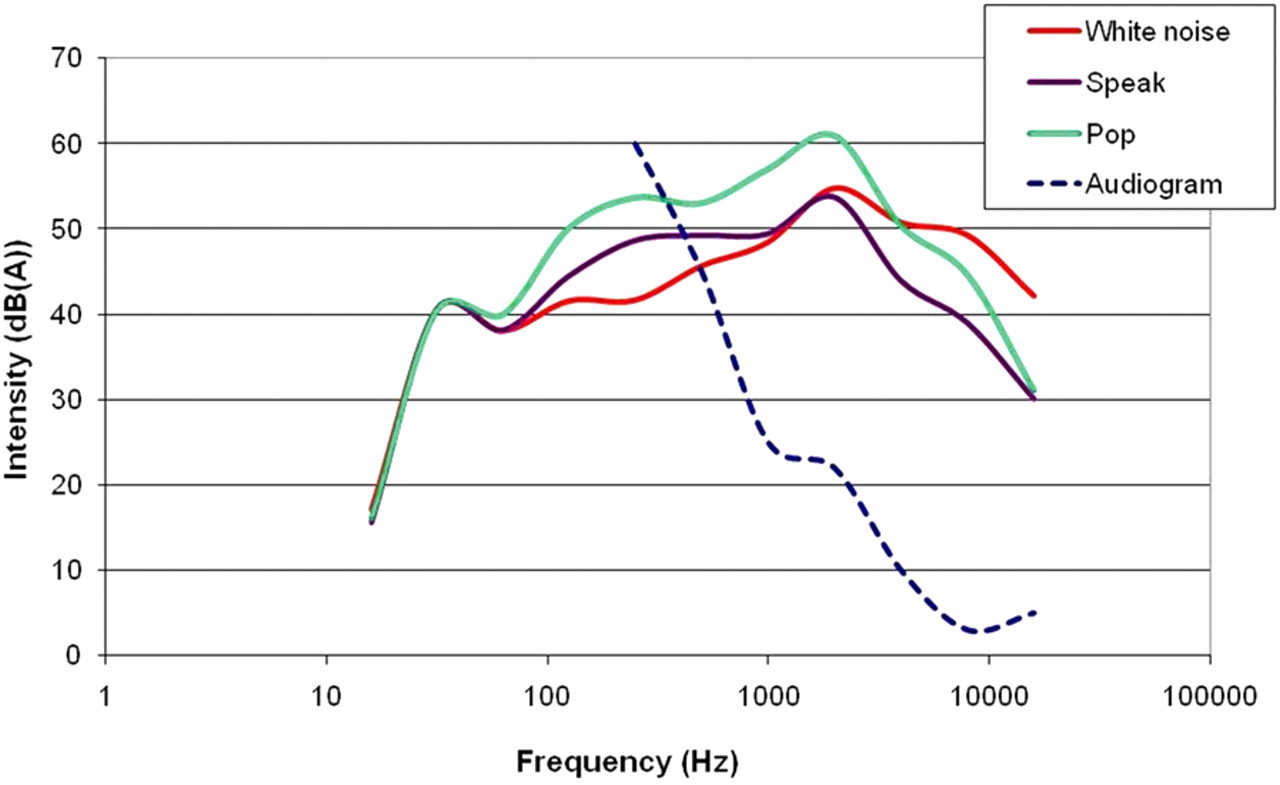
Sound spectra and the audiogram. The sound spectra for the three sounds: white noise, speak and pop. All three measured at 60 dB(A). The audiogram is modified from Heffner
Figure 3 shows the night time data for all seven set-ups for both the LH rats and the SD rats and Figure 4 shows the same for the day time data. For all SD rats at both day and night this shows that they prefer silence over anything else, whereas the LH rats prefer silence over radio and pop for both day and night. Both strains prefer pop and speak over white noise for both day and night, and both strains prefer speak over radio.
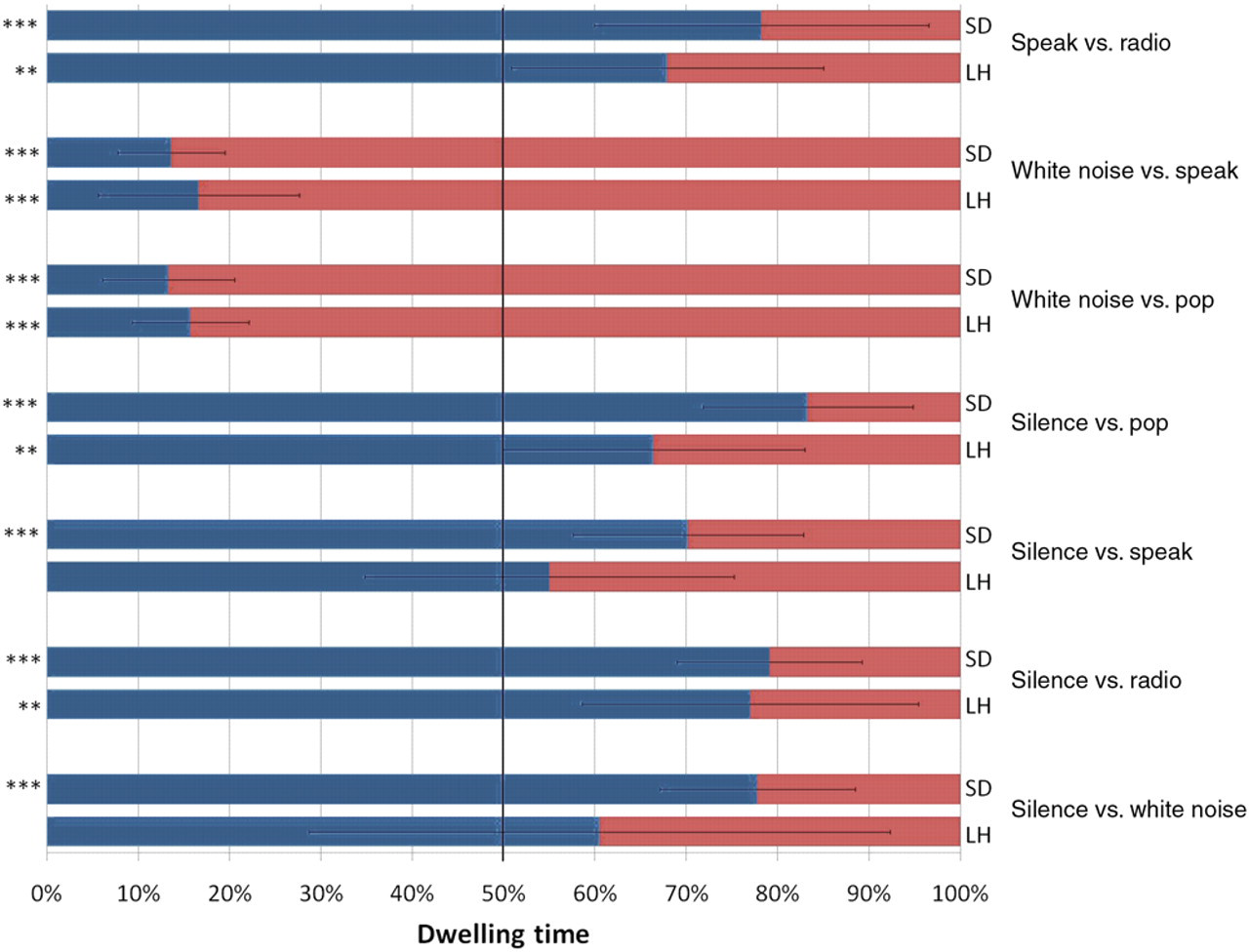
Results from the night time preference tests. The figure shows the distribution of dwelling time for both strains of rats exposed to seven different sound–pattern combinations. The 50% distribution is marked with a bold line, and for each result the standard deviation is marked. **
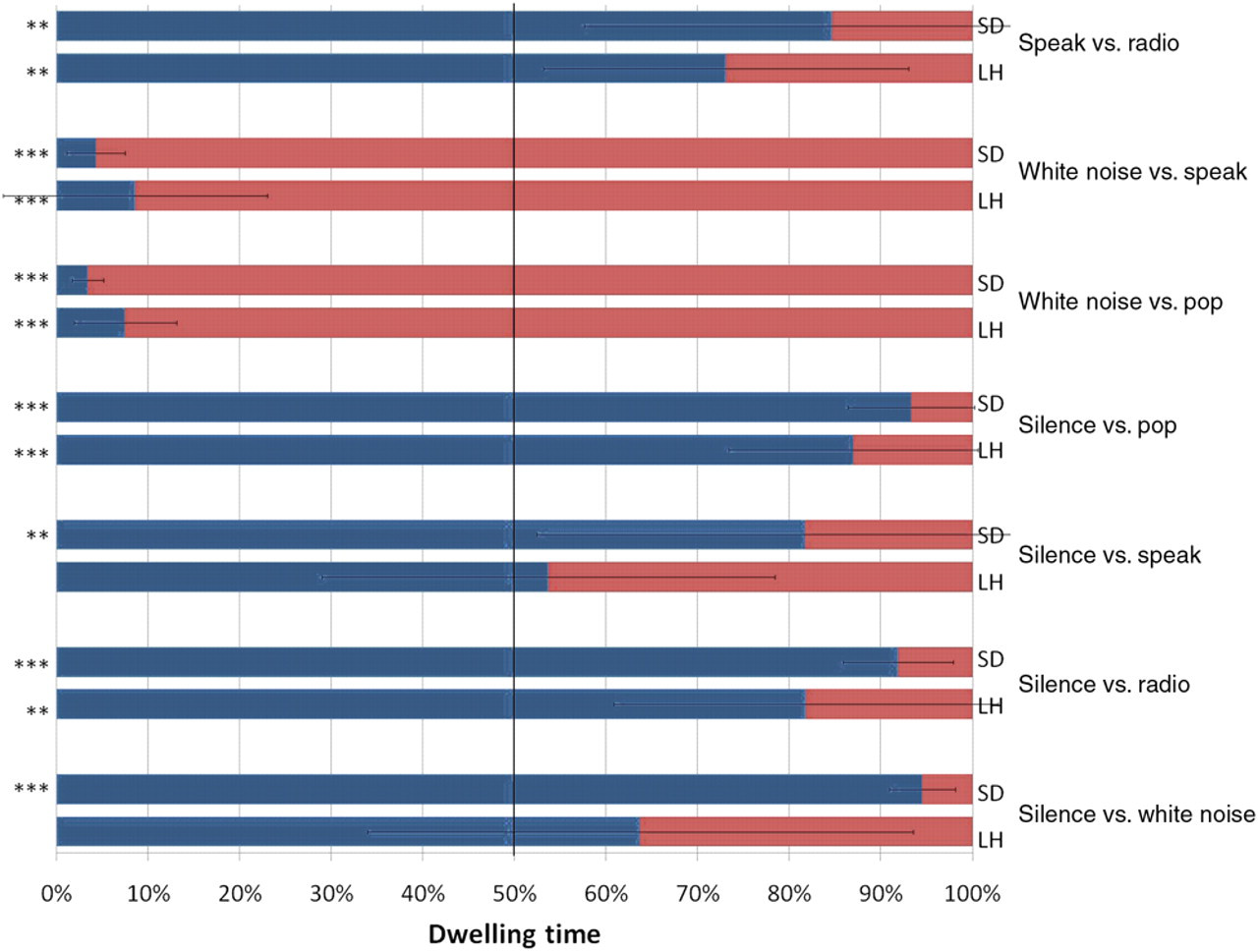
Results from the preference for the day time. The figure shows the distribution of dwelling time for both strains of rats exposed to seven different sound–pattern combinations. The 50% distribution is marked with a bold line, and for each result the standard deviation is marked. **
The control shows that the selection between the right and the left sound-free cage was equally distributed for both strains.
Discussion
The present preference study reveals that rats are able to distinguish between different sound patterns, as they showed a clear preference for silence to anything else, which may easily be interpreted as they feel disturbed by the sound from the speaker. There are only slight differences in the preferences between the two strains, and the overall trends seem to be the same for both strains. The sound level at the cage was 60 dB(A), which corresponds to normal levels of conversation between two persons. 23 The sound pressure was measured by the use of the A-scale, and therefore the deep tones and the high tones were weighted less compared with the rest of the tones. This might be a problem for the rats, as they hear the high tones better, but using the A-scale makes most sense, as we wanted to measure the effects of music and radio used for human entertainment. Some studies suggest the use of a special scale for rats, called dB(R), when measuring hearing of rats. 24 However, when studying sounds for humans, such as the radio, referring to a scale made for rats does not make sense, as the loudspeaker will cut off a majority of higher tones that are weighted at the R-scale.
The results show that the rats avoid the white noise, while they select cages with pop or speak, and prefer speak to radio, which can be explained from the rat audiogram and the sound spectra of the different sounds. Rats seem to seek the sound with the lowest sound pressure at the optimal hearing frequency around 9–10 kHz. This could lead to the expectation that first white noise, then pop, radio and finally speak would be avoided. How stressful or annoying the sound from the loudspeaker is for the rat cannot be concluded from the present study, but it is clear that given the opportunity they would avoid certain sound patterns. A further step could be redoing the study with a filter cutting off all tones above 10 kHz.
There seems to be some differences between the two strains, as their preference is not exactly the same, but the trends in all the set-ups for the two strains are the same. The audiogram for the two strains may not necessarily look the same, as there could be small variations in the ability of each strain to hear different sounds or their tolerance towards disturbing sounds, although an older study concludes that there is little difference in the hearing ability between difference strains. 25
The study shows that a playing radio is entertainment for the staff, and not for animals, although it does not allow any strict recommendations on radio or music playing in animal facilities. As the rats are adaptive creatures, they may get used to the radio playing, but a question can be raised, whether a radio should play all 24 h or be limited to the day time, when the staff 23 is present and the rats are resting. Another solution could be a filter on the loudspeaker, as mentioned above.
When animals are used as models, a playing radio or music might affect the animal and thereby the model, either positively or negatively. It is known from cows' studies that milk production increases when listening to slow music and decreases when listening to fast music. 26 It could be hypothesized that a similar effect in a rat model may change the results of the research in an unknown way.
A cancer study showed that rats exposed daily to classical music decreased the number of metastases, whereas daily exposure to an alarm bell at 100 dB increased that number. 27 In another study changes in lymphocyte proliferation and IL-1 secretion were observed in rats daily exposed to rock music. 14
These studies show that rats react to different sound patterns, e.g. from a radio, but also that the reaction might vary from strain to strain. Therefore, the effects of music in the animal facility need further investigation before a clear conclusion or recommendation can be given.