




Abstract
In a conditioned taste aversion (CTA) procedure, the consumption of a flavor is followed by the administration of a toxin (e.g. lithium chloride, LiCl), resulting in the future avoidance of the flavor. CTA studies typically make use of forced-exposure paradigms where a volume of the toxin dependent upon the weight of the animal is injected. The use of forced paradigms can be problematic when extended training is required, such as in stimulus discrimination training involving similar flavors, since the animals can be exposed to a high amount of the toxin. In the present study we confirmed the viability of an alternative voluntary-exposure paradigm that more closely mimics natural conditions and is more considerate of the welfare of the animals as a useful tool for investigating discrimination training. In three experiments, rats received free access to either a flavor (sucrose in Experiments 1a and 1b, and saccharin in Experiment 2) or a compound of the flavor mixed with LiCl. The presence of LiCl in the compound induced post-consumption illness. Rats acquired an aversion to the flavor + LiCl compound, thus reducing both their consumption of, and exposure to, LiCl, and gradually increased their consumption of the flavor alone. The present paradigm is more similar to natural conditions than the forced-exposure paradigm as it allows the animals to experience a direct relationship between the amount of the flavor consumed and the magnitude of the illness induced by the toxin.
In Pavlovian discrimination training, (at least) two stimuli are presented which differ in terms of the reinforcement that they receive. In some trials, one of the stimuli (S+) is paired with an unconditioned stimulus (US); and in the other trials, the other stimulus (S−) is presented and the US is omitted. Such training results in the appearance of a conditioned response (CR) to the S+. The S− will often evoke the CR in the early trials of training (i.e. there will be generalization from the S+ to the S−). However, with continued training, while the tendency to respond to the S+ will increase, the tendency to respond to the S− will diminish (i.e. the generalization between the stimuli will decrease), and differential responding to the stimuli will thus be evident.
The ability of animals to learn to discriminate between similar stimuli is a well-established phenomenon across a wide variety of conditioning procedures in all the sensory modalities. 1 For example, it is well known that pairing a neutral flavor with a toxin such as lithium chloride (LiCl) decreases the intake of that flavor when it is subsequently encountered. 2 The widely accepted explanation for this observation is that an association is established between the ingested flavor and the illness experienced later as a reaction to the toxin.3,4 The conditioned aversion to the flavor paired with the toxin will initially generalize to other, similar non-conditioned flavors. But this generalization will disappear as the animal comes to experience that the intake of these similar flavors is not followed by illness. This discrimination learning is clearly an important adaptive tool since it allows animals to avoid consuming harmful or potentially harmful foods, whilst continuing to consume foods that have been experienced without detrimental post-ingestive effects.
In demonstrations of discrimination learning using this type of aversive procedure, LiCl has usually been administered via an intraperitoneal injection.5–8 This previous research has employed a forced exposure to toxin paradigm in which the animal receives a fixed amount of toxin (depending on its body weight) regardless of the level of flavor intake shown previously. 9 This feature of the procedure does not match the natural conditions usually encountered by the organism in which the amount of toxin (and the magnitude of the induced illness) directly depends on how much of the toxic food the animal has consumed. A procedure able to provide this direct relationship between consumption and the magnitude of the illness can be readily obtained under laboratory conditions by allowing the animals to orally ingest the food or solution containing LiCl. This voluntary exposure to toxin paradigm would bring a series of additional advantages. First, it would eliminate the pain that the animals might suffer from an intraperitoneal injection, thus having a positive impact on the welfare of animals used in research. Secondly, it would reduce the amount of LiCl administered to the animal. As the conditioning procedure progresses, the animal will tend to drink less and less LiCl and thus will be exposed to a lower amount of toxin than in the forced exposure to toxin procedures.6,8 Thirdly, as a result of these advantages, it will allow, if necessary, the programming of longer training phases with a greater number of reinforced trials that would otherwise adversely affect the welfare of the animals. And finally, the oral procedure allows for the use of other animal species for which administering an injection can be complicated (e.g. due to their weight or the features of the environment in which they live).
Experimental designs.
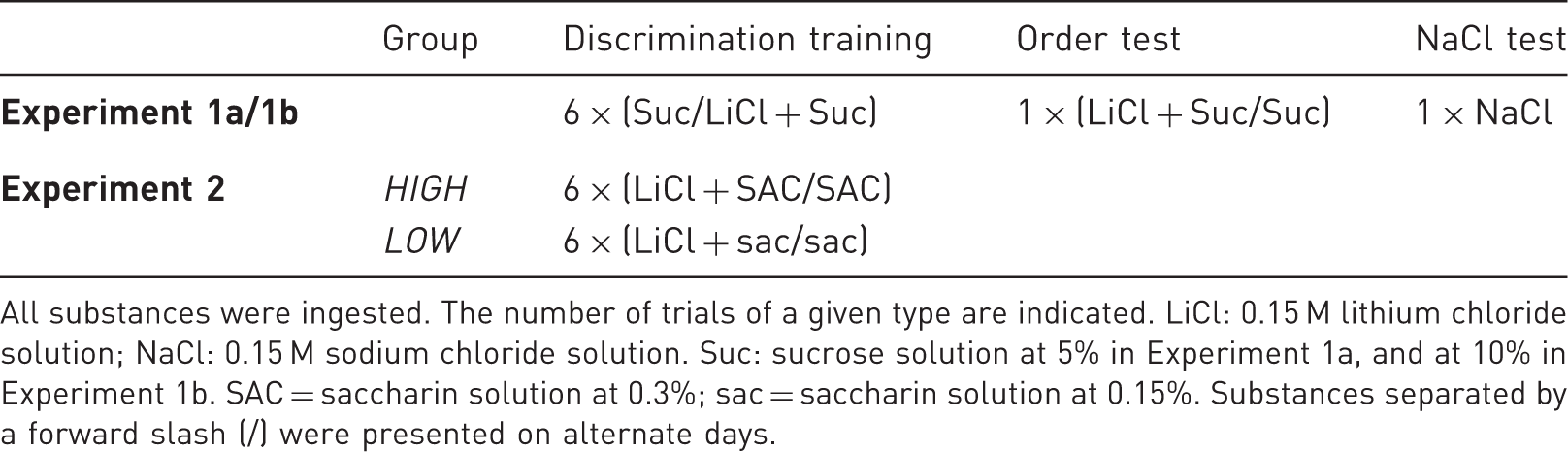
All substances were ingested. The number of trials of a given type are indicated. LiCl: 0.15 M lithium chloride solution; NaCl: 0.15 M sodium chloride solution. Suc: sucrose solution at 5% in Experiment 1a, and at 10% in Experiment 1b. SAC = saccharin solution at 0.3%; sac = saccharin solution at 0.15%. Substances separated by a forward slash (/) were presented on alternate days.
It is widely accepted that the difficulty of a discrimination task is directly related to the similarity of the stimuli. 19 In order to obtain direct evidence of this well-known feature of discrimination learning using our present procedures, we administered different concentrations of saccharin in Experiment 2 (i.e. the added flavor) in two different groups (LOW and HIGH). Since increasing the concentration of the saccharin would also increase the salience of the elements shared by the two stimuli (and hence the similarity between them), we expected acquisition of the discrimination ability would be faster when the concentration of the saccharin solution was lower.
Experiments 1a and 1b
Rats received discrimination training consisting of presentations of a LiCl + sucrose compound and presentations of sucrose alone. They thus had to learn to discriminate between the salty–sweet taste of the LiCl + sucrose compound (which was followed by LiCl-induced illness) and the sweet taste of the sucrose alone (which had no such consequences). We tested the ability of this voluntary exposure to LiCl paradigm in two of the most common strains of laboratory rats: Sprague–Dawley rats in Experiment 1a, and Wistar rats in Experiment 1b.
In these experiments we did not counterbalance the order of presentation of the stimuli during the discrimination training. All rats received the sucrose alone on odd days of training and the LiCl + sucrose compound on even days. Under these conditions, it might be argued that the observation of a differential response to the stimuli during training could be explained by the formation of associations between temporal cues (the sequence of strict alternation by which the stimuli were presented) and differential reinforcement. In order to rule out this possibility, we added two further sessions at the end of training in which the orders of presentation of the stimuli were reversed. If rats associated the different tastes of the LiCl + sucrose compound and the sucrose alone with their differential post-ingestive effects then they would be able to show differential responses to them regardless of the order in which the stimuli were presented.
Finally, we examined whether or not the aversion that we expected to be shown to the LiCl + sucrose compound was due to an association between the salty taste of LiCl and its detrimental gastric consequences. To this end, in the final session, rats received a presentation of a solution of NaCl that was equimolar (0.15 M) with respect to the LiCl solution used during the training.
Animals, stimuli and apparatus
In Experiment 1a there were eight experimentally naïve male Sprague–Dawley (obtained from the General Service of Research, SGIKER, of the University of the Basque Country, UPV/EHU, located in the Department of Medicine and Dentistry, Leioa, Spain) rats with a mean weight of 301 g (range: 201–387 g). In Experiment 1b there were eight experimentally naïve male Wistar (obtained from Harlan, Italy) rats with a mean weight of 353 g (range: 305–397 g). The animals were singly housed with continuous access to food in a room with a constant temperature (23℃), humidity (50%) and a 12:12 h light:dark cycle, with lights on at 08:00 h. Access to water was restricted as detailed below.
The solutions used as experimental stimuli were administered in the home cages at room temperature in 50 mL plastic centrifuge tubes, fitted with a metal spout. The following flavored solutions were used: in Experiment 1a, a solution of sucrose 5% (w/v), and a compound consisting of 0.15 M LiCl and 5% sucrose; in Experiment 1b, a solution of 10% (w/v) sucrose, and a compound consisting of 0.15 M LiCl and 10% sucrose. In both experiments a solution of 0.15 M NaCl was used in the NaCl test after the discrimination. Consumption was measured by weighing the tubes before and after trials, to the nearest 0.1 g.
Procedure
The water deprivation regime was initiated by removing the standard water bottles overnight. On each of the next four days access to water was restricted to two daily sessions of 30 min, beginning at 14:00 h (afternoon session) and 19:00 h (evening session). Presentation of fluids continued to be given at these times daily throughout the experiment. The experimental sessions were conducted in the afternoon session. In the evening session all animals received access to water.
Discrimination
Over the next 12 days, all the animals received a total of six presentations of the LiCl + sucrose compound (in the afternoon sessions of the odd days), and six presentations of the sucrose alone (in the afternoon sessions of the even days).
Order test
After the first 12 days of discrimination training, the animals received two additional sessions in which the stimuli were presented in the reverse order: the LiCl + sucrose compound was presented on the even day (i.e. the second day of this test), and the sucrose alone was presented on the odd day (i.e. the first day of this test).
NaCl test
In the afternoon session of the following day, all the animals received a 30 min presentation of the 0.15 M NaCl solution.
Results and discussion
Experiment 1a
Discrimination
The left panel of Figure 1 depicts the mean consumption of the LiCl + sucrose compound and the sucrose alone throughout discrimination training. It can be observed that consumption of the compound was slightly lower than that of sucrose on the early trials, and that this difference increased considerably as training progressed. A 2 (Stimulus: LiCl + sucrose versus sucrose) × 6 (Trial) analysis of variance (ANOVA) with these data confirmed these impressions, revealing significant main effects of Stimulus, F(1, 7) = 24.91 (here and elsewhere a statistical significance criterion of P < 0.05 was adopted), and Trial, F(5, 35) = 2.72, and the Stimulus × Trial interaction, F(5, 35) = 7.3. Subsequent analyses exploring this interaction revealed a significant effect of Stimulus from Trials 3 to 6, ts(7) > 2.99. There was also a significant effect of Trial for both the LiCl + sucrose compound and the sucrose alone, Fs(5, 35) > 4.44.
Experiment 1a (left panel) and Experiment 1b (right panel). Group mean consumption of the LiCl + sucrose compound (black squares) and the sucrose alone (white squares) during the six sessions of discrimination training (S) and the two sessions of the order test (OT). Group mean test consumption of NaCl (black squares) after the discrimination training is shown on the right hand of both panels. The concentration of the sucrose solution was 5% in Experiment 1a, and 10% in Experiment 1b. In both experiments, 0.15 M solutions of LiCl and NaCl were used. Vertical bars represent the standard errors of the means.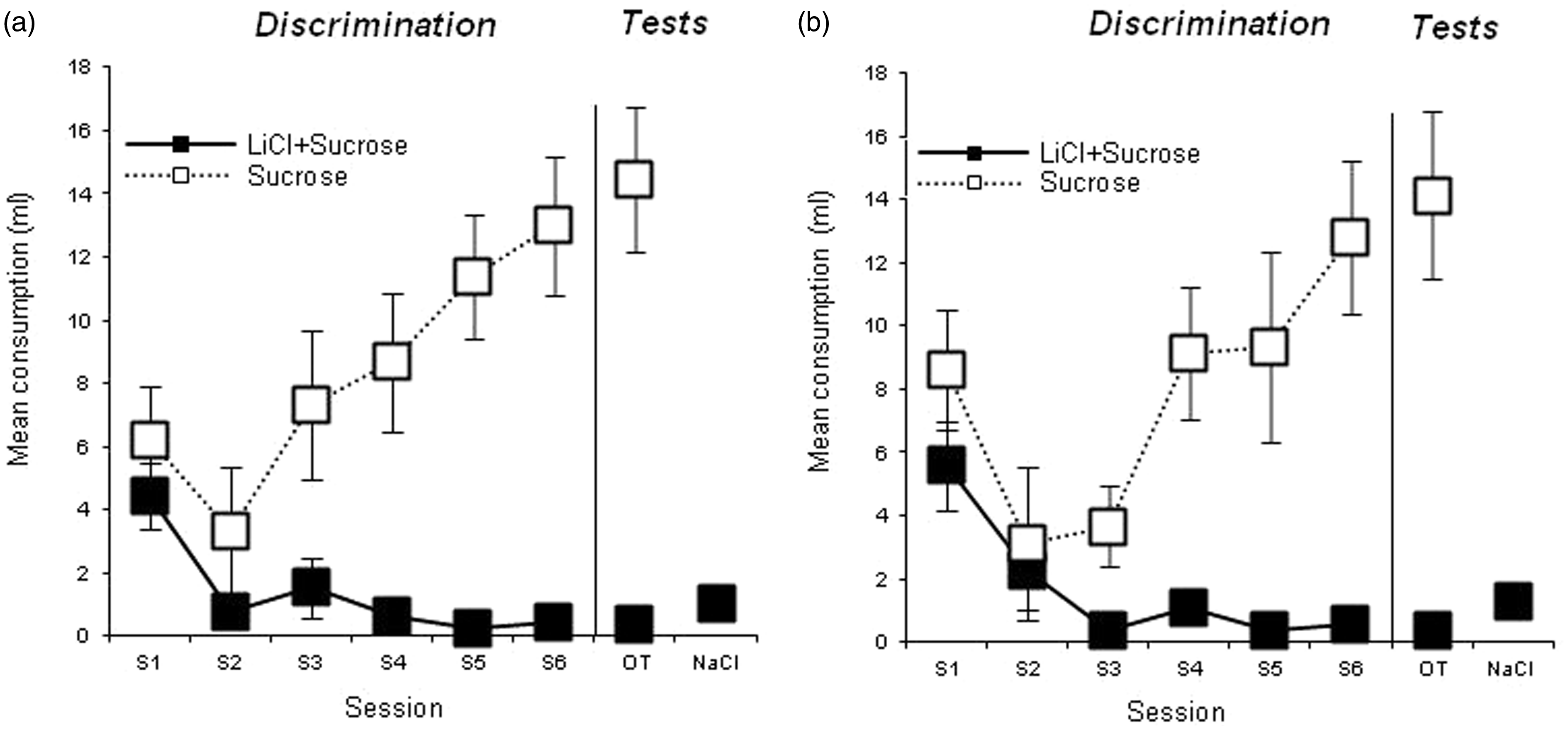
Order test
The left panel of Figure 1 also includes the mean consumption of the two stimuli on the two additional sessions for the reverse test (sessions 7 and 8). As can be seen, the magnitude and the direction of the differences observed at the end of the discrimination stage (less consumption of LiCl + sucrose than sucrose) were not affected by reversing the order of presentation of the stimuli in these sessions. Statistical analysis confirmed this impression. A t-test conducted on these data showed a significant difference between the consumption of LiCl + sucrose and sucrose, in sessions 7 and 8, t(7) = 6.16.
NaCl test
Consumption of NaCl was very low. A planned comparison showed that there were no significant differences between the consumption of LiCl + sucrose in the last trial in which it was presented (i.e. in session 7 of the order test) and the consumption of the NaCl solution during this test, t(7) = −1.39, P > 0.20.
Experiment 1b
Discrimination
The right panel of Figure 1 shows the mean consumption of LiCl + sucrose and sucrose during the course of discrimination training. As in Experiment 1a, consumption of LiCl + sucrose was slightly lower than that of sucrose in the early trials, and this difference increased considerably as training progressed. A 2 (Stimulus: LiCl + Suc versus Suc) × 6 (Trial) ANOVA with these data confirmed these impressions. There were significant main effects of Stimulus, F(1, 7) = 17.28, and Trial, F(5, 35) = 3.52. The Stimulus × Trial interaction was also significant, F(5, 35) = 5.98. Subsequent analyses exploring the source of this interaction showed that the effect of Stimulus was significant from Trial 3 to Trial 6, ts(7) ≥ 2.49, and non-significant in Trials 1 and 2, ts(7) < 1.52. The effect of Trial was also significant for both LiCl + sucrose and sucrose, Fs(5, 35) > 4.17.
Order test
As in Experiment 1a, the magnitude and the direction of the differences observed at the end of the discrimination stage (less consumption of the compound than sucrose) were not affected by reversing the order of presentation of the stimuli in this test. A t-test with these data confirmed this impression, t(7) = 5.3.
NaCl test
Very low consumption of NaCl was also evident in the final test of this experiment, confirming that during training an aversion was acquired to the salty taste of the LiCl + sucrose compound. A planned comparison between the consumption of LiCl + sucrose in the last session in which LiCl was presented (i.e. session 7 of the order test) and consumption of NaCl in this final test revealed no significant differences, t(7) = −2.05.
Experiments 1a and 1b showed that rats were able to learn to discriminate between a compound containing LiCl mixed with sucrose and from sucrose alone. The rats learned to avoid consumption of the LiCl + sucrose compound whilst continuing to readily consume the sucrose. This can be explained in associative terms. In particular, discrimination training will have allowed the formation of an association between the salty taste of LiCl and its detrimental post-consumption effects. Support for this interpretation comes from the NaCl tests carried out after the discrimination training phase. In these tests, when rats were allowed to drink a salty solution of NaCl they showed an aversion as intense as that shown to the LiCl + sucrose compound during training. Additionally, the order tests also allowed us to discard an explanation for the discriminative performance in terms of associations between any temporal cues (the strict alternation with which the non-reinforced and reinforced trials were presented) and the differential reinforcement.
Experiment 2
In Experiment 2, some variations were introduced with respect to the design and parameters employed in Experiments 1a and 1b. In order to demonstrate the generality of the effect, we used a solution of saccharin rather than the sucrose used previously. In addition, two levels of the discrimination difficulty were introduced by administering different concentrations of the saccharin solution (HIGH and LOW). The concentration of the saccharin solution was 0.15% for the LOW group, and 0.3% for the HIGH group. Since increasing the salience of the common element of the two stimuli (i.e. saccharin) would be expected to increase the similarity between them, we expected to find faster acquisition of discrimination ability in the LOW group than in the HIGH group.
Another procedural variation made was to shorten the duration of the trials. It is known that in rodents detrimental effects caused by LiCl can be manifested 15–20 min after its ingestion or systematic treatment.20,21 In our previous experiments rats were allowed to drink the compound containing LiCl for 30 min in each trial. It is thus possible that rats would already be experiencing the toxic effects of LiCl during the last 15 min of the trials and that this would cause them to avoid consumption of the flavor during this period. Of course, this is not enough to explain why the consumption of the compound containing LiCl fell to almost zero soon after the start of the trial. This (almost) avoidance of the compound containing LiCl can be explained in terms of the existence of an association between the salty taste of LiCl and its toxic effects. This would result in the animal anticipating the appearance of these effects when it encountered that taste. In any case, in this experiment we reduced the duration of the trials to 10 min in order to fully refine the procedure.
Finally, another procedural variation was that we counterbalanced the order of presentation of the LiCl + saccharin and saccharin trials. In Experiments 1a and 1b, all the animals started their training with a reinforced trial (i.e. a presentation of the compound containing LiCl). In order to ensure that this feature of the procedure was not relevant, in Experiment 2 half of the animals started the training by receiving a saccharin + LiCl trial (i.e. they drank the saccharin on even days of the training), and the other half started by receiving a saccharin trial (i.e. they drank the saccharin on odd days of the training).
Animals, stimuli and apparatus
There were 16 experimentally naïve male Wistar (obtained from Harlan, Italy) rats with a mean weight of 318 g (range: 279–396 g). As in Experiment 1, a solution of 0.15 M LiCl was used, but in this experiment a saccharin solution (rather than sucrose) was used in different concentrations (0.15% and 0.3%) mixed in compound with LiCl.
Procedure
At the end of this stage, the rats were randomly assigned to one of the two equally-sized (n = 8) groups (LOW and HIGH).
Discrimination
Over the next 12 days, all the animals received a total of six presentations of the LiCl + saccharin compound and six presentations of the saccharin alone. The duration of all these presentations was 10 min. For the LOW group, the concentration of the saccharin solution was 0.15% (w/v), and for the HIGH group it was 0.3% (w/v). Half of the animals in each group received the presentations of the LiCl + saccharin compound on odd days of training, and the presentations of the saccharin on even days; for the other half the opposite sequence was applied. In this experiment we did not run additional tests after the discrimination training as we did in Experiments 1a and 1b. In respects not specified here the procedure was the same as that described for the previous experiments.
Results and discussion
Discrimination
Figure 2 depicts the mean consumption of LiCl + saccharin and saccharin throughout discrimination training. First, consumption of the LiCl + saccharin compound began low and decreased to almost zero in both the HIGH and LOW groups. Secondly, for both the LOW and HIGH groups, consumption of saccharin alone was slightly higher than that of LiCl + saccharin in the early trials. Consumption of saccharin alone gradually increased during the course of training in the two groups, this increase being more marked in the LOW than in the HIGH group. The bigger differential response to the stimuli observed in the LOW group compared with the HIGH group indicates that rats learned to discriminate faster the less salient the saccharin (i.e. the less salient the common element shared by the two stimuli). A 2 (Group: LOW versus HIGH) × 2 (Stimulus: LiCl + saccharin versus saccharin) × 6 (Trial) ANOVA with these data confirmed these impressions, revealing significant main effects of Group, F(1, 12) = 5.05, Stimulus, F(1, 12) = 91.3, and Trial, F(3, 36) = 16.18, and the Stimulus × Trial interaction, F(3, 36) = 32.1. Subsequent analyses exploring this interaction revealed that there was a significant effect of Stimulus from Trials 3 to 6, ts(7) ≥ 2.99. There was also a significant effect of Trial for the consumption of both the LiCl + saccharin compound and the saccharin alone, Fs(5, 60) > 21.66. Neither the Group × Trial nor the Group × Stimulus × Trial were significant, Fs < 1.89, P > 0.10. The interaction Group × Stimulus was significant, F(1,12) = 7.33. Subsequent analyses made in order to clarify the source of this interaction showed that the groups differed in their consumption of saccharin alone, F(1,12) = 6.18, but not in their consumption of the LiCl + saccharin compound, F(1,12) < 1.
Experiment 2. Group mean consumption of the LiCl + saccharin compound (black symbols) and the saccharin alone (white symbols) during the six sessions of discrimination training (S). For the LOW (circles) and HIGH (triangles) groups the concentration of the saccharin solution was 0.15% and 0.3%, respectively. A 0.15 M solution of LiCl was used. Vertical bars represent the standard errors of the means.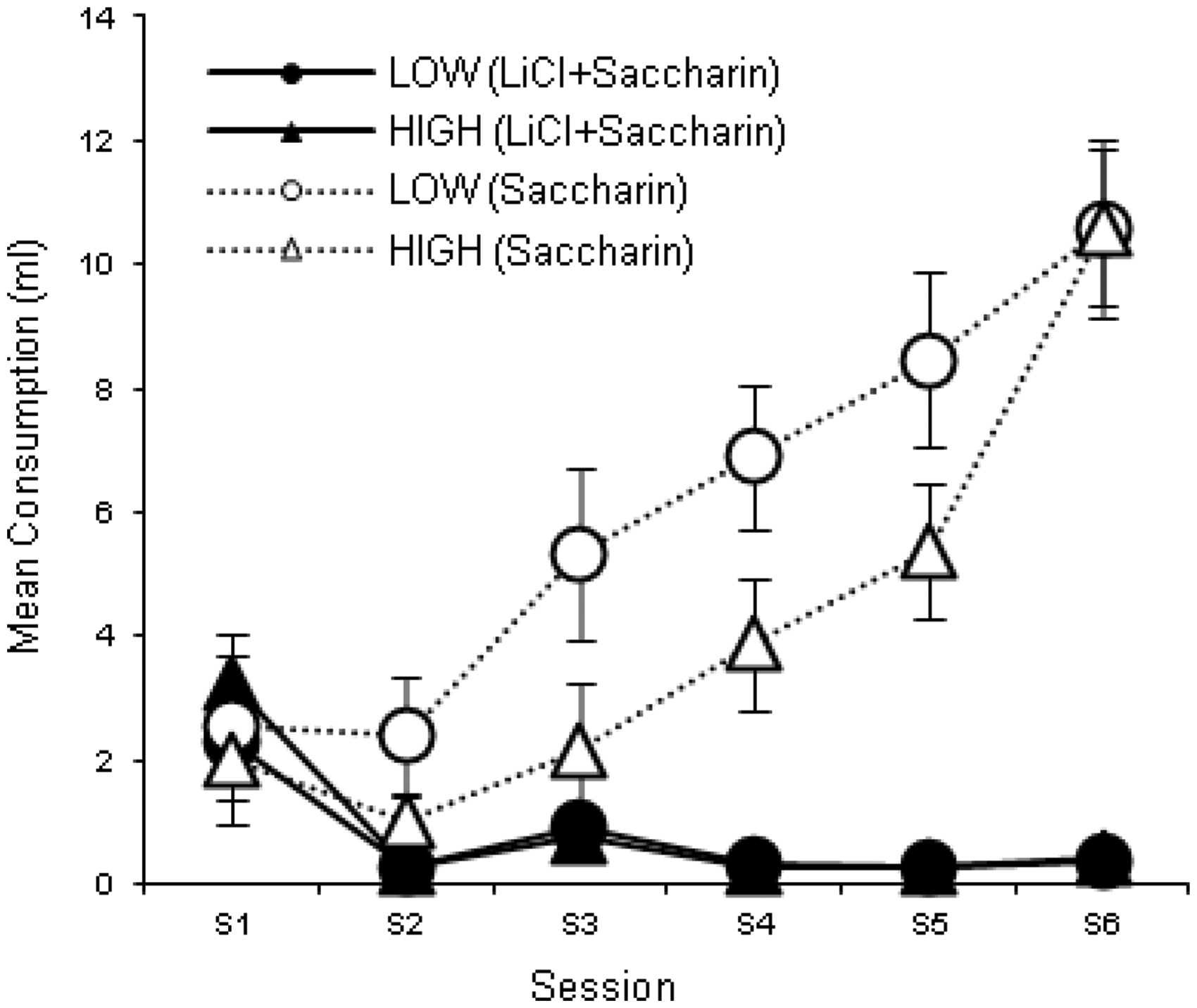
General discussion
In all three experiments the rats received discrimination training consisting of alternate presentations of a flavor (sucrose in Experiments 1a and 1b, and saccharin in Experiment 2) and a compound consisting of that flavor mixed with LiCl. During this training, rats gradually acquired a differential response to the flavor and the compound. They exhibited an aversion to the compound containing LiCl (i.e. they refused to drink) and gradually increased the consumption of the flavor not mixed with LiCl. This discriminative response depended on the concentration of the added flavor (saccharin 0.15% versus 0.3%, in Experiment 2), with the differential response (i.e. level of discrimination) being lower as the concentration increased.
These results are easily explained in terms of the formation of an association between the salty flavor of LiCl and the toxic effects that follow its presentations. Although the other flavor of the compound (sucrose or saccharin) also established an association with those toxic effects in the early compound trials, the additional experience in those other trials in which the flavor was presented alone, without LiCl, weakened that association and allowed LiCl to become established as an accurate predictor of the illness. 22 Previous demonstrations of discriminative learning using oral ingestion of LiCl as a reinforcer were obtained under a set of limited parameters: the stimuli to be discriminated were LiCl and NaCl, and these stimuli were always presented concurrently during training. Our findings thus extend these previous studies. We report that this type of learning can be obtained when LiCl is mixed with another flavor in compound, and that this learning also occurs when the stimuli to be discriminated are presented alternately, rather than concurrently, during the training phase. We have also demonstrated that this ‘voluntary exposure’ to toxin paradigm is sensitive to variations in the similarity of the stimuli to be discriminated. Discrimination learning occurs more slowly when the elements shared by the stimuli (saccharin in Experiment 2) are more salient. Our results thus add to previous evidence suggesting that well-established Pavlovian conditioning phenomena, such as latent inhibition, sensory preconditioning, and overshadowing can be obtained in procedures in which orally-administered LiCl is used as a US. 11
In addition, the development of this procedure has considerable practical implications. In particular, this method presents a series of advantages over the more usual procedures in which LiCl is usually injected. First, it eliminates the pain that the animals would suffer from an intraperitoneal injection, having a positive impact on the welfare of animals used in research. Secondly, this procedure reduces the amount of LiCl that is administered to animals. As the conditioning procedure progresses, animals tend to drink less and less LiCl and are thus exposed to a lower amount of toxin. In the procedures with ‘forced exposure’ to toxin the animals receive a higher total amount of the toxin in training, since they receive a fixed amount of LiCl depending on their body weight rather than on the amount of flavored solution consumed in the previous trial.4,6 Thirdly, as long as the amount of LiCl to which the animal is exposed in each reinforced trial is reduced, this procedure has the consequence of allowing the programming of a greater number of reinforced trials without threatening the welfare of the animals. And, finally it can be applied to animals for which administering an injection can be complicated (e.g. due to their weight or the features of the environment in which they live).
Footnotes
Acknowledgements
This research was supported by grants from the Spanish Ministerio de Economía y Competitividad (PSI2011-2431), Gobierno Vasco (IT-694-13), and Vicerrectorado de Euskera de la UPV/EHU. The authors would like to thank SGIker for personal and technical support.