




Abstract
Awake, behaving rhesus monkeys are widely used in neurophysiological research. Neural signals are typically measured from monkeys trained with operant conditioning techniques to perform a variety of behavioral tasks in exchange for rewards. Over the past years, monkeys' psychological well-being during experimentation has become an increasingly important concern. We suggest objective criteria to explore whether training sessions during which the monkeys work under controlled water intake over many days might affect their behavior. With that aim, we analyzed a broad range of species-specific behaviors over several months (‘ethogram’) and used these ethograms as a proxy for the monkeys' well-being. Our results show that monkeys' behavior during training sessions is unaffected by the duration of training-free days in-between. Independently of the number of training-free days (two or nine days) with ad libitum food and water supply, the monkeys were equally active and alert in their home group cages during training phases. This indicates that the monkeys were well habituated to prolonged working schedules and that their well-being was stably ensured during the training sessions.
Keywords
Non-human primates, and rhesus monkeys (Macaca mulatta) in particular, are widely used in neuroscience research.1,2 Because of a variety of primate-specific features, ranging from behavioral capabilities (e.g. dexterity and advanced behavioral flexibility) to neuroanatomical homologies (e.g. a granular prefrontal cortex), monkeys are indispensable for studying the neuronal mechanisms of cognitive functions. 3 Macaques can be trained with operant conditioning techniques to perform a variety of behavioral tasks in exchange for positive rewards. While monkeys are engaged in such tasks, electrical activity of nerve cells as well as their behavior can be monitored.4,5 Measuring neuronal activity simultaneously with behavioral performance presents a unique opportunity for experimental analyses of the neural foundation of behavioral utterances. Neuronal processing can be studied while the brain produces perceptions and actions.6–8 Because the brain lacks nocireceptors (‘pain sensors’), microelectrodes do not cause discomfort to the animals. In fact, electrodes are routinely implanted in humans for therapeutic access during illnesses such as Parkinson's disease, or epilepsy.9,10
Understanding the biology and behavior of primates bred and used for research is probably the single most important factor in the design and implementation of all types of refinement. 11 Given the relatively elaborate cognitive status of non-human primates, their psychological well-being, although poorly defined, has become an increasingly important concern over the past several years.12.A frequent worry in neurophysiological research with monkeys is that the number of consecutive behavioral training days under controlled water intake might constitute accumulated discomfort to the animals. 13 We thus specifically explored whether prolonged training over many days might affect monkeys' behavior, putatively as a sign of discomfort. To that aim, we measured and analyzed a broad range of species-specific behaviors over several months (ethogram) and used these ethograms as a proxy for the monkeys' well-being.
Material and methods
Study animals
We compared monkeys' behavior during 12-day training periods following either short two-day training-free periods (including ad libitum water and food supply) or long nine-day training-free periods. We measured the behavior of seven male rhesus monkeys (Macaca mulatta) aged 4–11 years. All the monkeys were purchased from the German Primate Center, Göttingen, Germany. All procedures were approved by the local authority, the Regierungspräsidium Tübingen, Germany. All experiments were in accordance with the European Convention for the Protection of Vertebrate Animals used for Experimental and Other Scientific Purposes, and the National Research Council Guide for the Care and Use of Laboratory Animals.
Housing and feeding routine
The animals were housed in several stable, small social groups in spacious group cages, each measuring 2.75 m(H) × 2.5 m(W) × 4.0 m(D) in a fully air-conditioned room (23 ± 1℃, 55 ± 10% relative humidity, maximum air change 15 times per hour) with daylight (10 to 16 h per day due to seasonal differences in Tübingen, Germany) and supplementary artificial light with 12 h day/12 h night cycle (07:00 to 19:00 h; 1500–2300 lux). Group cages were provided with hygienic animal bedding (Lignocel®, JRS, Rosenberg, Germany) and equipped with resting shelves, wooden branches, fire hoses, plastic tubs as well as cardboard tubes and boxes filled with nuts, seeds and raisins for environmental enrichment purposes. During behavioral investigation, the monkeys worked under a controlled water intake protocol. Water was provided as a reward to reinforce correct behavioral responses during behavioral conditioning. Food (primate pellets, 10 mm, ssniff, Soest, Germany) was provided ad libitum at all times. Raisins, sunflower seeds, peanuts, walnuts and dried fruits were given after behavioral sessions on a daily basis. During training-free phases that interrupted the experimental sessions, monkeys had free access to water, fresh fruits (i.e. apples, bananas, pears and grapes) and vegetables (i.e. carrot, beetroot, salad and bell pepper) as well as primate pellets.
Fluid control protocol
Determining a single standard by which all fluid control protocols can be evaluated or performed is difficult. 12 Baseline fluid intake varies depending on body size, age, housing, training protocol and physiological factors that are idiosyncratic to each animal. 3 Monkeys, like humans, appear to regulate hydration more or less efficiently, leading to substantial variation in the amount of fluid intake required each day. Such individual variations can only be appreciated if the history of the animal is known. We therefore determined the necessary fluid intake individually for each animal over a period of several days, when the monkey had a stable profile of behavior and physiology. The monkeys were required to obtain a substantial portion of their daily fluid requirement by earning it as a reward for performing a behavioral task once a day. In case a monkey was not able to earn its daily fluid requirement, a compensatory fluid supplement was provided; individual endpoints of the controlled water intake protocol were in place in order not to jeopardize the animal's health. Published figures comparable with ours are available 14 and strongly imply that the water access control procedures we employed allowed the monkeys to maintain a stable hydration state. Ad libitum access to fluid was provided on non-working days. With such a properly-managed fluid control, the animal could achieve all, or a substantial fraction, of its daily food/fluid requirement during training over many days and weeks. As an additional measure of physiological well-being, mean body weight did not differ between the two observation modes (i.e. two- or nine-day training-free periods) (P > 0.1, Wilcoxon sign rank test; n = 7).
The veterinarian staff provided advice on all animal welfare issues and closely monitored the health of the monkeys (e.g. by regular inspections and frequently analyzing blood samples). The level of fluid control was approved by the regulatory authority and the institution's ethical review. Physiological data collected over many years indicated that the monkeys stayed in good health with the applied individualized fluid control protocols, while continuing to work proficiently in cognitively demanding tasks.
Behavioral data collection
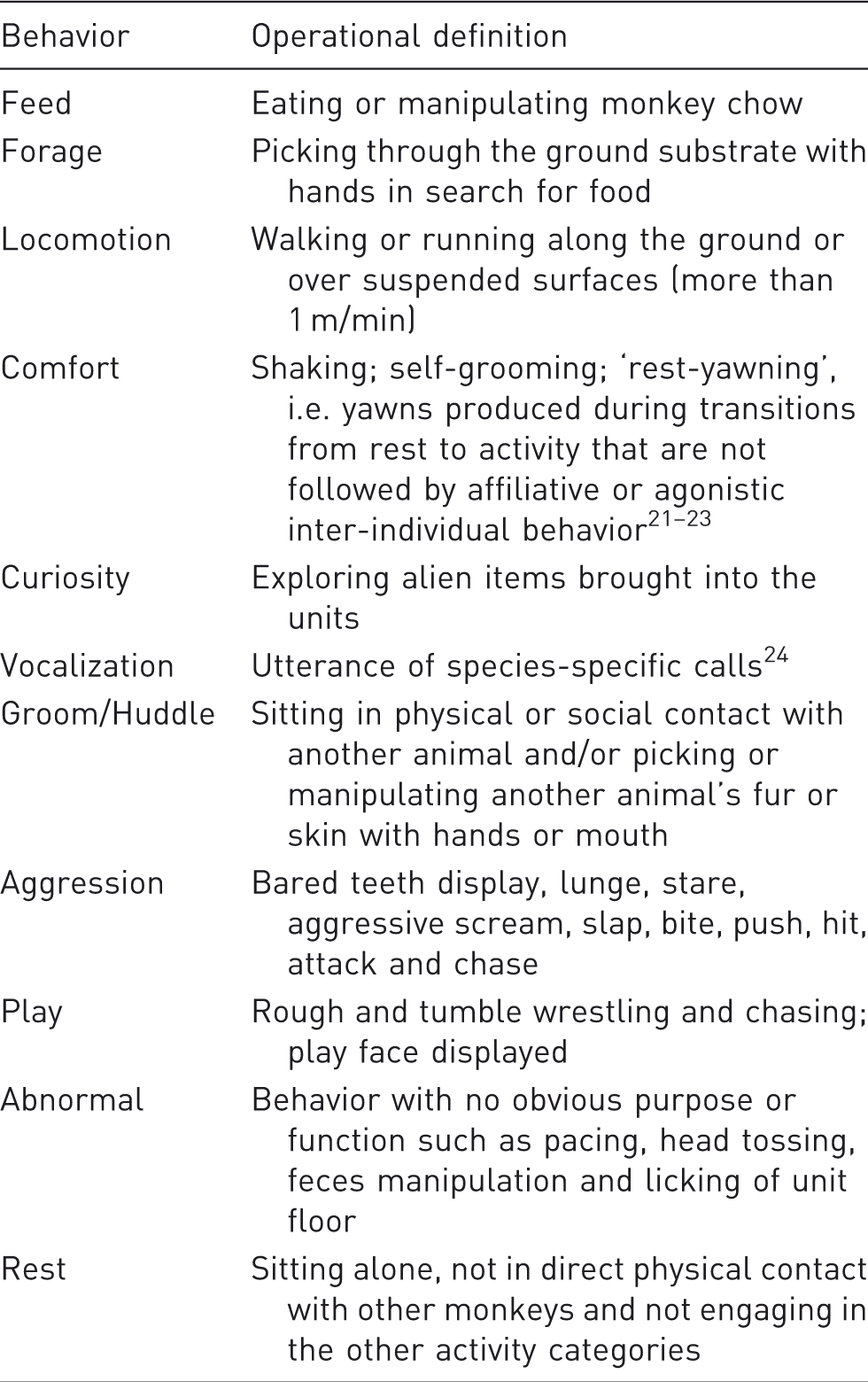
We used a combination of two sampling methods to assess the monkeys' behavior. During data collection, observers were in visual/olfactory/auditory proximity to the monkeys. However, the animals were very familiar with all observers whom they met on a daily basis. Thus, the monkeys were well habituated without noticeable reactions towards the observing person. All observers ran through an instruction phase, including test observations, in which they were introduced by SRH into the determination of each single behavioral category to assure uniform logging of the monkeys' behavior (inter-observer reliability). Data were collected over a five-month period (middle of May to end of October 2010).
First, we focally sampled the monkeys' behavior over 30 min in 1 min intervals (‘30 min ethogram’) immediately after the experimental animals were brought back to their home cage after training sessions (continuous sampling).15,16 We recorded the monkeys' behavior on the first five days and last five days of the 12-day training session periods. Data of three sets for both 12-day training sessions following either short two-day training-free periods (3 × 10 days) or long nine-day training-free periods (3 × 10 days) were collected. In a few cases, we had to omit the focal sampling sessions due to unchangeable animal care routines (cage cleaning, etc.) resulting in a median number of 58 ± 2 focal sampling sessions for each monkey. Overall, we logged over 200 h of behavioral observations during focal continuous sampling.
Statistical analysis
Statistical analysis was performed with MATLAB (MathWorks, Statistics Toolbox, Cambridge, UK) by SRH. For the continuous sampling data-set, we performed a two-way analysis of variance (two-way ANOVA) to test for significant differences in the behavioral activity during observation periods preceded by two- or nine-day training-free periods. The Wilcoxon signed rank was used to test for significant differences in the mean activity of the monkey throughout the ‘statistical day’. Differences in behavioral activity were considered significant at P < 0.05.
Results
Figure 1a depicts the median occurrence of all observed behaviors during focal animal scanning (‘30 min ethogram’) shown by one representative example monkey on 30 days with a preceding two- and nine-day break, respectively. Several behaviors like feeding, foraging and locomotion occurred quite frequently within both observation periods, while others like curiosity, comfort and vocal behavior were shown only occasionally. Some behaviors like aggression or play were not shown. Comparing the behavioral activity during observation periods preceded by two- or nine-day training-free periods, respectively, revealed no significant differences (P > 0.5, n = 540, two-way ANOVA). This indicates that this monkey showed similar behavior independent of the preceding training-free interval. Similar results revealing no differences between sessions with preceding two- or nine-day training-free phases, respectively, were obtained for the other monkeys (P > 0.1 for all monkeys, two-way ANOVA). Figure 1b depicts the averaged occurrence of the logged behavior for all seven monkeys. Abnormal behavior was not observed in any monkey during the entire behavioral investigation.
Comparison of monkey behavior observed with two types of focal animal analyses, focal animal sampling (a–d) and scan sampling (e, f), show no differences in relation to preceding training break modes. (a) Comparison of the median time a specific behavior was expressed by an individual monkey within 30 min observation intervals as a function of two or nine days of training-free phases, respectively (n = 30 sessions). Sum: incidence of all observed behaviors during a session. Bars show medians, dots and triangles indicate the 1st and 3rd quartile. (b) Averaged behavior of seven monkeys within the two session types. Same layout as in (a). (c,d) Averaged behavior depicted in (b) divided into the first (c) and second week of the training session (d) revealed no behavioral differences. Same layout as in (a). (e) Activity indices of behaviors shown in (a–d) of a single monkey reveal no differences between observation periods associated with two- and nine-day training-free phases. After the first hour of the day (07:00 h), no behavioral data were collected for the time where the monkey performed its daily training session (usually between 07:30 and 10:00 h). (f) Averaged probability for behaviors occurring in seven monkeys confirms the results depicted in (e). Shaded areas indicate 1st and 3rd quartile. Same layout as in (e).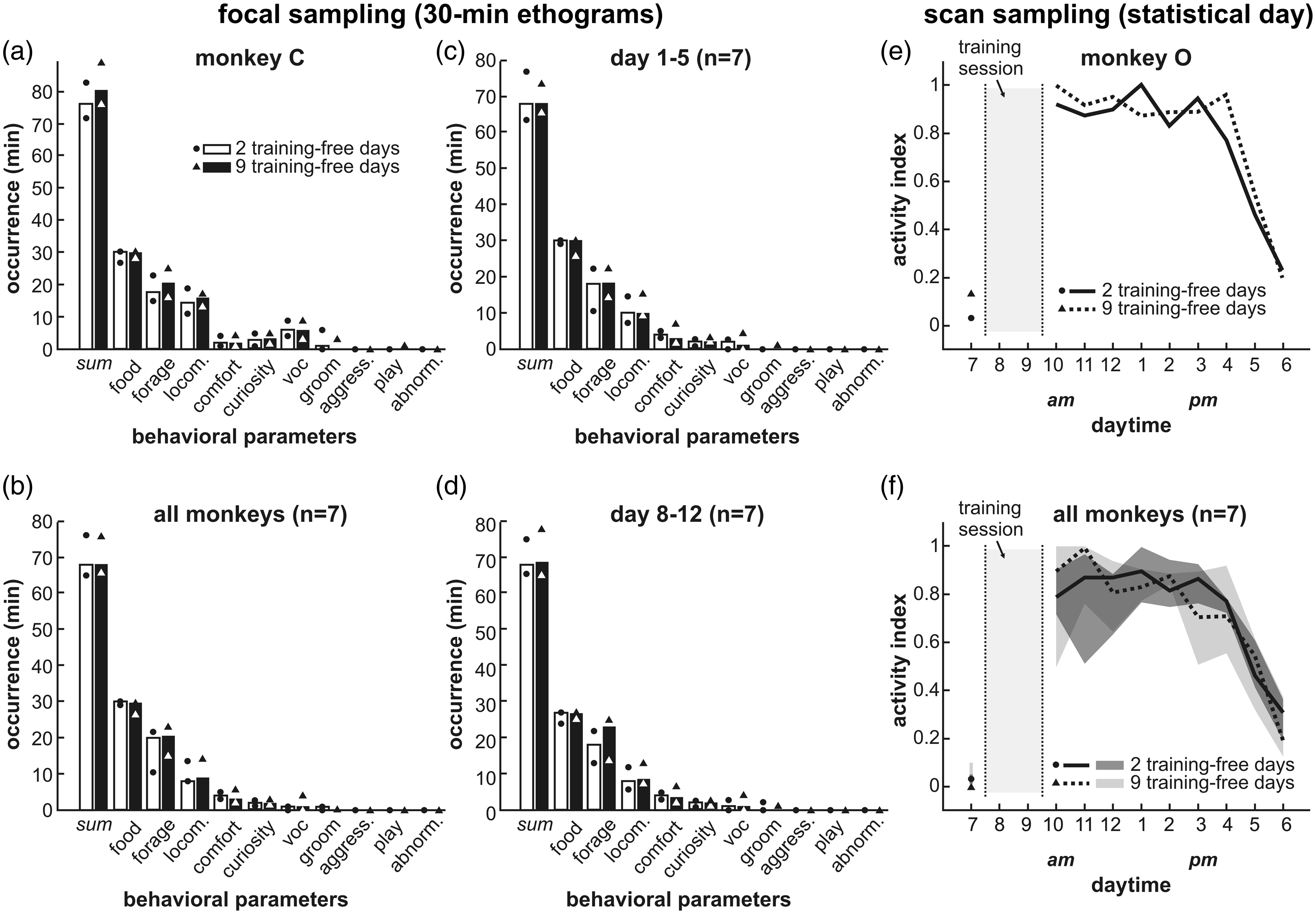
To test whether the monkeys' behavior changed over time during training, we performed a more detailed analysis by splitting the data-set into the first five and the last five days of the 12-day training sessions. Again, we observed no differences in any of the monkeys between the behavior shown during sessions with preceding two- or nine-day training-free phases, respectively, neither in the first five days, nor in the last five days of the training session (P > 0.1 for all monkeys, two-way ANOVA). Moreover, we found no significant differences in the observed behavior of any monkey between the first five and the last five days of the 12-day training sessions, neither in combination with the two-day, nor with the nine-day training-free periods (P > 0.1 for all monkeys, two-way ANOVA). Figures 1c and 1d show the averaged observed behaviors for all seven monkeys subdivided into the first five days and the last five days of the 12-day training session.
Instantaneous scan sampling revealed that the monkeys' behaviors were quite diverse throughout the day, resulting in the occurrence of most of the measured behaviors only occasionally. We defined an activity index that indicated a monkey's activity occurring within a single observation: An activity index of 1 revealed that a monkey showed at least one type of behavior during the observation; an activity index of 0 indicated that the monkey was resting. Figure 1e shows the mean activity indices for one example monkey during an average ‘statistical day’ 16 (30 days averaged for each of the two observation periods) for both observation periods tested. In both observation periods, the monkey was at rest in the morning and had its peak activity phase between 10:00 and 16:00 h, which declined towards the late afternoon/evening. (Between 08:00 and 10:00 h, no behavioral data were observed because the monkeys performed the daily training sessions during this period.) Statistical analysis revealed no significant difference in the mean activity of the monkey throughout the ‘statistical day’ (P > 0.2, n = 10, Wilcoxon signed rank test). At a group level, statistical analysis of the mean activity indices throughout the ‘statistical day’ of all monkeys revealed no differences between the two observation modes (P > 0.1, n = 10, Wilcoxon signed rank test). Figure 1f depicts the averaged distribution of the mean activity of all seven monkeys.
Discussion
Our results obtained from both focal animal sampling and behavioral scans show that monkeys' behaviors during training sessions were not affected by the durations of training-free days. Independently of whether the monkeys obtained two or nine training-free days with ad libitum food and water supply, behavior in the home cages was equivalent. The monkeys were just as active and alert after a two-day training-free phase as after a nine-day training-free period. From this, we conclude that the monkeys' well-being was robustly guaranteed during the training sessions because if the training phase had caused accumulated discomfort to the animals, longer training-free phases (that might have been necessary for recovery from the training phase) would have resulted in modifications of behavioral utterances as measured by the ethograms. Based on these data, we also conclude that monkeys are well habituated to prolonged working schedules. Prolongation of the daily working routine under controlled water intake over at least 12 days does not act as a stressor. Our results may thus also help to settle the debate over how long a given individual animal should be used for experimentation. Our quantitative data suggest that the reuse of individual animals is favorable over their replacement with new animals, thus allowing a reduction of the total number of animals used.
Footnotes
Acknowledgements
We thank Annette Denzinger, Roland Hilgartner and Matthias H J Munk for critical comments on the manuscript. This work was supported by a start-up grant provided by the University of Tübingen to AN. This research received no specific grant from any funding agency in the public, commercial, or not-for-profit sectors.