




Abstract
The effect of environmental enrichment in the form of a cage shelf on the behaviour of male C57BL/6 and BALB/c mice was compared. Male C57BL/6 and BALB/c mice were randomly allocated into 12 cages per strain. The mice were kept in control conditions or exposed to a cage shelf for two, four, six or eight weeks, and thereafter assessed with the elevated plus maze. C57BL/6 mice displayed a trend of being less anxious than the BALB/c mice. A cage shelf increased the number of entries made into the open arms and the total number of entries only in the case of the C57BL/6 mice, but had no effect on the behaviour of the BALB/c mice. In conclusion, the effect of a cage shelf on the elevated plus maze behaviour of mice depends on the strain of the animals.
Environmental enrichment (EE) is defined as any modification in the environment of animals that seeks to enhance their well-being by providing stimuli meeting the specific needs of the species. 1 In the elevated plus maze (EPM) test, EE has produced conflicting results in mice: both anxiolytic 2 and anxiogenic 3 effects, as well as no effect, 4 have been reported.
In a majority of studies both female 5 and male 6 BALB/c mice have been shown to be more anxious than C57BL/6 mice in the EPM test. Exposure to Tapvei OÜ stairs for three and four weeks has an anxiolytic effect in C57BL/6, but not in BALB/c mice.
We studied the effects of a specific item of EE, cage shelf (CS), on male C57BL/6 and BALB/c mice. We expected that the use of a CS could induce anxiolytic-like behaviour since it provides more opportunities for species-specific behaviour. CS provides shelter, creates extra floor and offers opportunities for climbing and explorative behaviour.
The study protocol was approved by the committee of the Ministry of Agriculture that grants permission for conducting animal experiments in Estonia.
One hundred and nineteen male mice were used: C57BL/6OlaHsd mice (n = 59), and BALB/c OlaHsd mice (n = 60) (both from Harlan, Horst, The Netherlands). At the time of the EPM test the mice were 13 weeks old and had body weights of 27.4 ± 0.4 g and 27.8 ± 0.3 g, respectively (mean ± SEM). The animals were maintained at 21 ± 2℃ and 50 ± 5% relative humidity, with both pelleted food (Labfor R70, Lantmännen, Södertalje, Sweden) and autoclaved water available ad libitum. They were housed in groups of five in polycarbonate cages (Tecniplast, Buguggiate, Italy) that measured 42.5 × 26.6 × 15.0 cm (Eurostandard type III). The lights were on 07:00–1900 h. Bedding was autoclaved aspen chips (4 × 4 × 1 mm) and aspen nesting material PM90L (11 g per cage) (Tapvei OÜ, Kiili, Estonia). Aspen CS (Ekolab OÜ, Viimsi vald, Estonia) was autoclaved and fitted into the cages, and a new item was provided with every cage change (Figure 1).
Drawing with dimensions and a picture of cage shelf.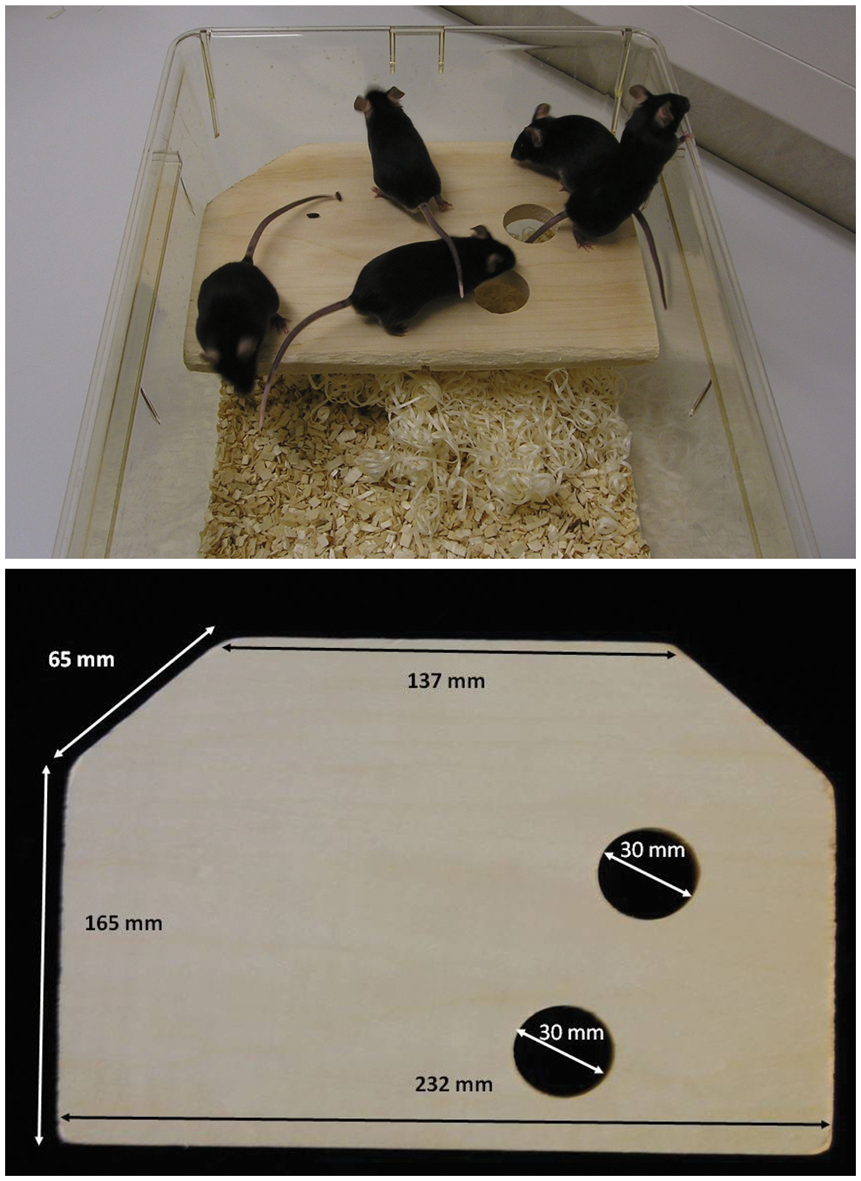
For eight weeks the mice were kept in control conditions or exposed to CS for two, four, six or eight weeks. Each CS exposure group consisted of 10 mice from each strain and the control group consisted of 20 BALB/C mice and 19 C57BL/6 mice. The time period was chosen from previous studies, which showed that the EE had the strongest effect during the third week. 7
The EPM test was performed according to a method modified from Lister. 8 The EPM consisted of two open (8 × 17 cm) and two closed (8 × 17 × 30 cm) arms, which were connected by a central platform (8 × 8 cm) elevated 30 cm above floor level. Light intensity in the room was 40 lux during all the experiments. The mice were placed on the central platform using cupped open hands, facing an open arm. The number of entries made into the open arms (NEOA) and closed arms during a 5 min period was counted, and the time spent in the open arms (TOA) was recorded. The percentage of entries made into the open arms (% EOA) was calculated.
The data were analysed by one- and two-way analysis of variance (ANOVA) using the strain, CS and cage as factors. CS was used as the continuous factor. Critical alpha was 0.05. Data were subjected to t-test and Bonferroni correction. Software used was Mystat 12 Version 12.02.00 (SYSTAT Software, Inc 2007, Chicago, IL, USA).
Two-way ANOVA revealed a significant effect of strain on the NEOA [F (1,114) = 35.4; P = 0.000], on the total number of entries (TE) [F (1,114) = 7.7; P = 0.006], on the TOA [F (1,114) = 11.0; P = 0.001] and on the % EOA [F (1,114) = 23.1; P = 0.000]. ANOVA also showed a significant effect of the CS on the NEOA [F (1,114) = 10.8; P = 0.001] and on the TE [F (1,114) = 26.1; P = 0.000]. There was also a significant interaction of these factors on the NEOA [F (1,114) = 10.1; P = 0.002], on the TE [F (1,114) = 4.7; P = 0.032] and on the TOA [F (1,114) = 5.3; P = 0.024].
Further results by t-test revealed that the behaviour of the C57BL/6 mice was characterized by a larger NEOA and % EOA as compared with the BALB/c mice. However, this effect did not reach statistical significance. CS increased NEOA and TE only in the C57BL/6 mice. This effect was statistically significant on the second, sixth and eighth weeks. CS had no significant effect on the behaviour of the BALB/c mice (Figure 2). One-way ANOVA did not show any effect of cage on the behaviour of the C57BL/6 and BALB/c mice.
The effect of cage shelf (CS) on the behaviour of male C57BL/6 and BALB/c mice in the elevated plus maze (EPM) test. Data are presented as mean ± SEM. +
P < 0.05, ++
P < 0.01 versus control housing in the same strain; *P < 0.05, **P < 0.01 versus same housing type in BALB/c mice (t-test, Bonferroni correction).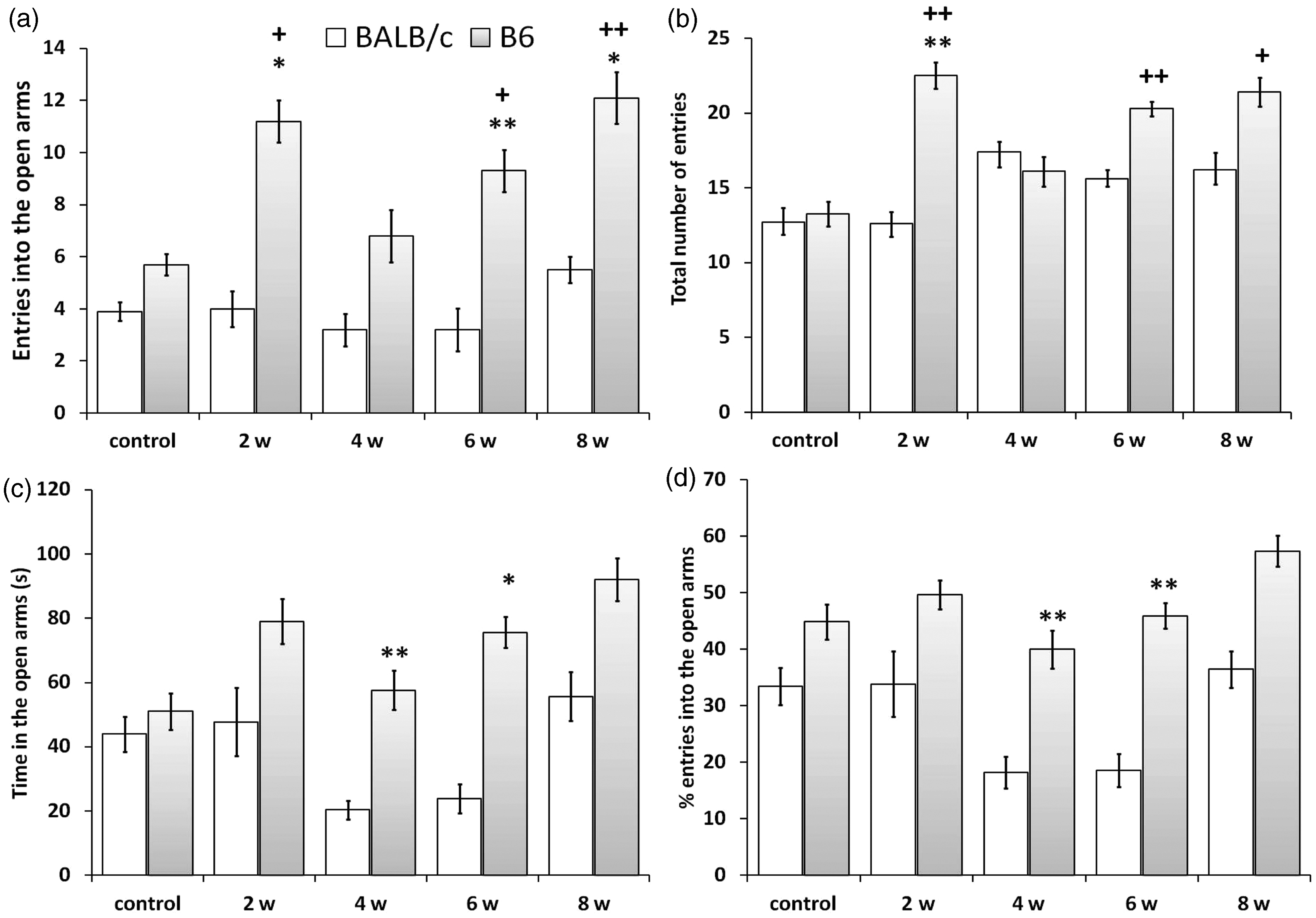
EE, provided in the form of CS, produced an anxiolytic effect as evidenced by an increased NEOA in the male C57BL/6 mice, but not in the male BALB/c mice – probably due to their high levels of anxiety. Exposure to CS increased locomotor activity, as shown by increased TE in the C57BL/6 but not in the BALB/c mice. We expected that adding CS would have an anxiolytic effect, and indeed this was the case with the male C57BL/6 mice.
The effect of CS depended on the exposure period. It is possible that the effect of CS is a combination of novelty and habituation. EE is claimed to have novelty effects and therefore in many studies it has been changed 9 or used in a superenriched form to maintain the effect. There are works comparing stable and variable EE regimens that support this hypothesis – e.g. running wheel activity diminishes with time, 10 and an olfactory environment that is not renewed does not stimulate neurogenesis. 11 In our study the effect of EE was diminished by the fourth week, but it reappeared by the sixth week. The reason for the reappearance of the anxiolytic-like effect is unclear. It can be proposed that the age of mice also has an important effect on how much they use cage furniture.
In conclusion, the effect of CS on the EPM behaviour of mice depends on the strain of the animals.
Footnotes
Funding
This work was supported by grant No 6586 from the Estonian Science Foundation.