




Abstract
Teaching residencies offer opportunities for sustained support within schools as a liminal space for novice teachers, and school-based mentor teachers significantly impact residency outcomes. Mentoring improves when mentors have clear expectations for their role and support for meeting those expectations. This mixed-method case study investigates the effects of a model for mentor training, its impact on residents’ learning, and the perceptions of mentors and residents regarding support provided. Quantitative findings showed a statistically significant difference in growth for residents whose mentors were trained in the Gradual Increase of Responsibility mentoring model compared with those who were not. Qualitative analysis offers support for differentiated use of the mentoring moves of modeling, recommending, questioning, affirming, and praising (with this sequence expressing de-escalating levels of support). Findings suggest that when mentoring varies based on residents’ differing and changing skill levels, teaching improves. Centering dialogue in mentor/resident interactions supports change and growth.
Keywords
In the face of teacher shortages and massive exodus from the profession, increased attention has turned to teacher preparation and retention (Darling-Hammond, 2022). Studies demonstrate the value of school-based clinical experiences as liminal spaces for preparing and retaining teachers, with student teaching as the capstone experience and residencies, defined here as yearlong, school-based teaching placements with learning scaffolded by mentor teachers (Beck, 2020; Rose & Mishnick, 2024), gaining attention because of increased opportunities for intensive support and development of professional practice (Marshall et al., 2021). Research, both within residencies and in shorter student-teaching experiences, suggests that practicing teachers who shares their classrooms, or mentor teachers, significantly impact student-teaching outcomes (Beck, 2020; Goldhaber et al., 2020). For example, research suggests mentors influence student-teachers’ knowledge, reflection, preparedness, identity, efficacy, and growth (Clarke et al., 2014; Izadinia, 2016; Pylman & Bell, 2021).
Various models have been proposed to guide mentoring of student teachers [(STs); Burger, 2024; Carmi, 2024; Orland-Barak et al., 2025]. In their study of approaches to mentoring, Mena and colleagues (2016) found dialogue journaling, regular conferences, and stimulated-recall conferences supported differing but complementary resident understandings. Van Ginkel and colleagues (2016) consider developmental versus instrumental mentoring models, suggesting that in developmental conceptions, mentors see themselves as “creative partners in dialogue and cooperation about teaching” (p. 105).
Ambrosetti (2014), describing the shift from a supervisory to a mentoring conception, suggests although both supervising teacher and mentor involve purposeful social interactions, supervision includes the intent to produce teachers who are “replicas of the context” (p. 31), whereas in mentoring, the relationship is “central to the interactions that occur.” Ambrosetti recognized continual dialogue, ongoing feedback about progress, and support for ST reflection as roles for mentors.
Guise and colleagues (2023), in their study of coteaching, called for additional research on how teaching responsibility should appropriately change over time. One promising model that acknowledges this shift is the Gradual Increase of Responsibility (GIR) Model for Mentoring and Coaching (Collet, 2012, 2022; Little, 2019; Smith et al., 2016). The GIR model includes five mentoring moves (modeling, recommending, questioning, affirming, and praising) that provide different levels of scaffolding, intended to be used differentially to meet the changing needs of residents.
The purpose of this mixed-method study is to better understand how training with the Gradual Increase of Responsibility Model (GIR) for mentoring and coaching influences the mentoring of residents. Specifically, we asked,
Does mentoring using the GIR model increase teaching performance of residents (relative to a control group)?
In what ways (if any) does the GIR model serve as descriptor and guide for the mentoring process of school-based mentors as they work with their residents?
How do residents perceive support from mentors who have been trained in the GIR model?
Theoretical Framework
Vygotsky’s (1978) sociocultural theory provides an overarching framework for considering not only the content and practices, but also the contexts involved in construction of knowledge for teacher development. During student-teaching, mentors offer models of practice and engage in ongoing dialogic interactions (Bakhtin, 1981) with residents, giving feedback as residents appropriate a repertoire of strategies and deepen their understanding.
Mediational and Dialogic Roles of Mentoring
From a Vygotskian (1978) perspective, mentors are more knowledgeable others who support residents’ development through co-construction of knowledge. Scaffolding provided to residents includes activity settings, artifacts, and dialogue (Wells, 1999). Learning is supported when scaffolding is adaptive and responsive to needs, gradually increasing the learner’s responsibility in a holistic task. Through scaffolding, learners’ independent skills are used as stepping stones while continually upping the ante in terms of what the learner is expected to do next (Rodgers, 2000; Vygotsky, 1978). In the case of residents, mentors make up the diminishing difference between what the resident can do on their own and the instructional needs of students.
Mentors scaffold learning through dialogic mediation, promoting understanding that can be contextually applied. From a Bakhtinian perspective (1981), dialogue is a contextual, dynamic interaction of voices and perspectives, and meaning is constructed in interaction with others. Dialogic interactions between mentor and resident are grounded in experiences: expected, enacted, or observed.
The GIR Model for Mentoring & Coaching
The gradual increase of responsibility (GIR) model (Figure 1) is a research-developed model that describes a mentoring process (Collet, 2012, 2022; Little, 2019; Smith et al., 2016), an adaptation of Pearson and Gallagher’s (1983) Gradual Release of Responsibility model for teaching reading comprehension. The model illustrates the theoretical relationship among different mentoring moves: modeling, recommending, questioning, affirming, and offering praise, suggesting that, by using these practices, mentors can provide scaffolding that moves residents toward interdependence and collaboration. The sequence of moves, from modeling through praising, offers graduated levels of support, with modeling giving residents the least responsibility, to authentic praise, where residents do not even feel the need for affirmation. The sinuous line sloping upward indicates not only increased responsibility but also recognizes variability as valuable in response to individual needs. The current study examines use of this model, seeking to explore how it may serve as both guide and descriptor for effective mentoring processes.
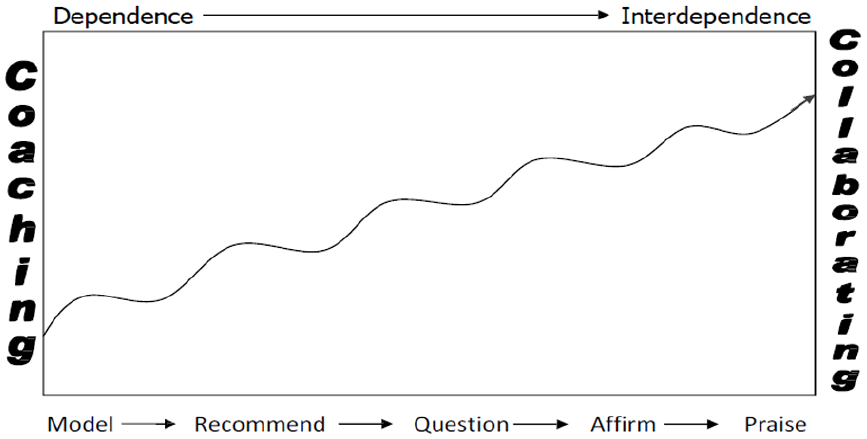
Gradual Increase of Responsibility Model for Mentoring.
Review of Literature
While the overall GIR model, with its varied levels of support, was identified through research on effective mentoring and coaching (Collet, 2012, 2015), each individual scaffold in the model also has a research base, as described below.
Modeling
Modeling is the most supportive mentoring move in the GIR model. At the beginning of student-teaching, residents typically watch mentors teach (Chu, 2022). This observation offers a bridge between academic theory and practical experience (Clarke et al., 2014). By offering vicarious experiences, modeling supports student-teachers’ identity construction (Pfitzner-Eden, 2016). In their study of student-teaching, Bastian and colleagues (2022) assert that vicarious experiences contributed to STs’ preparedness when placed with highly rated mentors. However, STs may also learn from observation of less-effective instruction and practices they do not align with (Davis & Fantozzi, 2016).
In addition to modeling instruction, mentors can model planning and problem-solving by thinking aloud, “bringing to the foreground how we think about what we do and why” (Hoffman et al., 2015, p. 111).
Recommending
Mentors often make recommendations as STs prepare to teach (Hoffman et al., 2015). Recommending plays an important role, given mentors know their students better and have more instructional experience. When making recommendations, mentors are assertive in directing instruction (Kavanagh et al., 2023).
STs favor mentors who give feedback that includes constructive, specific suggestions (Sayeski & Paulsen, 2012). Making recommendations can support reflection, encouraging reframing of practice (Stegman, 2007). A recommending conversation will be more successful if dialogue continues beyond the initial suggestion, giving STs “interpretive authority” to engage in meaning-making and take ownership of ideas (Bakhtin, 1981; Crafton & Kaiser, 2011, p. 113). Offering a range of recommendations from which STs can choose fosters agency and professionalism (Knight, 2019).
Asking Questions
Asking questions is a non-directive mentoring move that develops inferential knowledge (Mena et al., 2017). Through questioning, mentors and STs engage in joint exploration of ideas and co-construct knowledge. Skilled mentors ask open-ended questions that encourage STs to consider the why and for whom of instruction (Erbilgin, 2014). During planning conversations, questions can guide and scaffold thinking (Pylman & Bell, 2021). After lessons have been taught, asking STs if and how lesson outcomes were achieved supports thoughtful reflection (Stegman, 2007).
Studies suggest STs appreciate reflective questions, that their responses become more specific and a focus on student learning more prevalent over time, and that STs eventually internalize such questioning and become more reflective on their own (Erbilgin, 2014; Pylman & Bell, 2021).
Although the outcomes of questioning are promising, studies found varying results for the degree to which mentors ask questions, with mentors’ voices frequently dominating conversations (Clarke et al., 2014; Hoffman et al., 2015).
Affirming
Affirmations denote a context in which residents are making sound instructional decisions but looking to mentors for confirmation. Residents often ask, “Do you think I should . . .” (Collet & Beasley, 2014). Affirmation offers encouragement as STs try new ideas and practices (Ellis et al., 2020).
Research suggests novices are more likely to learn from successes than mistakes (Fishbach et al., 2010), confirming the request of STs in Sayeski and Paulsen’s (2012) study that mentors “begin with the positive” (p. 123). Mentors in Izadinia’s (2016) study also suggested feedback that affirms helps residents “take it on board” (p. 395).
Affirmation reassures and validates, important since teachers’ self-efficacy correlates directly with student achievement (Hattie, 2009). And as efficacy increases, motivation increases, imbuing teachers with the energy to teach (Hunt & Handsfield, 2013). For STs, validation enhances reflection that supports instructional decision making (Clarke et al., 2014). Affirmations also build trust, important to mentoring relationships (Heineke, 2013).
Praising
Praise in the workplace has been associated with increased effectiveness, engagement and autonomy and reduced stress (Bhui et al., 2016). With teachers, praise has been found to increase motivation and efficacy (Hattie, 2009). In coaching, praise empowers teachers and encourages reflection (Reinke et al., 2012). With preservice teachers, studies suggest mentors frequently offer praise (Kavanagh et al., 2023). STs have reported positive perceptions of praise (Rodriguez et al., 2020; Sayeski & Paulsen, 2012). Tian and Louw (2020) found praise builds rapport and provides emotional support, in addition to sustaining motivation.
Cautions regarding use of praise include praising process, not personal attributes (Kamins & Dweck, 1999) and not offering excessive or trivial praise (Bayat, 2011). Coaching literature has conjectured praise might reduce mentees’ own construction of knowledge (Burger et al., 2021; Costa & Garmston, 2002). Notwithstanding these cautions, positive outcomes of mentoring that includes praise are demonstrated in previous research with the GIR model.
A Gradual Release
In a study of 46 teachers seeking a literacy specialist master’s degree, Collet (2012) found that mentors’ support changed in form and quantity as the semester progressed in ways generally represented by the GIR model, providing decreasing scaffolding that moved toward collaboration. In a study of 19 elementary residents and their mentors at two schools (Collet & Beasley, 2014), the GIR model was descriptive of how mentors scaffolded their residents. Mentors used the model as a guide for considering residents’ individual needs. These findings are important given that, in their review of research, Clarke and colleagues (2014) found mentors “seem to have difficulty in varying the nature and substance of feedback according to the stage and level of the student teacher’s development over the course of the practicum” (p. 176). More recently, Gillespie et al. (2025) found irregularities in discursive moves when coaching; although some became less directive over time, others became more directive. However, studies have also found that training can make a positive difference in mentors’ feedback (Erbilgin, 2014; Hoffman et al., 2015), although this is not always the case (Gardiner, 2009).
Method
As advocated by Beck (2020) for studies of teacher education, our research takes a mixed-method approach to best address our research questions; our case study design considers “multiple ways of knowing,” and “relies upon multiple methods of data collection” (p. 386).
Participants and Procedures
Participants in this study include 13 residents (six in the implementation group and seven in the control group) and the 12 mentors who supported residents in the implementation group (see Table 1). Residents were seeking a Master in Arts of Teaching in Elementary Education at a university in the southern United States with a year-long residency that has been in place since 1996 and typically places about 45 residents annually in five schools across four school districts. Residency consisted of three placements in different elementary grades within the same school over the course of a full school year: two shorter placements at the beginning and end (August–October and March–May) and one longer placement from October through March. Residents in implementation and control groups were matched on characteristics of grade point average, scholarship receipt, and scores on a preresidency teaching evaluation; all residents were 21–24 years old and identified as White and female. The 12 implementation-group mentors were certified in elementary education and ranged in teaching experience from 3 to over 20 years; 11 identified as female, one as male; all identified as White. Four mentors served for two placements, with different residents. All mentors had previous experience as mentors within this program.
Mentors for Residents in Each Placement.
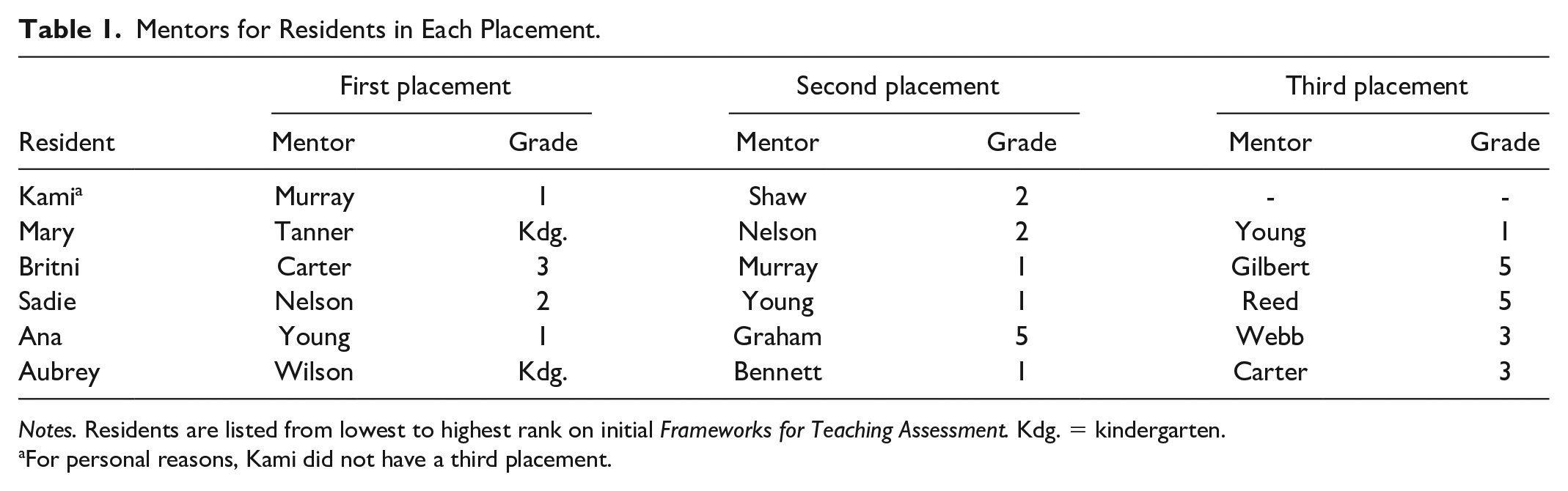
Notes. Residents are listed from lowest to highest rank on initial Frameworks for Teaching Assessment. Kdg. = kindergarten.
For personal reasons, Kami did not have a third placement.
Implementation residents were at an elementary school with 71% Hispanic, 15% White, 7% Pacific Islander, and less than 5% each in other categories, with 85% qualifying for free-or-reduced-price lunch. Control-group residents were at an elementary school in a neighboring district reporting 57% Hispanic, 12% White, 26% Pacific Islander, and less than 5% in other categories, with 92% qualifying for free-or-reduced-lunch.
At both schools, residents had onsite seminar with a university professor (liaison) for 1.5 hours each week, and the liaison met with mentors for one hour each week. Resident seminars focused on planning and preparation, the classroom environment, instruction, and professional responsibilities [the four domains of Danielson’s Framework for Teaching (Danielson, 2007), also used for evaluation, as described below]. Mentor meetings centered on residents’ needs and required paperwork. In addition, in the implementation school, mentor meetings included discussion of the GIR model, with the liaison (Collet) offering descriptions and examples of the varied mentoring moves. Implementation mentors had learned about the GIR model through mentor meetings in previous years. During this data collection period, meetings focused on one or two mentoring moves, depending on what mentors had marked on their weekly checklists the previous week. Conversations were dialogic, with mentors offering examples from their own interactions with interns.
Data Collection and Analysis
Quantitative Data
Each month, University liaisons at both sites evaluated a lesson for each resident using the FfT (Danielson, 2007) and provided feedback. For the purposes of this study, the September and February evaluations were video-recorded and domains two and three (classroom environment and instruction, which were scorable from videos) were scored by two authors, with each of 31 elements in these domains scored to the 0.5 level (possible score range of 1–4). Since specific scores capture differences better than using generalized scores for Domains (Kettler & Reddy, 2019), we summed scores across all elements in these two Domains and calculated growth from pre- to postassessment. A two-tailed t-test was used to consider growth differences between implementation- and control-group residents.
The FfT (Danielson, 2007), with the exception of Domain 1 (not included in this study), has been found to be reliable when observers are well-trained, including calibrating for consistency (Kettler & Reddy, 2019; Lash et al., 2016); reliability on teacher observation instruments increases with training and use of video and multiple raters (Hannafin et al., 2014; Whitehurst et al., 2014), which was our practice. Studies also support validity of the FfT Framework for use with both inservice and preservice teachers (Kettler & Reddy, 2019; Lash et al., 2016).
To better understand mentors’ use of the GIR model, mentors completed a weekly checklist indicating which move (modeling, recommending, questioning, affirming, or praising) they felt had been most beneficial for their resident that week. These were analyzed to track mentors’ reported use of each move throughout each placement. Mentors also completed a conference planning guide (see supplemental materials) where they made plans for a more-formal weekly conversation with their resident and took notes about that conference. Planning guides were checked for alignment with checklists.
Qualitative Data
Mentors’ notes on conference planning guides were a source of qualitative data. Mentors were interviewed at the end of each placement using a semi-structured interview protocol (see supplemental materials). To avoid concerns that residents may not freely express sentiments while still in residency, resident interviews were delayed until residency concluded. Five implementation residents were then interviewed using a semi-structured interview protocol (see supplemental materials). One resident, for personal reasons, did not complete third placement and was not available to interview. Memos and materials from weekly mentor meetings were a secondary data source.
Following transcription, each group of interviews was listened to several times, transcription corrected, and noticings memoed. Transcripts were initially coded deductively for the five mentoring moves (Miles et al., 2014). Ten percent of interview excerpts were coded by a second coder, with 91% match. Mismatches were discussed and codes refined.
In addition to excerpts deductively coded using the five mentoring moves, other segments related to the research questions were memoed, excerpted, and inductively coded, resulting in 15 inductive codes (Miles et al., 2014). A codebook was created (see supplemental materials). Transcripts were reviewed again and additional segments were excerpted related to identified codes. A spreadsheet was created and excerpts coded according to as many of the following descriptors as appropriate: speaker, role, placement, resident initial proficiency, when in placement (beginning, middle, or end), the GIR move, and inductive codes. These descriptors allowed for sorting in a variety of ways. For example, mentor and resident descriptions about use of modeling at the same time during a placement could be compared, both within and across mentor/resident pairs.
Excerpts identified with each move in the GIR cycle were analyzed to identify themes within each move, sorting by descriptors and also looking wholistically across excerpts. In this process, three additional codes were identified (open, specificity, seeking). Excerpts were reviewed in relation to these new codes.
After we were satisfied that appropriate codes had been applied to all excerpts, code counts were determined for each code. Codes with the lowest number of excerpts (informal, maintain, authority, differentiation, goal) were reviewed and dismissed. Codes with the highest incidence (gradual, reflect, skill level, specificity, confidence, agency) were noted and themes reviewed to ensure their inclusion. In addition, we noted which mentoring moves these codes were most associated with and whether they were emphasized more by mentors or residents. For data triangulation, notes from GIR conferencing forms and from mentoring meetings were reviewed for alignment with identified themes.
Findings
This study considered how training with the Gradual Increase of Responsibility Model (GIR) influenced the mentoring and instruction of student-teaching residents. Below, findings from quantitative data, including mentors’ GIR tracking forms and conference planning guides and resident teaching evaluations, are first reported, offering insight regarding mentors’ use of the GIR model and its impact on residents’ teaching. Subsequently, findings from qualitative data from interviews with both mentors and residents are described, offering descriptions and perceptions of use of the Model, with notes on conference planning guides and mentor meetings as secondary sources. Findings for each mentoring move in the GIR model are reported separately, followed by synthesis of how mentoring changed over time.
Growth in Teaching
Growth of residents in the domains of classroom environment and instruction, from September to February, was evaluated using videos of lessons and the FfT (Danielson, 2007). Comparing mean growth of implementation versus control-group residents, residents in the implementation group, whose mentors were trained in the GIR model, showed significantly higher growth (13.4) than residents in the control group (8.3) (p= .0276; p<.5).
Mentors’ Reported Use of the GIR Model
Finding this significant difference, we were interested in how, and to what extent, mentors’ reported support aligned with the GIR model, which suggests decreased scaffolding over time by changing the type of support offered (modeling, recommending, questioning, affirming, and praising). We analyzed the GIR tracking forms for each placement, where mentors reported the move each week they felt had been most impactful for their resident. Results are reported in Tables 2, 3, and 4.
Moves Marked by Mentors on Placement 1 Tracking Forms.
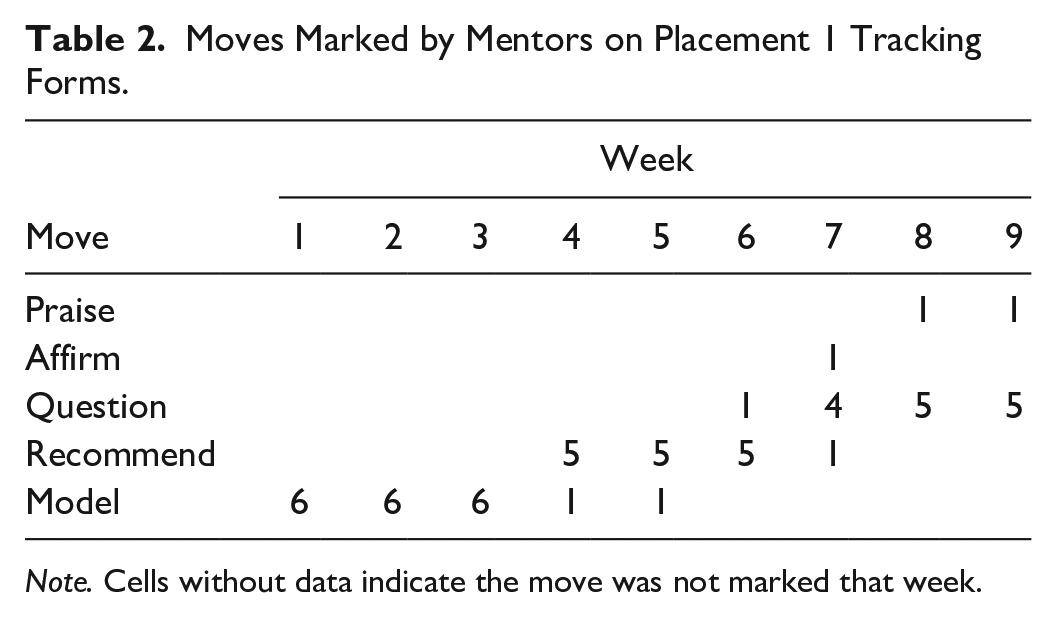
Note. Cells without data indicate the move was not marked that week.
Moves Marked by Mentors on Placement 2 Tracking Forms.
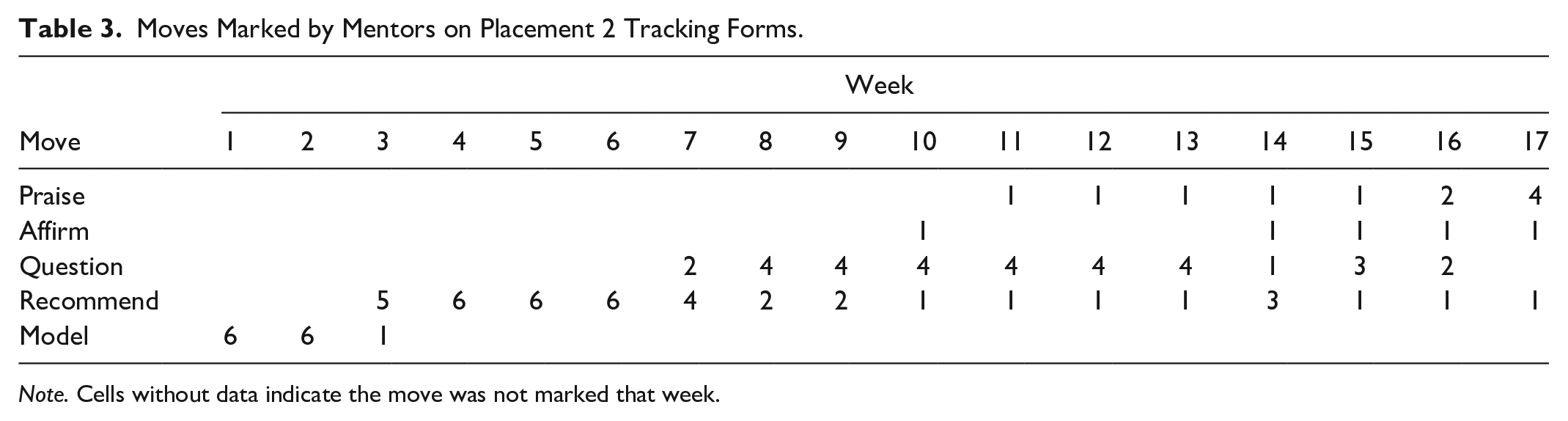
Note. Cells without data indicate the move was not marked that week.
Moves Marked by Mentors on Placement 3 Tracking Forms.
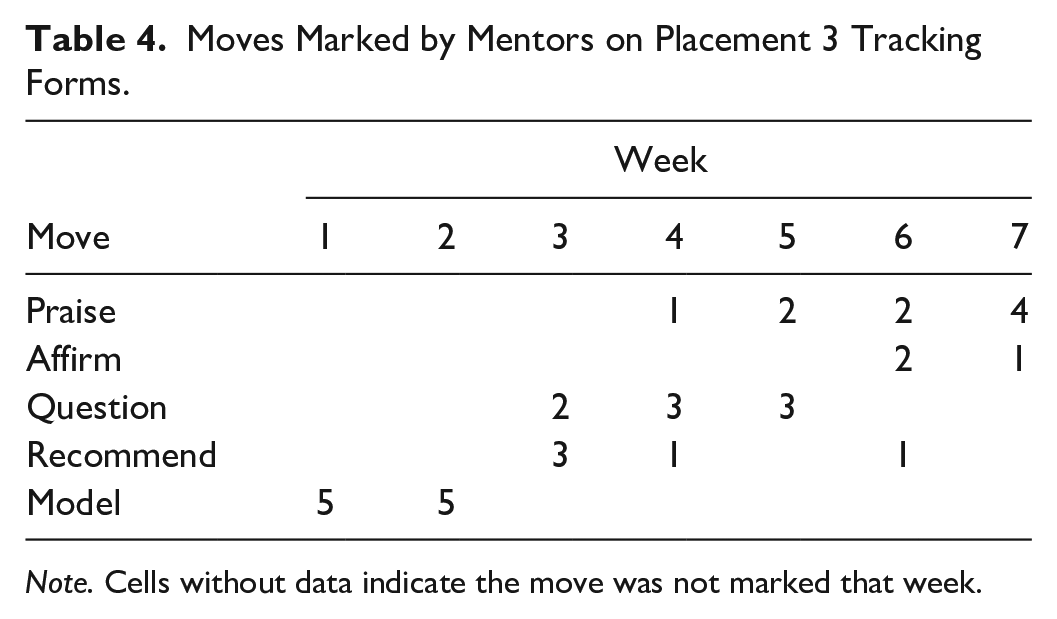
Note. Cells without data indicate the move was not marked that week.
Throughout each placement, tracking forms show a decrease in the level of scaffolding over time. Because residents were instructed to begin each placement by observing their mentors, it is unsurprising that modeling was indicated as most impactful at the beginning of each placement; of note is that the number of weeks during which modeling was named as most important decreased with each placement. Importantly, mentors did not move through these phases at the same pace; not observable in table summaries is the fact that, during second placement, one mentor marked recommending every week; this resident had the lowest pre-/postscores. Another exception to the trend toward decreasing support is in second placement, at week 14: the predominant move shifted from asking questions to making recommendations; this week aligned with when residents began “solo teaching” in that placement, with mentors out of the room and residents assuming all aspects of instruction. In third placement, one mentor marked recommending in week six, whereas she had marked questioning the previous week. Exceptions aside, data demonstrate a move toward increased independence for residents. To affirm this trend, we evaluated GIR conferencing guides, where mentors marked the move they intended to use most during a more-formal mentoring conversation. The move marked on guides aligned with the move marked on tracking sheets 89.5% of the time, and planning and reflective notes on forms generally aligned with the move marked.
Noting that residents in the GIR implementation group outperformed residents in the control group on a teaching evaluation, and that mentors appeared to be following a pattern of gradually increasing residents’ responsibility, we turned to qualitative data to better understand how mentors and residents perceived this process. The primary qualitative data source was interviews with mentors (at the end of each placement) and residents (at the end of residency). In the following sections, we consider findings related to each move in the GIR model.
Modeling: “The Number One Way I Learned”
Modeling was a prescribed mentoring move: Residents were instructed to observe prior to teaching. Comments suggest both mentors and residents saw modeling as important.
When and For Whom
Modeling was viewed as valuable at the beginning of each placement, and especially at the beginning of residency. Aubrey said, “I paid really close attention to what (my first-placement mentor) did with the kids . . . that really helped me get into my teaching shoes and have that kind of role with the kids.”
Although Ms. Bennett mentioned modeling “is always important . . . even if you come in strong,” Ms. Murray said, “the one that struggled needed a lot more modeling.” Mentors described modeling as less-needed with increased teaching capacity.
How, What and Why
Because of modeling, Ms. Reed said Sadie “felt more comfortable when she stood up and started having to do it on her own.” Mentors acknowledged that, throughout student-teaching, residents had seen different “teaching styles.” Ms. Webb said, “(Ana) didn’t try to mimic me . . . She would see me model it and she made it her own.” Residents valued their agency to “spread my wings a little bit and try things out” (Aubrey).
Mentors commonly discussed modeling classroom routines and expectations; additionally, they described modeling pacing, engagement practices, supportive relationships with students, awareness of students’ developmental levels, and specific aspects of instruction, such as focusing on objectives, increasing student response, and asking questions.
Ms. Young would “do purposeful planning for (her resident)” when creating her own lesson plans and “try to make sure to include” things the resident needed. She described drawing attention to specific aspects—“having to explain what I’m modeling.” Britni said Ms. Carter would sometimes stop in the midst of a lesson to say, “This is why I’m doing this,” which Britni felt worked in first placement, but if done later in residency, would have undermined her authority. She appreciated that second- and third-placement mentors explained afterward, “I did that because . . .” Modeling allowed for residents’ gradual transition into finding their own stance as teachers.
Recommending: “Their Toolbox Isn’t That Big Yet”
Mentors and residents made more comments about recommending than any other mentoring move (Table 5, supplemental). This, perhaps, signals the importance of recommendations for novice teachers.
When and For Whom
Mentors and residents described a gradual shift from modeling to recommending. Ms. Nelson said during first placement, she was “modeling with a purpose and then recommending.” Sadie said in every placement, “We worked our way up to more letting me freely do it with guidance and advice and suggestions.”
Mentors commented that lower-performing residents needed more recommendations. Ms. Murray said, “The one that struggled more needed a lot more things just given to them.” Stronger residents’ mentors “moved more quickly from recommending to questioning” (Ms. Bennett).
How, What, and Why
Ali described how mentors “were really good about picking, like, one thing to support me in a week” so she “wasn’t overwhelmed at the beginning.” Ms. Murray described her intentionality when working with Kami: Well, they need ALL this, so sometimes it’s overwhelming, and I have to go back and think, “Okay, I have to start here before she can move here.” Ms. Murray noted, however, “At the same time, it’s hard when she’s teaching my kids.”
This tension pushed mentors to close the distance between what residents knew and what their students needed with specific recommendations. Ms. Tanner said, “After we talked about it, I was just giving her the idea because, that’s something she hadn’t thought about—and so, ‘Let me just tell you . . .’” Ms. Tanner shifted the conversation to recommending what she felt her students needed.
Residents seemed to value recommendations. When pleas for help were met with questions, Britni felt frustrated. “I need help! They can ask me questions all day long, but I only have so much knowledge,” she emphasized. Ms. Bennett said residents’ requests “open(ed) the door for a recommendation.”
Mentors and residents gave examples of recommendations that included content knowledge, pedagogical recommendations, pacing, classroom climate, and individual student needs. “They gave me strategies,” said Sadie, and “resources I have never used before.”
Residents said recommendations encouraged reflection. Sadie said they “helped me reflect on what I could do next time.” Aubrey said she “definitely always thought about” her mentors’ recommendations, without suggesting she always took them up, implying a decision-making stance.
Unless it was related to a specific classroom routine they felt shouldn’t be disrupted, mentors offered recommendations as options, not requirements “Now they never said, ‘You have to do this,’ but they’re like, ‘‘Here’s something else you may try,’” said Sadie. Britni double-voiced Ms. Carter as saying, “You don’t have to do it this way. Just some thoughts.”
Asking Questions: “She Definitely Has the Strategies”
Questioning became a dominant mentoring move only after residents had spent some time in a placement. Interviews offer insight as to how and why this shift occurred.
When and For Whom
Moving from recommending to the less-supportive move of questioning was gradual and influenced by residents’ skill levels. Ms. Bennett said she leveraged questions “if I think they’re ready for it.” At the end of second placement, Ms. Young said, “It’s okay if I’m still in the recommending/questioning phase for the rest of the time—Having (the GIR) scaffolding has helped me understand how to better guide her.” In contrast, Ms. Wilson said she emphasized questioning with Aubrey even early in first placement because “she definitely has the strategies.” With more time in residency, mentors recommended less. “I moved quickly to questioning instead of recommending because she was in her third placement,” Ms. Webb said.
Lesson outcomes might also determine the support provided. Ms. Murray said if the lesson had not gone well, she might offer recommendations, and when a lesson went well, she encouraged the resident to think about why. Ms. Young reported asking, “Why did you think that worked better?”
How, What and Why
Mentors viewed the moves of the GIR model as varied levels of support. Ms. Nelson ruminated, “If I would have started questioning sooner, then it would have had her start thinking about our kids more.” Ms. Webb intentionally asked, “What do you think?’ instead of recommending, “Here, just do this.”
Mentors supported reflection by asking questions. “I wanted her to be more reflective, to think back on it,” said Ms. Webb. Ana said, “Even if I’ve already thought about it . . . if I say it out loud, I remember it forever.”
Mentors and residents gave examples of questions they asked ranging from general (“How did it go?”) to specific (“Could you put this in a different order?”). Aubrey said she preferred specific questions because general questions, “didn’t get as deep.”
Residents and mentors said questions were often “just a natural progression in the conversation” (Ms. Wilson). Mary said they would “just kind of start talking” and questions were “more the discussion part of it.” This collaborative tone is reflected in Ms. Young’s comment that, with more-proficient residents, questions were a natural part of joint inquiry, whereas with her less-proficient resident, she said, “I’ve had to really look at some question stems and try to pull things out that might make her think.” Through questioning, mentors seemed to be looking for ways to increase residents’ responsibility, even when this was challenging.
“Affirming All Along the Way”
Although consistent with the GIR model in that affirmation became a dominant move as other moves dropped off, findings indicate affirmation is valued “all along the way” (Ms. Tanner).
When and For Whom
Even though mentors didn’t consider affirmations the most impactful move early in residency, they felt they were needed, and residents described the positive impact. Ms. Bennett said there were “sprinkles of affirmation throughout.” Sadie said, “I did look for affirmation at the beginning just to make sure I was doing what I was expected to do.” Britni said affirmation was “very, very supportive.”
Ms. Bennett revoiced Aubrey, saying, “Oh, I’m not really sure if that went okay,” and her response: “Yeah, it was, it was good.” She said, “Then we could talk about some things that were great and some things that might be a little bit better next time.” This illustrates that affirmations were sometimes included along with recommendations, a practice Britni also noted. Ms. Young said, “You’ve got to find those things to encourage . . . If all you hear is critique and criticism, you never have that confidence.”
Ms. Bennett said, “I try to find something to be encouraging about, even if it’s a struggle.” However, for higher-skilled residents, and as all residents’ proficiency increased, mentors felt affirming was a natural process. Ms. Young found it “easy to affirm” Ana. Ms. Carter said, “Affirming just came as the placement went further in . . . it just came naturally.”
How, What and Why
Mentors gave examples of affirmations they had offered: “Yes, you cut down on that,” and “they listened, they were more attentive.” Mary said such specificity “was really helpful to not just be encouraging, but also specifically why they thought it went well.”
Mentors described affirmations about supporting individual students, using effective practices, and reflecting on teaching. Mr. Gilbert said Britni showed him her lesson plans and asked, “Is this okay?” Ms. Graham described how Ana sought affirmation in the midst of a lesson: “She would ask with her eyes, like, am I doing this right?”
Ms. Bennett said she doesn’t want residents “to have to wonder whether they’re doing a good job or not, and I think that helps them through confidence.” Ms. Young said she affirmed Mary’s positive practices to “grow her confidence.”
Mentors and residents described the value of affirming to build relationships and increase confidence as they were planning or teaching appropriately. Mentors reported they often began with affirmations when a recommendation was coming to buffer the impact; however, mentors said affirming increased and felt natural as residents gained experience.
Praise: “A Solid Pat on the Back”
In the GIR model, the distinction between affirmation and praise is about residents’ stance: Are they looking for assurance? Ms. Bennett said: In affirming her, I think she’d be worried about, “You did a great job, you got through it.” And praise is when I can sit back and say, “This is an excellent plan.” . . .Praise is just, you know, obviously one step above affirmation.
When and For Whom
Residents and mentors recognized the shift from affirmation to praise as gradual. Sadie said when she “wasn’t sure what to do,” she “did look for affirmation,” and “it just worked up to praise.” Ms. Murray said praise became dominant toward the placement’s end when “she’s been planning; she’s been teaching.”
The shift to praise seemed aligned with both time and skill level. Ms. Nelson, who had previously had only second-placement residents, said with her first-placement resident, there was “less praising for me, which is hard.” Even Aubrey, who scored high on the initial observation, said she got “more of praise in second placement.” Ms. Carter said in third-placement she praised more, attributing this to her resident’s “independence and her knowledge of the resources.”
How, What and Why
Some mentors said early-on they praised when they saw something they hoped would continue. Ms. Wilson said, “When I first saw her start to get stronger with classroom management, I just jumped up to praise, because I wanted her to keep going with that.” Sadie appreciated “the praise on what I’ve done well so I can continue to do so.”
Mentors also described praising ideas from residents that they wanted to use themselves. Ms. Webb said she told Ana, “I really like this . . . I’m going to start using that.” Aubrey revoiced Ms. Bennett as saying, “I’m gonna put some of that in my bag of tricks.’” Aubrey said “it really boosted me up.”
Residents appreciated praise that was specific. Ana said two of her mentors were “super good about being super-specific in my praise,” but countered that her other mentor “was a lot of times just saying, like, ‘You’re doing everything great’ I’m like, I don’t know what you’re talking about, and no, I’m not.” This general praise did not ring true.
Mentors said praise increased residents’ confidence. Mr. Gilbert said, “I think she appreciated the praise and it made her more confident in her planning ability.” Ms. Tanner said she praised to help Mary become more confident during first placement, and Ms. Young, who had Mary as a third-placement resident, offered sincere praise, saying, “I really hope she knows how good of a job I think she’s done. Because I say it all the time in front of the kids.”
Praise corresponded to residents’ skill and time in residency. Initially, mentors praised to encourage continuance of a positive practice. Residents especially found specific praise helpful and recognized the authenticity of praise when mentors wanted to borrow their ideas. Importantly, both mentors and residents reported the confidence-building impact of praise.
Changes Over Time
The experienced mentors in this study expected increasing proficiency throughout residency. Ms. Bennett said, “With the third placement, I knew going into it that it wouldn’t be like a first placement resident.” By the end of third placement, mentors all viewed their residents as prepared to teach. Mentors said residents were “very strong” and “exactly where she should be,” and residents said they felt “comfortable,” “ready,” and “really confident” about teaching.
At the end of student-teaching, residents talked about a mutual sharing of ideas with mentors, “working on lessons together.” Ms. Graham said, “We did a lot more collaboration.” Unidimensional support had transformed into a reciprocal relationship—even for residents like Mary, who started residency with low observation scores. Her third placement mentor reported frequently saying to the class, “What would I do without Miss Sheppard?” Their relationship had become a symbiotic one. As in the study from which the GIR mentoring model originated (Collet, 2015), interactions became collaborative and interdependent (see Figure 1).
Discussion
In this study, residents whose mentors were trained with and followed the GIR model showed increased growth, when compared with the control group, as measured by the Danielson FfT observation instrument. Findings illustrate how each move in the Model was used iteratively and flexibly throughout residency.
Quantitative and qualitative data suggest mentoring gradually shifted toward increased responsibility for residents. As described in Vygotsky’s (1978) sociocultural theory, levels of scaffolding decreased as skill increased, illustrated through mentors’ use of the GIR mentoring moves of modeling, recommending, questioning, affirming, and praising (with this sequence expressing de-escalating levels of support). These findings address a factor infrequently considered in mentoring literature: How mentoring STs varies based on their differing and changing skill levels (Collet, 2022). Especially relevant for residencies, findings suggest that as residents’ capacity increased over the year-long experience, mentoring reflected these changes.
In addition, findings draw attention to the dialogic nature of mentoring. The GIR moves of recommending, questioning, affirming, and praising naturally involve talk; analysis indicates this talk was dialogic, rather than monologic. Even the most-scaffolded move of modeling, which might be considered purely observational, was described as embedded in talk about what to watch for and what was noticed. From a Bakhtinian perspective, we see mentors’ words as “an ideological phenomenon par excellence” that sensitively reflects social shifts (Bakhtin, in Morris, 2009, p. 71).
Dialogic Eclecticism
Research depicts varying stances toward mentoring residents, with some emphasizing the role of mentor as expert consultant and others focusing on relationships of trust and residents’ strengths (Becker et al., 2019; Kavanagh et al., 2023). Rather than standing in opposition, our data demonstrate mentors’ use of recommending and affirming in the same breath. Findings resolve tension between these seemingly polemic stances, considering the potential for growth offered through their interaction. Rather than seeing these stances as dichotomous, we suggest that mentoring is a complex, ambiguous exercise; rather than considering these as opposing binaries, our findings reveal a nuanced, interconnected, and fluid relationship and the dynamic evolution of these stances. Analysis suggests these mentoring moves can be seen as consonant rather than contradictory. Like Bakhtin (1981), we reject a dialectical but/or perspective, embracing instead a yes/and perspective and the messy dialogism that better reflects the entwined practices of mentoring.
Although data suggest use of the GIR model promotes increased responsibility for residents though gradually decreasing mentor supports, we note that the five mentoring moves outlined were often used in conversation with one another: although one mentoring move might be viewed as most efficacious, these moves sometimes stood alongside one another, representing the diversity of a phenomenon “in the cross-section of a given moment” (Bakhtin, in Morris, 2009, p. 92). During interviews, Sadie described how her mentors asked questions about instruction they hadn’t been present for and then praised the outcomes she described. Ms. Murray revoiced language she had used when mentoring Kami: she gave a recommendation and modeled the words she would use with students. Britni revoiced Ms. Carter’s feedback that combined affirmation and recommendation: “She would say, ‘The way you handled this situation was really, really good, but this could have been a little bit more effective if you had maybe done this.’” Britni’s memory demonstrates how mentors might cushion recommendations by also accentuating the positive, braiding these moves together.
Including a Positive Stance
As noted above, mentoring moves were often used in tandem, with frequently described concurrences including affirmation. Our findings expand understanding of the role of affirmation during residency. Although mentors maintained that affirmation became a dominant move as the need for more-supportive moves dropped away, both mentors and residents discussed benefits of including affirmation throughout residency. According to Ms. Bennett, affirmation helped residents “feel like it’s a safe place and that they’re open and encouraged.” Ms. Bennett’s sentiment offers potential explanation for how the expanded timeframe of residencies could support not only more opportunities for mistakes, but, importantly, more opportunities for productive reflection with mentors on those mistakes (Kavanagh et al., 2023). This practice aligns with research recommending a strengths-based approach for reflection and growth with preservice teachers (Tian & Louw, 2020).
Offering Agency
Some frameworks for mentoring and coaching caution against use of affirmation and praise because they may constrain agency (Costa & Garmston, 2002; Killion et al., 2022); however, our findings align with research cited above that suggests emphasizing residents’ strengths. Agency was a prevalent code, suggesting affirmation and praise, in combination with other mentoring moves, support agency.
Although some research on mentoring preservice teachers includes views that making recommendations may constrain agency (Kavanagh et al., 2023), our data offers examples of recommendations that support agency. Mentors offered recommendations as options rather than imperatives. Sadie reported her mentors’ stance toward recommendations: “They’re like . . . ‘Here’s something else you may try.’ They never made it, like, ‘You have to do this.’” Although Aubrey said she had less flexibility during her first placement, retrospectively, she said, “maybe at that stage it was good for me.” Her second placement mentor, however, “was very open to me really taking the lesson in my own way.” In her third placement, Sadie said she was “thankful for that opportunity for letting me be a teacher, not just a student teacher”; agency supported her ideological becoming. Mr. Gilbert described interactions with Britni, his third-placement resident, that in Bakhtinian terms are an uncrowning, turning the tables on authority: Whenever I suggested something and she did not want to do it, she would tell me. And that’s cool. She needs to, you know, be confident in what she’s planned, and I don’t know everything, and that’s good that she stuck with her stuff.
Aligning with residents’ experience reported by Rose and Mishnick (2024), who said, “Because of this gradual release, my confidence grew so much” (p. 109), these examples reflect the gradual increase of responsibility over time possible in a residency, with residents’ exercise of agency aligned with their experience and confidence. And, although there is apparent tension in research suggestions for supporting residents, the current study offers insight for use of seemingly disparate practices within the GIR model in ways that increase residents’ agency.
Refining the GIR Model
Mentors’ practice of flexible and ongoing use of multiple mentoring moves, while still naming one as most effective, suggests reframing the GIR model as shown in Figure 2. This portrayal also demonstrates the dominance of less-supportive mentoring moves over time. Both mentors and residents describe this shift as gradual, and use of the mentoring moves as benefiting from specificity: drawing attention to specific things when modeling, making clear recommendations, asking precise questions, and offering affirmations and praise that name the effective practice.
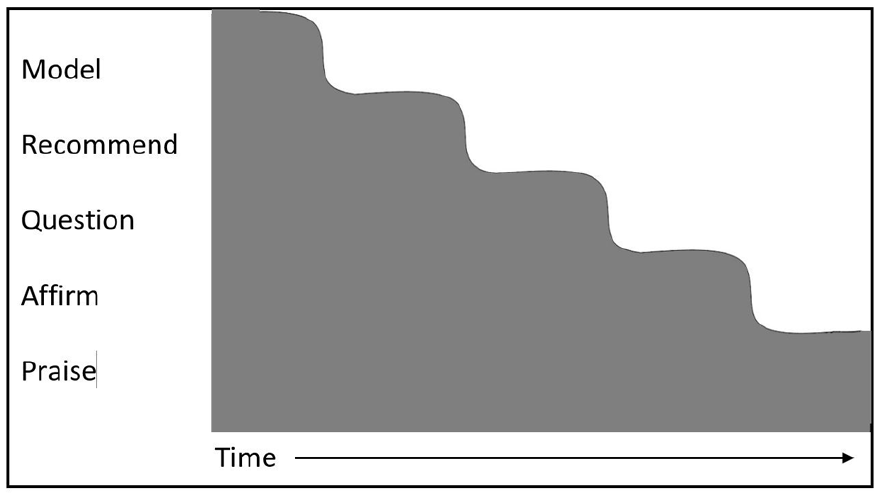
Adjusted Support Through Concurrent and Decreasing Mentoring Moves.
More than Increased Teaching
Extant research in mentoring demonstrates a gradual release of responsibility as residents begin by observing and progressively assume more teaching responsibilities, concluding with solo teaching (Kavanagh et al., 2023; Rose & Mishnick, 2024). This literature describes instances of co-teaching and collaborative planning; however, less insight is offered regarding how mentoring changes over time. The current study adds nuance by explaining shifts in mentoring practices.
Because, in this study, residents experienced student teaching in three different elementary grade-level placements, this gradual process was repeated; however, there was typically less time needed in the highly scaffolded moves of modeling and recommending as the residency progressed. This iterative and compressed use of the GIR model is represented in Figure 3 and may (or may not) generalize to residencies with different structures.
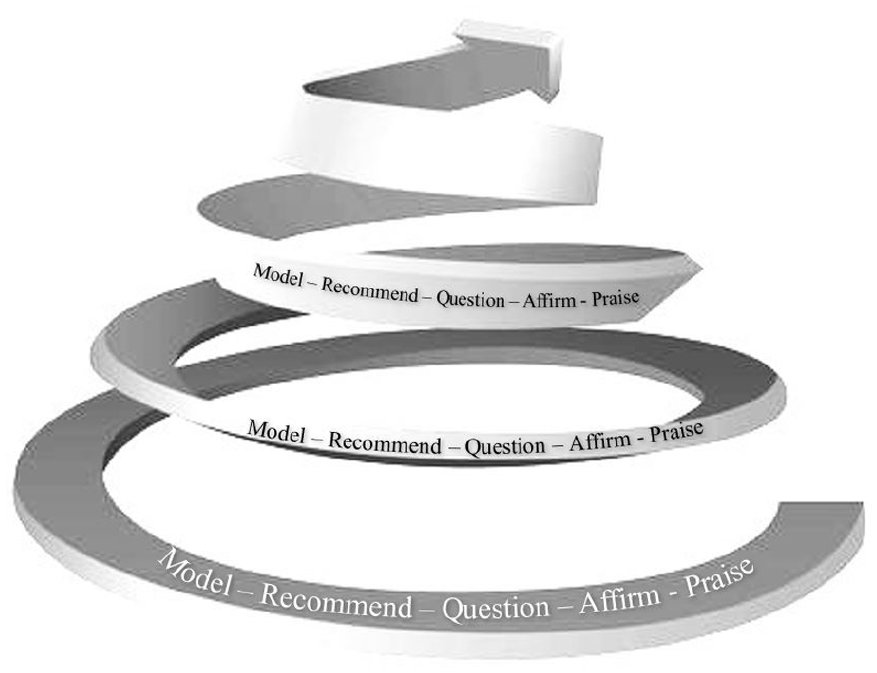
Iterative Use of the GIR Model During Residency.
A Natural Process
In our analysis, one code that surprised us was natural. Mary said recommendations felt like a natural part of dialogue with Ms. Nelson. Describing how their mentoring changed over time, Ms. Nelson, Ms. Carter, Ms. Bennett, Ms. Graham, Mr. Gilbert, Ms. Reed, and Ms. Young all used the word “flow.” Ms. Graham said, “It’s a natural flow of how you move through coaching.” However, the natural flow of mentoring was mitigated by residents’ skill level. Ms. Murray affirmed that with “an average to a strong resident . . . conversations happen naturally.” She added: It’s different when you have a struggling resident. I think those are where you have—for me, that’s where I’ve had the more planned—I really have to think, ‘How am I going to say this? What am I going to focus on . . . I felt like I had to write those conversations down before I had them so I’m not overwhelming.
With residents who were “struggling to maybe average in the beginning,” mentors used the moves more intentionally, with Bakhtin’s concept of addressivity demonstrated in their anticipation of their resident’s response.
As residents gained skill and experience, affirmation, especially, came more spontaneously. Ms. Carter said “it just came naturally for me to affirm her . . . as the placement went further in.” Ms. Bennett described affirmation as part of her disposition: “I just try to be encouraging,” she said. Similar to a teaching supervisor in Tian and Louw’s (2020) study, who said, “It seems to align with who I am maybe” (p. 388), mentors in our study felt affirming was a natural mentoring move.
Perhaps we should have expected the prevalence of the code natural, given that the GIR model was developed from a naturalistic study of effective mentoring (Collet, 2015). However, some research on mentoring STs suggests mentoring is not natural (Ambrosetti, 2014; Richardson et al., 2020). Perhaps mentors’ comfort in using the GIR mentoring moves in a dynamic, developmental, and diminishing way was intuitive for them. Or perhaps it was a result of their previous experience and ongoing training in the model. Ms. Murray, referencing her previous five years’ experience in mentoring with the GIR model, said, “A lot of these (mentoring moves) just come naturally now” (emphasis added). As suggested by research (Chu, 2022; Richardson et al., 2020), mentoring improves when mentors have clear expectations for their role and support for meeting those expectations.
Limitations and Implications
This study provides rich descriptions of the mentoring experiences of student-teaching residents, offering implications for practice and future research; however, several factors pose limitations that should be considered. Both limitations and implications are described below.
Limitations
Small sample size, combined with the fact that all participants were within the same teacher preparation program, limit generalizability of findings. An additional limitation is that all residents and mentors identified as White, even though the student population was culturally diverse. This mismatch is broadly problematic (Sleeter, 2023) and may limit insights into how the GIR model functions in culturally diverse mentoring relationships. Another limitation is the self-reported data from mentors, which may reflect overestimates and social desirability bias.
Implications for Future Research
Future research with larger sample sizes and in varied teacher preparation programs, including those with singular teaching placements during residency, could further investigate use of the GIR model. Specifically, the extent to which the pattern of reducing scaffolding holds true across one long placement, rather than iteratively across multiple placements, could be investigated. Use of the GIR model in culturally diverse mentoring relationships should also be explored. In addition, research could provide clearer understanding of mentor–mentee interactions by conducting discourse analysis through the lens of GIR mentoring moves.
Implications for Policy and Practice
The opportunity for developmental mentoring offered by year-long residencies implies that policymakers and program designers should prioritize extended student-teaching experiences with mentor support. Findings further suggest prioritization of mentor training that includes responsive models such as the GIR. For example, state departments of education and teacher preparation programs could provide asynchronous training modules, highlighting the mentoring moves described in the GIR model, or such training could be more efficaciously, although less efficiently, offered through face-to-face trainings that model and offer opportunities to practice these moves. Book study groups might also be formed for in-depth consideration of the GIR model (Collet, 2022).
The study offers numerous implications for practice, suggesting that mentors differentiate their approach based on the readiness and confidence of teacher candidates. Differentiation could include flexible and iterative use of mentoring moves such as modeling, recommending, asking questions, affirming, and praising, which offer diminishing levels of support, as demonstrated in the GIR model. In addition, findings suggest a dialogic, strengths-based approach to mentoring, with affirmation occurring consistently to foster reflection and agency.
Conclusion
This study both validates and refines the GIR mentoring model. Quantitative findings showed a positive, statistically significant difference in growth for residents whose mentors were trained in the GIR model compared with those who were not. Qualitative analysis suggests mentors’ use of the Model was dialogic and dynamic. Diverse moves created a heteroglossic learning experience tailored to each resident’s needs. These mentoring moves coexisted in complex ways, influencing one another and shifting over time. Mentoring is a provisional endeavor.
We note that the same moves that, in our study, were used dialogically could be harnessed in a monologic way. Our study names some criteria (attending to skill level, offering agency, being specific, encouraging reflection, taking an affirming stance) that seem to support their dialogic use; however, we call upon researchers to flesh out nuances of language use that move mentors and residents toward a productive, generative stance when using the mentoring moves in the GIR model.
Mentors play a crucial role in successful ST experiences (Goldhaber et al., 2020; Mena et al., 2016). When offered dialogically, modeling, recommending, questioning, affirming, and praising are invitations for residents’ reflection and response. Interactions between mentor and resident that center dialogue support change and growth. As emphasized by Bakhtin (1981), “Understanding comes to fruition only in the response” (p. 282).
Supplemental Material
sj-zip-1-jte-10.1177_00224871251364263 – Supplemental material for Making Moves: Use of the Gradual Increase of Responsibility Model for Mentoring Student Teachers in Residency
Supplemental material, sj-zip-1-jte-10.1177_00224871251364263 for Making Moves: Use of the Gradual Increase of Responsibility Model for Mentoring Student Teachers in Residency by Vicki S. Collet, Savannah Gragg and Amanda Leggett in Journal of Teacher Education
Footnotes
Declaration of Conflicting Interests
The author(s) declared no potential conflicts of interest with respect to the research, authorship, and/or publication of this article.
Funding
The author(s) received no financial support for the research, authorship, and/or publication of this article.

Supplemental Material
Supplemental material for this article is available online.
Author Biographies
References
Supplementary Material
Please find the following supplemental material available below.
For Open Access articles published under a Creative Commons License, all supplemental material carries the same license as the article it is associated with.
For non-Open Access articles published, all supplemental material carries a non-exclusive license, and permission requests for re-use of supplemental material or any part of supplemental material shall be sent directly to the copyright owner as specified in the copyright notice associated with the article.
