




Abstract
Across the United States, current curricular reforms are centering high-quality instructional material (HQIM) as a lever for improving classroom instruction and student achievement. While multiple legislative definitions of HQIM attend primarily to the degree of standards alignment, we expand quality to encompass rigor and cultural responsiveness. As teachers make decisions about curriculum materials, they demonstrate curriculum literacy. We conceptualize curriculum literacy as the capacity to navigate teacher identities, learner and community assets, and instructional materials. We survey the literature related to curriculum, curriculum literacy, and teacher education. We then present a framework for curriculum literacy in initial teacher preparation and describe three instructional tools for developing preservice teachers’ curriculum literacy. These tools support teachers’ practices of critically reflecting on their identities in relation to curriculum, contextualizing curricular decisions, and evaluating existing instructional materials. Implications for policy, practice, and future research are discussed.
Multiple waves of accountability policy have incorporated curriculum as a lever for shaping instruction and student outcomes. Recent concerns about post-pandemic learning loss and low scores on the National Assessment of Educational Progress have spurred calls for educational leaders to “redouble their efforts to support learning recovery” (U.S. Department of Education, 2022). This sense of urgency for boosting standardized test scores contributed to many states (e.g., Arkansas Initiative for Instructional Materials, 2023) focusing on the adoption of high-quality instructional materials (HQIM). State initiatives are underway to assess instructional materials and make recommendations for curriculum adoption (Doan et al., 2021).
For example, in the 88th Texas legislative session in 2023, two bills addressed HQIM. Now signed into law, House Bill (H.R.) 1605 (2023) and Senate Bill (S.) 2565 (2023) initiated a system for curriculum evaluation and recommendation to bridge learning gaps, mitigate teacher burnout, and support parental rights. The bills included a provision to create an online repository of open-source materials and encourage professional development related to their use (Lopez, 2023). In addition, these policies contain mandates for educator preparation programs (EPPs) to incorporate state-approved curriculum into their coursework and programming. This type of curriculum policy aims to shape and control several aspects of the education system.
Curriculum literacy has emerged in policy discourse regarding HQIM (Steiner et al., 2018). One definition of curriculum literacy is “the ability to distinguish between high- and low-quality curricula, use curriculum skillfully, and understand why it matters” (Steiner, 2019, p. 1). Borrowing from recent conversations (e.g., Duffy et al., 2022), we apply this definition of curriculum literacy to higher education by supporting preservice teachers’ (PSTs’) capacities to make decisions regarding curricular quality. While treating curriculum literacy as the practice of identifying, curating, adapting, and designing HQIM (Steiner, 2019; Steiner et al., 2018), we hold a view of “quality” that encompasses both academic rigor and potential for culturally sustaining instruction. We argue that this focus is not new in teacher education research; however, the field must direct greater attention to the role of teachers as makers and enactors, rather than implementers, of HQIM (Ball, 2023). This means that teachers bring their knowledge of themselves, children, and communities to the interactive work of curricular decision-making.
National attention to the curriculum has largely overlooked teachers’ roles, often positioning them as mechanisms of curriculum delivery rather than competent professionals (De Lissovoy & Armonda, 2020; Priestley & Philippou, 2018). The problematic implications of this mechanistic positioning for teacher preparation warrant a review of the literature. The purpose of this literature review is to synthesize research on curriculum in teacher education and put this research in conversation with HQIM-related policies and initiatives. First, we present elements of the policy context. Then, we review the literature, highlighting how curriculum has been defined, discussed, and researched in relation to teacher education. We draw on this strong base to make an argument for how the field might respond to the policy context. We end with an argument for a contextual approach to preparing teachers to enact curriculum literacy through an example of our program-specific tools for supporting PSTs’ curriculum literacy.
Policy Context
We situate our discussion of policy in Texas, noting that it is likely that other states have and will follow suit. Texas H.R. 1605 (2023) and S. 6525 (2023) incentivize the use of a state-sanctioned curriculum closely aligned with state standards and standards-based measures of proficiency. These state-level policies follow a nationwide trend of relying on curriculum as a lever to improve instruction and raise standardized test scores. Financial incentives were given to districts adopting state-sanctioned open-source materials (H.R. 1605 Hearing, 2023 1 ) including lesson plans, teacher guides, and other resources approved by the State Board of Education. These policies relate to the duties of teachers and propose to decrease teachers’ workload by reducing the amount of time spent creating and selecting instructional materials. This change will impact expectations for teaching and teacher education, effectively de-emphasizing the creation and selection of curriculum while foregrounding HQIM implementation. H.R. 1605 (2023) also specifies that adoption should “maintain the instructional flexibility of classroom teachers to address the needs of each student” (n.p.). The implication that teachers should be able to make use of state-approved curriculum in ways that meet the needs of all students is in tension with educators’ concerns about the limits of “pre-packaged” or “off-the-shelf" curriculum for meeting the needs of all children (Chandler, 2023, n.p.).
Given the multitude of possible educational contexts that new teachers may encounter upon entering the teaching force, EPPs have typically emphasized flexible curricular decision-making as a dimension of professional practice. We anticipate several implications of new state legislation for EPPs. First, driven by the needs of the schools and districts that will employ their teachers, certification programs will likely be expected to prepare future teachers to implement, select, and create HQIM used in the districts where graduates will be employed. Second, EPPs will be required to incorporate state-approved curricular materials. Both bills (H.R. 1605, 2023; S. 2565, 2023) propose that requirements for certification include “thorough understanding of and competence in the use of open education resource instructional materials approved and included on the list maintained by the State Board of Education in each subject area and grade level covered by the person’s certificate” (n.p.). EPPs will play roles in deciding which instructional materials PSTs interact with and what these interactions might look like, as “thorough understanding” of open-source materials is not clearly defined. Within this policy context, we turn to curriculum literacy as a way to conceptualize the specialized knowledge needed to build an understanding of and competence in the use of instructional materials. Curriculum literacy is the guiding frame for the remainder of this paper.
Curriculum Literacy
This literature review addresses two questions. How has curriculum been defined and discussed in relation to teacher education? How have others researched curriculum literacy in teacher education? Our findings are organized by definitions of curriculum, HQIM, and curriculum literacy; perspectives on curriculum and teacher education; and research relating to curriculum literacy and teacher education.
Defining Curriculum, HQIM, and Curriculum Literacy
Curriculum is commonly described as “what is taught in schools, why it should be taught, and who should teach it” (Tyson, 2011, p. 40). When “curriculum” entered educational discourse in the 19th century, there was a convergence that curriculum was what was taught, although views differed on what should be included. Multiple curriculum theorists in the 19th and 20th centuries redefined the purpose (the why) of curriculum (Jackson, 1992), rethinking both what is taught in schools and how it is taught (Egan, 1978). As a result, the lines between curriculum and teaching have become increasingly blurred.
Scholars often describe the components of curriculum at different levels of implementation. Cuban (1992) presents one such framework, differentiating between the intended curriculum mandated at the district, state, or federal level, the taught curriculum delivered by the teacher, and the learned curriculum experienced by youth. Other combinations of terms such as formal, operational, and experiential (Van den Akker, 1998) have been used to emphasize the role of teachers in translating a written curriculum into actual learning experiences. Other definitions have emphasized the null curriculum (Eisner, 1985), what is left out of the curriculum, and the hidden curriculum (Jackson, 1992), or its unintended impacts. Choosing what to include or leave out (the null curriculum) conveys messages about whose knowledge is school-worthy and whose is relegated to the margins (Cuban, 1992). Some researchers have taken up “hidden curriculum” to illustrate how instructional materials can reinforce particular ways of learning and being in a classroom (e.g., Giroux & Penna, 1979).
Despite the multitude of definitions offered in the literature, definitions of curriculum in the policy arena remain narrowly focused on instructional materials. Portelli (1987) distinguishes between Curriculum as a field of study and curriculum as a concrete thing adopted by a district and used in a classroom. It is the small-c definition that is centered in conversations about HQIM (e.g., Steiner, 2019). For example, the Carnegie Corporation of New York (Short & Hirsh, 2020), a leader in work in this area, focuses on the aspects of curriculum that relate to materials and their use: “The terms instructional materials and curriculum materials refer to the concrete resources that teachers use to provide standards-aligned learning experiences for students” (p. 6). In this article, we limit our discussion of curriculum in some ways due to our focus on the HQIM movement; however, from theory, we know that it is imperative to consider a broader view of curriculum. Portelli (1987) suggests that the theories through which we understand Curriculum (theory) impact what we do with curriculum (materials). From this perspective, the theories of Curriculum that PSTs study and the tacit theories they may hold will shape their use of curriculum. Our theoretical understandings allow us in this paper to both engage with and critique narrow definitions of curriculum associated with the HQIM movement.
Absent from HQIM-related discourse (e.g., Doan et al., 2021) are the critical perspectives offered by a rich body of curriculum theory (big-C Curriculum) scholarship. Curriculum plays a key role in reproducing the current social order and systematically oppressing communities of Color (Woodson, 1933/2008), but curriculum can be created and subverted to counter oppressive curricula (Givens, 2021). Curriculum can be a tool for social reform (Dewey, 2004), collective liberation (Freire, 1970/2007), and racial uplift (Grant et al., 2016). Curriculum can disrupt hegemonic education systems by sustaining the lifeways of communities of Color (Muhammad, 2023; Paris & Alim, 2017).
Some scholars insist that a clear definition of what is curriculum must preclude efforts to solve curricular problems (Portelli, 1987), but others advocate for productive dialogue rather than uniformity: the question now becomes not which one is right but, rather, what purpose does each definition serve? Why is it being put forward and who stands to gain what by adopting it? What would be the consequences of doing so? (Jackson, 1992, p. 11).
Scholars have proposed that curriculum as an object functions to “erode the relationship between teachers and their labor in the name of precision and efficiency” (De Lissovoy & Armonda, 2020, p. 5). Productive dialogue around curriculum would disrupt individual notions of curriculum implementation, and take up notions of ideology to examine curricular decisions in light of specific purposes and potential consequences. This article will discuss curriculum in terms of the materials that PSTs encounter and how they interact with them but will not fully engage with critical questions about ideology, liberation, and transformation of curriculum. This is a limitation and a consequence.
Because the instructional materials that compose curricula offer some insight into classroom learning such materials are often the targets of reform (e.g., Doan et al., 2021). Policy-makers have centered “quality” as a way of talking about curriculum and proposed curriculum evaluation as a response to the question of how to improve the quality of education (e.g., Kaufman et al., 2020). District-level officials, policy-makers, and taxpayers are all invested in providing a high-quality education to all children; however, interpretations of quality vary across individuals and communities. Curriculum literacy has entered conversations about how teachers should interact with the products of curricular reform, namely HQIM, to create high-quality learning experiences in the classroom.
Within policy discussions, curriculum literacy has been defined as “the ability to identify and remedy deficiencies in the materials they are told to teach” (Steiner et al., 2018, p. 18). This definition is elaborated by Steiner (2019) as “the ability to distinguish between high- and low-quality curricula, use curriculum skillfully, and understand why it matters” (p. 1). Steiner (2019, p. 7) explicates there are “basic” and “advanced” competencies of curriculum literacy. Basic competencies include identifying and using high-quality materials and supporting learning needs without sacrificing rigor. More advanced competencies include recognizing weaknesses in instructional materials, remediating weaknesses, and selecting the strongest materials for a given student population. While isolating these competencies is a useful starting point for building curriculum literacy into a teacher education program, the practice of curriculum literacy (like any teaching practice) entails more than the sum of a collection of isolated skills.
To expand Steiner and colleagues’ conceptualization of curriculum literacy, we turn to perspectives on curriculum-making and curriculum enactment (McKernan, 2008; Remillard, 2005; Shawer, 2010). Recent policy conversations have applied the tenet of fidelity, which frames curriculum as implemented, delivered, or transmitted by teachers (Priestley & Philippou, 2018). In contrast, many scholars argue for a view of curriculum as being “made” or “enacted” by teachers (Shawer, 2010, p. 174). Furthermore, they treat curriculum-making—designing, developing, implementing, and evaluating curriculum materials—as a reflective practice and an art form (McKernan, 2008). An expanded definition of curriculum literacy must also acknowledge the creativity, imagination, and experimentation employed as educators make curricular decisions. Perspectives on curriculum enactment (Remillard, 2005; Shawer, 2010) point to teachers’ interactions with the curriculum. Understanding curriculum as enacted highlights the teacher as “an active designer of curriculum rather than merely a transmitter or implementer” (Remillard, 2005, p. 214). Teachers may not design the official curriculum, but they adapt and develop materials for their classrooms (Davis & Krajcik, 2005; Shawer, 2010). Enactment is a process by which the official curriculum is shaped into what actually happens in the classroom (Stein et al., 2007). While teachers may use curriculum resources, enactment determines whether they use it as a tool, a guide, or a word-for-word script (Remillard & Bryans, 2004).
These perspectives are part of the complex view of curriculum literacy we forward in this article. To do so, we discuss multiple dimensions of teacher’s interactions with curriculum, from individual teacher identities and knowledge to broad socio-political contexts.
Perspectives on Curriculum and Teacher Education
Zumwalt (1989) argues for teacher education to take up a “curricular vision of teaching” (p. 173) that integrates what, why, and how questions. Zumwalt asserts that teaching and curriculum cannot be separated: Any choice regarding how something is taught transforms the content and, in turn, what can be learned. Learning to navigate these curricular choices is key to becoming a professional. “Professionally responsible beginners” (p. 174) should develop a working knowledge of curricular planning and an understanding of the long-term challenges associated with making curricular decisions within social-political systems.
Next, we explore learning to teach in relation to curriculum. We delineate teachers’ beliefs, experiences, and identities followed by teachers’ knowledge of the curriculum. Finally, we discuss challenges and tensions related to curriculum and socio-political contexts.
Teachers’ Identities
Perspectives on curriculum enactment emphasize the dynamic interactions between teachers, materials, and contexts. Stein et al.’s (2007) model of curriculum enactment identifies teachers’ beliefs, knowledge, orientations, and identities as key factors influencing the transformation of written to enacted curriculum. Teachers bring their own beliefs and orientations to bear as they make sense of curriculum creators' intentions and negotiate the curriculum (Remillard, 2005). For example, teachers utilizing the same set of inquiry-based curricular materials might enact them in different ways due to their own varied beliefs regarding the nature of inquiry learning. Moreover, classroom structures and related interactions also shape enactment as teachers interpret and respond to learners (Remillard & Bryans, 2004). For instance, teachers may use their own repertoires to adapt curriculum to fit the pedagogical approaches that are familiar to learners.
Research on teacher identity formation acknowledges the role of personal beliefs and experiences in constructing professional identities and enacting curriculum (Beijaard & Meijer, 2017). McKernan (2008) states: “The teacher is unavoidably a bearer of human values and meanings which are mediated through teaching and curriculum” (p. 178). Tensions can form as personal beliefs come into contact with the realities of the classroom. PSTs draw on their beliefs as they navigate these tensions and, as a result, negotiate their identities (Smagorinsky et al., 2004). In other words, PSTs previous schooling experiences inform their enactment of curriculum. This is particularly significant in light of the “racial, gendered, linguistic, and classed hierarchy” (Varghese, 2016, p. 44) in which teachers experience school and thus construct teaching identities. Because teachers’ social positions in an inequitable society influence their identities, it is vital for PSTs to examine and interrogate how these facets of their identities shape curricular decisions (King, 1991). Next, we discuss PSTs’ knowledge, which also plays an important role.
Teachers’ Knowledge of Curriculum
Consistent with Zumwalt’s (1989) curricular vision of teacher preparation and Stein et al.’s (2007) model of curriculum use, scholars have discussed the importance of teachers’ knowledge of curriculum. Cohen et al. (2003) state, “the best materials are of little use if teachers cannot turn them to advantage in framing tasks” (p. 124). The use of materials depends on the teacher’s knowledge of how curriculum works and what to do with it. Consequently, teachers need both HQIM and the know-how to “to make pedagogically fruitful use of materials” (Cohen et al., 2003, p. 125).
This kind of knowledge has been described by Shulman (2004) as curricular knowledge. Teachers must be able to select from multiple possible instructional approaches and materials to create the most effective experience for specific learners. This knowledge is particularly necessary when teachers encounter deficiencies in curriculum materials and must make strategic choices about how to remedy them (Shulman, 2004). Teacher educators have taken up Shulman’s components when organizing EPPs, emphasizing the knowledge needed to teach each content area (e.g., Ball et al., 2009).
Social and Political Contexts
Curriculum, teaching, and teacher education have been increasingly politicized as accountability efforts aimed at increasing test scores hyper-regulate teachers’ curriculum use (Au, 2017). Today, teachers are largely separated from the development of curriculum materials but expected to implement them locally—“an unhealthy and unprofessional division of labor” (McKernan, 2008, p. 6). Thus, curriculum enactment is a socio-politically situated practice (Priestley & Philippou, 2018). PSTs must learn to interpret changing policies and develop strategies for “manipulating and maneuvering among the various aspects of a teaching context” (Kersten & Pardo, 2007, p. 147). Often this means blending approaches to comply with multiple conflicting interests. Curriculum enactment, and thus curriculum literacy, can be agentive: PSTs use their curricular knowledge in flexible and creative ways to minimize their constraints (Priestley et al., 2015).
The primary conflict that we address in this article is the reality that PSTs must learn to negotiate curricular mandates while also learning to be responsive to the culturally, linguistically, and socioeconomically non-dominant learners in their classrooms (Darling-Hammond et al., 2005). We point to scholars who conceptualize socio-political context and curriculum. Paris and Alim (2017) argue that education research has failed to examine how schools further a colonial project that is responsible for the erasure of culture or subtraction (Valenzuela, 2010). Their approach to culturally sustaining pedagogy examines how this colonial project persists and how alternative pedagogies are produced. Culturally sustaining educators center languages and social practices that are powerful for diverse groups of students; center agency as the goal of the curriculum, and in many ways, disrupt what is taught. For example, Irizarry (2017) examines how Latinx youth use empowering pedagogy and how their actions inform teacher education. Similarly, Muhammad (2023) draws on her experience as a culturally sustaining teacher of Black students to encourage educators to build a culturally and historically responsive curriculum that cultivates learners’ identities, intellect, and criticality in addition to concrete skills. Approaches to culturally sustaining and historically responsive curriculum are evident in teacher education, bridging theoretical perspectives on educational equity with day-to-day decisions PSTs make in the classroom (e.g., Nash et al., 2021). Informed by perspectives on curriculum and teacher education, we now explore how a “curricular vision of teacher education” (Zumwalt, 1989, p. 173) has taken hold in teacher education research.
Research Relating to Curriculum Literacy and Teacher Education
Few studies have explored curriculum literacy in teacher education. Therefore, we draw from related research on PSTs’ experiences with curriculum including how they learn to select, use, and evaluate curriculum materials.
Some proponents of curriculum literacy in teacher education argue that EPPs pay little attention to curriculum materials (Steiner et al., 2018) and, in doing so, perpetuate the notion that good teachers do not rely on curriculum materials (Remillard, 2016). Ball and Feiman-Nemser (1988) demonstrated how an EPP that conveys such a doctrine can create dilemmas for PSTs who are expected to use curriculum materials in their clinical placements. Researchers have called for a disruption of the good-teacher doctrine, acknowledging the vital role teachers play in adapting materials to their learners (Remillard, 2016). Research has demonstrated how coursework can support PSTs’ critical stance toward existing materials and skillful use of materials in their teaching. For example, Graff (2011) incorporated a curricular planning model into coursework. The model contributed to teachers’ criticality toward existing curricula and helped them avoid dependence on pre-packaged materials (Graff, 2011). In another example, Flores et al.’s (2019) review of research from 2000 to 2018 examined how PSTs were prepared to select and use literature as curriculum materials in teaching. In addition to curating and using instructional materials, studies have also addressed PSTs’ evaluation of curriculum. Course instructors have used rubric tools to help PSTs critique instructional materials and revise existing materials for their own teaching (e.g., Forbes & Davis, 2010). PSTs developed knowledge through these interactions and the rubric tool was found to be increasingly helpful with repeated use. However, PSTs struggled to assess the alignment of standards and curriculum and determine how to respond to individual learners through curriculum modifications (Beyer & Davis, 2012). Together these studies suggest that engagement with curriculum materials can support teacher PSTs’ use and evaluation of curriculum, however, PSTs may need additional support evaluating curriculum in relation to the specific standards they teach and the learners they serve.
Another issue that has surfaced in conversations about curriculum literacy (Steiner et al., 2018) is PSTs’ navigation of online marketplaces of materials (e.g., Instagram, Pinterest, TeachersPayTeachers). Teachers, with little time or bandwidth to create a curriculum, may draw from online curriculum repositories that may be of questionable quality (Gallagher et al., 2019). When teachers use a curriculum that meets immediate needs but is not either connected to learning trajectories or to high-quality instructional practices, the use of such a curriculum may perpetuate systems of inequity (Rodríguez et al., 2020, 2023). Tools have been developed and used to support PSTs in evaluating and adapting curricular materials from online sources (e.g., Schroeder & Curcio, 2022). Overall, these studies highlight the need to account for PSTs’ varied interactions with the curriculum and to examine the curriculum through critical lenses.
Culturally responsive and sustaining perspectives are often at odds with accountability-driven reform efforts and resulting prescriptive curriculum. This appears to hold true in the context of teacher education. Studies have explored tensions related to teacher education, culturally responsive pedagogy, and curriculum mandates. In one study (Ahmed, 2020), PSTs felt that their teacher education program did not adequately confront the “reality” of teaching, namely following mandated curricula and demonstrating student learning in state-sanctioned ways. In some cases, mentors were able to provide guidance toward “how to maneuver through the system” (p. 252) as a social-justice educator but in others, navigating the system and pleasing administrators seemed like an impossible task. However, teacher educators can bridge culturally responsive pedagogy and curricular realities (Ahmed, 2019). For example, one teacher educator presented a model hybrid schedule to illustrate how a culturally responsive curriculum and a district-mandated curriculum could be integrated. While PSTs were excited about the prospect of “put[ting] my own spin on it [mandated curricula]” (Ahmed, 2019, p. 222), they did not incorporate the shift due to a lack of pedagogical knowledge or skill. The implications of these studies were that PSTs need practice and support to develop knowledge and skills to bridge equity-based theories promoted in university programs and district-mandated curricula. With this in mind, we present a framework for curriculum literacy in initial teacher preparation.
Framework for Curriculum Literacy in Initial Teacher Preparation
While we have surveyed many perspectives on curriculum, our use of the term is specific to our questions about instructional materials and curriculum enactment in an initial teacher preparation program. Thus, our framework considers the official (Cuban, 1992) or formal curriculum (Van den Akker, 1998) and how PSTs learn to enact it (Remillard, 2005). In considering how materials are enacted, we align with and expand definitions of curriculum that are circulating in conversations about HQIM such as the Carnegie Corporation of New York’s definition: “A high-quality curriculum includes standards-aligned instructional materials that teachers use, as well as resources that states and districts provide to support instruction, such as state standards, frameworks, scope and sequences, district instructional guidance, and interim assessments” (Short & Hirsh, 2020, p. 6). We also acknowledge that teachers continue to develop increasingly sophisticated practices with instructional materials throughout their careers. This framework is specific to initial teacher preparation and represents a foundation from which teachers would continue to build.
Notions of HQIM have emerged in response to questions about what is taught in schools; however, the literature suggests that these questions cannot be answered in isolation (e.g., Zumwalt, 1989). Our proposed framework for curriculum literacy in initial teacher preparation focuses on the what of curriculum—the materials and practices that align with learning trajectories set out in state or national standards, and how that is connected to policy. It also attends to the how of curriculum—how it is selected, curated, created, evaluated, and enacted; the role of teachers’ identities in shaping enactments of curriculum (the who); and the connection of such materials to learners’ communities, languages, cultural practices, and histories (the why of curriculum). Our framework builds upon current definitions of curriculum literacy in two unique ways: a recognition of the roles that teachers and teacher identities play in enacting curriculum and an understanding of curricular quality as context-dependent and variable across communities. We begin by discussing the alignment between our framework and current conceptions of curriculum literacy. We then explore how our framework expands current thinking about curriculum literacy.
We recognize that curriculum literacy includes curricular decision-making skills, as described by Steiner et al. (2018) and Steiner (2019)—identifying, curating, adapting, and designing HQIM. This requires that PSTs build knowledge of the content of specific curricula and of how the curriculum works (Shulman, 2004), which will support their ability to make use of HQIM (Cohen et al., 2003). This also requires that PSTs build their capacity to recognize low-quality instructional materials and adapt or supplement them to ensure academic rigor (Steiner, 2019). Our framework acknowledges the need for PSTs to become more knowledgeable about curriculum and develop specific competencies (e.g., evaluating instructional materials); however, we also understand curriculum literacy as a combination of knowledge and practices that develop in relation to PSTs’ identities and specific instructional contexts. The capacity to produce quality instruction has been conceptualized as a function of the interaction between three points in a triangle: teachers, students, and materials (Cohen & Ball, 1999). Following this model, we conceptualize curriculum literacy as an interactional triangle. We build on Cohen and Ball’s (1999) triangle by acknowledging teacher identities as part of their “intellectual and personal resources” (p. 3) and by situating students in their schools and communities (Figure 1).
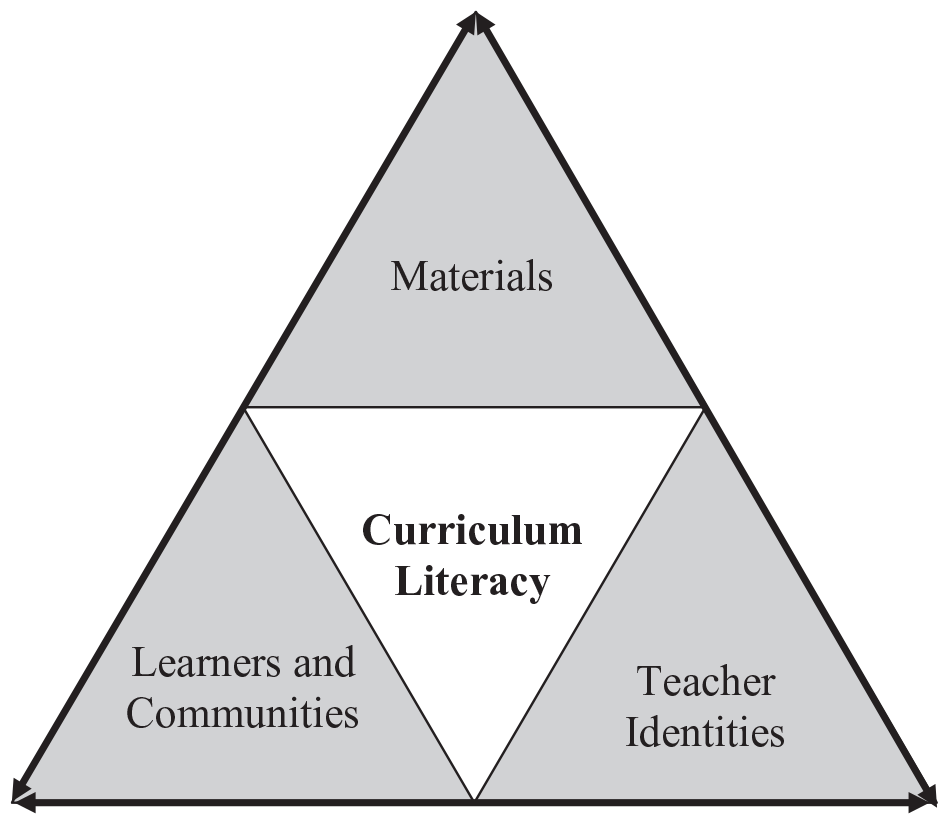
Curriculum Literacy Model.
Centering Teachers and Teacher Identities
Internationally, teachers’ identities and values have been shown to be “powerful mediators” (p. 97) of teachers’ responses to changes in curriculum policy (Vulliamy et al., 1997), and critical reflection has been framed as a tool for teachers to adapt to changing policies (Banoobhai, 2012). Vulliamy et al.’s (1997) comparative study explored policy shifts toward a prescriptive national curriculum (in England) and localized school-based curriculum (in Finland). In both contexts, “teachers’ prior values and self-identities play a major role in influencing the manner in which national and local policies are implemented (or not) at the school level” (Vulliamy et al., 1997, p. 102). This finding is echoed in Sloan’s (2006) study of teachers in urban Texas schools. Furthermore, in post-apartheid South Africa new progressive national curriculum differed substantially from the teacher-centered national curriculum used during apartheid. Learning to use new curricula was challenging for teachers whose beliefs and practices had been shaped by previous curriculum materials. Banoobhai (2012) argued for critical reflection as a tool for teachers “to interpret and organize the new curriculum in a meaningful way instead of simply implementing without thinking of the unique context that they [teachers] find themselves” (p. 177). Together, these studies suggest the recent focus on curriculum reform across the United States has overlooked a critical component: teachers’ identities and self-reflection.
Curriculum-focused initiatives often attempt to deploy instructional materials as “agents of instructional improvement” (Ball & Cohen, 1996, p. 6) that “operate nearly independently on students” (p. 7). Reform efforts that rely on curricula alone to solve educational problems are rarely effective because they neglect the influence of teachers’ knowledge and beliefs on curriculum enactment (Ball & Cohen, 1996). Cohen et al. (2003) posit that teachers should be at the center of questions about curriculum—developing curriculum literacy is not only a matter of PSTs learning about curriculum and how to deploy it but also must account for who PSTs are.
PSTs are not neutral actors, as they bring their identities, informed by their beliefs and experiences (McKernan, 2008), into curricular decision-making (Stein et al., 2007). These identities can serve as sources from which biases enter instruction (King, 1991). At the same time, teacher identities may also serve as resources that bolster curriculum literacy. That is, teachers’ privileged social positions and associated perspectives have the potential to reinforce dominant ideologies but teachers’ non-dominant identities can offer standpoints from which to disrupt curricular inequities (Varghese, 2016). Sealey-Ruiz (2022) calls for teacher education programs to cultivate PSTs’ practices for examining how their biases influence their selection and use of instructional materials. Our framework responds to this call by integrating critical self-reflection as a component of curriculum literacy.
Contextualizing Curricular Quality
While teacher education programs can and should support PSTs in developing specific skills, such as evaluating the quality of curricular materials, these capacities must develop alongside a deep understanding of the learners and the meaning of quality or strength for the learners’ communities. Grounding our work in the culturally and linguistically diverse communities that our PSTs serve, we draw on culturally sustaining (Ladson-Billings, 1995; Muhammad, 2023; Paris & Alim, 2017) frameworks. From a culturally sustaining perspective, instruction should aim to support learners in achieving high academic expectations while honoring and cultivating the assets of learners and their communities. Therefore, quality in HQIM refers to both academic rigor and the potential for instructional materials to achieve the goals of culturally sustaining pedagogy.
We also draw from Ball’s (2023) framework that acknowledges the limitations of HQIM and the role of teachers in enacting HQIM. HQIM includes indicators of rigorous instruction aligned to standards such as clearly articulated goals, learning activities aligned to these goals, and a coherent year-long learning trajectory (Grossman & Hirsh, 2021). HQIM can also offer insights into how learners might interact with materials and integrate their experiential knowledge with curriculum; however, Ball (2023) stresses that HQIM cannot offer sensitivity to learners or their contexts and communities. HQIM also cannot address moment-to-moment instantiations of systemic oppression (e.g., racism, sexism, homophobia, and xenophobia). Said more succinctly, “even high-quality curriculum cannot teach” (Ball, 2023, p. 93).
Uniting these perspectives, our framework calls for PSTs to develop curriculum-specific knowledge and competencies (Steiner, 2019; Steiner et al., 2018), for example, evaluating curricular quality or supplementing low-quality materials. Following Ball (2023) we also acknowledge the role of teachers as enactors, rather than implementers, of high-quality (read: academically rigorous and culturally sustaining) instructional materials. This means that teachers bring their knowledge of themselves, learners, and communities to the interactive work of curricular decision-making. They must be able to balance academic goals (rigor, proficiency, etc.) with the goals of humanizing and culturally sustaining pedagogies and they must be able to do so in the unique classrooms they serve. Therefore, we conceptualize curriculum literacy as a capacity to navigate teacher identities, learner and community assets, and the materials available. Our framework aligns with Au’s vision of teaching: one that disrupts the neoliberal vision of hyper-regulated classrooms.
Good teaching, teaching that can reach the diversity of our children, teaching that understands and accounts for the material realities of inequality that our students face daily, requires creativity, flexibility in curriculum, the space for deep introspection into one’s own identity, an understanding of institutional racism, and a knowledge of students and their communities (Au, 2017, p. 285).
We conceptualize curriculum literacy as encompassing all of these important dimensions.
Curriculum Literacy Practices and Tools
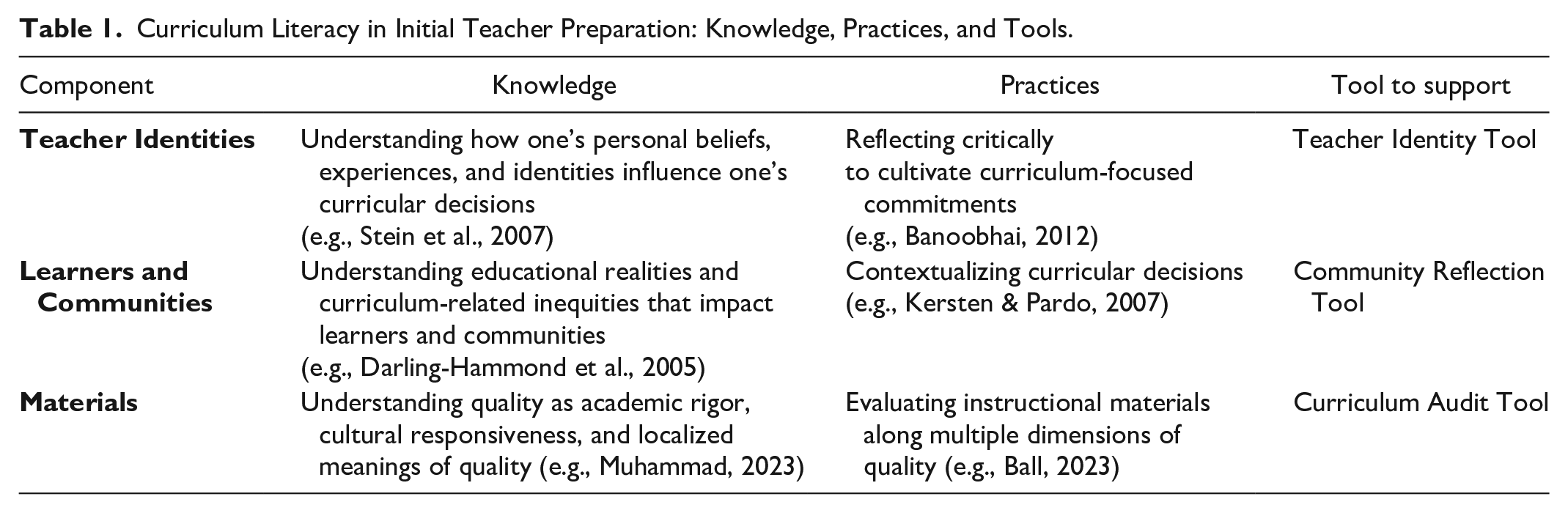
While curriculum literacy encompasses a wide range of practices, we follow Zumwalt (1989) in naming the three core practices we envision as most important for “professionally responsible beginners” (p. 174). These include critical reflection on one’s identity in relation to curriculum; contextualization of curricular decisions; and evaluation of instructional materials along multiple dimensions of quality. PSTs can become more aware of their agentive roles as enactors of curriculum (Priestley et al., 2015) and cultivate personal commitments that guide future curricular decisions through self-reflection (Banoobhai, 2012; Stein et al., 2007). Furthermore, PSTs can learn to mitigate potentially inequitable impacts of instructional materials for the youth and families they serve (Darling-Hammond et al., 2005; Kersten & Pardo, 2007). Developing strategies for evaluating the potential of specific materials along multiple dimensions of quality may support teachers in deciding if, when, and how to use materials in their classrooms (Ball, 2023; Muhammad, 2023). Within our model, we would expect PSTs to engage in all of these practices when faced with a curricular decision.
We are not the first to create resources for EPPs seeking to integrate HQIM and curriculum literacy; however, existing tools provide support at the programmatic level. For example, Duffy et al.’s (2022) Curriculum Literacy Guide offers reflection tools intended for program leaders. Our unique contribution is a set of tools for teacher educators’ use with PSTs to support curriculum literacy within an EPP. Representative selections (excerpts) from each tool are included in the supplemental materials. Subsequently, we summarize the relationship between knowledge, practices, and tools to support curriculum literacy in initial teacher preparation (Table 1).
Curriculum Literacy in Initial Teacher Preparation: Knowledge, Practices, and Tools.
Supporting Critical Reflection: A Teacher Identity Tool
Teacher identities have been the focus of prior research on teacher education (Beauchamp & Thomas, 2009) and models of reflective practice (Graham & Phelps, 2003; Walkington, 2005). Teacher educators encourage reflection to support PSTs in uncovering how their identities influence their teaching (Sealey-Ruiz, 2022). Tools for reflection include traditional reflective writing (e.g., Cattley, 2007) and the creation of identity texts (e.g., Keary et al., 2020). While identities are dynamic and fluid, composing texts about one’s identities helps sediment (Keary et al., 2020) or hold still the identity-making process (Dunham & Alexander, 2022). PST construction of identity texts has been shown to support critical reflection. In one example, creating professional identity texts allowed space for PSTs to resist standards of professionalism and construct their own interpretations based on their values (Keary et al., 2020).
We developed a tool to support PSTs’ reflection on their experiences with curriculum; beliefs and values relating to curriculum; and identities as curricular decision-makers. The Teacher Identity Tool is a scaffolded reflection guide that supports PSTs in connecting their identities to their enactment of the curriculum. For example, one component asks teachers to identify one of their own schooling experiences and reflect on how their values and beliefs influenced or were influenced by their schooling experience. The potential of our tool for building curriculum literacy lies in the invitation to connect one’s own experiences and sociocultural identities (race, ethnicity, language, and gender identity) to an emerging orientation toward curriculum and, subsequently, to curricular decisions. The final component of the tool makes these connections explicit by encouraging PSTs to connect each belief about curriculum to future action they will take (See Supplemental Figure S1). The tool then becomes an artifact of their participation in the exercise, an identity text that they might return to when later faced with a curricular decision. As PSTs develop reflective practices that inform their curricular decision-making, they build their curriculum literacy.
Supporting Contextualization: A Community Reflection Tool
Curricular decisions must take into account the realities faced by communities because local contexts, policies, and norms shape how curriculum is experienced by learners (Stein et al., 2007). The nuances of local contexts require teachers to recognize how curricular choices contribute to student success (in)equitably and navigate curricular materials accordingly (Darling-Hammond et al., 2005; Kersten & Pardo, 2007). Equity audits have been used by educators and school leaders to assess the degree to which curricular choices made on a campus contribute to learners’ academic success and well-being (e.g., Spikes, 2018). Green (2017) integrated a community-based equity audit into coursework for students of educational leadership, who partnered with students and families to develop context-specific solutions to problems of equity in the schools they serve (Green, 2017). This process disrupted deficit views of underserved communities and prompted asset-based understandings of the challenges that communities face. Equity audits are highly versatile and can be used by government officials (Skrla et al., 2009), educational leaders (Spikes, 2018), instructional coaches (Aguilar, 2020), and classroom teachers (Skerrett & Smagorinsky, 2022). For this reason, we drew from the literature on equity audits to design a Community Reflection Tool.
We envisioned equity-focused observations (Brown & Williams, 2019) as a powerful form of data that can help educators understand how curriculum and instruction are impacting learners. We drew on Aguilar’s (2020) Equity Rubric for our tool, in particular, one domain that states: “Curriculum and instructional practices are relevant, diverse, affirming of many identities, and student-centered” (p. 312). Users of Aguilar’s rubric can look for indicators of equity such as “teachers use students’ real-life experiences to help students connect with and make meaning of in-school learning” (p. 324) and “the experiences and stories of historically marginalized groups are integrated into and centralized in the curriculum” (p. 325). We designed similar curriculum-focused prompts in our rubric, such as “How is the teacher using curriculum materials to differentiate for diverse learners?” (See Supplemental Figure S2). This prompt is intended to support PSTs in noticing how teachers enact instructional materials and the degree to which materials reflect the linguistic and cultural strengths of learners, supporting their own practices for contextualizing curricular decisions in the classroom they serve—a component of their curriculum literacy.
This tool can be used as an individual reflection or as a guide for community-driven inquiry (Brown & Williams, 2019). Field supervisors and PSTs could use this tool to observe teaching, learning, and curriculum-in-action in clinical placement schools. Such a practice has the potential to begin enculturating field supervisors and PSTs into school communities, contribute to asset-based understandings of challenges schools face, and provide a foundation for contextualized and equity-oriented teaching and coaching. Engaging in this community reflection early in the clinical practicum could inform PSTs’ curricular decisions throughout the experience, potentially resulting in more community-informed decisions regarding the instructional materials that they select, adapt, or design.
Supporting Evaluation: A Curriculum Audit Tool
Previous studies of PSTs’ curriculum enactment have explored how tools can support PSTs in analyzing, modifying, and enacting curriculum materials (e.g., Schwarz et al., 2008). In one case, PSTs were found to be more resistant to using the rubric when the criteria were not in alignment with their beliefs about teaching or with expectations for teaching their placement classrooms (Schwarz et al., 2008). This finding supports our model of curriculum literacy, which must attend to PSTs’ identities and teaching contexts while building their capacities to evaluate curriculum. In addition, a criterion-based tool for curriculum evaluation has the potential to scaffold PSTs curriculum literacy but should invite teachers to bring their commitments to teaching and knowledge of their schools and communities to the act of evaluation. Finally, we know that any tool(s) for developing curriculum literacy must build on existing practices for teacher preparation, which may be contextual.
We developed a Curriculum Audit Tool drawing on the NYU/Steinhardt Culturally Responsive Curriculum Scorecard (Bryan-Gooden et al., 2023). This ELA-focused scorecard invites the evaluator to rank their level of satisfaction with a particular curriculum along multiple domains, such as “The curriculum presents different points of view on the same event or experience, especially points of view from marginalized people/communities” (Bryan-Gooden et al., 2023, p. 19). The user can also rate their own experience with the teacher materials using indicators like “Guidance is provided on being aware of one’s biases and the gaps between one’s own culture and identities and students’ cultures and identities” (Bryan-Gooden et al., 2023, p. 20). Similarly, we designed a rubric that invites the user’s beliefs, experiences, and consideration of their contexts into the evaluation process.
We designed rubric criteria to direct PSTs’ attention to potential inequities that may result as curriculum materials are enacted. To support the evaluation of instructional materials along multiple dimensions of quality, the rubric tools included criteria related to cultural responsiveness and academic rigor (See Supplemental Figure S3). For example, one criterion reads “To what extent do you believe the curriculum provides opportunities for collaboration and supports students in learning from multiple points of view and experiences?” Another reads “To what extent do you believe the curriculum promotes engagement with challenging academic content and supports teachers in facilitating high-level learning?” Explicit attention to both dimensions of quality is necessary for PSTs to recognize when materials are culturally insensitive but also when materials fail to hold all learners to high expectations of academic excellence (Ladson-Billings, 1995; Muhammad, 2023). Developing this awareness may also help PSTs avoid adapting materials in ways that underestimate learners’ capabilities. Each criterion is paired with several questions designed to connect the evaluation of materials to instructional decision-making. These questions may be useful for promoting individual reflection, small group discussion in courses, or coaching conversations among PSTs, field supervisors, and mentor teachers. We envision the rubric and questions supporting PSTs as they develop their own practices for evaluating curricular quality.
Implications
Our literature review and tool development have implications for policy, practice, and research and suggest the need for state-level standards that directly incorporate principles of curriculum literacy. Such standards would better define the goal of competence in the use of HQIM set forth by state legislatures and guide teacher educators toward incorporating curriculum literacy into their certification programs. In developing these standards, policy-makers should attend to the commonalities between principles of curriculum literacy and existing state-level teacher standards. Standards should frame teachers as makers and enactors of curriculum (McKernan, 2008; Remillard, 2005; Shawer, 2010). Also at the state level, we recommend that instructional materials being considered for high-quality adoption lists should attend to the learning needs of teachers who will use them and account for local variation in their use (Au, 2017; Ball, 2023). Relatedly, specific criteria are needed for evaluating the quality of teachers’ guides and other teacher-facing components of packaged curricula.
Our framework for curriculum literacy in initial teacher preparation can inform the development of a curriculum for curriculum literacy in EPPs. Tools, such as these, offer one possibility for supplementing existing teacher education curricula. The development of such a curriculum would be an important step in translating state-level standards for curriculum literacy (as described in the previous paragraph) into practice for teacher educators. Tools or curriculum within an EPP may support teachers as they transition from EPPs into their careers. Particularly, an EPP that fosters the development of curriculum literacy may better prepare teachers to learn from (Remillard, 2016) and critique (Graff, 2011) curriculum materials that they encounter on their campuses.
A curriculum literacy perspective also has implications for professional development and teacher evaluation. An acknowledgment of the centrality of teachers’ identities, contexts, and curriculum literacies to any potential curriculum-based reform (Banoobhai, 2012; Vulliamy et al., 1997) would shift expectations of teacher practice from implementation with fidelity to informed and adaptive enactment (Shawer, 2010), effectively restoring teacher agency (Priestley et al., 2015). This perspective could expand the look form of teacher appraisal to include evidence of teachers’ curriculum literacies, for example, a teacher’s ability to recognize when learners are underserved by instructional materials and adapt the curriculum appropriately (Shulman, 2004).
Future research could examine how the curriculum literacy tools presented in this paper impact PSTs’ curriculum literacy. For example, we plan to investigate the impact of such approaches when integrated into methods coursework in EPPs at the state level. Other potential studies might address the use of the tools in the context of field experiences, potentially investigating teacher candidates’ use of curriculum literacy in clinical experiences as well as in the first years of teaching. The tools we created are context-specific; additional research is needed to refine the tools and explore the potential of these tools for other contexts. Design-development methodologies would be particularly useful in further developing tools to be flexibly adapted across settings and EPPs.
Conclusion
Across the nation, heightened attention to HQIM has brought a wave of reform seeking to improve instruction and achievement by regulating instructional materials. We propose an expansion of curricular quality that encompasses both academic rigor and cultural responsiveness. We break from the view of teachers as implementers and instead frame teachers as enactors of each instructional decision, drawing on their own identities and contextualized knowledge of the communities they serve.
Supplemental Material
sj-docx-1-jte-10.1177_00224871241263803 – Supplemental material for A Framework for Curriculum Literacy in Initial Teacher Preparation: Policy, Practices, and Possibilities
Supplemental material, sj-docx-1-jte-10.1177_00224871241263803 for A Framework for Curriculum Literacy in Initial Teacher Preparation: Policy, Practices, and Possibilities by Molly Marek, Lizeth Lizárraga-Dueñas, Sarah Woulfin, Melissa Mosley Wetzel and Ernesto Muñoz in Journal of Teacher Education
Supplemental Material
sj-docx-2-jte-10.1177_00224871241263803 – Supplemental material for A Framework for Curriculum Literacy in Initial Teacher Preparation: Policy, Practices, and Possibilities
Supplemental material, sj-docx-2-jte-10.1177_00224871241263803 for A Framework for Curriculum Literacy in Initial Teacher Preparation: Policy, Practices, and Possibilities by Molly Marek, Lizeth Lizárraga-Dueñas, Sarah Woulfin, Melissa Mosley Wetzel and Ernesto Muñoz in Journal of Teacher Education
Footnotes
Declaration of Conflicting Interests
The author(s) declared no potential conflicts of interest with respect to the research, authorship, and/or publication of this article.
Funding
The author(s) disclosed receipt of the following financial support for the research, authorship, and/or publication of this article: Research reported here was supported by the Carnegie Foundation and the Bill and Melinda Gates Foundation under award numbers AWD00001074 and AWD00000868. The content is solely the responsibility of the authors and does not necessarily represent the official views of the Carnegie or Gates Foundations.

Supplemental Material
Supplemental material for this article is available online.
Notes
Author Biographies
References
Supplementary Material
Please find the following supplemental material available below.
For Open Access articles published under a Creative Commons License, all supplemental material carries the same license as the article it is associated with.
For non-Open Access articles published, all supplemental material carries a non-exclusive license, and permission requests for re-use of supplemental material or any part of supplemental material shall be sent directly to the copyright owner as specified in the copyright notice associated with the article.
