




Abstract
Globally, enduring skepticism around professionalism in education systems has questioned the efficiency in which teachers meet students’ educational needs and their authority to do so. Presently, efforts toward professionalization in teacher education (TE) are threatened by neoliberal reforms promoting alternative pathways into teaching and performance-based accountability mechanisms to monitor teachers and schools. In the face of public mistrust and external threats, this conceptual paper aims to envision the future of TE in light of the complexities inherent to the notion of professionalism. To this end, two competing ideals of teaching, which represent co-existing conceptions of professional work in education are examined: The teacher as an expert clinician ideal entrenched in expertise-driven professionalism and the teacher as a democratic pedagogue grounded in democratic professionalism. I offer ways in which these competing discourses could be fused to set the discussion about professionalism in teaching and its implications for TE on firmer grounds.
The notion of mistrust in education is not new. Many countries have witnessed a long-lasting history of skepticism regarding teachers’ professionalism and the efficiency of their educational practice in schools. Throughout history, public education has consistently fallen short of eliciting complete public satisfaction, primarily because it has often been tailored to serve specific groups, resulting in the exclusion of certain segments of society. Consequently, a record of international public attacks directed at teachers, their institutions, representatives, and training frameworks could fill an entire volume. In recent decades, governments worldwide have responded to such persistent public mistrust with a flood of reforms guided by the logic and values of the New Public Management (NPM), applying practices from business management and creating fundamental changes in the education landscape. In the field of teacher education (TE), efforts toward professionalization are presently evermore threatened by the NPM regulatory regime. For example, efforts to present evidence of effective university-based TE programs (Darling-Hammond, 2006) are offset by massive governmental investments in alternative pathways into teaching (Zeichner & Conklin, 2016) that significantly reduce subject matter and pedagogical readiness and enhance de-professionalization (Darling-Hammond, 2020). Teacher educators’ efforts to inform preservice teachers’ professional judgment through innovative pedagogical theories and approaches (Richardson, 2005) are hindered by performance-based accountability mechanisms that promote a “teaching to the test” culture in schools (Parcerisa et al., 2022).
Given these tensions, it might be tempting to determine whether the logic of professionalism should be embraced or rejected to restore public mistrust in teaching. However, in this article, I transcend these dichotomies by asking how we can expand our understanding of the future of TE in light of the complexities inherent to the notion of professionalism. This conceptual paper aims to enhance such understanding by examining two competing ideals of teaching, which represent co-existing conceptions of professionalism in education: A logic of professionalism entrenched in expert knowledge which creates an image of the teacher as an expert clinician, 1 and a logic of democratic professionalism that fosters an image of a democratic pedagogue. I argue that considering the inevitable tensions between these competing ideals and how they might be fused rather than resolved could set the discussion about professionalism in teaching and TE on firmer and more realistic grounds.
In presenting my argument, I review scholarship that explicitly discusses the nature of professionalism in teaching and TE. In this body of literature, scholars implicitly allude to the two aforementioned ideals of teaching: Some advocate for reinforcing expert knowledge, following the traditional professions (e.g., Glazer, 2008; Shalem, 2014), whereas others call for reclaiming democratic notions of educational work to guide practice and learning to teach (e.g., Payne, 2017; Zeichner, 2020). My analysis of these literatures is structured by three identified features of educational work and their implications for TE: The goals of the teaching occupation, the nature of teachers’ authority, and the epistemology of TE. This examination is guided by distinct theoretical frameworks: I draw on scholarly work from the sociology of the professions and professional knowledge to deconstruct the expert clinician ideal. Specifically, I use Abbott’s (1988) framework for analyzing expert labor and Bernstein’s (2000) concept of “recontextualization” to typify the connections between scientific disciplines, professional education curricula, and practice. To analyze the democratic pedagogue ideal, I rely on conceptualizations from the philosophy and anthropology of education. Particularly, I resort to Biesta’s (2017) framework of democratic professionality as an outline for educational work and on the notions of democratization of teacher knowledge (Zeichner et al., 2015) and “funds of knowledge” (Moll et al., 1992) as a basis for the epistemology of democratic TE. Informed by my own academic and professional journey as a teacher educator and educational researcher, my position within this debate does not favor any one of the theoretical discourses. Rather, I advocate developing a constructive dialogue between the multiple standpoints to reflect the complex character of professionalism in TE. First, I offer an account of relevant historical trajectories of the responses to public mistrust in teaching and TE as a background for the current predicaments.
Public Mistrust of Teachers’ Professional Service
Since the mid-20th century, fundamental social and cultural changes, including the desire for enhanced safety and a shrinking tolerance for risks and failures (Noordegraaf, 2015), have resulted in a decline in trust in public authorities. In many countries, public mistrust in education was fueled by a program of public sector reforms associated with the values and principles of the NPM, including the dissemination of budgetary control, managerial oversight, and organizational reform (Gunter et al., 2016; Tolofari, 2005). This approach applies knowledge and practices from business management to enhance efficiency, resource allocation, and overall performance within modern bureaucratic organizations providing social services. It employs governance tools known as “performance-based accountability,” which, in the context of education, involve establishing standards, procedures for transferring learning data, and standardized assessment tools focusing on core subjects for monitoring schools and teachers (Parcerisa et al., 2022). This regulatory approach has fundamentally altered teachers’ roles and professional identity and more generally, generated an ideal type of “new” organizational professionalism, involving standardized implementation of work procedures aligned with managerial controls and external accountability mechanisms (Evetts, 2011). Such performance management principles have increased inspection and strengthened the public’s impression that teachers cannot be trusted (Fitzgerald, 2008).
Since the 1980s, the critique over the inefficiency of schools has generated a twofold policy response across countries: Promoting the de-professionalization of teaching by imposing teaching standards and turning teachers into “managed professionals” (Goodwin, 2021), and advancing the professionalization of teaching by emphasizing teachers’ mastery of formal knowledge and workplace autonomy through regulation of accreditation and school structure (Labaree, 1992). Action toward the latter included efforts to conceptualize the professional knowledge of teaching (Ball et al., 2008; Shulman, 1987), demarcate and develop a knowledge base for teaching (Hiebert et al., 2002), and establish the science of teaching (Labaree, 1992). In some national contexts, these efforts have concentrated on the academization of TE programs, their providers, and teacher educators by strengthening their institutional and epistemological association with universities and research (Bøje, 2012; Connelly & Clandinin, 2004; Larsson & Sjöberg, 2021).
De-Professionalization/Professionalization in the Regulation of TE
Critiques on public education have also led to regulatory changes in TE (Furlong, 2013; Kumashiro, 2010; Zeichner, 2010), identified by Cochran-Smith (2016) as five overarching “turns”: The policy turn underscores the inclination to link TE policy with teacher quality and school outcomes, targeting program content, structure, certification methods, and entry pathways into teaching. This has been accompanied by an accountability turn, where TE programs face evaluation for the inputs they invest and the processes they employ to meet professional teaching standards as well as the outcomes they generate regarding graduates’ effectiveness. The practice turn emphasizes clinically based models for teacher preparation and school-based teacher learning in TE programs. Concurrently, the research turn aims to strengthen connections between teaching, research, and universities, fostering a research-based curriculum. Finally, the equity turn reflects a heightened focus on diversity, equity, and justice in TE, emphasizing moral and ethical dimensions in teaching standards implementation.
Internationally, the five turns in TE regulation reflect conflicting ways in which education systems have responded to public mistrust: For example, when used to erode qualities that are associated with traditionally acknowledged professions, the first three turns have the potential to de-professionalize TE. In the policy and accountability turns, policymakers often tighten governmental regulation of TE to shape its structure, processes, or outcomes and, thus, eliminate teacher educators’ collective control over professional preparation (Fenstermacher, 2002). Some critics have expressed concerns that in extreme cases the practice turn can push toward reducing the duration of TE, focus its content on practical issues of classroom teaching, and shift the locus from universities to schools and other nonacademic institutions (Zeichner, 2012). Concurrently, the research and equity turns could be interpreted as aspirations to professionalize TE. The first might reinforce a professional ethos by cultivating direct and beneficial relations between preparation programs and research-based knowledge (Muller, 2009). The equity turn could support a professional stance in which educational work adheres to values of inclusion, dialogue, and deliberation in pursuit of serving the collective common good (Cochran-Smith, 2021).
Notwithstanding, as demonstrated in diverse contexts, each turn can be enacted according to different interpretations of professionalism. For example, European Nordic nations, such as Norway and Finland, promote research-based TE to enhance teachers’ autonomy and professional judgment (Smith, 2018). Alternatively, countries like the United States, England, and Australia construct research-based TE to increase school achievements by improving teacher quality and view scientific knowledge as the answer to educational problems (Furlong, 2013). In addition, the clinical model of TE promoted in the practice turn has been divergently construed as an endeavor aimed at professionalization, portraying teaching as necessitating intricate pedagogical reasoning and practice (Forzani, 2014), an effort to emphasize the practical, hands-on aspects of teaching and strengthen deregulation in TE (Zeichner, 2017), and an attempt to link teachers’ professional knowledge to the public good by developing competent teachers obliged to school improvement efforts (Anagnostopoulos et al., 2010). Furthermore, pursuing equity in TE can be seen as enhancing access to equal educational opportunities and outcomes by ensuring high-quality teachers and education standards or as a commitment to resist the deep societal structures that reproduce inequalities and inequity of access (Cochran-Smith, 2016).
Competing Ideals of Teaching to Rehabilitate Public Trust
The aforementioned developments in teaching and TE have generated a spirited debate around the logic of professionalism in education. In the following sections, I examine two ideals of teaching stemming from this debate that represent competing conceptions of professionalism, and discuss their implications for TE (see Table 1).
Conceptions of Education, Teaching, Teachers’ Work, and Implications for TE in Two Ideals of Teaching.
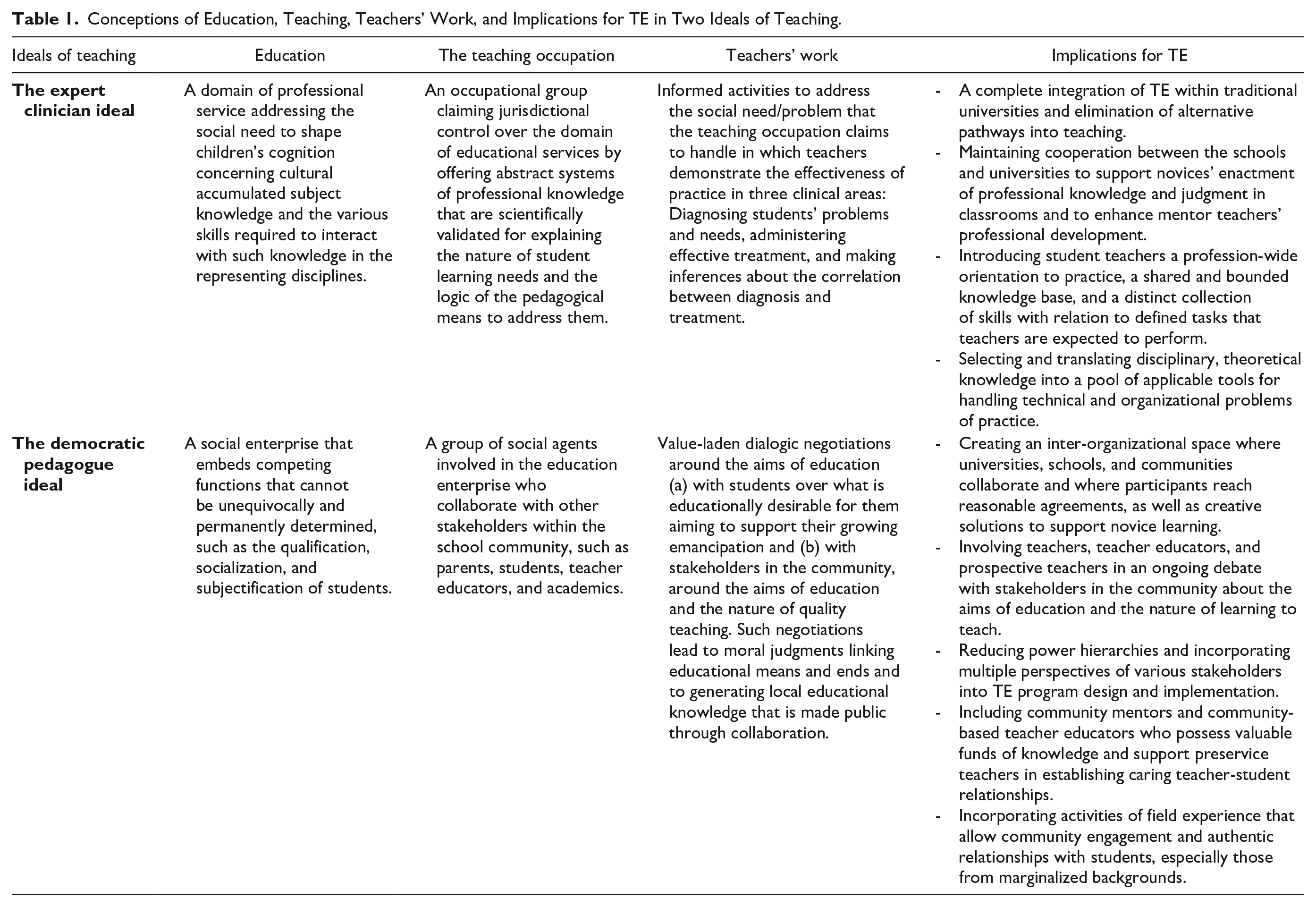
The ideal of the expert clinician is rooted in a desire to follow the traditional professions. For expert clinicians, innovative practice is based on the best available research evidence, and indisputable expertise is gained through prolonged preparation, internship periods, and solid standards for professional licensing (Darling-Hammond, 2020). Abbott (1988) argues that to uphold jurisdictional control over particular professional services, professionals must demonstrate proficiency in clinical activities of diagnosing the client’s problems and needs, administering effective treatment, and making inferences about the correlation between diagnosis and treatment. Professions develop systems of abstract professional knowledge to inform these clinical domains and provide evidential sources to support practitioners’ professional judgment. The profession’s capacity to establish connections between clinical activities and a scientifically valid body of professional knowledge confers public legitimization upon professional practice. Furthermore, public trust in professionals’ practice depends on their ability to efficiently identify and solve the problems the occupation aims to handle.
The democratic pedagogue ideal stems from an alternative conception of educational work that applies a critical lens to the logic of expertise-driven professionalism (Fenech et al., 2010). In this view, the illusion of expert knowledge fails to accurately reflect the essential nature of the educational field that is marked by increasing uncertainties, frequent changes, and complex, sometimes indeterminable situations. Hence, the nature of educational work makes it difficult to discern distinct and treatable problems or establish methods for attaining predetermined objectives within defined time frames (Urban, 2013). In the democratic pedagogue ideal, educational work is regarded as the building of an ongoing dialogue with stakeholders and communities over the purpose of education (Biesta, 2017).
The next sections will present a comparative analysis of these two ideals of teaching and their implications for TE. The analysis raised three overarching features of teachers’ work and learning to teach that the two ideals of teaching treat differently: (a) the goals of the teaching occupation defining teachers’ commitments to the public and central tasks; (b) the nature and foundations of teachers’ professional authority; and (c) the epistemology of TE. This comparative analysis highlights complexities inherent to the notion of professionalism in education that are worth considering for the future of TE.
The Goals of the Teaching Occupation
The aims of education are fundamentally ideological and, therefore, politically charged and highly contested. Scholars have identified competing traditional, romantic, progressive, and critical conceptions of education (Biesta, 2005). Others identify nation-building, economic development, and status attainment as the main competing social goals of schooling (Labaree, 2017). Such conceptions view teachers” work in light of very different ideals and promote fundamentally dissimilar processes and intended outcomes. As such, the boundaries of the professional service that teachers provide to students and their families are far from being clear. Nonetheless, in the expert clinician ideal, expertise in assessing students’ needs, deciding on proper educational courses, and making sense of educational situations requires a defined set of professional tasks describing what teachers are supposed to do and “what education means for society” (Dreeben, 2005, p. 68).
In this view, a popular way of demarcating the goals of the teaching occupation is to perceive teachers’ educational service as the source of learning opportunities, and teachers themselves as learning facilitators, supporters, and evaluators (Biesta, 2005). The goal of teaching, here, pertains to the need to shape children’s cognition in relation to cultural accumulated subject knowledge. It is presupposed that teaching activities aim to enhance student learning—whether in acquiring cognitive, intrapersonal, and interpersonal competencies or in mentalizing subject matter propositions, ways of thinking, theories, and methodologies. In this conception, teachers’ professional tasks are all directed at enhancing student subject matter learning. On such a view, equitable education entails consideration of student diversity, including race, ethnicity, and language, when designing learning opportunities in the classroom (Grossman et al., 2009).
Aligned with the occupation’s goals, clinicians need to demonstrate a constant degree of professional proficiency in defining, interpreting, and tackling the entailed problems of practice (Abbott, 1988). Such consistency is achieved by introducing to prospective practitioners a profession-wide orientation to practice, a shared and bounded knowledge base, and a distinct collection of skills with relation to defined tasks that teachers are expected to perform (Glazer, 2008). Maintaining such consistency in TE necessitates a comprehensive agreement among stakeholders around the content, pedagogy, and design of effective TE programs (Darling-Hammond, 2006).
Alternatively, the democratic pedagogue ideal is entrenched in a philosophical observation that teaching is an intentional practice, aimed at achieving specific goals associated with certain social ideologies (Whelen, 2019). The desired ends of this practice, however, manifests in various, often conflicting forms (Marples, 1999). A related observation posits that the aims of education cannot be unequivocally and permanently determined (Biesta, 2017), due to tensions between functions, which are “fundamental to the educational enterprise” (Labaree, 2017, p. 297). Biesta (2009) suggested three overlapping and interrelated functions that the education system performs and that teachers should consider in their work: qualification (i.e., equipping students with knowledge, skills, and dispositions to perform tasks effectively), socialization (i.e., having students become members of specific social, cultural, and political frameworks), and subjectification (i.e., having students become subjects, independent from social, cultural, and political orders).
Within this contested field, decision-making concerning the trajectory of education unavoidably involves value judgments about what is deemed educationally desirable (Biesta, 2009). This “value-based” model of educational work views teachers’ judgments as reciprocally linking educational means and ends (Van Kan et al., 2013). Here, teachers are to acquire, over time and in collaboration with colleagues, ways of seeing and being that allow them to engage with questions on the normative dimensions of educational practice. From this standpoint, focusing on educational purposes that instill meaning, identity, and direction in the teaching practice serves to resist the technical discourse of effectiveness (Biesta, 2017).
Therefore, in this ideal, the future of TE cannot be envisioned without bringing the issue of “what teaching is and what it is for” into the center of the discussion (Biesta, 2019, p. 260). Thus, negotiations around this question are crucial to TE programs’ design. Given the necessity to consider the purpose of educational practice and the challenge of reaching a consensus on it, an ongoing debate among stakeholders around the aims of education becomes imperative. Such debates may entail choosing between conflicting alternative frameworks, where goals and values may not align. Biesta (2009) framed this debate as posing “a ‘composite’ question” (p. 41), which provides a detailed account of the views on the three overlapping and interrelated functions that the education system performs: qualification, socialization, and subjectification.
Teachers’ Professional Authority
The competing ideals of teaching also diverge in how they view teachers’ professional authority while performing their professional tasks. The expert clinician ideal highlights two classification systems of professional knowledge that ground the clinician’s authority (Abbott, 1988): (a) The diagnostic classification system, which is a “dictionary of professionally legitimate problems” (p. 41), directs clinicians’ diagnostic acts of collecting information from the clients, assembling it into a holistic picture of clients’ states and needs (colligation), and associating it with a particular category from the common body of professional knowledge (classification). (b) The treatment classification system includes the various possible treatments, clustering problems that share a common treatment, and associating a “likelihood of successful outcome under a given treatment” (p. 45).
In teaching, such view of professionalism requires attention to the problems of classroom diagnosis through systematic “observation, conceptualization and codification” (Dreeben, 2005, p. 60). Therefore, it requires the development of professional classification categories that teachers can use to describe common learning situations or needs, and difficult cases encountered in the classroom. For example, in mathematics education, a student’s thought process can be didactically categorized as “finds result before finding operation” or “validates without reference to original text” (Prediger & Zindel, 2017, p. 232). As yet, teaching has not firmly developed a diagnostic classification system. Despite robust research programs in some instructional fields, these have failed to guide teachers’ practice for handling common problems of learning (Glazer, 2008).
So far, research on teacher diagnosis has focused on teachers’ diagnostic judgment, defined as the process through which a teacher assesses a student, a task, or a situation, and the resulting products (Loibl et al., 2020). This line of research explores the knowledge, beliefs, and motivations involved in teacher diagnostic judgment (Glogger-Frey et al., 2018); the cyclic cognitive judgment processes that link teachers’ professional knowledge to assessment performance (Herppich et al., 2018), and their ability to accurately assess a student’s performance (Klug et al., 2016). Research studies connect central elements in teachers’ diagnostic judgment to their “professional vision” (Seidel et al., 2021). In teaching, studies view professional vision as an individual ability which grows simultaneously with increasing professional expertise, containing three main components (van Es & Sherin, 2021): (a) Noticing is a selective attention through which teachers discern meaningful events in the classroom; (b) knowledge-based reasoning emphasizes the meanings a teacher assigns to what has been noticed and how she infers from it, and viewing phenomena as worthy of exploration; (c) shaping, where teachers facilitate interactions to gather additional information, enhancing their noticing. These lines of research characterize the specificities of diagnosis in teaching. They also empirically support the claim that the teaching practice encompasses core clinical activities. However, emphasizing the form of teacher diagnosis while neglecting the content of diagnostic classifications (i.e., the categories that define students’ identified problems and needs) cultivates an incomplete image of professional expertise in teaching: one that employs “hollow” clinical actions that can be charged with context-related and idiosyncratic meanings and values, rather than a shared system of abstract categories to understand student educational needs.
Furthermore, the expert clinician ideal requires connecting diagnostic and treatment classification systems to improve instructional consistency, enhance specialization, and provide evidence that students’ educational needs are met. Until now, efforts to strengthen professionalization in TE by advancing treatment classifications in teaching have focused on core teaching practices associated with enhanced student learning, also termed high-leverage practices (Calabrese Barton et al., 2020). Core practices are viewed as “a vehicle for accomplishing particular instructional goals in relation to specific content” (Forzani, 2014, p. 365). These efforts, framed as the “professional language project,” aim to cultivate a shared professional vocabulary (category systems) and grammar (analytic frameworks) to decompose, categorize, and describe complex teaching practices (Horn & Kane, 2019, p. 2). Note that core practices do not propose to represent detached technical know-how but rather to guide responsive navigation in the classroom context (Grossman, 2018). Thus, scholars have shown how core practices can support equitable outcomes by focusing on adaptive practices that respond to students’ thinking and bring forth student voice and performances (Calabrese Barton et al., 2020). Stemming from a very different approach to educational practice, other scholars and policymakers have attempted to associate educational means with evidence regarding their effectiveness. One movement, known as “what works” or “evidence-based practice,” calls for establishing substantial scientific evidence to determine the effectiveness of educational programs and means to guide teachers’ work. A well-known example is Hattie’s (2009) book, Visible Learning, presenting a meta-analysis of over 800 studies on the conditions of effective school teaching.
Despite stemming from fundamentally different conceptions of educational work, the above projects generate and present categories of practice and probabilities of success in isolation from educational problems and needs. Instead, the nature and effectiveness of educational practices, interventions, and programs are conceptualized, analyzed, and measured based on external and predetermined educational aims and desired outcomes. These external aims are not grounded in students’ educational problems and needs applicable to diagnosis, but in frameworks outlined by the discipline, curriculum, and national standards, dictating the content, skills, and values students are expected to learn. In this respect, current endeavors to advance treatment classifications in teaching deviate from the professional logic of the expert clinician ideal.
Contrarily, the democratic pedagogue ideal warrants transforming the “authoritarian relationships” between the teacher and students into “relationships of authority” (Biesta, 2017, p. 327), in which both sides voluntarily accept the teacher’s steering of the educational process. Hence, this approach calls for establishing egalitarian relationships between teachers and students where the delineation of students’ needs is seen as a dialogic process to which both the teacher and the student contribute significantly. The dialogic process of setting educational goals intends to support the students’ independent ability to distinguish between what they desire and what can be considered desirable for them. Furthermore, the democratic pedagogue demands that teachers insist on their ethical responsibility to others for their actions and decisions rather than their responsibility for auditable records. This sense of being answerable to others is understood in “dialogical rather than one-sided terms” (p. 327). Thus, it involves the contributions of teachers, students, and parents, generated through direct relationships and negotiations.
Consequently, advocates of this ideal (Hargreaves & O’Connor, 2018; Sachs, 2003; Whitty, 2008) stress collaboration among teachers and stakeholders as a primary strategy for defying the competitive climate created by neoliberal policies. Thus, the democratic pedagogue ideal envisions the teacher’s work environment as a hub of alliances and collaborations involving various stakeholders within the school community. In such an environment, teachers can no longer treat their work as taking place behind closed doors in classrooms or within the school gates (Anderson & Cohen, 2018). Moreover, they cannot treat parents as a source of annoyance or objects for conciliation. Students’ voices that have traditionally been marginalized in educational decision-making processes also become imperative for teachers’ work. Furthermore, this view promotes partnerships in the broader institutional sense within the realms of bureaucracies, unions, professional associations, higher education institutions, and community organizations (Sachs, 2003).
Taken to TE, this approach advocates for reducing power hierarchies and incorporating multiple perspectives of various stakeholders into program design and implementation (Ovens & Lynch, 2019). In this approach, the discourse and conduct of TE programs is no longer under the exclusive authority of university academics. Instead, universities, schools, and communities collaborate to support novice learning, as “each organization draws upon their knowledge of teaching and learning” (Zeichner et al., 2015, p. 5). In this inter-organizational space, participants reach reasonable agreements, and new and creative solutions emerge. Scholars are undecided about whether these spaces should be situated within universities, schools, community organizations or entirely new institutions for TE (Payne, 2017). Nonetheless, the contribution and responsibility of all participants is considered seriously.
The Epistemology of TE
The expert clinician ideal stresses strong links between practice, professional learning, and the scientific disciplines (Beck & Young, 2005). Such links facilitate a smooth flow of knowledge from the foundational disciplines to the professional education curricula, enabling its appropriation for practice (Shay, 2013). Conceptual knowledge relevant for practice “provides strong boundaries which enable practitioners to recognize the nature of their practice and their role within it, leading to a specialized professional identity that can be acknowledged, and trusted, by clients of the profession and the general public” (Hordern, 2015, p. 435). Although teaching has followed the traditional professions by developing a knowledge base, disciplinary robustness was not achieved and connections between foundational disciplinary knowledge, professional practice, and TE remain weak (Hordern, 2016a).
Shulman’s (1987) framework of the knowledge bases for teaching conceptualizes how disciplinary content knowledge, educational knowledge, and their integration (i.e., pedagogical content knowledge) inform teachers’ professional judgment in practice. Despite intense work for developing this framework in TE, disagreement regarding what constitutes educational knowledge, influences of craft and technical conceptions of teaching, and the dispute whether educational studies represent a coherent discipline challenge its consistent implementation (Hordern & Tatto, 2019). This challenge is linked to essential differences between applied domains of study associated with professions and the scientific disciplines (Bernstein, 2006). The complexity of educational problems and work requires educational scholars to adapt and blend knowledge taken from scientific disciplines such as psychology, sociology, and philosophy (Hordern, 2016b). Such adaptation and merging entangles the disciplines’ original conceptual structures and obscures the connections between the professional situation and the abstract meaning borrowed from the scientific discipline. Another reason for this challenge is the convenient availability of alternative types of knowledge that can substitute for the disciplines’ role in informing teachers’ practice, such as organizational and situated workplace knowledge (Hordern, 2014). For example, competence-based models of TE prioritize school-set performance standards and often regard academic and research-based education knowledge as irrelevant or harmful to teaching practice. Furthermore, by imposing guidelines for the knowledge base of TE and promoting structures of school-based professional learning, governments cause confusion, undermine the value of disciplinary knowledge, and shift authority over educational problems to policymakers (Hordern, 2016b).
The expert clinician ideal calls for professional and disciplinary communities in education to resolve the above challenges and address the connections between teaching practice and disciplinary knowledge, acknowledging the value of disciplinary knowledge for educational practice. Such value is grounded in teachers’ professional judgment, whereby defining a case involves accessing an organized pool of deductive propositions or theoretical notions that guide their focus on specific aspects of the case (Shalem, 2014). Organized concepts would support the development of teachers’ professional judgment in guiding the filtering of information, distinguishing between more and less reliable evidence, and evaluating research-based knowledge to make diagnostic and treatment inferences (Abbott, 1988).
Establishing the necessary relations between professional practice and disciplinary knowledge has vast implications for knowledge selection, appropriation, and transformation in TE programs. Bernstein’s (2000) notion of recontextualization is useful for conceptualizing these adjustment processes, alluding to the dislocation of knowledge from the scientific discipline and its relocation within the professional education program. Recontextualization is performed by allowing an intense flow of knowledge from the discipline to the professional learning domain, whereas the original knowledge addresses contextual purposes of practice yet retains its conceptual foundation (Hordern, 2016c). The recontextualization of knowledge entails transforming theoretical knowledge into a pool of applicable tools for handling technical and organizational problems of practice (Barnett, 2006). Such a process requires not only that these problems are defined in ways related to conceptual knowledge but also that the governing entities defining these issues (e.g., the research community, TE institutions, professional associations, professional development authorities) reach a broad consensus regarding the nature of these problems. For example, in special education, a consensus can be achieved regarding the common problems of children with special needs as identified through Vygotsky’s notion of reduced cultural participation (Winsler, 2003).
Given the above-mentioned requirements, the expert clinician ideal advocates full integration of TE within traditional universities, positioning Education as a valued academic domain associated with the teaching profession. Thus, this view entails eliminating alternative pathways into teaching, including “on-the-job” training offered by nonuniversity providers. Still, cooperation between the schools and universities should be further developed to support novices’ implementation of professional knowledge and judgment in classrooms and to enhance mentor teachers’ professional development. In addition, TE programs and schools of education should remain committed to their professional mission and avoid trading their “professional soul” for the status that come with the integration into higher education (Labaree, 2008, p. 301).
The democratic pedagogue ideal promotes a different epistemology of TE. First, it stresses that teaching must focus on evaluating the purpose of education. Therefore, while teachers’ know-how is a significant aspect of their practice, it always requires judgment “about ‘what is to be done’” (Biesta, 2019, p. 268). This kind of knowledge relates to the notion of praxis—the domain of doing in terms of promoting situations conducive to the good life. Such work necessitates pre- and in-service teachers to engage in conscious and critical reflection, questioning the prevailing norms within their practice environments (Biesta, 2015). TE should, thus, emphasize fostering self-discovery in teaching, cultivating an identity rooted in personal convictions rather than conforming to professional standards (Sockett, 2008). Furthermore, this ideal views teachers as generators of local knowledge through which they are able to amend unjust situations in schools (Cochran-Smith & Lytle, 2009). Through collaboration, this local knowledge is made public and can promote positive change in practice beyond the confines of individual classrooms (Sachs, 2001). These epistemic conditions imply that TE programs should include collaboration opportunities that enable student teachers to access the local knowledge of practicing teachers and teacher educators. Crucially, these collaborations should integrate collective deliberations on “what is to be done” by jointly analyzing particular lived experiences and co-creating value-based knowledge.
Second, a key issue in a democratic pedagogue ideal is “whose knowledge counts in the education of teachers” (Zeichner et al., 2015, p. 2). This conception assumes that learning to teach requires knowledge and expertise situated in schools, universities, colleges, and communities, and that these sources of knowledge should be treated equally. The expertise necessary for good teaching isn’t confined solely to institutions of higher education that train teachers but exists within other communities as well (Carter Andrews et al., 2018). For example, this approach emphasizes the importance of community members as mentors and community-based teacher educators (Lees, 2016). These participants possess valuable funds of knowledge 2 and a profound understanding of youth and families that could support preservice teachers in establishing caring teacher-student relationships (Carter Andrews et al., 2018). In such a perspective, the challenge of TE lies in two primary tasks: First, making these diverse sources of knowledge accessible to student teachers and second, mediating these sources while acknowledging the value and relevance of each for creating innovative solutions to the pressing dilemmas that define teachers’ daily professional lives (Zeichner, 2020). To this end, an epistemology of contextual knowledge is called for, acknowledging the pivotal role of students, families, and communities and the diverse knowledge held by each.
Scholars advancing such horizontal expertise in TE call for involving preservice teachers in deliberative democratic activities where community educators, university faculty, and parents are all present (Zeichner et al., 2015). Such activities highlight the crucial role of field experience, community engagement, and authentic relationships with students, especially those from marginalized backgrounds (Carter Andrews et al., 2018; Lees, 2016; Payne, 2017). Advocates of democratic TE consider field experience as the context in which prospective teachers learn about the sociopolitical reality of schools and communities (Ovens & Lynch, 2019). In these settings, Hogg (2011) pointed to prominent curricular principles and training strategies to support the developing of student teachers’ “sociocultural consciousness” (p. 674): Framing teacher planning as student-centered, including key content on a constructivist approach to teaching, exposing student teachers to a knowledge base on “funds of knowledge,” modeling culturally responsive teaching, and assisting student teachers to develop sociocultural awareness.
The “Double-Edged Sword” of Professionalism and the Future of TE
At the outset of this article, I suggested transcending dichotomous thinking concerning professionalization in TE by asking how we can expand our understanding of the future of TE in light of the complexities inherent to the notion of professionalism. The analysis of competing notions of teachers’ work and their implications for TE as espoused by the expert clinician ideal and the democratic pedagogue ideal exposes the “double-edged sword” of professionalism in education: On one hand, as an occupation that aims to have an impact on society, teaching cannot survive without gaining public legitimization. It is reasonable that the public legitimization of a profession entrusted with the education of all children demands a shared and solid system of abstract knowledge to direct practice. For this knowledge to be accepted as trustworthy by the public, it should be validated through processes aligned with leading cultural values. Furthermore, it also makes sense that such legitimization requires evidence of actual accomplishments in performing the tasks that the public expects of its education system. On the other hand, the very existence of validated systems of knowledge clashes with the recognition that public trust also requires balanced relations between educators, students and the social surrounding. This clash leads to questioning the supposedly validated authority of professional knowledge. Furthermore, the assumption that education can come into being by “accomplishments” in a particular set of “tasks” inevitably conflicts with the notion of education held by parts of the public whose trust we seek to gain. It is, therefore, reasonable that teachers should turn to more collaborative and dialogic constructions of educational purposes and knowledge. However, these local, idiosyncratic constructions are at odds with the more solid and consistent foundations of professional work that public legitimization necessitates.
Acknowledging the “double-edged sword” of professionalism in teaching as a fundamental dilemma for TE implies that it is impossible to envision the future based on a particular ideal of teaching. Instead, I suggest recognizing the complexity of professionalism in TE by looking for creative ways to integrate conceptions of teaching and stances toward professionalism, and exploring innovative strategies to harmonize diverse perspectives and practices. In doing so, new questions arise: What elements can and should be adopted from each ideal to rehabilitate public trust in education? How should these elements be adapted to the reality of students, teachers, and teacher educators? And importantly, how can we integrate these diverse elements to reduce counter-productive tensions? These questions call for thoughtful deliberations to be dealt with in future debates. Still, we can think of a few examples of such integration. First, in developing shared classification categories to talk about and typify educational needs and problems, teacher educators could remain attentive to more fluid, situated factors such as “how teachers use language to make sense of instructional decisions in their workplaces” (Horn & Kane, 2019, p. 1). Gaining public trust requires attending to both formal classification categories and teachers’ commonsense, and searching for creative and diplomatic ways to harmonize them. To this end, during mentoring conversations with student teachers, teacher educators can reciprocate situated and disciplinary terminologies by highlighting meaningful connections and tensions between teachers’ local talk in school settings and the technical language of teaching. Such deliberations should pinpoint the values and logic that ground these terminologies to develop student teachers’ understanding of students’ needs. For example, teacher educators can encourage prospective teachers to identify students’ intellectual strengths in their practicum settings based on experienced/observed classroom events. In collaboration with cooperating teachers, they can lead discussions to explore these observations, raise situated definitions, and suggest alternative disciplinary classifications that can help to describe them. Such discussions should delve into the relations between the situated and disciplinary terminologies, considering how the latter might promote aspects of equitable subject teaching, sometimes overlooked in schools. In proposing this, I claim not that the field of TE should be rigidly structured by concepts borrowed from traditional professions but rather that a shared professional language, attuned to prevailing cultural values, can bolster public trust in education. Furthermore, in designing TE programs, we could involve various sources of knowledge relevant to teaching, while still building a core professional identity connected to both disciplinary and contextual forms of knowledge. To recover public legitimization, we need to create ways to bring these forms of knowledge closer. Accordingly, TE programs can involve student teachers in conversations with community stakeholders and academics to learn about different perspectives on the goals of education and effective teaching. Then, teacher educators could prompt reflection on the connections between these community and academic viewpoints and how they might shape the ways they see themselves as teachers. For instance, student teachers could interview community mentors and faculty members about caring for young children. Following this, written reflections can prompt them to compare the ideas shared by different individuals and explain and justify their evolving perspectives and dilemmas as future teachers in light of this experience. With time and through joint work and deliberations with stakeholders, teachers’ identities and knowledge might expand to find innovative solutions while still maintaining their core professional values and ways of thinking and doing.
Attending to the challenging new questions I pose here entails fusing competing discourses of professionalism in the shaping of TE. Some insightful conceptualizations of professional practice and learning embedded in competing discourses are found within Orland-Barak’s (2010) extensive work on teacher mentoring. Particularly, her notion of “participations in competing discourses” during professional learning and mediation denotes the awareness to one’s educational agenda and values, recognition of how these stand against competing agendas of different stakeholders to whom one is committed, and the need to juggle between these discourses in one’s practice. Holding our ground in the face of public mistrust, as I suggest here, requires taking this notion forward. Instead of juggling between discourses, we can think of TE as fusing them into a sometimes messy but always clear unity in which teachers’ professional identities are not erased, bended, or blended, but rather expanded with spaces where professional and democratic discourses can work together toward improvement. This position, like the very trust we wish to restore, requires vulnerability, by shedding familiar conceptions of traditional, new, and democratic professionalism and moving to accommodating the tensions between them.
Practically, integrating competing conceptions of professionalism in TE requires striving toward several future directions: Establishing venues for ongoing dialogue among stakeholders from the professional and academic bodies, governmental authorities, and the local community regarding the aims of education, the nature of teachers’ authority, and the epistemology of TE. Such a dialogue can facilitate a process of consensus-building regarding the essential areas of disciplinary and local knowledge required for TE. We also need to develop pedagogies and strong alliances with community members that will allow reciprocity between local and disciplinary forms of knowledge in the learning-to-teach process. Furthermore, teacher educators must (re)assume collective authority over TE design to ensure that the recontextualization of disciplinary knowledge into TE curricula is responsive to teachers’ practical wisdom and the challenges they face in schools. Finally, we need to create a comprehensive research agenda to investigate the challenges and possibilities faced by teacher educators and leaders in TE who aim to navigate improvement amidst competing discourses of professionalism in TE. These bold and creative moves require strong agency from all those involved in TE that still dare to dream of a better future.
Footnotes
Declaration of Conflicting Interests
The author(s) declared no potential conflicts of interest with respect to the research, authorship, and/or publication of this article.
Funding
The author(s) received no financial support for the research, authorship, and/or publication of this article.
