




Abstract
The present work discusses the relevance of meta-reflexivity, both for the professionalization of the teaching profession and for teacher education. Meta-reflexivity is based on the multiparadigmatic system of teacher education, which finds itself grounded in diverse scientific disciplines. The approach takes uncertainty as an essential element characterizing the act of teaching. Inherent rationales of specific theories and empirical findings are made explicit, thus creating a referential framework for situation-specific interpretations and professional action. Based on a theoretical reconstruction, we propose meta-reflexivity as an essential element of pedagogic practice and, consequently, teacher professionalism. Such professionalism is characterized by teachers being able to undertake exemplary-typifying interpretations of situations, based on a deep understanding of multiple approaches. While assessing specific situations in school, a teacher can refer to these interpretations. Possible principles of a meta-reflexive teacher education are proposed that can potentially enrich the practice of teacher education for a future-proof profession.
Keywords
Student teachers often study several subjects (i.e., those that they will come to teach), deal with corresponding aspects of subject-matter teaching and learning, study selected components of educational sciences with divergent paradigmatic provenance (such as psychology and sociology), and are involved in heterogeneously designed school internships (Brown, 2019; Flores, 2016). They are thus regularly confronted with various and sometimes contradictory theories, methods, empirical findings, and so on that pose a challenge to the process of professionalization. It is often argued that teacher education is complex and does not follow a linear logic (Aldridge et al., 2018; Biesta et al., 2022; Cochran-Smith et al., 2014). A key question, therefore, is how student teachers can succeed in gaining a coherent picture of different components and contents in a teacher education that simultaneously positions these as both in contradiction and mutually complementary? Such a multiparadigmatic system, which is peculiar to teacher education, thus represents a challenge for individual professionalization.
Preliminary Considerations
According to the diversity of teacher education, there are a multitude of specific ideas and corresponding theories and approaches on what can be understood by teacher professionalism (Tatto, 2021). Such theories are largely unconnected, which provides alternatively a problematic, or an untapped potential, and thus a tension for the professionalization of (prospective) teachers. These approaches could be understood as competing views that call for the preference of certain modes of professionalization. Consequently, breaks in the professionalization process can occur because different elements and contents of teacher education are perceived as contradictory by (student) teachers, or there is a lack of coherence between these elements (Hammerness, 2006). Conversely, with the perspective of meta-reflexivity proposed here, we outline how different models of professionalism (and other theories and approaches relevant in teacher education) can be understood in themselves, but also how their relationship to each other can be determined or ascertained, leading to a potential enrichment of the professionalization process. For this purpose, following the theoretical development of meta-reflexivity, we address practical examples of implementing meta-reflexivity in teacher education, regarding curriculum, methods, and subject specificity. We embed such considerations in the discourses on coherence, democracy, and multiculturalism in teacher education: Here, where views and values of the actors involved vary highly, meta-reflexivity has a potential for sensitizing for and dealing with them.
The meta (literally: “after,” “behind”) of meta-reflexivity does not stand for an overarching claim to validity but means stepping back from presence within only one paradigm. Meta-reflexivity requires the reflexive permeation of different approaches. It distances itself from the possibility of a theoretical over-forming or radical removal from practice: Meta-reflexivity considers the irreducibility of practice by making the boundaries of specific theories transparent. This is the added value compared with a merely multiperspective view (see Figure 1).
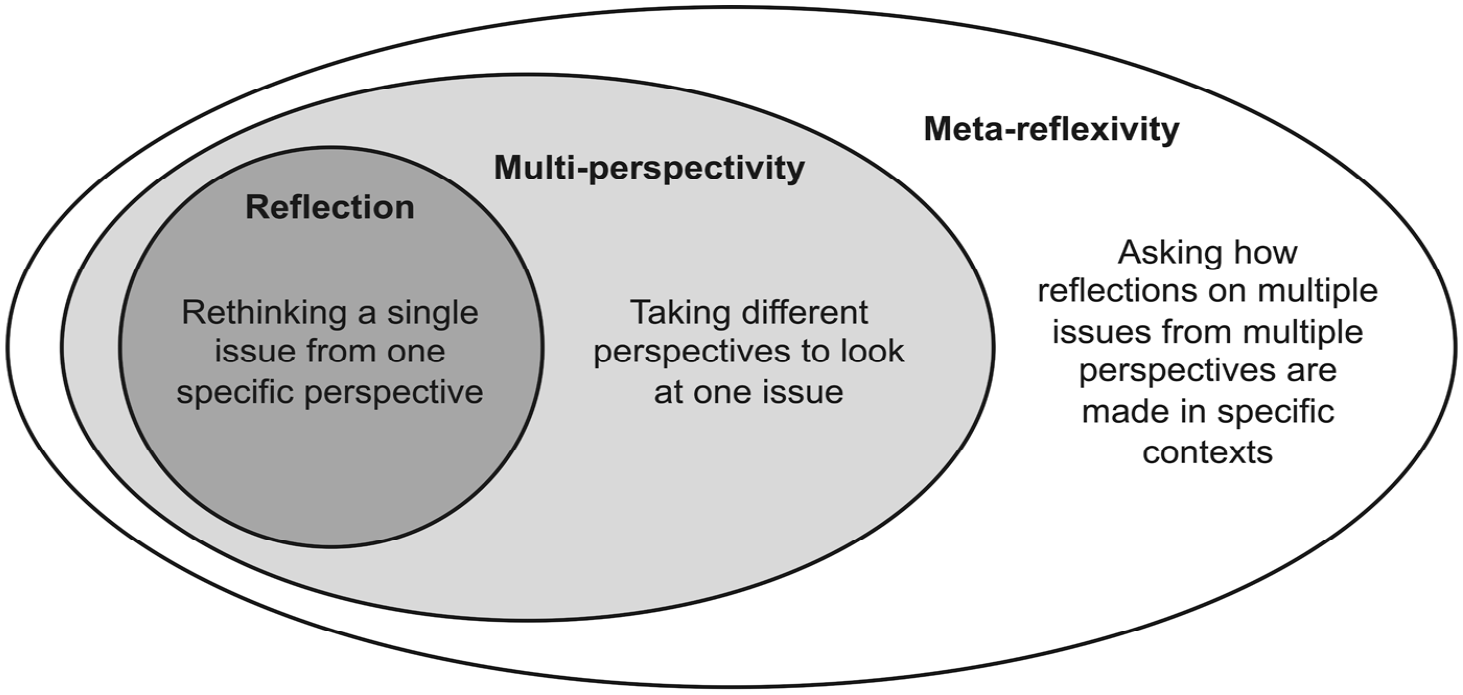
Meta-Reflexivity Including Multiperspectivity and Reflection.
For instance, as Figure 1 illustrates, reflection focusses on a conscious rethinking of a single issue from one specific perspective. A certain object is observed, and the observations are made explicit and thus available for interpretation. Reflection in the sense of multiperspectivity utilizes different perspectives to look at one issue. Those perspectives are adopted under consideration of terminological differences that enable reflection on the limitations of observations that are made from solely one specific perspective. Meta-reflexivity then asks how reflections on multiple issues from multiple perspectives are made in specific contexts. It therefore includes reflection on the foundations and limitations of cross-conceptual perspectives, recognition of differential axiomatics, and the nature of knowledge.
We situate our work within the observation that no theory can directly or exhaustively guide successful pedagogical practice: For instance, it is sometimes insinuated that the professional knowledge of teachers alone can explain satisfy all desirable achievements of pupils—even if this knowledge is not empirically secured and is often determined exclusively by political actors and so claimed regardless of the ontological, epistemic, conceptual, methodological, and normative limits that actually exist. The meta-reflexive approach removes itself from the quest for one single and generalized explanatory model: “Teaching is a complex process in which teachers have multiple goals and engage in a variety of processes” (Fives et al., 2017, p. 280). It becomes visible that “Ideas that we hold as truths in teacher education must be open to inspection, debate, and even reconsideration” (Craig et al., 2022, pp. 222–223).
If research takes the complexity of teaching and teacher education into account, retrospective descriptions seem more appropriate than postulating forecasts for the future, causal derivations for the practice of action are rejected, and caution emerges about making normative statements based on empirical description only. The meta-reflexive approach, as a theoretical perspective on professionalism, takes the field of action into account (i.e., achieves practical significance) by adding a critical-rational component to complexity. Complexity and deviations in practice are also not considered contradictory to its (partial) empirical development. For example, considering the relationship between uncertainty in the field of action in school and the subjective certainties of teachers (convictions that are relevant for their everyday situation-specific decision-making) leads to the question of whether largely stable personality traits, beliefs and values, professional ethos, and so on act as (temporary) constants in the context of uncertainty: Cochran-Smith et al. (2014, p. 3) state that research into these stable instability relationships requires a departure from the frequently assumed linear logic of teacher education and its realization as practice—rather, integrative theoretical framework models are needed.
Theoretical Frameworks
The need for an integrative theoretical framework model of teacher professionalism, as proposed by this article, suggests itself from different angles. Selected approaches are outlined as the starting point for a heuristic model of meta-reflexivity that we unfold below.
Western History of Ideas as a Precondition for Meta-Reflexivity
Reflection understood as individual awareness of one’s own thinking and acting is controversial in the Western history of ideas. There is a tension between the antiquated idea of mapping theory and practice in a joint cosmos of thought and action on one hand and late-modern subject criticism on the other. If such a field of tension is ignored, there is the danger of a one-sided abolition of complexity. Both a sweepingly demanded practical relevance of scientific knowledge and a prereflexive doing of practice that is decoupled from theory and research are indications of such a reduction of complexity (see Cramer et al., 2019).
Unlike, for example, more holistic scientific traditions found in Asia, ideas have prevailed in the so-called Occident, at the latest with the Western European Enlightenment Philosophy (O’Grady, 2018), which regard the individual and its ability to make rational decisions as an important starting point for the development of modern sciences. Being capable of development and self-awareness is seen as a prerequisite for addressing issues of meta-reflexivity. While meta-reflexivity shares the poststructuralist idea of meaning as something that is fluid and not predictable or universalist, it is, first and foremost, based on the structuralist precondition that patterns of social interaction can be identified and described. This enables one to name and distinguish different paradigms in science, which can then be discussed by recourse to their commonalities and differences. From a meta-reflexive perspective, there is no necessity to finally decide for one of these schools of thought in the field of education (Rømer, 2021).
Through theoretical distance, practice itself can be questioned and its immanent “rational quality” (Long, 2013, p. 142) made accessible. Following this idea, student teachers would need to gain distance through engagement with theory, but conversely, they (also) demand to achieve procedural knowledge (“knowing how”) that goes deeper than just seeing the big picture. The availability of such a final procedural knowledge would presuppose that practice in school is not bound to situation-specific conditions. From a meta-theoretical perspective, this does not seem adequate because it would then inevitably set a particular idea of teacher education as “universal” (e.g., with the adoption and subsequent critique of “what works” within education policy, indicative of the issues of such universality: Biesta, 2007; Biesta et al., 2022).
Yet, prior to this move toward “what works,” the move toward subject theory in early modernity led to an initial primacy of theory. Here, unlike the present, however, the previously assumed possibility of obtaining a big picture was transformed by a focus on reflection by the individual, which can recognize itself as the origin of thought and action. Teacher education was reproached for isolating itself in a theoretical approach that held little relevance for professional practice (e.g., as attributed to teacher education in Germany in the late 20th century). From a meta-theoretical perspective, this attribution would be tantamount to a one-dimensional understanding of teacher education.
In late modernity, the subject’s ability to reflect came into doubt. It was considered as impossible to distance from oneself, and the individual was seen as integrated into social structures. The sociological tradition led to the causes and conditions of knowledge and cognition being attributed to a socially constituted meaning (Mead, 2015). Considering Luhmann (1995), a first-order mode of observation, asking what is being signified, has to be complemented by a second-order mode of observation, asking how distinctions are made. It is to be asked whether other distinctions can be used in such processes of reflection, thus incorporating epistemological critique into professional practice in school. The perception of the self-referentiality of each observation first enables alternative distinctions and interpretations of problems, which seem compelling in view of the complexity of teacher education.
Reflection, Personal Epistemology, and Meta-Reflexivity
Early on, it was demanded that teachers need critical reflection to examine the relevance of various scientific findings for their pedagogical practice. For instance, Mezirow (1991) emphasizes the need to critically reflect on “why we perceive, think, feel, or act as we do” (p. 108) in a sociocritical mode: “Problem posing involves making a taken-for-granted situation problematic, raising questions regarding its validity” (p. 105). For Brookfield (1995), it is relevant “to question assumptions and practices . . . that actually end up working against our own best long term interests” (p. 8) leading to the teacher as a critical reflective practitioner.
Accompanying the social dimension, a further note of caution about the possibility and extent of reflection emerges from the phenomenological tradition, in which we are reminded of knowledge’s inarticulable or “tacit” dimension—captured in Polanyi’s (2009) observation that “we know more than we can tell” (p. 4). Reflection always emerges from a background intentional mode or orientation toward the world that cannot be reduced without remainder or made fully explicit, reminding us that the products of meta-reflexivity can never be total or exhaustive. In addition, self-reflection is beyond the complete control of a subjective agent but emerges only in a dialogical or eventful (“grown up”) relation with the world (see Biesta, 2016).
In more recent discussion, reflection moves away from a (socio-)critical connotation and is thought of more in terms of its epistemic foundations. Definitions (e.g., Alexander, 2017, p. 308) understand reflection as a conscious rethinking of decisions and actions, as a (retrospective) stepping out of a specific action situation. The additional stepping out of the reflection situation itself, which is specific for meta-reflexivity—for example, by addressing the foundations and conditions of reflection—is addressed with reference to action-relevant epistemic beliefs. Epistemic reflexivity can become “a powerful tool for teachers to facilitate meaningful and sustainable change in their classroom teaching” (Feucht et al., 2017, p. 334). The internal dialogue of a teacher can become epistemic reflexivity when it leads to modified expectations or beliefs and/or modified actions. This is the case, for example, when (student) teachers not only discuss a school-based sequence of actions in mathematics education, but when they develop a new, complex understanding of mathematics as a scientific discipline, with which a different view of mathematics education, as a whole, is associated (Felbrich et al., 2008). A change in personal epistemology (beliefs and cognitions about knowledge) due to an “Explicit Meta-Reflexive Practice” (Feucht et al., 2017, p. 335) is intended. Based on the identification of a relevant aspect of teaching (reflection), an internal dialogue, including aspects of personal epistemology (reflexivity), should take place, which finally leads to decisions of action in the class (resolved action). These steps were further developed into the concept of epistemic cognition (“concerns how people acquire, understand, justify, change and use knowledge in formal and informal contexts,” Greene et al., 2016, p. 1) in the 3R-EC-Framework (Lunn Brownlee et al., 2017), with the claim to support changes in cognitions.
Meta-reflexivity can be sharpened according to personal epistemology as an individual development of epistemic beliefs (Kerwer & Rosman, 2020). In the first stage, students can be expected to follow the idea of absolutism, hence that knowledge is objective facts. As they go through teacher education, multiplism (relativism) kicks in as an understanding of scientific knowledge as subjective opinions of scientists. Finally, there is the assumption that evaluism (postrelativism) can occur which assumes that scientific knowledge can be evaluated for its respective significance within and merit to specific contexts. Correspondingly, a gradual development of meta-reflexivity would be assumed. Furthermore, a dimensional view on personal epistemology, on the contrary, assumes independent dimensions of epistemic beliefs or cognitions (Hofer & Pintrich, 1997). Then, certain preconditions for meta-reflexive thinking could be established and meta-reflexive statements might be made a priori about which epistemic beliefs and cognitions could be relevant for professional action and be reflected upon (target categories): A meta-reflexive and thus evaluative or postrelativistic view—whether acquired in teacher education or brought into it—can contribute to perceiving it as more coherent.
Complexity Theory and Meta-Reflexivity
According to Cochran-Smith et al. (2014, p. 7), teacher education is a complex system that is influenced by frameworks (e.g., political settings), in which multiple interactions take place (e.g., between faculty and students). Such a system is dynamic and in disequilibrium (e.g., it is comprised of the conflicting views of educational policy and university), has evolved historically (e.g., via recourse to institutional frameworks), and (re)produces itself (e.g., adapting to social change). She proposes three modes of empirical research to map this complexity: (a) system mapping to lay “out the general landscape of a complex system” (p. 29); (b) extended case studies shift the focus “toward the ways that individuals’ experiences and performances are shaped by complex practice environments and organizations” (p. 31); and (c) process tracing to track processes and mechanisms that facilitate “teacher candidates’ enactment of classroom practices that enhance students’ learning” (p. 32).
From the meta-reflexive perspective, an idea of teacher education emerges from such research that focuses on the development of a professional teacher who is able to act under uncertainty. It consequently sees university teacher educators as “second-order teachers” (Swennen et al., 2010, p. 136), who not only offer student teachers knowledge but also see themselves as change agents for the formation of a professional teacher habitus. This requires a high degree of reflexivity and distancing from the teacher educators.
Discourse on Teacher Professionalism and Meta-Reflexivity
Although teaching is not simply a clinical profession, teachers and physicians share the requirement to act under a high level of uncertainty (Tatto, 2021). Doing so requires reflection on the basis of a specific professional ethos (Drahmann & Cramer, 2021). The subject of working in professions—such as the individual learning processes of students in the case of teaching—is ambiguous, leading to diverse definitions of teacher professionalism. It is important to take up these difficulties in defining this concept that is concerned with characterizing a sufficient qualification to practice the profession and is subject to constant change (Hoyle, 2008). We contribute new insights to the question of what teacher professionalism can be, in light of the intense debate in the last decades (Winch et al., 2013).
Traditionally, professionalism from a sociological perspective has been tied to the certain privileges of a profession such as social prestige, exclusive knowledge, autonomy, or a high societal relevance of the service (Freidson, 2001; Hoyle, 1974). Nowadays, approaches range from the basic assumptions of tension between autonomy and control described by Lortie (1975) to a more empirically grounded notion of professionalism based on the development of knowledge for the purpose of serving society (Gardner & Shulman, 2005) and the idea of a research-informed understanding of being professional (Tatto, 2021).
Evans (2008) argues for a readjustment: seeing the core of a profession in its specific culture as an “ideological consensus” (p. 24) that is formed by the sum of professionality shown by its members. According to the distinction made by Hoyle (1974), who saw the more formally and status-related issues of teaching as professionalism and elements such as professional knowledge and skills as professionality, Evans (2008) defines professionality as “an ideologically-, attitudinally-, intellectually- and epistemologically-based stance on the part of an individual, in relation to the practice of the profession to which s/he belongs, and which influences her/his professional practice” (p. 26). In this vein, professionality orientation is thus the location of individuals on a continuum between a restricted way of relying on experience and intuition in day-to-day practice and an extended understanding of teaching based on its theoretical nature. Professionalism is thus to be understood as “the amalgam of multiple ‘professionalities’” (p. 26).
In our focus, there are the basic conditions that characterize teaching as an educational profession (extended) without decoupling these characteristics from the everyday demands of teaching (restricted). If “the amalgamation of individuals’ professionalities influences and shapes the collective professionalism, which, in turn, stimulates or provokes responses in individuals that determine their professionality orientations” (Evans, 2008, p. 27), then meta-reflexivity is first carried out on the level of individual professionality of each teacher, which, in sum, contributes to the characterization of a collective meta-reflexive professionalism (as a specific professional culture) in the teaching profession as a whole. This, in turn, provides a reference for the future-proof positioning of (prospective) teachers as professionals. Professionalism is thus not defined by a set of externally prescribed characteristics of a profession or by certain expectations for professionals (Evans, 2011), but by a diversity of attitudes toward one’s own professional role within the larger framework of collective meta-reflexive professionalism. As a starting point, we follow Evans’s (2008) definition of professionalism as a professionality-influenced practice that is consistent with commonly-held consensual delineations of a specific profession and that both contributes to and reflects perceptions of the profession’s purpose and status and the specific nature, range and levels of service provided by, and expertise prevalent within, the profession, as well as the general ethical code underpinning this practice. (p. 29)
The meta-reflexive approach offers a theoretical perspective that does justice to the diversity of options for action in teaching by recourse to alternative ways of looking at school as a prerequisite for both individual professionality and collective professionalism. “It is important . . . we continue to problematize the taken-for-granted teacher education dogmas so discussions across differences (terminology, language, sensemaking, etc.) can occur” (Craig et al., 2022, p. 221). Teacher education as the institutionalized endeavor of increasing professionalism must problematize the supposedly obvious: Meta-reflexivity sensitizes us to the question of how and from which perspective which individual or collective understanding of professional action seems appropriate with which arguments, and whether it is prescribed by externals or enacted by teachers themselves. It contributes to the explanation of how professionalism can be constituted and how it becomes relevant for making decisions in the future-proof profession of teaching.
Theoretical Implications for Teacher Education
Following the starting point of Western history of ideas, the considerations on reflection and personal epistemology, complexity theory, and teaching as a profession, consequences for the constitution of meta-reflexivity can be drawn, especially when it comes to teacher education. This is relevant because research on teacher education is fragmented and diverse; as a result, the overall endeavor and its complexity are lost from view: “what is needed are new research questions and theoretical frameworks that account for wholes, not just parts, and take complex, rather than reductionist perspectives” (Cochran-Smith et al., 2014, p. 1).
Teacher education can be understood as a complex system (Byrne, 1998). The complexity results from the system itself, from the interactions and nonlinear relationships of its parts—the system is far more than their sum, so “outcomes are emergent and unpredictable, although not random and not inexplicable” (Cochran-Smith et al., 2014, p. 6).
Biesta (2007) reminds us that education is not a causal practice but is a “symbolically mediated” interaction in which teaching only affects learning because “students interpret and try to make sense of what they are taught” (p. 57). Thus, education is not a process of “push and pull” but is “an open and recursive system” (p. 57). Furthermore, in continuation of MacIntyre (1985, p. 98), social life can be characterized by unpredictability and has a game-theoretic character, speaking of situations where parties are always trying to predict what the other is doing, where there is imperfect knowledge, and where there is a universe of unknowns. This uncertainty in human interaction is reflected by concepts of professionalism that inevitably also focus on professional practice, the unpredictability of success in teacher education, and how teachers learn (Cochran-Smith & Lytle, 1999). There is an “importance of teachers’ agency—that is, their active contribution to shaping their work and its conditions” (Biesta et al., 2015, p. 624) in the pedagogical field of action in school, which continuously confronts teachers with new situation-specific decisions for action. Pedagogical reasoning is not linear, and teachers struggle when trying to achieve pedagogical equilibrium (Saito et al., 2022). From a meta-reflexive perspective, it is therefore important to achieve an awareness of one’s own convictions and knowledge as well as the extent and limits of reflection on one’s own professionalization (Lunn Brownlee et al., 2017).
Uncertainty represents a challenge for pedagogical action in school. Teachers can never be certain of the consequences of their action, and so the task of (social) science in teacher education is often defined in reflection as an analysis of pedagogical practice to generate orientation knowledge for acting under uncertainty (Luhmann & Schorr, 2000). This helps limit contingency, making appropriate decisions for action more probable in the pedagogical field of action characterized by a “deficit of technology” (Vanderstraeten, 2000): that is a fundamental and insurmountable lack of linear causality between the intention of an educator (teacher) and its actual effect on the educated person (student). But the relevance of professional knowledge is bound to certain ideas of the relationship between theory (scientific system of statements) and practice (situation-specific professional action) if it is intended to be relevant for teachers’ action. To consistently account for uncertainty, it seems necessary to consider such bases of reflection.
Uncertainty is evident in theories on professionalism, in research methodology, due to the complexity and irreducibility of the field of action in school, and in the social contexts of pedagogical practice, as well as in the plurality of approaches themselves (Cramer et al., 2019). The question that is answered depends on the question that is asked—the same in research as in teacher education (Cochran-Smith, 2004). Meta-reflexive teacher education is a possible professionalization strategy to be able to deal adequately with uncertainty generated from the professional field of action and from the inherent logic of the scientific cognition process (endemic double uncertainty). The relation and limitations of specific ways of looking at things become apparent: In a meta-reflexive manner, it is necessary to take different perspectives on the same object, to understand the foundations of individual perspectives, as well as to be able to comprehend the mode of the respective observation regarding potentials and limitations and to interpret it in relation to the other perspectives. This seems especially relevant in teacher education because it is characterized by a plurality of (epistemological) theories and empirical approaches due to the numerous scientific (sub-)disciplines involved. Student teachers have so far appeared to be largely on their own when they are supposed to transform these divergent perspectives into a coherent overall picture or when confronted with the monopolizing claim of a particular theory or empirical finding. Meta-reflexive professionalism therefore corresponds to reflecting on one’s own knowledge and actions against the background that there is ambiguous (social) scientific knowledge, and it is possible to relate divergent perspectives to each other.
Meta-Reflexivity as a Broadening of Perspective
Student perspectives on teacher education are embedded in horizons of interpretation that are accompanied by partly contrary epistemic approaches (e.g., simultaneous demand for theoretical guidance of action in school and the primacy afforded to practice). In each case, individual horizons of understanding schools emerge, which are constitutive for education and are not mutually interchangeable. Individual theories are then to be considered problematic in teacher education when they claim a monopoly: There is no integrating tendency between social science theories through paradigm shifts or restriction to general theorems. For example, theories originating from humanities or empirical studies on teachers and teacher education stand side by side, each offering specific benefits. First and foremost, the possibility of a comparison between theories enables the individual to reflect on their specific view of things and to understand their views as particular constructions of an ambivalent, ambiguous reality. While teachers must make their decisions against the backdrop of certain normative settings, there cannot be the one basis for decision-making. Theory and empirical findings can be interpretive horizons for decision-making that extend intuitive assumptions through detached, nuanced, and controlled observations. Meta-reflexivity requires the consultation of different approaches. It distances itself from the possibility of a theoretical over-forming or radical distancing from the field of action.
Meta-reflexivity as a goal of teacher education at university requires knowing theories in terms of consistent propositional systems (this includes empirical frameworks) and their limitations. Theories limit the uncertainty of the pedagogical field: In academic courses, actions are made available, for example, by referring to video case studies, and providing relief from immediate action allows a limit to contingency by differentiating between the interpretation of pedagogical situations in teacher education and real action in school. A meta-reflexive teacher is aware that there is no linear application of theory to practice. Through contrasting engagement with different or even apparently incommensurable (scientific and experience-based) perspectives, meta-reflexivity could be initiated as broadening the perspective on professional practice.
The Perspective of Meta-Reflexivity
The initial assumption that student teachers must bring together diverse issues raises the question of how the knowledge they gain in teacher education and their day-to-day practice as future teachers are related. Meta-reflexivity allows us to theorize the complex and often diffuse relations between the environment of teacher education at university and the environment of the pedagogical field of action in school. As such, meta-reflexivity is defined as the awareness of different theoretical approaches and empirical findings related to the teaching profession, the ability to situate these with regard to their respective backgrounds and claims to validity, to relate them to each other and to be able to critically deal with them, as well as to be able to make consistent, exemplary-typifying (saturated, pattern spotting) interpretations of the complex field of pedagogical action in school. With reference to these exemplary-typifying interpretations, appropriate situation-specific (situational) interpretations can be developed in school and, building on these, options for action-related decisions appropriate to the situation can be established. The decisions for a specific action and the action itself can take place with reference to these options. (Cramer et al., 2019, p. 410, translated)
A simplified representation of this definition of meta-reflexivity is illustrated in Figure 2. The numbers found in the figure can be explained as follows:
(1) Students accumulate knowledge about theories and empirical findings in (initial) teacher education, which they are increasingly able to locate and relate to specific academic traditions and paradigms. These intrascientific processes are first and foremost related to the environment of the university as a social system.
(2) On this basis, however, students can potentially also make exemplary-typifying interpretations of the anticipated field of action in school.
(3) What is meant by this are consistent and reliable patterns of interpretation based on findings repeatedly produced in research, such as basic theoretical assumptions or empirical findings that are considered stable.
(4) Dealing with exemplary-typifying interpretations can have relevance for which theories and empirical findings students increasingly deal with.
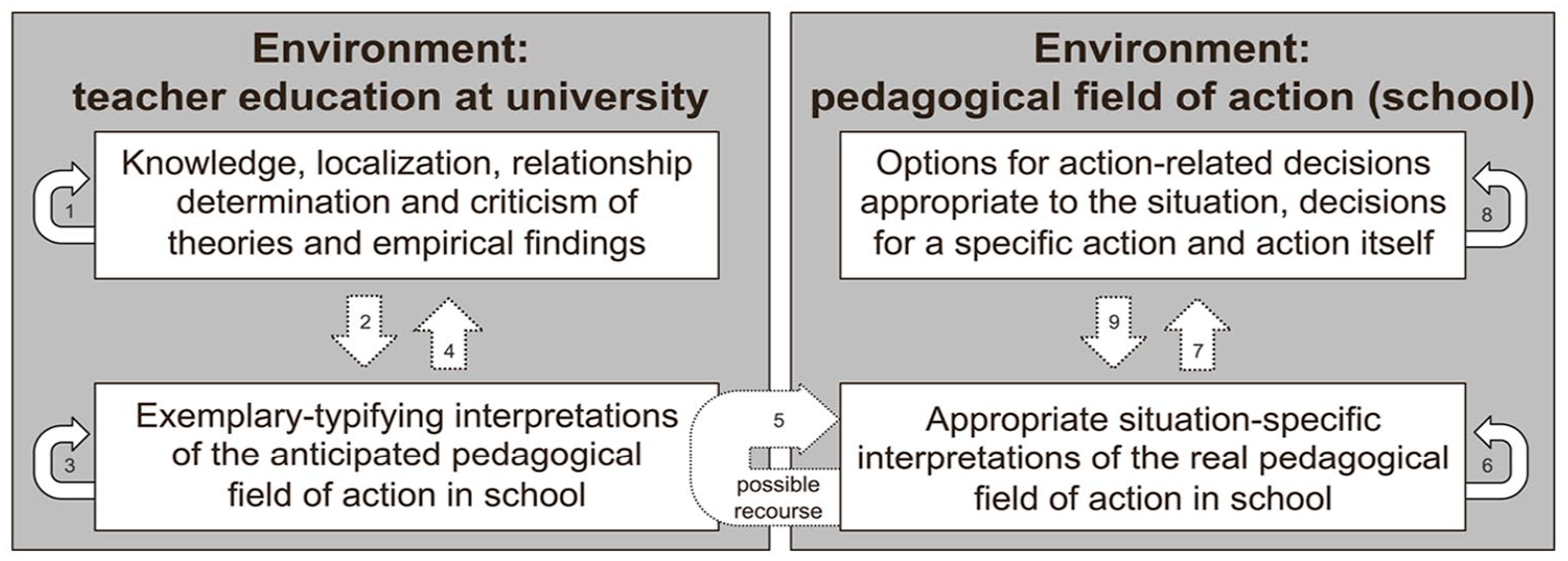
Meta-Reflexivity in the Recursive Relation of Two Environments: The Field of Action in School to Teacher Education at University
However, these exemplary-typifying (saturated) interpretations do not directly result in appropriate situation-specific (situational) interpretations, which teachers must continuously make in the real field of action in the environment of the school. Due to the local separation of university and school, there is no linear penetration of ideal-typical scientific interpretations into the uncertain field of action in school:
(5) Rather, the relevance of (initial) teacher education lies in being a possible reference point for making situation-specific interpretations in the field of action, in which one can, but does not have to fall back on the exemplary-typifying interpretations from teacher education.
Such situation-specific interpretations are appropriate when they do not ascribe arbitrary meaning to the observed facts, but when recourse is made to exemplary-typifying interpretations, and also, of course, when such recourse is excluded because no such saturated interpretations are available. The degree of professionalism is assessed by the quality and not by the quantity of this recourse. Appropriate situation-specific interpretations are then also professional interpretations if they are made in the light of reflection on scientifically saturated interpretations:
(6) Here, situational interpretations are not evoked by this recursion, but are usually experience-based (self-recursivity). As such, even without this recursion, appropriate situational interpretations can occur, but they would not be described as professional, but as intuitive (Evans, 2008).
(7) (Appropriate) situational interpretations can potentially inspire multiple options for action.
(8) However, these options tend to be experience-based evocations.
(9) Ideally, their evaluation can be based on the most appropriate situational interpretation possible.
Making a decision to act would then potentially recur to the saturated interpretations gained in teacher education.
Professional (meta-reflexive) teachers are characterized by their ability to gain as many exemplary-typifying (saturated) interpretations as possible (especially in initial teacher education at university) and to achieve appropriate situation-specific (situational) interpretations in the field of action in school with recourse to these or in distinction from them, which can be the basis for weighing options for action and making a decision to act. Such meta-reflexive elaborations (metacognitions) are then the constitutive core of professionalism. They include the certainty that theory cannot simply be mapped onto practice, that practice is therefore always ambiguous (including an ethical ambiguity), and that consequently there is no one single appropriate decision to act. However, teacher education in the mode of meta-reflexivity could increase the probability of appropriate situation-specific interpretations because it enables the recourse to consistent, exemplary-typifying interpretations in the first place: Meta-reflexivity manifests itself in the secure handling of uncertainty.
Relevance of Meta-Reflexivity to Teacher Education
Meta-reflexive teacher education (secondary mode) is dependent on the approaches of teacher education in a primary mode. It relates the primary gained professional knowledge and competencies, case-related reflexivity, the increased sensitivity for biographically relevant experiences, and so on reciprocally to each other. To this end, it directs attention to the foundations and arguments immanent to such models of professionalism (and further theories). Heuristic principles of meta-reflexive teacher education in terms of secondary modes differentiate and dimension the primary modes. This is illustrated in Figure 3.
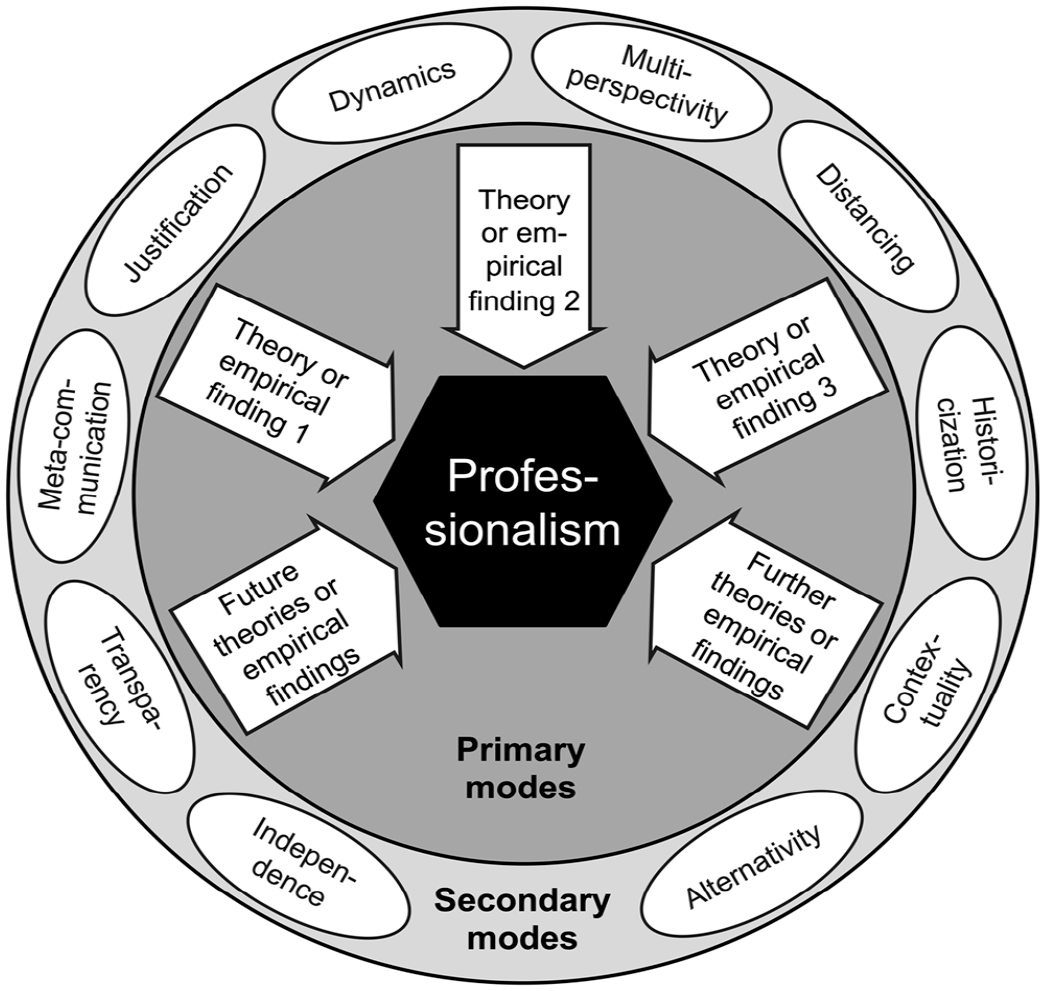
Primary and Secondary Modes of Professionalism: Principles of Meta-Reflexive Teacher Education
The principles are and can be described as follows: (a) Consequent multiperspectivity on theories and empirical findings can foster the development of meta-reflexivity. (b) On its basis, the principle of distancing can be thematized as recognizing the added value of critical-constructive, that is, distanced (temporally relieved) considerations. (c) Furthermore, historicization means a sensitivity to the (contingent) historical circumstances of the emergence of a particular theory or empirical context, which supports understanding of the possibility of alternative conceptions in different circumstances. (d) As one result of this awareness, the contextuality of scientific cognition in theory and empiricism is to be disclosed. (e) Furthermore, a regular thematization of the alternativity or provisional nature of all cognitions can sensitize to the fact that every chosen theory can neither completely nor conclusively explain the field of action in school. (f) The independence of specific ways of looking at things points to different settings (concepts, theorems, paradigms, etc.) that place theories in a nonhierarchical relationship to each other. (g) The awareness of each specific axiomatic points to the relevance of transparency in teacher education by disclosing the principles to students and discussing them together. (h) Thereby, a meta-communication is necessary about the manner in which different theories and empirical findings are considered in a meta-reflexive perspective at university. (i) The question of the selection criteria and sources as well as the relevance of the theories and findings need a justification by university teacher educators and go hand in hand with this. (j) The principle of dynamics as a gradual increase of the degree of complexity in their courses and lectures appears to be important to avoid overtaxing students. Further principles might be added in future, leading to an even more differentiated understanding of meta-reflexivity.
Meta-Reflexivity and Coherence in Teacher Education
In addition to this specific perspective, which arises with meta-reflexivity as a secondary mode of teacher’s professionalism, it is also crucial to the old but still virulent debate about coherence in teacher education (Hammerness, 2006), the intention to force a meaningful linkage of the single elements of teacher education through curricular optimization. According to meta-reflexivity, such a meaningful linkage is ultimately characterized as informal-individual coherence that must emerge in the minds of students if different theories, paradigms, scientific disciplines, and so on are to be related to each other in teacher education. The discourse in this regard has so far largely ignored this fact and assumes that meaningful linkages can be established technically-instrumentally in the sense of a formal-institutional (curricular) coherence alone. Of course, it can be assumed that curricular-based formal-institutional coherence can optimize the framework conditions of teacher education programs in such a way that informal-individual coherence is more likely to emerge. Thus, meta-reflexivity rejects the too simple idea that best practices and curricular optimization alone can be sufficient for teacher education, such as, for example, certain practices in England assume or that legal restrictions on dealing with diversity and multiculturalism in (teacher) education (PEN America, 2021) can be easily legitimized in democracies, as in the United States. Instead, it can be understood as a guiding principle that opens a basic idea of how teachers can professionalize themselves under conditions of complexity and uncertainty.
Meta-Reflexivity and Democracy in Teacher Education
The way of gaining distance and weighing alternatives by broadening perspectives seems to be essential and enriching even in more fundamental ways. In recent years, Western democracies have been challenged and the achievements of intellectual history have been questioned in quite novel ways. In addition to the societal and political divisive tendencies in the United States, questions about constitutional principles are also being raised in Europe, not to mention the war in Ukraine, and a new preoccupation with the question of what constitutes the common basis for values is needed.
This is particularly evident in the field of (teacher) education. In the United States, for example, an increase in bills, laws, and executive orders known as “educational gag orders” has been demonstrated (PEN America, 2021). For instance, by officially banning certain literature from classrooms, such increasingly punitive regulations limit free discussion of socially controversial topics, including the study of categories such as race, ethnicity, and gender in schools. Similar tendencies can be found in Europe, for example, in Hungary. Recently, restrictions have also increased, affecting not only schools but also universities and teacher colleges, for example, regarding curricula transparency. Especially in democratic societies, this disregard for diversity and the general distrust of educational professionals in school and teacher education represents a disturbing trend. The diversity that exists in society does not disappear by being ignored or suppressed. Democracy is based on addressing and positioning oneself in the face of such differences.
Many social groups do not feel sufficiently heard and involved. Their lack of participation plays into the hands of all too simple and unambiguous patterns of interpretation (absolutism), but can also promote an egalitarian attitude toward scientific knowledge (multiplism/relativism) and makes it difficult to open up to the better argument (evaluism/postrelativism). A strong democracy needs the conditions and the opportunity to constantly renegotiate the shared good of democracy and thus arguments (Habermas, 1986). The massive legislative and public control of teachers and teacher educators limiting the freedom to address socially controversial issues, such as multiculturalism, also pose another challenge: Because of the broad societal impact of teachers’ actions into future generations, there is a risk that such restrictions of teachers and education might manifest itself in our general societal conceptions of democracy and citizenship. The freedom of expression and the ability to tolerate differences run the risk of being replaced by simple truths.
Democracy plays an important role in teacher education and vice versa: “We advocate for the creation of new hybrid spaces in university teacher education where academic, school-based, and community-based knowledge come together in less hierarchical and haphazard ways to support teacher learning” (Zeichner et al., 2015, p. 124). Teacher education can be even framed as a contribution to “democratic professionalism” (Zeichner, 2020, p. 38). Teachers are not only responsible and accountable for their actions in and for the preservation of democracy; they also need to be professionalized in a way that enables them to do so and they need trust from different stakeholders (Cochran-Smith et al., 2018). Accountability is thus understood first and foremost as an individual achievement and only secondarily as an achievement of institutions (school or teacher education system): The required accountability of the teacher is necessarily accompanied by the accountability of the teacher educator. Both resemble what Schütz (1946) described as the well-informed citizen that “has to choose the frame of reference by choosing his interest; he has to investigate the zones of relevances adhering to it; and he has to gather as much knowledge as possible of the origin and sources of relevances actually or potentially” (pp. 474–475).
Furthermore, meta-reflexivity sensitizes to the potentials, but also to the limits of an evidence-based governance of the education system as well as an evidence-based decision-making of professional teachers. It has to consider “limits of knowledge, the nature of social interaction, the ways in which things can work, the processes of power that are involved in this and, most importantly, the values and normative orientations” (Biesta, 2010, p. 501). In the context of meta-reflexivity, this is not an argument against an empirically informed pedagogical practice, not an acceptance of relativism, but it is an argument against a radically empiricist position, which is always in need of expansion through other perspectives and must expose itself to critical scrutiny. For example, meta-analyses provide relevant information to the educational field, but they remain weak without a solid theoretical background and impact (Renkl, 2022) and risk underestimating the complexity of the field of education (Berliner, 2002).
Meta-Reflexivity and Diversity in Multicultural Teacher Education
The need to reflect on complex characteristics of teacher diversity in teacher education is emphasized in scholarship. Meta-reflexivity is one mode of addressing the multifaceted nature of diversity with respect to multiculturalism in the process of teacher professionalization, including dimensions of race and ethnicity, gender and sexual orientation, linguistic backgrounds, and religion among other cultural aspects. A meta-reflexive perspective does not advocate a single multicultural teacher education approach such as a conservative, liberal, or critical approach (Gorski & Dalton, 2019), but allows to recognize them as such and to discuss their respective claims to validity. This is relevant to situate oneself as a professional with regard to issues of multiculturalism, to better meet the needs of all students, especially because multicultural awareness of preservice candidates differs between populations of different cultural heritage (Cherng & Davis, 2019), which requires a high degree of distancing ability.
Furthermore, from a democracy perspective, meta-reflexivity contributes to an unbiased and balancing approach to diversity, both regarding students and the teachers themselves. For example, qualitative research reminds us that ideas of teachers’ professionalism are tied to social class, race, and gender, problematizing the exclusivity of a traditional understanding of teaching as a highly elaborated profession (Kurtz & White, 2022). Even within a teacher education program formally focused on diversity, a traditional understanding of deference to power, and high cultural capital can be handed down, as Tolbert and Eichelberger (2016) show within their case study. From a gender perspective, the common idea of modeling a professional teacher as acting rationally and instrumentally and being expected to subvert personal interests, for example, political concerns, can be subjected to critique (Dillabough, 1999). This seems particularly virulent because the teaching profession internationally is predominantly female, which reveals a particular mismatch between common teacher education practices and the mainly female student teachers addressed. A meta-reflexive perspective can sensitize people to the conflicting perspectives on the category of gender in a multicultural society and initiate transformation processes by distancing oneself from one’s own conceptions of roles.
Such diversity-sensitive research underscores the fundamental concern of meta-reflexivity to consistently consider the complexity and contextuality of modeling professionalism. However, the goal is not to overcome or abolish the concept or subject of professionalism, but to deal sensitively in all directions with the preconditions, the justifications, and the consequences of a particular approach to it. Scholars have repeatedly emphasized how presuppositional and laborious it can be to gain a diversity-sensitive view of teacher education, as the review of Ladson-Billings (1999) briefly shows. (Future) teachers can increase their awareness of their own (and often dominant) culture as a precondition to successfully perceive the culture of others, their (future) colleagues and students in school (Ladson-Billings, 2006). Meta-reflexivity pays attention to the “multi” in multicultural teacher education as it allows researching one’s own and foreign cultural imprints unpretentiously by identifying and juxtaposing them, thus making differences visible.
Ways of Realization: Meta-Reflexive Practice in Teacher Education
To illustrate the rather abstract meta-reflexive principles introduced so far with a view to their implementation in teacher education, possible forms of realization will now be shown.
Curriculum
According to the meta-reflexive principles of historicization and contextuality, in how to adequately switch between different theories and empirical findings, and to examine them for a possible mutual reference, the studying of basics of philosophy of science can be relevant. Such basics are rarely part of compulsory teacher education and could be addressed as a component of a mandatory lecture to make students aware of different approaches to science and knowledge in the sense of the principle of distancing. Furthermore, teacher education programs are increasingly standardized, while curricular electives can be taken that consciously sensitize students to unfamiliar scientific perspectives beyond their own chosen majors or specialist subjects. For example, students who only study languages could be confronted with natural science ways of thinking, or those in the life sciences could be familiarized with basic assumptions of the humanities to comprehend preconditions and consequences of different approaches to reality and knowledge characterized by alternativity and independence.
Methods
The idea of research-based learning as a relevant mode of scientific teacher education (Brewa & Saunders, 2020) can make the principles of transparency, meta-communication, and justification tangible. Certain decisions in the field of action can be more obvious and thus justifiable against the background of scientific findings, accountability can be given for decisions made, and decisions can be communicated in a comprehensible way to students, parents, school administrators, or the public. In meta-reflexive teacher education, such aspects of dealing with research are inherent in the presentation, processing, and discussion of research findings (science communication), which can be referred to in school practice. Thus, academia serves as a role model for transparency and meta-communication. A meta-reflexive stance avoids rash and under-complex transfers from theory to practice. The portfolio method, which is widely used in teacher education (Berrill & Whalen, 2007), ideally allows for very different perspectives on a school phenomenon. For example, cases (audio/text/video) can be captured in an e-portfolio during school internships, which are then processed in several courses from the different perspectives of the respective scientific disciplines, subject-matter teaching and learning, and insights from various educational sciences. Using the exemplary case of a language teacher, not only subject-related skills (e.g., appropriate language a teacher uses in the presentation of content) and subject-matter didactic aspects (e.g., teacher encourages conversation), but also categories from educational sciences (e.g., teacher disregards student heterogeneity) could be identified and related within the portfolio and corresponding discussions in involved courses. What is judged to be adequate from a certain perspective may be viewed as questionable from another one: Student teachers can realize that an adequate picture of a teaching situation can only be gained by taking different perspectives that can complement each other while also standing in tension.
Subject Specifics
The relevance of an adequate subject-specific self-understanding of teachers for student learning has been repeatedly highlighted (Felbrich et al., 2008). In this respect, in the light of the principles of contextuality, transparency, and meta-communication, subjects in university teacher education have a special responsibility to disclose and communicate to students their epistemic foundations. For example, what does it mean for mathematics to be an axiomatic science and what are its axioms, or is mathematics not a natural science but a humanity? How does a language and its grammar emerge as a formal logic even though language changes, or how do different reception modes relate to each other when dealing with literature? To what extent is Physical Education concerned with the development of sporting prowess, and to what extent with the promotion of healthy lifestyles or the development of holistic flourishing, as informed by certain theories of movement or conceptions of physical literacy? Raising such basic questions with meta-reflexive intent not only allows the epistemic foundations inherent in the subjects to become transparent: It also becomes clear that the question of good teaching or a professional teacher can only be adequately dealt with by revealing the perspective taken in each case. Moreover, different perspectives mutually enrich each other: Foundations of gaining knowledge are not only relevant for math teachers, interpretative openness of aesthetic experience concerns many areas (fine arts, literature, music, theater, etc.), and all school subjects can contribute to health. Thus, in the mode of meta-reflexivity, a sensitivity for transversal demands on teachers can be created, for example, to behave as adequately as possible regarding issues of language sensitivity, digitalization, sustainability, diversity, and further cross-sectional tasks.
Conclusion: Meta-Reflexivity as Professionalism
The principles of meta-reflexivity ideally describe professional teachers (and teacher educators) who are able to critically examine and evaluate offers of interpretation and thus do not prematurely expose themselves to a specific (political) lack of alternatives. To do so, teachers need professional knowledge and a professional ethos, a vision for their practice in school. For them, it is inevitable to make decisions in their pedagogical practice that they consider to be as adequate and justified as possible. Only by gaining security under uncertainty, they can hopefully strengthen the outcomes of their students. Decision-making with the participation of those involved in school life to strengthen professional learning networks (Brown, 2020) requires the ability to change perspectives and to critically evaluate the arguments put forward, that is, a discussion about who is responsible for what and why with what expertise. The possession of a broad understanding of these positions and the ability to integrate existing potentials of different groups of actors and individuals can be understood as a central meta-reflexive achievement.
Discussion
When weighing interpretations from multiple perspectives on the field of action in school (Feucht et al., 2017, p. 238), a close relation of meta-reflexivity to the discourse around epistemic cognitions becomes apparent (e.g., Kindlinger, 2021)—but with some significant differences: First, reflection and reflexivity are limited to the construct of epistemic cognition, whereas in a meta-reflexive mode, manifold ways of modeling the basis for meta-elaborations are possible; second, a (direct) effect of reflexivity on changed action is assumed, whereas reflection in a meta-reflexive mode takes place through recursivity to professional knowledge and as a preliminary stage to action; and third, the reference for meta-reflexive elaborations never solely lies in one’s own action, but (also) in plural scientific theory and empirical findings (reflection of differential axiomatics and their limitations). Meta-reflexivity thus takes up the critique of Alexander (2017, p. 308) who questions “merits of adding the term of reflexivity . . . to the educational lexicon without further conceptual elaboration”—the sole claim to use the term to describe reflection in action situations falls short of the mark.
The demands and relevance of meta-reflexivity are difficult to convey (at the beginning of a study program) and carry the risk of excessive demands. Meta-reflexivity as one target perspective of professionalization can only be achieved by a gradual increase in complexity during teacher education. Theoretical assumptions (e.g., uncertainty and multiperspectivity) must be disclosed and discussed. The potential relevance of meta-reflexivity for professional action has to be researched (empirically), because teaching success is obviously based on knowledge, but also on intuition and experience (Evans, 2008). Further inquiries are the following: Can meta-reflexive knowledge be determined as flexible knowledge about nonlinearity, about the optionality of situation-specific action, if there is no unified understanding of teachers’ professionalism? Can meta-reflexivity be produced by recourse to primary theories and empirical findings, or can skeptical sovereignty in dealing with them only be established by one’s preexisting critical distance? And, can scientific practice that is informed by science theory in the sense of meta-reflexivity be a theory of professionalism or is it only a specific perspective on theories on professionalism or the (didactic) way of dealing with them? In addition, it must be stated that empirical research on meta-reflexivity is a desideratum that has only been partially addressed so far (e.g., Hartmann et al., 2021). Finally, the roots of meta-reflexive thinking itself and the related preference of multiperspectivity can expose themselves to criticism.
The perspective of meta-reflexivity is probably also to be understood as a demand on teacher educators in times of challenged democracies. Meta-reflexivity means being able to deal productively with divergent perspectives in their potential contradictoriness. However, these contradictions are then not to be evaluated as conflicting, but as different perspectives on the same issue that stand unpretentiously side by side: To perceive quite different things explicitly in their incoherence is itself a form of obtaining coherence. Therefore, meta-reflexivity has the potential to prevent ruptures in the process of professionalization of (future) teachers and to open up a perspective for them on how what at first sight seems incompatible can be perceived as mutually enriching through distanced observation. As the above examples of a possible practical realization of meta-reflexive teacher education show, the proposed principles can be implemented through curricular additions, but also in a low-threshold way through supplementing existing courses and the adaptations of previously introduced methods that characterize teacher education as an academic endeavor. Those responsible for teacher education must ask themselves whether and how capacity can be ensured for teacher educators to be oriented toward meta-reflective principles and not to view the direct usability of professional knowledge acquired as the sole goal of teacher education. To ensure this, they must themselves be meta-reflexive.
Footnotes
Declaration Of Conflicting Interests
The author(s) declared no potential conflicts of interest with respect to the research, authorship, and/or publication of this article.
Funding
The author(s) received no financial support for the research, authorship, and/or publication of this article.
