




Abstract
Teachers commonly use sites such as Pinterest, TeachersPayTeachers.com, and Instagram to support their lesson planning. Developing a critical lens toward the use of these sites in teacher education is imperative, yet little research has been published outlining how this might be done. This study investigates how 44 teacher candidates (TCs) across two methods courses altered their thinking about the use of sites such as Pinterest, TeachersPayTeachers.com, and Instagram after experiencing explicit instruction and practice in 21st-century critical curriculum literacy. Findings indicate that TCs developed a more critical lens toward these sites, yet the inclusion of critical pedagogical content knowledge within 21st-century critical curriculum literacy is essential to develop a critical lens toward specific resources. Implications include how teacher educators might continue to develop 21st-century critical curriculum literacy in TCs and directions for future research.
Keywords
Over the last decade, teachers have increasingly used the internet for professional learning. The rise of 21st-century social media platforms has aided this endeavor, as teachers join and participate in online professional learning networks to support professional growth (Trust et al., 2016). It is widely established that teachers use social media for professional purposes (Greenhow et al., 2019). Whether it be for professional learning (Carpenter & Krutka, 2014, 2015; Davis, 2015; Wesely, 2013), to combat isolation (Carpenter & Krutka, 2014; Staudt Willet, 2019), for mentorship (Cinkara & Arslan, 2017), or to find teaching inspiration (Sawyer et al., 2020; Schroeder et al., 2019), teachers and teacher candidates (TCs) use social media platforms and other sites on the internet often. Moreover, seeing a market for their knowledge and knowledge products, education influencers and online teacherpreneurs (Shelton & Archambault, 2018, 2019) have risen in status on sites like Instagram and TeachersPayTeachers (TpT), contributing to teachers’ use of such sites.
Although it is widely known why teachers turn to these sites, it is less understood how they interrogate, problematize, or otherwise “vet” the unvetted resources found there (Sawyer et al., 2020). Indeed, we currently see little empirical work in the field of teacher education that addresses how TCs critique such resources or how teacher educators might support that endeavor. Compounding the issue, Knake et al. (2021) have identified that the quality of curricular resources teachers save online is related to student achievement. More specifically, teachers who save materials with less cognitive demand see negative impacts on student growth. They argue that “Despite whether they [curricular materials] are used within the classroom, they speak to a broader vantage of how teachers conceptualize knowledge and their teaching practice” (n.p.). Something as seemingly simple as a teacher’s Pinterest pinboard, then, can have profound consequences, resulting in inequitable access to a quality education. Given the lack of published empirical research on how teachers vet online materials, and Sawyer and Myers’s (2018) assertion that “preservice teachers need additional support in identifying valid resources” (p. 28), we set out in this study to develop what we term 21st-century critical curriculum literacy (21st-centuryCCL) in elementary TCs at two research-intensive universities. After designing and teaching a generalized instructional sequence based on 21st-centuryCCL for use across elementary methods courses, we asked the following research question: In what ways do explicit instruction and practice in 21st-centuryCCL inform how TCs approach using resources found on the Teacher-to-teacher Online Marketplace of Ideas (TOMI)?
Literature Review
We position our work within the growing bodies of scholarship around how teachers use social media and other networking sites for professional learning. We define the TOMI and share how teachers use this marketplace. We synthesize the positive outcomes of teachers’ usage of the TOMI, the critiques scholars have levied on the TOMI, and how researchers and teacher educators have sought to prepare TCs to make sense of this ever-evolving space.
The Teacher-to-Teacher Online Marketplace of Ideas
Teachers’ use of sites such as Twitter and Facebook has been heavily researched (Carpenter & Krutka, 2014, 2015; Cinkara & Arslan, 2017; Davis, 2015; Greenhalgh & Koehler, 2017; Manca & Ranieri, 2016; Rehm & Notten, 2016), both in the United States and internationally. Of emerging interest to educational researchers is how preservice and inservice teachers use sites such as Pinterest, TpT, YouTube, and Instagram to support professional learning and classroom curriculum design (Carpenter et al., 2018; Gallagher et al., 2019; Pittard, 2017; Polikoff & Dean, 2019; Sawyer et al., 2020; Sawyer & Myers, 2018; Schroeder et al., 2019). To differentiate these sites from the more generalized language of “online resources,” Shelton et al. (2020) have termed these sites (including Twitter, Facebook, Pinterest, Instagram, TpT, YouTube, Patreon, Amazon Ignite, and teacher blogs) the TOMI, as teachers use them to share curricular materials sometimes at a cost, sometimes for free, in online spaces. Indeed, the TOMI can be differentiated from other sites of curriculum sharing, like those of professional organizations, due to its democratized nature, as resources shared in the TOMI undergo no peer review or vetting process (Hunter & Hall, 2018).
How Teachers Use the TOMI
TCs use TOMI materials frequently. Sawyer et al. (2020) found elementary-level TCs turn to TpT, Pinterest, and YouTube to support lesson planning almost as often as they turn to a mentor teacher and more often than they seek guidance from university faculty. Evidence suggests TCs use resources from the TOMI more often than those from professional organizations or other vetted Open Educational Resources (OERs) (Caniglia & Meadows, 2018). Indeed, TCs’ use of the TOMI mirrors what scholars know about inservice teachers’ use of the TOMI. A RAND American Teacher Panel survey of more than 2,500 K-12 teachers found that up to 77% of teachers used TpT and Pinterest to plan curriculum (Kaufman et al., 2016). To further attest to its popularity, TpT boasts that over two thirds of U.S. teachers have downloaded a resource from the site. Instagram has also risen in popularity, as education influencers serve as informal mentors for teachers by offering insight into classroom routines, activities, and inspiring lessons (Rozen, 2018), usually linked to TpT for a cost. As of this writing, there are more than 6 million photos posted to Instagram with the hashtag #teachersofinstagram, the use of which helps teachers promote their Instagram and connected websites.
Positive Features of the TOMI
Positive outcomes of teachers’ social media and TOMI use exist. Social media can and have been used by teachers to engage in professional learning through the exchange of ideas and the building of community (Greenhow et al., 2019). Isolated in their classrooms and with little time to collaborate during the school day, online communities enable teachers to combat isolation and share with other teachers (Hur & Brush, 2009). Some assert that professional learning on social media is more individualized and self-directed (Visser et al., 2014), authentic, relevant, collective, and sustaining (Fischer et al., 2019) than traditional forms of professional learning. Educators concerned with social justice have found community on social media (Collins, 2019), and, with guided instruction using Pinterest, TCs learning about disability have been able to expand “their knowledge of various instructional strategies by finding multiple ways that supported strong pedagogy for future teaching” (Peterson-Ahmad et al., 2018, p. 7). Content creators, in particular those who create products for TpT, are highly educated and experienced educators who claim to use research-based practices to design materials that support diverse learners (Shelton & Archambault, 2019, 2020).
Criticism of the TOMI
Despite the popularity of the TOMI with teachers and its many affordances, researchers have critiqued the TOMI for inaccuracies, lack of depth, and capitalist spirit. Across content areas, lesson ideas and activities found on sites like Pinterest and TpT contain frequent inaccuracies or misrepresentations, particularly in math (Hertel & Wessman-Enzinger, 2017; Hu et al., 2018; Kaminski & Sloutsky, 2020; Sawyer et al., 2020) and social studies (Gallagher et al., 2019; Rodríguez et al., 2020; Shelton et al., 2020). Polikoff and Dean (2019) also argue that secondary English language arts resources on TpT are “subpar” (p. 7), lack rigor, and “do a very poor job of offering teachers support for teaching diverse learners” (p. 116). Combined with the potential for a fragmented and incoherent curriculum from the use of a hodgepodge of resources rather than a textbook (Greene, 2016), Gustafson (2019) warns that curriculum created through the TOMI may result in curricular inequities. Researchers also raise alarm around Instagram, a site that can be dominated by marketing appeals (Carpenter et al., 2022; Shelton et al., 2020) and the emerging education influencers on the site who position themselves as expert teachers (Carpenter et al., 2019). These expert teachers and their constant call for other teachers to consume (Shelton et al., 2020) may have negative implications for audiences who can struggle with either feeling “good enough” (Pittard, 2017) or maintaining separation between their personal and professional lives (Carpenter et al., 2019; Fox & Bird, 2017).
The TOMI and Teacher Education
Teacher educators have brought these negative aspects of the TOMI to the forefront of their methods coursework. In science education, McDonald (2018) has found that TCs commonly use Pinterest and TpT to seek out curricular resources, and that, from his perception, “students do not critically evaluate the activities they are going to teach” (p. 12). He thus developed what he terms the “Critical Lesson Evaluation” that involves small group discussion around a set of critical questions and curricular resources found via the TOMI. Similarly, Gallagher et al. (2019) developed an analysis tool called the “Pinning with Pause” checklist for use with their social studies methods that ask TCs to analyze a resource for its cultural relevance and appropriateness for the classroom. These critical conversations around curriculum have always been necessary, as Grossman and Thompson (2008) point out, as “new teachers need help developing a more critical stance if they are to be able to overcome the inevitable limitations of any curriculum materials” (p. 2025). With the plethora of options available to TCs via the TOMI, the need, however, becomes more pronounced.
Schroeder et al. (2019) have identified that teachers who use one site of the TOMI, Pinterest, do not do so entirely uncritically, paying attention to how lesson activities meet student needs. Yet Rodr et al. (2020) found that even with support to critically analyze materials, TCs still struggled to identify “problematic historical narratives and instructional approaches” with resources from the internet (p. 497). Heeding Grossman and Thompson’s (2008) assertion that “new and aspiring teachers need opportunities to analyze and critique curriculum materials, beginning during teacher education and continuing in the company of their more experienced colleagues” (p. 2014), we sought to take up this issue with TCs in our methods classrooms through the present study. We recognize that practicing critique and analysis of the TOMI is necessary in teacher education “because social media spaces are not neutral” (Nagle, 2018, p. 91), and use of some sites of the TOMI can lead to considerable challenges. Acknowledging that “to be successful lesson planners, PSTs [pre-service teachers] need skills of critical consumption” (Sawyer et al., 2020, p. 518), we designed an instructional sequence guided by the conceptual framework outlined below to support TCs to use the TOMI.
Conceptual Framework
Guided by critical media literacy (Kellner & Share, 2005), new literacies theory (Coiro et al., 2008), and critical curation theory (Sawyer et al., 2020), we, two elementary methods instructors—one a literacy professor at a Southeastern research-intensive university and another a social studies professor at a mid-Atlantic research-intensive university, designed a generalized instructional approach to developing in TCs what we term 21st-centuryCCL. We outline each of the theories below, ending with our definition of 21st-centuryCCL.
Critical Media Literacy
A foundational assumption of this project was the notion that critical consumption of the TOMI requires critical media literacy, wherein the consumer of media analyzes power inequities in the creation and reception of media. We approach the TOMI assuming that the TOMI educates through its own pedagogy that “is frequently invisible and unconscious” (Kellner & Share, 2005, p. 372). To understand how that pedagogy operates, a media literate individual seeks to understand the nature of media messages by analyzing the message’s author, techniques used to persuade, who or what is included and left out, and the purpose for the message (Thoman & Jolls, 2005b). Going deeper into the educative power of media, critical media literacy explicitly explores how power operates in the creation of media messages, “analysing media culture as products of social production and struggle and teaching students to be critical of media representations and discourses” (Kellner & Share, 2005, p. 371). A critically media literate individual seeks to understand how inequities of race, sex, gender, class, ability, and immigration status, among others, impact media messages. In an age of increased dissemination of information across new and expanding networks, critical media literacy is necessary, so teachers can support students in their abilities to “question and create with and about the very tools that can empower or oppress, entertain or distract, inform or mislead, and buy or sell everything from lifestyles to politicians” (Share et al., 2019, p. 3).
New Literacies Theory
Critical media literacy for teachers and TCs is all the more necessary as new forms of media develop, including social media and other networked sites of the TOMI. New literacies theory acknowledges that new and different sets of skills are “essential for surviving in a digital networked environment” (McPherson et al., 2007, p. 24). Such skills include the ability to find and evaluate knowledge on the internet, understand found knowledge, communicate new ideas on the internet, and engage ethically in that space (McPherson et al., 2007). Typically used to understand how youth engage with multimodal digital texts, new literacies theory accounts for the ways emerging technologies create opportunity for new learning (Coiro et al., 2008). Knobel and Lankshear (2014) explain that new literacies are made up of “skills, knowledge, and tools” (p. 97) that enable people to more fully participate in their everyday worlds. New literacies, they explain, “are more participatory, collaborative, and distributed, and less ‘published,’ less ‘author- centric’, and less ‘individual’ than conventional literacies” (p. 98). Those who engage with new literacies are likely to understand authorship or ownership of a text as more fluid, are likely to easily engage across modalities, and perhaps understand texts as collaborative artifacts that are always under construction.
Faltis (2013) explains that TCs enter teacher education programs with new literacy practices and skills, including social media use. However, many “use these new literacies for communication, and not for transforming knowledge or understanding” (p. 3). Thus, a challenge in teacher education “is to figure out how these multimedia sources of communication might change some of the ways that pre-service teachers learn about teaching” (p. 3). Because TCs might use the new literacies in their personal lives, it does not mean that they “will automatically bring these new literacies through the schoolroom door in groundbreaking ways” (Kist & Pytash, 2015, p. 156). Importantly, the “multimodal and multifaceted” nature of technology requires that users not just critique one or two text features, but instead “make sense of features such as color, sound, image, position, comment boxes, hyperlinks, and sharing options” (Draper & Wimmer, 2015, p. 254). The TOMI itself is a highly networked ecosystem, as one might follow an Instagram influencer from their Instagram account to a linked resource on TpT or vice versa (Pittard, 2017). As a result, social media platforms and the TOMI must be approached in teacher education through a “critical social media” lens that takes into account their many features and their commercial and capitalist nature, which is inevitably entangled with issues of power and inequity (Nagle, 2018, p. 91).
Critical Curation Theory
Nagle’s call for a critical social media lens coincides with Sawyer et al.’s (2020) conception of critical curation theory, which includes components of both critical media literacy and new literacies theory. Culled from an empirical understanding of how TCs use the TOMI for lesson planning, critical curation theory explains how teachers’ use of the TOMI operates as a new literacy practice that assumes knowledge is collective, active, shared, distributed, creative, and experimental (Knobel & Lankshear, 2007; Sawyer et al., 2020). The process by which TCs select and apply curricular resources during lesson and unit planning, critical curation theory is made up of searching, selecting, and synthesizing found resources to create “something new for classroom application” (p. 531). Based on their study of 158 TC lesson plans and planning reflections, Sawyer et al. (2020) argue that curation of resources involves identifying resources through different “sources of inspiration,” such as the internet or prior coursework, considering the purpose of the resource, and taking into account their prior experiences (p. 14). Once curated, TCs then work to synthesize and adapt resources into a coherent plan. Sawyer et al. (2020) argue that this process of curation “demands a discerning, critical consumer” (p. 532). The task of the teacher educator is to develop in TCs the “habit of critical consumption by considering the worth of these activities, determining biases, and researching other sources during the curation process” (p. 532).
21st-CenturyCCL
We have taken up Sawyer et al.’s (2020) call to teacher educators to develop the practices of critical consumption by developing an instructional sequence for elementary TCs built around what we term 21st-centuryCCL. While curriculum has been defined in myriad ways—from the symbolic representation of the hidden, null, and implicit (Eisner, 2001; Pinar et al., 1995) to the literal focus on physical text—our primary intent when we began this project was to focus on the physical materials used during instruction: the texts shown to students. Entangled within materials, though, are pedagogies, and teachers develop through 21st-centuryCCL additional pedagogies that inevitably move beyond the texts that make up an explicit curriculum. Still, we conceive of 21st-centuryCCL as focused on 21st-century specific curriculum materials: those found on the TOMI or sites such as Pinterest, Instagram, TpT, YouTube, Reddit, Twitter, and similar. The critical component of this literacy practice incorporates elements of critical media literacy, seeking to interrogate the power relationships involved in the creation, selection, and promotion of resources in the for-profit TOMI (Koehler et al., 2020; Krutka et al., 2020). This inevitably must take into account content knowledge and discipline-specific skills that promote social justice (Dyches & Boyd, 2017). The literacy component takes into account new literacy practices, assuming that 21st-centuryCCL must be collaborative, dialogic, and active. We acknowledge that this nascent theory of 21st-centuryCCL must also be developed in a collaborative and dialogic manner, and as a result, we present it here as an emergent theory to be refined through cross-institutional and cross-discipline empirical study.
Methods
We approached this study as a comparative case study (Merriam, 1998) of two elementary teaching methods classrooms (elementary social studies methods and elementary literacy methods) inspired by practitioner inquiry (Dana & Yendol-Hoppey, 2014) and self-study methodology (Dinkelman, 2003). Despite teaching different courses, we designed a similar instructional sequence for elementary TCs to cultivate 21st-centuryCCL around the use of the TOMI. This instructional sequence was embedded into our regularly planned coursework.
Context
Author 1 teaches a social studies methods course meant to prepare TCs to teach at the early childhood level through fourth grade. The course is organized around an anti-bias, justice-oriented social studies curriculum. The resources that Author 1 chose for TCs to analyze for the pre- and post-analysis align with content knowledge focused on in the course, as one of the goals was to see how in-depth content knowledge impacted TCs’ abilities to think critically about resources culled from the TOMI. Thus, Author 1 chose resources from TpT that focused on the Civil Rights Movement, the First Thanksgiving, and American symbols.
Author 2’s course, Literacy Assessment, is a literacy methods course intended to broaden and deepen TCs’ understanding of the reading process and of reading assessment for elementary-aged children. The overarching focus of the semester is to support TCs’ ability to understand the reading process and five areas of reading (phonemic awareness, phonics, fluency, vocabulary, and comprehension) to successfully teach a literacy curriculum. Literacy content is taught from a sociopsycholinguistic perspective in which the reading process is a non-linear experience that is influenced by the reader’s background knowledge and their social and situational contexts. The resources that Author 2 chose for students to analyze for this study aligned with course objectives and focused specifically on literacy content and pedagogy. Thus, Author 2 chose resources from TpT that focused on the fluency, comprehension, and non-fiction text.
Generalized Instructional Sequence
Based on our 21st-centuryCCL framework, we planned a generalized instructional sequence that could be taught in either the social studies or literacy methods course. The instructional sequence included the following elements: (a) an analysis of three TpT resources, chosen by the instructor, based on our course content. This analysis was completed by TCs on the first day of class and recorded using Flipgrid, a video discussion platform. (b) Mid-semester we explicitly taught principles of 21st-centuryCCL which we combined with required readings (see Collins, 2019; Gallagher et al., 2019; Hernandez et al., n.d.; Reinstein, 2018). (c) Over the course of multiple class periods, we unpacked the related readings, focusing first on a critical analysis of three education influencers on Instagram, two of whom brought a justice-oriented lens to their influencing work and one of whom did not. Next, we used analysis checklists from the readings, such as the Pinning with Pause checklist (Gallagher et al., 2019) and the NEA’s checklist for using online resources (Hernandez et al., n.d.), to guide analysis of online resources. We modeled authentic use of these checklists with sources culled from TpT or Pinterest and asked candidates to engage in small group practice with the checklists. (b) As TCs gained pedagogical content knowledge (PCK) related to teaching literacy and social studies over the following weeks, they were asked to identify, select, and analyze TpT and/or Pinterest resources using the PCK they were acquiring and the checklists. TCs analyzed these sources independently in connection to weekly readings and reading responses, and then worked collaboratively to discuss and debrief during class time. (e) As a final course assignment, candidates revisited the original resources reviewed on the first day of class. They completed a second review of the same resources and wrote a reflective paper. See Table 1 for a more detailed breakdown of activities in the instructional sequence.
Generalized Instructional Sequence.
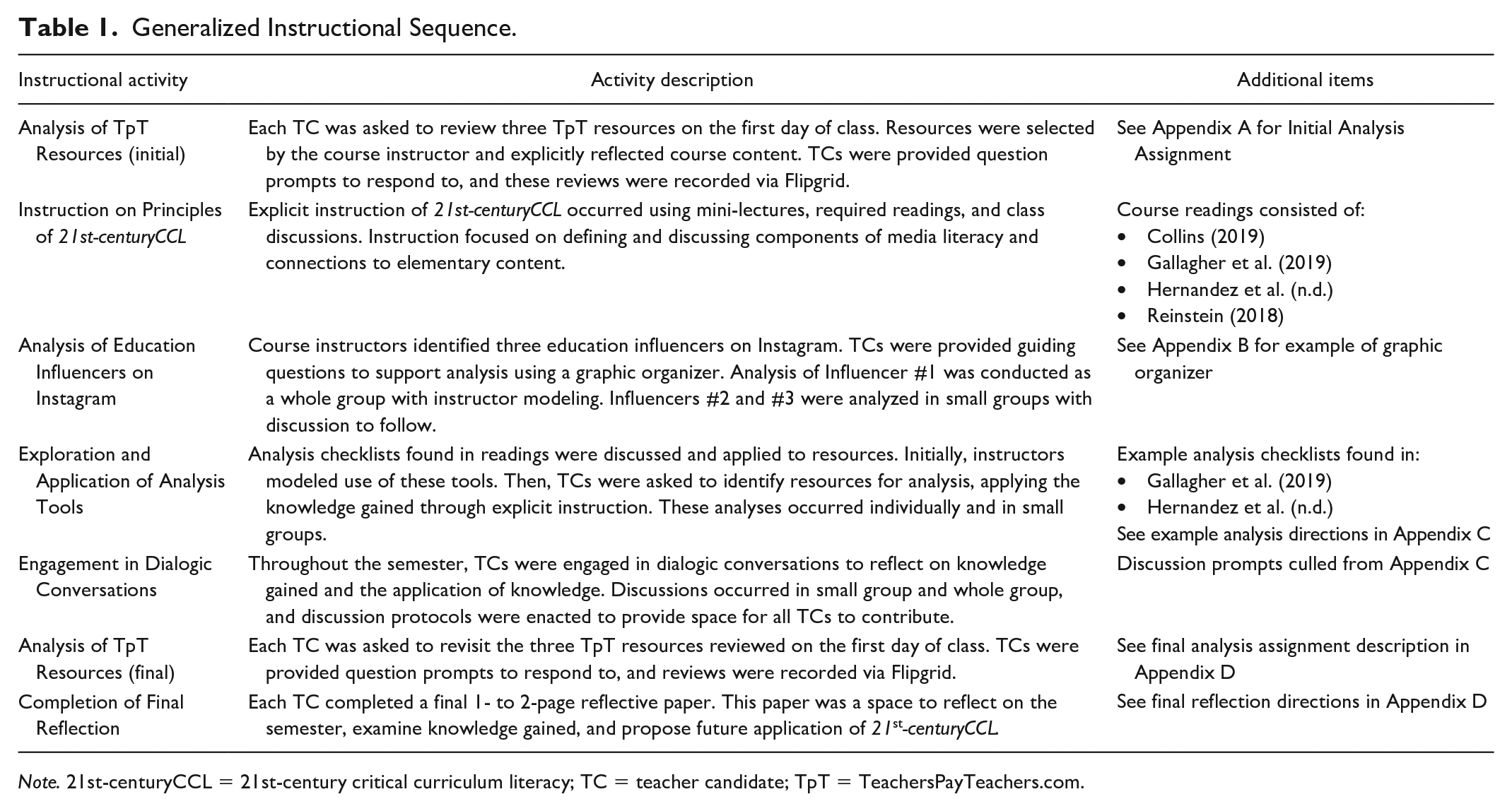
Note. 21st-centuryCCL = 21st-century critical curriculum literacy; TC = teacher candidate; TpT = TeachersPayTeachers.com.
Data Collection
Our findings are culled from the following data sources: (a) TCs’ initial analysis of the three TpT resources chosen by the instructor at the outset of the course. These analyses were recorded as videos on Flipgrid, which we transcribed. (b) TCs’ final resource analysis, also recorded on Flipgrid and transcribed, and (c) TCs’ final reflective papers.
Initial and final resource analysis data were collected on the first and last days of each author’s methods course. During these class sessions, TCs were presented assignment directions and either time to complete their pre- and post-analysis videos, or instructions to complete the assignment as homework. TCs created separate analysis videos for each resource, creating three initial and three final videos. For each video, initial and final, candidates were asked to respond to four focus questions, and for the final analysis they were also prompted to provide additional insights and critiques based on knowledge gained during the semester. In all, 24 social studies methods TCs and 20 literacy methods TCs took part in the study.
In addition to resource analysis data, we asked each TC to write a final reflective paper. Within this paper, TCs were provided the following reflective questions and were asked to cite activities and readings from class that influenced their thinking: (a) How did your review of the curriculum materials change from August to December? (b) What insights have you gained related to being a critical consumer of online resources? (c) What do teachers need to consider when choosing curricular materials? See Table 2 for more specifics on each data source.
Data Sources.
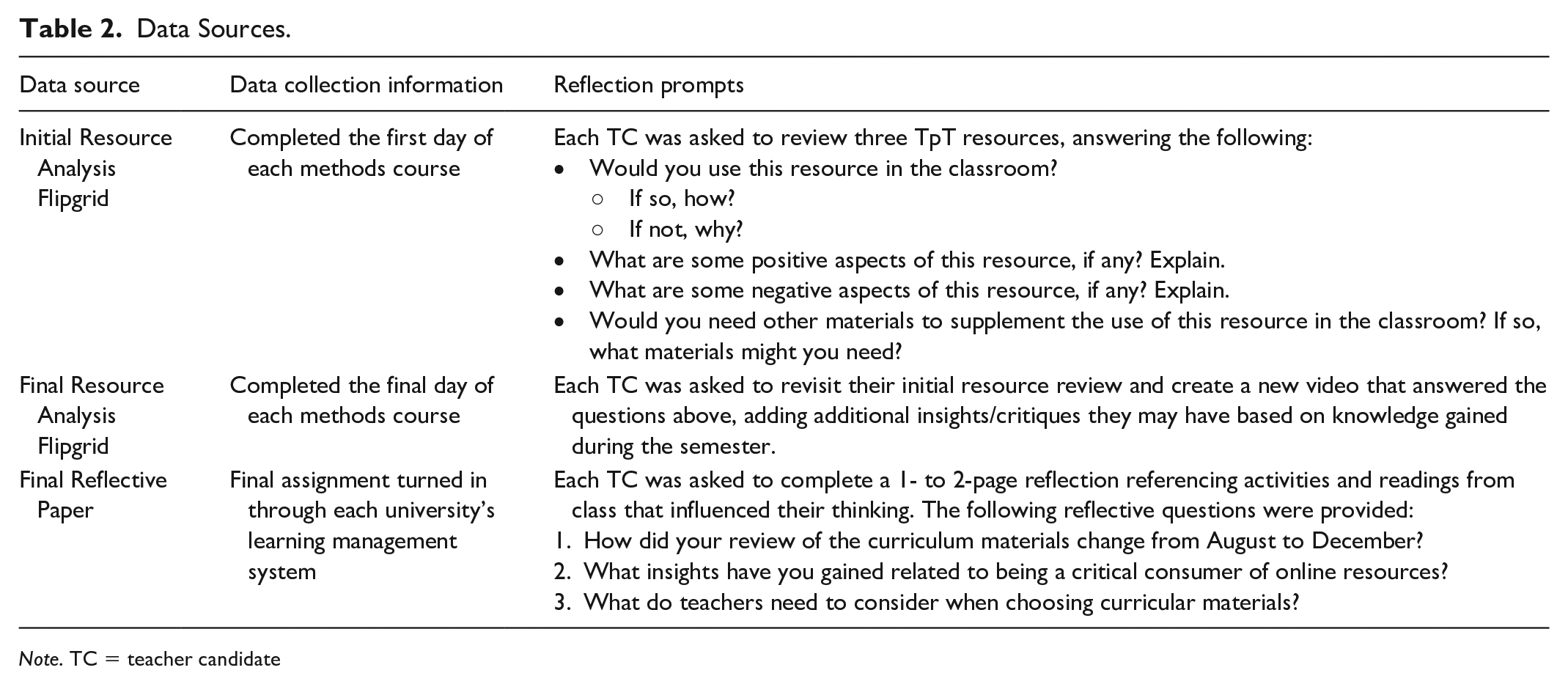
Note. TC = teacher candidate
Data Analysis
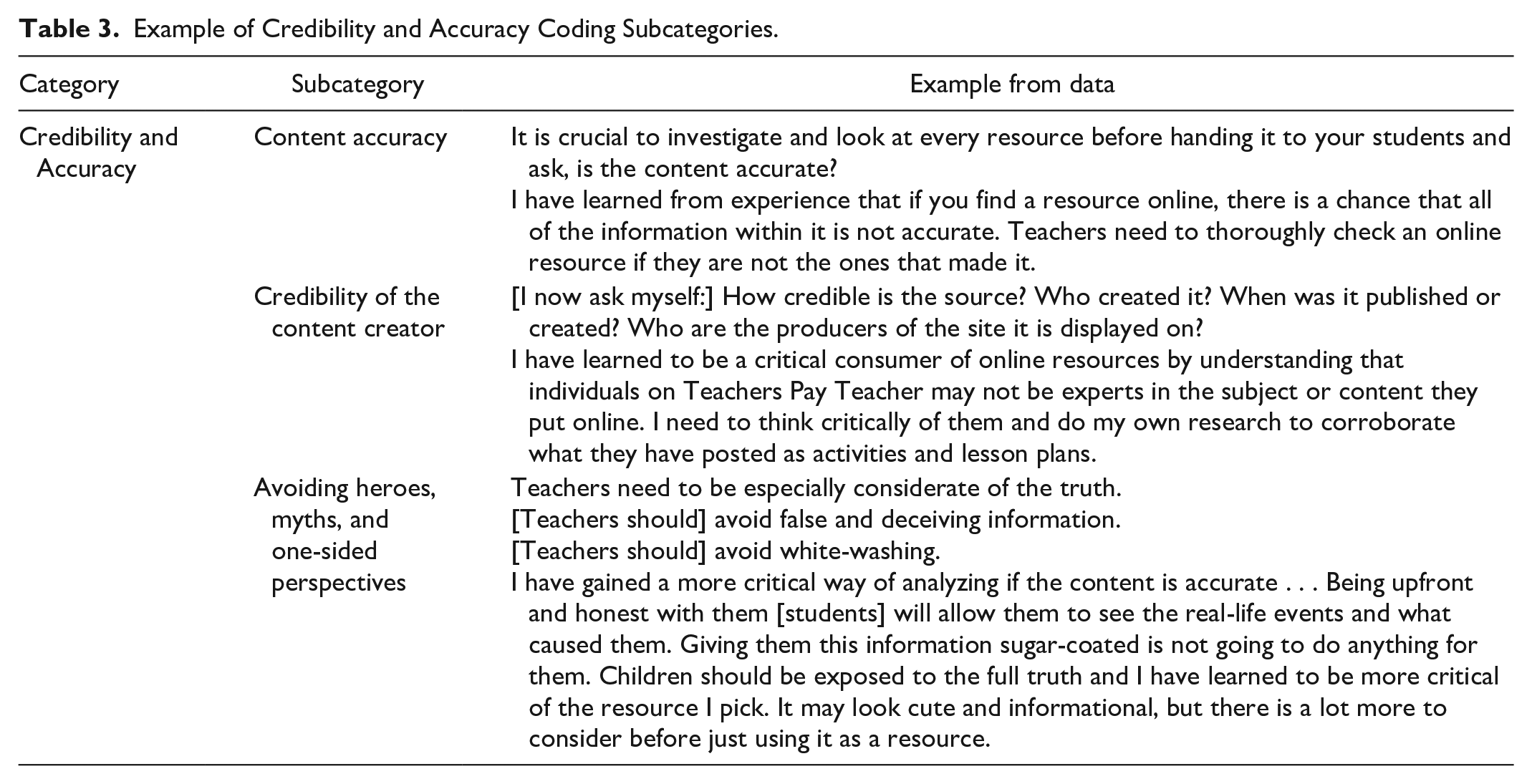
We analyzed data through a series of coding cycles, separating each data source and following an initial open coding scheme for each individual source. Initially, we conducted within-case analysis, coding the data set from each individual course (Merriam, 1998). For this process, we created tables for each individual data source (i.e., one table for reflective final papers, one table for initial analyses, and one table for final analyses) where we copied each coded data point. Next, we conducted a cross-case analysis, in which we separated the data points into two columns, one for the literacy course and one for the social studies course, as a way to engage in cross-case syntheses (Yin, 2014). We individually organized the data points into emerging categories, separating our categories by row. Together, we collaboratively engaged in a second round of coding to refine our categories and re-code as necessary. We sought through these rounds of coding to identify the ways the second analyses of resources shifted from the first, as well as the themes present in the reflections to identify the ways our instructional sequence informed TCs’ thinking about using the TOMI. This process continued iteratively through each data source and resulted in the findings we present below. An example of our coding categories can be seen in Table 3.
Example of Credibility and Accuracy Coding Subcategories.
Findings
This study asked the following research questions: In what ways do explicit instruction and practice in 21st-centuryCCL inform how TCs approach using resources found on the TOMI? We organize our findings around the four main ways TCs indicated that engaging in 21st-centuryCCL impacted their thinking when using the TOMI. First, TCs learned the importance of assessing the creator’s credibility and resource accuracy. Next, they expressed the need to focus on resources’ alignment to grade level standards and their learners’ academic needs. Third, TCs shared the importance of analyzing resources to identify cultural relevance. Finally, they acknowledged the importance of adapting resources to improve them.
Is the Author Credible? Is the Resource Accurate?
When reflecting on learning throughout the semester, TCs noted the importance of identifying content accuracy and considering the creator’s expertise. TCs recognized their responsibility in selecting “up to date” curricular materials that “portray accurate and relevant information.” TCs consistently reiterated the importance of investigating resources thoroughly to ensure representation of accurate information, as opposed to resources that present “deceiving information” that may “promote false ideas and beliefs.” As one TC shared, I have learned from this experience that if you find a resource online, there is a chance that all of the information within it is not accurate. Teachers need to thoroughly check an online resource if they are not the one that made it.
TCs recognized the “internet has a lot of false information that can be detrimental to one’s learning.” In the social studies course in particular, TCs noted the importance of identifying resources that avoided myths, heroes, and one-sided accounts of history. These TCs recognized the need to be wary of “inaccurate or glorified information” and they acknowledged the importance of critically looking for “herofication and stereotyping” when initially reviewing resources. As one social studies student stated, I have gained a more critical way of analyzing if the content is accurate . . . Giving them this information sugar-coated is not going to do anything for them. Children should be exposed to the full truth and I have learned to be more critical of the resource I pick. It may look cute and informational, but there is a lot more to consider before just using it as a resource.
Furthermore, TCs acknowledged that content creators “may not be experts in the subject or content they put online.” Thus, TCs found it crucial to critically examine and review all resources prior to implementing within their classroom: You need to look at everything thoroughly because I’ll be honest, I thought, before this class, everything on Teachers Pay Teachers was a good resource and after going through this course I have learned that this is not always the case.
Indeed, TCs learned to question the accuracy of resources, as what is posted to a website may not be of quality by virtue of being created by another teacher. Throughout their reflections, candidates stated the need to “find trusted teachers” and asked questions such as the following: Who created this? When was this created? What might the agenda be of the person posting?
In particular, when considering the credibility of a TOMI resource, one candidate wrote, I really need to think about the meaning behind what someone is posting and why [they are posting]. I need to think about if they have an agenda behind what they are posting and [I] cannot take what they have by face value.
Across both methods courses, a concern with credibility and accuracy appeared consistently.
While TOMI content producer credibility was an overt theme in both classes, TCs in the literacy methods course attended to this topic more frequently. These participants talked about how they now reviewed the TOMI with a “completely different eye” and previously had “trusted the websites too much.” Several explicitly stated the importance of checking the credibility of a resource’s creator, noting that “someone who is not a teacher or does not have experience with education” may not produce quality instructional materials. When reflecting on her growth in critically reviewing literacy materials, a TC shared the following: I never really put much thought into how I reviewed curriculum materials. I really just looked to see if it was a fun activity that related to the topic I was trying to teach. As long as the website did not look too sketchy, I thought that it was reliable. By December, I learned this is not all that I should be looking for. Source reliability is essential when examining tools to use in the classroom.
Holistically, TCs noted the importance of reviewing not only content accuracy but also the credibility of the content producer.
Does the Resource Connect to the Standards and My Learners’ Academic Needs?
TCs across both courses also emphasized the importance of aligning TOMI resources to standards, objectives, and varying student needs. Candidates asked themselves questions such as the following: How can it [the resource] be applied to the standard you are teaching? Is the resource hitting the standard you are trying to meet? Is the resource aligned with the main learning goal or standard?
Initially, TCs in both classes reviewed resources with a focus on visual formatting (i.e., is the resource cute?), perceived ease of use, and item cost. When reflecting later, TCs focused instead on whether resources authentically aligned with grade-level standards and objectives. TCs recognized that at the course outset they selected resources they “thought were cute and fun for students,” yet by the end of the course additional ways to evaluate resources. Many cited their internship placements in primary grades as influencing their original focus on cute resources, wanting to use “lots of colors and pictures to engage children.” However, after working in the internship over the semester, one TC explained that they now “go back to the second-grade standards and ask myself if this resource/activity was meeting the standard.” Instead of getting “caught up in the ‘cuteness’ of the sources,” they “now look at the content of a resource more than the appealing aspect of the resource.”
Further elaborating on their shift from cute to standards, TCs discussed how they initially sought out resources by looking at the format of the resource (i.e., flipbook or brochure). At the end of the semester, TCs claimed they sought out resources with quality content. Throughout reflections, TCs stated the importance of critically analyzing resources to distinguish between a source that “looks good and a source that teaches students targeted content.” They believed they had lacked the necessary content and pedagogical knowledge to critically analyze resources at the outset of the semester. For example, a TC in the social studies methods course stated she originally was “more critical of the format of the materials than of the content in them.” She attributed this to “the fact that I didn’t know what I know now about topics like Thanksgiving and the Civil Rights Movement.”
While discussing the need for resources to align with standards, TCs also often mentioned engagement. Candidates recognized that standards alignment alone may not be sufficient and that TOMI resources should provide “opportunities for critical engagement” that facilitate student thinking. When reflecting on student engagement, the TCs posed the following questions to guide resource analysis: Does it promote conceptual learning and variety, not just memorization? Does the resource promote higher level thinking and engagement in the classroom? Does it lead to further inquiry?
Furthermore, when reflecting on standards alignment and opportunities for student engagement, candidates also noted the role of differentiation. The importance of attending to “individual student needs and learning goals” was a common concept TCs reflected upon, and when reviewing resources candidates wondered, “Is there room for differentiation?” TCs recognized that “to obtain a standard I have to differentiate.” Another explained, “I learned over this semester to always make activities and lessons differentiated . . . so I need to make sure the resources being used in the classroom can be differentiated for students.”
TCs also shared their concern with looking at all aspects of a resource by the close of the semester, particularly the hidden curriculum. Throughout reflections, they noted the need to be mindful and aware of the “indirect or hidden messages that resources might be presenting to students.” In particular, candidates in the social studies methods course expressed the importance of reviewing the direct and indirect messages communicated through a resource. One social studies student reflected, “Sometimes, not teaching something is still teaching something . . . sometimes the unspoken or underlying ideas . . . are the ones that stand out the most. It is important to consider both the obvious and the underlying lessons we are teaching.”
In sum, TCs’ perspectives shifted from a focus on cute resources to realizing that the content, validity, and alignment of the materials “is what is most important” when seeking ideas and resources. In addition, candidates recognized that explicit instruction in class informed them on how to “carefully identify and select resources that are adequate, holistic, and truthful.”
Is the Resource Culturally Relevant?
TCs identified the importance of considering individual classroom contexts when analyzing items from the TOMI. Yet they also extended their analysis beyond just meeting student needs. Candidates consistently expressed that they must identify whether the TOMI resource would be beneficial for their students, ensuring the resources will “do no harm,” are culturally relevant, and represent diverse perspectives. When considering how TOMI resources may connect to their classroom contexts, candidates posed questions such as the following to guide their thinking: Does this relate to my students? What would this look like in MY classroom? Does the resource connect to students’ lived experiences and represent their community? Does it give my students windows into new cultures or contexts?
TCs noted the importance of knowing the cultures and backgrounds of all students within their class and applied this knowledge toward resource analysis. They noted the need to consider student identities and representation of these identities within a resource. As one TC shared, “If students cannot relate to what we are teaching them, then we are not recognizing them and giving them the voice that we should.” In addition, candidates expressed that they should thoroughly analyze all resources to identify how it might be perceived “by students who have different backgrounds than they do” and how resources “may be perceived by any student of any background.”
When reflecting, TCs also focused on the importance of providing students multiple perspectives. TCs reflected upon the importance of identifying who or what is represented within a resource, and more importantly, who or what is excluded. One candidate stated, “I need to ask myself, what lifestyles, values and points of view are represented in or omitted from this message?” TCs also referenced the need for resources to serve as mirrors, windows, and sliding glass doors (Sims Bishop, 1990), as one stated, “I had never considered that resources should allow students to explore their own, and new, identities and viewpoints. When looking for activities they should illustrate to students both shared and new perspectives.” Similarly, when sharing their learning related to social studies resource analysis, a student expressed, “An insight I have gained related to being a critical consumer of online resources is that a negative aspect of this resource is that it lacks windows into other cultures or contexts.” Across both classes, TCs wondered in final reflections about a resource’s ability to not only provide a culturally relevant mirror but to also “give students windows into new cultures and contexts.”
How Can the Resource Be Adapted and Improved?
Another theme prevalent across both classes was TCs’ recognition of the need to edit, revise, omit, and add to TOMI resources, as opposed to simply using them as posted. TCs’ reflections and post-analyses showed their commitment to adapting and improving resources to better align with students’ needs, as well as grade-level standards and content. Specifically, candidates wondered the following: Are there ways to supplement the resource with other materials? Can the resource be accommodated or adapted? How might I add other perspectives?
Analysis of final reflections showed significant growth in candidates’ knowledge of why resources should be adapted and how to consider designing resource adaptations. TCs explicitly communicated the need to add read alouds and mentor texts to support student learning, use primary and secondary sources within social studies instruction, identify additional tools to share multiple perspectives, and the importance of knowing when to omit extraneous, confusing, or inaccurate information. For example, one TC shared, “After really delving into how to choose resources, I realize now that you just can’t type any kind of lesson into Google, Pinterest, or TpT and use whatever comes up exactly how it is written . . . I have to adapt.”
TCs also grappled with what actually constitutes a “good” resource. Noting that they should apply a critical lens and inquire on adaptations for any explored resource, TCs shared sentiments such as “What determines a good resource? Can you adapt it and change it to make it relevant to the educational components of what you are trying to teach? Then, it is a good resource.” In addition, they expressed that they “learned it is okay, and almost always necessary, to take parts of a resource, activity, or idea found online and tailor to fit the needs of your students.” Another TC reflected that “not everything we find online is perfect and need[s] to be edited for further knowledge and educational value,” requiring that they continue learning themselves.
Discussion and Implications
Our findings indicate that explicitly teaching about the TOMI, including ways to critically interrogate the TOMI, did enhance the ways TCs viewed curriculum resources found on those sites. We expected to see this result, considering the time spent on these activities. Yet we were unsure of how the generalized instructional sequence and other course activities would impact TCs. We found, specifically, that TCs were better able to look beyond “cute” materials that appeared engaging and interactive at first glance. They were also able to identify poor pedagogical practices and content inaccuracies in those resources, particularly if they had been taught about the specific content during the course. They could articulate that teachers need to look “behind the resource” to ascertain the content creator’s credibility, as well as how resources would meet the standards and objectives of their lessons. They focused heavily on cultural relevance and the need to avoid myth-making and misconception. Importantly, they were adept at suggesting adaptations that would correct some of the problematic aspects of the resources. Finally, through their reflections, they realized that professional learning can take place online in an ongoing manner.
Given the ecological nature of learning, and the variety of other learning experiences TCs engaged in over the semester including other coursework and student teaching internships, we cannot claim that the findings we have identified are the direct result of the generalized instructional sequence, nor is that the goal of a study inspired by self-study methodology. In their reflections and analyses, TCs cited other elements of coursework that helped them more ably critique the TOMI, including lessons on culturally relevant pedagogy, anti-bias education, and specific course readings and activities that occurred normally in our classes. However, providing TCs the time and space to apply their content-specific learning through the generalized instructional sequence enhanced their analysis of TOMI materials over the course of the semester. TCs across the two methods courses enhanced their analysis of the TpT resources, suggesting that the generalized instructional sequence may be useful across methods courses and not specifically in social studies or literacy courses. Indeed, at least one TC reflected that she wished “all of our courses had a crash course on critically analyzing courses online for that particular subject.” We see three main points from these findings as deserving additional discussion.
The Need for Explicit Content Instruction
Perhaps because TCs cited other course learning in their analysis, we believe that a generalized instructional sequence is necessary but not sufficient. No single checklist or isolated activity will be sufficient to effectively guide TCs through critically analyzing the TOMI. Indeed, we taught content related to five of the six materials TCs analyzed in the pre- and post-assessment. The sixth, the American symbols lesson, was not a focus of guided analysis or additional content-related readings. Notably, the only resource that social studies TCs did not become more critical of was the American symbols lapbook, which suggests to us that there is a need for the simultaneous development of critical content knowledge with 21st-centuryCCL skills. Rodríguez et al.’s (2020) recent research, which was published after the conclusion of our study, also points to this need for simultaneous critical content knowledge development.
Infusing Critical Perspectives on Social Media Into Teacher Education
In addition, while we believe the Pinning with Pause checklist and other similar tools are powerful and helpful, these checklists do not engage teachers in a deep analysis of the ways in which Instagram and TpT are monetized, branded, and otherwise imbued with a consumerist ideology (Koehler et al., 2020; Krutka et al., 2020; Rodríguez et al., 2020; Shelton et al., 2020). Rodríguez et al. (2020) note that before engaging in the analysis of TpT resources, “a conversation around the problematics of for-profit platforms and the unique relationship between Teachers Pay Teachers and Pinterest (in particular, Pinterest as a marketing tool for Teachers Pay Teachers) must be explored” (p. 518). We believe this is a critical component of the generalized instructional sequence we created, as it enables TCs to understand the larger ecosystem of the TOMI. Without understanding how consumerism and capitalism drive the TOMI content creation, TCs are left with only the products of this capitalistic system to analyze, not the complex and problematic system itself. Indeed, as Sandlin et al. (2012) argue, “Given the omnipresence of consumption in our lives, it seems currently impossible to understand education in its broadest articulations ‘without a conception of the part played by consumption’ (Usher et al., 1997, p. 18)” (pp. 142–143). Understanding that profit is a motivating factor for TOMI content creators can help TCs see why some messages gain traction and others do not.
Embracing Teachers as Curriculum Makers
The findings of this study also indicated that TCs focused heavily on cultural relevance, the avoidance of myth-making and heroification, and the need to adapt resources for their classroom and learners. They were able to bring the content and pedagogical knowledge they gained over the semester to their analysis of resources, suggesting adaptations to resources that could be salvaged. TCs saw value in certain aspects of resources they analyzed: perhaps the format of the activity or an idea the resource sparked. As a result, they suggested ways to use the positive components of a resource within a larger lesson or unit sequence, often with different content applied to the teaching strategy or activity. This agency to adapt curriculum aligns with the notion of teachers as curriculum makers, “the view of teachers as knowing and knowledgeable human beings” (Craig & Ross, 2008, p. 283). To merely tell TCs they should not use the TOMI denies them agency, their role as curriculum makers, and further deprofessionalizes the teaching force. If we in teacher education believe teachers are not technicians (Giroux, 1985), we should work to equip them to curate, remix, revise, reject, or create, making sure to keep “professional expertise and judgement . . . buffered against pedagogical licentiousness” (Grimmett & Chinnery, 2009, p. 134). In other words, we should educate TCs who hold a “serious commitment to learning-centered professional responsibility” and are “able to articulate and defend the grounds on which their curriculum decisions and choices are based” (p. 134). Teaching is an “intellectual labor,” and if teacher educators believe “teachers must take active responsibility for raising serious questions about what they teach, how they are to teach, and what the larger goals are for which they are striving” (Giroux, 1985, p. 378), then we must frame our instruction around our desire to educate transformative intellectuals. This includes how we speak and educate about the TOMI. Importantly, it moves 21st-centuryCCL beyond merely curricular materials and into the more symbolic realm, wherein the classroom and everything that takes place within it become curriculum.
Our findings suggest to us that TCs are capable of curriculum making that is culturally relevant, inclusive of multiple perspectives, and devoid of misconceptions if they are given the opportunity to learn the necessary content and skills to do this work. Crucially, they must be able to apply that content and skill-set to curriculum making with guided feedback and scaffolding. The generalized instructional sequence we designed supported this endeavor and aligns with Sawyer et al.’s (2020) encouragement that teacher educators support “PSTs to become critical consumers” as it is a “step toward fostering an accepting environment and one that sanctions this professional use and adaptation of found online sources” (p. 17). Many of our participants indicated they see their analysis of resources online as an ongoing endeavor, in which they must continually educate themselves on the specific content they intend to teach to students. Their commitment to ongoing professional learning aligns with more agentic visions of teachers as inquirers (Cochran-Smith & Lytle, 2009) and curriculum makers, and we are encouraged to see that TCs acknowledge “the importance of educating ourselves so we can properly educate our students” as a result of engaging in this instructional sequence.
Implications
Revising the instructional sequence
We see implications of our findings as having two trajectories—for the revision of our instructional sequence and for future research endeavors. Taking into account our TCs’ learning, we see a need to add in additional opportunities for TCs to explore content independently. Teachers do not have teacher educators continually curating content for them to learn as they proceed through their careers—they must do this themselves. It is essential then, if content knowledge is essential to 21st-centuryCCL, that we equip TCs with the abilities to research content in our subject areas. In addition, given the importance of teachers being able to adapt found resources, we see the need to provide scaffolding and guidance when using TOMI resources within the scope of longer lessons and units and embedded within the real life of a classroom. We plan to integrate the use of TOMI resources in lesson plan or unit plan assignments to support TCs’ abilities to design coherent curriculum that goes beyond merely critiquing one or two curricular materials. Giving TCs time to put their plans into action, whether it be with K-12 students or microteaching in methods classes, can enhance TCs’ ability to identify coherent materials, and we plan to implement this as well. Of course, teacher learning does not stop in teacher education programs. We hope that school-based administrators and professional development experts support teachers as they engage in sustained, long-term practice integrating a variety of curricular materials into their curriculum, particularly as new literacies develop and change.
Future research
In terms of future research, we are curious to know how TCs in this study bring their 21st-centuryCCL skills into the profession. Now early career teachers, we question how they might use the TOMI, particularly when remote teaching due to the COVID-19 pandemic. We also must consider newly passed legislation banning the teaching of divisive topics or “critical race theory.” With our ever-changing political environment, teachers and teacher educators must be mindful of evolving legislation and the political context they are preparing TCs to teach within. As a result, we are continuing to think about how that preparation might fit within this framework or if it is a separate but essential issue that teacher education programs must deal with on a larger scale. We believe it is the latter, but we are interested in knowing how teachers use the TOMI in states and districts hostile to social justice instruction. Relatedly, we urge teacher education programs to develop coherent, integrated, and critical instruction for TOMI use across methods courses. What might be the impact of a united effort to develop curriculum literacy skills in TCs that take into account their sources of inspiration when lesson planning (Sawyer et al., 2020)? More research into how skilled teachers and teachers who teach explicitly for social justice use the TOMI is also needed, as this information could help teacher educators more effectively plan instruction. Finally, as we continue to employ self-study methodology in our classrooms to refine our instructional sequence and framework of 21st-centuryCCL, we will continue to research its impacts to share with the wider scholarly community.
Conclusion
Although Torphy and Drake (2019) argue that a number of factors contribute to “teacher educators’ hesitation to focus on pre-service teachers’ engagement with social networks,” including their constant evolution, “uneven” resource quality, and “lack of clarity about generative ways in which teachers might engage social networks” (p. 6), we contend that the TOMI, including social media and other social networking sites, is not going away. Thus, teacher education programs must acknowledge this reality and prepare TCs for it, particularly with a lens toward justice. Therefore, instructional sequences like the one described in this study provide a foundation for teacher educators to adapt, improve, and create similar instructional opportunities tailored to their particular contexts and content. Frameworks of this nature provide a space to prepare TCs while also helping to provide the clarity and support teacher educators may need to authentically engage their students with social networks (Torphy & Drake, 2019). As opposed to dissuading our TCs from using the TOMI, teacher educators should embrace the cultivation of TCs’ 21st-centuryCCL. Explicit instruction in 21st-centuryCCL prepares candidates for diverse classroom contexts while also honoring educators as professionals who are provided with the tools to think like intellectuals, capable of critique and reimagining curricular resources of all kinds.
Footnotes
Appendix A
Appendix B
Developing 21st-Century Critical Curriculum Literacy: Analyzing Teacher Influencers.
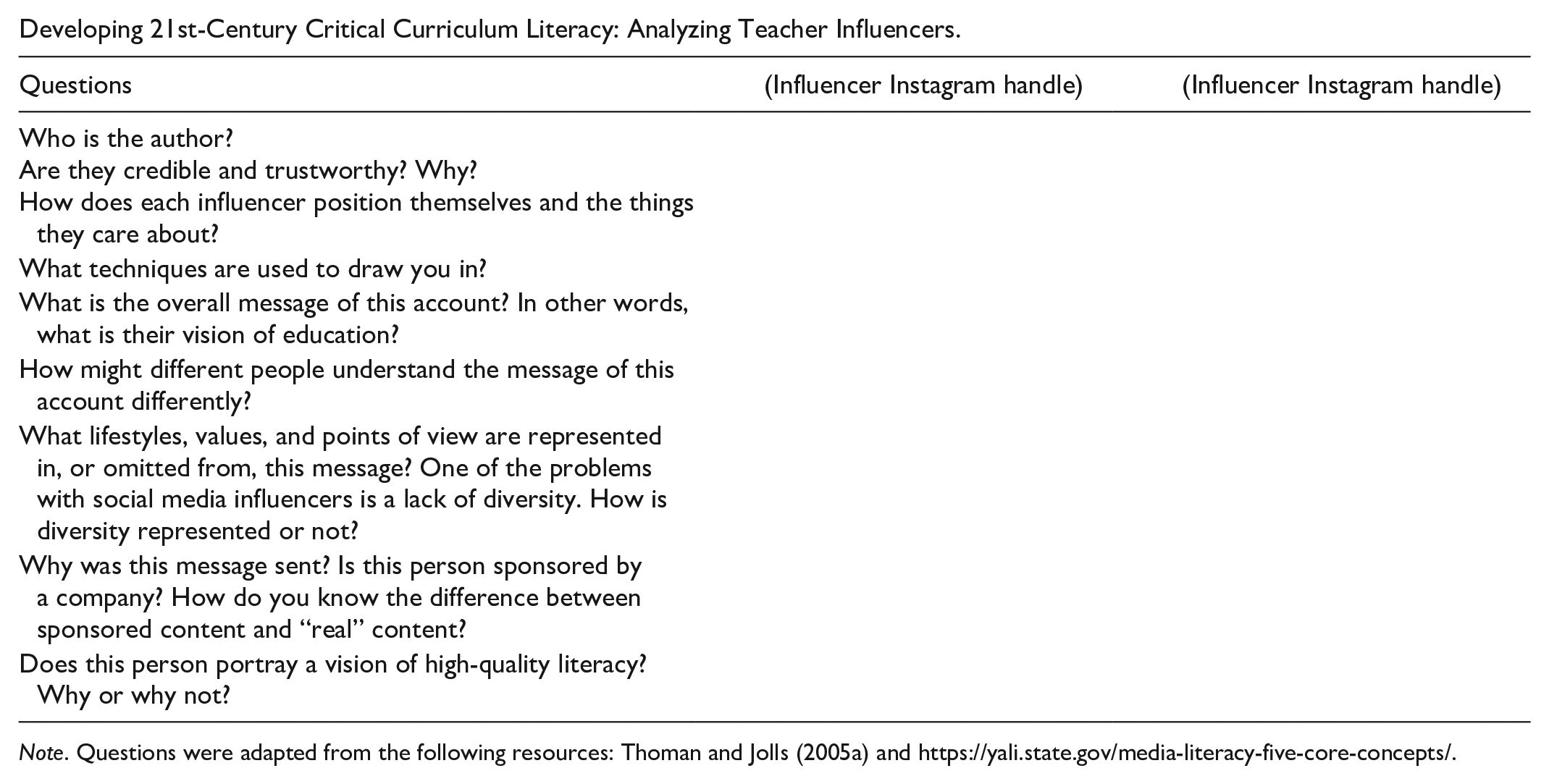
| Questions | (Influencer Instagram handle) | (Influencer Instagram handle) |
|---|---|---|
| Who is the author? Are they credible and trustworthy? Why? How does each influencer position themselves and the things they care about? |
||
| What techniques are used to draw you in? | ||
| What is the overall message of this account? In other words, what is their vision of education? | ||
| How might different people understand the message of this account differently? | ||
| What lifestyles, values, and points of view are represented in, or omitted from, this message? One of the problems with social media influencers is a lack of diversity. How is diversity represented or not? | ||
| Why was this message sent? Is this person sponsored by a company? How do you know the difference between sponsored content and “real” content? | ||
| Does this person portray a vision of high-quality literacy? Why or why not? |
Note. Questions were adapted from the following resources: Thoman and Jolls (2005a) and https://yali.state.gov/media-literacy-five-core-concepts/.
Appendix C
Appendix D
Declaration of Conflicting Interests
The author(s) declared no potential conflicts of interest with respect to the research, authorship, and/or publication of this article.
Funding
The author(s) received no financial support for the research, authorship, and/or publication of this article.
